Copyright©2013 by The American Society of Tropical Medicine and Hygiene
Plasmodium vivax
Isolates from Cambodia and Thailand Show High Genetic Complexity
and Distinct Patterns of
P. vivax
Multidrug Resistance Gene 1 (pvmdr1) Polymorphisms
Jessica T. Lin,*Jaymin C. Patel, Oksana Kharabora, Jetsumon Sattabongkot, Sinuon Muth, Ratawan Ubalee, Anthony L. Schuster, William O. Rogers, Chansuda Wongsrichanalai, and Jonathan J. Juliano
Division of Infectious Diseases, University of North Carolina School of Medicine, Chapel Hill, North Carolina; Department of Epidemiology, Gillings School of Public Health, University of North Carolina, Chapel Hill, North Carolina; Department of Entomology,
USAMC Armed Forces Research Institute of Medical Sciences, Bangkok, Thailand; National Malaria Center,
Phnom Penh, Cambodia; Naval Medical Research Unit#2, Phnom Penh, Cambodia
Abstract. Plasmodium vivaxaccounts for an increasing fraction of malaria infections in Thailand and Cambodia. We comparedP. vivaxgenetic complexity and antimalarial resistance patterns in the two countries. Use of a heteroduplex tracking assay targeting the merozoite surface protein 1 gene revealed that vivax infections in both countries are frequently polyclonal (84%), with parasites that are highly diverse (HE=0.86) but closely related (GST=0.18). Following
a history of different drug policies in Thailand and Cambodia, distinct patterns of antimalarial resistance have emerged: most Cambodian isolates harbor theP. vivax multidrug resistance gene 1 (pvmdr1) 976F mutation associated with chloroquine resistance (89% versus 8%,P<0.001), whereas Thai isolates more often display increasedpvmdr1copy number (39% versus 4%,P<0.001). Finally, genotyping of paired isolates from individuals suspected of suffering relapse supports a complex scheme of relapse whereby recurrence of multiple identical variants is sometimes accompanied by the appearance of novel variants.
INTRODUCTION
Plasmodium vivax accounts for an increasing fraction of malaria cases in Thailand and Cambodia.1–3It is now recog-nized thatP. vivaxposes a greater challenge to malaria elim-ination in the region, largely caused by its propensity for relapse.4,5Little is known about the transmission dynamics of vivax parasites in Southeast Asia and their evolving drug resistance patterns. Molecular tools can provide insights into these processes by evaluating the diversity of parasites and assessing for polymorphisms correlated with drug resistance. They also have the potential to identify genotypic patterns of relapsing parasites.6These data can provide a framework for monitoring control efforts and informing interventions targeted at elimination.
The interplay between malaria genetic diversity, multiplic-ity of infection (MOI), and emergence of drug resistance is complex. The MOI is the number of parasite clones found simultaneously within a host, a measure of within-host genetic complexity. While parasite diversity on a population scale allows for resistant parasite populations to expand under drug pressure, in-host diversity impacts the development of drug resistance by affecting sexual recombination rates and allowing competitive suppression among co-infecting drug-resistant and drug-sensitive clones.7,8
Previous studies have shown high genetic diversity but lim-ited MOI among P. vivax infections in Southeast Asia.9–12 However, the genotyping methods used in these studies are often limited in their ability to detect minority clones, leading to an underestimation of MOI.8 The heteroduplex tracking assay (HTA) is a genotyping technique that has proven adept at uncovering minority variants within malaria infections and in infections with other agents.13–16Thus, it provides a more accurate picture of within-host genetic diversity.17It also
facil-itates the tracking of clones within hosts over time, potentially providing a nuanced portrait of relapsing vivax populations.18
Additionally, there is concern for emerging chloroquine-resistant vivax in Southeast Asia; however, reports concern-ing putative vivax drug resistance genes remain limited. Studies ofP. vivaxmultidrug resistance gene 1 (pvmdr1), the vivax analogue to the multidrug resistance gene found inP. falciparum, have linked a polymorphism (Y976F) in this gene to chloro-quine resistance, whereas an increased copy number of the gene is associated with increased susceptibility to chloroquine and reduced susceptibility to mefloquine, amodiaquine, and artesunatein vitro.19–22Variable prevalence of mutant single nucleotide polymorphisms (SNPs) and copy number increases inpvmdr1have been reported from Thailand, however little comparative data has been published from Cambodia.19,21–26 Because this region has played an important role in the evo-lution of drug-resistant falciparum malaria, a better under-standing of the distribution of vivax drug resistance alleles in the parasite populations is needed.
In this report, we use an HTA and nested polymerase chain reaction (nPCR) assay forP. vivaxmerozoite surface protein 1 (pvmsp1), a real-time PCR assay forpvmdr1copy number, andpvmdr1 sequencing on parasite isolates from Thailand and Cambodia to determine: 1) the relative genetic diver-sity and multiplicity of infection of P. vivax infections in these regions, 2) differences in the patterns of molecular markers of antimalarial resistance between the two countries, and 3) genotype patterns of paired initial and recurrent vivax infections in Cambodia. Together, these data provide a com-parative view of drug resistance patterns and the genetic fac-tors that may shape the future development of drug resistance in these areas.
MATERIALS AND METHODS
Patient samples.Filter paper blood spots from vivax patients were acquired from clinical studies carried out in northwest-ern Thailand and southnorthwest-ern Cambodia. Vivax malaria cases occur throughout the year in both locales, but most cases
*Address correspondence to Jessica T. Lin, Division of Infectious Diseases, University of North Carolina School of Medicine, 130 Mason Farm Road, Suite 2115 CB 7030, Chapel Hill, NC 27599. E-mail: [email protected]
occur during the rainy season. Thai samples (N=50) were collected from patients presenting to public health clinics in the Mae Sod district of Tak Province between February and June 2009. Cambodian samples were collected between August 2006 and December 2007 as part of a chloroquine treatment trial at the Chumkiri health center in Kampot Province.27 Details of the study have previously been published. Anti-relapse therapy with primaquine was not given. One hundred and ten (110) subjects were enrolled, 45 of whom developed recurrent infection within the 42-day follow-up. One hundred and nine (109) enrollment isolates and 44 recurrent isolates were available for study.
Ethics statement. Written informed consent was obtained from all participants, with approval from the ethics commit-tees of Walter Reed Army Institute of Research, the Naval Medical Research Unit 2 (Jakarta, Indonesia), the Ministry of Public Health in Thailand (Bangkok, Thailand), the National Ethics Committee for Health Research (Phnom Penh, Cambodia), and the University of North Carolina.
HTA tracking assay and nPCR of pvmsp1. The strategy used to develop thepvmsp1HTA was based on that previ-ously used to develop HTAs forPlasmodium falciparum.13,17 Four radiolabeled probes targeting 500 bp of interspecies con-served blocks (ICB) 5&6 of thePvmsp1gene and the variable region in between were developed—two based on P. vivax strains found in the MR4 repository (Nicaragua, Pakchong), and two generated from Thai clinical samples (Th04, Th06). The PCR products amplified using the primers and conditions listed in Table 1 were blunt-end cloned into the pT7Blue vector (Novagen, Inc., Madison, WI) and sequenced to con-firmpvmsp1insertion. Ten micrograms (10mg) of eachpvmsp1 ICB5-6 pT7Blue construct was then digested, end-labeled, and digested again to release the35S-labeled probes as previ-ously described. Heteroduplexes containing35S-labeled probe and 8mL of PCR-amplified ICB5-6 ofPvmsp1from patient samples were formed in annealing reactions and separated by electrophoresis on a 6% polyacrylamide gel, and then exposed to BioMax MR x-ray film (Eastman Kodak, Rochester, NY) for 24–72 hours at room temperature.
The HTA bands were considered uniquepvmsp1sequence variants if they were not in the single-stranded probe or probe homoduplex lanes (Figure 1A). Because all four probes were able to distinguish multiple minority variants in the clin-ical samples, the Nicaragua probe (NIC) (GenBank accession
no. JN674534) was chosen for application of the HTA to the study samples, as it was expected to contain the sequence that was the most different from the Thai/Cambodian samples. Supplemental Figure 1 provides a comparison of thepvmsp1 ICB5-6 probe sequence to the Sal1 and Belem strains and several Thai sequences from GenBank.
A previously published nPCR assay targeting ~700 bp of the same ICB5-6 region was selected as a comparison assay for measuring MOI.29,30The assay was carried out as previ-ously described using Hotstar master mix (Qiagen, Valencia, CA), 800 nM of the forward and reverse primers, and 2mL of parasite DNA in each reaction. The PCR products were run on a 1.8% agarose gel with the presence of mixed genotypes determined by size polymorphisms (Figure 1B and C). Ran-domly selected products were also run on a 3.0% agarose gel but did not result in a greater number of distinguished bands per sample. Plasmid DNA containing the clonedPvmsp1 frag-ment of the Nicaragua strain (cat. MRA-340; MR4, Manassas, VA) was used as a positive control for all assays.
Measuring MOI and genetic diversity. The MOI was defined as the number of genotypic clones detected per patient isolate by counting either the number of size variants detected by nPCR or the number of sequence variants detected by HTA (Figure 1). The MOI was determined by both assays on all enrollment samples (Thai [N=50] and Cambodian [N= 109]). To distinguish allelic variants in the HTA, the distance migrated by eachpvmsp1variant was measured and assigned a relative migration index (Rf). The Rf units were divided
among 20 bins of 0.05Rfunits, a method that has previously
been validated.17When more than one band fell within the same bin, they were assigned the sameRf. Allele frequencies
were calculated as the prevalence of a clone with a uniqueRf
among the total number of clones within each geographical cohort. The genetic diversity within each population was esti-mated by calculating the virtual heterozygosity (HE).8In this
context, HE gives the average probability that two clones
taken at random from the population are different. The genetic divergence between populations was estimated by calculating Nei’s genetic distance (similar to the fixation index or FST) using Genetic analysis in Excel (GenAlEx) software v6.1.31,32 Recurrent isolates were not included in these calculations to avoid sampling bias.
Real-time PCR forPvmdr1copy number.A novel multi-plex Taqman assay was developed to estimate pvmdr1copy
Table1
Primers and probe sequences used in the heteroduplex tracking assay (HTA) andPvmdr1assays
Genetic marker Primer/probe sequence Amplification program
Pvmsp1
HTA forward* 5¢-GATGGTCCTCAAAAGGGAAA 95°C +15¢; 35 cycles of
HTA reverse* 5¢-GACATGCGTAAGCGGATTTT 94°C +1¢, 55°C +2¢, and 72°C +2¢; 72°C +5¢
Pv aldolase
Forward 5¢-GACAGTGCCACCATCCTTACC
Reverse 5¢-CCTTCTCAACATTCTCCTTCTTTCC
Probe 5¢-VIC-ATTCCATCAATGCGTTAGGC-MGB
Pvmdr1
Copy number forward 5¢-CGATTGAAGATTCCGAAGTTG 50°C +2¢; 95°C +10¢; 40
Copy number reverse 5¢-TTAGAACCCACCAGCGTTTC cycles of 95°C +15²and
Copy number probe 5¢-6FAM-GAAGGTGCTGATCCACGATT-MGB 60°C +1¢
Sequencing forward 5¢-ATAGTCATGCCCCAGGATTG 95°C +15¢; 35 cycles of
Sequencing reverse 5¢-CCTTTCGAAGGACAGCTTTG 95°C +15², 55°C +30²,
and 72°C +1¢; 72°C +10¢
*Primers modified from Maestre and others.28
number usingP. vivaxaldolase (Pv aldolase) as the reference gene. Aldolase primers were previously described.19The other primers and probes were designed with Primer Express Soft-ware v3.0 (Applied Biosystems, Foster City, CA) (Table 1). Real-time PCR was performed on an ABI 7300 Real-Time PCR system (Applied Biosystems) in duplicate 20 mL reac-tions containing Roche FastStart Universal Probe Master mix, 800 nM ofpvmdr1forward and reverse primers, 400 nM ofpvaldolase forward and reverse primers, 100 nM of each probe, and 2 mL of parasite DNA, with cycling conditions listed in Table 1. Plasmids containing the cloned fragments of pvmdr1 andpvaldolase, developed using the TOPO XL PCR Cloning Kit (Invitrogen, Carlsbad, CA), were used as positive controls in every experiment. Threshold cycle (Ct) values were exported and analyzed in Microsoft Excel using the Pfaffl method to determine copy number.33Copy number was determined by rounding to the nearest integer and was considered increased if>1.
Sequencing for Pvmdr1 mutant SNPs. Primers were designed to amplify a 647 bp region of the pvmdr1 gene containing the Y976F SNP and the F1076L SNP (Table 1). The PCR amplification was carried out in 50 mL reactions containing 5mL of 10
+
PCR buffer, 20mM of forward and reverse primers, of 0.2 mM dNTP, 0.25mL of Qiagen Hotstar taq, and 5mL of parasite DNA with cycling conditions listed in Table 1. The amplified products were directly sequenced by Eton Bioscience, Inc. (Research Triangle Park, NC) (GenBank accession nos.: JQ925719–JQ925865).Statistical analysis. Median MOI was compared between the two Pvmsp1genotyping assays (HTA and nPCR) using the Wilcoxon rank-sum test. Possible associations between MOI and clinical features including age, gender, baseline parasitemia, parasite clearance time in days, and pvmdr1 copy number were investigated using the Wilcoxon rank-sum test or linear regression as appropriate. The proportion of
samples harboring increased pvmdr1 copy number or the Y976F and F1076L mutations were compared between the Thai and Cambodian study populations using the Pearsonc2 or Fisher’s exact tests. Genotypes of initial and recurrent iso-lates were compared for relatedness, and for MOI andpvmdr1 copy number status using pairedt tests. Statistical analysis was done using STATA v.12.0 (STATA Corp, College Station, TX).
RESULTS
Multiplicity of infection.Compared with nPCR, the HTA detected more polyclonal infections, revealing a high multi-plicity of infection in both Thailand and Cambodia (Figure 1). Of the 47 Thai isolates that successfully amplified in both assays, 39 (83%) displayed multiple clones by HTA, whereas only 6 (13%) displayed more than one size polymorphism by nPCR Figure 2A, Table 2. Similarly, among the Cambodian enrollment isolates, 92 (84%) were multiclonal by HTA ver-sus 27 (25%) by nPCR (Figure 2B). The HTA detected up to 7 clones within single individuals, whereas nPCR very rarely detected more than 2 clones (only 1 of 156 isolates had 3 var-iants). The mean MOIs for the Thai and Cambodian samples as determined by HTA were very similar: 3.0 and 2.9, respec-tively, with a combined mean MOI of 2.9 (interquartile range [IQR] 2–4). Among the Cambodian trial participants, no association was found between MOI at enrollment and age, gender, baseline parasitemia, parasite clearance time, orpvmdr1 copy number.
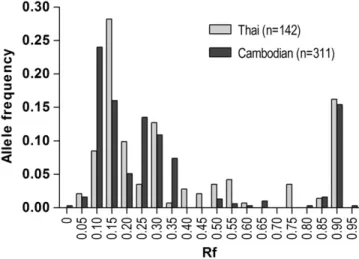
Thai clones, whereas six common variants accounted for 87% of Cambodian clones. The distribution of alleles appeared sim-ilar between the two regions. Individual allele frequencies ranged from 0.2% (occurring once) to 28%. Based on these allele frequencies,HEat thepvmsp1locus was 0.86 in Thailand
and 0.86 in Cambodia, whereas Nei’s genetic distance between the two populations was 0.18.
Pvmdr1copy number and SNP analysis.Thai isolates were more likely to display increasedpvmdr1copy number com-pared with the Cambodian isolates (39% versus 4%, P < 0.001). Among the Thai samples, 61% (30 of 49) contained one copy ofpvmdr1, 33% (16 of 49) had two copies, and 6% (3 of 49) had three copies. In contrast, only 4% (4 of 109) of the Cambodian enrollment samples displayed increased copy number (Figure 4). However, the 976F mutation was much more prevalent among the Cambodian isolates. Eighty-nine percent (83 of 93) of the enrollment samples harbored the Y976F mutant SNP versus just 8% (2 of 26) of the Thai samples (P< 0.001) (Figure 4). Most of the 83 Cambodian samples that were positive for the Y976F mutation also car-ried the F1076L mutation, making them double mutants; only two samples were mutant at codon 976 but wild-type at 1076. On the other hand, 62% (16 of 26) of Thai samples were single 1076L mutants, remaining wild-type at codon 976 while carrying the F1076L mutation.
Recurrent and relapsing genotypes.When sampling recur-rent infections from an endemic area, it is impossible to dis-tinguish with confidence which recurrences are relapses versus reinfections or recrudescence from treatment failure. However, we have previously reasoned that the majority of the 44 recurrent parasitemias from the Cambodian study rep-resent relapses.18Previously, we reported the use of HTA in this cohort to identify variants specifically associated with relapse. However, this does not provide a complete picture
of the potentially complex nature of recurrent parasitemias. Therefore, here we provide a more detailed examination of the genotypic patterns associated with these recurrences as determined by HTA. Paired isolates were classified into different categories of relatedness based on the number of shared variants between the initial and recurrent sample. Recurrent genotypes were “related” if at least one of the variants detected initially was also observed in the recurrent isolate and “different” if none of the variants detected ini-tially was observed in the recurrent sample. A genotype was considered “novel” if at least one variant detected in the recurrent sample was not detected initially. Based on this classification system, adapted from other studies,12the vast majority of paired infections were related (41 of 44 or 93%), whereas only 3 of 44 (6.8%) pairs were different (Figure 5). Among the related pairs, 13 of 41 recurrent genotypes were identical, 18 of 41 were not identical but did not contain any novel variants, and 10 of 41 contained novel variants. In 29 of 41 (71%) of these related pairs, both initial and recurrent genotypes were multiclonal.
In most of the 41 genotypic pairs that were related, at least half of the variants in the recurrent genotype were also detected in the initial isolate, making them highly related.
Table2
MOI of Thai and Cambodian vivax samples detected by HTA versus nPCR assays forPvmsp1*
Sample origin No.
Multiplicity of infection†
Pvalue‡
% Multiclonal
HTA nPCR HTA nPCR
Thailand 47 3.0 (2–4) 1.1 (1–1) <0.001 83% 13%
Cambodia 109 2.9 (2–4) 1.3 (1–1) <0.001 84% 25%
Combined 156 2.9 (2–4) 1.2 (1–1) <0.001 84% 21%
*MOI=multiplicity of infection; HTA=heteroduplex tracking assay; nPCR=nested polymerase chain reaction.
†Reported as mean MOI (interquartile range).
‡Pvalue comparing MOI of HTA versus nPCR by Wilcoxon rank-sum test.
Figure3. Frequency ofpvmsp1sequence variants in enrollment samples by heteroduplex tracking assay (HTA) migration index (Rf). Total N = 453 clones (142 Thai and 311 Cambodian)
cor-responding to 156 vivax infections. Five common variants accounted for 75% of Thai clones, whereas six common variants accounted for 87% of Cambodian clones.
Figure2. Distribution of multiplicity of infection. Number of coinfectingPvmsp1clones per isolate detected by nested polymerase chain reaction (nPCR) versus heteroduplex tracking assay (HTA) among the Thai samples (N=47) (A) and Cambodian enrollment samples (N=109) (B).
Twenty-six of 38 (68%) of these highly related recurrences were multiclonal, with multiple clones matching the initial genotype, making it unlikely that they represent reinfec-tions. All of these pairs, suspected of being relapses, showed either no change or a reduction in MOI from the initial to recurrent sample.
DISCUSSION
Our study offers several important observations about the genetic diversity, drug resistance patterns, and relapse pat-terns of P. vivaxinfections in Southeast Asia. First, despite being a region of relatively low transmission, most infections (84%) were polyclonal with a mean MOI of 2.9, a finding consistent between Thailand and Cambodia. This is compara-ble to estimates of MOI in children in a hyperendemic region of Papua New Guinea (74% multiclonal infections, mean MOI of 2.7) determined by similarly discriminatory methods.34 This finding supports growing evidence thatP. vivax complex-ity rivals that ofP. falciparumin areas where the species are co-endemic.34,35Previous estimates of the prevalence of mixed strain genotypes in Thailand have come close to this level, but have relied on typing multiple microsatellite markers, whereas the HTA sensitively detects multiple alleles or clones at a single locus. A limitation of the HTA is its reliance on the migration index (Rf) to indirectly discriminate between
differ-ent sequence variants. The genetic relatedness between vari-ants cannot be deduced as may be possible with microsatellite variants with similar numbers of repeats. Furthermore, it is hard to precisely compare multi-allelic genotypes across dif-ferent gels. We grouped thepvmsp1variants into 20 different bins based on theirRf, but there were instances when more
than one unique band was found within one bin. Although these bands likely represented unique clones, we assigned them the same genotype. This binning system has the
poten-tial to underestimate MOI and allelic diversity, but we were still able to show a great range ofpvmsp1diversity consistent with other studies.35
Why might MOI ofP. vivax in a hypoendemic region of Southeast Asia reach the same levels as that seen in the hyperendemic region of Papua New Guinea? Transmission intensity is an important determinant of MOI, but factors relating to the intrinsic biology ofP. vivaxlikely also contrib-ute to higher MOI in hypoendemic regions. These factors include the contribution of vivax relapses, with the potential for reactivation of multiple heterologous hypnozoites at the same time. The production and circulation of gametocytes early inP. vivaxinfection also leads to 1) more opportunities for recombination when multiple gamete clones are present and 2) individuals with multiclonal infections becoming infec-tious before they receive antimalarial treatment that quickly eliminates drug-sensitive clones and reduces MOI.4,12,36The transmission of multiple gametocyte clones at one time has been shown inP. falciparumand is expected to be an impor-tant contributor to MOI in areas of low transmission.37–39 Because increased MOI facilitates recombination, these forces could allowP. vivaxto maintain high genetic diversity despite lower levels of transmission.
Second, we have shown that despite similar allelic diversity and close kinship measured at the pvmsp1 locus within Thailand and Cambodia, the parasites display distinct drug resistance patterns. The HE was high for both locations,
samples collected 2–3 years before the Thai samples. How-ever, the prevalence of 976F mutants in our 2006–2007 Cambodian cohorts closely matched the prevalence found in samples collected in 2008 from an area just north of Chumkiri.25No prior studies measuringpvdmr1copy number in Cambodia have been reported. Our Thai copy number data show a slightly higher proportion of increased copy number isolates (39%) than previous studies in which 7–23% (cumu-lative 23 of 164 or 14%) of western Thai isolates collected from 2003 to 2007 displayed increased copy number19,21,22,24; however, our isolates were also collected later in time. The same studies reported 9–25% prevalence of the 976F mutant, slightly greater than the 8% prevalence in our sample. Inter-estingly,P. falciparumisolates from Thailand show a synon-ymous pattern of contrastingPfmdr1drug resistance profiles at the Thai-Myanmar versus Thai-Cambodian borders, with western isolates having highermdr1copy numbers, and
east-ern isolates on the Cambodian border carrying the mutant 184F allele.40,41
Selection for differentPvmdr1haplotypes has likely been shaped by different drug policies in the two countries. Chlo-roquine monotherapy was still the official drug policy for P. vivaxin Cambodia until very recently, whereas in Thailand a combination of chloroquine and primaquine has been the recommended regimen for over 30 years. Because primaquine also has efficacy against blood-stage vivax parasites,42 the Thai drug policy aimed at radical cure may have delayed the development of chloroquine resistance by administering com-bination therapy. Additionally, a longer history of mefloquine therapy in Thailand, with a gradual switch from mefloquine monotherapy to artemisinin-based combination therapy with artesunate-mefloquine from 1995 to 2005, may have prevented the accumulation of 976F mutants. The increased pvmdr1 copy number of Thai vivax parasites suggests that they have responded to mefloquine drug pressure in the same fashion as their falciparum counterparts, likely in the context of highly prevalent mixed falciparum/vivax infections.2
Thepvdmr1profile of the Cambodian parasites in our study resembles that of multidrug-resistant vivax in Papua New Guinea. However, thein vivo trial from which our samples were collected identified no vivax recurrences before Day 28 that would be suggestive of treatment failure. Unfortunately, there is not enough evidence to determine whether the high prevalence of double 976F/1076L pvmdr1 mutants in the Cambodian parasites heralds increasing tolerance to chloro-quine. It is also important to note that because all current pvmdr1assays are PCR based, they cannot account for the presence of multiple clones that may have varying degrees of drug resistance; sequences and copy numbers are likely a reflection of the dominant clones existing within samples. As a result of increasing evidence of rising clinical chloroquine resistance in Cambodia, as of 2012, dihydroartemisinin-piperaquine has been adopted by the National Malaria Pro-gram for treatment of all malaria species, whetherP. falciparum orP. vivax.
As opposed to prior studies of vivax relapses, which have concluded that approximately two-thirds of vivax relapses in adults display different genotypes from the initial primary infection,12,29,43 we found high degrees of relatedness in paired initial and recurrent isolates from Cambodia when accounting for minority variants at a single locus. The HTA was highly discriminatory atpvmsp1(HE0.86), but still showed
frequent recurrence of multiple variants matching the initial genotype. Similarly, when de Araujo and others44accounted for rare alleles detected by sequencing 10 microsatellite markers, they found that 88% of relapses met their definition of homolo-gous relapse. Our relapse data are limited by the inability to distinguish with confidence which recurrences are relapses ver-sus reinfections or recrudescence when sampling persons in an endemic setting. However, as discussed elsewhere in more depth, the lack of primaquine dosing in these persons, com-bined with the timing of recurrences after treatment (between Day 35 and Day 42), and the overall low incidence of malaria in the area lead us to believe that relapses comprised a signif-icant proportion of the recurrences we studied.18
If the recurrence of multiple identical variants matching the initial genotype identifies a relapse as we suspect, our findings support a highly complex scheme of relapse. In initial infec-tions with multiple genetically distinct vivax clones, all or a Figure5. Categories of relatedness for 44 paired initial and
recur-rent vivax parasitemias. Genotypic patterns of 44 paired isolates from persons with recurrent vivax infection were categorized as related (at least one of the variants detected in the initial sample was observed in the recurrent sample), different (none of the variants detected in the initial sample was observed in the recurrent sample), or novel (at least one variant detected in the recurrent sample was not detected in the initial sample). The majority of genotypic pairs were related (93% or 41 of 44). In 29 of 41 (71%) of these related pairs, both initial and recurrent genotypes were multiclonal. Representative examples are diagrammed in the lower panel.
subset of these multiple clones can reactivate simultaneously to cause relapse. At the same time, 30% of recurrent samples showed novel variants, suggesting that latent hypnozoites unrelated to the initial infection may also be reactivated at the time of relapse. Together, a picture of reactivation of multiple homologous hypnozoites, sometimes accompanied by heterologous hynozoites, emerges. This schema of relapse could help explain the high MOI we observed among vivax parasites in the region.
CONCLUSIONS
We have used a range of molecular assays to characterizeP. vivax populations from Thailand and Cambodia, including those causing relapse. Together, these assays have drawn a portrait of 1) high genetic diversity both within and among hosts, rivaling that of P. falciparum; 2) different resistance profiles among parasites in Thailand versus Cambodia shaped by unique drug pressures within the two countries; and 3) frequent relapses caused by multiclonal populations that are related to preceding infections. These findings expand our knowledge of the unique factors influencing the develop-ment of drug-resistant vivax and provide insight into poten-tial barriers to malaria elimination in Southeast Asia.
Received November 22, 2012. Accepted for publication January 28, 2013.
Published online March 18, 2013.
Note: Supplemental figure appears at www.ajtmh.org.
Acknowledgments: We thank Steven Meshnick for his thoughtful review of the manuscript.
Financial support: This work was supported by the U.S. Department of Defense Global Emerging Infections Surveillance and Response System Program and the National Institutes of Health [grant number AI089819 to J.J.J.]. J.T.L. was supported by an NIH Infectious Disease Pathogenesis Research Training Grant [grant number 5T32AI0715132] and the North Carolina Clinical and Translational Science Award [grant number UL1RR025747].
Disclaimer: The views expressed in this paper are those of the authors and do not represent the official position of the U.S. Department of Defense.
Authors’ addresses: Jessica T. Lin, Oksana Kharabora, and Jonathan J. Juliano, Division of Infectious Diseases, University of North Carolina School of Medicine, Chapel Hill, NC, E-mails: [email protected] .edu, [email protected], and [email protected]. Jaymin C. Patel, Gillings School of Global Public Health, University of North Carolina, Chapel Hill, NC, E-mail: [email protected] .edu. Jetsumon Sattabongkot, Mahidol Vivax Research Center, Fac-ulty of Tropical Medicine, Mahidol University, Bangkok, Thailand, E-mail: [email protected]. Sinuon Muth, National Malaria Center, Phnom Penh, Cambodia, E-mail: [email protected]. Ratawan Ubalee and Anthony L. Schuster, Department of Ento-mology, USAMC Armed Forces Research Institute of Medical Sci-ences, Bangkok, Thailand, E-mails: [email protected] and Schuster [email protected]. William O. Rogers, E-mail: mrogers70@ yahoo.com. Chansuda Wongsrichanalai, Bangkok, Thailand, E-mail: [email protected].
REFERENCES
1. Zhou G, Sirichaisinthop J, Sattabongkot J, Jones J, Bjørnstad ON, Yan G, Cui L, 2005. Spatio-temporal distribution of
Plasmodium falciparumandP. vivaxmalaria in Thailand.Am
J Trop Med Hyg 72:256–262.
2. Snounou G, White NJ, 2004. The co-existence ofPlasmodium: sidelights from falciparum and vivax malaria in Thailand. Trends Parasitol 20:333–339.
3. Wangroongsarb P, Sudathip P, Satimai W, 2012. Characteristics and malaria prevalence of migrant populations in malaria-endemic areas along the Thai-Cambodian border.Southeast
Asian J Trop Med Public Health 43:261–269.
4. Sattabongkot J, Tsuboi T, Zollner GE, Sirichaisinthop J, Cui L, 2004. Plasmodium vivax transmission: chances for control? Trends Parasitol 20:192–198.
5. Wells TNC, Burrows JN, Baird JK, 2010. Targeting the hypnozoite reservoir ofPlasmodium vivax: the hidden obstacle to malaria elimination.Trends Parasitol 26:145–151.
6. de Brito CFA, Ferreira MU, 2011. Molecular markers and genetic diversity of Plasmodium vivax. Mem Inst Oswaldo Cruz 106 (Suppl 1):12–26.
7. Hastings IM, Watkins WM, 2005. Intensity of malaria transmission and the evolution of drug resistance.Acta Trop 94:218–229. 8. Havryliuk T, Ferreira MU, 2009. A closer look at multiple-clone
Plasmodium vivaxinfections: detection methods, prevalence
and consequences.Mem Inst Oswaldo Cruz 104:67–73. 9. Cui L, Mascorro CN, Fan Q, Rzomp K, Khuntirat B, Zhou G,
Chen H, Yan G, Sattabongkot J, 2003. Genetic diversity and multiple infections of Plasmodium vivaxmalaria in western Thailand.Am J Trop Med Hyg 68:613–619.
10. Karunaweera ND, Ferreira MU, Munasinghe A, Barnwell J, Collins W, King CL, Kawamoto F, Hartl DL, Wirth DF, 2008. Extensive microsatellite diversity in the human malaria
para-sitePlasmodium vivax.Gene 410:105–112.
11. Zhong D, Bonizzoni M, Zhou G, Wang G, Chen B, Vardo-Zalik A, Cui L, Yan G, Zheng B, 2011. Genetic diversity of
Plasmo-dium vivaxmalaria in China and Myanmar.Infect Genet Evol
11:1419–1425.
12. Imwong M, Snounou G, Pukrittayakamee S, Tanomsing N, Kim JR, Nandy A, Guthmann J, Nosten F, Carlton J, Looareesuwan S, Nair S, Sudimack D, Day NP, Anderson TJ, White NJ, 2007. Relapses ofPlasmodium vivaxinfection usually result from activation of heterologous hypnozoites. J Infect Dis 195:927–933.
13. Ngrenngarmlert W, Kwiek JJ, Kamwendo DD, Ritola K, Swanstrom R, Wongsrichanalai C, Miller RS, Ittarat W, Meshnick SR, 2005. Measuring allelic heterogeneity in
Plas-modium falciparumby a heteroduplex tracking assay. Am J
Trop Med Hyg 72:694–701.
14. Juliano JJ, Kwiek JJ, Cappell K, Mwapasa V, Meshnick SR, 2007.
Minority-variant pfcrt K76T mutations and chloroquine
resistance, Malawi.Emerg Infect Dis 13:872–877.
15. Harrington PR, Connell MJ, Meeker RB, Johnson PR, Swanstrom R, 2007. Dynamics of simian immunodeficiency virus popu-lations in blood and cerebrospinal fluid over the full course of infection.J Infect Dis 196:1058–1067.
16. Schnell G, Price RW, Swanstrom R, Spudich S, 2010. Com-partmentalization and clonal amplification of HIV-1 variants in the cerebrospinal fluid during primary infection.J Virol 84: 2395–2407.
17. Kwiek JJ, Alker AP, Wenink EC, Chaponda M, Kalilani LV, Meshnick SR, 2007. Estimating true antimalarial efficacy by heteroduplex tracking assay in patients with complex
Plasmo-dium falciparuminfections.Antimicrob Agents Chemother 51:
521–527.
18. Lin JT, Juliano JJ, Kharabora O, Sem R, Lin FC, Muth S, Menard D, Wongsrichanalai C, Rogers WO, Meshnick SR, 2012. IndividualPvmsp1variants within polyclonalPlasmodium vivax infections display different propensities for relapse. J Clin Microbiol 50:1449–1451.
19. Suwanarusk R, Russell B, Chavchich M, Chavchich M, Chalfein F, Kenangalem E, Kosaisavee V, Prasetyorini B, Piera KA, Barends M, Brockman A, Lek-Uthai U, Anstey NM, Tjitra E, Nosten F, Cheng Q, Price RN, 2007. Chloroquine resistant
Plasmodium vivax: in vitro characterization and association
with molecular polymorphisms.PLoS ONE 2:e1089. 20. Marfurt J, de Monbrison F, Brega S, Barbollat L, Mueller I, Sie
A, Goroti M, Reeder JC, Beck H, Picot S, Genton B, 2008. Molecular markers ofin vivo Plasmodium vivaxresistance to amodiaquine plus sulfadoxine-pyrimethamine: mutations in
pvdhfrandpvmdr1.J Infect Dis 198:409–417.
2008. Amplification of pvmdr1 associated with multidrug-resistantPlasmodium vivax.J Infect Dis 198:1558–1564. 22. Imwong M, Pukrittayakamee S, Pongtavornpinyo W, Nakeesathit
S, Pongtavornpinyo W, Nakeesathit S, Nair S, Newton P, Nosten F, Anderson TJ, Dondorp A, Day NP, White NJ, 2008. Gene amplification of the multidrug resistance 1 gene of
Plas-modium vivax isolates from Thailand, Laos, and Myanmar.
Antimicrob Agents Chemother 52:2657–2659.
23. Brega S, Meslin B, de Monbrison F, Severini C, Meslin B, de Monbrison F, Severini C, Gradoni L, Udomsangpetch R, Sutanto I, Peyron F, Picot S, 2005. Identification of the
Plas-modium vivaxmdr-like gene (pvmdr1) and analysis of
single-nucleotide polymorphisms among isolates from different areas of endemicity.J Infect Dis 191:272–277.
24. Lu F, Lim CS, Nam DH, Kim K, Lin K, Kim T, Lee H, Chen J, Wang Y, Sattabongkot J, Han E, 2011. Genetic polymorphism
inpvmdr1andpvcrt-ogenes in relation toin vitrodrug
suscep-tibility of Plasmodium vivax isolates from malaria-endemic countries.Acta Trop 117:69–75.
25. Orjuela-Sa´nchez P, Karunaweera ND, da Silva-Nunes M, da Silva NS, Scopel KK, Goncalves RM, Amaratunga C, Sa JM, Socheat D, Fairhurst RM, Gunawardena S, Thavakodirasah T, Galapaththy GL, Abeysinghe R, Kawamoto F, Wirth DF, Ferreira MU, 2010. Single-nucleotide polymorphism, linkage disequilibrium and geographic structure in the malaria parasite
Plasmodium vivax: prospects for genome-wide association
stud-ies.BMC Genet 11:65.
26. Vargas-Rodrı´guez RC, da Silva Bastos M, Menezes MJ, Orjuela-Sa´nchez P, Ferreira MU, 2012. Single-nucleotide polymor-phism and copy number variation of the multidrug resistance-1 locus ofPlasmodium vivax: local and global patterns.Am J
Trop Med Hyg 87:813–821.
27. Rogers WO, Sem R, Tero T, Chim P, Lim P, Muth S, Socheat D, Ariey F, Wongsrichanalai C, 2009. Failure of artesunate-mefloquine combination therapy for uncomplicated
Plasmo-dium falciparummalaria in southern Cambodia.Malar J 8:10.
28. Maestre A, Sunil S, Ahmad G, Mohmmed A, Echeverri M, Corredor M, Blair S, Chauhan VS, Malhotra P, 2004. Inter-allelic recombination in thePlasmodium vivaxmerozoite surface pro-tein 1 gene among Indian and Colombian isolates.Malar J 3:4. 29. Chen N, Auliff A, Rieckmann K, Gatton M, Cheng Q, 2007. Relapses
ofPlasmodium vivaxinfection result from clonal hypnozoites
activated at predetermined intervals.J Infect Dis 195:934–941. 30. Premawansa S, Snewin VA, Khouri E, Mendis KN, David PH, 1993.Plasmodium vivax: recombination between potential alle-lic types of the merozoite surface protein MSP1 in parasites isolated from patients.Exp Parasitol 76:192–199.
31. Nei M, 1978. Estimation of average heterozygosity and genetic distance from a small number of individuals. Genetics 89: 583–590.
32. Peakall R, Smouse PE, 2006. GENALEX 6: genetic analysis in Excel. Population genetic software for teaching and research. Mol Ecol Notes 6:288–295.
33. Pfaffl MW, 2001. A new mathematical model for relative quanti-fication in real-time RT-PCR.Nucleic Acids Res 29:e45. 34. Koepfli C, Ross A, Kiniboro B, Smith T, Zimmerman PA, Siba P,
Mueller I, Felger I, 2011. Multiplicity and diversity of
Plasmo-dium vivaxinfections in a highly endemic region in Papua New
Guinea.PLoS Negl Trop Dis 5:e1424.
35. Ferreira MU, Karunaweera ND, da Silva-Nunes M, da Silva NS, Wirth DF, Hartl DL, 2007. Population structure and transmis-sion dynamics ofPlasmodium vivaxin rural Amazonia.J Infect Dis 195:1218–1226.
36. White NJ, 2011. Determinants of relapse periodicity in
Plasmo-dium vivaxmalaria.Malar J 10:297.
37. Kheir A, Nwakanma D, Al-Gazali A, Akbarova Y, Al-Saai S, Swedberg G, Babiker HA, 2010. Transmission and cross-mating of high-level resistancePlasmodium falciparumdihydrofolate
reductase haplotypes in The Gambia.Am J Trop Med Hyg
82:535–541.
38. Nwakanma D, Kheir A, Sowa M, Dunyo S, Jawara M, Pinder M, Milligan P, Walliker D, Babiker HA, 2008. High gametocyte complexity and mosquito infectivity ofPlasmodium falciparum in The Gambia.Int J Parasitol 38:219–227.
39. Nkhoma SC, Nair S, Cheeseman IH, Rohr-Allegrini C, Singlam S, Nosten F, Anderson TJ, 2012. Close kinship within multiple-genotype malaria parasite infections.Proc Biol Sci 279:2589–2598.
40. Setthaudom C, Tan-ariya P, Sitthichot N, Khositnithikul R, Suwandittakul N, Leelayoova S, Mungthin M, 2011. Role of
Plasmodium falciparum chloroquine resistance transporter
and multidrug resistance 1 genes onin vitrochloroquine resis-tance in isolates ofPlasmodium falciparum from Thailand.
Am J Trop Med Hyg 85:606–611.
41. Dondorp AM, Nosten F, Yi P, Das D, Phyo AP, Tarning J, Lwin KM, Ariey F, Hanpithakpong W, Lee SJ, Ringwald P, Silamut K, Imwong M, Chotivanich K, Lim P, Herman T, An SS, Yeung S, Singhasivanon P, Day NP, Lindegardh N, Socheat D, White NJ, 2009. Artemisinin resistance in Plasmodium
falciparumMalaria.N Engl J Med 361:455–467.
42. Pukrittayakamee S, Imwong M, Looareesuwan S, White NJ, 2004. Therapeutic responses to antimalarial and antibacterial drugs in vivax malaria.Acta Trop 89:351–356.
43. Restrepo E, Imwong M, Rojas W, Carmona-Fonseca J, Maestre A, 2011. High genetic polymorphism of relapsingP. vivax isolates in northwest Colombia.Acta Trop 119:23–29. 44. de Araujo FC, de Rezende AM, Fontes CJ, Carvalho LH, Alves
de Brito CF, 2012. Multiple-clone activation of hypnozoites is the leading cause of relapse inPlasmodium vivaxinfection.
PLoS ONE 7:e49871.