Master Thesis Clinical Neuropsychology
Faculty of Behavioural and Social Sciences – Leiden University March 19, 2018
Student number: 1466461
Daily Supervisor: Ineke van der Ham, Department of Health, Medical and Neuropsychology; Leiden University
CNP-co-evaluator: Rebecca Schaefer, Health, Medical and Neuropsychology Unit; Leiden University
The effect of gender and spatial anxiety on
navigation ability
Content
Abstract 3
Introduction 4
Methods 8
Participants 8
Measures 8
Wayfinding Questionnaire 8
Virtual Tübingen programme 8
Procedure 9
Design 10
Statistical analysis 10
Results 12
Mediation analysis 12
Repeated measures ANOVA 14
Discussion 16
Conclusion 19
Abstract
Introduction
Navigation is a skill that is crucial in a person’s daily life. It enables a person to find their way to a new location, and allows them to remember the route to a familiar destination. However, not everyone is equally skilled at finding their way. The objective of this study was to
investigate navigational differences between people and look into possible explanations as to where these differences originate from. One of these explanations could be gender, as
multiple studies have found men and women to perform differently from one another
(Lawton, 1994; Nori, Mercuri, Giusberti, Bensi, & Gambetti, 2009; Levay, Gonda, & Labadi, 2016). Another factor that could affect navigational performance is spatial anxiety, which is thought to have a negative effect on navigation ability (Nori et al., 2009; Levay et al., 2016). The current study will look further into individual variation in navigation ability, by
researching the relationship between gender and navigation ability, as well as by investigating the potential role of spatial anxiety as a mediator.
In the current study, the ability to navigate is viewed as a construct which incorporates three fundamentally different components: landmark-based, location-based and path-based navigation (Claessen & Van der Ham, 2017). Landmark-based navigation is based on recognising landmarks. Location-based navigation is associated with being able to recall location knowledge and use this knowledge to indicate the direction of one location relative to another. This can be separated into allocentric (object-to-object) and egocentric (self-to-object) perspectives (Zhong & Kozhevnikov, 2016). The last component is path-based navigation, which consists of knowledge of paths that connect locations. This can be separated into route (the route from an egocentric perspective) and survey (map-like,
allocentric perspective, which is not associated with the position of the person) perspectives (Claessen & Van der Ham, 2017).
cognitive map, a “flexible internal representation of the structure of the environment that is not associated with a specific orientation” (Wolbers & Hegarty, 2010).
Although it is clear the construct of navigation integrates the three described navigational components, and evidence of this can be found both functionally and
structurally, there are other personal factors that could possibly affect navigation ability. One of these factors is gender. It has been reported that women appear to prefer a more route-based navigation strategy, while men often prefer a survey-route-based navigation strategy (Lawton, 1994; Nori et al., 2009; Levay et al., 2016). Nori et al. (2009) also investigated gender, in which they not only looked at biological gender, but additionally took personality traits (i.e. feminine or masculine) into account. A questionnaire was used to discern masculine and feminine personality traits, which were separate from biological gender (e.g. female participants could have a masculine personality and vice versa). Results showed feminine people were more likely to use route-based strategies, compared to masculine people.
In addition to gender, Nori et al. (2009) investigated spatial anxiety, which is the fear of getting lost. Spatial anxiety has been reported to be negatively related to navigational performance (Levay et al., 2016). Meaning that people who do not perform well in finding their way, in other words, get lost more often, experience a higher level of spatial anxiety. Higher levels of spatial anxiety have been reported in women, compared to men, as well as in route-based strategy use, compared to survey-based strategy use (Lawton, 1994; Schmitz, 1999). This was supported by the finding that women, or people with a feminine personality, and high levels of anxiety appear to be more likely to use route-based strategies. Men,
however, or people with a masculine personality, and low levels of anxiety, appear to be more likely to use survey-based strategies (Nori et al., 2009). Unrelated to gender, Levay et al. (2016) found that an elevated spatial anxiety level was correlated with a worsened detection time and spontaneous memorisation of landmarks.
Incorporating all these different factors together, perhaps one might get a clearer understanding as to how they could affect someone’s navigation ability. As stated above, localised function in certain brain areas might explain why specific brain damage can cause particular navigational problems. However, the other factors such as gender and spatial anxiety might influence this navigational ability, without the cause of localised function. It is important to understand gender differences, as this information might be useful in
treatment tools, for example to determine if a person may be more inclined to use and have used a more female or male approach, which in turn can help to understand what treatment should focus on. The current study will look into the effects of biological gender, rather than gender traits, to discern if biological gender on its own, influences navigation ability. With regard to investigating spatial anxiety, this factor is relevant when taking into account that people who are no longer able to navigate correctly, might experience this fear of getting lost at higher levels. In turn, this will decrease their ability to navigate even more. If it is indeed the case that spatial anxiety has an influence on the ability to navigate, this has to be
incorporated into diagnostic and treatment tools. For example, if anxiety plays a large role in the navigational problems one is experiencing, treatment needs to focus on reducing spatial anxiety, in addition to other treatment, to gain the best results. Additionally, if spatial anxiety mediates the relationship between gender and navigation ability, this gives insight into previous findings regarding gender. If spatial anxiety is a mediator, previous findings might have reported gender effects that are actually different, because of the influence of spatial anxiety.
It is important to take gender and spatial anxiety into account to understand how strongly these different factors influence navigation ability. It is known there is a high rate of people who report experiencing impaired navigation ability after sustaining brain damage. For example, as much as 29% of stroke patients report experiencing problems with navigation (Van der Ham, Kant, Postma, & Visser-Meily, 2013). However, it is yet unknown how the different factors work together within navigation ability. It is important to investigate all these different factors together, as this knowledge can be used to develop diagnostic and treatment tools for navigational problems. For example, if a large part of a patient’s navigation
problems is influenced by spatial anxiety, treatment should focus more on reducing this. However, if spatial anxiety is low, it will not be useful to focus on this in treatment. Although gender can perhaps not directly be implemented into treatment, it might be useful in
understanding why a similar type of brain damage results in different types of navigation impairment, in different people. Additionally, it could explain why certain treatment might not work for people, but does aid others. As of now, diagnostic and treatment tools are not yet widely available, although it is clear that people suffering from navigational problems, for example as a result of brain damage, could benefit from this.
Methods
Participants
University students were recruited at Leiden University (N = 87, 34 male, 52 female, 1 missing) age ranging from 18-30, M = 22.07, SD = 2.74). Participants were asked to fill out a questionnaire, which was used to screen them for psychiatric and physical disorders.
Participants were excluded if they had a psychiatric disorder or had experienced any type of brain injury. Participants needed to have access to a PC/Mac and the internet. Informed
consent was given by the participants at the start of the study. Participants were rewarded with 9 university credits or €27,- after completing the final block of testing. If a participant stopped prematurely, they were compensated for the last block they attended.
Measures
During the first part of the study participants were asked to first fill out a demographic questionnaire, of which only the gender response was used, and the Wayfinding
Questionnaire, after which they performed navigational tasks based on the Virtual Tübingen programme.
The Wayfinding Questionnaire. This questionnaire measured self-reported
navigation ability and spatial anxiety. The questionnaire consisted of 22 items, which could be answered on a 7-point Likert scale ranging from 1 “not applicable to me at all” to 7 “very applicable to me”, apart from question 14 to 16, which range from 1 “not uncomfortable at all” to 7 “very uncomfortable”. Eight of the items represented spatial anxiety, in which a higher score indicates a higher anxiety level. Which was later reversed for analysing the data. The Wayfinding Questionnaire was found to show discriminant validity with small to medium effect sizes (d = 0.20-0.51), internal consistency of the subscales, which showed strong
correlation with the total score (De Rooij, Claessen, Van der Ham, Post, & Visser-Meily, 2017; Claessen, Visser-Meily, De Rooij, Postma, & Van der Ham, 2016b). Only the spatial anxiety subscale of this questionnaire was used in the current study.
Virtual Tübingen programme. This was a virtual reality-based programme to test navigation ability. Participants were shown a virtual route through the city of Tübingen, after which six tasks were performed, related to this route. The tasks were performed on a 17” laptop. Four of these tasks were used in the current study: Route sequence, Route
according to a percentage of correct answers (range: 0-100) and was based on route type navigation. The Route continuation task relies on the 8 intersection points shown during the virtual route. The intersection points were shown in random order and participants were asked to recall which direction was taken at the intersection point. This was a route-based navigation type task, which was scored according to the percentage of correct answers (range: 0-100). During the Distance estimation task, participants were asked to estimate the distance between two locations. They were shown three images of locations encountered on the viewed route: two images had to be compared to a goal image, after which participants had to choose which of the two images was closer in distance to the goal image. This task was based on survey type navigation and consisted of 8 trials. Scoring was done according to the percentage of correct answers (range: 0-100). During the Location on map task, participants were shown an image of a location on the route and were asked to click on the correct location on the map that corresponds to this image. This task was based on survey type navigation and consisted of 8 trials. Scoring was done according to the number of pixels the given answer deviates from the correct answer. The total score was the average deviation on the trials. This was a survey-based navigation type task. The Route sequence and Route continuation task are based on previously used tasks. Moderate overlap was found between real life and the virtual
navigation tasks (r = 0.535), which indicates virtual tasks are a valid tool to measure navigation ability (Claessen, Visser-Meily, De Rooij, Postma, & Van der Ham, 2016a).
Procedure
The study consisted of three consecutive stages: pre-training, training and
post-training, however, for the current study only the data from the pre-training stage will be used. During the first stage participants were presented with, and asked to sign an informed consent form and the procedure of the study was explained. Participants were then asked to fill out the Wayfinding Questionnaire, of which only the spatial anxiety subscale was used in the current analyses, and a general demographic questionnaire, of which only gender was used.
Design
The current study was part of a larger study, which investigated navigational problems in stroke patients. The current study was performed using a within-subject and between-subject design. The within-between-subject factors were the performance on the navigational tasks and the level of spatial anxiety. The between-subject factor was gender.
Statistical analyses
Statistical analyses were performed using SPSS. The participant who did not report their gender was removed from analyses concerning gender. Before conducting the analyses, a composite Z-score was calculated for the navigation ability; Route sequence, Route
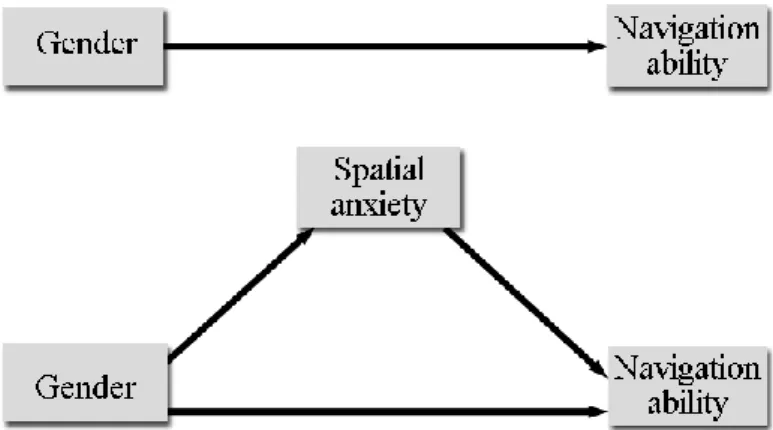
continuation, Distance estimation and Location on map. A mediation analysis was performed to investigate questions 1 through 4 in which the relationship between the independent variable gender and dependent variable navigation ability was tested, the mediating factor being spatial anxiety. A visual of this is shown in Figure 1. Navigation ability was based on the Z-scores of the aforementioned described Tübingen tasks, and spatial anxiety on the mean score on the spatial anxiety subscale from the Wayfinding Questionnaire. Gender was a dichotomous variable, while navigation ability and spatial anxiety were interval variables. Assumptions of normality, linearity of both independent and dependent variables, normality and homoscedasticity of residuals were checked, and multicollinearity of the independent variables was examined by assessing VIF values.
Figure 1. Mediation model for gender and navigation ability, mediated by spatial anxiety.
First, a linear regression analysis was performed to investigate the relationship
the relationship between spatial anxiety and navigation ability (3). It is expected to find that higher levels of spatial anxiety were correlated with lower performance on navigation ability. Lastly, a multiple linear regression and the Sobel test would be performed to investigate the relationship between gender, spatial anxiety and navigation ability together and the
significance of the indirect effect of spatial anxiety, in case gender and spatial anxiety were found to have a significant effect on navigation ability and gender was found to have a
significant effect on spatial anxiety (4). It was expected that female gender and spatial anxiety would have a significant negative effect on navigation ability and that spatial anxiety would be a significant mediating factor in the relationship between gender and navigation ability.
To investigate questions 5 and 6, regarding the differences on performance on the different navigation tasks (Route sequence, Route continuation, Distance estimation and Location on map; 5) and compare the performance on the tasks within gender (6), a repeated measures ANOVA was performed. This was done both with and without gender as a variable. Assumptions of normality and sphericity were checked and the data was checked on
significant outliers. The Z-scores of the Route sequence, Route continuation, Distance estimation and Location on map tasks were used as within-subject variables and gender as a between-subjects variable. It was expected that women would perform higher on the Route sequence and Route continuation task, compared to the Distance estimation and Location on map tasks. It was expected that the men's performance would show the opposite. Performance on the navigation tasks in general was also investigated, to see if there were differences within navigation performance in general. No significant differences were expected, as the
Results
Before conducting the regression analyses, the assumptions of normality, linearity of both independent and dependent variables, normality and homoscedasticity of residuals were checked, and multicollinearity of the independent variables was examined by assessing VIF values. No violations were found.
A simple linear regression was performed to investigate hypothesis 1, that males would perform better on navigation ability, compared to females. The results of this regression analysis are displayed in Table 1 and Table 2.
Table 1. Regression analysis of gender and navigation ability
Model df F Sig.
1 Regression 1 0.070 0.792b
Residual 84
Total 85
a. Dependent Variable: Navigation ability b. Predictors: (Constant), Gender
Table 2. Regression analysis of gender and navigation ability
Model
Unstandardized Coefficients
t Sig. B Std. Error
1 (Constant) 0.058 0.292 0.200 0.842
Gender -0.099 0.375 -0.265 0.792
a. Dependent Variable: Navigation ability
Gender does not significantly affect navigation ability (F(1, 84) = 0.070, p = 0.792), with an
R2of 0.001. Table 2 displays a participants’ predicted navigation ability is 0.058 - 0.099 (gender). In this case gender can only be male (0) or female (1).
Table 3. Regression analysis of gender and spatial anxiety
Model df F Sig.
1 Regression 1 5.168 0.026b
Residual 84
Total 85
a. Dependent Variable: Spatial anxiety b. Predictors: (Constant), Gender
Table 4. Regression coefficients of gender on spatial anxiety
Model
Unstandardized Coefficients
t Sig. B Std. Error
1 (Constant) 5.493 0.164 33.577 0.000
Gender -0.478 0.210 -2.273 0.026
a. Dependent Variable: Spatial anxiety
Gender was found to significantly influence spatial anxiety (F(1, 84) = 5.168, p = 0.026), with an R2of 0.058. This indicates there is a significant negative relationship between gender and spatial anxiety. Table 4 displays a participants’ predicted spatial anxiety is 5.493 - 0.478 (gender). Again, gender can only be male (0) or female (1). This indicates that females score significantly lower than males. A lower score indicates a higher anxiety level.
A simple linear regression was performed to investigate hypothesis 3, that higher levels of spatial anxiety result in lower performance on navigation ability. The results of this regression analysis are displayed in Table 5 and Table 6.
Table 5. Regression analysis of spatial anxiety and navigation ability
Model df F Sig.
1 Regression 1 1.512 0.222b
Residual 85
Total 86
a. Dependent Variable: Navigation ability b. Predictors: (Constant), Spatial anxiety
Table 6. Regression coefficients of spatial anxiety on navigation ability
Model
Unstandardized Coefficients
B Std. Error t Sig.
1 (Constant) -1.191 0.985 -1.209 0.230
Spatial anxiety was found not to significantly influence navigation ability (F(1, 85) = 1.512, p
= 0.222), with an R2of 0.017. Table 6 displays a participants’ predicted navigation ability is -1.191 + 0.229 (spatial anxiety), in which spatial anxiety is the individual score on the Spatial anxiety subscale of the Wayfinding Questionnaire, and again that it is not a significant positive relationship.
Due to gender and spatial anxiety not having a significant effect on navigation ability, the multiple linear regression of both gender and spatial anxiety’s effect on navigation ability and the Sobel test were not performed, as hypothesis 4, that anxiety is a significant mediator in the relationship between gender and navigation ability, was already rejected based on the aforementioned findings.
A repeated measures ANOVA was performed to investigate hypothesis 5, that there would be no difference on the performance on four different navigation tasks, two of which represent route-based navigation (Route sequence and Route continuation), while the other two represent survey-based navigation (i.e. Distance estimation and Location on map) and 6, that women used more route-based navigation, while men used more survey-based navigation. Assumptions of normality and sphericity were checked and the data was checked on
significant outliers. A Huynh-Feldt correction was used because the assumption of sphericity was violated. Although the assumption of normality was violated for the variables Route sequence, Route continuation and Direction estimation, it was decided to continue with the repeated measures ANOVA, based on histograms and Q-Q plots. This means the results should be interpreted more carefully.
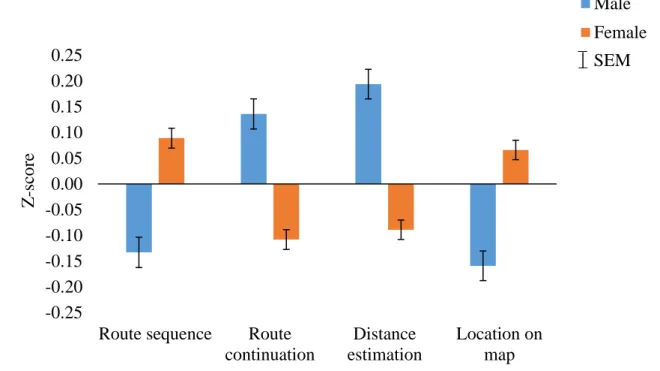
A repeated measures ANOVA with a Huynh-Feldt correction showed that that the navigation ability did not significantly differ between the four navigation tasks (F(2.679, 225.041) = 0.135, p = 0.924, partial η2 = 0.002), nor did it show a significant interaction between navigation task and gender (F(2.679, 225.041) = 1.468, p = 0.227, partial η2 = 0.017).
Figure 2. Means per navigation task and gender, with SEM in error bars
Table 7. Unstandardized performance on the navigation tasks per gender
Gender Navigation task N Minimum Maximum Mean Std. Deviation
Male Route sequence 34 0.00 100.00 57.35 28.39
Route continuation 34 37.50 100.00 71.32 18.08
Distance estimation 34 25.00 100.00 69.49 19.02
Location on map 34 8.88 363.38 130.82 84.58
Female Route sequence 52 0.00 100.00 63.22 29.44
Route continuation 52 25.00 100.00 66.59 20.22
Distance estimation 52 25.00 100.00 63.70 20.60
Location on map 52 12.50 272.75 146.26 53.76
-0.25 -0.20 -0.15 -0.10 -0.05 0.00 0.05 0.10 0.15 0.20 0.25
Route sequence Route continuation
Distance estimation
Location on map
Z
-sc
ore
Discussion
It is important to gain more knowledge of the workings of navigation ability, to understand what factors make up, or affect the ability to navigate. The current study aimed to investigate how gender and spatial anxiety influence navigation ability, to understand how individual factors explain differences in navigation ability between people. This knowledge can then be used for developing the most effective diagnostic and treatment tools. As there are people suffering from navigation impairment after brain damage, for example approximately 30% after a stroke (Van der Ham et al., 2013), there is a need to develop these diagnostic and treatment tools, as they are currently not yet available. Healthy university students were recruited to participate in a VR based experiment in which their gender was registered and the performance on four navigation tasks and the spatial anxiety levels were measured.
The first hypothesis was that women would generally perform worse at navigating, compared to men. However, this could not be supported by the current findings, as no differences in performance between men and women were found. This contradicts previous findings regarding gender differences in navigational performance (Lawton, 1994; Schmitz, 1999; Nori et al., 2009; Levay et al., 2016). A possible explanation for this could be related to an expectancy bias and differences between how strong this bias might have been in the past when previous research was performed, compared to current times. It was found that if there was a performance expectancy, of either men or women performing better, the performance of men and women, respectively, increased on a mental rotation task (Heil, Jansen, Quaiser-Pohl, & Neuburger, 2012). This means that if there is an expectancy of men performing better, compared to women, this could influence the performance of both men and women. Perhaps in the past this expectancy bias was stronger, explaining a difference between men and women, and has decreased over time.
compared to survey tasks and men do not perform better on survey tasks, compared to route tasks. In these hypotheses, the expectation relied on performance on these tasks, and not on whether either route or survey strategy was preferred, as this was not measured in the current study. However, the aforementioned articles did find differences in strategy use between the genders. Additionally, an fMRI study shows there are neural differences between men and women, substantiating the possibility of different strategy use (Grön, Wunderlich, Spitzer, Tomczak, & Riepe, 2000). In the current study, no differences were found between the performance on the different navigation tasks, which was expected. In combination with the finding regarding gender differences, this could indicate that there are no differences in the general performance, because there are no differences within and between the genders. This means that performance on navigation as a whole is likely to be stable within a person. However, this does not say anything regarding differences in preferred strategy use between women and men.
Combining both expectancy bias and differences in strategy use, instead of
performance on different strategy based tasks, changing gender role attitudes could explain why the current findings contradict previous reports. Nori et al. (2009) reported that strategy use was related, not only to biological gender, but to gender traits, specifically femininity or masculinity. The masculine/feminine trait-mediated the relationship between biological gender and navigation ability. This could be interesting, as the gender traits, social construct and attitudes towards both of these have changed over time. Whereas in the past feminine traits were more corresponding with female gender, and masculine traits with male gender, this is not necessarily so anymore in current times (Barth, 2016; March, van Dick, & Bark, 2016). March et al. (2016) reported feminine traits were given to people in a homemaker role, while male traits were given to a person in an employee/breadwinner role, regardless of their biological gender. Although nothing can be said specifically about associations with
navigation ability, the general gender role attitudes (e.g. regarding women being the primary homemaker, and men being the primary breadwinner, or women working) have become more liberal and egalitarian, for example compared to 1994, when Lawton reported on gender differences in navigational performance (Cotter, Hermsen, & Vanneman, 2011; Knight & Brinton, 2017). If this is indeed the case, this could explain why biological gender was found to have an effect in the past, but not anymore, as gender traits have become less in line with biological gender.
anxiety, which led to hypothesis 3, that people with higher spatial anxiety levels would perform worse when navigating, perhaps regardless of gender. Hypothesis 1, 2 and 3 combined were the base for hypothesis 4, in which spatial anxiety was expected to be a
mediator in the relationship between gender and navigation ability. Although it was found that women experience a higher level of spatial anxiety, this did not influence navigation ability. Nor did spatial anxiety affect navigation ability. This contradicts previous findings, which indicate that spatial anxiety has a negative effect on navigation ability, and is correlated with route strategy use (Lawton, 1994; Schmitz, 1999; Nori et al., 2009; Levay et al., 2016). The current study found that women did experience higher levels of spatial anxiety, compared to men, despite the fact that they did not differ in performance, nor did spatial anxiety influence navigation ability. However, it was not tested if spatial anxiety correlated with specific strategy use, only with performance. The expected mediation of spatial anxiety on gender and navigation ability was not found, as neither gender, nor spatial anxiety had an effect on navigation ability. However, the current study did not confirm women used route-based navigation more, as this was not measured. Perhaps spatial anxiety is still related to route-based navigation use, separate from gender, although this does not influence the outcome that spatial anxiety is not related to navigation performance in general.
Perhaps another explanation for the lack of effect of spatial anxiety on navigation ability could be that there is a difference in the level of spatial anxiety before and during testing. In the current study participants were asked to think about certain situations and report how these situations made them feel. However, it is uncertain if this accurate when the
participants are actually performing the navigation tasks.
Another strength of this study was the homogeneity of the sample. Participants all had a similar education level and had a maximum age difference of 13 years. This allows for a more reliable measure of gender’s effect on the navigation ability, which is then less likely to be influenced by other factors. Although the sample was relatively homogeneous, the
assumption of normality was violated for the distribution of scores in three of the four navigation tasks (Route sequence, Route continuation and Distance estimation). This makes the results regarding these tasks less reliable.
As of this moment, the field of navigation and neuropsychology is relatively new. This is a limitation in the sense that there is a scarce amount of previous research to compare findings to. It is more difficult to explain observations and findings, as several aspects are still unexplored or perhaps even unknown.
The current study does not provide enough knowledge to implement into practice, although it indicates there is no need for a tool to decrease spatial anxiety for the sake of improving navigation ability, nor would women and men benefit to tools fine-tuned to their gender. However, it does give guidance for new research. As gender was found to have no effect on navigation ability, it is important to conduct research into why this effect was found in previous research. In this it is vital that not only biological gender is taken into account, but also gender traits and expectancy bias, for reasons explained above.
With regard to spatial anxiety, further research can be conducted into differences between anticipated anxiety and anxiety during navigating. The Wayfinding Questionnaire was filled out before performing the navigation tasks, but perhaps there are differences when a person is actually navigating. Spatial anxiety questions could be asked during, or after the tasks to estimate if the reported spatial anxiety was actually experienced during navigation. This is useful as it can give more insight into the effect of spatial anxiety on navigation. A combination of gender traits, biological gender and spatial anxiety can also be explored. This could shed more light on the relationship between these factors and navigation ability.
Conclusion
The current study was conducted to gain more insight into the relationship between gender, spatial anxiety and navigation ability. In contrast with the expectations and
level of spatial anxiety they experience, despite the fact that there is no difference in their navigational performance.
References
Barth, A. (2016). The changing nature of attitude constructs: an application of multiple correspondence analysis on gender role attitudes. Quality & Quantity, 50(4), 1507- 1523.
Ciaramelli, E. (2008). The role of ventromedial prefrontal cortex in navigation: a case of impaired wayfinding in rehabilitation. Neuropsychologia, 46(7), 2099-2105. Claessen, M. H., Visser-Meily, J. M., De Rooij, N. K., Postma, A., & Van der Ham, I. J.
(2016). A direct comparison of real-world and virtual navigation performance in chronic stroke patients. Journal of the International Neuropsychology Society, 22(4), 467-477.
Claessen, M. H., Visser-Meily, J. M., De Rooij, N. K., Postma, A., & Van der Ham, I. J. (2016b). The wayfinding questionnaire as a self-report screening instrument for navigation-related complaints after stroke: Internal validity in healthy respondents and chronic mild stroke patients. Archives of Clinical Neuropsychology, 31, 839-854. Claessen, M. H., & Van der Ham, I. J. (2017). Classification of navigation impairment: A
systematic review of neuropsychological case studies. Neuroscience and Biobehavioral Reviews, 73, 81-97.
Cotter, D., Hermsen, J. M., & Vanneman, R. (2011). The end of the gender revolution? Gender Role Attitudes from 1977 to 2008. American Journal of Sociology, 117(1), 259-289.
De Rooij, N., Claessen, M., Van der Ham, I., Post, M., & Visser-Meily, J. (2017). The Wayfinding Questionnaire: A clinically useful self-report instrument to identify navigation complaints in stroke patients. Neuropsychological Rehabilitation, 1-20. Epstein, R., Higgins, J., & Thompson-Schill, S. (2005). Learning places from views:
Variation in scene processing as a function of experience and navigational ability.
Journal of Cognitive Neuroscience, 17(1), 73-83.
Grön, G., Wunderlich, A. P., Spitzer, M., Tomczak, R., & Riepe, M. W. (2000). Brain activation during human navigation: gender-different neural networks as substrate of performance. Nature Neuroscience, 3(4), 404-408.
Heil, M., Jansen, P., Quaiser-Pohl, C., & Neuburger, S. (2012). Gender-specific effects of artificially induced gender beliefs in mental rotation. Learning and Individual Differences, 22(3), 350-353.
gender-role attitude change in Europe. American Journal of Sociology, 122(5), 1485-1532.
Lawton, C. A. (1994). Gender differences in way-finding strategies: Relationship to spatial ability and spatial anxiety. Sex Roles, 30(11-12), 765-779.
Levay, C., Gonda, X., & Labadi, B. (2016). Effect of age and gender in association with spatial anxiety on navigation strategy preferences. European
Neuropsychopharmacology, 26, 356-357.
March, E., van Dick, R., & Bark, A. H. (2016). Current prescriptions of men and women in differing occupational gender roles. Journal of Gender Studies, 25(6), 681-692. Nori, R., Mercuri, N., Giusberti, F., Bensi, L., & Gambetti, E. (2009). Influences of gender
role socialization and anxiety on spatial cognitive style. The American Journal of Psychology, 122(4), 497-505.
Rondi-Reig, L., Petit, G., Tobin, C., Tonegawa, S., Mariani, J., & Berthoz, A. (2006).
Impaired sequential egocentric and allocentric memories in forebrain-specific-NMDA receptor knock-out mice during a new task dissociating strategies of navigation. The Journal of Neuroscience, 26(15), 4071-4081.
Schmitz, S. (1999). Gender differences in acquisition of environmental knowledge related to wayfinding behavior, spatial anxiety and self-estimated environmental competencies.
Sex Roles, 41(1-2), 71-93.
Van der Ham, I., Kant, N., Postma, A., & Visser-Meily, J. (2013). Is navigation ability a problem in mild stroke patients? Insights form self-reported navigation measures.
Journal of Rehabilitation Medicine, 45(5), 429-433.
Wolbers, T., & Büchel, C. (2005). Dissociable retrosplenial and hippocampal contributions to successful formation of survey representations. Journal of Neuroscience, 25(13), 3333-3340.
Wolbers, T., & Hegarty, M. (2010). What determines our navigational abilities? Trends in Cognitive Sciences, 14(3), 138-146.