Contents lists available atSciVerse ScienceDirect
Veterinary Parasitology
j o u r n a l h o m e p a g e :w w w . e l s e v i e r . c o m / l o c a t e / v e t p a r
Efficacy of dinotefuran, permethrin and pyriproxyfen combination
spot-on against
Aedes aegypti
mosquitoes on dogs
Michel Franc
a,∗, Claudio Genchi
b, Emilie Bouhsira
a, Stephan Warin
c, Vassilios Kaltsatos
c,
Laure Baduel
c, Marc Genchi
baUniversité de Toulouse, INP, ENVT, F-31076 Toulouse, France
bDipartimento di Patologia Animale, Igiene e Sanità Pubblica Veterinaria, Sezione di Patologia generale e Parassitologia, Universita’ degli Studi di Milano, Via
Celoria, 10 – 20133 Milano, Italy
c10 CEVA Santé Animale, 10 avenue de la Ballastière, 33500 Libourne, France
a r t i c l e
i n f o
Article history:Received 8 December 2011
Received in revised form 28 February 2012 Accepted 17 April 2012
Keywords: Permethrin Dinotefuran Dog Aedes aegypti Control
a b s t r a c t
A spot-on formulation combining permethrin, dinotefuran and pyriproxyfen (Vectra 3DTM
spot-on solution for dogs – one 10–25 kg pipette contains 196 mg dinotefuran, 1429 mg permethrin and 17 mg pyriproxyfen) was evaluated in adult Beagle dogs in a study designed to measure its efficacy to controlAedes aegypti(anti-feeding effect and mortality effect).
The trial was performed according to Animal Welfare and Good Clinical Practice. Twelve dogs (five males and seven female, >3 years old, weighing 8.8–13.0 kg) were ran-domly allocated to treatment groups on pre-treatment mosquito counts: six dogs served as untreated controls, and six dogs were treated with the test formulation. Treatment con-sisted of applying a combination formulation to deliver at least 46.6 mg kg−1permethrin,
6.40 mg kg−1dinotefuran and 0.57 mg kg−1pyriproxyfen. The combination is designed to
control fleas, ticks, sand flies and mosquitoes. Each dog was infested with approximately 100 adult unfedA. aegyptionce before treatment (day 6) then at 1, 7, 14, 21 and 28 days post-treatment. Counts and engorgement determination of dead and live mosquitoes were performed after 1 h exposure period. In the treated group (group A), the repellency effect of the product based on engorgement status (anti-feeding effect), was 91.5%, 94%, 94.7%, 94% and 87% at 1, 7, 14, 21 and 28 days post-treatment. Mortality effect or insecticidal efficacy calculated at the end of the 1-h exposure was almost identical when calculated 24 h after the 1-h exposure and remained above 93% until the end of the in-life phase. No adverse events were observed following treatment, including observations conducted 2, 4 and 24 h after the last dog was treated.
© 2012 Elsevier B.V. Open access under CC BY-NC-ND license.
Aedes aegypti is a major vector ofDirofilaria immitis heartworm, the most serious mosquito-borne disease in dogs (Apperson et al., 1989; Russell et al., 2005; Genchi et al., 2009; Vezzani et al., 2011) and ofDirofilaria repens (Anyanwu et al., 2000). Dirofilariosis can be prevented
∗ Corresponding author at: Ecole Nationale Vétérinaire, Université de Toulouse, INP, ENVT, F-31076 Toulouse, France. Tel.: +33 5 61 193 873.
E-mail address:[email protected](M. Franc).
by the use of anthelmintics such as moxidectin (Genchi et al., 2010), ivermectin, milbemycin oxime and selamectin (Blagburn et al., 2011). The application of a parasiticide having an anti-feeding effect on mosquitoes can be addi-tional help preventing the risk ofDirofilariatransmission by infected mosquitoes (Haysaki and Saeki, 2009).
Controlling ectoparasites (fleas, ticks, sandflies and mosquitoes) on pets is a constant request from owners and a persistent issue for practitioners; as a consequence, new products combining different active ingredients are being 0304-4017/© 2012 Elsevier B.V. Open access under CC BY-NC-ND license.
developed.Aformulationcombiningdinotefuran, perme-thrinandpyriproxyfen(Vectra3D)wasregisteredinthe USAin2007andisindicatedforthepreventionand treat-mentoffleas,ticks,fliesandmosquitoesondogs.
Permethrinisawell-knowninsecticideusedforyears forthecontrolofectoparasitesoncompanionanimalsand farm animals (Ross et al., 1997; Machida et al., 2008). Permethrin, as all of the pyrethroids, exerts its action onsodiumvoltage-dependentchannelsoftheparasites. Pyrethroidsmodulatetheconductanceofthesodiumions inthesechannelsbyincreasingthedurationoftheir open-ing which leads to hyper-excitability and death of the parasite(ClarkandSymington,2012).
Dinotefuran is a third-generation rapid-acting nitroguanidine neonicotinoid insecticide exerting its actiononauniqueacetylcholinereceptorpresentinthe insect nerve synapse by mimicking the action of the neurotransmitter(Wakitaetal.,2005).Pyriproxifenused inthis combinationtargetstheinsectendocrine system bymimingtheactivityoftheinsectjuvenilehormone.It actstostoptheflealifecyclebypreventingdevelopment ofimmaturestagesof fleastherebyarresting the devel-opmentoffleaeggs, flealarvaeandpupae(Meola etal., 1996;Milleretal.,1999;Murphyetal.,2009).
This study was conducted to assess the efficacy of apermethrin–dinotefuran–pyriproxyfenspot-on formula-tiontorepelandkilladultA.aegyptimosquitoesondogs. ThestudywasconductedinaccordancewithAnimal Wel-fareandGoodClinicalPractice.
1. Materialsandmethods
1.1. Dogs
FivemalesandsevenfemaleBeagledogs(>3yearsold, healthy,weighing8.8–13.0kg) fromtheÉcoleNationale VétérinairedeToulouse(ENVT)wereenrolled.Dogshad notbeenexposedtoectoparasiticidesfor3monthsprior totreatmentandremainedingoodhealththroughoutthe study.Dogswerehousedindividuallyincagesindoorswith controlledenvironmentalconditions.Dogswerefeda com-mercial dry dog food ration calculated to maintain the animal ina healthy physical state.Waterwasavailable adlibitumthroughautomaticlickers.Noconcurrent med-icationwasgivenduringthestudy.Dogsweremanaged similarlyandwithdueregardfortheirwell-being.Animals werehandledincompliancewiththerelevantInstitutional AnimalCareandwiththeRegionalEthicsCommitteefor animalexperimentation.
Thedogswereacclimated tostudyconditions for14 days prior totreatment and were observed for general healthconditions throughoutthe study.Onday7, each dogwaschallengedwith100unfedadultfemaleA.aegypti. TheywererankedaccordingtothenumberofA.aegypti bitingintotwogroupsofsix(treated–untreated). 1.2. Mosquitomaintenanceandsupply
A. aegypti (Liverpool strain) originally sourced from MilanowereculturedatENVTusinga5-weekeggtoadult
cyclebeginningJuly2010.Mosquitoeswerereared follow-ingFortinandSlocombe(1981).
1.3. Treatment
GroupAdogsremaineduntreated,groupBdogswere treatedwithapermethrin,dinotefuranandpyriproxyfen combinationspot-on 1.6ml(dogsweighingbetween4.1 and 10.0kg)or3.6ml(dogs weighingbetween10.1 and 25.0kg).Foralltreatedanimals,formulationwasapplied bypartingthehairand applyingthespot-ondirectlyto the skin: for dogs weighing less than 10.0kg, a 1.6-ml pipettewasusedwithhalfofthedoseappliedbetween theshoulder bladesand halfof thedoseat thebaseof the tail, for dogsweighing more than 10.1kg,a 3.6-ml pipettewasusedwithone-thirdofthedosebetweenthe shoulderblades,one-thirdofthedoseatthebaseofthe tail,thenone-thirdofthedoseinthemiddleoftheback (Vectra3DTM spot-on solutionfor dogs – one10–25kg pipettecontains196mgdinotefuran,1429mgpermethrin and17mgpyriproxyfen).Treatmentdosageswereinthe rangeof69–135mgkg−1forpermethrin,9.5–18.5mgkg−1 fordinotefuranand0.84–1.64mgkg−1forpyriproxyfen.
1.4. Experimentalprocedure
The mosquitoes challenge assessment cages (60cm×40cm×50cm)wereconstructedfrommosquito nettingmountedonawoodenframeandplacedin envi-ronmentallycontrolledrooms.Onehundredunfedfemale mosquitoes were placed in each of these 24h before introducingthedogswhichweresedatedusingketamine1 (9mgkg−1), medetomidine2 (4gkg−1) and diazepam3 (5mgdog−1).
After 60±5min of exposure, the dogs were care-fully taken out of the net and examined for any dead mosquito ontheir body, and then placed backin their cage.Alllivemosquitoeswereaspiratedfromeach chal-lengenetusingavacuumpumpandwererecordedaslive engorgedorlivenon-engorged.Alldeadmosquitoeswere collected, counted and recorded as dead non-engorged or dead engorged. During infestation, treated dogs and controldogswereplacedinseparatedinfestationrooms wheretemperatureandrelativehumidityweremaintained between25◦Cand26◦Candbetween58%and72%, respec-tively.Cagesandnetswerethoroughlycleanedaftereach mosquitochallenge.
Ondays−6,1,7,14,21and28,livemosquitoes recov-eredfromindividualanimalsattheendofexposurewere placedinseparatenetsandkeptintheexperimentalroom. Themosquitoeswerefedonsugar–waterandcheckedfor mortalityafter24h.
1Medetomidine,intramuscular(IM);Dexdomitor®,PFIZERSanté
ani-male,23-25avDrLannelongue,75668Paris.
2Ketamine,IM;Clorketam®,LaboratoireVETOQUINOLS.A.70204Lure
cedex.
3Diazepam,IM;Valium®Rocheinjectable,52Bdduparc,92521Neuilly
1.5. Dataanalysis
Anti-feedingeffect:Foreachtimepointafterexposure, the anti-feeding rate was evaluated for each group as describedbelowandcomparedtothecontrolgroup:
Anti-feeding rate= Total number of unengorged mosquitoes
Total number of recovered mosquitoes Thentheanti-feedingeffect(expressedinpercentage)was determined:
Antifeeding effect=100×anti-feeding rate in treated dogs−anti-feeding rate in untreated dogs
1−anti-feeding rate in untreated dogs Mortalityeffect:Foreachtimepointafterexposure,the
mortalityratewasevaluatedforeachgroupasdescribed belowandcomparedtothecontrolgroup:
Mortality rate=Total number ofTotal number ofrecovereddead mosquitoesmosquitoes
Thenthemortalityeffect(expressedinpercentage)was determined:
Mortality effect=100×mortality rate in treated dogs−mortality rate in untreated dogs
1−mortality rate in untreated dogs The percentage of A. aegypti engorgedfemales and live
femalesinbothgroupswerecomparedusinga date-by-dateanalysisofvariancefollowedbyanon-parametrictest ofKruskall–Wallis.Differenceswereconsideredsignificant atP<0.05.TheanalyseswereperformedwithSystat9 soft-wareusingpercentage×10asdata.
2. Results
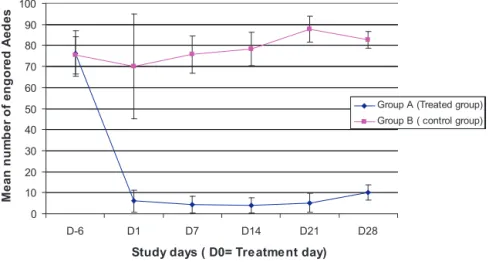
Alldogsincludedinthestudydemonstratedadequate pre-treatmentparasiteholdingability.Onday−7,the per-centage ofengorgedfemale was,respectively,87.6% for the treated group and 86.3% for the control group. All untreatedanimalsmaintainedadequateengorgedfemale level throughout thestudy(Fig.1).Post-treatment per-centageofengorgedmosquitoesforthetreateddogswas significantly lowerthan that for untreated controldogs (whichrangedfrom81%to92%atallpost-treatment eval-uations–P<0.05,Table1).Thetreatmentprovided91.5% anti-feedingefficacyonday1then≥94%efficacyupto3 weeksaftertreatment(day21)andattheendofthestudy (day28)87%efficacy.
Therewasnosignificantstatisticaldifferencebetween bothgroupsinmortalityinfemalesatday−6andatday−5 meaningthatpre-treatment,bloodfeedingondogsfrom both groups didnot leadtodeathof mosquitoes.Then, after1hofexposureand24haftereachchallengepoint performedatday1,day7,day14,day21andday28,the dif-ferenceinmortalityoffemalesA.aegyptibetweentreated andcontrolledgroupwassignificant(P<0.05).
Thetreatmenthadamortalityeffectcalculatedat1h andat24hpost-exposureabove93.0%and93.4%, respec-tively,untiltheendoftheanimal phase.Themaximum ofmortalityisobtainedatday7withanefficacyof100%, andthenremainedabove96.3%untilday21.The mortal-ityeffectcalculatedat1handat24hpost-treatmentwas approximatelythesame(Table1).
3. Discussion
The objectives of this study were to evaluate the insecticidaleffectand therepellenteffect ofa formula-tion with permethrin 36.08% (w/w), dinotefuran 4.95%
(w/w)andpyriproxyfen0.44%(w/w)combinationagainst A. aegypti mosquitoes on dogs. This formulation pro-videdexcellentresultswithagoodrepellenteffect– 94% andinsecticidaleffect–96%for3weekspost-treatment falling to 87% in week 4. The treatment of dogs with permethrin–dinotefuran–pyriproxyfenformulationseems toofferbetterprotectionfromAedesmosquitobitesthan formulationsoflowerorsimilardosageofpermethrin com-binedwithimidaclopridorwithpermethrinalone.Indeed, insimilartrialsperformedwithA. aegypti(Meyeret al., 2003;Tiawsirisupetal.,2007),insecticideefficacyfor65% permethrinalonerangedfrom84%to90.9%untilday21 anddeclinedto50.3%onday28;insecticideefficacyfor 50%permethrincombinedwith10%imidaclopridranged from40.4%to100%untilday21anddeclinedto2.1%on day28.Thepermethrin–dinotefuran–pyriproxyfen combi-nationprovidedaninsecticideefficacybetween93%(day 28)and100%(day7).Therepellenteffectobtainedwith permethrinalonerangedfrom78%to89.9%throughday 21anddeclinedto61.9%onday28;fortreatment com-biningimidaclopridand permethrin,therepellenteffect rangedfrom84.9%to94.1%throughday21anddeclined to50.4%onday28.Theformulationtestedinthecurrent studyofferedarepellenteffectrangingfrom91.5%to94.7% withminimaldeclineto87%onday28.
A.aegyptimosquitoeswerechoseninthistrialbecause oftheirmedicalimportanceintransmissionoftheyellow fevervirusandotherarbovirusesandasawell-known vec-torofdirofilariosiswhichcausesseverediseasesandeven deathindogsinmanyparts oftheworld(McCallet al., 2008).In addition,humanbeings can beaffectedby D. immitisandD.repensalthoughtheyaredead-endhostsfor theseparasites(Estranetal.,2007;Genchietal.,2011).
The experimental protocol proposed here tended to recreatenatural infestationofdogsbecausemosquitoes wereallowedtobiteontheirpreferential sites(around eyes,aroundmouthandventralpartofthedog),asthefull
0 10 20 30 40 50 60 70 80 90 100
D28 D21
D14 D7
D1 D-6
Study days ( D0= Treatment day)
M
e
a
n
num
b
e
r of
e
ngor
e
d A
e
de
s
Group A (Treated group) Group B ( control group)
Fig.1. EvolutionofmeannumberofengorgedAedesaegyptiobtainedinbothgroupsafter1hexposuretodogs.
Table1
Mortalityandantifeedingeffect.
Day1(%) Day7(%) Day14(%) Day21(%) Day28(%) Mortalityeffect
1h 99.0a 100.0 96.3 98.9 93.0
24h 98.9a 100.0 96.5 99.1 93.4
Antifeedingeffect(P-value)
1h 91.5(0.004) 94.0(0.004) 94.0(0.004) 94.0(0.004) 87.0(0.004)
aThemortalityofA.aegyptiinthecontrolgroupduringthe24hoursafterthedogexpositionexplainthedecreaseofthemortalityeffect.
bodyofdogswasaccessible.Onthecontrary,Tiawsirisup etal.(2007)presentedA.aegyptitrappedinplasticcupsto dogs.Thefeedingratetheyobtainedinthecontrolgroup rangedfrom49.4%to88%versusafeedingratefrom86.3% to91.6%forthecontrolgroupobtainedinthiscurrenttrial. Thesedifferences confirmtheimportance ofsticking to naturalconditionsofinfestation.Furthermore,mosquitoes wereallowedtoperformtheirentirebloodmealwithout anydisturbanceorinterruptionasthedogswereasleep. Oncethebloodmealwasperformed,femalemosquitoes leftthedogstolayonthesideofthenetwhichmadeit eas-ierfortheircollection.Mosquitoesincontactwithtreated dogsdiedquicklyaftertheirexposure,especiallyonthe earlydayspost-treatment(cf.day7withinsecticidaleffect of100%).Thiswasconfirmedbytheinsecticideeffectwhich didnotincreasesignificantly24hafterexposure.
Recently, an increasing number of veterinarians reportedpetownersclaimingthatnumerousparasiticide productswerenotefficientanymore(Drydenetal.,2011) against ectoparasites of pets. Resistance is often cited. Sothecombination of newproductsor combination of well-knownproductswithnewchemistrieswhich have not been associated yet could be a pertinent solution. Murphyetal.(2009)demonstratedthatdinotefuranwas moreefficientthanimidacloprid againstCtenocephalides felis on cats. In an assay against mosquitoes (Corbel etal.,2004),dinotefuranwaslesstoxicthanmostofthe commonlyusedinsecticides(e.g.,deltamethrin, carbosul-fanandtemephos);however,theefficacyofdinotefuran towardsresistant mosquitoes wasnot strongly affected by the presence of common resistance mechanisms (kdrmutationand insensitiveacetylcholinesterase).The
differenceofsitesofactionofdinotefuran,acetylcholine receptor versus sodium channels for pyrethroids, may explaintheabsenceofcross-resistancewithcommon par-asiticidesandmakesdinotefuranapotentialcandidatefor vectorcontrolinareaswheremosquitoesmayberesistant tocommoninsecticides(Corbeletal.,2004).
Pyriproxifen, dinotefuranand permethrinare associ-atedforthefirsttimeinaformulation.Theinterestofthis associationwouldbetobroadenthespectrumofactionto fleasandimmaturestagesoffleaswhichcouldbevery use-fulfordogsinfestedwithfleastravellinginendemicareas ofdirofilariosis,butthiswasnottheaimforthecurrent studywhichchosetofocusonitsefficacytowardsA.aegypti mosquitoesonly.
In conclusion, the combination of permethrin– dinotefuran–pyriproxyfencanbeusedondogstorepeland killA.aegyptimosquitoesreducingstressandannoyance causedbythebiteofmosquitoes.Moreimportantly,this combinationmayreducetheriskofheartworm transmis-sionforanimalsleavingortravellinginDirofilariaendemic areas. The application of this combination needsto be repeatedevery3–4weeksanditshouldnotbeseenasa substituteforheartwormpreventiontreatments.
Acknowledgements
WethankSolangeVermot,MartineRoquesandSonia GounaudoftheparasitologicaldepartmentoftheENVTfor theirassistanceduringthein-lifephase.
Thisstudywasfundedinpartbya grantfromCEVA SantéAnimale.
References
Anyanwu,I.N.,Agbede,R.I.,Ajanusi,O.J.,Umoh,J.U.,Ibrahim,N.D.,2000. TheincriminationofAedes(Stegomyia)aegyptiasthevectorof Dirofi-lariarepensinNigeria.Vet.Parasitol.92,319–327.
Apperson,C.S.,Engber,B.,Levine,J.F.,1989.RelativesuitabilityofAedes albopictusandAedesaegyptiinNorthCarolinatosupportdevelopment ofDirofilariaimmitis.Am.Mosq.ControlAssoc.5,377–382. Blagburn,B.L.,Dillon,A.R.,Arther,R.G.,Butler,J.M.,Newton,J.C.,2011.
Comparativeefficacyoffourcommerciallyavailableheartworm pre-ventiveproducts against theMP3laboratorystrain ofDirofilaria immitis.Vet.Parasitol.176,189–194.
Clark,J.M.,Symington,S.B.,2012.Advances inthemodeofactionof pyrethroids.Top.Curr.Chem.314,49–72.
Corbel,V.,Duchon,S.,Zaim,M.,Hougard,J.M.,2004.Dinotefuran:a poten-tialneonicotinoidinsecticideagainstresistantmosquitoes.J.Med. Entomol.41,712–717.
Dryden,M.W.,Payne,P.A.,Vicki,S.,Riggs,B.,Davenport,J.,Kobuszewski, D., 2011. Efficacy of dinotefuran-pyriproxyfen, dinotefuran-pyriproxyfen-permethrin and fipronil-(S)-methoprene topical spot-onformulationstocontrolfleapopulationsinnaturallyinfested petsandprivateresidencesinTampa,FL.Vet.Parasitol.182,281–286. Estran,C.,Marty,P.,Blanc,V.,Faure,O.,Leccia,M.T.,Pelloux,H.,Diebolt,E., Ambrosetti,D.,Cardot-Leccia,N.,2007.Humandirofilariasis:3cases inthesouthofFrance.PresseMed.36,799–803.
Fortin,J.F.,Slocombe,J.O.D.,1981.Temperaturerequirementsforthe developmentofDirofilariaimmitisinAedestriseriatusandAe.vexans. Mosq.News41,625–633.
Genchi,C.,Rinaldi,L.,Mortarino,M.,Genchi,M.,Cringoli,G.,2009.Climate andDirofilariainfectioninEurope.Vet.Parasitol.163,286–292. Genchi,M.,Pengo,G.,Genchi,C.,2010.Efficacyofmoxidectinmicrosphere
sustainedreleaseformulationforthepreventionofsubcutaneous filarial (Dirofilaria repens) infectionin dogs. Vet. Parasitol. 170, 167–169.
Genchi,C.,Kramer,L.H.,Rivasi,F.,2011.DirofilarialinfectionsinEurope. VectorBorneZoonoticDis.11,1307–1317.
Haysaki,M.,Saeki,H.,2009.Inhibitionandpreventionefficacyagainst mosquitoboodsukingandDirofilariaimmitisinfectionby administra-tionoftopicalinsecticide.J.Vet.Med.Sci.71,1049–1052.
Machida,H.,Kondo,T.,Kanehira,K.,Hagimori,I.,Kamio,T.,2008.The inhibitoryeffectofacombinationofimidaclopridandpermethrinon bloodfeedingbymosquitoesindogsraisedunderoutdoorconditions. Vet.Parasitol.154,318–324.
McCall,J.W.,Genchi,C.,Kramer,L.H.,Guerrero,J.,Venco,L.,2008. Heart-wormdiseaseinanimalsandhumans.Adv.Parasitol.66,193–285. Meola,R.,Pullen,S.,Meola,S.,1996.Toxicityandhistopathologyofthe
growthregulatorpyriproxyfentoadultsandeggs ofthecatflea (Siphonaptera:Pulicidae).J.Med.Entomol.33,670–679.
Meyer,J.A.,Disch,D.,Cruthers,L.R.,Slone,R.L.,Endris,R.G.,2003. Repel-lencyandefficacyofa65%permethrinspot-onformulationfordogs againstAedesaegypti(Diptera:Culicidae)mosquitoes.Vet.Ther.4, 135–144.
Miller,R.J.,Broce,A.B.,Dryden,M.W.,Throne,J.E.,1999.Emergence, survival,andfecundityofadultcatfleas(Siphonaptera:Pulicidae) exposedaspupaetojuvenilehormonemimics.J.Med.Entomol.36, 776–779.
Murphy,M.,Ball,C.A.,Gross,S.,2009.Comparativeinvivoadulticidal activityofatopicaldinotefuranversusanimidacloprid-based formu-lationagainstcatfleas(Ctenocephalidesfelis)oncats.Vet.Ther.10, 9–16.
Ross,D.H.,Pennington,R.G.,Cruthers,L.R.,Slone,R.L.,1997.Efficacyofa permethrinandpyriproxyfenproductforcontroloffleas,ticksand mosquitoesondogs.CaninePract.22,53–58.
Russell,R.C.,Webb,C.E.,Davies,N.,2005.Aedesaegypti(L.)andAedes polynesiensisMarks(Diptera:Culicidae)inMoorea,French Polyne-sia:astudyofadultpopulationstructuresandpathogen(Wuchereria bancroftiandDirofilariaimmitis)infectionratestoindicateregional andseasonalepidemiologicalriskfordengueandfilariasis.J.Med. Entomol.42,1045–1056.
Tiawsirisup,S.,Nithiuthai,S.,Kaewthamasorn,M.,2007.Repellentand adulticideefficacyofacombinationcontaining10%imidaclopridand 50%permethrinagainstAedesaegyptimosquitoesondogs.Parasitol. Res.101,527–531.
Vezzani,D.,Mesplet,M.,Eiras,D.F.,Fontanarrosa,M.F.,Schnittger,L.,2011. PCRdetectionofDirofilariaimmitisinAedesaegyptiandCulexpipiens fromurbantemperateArgentina.Parasitol.Res.108,985–989. Wakita,T.,YasuiN,Yamada,E.,Kishi,D.,2005.Developmentofanovel