pwc.com.au
Practical
guide to IFRS
Consolidated financial
statements: redefining
control
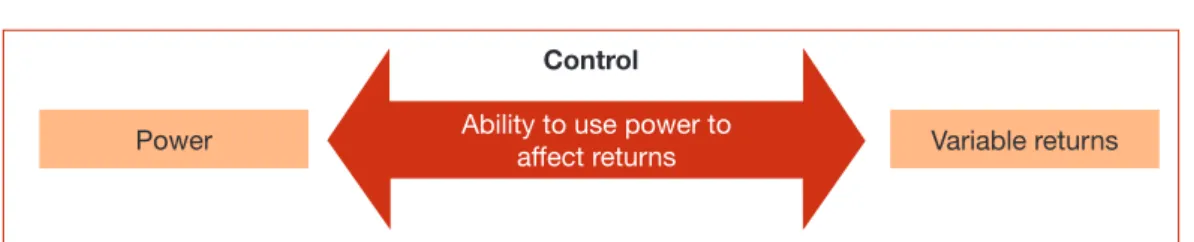
Practical guide to IFRS
Consolidated financial statements:
redefining control
At a glance
• The IASB released IFRS 10,
‘Consolidated financial statements’, on 12 May 2011, introducing new guidance on control and consolidation.
• The new approach combines the concepts of power and exposure to variable returns to determine whether control exists. Control exists under IFRS 10 when the investor has power, exposure to variable returns and the ability to use that power to affect its returns from the investee.
• IFRS 10 contains guidance on the following issues when determining who has control:
4 Assessment of the purpose and design of an investee;
4 Nature of rights – substantive or protective in nature;
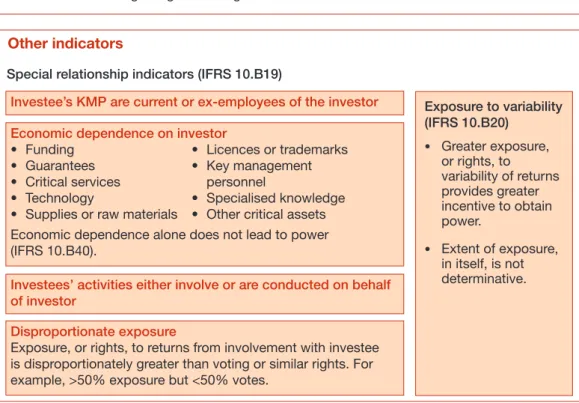
4 Assessment of existing and potential voting rights;
4 Whether an investor is a principal or agent when exercising its controlling power;
4 Relationships between investors and how they affect control; and
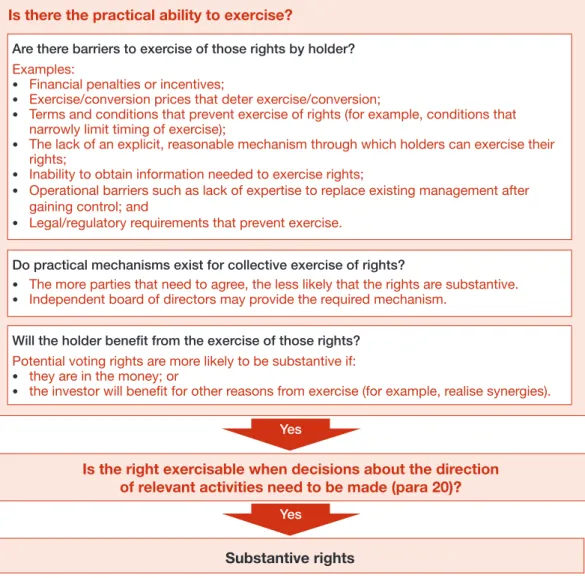
4 Existence of power over specified assets only.
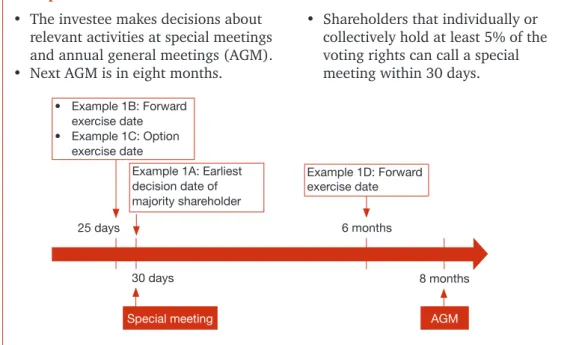
• The new standard is available for early adoption, with mandatory application required from 1 January 2013.
• Management will need to evaluate the impact of the new standard in their assessment of the entities that they are required to consolidate.
• Changes to the composition of the group could arise and impact key investor metrics (including debt covenants) such as gearing, liquidity and profitability ratios.
Contents
Page
At a glance 1
Introduction 3
Scope 3
Control 4
Framework for assessment of control 4
Purpose and design of the investee 5
Power 5
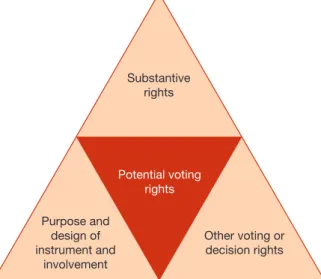
Relevant activities 6
Power over relevant activities 8
Substantive or protective rights 9
Voting and potential voting rights 12
Structured entities 20
Variable returns 23
Link between power and returns – principal vs agent 23
Other issues 29
De facto agent 29
Silos 29
Frequency of reassessment 29
Accounting requirements 30
Disclosures 30
General objective of IFRS 12 30
Scope of disclosures 30
Aggregation of disclosures 31
Significant judgements and assumptions 32
Transition 32
Potential business impacts 33
Industry insights 33
Where to go for more information 33
Introduction
1. IFRS 10 is the major output of the consolidation project, resulting in a single definition of control for all entities. The IASB continues work on a project that will propose changes to how investment entities account for entities they control. An exposure draft on investment entities is expected in the third quarter of 2011. A separate standard, IFRS 12 ‘Disclosure of interests in other entities’, sets out disclosures for investor/investee relationships.
PwC observation: The consolidation project has been on the IASB’s agenda since June 2003. The objective was to develop a standard to replace IAS 27 and SIC 12. IFRS 10 revises the definition of control and provides detailed application guidance so that a single control model can be applied to all entities. The project was developed partly to address perceived inconsistencies between IAS 27 and SIC 12, and also to enhance convergence with US GAAP. The project was accelerated in 2008 as a result of the global financial crisis.
2. The key principle in the new standard is that control exists, and consolidation is required, only if the investor possesses power over the investee, has exposure to variable returns from its involvement with the investee and has the ability to use its power over the investee to affect its returns.
PwC observation: The new standard will affect some entities more than others. The consolidation conclusion is not expected to change for most straightforward entities. However, changes can result in complex cases. Entities that are most likely to be affected potentially include investors in the following entities: • entities with a dominant investor that does not possess a majority voting interest, where the remaining votes are held by widely-dispersed shareholders (de facto control);
• structured entities;
• entities that issue or hold significant potential voting rights; and
• asset management entities.
In difficult cases, the precise facts and circumstances will affect the analysis under IFRS 10. IFRS 10 does not provide ‘bright lines’ and requires consideration of many factors.
3. The new standard also sets out consolidation principles and guidance for measuring non-controlling interests, potential voting rights and accounting for loss of control.
Scope
4. IFRS 10 applies to all parent entities that need to present consolidated financial statements, except for post-employment benefit plans or other long-term employee benefit plans to which IAS 19 applies (IFRS 10.4b).
5. Parent entities are exempted from having to consolidate if:
(a) the parent is a wholly or partially- owned subsidiary in which all owners do not object to non-consolidation; (b) the parent’s debt or equity securities are not publicly traded;
(c) the parent did not file, and is not filing, its financial statements to issue publicly-traded instruments; and (d) the ultimate or any intermediate parent of the parent entity produces IFRS consolidated financial
statements that are available for public use.
(IFRS 10.3)
PwC observation: The exemptions from consolidation and the ‘how-to’ of consolidation have not changed from IAS 27.
Control
Control
Power Ability to use power to affect returns Variable returns
Illustration 1: The elements of control
6. Control exists when an investor has all three of the following elements: (a) power over the investee;
(b) exposure or rights to variable returns from its involvement with the investee; and
(c) the ability to use its power over the investee to affect the amount of the investor’s returns.
(IFRS 10.7)
PwC observation: Previously, control through voting rights was addressed by IAS 27, while exposure to variable returns was an important consideration within the SIC 12 framework. However, the relationship between these two approaches to control was not always clear. IFRS 10 links power and returns by introducing an additional requirement that the investor is capable of wielding that power to influence its returns.
Assess purpose and design (para 8-9)
Assess power (illustration 3)
What activities significantly affect the investee’s returns (‘relevant activities’)?
How are decisions about relevant activities made? Do investor’s rights provide ability to direct relevant activities?
Assess ability to use power to influence variable returns Principal/agent assessment (illustration 20)
De facto agent assessment (para 49-51) Assess exposure to variable returns (para 42-44)
Illustration 2: Framework for assessment of control
7. Reassessment of control is required if facts and circumstances indicate that any of the elements have changed (IFRS 10.8).
Purpose and design of
the investee
8. The purpose and design of an investee could impact the assessment of what the relevant activities are, how those activities are decided, who can direct those activities, and who can receive returns from those activities
(IFRS 10.B5). The consideration of purpose and design may make it clear that the entity is controlled by voting or potential voting rights (IFRS 10.B6). 9. Voting rights in some cases may not
significantly impact an investee’s return. The investee may be on ‘auto-pilot’ through contractual arrangements. In those cases, the following should be considered in assessing the purpose and design of an entity (IFRS 10.B8):
(a) downside risks and upside potential that the investee was designed to create;
(b) downside risks and upside potential that investee was designed to pass on to other parties in the transaction; and (c) whether the investor is exposed
to those risks and upside potential.
Power
Control
Power Ability to use power to affect returns Variable returns
10. An investor has power over an
investee when the investor has existing substantive rights that give
it the current ability to direct the relevant activities (IFRS 10.10, IFRS 10.B9). Relevant activities are the activities that significantly affect the investee’s returns.
The diagram below summarises the considerations involved in the assessment of power.
Assess purpose and design of entity (para 8-9)
Illustration 3: Conceptual flowchart for assessment of power * Whether rights are substantive or protective is dealt with in illustration 7.
Determine relevant activities (paras 12-13, illustration 4b)
Determine how relevant activities are directed (paras 14-15)
Does entity own >50% of substantive* voting rights (illustration 9)?
Is there de facto control (illustration 10)?
Do substantive* potential voting rights give controlling power (illustration 14)? Do other contractual agreements, or some combination of contracts, voting rights, and potential voting rights provide
controlling power (para. 27)?
Does entity have power over structured entity (illustration 18)?
Consider factors in IFRS 10.B18-B20
(illustration 6). Directed by
voting rights Directed by contracts
Unclear
No
No Yes
Determine whether investor’s rights provide ability to direct relevant activities
No
No
No power Power
No power Power
No Yes
Example 13.1
Two investors form an investee to •
develop and market a medical product. One investor has the responsibility •
and the unilateral ability to make all decisions relating to product development and to obtaining regulatory approval.
Once the regulator has approved the •
product, the other investor has the responsibility and the unilateral ability to make all manufacturing and marketing decisions.
Regulatory approval Activity 1:
Product development
Investor A decides Investor B decides
Activity 2: Manufacturing/ Marketing
Illustration 4(a): Relevant activities directed by different parties – example 13.1
Solution
The considerations are summarised in the flowchart below: Do both activities significantly affect
investee’s returns? Consider only the activity that significantly affects returns.
Which activity most significantly affect returns?
General considerations:
a) the purpose and design of the investee;
b) the factors that determine the profit margin, revenue and value of the investee as well as the value of the medical product;
c) the effect on the investee’s returns resulting from each investor’s decision-making authority with respect to the factors in (b); and
d) the investors’ exposure to variability of returns. Considerations specific to this example:
e) the uncertainty of, and effort required in, obtaining regulatory approval (considering the investor’s record of successfully developing and obtaining regulatory approval of medical products); and
f) which investor controls the medical product once the development phase is successful. Illustration 4(b): Relevant activities directed by different parties – example 13.1
Yes
No
Which investor has power over the investee? PwC observation: Control is
determined by voting rights in the majority of cases. No further assessment is required to determine control.
Relevant activities
12. IFRS 10 defines ‘relevant activities’ as those activities of the investee that significantly affect the investee’s returns (IFRS 10 Appendix A).
IFRS 10 offers a wide range of possible ‘relevant’ activities including but not limited to:
(a) sales and purchases of goods and
services;
(b) management of financial assets before and after default;
(c) selection, acquisition and disposal of assets;
(d) research and development; and (e) funding activities (IFRS 10.B11). 13. Decisions over relevant activities
may include operating, capital and budgetary decisions; or the appointment, remuneration and termination of service providers or key management (IFRS 10.B12).
The following examples are summarised from IFRS 10 examples 1 and 2:
PwC observation: This type of decision will be highly judgemental in practice. For example, when one investor is responsible for manufacturing and another investor is responsible for marketing, it can be difficult to identify which activity has more effect on returns. The answer could be affected by the investee’s strategy. For example,
consider a low-cost manufacturer of a commoditised product and a manufacturer of a high-end branded product. Low-cost manufacturing could be the critical process for the first manufacturer, while effective marketing could be the critical process in the second manufacturer.
Example 13.2
Default passes threshold Activity 1:
Asset portfolio management
Asset manager decides
Activity 2: Defaulted asset management
Illustration 5(b): Relevant activities directed by different parties – example 13.2 Who controls the investment vehicle?
Solution
The asset manager and the debt investor each need to determine whether they are able to direct the activities that most significantly affect the investee’s returns, including considering the purpose and design of the investee as well as each party’s exposure to variability of returns.
The sequence of decision powers are illustrated diagrammatically as follows:
Asset manager Other equity investors
Investee
• Equity absorbs first losses and receives residual returns
• Markets debt instrument as having minimal credit risk due to existence of equity • Purchases portfolio of financial assets with debt and equity proceeds
• Returns affected by:
– management of asset portfolio – management of defaulted assets
Illustration 5(a): Relevant activities directed by different parties – example 13.2 30% equity
The asset manager manages all •
activities until defaults reach a specified threshold (i.e. when the equity tranche of the investee has been consumed).
Thereafter, a third-party trustee •
manages the assets according to the instructions of the debt investor. An investment vehicle (the investee) is created with debt and equity instruments. Debt investor
70% equity Debt
instrument
Power over relevant activities
14. An investor must have rights that provide the current ability to direct relevant activities to have power (IFRS 10.B14). This ability can stem from a wide variety of rights, including voting or potential voting rights, rights to appoint or remove decision-makers including key management veto rights and contractual rights (IFRS 10.B15). 15. Generally, when the investee has a
range of relevant activities that require
continuous substantive decisions, voting or similar rights will provide power (IFRS 10.B16). In other cases, voting rights do not have a significant effect on returns, and these are dealt with in paragraphs 34 to 41 below. Factors to consider in difficult situations 16. When it is difficult to determine
whether an investor’s rights are sufficient to provide power over an investee, the factors to be considered are shown in the following diagram:
Indicators relating to the practical ability to direct the investee (IFRS 10.B18)
Non-contractual ability to appoint investee’s key management personnel (KMP)
•
Non-contractual ability to direct investee to enter into significant transactions or veto such
•
transactions
Ability to dominate the nomination of members to the investee’s governing body or obtain
•
proxies from other vote-holders
Investee’s KMP, or majority of governing body, are related parties of the investor (for
•
example, investee and investor share the same CEO)
These indicators are given greater weight than the indicators below.
Special relationship indicators (IFRS 10.B19) Other indicators
Exposure to variability (IFRS 10.B20)
Greater exposure,
•
or rights, to variability of returns provides greater incentive to obtain power.
Extent of exposure,
•
in itself, is not determinative.
Illustration 6: Factors to consider when assessment of control remains uncertain Investee’s KMP are current or ex-employees of the investor Economic dependence on investor
• Funding • Licences or trademarks • Guarantees • Key management • Critical services personnel
• Technology • Specialised knowledge • Supplies or raw materials • Other critical assets Economic dependence alone does not lead to power
(IFRS 10.B40).
Investees’ activities either involve or are conducted on behalf of investor
Disproportionate exposure
Exposure, or rights, to returns from involvement with investee
is disproportionately greater than voting or similar rights. For example, >50% exposure but <50% votes.
Illustration 7: Flowchart for determining whether rights are substantive
Are there barriers to exercise of those rights by holder?
Examples:
Financial penalties or incentives;
•
Exercise/conversion prices that deter exercise/conversion; •
Terms and conditions that prevent exercise of rights (for example, conditions that
•
narrowly limit timing of exercise);
The lack of an explicit, reasonable mechanism through which holders can exercise their
•
rights;
Inability to obtain information needed to exercise rights;
•
Operational barriers such as lack of expertise to replace existing management after
•
gaining control; and
Legal/regulatory requirements that prevent exercise. •
PwC observation: Economic dependence is not uncommon. For example, mid-stream processing companies for rare minerals or resources could be dependent on its resource suppliers. However, the ‘priority indicators’ in the above illustration take precedence over economic dependence indicators. Therefore, if the resource supplier has little or no influence over the mid-stream processor’s key management personnel, governing bodies, proxy process and decision-making processes, the processor’s dependence on the resource supplier for raw materials will be insufficient to constitute power.
Substantive or protective rights
17. IFRS 10 requires only substantive rights to be considered in the assessment of power (IFRS 10.B22). Protective rights are not considered. 18. Substantive rights exercisable by
other parties can prevent an investor from obtaining control, even if those right-holders are not able to initiate decisions (IFRS 10.B25).
Substantive rights
19. The following flowchart summarises the criteria for differentiating substantive and protective rights. It applies to all types of rights, including current voting rights and potential voting rights.
Is there the practical ability to exercise?
Do practical mechanisms exist for collective exercise of rights?
The more parties that need to agree, the less likely that the rights are substantive.
•
Independent board of directors may provide the required mechanism.
•
Will the holder benefit from the exercise of those rights?
Potential voting rights are more likely to be substantive if: they are in the money; or
•
the investor will benefit for other reasons from exercise (for example, realise synergies).
•
Yes
Is the right exercisable when decisions about the direction of relevant activities need to be made (para 20)?
Yes
PwC observation: An important change introduced by IFRS 10 is its articulation of the financial position of potential voting rights (that is, whether in or out of the money) as a factor to consider in assessing control. IAS 27 provided very (IFRS 10.B23)
little guidance on this factor until now. Potential voting rights that are deeply out of the money can result in those rights being regarded as non-substantive, as examples 9 and 10 in IFRS 10.B50 illustrate. These are summarised below. Fact pattern Financial position of
potential voting rights Other facts Conclusion 30% investor with call
option exercisable for next 2 years over a further 50%.
Deeply out of the money and expected to remain so over option life.
The other investor (holding 70%) has been exercising its votes and actively directing the investee’s activities.
Option is not substantive.
Three investors each hold 1/3 of votes in an investee. One investor (A) holds convertible debt with a fixed strike price. If converted, A will own 60% of votes.
Out of the money but not deeply out of the money.
Investee’s business activity
•
is closely related to A. A benefits from synergies
•
if the conversion option is exercised.
Option is substantive.
The investee makes decisions about •
relevant activities at special meetings and annual general meetings (AGM). Next AGM is in eight months. •
Shareholders that individually or •
collectively hold at least 5% of the voting rights can call a special meeting within 30 days. 20. Substantive rights that provide the
holder with the current ability to direct relevant activities are usually currently exercisable, but not
always so. IFRS 10.B24 provides the examples below of non-currently exercisable rights that are nevertheless substantive.
Example 20.1
Rights held by investor Are rights substantive? Example 20.1A
Majority of voting rights.
Voting rights are substantive.
Investor can make decisions on relevant activities when they need to be
•
made.
30-day delay before exercise does not preclude existence of power from
•
moment that shares are acquired.
Example 20.1B
25-day forward to acquire majority voting rights.
The forward contract is substantive.
Existing shareholders are unable to change existing policies within the •
next 30 days. The forward contract will have settled by that time. The investor’s rights are essentially equivalent to the majority shareholder in example 20.1A.
The forward contract gives the investor power even though settlement has
•
not yet occurred.
Example 20.1C
Deeply in-the-money 25-day option to acquire majority voting rights.
The same conclusion would be reached as in example 20.1B.
Example 20.1D
Six-month forward to acquire majority voting rights; no other related rights.
The forward contract is not substantive.
Existing shareholders can change existing policies over the •
relevant activities before the forward contract is settled. Therefore, investor does not have the current ability to direct
•
relevant activities.
This scenario applies to examples 20.1A–D described below. Each example is considered in isolation.
Special meeting
25 days
Example 1B: Forward •
exercise date
Example 1C: Option •
exercise date
Example 1A: Earliest
decision date of majority shareholder
Example 1D: Forward
exercise date
AGM
30 days
6 months
8 months
Protective rights
21. Protective rights are those that apply only in exceptional circumstances or relate to fundamental changes in the investee (IFRS 10.B26).
22. Rights are not protective simply because they are contingent on events or circumstances or because they apply in exceptional circumstances (IFRS 10.B26). 23. Protective rights include:
(a) lender’s rights to restrict borrower’s activities that adversely affect its credit risk to the lender’s detriment; (b) rights of a non-controlling
shareholder to approve
exceptional capital expenditure or debt/equity issues; and (c) rights of a lender to seize
assets upon default. (IFRS 10.B28)
Franchises
24. Judgement is required to determine whether a franchisor’s rights over a franchisee are substantive or protective in nature. IFRS 10 distinguishes decision rights held
by the franchisor that protect the franchise brand from decision rights that significantly affect the franchisee’s returns (for example, legal form and funding structure – IFRS 10.B33). The franchisor does not have power over the franchisee if other parties have the current ability to direct the franchisee’s relevant activities (IFRS 10.B31). 25. The less financial support provided
by the franchisor and the lower the franchisor’s exposure to variability of returns from the franchisee, the more likely it is that the franchisor only holds protective rights (IFRS 10.B33). PwC observation: The introduction of explicit guidance on franchises is new in IFRS 10. It is expected to provide more clarity on decisions by franchisors on consolidation of franchisees.
Voting and potential voting rights Power with a majority of the voting rights
26. An investor with more than half of the voting rights has power, when the conditions illustrated in the following flowchart are fulfilled.
Illustration 9: Flowchart for assessing whether voting rights provide power
Does investor hold majority of voting rights?
Yes
Power
Either Relevant activities are directed by majority vote (IFRS 10.B35a);
Or Majority of governing body that directs relevant activities are appointed by majority vote (IFRS 10.B35b)?
Yes
Are voting rights substantive (paras 17-20) (IFRS 10.B36)?
Voting rights cannot be substantive if the investee is subject to direction by a government, court, administrator, receiver, liquidator or regulator (IFRS 10.B37).
Do voting rights provide current ability to direct relevant activities (IFRS 10.B36)?
An investor does not have power if another entity, not acting as the agent of the investor, can direct the relevant activities (IFRS 10.B36).
Yes
Power without a majority of voting rights
27. An investor with less than a majority of voting rights can also gain power through: Contractual arrangements with
other vote holders. For example, such a contract may enable the investor to control sufficient votes held by other investors to provide itself with power over the investee (IFRS 10.B39).
Rights arising from other contractual arrangements.
For example, such a contractual arrangement may allow the investor to directly control certain investee’s activities (for example, manufacturing). If these are relevant activities, this may result in control by the investor (IFRS 10.B40).
Ownership of the largest block of voting rights in a situation where the remaining rights are widely dispersed (‘de facto control’).
This is discussed in detail in the section ‘De facto control’.
Potential voting rights. This is discussed in detail in the section ‘Potential voting rights’.
A combination of the above. For example, a combination of 40% voting rights and 20% potential voting rights may provide power.
De facto control
PwC observation: One of the significant changes introduced by IFRS 10 includes guidance on de facto control for the first time.
28. An investor with less than a majority of the voting rights may hold the largest block of voting rights with the remaining voting rights widely-dispersed. The investor may have
the power to unilaterally direct the investee unless a sufficient number of the remaining dispersed investors act in concert to oppose the influential investor. However, such concerted action may be hard to organise if it requires the collective action of a large number of unrelated investors.
29. The following diagram summarises the considerations for assessment of de facto control.
Primary considerations (IFRS 10.B42)
Secondary considerations (IFRS 10.B45) Voting patterns at previous shareholder meetings
•
Factors to consider when control is unclear (illustration 6)
•
No de facto control (IFRS 10.B46) Inconclusive
Potential voting rights held by reporter* and other investors Number of other investors that must act together to outvote reporter* Amounts of shares held
by reporter*
Rights arising from other contractual arrangements Other investors shares
Size Dispersion
Affects Affects
Inconclusive
Conclude
Conclusive Conclusive
* ‘Reporter’ is used to refer to the reporting entity that is performing the assessment for de facto control over the investee.
PwC observation: De facto control judgements are difficult in practice because of the many qualitative factors that must be considered. Examples 4-8 provided in IFRS 10.B43 and B45
may have significant influence on the determination of when holdings do and do not result in de facto control. These examples are summarised as follows: IFRS 10
ref. Largest investor’s holdings
Holdings of next largest investors
Holdings of remaining investors
Other facts and circumstances
stated in example Control by largest investor? IFRS 10
example 4 48% – Thousands of shareholders with less than 1% each.
None of the shareholders have arrangements to consult each other or make collective decisions.
Yes.
IFRS 10
example 5 40% – 12 investors holding 5% each.
A shareholder agreement grants the largest investor the right to appoint, remove and set the compensation of management responsible for directing the relevant activities. A two-thirds majority shareholder vote is required to change this agreement.
Yes, because of the agreement. Not conclusive if considering only voting rights. IFRS 10
example 6 45% Next 2 investors hold 26% each.
3 other investors hold 1%.
– No.
IFRS 10
example 7 45% – 11 shareholders holding 5% each.
None of the shareholders have arrangements to consult each other or make collective decisions.
Not conclusive if considering only voting rights. IFRS 10
example 8
35% Next 3 investors hold 5% each.
Numerous shareholders with less than 1% each.
None of the shareholders have arrangements to consult each other or make collective decisions. Decisions made based on majority vote. 75% of votes have been cast at recent shareholders’ meetings.
30. The additional examples below illustrate the application of the above principles.
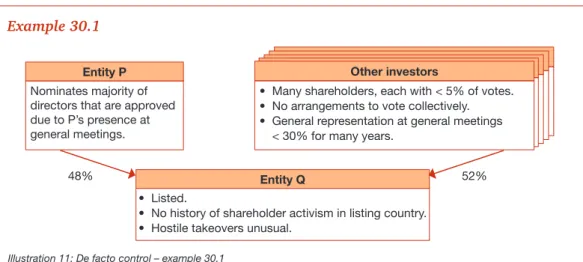
Example 30.1
Does P control Q? Solution
Applying the de facto control guidance,
(a) Relative size – P holds 48% as compared to other shareholders individually owning less than 5% each.
(b) Dispersion of other shareholdings – The other shareholders each own less than 5% so there would be at least 11 shareholders.
The examples in IFRS 10 concluded that:
(a) An investor with 48% voting rights and remaining shareholders holding less than 1% was sufficient to constitute power (IFRS 10.B43 example 4).
(b) An investor with 45% voting rights as compared to 11 other investors each holding (exactly) 5% was insufficient to constitute power (IFRS 10.B45 example 7).
P’s case lies in between the two examples and further analysis is required. Looking at the additional factors (see illustration 10 above),
(a) The remaining shareholders have not formed any group to vote collectively, they have not been well-represented in past general meetings, and there is no history of shareholder activism (IFRS 10.B45).
(b) Entity P dominates the nominations process for electing Q’s governing body (IFRS 10.B18c).
The additional factors may suggest that P controls Q. Illustration 11: De facto control – example 30.1
Nominates majority of directors that are approved due to P’s presence at general meetings.
Entity P Other investors
Many shareholders, each with < 5% of votes.
•
No arrangements to vote collectively.
•
General representation at general meetings
•
< 30% for many years.
Listed. •
No history of shareholder activism in listing country.
•
Hostile takeovers unusual.
•
Entity Q 52%
Example 30.2
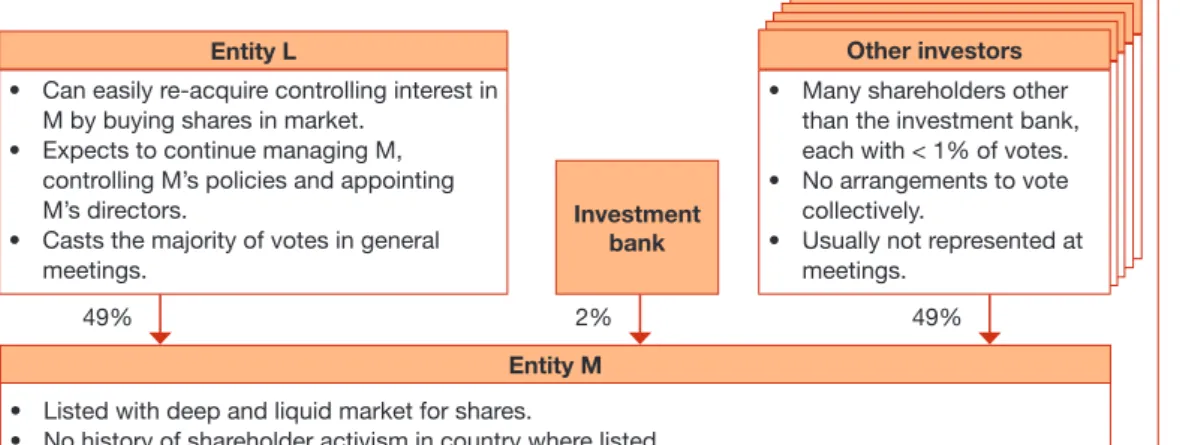
• Parent L has a 51% interest in listed entity M. L consolidates M.
• M is highly-leveraged and started making losses. L decided to sell 2% to an investment bank.
The post-sale structure, and additional information, is as follows:
Solution
L owns 49% as compared to other shareholders with holdings that are dispersed. It expects to go on appointing management and directing activities. L has the practical ability to direct the relevant activities of M (IFRS 10.B18).
The de facto control guidance in IFRS 10.B42 together with the factors in IFRS 10.B18, indicate that L controls M.
Illustration 12: De facto control – example 30.2 Can easily re-acquire controlling interest in
•
M by buying shares in market.
Expects to continue managing M, •
controlling M’s policies and appointing M’s directors.
Casts the majority of votes in general
•
meetings.
Entity L
Listed with deep and liquid market for shares. •
No history of shareholder activism in country where listed.
•
Entity M
Investment bank
Other investors
Many shareholders other
•
than the investment bank, each with < 1% of votes. No arrangements to vote
•
collectively.
Usually not represented at
•
meetings. 49% 2%
49%
Example 30.3
Investors 1 to 5:
are venture capital companies or institutional investors; •
do not participate at general meetings; and •
are known to meet with representatives of entity V and with each other. •
Solution
Applying IFRS 10.B42 principles:
(a) Relative size – T holds 30%, which is not that much higher than the other shareholders.
(b) Dispersion of other shareholdings – Remaining shareholdings are concentrated in five shareholders who do meet with each other. It may not be difficult for the remaining five shareholders to act together.
Example 6 in IFRS 10.B43 concluded that an investor does not have control as only Illustration 13: De facto control – example 30.3
Investor 1
Entity V
14% Investor 5
Investor 4 Investor 3 Investor 2
Entity T
14% 14% 14% 14%
Potential voting rights
31. Potential voting rights are defined as ‘rights to obtain voting rights of an investee, such as those within an option or convertible instrument.’ (IFRS 10.B47)
32. IFRS 10 specifies 3 issues to consider: (a) Substantive or protective?
Only substantive voting rights are considered in assessing power (IFRS 10.B47). Therefore voting rights should be assessed against the criteria for substantive rights specified by IFRS 10
(see illustration 7). (b) Purpose and design of
instrument and other involvement (IFRS 10.B48).
The purpose and design of the potential voting right instrument and the purpose and design of any other involvement the investor has with the investee should be assessed. This involves both an assessment of terms and conditions and the investor’s apparent expectations, motives and reasons for agreeing to those terms and conditions.
(c) Other voting or decision rights held by the investor (IFRS 10.B49). For example, ownership of a 20% option that is accompanied by a 40% shareholding may result in control (IFRS 10.B50).
Substantive rights
Other voting or decision rights Purpose and
design of instrument and
involvement
Potential voting rights
33. The following examples illustrate the application of the above principles. The analysis based on the existing
IAS 27/SIC 12 guidance has been included for comparison purposes.
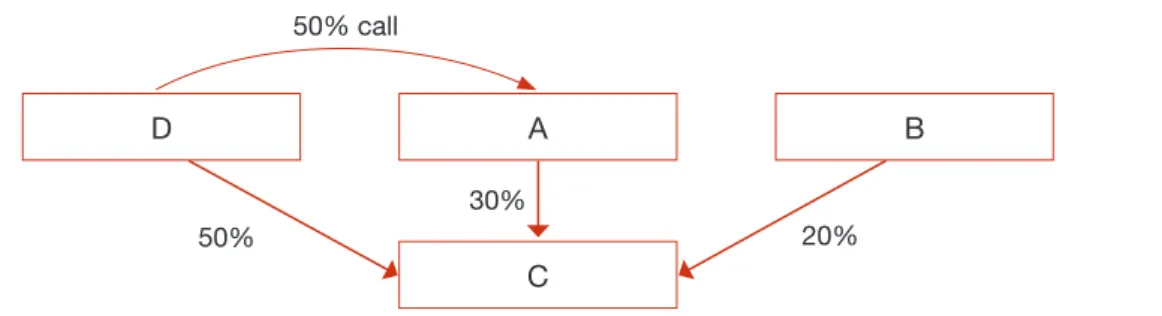
Example 33.1
A and B own 80% and 20% respectively of the voting shares of C. •
A sells a 50% interest to D and buys call options from D that are exercisable at any •
time at a premium to the market price on issue. The resulting structure is as follows:
Illustration 15: Potential voting rights example 33.1 Additional information about the call option:
If exercised, A would recover its original 80% interest and voting rights. •
The exercise price has economic substance and is not set deliberately high. •
The option is slightly out of the money at the reporting date. •
Is the call option substantive?
D A B
C
20% 30%
50%
50% call
IFRS 10 analysis IAS 27/SIC 12 analysis
The options held by A are at a premium to the market price upon issue and are slightly out of the money at the reporting date. However, it is necessary to consider whether A benefits for other reasons from the exercise of the options (for example, protection of interests, acquisition of assets). If that is the case, the options may be substantive, and A should consolidate C.
The options are out of the money when issued, but they are exercisable immediately. Hence, A has the power to govern the financial and operating policies of C and, as a consequence, C is determined to be a subsidiary of A.
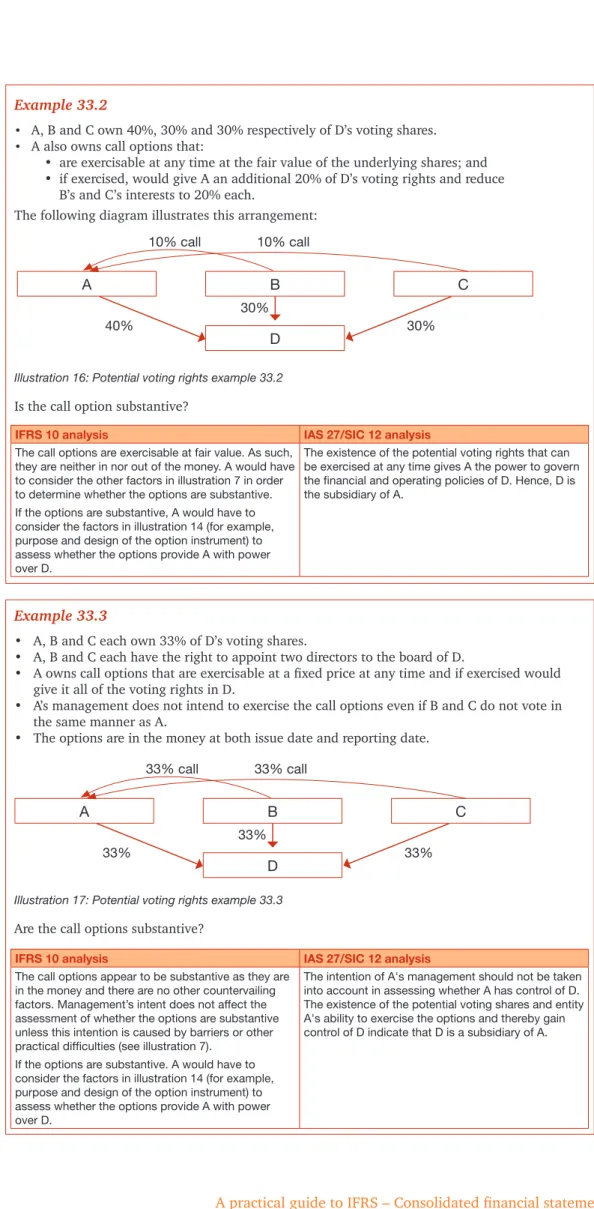
Example 33.2
A, B and C own 40%, 30% and 30% respectively of D’s voting shares. •
A also owns call options that: •
• are exercisable at any time at the fair value of the underlying shares; and • if exercised, would give A an additional 20% of D’s voting rights and reduce B’s and C’s interests to 20% each.
The following diagram illustrates this arrangement:
Illustration 16: Potential voting rights example 33.2
Is the call option substantive?
IFRS 10 analysis IAS 27/SIC 12 analysis
The call options are exercisable at fair value. As such, they are neither in nor out of the money. A would have to consider the other factors in illustration 7 in order to determine whether the options are substantive. If the options are substantive, A would have to consider the factors in illustration 14 (for example, purpose and design of the option instrument) to assess whether the options provide A with power over D.
The existence of the potential voting rights that can be exercised at any time gives A the power to govern the financial and operating policies of D. Hence, D is the subsidiary of A.
A B C
D 30%
30% 40%
10% call 10% call
Example 33.3
A, B and C each own 33% of D’s voting shares. •
A, B and C each have the right to appoint two directors to the board of D. •
A owns call options that are exercisable at a fixed price at any time and if exercised would •
give it all of the voting rights in D.
A’s management does not intend to exercise the call options even if B and C do not vote in •
the same manner as A.
The options are in the money at both issue date and reporting date. •
Illustration 17: Potential voting rights example 33.3
Are the call options substantive?
IFRS 10 analysis IAS 27/SIC 12 analysis
The call options appear to be substantive as they are in the money and there are no other countervailing factors. Management’s intent does not affect the assessment of whether the options are substantive unless this intention is caused by barriers or other practical difficulties (see illustration 7).
The intention of A's management should not be taken into account in assessing whether A has control of D. The existence of the potential voting shares and entity A's ability to exercise the options and thereby gain control of D indicate that D is a subsidiary of A.
A B C
D 33%
33% 33%
33% call 33% call
Structured entities
34. Voting rights may not have a significant effect on an investee’s returns. For example, voting rights might relate to administrative tasks only and contractual arrangements dictate how the investee should carry out its activities (IFRS 10.B17). These entities are described as ‘structured entities’ (IFRS 12.B21).
PwC observation: Previously, SIC 12 used the term ‘special purpose entities’ (SPEs) to mean those entities that are created to accomplish a narrow and well-defined objective, and stipulated separate consolidation criteria for these entities. This term is no longer used under IFRS 10. However, IFRS 12.B22(b) indicates that a narrow and well-defined objective may be an
identification characteristic for
structured entities. This suggests that a subset of former SPEs may qualify to be classified as ‘structured entities’. ‘Auto-pilot’ entities under SIC 12 are a key candidate for classification as ‘structured entities’.
35. All substantive powers in such entities may appear to have been surrendered to contracts that impose rigid control over the entities’ activities. None of the parties may appear to have power. However, entities may be indirectly controlled by one of the parties involved. Further analysis is required to determine if there is a party with control.
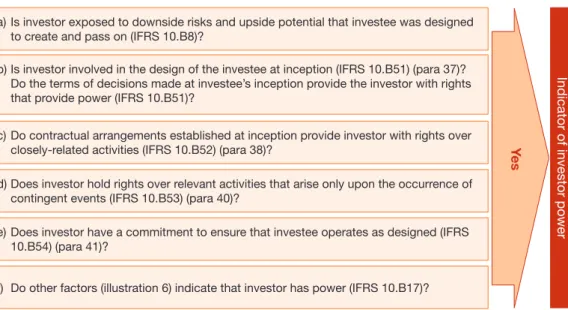
36. An investor should consider the following factors when determining whether it has power:
Indicator of investor power
Illustration 18: Structured entity considerations
(a) Is investor exposed to downside risks and upside potential that investee was designed to create and pass on (IFRS 10.B8)?
Yes
(b) Is investor involved in the design of the investee at inception (IFRS 10.B51) (para 37)? Do the terms of decisions made at investee’s inception provide the investor with rights that provide power (IFRS 10.B51)?
(c) Do contractual arrangements established at inception provide investor with rights over closely-related activities (IFRS 10.B52) (para 38)?
(d) Does investor hold rights over relevant activities that arise only upon the occurrence of contingent events (IFRS 10.B53) (para 40)?
(e) Does investor have a commitment to ensure that investee operates as designed (IFRS 10.B54) (para 41)?
(f) Do other factors (illustration 6) indicate that investor has power (IFRS 10.B17)?
Involvement and decisions made at the investee’s inception as part of its design
37. IFRS 10.B51 requires a consideration of the involvement of various
participants in the design of the investee at inception. Such involvement, by itself, is not sufficient to demonstrate control. However, participants who were involved in the design may have the opportunity to obtain powerful rights. Decisions made at the investee’s inception should be evaluated to determine whether the transaction terms provide any participant with rights that are sufficient to constitute power. Contractual arrangements established at investee’s inception
38. The structured entity is often governed not only by its constitution documents but by contracts that bind the structured entity to its original purpose. These include call rights, put rights, liquidation rights and other contractual arrangements that may provide investors with power. For example, the put right in example 41.1 ensures that the structured entity only needs to collect and pass on principal and interest, and provides X with the power to manage defaulted receivables.
39. When these contractual arrangements involve activities that are closely related to the investee, these are considered relevant activities. This is true even if the activities do not occur within the structured entity itself but in another entity. Example 41.1 illustrates this.
Rights to direct relevant activities that arise upon the occurrence of certain events
40. IFRS 10.B53 requires consideration of decision rights that take effect only when particular circumstances arise or events occur. An investor with these rights can have power even if those circumstances have not yet arisen.
Commitment to ensure that investee operates as designed
41. Such an explicit or implicit commitment by an investor may increase exposure to variability of returns and heighten the likelihood of control. However, on its own, this factor is insufficient to demonstrate power or prevent other parties from having power (IFRS 10.B54). The following example from IFRS 10 illustrates the above principles.
Example 41.1
An investee’s only business activity is to purchase receivables and service them on a •
day-to-day basis.
Servicing involves collection and passing on of principal and interest payments. •
Upon default, the investee automatically puts the receivable to investor X as agreed •
separately in a put agreement with investor X.
Does investor X have power over the investee? Solution
Yes.
• The only activity that significantly affects the investee’s returns is managing the receivables upon default.
• Servicing receivables before default is not a relevant activity. The actions are pre-determined and do not require substantive decisions that affect returns.
• Investor X controls the only relevant activity and therefore it has power over the investee.
This example demonstrates three additional points. For structured entities, the consolidation analysis is not affected by the following:
• X can only exercise its power upon a contingent event (that is, default). This is because a default is the only time when decisions are required. X can decide when decisions are needed, and therefore it has power, even though it may not be able to make decisions immediately (IFRS 10.B53).
• X’s power arises only from a side contract (the put agreement) rather than the incorporation documents of the investee.
The put agreement is integral to the overall transaction and the establishment of the investee and as such should be considered (IFRS 10.B52).
• Management of defaulted receivables takes place within X and not the investee – that is, X owns the defaulted receivables that it manages, not the investee.
Default of receivable
Activity 1:
Servicing receivables – collect and pass on principal and interest
Investee’s responsibility
Activity 2:
Collecting on defaulted receivables
Illustration 19: Structured entities – example 41.1
Investor X’s responsibility Receivables owned by investee Receivables owned by X
Variable returns
ControlPower Ability to use power to affect returns Variable returns
42. Variable returns are defined as returns that are not fixed and have the potential to vary as a result of the performance of an investee. They can be positive, negative or both (IFRS 10.B56).
43. A wide variety of possible returns are identified in IFRS 10, ranging from traditional dividends and interest to servicing fees, changes in the fair value of an investment, exposures arising from credit or liquidity support, tax benefits, access to future liquidity, economies of scale, cost savings and gaining proprietary knowledge (IFRS 10.B57).
44. Variability is assessed based on the substance of the arrangement regardless of legal form. For example, contractually-fixed interest payments could be highly variable if credit risk is high. Asset management fees that are contractually fixed could nevertheless be subject to variability if the investee has a high risk of non-performance (IFRS 10.B56).
Link between power
and returns –
principal vs. agent
ControlPower Ability to use power to Variable returns affect returns
45. An agent is a party engaged to act on behalf of another party (the principal). A principal may delegate some of its decision authority over the investee to the agent, but the agent does not control the investee when it exercises such powers on behalf of the principal (IFRS 10.B58). The decision-making rights of the agent should be treated as being held by the principal directly in assessing control. Power resides with the principal rather than the agent (IFRS 10.B59).
46. The overall relationship between the decision-maker and other parties involved with the investee must be assessed to determine whether the decision-maker acts as an agent. The standard sets out a number of specific factors to consider; several are determinative, but the majority are judgemental and need to be considered together in assessing the overall relationship.
Definitive considerations
Does any single party have the ability to remove the decision maker without cause (IFRS 10.B65)?
Principal Agent Yes
No
No Is the decision maker’s remuneration commensurate with his
skill level (IFRS 10.B69-B70)?
Does the remuneration agreement include only terms, conditions and amounts that are customarily present in arm’s-length contracts for similar services (IFRS 10.B69-B70)?
Scope of decision-maker’s authority over investee
Consider:
Decision-maker’s discretion over activities permitted by contracts/law (IFRS 10.B62) Purpose and design of investee (IFRS 10.B63)
Decision-maker’s involvement in design of investee (IFRS 10.B63)
Judgemental considerations
Rights held by other parties (IFRS 10.B64-B67)
Consider:
Number of parties required to act together to remove decision maker
Remuneration of decision-maker
Consider:
Magnitude/variability of decision-maker’s remuneration (IFRS 10.B68)
Decision maker’s exposure to variability of returns from other interests in the investee (IFRS 10.B71-B72)
Consider:
Magnitude/variability of decision-maker’s total economic interests Whether decision-maker’s exposure differs from other investors (e.g. subordinated interests)
No
Yes
Mor
e likely to be principal
Greater scope
Greater rights
Larger/more
variable remuneration
Larger
exposure
Illustration 20: Assessment of whether decision maker is principal or agent
Yes
47. IFRS 10.B72 illustrates the above principles with the following examples:
Example 47.1
A fund manager establishes, markets and manages a publicly-traded, regulated fund. The fund was marketed to investors as an investment in a diversified portfolio of equity securities of publicly-traded entities.
IFRS 10
criteria Additional facts relevant to assessment of IFRS 10 criteria
Scope of decision-maker’s authority
Fund manager is subject to narrowly defined parameters set out in the
•
investment mandate.
Within the defined parameters, the fund manager has discretion about the assets in
•
which to invest. Rights held by
other parties
Investors do not hold any substantive rights that would affect the decision-making
•
authority of the fund manager, but can redeem their interests within particular limits set by the fund.
The fund is not required to establish, and has not established, an independent board
•
of directors. Remuneration
of decision-maker
A market-based fee equal to 1 per cent of the fund’s net asset value.
•
The fees are commensurate with the services provided.
•
Decision-maker’s exposure to variability from other interests
Fund manager has a 10 per cent pro rata investment in the fund.
•
Fund manager does not have any obligation to fund losses beyond its 10 per cent
•
investment.
It has been assessed that the fund manager’s remuneration and investment does not
•
create exposure that is of such significance that it indicates that the fund manager is a principal.
Is the fund manager a principal? Solution
Consideration of the fund manager’s exposure to variability of returns together with its restricted decision-making authority indicates that the fund manager is an agent.
Example 47.2
A fund manager establishes, markets and manages a fund that provides investment opportunities to a number of investors. Is the fund manager principal or agent in examples A-C? These examples are considered in isolation.
IFRS 10
criteria Additional facts relevant to assessment of IFRS 10 criteria
Scope of decision-maker’s authority
Examples A-C
The fund manager must make decisions in the best interests of all investors and in
•
accordance with the fund’s governing agreements.
Despite this, the fund manager has extensive decision-making authority to direct the
•
relevant activities of the fund. Rights held
by other parties
Example A
The investors can remove the fund manager by a simple majority vote, but only for breach of contract.
Example B
Same as example A. Example C
The fund has a board of directors comprised entirely of directors that are independent
•
of the fund manager.
The board appoints the fund manager annually.
•
The services performed by the fund manager could be performed by other fund
•
managers. Remuneration
of decision-maker
Examples A-C
A market-based fee of
•
– 1% of assets under management; and
– 20% of profits if a specified profit level is achieved. Fees are commensurate with services provided.
•
The remuneration is intended to align the interests of the fund manager with those of
•
the other investors.
It is assessed that the remuneration, on its own, does not create sufficient exposure to
•
variability of returns for the fund manager to be a principal.
Decision-maker’s exposure to variability from other interests
Example A
The fund manager also has a 2% investment in the fund that aligns its interests with
•
those of the other investors.
The fund manager does not have any obligation to fund losses beyond its 2%
•
investment. Example B
The fund manager has a more substantial pro rata investment in the fund.
•
The fund manager does not have any obligation to fund losses beyond that investment.
•
Example C
The fund manager has a 20 per cent pro rata investment in the fund.
•
The fund manager does not have any obligation to fund losses beyond its
•
20% investment.
Solution
Example A The fund manager is an agent.
The market-based fee of 1% of assets and 20% of profits, as well as the 2%
•
investment does not create sufficient exposure for the fund manager to be a principal. The other investors’ rights to remove the fund manager are protective as they are
•
exercisable only for breach of contract.
Example B It depends on the amount of the fund manager’s investment in the fund.
For example, a 20% investment may be sufficient to conclude that the fund manager is
•
principal.
The amount of exposure that will result in principal classification will change in different
•
circumstances (for example, if the remuneration is different).
The other investors’ rights to remove the fund manager are protective, as in example A.
•
Example C The fund manager is an agent. The investors have substantive rights to remove the fund
Example 47.3
Is the asset manager a principal? Solution
The asset manager is a principal and thus has control.
• Holding 35% of the equity, in addition to the exposure provided by the fees, provides sufficient variability for the asset manager to be classified as a principal. • The right to remove the asset manager without cause receives lower emphasis in
this example, as this right is not easily-exercisable, requiring the concerted effort of a large number of widely-dispersed investors.
Illustration 21: Principal-agent analysis – example 47.3
Created to purchase a portfolio of fixed rate asset-backed securities (ABS).
•
Equity instruments absorb losses and are entitled to residual returns. •
Equity instruments represent 10% of asset value at formation. •
Debt was marketed as an investment in ABS with interest rate and credit risks.
•
Investee
Fixed-rate debt 65% equity
35% equity
Asset manager
Investment bank Investment bank Investment bank Investment bank Widely-dispersed
equity investors
IFRS 10 criteria Additional facts relevant to assessment of IFRS 10 criteria
Scope of decision-maker’s authority
The asset manager manages the active asset portfolio by making investment decisions within the parameters set out in the investee’s prospectus. Rights held by
other parties
The asset manager can be removed, without cause, by a simple majority
•
decision of the other investors.
The other equity and debt investors comprise of a large number of
widely-•
dispersed, unrelated third party investors. Remuneration of
decision-maker • – 1% of assets under management; andThe asset manager receives fees of:
– 10% of profits if profits exceed a specified level.
The fees are market-based and are commensurate with services provided.
•
The remuneration aligns the interests of the fund manager with those of other
•
investors. Decision-maker’s
exposure to variability from other interests
The asset manager holds 35% of equity in the investee.
Investment bank Investment bank Investment bank Investment bank Widely-dispersed
Example 47.4
Is the sponsor a principal? Solution
The sponsor appears to be a principal and thus has control.
• Sponsor’s exposure to variability of returns is significant, arising from both the sponsor’s entitlement to residual returns and the credit enhancement and liquidity facilities it provides. The exposure to liquidity risk is exacerbated by the fact that MSC uses short-term debt to fund medium-term assets.
• Sponsor has extensive authority over those decisions such as transferor selection, asset selection, and funding, which are likely to be the activities that most significantly affect the MSC’s returns.
The obligation to act in the best interest of all investors does not prevent the sponsor from being a principal.
Illustration 22: Principal-agent analysis – example 47.4
Multi-seller conduit (MSC) Investment bank Investment bank
Investment bankSponsor Investment bankUnrelated third- Investment bankInvestment bank party investors A decision-maker (the sponsor) sponsors a multi-seller conduit (MSC):
Investment bank Investment bank Investment bankTransferors Sell high-quality •
medium-term assets Manage defaulted •
receivables for market-based fee Provide first loss •
protection against credit losses through over-collateralisation of transferred assets
See additional •
information below
Invest in short-term •
debt, which has been marketed as having minimal credit risk
IFRS 10 criteria Additional facts relevant to assessment of IFRS 10 criteria
Scope of decision-maker’s authority
The sponsor establishes the terms of the MSC.
•
The sponsor:
•
– manages the operations of the MSC;
– approves the transferors permitted to sell to the MSC; – approves the assets to be purchased by the MSC; and – makes decisions about the funding of the MSC.
The sponsor must act in the best interests of all investors.
•
Rights held by other parties
The investors do not hold substantive rights that could affect the decision-making authority of the sponsor.
Remuneration of decision-maker
Sponsor receives a market-based fee that is commensurate with the services provided.
Decision-maker’s exposure to variability from other interests
Sponsor is entitled to residual return of the MSC.
•
Sponsor provides credit enhancement, which absorbs losses of up to 5% of all
•
of the MSC’s assets, after losses are absorbed by the transferors.
Sponsor provides liquidity facilities to the MSC. Liquidity facilities are not •
Other issues
48. Three further issues are addressed by IFRS 10:
(a) Determining whether the investor is a ‘de facto agent’;
(b) Determining whether an investor who has power over specified assets of an investee must regard those assets as a separate entity. IFRS 10 uses the term ‘silo’ to denote such an entity that has been ring-fenced for accounting purposes; and
(c) Frequency of reassessment with regards to whether an investor has control over an investee.
De facto agent
49. An agent need not be bound to the principal by a contract. IFRS 10 uses the term ‘de facto agents’ to describe agents who may be acting on behalf of principals even when there is no contractual arrangement in place. Identification of such relationships is expected to be highly judgemental. Consideration should be given to the nature of relationships between the investor and various parties and how they interact with each other (IFRS 10.B73).
50. The standard identifies a number of possible de facto agent/principal relationships including:
(a) IAS 24 related parties of the principal;
(b) parties that received interests in the investee as a contribution or loan from the principal;
(c) parties that agreed not to sell, transfer or encumber their interests in the investee without the
principal’s approval; (d) parties that cannot finance
operations without subordinated financial support from the principal;
(e) parties that have largely similar governing body members or key management personnel as the principal; and
(f) parties that have close business
indirect exposure to variable returns through the de facto agent when assessing control of the investee (IFRS 10.B74).
Silos
52. Specified assets of an investee are deemed to be a separate entity for accounting purposes (a ‘silo’) when, in substance:
(a) the specified assets and related credit enhancements, if any, are the only source of payment for the investor’s interest in the investee; and
(b) parties other than the investor do not have rights or obligations over the specified assets and the cash flows from those assets.
53. If assets constitute a silo, the investor must then determine whether it can control the silo (IFRS 10.B78) based on the IFRS 10 criteria.
54. The silos that meet the above conditions are excluded from consolidation if another investor controls and consolidates the entity that contains the silos (IFRS 10.B79).
Frequency of reassessment
55. Reassessment of control is required if facts and circumstances indicate changes to the elements of control (IFRS 10.B80).
56. IFRS 10 highlights that control can change when:
(a) decision-making mechanisms change (for example, change from a substantive voting system to an ‘auto-pilot’ mechanism)
(IFRS 10.B81);
(b) events occur, even if they do not involve the investor (for example, lapse of decision-making rights by another party) (IFRS 10.B82); (c) an investor’s exposure or rights to
variable returns change (IFRS 10.B83); and
(d) the relationship between an agent and a principal changes (IFRS 10.B84).
Accounting requirements
57. The accounting for consolidation has remained largely consistent with the existing IAS 27 guidance.
58. Additional guidance has been provided in respect of potential voting rights. IFRS 10 specifies that allocation of profits and assets to the parent company and non-controlling interests for consolidation purposes is usually based on present ownership interests. However, where potential voting rights or other derivatives, in substance, give access to the economic benefits associated with an ownership interest, the allocation of profits and assets is determined by taking into account the eventual exercise of those potential voting rights and derivatives. Such potential voting rights and derivatives are not accounted for using either IAS 39 or IFRS 9.
Disclosures
59. The disclosure requirements for subsidiaries are not spelt out in IFRS 10 itself; they are in IFRS 12 ‘Disclosure of interests in other entities’.
General objective of IFRS 12
60. The objective of IFRS 12 is to disclose information that helps financial statement readers to evaluate the nature, risks and financial effects associated with the entity’s interests in subsidiaries, associates, joint arrangements and unconsolidated structured entities (IFRS 12.1). Reporting entities should disclose any information that is necessary to meet this objective (IFRS 12.3).
Scope of disclosures
61. IFRS 12 applies to interests in subsidiaries, joint arrangements, associates and unconsolidated
structured entities. This practical guide
sets out disclosures for subsidiaries and unconsolidated structured entities. 62. IFRS 12 disclosures only apply to
involvements that meet the definition of ‘interests in’ another entity. IFRS 12 provides detailed guidance on what is meant by ‘interests in’ another entity. This question takes on particular relevance with regards to disclosures for unconsolidated structured entities as it determines the scope of such disclosures. For example, do banks have to make those disclosures for swap customers that are structured entities?
63. IFRS 12 defines ‘interest in another entity’ as an involvement that: • can be contractual or
non-contractual;
• exposes an entity to variability of returns from the performance of the other entity;
• examples include: – equity or debt holdings; – provision of funding; – liquidity support; – credit enhancement; – guarantees;
• includes control, joint control or significant influence; and • does not arise solely because
of a typical customer-supplier relationship.
64. The purpose and design of a structured entity should be considered in making a judgement as to when a relationship represents an ‘interest’ (IFRS 12.B7). 65. Only instruments that absorb
variability of returns from the investee qualify as ‘interests’ (IFRS 12.B8). Instruments that transfer risk to the investee create variability for the investee but do not typically expose the reporting entity to variability (IFRS 12.B9). Such instruments do not qualify as ‘interests’. The following examples from IFRS 12.B8 and B9 illustrate this.
Example 65.1
Example 65.2
The following structured entity was set up to provide investment opportunities to investors.
Does the swap counterparty have an ‘interest’ in the structured entity? Solution
The swap counterparty does not have an ‘interest’ in the structured entity because the CDS transfers variability to the structured entity, rather than absorbing variability of returns of the structured entity.
A structured entity holds a loan portfolio. •
The structured entity obtains a credit default swap from the reporting entity to •
protect itself from the default risk.
Does the reporting entity have an ‘interest’ in the structured entity? Solution
The reporting entity has involvement that exposes it to variability of returns from the performance of the structured entity because the credit default swap absorbs variability of returns of the structured entity.
Illustration 23: Identifying ‘interest’ in an entity - example 65.2 Investors
Swap counterparty
Structured entity Risk-free debtors
Credit default swap (CDS) to transfer Z’s credit risk to structured entity
Notes linked to credit
risk of third party (Z) Risk-free notes Proceeds Proceeds
Fee
66. IFRS 12 does not apply to the following:
(a) post-employment benefit plans or other long-term employee benefit plans to which IAS 19 applies; (b) separate financial statements to
which IAS 27 applies; however, disclosures of unconsolidated structured entities are required if the entity only prepares separate financial statements;
(c) an interest held by an entity that participates in, but does not have joint control of, a joint arrangement unless that interest results in significant influence over the joint arrangement or is an interest in a structured entity; (d) an interest that is accounted
Aggregation of disclosures
67. IFRS 12 allows reporting entities to judge the level of detail required in the disclosures and the emphasis of the disclosures. Disclosures should be aggregated or disaggregated as appropriate to avoid either obscuring useful information or including voluminous insignificant detail (IFRS 12.4, IFRS 12.B2). IFRS 12 provides that:
(a) aggregation should be consistent with the disclosure objective in paragraph 60 (IFRS 12.B3); (b) interests in subsidiaries, joint
ventures, joint operations, associates and unconsolidated structured entities should be