http://www.ijpediatrics.com pISSN 2349-3283 | eISSN 2349-3291
Original Research Article
Specific learning disability: a 5 year study from India
Shipra Singh
1*, Vishal Sawani
2, Mahesh Deokate
3, Saminder Panchal
4, Alka A. Subramanyam
5,
Henal R. Shah
5, Ravindra M. Kamath
5INTRODUCTION
Specific learning disability (SLD) is a developmental disorder, manifesting as difficulty in reading, writing, comprehending or using language, calculations, wherein the child has normal intelligence and conventional schooling, adequate motivation and opportunity, and
intact hearing and visual capacity.1-4 The child may also have ineffective information processing, thereby affecting his prioritizing and organizing abilities.
About 5-15% of school-going children have this disability.2 Dyslexia is the most common and most studied one, affecting 80% of all those identified as
ABSTRACT
Background: Specific learning disability (SLD) is an important cause of academic underachievement among children, which often goes unrecognized, due to lack of awareness and resources in the community. Not much identifiable data is available such children, more so in Indian context. The objectives of the study were to study the demographic profile, risk factors, co-morbidities and referral patterns in children with specific learning disability. Methods: The study has a descriptive design. Children diagnosed with SLD over a 5 years’ period were included, total being 2015. The data was collected using a semi-structured proforma, (based on the aspects covered during child’s comprehensive assessment at the time of visit), which included socio-demographic aspects, perinatal and childhood details, scholastic and referral details, and comorbid psychiatric disorders.
Results: Majority of the children were from English medium schools, in 8-12 years’ age group, with a considerable delay in seeking medical help, were referred mostly by the teachers for academic issues. Most of them had all the three disabilities-dyslexia, dysgraphia and dyscalculia. 38.56% of children had ADHD. Psychological maternal stress, developmental issues and various co-morbidities were accompanying in many cases, of which speech delay and fine motor issues were more in children having comorbid ADHD.
Conclusions: Awareness, early identification and referral to appropriate services is crucial to deal with the challenge of learning disability. Health professionals should look for early signs in routine visits of children and co-morbidities, particularly ADHD, should be adequately taken care of. Role of media and education system is crucial for its destigmatization in community.
Keywords: ADHD, Comorbidity, Risk factors, Referral, Specific learning disability 1Department of Psychiatry, Dr. R.M.L. Hospital and PGIMER, Delhi, India
2Consultant Psychiatrist, Mumbai, Maharashtra, India
3Department of Psychiatry, Jagdale Mama Hospital, Solapur, Maharashtra, India
4Department of Psychiatry MM Institute of Medical Sciences and Research, Ambala, India
5Department of Psychiatry, B. Y. L. Nair Hospital and T. N. Medical College, Mumbai, Maharashtra, India
Received: 26 January 2017 Revised: 04 March 2017 Accepted: 09 March 2017
*Correspondence: Dr. Shipra Singh,
E-mail: [email protected]
Copyright: © the author(s), publisher and licensee Medip Academy. This is an open-access article distributed under the terms of the Creative Commons Attribution Non-Commercial License, which permits unrestricted non-commercial use, distribution, and reproduction in any medium, provided the original work is properly cited.
learning-disabled. There are significant gender differences: boys are more often affected in developmental dyslexia than girls (4:1). However, in developmental dyscalculia and language difficulties, there are no noticeable differences.5 Considering Indian scenario, information about SLD is sparse. The incidence of dyslexia in Indian primary school children has been reported to be 2-18%, dysgraphia 14%, and dyscalculia 5.5%. However, its awareness as a significant cause of academic underachievement has recently increased.6
Various factors are implicated in understanding SLD. Social variables like socioeconomic stress and maternal education have links with school performance.7,8 Genetic basis of dyslexia has also been identified.9 Various perinatal factors, like low birth weight (LBW) and prenatal stress can indirectly affect attention, leading to attention deficit hyperactivity disorder (ADHD), a common co-morbidity with SLD.10,11
Co-morbidity in SLD is more of a rule than an exception. Dyslexia is common in ADHD and conduct disorders. Around 40 percent of children with ADHD also meet diagnostic criteria for dyslexia, and major link appears to be the inattention dimension. SLD is widely associated with affective disorders, particularly depression, deficits in social skills, self-esteem; peer relationship problems, feelings of lack of control and poor self-esteem.12 Common behavioral signs of learning disabilities fall within two categories, internalizing and externalizing.4 Students who internalize show behaviors that mostly affect themselves and are sometimes overlooked by others. Students with externalizing behaviors have a more obvious effect on those around them and are usually recognized earlier as having problems. Both these groups are at-risk for being seen as being problems rather than having problems.11,13
Karande et al found that about 40 percent of the sample of Indian children with SLD had developed aggressive or withdrawn behavior,14 for which, identified reason was lack of awareness about the disorder.15 Their referral is often made for reasons other than academic, and that too after a substantial delay in identification of the symptoms.16
The increasing focus on child mental health in developing countries like India points to the importance of epidemiological research in developing training, service and research paradigms. As there is need of more identifiable data, we planned to study the overall pattern of risk factors, co-morbidities and referral patterns of children with SLD. Also, high co-occurrence of ADHD, led us comparing certain parameters between those having SLD with and without ADHD.
METHODS
The study was conducted in the Learning Disability Clinic of a tertiary care hospital. The children who were
seen in this clinic were assessed by two psychiatrists for the learning problems, as well as for any other co-morbidities - physical or psychiatric. Parents and the child, both were interviewed. Children were screened for hearing and visual impairments. Thereafter, they were seen by a faculty from Developmental Pediatrics for any neurological issues, which can play a role in child’s scholastic performance. Trained and certified psychologists evaluated for learning difficulties, using batteries like Woodcock Johnson. In particular cases, occupational therapy assessment was also performed to look for hyperactivity, incoordination or sensory abnormalities. A child diagnosed with any comorbid psychiatric illness was first treated for the same, and then evaluated after being stabilized. Finally the diagnosis would be made with consensus of the mentioned professionals of the team. All the assessments are compiled and a meticulous yearly record of all these has been maintained right after the establishment of this LD clinic.
In our study, children diagnosed having SLD in past 5 years, were included, total being 2015. A semi-structured proforma was constructed (based on the information in the records of the LD clinic) which consisted of demographic details, perinatal events, referral pattern and co-morbidities of included children frequency computation was done.
RESULTS
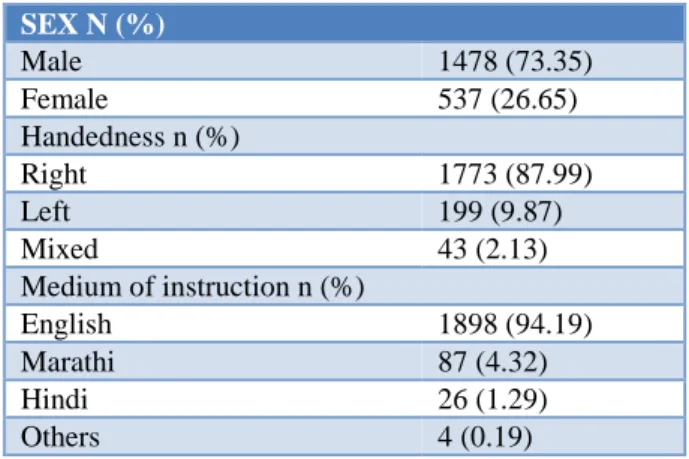
Table 1 shows demographic details of the sample. Out of the total studied 2015 case records, 73.35% were males; male to female ratio being 2.75:1. Mean age was 12.9 years and 87.99% were right handed. 67.14% were from state board schools and had English as their medium for instructions (94.19%).
Table 1: Demographic profile of the children having SLD.
SEX N (%)
Male 1478 (73.35)
Female 537 (26.65)
Handedness n (%)
Right 1773 (87.99)
Left 199 (9.87)
Mixed 43 (2.13)
Medium of instruction n (%)
English 1898 (94.19)
Marathi 87 (4.32)
Hindi 26 (1.29)
Others 4 (0.19)
was the next most common diagnosis (9.73%). Mean verbal Intelligence quotient (IQ) was 99.57 and performance IQ 106.95. 45.11% children had discrepancy of more than 15 points in verbal and performance quotient and 16.28% children had language barrier. 6.05% had siblings having academic difficulties and siblings of 3.77% children were diagnosed with SLD.
Risk factor profile
There were 25 adopted children in this study, for whom antenatal or birth related details were not available. Considering the perinatal factors of the rest, psychological stress to mother was present during pregnancy in 10.17% of the study group, as elicited on history. Delivery of the child was normal in 72.04% and the rest were Caesarean section or assisted. 9.48% of the mothers of these children suffered from antenatal complications, commonest being pregnancy-induced hypertension (3.17%), followed by fever, bleeding per vagina and gestational diabetes mellitus. Pregnancy was preterm in 6.5%, post term in 1.84% and term in the rest. 14.54% children had post-natal complications, the commonest being jaundice in 10.14%, followed by hypoxia and seizures. It was found that 4.81% of the children did not cry immediately after birth and 11.11% had low birth weight (LBW). Speech milestones were delayed in 15.38%; 65% had delayed motor development and 6.94% children had speech deficits like stammering. Table 2 shows certain visuo-spatial and fine motor deficits in these children.
Table 2: Some associated deficits in the children having SLD.
Ability N (%)
Fine motor issues 346 (17.17) Right left confusion 100 (4.96) Difficulty in telling time seeing the clock 754 (37.41)
Referral pattern
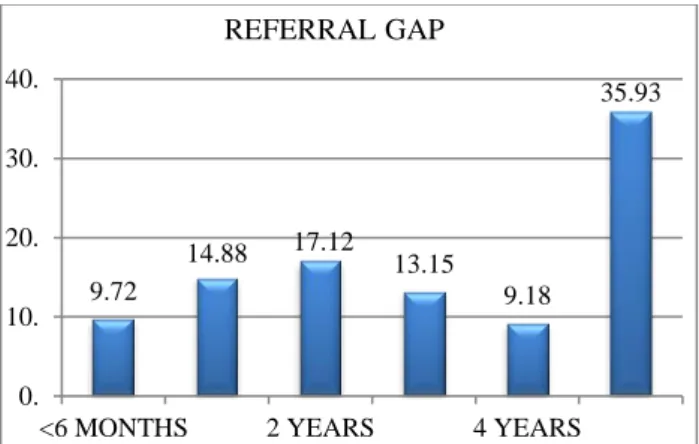
According to the parents’ report, symptoms were noticed initially during 8-12 years of age in around 46.74% of the children and thereafter in the 4-8year age group (36.03%); and majority (63.87%) of them were related to academic issues. However, still a large number were identified due to other behavior or inattention related problems. Most of them were referred by teachers (46.38%) or parents (32.22%) or both (18.11). 9.8% of them also reported issues with peer groups. The referral gap between onset of symptoms and referral is shown in Figure 1.
Co-morbidities
Out of 2015 studied cases, 38.56% (i.e.777) had co-existing ADHD. Further associated conditions were nocturnal enuresis, anxiety, and others, as shown in Figure 2.
Figure 1: shows the gap between the onset of symptoms and the referral (in %).
Figure 2: Co-morbidities in children having specific learning disorder (in %).
Comparison between SLD and SLD with ADHD group
As ADHD was found in such a high number, two groups were seen emerging, i.e., SLD with and without ADHD. The SLD with ADHD group had 81.47% male as against 68.17% in pure SLD one; male to female ratio being 4.39:1 and 2.14:1 in the two groups respectively. Handedness and average IQ (both verbal and performance) were nearly similar (Table 3). Number of school drop - outs was 29 (2.34%) in the SLD without ADHD and 14 (1.80%) in the other group.
Table 3: Intelligence quotient in children having LD with and without ADHD.
SLD N (%) SLD with ADHD N (%)
Average VQ 99.47 99.62 Average PQ 107.13 106.54
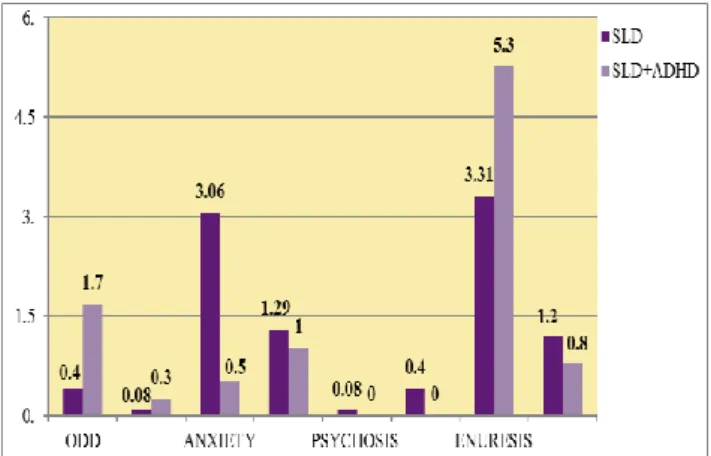
Considering the development, delay in motor milestones was similar in two groups (5% and 6.17%) but speech delay was more in children having SLD with ADHD, i.e. 16.98% as against 14.05% of children having only SLD. Children having co-morbid ADHD had more fine motor issues (21.23%) and right left confusion (6.3%) as against the other group (14.6% and 4.03% respectively). ODD and nocturnal enuresis, was found higher in the children
9.72
14.88 17.12 13.15 9.18
35.93
0. 10. 20. 30. 40.
<6 MONTHS 2 YEARS 4 YEARS
REFERRAL GAP
38.56
6.94 1.14
19.25 9.28
0.39 2.67 31.81
2.92 0.
10. 20. 30. 40. 50.
with co-morbid ADHD; whereas those without ADHD had higher co-morbid anxiety disorder (Figure 3).
Figure 3: Co-morbidities in children having SLD with and without ADHD (IN %).
DISCUSSION
In this study, male to female ratio was 2.75:1. Earlier studies have found SLD occurring more in boys, but recent ones found no difference.4,17 Higher number of males has been considered to be the result of referral bias by various authors.14,18 Handedness was nearly similar to what exists in general population.19
2.13% of them were school dropouts. Zigmond et al in his study found 50% of the youth with learning disabilities (in comparison to 33% of their peer group) had left school before graduation.20 30.3% of the students in our study had changed their schools at least once because of not being able to cope or failing in class, as stated by other studies as well.21 Mean IQ here, was nearly similar to previous studies, including those in Indian children.12,14,22
Majority students (87.94%) in our study had all three disabilities- dyslexia, dysgraphia and dyscalculia. Karande et al found 58% children had the three diagnoses with co-occurring ADHD.14 In our study, 16.28% also had associated language barrier. In India, most of the children are bilingual and first generation English learners; hence possibility of language barrier is very strong, as in any other country where second language is being taken up.23
In present study, 6.05% children had siblings with some academic issues and 3.77% had diagnosed SLD. Family studies indicate that around 50% of siblings of child with learning disability may have this disorder.4,12
Considering the various probable risk factors, Talge et al found children with mothers having antenatal stress more likely to have emotional or cognitive problems, including an increased risk of attention deficit or hyperactivity, anxiety, and language delay; in relation to the HPA axis activity of the two.11 Previous research also shows link
between LBW and SLD or cognition.24,25 4.81% of children had delayed cry in our study, which may not necessarily reflect a hypoxic insult but studies indicate that perinatal issues primarily affect growth and cognition.26-29 Regarding development, Darya et al found that delayed gross motor development and early evidence of speech problems predict risk of reading impairment. The problems within reading, speech, and motor domains could have a common biological substrate operating through the cerebellum.Poorer reading ability is earlier found associated with lower language and cognitive scores.30,31
On analyzing referral pattern of the children, mean age was found to be 12.9 years, which appears quite late when onset of the disorder per se is viewed. Earlier studies have found varied results.18,31 In our study, the symptoms in most cases were noticed between 8-12 years of age, related to academic issues, and were referred by teachers or parents. This might be because of inclusion of the subject of SLD in the modified B. Ed (Bachelor of Education) curriculum. However, various reasons have been quoted for such referrals by other authors, including academic, behavioural, non academic, even medical ones or a combination of these.2,16,18 Majority students were referred for either academic or both academic and behavioural reasons.14 We noticed a significant delay in referral in many children, which shows lack of awareness about the disorder among parents, inadequately trained teachers for identifying and referring the child for assessment, waiting to the extent until the situation become unmanageable, lack of knowledge in health professionals and inadequate resources.
Children with SLD are known to have peer issues. They develop behavioural problems such as aggressive and withdrawn behaviours and inadequate communications because of lack of self-esteem and frustration due to poor scholastic performance.32 According to Cheryl et al, these children had fewer peers for support, while dealing with an academic stressor or an interpersonal problem.23
Children with SLD are at increased risk for other psychiatric disorder, seen in both epidemiological and referred samples.33 In particular ADHD, inattention type and conduct Disorder (CD) are found related to reading difficulties.34 The degree of overlap between ADHD and dyslexia has been reported to be 35%.35
Enuresis was found in 31.81% of our sample, much higher than its prevalence in normal population, i.e. 3% in girls and 7% in boys. This is suggested to be related to deficits in the maturation of the central nervous system.4
During the course of the study, we found two groups emerging: SLD with and without ADHD. Comparing a few variables, we found that male to female ratio was 4.39:1 and 2.14:1 in the two groups respectively. Studies also suggest that the relation between ADHD and SLD is stronger for males than for females.33,36 No considerable difference was found in handedness and IQ of the two groups, which is against the findings of Jepsen et al that there is modest association between IQ and ADHD, with the mean influence on IQ probably amounting to two to five IQ points.37 This was probably because the children who came for assessment of SLD in our hospital, if found to have ADHD, were initially treated for the same, and only after symptomatic control, were taken up for further SLD evaluation, including IQ, which suggests that improvement in ADHD symptoms can probably lead to better performance. Considering the development, delay in speech was more in children with co-morbid ADHD. Also, this group had higher fine motor issues, which is in accordance with the disorder of ADHD. Comparing co-morbidities, anxiety was found more in the SLD without ADHD children; and ODD, CD and enuresis more with co-existing ADHD, as stated by Willicut as well, suggesting that significant relation between SLD and CD is mediated by co-morbid ADHD.36
CONCLUSION
We found that majority of the children belonged to 8-12 years age group, were referred by teachers, mostly for academic issues and had all three disabilities-dyslexia, dysgraphia and dyscalculia. However, sizeable delay was seen between the onset of symptoms and seeking medical help. Antenatal complications, birth weight and maternal stress did not seem to stand out in these cases. Speech delay, fine motor issues and visuo-spatial deficits were found in a considerable number; more in the children having co-morbid ADHD. ADHD, Enuresis and anxiety were the most commonly found co-morbidities, although anxiety and depression were commonly associated with children having SLD without ADHD, and enuresis and conduct disorder with those having SLD with ADHD. Evaluating the data of 2015 cases, we can infer that improvement in such children would require a comprehensive approach- awareness programs for teachers and parents for early identification and intervention of learning issues and associated problem behavior. Media can play a very significant role in creating a clear and discrete understanding of the disorder in the community. However, this study was retrospective; a prospective and longitudinal research would lead to better results.
ACKNOWLEDGEMENTS
We would like to thank the team of the LD clinic.
Funding: No funding sources Conflict of interest: None declared Ethical approval: Not required
REFERENCES
1. LDA position statement, adopted by the LDA board of directors September 22, learning disability association of America; 2012.
2. Karande S, Bhosrekar K, Kulkarni M, Thakker A. Health-related quality of life of children with newly diagnosed specific learning disability. J Trop Pediatr. 2009;55:160-9.
3. Karande S, Venkataraman R. Self-perceived health-related quality of life of Indian children with specific learning disability. J Postgrad Med. 2012;58:246-54.
4. Shaywitz SE. Dyslexia. N Engl J Med. 1998;338(5):307-12.
5. Goswami U. Learning difficulties: future challenges. In: Cooper CL, Field J, Goswami U, Jenkins R, Sahakian BJ editors. Mental capital and wellbeing. UK: John Wiley and Sons; 2008:727-766.
6. Karande S, Kulkarni M. Specific learning disability: the invisible handicap. Indian Pediatr. 2005;42:5-9. 7. Hollomon H, Dobbins D, Scott K. The effects of
biological and social risk factors on special education placement: Birth weight and maternal education as an example. Res Dev Disabil. 1998;19:281-94.
8. Stanton-Chapman TL, Chapman DA, Scott KG. Identification of early risk factors for learning disabilities. J Early Interv. 2001;24(3):193-206. 9. Snowling MJ, Muter V, Carroll J. Children at family
risk of dyslexia: a follow-up in early adolescence. J Child Psychol Psychiatry. 2007;48:609-18.
10. King S, Laplante DP. The effects of prenatal maternal stress on children's cognitive development: Project Ice Storm. Stress. 2005;8:35-45.
11. Talge NM, Neal C, Glover V. Antenatal maternal stress and long: term effects on child neurodevelopment: how and why? J Child Psychol. 2007;48:245-61.
12. Willcutt EG, Pennington BF. Psychiatric comorbidity in children and adolescents with reading disability. Journal of Child Psychology and Psychiatry. 2000;41:1039-48.
13. Miller CJ, Hynd GW, Miller SR. Children with dyslexia: Not necessarily at risk for elevated internalizing symptoms. Read Writ. 2005;18:425-36.
and co-occurring attention-deficit hyperactivity disorder. Indian J. Med Sci. 2007;61:639-47. 15. Crawford SG. Specific learning disabilities and
attention-deficit hyperactivity disorder: Under- recognized in India. Indian J. Med Sci. 2007;61:637. 16. Anderson PL, Cronin ME, Miller JH. Referral reasons for learning disabled students. Psychol Sch. 1986;23:388-95.
17. Shapiro BK, Gallico RP. Learning disabilities. Pediatr Clin North Am. 1993;40:491-505.
18. Picton TA, Karki C. Referral patterns of children to a psychiatric learning disability service. Brit J Dev Disabil. 2002;48:53-9.
19. Holder MK. Why are more people right-handed?;
2008. Available form:
http://www.scintificamerican.com/article.cfm [Accessed 2008-04-14].
20. Zigmond N, Thornton H. Follow-Up of Postsecondary-Age Rural Learning Disabled Graduates and Dropouts. Except Child. 1989;56:40. 21. Geisthardt C, Munsch J. Coping with school stress: A comparison of adolescents with and without learning disabilities. J Learn Disabil. 1996;29:287-96.
22. Panicker AS, Hirisave U, Subbakrishna DK. WISC-III [superscript uk]: Comparison of Indian and UK norms. J. Indian Assoc Child Adolesc Ment Health. 2006;2:108-11.
23. Roseberry-McKibbin C, Brice, A. Acquiring English as a second language. ASHA Lead. 2000;5:4-7.
24. Johnson EO, Breslau N. Increased risk of learning disabilities in low birth weight boys at age 11 years. Biol Psychiatry. 2000;47:490-500.
25. Tandon A, Kumari S, Ramji S, Malik A, Singh S, Nigam VR. Intellectual psycho-educational and functional status of low birth weight survivors beyond 5 years of age. Indian J Pediatr. 2000;67:791-6.
26. Ounsted M, Moar VA, Cockburn J, Redman CW. Factors associated with the intellectual ability of children born to women with high risk pregnancies. BMJ (Clinical research ed.). 1984;288:1038. 27. Esser G, Schmidt MH. Children with specific
reading retardation: Early determinants and
long-term outcome. Acta Paedopsychiatr. 1984;56:229-37.
28. Xiong X, Mayes D, Demianczuk N, Olson DM, Davidge ST, Newburn-Cook C, Saunders LD. Impact of pregnancy-induced hypertension on fetal growth. Am J Obstet Gynecol. 1999;180:207-13. 29. Silva PA, McGee ROB, Williams S. A seven-year
follow-up study of the cognitive development of children who experienced common perinatal problems. J Paediatr Child Health. 1984;20:23-8. 30. Gaysina D, Maughan B, Richards M. Association of
reading problems with speech and motor development: results from a British 1946 birth cohort. Dev Med Child Neurol. 2010;52:680-1. 31. Green K, Williams C, Wright B, Partridge I.
Developing a child and adolescent mental health service for children with learning disabilities. Psychiatr Bull. 2001;25:264-7.
32. Mugnaini D, Lassi S, La Malfa G, Albertini G. Internalizing correlates of dyslexia. World J Pediatr. 2009;5:255-64.
33. Carroll JM, Maughan B, Goodman R, Meltzer H. Literacy difficulties and psychiatric disorders: evidence for comorbidity. J Child Psychol Psychiatr. 2005;46:524-32.
34. Hinshaw SP. Externalizing behavior problems and academic underachievement in childhood and adolescence: causal relationships and underlying mechanisms. Psychol Bull. 1992;111:127.
35. Fletcher JM, Shaywitz SE, Shaywitz BA. Comorbidity of learning and attention disorders: Separate but equal. Pediatr Clin North Am. 1999;46:885-97.
36. Willcutt EG, Pennington BF, DeFries JC. Twin study of the etiology of comorbidity between reading disability and attention-deficit/hyperactivity disorder. Am J Med Genet. 2009;96:293-301. 37. Jepsen JRM, Fagerlund B, Mortensen EL. Do
attention deficits influence IQ assessment in children and adolescents with ADHD? J Atten Disord. 2008;12:551-62.