Short communication
Evaluation of the general health of the infertile couples
Mohammad Hossein Baghiani Moghadam1 Ph.D., Amir Hosein Aminian2 M.Sc., Ali Mohammad Abdoli3 M.D., Najmeh Seighal4 B.Sc., Hosein Falahzadeh5 B.Sc., Nasrin Ghasemi5 M.D., Ph.D.
1Department of Health Education, Faculty of Health, Shahid Sadoughi University of Medical Sciences, Yazd, Iran.
2Department of Psychology, Consultation Center, Shahid Sadoughi University of Medical Sciences, Yazd, Iran.
3Research and Clinical Centre for Infertility, Shahid Sadoughi University of Medical Sciences, Yazd, Iran.
4Department of General health, Faculty of Health, Shahid Sadoughi University of Medical Sciences, Yazd, Iran.
5Department of Medical Genetics, Research and Clinical Centre for Infertility, Shahid Sadoughi University of Medical Sciences, Yazd, Iran.
Received: 25 September 2010; accepted: 18 May 2011
Abstract:
Background:
The prevalence of infertility is variable between 5-30% around the world.
In Iran, more than 2 million couples suffer from infertility. Infertility causes depression,
anxiety, social isolation and sexual dysfunction.
Objective:
This descriptive study was undertaken to determine general health in
infertile couples.
Materials and Methods:
One hundred and fifty infertile couples attending Yazd
Research and Clinical Center for Infertility were randomly selected during March till
September 2009. The GHQ-28 questionnaires were completed by researchers, based on
face to face interview. It contains 28 items, which have been divided to four sub- items.
The results come out by scoring the patients answer from 0 to 84. All data were
analyzed by Chi-square and t-test in SPSS software.
Results:
GHQ scores of all sub-scales and total in women were more than men, which
shows general health condition in women is worse than men. There was no relation
between the duration of infertility and general health scores.
Conclusion:
This study suggests that the infertility has significant effect (p=0.001) on
health situation of infertile couples, especially infertile women. They are at risk of
somatic symptoms (p=0.0001), social dysfunction (p=0.0001) and severe depression
(p=0.0001). GHQ could provided help and support in order to improve the health
situation of infertile couples.
Key words: GHQ-28, Infertile couples, Sub- scales of GHQ.
Introduction
Infertility causes a big social distress and it is accompanied by numerous psychological and
Coresponding Author:
Nasrin Ghasemi, Department of Medical Genetics, Research and Clinical Centre for Infertility, Shahid Sadoughi University Medical Sciences, Yazd, Iran.
Email: [email protected]
social problems. Sub fertility affects 10-15% of individual in western world (1). The prevalence of infertility in the different countries is variable between 5-30% and in Iran more than 2 million infertile couples were found (2). Infertility is one of the major crises of life (3), which could cause depression, anxiety, social isolation and sexual dysfunction (4, 5). Infertile couples are more anxious and emotionally distressed than other fertile people (6), which stated by WHO (7).
This psychiatric problem might either be the cause of infertility or the consequenceof it (6). For many couples, infertility isundeniably a major life crisis and psychologically stressful (9, 10), so infertility is known as an agonizing and disappointing stressor for couples. Infertility could affect personal, social and marital relationships, and might cause mental instability and lead to divorce. Previous study suggests that infertilityis more stressful for women than men (11-15).
Women with idiopathic infertility are more anxious and have lower self esteem and life-style than others, but also reported greater marital unsatisfaction and greater unsatisfaction in other areas of lifethan controls (16-18). Even women in assisted reproductive technique (ART) treatment, experienced more emotional and social problems than same age fertile women (19). Couples seek ART treatment, might have numerous psychological disorders. According to Iranian culture and the high birth rate in Iran, psycho-social aspects of infertility are very important especially for women. It effects their quality of life, which could refers to the patients' physical condition as a consequence of disease or the treatment or psychological aspect reflects the patient's satisfaction with social roles and activities. The psychological aspect refers mostly to anxiety and depression (20-22).
In order to assess the psychological aspect of quality of life, the 28-item version of the General Health Questionnaire (GHQ-28) could be used (23, 24). This self-report questionnaire was designed for detection of current psychiatric disorder. The GHQ was developed in a few countries, and it had been translated into about 38 languages with over 50 validity studies (23-28).
This descriptive study was undertaken to determine general health in infertile couples using GHQ-28.
Materials and methods
This descriptive study evaluated general health of 150 infertile couples attending to the Yazd Research and Clinical Centre for Infertility, which were randomly selected during March to September 2009. The data were gathered by the researchers, based on face to face interview.
The questionnaires contain two sections; first is a demographic information and second is GHQ-28. GHQ-28 is used to detect psychiatric disorder in the general population and within community or non-psychiatric clinical settings such as primary care or general medical outpatients. This self-report questionnaire was designed for detection of current psychiatric disorder.
The GHQ was developed in a few countries during 1960s and 1970s. Goldberg and Williams, in 1988, reported that GHQ had been translated into about 38 languages, and over 50 validity studies have been published. However, these validity studies were conducted mainly in Western European countries and the USA (23-28). They compare their recent psychological state with usual state and it is sensitive for short-term psychiatric disorders. All items have a 4 point scoring system using Likert scoring (0-1-2-3). GHQ-28 divided into four scales, which have been contains 28 queries. The four scales are as follow: somatic symptoms (item 1-7), anxiety/insomnia (8-14), social dysfunction (items 15-21) and depression (items 22-28).
There is no threshold for individual sub- scales. Individual sub-scales are used for providing individual diagnostic or profile information. For identifying general health condition with GHQ-28, the total of the sub- scales was used. In the GHQ-28 the respondent is asked to compare his recent psychological state with his usual state. For each item four possible answer are available [1) not at all, 2) no more than usual, 3) rather more than usual, and 4) much more than usual]. Scoring from 0 to 3 is applied and the total scale score is from 0 to 84. Every sub-scales are composed of 4 points Likert scales.
The minimum and maximum scales of every sub-scales are 0 to 21. In total the participants with scores of lower than 23 have normal general health and participants with scores more than 23 are not healthy. Participants with sub-scale scores lower than 7, are healthy, scores between 7 and 14 are moderately healthy and with score more than 14 not healthy. Previous researches in Iran reported that the validity of GHQ questionnaire are very high. Yaghoby reported the sensitivity and specificity of it %89.5 and %82 respectively (29) and Palahang reported the reliability of it 91%
(30). Informed consent was obtained from each participant; and their results were confidential.
Statistical analysis
All data were transferred directly into SPSS (version 15). For data analysis, Chi-square and “t-test” were used and level of confidence interval was 95%.
Results
Three hundred questionnaires were completed by randomly selected 150 infertile couples. The mean age of women was 28.3 (between 20-42) and for men 32.4 (between 22-46) years. Twenty one of 300 (7%) were illiterate and 58 of them (19.3%) were educated, 132 (44%) completed the high school and 92 (30.6%) had higher education. The more frequent ethnicity of the couples was Fars (82.3%) and then Lore (7.3%). The worse health score was seen in Arab people and the best score was for Lore people. The mean grade scores of total GHQ for Arabs was 33.33±17.16 and for Lore was 14.82±6.79.
The difference between them was significant (p<0.001). The scores of all of sub- scales of GHQ in women were more than men. The mean total score of the general health of women was more than men. The mean grade scores of GHQ for males was 17.5±9.97 and for females 22.92±13. The relation between the sex and GHQ in total and
all of sub- scales of GHQ was significantly different (p=0.001). There is no significant difference between the duration of infertility and mean grade scores of sub- scales of GHQ and GHQ in total. However, with increasing the duration of infertility, the mean grade scores of GHQ increased (Table II).
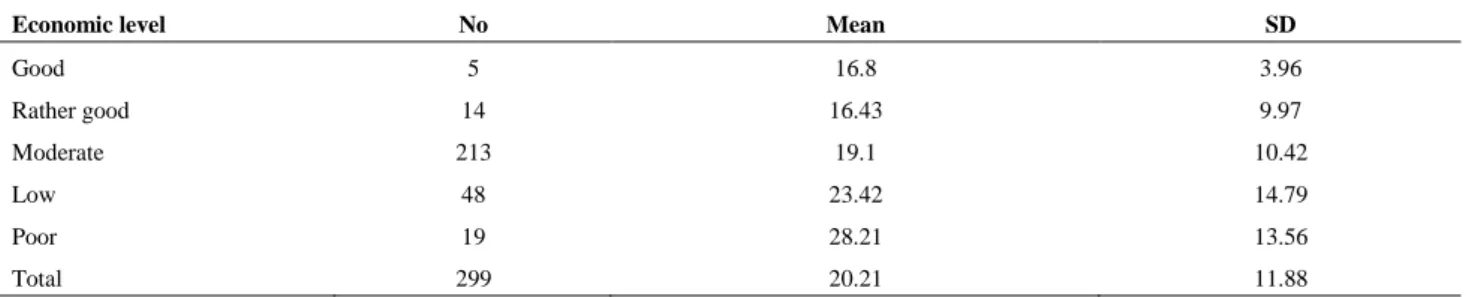
The mean grade scores of all of sub- scales of GHQ in participants with university education were lower than others. There is significant difference between the somatic symptoms and education of participants (p=0.046). There is relationship between the health situation of participants and their economic levels; worse health condition was seen in lower economic level. The mean grade scores of GHQ of high economic level were 16.8±9.8 and for participants with low economic levels was 28.21±13.56 (Table IV). There is significant difference between the economic level of participants and their GHQ (p=0.008).
The mean grade scores of participants in age of 25-29 years old (22.79±12.35) is more than others. There is significant difference between the age of participants and their GHQ scores (p=0.005). The mean grade scores of participants in Lores (14.82±6.79) is lower than others. There is significant difference between the different ethnicity of participants and their GHQ scores (p=0.004).
Table I. The mean sub- scales grade scores of GHQ based on sex.
Sex
Sub- scales
Male
Mean (±SD)
Female
Mean (± SD)
p-value
Somatic symptoms 4.17 (± 3.02) 5.88 (± 3.9) 0.000 1
Anxiety insomnia 4.95 (± 3.73) 6.45 (± 4.92) 0.09
Social dysfunction 6.31(± 2.48) 7.39 (± 2.64) 0.0001
Severe depression 2.07 (± 3.39) 3.24 (± 4.06) 0.001
Total 17.5 (± 9.97) 22.92 (± 13) 0.0001
The results showed women are worse than men in each and total scores significantly.
Table II. The mean sub- scales grade scores of GHQ based on duration of marriage of cases.
Duration of marriage
Sub – scales
<5 years
Mean(± SD)
5-10 years
Mean (± SD)
>10 years
Mean(± SD)
p-value
Somatic symptoms 5.19 (± 3.52) 4.69 (±4.1) 5.59 (± 4.41) 0.521
Anxiety insomnia 5.42 (±4.3) 5.68 (± 4.28) 6.21(± 5.19) 0.845
Social dysfunction 7.06 (±2.44) 6.71 (±2.59) 7.83 (± 2.95) 0.179
Severe depression 2.13 (± 3.32) 2.82 (± 3.82) 3.15(± 4.33) 0.278
Total 19.8 (± 10.9) 19.84 (± 11.29) 21.78(± 14.65) 0.936
There is no relation between scores and duration of infertility. Higher scores were seen in longer duration, which are not significant.
Table III. The mean sub- scales grade scores of GHQ based on education of cases.
Education
Sub – scales
Illiterate and lower
Mean(± SD)
Secondary school
Mean(± SD)
High school
Mean(± SD)
University
Mean(± SD)
p-value
Somatic symptoms 5.19 (± 3.4) 5.71(± 4.07) 5.4 (± 3.87) 4.0 (± 2.62) 0.046 Anxiety insomnia 5.36(±3.72) 6.11(± 4.71) 5.98(± 4.75) 5.12 (± 3.86) 0.706 Social dysfunction 6.62 (± 1.32) 6.65 (± 2.96) 6.95 (± 2.69) 6.58(± 2.53) 0.573 Severe depression 2.95 (± 3.47) 3.09 (± 4.33) 2.68(± 3.74) 2.3 (± 3.58) 0.662 The somatic symptoms have a significant relation with the education of the cases.
Table IV. The mean grade scores of GHQ in infertile couples in relation with their economic level.
Economic level No Mean SD
Good 5 16.8 3.96
Rather good 14 16.43 9.97
Moderate 213 19.1 10.42
Low 48 23.42 14.79
Poor 19 28.21 13.56
Total 299 20.21 11.88
p=0.008
This table showed couples with higher economic level have better grade of general health according to GHQ test.
Table V. Distribution and mean grade scores of GHQ in infertile couples in relation with their age.
Age (years) No Mean SD
20-24 37 21.73 13.11
25-29 104 22.79 12.35
30-34 89 18.19 10.65
35+ 68 19.19 11.37
Total 298 20.21 11.88
p=0.005
There is significant relation between the age and GHQ scores of the infertile couples.
Table VI. The mean grade scores of GHQ in infertile couples in relation with their ethnicity.
Ethnic No Mean SD
Turkish 11 26.1 10.33
Lore 22 14.82 6.79
Fars 247 19.97 11.77
Others 20 26.15 15.04
Total 300 20.21 11.88
p=0.004
This table showed the ethnicity of Iranian patients affect their general health.
Discussion
This research using GHQ-28 questionnaire investigated health situation of 300 infertile men and women planning to undergo IVF or ICSI treatment. The data of this study showed the scores of all of sub- scales of GHQ in women are more than men. Previous studies have revealed that the effect of infertility in women is higher than men (5-11, 31, 32), and women with planning IVF experienced have more emotional and social problems than women of same age groups in the general population (19).
The difference of the GHQ-28 scale due to gender was also found by Goldberg and Williams (25). Women usually have higher score on the GHQ-28 scale than men (25). Other studies have suggested that impact of infertility and its treatment is higher in women than in men (33-35). Fekkes et al demonstrated that having children was more important for women than men (34). Results from the present study about gender are in line with the previous conclusions. Shindel et al revealed that depression, social dysfunction and sexual problems were more frequent among male
partners of infertile couples than fertile men. In addition, they significantly are in lower mental health score than fertile men (35).
In present study severe depression in male was 2.07±3.39 and in women 3.24±4.06. These data is confirmed by the result of Alizadegan et al, which described that 48% of infertile women and 23.8% of infertile men had depression, but 5.3% of women and 2.5% men in population are severly depressed (36).
There is no significant difference between the duration of infertility and mean grade scores of sub-scales of GHQ and GHQ in total. Ragni et al in Italy showed duration of infertility dose significantly affect the psychological area of infertile couples and it might be reflected by the duration of infertility. However, it does not markedly affect subjective health status in patients requiring IVF (37). In our study the higher score in social dysfunction scale observed in patients with infertility duration of more than 10 years, while this was more than 5 years in the Italian patients with infertility (37). However, Rashidi et al found quality of life, physical or mental; have no relation with either infertility duration or cause of infertility (38).
In this study the situation of health are worse in younger participants and it goes better with older age. Matsubayashi et al (41), Beutel et al (42) and Rashidi et al (38) found the same results, which showed younger patients significantly have worse health condition. However Guz et al (39) and Khayata et al (40) argued that psycho-cognitive sign of anxiety and depression have a significant relationship with old age.
Our study finding showed that mean grade scores of all of sub-scales of GHQ in higher educated couples is lower than others. However the difference was not significant. In addition, it revealed that socio- demographic characteristics of infertile couples could be important for their health situation. These results are same as the results of study by Brkovich et al (9).
The result of present study is in line of Hus and Kuo (43), they argued that health situation of infertile couples vary according to their level of education. In the present study severe depression was found in secondary school education and social dysfunction in high school education.
This investigation showed the worse health score was found in couples with lower income. The relationship between income and health situation was significantly different (p=0.008).
Schmidt et al (44) confirmed that psychological situation among low income couples is worse than couples with high income.
In conclusion, the study finding suggest that the infertility have significant effect on health situation of infertile couples, specially infertile women, which are at risk of somatic symptoms, anxiety, insomnia, social dysfunction, and severe depression. General health evaluation using GHQ should be provided to help and support in order to improve the infertile couples, health situation.
Acknowledgment
We thank Yazd Research and Clinical Center for Infertility for paying all expenses for this research.
References
1. Evers JL. Female sub fertility. Lancet 2002; 360: 151-159. 2. Abbasi-Shavazi MJ, Razeghi Nasrabad HB, Behjati Ardekani Z, Akhondi MA. Attitudes of infertile women towards gamete donation: a case study in Tehran. J Reprod Infertil 2006; 7: 139-148.
3. Leiblum Sr, Greenfield DA. Infertility: psychological issues and counseling strategies, Edited by: Leiblum SR, New York: John Wiley and Sons; 1997: 83-102.
4. Fassino S, Piero A, Boggio S, Piccioni V, Garzaro L: Anxiety, depression and anger suppression in infertile couples. Hum Reprod 2002; 17: 2986-2994.
5. Chen TH, Chang SP, Tsai CF, Juang KD. Prevalence of depressive and anxiety disorders in an assisted reproductive technique clinic. Hum Reprod 2004; 19: 2313-2318.
6. Greil AL. Infertility and psychological distress: a critical review of the literature. Social Sci Med 1997; 45:1679-1704.
7. Mohammadi MR, Ghalagabadi Farahani F. Emotional and Mental problems of infertility and methods for contrast with them. J Reprod Infertil 2001; 2: 33-39.
8. Leiblum SR, Greenfield DA. The course of infertility: immediate and long-term reactions. In Leiblum, S. (ed.), Infertility: Psychological Issues and Counseling Strategies. John Wiley & Sons, New York; 1997: 83-102.
9. Brkovich AM, Fisher WA. Psychological distress and infertility: forty years of research. J Psychosom Obstet Gynaecol 1998; 19: 218-228.
10.Burns LH, Covington SH. Psychology of Infertility. In Burns LH, Covington SH. (eds), Infertility Counseling. A Comprehensive Handbook for Clinicians. Parthenon Publishing, New York, London; 1999: 3-25.
11.Berg BJ, Wilson JF. Psychological sequelae of infertility treatment: the role of gender and sex-role identification.
Soc Sci Med 1991; 33, 1071-1080.
12.Wright J, Duchesne C, Sabourin S, Bissonnette F, Benoit J, Girard Y. Psychosocial distress and infertility: men and women respond differently. Fertil Steril 1991; 55, 100-108.
13.Daniluk JC. Gender and infertility. In Leiblum, S. (ed.), Infertility: Psychological Issues and Counseling Strategies. John Wiley & Sons, New York; 1997; 103-125.
14.Nachtigall RD, Becker G, Wozny M. The effects of gender-specific diagnosis on men's and women's response to infertility. Fertil Steril 1992; 57: 113-121.
15.Jorda, C, Revenson TA. Gender differences in coping with infertility: a meta-analysis. J Behav Med 1999; 22: 341-358.
16.O'Moore AM, O'Moore RR, Harrison RF, Murphy G, Carruthers ME. Psychosomatic aspects in idiopathic infertility: effects of treatment with autogenic training. J Psychosom Res 1983; 27: 145-51.
17.Callan VJ. The personal and marital adjustment of mothers and of voluntarily and involuntarily childless wives. JMF 1987; 49: 847-856.
18.Callan VJ, Hennessey JF. The psychological adjustment of women experiencing infertility. Br J Me Psychol 1998; 61: 137-140.
19.Fekkes M, Buitendijk SE, Verrips GH, Braat DD, Brewaeys AM, Dolfing JG, et al. Health-related quality of life in relation to gender and age in couples planning IVF treatment. Hum Reprod 2003; 18: 1536-1543.
20.Blalock SJ, Devellis RF, Brown GK, Wallston KA. Validity of the center for epidemiological studies depression scale in arthritis population. Arthritis Rheum
1989; 32: 991-997.
21.Pincus T, Callahan LF. Depression scale in rheumatoid arthritis: criterion contamination of patient responses.
Patient EDUC Couns 1993; 20: 133-143.
22.Krol B, Sanderman R, Moun T, Suurmeijer T. Social support, rheumatoid arthritis and quality of life: concept, measurement and research. Patients Educ Couns 1993; 20: 101-120.
23.Goldberg DP, Hillier VF. A scaled version of the General Health Questionnaire. Psychol Med 1979; 9: 139-145. 24.Krol B, Sanderman R, Moun T, Suurmeijer T, Doeglas D,
Krijnen W, et al. A comparison of General Health Questionnaire- 28 between patients with rheumatoid arthritis from the Netherland, France, Sweden and Norway. Eur J Psychol Assess 1994; 10: 93-101.
25.Goldberg DP, Williams P. A user's guide to the General Health Questionnaire. NFER NELSON Publishing Company Ltd. Windsor; 1988.
26.Mc Dowell I, Newell C. Measuring Health. New York, Oxford. Oxford University Press; 1987.
27.Banks M. Validitation of the General Health Questionnaire in a young community sample. Psychol Med 1983; 13: 349-353.
28.Sanderman R, Stewart R. The assessment of psychological distress: psychometric properties of the GHQ. Int J Health Sci 1990; 1: 195-202.
29.Yaghoby N. A survey about epidemiology of psychotic disorders in Soumeah sara city. Thought and Behavior in ClinicalPsychology 1996; 2: 55-65.
30.Torkamani por Rouh angiz, Palahang H. Prevalence of mental disorders in the internal ward of Kashani Hospital, Shahrekord. J Shahrekord Univ Med Sci 1999; 1: 44-51.
31.Van Balen F, Trimbos-Kemper TC: Factors influencing the well-being of long-term infertile couples. J Psychosom Obstet Gynaecol 1994; 15: 157-164.
32.Pasch LA, Dunkel-Schetter C, Christensen A: Differences between husbands, and wives, approach to infertility affect marital communication and adjustment. Fertil Steril 2002; 77: 1241-1247.
33.Lee TY, Sun GH and Chao SC. The effect of an infertility diagnosis on the distress, marital and sexual satisfaction between husbands and wives in Taiwan. Hum Repord
2001; 16: 1762-1767.
34.Fekkes M, Buitendijk SE, Verrips GH, Braat DD, Brewaeys AM, Dolfing JG, et al. Health related quality of life in relation to gender and age in couples planning IVF treatment. Hum Repord 2003; 18: 1536- 1543.
35.Shindel AW, Nelson CJ, Naughton CK, Ohebshalom M, Mulhall JP. Sexual function and quality of life in the male partner of infertile couples: prevalence and correlates of dysfunction. J Urol 2008; 179: 1056-1059.
36.Alizadegan S, Ashrafi M, Baghestani AR. Mental Health Status of Women Referring to Royan Infertility Treatment Center. Fertil Steril 2005; 84 (Suppl.): 231-232.
37.Ragni G, Mosconi P, Baldini MP, Somigliana E, Vegetti W, Caliari I, et al. Health- related quality of life and need for IVF in 1000 Italian infertile couples. Hum Reprod
2005; 20: 1286-1291.
38.Rashidi B, Montazeri A, Ramezanzadeh F, Shariat M, Abdinia M, Ashrafi M. Health- related quality of life in infertile couples receiving IVF or ICSI treatment. BMC Health Services Research 2008; 8: 186.
39.Guz H, Ozkan A, Sarisoy G, Yanik F, Yanik A. Psychiatric symptoms in Turkish infertile women. J Psychosom Obstet Gynecol 2003; 24: 267-271.
40.Khayata GM, Rizk DE, Hasan MY, Ghazal Aswad S, Asaad MA. Factors influencing the quality of life of infertile women in United Arab Emirates. Int J Gynecol Obstet 2003; 80: 183-188.
41.Matsubayashi H, Hosaka T, Izumi T, Makino T. Emotional distress of infertile women in Japan. Hum Reprod 2001; 16: 966- 969.
42.Beutel M, Kupfer J, Kirchmeyer P, Kehde S, Kohn FM, Schroeder- printzen I, et al. Treatment- related stresses and depression in couples undergoing assisted reproduction treatment by IVF or ICSI. Andrologia 1999; 31 (Suppl.): 37-44.
43.Hsu YL, Kuo BJ. Emotional reactions and coping behaviors as well as correlated factors for infertile couples receiving assisted reproductive technologies. J Nurs Res
2002; 10: 291-302.
44.Schmidt L, Holstien BE, Boivin J, Tjqrnhqj-Thomsen T, Blaabjerg J, Hald F, et al. High rating of satisfaction with fertility treatment is common: finding from the Copenhagen multi-center psychological infertility(COMPI) Research programe. Hum Repord 2003; 18: 2638-2646.