O R I G I N A L R E S E A R C H
Open Access
Hospital incident command groups
’
performance during major incident
simulations: a prospective observational
study
Jason P. Murphy
1,2*, Lisa Kurland
1,3,4, Monica Rådestad
1and Anders Rüter
1,2Abstract
Background:Hospital incident command groups’(HICG) performance may have a profound impact on hospital response to major incidents. Previous research has assessed hospital incident command group capacity as opposed to performance and factors associated to performance. The objective was to assess associations between decision-making and staff procedure skills of the hospital incident command group.
Methods:This was a prospective observational study using performance indicators to assess hospital
incident command groups’ decision-making and performance. A total of six hospitals in Stockholm, Sweden, with their respective HICGs participated. Associations between decision-making skills and staff procedure skills during major incident simulations were assessed using measurable performance indicators.
Results: Decision-making skills are correlated to staff procedure skills and overall HICG performance. Proactive decision-making skills had significantly lower means than reactive decision-making skills and are significantly correlated to staff procedure skills.
Conclusion: There is a significant correlation between decision-making skills and staff procedural skills. Hospital incident command groups’ proactive decision-making abilities tended to be less developed than reactive decision-making abilities. These proactive decision-making skills may be a predictive factor for overall hospital incident command group performance. A lack of proactive decision-making ability may hamper efforts to mitigate the effects of a major incident.
Keywords: Hospital disaster preparedness, Hospital incident command group, Performance indicators, Simulation exercises, Major incident, Hospital management, Decision-making
© The Author(s). 2020Open AccessThis article is licensed under a Creative Commons Attribution 4.0 International License, which permits use, sharing, adaptation, distribution and reproduction in any medium or format, as long as you give appropriate credit to the original author(s) and the source, provide a link to the Creative Commons licence, and indicate if changes were made. The images or other third party material in this article are included in the article's Creative Commons licence, unless indicated otherwise in a credit line to the material. If material is not included in the article's Creative Commons licence and your intended use is not permitted by statutory regulation or exceeds the permitted use, you will need to obtain permission directly from the copyright holder. To view a copy of this licence, visithttp://creativecommons.org/licenses/by/4.0/. The Creative Commons Public Domain Dedication waiver (http://creativecommons.org/publicdomain/zero/1.0/) applies to the data made available in this article, unless otherwise stated in a credit line to the data.
* Correspondence:[email protected]
1Department of Clinical Science and Education, Karolinska Insititutet,
Stockholm, Sweden
2Sophiahemmet University, PO Box 5605, SE-11486 Stockholm, Sweden
Background
Hospitals play vital roles during major incidents (MI) [1]. Previous studies have demonstrated that well-prepared hospitals may mitigate the impact of an MI as measured by morbidity and mortality [2–4]. A consensus concerning a standardized method for assessing hospital disaster preparedness is lacking despite directives stipu-lating the need for hospital disaster preparedness [5, 6]. Hospital response and performance is reliant on hospital management [7]. Hospital emergency contingency plans include descriptions the hospital incident command group (HICG). This group, responsible for coordinating medical care, personnel and allocation of resources con-sists of an incident commander and representatives from amongst others, logistics, the ED, surgical units, the ICU, security, and communications [7]. While address-ing aspects of hospital management e.g. capacity, there are few studies focusing on HICGs’ performance [4, 7– 9]. However, there is mounting evidence suggesting that performance of the HICG as opposed to capacity can and should be assessed [10–12].
Measuring hospital incident command performance
Decisions and actions taken by the HICG during the ini-tial phase of an incident are essenini-tial for managing re-sources during a major incident and may affect patient outcomes [13]. Successful management of limited re-sources is contingent on planning, training and timely responses concerning the mobilization of limited re-sources [14]. Of importance is the ability to mobilize re-sources to meet medical demands before all facts of an incident are known, relying on anticipatory or analytical abilities [3]. It has been demonstrated that the HICG’s ability to work in a structured fashion and its
decision-making skills can be assessed by analyzing measurable indicators (Tables 1 and 2) [6, 10]. The Disaster Man-agement Indicator (DiMI) instrument which is based on process modeling and constructed through con-sensus by the Swedish National Board of Health and Welfare [6] is to the authors knowledge the only tool measuring HICG performance.
The DiMI allows for assessment of HICG performance by analyzing measurable indicators reflective of the oper-ations of the HICG. The DiMI assesses whether actions relating to structures, process and decision-making were performed through two focal points; HICG’s decision-making ability and staff procedure skills which is the staff’s ability to work in a structured and organized way [6, 15]. A previous study providing a first analysis of as-sociations between the two skill sets, identified a linear association between staff procedure and decision-making abilities and indicated that improved staff procedure skills would lead to improved decision-making skills [15]. DiMI decision-making indicators can be divided into two sub-groups of indicators, reactive and proactive decision-making. Reactive decision-making can be de-fined as intuitive, reflexive decisions based on previous experiences and knowledge while utilizing minimal cog-nitive resources [16,17]. Conversely, proactive decision-making may be defined as anticipatory, time consuming, deliberate requiring analytical process and is more de-manding of cognitive efforts [16,17].
There are to our knowledge, few prospective observa-tional studies focusing on the association between decision-making skills and staff procedure skills and no studies analyzing the association between proactive decision-making and staff procedure skills during a sim-ulated major incident.
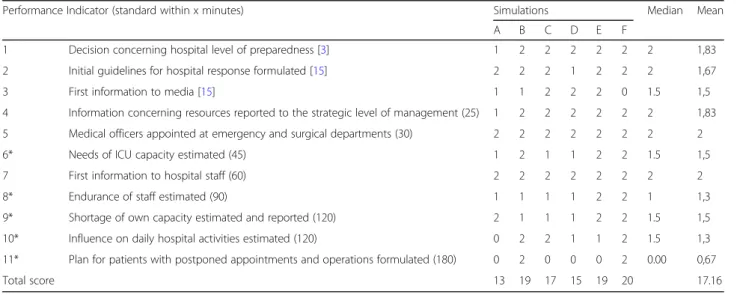
Table 1Scores, Median and Mean for decision-making skills
Performance Indicator (standard within x minutes) Simulations Median Mean
A B C D E F
1 Decision concerning hospital level of preparedness [3] 1 2 2 2 2 2 2 1,83
2 Initial guidelines for hospital response formulated [15] 2 2 2 1 2 2 2 1,67
3 First information to media [15] 1 1 2 2 2 0 1.5 1,5
4 Information concerning resources reported to the strategic level of management (25) 1 2 2 2 2 2 2 1,83
5 Medical officers appointed at emergency and surgical departments (30) 2 2 2 2 2 2 2 2
6* Needs of ICU capacity estimated (45) 1 2 1 1 2 2 1.5 1,5
7 First information to hospital staff (60) 2 2 2 2 2 2 2 2
8* Endurance of staff estimated (90) 1 1 1 1 2 2 1 1,3
9* Shortage of own capacity estimated and reported (120) 2 1 1 1 2 2 1.5 1,5
10* Influence on daily hospital activities estimated (120) 0 2 2 1 1 2 1.5 1,3
11* Plan for patients with postponed appointments and operations formulated (180) 0 2 0 0 0 2 0.00 0,67
Total score 13 19 17 15 19 20 17.16
Aim
The aim was to assess associations between decision-making skills and staff procedure skills of hospital inci-dent command groups during major inciinci-dent simula-tions using performance indicators as measured by DiMI.
Method
This was a prospective observational study using per-formance indicators to assess hospital incident com-mand groups’decision-making and performance.
Study setting
Six consecutive tabletop simulation exercises at six separ-ate major hospitals (A-E. Tables1 and2) were conducted during the fall of 2016 in the region of Stockholm, Sweden during the period of October 2016 to December 2016. All six simulations planned and carried out by the regional hospital disaster preparedness coordinators in Stockholm, Sweden, were antagonistic scenarios based on prior terror-ist incidents; five bomb blast scenarios and one active shooter scenario. The incident was presented as realistic-ally as possible, i.e. the conditions for the participating hos-pitals were consistent with the real time personnel, resources and information. Information concerning the na-ture of the respective incidents was withheld from partici-pants prior to the exercises, they were only informed of the date and approximate time. The extent of the simulations varied, i.e. some simulation exercises included other parts of the hospital, while others focused solely on the HICG. In both instances, the HICG had access to all units and representatives per emergency contingency plans, facilitat-ing similar conditions for evaluation of the HICG.
The designated hospital incident command groups, which are activated in accordance to the hospital disas-ter management plans, were the study subjects.
Data collection
Data collection was based on observation and included variables as required by the DiMI [6]. The DiMI consists of 22 measurable indicators divided into two groups of 11 indicators with 11 measuring decision-making skills and 11 measuring staff procedure skills. The observers (JM and AR) were present in the hospital incident com-mand room throughout the entire duration of each simulation. Written documentation and logfiles from the HICGs were obtained after completion of the simula-tions in order to ensure accurate documentation.
Time standards for indicators were reached through ex-pert consensus [18,19]. The indicators reflecting decision-making skills consist of six reactive and five proactive decision-making indicators Table 1 [17]. Each indicator was scored on a scale from 0 to 2. A value of 0 indicates that the standard for the indicator was not completed. A value of 1 indicates that the standard for the indicator is partially completed or not completed within the prede-fined required time frame. A value of 2 indicates that the standard for the indicator was completed correctly and within the predefined required time frame.
Table 2Scores, Median and Mean staff procedure skills
Performance indicator (standard within x minutes) Simulation Median Mean
A B C D E F
12 Functions to staff members assigned (direct) 2 2 2 2 2 2 2 2
13 Positioning in room in accordance to above (direct) 2 2 2 2 2 2 2 2
14 Designated telephone numbers (direct) 2 2 2 2 2 2 2 2
15 Arriving staff members introduced (1 min) 1 2 2 0 2 2 2 1,5
16 Equipment utilize (only if equipment is available) 2 2 2 2 2 2 2 2
17 Staff briefing (max 8 min in length) 2 2 1 2 1 2 1.5 1,5
18* Content of staff briefing 1.75 2 2 1.75 2 2 2 1,92
19 Telephone discipline 0 1 1 0 1 2 1.25 1,08
20 Content of staff schedule 2 1 1 2 2 0.5 2 1,67
21 Summary: oral briefing 2 2 2 2 2 2 2 2
22 Summary: written 2 2 0 2 2 2 2 2
Total 18.75 19 17 15 19 20.5 19,7
* consists of sub indicators as described [6]
Table 3Post Hoc Comparisons–Decision-making and staff procedure means
Mean Difference SE t Cohen’s d ptukey
1 2 −0.227 0.103 −2.215 −0.386 0.028
Kruskal-Wallis Test
Factor Statistic df p
Data analysis
Data from all simulations was first imported to Micro-soft Excel for Mac version 16.33 and analyzed using descriptive and inferential statistics.
Individual indicators were analyzed using ANOVA and DUNN post hoc analysis. Differences in means for decision-making and staff procedure skills were assessed using one-way ANOVA and Kruskal-Wallis Test. Pear-son’s correlation was used to assess the association be-tween decision-making and staff procedure skills. Due to the data being rank-order data as well as a lack of as-sumption concerning the distribution of data, a Spear-man’s rho correlation coefficient was computed to measure the degree of association between the different groups of indicators, i.e. decision-making and staff pro-cedure skills and subgroups of decision-making skills.
Aρvalue < 0.05 was considered significant.
Data analysis was conducted using JASP version 0.9.2(JASP Team 2018) and Statistical Package for Social Sciences (SPSS) version 25 (IBM SPSS Statistics North Castle, New York, USA).
Results
The duration of each simulation ranged from 2 h and 13 min to 6 h and 52 min. Medians and mean scores are pre-sented. Mean scores are used with the aim of more ac-curately highlighting subtle, yet significant differences in performance. For instance, a mean score of 0.67 is closer to 1, than the median of 0.000, indicating that a task, was performed to a certain degree (0.67), as opposed to“not at all”that a median of 0 would indicate. The mean score for the decision-making indicators ranged from 0.67 to 2.0 while mean scores for staff procedure indicators ranged from 1.08 to 2.0. The sum of the mean scores for
all six simulations concerning decision-making was 17.16 (Table1) while the sum of the mean scores for staff pro-cedure skills was 19.66 (Table2).
Indicator related to proactive decision-making indi-cated with (*).
Association of indicators
A one-way analysis of variance indicated a statistically significant differences between the decision-making skills and staff procedure (p= 0.036, d = 0.386) (Table3).
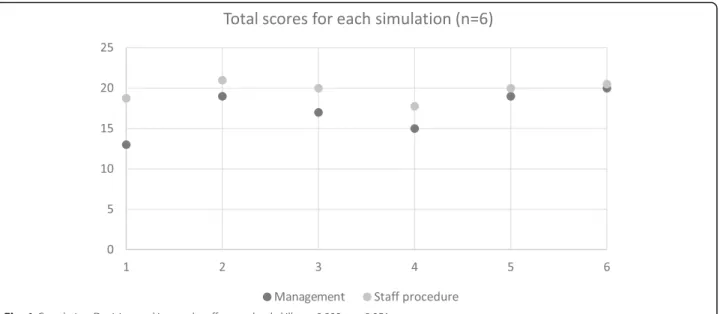
The correlation between decision-making skills and staff procedure skills was r = 0.809,ρ= 0.51 (Fig.1, Table4).
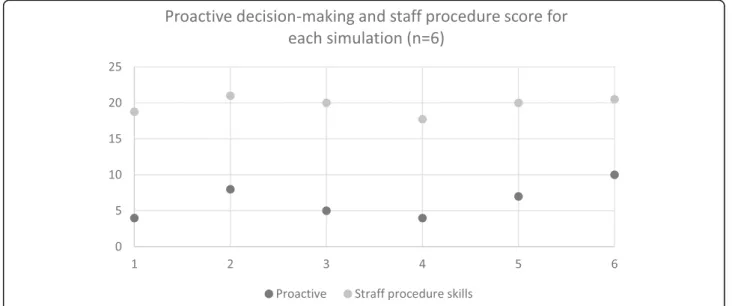
Reactive skills had statistically significant higher means (1.5–2.0) than proactive skills which had lower means (0,80–1.60) (p= .046) (Table 5). While Spearman’s rho indicated no significant correlation between reactive in-dicators and staff procedure (r = 0,09 and p= .86) there was significant positive correlation between proactive in-dicators and staff procedure skills (r = 0,947 p= .014) (Fig.2, Table4).
Discussion
The current study identified a relationship between decision-making and staff procedure skills. In addition, this study identified a correlation between proactive decision-making and staff procedure skills. Proactive Fig. 1Correlation Decision-making and staff procedural skills r = 0.809,p= 0.051
Table 4Spearman’s rho correlation of decision-making and staff procedure skills
Staff procedure skills ρ
Decision-making .809 .051
Proactive decision-making .947 .014
Reactive decision-making .090 .86
decision-making skills in particular may therefore have an impact on overall disaster performance of the HICG. Hospital incident command groups with lower scores for proactive decision-making skills, had statistically sig-nificantly lower performance scores. While a previous study suggested that improved staff procedure skills re-sulted in improved decision-making skills [15], to our knowledge, this is the first study to demonstrate an asso-ciation between proactive decision-making and HICG disaster performance. Given the type of data and the na-ture of this study, it is not possible to state causation. However, based on these results, decision-making skills may provide the foundation needed for effective staff performance and overall hospital response. The positive correlation between decision-making and staff procedure skills identified in this study illustrate the need to further explore the possible causative relationships and motivate the need for further research.
The significant difference between reactive decision-making indicators and proactive decision-decision-making indica-tors with respect to HICG performance measured by DiMI is noteworthy. Reactive decisions are typically made during the early stages of an incident e.g. decisions on the level of preparedness, were more often correctly executed within the predetermined time frames. Con-versely, proactive decisions based on estimations, e.g. the delivery of information pertinent to staff stamina, or es-timating influence on daily activities, were delayed or
not made, consistent with a previous retrospective study assessing decision-making [11] . Of particular interest is the correlation between proactive decision-making indi-cators and staff procedure skills. The statistically lower means for proactive decision-making skills indicate that analytical skills may be an underdeveloped yet vital com-ponent as indicated by their correlation with staff pro-cedure skills. The importance of analytical/anticipatory abilities is further illustrated by the lack of correlation between reactive decision-making and staff procedure skills. Previous research has demonstrated that experi-ence is an important aspect for analytical ability [20,21]. While not controlled for in this study, lower proactive abilities may be a result of a lack of experience or know-ledge as reported in a 2007 study assessing proactive vs reactive decision-making in the clinical setting [21].
While this study reports acceptable levels of HICG disaster preparedness, the frequency of training required to maintain or improve preparedness is an important factor to consider.
This study also further demonstrated that measurable indicators may be an effective method for facilitating a structured evaluation of the hospital incident command group. Furthermore, this study suggests that the DiMI may facilitate HICG performance if implemented as a guide for the HICG. While the DiMI is an efficient method for evaluating HICG preparedness, the DiMI may also be compatible with other methods such as checklists, interviews or questionnaires.
In addition to factors such as training, repetition and effectivity, this study indicates the need to recognize and improve analytical skills. Furthermore, these findings may guide pedagogical construction of training and edu-cational programs targeting these skills. This in turn, may enhance HICG’s disaster management.
Table 5Reactive and proactive indicator means
N Minimum Maximum Mean ρ
Reactive 6 1,66 2,00 1,83 .046
Proactive 5 ,80 1,60 1,07
Limitations
The data was treated as interval data in order to make the results comparative with earlier studies as well as more accurately reflect performance. All simulations in the current study were held within a short period of time and with similar scenarios, thereby facilitating ana-lysis and comparison between participating hospitals. While providing potentially vital information concerning HICGs’response, the generalizability of the results may be questionable due to the relatively low number of sim-ulations. However, this study, when added to the litera-ture with similar results, strengthens the likelihood that these results may be transferable in similar settings. The wording of some of the indicators from the original tool have been adjusted for grammar [6].
Conclusion
To our knowledge, this is the first study identifying spe-cific decision-making indicators that are directly associ-ated to overall performance of the hospital incident command group. There is a significant correlation be-tween decision-making skills and staff procedural skills. Hospital incident command groups’ proactive decision-making abilities tended to be less developed than reactive decision-making abilities. Proactive decision-making skills are correlated to staff procedure skills and may be a pre-dictive factor for overall hospital incident command per-formance. A lack of proactive decision-making ability may hamper efforts to mitigate the effects of a major incident.
While the results of this study provide important steps in understanding disaster preparedness at the command level, further research utilizing other types of simulations are needed before conclusions of causation and needs for definitive educational interventions can be drawn.
Abbreviations
ANOVA:Analysis of variance; DiMI: Disaster Management Indicator tool; HICG: Hospital incident command group; MI: Major incident
Acknowledgements
The authors of this study would like to express thanks and gratitude to Professor Christopher P. Halter, University of California San Diego for his valuable contributions concerning statistical analysis as well as to all participating hospitals.
Authors’contributions
All authors contributed to design, conception and planning of the study. Data collection: JM and AR. Initial data analysis and interpretation was done by JM, AR. All authors contributed to the results. The first draft was written by JM with all authors aiding in revision of the final manuscript. All authors have read and approved the final manuscript.
Funding
Funding was provided by Sophiahemmet University non-profit association. Open access funding provided by Sophiahemmet University College.
Availability of data and materials
The datasets used and/or analyzed during the current study are available from the corresponding author on reasonable request.
Ethics approval and consent to participate
All representatives of the respective hospitals were informed of the study in written and oral form after which permission was granted. Participants were informed that participation was voluntary and could be withdrawn without consequences. Furthermore, confidentially was guaranteed.
Ethics approval applied for and received a waiver by the Swedish Regional Ethical Review Board. (Diary number 2016/1530–31/5).
Consent for publication Not applicable.
Competing interests
The authors declare they have no competing interests.
Author details
1Department of Clinical Science and Education, Karolinska Insititutet,
Stockholm, Sweden.2Sophiahemmet University, PO Box 5605, SE-11486
Stockholm, Sweden.3Department of Medical Sciences, Örebro University, Örebro, Sweden.4Department of Neurobiology and Society, Karolinska
Institutet, Stockholm, Sweden.
Received: 30 April 2020 Accepted: 5 July 2020
References
1. World Health Organization. Regional Office for Europe. Hospital emergency response checklist. An all-hazards tool for hospital administrators and emergency managers. Copenhagen Ø, Denmark2011.
2. Haverkort JJ, de Jong MB, Foco M, Gui D, Barhoum M, Hyams G, et al. Dedicated mass-casualty incident hospitals: an overview. Injury. 2017;48(2): 322–6.https://doi.org/10.1016/j.injury.2016.11.025.
3. Chuang S, Woods DD, Ting HW, Cook RI, Hsu JC. Coping with a mass casualty: insights into a Hospital's emergency response and adaptations after the Formosa fun coast dust explosion. Disaster medicine and public health preparedness. 2019:1–10.https://doi.org/10.1017/dmp.2019.69. 4. Djalali A, Castren M, Khankeh H, Gryth D, Radestad M, Ohlen G, et al.
Hospital disaster preparedness as measured by functional capacity: a comparison between Iran and Sweden. Prehosp Disaster Med. 2013;28(5): 454–61.https://doi.org/10.1017/S1049023X13008807.
5. SOSFS 2013:22 Socialstyrlesens Föreskrifter och allmäna råd.
Katastrofmedicinsk beredskap (Disaster medicine preparedness). National Board of Health and Welfare;, (2013).https://www.socialstyrelsen.se/ globalassets/sharepoint-dokument/artikelkatalog/foreskrifter-och-allmanna-rad/2013-5-46.pdf. .
6. Ruter A, Kurland L, Gryth D, Murphy J, Radestad M, Djalali A. Evaluation of disaster preparedness based on simulation exercises: a comparison of two models. Disaster medicine and public health preparedness. 2016;10(4):544– 8.https://doi.org/10.1017/dmp.2015.176.
7. Djalali A, Castren M, Hosseinijenab V, Khatib M, Ohlen G, Kurland L. Hospital incident command system (HICS) performance in Iran; decision making during disasters. Scand J Trauma Resusc Emerg Med. 2012;20:14.https://doi. org/10.1186/1757-7241-20-14.
8. Naser WN, Ingrassia PL, Aladhrae S, Abdulraheem WA. A study of hospital disaster preparedness in South Yemen. Prehosp Disaster Med. 2018;33(2): 133–8.https://doi.org/10.1017/s1049023x18000158.
9. Ingrassia PL, Mangini M, Azzaretto M, Ciaramitaro I, Costa L, Burkle FM Jr, et al. Hospital disaster preparedness in Italy: a preliminary study utilizing the World Health Organization Hospital emergency response evaluation toolkit. Minerva Anestesiol. 2016;82(12):1259–66.
10. Nilsson H, Vikstrom T, Ruter A. Quality control in disaster medicine training--initial regional medical command and control as an example. Am J Disaster Med. 2010;5(1):35–40.https://doi.org/10.5055/ajdm.2010.0004.
11. Nilsson H, Vikstrom T, Jonson CO. Performance indicators for initial regional medical response to major incidents: a possible quality control tool. Scand J Trauma Resusc Emerg Med. 2012;20:81. https://doi.org/10.1186/1757-7241-20-81.
13. Waxman DA, Chan EW, Pillemer F, Smith TW, Abir M, Nelson C. Assessing and improving hospital mass-casualty preparedness: a no-notice exercise. Prehosp Disaster Med. 2017;32(6):662–6. doi:https://doi.org/10.1017/ s1049023x17006793.
14. Kearns RD, Cairns BA, Cairns CB. Surge capacity and capability. A Review of the History and Where the Science is Today Regarding Surge Capacity during a Mass Casualty Disaster Frontiers in public health. 2014;2:29.https:// doi.org/10.3389/fpubh.2014.00029.
15. Ruter A, Vikstrom T. Improved staff procedure skills lead to improved managment skills: an observational study in an educational setting. Prehosp Disaster Med. 2009;24(5):376–9.
16. Croskerry P, Petrie DA, Reilly JB, Tait G. Deciding about fast and slow decisions. Academic medicine : journal of the Association of American Medical Colleges. 2014;89(2):197–200.https://doi.org/10.1097/acm. 0000000000000121.
17. Arbula S, Capizzi M, Lombardo N, Vallesi A. How life experience shapes cognitive control strategies: the case of air traffic control training. PLoS One. 2016;11(6):e0157731.https://doi.org/10.1371/journal.pone.0157731. 18. Rüter A, Lundmark T, Ödmansso E, Vikström T. The development of a
national doctrine for management of major incidents and disasters. Scand J Trauma Resusc Emerg Med. 2006;14:189–94.
19. Ruter A, Vikstrom T. Indicateurs de performance: De la théorie à la pratique. Approche scientifique à propos de la médicine de catastrophe. Urgence Pratique. 2009;93:41–4.
20. Hoffman KA, Aitken LM, Duffield C. A comparison of novice and expert nurses' cue collection during clinical decision-making: verbal protocol analysis. Int J Nurs Stud. 2009;46(10):1335–44.https://doi.org/10.1016/j. ijnurstu.2009.04.001.
21. Young JS, Stokes JB, Denlinger CE, Dubose JE. Proactive versus reactive: the effect of experience on performance in a critical care simulator. Am J Surg. 2007;193(1):100–4.https://doi.org/10.1016/j.amjsurg.2006.08.066.
Publisher’s Note