Enhanced Home Energy Management Scheme
(EHEM) in Smart Grids
Muneer Bani Yassein, Yaser Khamayseh, Wail Mardini, Manar Al Bataineh
Jordan University of Science and Technology, Irbid, Jordan
Abstract: Wireless Sensor Networks (WSNs) have become one of the most important components that play a major role in home environment applications. It plays a major role in the creation and the development of smart home environments. Smart homes creates home area network (HAN) to be used in different applications including smart grids. In this paper, we propose an enhancement to in-Home Energy Management (iHEM) scheme, namely EHEM, to reduce energy consumption by shifting the residents’ demands to mid-peak or off-peak periods depending on the appliances priorities and delays. The proposed system handles challenging cases by using internal storage battery. The performance of the proposed system is compared against iHEM and the traditional iHEM scheme, based on the total cost of the power consumption. Obtained results show slight improvement over the existing iHEM scheme.
Keywords: Smart, Grid, Energy, Management, Home, iHEM.
1.
Introduction
The demand on energy is increasing rapidly in the 21st century. Traditional power grids have been used in the last century to provision energy to customers (both residential and commercial). However, traditional grids suffer from many problems such as blackouts that comes from the mismatch between demand and supply, and the limitation of using the renewable energy resources. Because of these limitations, traditional power grids are not compatible with the demands of this century, hence, smart grids have been proposed to overcome these problems.
Energy consumption is considered one of the key challenges of modern societies. The rapid growth in demand for energy must be matched with rapid growth in energy supply. Unfortunately this match is hard, even impossible to achieve. Hence, the need for new and innovative approaches to the energy issues. One main approach considered by academic research and energy industries, and governmental bodies is energy reduction. In which, a smart grid is deployed to monitor and control the energy consumption in the house. Smart grids promises to provide smart solutions to the energy issue, saving the environment, and reducing monetary costs. The costs of deploying smart grids can be paid off by the saving achieved by these smart technologies. A smart grid is an electricity network which combines all users with their actions connected to the network to establish a smart, reliable, available, and efficient communication. Using smart grids improves the security, the efficient transmission of the electricity, and the management of the power consumption, and provide the consumers with the
opportunity to produce their own energy from renewable sources [2].
Smart grid is modern technology used to face the challenges of the electricity supply. It allows consumers to generate and use the renewable energy resources to be used locally. In the smart grid implementation, smart meters are used to provide the consumers with information about the current usage and rate. Time-Of-Use (TOU) pricing is one of the most usable pricing models in smart grid providers, in which energy prices differ based on the usage time: off-peak, mid-peak, and on-peak periods. Consumers usually use appliances during the on-peak periods, and hence, it has the highest prices. Thus, shifting consumers’ demands to off-peak or mid-peak will reduce the electricity bill. Therefore, it is very important to implement a management system to handle energy consumption in smart homes [1, 4].
The rest of this paper is organized as follows: Section II discuses some previous works about smart grids. Section III gives an overview about iHEM and introduce the design of the proposed algorithm and the test cases scenarios that have been used in the testing phase. Section IV presents and discuss the obtained experimental results. Section V concludes the paper and provides some ideas for future work.
2.
Related Work
Many energy management studies have been proposed to reduce the power consumption and reduce the electricity bill. This section presents some of the previous studies that highlight different schemes and techniques proposed for energy management systems in smart grids.
(EMU). It depends on the appliance coordination scheme (ACS), which means that the system will fulfill the customers’ demands at the lowest electricity price times. However, the customer can use the appliances at any time, and these demands will be processed at the nearest real time. This system reduced the electricity expense, and the achieved savings were very similar to the savings from the optimization-based residential energy management (OREM) system [4].
Authors in [6] developed a system that utilizes mixed-integer linear programming paradigm, this system can provide an optimal solution for the power consumption under the dynamic electrical constraints. They worked on a thermal model depending on heat-pump usage to ensure the thermal comfort regarding the end user needs. This system also includes a priority policy to enhance the scheduling. The results of this system did not just reduce the power consumption, it also reduced the required computational time.
In [7], authors proposed Appliance Coordination with Feed In (ACORD-FI) scheme to reduce the power consumption. This system needs a wireless sensor home area network (WSHAN) to authorize the connection between the devices and the energy management unit (EMU). This EMU is responsible for knowing the available local energy and the pricing information to derive a start time. At this starting time the, all the demands will be processed with the lowest energy consumption. They used C++ language to implement this model, and used the cost of the power consumption and the delay as the performance metrics. In their simulation, they used four appliances: dryer, washer, coffee maker, and dish washer, and found their impact on the energy cost, where each appliance has a cycle duration and the power consumption per cycle. And for the pricing information, they used the Time-of-Use pricing, where it depends on the pricing based on the peak periods. They did the simulation for a 7 months period; the first 5 days were for enabling the EMU to store some consumer preferences. After the 7 months, they compared the results of the ACORD-FI with (ACORD) scheme [9] which does not include the load energy generation, and the (NOCOORD) scheme which does not support any energy management and does not employ the WSN. The ACORD-FI reported the lowest energy cost and the lowest average delay, which means that it has the best performance. While the NOCOORD had no delay because the appliances will be turned on when the consumer hits the start button.
In [8], the authors used particle swarm optimization (PSO) to solve the HEM problem by adding stochastic dissonance between the devices. Then they used an improved distributed energy resource (DER) scheduler to find the consumption value that has been used by DER scheduling. After that, they compared the end-user cost between two cases, the first case is the cost of using their modified algorithm scheduling all the DER at the same time, and the second one is the cost when applying each DER schedule individually. This comparison helped them in finding the best value of coordination from the DER. Finally, they found that some cases need the DER to work together to enhance the net benefits and some other cases the coordination did not give the wanted enhancement.
Energy conservation is essential area of concern in wireless communications in general. Many techniques were proposed to prolong network lifetime by reducing the amount of
consumed energy by the network’s nodes. The usage of smart bio-inspired algorithms in this domain is evident. The work in [15] proposed the usage of Neural Network (NN) and Kohonen Self-Organizing Map (KSOM) techniques to optimize energy consumption in WSNs. The scheduling problem also described and discussed in [1] in a similar setting to smart home with strong emphasis on smart grid component. A Genetic Algorithms (GA) is proposed to construct an optimal schedule for home appliances. Despite their improved performance, NN and GA techniques requires extensive amount of computations and do not guarantee a successful convergence to the optimal solution.
3.
Methodology
In this section, we will discuss the iHEM technique proposed in [5] in both cases: with in and without feed-in, then we discuss the algorithms proposed in [3] that improved the iHEM by using different delays and priorities for each appliance. Finally, we present the proposed improvement for these techniques.
A. In Home Energy Management Technique (iHEM)
In iHEM [1], the main idea is to shift the appliances events to the off-peak or mid-peak as much as possible. The main queue has the initial events, each with two parameters; the type event (stop or start) events, and the timestamp of this event. Then, the algorithm starts checking the event type. If the event is a start event, the timestamp is checked to find the peak period. If the start event is on the on-peak period, then try to shift this event to off-peak based on the delay. A delay for the off-peak is calculated for this event, and then ask if this delay is less than the maximum allowable delay, which is 12 hours. If the delay of the off-peak is less than the allowable delay then the event is shifted to the off-peak hours with changing the timestamp of the event, else the delay to the mid-peak is calculated and compared with the maximum allowable delay, if less than this delay then the event is shifted to the mid-peak hours, else it will start immediately with no changing on the timestamp. If the start event is on mid-peak, then the algorithm tries to shift the event to the off-peak by calculating the delay and compare it with the maximum allowable delay. For the case of the off-peak hours events, the events will start immediately. But if the event is a stop event, the cost of the total energy consumption for running the event is calculated. First, the power consumption is calculated based on Equation 1 in kilowatt [5], and the total cost of the power consumption is calculated using Equation 2 in cents [5].
(1) PowerConsumption =
CostOfPowerConsumption=
(2) In iHEM, the option of using feed-in is supported, where there is a battery storage at homes that can produce 350W per day. In this technique, the algorithm checks the stored energy, if it is enough to run the appliance immediately, before trying to shift the event to off-peak or mid-peak.
B. iHEM with Preemtive Priority Scheduling Scheme
each event has four parameters; the timestamp, event type, remaining time, and event priority.
iHEM with preemptive priority algorithm is shown in Algorithm 1 [3]. When a new event is added to the main queue the priority is checked, if the event priority is higher than the running event, then this event is moved to the waiting queue after changing the time stamp to not start from the beginning in the next time, and the higher priority event enters the running state.
Algorithm 1: iHEM with Preemptive Priority Scheduling Technique [3]
1: While (Timer < SimulationTime)
2: choose an event with the smallest timestamp from MainQueue
3: currEvent startSelectedEvent()
4: while(true) 5: if (Timer is equal) 6: break;
7: highPriorityEvent checkHigherPriorityEvent()
8: if (highPriorityEvent arrived while currEvent in running state) 9: then enqueue(highPriorityEvent) to PQ and startImmediately() 10: enqueue(currEvent) to WQ and start after highPriorityEvent finished 11: end if
12: end if
13: end while
C. iHEM with Different Delays Scheduling Scheme
This scheme is proposed in [3]. This algorithm works exactly like the iHEM except that each appliance has its own maximum delay instead of the global maximum allowable delay in iHEM (12 hours). In this scheme, six appliances have been used each with different priority (washer: 15 hours, dishwasher: 15 hours, dryer: 15 hours, PHEV battery, coffee maker: 5 minutes, air conditioner: 0 hours). When the event enters the main queue, the algorithm checks the timestamp. If it is in the on-peak or mid-peak periods, then the event is shifted to the off-peak or on-peak if possible, as shown in Algorithm 2.
Algorithm 2: iHEM with Different Delays Scheduling Technique [3]
1: {Di: Own delay of appliance i}
2: {Waiti: Waiting Time of appliances} 3: {Sti: requested start time of appliances i}
4: {T: Timer}
5: {S: Simulation Time} 6: While (T < S)
7: PickSmallestTimeStamp()
8: if (Stored energy available = TRUE) then 9: startImmediately()
10: else
11: if (Sti is in peak) then
12: WaitishiftToOff-peak()
13: if (Waiti > Di) then
14: WaitishiftToMid-peak()
15: if (Waiti > Di) then
16: startImmediately()
17: else
18: startDelayed()
19: end if 20: else
21: startDelayed()
22: end if
23: else if (Sti is in mid-peak) then
24: WaitishiftToOff-peak()
25: if (Waiti > Di) then
26: startImmediately() 27: else
28: startDelayed()
29: end if
30: else
31: startImmediately() 32: end if
33: end if
34: end if
A third enhanced algorithm is also proposed in [3], the iHEM with Preemptive Priority Scheduling algorithm and the iHEM with Different Delays Scheduling are combined and the choice of the next event to run is based on the delay and the priority.
D. Proposed Enhanced iHEM Scheduling Scheme (EHEM)
This scheme is a modified version of the iHEM with preemptive priority and different delays scheme. The implementation is the same with one main modification. Each event enters the main queue with four parameters; the event type, timestamp, priority, and remaining time. First, the system checks if there is enough stored power to run the event, if not we check the priority of the new event, if this priority is higher than the priority of the running event, then we start running the new event, and the lower event goes to the waiting queue after changing the timestamp and the duration of remaining time. Then we try to shift the event to the off-peak or mid-peak. At the beginning, we check the event type, if the event is a start event, then we check the timestamp to find the peak of the event. If the event is on-peak, we try to shift it to the off-peak based on calculating the delay. We find the delay to off-peak, if the calculated delay is less than the maximum allowable delay, then the timestamp is going to change to work on the off-peak periods. But if not, we calculate the delay to the mid-peak and ask the same question, if the calculated delay is less than the maximum allowable delay, we change the timestamp to run the event in the mid-peak hours, else we make the event waits in the waiting queue for some threshold time, this time is less than the maximum allowable delay for the appliance event, and less than the time to shift for another peak. At this time, we ask if there is enough available stored energy to run the appliance, then the appliance will run on the stored energy without consuming energy from the utility. The same steps happen for the event, if it is on mid-peak hours. If the event is a stop event, the cost of the total energy consumption for running the event is calculated based on equations (1) and (2) as shown in algorithm (3).
Algorithm 3: Proposed Enhanced iHEM with Different Delays Scheduling Technique (EHEM)
1: {Di: Own delay of appliance i}
2: {Waiti: Waiting Time of appliances} 3: {Sti: requested start time of appliances i}
4: {T: Timer}
5: {S: Simulation Time}
6: {W: Waiting Time less than maximum delay
,
and less than the time to shift for another peak }7: While (T < S)
8: PickSmallestTimeStamp()
9: if (Stored energy available = TRUE) then
10: startImmediately() //using the power from the PV panels
11: else
12: if (Sti is in peak) then
13: WaitishiftToOff-peak()
14: if (Waiti > Di) then
15: WaitishiftToMid-peak()
16: if (Waiti > Di) then
17: While(T1<W)
19: startImmediately() //using the power from the PV panels
20: startImmediately()
21: else
22: startDelayed()
23: end if 24: else
25: startDelayed()
26: end if
27: else if (Sti is in mid-peak) then
28: WaitishiftToOff-peak()
29: if (Waiti > Di) then
30: While(T1<W)
31: if (Stored energy available = TRUE) then 32: startImmediately()
33: startImmediately()
34: else
35: startDelayed()
36: end if 37: else
38: startImmediately()
39: end if 40: end if
41: end if
4.
Experiments and Results
In this section, we discuss the different test scenarios, the experiments and the results of applying the modified algorithm discussed in section 3.
We have different test scenarios for the experiments. Thus, we need different parameters to satisfy each test scenario. Table 1 shows the main parameters of all simulation tests, some of them are used in [3].
Table 1. Simulation Parameters for All Scenarios
PARAMETER Value
1 Simulation time 80 days
2 Number of
appliances
6 appliances: dryer, washer, coffee maker, dish washer, air conditioner, and PHEV.
Table 2 shows the parameters for the appliances that has been used in all test scenarios. While, Table 3 presents parameters that are not used in all test scenarios. Table 4 presents the TOU rates that have been used in simulation based on the TOU procing used in [5].
Table 2. Simulation Parameters used in all Scenarios
Appliance
ENERGY CONSUMPTION
(KWH)
Duration(min)
PHEV 9.9 60
Air Conditioner
1.5 60
Coffeemaker 0.4 10
Dryer 2.46 60
Dishwasher 1.19 90
Washer 0.89 30
Table 3. Simulation Parameters used in some Scenarios
Appliance PRIORITY Delay (hour)
PHEV 6 24
Air Conditioner
2 0
Coffeemaker 1 5 minutes
Dryer 5 15
Dishwasher 3 15
Washer 4 15
Table 4. Time-of-Use rates in Ontario in 2011[3] TOU
Period TIME TOU Rate (cent/kWh)
On-Peak
6:00am to 12:00pm
9.3
Mid-Peak
On-Peak
Off-Peak
12:00pm to 6:00pm
6:00pm to 12:00am
12:00am to 6:00am
8.0
9.3
4.4
Each simulation experiment ran for 80 days. We assume that the model smart home has three Photovolatics (PV) panels that are able to generate 350 W per day. And we present three different simulation runs, each one has more than one test scenario. The performance measurement is the total cost of the energy bill. We implemented the proposed system using C++ under Windows 10 on Lenovo Yoga520 core i7 with 16 GB RAM.
Figure 1: Total cost for Four Devices
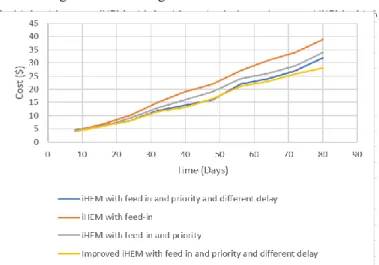
Figure 2 represent the relation between the time for running the simulation in days and the total cost of the energy consumption in dollars for six devices (Dryer, washer, dishwasher, coffeemaker, air conditioner, and PHEV) using four test scenarios; iHEM with feed-in, iHEM with feed-in and priority, iHEM with feed-in priority and delay, and the improved iHEM with feed-in priority and different delays. Results show that the proposed algorithm reduces the energy consumption more than the iHEM with feed-in priority and different delays. However, the total energy cost of iHEM with feed-in priority and different delays with 6 devices and the same period is $32, and the total energy cost of the improved iHEM with feed-in priority and different delays with 6 devices and the same period is $28, which means that there is a gain in the savings of $4.
Figure 2. Total cost for Four Devices
Comparing results depicted in Figures 1 and 2, the iHEM with feed-in priority and delay shows the best results regardless to the number of devices. The total cost of regular iHEM is $20 and 34 for four devices and six devices respectively after 80 days of simulation, and the total cost for the regular feed-in iHEM is $23 and $39 respectively. Where the iHEM with feed-in priority and different delays reduced $3 for using for devices for 80 days regard to the regular feed-in iHEM, and a total $9 reduction for using different six devices.
5.
Conclusion and Future Work
In this research we aimed to reduce the cost of the energy bill for consumers by shifting their demands to off-peak or mid-peak periods depending on the appliances priorities and delays. And we improved the case of not being able to shift the consumer demands by using the internal storage battery.
The proposed approach reduced the power consumption, thus the cost of the total energy bill. We proved that this approach is better than the regular iHEM and the iHEM with priority and different delays.
For future work, other factors are required to be considered in designing more efficient energy consumption algorithms for smart grids. Moreover, the relation and possible integration of the smart management system per home with other management systems in the same neighborhood needs to be studied and considered.
References
[1] Firas A. Albalas, Wail Mardini, Dua'a Bani-salameh, “Optimized Job Scheduling approach based on Genetic algorithms in smart Grid environment”, International Journal of Communication Networks and Information Security (IJCNIS), Vol 9, No 2 (2017).
[2] Expert Group 1. “Functionalities of smart grids and smart meters”, EU Commission Task Force for Smart Grids, Dec. 2010.
[3] W. Mardini, F. Albalas, M. Bani-Yasein, Q. Obeidat, "Improved Home Energy Management (HEM) Techniques for Smart Grids ", International Journal of Smart Home, pp. 1-20, vol. 11, no. 5, Jun. 2017.
[4] M. Erol-Kantarci, H. T. Mouftah, "Wireless Sensor Networks for Cost-Efficient Residential Energy Management in the Smart Grid", IEEE Trans. Smart Grid, vol. 2, no.2, Jun. 2011. [5] Prasath KB, Vijayakumar S, Prasath S. Kumar, “An Efficient Approach for Home Energy Management System”, International Journal of Engineering Science Inventio, pp. 49-58, Dec. 2013.
[6] F. De Angelis, M. Boaro, D. Fuselli, S. Squartini, F. Piazza, Q. Wei, "Optimal home energy management under dynamic electrical and thermal constraints", IEEE Transactions on Industrial Informatics, pp. 1518-1527, vol. 9, no. 3, Aug. 2013.
[7] M. Erol-Kantarci, H. Mouftah, "Using wireless sensor networks for energy-aware homes in smart grids", IEEE Symposium on Computers and Communications (ISCC), pp. 456-458, Jun. 2010.
[8] M. Pedrasa, T. Spooner, I. MacGill, "Coordinated Scheduling of Residential Distributed Energy Resources to Optimize Smart Home Energy Services", IEEE Transactions on Smart Grid, pp. 134-143, vol. 1, no. 2, Sept. 2010.
[9] Erol-Kantarci M, Mouftah HT, “Supply and load management for the smart distribution grid using wireless networks”, Electronics, Communications and Computers (JEC-ECC), 2012 Japan-Egypt Conference, Mar. 2012.
[10] H.-T. Yang, C.-T. Yang, C.-C. Tsai, G.-J. Chen, S.-Y. Chen,
"Improved PSO based home energy management systems integrated with demand response in a smart grid", IEEE Congress Evolutionary Computation (CEC), pp. 275-282, May 2015.
[11] Y. Ozturk, D. Senthilkumar, S. Kumar, G. Lee, "An intelligent
home energy management system to improve demand response", IEEE Transactions on Smart Grid, pp. 694-701, vol.4, no. 2, Jun. 2013.
[12] Z. Zhao, W.-C. Lee, "An Optimal Power Scheduling Method
for Demand Response in Home Energy Management System", IEEE Transactions on Smart Grid, pp. 1391-1400, vol. 4, no. 3, Sept. 2013.
[13] F. Mangiatordi, E. Pallotti, P. Del Vecchio, F. Leccese,
"Power consumption scheduling for residential buildings", 2012 11th International Conference on Environment and Electrical Engineering (EEEIC), pp. 926-930, May 2012.
[14] F. De Angelis, M. Boaro, D. Fuselli, S. Squartini, F. Piazza,
Industrial Informatics, pp. 1518-1527, vol. 9, no. 3, Aug. 2013.
[15] Pooja Singh, Vikas Pareek, Anil K Ahlawat, “Designing an