Gatekeeper
Public Key Infrastructure Framework
Gatekeeper
Public Key Infrastructure Framework
Foreword
Information and Communication Technologies (ICT) are transforming the way we work and are driving change in many industries. Governments around the world understand their decisions can assist or impede businesses to adjust to an
increasingly digital economy and society. The Commonwealth Government, as a key user of ICT has an important role to play in developing and supporting the
infrastructures required to support this digital transformation.
Trust is an essential element in the provision of government online services. Agencies and their customers alike need to establish a degree of trust or confidence about the identity of parties to digital services. Where an agency may be providing online access to services and benefits it will need to ensure that these are being delivered to the correct customer. As such, authentication policies, standards and technologies are essential.
Since 1999, the Department of Finance has developed and maintained the
Gatekeeper Public Key Infrastructure (PKI) Framework. The Framework ensures a whole-of-government context that delivers integrity, interoperability, authenticity and trust between agencies and their clients.
The Gatekeeper PKI Framework includes a suite of policies, standards and procedures that govern the use of digital certificates in Government for the
authentication of agencies and their clients. This document is the third release of the Framework and outlines the requirements Service Providers need to obtain and maintain accreditation and recognition.
I recommend the Gatekeeper Framework to anyone interested in doing business with Government in the future.
Firstname surname
Gatekeeper Competent Authority Month year
Gatekeeper PKI Framework | 3
Contents
1.
Framework Management
7
1.1.Change Log 7 1.2.Review Date 7 1.3.Conventions 71.4.Terms and Definitions 8
1.5.Transition Arrangements 8
1.6.Advice on this Framework 8
1.7.Document Structure 8
2.
Aims and Purpose
9
3.
Electronic Authentication
11
3.1.Electronic Authentication 11
3.2.The e-Authentication Process 11
3.3.Levels of Assurance 12
4.
Public Key Infrastructure
13
4.1.Public Key Infrastructure 13
4.2.Elements of Public Key Infrastructure 13
4.3.Security Services provided by a PKI 14
5.
Gatekeeper PKI Framework
16
5.1.Purpose 16 5.2.Framework Structure 16 5.3.Levels of Assurance 17 5.4.Government Requirements 17 5.5.Risk Management 17 5.6.Accreditation Process 18 5.7.Accreditation requirements 21 5.8.Mandatory Requirements 22
5.9.Recommended Standards and Guides 23
6.
Core Obligations
24
6.1.Core Obligations Policy 24
6.2.Liability 24
Gatekeeper PKI Framework | 4 6.4.Certification Authority 25 6.5.Registration Authority 29 6.6.Validation Authority 30 6.7.Subscriber 30 6.8.Relying Party 31
7.
Gatekeeper Mandatory Security Requirements
32
8.
Operational Evaluations
37
8.1.Information Security Registered Assessors Program 37
8.2.Gatekeeper Physical Security Evaluation 37
9.
Gatekeeper Criteria (Approved Documents)
39
9.1.Gatekeeper Information Security Documentation 39
9.2.Information Security Policy 40
9.3.Protective Security Risk Review 41
9.4.Security Risk Management Plan 43
9.5.System Security Plan 44
9.6.Site Security Plan 48
9.7.Personnel Security Plan 49
9.8.Vulnerability Management Plan 49
9.9.Incident Response Plan 51
9.10.Cryptographic Key Management Plan 52
9.11.Change Management Plan 54
9.12.Disaster Recovery and Business Continuity Plan 55
10.
Certification Authority
57
10.1.Certification Authority 57
10.2.Use of accredited identity proofing Service Providers 57
10.3.Certification Authority security assurance 58
10.4.Certification Authority Levels of Assurance 59
10.5.Object Identifiers 63
11.
Registration Authority
65
11.1.Registration Authority 65
11.2.Evidence of Identity Rigour and Storage 66
11.3.RA Operations Manual 66
11.4.Privacy Impact Assessment 67
11.5.Registration Authority Levels of Assurance 68
11.6.Individual Identity Proofing 71
11.7.Organisation Identity Proofing 72
Gatekeeper PKI Framework | 5
12.1.Validation Authority 75
13.
References
76
ANNEX A - Algorithms and Key Lengths
80
Gatekeeper PKI Framework | 6
Figures
Figure 1: Policy Environment 10
Figure 2: Elements of a PKI 14
Figure 3: Framework Structure 16
Figure 4: Accreditation Process 18
Gatekeeper PKI Framework | 7
1. Framework Management
1.1.
Change Log
This is the third published edition of the Gatekeeper PKI Framework (The Framework). This release includes a number of changes from the 2009 edition, including:
Merge and/or removal of the previous suite of 31 Gatekeeper policies, documents and guides into 5 documents.
Removed digital certificate classes and registration models.
o The former accreditation and listing arrangements have been replaced with Levels of Assurance (LOAs) - 1 through 4.
o Special and General Gatekeeper Listings have been removed and are now mapped to LOAs 1-3, depending on the Service Provider’s particular operating model.
o Relationship Organisations have been removed and replaced with Registration Authority requirements which map to LOAs 1 – 3, depending on the Service Provider’s particular operating model. o Removed Certification Authority (CA) and Validation Authority (VA)
Operations Manuals.
Included all relevant mandatory requirements of the Australian Government Information Security Manual (ISM) and Australian Government Protective Security Policy Framework (PSPF) into the Framework.
Definition of LOA requirements for Registration Authorities (RA), CAs and VAs which directly link to the National Identity Proofing Guidelines (NIPG)1 and National eAuthentication Framework (NeAF).2
1.2.
Review Date
To remain as a relevant and current accreditation regime and to maintain alignment with the ISM and PSPF, this document will be reviewed annually. Reviews will also consider emerging registration approaches and innovative certificate lifecycle processes.
1.3.
Conventions
The Gatekeeper Framework adopts the following conventions:
MUST indicates a mandatory requirement that is required in order to meet and maintain Gatekeeper Accreditation.
SHOULD indicates something that is not mandatory but is recommended which either supports a mandatory obligation or is considered best practice.
MUST NOT indicates something that if practiced, exercised or implemented will breach a Gatekeeper Core Obligation or Framework requirement.
1
For further information see [NIPG]
2
Gatekeeper PKI Framework | 8
1.4.
Terms and Definitions
The terms and definitions used in this document are defined in the Identity and Access Management Glossary [IAMG]3. (This glossary replaces the Gatekeeper PKI Framework Glossary 2009)
1.5.
Transition Arrangements
Existing accredited Service Providers will have two years from the date the Framework is published to align their Approved Documents with the new
requirements. Service Provider’s computing capabilities will need to transition to the new requirements as part of the next appropriate technical refresh.
Applicants are required to meet all Gatekeeper Policies and Criteria from the Framework’s publication date.
1.6.
Advice on this Framework
Advice on the Framework or suggestions for amendment can be forwarded to: Gatekeeper Competent Authority
C/O Director, Authentication and Identity Management Efficiency, Assurance and Digital Government Cluster Governance and Resource Management Group Department of Finance
John Gorton Building King Edward Terrace PARKES ACT 2600
Email: [email protected]
1.7.
Document Structure
This document is structured in the following manner:
Section 2 describes the Framework’s aims and purpose;
Section 3 introduces the concepts of e-Authentication and assurance levels;
Section 4 describes Public Key Infrastructure, the elements of a PKI and the security services provided by a PKI;
Section 5 describes the Gatekeeper Framework;
Section 6 lists the Core Obligations;
Section 7 lists the Gatekeeper Mandatory Security Requirements;
Section 8 defines operational evaluations to be carried out by Service Providers;
Section 9 describes the mandatory Gatekeeper documentation and provides guidance on the required content of each document;
Sections 10 through 12 describe the additional requirements specific for Certification Authorities, Registration Authorities and Validation Authorities respectively;
Section 13 lists the sources referenced in the Framework;
Annex A provides indicative guidance on appropriate cryptographic algorithms and key lengths;
Annex B lists the Root CA, Subordinate CA and Subscriber Certificate Profiles;
3
Gatekeeper PKI Framework | 9
2. Aims and Purpose
The Gatekeeper PKI Framework is a whole-of-government suite of policies, standards and procedures that governs the use of PKI in Government for the
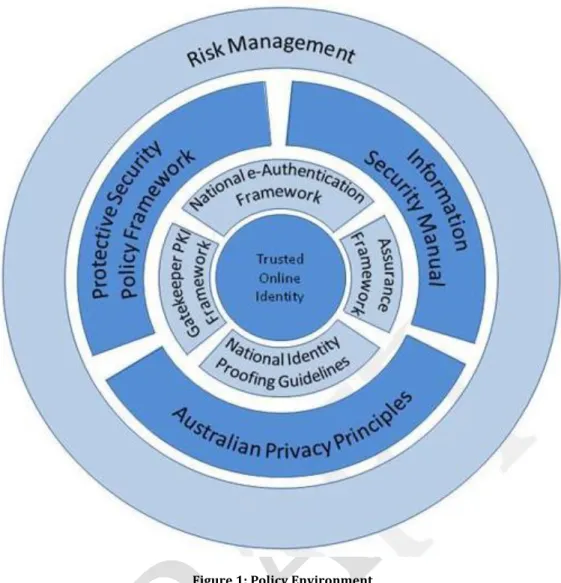
authentication of individuals, organisations and non-person entities (NPE) – such as devices, applications or computing components. Gatekeeper operates within a broader policy environment (Figure 1) which supports the Government’s agenda for the digital economy.
The Department of Finance is responsible for conducting the Gatekeeper
Accreditation Process and making recommendations to the Gatekeeper Competent Authority. The Gatekeeper Competent Authority is responsible for decisions in relation to the accreditation of Service Providers.
The Framework is mandatory for agencies using PKI to authenticate their clients through the use of digital keys and certificates issued by Gatekeeper accredited Service Providers. It ensures a whole-of-government outcome that delivers integrity, interoperability, authenticity and trust for Service Providers and their Subscribers that aligns the application of PKI to the way government agencies interact with external stakeholders.
Organisations operate independently of the government can also undergo the Gatekeeper Accreditation Process. The requirements outlined in this document apply equally to government agencies and organisations that choose to obtain and maintain Gatekeeper accreditation.
The Framework is recognised as PKI best practice and aligns with international standards.
Gatekeeper PKI Framework | 10
Figure 1: Policy Environment
The Australian Government Protective Security Policy Framework and Australian Government Information Security Manual provide the overarching security policy context for Gatekeeper. Within the risk-based approach set out in these policy frameworks, Service Providers MUST satisfy Gatekeeper-specific standards and benchmarks. Additionally, Gatekeeper benchmarks enable the accreditation process to be undertaken against agreed criteria ensuring that all Service Providers operate to the same standards.
Privacy of personal information is a fundamental consideration under the Gatekeeper PKI Framework. All Service Providers are required to comply with the Privacy Act 1988 (Cth) and the Australian Privacy Principles (APPs).
The National Identity Proofing Guidelines, National e-Authentication Framework and Third Party Identity Services Assurance Framework (Assurance Framework) support the Gatekeeper PKI Framework. Standardised and transparent approches to identity proofing, electronic authentication and identity service provisioning are achieved through the use of these frameworks and guidelines which, together with Gatekeeper assist with establishing trusted online identities.
Gatekeeper PKI Framework | 11
3. Electronic Authentication
3.1.
Electronic Authentication
Electronic authentication (e-authentication) is the process of establishing confidence in a claimed digital identity presented to an online resource. High-risk systems, applications and information requires stronger forms of authentication that more accurately confirm the entity’s digital identity as being who they claim to be, as opposed to low-risk applications where the confirmation of the digital identity is not as important from a risk perspective.
Determining the appropriate authentication approach requires a balance between the level of risk that is acceptable and the desired user experience.
Authentication is not the same as authorisation, which addresses the permissions or privileges granted to a Subscriber when accessing systems, or online services. The issue of authorisation is not addressed in the Framework.
3.2.
The e-Authentication Process
Before an individual can authenticate to an online service, they must first be enrolled and issued a digital credential.
The first step of e-authentication requires an Applicant to undergo an evidence of identity check. This identity verification process is called ‘identity proofing’. The usual sequence of events for registration is as follows:
An Applicant applies to a RA to become a Subscriber of a Credential Service Provider4 (CSP);
The RA verifies the identity of the Applicant; and
The RA associates the Applicant with the identity record created. This
association may occur within or on behalf of an agency. (On successful identity proofing the Applicant will be considered a Subscriber of the CSP.)
Once the individual’s identity has been verified to a defined LOA, the RA will request a credential from the CSP on behalf of the individual. This process is called
‘credentialing’. The usual sequence of events for credentialing is as follows:
The RA will send the CSP a registration confirmation message.
The CSP will generate and register the credential and associate it with the Subscriber
The CSP will issue the credential to the Subscriber.
The CSP will manage the credential throughout its lifecycle.
The Subscriber will then be able to use the credential to subsequently authenticate to online services.
4
Gatekeeper PKI Framework | 12
3.3.
Levels of Assurance
The NeAF provides guidance on establishing confidence in an entity’s digital identity to a defined LOA for a particular transaction.
Each assurance level describes the degree of confidence that a user has presented a claim to an online resource that represents his or her identity (for example, these claims may be contained within a credential such as a digital certificate).
To determine the appropriate LOA in the entity’s asserted identity, NeAF provides guidance on assessing the potential risks and identifies measures to minimise their impact. In this context, assurance is defined as:
1. The degree of confidence in the registration processes used to verify the identity of the entity to whom the credential is issued,
2. The degree of confidence in the management and operations of the CSP, 3. The degree of confidence in the underlying security characteristics of the
credential, and
4. The degree of confidence the relying party has about entity using the credential is the same entity to whom the credential was issued.
The four NeAF assurance levels are:
Level 1: No or little confidence in the claimed or asserted identity.
Level 2: Some confidence in the claimed or asserted identity.
Level 3: High confidence in the claimed or asserted identity.
Level 4: Very high confidence in the claimed or asserted identity.
The overall LOA is that of the lowest ranking of the four characteristics above. The NeAF is used at the initial design or redesign stage of an information system to determine the required LOA. The degree of rigour required in the registration process and type of credential needed to deliver the required LOA are outputs of a NeAF assessment. For further information see [NeAF].
Gatekeeper PKI Framework | 13
4. Public Key Infrastructure
4.1.
Public Key Infrastructure
Public Key Infrastructure are a set of policies, practices and technologies that enables users of an insecure online service, such as the Internet, to authenticate their identity and to securely and privately exchange information with a third party through the use of Public Key Cryptography.
Public Key Cryptography or asymmetric cryptography is a class of cryptographic algorithms which require two separate keys - one which is public and one which is private. Although different, the keys are mathematically linked in a manner which enables actions performed by one key to be verified with the other. For example, a public key can be used to encrypt information or to verify a digital signature, whereas a private key can be used to decrypt information or to create a digital signature.
The central function of a PKI is the provision of digital certificates and cryptographic keys that can identify an individual, organisation or NPEs. It also provides the management, distribution and revocation of those digital certificates.
4.2.
Elements of Public Key Infrastructure
A PKI may consist of the following components including:
Registration Authority undertakes functions such as Identity Proofing and processes requests for new digital certificates, requests for renewal of digital certificates and requests for revocation of digital certificates.
Certification Authority is trusted by one or more entities to create and assign digital certificates. The CA links the public key to the digital certificate and vouches for the identity of the Key Holder. In the context of e-authentication a CA is the Credential Service Provider.
Repository may store and make available certificates and Certificate Revocation Lists (CRLs) or Online Certificate Status Protocol (OCSP) services. CRLs and optionally OCSP services are maintained by CAs and contain details of certificates issued by the CA that have not expired.
Validation Authority is a special form of PKI entity which can be used to check the validity and currency of digital certificates. A VA is typically used when certificate generation and certificate status services are separated between Service Providers. For example, the Australian Taxation Office issues AusKey
digital certificates and the Department of Industry through VANguard manage the associated Certificate Validation Service.
Subscriber also referred to as a Certificate or Key Holder is issued a key and certificate which, depending on the rules outlined in its associated Certification Practice Statement (CPS) and Certificate Policy (CP), can be used to authenticate to online resources or digitally sign or encrypt electronic documents.
Subscribers can be individuals, organisations or NPEs.
Relying Party receives, validates and accepts digital certificates and digital signatures from Subscribers.
Gatekeeper PKI Framework | 14 Certificate Policy is a named set of rules that indicates the purposes for which a
particular digital certificate can be used.
Certification Practices Statement (CPS) describes the rules and operating practices by which the CA will follow when providing digital certificate certifcates.
Subscriber (and Relying Party) Agreement is a legal document that explains the rights and obligations of a Subscriber (and Relying Party).
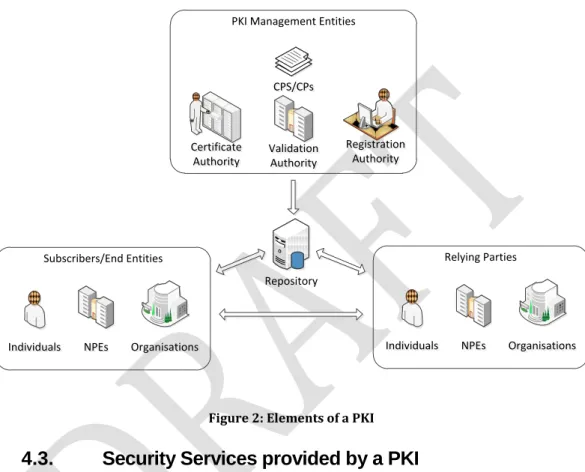
The following diagram (Figure 2) shows the relationships between these components. The arrows indicate the flow of digital certificates and certificate status information.
Individuals
Individuals NPEsNPEs OrganisationsOrganisations Subscribers/End Entities
Individuals
Individuals NPEsNPEs OrganisationsOrganisations Relying Parties Repository Registration Authority Registration Authority Certificate Authority Certificate Authority CPS/CPs CPS/CPs PKI Management Entities
Validation Authority Validation Authority
Figure 2: Elements of a PKI
4.3.
Security Services provided by a PKI
Depending on the operating model, the use of PKI may provide authentication, integrity, non-repudiation and confidentiality security services for online transactions, with assurance of:
Confidentiality of the information or information channel (where required)
Validity of the information conveyed and received (data integrity)
Identity of the parties involved in the transactions (authentication)
Accountability of commitments or actions (non-repudiation) These features are provided with some or all of the following systems:
A digital certificate or public key certificate is an electronic data structure signed by a CA which identifies the Key Holder and business entity (if appropriate) he or she represents. It binds the Key Holder to a key pair by specifying the public key of the key pair. It also contains any other information required by the profile for that digital certificate. The key pair can be generated in either
software or hardware. Software-based digital certificates are typically stored on Subscriber’s computer hard drives or group drives whereas hardware-based digital certificates are typically stored in hardware form (e.g. USB and smartcards) which connect to Subscriber’s computers and networks.
Gatekeeper PKI Framework | 15 A digital signature is a cryptographic technique that applies a mathematical
algorithm to a document based on a certificate holder’s private key. This creates a unique seal which is inherently difficult5 to forge and that can be checked by a Relying Party to confirm that the document or file has not been altered or interfered with.
A digital signing certificate is a combination of the above two systems.
An encryption scheme is a cryptographic technique that applies a mathematical algorithm to messages and information in such a way that only authorised parties can read it. Using an encryption scheme turns message or information into an unreadable mix of characters known as ciphertext. This is usually done with the use of an encryption key, which specifies how the message or
information is to be encoded. Unauthorised parties will be able to view the unreadable data but will be unable to determine anything about the message or information. The intended recipient of the information is able to decode the ciphertext using a decryption algorithm and a secret, or private decryption key, which only they have access to.
A digital encryption certificate is a combination of a digital certificate and an encryption scheme.
Service (or device) authentication is where only one party involved with an online service is required to manage the authenticated session. This means only one party has to have a digital certificate but both parties must be able to execute PKI cryptography. Most web servers and browsers have this functionality built in. Server authentication is typically used where many remote parties need to connect securely to a web server and there is no need to fully authenticate the remote parties. General uses of server authentication include Internet banking, logging on to social media sites and accessing online government services.
Client authentication is necessary when transacting parties require mutual authentication. This typically occurs when higher levels of confidence are required in the identity of the transacting parties and requires both parties to verify their identity with a digital certificate. Client authentication is generally used when accessing or transacting highly sensitive information (e.g. corporate banking, medical or national security).
5
Gatekeeper PKI Framework | 16
5. Gatekeeper PKI Framework
5.1.
Purpose
The Gatekeeper PKI Framework is a whole-of-government suite of policies, standards and procedures that governs the use of PKI in Government for the authentication of individuals, organisations and NPEs.
Under the Framework the PKI participants are: 1. Certification Authorities 2. Registration Authorities 3. Validation Authorities 4. Subscribers 5. Relying Parties
5.2.
Framework Structure
The Framework is built around five core documents as shown in Figure 3 below.
Gatekeeper PKI Framework IRAP Gatekeeper PKI
Framework Guide Gatekeeper Compliance Audit Program Gatekeeper Head Agreement/ Memorandum of Agreement
Identity & Access Management
Glossary
Figure 3: Framework Structure
The Gatekeeper PKI Framework (this document) defines the minimum requirements for Service Providers to obtain and maintain Gatekeeper accreditation.
The IRAP Gatekeeper PKI Framework Guide provides Information Security Registered Assessors Program (IRAP) Assessors with a guide to assess the implementation of security practices and controls by Service Providers.
Gatekeeper PKI Framework | 17 The Gatekeeper Head Agreement/Memorandum of Agreement is the ‘contract’
between the Department of Finance (on behalf of the Commonwealth) and the Service Provider. This provides a legal framework which establishes the
conditions under which the Service Provider is accredited and what is required in order for the Service Provider to maintain its Gatekeeper Accreditation.
The Gatekeeper Compliance Audit Program provides guidance to auditors and Service Providers on the scope and conduct of the compliance assessment required under the Framework.
The Identity and Access Management Glossary contains a list of definitions, acronyms and associated terms related to the Framework. The Glossary also contains all related terms associated with the NeAF and Assurance Framework.
5.3.
Levels of Assurance
Similar to the NeAF, the Gatekeeper Framework is designed around the concept of assurance levels. The four Gatekeeper assurance levels are:
Level Description RA CA VA
1 No or little confidence In the registration processes used to identify the claimant In the credentialing processes used to manage digital certificates throughout their lifecycle In the certificate validation services provided 2 Some confidence 3 High confidence 4 Very high confidence
5.4.
Government Requirements
Government policy does not mandate the use of PKI for authenticating online transactions. Use of PKI for authentication purposes is purely a business decision for agencies.
Commonwealth agencies wishing to use digital certificates to authenticate their clients are required to use Gatekeeper accredited Service Providers. This has been Government policy since July 1999.
5.5.
Risk Management
Gatekeeper operates within a risk management context and aligns with the Australian Government’s PSPF and ISM.
The PSPF defines a series of mandatory requirements with which Commonwealth agencies and bodies must demonstrate their compliance. These requirements cover personnel security, information security and physical security.
The ISM is designed to assist Australian government agencies in applying a risk-based approach to protecting information and ICT systems. The ISM includes a set of controls that, when implemented, will help agencies meet their compliance requirements for mitigating security risks to their information and systems. In support of the PSPF and ISM compliance obligations, the Framework contains Gatekeeper Mandatory Security Requirements with which Service Providers MUST comply.
Gatekeeper PKI Framework | 18
5.6.
Accreditation Process
5.6.1.
Obtain and maintain accreditation
The Accreditation Process is outlined in Figure 4 below:Request accreditation 1 Accept request & propose initial meeting 2 Organise initial meeting 3 Draft documentation 5 Review & endorse documentation 5a Request evaluation(s) of operations 6 Evaluate operations 6a Endorse evaluation(s) 6b Recommend accreditation 7 Award accreditation 8 Update Gatekeeper website 8a Maintain accreditation 9 Request compliance audit 10 Undertake compliance audit 10a Accept audit findings 13 Provide compliance report 11 Review audit findings 12 Discuss accreditation requirements 4
Applicant Assessor(s) Gatekeeper Competent
Authority Department of Finance
Gatekeeper PKI Framework | 19 The Applicant submits a formal request in writing to the Gatekeeper Competent
Authority ([email protected]) seeking Gatekeeper accreditation to a defined LOA as a RA, CA, VA or a combination of these.
The Gatekeeper Competent Authority formally responds to the request and an initial meeting with the Applicant is convened to discuss the accreditation process.
The Applicant drafts its documentation and organises independent evaluations of its operations for compliance with Gatekeeper Policies and Criteria. For CAs and VAs this includes an IRAP evaluation and a Gatekeeper Physical Security Evaluation (GPSE). For RAs this includes an IRAP, GPSE and a Privacy Impact Assessment (PIA).
The Department of Finance commences its evaluation of the Applicant’s documents for compliance with Gatekeeper Policies and Criteria.
Following successful completion of the evaluation process, Finance recommends accreditation to the Gatekeeper Competent Authority and a Head Agreement or Memorandum of Agreement between Finance and the Service Provider is negotiated and signed and a Certificate of Accreditation is presented to the Service Provider. (The Agreement will include the list of Approved Documents.)
The Service Provider’s details are listed on the Gatekeeper website.
The Service Provider maintains accreditation by providing its services in accordance with its Approved Documents.
The Service Provider will undertake annual compliance audits and provide the findings to the Department of Finance. The Gatekeeper Competent Authority will accept the audit findings and the Gatekeeper website will be updated to reflect the Service Providers accreditation status.
5.6.2.
Gatekeeper Accreditation Disclaimer
GATEKEEPER ACCREDITATION DISCLAIMER The Gatekeeper Competent Authority is responsible for ensuring that theaccreditation process is conducted with due care and in accordance with published Gatekeeper Criteria and Policies
The Gatekeeper Competent Authority is not liable for any errors and/or omissions in the final Approved Documents, which remain the responsibility of the accredited Service Provider.
The Department of Finance is not responsible and cannot be held liable for any loss of any kind in relation to the use of digital keys and certificates issued by a
Gatekeeper accredited Service Provider.
By granting a Service Provider Gatekeeper Accreditation the Department of Finance makes no representation and gives no warranty as to the:
Accuracy of any statements or representations made in, or suitability of, the Approved Documents of a Gatekeeper accredited Service Provider;
Accuracy of any statement or representation made in, or suitability of, the documentation of a Service Provider in a Gatekeeper recognised PKI domain; or
Standard or suitability of any services thereby provided by any Subscriber or Relying Party or application.
Gatekeeper PKI Framework | 20
5.6.3.
Variation to accreditation
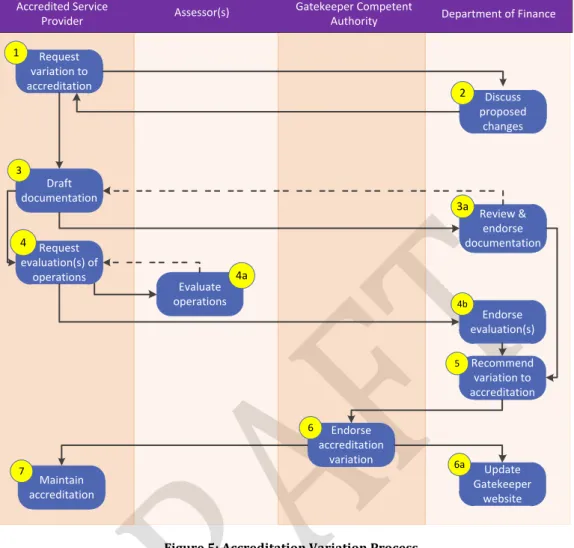
The accreditation variation process is outlined in Figure 5 below:
Draft documentation Review & endorse documentation 3a Request evaluation(s) of operations Evaluate operations 4a Endorse evaluation(s) 4b Recommend variation to accreditation 3 Endorse accreditation variation 6 Update Gatekeeper website 6a Maintain accreditation 7 Accredited Service Provider Assessor(s) Gatekeeper Competent
Authority Department of Finance Request variation to accreditation Discuss proposed changes 1 2 4 5
Figure 5: Accreditation Variation Process
The accredited Service Provider advises the Department of Finance of a need to vary the terms of its accreditation. A typical variation includes changes to Approved Documents.
The Department of Finance will discuss the proposed changes with the Service Provider.
Depending on the nature of the proposed change, Approved Documents may need to be revised and submitted to the Department of Finance for review and endorsement. Similarly, for proposed changes with possible significant impacts, the Department of Finance may direct the Service Provider to organise
independent evaluations (i.e. IRAP, GPSE, PIA) of its operations.
Following successful completion of the documentation review and possibly operational evaluations, the Department of Finance will recommend to the Gatekeeper Competent Authority that a variation to the accredited Service Provider’s Head Agreement or Memorandum of Agreement be granted.
Once granted, the details of the variation will be listed on the Gatekeeper website.
The accredited Service Provider will maintain its accreditation by providing its services in accordance with its Approved Documents and undertake annual compliance audits as shown in step 10 of Figure 4.
Gatekeeper PKI Framework | 21
5.7.
Accreditation requirements
Gatekeeper Accreditation provides participants in Gatekeeper PKI deployments with assurance of the operational competence and protective security of the organisations responsible for the registration, generation, issuance, storage and management of public keys and certificates.
Ongoing compliance with Gatekeeper Policies & Criteria is a mandatory requirement for Service Providers to achieve and maintain Gatekeeper Accreditation. The
following table lists these compliance obligations and to whom they apply.
Requirement RA CA VA Section
Gatekeeper Policies
Core Obligations Policy X X X 6
Gatekeeper Mandatory Security
Requirements X X X 7
Identity Proofing X 11.6 & 11.7
Gatekeeper Criteria (General)
Privacy Impact Assessment X 11.4
Information Security Registered Assessors Program
X X X 8.1
Gatekeeper Physical Security Evaluation X X X 8.2
Annual Compliance Audits X X X See [GCAP]
Gatekeeper Criteria (Approved Documents)
Information Security Policy X X X 9.2
Protective Security Risk Review X X X 9.3
Security Risk Management Plan X X X 9.4
System Security Plan X X X 9.5
Site Security Plan X X X 9.6
Personnel Security Plan X X X 9.7
Vulnerability Management Plan X X X 9.8
Incident Response Plan X X X 9.9
Cryptographic Key Management Plan X X X 9.10
Change Management Plan X X X 9.11
Disaster Recovery & Business Continuity
Plan X X X 9.12
Gatekeeper PKI Framework | 22
Requirement RA CA VA Section
Certification Practice Statement X 10.1
Certificate Policy X 10.1
5.8.
Mandatory Requirements
The Framework requires compliance with the following regimes:
Regulatory Regime Reference
Protective Security Policy Framework [PSPF]
Agency Personnel Security Guidelines [APSG]
Australian Government Personnel Security Management
Protocol [AGPSP]
Information Security Management Guidelines – Australian
Government Security Classification System [ISMG1]
Information Security Management Guidelines – Management of
aggregated information [ISMG2]
Physical Security Management Guidelines – Physical Security of
ICT equipment, systems and facilities [PSMG1]
Physical Security Management Guidelines – Security Zones and
Risk Mitigation Control Measures [PSMG2]
Protective Security Governance Guidelines - Business Impact
Levels [BIL]
Securing Government Business – Protective Security Guidance
for Executives [SGB]
Australian Government Information Security Manual [ISM]
Archives Act 1983 [AA1983] National Archives of Australia – Administrative Functions Disposal
Authority [AFDA]
Information Security Registered Assessors ProgramGatekeeper
PKI Framework Guide [IRAP]
ITU-T X.500 (10/12) Information technology – Open Systems Interconnect – The Directory: Overview of concepts, models and services
[X.500]
National e-Authentication Framework [NeAF]
National Identity Proofing Guidelines [NIPG]
Privacy Act 1988 [PA1988]
Privacy Amendment (Enhancing Privacy Protection) Act 2012 [PA2012] RFC3647 Internet X.509 Public Key Infrastructure Certificate
Policy and Certification Practices Framework [RFC3647] RFC 5280 Internet X.509 Public Key Infrastructure and Certificate
Revocation List (CRL) Profile [RFC5280]
Gatekeeper PKI Framework | 23
5.9.
Recommended Standards and Guides
To assist with meeting the compliance obligations of the Framework Applicants SHOULD consider the following standards and guides:
Recommended Standards and Guides Reference Australian National Audit Office Business Continuity Management
– Building resilience in public sector entities [ANAO] AS/NZS 5050:2010 Business Continuity – Managing
disruption-related risk. [ANZ5050]
AS/NZS ISO 31000:2009 Risk Management Principles and Guidelines
[ANZ2009] Australian Standard HB 167:2006 Security Risk Management [HB167] CA/Browser Forum Baseline Requirements for the Issuance and
Management of Publicly-Trusted Certificates [CABF] Canada Institute of Chartered Accountants, 2011, Trust Service
Principles and Criteria for Certification Authorities, Version 2.0,
Canada Institute of Chartered Accountants, Canada [WebTrust] European Telecommunications Standards Institute, Electronic
Signature and Infrastructure (ESI); Policy requirements for certification authorities issuing public key certificates,(ETSI TS 102 O42)
[ETSI]
Federal Information Processing Standard (FIPS) 140-2 Security
Requirements for Cryptographic Modules [FIPS]
ISO/IEC 27005:2011 Information Technology – Security Techniques – Information Security Risk Management
[27005] National Institutes of Standards and Technology Special
Publication 800-57 Part 1 Recommendation for Key Management Part 1: General (Revision 3)
[800-57]
Office of the Australian Information Commissioner Data Breach
Notification [DBN]
Office of the Australian Information Commissioner Guide to
Undertake Privacy Impact Assessments [PIA]
RFC 6960 X.509 Internet Public Key Infrastructure Online
Certificate Status Protocol – OCSP [RFC6960]
RFC 5019 The Lightweight Online Certificate Status Protocol
(OCSP) Profile for High-Volume Environments [RFC5019] Third Party Identity Services Assurance Framework [TPISAF]
Gatekeeper PKI Framework | 24
6. Core Obligations
6.1.
Core Obligations Policy
This policy sets out the Core Obligations as determined by the Gatekeeper Competent Authority in relation to the application, generation, issuance and on-going management of digital keys and certificates issued by a Service Provider in Gatekeeper PKI deployments.
The Gatekeeper Competent Authority will not grant Gatekeeper Accreditation to a Service Provider that seeks through its documentation to avoid or exclude liability for breaches of its Gatekeeper Core Obligations as specified in the following sections.
6.2.
Liability
Liability is the legal obligation to compensate another party when an obligation has been breached.
The source of the obligation can be a contract, a common law obligation, a statutory obligation or an equitable obligation. Liability will follow when an obligation of the kind that is spelt out in the following sections of this policy is breached.
6.3.
Service Providers
Service Providers MUST:
Be registered with the Australian Business Register (ABR) and maintain a current Australian Business Number (ABN);
o Loss of ABR registration will result in termination of the Service Provider’s Gatekeeper Accreditation.
Meet all relevant third party evaluation requirements as set out in the Framework including:
o Undertake an assessment of all PKI-related systems using a registered IRAP Assessor listed on the Australian Signals Directorate (ASD) IRAP website. Unless otherwise directed by the Gatekeeper Competent Authority this is a one-off evaluation as per step 6a in the accreditation process listed at Figure 4;
o Undergo a physical evaluation by an authorised assessor from the Gatekeeper Physical Security Evaluation Panel. Unless otherwise directed by the Gatekeeper Competent Authority this is a one-off evaluation as per step 6a in the accreditation process listed at Figure 4.
Be physically located within Australia and provide services from within Australia6;
Develop, maintain and provide PKI services in accordance with their Approved Documents;
Undergo an annual Gatekeeper Compliance Audit;
6
Gatekeeper PKI Framework | 25 Document their compliance with Gatekeeper Core Obligations in their legal
documentation such as CPS, CP, Subscriber and Relying Party Agreements (where relevant) or into other Approved Documents submitted for approval by the Gatekeeper Competent Authority; and
Implement the mandatory Top 4 Strategies to Mitigate Targeted Cyber Intrusions
as detailed in the ISM.
Adopt a risk-management approach and implement alternative security controls for:
o Technologies which lack available software to enforce the mandatory controls, and
o Scenarios or circumstances which prevent enforcement of the mandatory controls.
Service Providers SHOULD implement the recommended ISM controls that relate to the Top 4 Strategies. Although not considered mandatory these controls are best practice and complement the Top 4 Strategies.
6.4.
Certification Authority
6.4.1.
Standards
A CA MUST ensure all: Digital certificates conform to the Request for Comment (RFC) X.509 v3 format; o Annex B lists the Root CA, Subordinate CA and Subscriber Certificate
Profiles to be used; and,
o Any digital certificate extensions that do not confirm to RFC 5280 MUST be marked non-critical).
CRLs conform to the X.509 v2 profiles as described in RFC5280;
OCSP responses conform to RFC5019 (if OCSP is supported); and
CPS and CPs conform to the document framework as described in RFC3647. A CA SHOULD ensure all OCSP responses conform to RFC6960.
6.4.2.
Certification Practice Statement / Certificate Profile
A CA MUST: Perform digital certificate lifecycle operations in a manner which is compliant with its CPS;
Display the Gatekeeper Accreditation Disclaimer (Section 5.6.2) in their CPS and CPs;
Ensure the security objectives identified in the Security Profile are reflected in the CPS and CPs;
Ensure the CP under which each digital certificate is issued clearly specifies the Key Usage within the Certificate Profile;
Ensure every CP under which digital certificates are issued clearly specifies the Level of Assurance associated with the digital certificates by including the Gatekeeper LOA Object Identifier (OID) as a Mandatory Non Critical Key Usage Extension;
Ensure all CPS and CPs undergo a legal evaluation by an authorised legal assessor from the Gatekeeper Legal Evaluation Panel and,
Gatekeeper PKI Framework | 26 Make available as much of its published CPS and CPs as necessary to allow a
relying party to make an informed decision on trust. A CA MUST NOT:
Escrow or backup Subscriber private keys used for non-repudiation; and
Mark the Key Usage Extension in Subscriber digital certificates as both Critical and Mandatory.
6.4.3.
Staff Training
A CA MUST: Provide all personnel performing information verification duties with skills-training that covers basic PKI knowledge, authentication and vetting policies and procedures, including the CPS and CA CP; and,
Maintain records of such training and ensure that personnel maintain a skill level that enables them to perform such duties satisfactorily.
6.4.4.
Certificate Generation
A CA MUST, when generating a digital certificate, ensure that:
The certificate information provided to it by an RA has been accurately transcribed into the digital certificate;
All other certificate information it generates itself is accurate; and,
The digital certificate contains all the elements required by the certificate profile contained in the CP.
6.4.5.
Key Generation
A CA MUST ensure that each key pair generated can work as an operable pair of cryptographic keys.
6.4.6.
Possession of Private Key
A CA MUST take all reasonable actions to ensure that the Subscriber or an
appropriately authorised entity is in control of the activation data and private key(s) corresponding to the public key identified in the digital certificate before the private key can be used.
6.4.7.
Private Key Use
A CA MUST ensure the Root CA Private Keys are not used to sign certificates except in the following cases:
Self-signed certificates to represent the Root CA itself;
Certificates for Subordinate CAs (and Cross Certificates);
Certificates for infrastructure purposes (e.g. administrative role certificates, internal CA NPE certificates, and OCSP certificates); and
Certificates issued solely for the purpose of testing products with certificates issued by the Root CA.
6.4.8.
Certificate Repository
A CA MUST:Gatekeeper PKI Framework | 27 In accordance with the ITU-T Recommendation [X.500] and [RFC3647],
generate, maintain and make available a list of revoked digital certificates in a manner accessible by all potential Relying Parties using standard protocols and technologies to enable them to verify, in a timely manner, the currency of a particular digital certificate;
Operate and maintain its CRL and OCSP (if supported) capabilities with resources sufficient to provide a response time of ten seconds or less under normal operating conditions; and,
Ensure the location where certificates and CRLs are published has restricted write access so that only valid certificates and CRLs issued by approved PKI entities can be published by an authorised person or process.
6.4.9.
Certificate Revocation
A CA MUST: Provide a process for Subscribers to request revocation of their own certificates. The process MUST be described in the CPS and relevant CP;
Provide Subscribers and Relying Parties with clear instructions for reporting suspected Private Key compromise, certificate misuse, or other types of fraud or inappropriate conduct relating to certificates. The CA MUST publically disclose the instructions through a readily accessible online means accessible by Subscribers and Relying Parties;
Ensure the prompt revocation of a digital certificate in accordance with the requirements of the CP under which it was issued and in accordance with the requirements outlined in the CA Requirements section for the specific LOA of the accreditation; and,
Revoke a certificate if one or more of the following occurs:
o The Subscriber notifies the CA that the original certificate request was not authorised and does not retrospectively grant authorisation;
o The CA obtains evidence that the Subscriber’s private key corresponding to the public key in the certificate suffered a key compromise or no longer complies with the requirements outline in the CP;
o The CA obtains evidence any certificate it has issued has been misused; o The CA is made aware that a Subscriber has violated one or more of its
material obligations under the Subscriber Agreement or other contractual or terms of use agreements that apply;
o The CA is made aware that the certificate was not issued in accordance with its CP or CPS;
o The CA determines that any of the information appearing in the certificate is inaccurate or misleading;
o The CA ceases operations for any reason and has not made arrangements for another CA to provide revocation support for the certificate; and,
o The CA is made aware of a possible compromise of a Subordinate CA’s private key.
6.4.10.
Key Archive and Recover
A Key Archive MUST be at least as well protected as the CA and implement network filtering, identity segmentation and security controls commensurate with the CAs LOA.
Gatekeeper PKI Framework | 28
Private keys MUST be encrypted within the key archive store to stope attacks where the store is stolen and accessed offline.
Any instance of key recovery MUST be logged, audited and alerted so they can be reviewed by the appropriate authority.
Service Providers MUST only archive encryption keys to enable recovery of encrypted data. Keys used for digital signature or authentication MUST NOT be archived.
6.4.11.
CA Termination
In the event that a Gatekeeper accredited CA terminates its operations whether voluntary or involuntary it MUST NOT:
Enter into any new contracts with customers, or renew existing contracts; and,
Enter into any new Subscriber Agreements, or renew existing Subscriber Agreements.
In the event that a Gatekeeper accredited CA terminates its operations whether voluntary or involuntary it MUST:
Make arrangements to novate to another Gatekeeper accredited CA or terminate all Subscriber agreements that were entered into in accordance with the
relevant CP;
Give notice to the Gatekeeper Competent Authority and all associated parties (e.g. Subscribers, Relying Parties) advising them of its intention to terminate its contracts with them, the termination to be effective in accordance with the terms of the relevant contract;
Continue to provide the services, in particular the maintenance of a CRL or other listing of revoked digital certificates in accordance with the contractual
arrangements it has with agencies, and any relevant Approved Documents which include arrangements to accommodate significant interruptions in the provision of the service; and
Co-operate with the Department of Finance and other Service Providers, to achieve a seamless and secure migration of the agencies and Subscribers to a new Gatekeeper accredited CA.
6.4.12.
Logging
The CA MUST record at least the following events:
CA key lifecycle management events, including:
o Key generation, backup, storage, recovery, archival and destruction; and, o Cryptographic device lifecycle management events.
CA and Subscriber lifecycle management events, including:
o Certificate requests, renewal requests, re-key requests, revocation requests and revocation actions;
o Acceptance and rejection of certificate requests; and, o Issuance of certificates and.
Generation of CRLs and if supported, OCSP entries
Security events, including:
o Successful and unsuccessful PKI system access attempts; o Changes to rights assigned to privileged accounts; o System outages, hardware failures and other anomalies; o Firewall and router activities; and,
Gatekeeper PKI Framework | 29
o Entries to and exits from the CA facility.
Logs MUST be retained for at a minimum of seven years after action is completed in accordance with the [AA1983] and [AFDA].
6.5.
Registration Authority
6.5.1.
Privacy Impact Assessment
A RA MUST: Undertake a PIA for all PKI-related systems that collect, process, store or disclose personal information unless otherwise directed by the Gatekeeper Competent Authority this is a one-off evaluation as per step 6a in the accreditation process listed at Figure 4;
6.5.2.
Identity Proofing
A RA MUST: Take all reasonable actions to verify7 the accuracy and sufficiency8 of identity documentation, including any client application forms and supporting
documentation received by it;
Ensure the accurate recording and secure transmission of all relevant certificate information to the relevant CA;
Ensure the secure storage of all retained Applicant and Subscriber information in accordance with the requirements of its Approved Documents; and
In the event that an error is identified in the identity proofing process that gives rise to uncertainty as to the identity of a particular Subscriber, promptly notify the CA that generate the digital certificate of the error and request the
revocation of the digital certificate.
6.5.3.
Staff Training
A RA MUST provide all personnel performing identity verification duties with skills-training that covers basic PKI knowledge, authentication and vetting policies and procedures, including CPS and CA CP.
6.5.4.
RA Termination
In the event that a Gatekeeper accredited RA terminates its services, whether voluntary or involuntary it MUST NOT conduct any new registration activities for Applicants or Subscribers.
In the event that a Gatekeeper accredited RA terminates its services, whether voluntary or involuntary it MUST give notice to the Gatekeeper Competent
Authority and all CAs with whom it has a relationship in accordance with the terms of the relevant contract.
7
Verify means to determine or test the accuracy of identity documentation submitted by an Applicant (including photographic evidence) and including signature verification in accordance with:
The procedures set out in the RA’s Approved Documents; The relevant CP and CPS; and
The service agreement between the RA and CA.
8
Sufficiency means that the documents submitted by an Applicant in relation to the particular certificate being requested satisfy the Gatekeeper Identity Proofing Policy
Gatekeeper PKI Framework | 30
6.6.
Validation Authority
6.6.1.
Standards
A VA MUST be able to process: Digital certificates which conform to the X.509 v3 format and CRLs which conform to the X.509 v2 profiles as described in RFC5280; and,
OCSP responses which conform to RFC5019
A VA SHOULD be able to process OCSP responses which confirm to RFC6960.
6.6.2.
Staff Training
A VA MUST:
Provide all personnel performing information verification duties with skills-training that covers basic PKI knowledge, authentication and vetting policies and procedures, including the CPS and CA CP; and,
Maintain records of such training and ensure that personnel maintain a skill level that enables them to perform such duties satisfactorily.
6.6.3.
Certificate Repository
A VA MUST: In accordance with the ITU-T Recommendation [X.500] and [RFC3647], maintain and make available a list of revoked digital certificates in a manner accessible by all potential Relying Parties using standard protocols and technologies to enable them to verify, in a timely manner, the currency of a particular digital certificate; and,
Operate and maintain its repository capabilities which house CRL (and optionally OCSP) services with resources sufficient to provide a response time of ten seconds or less under normal operating conditions.
6.6.4.
VA Termination
In the event that a Gatekeeper accredited VA terminates its operations, whether voluntary or involuntary it MUST NOT conduct any certificate validation activities for Relying Parties
In the event that a Gatekeeper accredited VA terminates its operations, whether voluntary or involuntary it MUST give notice to the Gatekeeper Competent Authority and all associated parties (e.g. CAs) advising them of its intention to terminate its contracts with them, the termination to be effective in accordance with the terms of the relevant contract.
6.7.
Subscriber
A Subscriber MUST:
Ensure that all information provided, and any representations made to a Gatekeeper accredited RA are complete and accurate;
Perform any additional requirements as specified in the CP under which the digital certificate was issued;
Take all reasonable measures to protect their private key and activation data from compromise and take all necessary precautions to prevent loss, disclosure, modification or unauthorised use of their private key;
Gatekeeper PKI Framework | 31 Promptly notify the relevant CA in the event that they consider or suspect there
has been a compromise of their private key; and
Promptly notify the relevant RA in the event that they consider the identity information provided by them is or may be incorrect.
6.8.
Relying Party
A Relying Party SHOULD:
Verify the validity of a digital certificate i.e. verify that the digital certificate is current and has not been revoked or suspended, in a manner specified in the CPS and CP under which the digital certificate was issued;
Verify that the digital certificate is being used within the limits specified in the CPS and CP under which the digital certificate was issued; and
Promptly notify the relevant CA in the event that they consider or suspect there has been a compromise of a Subscriber’s private key.
Gatekeeper PKI Framework | 32
7. Gatekeeper Mandatory Security Requirements
Service Providers’ are required to comply with the Gatekeeper Mandatory Security Requirements. These requirements are derived from the PSPF mandatory obligations described in the Securing Government Business – Protective Security Guidance for Executives9.
The following table describes in detail the Gatekeeper Mandatory Security Requirements and shows the mappings to the PSPF mandatory obligations.
Gatekeeper Mandatory Security Requirements PSPF
Reference Mandatory Obligations Gatekeeper 1:
Training
Service Providers MUST provide all staff (ongoing and non-ongoing), including contractors:
with sufficient information and security awareness training to ensure they are aware of, and meet the requirements of the PSPF in general and Gatekeeper in particular:
GOV-1
- Guidance on Sections 70 and 79 of the Crimes Act 1914, section 91.1 of the Criminal Code 1995, the Freedom of Information Act 1982 and the Australian Privacy Principles contained in the Privacy Amendment (Enhancing Privacy Protection) Act 2012 including how this legislation relates to their role.
GOV-9
Gatekeeper 2: Appointment of security officials
To fulfil their security obligations, Service Providers MUST appoint:
i) An Information Technology Security Adviser (ITSA) or equivalent position or title to advise senior management on the ICT security of the Service Provider’s PKI and related systems.
GOV-2
9
Gatekeeper PKI Framework | 33
An Information Technology Security Manager (ITSM) or equivalent position or title responsible for the Service Provider’s
day-to-day performance of protective security functions. GOV-2
Service Providers MUST ensure that the ITSA and ITSM has detailed knowledge of organisation-specific protective security policy, protocols and protective security requirements in order to fulfil their protective security responsibilities.
GOV-3
Gatekeeper 3: Security Policies
Service Providers MUST:
i) Prepare a Security Risk Management Plan (SRMP) as part of their Security Profile to manage their security risks. This plan MUST be regularly reviewed and updated or revised when changes in risks and the Service Provider’s operating environment dictate;
GOV-4
Develop their own protective security policies and procedures to meet their specific business needs (these are also
documented in the Security Profile); INFOSEC-2 GOV-5
As part of their risk management approach to protective security, identify designated Positions of Trust within their Organisation that require access to security classified assets and information;
PERSEC-2
Maintain a Trusted Persons Register; PERSEC-3
Ensure that security vetting is only applied where necessary and the level required as determined by the outcomes of
their Protective Security Risk Review (PSRR); PERSEC-2
As part of their Security Profile develop and implement an Information Security Policy (ISP). INFOSEC-1 Gatekeeper 4:
Security Risk Management Plan
Service Providers MUST adopt a risk management approach to cover all areas of protective security activity across their Organisation. This approach SHOULD be in accordance with the Australian Standard for Risk Management AS/NZS ISO 31000:2009 Risk management – Principles and guidelines and the Australian Standard HB 167:2006 Security Risk
Management.
Gatekeeper PKI Framework | 34
Service Providers MUST prepare a SRMP to manage their security risks.
The SRMP is the key element of a Service Provider’s Security Profile as it identifies and assesses the full spectrum of security risks associated with the operation of the Service Provider’s PKI and includes the identification, assessment and treatment planning of people, process, facility and technology related security risks.
INFOSEC-2
The SRMP MUST be reviewed or revised annually or sooner when changes in risks and the Service Provider’s operating environment dictate
GOV-4
Gatekeeper 5: Audit
Service Providers MUST:
i) Undertake an annual Gatekeeper Compliance Audit against their Approved Documents and the requirements of the PSPF
and ISM, and GOV-7
Report the outcomes of the Compliance Audit to the Gatekeeper Competent Authority. The report MUST state any areas of non-compliance, including details on measures taken to address such non-compliances.
GOV-7
Gatekeeper 6: International obligations
Service Providers MUST, where required by an Agency, adhere to any provisions concerning the security of people,
information and assets contained in multilateral or bilateral agreements and arrangements to which Australia is a party GOV-10
Gatekeeper 7: Disaster Recovery and Business
Continuity Plan
Service Providers MUST:
Establish a Disaster Recovery and Business Continuity Plan (DRBCP) to provide for the continued availability of critical services and assets, and of other services and assets when warranted by a threat and risk assessment.
The Plan SHOULD be consistent with the Australian National Audit Office Better Practice Guide on Business Continuity Management.
GOV-11
Gatekeeper 8: Security vetting
Service Providers MUST ensure that employees, contractors and temporary staff who require access to PKI resources and Subscriber/Relying Party information:
i) Are authorised to have access, have had their identities established, have undertaken appropriate security training; and hold a Security Clearance appropriate to their job requirements.
PERSEC-1 PERSSEC-5
Gatekeeper PKI Framework | 35
Security clearances MUST be sponsored by an Australian Government agency and undertaken by the Australian
Government Security Vetting Agency (AGSVA). PERSEC- 4
Gatekeeper 9: Personnel security
Have in place personnel security aftercare arrangements. Individuals holding security clearances should advise the AGSVA of any significant change in personal circumstance that may impact on their continuing suitability to access security classified resources.
PERSEC-6
Gatekeeper 10: Information classification
Service Providers MUST:
Implement policies and procedures for the security classification and protective control of information assets (in
electronic and paper-based formats) which match their value, importance and sensitivity; INFOSEC-3 Have in place control measures based on business requirements and assessed/accepted risks for controlling access to all
information, ICT systems, networks (including remote access), infrastructures and applications. Access control rules must be consistent with business requirements and information classification as well as legal obligations;
INFOSEC-5
Have in place security measures during all stages of ICT system development, as well as when new ICT systems are implemented into the operational environment. Such measures must match the assessed security risk of the information holdings contained within, or passing across, ICT networks infrastructures and applications;
INFOSEC-6
Ensure that information security measures for all information processes, ICT systems and infrastructure comply with any
legislative or regulatory obligations under which they operate. INFOSEC-7
Document and implement operational procedures and measures to ensure information, ICT systems and network tasks are
managed securely and consistently, in accordance with the level of required security. This includes implementing the mandatory Top 4 Strategies to Mitigate Targeted Cyber Intrusions as detailed in the ISM.
INFOSEC-4
Gatekeeper 11: Personnel / Physical Security
Service Providers MUST:
i) Ensure that any proposed physical security measure or activity does not breach relevant employer occupational health
Gatekeeper PKI Framework | 36
Implement a level of physical security measures that minimises or removes the risk of ICT equipment and information
being made inoperable or inaccessible, or being accessed, used or removed without appropriate authorisation. PHYSEC-6 Service Providers SHOULD have in place policies and procedures to:
i) Identify, protect and support employees under threat of violence, based on a threat and risk assessment of specific situations. In certain cases, Service Providers may have to extend protection and support to family members and others; Report incidents to management, human resources, security and law enforcement authorities, as appropriate;
Provide information, training and counselling to employees; and Maintain thorough records and statements on reported incidents.
PHYSEC-2
Gatekeeper 12: Security
responsiveness
Service Providers MUST develop plans and procedures to move up to heightened security levels in case of emergency and increased threat. The Australian Government may direct its Service Providers to implement heightened security levels.