CHAPTER 4
VENTILATION
SECTION 401GENERAL
401.1 Scope. This chapter shall govern the ventilation of spaces within a building intended to be occupied. This chapter does not govern the requirements for smoke control systems.
401.2 Ventilation required. Every occupied space shall be ventilated by natural means in accordance with Section 402 or by mechanical means in accordance with Section 403.
401.3 When required.Ventilation shall be provided during the periods that the room or space is occupied.
401.4 Opening location.Outdoor air exhaust and intake open-ings shall be located a minimum of 10 feet (3048 mm) from lot lines or buildings on the same lot. Where openings front on a street or public way, the distance shall be measured to the cen-terline of the street or public way.
Exceptions:
1. Group R-3.
2. Exhaust outlets for environmental air exhaust open-ings shall be located not less than 3 feet (914 mm) from property lines and not less than 3 feet (914 mm) from openings into the building.
401.4.1 Intake openings.Mechanical and gravity outdoor air intake openings shall be located a minimum of 10 feet (3048 mm) horizontally from any hazardous or noxious contaminant source, such as vents, chimneys, plumbing vents, streets, alleys, parking lots and loading docks, except as otherwise specified in this code. Where a source of con-taminant is located within 10 feet (3048 mm) horizontally of an intake opening, such opening shall be located a minimum of 2 feet (610 mm) below the contaminant source.
The exhaust from a bathroom or kitchen in a residential dwelling shall not be considered to be a hazardous or nox-ious contaminant.
401.4.2 Exhaust openings.Outdoor exhaust openings shall be located so as not to create a nuisance. Exhaust air shall not be directed onto walkways.
[B] 401.4.3 Flood hazard.For structures located in flood hazard areas, outdoor exhaust openings shall be at or above the design flood elevation.
401.5 Outdoor opening protection.Air exhaust and intake openings that terminate outdoors shall be protected with corro-sion-resistant screens, louvers or grilles. Openings in louvers, grilles and screens shall be sized in accordance with Table 401.5, and shall be protected against local weather conditions. Outdoor air exhaust and intake openings located in exterior walls shall meet the provisions for exterior wall opening protectives in accordance with the International Building Code.
TABLE 401.5
OPENING SIZES IN LOUVERS, GRILLES AND SCREENS PROTECTING OUTDOOR EXHAUST AND
AIR INTAKE OPENINGS
OUTDOOR OPENING TYPE
MINIMUM AND MAXIMUM OPENING SIZES IN LOUVERS, GRILLES AND SCREENS MEASURED IN ANY
DIRECTION Exhaust openings Not<1/
4inch and not>1/2inch
Intake openings in residential
occupancies Not<
1/
4inch and not>1/2inch
Intake openings in other than residential occupancies >
1/
4inch and not>1 inch For SI: 1 inch = 25.4 mm.
401.6 Contaminant sources.Stationary local sources produc-ing air-borne particulates, heat, odors, fumes, spray, vapors, smoke or gases in such quantities as to be irritating or injurious to health shall be provided with an exhaust system in accor-dance with Chapter 5 or a means of collection and removal of the contaminants. Such exhaust shall discharge directly to an approved location at the exterior of the building.
[B] SECTION 402 NATURAL VENTILATION
402.1 Natural ventilation.Natural ventilation of an occupied space shall be through windows, doors, louvers or other ings to the outdoors. The operating mechanism for such open-ings shall be provided with ready access so that the openopen-ings are readily controllable by the building occupants.
402.2 Ventilation area required.The minimum openable area to the outdoors shall be 4 percent of the floor area being venti-lated.
402.3 Adjoining spaces. Where rooms and spaces without openings to the outdoors are ventilated through an adjoining room, the opening to the adjoining rooms shall be unobstructed and shall have an area not less than 8 percent of the floor area of the interior room or space, but not less than 25 square feet (2.3 m2). The minimum openable area to the outdoors shall be based
on the total floor area being ventilated.
Exception:Exterior openings required for ventilation shall be permitted to open into a thermally isolated sunroom addition or patio cover, provided that the openable area between the sunroom addition or patio cover and the interior room has an area of not less than 8 percent of the floor area of the interior room or space, but not less than 20 square feet (1.86 m2). The minimum openable area to the outdoors shall
be based on the total floor area being ventilated.
402.4 Openings below grade.Where openings below grade provide required natural ventilation, the outside horizontal clear space measured perpendicular to the opening shall be one and one-half times the depth of the opening. The depth of the opening shall be measured from the average adjoining ground level to the bottom of the opening.
SECTION 403
MECHANICAL VENTILATION
403.1 Ventilation system.Mechanical ventilation shall be pro-vided by a method of supply air and return or exhaust air. The amount of supply air shall be approximately equal to the amount of return and exhaust air. The system shall not be pro-hibited from producing negative or positive pressure. The sys-tem to convey ventilation air shall be designed and installed in accordance with Chapter 6.
403.2 Outdoor air required.The minimum outdoor airflow rate shall be determined in accordance with Section 403.3. Ventilation supply systems shall be designed to deliver the required rate of outdoor airflow to the breathing zone within each occupiable space.
Exception:Where the registered design professional dem-onstrates that an engineered ventilation system design will prevent the maximum concentration of contaminants from exceeding that obtainable by the rate of outdoor air ventila-tion determined in accordance with Secventila-tion 403.3, the mini-mum required rate of outdoor air shall be reduced in accordance with such engineered system design.
403.2.1 Recirculation of air.The outdoor air required by Section 403.3 shall not be recirculated. Air in excess of that required by Section 403.3 shall not be prohibited from being recirculated as a component of supply air to building spaces, except that:
1. Ventilation air shall not be recirculated from one dwelling to another or to dissimilar occupancies. 2. Supply air to a swimming pool and associated deck
areas shall not be recirculated unless such air is dehu-midified to maintain the relative humidity of the area at 60 percent or less. Air from this area shall not be recirculated to other spaces where 10 percent or more of the resulting supply airstream consists of air recirculated from these spaces.
3. Where mechanical exhaust is required by Note b in Table 403.3, recirculation of air from such spaces shall be prohibited. All air supplied to such spaces shall be exhausted, including any air in excess of that required by Table 403.3.
4. Where mechanical exhaust is required by Note h in Table 403.3, mechanical exhaust is required and recirculation is prohibited where 10 percent or more of the resulting supply airstream consists of air recirculated from these spaces.
403.2.2 Transfer air.Except where recirculation from such spaces is prohibited by Table 403.3, air transferred from occupiable spaces is not prohibited from serving as makeup air for required exhaust systems in such spaces as kitchens,
baths, toilet rooms, elevators and smoking lounges. The amount of transfer air and exhaust air shall be sufficient to provide the flow rates as specified in Section 403.3. The required outdoor airflow rates specified in Table 403.3 shall be introduced directly into such spaces or into the occupied spaces from which air is transferred or a combination of both.
403.3 Outdoor airflow rate. Ventilation systems shall be designed to have the capacity to supply the minimum outdoor airflow rate determined in accordance with this section. The occupant load utilized for design of the ventilation system shall not be less than the number determined from the estimated maximum occupant load rate indicated in Table 403.3. Ventila-tion rates for occupancies not represented in Table 403.3 shall be those for a listed occupancy classification that is most simi-lar in terms of occupant density, activities and building con-struction; or shall be determined by an approved engineering analysis. The ventilation system shall be designed to supply the required rate of ventilation air continuously during the period the building is occupied, except as otherwise stated in other provisions of the code.
With the exception of smoking lounges, the ventilation rates in Table 403.3 are based on the absence of smoking in occupiable spaces. Where smoking is anticipated in a space other than a smoking lounge, the ventilation system serving the space shall be designed to provide ventilation over and above that required by Table 403.3 in accordance with accepted engi-neering practice.
Exception:The occupant load is not required to be deter-mined, based on the estimated maximum occupant load rate indicated in Table 403.3 where approved statistical data document the accuracy of an alternate anticipated occupant density.
403.3.1 Zone outdoor airflow.The minimum outdoor air-flow required to be supplied to each zone shall be deter-mined as a function of occupancy classification and space air distribution effectiveness in accordance with Sections 403.3.1.1 through 403.3.1.3.
403.3.1.1 Breathing zone outdoor airflow.The outdoor airflow rate required in the breathing zone (Vbz) of the occupiable space or spaces in a zone shall be determined in accordance with Equation 4-1.
Vbz=RpPz+RaAz (Equation 4-1)
where:
Az= zone floor area: the net occupiable floor area of the space or spaces in the zone.
Pz= zone population: the number of people in the space or spaces in the zone.
Rp= people outdoor air rate: the outdoor airflow rate required per person from Table 403.3.
Ra= area outdoor air rate: the outdoor airflow rate required per unit area from Table 403.3.
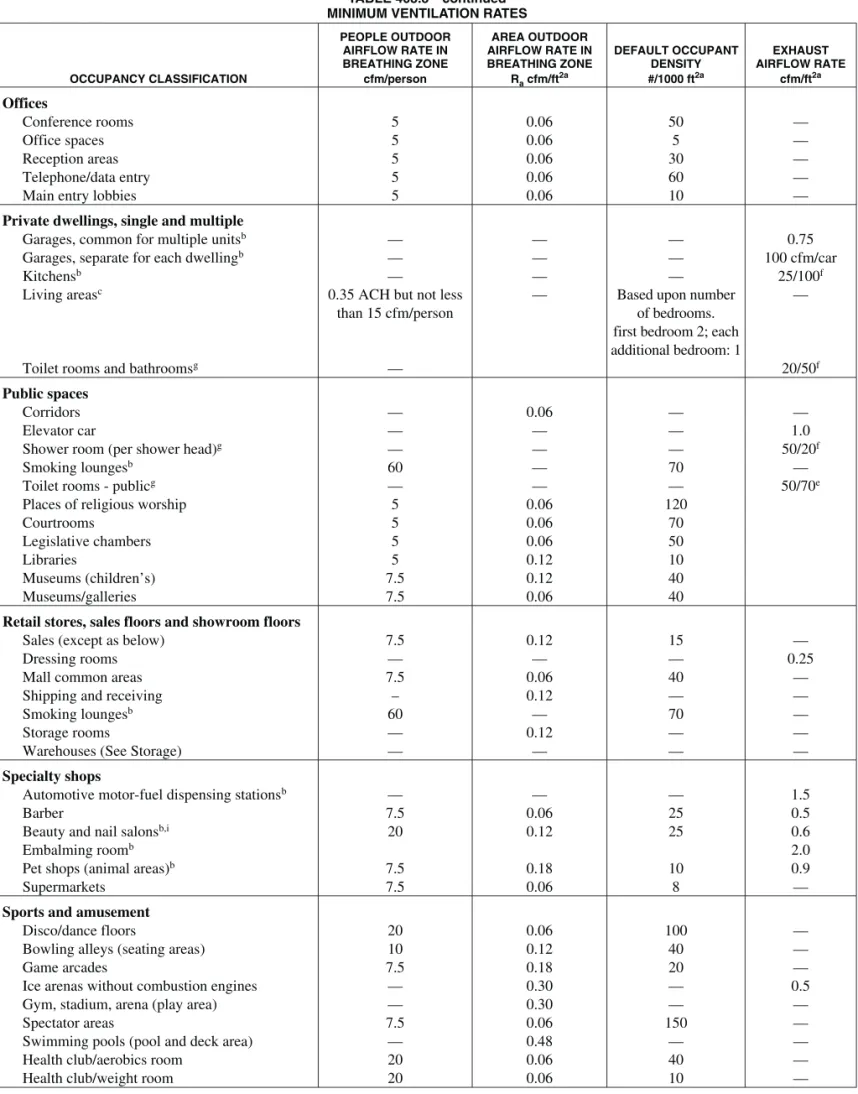
TABLE 403.3
MINIMUM VENTILATION RATES
OCCUPANCY CLASSIFICATION
PEOPLE OUTDOOR AIRFLOW RATE IN BREATHING ZONE
cfm/person
AREA OUTDOOR AIRFLOW RATE IN BREATHING ZONE
Racfm/ft2a
DEFAULT OCCUPANT
DENSITY #/1000 ft2a
EXHAUST AIRFLOW RATE
cfm/ft2a
Correctional Facilities
Cells
without plumbing fixtures with plumbing fixturesg
Dining halls (See Food and Beverage Service) Guard stations Day room Booking/waiting 5 5 — 5 5 7.5 0.12 0.12 — 0.06 0.06 0.06 25 25 — 15 30 50 — 1.0 — — — —
Dry cleaners, laundries
Coin-operated dry cleaner Coin-operated laundries Commercial dry cleaner Commercial laundry Storage, pick up
15 7.5 30 25 7.5 — 0.06 — — .12 20 20 30 10 30 — — — — — Education Auditoriums
Corridors (See Public Spaces) Media center
Sports locker roomsg
Music/theater/dance Smoking loungesg
Daycare (through age 4) Classrooms (ages 5-8) Classrooms (age 9 plus) Lecture classroom Lecture hall (fixed seats) Art classroomg
Science laboratoriesg
Wood/metal shopsg
Computer lab Multi-use assembly Locker/dressing roomsg
5 — 10 — 10 60 10 10 10 7.5 7.5 10 10 10 10 7.5 — 0.06 — 0.12 — 0.06 0.18 0.12 0.12 0.06 0.06 0.18 0.18 0.18 0.12 0.06 — 150 — 25 — 35 70 25 25 35 65 150 20 25 20 25 100 — — — 0.5 — — — — — — — 0.7 1.0 0.5 — — 0.25
Food and beverage service
Bars, cocktail lounges Cafeteria, fast food Dining rooms Kitchens (cooking)b
7.5 7.5 7.5 — 0.18 0.18 0.18 — 100 100 70 — — — — 0.7
Hospitals, nursing and convalescent homes
Autopsy roomsb
Medical procedure rooms Operating rooms Patient rooms Physical recovery Recovery and ICU
15 30 25 15 15 — — — — — — — 20 20 10 20 20 0.5 — — — — —
Hotels, motels, resorts and dormitories
Multi-purpose assembly Bathrooms/toilet – privateg
Bedroom/living room Conference/meeting Dormitory sleeping areas Gambling casinos Lobbies/pre-function 5 — 5 5 5 7.5 7.5 0.06 — 0.06 0.06 0.06 0.18 0.06 120 — 10 50 20 120 30 — 25/50f — — — — — continued
TABLE 403.3—continued MINIMUM VENTILATION RATES
OCCUPANCY CLASSIFICATION
PEOPLE OUTDOOR AIRFLOW RATE IN BREATHING ZONE
cfm/person
AREA OUTDOOR AIRFLOW RATE IN BREATHING ZONE
Racfm/ft 2a
DEFAULT OCCUPANT DENSITY #/1000 ft2a
EXHAUST AIRFLOW RATE cfm/ft2a Offices Conference rooms Office spaces Reception areas Telephone/data entry Main entry lobbies
5 5 5 5 5 0.06 0.06 0.06 0.06 0.06 50 5 30 60 10 — — — — —
Private dwellings, single and multiple
Garages, common for multiple unitsb
Garages, separate for each dwellingb
Kitchensb
Living areasc
Toilet rooms and bathroomsg
— — —
0.35 ACH but not less than 15 cfm/person
— — — — — — — — Based upon number
of bedrooms. first bedroom 2; each additional bedroom: 1
0.75 100 cfm/car 25/100f — 20/50f Public spaces Corridors Elevator car
Shower room (per shower head)g
Smoking loungesb
Toilet rooms - publicg
Places of religious worship Courtrooms Legislative chambers Libraries Museums (children’s) Museums/galleries — — — 60 — 5 5 5 5 7.5 7.5 0.06 — — — — 0.06 0.06 0.06 0.12 0.12 0.06 — — — 70 — 120 70 50 10 40 40 — 1.0 50/20f — 50/70e
Retail stores, sales floors and showroom floors
Sales (except as below) Dressing rooms Mall common areas Shipping and receiving Smoking loungesb
Storage rooms
Warehouses (See Storage)
7.5 — 7.5 – 60 — — 0.12 — 0.06 0.12 — 0.12 — 15 — 40 — 70 — — — 0.25 — — — — — Specialty shops
Automotive motor-fuel dispensing stationsb
Barber
Beauty and nail salonsb,i
Embalming roomb
Pet shops (animal areas)b
Supermarkets — 7.5 20 7.5 7.5 — 0.06 0.12 0.18 0.06 — 25 25 10 8 1.5 0.5 0.6 2.0 0.9 —
Sports and amusement
Disco/dance floors
Bowling alleys (seating areas) Game arcades
Ice arenas without combustion engines Gym, stadium, arena (play area) Spectator areas
Swimming pools (pool and deck area) Health club/aerobics room
Health club/weight room
20 10 7.5 — — 7.5 — 20 20 0.06 0.12 0.18 0.30 0.30 0.06 0.48 0.06 0.06 100 40 20 — — 150 — 40 10 — — — 0.5 — — — — — continued
403.3.1.2 Zone air distribution effectiveness.The zone air distribution effectiveness (Ez) shall be determined using Table 403.3.1.2.
403.3.1.3 Zone outdoor airflow.The zone outdoor air-flow rate (Voz), shall be determined in accordance with Equation 4-2.
Voz= Vbz/Ez (Equation 4.2)
403.3.2 System outdoor airflow.The outdoor air required to be supplied by each ventilation system shall be deter-mined in accordance with Sections 403.3.2.1 through 403.2.3 as a function of system type and zone outdoor air-flow rates.
403.3.2.1 Single zone systems.Where one air handler supplies a mixture of outdoor air and recirculated return air to only one zone, the system outdoor air intake flow
rate (Vot) shall be determined in accordance with Equa-tion 4-3.
Vot=Voz (Equation 4-3)
403.3.2.2 100-percent outdoor air systems.Where one air handler supplies only outdoor air to one or more zones, the system outdoor air intake flow rate (Vot) shall be determined using Equation 4-4.
Vot=Σall zonesVoz (Equation 4-4)
403.3.2.3 Multiple zone recirculating systems.Where one air handler supplies a mixture of outdoor air and recirculated return air to more than one zone, the system outdoor air intake flow rate (Vot) shall be determined in accordance with Sections 403.3.2.3.1 through 403.3.2.3.4.
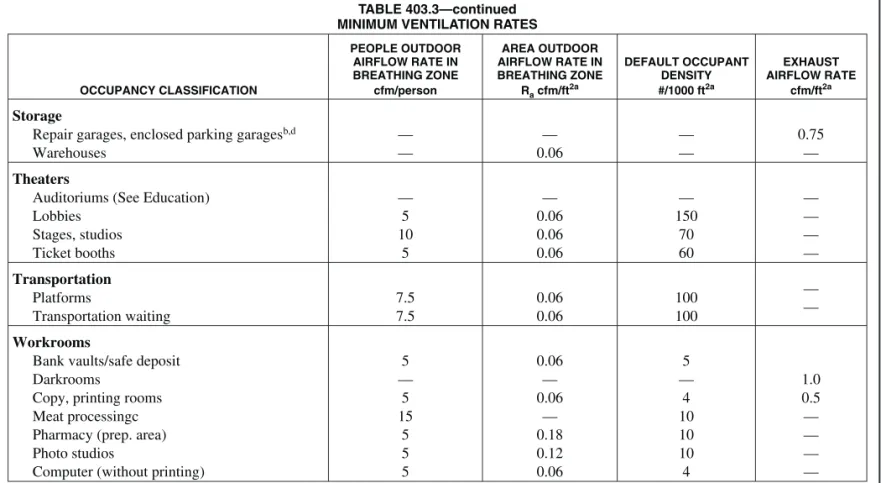
TABLE 403.3—continued MINIMUM VENTILATION RATES
OCCUPANCY CLASSIFICATION
PEOPLE OUTDOOR AIRFLOW RATE IN BREATHING ZONE
cfm/person
AREA OUTDOOR AIRFLOW RATE IN BREATHING ZONE
Racfm/ft2a
DEFAULT OCCUPANT DENSITY #/1000 ft2a
EXHAUST AIRFLOW RATE
cfm/ft2a
Storage
Repair garages, enclosed parking garagesb,d
Warehouses
— —
— 0.06
— —
0.75 —
Theaters
Auditoriums (See Education) Lobbies
Stages, studios Ticket booths
— 5 10
5
— 0.06 0.06 0.06
— 150
70 60
— — — —
Transportation
Platforms
Transportation waiting
7.5 7.5
0.06 0.06
100 100
— —
Workrooms
Bank vaults/safe deposit Darkrooms
Copy, printing rooms Meat processingc Pharmacy (prep. area) Photo studios
Computer (without printing)
5 —
5 15
5 5 5
0.06 — 0.06
— 0.18 0.12 0.06
5 —
4 10 10 10 4
1.0 0.5 — — — —
For SI: 1 cubic foot per minute = 0.0004719 m3/s, 1 ton = 908 kg, 1 cubic foot per minute per square foot = 0.00508 m3/(s·m2),
C = [(F) – 32]/1.8, 1 square foot = 0.0929 m2. a. Based upon net occupiable floor area.
b. Mechanical exhaust required and the recirculation of air from such spaces is prohibited (see Section 403.2.1, Item 3). c. Spaces unheated or maintained below 50°F are not covered by these requirements unless the occupancy is continuous. d. Ventilation systems in enclosed parking garages shall comply with Section 404.
e. Rates are per water closet or urinal. The higher rate shall be provided where periods of heavy use are expected to occur, such as, toilets in theaters, schools, and sports facilities. The lower rate shall be permitted where periods of heavy use are not expected.
f. Rates are per room unless otherwise indicated. The higher rate shall be provided where the exhaust system is designed to operate intermittently. The lower rate shall be permitted where the exhaust system is designed to operate continuously during normal hours of use.
g. Mechanical exhaust is required and recirculation is prohibited except that recirculation shall be permitted where the resulting supply airstream consists of not more than 10 percent air recirculated from these spaces (see Section 403.2.1, Items 2 and 4).
h. For nail salons, the required exhaust shall include ventilation tables or other systems that capture the contaminants and odors at their source and are capable of exhausting a minimum of 50 cfm per station.
TABLE 403.3.1.2
ZONE AIR DISTRIBUTION EFFECTIVENESSa,b,c,d,e AIR DISTRIBUTION CONFIGURATION Ez Ceiling or floor supply of cool air 1.0f
Ceiling or floor supply of warm air and floor return 1.0 Ceiling supply of warm air and ceiling return 0.8g
Floor supply of warm air and ceiling return 0.7 Makeup air drawn in on the opposite side of the room from the exhaust and/or return 0.8 Makeup air drawn in near to the exhaust and/or
return location 0.5
For SI: 1 foot = 304.8 mm, 1 foot per minute = 0.00506 m/s, °C = [(°F)–32]/1.8. a. “Cool air” is air cooler than space temperature.
b. “Warm air” is air warmer than space temperature. c. “Ceiling” includes any point above the breathing zone. d. “Floor” includes any point below the breathing zone.
e. “Makeup air” is air supplied or transferred to a zone to replace air removed from the zone by exhaust or return systems.
f. Zone air distribution effectiveness of 1.2 shall be permitted for systems with a floor supply of cool air and ceiling return, provided that low-velocity dis-placement achieves unidirectional flow and thermal stratification. g. Zone air distribution effectiveness of 1.0 shall be permitted for systems
with a ceiling supply of warm air, provided that supply air temperature is less than 15°F above space temperature and provided that the 150 foot-per-minute supply air jet reaches to within 4.5 feet of floor level.
403.3.2.3.1 Primary outdoor air fraction.The pri-mary outdoor air fraction (Zp) shall be determined for each zone in accordance with Equation 4-5.
Zp=Voz/Vpz (Equation 4-5)
where:
Vpz= Primary airflow: The airflow rate supplied to the zone from the air-han-dling unit at which the out-door air intake is located. It includes outdoor intake air and recirculated air from that air-handling unit but does not include air transferred or air recirculated to the zone by other means. For design pur-poses, Vpz shall be the zone design primary airflow rate, except for zones with variable air volume supply and Vpz shall be the lowest expected primary airflow rate to the zone when it is fully occu-pied.
403.3.2.3.2 System ventilation efficiency.The sys-tem ventilation efficiency (Ev) shall be determined using Table 403.3.2.3.2 or Appendix A of ASHRAE 62.1.
TABLE 403.3.2.3.2
SYSTEM VENTILATION EFFICIENCY
MAX (Zp) Ev
0.15 1.0
0.25 0.9
0.35 0.8
0.45 0.7
0.55 0.6
0.65 0.5
0.75 0.4
> 0.75 0.3
a. Max (Zp) is the largest value ofZpcalculated using Equation 4-5 among all the zones served by the system.
b. Interpolating between table values shall be permitted.
403.3.2.3.3 Uncorrected outdoor air intake. The uncorrected outdoor air intake flow rate (Vou) shall be determined in accordance with Equation 4-7.
Vou=DΣall zonesRpPz+Σall zonesRaAz (Equation 4-7) where:
D= Occupant diversity: The ratio of the system population to the sum of the zone populations, deter-mined in accordance with Equation 4-8.
D=Ps/Σall zonesPz (Equation 4-8)
where:
Ps= System population: The total number of occu-pants in the area served by the system. For design pur-poses,Psshall be the maxi-mum number of occupants expected to be concurrently in all zones served by the system.
403.3.2.3.4 Outdoor air intake flow rate.The out-door air intake flow rate (Vot) shall be determined in accordance with Equation 4-9.
Vot=Vou/Ev (Equation 4-9)
403.4 Exhaust Ventilation.Exhaust airflow rate shall be pro-vided in accordance with the requirements in Table 403.3. Exhaust makeup air shall be permitted to be any combination of outdoor air, recirculated air and transfer air, except as limited in accordance with Section 403.2.
403.5 System operation.The minimum flow rate of outdoor air that the ventilation system must be capable of supplying during its operation shall be permitted to be based on the rate per person indicated in Table 403.3 and the actual number of occupants present.
403.6 Variable air volume system control.Variable air vol-ume air distribution systems, other than those designed to sup-ply only 100-percent outdoor air, shall be provided with controls to regulate the flow of outdoor air. Such control system shall be designed to maintain the flow rate of outdoor air at a rate of not less than that required by Section 403.3 over the entire range of supply air operating rates.
403.7 Balancing.The ventilation air distribution system shall be provided with means to adjust the system to achieve at least the minimum ventilation airflow rate as required by Sections 403.3 and 403.4. Ventilation systems shall be balanced by an approved method. Such balancing shall verify that the ventila-tion system is capable of supplying and exhausting the airflow rates required by Sections 403.3 and 403.4.
SECTION 404
ENCLOSED PARKING GARAGES
404.1 Enclosed parking garages.Mechanical ventilation sys-tems for enclosed parking garages shall be permitted to operate intermittently where the system is arranged to operate automat-ically upon detection of vehicle operation or the presence of occupants by approved automatic detection devices.
404.2 Minimum ventilation.Automatic operation of the sys-tem shall not reduce the ventilation airflow rate below 0.05 cfm per square foot (0.00025 m3/s·m2) of the floor area and the
sys-tem shall be capable of producing a ventilation rate of 0.75 cfm per square foot (0.0035 m3/s·m2) of floor area.
404.3 Occupied spaces accessory to public garages. Con-necting offices, waiting rooms, ticket booths and similar uses that are accessory to a public garage shall be maintained at a positive pressure and shall be provided with ventilation in accordance with Section 403.3.
SECTION 405 SYSTEMS CONTROL
405.1 General.Mechanical ventilation systems shall be pro-vided with manual or automatic controls that will operate such systems whenever the spaces are occupied. Air-conditioning systems that supply required ventilation air shall be provided with controls designed to automatically maintain the required outdoor air supply rate during occupancy.
SECTION 406
VENTILATION OF UNINHABITED SPACES 406.1 General.Uninhabited spaces, such as crawl spaces and attics, shall be provided with natural ventilation openings as required by theInternational Building Codeor shall be pro-vided with a mechanical exhaust and supply air system. The mechanical exhaust rate shall be not less than 0.02 cfm per square foot (0.00001 m3/s
•m2) of horizontal area and shall be
automatically controlled to operate when the relative humidity in the space served exceeds 60 percent.