Protecting Browsers from DNS Rebinding Attacks
Collin Jackson
Stanford University
[email protected]
Adam Barth
Stanford University[email protected]
Andrew Bortz
Stanford University[email protected]
Weidong Shao
Stanford University
[email protected]
Dan Boneh
Stanford University[email protected]
ABSTRACT
DNS rebinding attacks subvert the same-origin policy of browsers and convert them into open network proxies. We survey new DNS rebinding attacks that exploit the inter-action between browsers and their plug-ins, such as Flash Player and Java. These attacks can be used to circumvent firewalls and are highly cost-effective for sending spam e-mail and defrauding pay-per-click advertisers, requiring less than $100 to temporarily hijack 100,000 IP addresses. We show that the classic defense against these attacks, called “DNS pinning,” is ineffective in modern browsers. The pri-mary focus of this work, however, is the design of strong defenses against DNS rebinding attacks that protect mod-ern browsers: we suggest easy-to-deploy patches for plug-ins that prevent large-scale exploitation, provide a defense tool, dnswall, that prevents firewall circumvention, and detail two defense options, policy-based pinning and host name authorization.
Categories and Subject Descriptors
K.6.5 [Management of Computing and Information Systems]: Security and Protection
General Terms
Security, Design, Experimentation
Keywords
Same-Origin Policy, DNS, Firewall, Spam, Click Fraud
1.
INTRODUCTION
Users who visit web pages trust their browser to prevent malicious web sites from leveraging their machines to attack others. Organizations that permit JavaScript and other ac-tive content through their firewall rely on the browser to protect internal network resources from attack. To achieve
Permission to make digital or hard copies of all or part of this work for personal or classroom use is granted without fee provided that copies are not made or distributed for profit or commercial advantage and that copies bear this notice and the full citation on the first page. To copy otherwise, to republish, to post on servers or to redistribute to lists, requires prior specific permission and/or a fee.
CCS’07,October 29–November 2, 2007, Alexandria, Virginia, USA. Copyright 2007 ACM 978-1-59593-703-2/07/0011 ...$5.00.
these security goals, modern browsers implement the same-origin policythat attempts to isolate distinct “origins,” pro-tecting sites from each other.
DNS rebinding attacks subvert the same-origin policy by confusing the browser into aggregating network resources controlled by distinct entities into one origin, effectively con-verting browsers into open proxies. Using DNS rebinding, an attacker can circumvent firewalls to spider corporate in-tranets, exfiltrate sensitive documents, and compromise un-patched internal machines. An attacker can also hijack the IP address of innocent clients to send spam e-mail, commit click fraud, and frame clients for misdeeds. DNS rebinding vulnerabilities permit the attacker to read and write directly on network sockets, subsuming the attacks possible with ex-isting JavaScript-based botnets [24], which can send HTTP requests but cannot read back the responses.
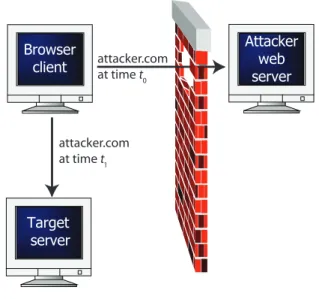
To mount a DNS rebinding attack, the attacker need only register a domain name, such asattacker.com, and attract web traffic, for example by running an advertisement. In the basic DNS rebinding attack, the attacker answers DNS queries forattacker.comwith the IP address of his or her own server with a short time-to-live (TTL) and serves vis-iting clients malicious JavaScript. To circumvent a firewall, when the script issues a second request toattacker.com, the attacker rebinds the host name to the IP address of a tar-get server that is inaccessible from the public Internet. The browser believes the two servers belong to the same origin because they share a host name, and it allows the script to read back the response. The script can easily exfiltrate the response, enabling the attacker to read arbitrary documents from the internal server, as shown in Figure 1.
To mount this attack, the attacker did not compromise any DNS servers. The attacker simply provided valid, au-thoritative responses forattacker.com, a domain owned by the attacker. This attack is very different from “pharm-ing” [34], where the attacker must compromise a host name owned by the target by subverting a user’s DNS cache or server. DNS rebinding requires no such subversion. Conse-quently, DNSSEC provides no protection against DNS re-binding attacks: the attacker can legitimately sign all DNS records provided by his or her DNS server in the attack.
DNS rebinding attacks have been known for a decade [8, 36]. A common defense implemented in several browsers is
DNS pinning: once the browser resolves a host name to an IP address, the browser caches the result for a fixed dura-tion, regardless of TTL. As a result, when JavaScript con-nects toattacker.com, the browser will connect back to the attacker’s server instead of the internal server.
Attacker web server
Target server Browser
client
attacker.com at time t1
attacker.com at time t0
Figure 1: Firewall Circumvention Using Rebinding
Pinning is no longer an effective defense against DNS re-binding attacks in current browsers because of vulnerabil-ities introduced by plug-ins. These plug-ins provide addi-tional funcaddi-tionality, including socket-level network access, to web pages. The browser and each plug-in maintain sep-arate pin databases, creating a new class of vulnerabilities we callmulti-pin vulnerabilities that permit an attacker to mount DNS rebinding attacks. We demonstrate, for exam-ple, how to exploit the interaction between the browser and Java LiveConnect to pin the browser to one IP address while pinning Java to another IP address, permitting the attacker to read and write data directly on sockets to a host and port of the attacker’s choice despite strong pinning by each component.
Our experiments show how an attacker can exploit multi-pin vulnerabilities to cheaply and efficiently assemble a tem-porary, large-scale bot network. Our findings suggest that nearly 90% of web browsers are vulnerable to rebinding at-tacks that only require a few hundreds of milliseconds to conduct (see Table 1). These attacks do not require users to click on any malicious links: users need only view an at-tacker’s web advertisement. By spending less than $100 on advertising, an attacker can hijack 100,000 unique IP ad-dress to send spam, commit click fraud, or otherwise misuse as open network proxies.
The bulk of our work focuses on designing robust defenses to DNS rebinding attacks that protect current and future browsers and plug-ins:
1. To combat firewall circumvention, we recommend or-ganizations deploy DNS resolvers that preventexternal
names from resolving to internal addresses. We pro-vide an open-source implementation of such a resolver in 300 lines ofCcalleddnswall[15].
2. For Flash Player, Java, and LiveConnect, we suggest specific, easy-to-deploy patches to prevent multi-pin vulnerabilities, mitigating large-scale exploitation of DNS rebinding for firewall circumvention and IP hi-jacking.
Technology Attack Time LiveConnect (JVM loaded) 47.8±10.3 ms Flash Player 9 192±5.7 ms Internet Explorer 6 (no plug-ins) 1000 ms Internet Explorer 7 (no plug-ins) 1000 ms Firefox 1.5 and 2 (no plug-ins) 1000 ms Safari 2 (no plug-ins) 1000 ms LiveConnect 1294±37 ms Opera 9 (no plug-ins) 4000 ms
Table 1: Time Required for DNS Rebinding Attack by Technology (95% Confidence)
3. We propose two options for protecting browsers from DNS rebinding: smarter pinning that provides better security and robustness, and a backwards-compatible use of the DNS system that fixes rebinding vulnerabil-ities at their root (which we implemented as a 72-line patch to Firefox 2).
The remainder of the paper is organized as follows. Sec-tion 2 describes existing browser policy for network access. Section 3 details DNS rebinding vulnerabilities, including standard DNS rebinding and current multi-pin vulnerabili-ties. Section 4 explains two classes of attacks that use these vulnerabilities, firewall circumvention and IP hijacking, and contains our experimental results. Section 5 proposes de-fenses against both classes of attacks. Section 6 describes related work. Section 7 concludes.
2.
NETWORK ACCESS IN THE BROWSER
To display web pages, browsers are instructed to make network requests by static content such as HTML and by active content such as JavaScript, Flash Player, Java, and CSS. Browsers restrict this network access in order to to pre-vent web sites from making malicious network connections. The same-origin policy provides partial resource isolation by restricting access according to origin, specifying when content from one origin can access a resource in another ori-gin. The policy applies to both network access and browser state such as the Document Object Model (DOM) interface, cookies, cache, history, and the password database [20]. The attacks described in this paper circumvent the same origin-policy for network access.
Access Within Same Origin. Within the same origin,
both content and browser scripts can read and write net-work resources using the HTTP protocol. Plug-ins, such as Flash Player and Java, can access network sockets directly, allowing them to make TCP connections and, in some cases, send and receive UDP packets as well. Java does not restrict access based on port number, but Flash Player permits ac-cess to port numbers less than 1024 only if the machine authorizes the connection in an XML policy served from a port number less than 1024.
Access Between Different Origins. In general,
con-tent from one origin can make HTTP requests to servers in another origin, but it cannot read responses, effectively restricting access to “send-only.” Flash Player permits its movies to read back HTTP responses from different origins, provided the remote server responds with an XML policy authorizing the movie’s origin. Flash Player also permits
reading and writing data on TCP connections to arbitrary port numbers, again provided the remote server responds with a suitable XML policy on an appropriate port.
By convention, certain types of web content are assumed to be public libraries, such as JavaScript, CSS, Java ap-plets, and SWF movies. These files may be included across domains. For example, one origin can include a CSS file from another origin and read its text. Scripts can also read certain properties of other objects loaded across domains, such as the height and width of an image.
Prohibited Access.Some types of network access are pro-hibited even within the same origin. Internet Explorer 7 blocks port numbers 19 (chargen), 21 (FTP), 25 (SMTP), 110 (POP3), 119 (NNTP), and 143 (IMAP), Firefox 2 blocks those plus 51 additional port numbers, but Safari 2 does not block any ports. Some of these port restrictions are designed to prevent malicious web site operators from leveraging vis-iting browsers to launch distributed denial of service or to send spam e-mail, whereas others prevent universal cross-site scripting via the HTML Form Protocol Attack [41].
Origin Definition. Different definitions of “origin” are used by different parts of the browser. For network access, browsers enforce the same-origin policy [38] based on three components of the Uniform Resource Locator (URL) from which it obtained the content. A typical URL is composed of the below components:
scheme://hostname:port/path
Current browsers treat two objects as belonging to the same origin if, and only if, their URLs contain the same scheme, host name, and port number (e.g.,http://amazon.com/is a different origin thanhttp://amazon.co.uk/, even though the two domains are owned by the same company). Other resources use fewer components of the URL. For example, cookies use only the host name.
Objects on the Internet, however, are not accessed by host name. To connect to a server, the browser must first trans-late a host name into an IP address and then open a socket to that IP address. If one host name resolves to multiple IP addresses owned by multiple entities, the browser will treat them as if they were the same origin even though they are, from an ownership point-of-view, different.
3.
DNS REBINDING VULNERABILITIES
The network access policy in web browsers is based on host names, which are bound by the Domain Name Sys-tem (DNS) to IP addresses. An attacker mounting a DNS rebinding attack attempts to subvert this security policy by binding his or her host name to both the attack and target server’s IP addresses.
3.1
Standard Rebinding Vulnerabilities
A standard rebinding attack uses a single browser tech-nology (e.g. JavaScript, Java, or Flash Player) to connect to multiple IP addresses with the same host name.
Multiple A Records.When a client resolves a host name using DNS, the authoritative server can respond with mul-tipleArecords indicating the IP addresses of the host. The first attack using DNS rebinding [8] in 1996 leveraged this property to confuse the security policy of the Java Virtual Machine (JVM):
1. A client visits a malicious web site,attacker.com, con-taining a Java applet. The attacker’s DNS server binds attacker.comto two IP addresses: the attacker’s web server and the target’s web server.
2. The client executes the attacker’s applet, which opens a socket to the target. The JVM permits this connec-tion, because the target’s IP address is contained in the DNS record forattacker.com.
Current versions of the JVM are not vulnerable to this at-tack because the Java security policy has been changed. Ap-plets are now restricted to connecting to the IP address from which they were loaded. (Current attacks on Java are de-scribed in Section 3.2.)
In the JavaScript version of this attack, the attacker sends some JavaScript to the browser that instructs the browser to connect back to attacker.com. The attacker’s server refuses this second TCP connection, forcing the browser to switch over to the victim IP address [21]. By using a RST packet to refuse the connection, the attacker can cause some browsers to switch to the new IP address after one second. Subsequent XMLHttpRequests issued by the attacker’s code will connect to the new IP address.
Time-Varying DNS.In 2001, the original attack on Java was extended [36] to use use time-varying DNS:
1. A client visits a malicious web site, attacker.com, containing JavaScript. The attacker’s DNS server is configured to bindattacker.comto the attacker’s IP address with a very short TTL.
2. The attacker rebindsattacker.comto the target’s IP address.
3. The malicious script uses frames or XMLHttpRequest to connect toattacker.com, which now resolves to the IP address of the target’s server.
Because the connection in Step 3 has the same host name as the original malicious script, the browser permits the at-tacker to read the response from the target.
Pinning in Current Browsers. Current browsers defend
against the standard rebinding attack by “pinning” host names to IP address, preventing host names from referring to multiple IP addresses.
• Internet Explorer 7pins DNS bindings for 30 minutes.1 Unfortunately, if the attacker’s domain has multipleA records and the current server becomes unavailable, the browser will try a different IP address within one second.
• Internet Explorer 6also pins DNS bindings for 30 min-utes, but an attacker can cause the browser to release its pin after one second by forcing a connection to the current IP address to fail, for example by including the element<img src="http://attacker.com:81/">.
1The duration is set by the registry keysDnsCacheTimeout
andServerInfoTimeOutin
HKEY CURRENT USER\SOFTWARE\Microsoft Windows\
• Firefox 1.5 and 2cache DNS entries for between 60 and 120 seconds. DNS entries expire when the value of the current minute increments twice. 2 Using JavaScript, the attacker can read the user’s clock and compute when the pin will expire. Using multipleArecords, an attacker can further reduce this time to one second.
• Opera 9 behaves similarly to Internet Explorer 6. In our experiments, we found that it pins for approxi-mately 12 minutes but can be tricked into releasing its pin after 4 seconds by connecting to a closed port.
• Safari 2 pins DNS bindings for one second. Because the pinning time is so low, the attacker may need to send a “Connection: close” HTTP header to ensure that the browser does not re-use the existing TCP con-nection to the attacker.
Flash Player 9. Flash Player 9 permits SWF movies to
open TCP sockets to arbitrary hosts, provided the destina-tion serves an XML policy authorizing the movie’s origin [2]. According to Adobe, Flash Player 9 is installed on 55.8% of web browsers (as of December 2006) [1]; according to our own experiments, Flash Player 9 was present in 86.9% of browsers. Flash Player is vulnerable to the following re-binding attack:
1. The client’s web browser visits a malicious web site that embeds a SWF movie.
2. The SWF movie opens a socket on a port less than 1024 toattacker.com, bound to the attacker’s IP ad-dress. Flash Player sends<policy-file-request />. 3. The attacker responds with the following XML:
<?xml version="1.0"?> <cross-domain-policy>
<allow-access-from domain="*" to-ports="*" /> </cross-domain-policy>
4. The SWF movie opens a socket to an arbitrary port number onattacker.com, which the attacker has re-bound to the target’s IP address.
The policy XML provided by the attacker in step 3 in-structs Flash Player to permit arbitrary socket access to attacker.com. Flash Player permits the socket connections to the target because it does not pin host names to a single IP address. If the attacker were to serve the policy file from a port number ≥1024, Flash Player would authorize only ports≥1024.
3.2
Multi-Pin Vulnerabilities
Current browsers use several plug-ins to render web pages, many of which permit direct socket access back to their ori-gins. Another class of rebinding attacks exploit the fact that these multiple technologies maintain separate DNS pin databases. If one technology pins to the attacker’s IP ad-dress and another pins to the target’s IP adad-dress, the at-tacker can make use of inter-technology communication to circumvent the same-origin restrictions on network access. Some of these attacks have been discussed previously in the full-disclosure community [4].
Java. Java, installed on 87.6%3of web browsers [1], can also 2The duration is set bynetwork.dnsCacheExpiration. 3
We observed 98.1% penetration in our experiment.
open TCP connections back to their origins. The Java Vir-tual Machine (JVM) maintains DNS pins separately from the browser, opening up the possibility of DNS rebinding vulnerabilities. Java applets themselves are not vulnerable because the JVM retrieves applets directly from the net-work, permitting the JVM to pin the origin of the applet to the correct IP address. Java is vulnerable, however, to the following attacks.
• LiveConnectbridges JavaScript and the JVM in Fire-fox and Opera, permitting script access to the Java standard library, including the Socket class, without loading an applet. The browser pins to the attacker’s IP address, but the JVM spawned by LiveConnect does a second DNS resolve and pins to the target’s IP address. The attacker’s JavaScript can exploit this pin mismatch to open and communicate on a socket from the client machine to an arbitrary IP address on an arbitrary destination port, including UDP sockets with a source port number≥1024.
• Applets with Proxies are also vulnerable to a multi-pin attack, regardless of which browser the client uses. If the client uses an HTTP proxy to access the web, there is yet another DNS resolver involved—the proxy. When the JVM retrieves an applet via a proxy, it re-quests the applet by host name, not by IP address. If the applet opens a socket, the JVM does a second DNS resolve and pins to the target’s IP address.
• Relative Paths can cause multi-pin vulnerabilities. If a server hosts an HTML page that embeds an applet using a relative path with the parameter mayscript set totrue, that machine can be the target of a multi-pin attack. The browser multi-pins to the target, retrieves the HTML page, and instructs the JVM to load the applet. The JVM does a second DNS resolve, pins to the attacker, and retrieves a malicious applet. The applet instructs the browser, via JavaScript, to issue XMLHttpRequests to the target’s IP address.
Flash Player. Flash Player would still be vulnerable to multi-pin attacks even if it pinned DNS bindings. Flash Player does not retrieve its movies directly from the net-work. Instead, the browser downloads the movie and spawns Flash Player, transferring the movie’s origin by host name. When the attacker’s movie attempts to open a socket, Flash Player does a second DNS resolution and would pin to the target’s IP address. TheURLLoaderclass is not vulnerable to multi-pin attacks because it uses the browser to request the URL and thus uses the browser’s DNS pins, but theSocket class could still be used to read and write on arbitrary TCP sockets.
Other Plug-ins. Other browser plug-ins permit network
access, including Adobe Acrobat and Microsoft Silverlight. Acrobat restricts network communication to the SOAP pro-tocol but does not restrict access by document origin. Of-ten, the Acrobat plug-in will prompt the user before access-ing the network. Silverlight permits network access through BrowserHttpWebRequest, which uses the browser to make the request (likeURLLoaderin Flash Player) and thus uses the browser’s DNS pins.
4.
ATTACKS USING DNS REBINDING
An attacker can exploit the DNS rebinding vulnerabilities described in Section 3 to mount a number of attacks. For some of these attacks, the attacker requires the direct socket access afforded by DNS rebinding with Flash Player and Java, whereas others require only the ability to read HTTP responses from the target. The attacks fall into two broad categories, according to the attacker’s goal:
• Firewall Circumvention. The attacker can use DNS re-binding to access machines behind firewalls that he or she cannot access directly. With direct socket access, the attacker can interact with a number of internal services besides HTTP.
• IP Hijacking. The attacker can also use DNS rebinding to access publicly available servers from the client’s IP address. This allows the attacker to take advantage of the target’s implicit or explicit trust in the client’s IP address.
To mount these attacks, the attacker must first induce the client to load some active content. This can be done by a variety of techniques discussed in Section 4.4. Once loaded onto the client’s machine, the attacker’s code can communi-cate with any machine reachable by the client.
4.1
Firewall Circumvention
A firewall restricts traffic between computer networks in different zones of trust. Some examples include blocking connections from the public Internet to internal machines and mediating connections from internal machines to Inter-net servers with application-level proxies. Firewall circum-vention attacks bypass the prohibition on inbound connec-tions, allowing the attacker to connect to internal servers while the user is visiting the attacker’s Internet web page (see Figure 1).
Spidering the Intranet. The attacker need not specify
the target machine by IP address. Instead, the attacker can guess the internal host name of the target, for example hr.corp.company.com, and rebindattacker.comto aCNAME record pointing to that host name. The client’s own recur-sive DNS resolver will complete the resolution and return the IP address of the target. Intranet host names are often guessable and occasionally disclosed publicly [30, 9]. This technique obviates the need for the attacker to scan IP ad-dresses to find an interesting target but does not work with the multipleArecord technique described in Section 3.1.
Having found a machine on the intranet, the attacker can connect to the machine over HTTP and request the root document. If the server responds with an HTML page, the attacker can follow links and search forms on that page, eventually spidering the entire intranet. Web servers inside corporate firewalls often host confidential documents, rely-ing on the firewall to prevent untrusted users from accessrely-ing the documents. Using a DNS rebinding attack, the attacker can leverage the client’s browser to read these documents and exfiltrate them to the attacker, for example by submit-ting an HTML form to the attacker’s web server.
Compromising Unpatched Machines.Network
admin-istrators often do not patch internal machines as quickly as Internet-facing machines because the patching process is time-consuming and expensive. The attacker can attempt
to exploit known vulnerabilities in machines on the internal network. In particular, the attacker can attempt to exploit the client machine itself. The attacks against the client it-self originate from localhost and so bypass software fire-walls and other security checks, including many designed to protect serious vulnerabilities. If an exploit succeeds, the attacker can establish a presence within the firewall that persists even after clients close their browsers.
Abusing Internal Open Services. Internal networks
contain many open services intended for internal use only. For example, network printers often accept print jobs from internal machines without additional authentication. The attacker can use direct socket access to command network printers to exhaust their toner and paper supplies.
Similarly, users inside firewalls often feel comfortable cre-ating file shares or FTP servers accessible to anonymous users under the assumption that the servers will be avail-able only to clients within the network. With the ability to read and write arbitrary sockets, the attacker can exfiltrate the shared documents and use these servers to store illicit information for later retrieval.
Consumer routers are often installed without changing the default password, making them an attractive target for re-configuration attacks by web pages [40]. Firmware patches have attempted to secure routers against cross-site scripting and cross-site request forgery, in an effort to prevent recon-figuration attacks. DNS rebinding attacks allow the attacker direct socket access to the router, bypassing these defenses.
4.2
IP Hijacking
Attackers can also use DNS rebinding attacks to target machines on the public Internet. For these attacks, the at-tacker is not leveraging the client’s machine to connect to otherwise inaccessible services but instead abusing the im-plicit or exim-plicit trust public services have in the client’s IP address. Once the attacker has hijacked a client’s IP ad-dress, there are several attacks he or she can perpetrate.
Committing Click Fraud. Web publishers are often paid
by web advertisers on a per-click basis. Fraudulent publish-ers can increase their advertising revenue by generating fake clicks, and advertisers can drain competitors’ budgets by clicking on their advertisements. The exact algorithms used by advertising networks to detect these “invalid” clicks are proprietary, but the IP address initiating the click is widely believed to be an essential input. In fact, one common use of bot networks is to generate clicks [7].
Click fraud would appear to require only the ability to send HTTP requests to the advertising network, but adver-tisers defend against the send-only attacks, permitted by the same-origin policy, by including a unique nonce with every advertising impression. Clicks lacking the correct nonce are rejected as invalid, requiring the attacker to read the nonce from an HTTP response in order to generate a click.
This attack is highly cost-effective, as the attacker can buy advertising impressions, which cost tens of cents per thousand, and convert them intoclicks, worth tens of cents each. The attack is sufficiently cost-effective that the at-tacker need not convert every purchased impression into a click. Instead, the fraudster can use most of the purchased impressions to generate fake impressions on the site, main-taining a believable click-through rate.
Sending Spam. Many e-mail servers blacklist IP addresses known to send spam e-mail [39]. By hijacking a client’s IP address, an attacker can send spam from IP addresses with clean reputations. To send spam e-mail, the attacker need only write content to SMTP servers on port 25, an action blocked by most browsers but permitted by Flash Player and Java. Additionally, an attacker will often be able to use the client’s actual mail relay. Even service providers that require successful authentication via POP3 before sending e-mail are not protected, because users typically leave their desktop mail clients open and polling their POP3 servers.
Defeating IP-based Authentication. Although
discour-aged by security professionals [10], many Internet services still employ IP-based authentication. For example, the ACM Digital Library makes the full text of articles available only to subscribers, who are often authenticated by IP address. After hijacking an authorized IP address, the attacker can access the service, defeating the authentication mechanism. Because the communication originates from an IP address actually authorized to use the service, it can be difficult, or even impossible, for the service provider to recognize the security breach.
Framing Clients. An attacker who hijacks an IP address can perform misdeeds and frame the client. For example, an attacker can attempt to gain unauthorized access to a computer system using a hijacked IP address as a proxy. As the attack originates from the hijacked IP address, the logs will implicate the client, not the attacker, in the crime. Moreover, if the attacker hosts the malicious web site over HTTPS, the browser will not cache the page and no traces will be left on the client’s machine.
4.3
Proof-of-Concept Demonstration
We developed proof-of-concept exploits for DNS rebinding vulnerabilities in Flash Player 9, LiveConnect, Java applets with proxy servers, and the browser itself. Our system con-sists of a custom DNS server authoritative fordnsrebinding.net, a custom Flash Player policy server, and a standard Apache web server. The various technologies issue DNS queries that encode the attacker and target host names, together with a nonce, in the subdomain. For each nonce, the DNS server first responds with the attacker’s IP address (with a zero TTL) and thereafter with the target’s IP address. Our proof-of-concept demo,http://crypto.stanford.edu/dns, implementswget and telnet by mounting a rebinding at-tack against the browser.
4.4
Experiment: Recruiting Browsers
Methodology. We tested DNS rebinding experimentally
by running a Flash Player 9 advertisement on a minor ad-vertising network targeting the keywords “Firefox,” “game,” “Internet Explorer,” “video,” and “YouTube.” The experi-ment used two machines in our laboratory, an attacker and a target. The attacker ran a custom authoritative DNS server fordnsrebinding.net, a custom Flash Player policy server, and an Apache web server hosting the advertisement. The target ran an Apache web server to log successful attacks. The Flash Player advertisement exploited the vulnerability described in Section 3.1 to load an XML document from the target server in our lab. The attack required only that the client view the ad, not that the user click on the ad.
Vulnerability Impressions Flash Player 9 86.9%
LiveConnect 24.4% Java+Proxy 2.2% Total Multi-Pin 90.6%
Table 2: Percentage of Impressions by Vulnerability Cumulative Duration of Successful Attacks
for 75% Shortest Duration Attacks
0 10 20 30 40 50 60 70 80 90 100
0 64 128 192 256
Duration of Attack Success (secs)
Su
cc
es
sf
ul
A
tt
ac
ks
(p
er
ce
nt
)
Cumulative Duration of Successful Attacks
1 10 100 1,000 10,000 100,000
1 10 100 1000 10000 100000 1000000
Duration of Attack Success (secs, logscale)
Su
cc
es
sf
ul
A
tt
ac
ks
(l
og
sc
al
e)
Figure 2: Duration of Successful Attacks
The experiment lasted until the user navigated away from the advertisement, at which time we lost the ability to use the viewer’s network connection. For privacy, we collected only properties typically disclosed by browsers when viewing web pages (e.g., plug-in support, user agent, and external IP address). The experiment conformed to the terms of service of the advertising network and to the guidelines of the in-dependent review board at our institution. Every network operation produced by the advertisement could have been produced by a legitimate SWF advertisement, but we pro-duced the operations through theSocketinterface, demon-strating the ability to make arbitrary TCP connections.
Results. We ran the ad beginning at midnight EDT on
three successive nights in late April 2007. We bid $0.50 per 1000 impressions for a variety of keywords. We spent $10 per day, garnering approximately 20,000 impressions per day. Due to a server misconfiguration, we disregarded ap-proximately 10,000 impressions. We also disregarded 19 im-pressions from our university. We received 50,951 impres-sions from 44,924 unique IP addresses (40.2% IE7, 32.3% IE6, 23.5% Firefox, 4% Other).
We ran the rebinding experiment on the 44,301 (86.9%) impressions that reported Flash Player 9. We did not at-tempt to exploit other rebinding vulnerabilities (see Ta-ble 2). The experiment was successful on 30,636 (60.1%) impressions and 27,480 unique IP addresses. The attack was less successful on the 1,672 impressions served to Mac OS, succeeding 36.4% of the time, compared to a success rate of 70.0% on the 49,535 (97.2%) Windows impressions.4
Mac OS is more resistant to this rebinding attack due to some caching of DNS entries despite their zero TTL.
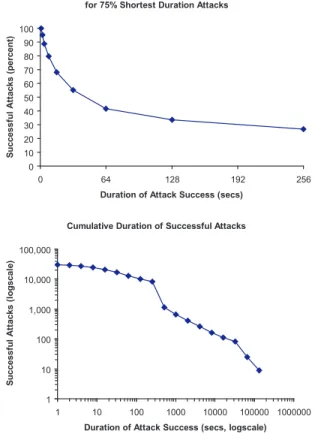
For each successful experiment, we measured how long an attacker could have used the client’s network access by load-ing the target document at exponentially longer intervals, as shown in Figure 2. The median impression duration was 32 seconds, with 25% of the impressions lasting longer than 256 seconds. We observed 9 impressions with a duration of at least 36.4 hours, 25 at least 18.2 hours, and 81 at least 9.1 hours. In aggregate, we obtained 100.3 machine-days of net-work access. These observations are consistent with those of [24]. The large number of attacks ending between 4.2 and 8.5 minutes suggests that this is a common duration of time for users to spend on a web page.
Discussion. Our experimental results show that DNS re-binding vulnerabilities are widespread and cost-effective to exploit on a large scale. Each impression costs $0.0005 and 54% of the impressions convert to successful attacks from unique IP addresses. To hijack 100,000 IP addresses for a temporary bot network, and attacker would need to spend less than $100. This technique compares favorably to rent-ing a traditional bot network for sendrent-ing spam e-mail and committing click fraud for two reasons. First, these applica-tions require large numbers of “fresh” IP address for short durations as compromised machines are quickly blacklisted. Second, while estimates of the rental cost of bot networks vary [44, 14, 7], this technique appears to be at least one or two orders of magnitude less expensive.
5.
DEFENSES AGAINST REBINDING
Defenses for DNS rebinding attacks can be implemented in browsers, plug-ins, DNS resolvers, firewalls, and servers. These defenses range in complexity of development, diffi-culty of deployment, and effectiveness against firewall cir-cumvention and IP hijacking. In addition to necessary mit-igations for Flash Player, Java LiveConnect, and browsers, we propose three long-term defenses. To protect against fire-wall circumvention, we propose a solution that can be de-ployed unilaterally by organizations at their network bound-ary. To fully defend against rebinding attacks, we propose two defenses: one that requires socket-level network access be authorized explicitly by the destination server and an-other works even if sockets are allowed by default.
5.1
Fixing Firewall Circumvention
Networks can be protected against firewall circumvention by forbidding external host names from resolving to internal IP addresses, effectively preventing the attacker from nam-ing the target server. Without the ability to name the tar-get, the attacker is unable to aggregate the target server into an origin under his or her control. These malicious bindings
4
We succeeded in opening a socket with 2 of 11 PlayStation 3 impressions (those with Flash Player 9), but none of the 12 Nintendo Wii impressions were vulnerable.
can be blocked either by filtering packets at the firewall [5] or by modifying the DNS resolvers used by clients on the network.
• Enterprise. By blocking outbound traffic on port 53, a firewall administrator for an organization can force all internal machines, including HTTP proxies and VPN clients, to use a DNS server that is configured not to resolve external names to internal IP addresses. To implement this approach, we developed a 300 line C program,dnswall[15], that runs alongside BIND and enforces this policy.
• Consumer. Many consumer firewalls, such as those produced by Linksys, already expose a caching DNS resolver and can be augmented withdnswallto block DNS responses that contain private IP addresses. The vendors of these devices have an incentive to patch their firewalls because these rebinding attacks can be used to reconfigure these routers to mount further at-tacks on their owners.
• Software. Software firewalls, such as the Windows Firewall, can also prevent their own circumvention by blocking DNS resolutions to 127.*.*.*. This tech-nique does not defend services bound to the external network interface but does protects a large number of services that bind only to the loopback interface.
Blocking external names from resolving to internal addresses prevents firewall circumvention but does not defend against IP hijacking. An attacker can still use internal machines to attack services running on the public Internet.
5.2
Fixing Plug-ins
Plug-ins are a particular source of complexity in defend-ing against DNS rebinddefend-ing attacks because they enable sub-second attacks, provide socket-level network access, and op-erate independently from browsers. In order to prevent re-binding attacks, these plug-ins must be patched.
Flash Player. When a SWF movie opens a socket to a
new host name, it requests a policy over the socket to de-termine whether the host accepts socket connections from the origin of the movie. Flash Player could fix most of its rebinding vulnerabilities by considering a policy valid for a socket connection only if it obtained the policy from the same IP addressin addition to its current requirement that it obtained the policy from the same host name. Us-ing this design, whenattacker.comis rebound to the tar-get IP address, Flash Player will refuse to open a socket to that address unless the target provides a policy authorizing attacker.com. This simple refinement uses existing Flash Player policy deployments and is backwards compatible, as host names expecting Flash Player connections already serve policy documents from all of their IP addresses.
SWF movies can also access ports numbers ≥ 1024 on their origin host name without requesting a policy. Al-though the majority of services an attacker can profitably target (e.g., SMTP, HTTP, HTTPS, SSH, FTP, NNTP) are hosted on low-numbered ports, other services such as MySQL, BitTorrent, IRC, and HTTP proxies are vulnera-ble. To fully protect against rebinding attacks, Flash Player could request a policy before opening sockets to any port, even back to its origin. However, this modification breaks
backwards compatibility because those servers might not be already serving policy files.
Java. Many deployed Java applets expect sockets to be al-lowed by default. If clients are permitted to use these applets from behind HTTP proxies, they will remain vulnerable to multi-pin attacks because proxy requests are made by host name instead of by IP address. A safer approach is to use the CONNECTmethod to obtain a proxied socket connection to an external machine. Typically proxies only allowCONNECT on port 443 (HTTPS), making this the only port available for these applets. Alternatively, proxies can use HTTP head-ers to communicate IP addresses of hosts between the client and the proxy [28, 29], but this approach requires both the client and the proxy to implement the protocol.
Java LiveConnect. LiveConnect introduces additional
vulnerabilities, but browsers can fix the LiveConnect multi-pin vulnerability without altering the JVM by installing their own DNS resolver into the JVM using a standard interface. Firefox, in particular, implements LiveConnect through the Java Native Interface (JNI). When Firefox ini-tializes the JVM, it can install a customInetAddressclass that will handle DNS resolution for the JVM. This custom class should contain a native method that implements DNS resolution using Firefox’s DNS resolver instead of the system resolver. If the browser implements pinning, LiveConnect and the browser will use a common pin database, removing multi-pin vulnerabilities.
5.3
Fixing Browsers (Default-Deny Sockets)
Allowing direct socket access by default precludes many defenses for DNS rebinding attacks. If browser plug-ins de-faulted to denying socket access, as a patched Flash Player and the proposed TCPConnection (specified in HTML5 [19]) would, these defenses would become viable. Java and Live-Connect, along with any number of lesser-known plug-ins, expect socket access to be allowed, and fixing these is a chal-lenge.
Checking Host Header. HTTP 1.1 requires that user
agents include aHost header in HTTP requests that spec-ifies the host name of the server [11]. This feature is used extensively by HTTP proxies and by web servers to host many virtual hosts on one IP address. If sockets are de-nied by default, theHostheader reliably indicates the host name being used by the browser to contact the server be-cause XMLHttpRequest [43] and related technologies are re-stricted from spoofing theHostheader.5 One server-side de-fense for these attacks is therefore to reject incoming HTTP requests with unexpectedHostheaders [28, 37].
Finer-grained Origins. Another defense against DNS
rebinding attacks is to refine origins to include additional information, such as the server’s IP address [28] or public key [27, 23], so that when the attacker rebindsattacker.com to the target, the browser will consider the rebound host name to be a new origin. One challenge to deploying finer-grained origins is that every plug-in would need to revise its security policies and interacting technologies would need to hand-off refined origins correctly.
5
Lack of integrity of the Host header has been a recur-ring source of security vulnerabilities, most notably in Flash Player 7.
• IP Addresses. Refining origins with IP address [28] is more robust than pinning in that a single browsing session can fail-over from one IP address to another. When such a fail-over occurs, however, it will likely break long-lived AJAX applications, such as Gmail, because they will be prevented from making XML-HttpRequests to the new IP address. Users can recover from this by clicking the browser’s reload button. Un-fortunately, browsers that use a proxy server do not know the actual IP address of the remote server and thus cannot properly refine origins. Also, this defense is vulnerable to an attack using relative paths to script files, similar to the applet relative-path vulnerability described in Section 3.2.
• Public Keys. Augmenting origins with public keys [27, 23] prevents two HTTPS pages served from the same domain with different public keys from reading each other’s state. This defense is useful when users dis-miss HTTPS invalid certificate warnings and chiefly protects HTTPS-only “secure” cookies from network attackers. Many web pages, however, are not served over HTTPS, rendering this defense more appropriate for pharming attacks that compromise victim domains than for rebinding attacks.
Smarter Pinning. To mitigate rebinding attacks, browsers can implement smarter pinning policies. Pinning is a de-fense for DNS rebinding that trades off robustness for secu-rity. RFC 1035 [32] provides for small (and even zero) TTLs to enable dynamic DNS and robust behavior in the case of server failure but respecting these TTLs allows rebinding attacks. Over the last decade, browsers have experimented with different pin durations and release heuristics, leading some vendors to shorten their pin duration to improve ro-bustness [13]. However, duration is not the only parameter that can be varied in a pinning policy.
Browsers can vary thewidth of their pins by permitting host names to be rebound within a set of IP addresses that meet some similarity heuristic. Selecting an optimal width as well as duration enables a better trade-off between se-curity and robustness than optimizing duration alone. One promising policy is to allow rebinding within a class C net-work. For example, if a host name resolved to171.64.78.10, then the client would also accept any IP address beginning with171.64.78for that host name. The developers of the NoScript Firefox extension [26] have announced plans [25] to adopt this pinning heuristic.
• Security. When browsers use class C network pinning, the attacker must locate the attack server on the same class C network as the target, making the rebinding attack much more difficult to mount. The attack is possible only if the attacker co-locates a server at the same hosting facility or leverages a cross-site scripting vulnerability on a co-located server. This significantly raises the bar for the attacker and provides better re-courses for the target.
• Robustness. To study the robustness of class C net-work pinning, we investigated the IP addresses re-ported by the 100 most visited English-language sites (according to Alexa [3]). We visited the home page of these sites and compiled a list of the 336 host names
used for embedded content (e.g., www.yahoo.com em-beds images from us.i1.yimg.com). We then issued DNS queries for these hosts every 10 minutes for 24 hours, recording the IP addresses reported.
In this experiment, 58% reported a single IP address consistently across all queries. Note that geographic load balancing is not captured in our data because we issued our queries from a single machine, mimicking the behavior of a real client. Averaged over the 42% of hosts reporting multiple IP addresses, if a browser pinned to an IP address at random, the expected frac-tion of IP addresses available for rebinding under class C network pinning is 81.3% compared with 16.4% un-der strict IP address pinning, suggesting that class C pinning is significantly more robust to server failure. Other heuristics for pin width are possible. For example, the browser could prevent rebinding between public IP ad-dresses and the RFC 1918 [35] private IP adad-dresses. This provides greater robustness for fail-overs across data centers and for dynamic DNS. LocalRodeo [22, 45] is a Firefox ex-tension that implements RFC 1918 pinning for JavaScript. As for security, RFC 1918 pinning largely prevents firewall circumvention but does not protect against IP hijacking nor does it prevent firewall circumvention in the case where a firewall protects non-private IP addresses, which is the case for many real-life protected networks and personal software firewalls.
Even the widest possible pinning heuristic prevents some legitimate rebinding of DNS names. For example, public host names controlled by an organization often have two IP addresses, a private IP address used by clients within the firewall and a public IP address used by clients on the Inter-net. Pinning prevents employees from properly connecting to these severs after joining the organization’s Virtual Pri-vate Network (VPN) as those host names appear to rebind from public to private IP addresses.
Policy-based Pinning.Instead of using unpinning heuris-tics, we propose browsers consult server-supplied policies to determine when it is safe to re-pin a host name from one IP address to another, providing robustness without degrading security. To re-pin safely, the browser must obtain a policy from both the old and new IP address (because some at-tacks first bind to the attacker whereas others first bind to the target). Servers can supply this policy at a well-known location, such as/crossdomain.xml, or in reverse DNS (see Section 5.4).
Pinning Pitfalls.Correctly implementing pinning has sev-eral subtleties that are critical to its ability to defend against DNS rebinding attacks.
• Common Pin Database. To eliminate multi-pin at-tacks, pinning-based defense require that all browser technologies that access the network share a common pin database. Many plug-ins, including Flash Player and Silverlight, already use the browser’s pins when issuing HTTP requests because they issue these re-quests through the browser. To share DNS pins for other kinds of network access, either the browser could expose an interface to its pin database or the operating system could pin in its DNS resolver. Unfortunately, browser vendors appear reluctant to expose such an interface [12, 33] and pinning in the operating system
either changes the semantics of DNS for other applica-tions or requires that the OS treats browsers and their plug-ins differently from other applications.
• Cache. The browser’s cache and all plug-in caches must be modified to prevent rebinding attacks. Cur-rently, objects stored in the cache are retrieved by URL, irrespective of the originating IP address, creat-ing a rebindcreat-ing vulnerability: a cached script from the attacker might run later whenattacker.comis bound to the target. To prevent this attack, objects in the cache must be retrieved by both URL and originat-ing IP address. This degrades performance when the browser pins to a new IP address, which might occur when the host at the first IP address fails, the user starts a new browsing session, or the user’s network connectivity changes. These events are uncommon and are unlikely to impact performance significantly.
• document.domain. Even with the strictest pinning, a server is vulnerable to rebinding attacks if it hosts a web page that executes the following, seemingly in-nocuous, JavaScript:
document.domain = document.domain; After a page sets itsdomainproperty, the browser al-lows cross-origin interactions with other pages that have set theirdomainproperty to the same value [42, 17]. This idiom, used by a number of JavaScript li-braries6, sets the domain property to a value under the control of the attacker: the current host name.
5.4
Fixing Browsers (Default-Allow Sockets)
Instead of trying to prevent a host name from rebinding from one IP address to another—a fairly common event—a different approach to defending against rebinding is to pre-vent the attacker from naming the target server, essentially generalizingdnswallto the Internet. Without the ability to name the target server, the attacker cannot mount a DNS rebinding attack against the target. This approach defends against rebinding, can allow socket access by default, and preserves the robustness of dynamic DNS.
Host Name Authorization. On the Internet, clients
re-quire additional information to determine the set of valid host names for an given IP address. We propose that servers advertise the set of host names they consider valid for them-selves and clients check these advertisements before binding a host name to an IP address, making explicit which host names can map to which IP addresses. Host name autho-rization prevents rebinding attacks because honest machines will not advertise host names controlled by attackers.
Reverse DNS already provides a mapping from IP ad-dresses to host names. The owner of an IP address ip is delegated naming authority for ip.in-addr.arpaand typi-cally stores a PTR record containing the host name associ-ated with that IP address. These records are insufficient for host name authorization because a single IP address can have many valid host names, and existing PTR records do not indicate that other host names are invalid.
6For example, “Dojo” AJAX library, Struts servlet/JSP
based web application framework, jsMath AJAX Mathemat-ics library, and Sun’s “Ultimate client-side JavaScript client sniff” library are vulnerable in this way.
The reverse DNS system can be extended to authorize host names without sacrificing backwards compatibility. To authorize the hostwww.example.comfor171.64.78.146, the owner of the IP address inserts the following DNS records:
auth.146.78.64.171.in-addr.arpa. IN A 171.64.78.146
www.example.com.auth.146.78.64.171.in-addr.arpa. IN A 171.64.78.146
To make a policy-enabled resolution forwww.example.com, first resolve the host name a set of IP addresses normally and then validate each IP address as follows:
1. Resolve the host nameauth.ip.in-addr.arpa. 2. If the host name exists, ip is policy-enabled and
ac-cepts only authorized host names. Otherwise, ip is not policy-enabled and accepts any host name.
3. Finally, ifipis policy-enabled, resolve the host name
www.example.com.auth.ip.in-addr.arpa to determine if the host name is authorized.
An IP address ip implicitly authorizes every host name of the form*.auth.ip.in-addr.arpa, preventing incorrect re-cursive policy checks. For host names with multiple IP ad-dresses, only authorized IP addresses should be included in the result. If no IP addresses are authorized, the result should be “not found.” If an IP address is not policy en-abled, DNS rebinding attacks can be mitigated using the techniques in Section 5.3.
The policy check can be implemented in DNS resolvers7, such as ones run by organizations and ISPs, transparently protecting large groups of machines from having their IP addresses hijacked. User agents, such as browser and plug-ins, can easily query the policy records because they are stored in A records and can issue policy checks in paral-lel with HTTP requests (provided they do not process the HTTP response before the host name is authorized). Stan-dard DNS caching reduces much of the overhead of redun-dant policy checks issued by DNS resolvers, browsers, and plug-ins. As a further optimization, policy-enabled resolvers can include policy records in the “additional” section of the DNS response, allowing downstream resolvers to cache com-plete policies and user-agents to get policy records without a separate request. We have implemented host name autho-rization as a 72-line patch to Firefox 2.
One disadvantage of this mechanism is that the owner of an IP address, the ISP, might not be the owner of the ma-chine at that IP address. The mama-chine can advertise the correct set of authorized host names only if the ISP is will-ing to delegate theauthsubdomain to the owner or insert appropriate DNS records. Instead, machines could advertise authorized host names over HTTP in a well-known location, similar tocrossdomain.xml, but this has several disadvan-tages: it requires policy-enabled DNS resolvers to implement HTTP clients, it requires all machines, such as SMTP gate-ways, to run an HTTP server, and policy queries are not cached, resulting in extra traffic comparable tofavicon.ico.
7To prevent a subtle attack that involves poisoning DNS
caches, a policy-enabled DNS resolver must follow the same procedure for CNAME queries as for A queries, even though responses to the former do not directly include IP addresses.
Trusted Policy Providers. Clients and DNS resolvers
can also check policy by querying a trusted policy provider. Much like spam black lists [39] and phishing filters [6, 31, 16], different policy providers can use different heuristics to determine whether a host name is valid for an IP address, but every provider should respect host names authorized in reverse DNS. When correctly configured, host name au-thorization in reverse DNS has no false negatives (no valid host name is rejected) but many false positives (lack of pol-icy is implicit authorization). Trusted polpol-icy providers can greatly reduce the false positive rate, possibly at the cost of increasing the false negative rate. Clients are free to select as aggressive a policy provider as they desire.
6.
RELATED WORK
Using Browsers as Bots. The technique of luring web
users to an attacker’s site and then distracting them while their browsers participate in a coordinated attack is de-scribed in [24]. These “puppetnets” can be used for dis-tributed denial of service but cannot be used to mount the attacks described in Section 4 because puppetnets cannot read back responses from different origins or connect to for-bidden ports such as 25.
JavaScript can also be misused to scan behind firewalls [18] and reconfigure home routers [40]. These techniques of-ten rely on exploiting default passwords and on underlying cross-site scripting or cross-site request forgery vulnerabil-ities. DNS rebinding attacks can be used to exploit de-fault passwords without the need for a cross-site scripting or cross-site request forgery hole.
Sender Policy Framework. To fight spam e-mail, the
Sender Policy Framework (SPF) [46] stores policy informa-tion in DNS. SPF policies are stored as TXTrecords in for-ward DNS, where host names can advertise the set of IP addresses authorized to send e-mail on their behalf.
7.
CONCLUSIONS
An attacker can exploit DNS rebinding vulnerabilities to circumvent firewalls and hijack IP addresses. Basic DNS re-binding attacks have been known for over a decade, but the classic defense, pinning, reduces robustness and fails to pro-tect current browsers that use plug-ins. Modern multi-pin attacks defeat pinning in hundreds of milliseconds, granting the attacker direct socket access from the client’s machine. These attacks are a highly cost-effective technique for hi-jacking hundreds of thousands of IP addresses for sending spam e-mail and committing click fraud.
For network administrators, we provide a tool to prevent DNS rebinding from being used for firewall circumvention by blocking external DNS names from resolving to internal IP addresses. For the vendors of Flash Player, Java, and LiveConnect, we suggest simple patches that mitigate large-scale exploitation by vastly reducing the cost-effectiveness of the attacks for sending spam e-mail and committing click fraud. Finally, we propose two defense options that prevent both firewall circumvention and IP hijacking: policy-based pinning and host name authorization. We hope that ven-dors and network administrators will deploy these defenses quickly before attackers exploit DNS rebinding on a large scale.
Acknowledgments
We thank Drew Dean, Darin Fisher, Jeremiah Grossman, Martin Johns, Dan Kaminsky, Chris Karlof, Jim Roskind, and Dan Wallach for their helpful suggestions and feedback. This work is supported by grants from the National Science Foundation and the US Department of Homeland Security.
8.
REFERENCES
[1] Adobe. Flash Player Penetration.http://www.adobe. com/products/player census/flashplayer/. [2] Adobe. Adobe Flash Player 9 Security.
http://www.adobe.com/devnet/flashplayer/ articles/flash player 9 security.pdf, July 2006. [3] Alexa. Top sites.http://www.alexa.com/site/ds/
top sites?ts mode=global.
[4] K. Anvil. Anti-DNS pinning + socket in flash. http://www.jumperz.net/, 2007.
[5] W. Cheswick and S. Bellovin. A DNS filter and switch for packet-filtering gateways. InProc. Usenix, 1996. [6] N. Chou, R. Ledesma, Y. Teraguchi, and J. Mitchell.
Client-side defense against web-based identity theft. InProc. NDSS, 2004.
[7] N. Daswani, M. Stoppelman, et al. The anatomy of Clickbot.A. InProc. HotBots, 2007.
[8] D. Dean, E. W. Felten, and D. S. Wallach. Java security: from HotJava to Netscape and beyond. In
IEEE Symposium on Security and Privacy: Oakland, California, May 1996.
[9] D. Edwards. Your MOMA knows best, December 2005.http://xooglers.blogspot.com/2005/12/ your-moma-knows-best.html.
[10] K. Fenzi and D. Wreski. Linux security HOWTO, January 2004.
[11] R. Fielding et al. Hypertext Transfer Protocol—HTTP/1.1. RFC 2616, June 1999. [12] D. Fisher, 2007. Personal communication. [13] D. Fisher et al. Problems with new DNS cache
(“pinning” forever).https:
//bugzilla.mozilla.org/show bug.cgi?id=162871. [14] D. Goodin. Calif. man pleads guilty to felony hacking.
Associated Press, Janurary 2005. [15] Google.dnswall.
http://code.google.com/p/google-dnswall/. [16] Google. Google Safe Browsing for Firefox, 2005.http:
//www.google.com/tools/firefox/safebrowsing/. [17] S. Grimm et al. Setting document.domain doesn’t
match an implicit parent domain.https:
//bugzilla.mozilla.org/show bug.cgi?id=183143. [18] J. Grossman and T. Niedzialkowski. Hacking intranet
websites from the outside: JavaScript malware just got a lot more dangerous. InBlackhat USA, August 2006. Invited talk.
[19] I. Hickson et al. HTML 5 Working Draft.http: //www.whatwg.org/specs/web-apps/current-work/. [20] C. Jackson, A. Bortz, D. Boneh, and J. Mitchell.
Protecting browser state from web privacy attacks. In
Proc. WWW, 2006.
[21] M. Johns. (somewhat) breaking the same-origin policy by undermining DNS pinning, August 2006.
http://shampoo.antville.org/stories/1451301/.
[22] M. Johns and J. Winter. Protecting the Intranet against “JavaScript Malware” and related attacks. In
Proc. DIMVA, July 2007.
[23] C. K. Karlof, U. Shankar, D. Tygar, and D. Wagner. Dynamic pharming attacks and the locked same-origin policies for web browsers. InProc. CCS, October 2007. [24] V. T. Lam, S. Antonatos, P. Akritidis, and K. G.
Anagnostakis. Puppetnets: Misusing web browsers as a distributed attack infrastructure. InProc. CCS, 2006.
[25] G. Maone. DNS Spoofing/Pinning.http:
//sla.ckers.org/forum/read.php?6,4511,14500. [26] G. Maone. NoScript.http://noscript.net/.
[27] C. Masone, K. Baek, and S. Smith. WSKE: web server key enabled cookies. InProc. USEC, 2007.
[28] A. Megacz. XWT Foundation Security Advisory. http://xwt.org/research/papers/sop.txt. [29] A. Megacz and D. Meketa. X-RequestOrigin. http://www.xwt.org/x-requestorigin.txt. [30] Microsoft. Microsoft Web Enterprise Portal, January
2004. http://www.microsoft.com/technet/ itshowcase/content/MSWebTWP.mspx.
[31] Microsoft. Microsoft phishing filter: A new approach to building trust in e-commerce content, 2005. [32] P. Mockapetris. Domain Names—Implementation and
Specification. IETF RFC 1035, November 1987. [33] C. Nuuja (Adobe), 2007. Personal communication. [34] G. Ollmann. The pharming guide.http://www.
ngssoftware.com/papers/ThePharmingGuide.pdf, August 2005.
[35] Y. Rekhter, B. Moskowitz, D. Karrenberg, G. J. de Groot, and E. Lear. Address Allocation for Private Internets. IETF RFC 1918, February 1996.
[36] J. Roskind. Attacks against the Netscape browser. In
RSA Conference, April 2001. Invited talk. [37] D. Ross. Notes on DNS pinning.
http://blogs.msdn.com/dross/archive/2007/07/ 09/notes-on-dns-pinning.aspx, 2007.
[38] J. Ruderman. JavaScript Security: Same Origin. http://www.mozilla.org/projects/security/ components/same-origin.html.
[39] Spamhaus. The spamhaus block list, 2007. http://www.spamhaus.org/sbl/.
[40] S. Stamm, Z. Ramzan, and M. Jakobsson. Drive-by pharming. Technical Report 641, Computer Science, Indiana University, December 2006.
[41] J. Topf. HTML Form Protocol Attack, August 2001. http://www.remote.org/jochen/sec/hfpa/hfpa.pdf. [42] D. Veditz et al. document.domain abused to access
hosts behind firewall.https:
//bugzilla.mozilla.org/show bug.cgi?id=154930. [43] W3C. The XMLHttpRequest Object, February 2007.
http://www.w3.org/TR/XMLHttpRequest/.
[44] B. Warner. Home PCs rented out in sabotage-for-hire racket.Reuters, July 2004.
[45] J. Winter and M. Johns. LocalRodeo: Client-side protection against JavaScript Malware.
http://databasement.net/labs/localrodeo/, 2007. [46] M. Wong and W. Schlitt. Sender Policy Framework
(SPF) for Authorizing Use of Domains in E-Mail. IETF RFC 4408, April 2006.