Acta Psychologica 47 (1981) 143-148 0 North-Holland Publishing Company
ARE WE ALL LESS RISKY AND MORE SKILLFUL
THAN OUR
FELLOW DRIVERS?
*
Ola SVENSON
Department of Psychology, University of Stockholm, Sweden Accepted March 1980
In this study subjects were asked about their competence as drivers in relation to a group of drivers. The results showed that a majority of subjects regarded themselves as more skillful and less risky than the average driver in each group respectively. This result was compared with sim- ilar recent findings in other fields. Finally, the consequences for planning and risk taking of seeing oneself as more competent than others were discussed briefly.
Do people engaged in a risky activity where skill plays some role, have
an unbiased view of their own skill and risk taking? More specifically,
do they have a correct
conception
of their own skill and risk taking
behavior, e.g., in comparison
to others?
One of the most common
and best known risky activity in modern
society is that of driving a car. Therefore,
some observations
of drivers’
notions
of their own driving skills and risk taking behavior will be pre-
sented in this paper. The observations
will then be used as a start for a
brief discussion
of the importance
of an actor’s self image on his risk
taking behavior
and his readiness
to find information
about risk and
safety applicable to himself.
For a long time it has been asserted (ct Naatanen
and Summala
1975) that most drivers tend to believe that they are better drivers than
the average driver.
This assertion
was based on studies made several
decades ago and poorly documented
in reports now virtually impossible
* This study was sponsored by the Swedish Council for Social Science Research. I want to thank the people at Decision Research, a branch of Perceptronics, in Eugene, Oregon, Kit Sjo- berg and Berndt Brehmer for support and discussions about the paper.
Author’s address: Dept. of Psychology, University of Stockholm, Box 6706, S-11385 Stock- holm, Sweden.
144 0. Svenson /Estimates of risk and skill
to obtain
(but for a summary
see Naatanen
and Summala
1975). In
these studies
subjects
were asked to judge how safely they drove in
comparison
with the average driver, vaguely defined as drivers in gen-
eral. Typically,
the results showed that around 70-80%
of the subjects
were reported
to put themselves in the safer half of the distribution.
The following
experiment
was performed
in order to try to replicate
the earlier findings but in a situation
where the subjects were asked to
compare
themselves
with a more well-defined
population
of drivers
whose characteristics
were, at least partly, known to the subjects. Such
comparisons
should reduce
possible effects of group stereotypes
(e.g.,
“California
drivers are better drivers”)
which could explain part of the
earlier results.
The experiment Subjects
A total of 161 Ss participated in the experiment. Of these 81 were American stu- dents who responded to an advertisement in the University of Oregon student paper and had a driver’s licence. The median age of the US Ss was 22 years. Forty-one of them judged their skill in driving and 40 judged how safe they were as drivers. In Sweden, Ss were recruited among psychology students at the University of Stock- holm having a driver’s licence. Eighty students with a median age of 33 years partic- ipated. Driving skill was judged by 45 and safety by 35 of the Swedish students. Method
In the US group the questions were given in written form to the Ss as one of several tasks to judge in a session involving a variety of other judgment tasks.
The Swedish Ss were also given the questions in written form but did not have any more task to fulfill in the session. To illustrate, the question concerning safety was formulated as follows:
We would like to know about what you think about how safely you drive an automobile. All drivers are not equally safe drivers. We want you to compare your own skill to the skills of the other people in this experiment. By definition, there is a least safe and a most safe driver in this room. We want you to indicate your own estimated position in this experimental group (and not, e.g., Eugene, Oregon or in the U.SJ (or (and not e.g., people in Stockholm or in Sweden)). Of course, this is a difficult question because you do not know all the people gathered here today, much less how safely they drive. But please make the most accurate estimate you can.
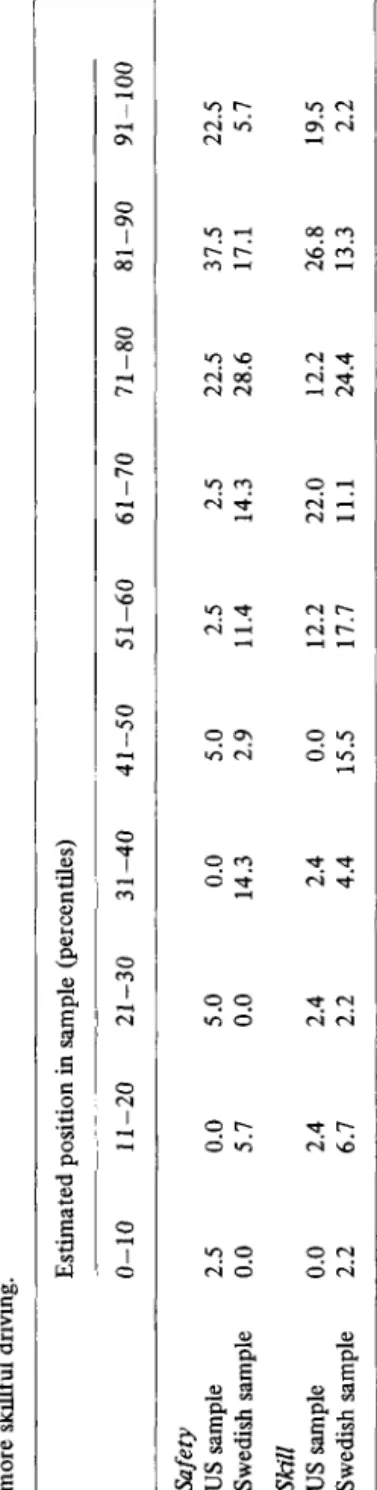
Table 1 Distribution of percent of estimates over degree of safe and skillful driving in relation to other drivers. Higher percentiles represent less risky and more skillful driving. Estimated position in sample (percentiles) O-10 11-20 21-30 31-40 41-50 51-60 61-70 71-80 81-90 91-100
safety US
sample
Swedish
sample
Skill US
sample Swedish sample 2.5 0.0 5.0 0.0 5.0 2.5 2.5 22.5 37.5 22.5 0.0 5.7 0.0 14.3 2.9 11.4 14.3 28.6 17.1 5.7 0.0 2.4 2.4 2.4 0.0 12.2 22.0 12.2 26.8 19.5 2.2 6.7 2.2 4.4 15.5 17.7 11.1 24.4 13.3 2.2
146 0. Svenson /Estimates of risk and skill
The question about driving skill was given in the same way as the question about safety with minor changes in wording to fit the task. The responses were given on a percentile scale by marking one of 10 successive 10 percent intervals.
Results
The distributions of the judgments are shown in table 1 for the two groups and the two questions respectively. The table shows that most of the Ss in the group viewed themselves as safer and more skillful drivers than the rest of the group.
The medians for the distributions of safety judgments in table 1 fall in the inter- val 8 l-90% for the US group and between 7 1 and 80% for the Swedish group. This indicates that half of the Ss believe themselves to be among the safest 20 (US) or 30 (Sweden) percent of the drivers in the two groups respectively. In the US group 88% and in the Swedish group 77% believed themselves to be safer than the median driver.
The medians for the distributions of skill judgments fall in the interval 61-70% for the US group and between 51-60% for the Swedish group. Of the US sample 46.3% regard themselves among the most skillful 20%. The corresponding number in the Swedish group was only 15.5%. In the US sample 93% believed themselves to be more skillful drivers than the median driver and 69% of the Swedish drivers shared this belief in relation to their comparison group.
In summary, there was a strong tendency to believe oneself as safer and more skillful than the average driver. In addition, there seemed to be a stronger tendency to believe oneself as safer than and more skillful than the average person.
Discussion
Very clearly, the present results illustrate
a strong tendency
among the
subjects to believe themselves
to be more skillful and less risky than the
others in the groups. These results may reflect purely cognitive mecha-
nisms or may be mainly a result of lacking information
about the others
in the group which may lead a majority
of the people to regard them-
selves as “better”.
For example,
the results may be explained
by cog-
nitive mechanisms,
such as, low memory
availability
of negative events
(e.g., accidents
or near accidents)
in the experimental
situation
(ct
Tversky and Kahneman
1974; Svenson 1978). But there is also evidence
pointing at greater generality
of the findings (cJ: Slavic
et al.1978). For
instance,
Preston and Harris ( 1965) compared
50 drivers whose driving
involved
them in accidents
(serious enough to require hospitalization)
with 50 drivers without
accident
histories but matched in relevant vari-
ables. When asked about how skillful drivers they were, the two groups
0. Svenson / Estimates of risk and skill 147
gave almost
identical
means indicating
that the average driver, irre-
spective of accident record, judged himself to be more skillful than the
average on the nine point scale. According
to police records 34 of the
drivers in the accident
group were responsible
for the accidents.
The
accident
group had a higher frequency
of previous
traffic violations.
This seems to indicate that we have difficulties
in learning from experi-
ence (cc Brehmer
1980).
Traffic
safety campaigns
with general road safety propaganda
seem
to have short-lived
effects, if any (~5 Wilde 1972) which is quite under-
standable
if we believe ourselves safer than most others. Why should we
pay much attention
to information
directed
towards drivers in general
if we are safer and more skillful than they are?
Similar findings
indicating
prevailing
views of oneself as generally
more favorable
than others have been reported
also in other areas such
as ethics (Baumhart
1968), success in sales management
(Larwood
and
Whittaker
1977), attribution
of responsibility
(Miller and Ross 1975;
Regan
et al.
1975; Ross and Sicoly
1979). By way of example,
Lar-
wood and Whittaker
(1977) found that management
students
and cor-
porate
presidents
held a self-serving
bias of their own competence
which lead to overly optimistic
and risky planning for the future. Thus,
believing oneself as more skillful than others may lead to greater risk
taking which is positively reinforced
for those who “win the game” and
are successful (e.g., stay on top positions in business or administration).
The same reasoning
also applies to the successful risky driver but here
the gain of success tends to be less and the cost in suffering and money
for failures (accidents)
seems to be intolerably
great.
References
Baumhart, R., 1968. Ethics in business. New York: Holt, Rinehart and Winston. Brehmer, B., 1980. In one word: not from experience. Acta Psychologica 45,223-241.
Larwood, L. and W. Whittaker, 1977. ManegeriaJ myopia: self-serving biases in organizational planning. Journal of Applied Psychology 62,194-198.
Miller, D.T. and M. Ross, 1975. Self-serving biases in the attribution of causality: fact or fic- tion? Psychological Bulletin 82, 213-225.
Ntitiinen, R. and H. Summala, 1975. Road-user behavior and traffic accidents. Amsterdam: North-Holland.
Preston, C.E. and S. Harris, 1965. Psychology of drivers in traffic accidents. Journal of Applied Psychology 49,284-288.
148 0. Svenson /Estimates of risk and skill
Regan, J.W., H. Gosselink, J. Hubsch and E. Ulsh, 1975. Do people have inflated views of their own ability? Journal of Personality and Social Psychology 31, 295-301.
Ross, M. and F. Sicoly, 1979. Egocentric biases in availability and attribution. Journal of Per- sonality and Social Psychology 37, 322-336.
Slavic, P., B. Fischhoff and S. Lichtenstein, 1978. Accident probabilities and seat belt usage: a psychological perspective. Accident Analysis and Prevention 10, 281-285.
Svenson, O., 1978. Risks of road transportation in psychological perspective. Accident Analysis and Prevention 10, 267-280.
Tversky, A. and D. Kahneman, 1974. Judgment under uncertainty: heuristics and biases. Science 185, 112441131.
Wilde, G.J.S., 1972. General survey efficiency and effectiveness of road safety campaigns: achievements and challenges. International Congress on Road Safety Campaigns. The Hague, The Netherlands, October 1972.