Projected Replacement Rate at Age 65 July 2014, Number 14-11
HOW MUCH SHOULD PEOPLE SAVE?
* Alicia H. Munnell is director of the Center for Retirement Research at Boston College (CRR) and the Peter F. Drucker Professor of Management Sciences at Boston College’s Carroll School of Management. Anthony Webb is a senior research economist at the CRR. Wenliang Hou is a research associate at the CRR. The Center gratefully acknowledges Prudential Financial for its sponsorship of the National Retirement Risk Index.
Introduction
The National Retirement Risk Index (NRRI) shows that half of today’s working families are “at risk” of not being able to maintain their standard of living once they retire. This result is not surprising given that half of private sector workers do not have an em-ployer–sponsored retirement plan and that many who do have a plan save relatively little. The question is how much households would have to save in order to maintain their pre-retirement living standards. This analysis employs the NRRI infrastructure in a slightly different way to answer this question in three steps. What is the average amount of saving that will come from retirement savings plans? What is the average required saving rate to produce adequate retirement income? Given current saving patterns, how much more would households have to save?
The discussion proceeds as follows. The first section recaps the nuts and bolts of the NRRI and describes the target calculations that serve as the basis for this analysis. The second section describes the methodology for answering each of the three ques-tions. The third section discusses the benefits of starting to save early and retiring late. The final sec-tion concludes that a saving rate of about 15 percent of income would be sufficient to achieve retirement income targets. Among those households currently falling short, attaining the necessary saving rate is a much more feasible goal for younger households than for older households.
Nuts and Bolts of the NRRI
Constructing the NRRI involves three steps: 1) pro-jecting a replacement rate – retirement income as a share of pre-retirement income – for each member of a nationally representative sample of U.S. households; 2) constructing a target replacement rate that would allow each household to maintain its pre-retirement standard of living in retirement; and 3) comparing the projected and target replacement rates to find the per-centage of households at risk. Although the analysis in this brief relies on the model used to generate the targets, it is useful to recap how the target model fits into the NRRI structure (see Figure 1).
By Alicia H. Munnell, Anthony Webb, and Wenliang Hou*
R E S E A R C H
Figure 1. Overview of the NRRI
NRRI Percentage of
Households with Projected Rate
< Target
=
Target Replacement
Rate Sample of
Households*
*The sample is from the U.S. Board of Governors of the
Federal Reserve System’s 2010 Survey of Consumer Finances. Source: Authors’ illustration.
Life-cycle Savings
plans, other financial assets, and imputed rent from housing.4 Average lifetime income then serves as the
denominator for each household’s replacement rate.
Estimating Target Replacement Rates
To determine the share of households that will be at risk requires comparing projected replacement rates with target replacement rates. The NRRI target assumes that the household’s goal is to accumulate sufficient wealth to generate a level of post-retirement consumption that equals consumption immediately before retirement. The household achieves this goal by choosing an age-varying saving rate. The target re-placement rate is the ratio of post-retirement income to pre-retirement income associated with the optimal saving strategy. Pre-retirement income equals labor market earnings, imputed rent, and investment returns, minus mortgage and loan interest paid, all averaged over ages 20-65.5 Post-retirement income
equals income from Social Security, employer pen-sions, and an inflation-indexed annuity, plus imputed rent. The household is assumed to purchase an inflation-indexed annuity with its financial assets plus the proceeds of a reverse mortgage. The calculations include federal, state (Massachusetts), and Social Se-curity taxes, including the Earned Income Tax Credit and the favorable tax treatment accorded to income from Social Security.6
Targets are calculated for 48 types of households – those in the bottom, middle, and top tercile of the income distribution who are single men, single wom-en, or one- or two-earner couples, with or without defined benefit pensions, and who are homeowners or renters. Weighted averages are calculated to yield targets for three income terciles for single men, single women, and one- and two-earner couples. Overall the replacement rates that emerge from the target model are consistent with those from other approaches (see Table 1).7
Figure 2. Ratio of Wealth to Income from the Surveys of Consumer Finances, 1983-2010
Source: Authors’ calculations based on U.S. Board of Gov-ernors of the Federal Reserve System, Survey of Consumer Finances (SCF), 1983-2010.
Projecting Household Replacement Rates
The exercise starts with projecting how much retire-ment income each of today’s working households will have at age 65. Retirement income is defined broadly to include all of the usual suspects plus housing.1
Re-tirement income from financial assets and housing is derived by projecting assets that households will hold at retirement, based on the stable relationship be-tween wealth-to-income ratios and age evident in the Federal Reserve’s Survey of Consumer Finances (SCF) during the 1983-2010 period (see Figure 2).2 In the
case of housing, the projections are used to calculate two distinct sources of income: the rental value that homeowners receive from living in their home rent free – “imputed rent” – and the amount of equity they could borrow from their housing wealth through a reverse mortgage.3 Sources of retirement income that
are not derived from SCF reported wealth – namely, income from defined benefit pensions and Social Security – are estimated directly. Once estimated, the components are added together to get total projected retirement income at age 65.
0 2 4 6
20-22 26-28 32-34 38-40 44-46 50-52 56-58 62-64
Age
1983 1986 1989 1992 1995 1998 2001 2004 2007 2010
To calculate projected replacement rates, we also need income prior to retirement. Earnings are calculated by creating a wage-indexed earnings his-tory and averaging each individual’s annual indexed wages over his lifetime. Other items that comprise pre-retirement income include the return on 401(k)
Table 1. NRRI Target Replacement Rates
Source: Authors’ calculations.
Income group Target replacement rate
All 73
Low income 80
Middle income 71
High income 67
Calculating the Index
The final step in creating the NRRI is to compare each household’s projected replacement rate with its target. Households whose projected replacement rates fall more than 10 percent below their targets are deemed to be at risk of having insufficient income to maintain their pre-retirement standard of living. The NRRI is simply the percentage of all households that fall more than 10 percent short of their target. Figure 3 shows the Index from 1983 to 2010. The NRRI will be updated in early 2015 with the release of data from the Federal Reserve’s 2013 SCF.
fined contribution plans are rapidly replacing defined benefit plans in the private sector, the results below can be thought of as 401(k) saving rates.
The simplest question is what portion of retire-ment income needs to come from retireretire-ment sav-ings plans. This percentage will vary by household income, since Social Security’s progressive benefits replace a higher portion of pre-retirement income for lower-income households than for those with higher incomes. Table 2 shows the percentage of income that households must generate through savings in employer retirement plans to produce their target replacement rates.
While both pre-retirement and retirement income include imputed rent, this number is not included in the percentage calculation. For example, the middle household will require 71 percent of pre-retirement income to maintain pre-retirement living standards. This amount breaks down as follows: 41 percent of pre-retirement income from Social Security, 4 per-cent from the reverse mortgage, and 6 perper-cent from imputed rent, which means that the rest – 21 percent – needs to come from retirement savings plans.10 The
32 percent reported in the table is simply the ratio of 21/(41+21+4), so it excludes imputed rent. The take-away here is that a quarter of retirement income must come from retirement savings plans for low-income households, one third for the middle income, and half for the high income.
Using the Target Model to
Calculate Needed Saving Rates
The target model can be queried to answer the ques-tions about required saving through employer plans. Employer plans include both traditional defined benefit plans and defined contribution – primarily 401(k) – plans.8 Private sector defined benefit plans
generally do not require any direct employee contri-butions; however, these benefits – just like employer contributions to a 401(k) – are not “free” in that they are part of a worker’s total compensation and a form of workers’ retirement saving. In the following analy-sis, saving in defined benefit plans is calculated based on reported defined benefit income and is combined with saving in defined contribution plans.9 Since
de-Figure 3. The National Retirement Risk Index, 1983-2010
Source: Munnell, Webb, and Golub-Sass (2012).
31% 31% 30%
37% 38% 40% 38%
45% 44% 53%
0% 20% 40% 60%
Table 2. Percentage of Retirement Income Required from Retirement Savings Plans
Note: Retirement savings plans include defined benefit plans, defined contribution plans, and IRAs.
Source: Authors’ calculations.
Income group Percentage of
retirement income
All 35
Low income 25
Middle income 32
High income 47
%
The second question is how much households must save over their worklives to generate the required amount of income. This number falls out of the target calculation, since the target saving rate is the rate that allows households to maintain their pre-retirement consumption once they stop working.
Again, nothing is simple. Saving can be measured in any number of ways, given the pattern of income and consumption in the target model. The concept reported here measures net saving – positive saving less amounts required to pay off debts – divided by income from the age at which debt is repaid to age 65 (see Figure 4).
tude of the shortfall. Second, we calculate the per-centage of income that the household needs to save each year so that the accumulated additional savings, when annuitized at age 65, will bring the household’s total income up to the target. Third, we divide the shortfall in replacement rate by the additional replace-ment income from a 1-percent increase in saving to calculate the required additional saving.
The median required increases in the saving rate are shown in Table 4. The most sensible way to look at these numbers is by age group. A feasible increase in saving rates at younger ages can have a large effect on wealth at age 65. In contrast, people in their 50s have so little time before retirement that middle-in-come households would have to increase their saving by an unrealistic 29 percentage points of income to reach their target. A better strategy for these house-holds would be to work longer and cut current and future consumption in order to reduce the required saving rate to a more feasible level.
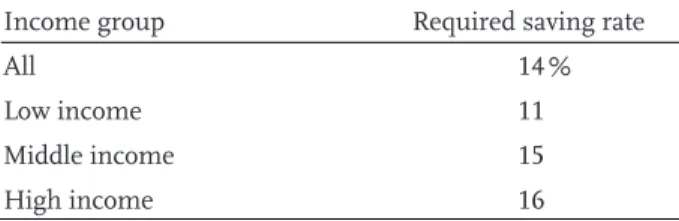
The required saving rate produced by these calculations is 15 percent for the middle income household (see Table 3). These saving rates represent total saving in retirement plans, which includes both employee and employer contributions.11
Figure 4. Calculation of Saving Rates from the Target Model
Source: Authors’ illustration.
20 65
Age
Income Consumption
Income period
Table 3. Required Saving Rates from Retirement Savings Plans
Source: Authors’ calculations.
Income group Required saving rate
All 14
Low income 11
Middle income 15
High income 16
%
Importance of Starting Early
and Retiring Late
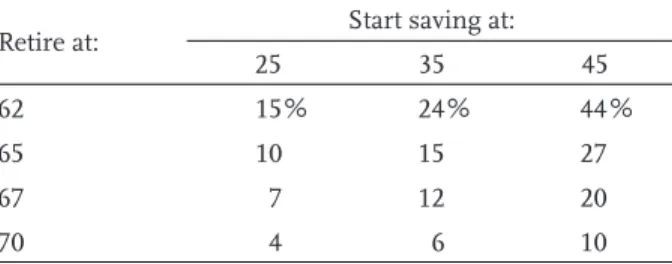
The NRRI target calculations effectively have house-holds beginning retirement saving in their mid-30s and retiring at 65, which produces high required saving rates. The required saving rates, however, are very sensitive to assumptions about starting and end-ing dates. Consider a simple Excel spreadsheet exam-ple of individuals earning the average wage and plan-ning to retire at 65 in 2040. Under current law, Social Security will replace 36 percent of their final inflation-adjusted earnings, so they have to save enough on their own to replace 34 percent (70 percent minus 36 percent). Assuming individuals purchase an annuity at retirement that produces steady inflation-adjusted consumption, average workers need to accumulate The final question is how much more households
would need to save to hit their target replacement rates. This analysis proceeds in three steps. First, for each household in the NRRI, we compare its project-ed replacement rate to its target in order to identify the half of households falling short and the
magni-Table 4. Required Increase in Saving Rates for Households Falling Short (Percentage Points)
Source: Authors’ calculations.
Age Household income (tercile)
Low Middle High
30-39 8 7 7
40-49 16 13 13
investments of $538,000. If they start saving at 35 and earn a real return of 4 percent, they will need to save 15 percent of earnings each and every year to be able to retire at 65 with financial security (see Table 5). However, if they delay retirement to 70, that figure drops from 15 percent to 6 percent. Starting to save earlier would bring the rate even lower.
Conclusion
Currently, about half of working-age households are not saving enough to maintain their pre-retirement standard of living in retirement. To supplement Social Security, depending on their income level, households should plan to get between one-quarter to one-half of their retirement income from retire-ment savings plans, such as 401(k)s. To produce this income, the typical household needs to save about 15 percent of earnings, well above today’s actual saving rates. Low-income households need to save less and high-income households more. For those households currently identified as having a savings shortfall in the National Retirement Risk Index, the necessary increase in saving depends crucially on their age; younger households need to boost their saving by a feasible amount while older households would need to work longer to moderate the need for additional saving.
Table 5. Saving Rate Required for a Medium Earner to Attain a 70-Percent Replacement Rate
Note: The calculations assume a real rate of return of 4 per-cent and the purchase of an inflation-indexed annuity with the same rate as in the National Retirement Risk Index.
Source: Authors’ calculations.
Retire at: Start saving at:
25 35 45
62 15 24 44
65 10 15 27
67 7 12 20
70 4 6 10
Endnotes
1 The Index does not include income from work, since labor force participation declines rapidly as people age.
2 Both mortgage debt and non-mortgage debt are subtracted from the appropriate components of pro-jected wealth.
3 For 401(k) assets, other financial wealth, and hous-ing wealth, the assumption is that households convert the wealth into a stream of income by purchasing an inflation-indexed annuity – that is, an annuity that will provide them with a payment linked to the Consumer Price Index for the rest of their lives. For couples, the annuity provides the surviving spouse two-thirds of the base amount. While inflation-indexed annuities are not widely used by consumers, they provide a convenient metric for calculating the lifetime income that can be obtained from a lump sum. And while inflation-indexed annuities provide a smaller initial benefit than nominal annuities, over time they protect a household’s purchasing power against the erosive effects of inflation.
4 As with the components of retirement income, both mortgage debt and non-mortgage debt are subtracted from the appropriate components of pre-retirement income.
5 Low, middle, and high earners experience wage increases derived from Clingman and Nichols (2004). The calculations assume that young households are able to borrow if their desired consumption exceeds their net income. They also assume that, during their working lives, households optimally choose a level of consumption that increases at the rate of 1 percent a year.
6 The calculations assume that both housing and financial assets yield a historical real return. The secondary earner joins the household at age 25 with zero assets. Married couples, single men, and single women face annuity rates corresponding to the income payable on inflation-indexed annuities for members of the 1956 birth cohort at 2004 inter-est rates and expense loads. At age 30, homeowners purchase a house valued at twice their age-50 earn-ings with the aid of a 30-year mortgage at a real inter-est rate of 2.23 percent. At retirement, homeowners can borrow a portion of the value of the house on a reverse mortgage.
7 See Palmer (2008). Lower-income households require higher replacement rates, because they pay little in taxes and need to save little for retirement and therefore do not experience much relief from these payments upon retirement.
8 IRA assets are also included in employer plans because the large majority of these assets are simply rolled over from 401(k)s. In addition, for the sake of simplicity, savings outside of employer plans – which are very small for most households – are also in-cluded.
9 A simpler alternative calculation would be to exclude households with defined benefit plans from the analysis, but this approach unnecessarily discards too much information that is relevant to determining average saving rates.
10 The imputed rent assumption is broadly consis-tent with estimates by Poterba and Sinai (2008) of homeowner user costs – which, in addition to im-puted rent, include property taxes and maintenance. 11 One question is whether people can achieve these saving rates under the current system, given that 401(k) contributions are limited to specified dollar amounts (currently $17,500 for those under age 50 and $22,000 for those age 50 and over). The answer is yes. Currently only about 5 percent of workers (both those under and over age 50) have incomes so high that they would be constrained by the 401(k) contribution limits. And, even for these individuals, widespread acceptance of the need for more retire-ment saving could persuade employers to raise their matching contributions. If so, plenty of room exists for additional employer contributions because the combined employer-employee contribution limit is $52,000. Alternatively, individuals could always choose to save outside of tax-deferred retirement ac-counts.
References
Clingman, Michael and Orlo Nichols. 2004. “Scaled Factors for Hypothetical Earnings Examples under the 2004 Trustees Report Assumptions.” Actuarial Note, 2004.3. Washington DC: Office of the Chief Actuary, Social Security Administration.
Munnell, Alicia H., Anthony Webb, and Francesca Golub-Sass. 2012. “The National Retirement Risk Index: An Update.” Issue in Brief 12-20. Chestnut Hill, MA: Center for Retirement Research at Bos-ton College.
Palmer, Bruce A. 2008. “2008 GSU/Aon RETIRE Project Report.” Research Report Series 08-1. Atlanta, GA: J Mack Robinson College of Business, Georgia State University.
Poterba, James, and Todd Sinai. 2008. “Tax Expendi-tures for Owner-Occupied Housing: Deductions for Property Taxes and Mortgage Interest and the Exclusion of Imputed Rental Income.” American Economic Review 98(2): 84-89.
U.S. Board of Governors of the Federal Reserve System. Survey of Consumer Finances, 1983-2010. Washington, DC.
About the Center
The mission of the Center for Retirement Research at Boston College is to produce first-class research and educational tools and forge a strong link between the academic community and decision-makers in the public and private sectors around an issue of criti-cal importance to the nation’s future. To achieve this mission, the Center sponsors a wide variety of research projects, transmits new findings to a broad audience, trains new scholars, and broadens access to valuable data sources. Since its inception in 1998, the Center has established a reputation as an authorita-tive source of information on all major aspects of the retirement income debate.
Affiliated Institutions
The Brookings Institution
Massachusetts Institute of Technology Syracuse University
Urban Institute
Contact Information
Center for Retirement Research Boston College
Hovey House
140 Commonwealth Avenue Chestnut Hill, MA 02467-3808 Phone: (617) 552-1762
Fax: (617) 552-0191 E-mail: [email protected] Website: http://crr.bc.edu
© 2014, by Trustees of Boston College, Center for Retire-ment Research. All rights reserved. Short sections of text, not to exceed two paragraphs, may be quoted without ex-plicit permission provided that the authors are identified and full credit, including copyright notice, is given to Trustees of Boston College, Center for Retirement Research.
The research reported herein was supported by Prudential Financial. The findings and conclusions expressed are solely those of the authors and do not represent the opinions or policy of Prudential Financial or the Center for Retirement Research at Boston College.