Future Skills Requirements of
the Manufacturing Sector to
2020
Table of Contents
Table of Contents ... 1
Foreword ... 3
Executive Summary ... 5
E.1 Introduction ... 5
E.2 21st Century Manufacturing ... 5
E.3 Manufacturing in Ireland ... 6
E.4 Manufacturing Skills Supply ... 8
E.5 Modelling future skills demand ... 10
E.6 Future Demand for Skills in Manufacturing ... 12
E.7 Recommendations ... 14
Chapter 1: Introduction and Objectives ... 23
1.1 Background ... 23
1.2 Aim of Study ... 24
1.3 Methodology ... 24
1.4 Report Outline ... 25
Chapter 2: Manufacturing – Global Drivers of Change ... 26
2.1 Introduction ... 26
2.2 Global Shifts and Trends ... 26
2.3 Impact of Global Drivers of Change at the Firm Level ... 34
2.4 Conclusions – Implications for Skills ... 40
Chapter 3: Profile of the Manufacturing Sector in Ireland ... 42
3.1 Introduction ... 42
3.2 The Economic Contribution of Manufacturing ... 42
3.3 Broad Employment Trends... 43
3.4 Sectoral Profile ... 45
3.5 Occupational Profile ... 52
3.6 Qualification Profile ... 55
3.7 Employment by Age ... 57
3.8 Employment by Gender ... 59
3.9 Nationality ... 60
3.10 Conclusion ... 61
Chapter 4: Provision of Manufacturing-Related Education and Training in Ireland ... 63
4.1 Introduction ... 63
4.2 Parameters ... 63
4.3 Higher Education ... 64
4.4 Further Education and Training (FETAC awards) ... 72
4.5 Manufacturing Apprenticeships ... 74
4.6 Profile of In-Company Education and Training/Upskilling Activity... 76
4.7 Conclusion ... 85
Chapter 5: Anticipated Level of Skills Demand ... 87
5.1 Introduction ... 87
5.2 Employment under the Three Scenarios ... 89
Chapter 6: Future Demand for Skills in the Manufacturing Sector ... 101
6.1 Introduction ... 101
6.2 Manufacturing Cross-sectoral Themes ... 102
6.3 Enterprise Skills ... 114
6.4 Closing Skills Gaps ... 114
6.5 Future Opportunities for Manufacturing ... 115
6.6 Strategic Threats and Challenges for Manufacturing ... 116
6.7 Recruitment Challenges... 117
6.8 Sector Specific Skills Gaps ... 117
6.9 Conclusions ... 122
Chapter 7: Conclusions and Recommendations ... 123
7.1 Introduction ... 123
7.2 Key Findings and Conclusions ... 123
7.3 Recommendations ... 138
Appendices ... 138
Appendix 1: Steering Group Members ... 147
Appendix 2: NACE Classification ... 148
Appendix 3: Industry Stakeholders Consulted ... 149
Appendix 4: Members of the Expert Group on Future Skills Needs ... 150
Foreword
Manufacturing in Ireland has experienced huge changes in recent years. The sector has experienced significant employment declines over the past decade, driven by a combination of erosion in competitiveness domestically and external factors such as the global financial crisis that impact on the demand for manufactured goods. This report, requested by Government under the Action Plan for Jobs 2012, assesses the skills needs of the manufacturing sector to 2020. The report
highlights that the skills and competencies needed within manufacturing are rising across virtually all occupations due to factors such as scientific and technological advances, automation, regulatory requirements, new ICTs and the drive for continuous improvement. These factors are driving demand for increased levels of skills, both for upskilling within the existing workforce and for ensuring skills supplied by mainstream education and training are sufficient and relevant to industry requirements. The need for export-led growth is generally accepted as the basis for Ireland’s economic recovery and sustainability. Manufacturing is at the heart of making this happen. Manufacturing firms play critical roles as exporters, as employers, developers of new products and processes and as purchasers of goods and materials. The manufacturing sector currently employs around 200,000 people and it is estimated that each direct manufacturing job supports at least one other job in the wider economy. The employment outlook for the sector depends critically on addressing domestic competitiveness factors and a favourable international trading environment. The future employment scenarios within this report highlight an increasing demand for higher skills, with skilled operative jobs replacing elementary jobs and employment accounted for by qualified technicians and STEM professionals continuing to increase as a proportion of total employment. In tandem, the demand for higher levels of qualifications, even at basic entry roles, is rising. Importantly, from the perspective of future supply, the scenarios predict a replacement demand in the region of 4,000 to 5,000 persons per annum.
There are skills shortages currently within manufacturing, though not of significant scale.
Nonetheless, many of these shortages are critical at an operational level to manufacturing firms due to the technical expertise they provide and it is therefore vital that they are addressed. The report highlights current and future shortages in areas such as toolmaking, machinists, supervisors, polymer technicians and across a number of engineering disciplines.
More broadly, the report also highlights the importance of continuous upskilling requirements across all occupations. Finally, the manufacturing sector needs to do more to promote and boost the attractiveness of manufacturing as a career choice. There are highly varied and rewarding career paths within the sector, with good potential for mobility, however, these are often not apparent to students or those working outside of the sector.
On behalf of the Expert Group, I would like to thank the wide range of companies, stakeholders and individuals who contributed to this report through consultations, workshops and who helped to shape the recommendations. As chairperson of the Steering Group for the project, I would like to thank each member of the group for their full commitment and support in overseeing the study. Finally, I would like to thank the team at Forfás for their research and analysis and leading this project to a successful conclusion.
Una Halligan
Acknowledgements
Forfás would like to record its appreciation to the members of Steering Group who oversaw the work of the report for their commitment and contribution - membership is set out in Appendix 1. Forfás would also like to acknowledge the valuable input of the many senior executives of companies and organisations who participated in the research work for this study. Also, to those expert staff from professional and trade organisations and State Agencies who provided valuable insights at workshops and meetings. Forfás would like to acknowledge the quality of the work of Publica Consulting and Dwyer-Doyle Associates who undertook the fieldwork and the research work with companies, facilitated workshops, drafted recommendations and produced the scenarios for future employment. Thanks are due to the Skills and Labour Market Unit at FÁS which provided data and analysis on the manufacturing labour market and relevant education and training provision.
Execu
E.1
The Gov Needs to structur manufac tandem by Forfá The over sector in change; future sk identifie address A steerin appointeE.2
There ar which arutive Su
Introducti
vernment’s A o undertakeres for traini cturing secto
with the wid ás.
rarching obje n Ireland ove
a statistical kills needs th ed through co immediate a ng group con ed to oversee
21
stCentu
re numerous re in turn dri
ummary
ion
Action Plan fo
a detailed a ing and skills or and to ant
der strategy ective of thi er the period l profile of sk
hrough econ onsultations and future sk nsisting of m
e the develo
ury Manufa
drivers of c iving changin
Research Developm and Innova (RDI)
Impact of ICTs
Su Man Pro P
y
or Jobs 2012
assessment o s developme ticipate long
for manufac s study is to d 2012-2020.
kills supply a omic modell with enterp kills requirem
anufacturing opment of th
acturing
hange impac ng skills need
Managing Global V Chai h, ent ation s ustainable nufacturing ocesses and Practices
2 requested F
of manufactu ent to addres ger term nee
cturing, Mak o address the
Specifically and demand ling; a qualit prise and ind
ments. g enterprise he report.
cting on the ds within the
Changing Skil Needs of Manufacturin Globalisation and Emergin Markets Com g the Value n
Forfás and th
uring skills n ss both the i eds. This stud
ing it in Irel
e skills requir y this entails in the secto tative assess ustry stakeh and educati overall envi e sector. lls ng n g Scientif Techno Advan E Cost mpetitiveness
he Expert Gr
eeds and use mmediate n
dy has been
and, which i
rements of t an analysis o
r; a quantita ment of futu olders and; on/training ronment for fic and logical nces Shifting Demograph and Consumptio Trends Environmental and Energy Concerns
roup on Futu
e of the new needs of the
developed i is being unde the manufact of global dri ative assessm ure skills nee recommenda stakeholders manufactur hic on ure Skills w n ertaken turing ivers of ment of eds ations to s was ring,
At a macro level, globalisation – the movement of capital, people, goods, services, ideas and people across borders – is accelerating and evidenced through the growth of emerging markets in terms of world trade. In 2010, developing economies were the recipients of the majority of inward foreign direct investment flows for the first time. Scientific and technological advances have significant implications for skills. In particular, Key Enabling Technologies (KETS) such as advanced materials, nanotechnology, biotechnology, photonics and advanced manufacturing are increasingly having a transformative effect on the manufacturing sector now and in the future. Projected world population growth of 9.3 billion by 2050 and shifting demographics, including ageing populations within developed economies, will have a profound impact on the future demand for manufactured goods and associated materials and commodities.
Growing middle class populations within the BRIC nations are expected to drive additional demand for manufactured goods. Consumer preferences are shifting in many countries with increasing emphasis on the sustainability of products, their carbon footprint and ‘air miles’. Environmental regulations and goals for energy efficiency mean that many manufacturing firms are developing sustainability teams to drive efficiencies from input, through production and delivery to customers. At firm level, disaggregated global supply chains are driving specialisation within many
manufacturing firms seeking to plug in to global networks. Cost competitiveness is placing increased scrutiny on all aspects of the production chain, raising the demand for continuous
improvement and lean manufacturing techniques. The competitive manufacturing environment puts a particular emphasis on research, development and innovation activities, not only in the context of R&D for new products, but also the ability to absorb technologies and expertise developed externally which can drive innovation in manufacturing products and processes. ICTs are having a highly significant impact on manufacturing processes with ICT enabled processes such as increasing automation, computer integrated manufacturing (CIM), simulated manufacturing, virtual test beds and ‘digital factories’ at the cutting edge of manufacturing competitiveness. All of these drivers have significant implications for skills requirements.
E.3
Manufacturing in Ireland
Manufacturing firms play a critical role in the Irish economy – as a driver of exports, as an employer, as a source of revenue and as a key driver of growth. Manufacturing sales accounted for
approximately 22 per cent of GDP in 20091.There are 12,790 manufacturing enterprises in Ireland.2
Most of these are small in scale, with 83 per cent employing less than 10 people (micro firms) and 95 per cent employing less than 50 people. Manufacturing exports were approximately €92.9 billion in 2011, almost twice the level of manufacturing imports of €48.2 billion, giving a net export figure of €44.7 billion, thereby the primary positive contributor to the Balance of International Payments. The manufacturing sector also has significant spin off effects, such as indirect employment
supported in other sectors including services, logistics, mining/quarrying, agriculture and sub-supply.Manufacturing firms source approximately €14 billion of materials and services from Irish based suppliers – although this has decreased from €17.5 billion since 2001.3 Manufacturing is a key
driver of R&D activity and innovation, with 40 per cent of Business Expenditure on Research and
1 OECD Statistics Database
2 CSO Business Demography Statbank referenced Nov 2012 3 Forfás Annual Business Survey of Economic Impact
Development being undertaken by manufacturing firms and €740 million invested by manufacturing enterprises in R&D in 2009. The Revenue Commissioners estimate that the manufacturing sector accounted for almost 40 per cent of net corporation tax receipts in 20104.
There were approximately 206,000 people employed in manufacturing in 20115, accounting for 11.4
per cent of total employment. The historic long term employment contribution of manufacturing is downward, representing both cyclical (as a result of the global crisis) and structural losses (as a result of deindustrialisation/outsourcing/automation and productivity gains). However, employment has held relatively steady at 11-12 per cent of total employment from 2009 to 2011.
Figure E.1 Employment in Manufacturing in Ireland 1992-2011 (‘000s)
Eurostat Annual Labour Force Statistics
Over the last decade, there have been two major shocks to the manufacturing sector in Ireland. The first occurred in 2000-2001 when, just as employment in manufacturing peaked at 296,600, the dot com bubble burst resulting in significant losses in manufacturing output worldwide, particularly within the ICT sector. The second major shock occurred in 2007-2008 when approximately 50,000 jobs were lost in manufacturing in the next 3 years. This was driven by the impacts of the global financial crisis on the one hand, which resulted in worldwide consolidation of manufacturing, major relocation of some Irish-based multinational operations abroad, merger activities and a sudden drop in demand for exports. On the other hand, demand for Irish-based manufactured goods linked to
4 Revenue Commissioners (2011) Statistical Report 2010
http://www.revenue.ie/en/about/publications/statistical/2010/index.html 5 CSO Quarterly National Household Survey Data
100 150 200 250 300 350
construction and consumption declined significantly in line with the downturn in those sectors. Since then Ireland has regained some competitiveness primarily as a result of falls in relative prices and favourable exchange rate movements. On a sectoral basis employment in Pharma-chemicals, Medical Devices and Food and Beverages has remained resilient throughout the recent recession. The Engineering and ICT hardware sectors have stabilised after significant shocks in 2007/2008. Consumer Goods and Other Manufacturing have continued a long term decline. Firms in these sectors that remain competitive tend to be those that have invested in technology, marketing and their strategies are focused on export potential.
Since 2007, the proportion of those employed in managerial, professional and associate professional roles has increased from 25 per cent to 32 per cent. This reflects cyclical shocks (which tend to affect those with lower skills disproportionately) and also structural change as the shift towards more knowledge intensive and higher value added activities increases skills demands across virtually all roles. The qualifications profile of the manufacturing sector is slightly below the national
average with 38 per cent of employees having third level education and above (compared to 44 per cent nationally) and 16 per cent of employees with junior certificate or below (compared to 15 per cent nationally). There are substantial differences across manufacturing sectors. For example, within the food and drink, consumer products other manufacturing sectors, there are very
significant proportions (20 per cent plus) of those with lower secondary education and below. At the same time, these sectors have comparatively low proportions of employees with higher level
education compared to the national average. By contrast, the Pharma-chemicals and ICT hardware sectors have a very high qualifications profile, with over 60 per cent of those employed in those sectors having third level education and above.
There are also significant differences across sectors in terms of variables such as gender, age and nationality.
For example, females account for 30 per cent of employment in manufacturing overall.
However, within Pharma-chemicals and medical devices females account for around 40 per cent of employment, whereas in ICT hardware they account for just 25 per cent of employees.
43 per cent of employees in Consumer Products and 38 per cent of those in Other Manufacturing
are over 45 years of age, whereas just 26 per cent of those employed in ICT hardware are in the same age bracket.
30 per cent of those employed in Food and Beverages are non-national, whereas just 7 per cent
of those employed in Pharma-chemicals are non-nationals. The national average is 13 per cent.
E.4 Manufacturing
Skills
Supply
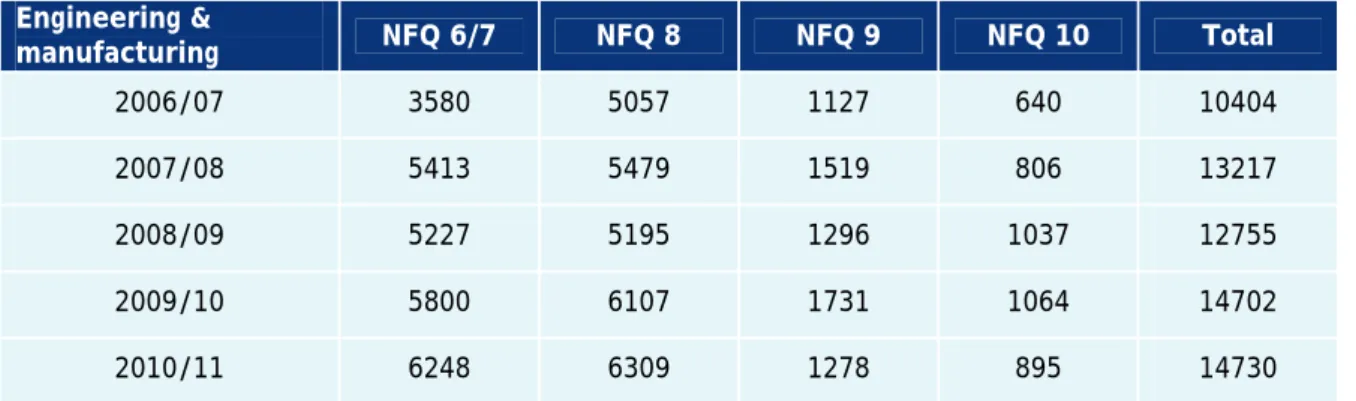
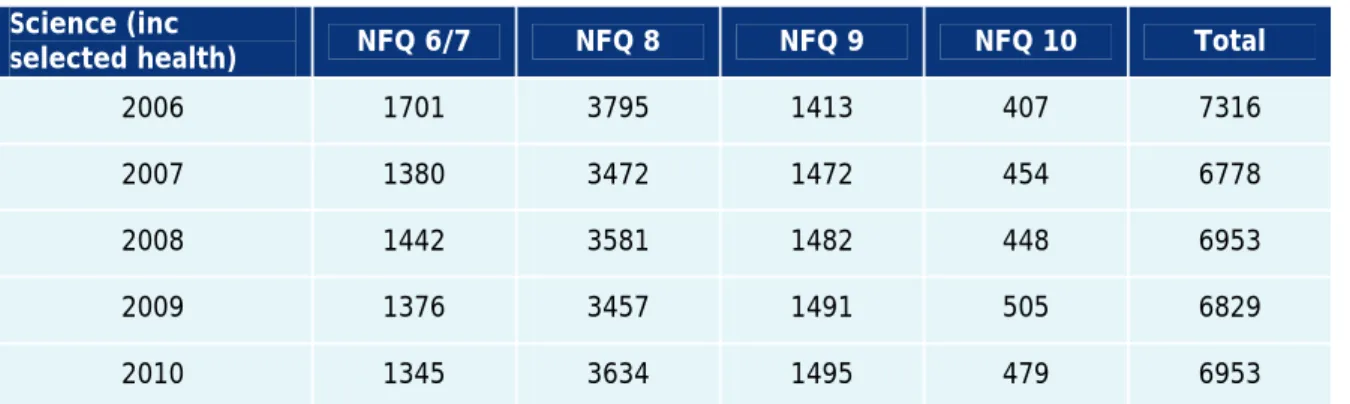
Within higher education, there has been a significant increase in enrolments (39 per cent) from 2006/07 to 2010/11 in Science, Technology and Engineering disciplines relevant to the
manufacturing sector, which is a particularly positive development given relatively stagnant levels of graduations over the same period (approx. 10,000). Therefore, an increased outflow of STEM graduates to the labour market can be expected in the coming years. Total enrolments now stand at just over 45,000. Enrolments in science/selected health programmes related to manufacturing outnumber engineering enrolments by approximately 2 to 1. Both science and engineering
programmes experienced similar rates of increased enrolments. There have been strong increases at Level 6/7 enrolments, particularly in ICT related programmes, electrical engineering and
mechanical engineering. Enrolments at Level 8 and 9 mainly relate to biological/biochem/chemical sciences; computing and electronics and engineering categories. There have also been strong increases in enrolments in energy/environmental related programmes, reflecting the increasing influence of the environmental agenda. There is a challenge for manufacturing enterprises in attracting the top graduate talent in that many of these graduates are sought after for other sectors such as health, education, software and research.
Figure E.2 Enrolments (science, including selected health, and engineering/manufacturing)
Source: HEA
In addition to the enrolment data outlined above, since 2011 provision relevant to the
manufacturing sector has been expanded through the introduction of the Springboard programme, which strategically targets funding of part time higher education courses for unemployed people in areas where there are identified labour market skills shortages or employment opportunities. Under the first two phases of Springboard 2011 and 2012 almost 8,000 places have been being provided on courses from NFQ Level 6 to 9 in areas relevant to the manufacturing sector: Pharma-chemicals; Food and Beverage; Green Economy; ICT and; Medical Devices. A further expansion of the Springboard initiative has been announced in Budget 2013.
A number of higher education institutes have specific expertise or centres dedicated to
manufacturing, for example the BioInnovate forum; the Centre for Advanced Manufacturing and Management Systems in CIT; the Enterprise Research Centre and U Learning programme in University of Limerick; UCD-Trinity Innovation Partnership; and Sligo/Athlone Institutes of Technology/Skillnets distance learning offering in Polymer Engineering. Overall, the numbers expected to graduate from higher education are increasing, however, as outlined in Chapter 7 the
0 5000 10000 15000 20000 25000 30000 35000 40000 45000 50000
2006/07 2007/08 2008/09 2009/10 2010/11
NFQ 10 NFQ 9 NFQ 8 NFQ 6/7
skills and competencies of these graduates to meet what will be required of the manufacturing sector is key.
Within Further Education and Training Awards, it is clear that there are a significant number of awards relevant to the manufacturing sector. In 2012, approximately 18,000 FETAC awards were made across the science, engineering, manufacturing and computing fields.6 Some of these awards
are quite general (for example relating to IT skills), however, others are highly specific to manufacturing such as those relating to pharmaceutical processing, materials manufacturing and injection moulding. The breadth and specificity of awards highlights that there are established standards for many of the competencies required at the lower qualifications levels of
manufacturing, however, these may not be apparent or clearly mapped out to all learners and employers.
There have been significant declines across most of the manufacturing Apprenticeships since 2007, coinciding with the period of decline in manufacturing employment generally. In particular, there has been a substantial relative decline in the numbers of fitters, electricians, metal fabricators, toolmakers and sheet metal workers. It is clear supply has fallen to very low levels in some
apprenticeships that are critical to manufacturing (as in a recession, employers are not recruiting), giving rise to concern for the future around adequate replacement demand for qualified
tradespersons within the sector.
A number of industry stakeholders as well as individual companies are involved in funding and/or provision of skills development within the manufacturing sector in Ireland, such as Enterprise Ireland, Skillnets, Engineers Ireland, Institute for the Development of Employees Advancement Services (IDEAS) and the Irish Medical Devices Association (IMDA). In-employment education and training is essential within the manufacturing sector as new technologies, regulations, processes and products continually affect skills required by existing employees.
E.5
Modelling future skills demand
Future manufacturing employment has been modelled to take account of the Government’s Action Plan for Jobs 2012 targets and implementation of the Forfás strategy for manufacturing - Making it
in Ireland – report. Three scenarios for the future employment in manufacturing and skill needs are
presented, based on drivers and trends described in the report, on opinions of informants in the sector and based on historic trends in employment and occupations within the subsectors of manufacturing. The scenarios are based on different assumptions about drivers of manufacturing activity in Ireland, focusing particularly on the issues of competitiveness that are likely to most influence future manufacturing employment in Ireland.
6 Note, the number of FETAC awards does not equate to number of graduates as many learners earn more than one FETAC award in a given year.
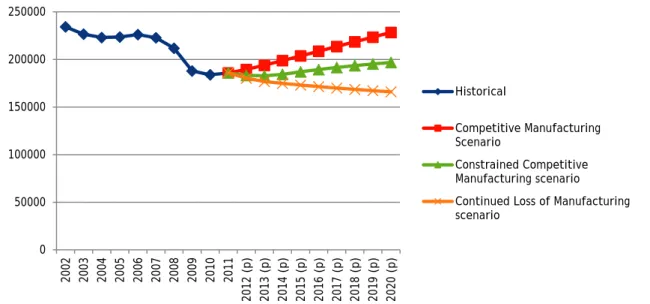
Figure E.3 Anticipated Total Employment* under the Three Scenarios
* Based on Forfás Employment Survey manufacturing employment data. Note that this survey does not have full coverage of the manufacturing sector. It covers circa 92% of manufacturing
employment.
These scenarios are:
Competitive Manufacturing Scenario – employment under this scenario rises by 22,000 to 2016
and continues incrementally to increase by 43,000 by 2020. This scenario reflects the Government’s Action Plan for Jobs targets for the period to 2016, and continues these projections forward for the period 2017-2020. This scenario depends crucially on attaining reductions in labour and other business costs, productivity and innovation improvements and necessary skills supply to be realised. At the same time, the scenario also depends on a positive international environment for trade and investment and a favourable exchange rate climate with Ireland’s main trading partners.
Constrained Competitive Manufacturing Scenario – this scenario assumes progress within
Ireland on competitiveness factors impacting on the manufacturing sector, however, potential employment growth is constrained due to a depressed international environment. Under this scenario, employment growth is limited, increasing by a net 11,000 out to 2020.
Continued Loss of Manufacturing Scenario - This scenario assumes that only limited further
progress is made on tackling the deficiencies in manufacturing competitiveness that accumulated over the period from around 2000 to 2008. As a consequence, the long term downward trend in manufacturing employment seen since 2001 continues. Employment falls by approximately 20,000 by 2020.
At a sectoral level across all three scenarios, Engineering, Medical Devices and Food and Beverages are expected to perform above average. ICT hardware is expected to perform around the
manufacturing average. Consumer products and Other Manufacturing are expected to perform below the manufacturing average. The outlook for the Pharma-chemicals sector is that employment levels will remain stable with labour productivity and redeployment primarily driving increases in
0 50000 100000 150000 200000 250000
2002 2003 2004 2005 2006 2007 2008 2009 2010 2011
2012 (p) 2013 (p) 2014 (p) 2015 (p) 2016 (p) 2017 (p) 2018 (p) 2019 (p) 2020 (p)
Historical
Competitive Manufacturing Scenario
Constrained Competitive Manufacturing scenario Continued Loss of Manufacturing scenario
output. There are significant shifts expected in occupational composition. The share of employment accounted for by elementary occupations falls in each subsector, as jobs at this level are replaced by operative jobs, representing an upskilling of the workforce as unskilled jobs are eliminated and replaced by skilled operative jobs. In addition, the share of employment accounted for by STEM technicians and by STEM professionals increases.
Substantial shifts in the qualifications profile of the workforce are projected, which continue trends visible in the historical data. The share of manufacturing employment accounted for by workers qualified to lower secondary level and below decreases, reflecting more demanding skills
requirements at operative level. The share of manufacturing employment accounted for by workers with third level qualifications continues to increase, partly due to an increase in the share of employment accounted for by professional and associate professional level occupations, but it is mainly driven by more demanding skills requirements raising the level of qualification required within occupations, due to lower skilled manufacturing activities having moved to Eastern Europe and further afield (China, India). At the upper end, some leading manufacturing employers now require operatives to have an NFQ Level 6 or Level 7 qualification, technicians to have a Level 8 qualification and professional level occupations to have postgraduate diploma, Masters or PhD qualifications.
In summary, future employment scenarios are highly dependent on both internal and external factors, with future employment growth requiring significant improvements in domestic
competitiveness coupled with a favourable international environment for trade. The model also highlights the potential for continuing loss of manufacturing employment if domestic
competitiveness factors are not addressed. Across all three scenarios, there are upskilling
requirements at both occupational and qualifications level. Furthermore, and importantly from the perspective of future supply, the scenarios predict an replacement demand in the region of 4,000 to 5,000 persons per annum regardless of whether employment expands or not.
E.6
Future Demand for Skills in Manufacturing
Evidence gathered through a combination of research, workshops, consultations with industry stakeholders and firm level interviews identified the following key skills issues and requirements.
Perceptions of Manufacturing Careers and Career Paths
There is a clear consensus among stakeholders that manufacturing industry suffers from
negative perceptions among the Irish population, and that this dissuades suitable people from
seeking to make a career in manufacturing. This is an important root cause of some of the more specific skills issues. Even within manufacturing, certain sectors are perceived better than others for careers.
Opportunities for career progression are not clearly structured or mapped out, particularly
to prospective entrants to manufacturing and mainly at operative, trade, technician and supervisory levels. In the US and the UK the development of career paths are industry–led (for example, the Manufacturing Institute in the US, or the UK SEMTA sector skills council). In Germany, employers and the education and training infrastructure are highly integrated in the operation of apprenticeships in particular. Industry ownership and endorsement of career paths ensures that the education and training infrastructure can be mapped appropriately to provide
clarity to learners. It also provides clarity between industry and education regarding required competencies and enables gaps in learning infrastructure to be addressed where they may arise.
Skills for Manufacturing Excellence
Lean manufacturing techniques and increasing automation are driving upskilling requirements
for both generic skills and technical skills across virtually all occupations.
Modern statistical software and more complex and sometimes novel manufacturing processes
are together generating opportunities to use more sophisticated data analytic techniques in support of lean manufacturing, automated manufacturing processes and manufacturing process R&D. There is a strong consensus from stakeholders consulted on this that the main need is for professionals with a strong understanding of the specific manufacturing process, typically engineers or scientists (depending on the sector), to acquire skills in data analytics.
Trades & Technicians Skills Requirements
A significant number of engineering firms indicated a shortage of people with toolmaking
and/or machinist skills. Some medical devices firms also identified a shortage or potential
shortage of toolmakers. A significant number of medical devices firms, and some firms in other sectors, identified a shortage or potential shortage of polymer technicians, qualified to around Level 7 in the National Framework of Qualifications.
There are also more general concerns about the supply of technical workers at skilled trades
or technician level capable of working on machinery that combines mechanical, electrical,
electronic and IT/software technologies.
The concerns in industry about the supply of mechanical-electronic technicians and trades
appear more diffuse. These skills are important in the context of automation and computerised machinery. They can be supplied either through training and education that covers a
combination of mechanical, electrical, electronic and software/IT skills, such as a Level 7 qualification in mechatronic engineering or an apprenticeship-based qualification in electrical instrumentation, or through training in a subset of these areas in the initial technician or trade qualification, followed by further training in complementary areas later.
Engineering skills
Manufacturing firms consulted on their engineering and manufacturing management skills
requirements emphasised the need for core engineering skills – that engineers should have the core skills associated with one or other of the main engineering disciplines, with mechanical, electrical, electronic and chemical/process engineering being the main disciplines relevant to manufacturing. So long as an engineering course develops these core skills and this is visible to prospective employers, variants such as biomedical or aeronautical engineering may also be valued. Employers will not necessarily prefer a qualification tailored to their sector over a qualification in the most closely related main engineering discipline.
The strong consensus from workshops is that demand for validation engineering, quality
engineering, automation engineering, supply chain engineering and other professional level
qualified and experienced engineers undertaking further study in the area to develop the specialist skills needed. Postgraduate diploma and taught Masters courses in these areas are primarily the most appropriate response to the skills.
Engineers with a strong knowledge of polymers are in demand in the medical devices and
plastics industries, and in parts of other sectors. Firms report a shortage of engineers with strong skills in the area.
Researcher Skills
There is a need for researcher skills relevant to product development. This work requires high
levels of skill and, at its more advanced levels, requires people with research degrees at Levels 9 and 10 in a relevant area, or with equivalent levels of skill. Generating these skills requires higher education research in areas relevant to the specific skills requirements. Existing moves to focus higher education research funding on industry-relevant topics, and to develop industrial PhD programmes should make a major contribution to meeting these skills needs.
A number of manufacturing firms consulted drew attention to the high business and employment
impact that a key person with industry-leading skills can have at firm level. They may drive improvements in business performance far out of proportion to the cost of hiring them through driving product development, commercialisation, operational performance or marketing, and through improving decision-making. They are valuable from a jobs policy perspective because they can drive activity that boosts employment.
Generic Skills
Firms and other stakeholders consulted through interviews, workshops and stakeholder
consultations emphasised that it is necessary for technical skills at all levels to be
complemented with strong generic skills, particularly in terms of people skills, communication skills, problem solving skills, planning skills and project management skills appropriate to the level of the work. These skills are essential enablers for manufacturing excellence. They are also essential in other contexts, such as where contact with customers or suppliers is required, in product development, when working with regulatory bodies, or when seeking to influence investment decisions by parent companies.
E.7 Recommendations
In developing recommendations, it is clear that the skills needs of the manufacturing sector are wide and, in some instances, complex. Addressing skills needs, therefore, has a number of facets:
Some shortages can be addressed through increasing supply, providing specific modules,
accredited work placements or amending the curriculum within the mainstream education and training system. This is about ensuring both the right numbers are being produced and that graduates have relevant industry skills.
However, many employers also address specific skills needs through upskilling and building upon existing skills base and experience within the firm – this requires flexible systems of Continuing Professional Development (CPD), online delivery, post graduate qualifications and conversion courses. In many cases, these shortages are small in scale but acutely felt by industry due to the critical nature of the roles within the firm.
Finally, some skills requirements are for key persons with highly specific expertise that is mainly developed through experience. These are often global shortages for key persons that drive innovation and growth within the firm. The main requirements from education and training relate to ensuring access to relevant research expertise and/or collaboration on company-specific product/process development.
1. Establishing clear career paths in manufacturing
Internationally, there are clear paths in many countries for career progression from operative level up to senior roles in manufacturing, linked to their systems of training, education and
qualifications. Industry takes the lead role in establishing and developing these career paths in collaboration with education and training providers. Ireland does not have a comparable resource at present. Some consequences of this include:
School leavers and others making career choices do not have visibility of the career
opportunities available in manufacturing. Employees may have difficulty identifying learning opportunities that will help in progressing their careers.
Without clarity over career paths, providers of education and training are constrained in their ability to map their course offerings to industry needs and identify current gaps in provision that will be widely required by industry.
The most significant gap in the system is the lack of a clear framework for training at operative level, and for progressing from operative level. There are existing elements to the system which function well; there are discrete sector level initiatives for operative level training that might fit well into an overarching framework; and there are examples of very good practice on career paths within individual firms. The challenge is to build on good work that is already being done.
Key features of a career path framework for manufacturing at this range of levels would include:
Establishing competency frameworks for the main occupations, mapped to the National
Framework of Qualifications;
Establishing learning pathways for the skills associated with each occupation, and for progression between occupations, that meet the needs of both industry and employees, and are robust in terms of learning and qualifications; and
Facilitating both college-based and industry-based learning pathways where these meet
industry and learner needs, with cross-linkages and even joint provision between the two types of pathway.
Consideration should be given to the possibility of an industry-based track to qualifications for higher level occupations, comparable to German Meister or time-served engineer.
Recommendations:
The Manufacturing Development Forum should lead a review of manufacturing career paths. It
should engage industry, employee representatives and relevant providers of education and training and the qualifications bodies including Industry Representatives, Further Education providers, FÁS/SOLAS, Skillnets and Higher Education representatives.
The review should have reference to international experience with developing and mapping
career paths, such as the US stackable credentials model, the training and progression models of various “dual system” countries in Europe and the training and progression maps of sector
1. Establishing clear career paths in manufacturing
skills councils such as SEMTA in the UK.
(Manufacturing Development Forum, Industry Associations, FÁS/SOLAS, Skillnets, Higher Education
Institutes)
2. Promoting manufacturing careers
The ability of manufacturing industry to attract employees is affected adversely by lack of
knowledge of the career opportunities it offers and by negative perceptions of what manufacturing work entails, among potential future employees and many of those who influence them. A
programme of information and promotion targeted at all skill levels is required to ensure that the sector has a strong supply of skills, and that second level students and others are well informed about the career opportunities available to them.
There is already considerable Irish expertise with careers promotion. Discover Science and
Engineering (DSE), managed by Science Foundation Ireland (SFI), promotes science, engineering
and technology careers, and Engineers Ireland’s STEPS programme promotes engineering careers in conjunction with DSE. Promoting careers in manufacturing intersects significantly with the work of DSE and STEPS, as many of the key skills required in manufacturing are in engineering, science and technology at technician and professional levels.
Recommendations:
Manufacturing companies and industry associations should participate in future Discover Science and Engineering campaigns to highlight manufacturing opportunities within the STEM sector. The initiative should draw attention to the career paths being mapped and developed under Recommendation 1 and to examples of manufacturing career success across the range of occupations, including operative, technician, supervisor and professional occupations.
(Manufacturing Companies, Industry Associations, Science Foundation Ireland, Engineers Ireland)
3. Tackling supply issues at operative, skilled trades and technician levels
Toolmakers
The shortage of toolmakers can only be addressed by an increase in the number of apprentices recruited by industry. This process could be accelerated, with the cooperation of FAS (and subsequently SOLAS when established), by firms who are FÁS-approved employers for apprenticeship training through registering skilled operatives as apprentices and submitting applications with portfolios of evidence for exemptions from phases of the apprenticeship
programme for toolmaking.7 Feedback from employers also indicates that the toolmakers syllabus
requires some updating to take account of recent advances in materials and manufacturing processes.
7 It should be noted that exemptions are only granted for Phases 1-5 of the Apprenticeship inclusive. All applicants are required to complete the Phase 6 examination in Theory and Practice and complete Phase 7 on the job with the FÁS approved employer to meet the criteria for the award of the FETAC Level 6 Advanced Certificate-Craft. The acceleration of the apprenticeship programme would need to be discussed with FÁS and HEA to ensure training capacity resources are available to meet the demand for Phase 2, Phase 4 and Phase 6 as a result of the exemption application process and the phases of exemptions granted.
3. Tackling supply issues at operative, skilled trades and technician levels
Polymer Technicians
The current shortages for polymer technicians are being addressed in part through a Level 7 distance learning course provided by IT Sligo on behalf of the First Polymer Skillnet. At the time of writing, the Skillnet is consulting on how many additional places might be required to meet future demand from firms for places for employees, while also continuing to provide places for the unemployed. Skill needs in this area could also, in principle, be addressed through mainstream full time provision or through initiatives such as Springboard-funded courses for job seekers.
Machinists
There is substantial demand from employers for on-going upskilling of machinists due to new technologies and/or processes. Skillnets should examine the establishment of an engineering sector Skillnet that could be responsible for in-employment training for machinists which were identified as in short supply.
More broadly, in the review of the Apprenticeship model and the range of apprenticeships, trades and traineeships, the Department of Education and Skills/FÁS should examine the potential for formal learning opportunities for machinists, particularly for CNC machining and programming, including the potential for the development of a Machinist Apprenticeship or Traineeship.
Recommendations:
Toolmakers
Use the accelerated apprenticeship scheme to augment the number of apprentices qualifying
as toolmakers every year. FAS (and subsequently SOLAS) should endeavour to ensure that at least 55-60 apprentices qualify as toolmakers each year over the period to 2016.
(Companies, FÁS/SOLAS, Higher Education Authority)
Update the toolmaking apprenticeship syllabus to reflect recent advances in manufacturing
materials and processes.
(FÁS/SOLAS) Polymer Technicians
Assess the potential for increasing the supply of polymer technicians, including pooling resources for the associated equipment requirements. Providers should also investigate the possibility of funding equipment costs through leasing arrangements or sponsorship by clusters of companies or equipment manufacturers.
(Skillnets, Institutes of Technology, Plastics Ireland, IMDA)
Machinists
Target the development of an Engineering Skillnet training network (see Recommendation 7)
which can address demand for in-company training and upskilling for machinists
(Skillnets in collaboration with the Manufacturing Development Forum)
Examine the potential for formal learning opportunities for machinists, particularly for CNC machining and programming, including the potential for the development of a Machinist Traineeship or Apprenticeship.
(Department of Education and Skills, FÁS/SOLAS)
Support places for the unemployed within these recommendations through, for example,
Springboard and Momentum programmes.
3. Tackling supply issues at operative, skilled trades and technician levels
Expedite, insofar as possible, the review of the Apprenticeship model taking into account the needs of manufacturing firms and the analysis and recommendations set out in this report. The review should consider options for provision that mitigate against shortages where they result from the cyclical nature of apprenticeship.
(Department of Education and Skills)
4. Undergraduate level skills for manufacturing
Under the medium to high growth scenarios, demand for mechanical engineers would rise significantly and feedback from employers indicates the need to increase the skills pool in this regard. This demand for mechanical engineering graduates and similar disciplines is at present driven particularly by developments in the medical devices sector.
Increasing enrolments in engineering fields should result in increased supply to the manufacturing sector in approximately 2-3 years. In the short term, the demand for mechanical engineering should be addressed through the Springboard programme.
Recommendations:
Mechanical/Manufacturing Engineering Level 8 programmes should be targeted within the next
Springboard call in the order of 250 places. They should have a particular emphasis on manufacturing skills related to automation, development and design.
In awarding places and ensuring that the demand is appropriately addressed, a strong emphasis
should be placed in tendering for programmes that demonstrate collaboration between providers and enterprises, including development of course content and provision of work placements to ensure specific industry requirements are met.
Target jobseekers with Level 8 and below qualifications with previous work experience and
engineering and related technical disciplines.
(Department of Education and Skills, Higher Education Authority, Industry Associations,
Companies) Course Content
A number of significant points with regard to courses developing professional level engineering skills for manufacturing industry emerged from the research. These refer both to Level 8 Honours Bachelor Degrees and to more recent ‘3 and 2’ programmes that start at undergraduate level, but have the option of progressing to a Level 9 Masters degree award.
Professional level courses in engineering that are relevant to manufacturing should all develop the core engineering skills associated with one or other of the main engineering disciplines. This should be visible to manufacturing employers, who can have difficulty in identifying what content has been covered by a graduate from a course with a non-standard title.
Courses in mechanical engineering and other engineering disciplines connected to
manufacturing engineering should all include a practical grounding in the process improvement techniques currently in use in industry, including Lean and Six Sigma.
While it is not necessary for all graduates in mechanical engineering and closely related disciplines to have a specialised knowledge of polymers, higher education institutions should
4. Undergraduate level skills for manufacturing
recognise that many graduates in these disciplines will work in design or manufacture of polymer-based products. Therefore, it is important that mechanical engineering courses include modules or specialisations in polymer science and engineering.
Engineering courses at this level should generally include a substantial and accredited work
placement period (9-12 months) during which the student undertakes a project relevant to the employer. The 2011 Roadmap for Employment-Academic Partnerships (REAP) project on Work Placements produced good practice guidelines for work placement development.8
Other widely-applicable topics that higher education institutions should address in mechanical engineering and related courses, where they do not already do so, include automation and data analytics.
Recommendations:
Review the course content of mechanical engineering and other engineering disciplines
relevant to manufacturing in the context of the findings set out above.
(Higher Education Institutes, Engineers Ireland, Higher Education Authority and Qualifications
Bodies)
Identify ways in which a structured, mentored and accredited 9-12 month work placement
programme could operate more effectively to deliver to the needs of the graduate/ under-graduate and to the firm, taking into account the resource commitment required by SMEs and having regard to the good practice guidelines in the 2011 REAP report on work placements. (Companies, in conjunction with Manufacturing Industry Associations, Higher Education Authority
and Higher Education providers)
5. Postgraduate skills and Continuing Professional Development for manufacturing
From a skills perspective, some of the key functions of higher education research are to provide industry with access to researcher level skills relevant to its needs, to strengthen taught courses in higher education by improving the teaching capabilities of research academics, and to prepare Irish researchers to be effective innovators. These functions should be served well for manufacturing industry by the decision of the Government to focus research funding on 14 priority areas, most of which are relevant to Irish manufacturing industry subsectors, and two of which – Manufacturing Competitiveness and Processing Technologies and Novel Materials – are specifically targeted on the inventive underpinnings of manufacturing innovation.9 They should also be served well by the Irish
Research Council’s Employment-Based Postgraduate Programmes and Enterprise Partnership Scheme. Fourth level skills are important to drive product and process innovation in Irish
manufacturing and therefore have an impact on future economic performance and employment. Continuing learning – formal and informal – for manufacturing professionals is important for all parts of the sector. The development of the employment-based postgraduate programme and industrial PhDs in the higher education sector, higher education programmes with progression
8 http://reap.ie/site/wp-content/uploads/Work-Placement-Report-20111.pdf 9
5. Postgraduate skills and Continuing Professional Development for manufacturing
opportunities developed specifically for manufacturing employees, developments in taught masters and postgraduate diploma courses, and the development of a strong CPD programme at Engineers Ireland puts in place a good institutional foundation for formal, accredited continuing learning for manufacturing professionals that builds on Level 8 and Level 9 qualifications already held.
There are, in addition, initiatives in place to develop innovation skills among higher education research students, including the UCD-Trinity Innovation Academy and BioInnovate Ireland. Taught courses at postgraduate level have an important role to play in skills development for the manufacturing sector. There are already taught courses in place at postgraduate diploma and Masters level in mechanical engineering to develop specialised skills in some of the main areas where skills shortages at this level were identified, including taught Masters courses in materials science and engineering, supply chain management, technology management and manufacturing excellence. The key objective for the future is to leverage the existing infrastructure and develop new programmes and modules where appropriate to address continuing demand for fourth level skills.
Recommendations:
Postgraduate/Masters Programmes
Support up to 200 places on taught postgraduate courses in disciplines relevant to manufacturing as skills priorities, particularly where key shortages have been identified
through this report and annually through the EGFSN National Skills Bulletin. Address the current small scale but critical shortages in Validation engineering, Quality engineering, Polymer engineering, Automation engineering and Supply chain engineering (primarily at NFQ Level 9) through upskilling employees and the unemployed (Springboard) in partnership with industry.
(Higher Education Authority, Skillnets, Industry Associations, Engineers Ireland, Higher Education Institutes)
Focus on Manufacturing SMEs in future Irish Research Council calls for the Employment-Based
Postgraduate Programme and Enterprise Partnership Scheme. Enterprise Ireland should seek to promote engagement by client companies within these programmes.
(Irish Research Council; Higher Education Authority; Higher Education Institutes; Enterprise
Ireland)
6. Linking higher education provision to manufacturing industry needs
Engagement with industry is a core mission under the National Strategy for Higher Education and recommendations aimed at ensuring the system is responsive to enterprise needs are being implemented. This includes structured employer surveys and interaction and increased work placement opportunities. The Higher Education Authority has also published guidelines for the establishment of higher education institutional clusters at a regional level to support enterprise development and employment needs.
A significant theme that emerged from the research was that many of the manufacturing firms consulted spoke positively about how specific higher education institutions respond to industry skills and training needs. At the same time, there were cases where higher education institutions had put on courses in areas broadly relevant to manufacturing that were unsuccessful in terms of
6. Linking higher education provision to manufacturing industry needs
failing to attract participation from industry, or failing to place graduates within Ireland. Higher education participants in the workshops noted that it can be difficult to respond to enquiries or requests from industry given overall responsibilities and resource constraints. This issue has been examined in detail in the Roadmap for Employment-Academic Partnership (REAP) project, which provided recommendations for enhancing the interface between higher education institutes and employers.10
Recommendations:
Put in place where necessary measures for improving the interface with employers, following the National Strategy for Higher Education objectives and REAP 2011 guidelines for enhancing industry-academic engagement in the provision of skills, including:
Clear points of contact for industry engagement;
Communication of relevant expertise, capacity and capabilities of the HEI;
Illustrations of the potential and benefits of engagement activities through exemplars or case studies;
Professionalisation of the interface and service level expectations;
Targets and metrics for engagement within the broader HEI mission.
(Higher Education Institutes)
7. Upskilling those in-employment in Manufacturing
Upskilling those with low levels of qualifications
A general issue persists at operative level in some manufacturing sectors whereby new processes and technologies are raising skills requirements at basic entry level positions in many
manufacturing sectors, including demand for skills such as literacy (including technological literacy), numeracy and generic skills such as teamwork, interpersonal and communication skills. The consequence of this is that many of those employed in operative positions with low levels of educational attainment need to engage in upskilling in order to stay in employment. In particular, sectors such as Food and Drink, Consumer Products and Other Manufacturing have above average proportions of those with lower secondary education and below.
Skillnets
Skillnets is an important stakeholder in manufacturing industry training for the employed, which also provides industry-relevant training opportunities for the unemployed.
Recognising the importance highlighted amongst manufacturing companies of upskilling employees, the industry-led nature of the Skillnets model of provision, its responsiveness to manufacturing industry training needs, and the fact that Skillnets training networks collectively cover (or are available to cover) most sectors of manufacturing industry, it is recommended that Skillnets’ role in continuing education and training for manufacturing industry should be developed further.
10 See the following REAP reports for further detail: http://reap.ie/site/wp-content/uploads/Customised-Learning-Development-March-2012-2.pdf ; http://reap.ie/site/wp-content/uploads/work-based-learning.pdf
7. Upskilling those in-employment in Manufacturing Recommendations:
Operatives
Identify progression opportunities for the low skilled and / or operatives in the sector having particular regard to the objectives of Recommendation 1.
(VECs, NALA, AONTAS)
Develop and roll-out an operative accredited upskilling programme building on progress to date made in the Food and Beverages sector and activity under the Workplace Basic Education Fund. (VECs, NALA, Skillnets)
Roll out a promotion and recruitment campaign aimed at upskilling low-skilled general operatives in the manufacturing sector. It should entail clearly detailing the free career progression opportunities for employees available through the VECs Skills for Work Initiative, wider VEC basic skills provision and www.writeon.ie which also offers an RPL solution. Funding should be targeted through the EU Agenda on Adult Learning.
(NALA, VECs, Department of Education and Skills, AONTAS, Manufacturing Development Forum,
Manufacturing Industry Associations and Skillnets) Skillnets
Examine the potential for a cost effective national manufacturing supervisory development
programme, preferably leading to the award of a substantial qualification.
(Skillnets, Industry Associations) Support specific technical manufacturing upskilling and learning for manufacturing excellence (lean), and review periodically how to maximise its impact in this area. (Skillnets)
Bring together sectoral training networks in manufacturing to identify whether there are opportunities for cross-network initiatives that might benefit from the scope or scale of serving multiple manufacturing sectors.
(Skillnets)
Target the development of an Engineering Skillnet for the sector in consultation with representatives of the engineering sector.
Chapter 1:
Introduction and Objectives
1.1 Background
The manufacturing sector is a fundamental driver of the economy in Ireland. As a small, open economy, long term and sustainable growth has always relied heavily on the ability to achieve foreign earnings and success in export markets. This sector is central to this objective. However, over the past decade, the manufacturing sector has to some extent been overshadowed by growth in the domestic economy, primarily driven by consumption and construction. In the wake of the economic collapse of 2008, it is now widely accepted that Ireland’s future recovery and
sustainability relies primarily on the strength of our exporting sector. In this context, the manufacturing sector merits increased policy attention as a central cog in Ireland’s economic potential. It is now appropriate to consider how manufacturing in Ireland can best compete into the future, drawing from its existing strengths and dynamics.
The 2012 Action Plan for Jobs (APJ) highlighted this need for a renewed focus on manufacturing.11
Specifically, the APJ requested Forfás and the Expert Group on Future Skills Needs (EGFSN) “to
undertake a detailed assessment of manufacturing skills needs and use the new structures for training and skills development to address both the immediate needs of the manufacturing sector and to anticipate the longer term needs of the sector”. This study on the future skills needs of the
manufacturing sector will support the main policy objectives of the wider long term vision and strategic plan required under the APJ. Therefore, the emphasis of this study will be on the human capital implications of the competitive needs of manufacturing to 2020, in the context of the Government’s overall strategy for manufacturing Making it in Ireland, which is being undertaken by Forfás.
A significant proportion of the future skills needs of the manufacturing sector have already been examined in detail by the EGFSN through various sectoral reports, including: Medical Devices; Food and Beverage Manufacturing; Bio-Pharma/Pharma-chemicals and; the Green Economy. Other EGFSN studies such as that on skills for International Trade and Creativity, Design and Innovation are also relevant in this regard. Many of the recommendations in these reports are being progressed. Through recent EGFSN sectoral studies it is estimated that these sectors which have been assessed for future skills requirements account for over 50 per cent of employment and over 70 per cent of output in manufacturing. Therefore, two key objectives of this study are to update (where necessary) and reinforce the recommendations that have already been made and, within new research, there is a particular focus in the consultations on manufacturing sectors that have not been addressed in recent EGFSN sectoral studies. Broadly, this places the emphasis of research on ICT hardware, Engineering and Consumer Products.12
11 Department of Jobs, Enterprise & Innovation (2012) Action Plan for Jobs
12 Note, NACE manufacturing sectors have been grouped for the purposes of the report into 7 high level sectors. These groupings are provided in Appendix 2. The engineering cohort encompasses activities such as Machinery and Equipment, Materials Handling, Precision Engineering, Materials and Toolmaking, Automotive and Aerospace, Metal Fabrication and Processing. The Consumer Products section includes the manufacture of, for example, health and beauty products,
cosmetics, electronic accessories, furniture; textiles; giftware; jewellery. There is a significant indigenous base of companies in this sector.
There has also been concern expressed by some stakeholders that there needs to be renewed focus on the production/process aspects of the value chain, which are perceived to have been eclipsed to a large extent from a policy perspective by other activities such as R&D, Services, Sales and
Marketing. In this context, this study will have particular regard to the production/process elements of manufacturing. The competitiveness and quality of process and production functions are
increasingly seen as integral to retaining, attracting and embedding higher value added activities. In addition, the views of SMEs and multinationals of various sizes and at various stages of development are sought. From a labour market perspective, potential future employment opportunities in manufacturing must also be highlighted. In particular, it is important to continue to develop and attract high level skills that will drive growth in the sector and also raise the profile of
manufacturing among students as a potential career path for a diverse range of rewarding occupations.
1.2
Aim of Study
The overarching objective of the study is to assess the skills requirements of the Manufacturing sector in Ireland, over the period 2012-2020. Specifically, the project aims to:
1 Assess the global drivers of change impacting on the industry and the relevant consequences for future skills needs.
2 Provide an economic assessment and labour profile of the sector, particularly with regard to current employment and human capital characteristics.
3 Quantify and assess the supply of skills to the manufacturing sector from the education and training system. In addition, in-employment education and training will be reviewed.
4 Review best practice internationally, particularly in competitor countries, of VET and Continual Vocational Training systems and possible learnings for the Irish context.
5 Provide scenarios for the demand for skills in the manufacturing sector in Ireland over the period to 2020.
6 Develop profiles of the future skills requirements of the key occupations within manufacturing.
7 Based on the assessment of supply and demand, identify potential skills gaps.
8 Make recommendations to ensure that the skills requirements of the manufacturing sector can
be addressed out to 2020. Specifically, this will propose detailed education and training interventions that may need to be introduced or expanded upon.
1.3 Methodology
Report Parameters
A number of research methodologies were employed in the research.
The project was managed by the Forfás EGFSN secretariat working in tandem with the Forfás
Enterprise Policy Department ensuring consistency with the wider Strategy for Manufacturing
A steering group consisting of industry, education, training and trade association
representatives was appointed to approve the terms of reference and to validate and advise on the development of the report. A list of the steering group members is provided in Appendix 1.
The Skills and Labour Market Research Unit, FÁS (SLMRU) provided the key statistics
underpinning the profile of skills supply and demand for the sector, drawing from QNHS data and Education and Training statistics. The SLMRU also consulted and provided data underpinning the development of scenarios for the quantification of future skills requirements, with a
particular focus on sectoral, occupational and skills data.
The Forfás EGFSN secretariat undertook research on global drivers of change and international, economic and skills profiling of manufacturing.
Research consultants Publica Consulting/Dwyer-Doyle Associates were appointed to undertake
and report on interviews with over 35 manufacturing enterprises, facilitate stakeholder workshops, assess future skills needs requirements, provide scenarios for future employment and develop the report recommendations.
Detailed consultations were undertaken by the Forfás EGFSN secretariat with 18 industry trade representatives and unions.
3 Workshops attended by 38 participants were held on specific themes of Operatives,
technicians, crafts and supervisors, Skills for Enterprise and Innovation and Skills for Manufacturing Excellence, which framed the areas for recommendations.
A final draft report was approved by the Expert Group on Future Skills.
1.4 Report
Outline
The outline of the report is as follows: Executive Summary
Chapter 1 – Introduction and Objectives
Chapter 2 – Global Drivers of Change in the Manufacturing Sector and Implications for Skills Chapter 3 – Profiling Ireland’s Manufacturing Sector
Chapter 4 – Description of Key Occupations and Skills Sets within the Key Enterprise Functions Chapter 5 – Scenarios for Employment in Manufacturing to 2020
Chapter 6 – Future Demand for Skills in the Manufacturing Sector Chapter 7 – Recommendations