NAVIGATING THE NEW DIGITAL DIVIDE
Introduction ... 3
What we learned ... 6
Drilling down ... 8
Simply measuring channel sales misses the larger trend ... 9
Consumers use digital very differently by category ... 11
In-store shopping has digital at its core ... 15
How can retailers evolve? ... 18
Measure for measure ... 19
Analysis methodology ... 20
Related materials ... 21
Contact us ... 22
3
Copyright © 2015 Deloitte Development LLC. All rights reserved.
While it was our belief that this hypothesis was true, what we did not expect to find was such a drastic digitally-driven change in both consumers and retailers. Digital influence – that is, the degree to which in-store sales are influenced by digital at some point in the shopping journey – is growing at an increasing pace. We are fast approaching a day when we can assume 100 percent of
shoppers will be connected 100 percent of the time. To survive and thrive in this environment, retailers need to start preparing for that day now, as the data tells us that this time will be here sooner than many think.
Since 2012, we have confirmed the existence and acceleration of this digital influence phenomenon, and the rapid
pace in which it is impacting in-store shopping and purchase behavior. What is more, we also found that consumers’ digital behaviors and expectations are evolving faster than retailers are able to deliver, a gap we refer to as the ‘new digital divide.’ Some of the biggest players in retail have been reluctant or slow to understand or acknowledge this widening gap.
All in all, our research confirms our view that retailers and the market continue to dramatically underestimate the impact this onslaught of digital is having on the retail industry.
In 2014, 6.5 percent of retail sales were online – or roughly $305 billion, with the remaining 93.5 percent (or
more than $4 trillion) happening through traditional brick-and-mortar stores.1 Most studies that focus on digital in the retail marketplace focus exclusively on the 6.5 percent of total sales that occur through digital channels. Instead, we chose to focus on the 93.5 percent of sales still taking place in physical stores and the role that digital plays on that number. Our experience in the industry tells us that the traditional approach of focusing on digital as a channel drastically limits the value, the opportunity, and ultimately, the strategy.
When we first set out to explore
the concept of ‘digital influence,’
our objective was simple: to test
our belief that mobile technology
and easy access to digital
information not only affects sales
in digital channels, but also has a
much broader impact on
in-store sales and in-store
consumer behavior.
1Sales calculated based on U.S. Census Bureau Quarterly Retail E-Commerce Sales, 4th Quarter 2014.
The New Digital Divide
The gap between consumers’
digital behaviors and
expectations and retailers’ ability
to deliver the desired experiences.
Copyright © 2015 Deloitte Development LLC. All rights reserved.
In each of the last three years,
Deloitte conducted surveys
with thousands of consumers in
order to understand how they
shop, which provides the basis
for many of the suppositions in
this report. We gained a unique
view into not only consumer
needs and preferences, but also
actionable insights related to
how the landscape is shifting
and how retailers need to adapt
to survive and thrive. More
than two million consumer data
points revealed that, with the
growth in digital influence, the
new digital divide continues to
widen as retailers continue to be
slow to react.
The Dawn of Mobile Influence, our first effort at studying and defining digital influence in 2012, came at a time when the market was fixated on the idea of “showrooming” – viewing products in a physical retail store only to use a digital device to buy from a cheaper, online competitor. Our data debunked the showrooming myth when we found that, in fact, customers who use a digital device in-store as part of their shopping process were actually more likely to make a purchase – not less. At a time when retailers were just starting to make investments in mobile, we projected mobile’s in-store influence to grow exponentially to between 14 and 15 percent by 2015. These projections, which seemed to many to be quite bold at the time, were actually exceeded by the reality just a few years later. This illustrates further our view that the larger trend will likely continue and the new digital divide will continue to expand.
Our second exploration of mobile and digital influence resulted in a very clear acceleration of the trend, described in 2014’s The New Digital Divide. More customers were using digital devices before and during their shopping journey – including smartphones but also tablets and laptop computers – and much more digital information was available to them. What we called the ‘digital influence factor’ directly impacted 36 percent of total in-store retail sales in 2013 – that’s $1.1 trillion, or more than four times bigger than eCommerce alone. While many retailers continued to focus on digital as a channel, we proved that digital clearly was not just an addendum, but an integral component to traditional brick-and-mortar retail. Many retailers were failing to leverage the potential of digital, and they were quickly falling behind compared to their consumers’ digital expectations.
We concluded that successful retailers could no longer afford to treat digital channels as a separate or distinct business. This concept goes well beyond the current conventional wisdom of omni-channel.
This is not about connecting the channels, but instead, this is about leveraging digital in a dramatically different way. Digital and mobile influence, which will evolve with technology over time, will continue to grow to a level where eCommerce sales alone pale in comparison to the bigger sales opportunity.
This year, in our third and latest iteration of the study,
Navigating the New Digital Divide, the data clearly shows that digital influence continues to increase and shift the ground under the feet of retailers large and small alike. In a world where nearly everyone is always online, there is no offline. So it is not about the digital business, it is just business. It’s not about eCommerce, it is simply commerce. While many are starting to give this concept lip service, in our observations, few have fundamentally embraced this in terms of their retail strategy and operations.
Figure 1. Dollar impact comparison between digitally- and mobile-influenced in-store sales and eCommerce in the
United States, 20142
Our traffic [store] is down but our conversion is up significantly. Deloitte estimates that 50 percent of all retail transactions by the end of next year will have a digital experience involved, they buy it or they research it. I argue that at J.C. Penney we are already beyond 50 percent. And what we are seeing in our traffic by device is very indicative of this.
Mike Rodgers, Executive Vice President, Omni-channel, J.C. Penney
October 8, 2014 Analyst Conference
Digitally-influenced in-store sales Mobile-influenced in-store sales eCommerce sales
Figure 1. Dollar impact comparison between digitally- and
mobile-influenced sales and eCommerce in the U.S., 2014
2$1.70T $0.97T $0.30T
5
Copyright © 2015 Deloitte Development LLC. All rights reserved.
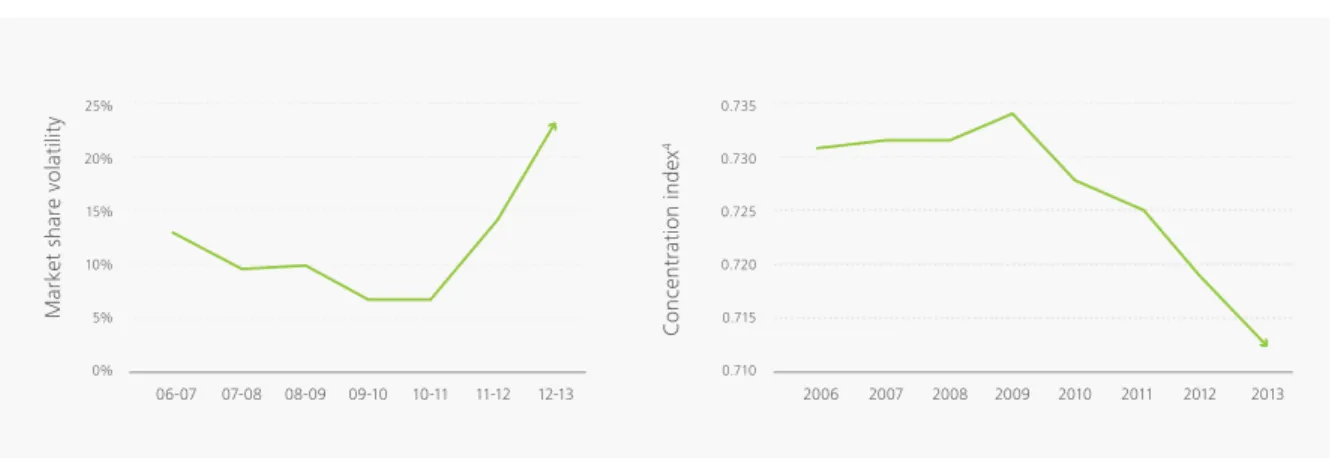
While looking closely at the impact of digital on the consumer, it is also important to understand that digital is the great competitive equalizer. We recently looked closely at U.S. retail market share and discovered that the behaviors outlined here are derivative of something much bigger – these findings are actually much more telling about the manner in which retailers compete. What we discovered was that, since 2009, the volatility of market share increased every year.3 This means that the pace at which share is changing hands is increasing, which could be viewed as a proxy for competitive intensity. We also found that concentration decreased over the same period, meaning that it is smaller players stealing share, not large players trading share that is driving the change. Our research indicates that, over the last five years, the top 25 established retailers have lost nearly 2 percent of their combined market share, which equates to $64 billion. The intensity of competition has increased – fueled by digital. The data represents a tumultuous U.S. retail marketplace; one in which big retailers are subjected to a phenomenon that could be described as ‘a death by a thousand paper cuts.’
What does success look like?
Indexing volatility
Based on our findings, we would assert that, “Our
eCommerce sales are growing by 30 percent!” likely isn’t the answer to how retailers will win and remain relevant over time. The majority of retailers in the market are putting up aggressive eCommerce growth numbers between 20 and 30 percent and sometimes more. This growth, however, is coupled with a flat to declining store business. In many cases, the only real growth is coming from the online channel;
therefore, this does nothing to revive the health of what could be construed as the most critical asset – the store base. The answer to the question of how to win has to go further, and has to address the new competitive environment. We think our research is telling and reveals a clear imperative: retailers must combine the best of physical and digital experiences in new ways that matter to the customer to regain the offensive and achieve growth overall.
3Deloitte Retail Market Share Index, 2015.
4Deloitte Retail Market Share Index, 2015. The concentration index is based on the Gini coefficient,
which measures the relative dispersion of market share where 1 is a pure monopoly and 0 means every firm has equal share.
Figure 2. U.S. retail share volatility over time
Figure 2.
U.S. retail industry concentration over timeU.S. retailer share volatility over time
06-07 07-08
Calendar year Year-over-year change
Market share volatility
08-09 09-10 10-11 11-12 12-13
25% 20% 15% 10% 5% 0%
U.S. retail industry concentration over time
2006 2007 2008 2009 2010 2011 2012 2013
0.735 0.730 0.725 0.720 0.715 0.710 Concentration index 4 Concentration index 4
Gini coefficient of largest ≈140 U.S. retailers
4
4The Gini coefficient measures the relative dispersion of market share where 1 is a pure monopoly and 0 means every firm has equal share
Figure 2.
U.S. retailer share volatility over time
06-07 07-08
Calendar year Year-over-year change
Market share volatility
08-09 09-10 10-11 11-12 12-13
25% 20% 15% 10% 5% 0%
U.S. retail industry concentration over time
2006 2007 2008 2009 2010 2011 2012 2013
0.735 0.730 0.725 0.720 0.715 0.710 Concentration index 4 Concentration index 4
Gini coefficient of largest ≈140 U.S. retailers
4
4The Gini coefficient measures the relative dispersion of market share where 1 is a pure monopoly and 0 means every firm has equal share
WHAT WE LEARNED
Definition
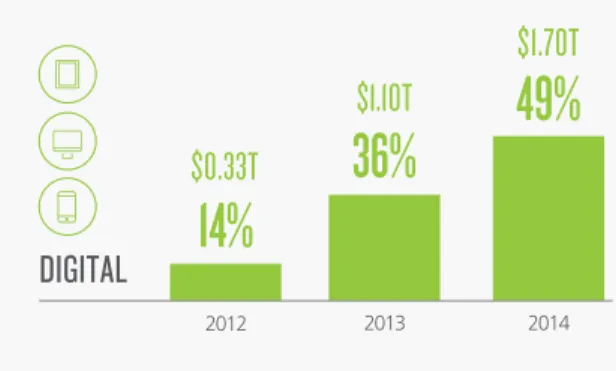
Among consumers who use digital devices to shop – the focus of our study – almost one-third of consumers say they spend more due to their use of digital during the shopping process. Most often, these shoppers end up spending more because they either perform product research (leading to the purchase of a complementary or higher-priced item) or take advantage of a discount or coupon found online, which causes them to buy more overall. We also found that people who use digital while they shop in-store convert at a 20 percent higher rate compared to those who do not use digital as part of the shopping process.
While the upward trend in overall digital usage and influence is quite clear, we are noting shifts in shoppers’ digital
Many of the key findings from
our study of digital influence have
held up over time and continue to
illustrate – and at times exceed –
the trends we previously predicted.
Year over year, we see both digital
influence and mobile influence on
in-store retail purchases growing
by double digits, with mobile
growing faster than overall digital.
Digital influenced $1.7 trillion of
in-store sales last year compared
to just $0.33 trillion only a couple
of years ago. Mobile influence on
in-store sales jumped to nearly
$1.0 trillion from just $0.16 trillion
in 2012.
Figure 3. Digital and mobile influence on in-store sales
Digital influence factor
The percentage of in-store retail sales influenced by the shopper’s use of any digital device, including: desktop computers, laptops, netbooks, tablets, smartphones, wearable devices, and in-store devices (i.e., kiosk, mobile payment device.) It is an accelerating phenomenon that is both shaping how consumers shop and make decisions in-store and setting new, higher expectations for retailers’ digital offerings.
Figure 3. Mobile’s and Digital’s Influence on In-store Sales
$0.59T
$0.97T
$0.33T
$1.10T
$1.70T
2014
2012 2013 2012 2013 2014
$0.16T
5%
19%
28%
14%
36%
49%
MOBILE
DIGITAL
behaviors. For example, we found that digital consumers are 30 percent less likely to use mobile devices to perform price comparisons in-store than they were a year ago. We believe this may indicate that consumers are using digital more for inspiration and idea generation earlier in their shopping process, and not simply as a price comparison vehicle. In many ways, it demonstrates the growing sophistication of the consumer. In addition, fewer than half (45 percent) of consumers say digital makes shopping easier for them in stores. We expect this figure to increase as retailers take steps to bridge the new digital divide.
Mobile influence factor
The percentage of in-store retail sales influenced by the shopper’s use of a web-enabled mobile device, including smartphones.
7
Copyright © 2015 Deloitte Development LLC. All rights reserved.
An overwhelming majority of retailers, it would seem, believe navigating the new digital divide is all about omni-channel – what the market has grown to understand as connecting the channels. However, the idea of connecting the disparate channels is not proving to be a panacea. We have found that reducing the fundamental changes in the retail environment to an omni-channel solution simply misses the point of what is really happening.
Certain groups of consumers are using digital more often to shop, specifically Hispanic and Latino Americans and the Millennial age group (between 18 and 34 years old). Nearly half (49 percent) of Hispanic and Latino consumers are influenced by their access of social media, compared to 32 percent of consumers across all ethnic groups. Hispanic and Latino shoppers who use digital during their shopping journey convert at a 37 percent higher rate than those who do not use digital, versus a 20 percent difference for all consumers. Finally, 41 percent of Hispanic and Latino consumers spend more due to digital, compared to 28 percent of all consumers.
Perhaps unsurprisingly, younger adult consumers are heavier users of digital than older generations. Forty-seven percent of all Millennial consumers use social media during their shopping journey, compared to 19 percent of non-Millennials. Similarly, 37 percent of Millennial consumers spend more due to their use of digital, versus only 23 percent of non-Millennials. Finally, 19 percent of Millennial shoppers purchase their shopping basket items online prior to picking them up in-store, compared to 12 percent of non-Millennials.
Our projection
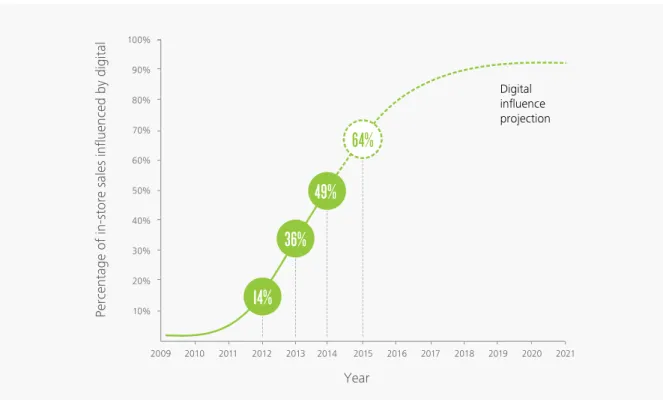
About half of all in-store retail sales were influenced by digital in 2014, and digital is projected to influence 64 percent of in-store retail sales by the end of 2015. This data reveals that retailers need to go much further and evolve how they compete, beyond simply building connection points between separate business units. For retailers that still treat their channels like isolated businesses, connecting them is an important step. We simply do not believe it is the panacea that creates a differentiated, competitive position. We view this as more akin to table stakes.
Figure 4. Digital influence factor projection
Figure 4. Digital Influence Factor Projections
2009 2010 2011 2012 2013 2014 2015 2016 2017 2018 2019 2020 2021
90% 80% 70%
Digital influence projection 60%
50% 40% 30% 20% 10%
Percentage of in-store sales influenced by digital
Year
100%
36%
14%
64%
49%
Our projection for the future of retail is that the concept of online is dead. Because when everyone is online all the time, when digital is pervasive – there is no offline. When no one is offline, then the concept of online is not necessary. Operating separate online and offline businesses is likely a waste of valuable time and energy. Three years of Deloitte data now provides a strong projection of where consumer behavior is headed.
People have not stopped visiting
stores, but digital continues
to increasingly impact in-store
behavior and store sales. Taking
a closer look at the data, we
uncovered three key findings that
help us understand the trajectory
of digital influence.
DRILLING DOWN
1. Simply measuring
channel sales misses
the larger trend.
Our latest research points to the fact that digital sales alone – a metric used by most retailers to measure the success of their digital strategy – is a lagging indicator. The 76 percent of surveyed consumers using digital devices to shop prior to their store trip are making digitally-influenced decisions much earlier in the process and it’s not just about the moment the shopper makes a buying decision. It is about a much broader spectrum of ‘moments that matter’ along the journey. Many retailers are looking in the wrong places to measure success – failing to understand whether or not they are affecting these early steps. The impact of digital on overall sales is fundamental and retailers are losing authority along the purchase journey, particularly as many nontraditional competitors are focusing on these earlier steps in the purchase process.
2. Consumers use digital
very differently by
category.
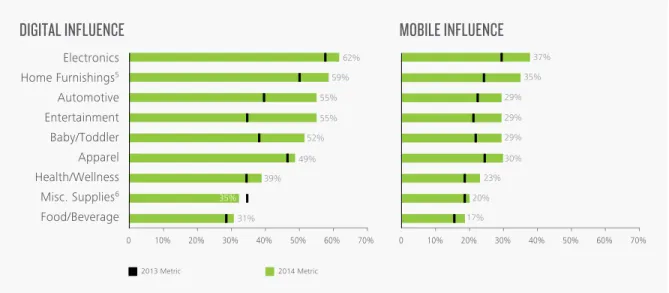
Shoppers are defining their own journeys, and more often, are doing this at the category or even the product level. How a customer gets inspired and informed to buy shoes may differ greatly from how he or she buys groceries or electronics, as evidenced by disparities in digital behaviors. With the digital influence factor ranging from 31 percent for the food and beverage category all the way up to 62 percent for electronics, the variation is clear: category by category, shoppers curate different shopping experiences using digital.
3. In-store shopping has
digital at its core.
As inspiration, information, and decision making have become decoupled from the physical trip, consumers now shop differently. An increasing number of consumers have already determined what to buy by the time they reach the store’s front door. They have specific, personalized actions in mind fueled by sources of information they trust that are more often not controlled by the retailer. Furthermore, 34 percent of shoppers surveyed are using digital while in the store. It would seem from our data that the degree to which consumers value the traditional in-store shopping and browsing experience is decreasing. This raises the stakes on how retailers leverage digital in creating a more valuable in-store experience. If retailers are investing in digital only through the lens of their eCommerce business, or measuring success simply by measuring channel sales, they may be missing the bigger opportunity.
9
Copyright © 2015 Deloitte Development LLC. All rights reserved.
Over the past three years,
consumers have stated that digital
interactions can affect multiple
points along their shopping
journey, and the steps in the
process may not be directly
attributable to the eventual
purchase. By failing to capture
the consumers’ share of mind at
critical decision points, retailers
potentially fail to become a part
of the consideration set and
therefore, risk losing out on the
sale at the end of the journey.
Retailers need to increasingly
focus on, and invest in, the
moments that matter across the
shopping journey.
More and more of the moments that matter are taking place outside of the store environment, or even outside of the retailer’s control – enabled by digital. Increasingly, the retail experience is an ecosystem that is built and directed by the consumer. Usage data indicates directionally which interaction points are most critical to consumers, and where they may choose to seek information outside of the realm of the retailer.
Consider the following questions:
• When a customer describes something they want in their own words, does a search engine take them directly to the right thing?
• Is information on all in-store options available to them via digital?
• When they are looking for online product reviews, do these reviews tell them what they need to know?
• When they are making a purchase, are they presented with options that will complement their order?
• If the item is not exactly right, is another satisfying solution readily available?
• When they have decided to make the purchase, is the order/checkout process simple and convenient?
Moment Definition Finding
Find Inspiration
The customer informally gathers information from a variety of trusted sources: family, friends, blogs, social media, and traditional media.
Seventy percent of consumers are now leading their own shopping journey (becoming aware of products through means outside of retailer or brand communications), while only 30 percent get their initial inspiration from a retailer or brand’s advertisement.
Browse and Research
The customer begins to match the inspiration to a group of physical products that meet his/her need. He/she gathers additional information on the options available for sale.
Sixty-seven percent of shoppers browse retailer sites prior to shopping in stores, but nearly as many (61 percent) are using search engines for their browsing and research activities.
Select and Validate
The customer continues to narrow down his/her consideration set, eventually reducing the choices to only a few options. Then, he/she makes a selection and validates that the choice will best meet his/her need.
Sixty-seven percent of consumers read product reviews during their shopping journey. The reviews they read are split equally across retailers’ sites or apps and third-party sites or apps.
Purchase and Pay
The customer locates the product (online or in a physical store) and determines how he/she would like to pay for and receive the item.
Thirteen percent of shoppers use the ‘buy online, pick up in store’ (or BOPUS) method to purchase and pay for their items. Twenty-five percent of consumers indicated that this is their preferred method for receiving their purchases in the future.
Return and Service
The customer returns to the original place or channel of purchase to seek follow-up related to the item.
Nearly twenty percent of shoppers would like to initiate a product return or refund from their personal digital device.
To succeed in capturing the sale, retailers need to find ways to compete for a position in the consideration set earlier in the customer journey. They should focus on designing and building customer experiences that play to how their customers are shopping for their products – not just pointing consumers to purchase if what customers really seek is inspiration or information. The digitally-enabled path to purchase is truly not just about the ‘buy’ button anymore.
Reacting to these findings, retailers should identify the points along the shopping journey that are critical to their customers.
• At which decision points are customers using digital, and how?
• Are they using retailer-provided sites/apps or third-party sites/apps?
• Which competitor (traditional or not) is providing components of a highly desirable experience?
• In response, how should retailers combine the best of their unique assets to create a defensible position? Answering these questions can help retailers understand where to prioritize their digital investments to maximize impact.
Consider a media company that launched a website catered toward future brides and engaged couples planning their weddings. The site gained a loyal following as an information and research destination. Over time, the company expanded and became more interactive, adding its own online marketplace for
brides and grooms to-be. The evolution of what was initially a wedding blog demonstrated the potential of new competitors – for example, those who have focused on inspiration but are slowly expanding their commercialization to the consumer. These sites have become competitors for mind share, as traditional
retailers may be ceding their position as the default product information source. This represents an example of customer attention shifting away from retailers during critical decision points along the journey, potentially relegating retailers to more of a position of ‘inventory provider.’
11
Copyright © 2015 Deloitte Development LLC. All rights reserved.
All product categories are not
created, or shopped, equally.
Consumer behavior vis-à-vis
digital varies greatly depending
on what the consumer is
looking to purchase; therefore,
analysis of consumer behavior
at the category level provides
for a better understanding of
how shoppers are using digital
during key decision points in
their journey. Retailers should
pay greater attention to which
moments along the customer’s
purchase journey are highly
influenced by digital, as well as
if they are successful at applying
influence during those moments.
Both digital and mobile influence increased across all categories over the past year. Notably and unsurprisingly, 62 percent of consumers continue to be most influenced by digital when shopping for electronics, which includes television and audio products, personal electronics, and
CONSUMERS USE DIGITAL VERY DIFFERENTLY BY CATEGORY
Figure 5. Digital and mobile influence by category
Retailers’ influence is declining, category by category
MOBILE INFLUENCE
DIGITAL INFLUENCE
0 10% 20% 30% 40% 50% 60% 70%
Electronics Home Furnishings5 Automotive Entertainment Baby/Toddler Apparel Health/Wellness Misc. Supplies6 Food/Beverage
1: Defined as smartphones, tablets, laptops/netbooks, desktop computers, in-store kiosks or digital payment devices, and wearables. 2: Combination of Furniture & Home Improvement categories from last year’s publication.
62% 59% 55% 55% 52% 49% 39%
31%
37% 35% 29% 29% 29% 30% 23% 20% 17%
2013 Metric 2014 Metric
0 10% 20% 30% 40% 50% 60% 70%
35%
5Combination of Furniture and Home Improvement categories from last year’s publication. 6Miscellaneous Supplies includes such sub-categories as pet products and office supplies.
home appliances. Shoppers continue to be least influenced when shopping in-store for products in the food and beverage categories, with digital influencing only 31 percent of sales. The digital and mobile influence factors at the category level continue to be highly correlated.
Historically, mass retailers have
benefited from scale – their
ability to serve as a ‘one-stop
shop’ for many product needs.
New technologies, however, are
threatening scale as an absolute
differentiator: digital access has
driven down the cost to the
consumer of shopping across
multiple retailers. With digital –
choice is becoming a commodity.
As new competitors arise and
focus on specific categories,
at-scale retailers must work even
harder to remain relevant in their
core categories.
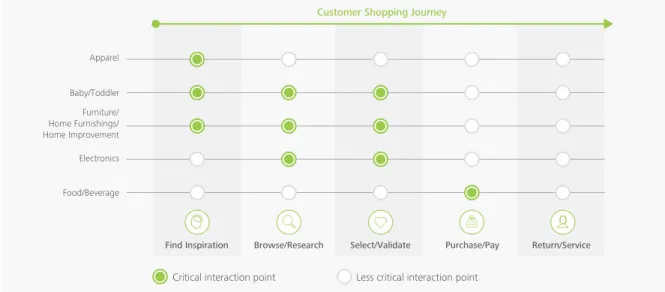
Figure 6. The moments that matter differ by category
Apparel
Find Inspiration Browse/Research Select/Validate Purchase/Pay Return/Service Baby/Toddler
Electronics Food/Beverage
Critical interaction point Less critical interaction point
Customer Shopping Journey
Furniture/ Home Furnishings/ Home Improvement
Due to the proliferation of avenues through which consumers can find inspiration, browse, validate, purchase, and service their purchases, the types of digital interactions that matter most vary by product category. Comparing digital usage data across all categories indicates, directionally, where retailers should increase their focus on category-level digital strategies and investments.
Inspiration as a point in the digital journey is assumed to be critical if more consumers use social media to shop than the average of thirty-two percent across all categories. Among consumers who use digital devices to shop:
• Fifty-six percent of consumers shopping for baby and toddler products consult social media at some point during their shopping journey.
• Forty percent of consumers shopping for furniture, home furnishings, and home improvement products use social media to gather inspiration or shop.
• Conversely, only 21 percent of food and beverage shoppers use social media to shop, the lowest of any category.
Figure 6. The moments that matter by category
Similarly, the inspiration step is assumed to be critical if consumers are less aware of the products to start off with and do not know where they want to buy them. As previously mentioned, only 30 percent of consumers are getting their initial inspiration from a retailer or brand’s advertisement or communication.
• Forty-two percent of baby and toddler consumers start their shopping journey due to an advertisement or communication from a brand or retailer advertisement.
• Over 15 percent of apparel shoppers are unaware of the product until they see a brand or retailer advertisement that makes them want to buy the item, compared to an average of only nine percent across all categories.
• Over 67 percent of shoppers in the food and beverage category already know what they want to buy and from where, compared to an average of 56 percent across categories – this is a less important decision point for shoppers in this category.
13
Copyright © 2015 Deloitte Development LLC. All rights reserved.
7High frequency shoppers in a given category are defined as those who take greater than seven trips within a three-month period.
Low frequency shoppers take fewer than three trips within that same period.
Figure 7. Percentage of consumers that use social media during their shopping journey by category
Across the browse/research and select/validate steps, consumers shopping for baby and toddler, electronics, and furniture and home furnishings products are heavy users of digital functionality. Shoppers in these categories perform general searches using search engines and browse retailer sites and apps more often than the average digital shopper. In addition, while two-thirds (67 percent) of shoppers are using product reviews, usage rates were particularly high in these same three categories, with around 80 percent of shoppers consulting reviews prior to making a purchase decision.
Grocery customers are least influenced by digital overall, and they also tend to do less pre-shopping before arriving in stores than shoppers in other categories. In general, higher-frequency shoppers tend to use digital more often; however, grocery shoppers demonstrate the opposite behavior. Interestingly, low frequency grocery shoppers’ purchases are more influenced by digital.7 This begs the question: is digital usage in the grocery category low because the consumer does not want to use it, or because digital shopping features are relatively less available?
Electronics
Home Furnishings
Automotive
Entertainment
Baby/Toddler
Apparel
Health/Wellness
Food/Beverage
31% 40%
18%
56% 29%
33% 21%
0 10% 20% 30% 40% 50% 60% 70%
Deloitte’s research indicates
the next categories likely to be
disrupted due to digital. Note
that this does not imply that
these categories will fail or shrink,
simply that digital is having a
profound impact today. Across
the board, consumers shopping
in these categories are highly
influenced by digital, with digital
influence factors greater than 50
percent of sales impacted.
In the Baby/Toddler category:
• Consumers are most likely to spend more due to digital, at 46 percent.
• Shoppers are most likely to read product reviews via digital, at 81 percent.
• Consumers are most likely to use social media during their shopping journey, at 56 percent.
• Over 15 percent of shoppers made their last purchase through ‘buy online, pick up in store.’
Which categories will be the next to ‘tip’?`
In the Furniture, Home Furnishings, and Home
Improvement category:
• Consumers are next most likely to spend more due to digital (after baby/toddler shoppers), at 38 percent.
• High frequency shoppers use digital 50 percent more than low frequency consumers.
• Consumers are 37 percent more likely to make a purchase if they use social media along the journey.
Retailers operating in these categories should reassess and revise their value proposition to speak to the way their customers are shopping. They need to add value at every step that is important to customers and they need to understand deeply what keeps them coming into their stores. The most effective retailers in these and other categories will plan and execute their digital, merchandising, and offer strategies at the category level.
15
Copyright © 2015 Deloitte Development LLC. All rights reserved.
Today’s digital shoppers do
not follow the same ‘rules of
the road’ that they used to. An
overwhelming majority – nearly
80 percent and trending up over
the past few years – interact with
brands or products through digital
before arriving at the physical
store. These customers do their
research online, identify the
products they want to purchase,
and even select the stores and
departments they want to visit.
They may even purchase a product
online to be picked up at a
store. In short, customers in the
digital era are more hunters than
gatherers once they arrive in-store.
Customer satisfaction and loyalty is a matter of trust. Previously, customers came to the store to collect any information they could about products and made their decision during that trip – the store was likely one of their only sources of product information. Today, as the number of information sources have grown, the digital-enabled customer can actively decide where amongst their many options to look for the best information. These customers look to influencers through social media, often friends or family, subject matter experts, or independent bloggers, for their trusted information. They also visit review sites to assess everything from quality to price to customer service, as evaluated by complete strangers. The common thread is that many consumers place their trust in these influencers specifically because they are not tied directly to retailers or brands.
The impact of social media
Shoppers are
29 percent more likely
to make a purchase the same day when they use social media
to help shop either before or during their trip (90 percent vs. 70 percent conversion).
Consumers who use social media during their shopping process are
≈4x more likely
than non-users
to spend more or significantly more on purchases as a result of a digital shopping experience.
8Respondents who consider themselves somewhat or very influenced by social media are
6x more likely
to
spend significantly more than non-users (42 percent vs. 7 percent) due to their digital shopping experiences.
8Note: ‘Somewhat more’ = spent up to 25% more; ‘significantly more’ = spent 25+% more.
Figure 8. The impact of social media
authenticity. This channel offers an opportunity to build and maintain trust.
Shoppers are showing a preference for following their own digitally-augmented path, both online and in-store. Digital represents an opportunity to gain consumers’ trust in a new The good news is, even though consumers tend to look
outside of the four walls of the store for advice and specifically to social media, these consumers end up converting more often and spending more. Retailers should look for ways to ‘influence the influencers’ through their marketing campaigns, therefore achieving a greater level of
way. If retailers are investing in digital only with the mindset of supporting their eCommerce business (or channel-specific sales goals), they are missing out on the opportunity to arm their customers with the best information to help them make a decision once they enter the store.
17
Copyright © 2015 Deloitte Development LLC. All rights reserved.
Retailers must find opportunities to reconnect with the self-sufficient hunter/customer, now armed with more information than ever before. Trust-building efforts can complement the in-store shopper’s digital journey – through free in-in-store wireless Internet, for example. Alternatively, a knowledgeable sales associate able to help with specialized requests continues to provide an alternative avenue to earning customer confidence. While nearly 50 percent of consumers who received sales associate assistance on their last store trip would prefer to have been able to perform the same action themselves on their own device, the remaining 50 percent of consumers value in-person advice for those activities. In fact, one in three customers still prefer to consult store associates for assistance when selecting and validating products. Marrying this point with consumers’ desire for digital data, perhaps empowering the store associate with digital access or information will help them to maintain relevance with both digitally-enabled and non-digital customers. In our experience, however, this only happens with a reinvention of the store associate engagement model: by integrating digital into their everyday processes, not merely by providing them with digital tools.
Personalized marketing is clearly driving a lift in conversion, with 39 percent of shoppers who received a personalized coupon, promotion, or recommendation spending more. Poor attempts at personalization, however, have the potential to destroy both trust and loyalty – retailers must balance product information, context, and customer privacy. They have the opportunity to leverage their numerous consumer data sources in order to drive effective personalization.
With the increased adoption of BOPUS options for consumers, this implies even less decision making happening in the store. Thirteen percent of customers are using the feature today, while nearly twice that many would like to use it more in the future. What is more, once in the store, BOPUS shoppers are two times more likely to spend more than non-BOPUS shoppers.
FOLLOWING THEIR OWN PATHS
GETTING PERSONAL
BUYING ONLINE, PICKING UP IN-STORE
Consumers are coming into stores with not only a specific objective in mind, but a specific path sketched out. Although they are more focused, the data clearly shows that consumers continue to use digital once they have entered the store. Despite the fact that consumers are increasingly mission-driven, retailers should not overlook this opportunity to continue to impact the path to purchase through digital.
The strongest perspective we can
provide retailers, large and small,
trying to navigate this
digitally-influenced, rapidly evolving
landscape is to first reconsider
their actual performance. We
often find that even the biggest
retailers in the world do not fully
understand how fundamentally
digital has changed their business.
Retailers should stop evaluating
their strategy and investments
through the traditional
channel-specific lens.
Our findings support that strategies are all about choices for specific retailers in specific categories – determining how to ‘win’ among increasing competition. For some, pricing will continue to be the primary focus. For others, it will be about combining the best of physical and digital to create more unique, valuable, or convenient experiences. For the biggest retailers, it will likely be about prioritizing two or three categories or experiences where the retailer wants to win and focus on those to become best-in-class.
A few simple truths:
Operating the physical and
digital businesses separately is
inhibiting focus.
Retailers should abandon the idea of digital as a separate business altogether, if they have not already. Customers no longer recognize channels during their shopping journeys, so retailers must build and execute their strategy in a much more integrated way.
The digitally-enabled customer
experience requires reinvention.
With 70 percent of customers inspiring their own customer journeys, it is imperative to be focused on how the customer travels through the path to purchase. We see retailers who are honestly surprised when the data shows that mobile can be inspirational. Our data shows that retailers are losing influence along the path topurchase, and although concerning, retailers do not necessarily need to capture the consumer’s attention at every step along the way. For one, some decision points are more critical to certain shoppers based on what type of product he or she is shopping for. Retailers should start leveraging the opportunity to build trust by making inroads to the sources of inspiration and information their customers already interact with most.
There should be no such thing as a
digital strategy.
Digital strategy tends to be applied horizontal across the full organization, focusing on utilities that make sense across categories. However, our data reveals that retailers should consider organizing themselves vertically designing for specific categories or customer experiences, where digital is a significant component when integrated within that vertical. Retailers need to develop integrated strategies to win within specific categories.
Own the core categories.
Retailers need to identify the categories of their business where the largest opportunities and threats lie. Then, they should double down on their efforts within those categories to provide the best end-to-end experience.Understand the transformed role
of marketing.
Retail customers have unprecedented access to information, and they place their
trust in those sources they believe are most authentic. Information has been decoupled from inventory – meaning shoppers can learn about products, compare prices, read reviews, and build shopping carts independent of traditional retailers. As a result, the traditional role of marketing is being disrupted every bit as much as the overall retail landscape. The data tells us that retailers are losing their voice as they compete with a myriad of new information sources. Retailers should prioritize the creation and curation of more authentic messages that speak directly to the category shopper and evolve from the promotional, traffic-focused approach.
Develop valuable ecosystems.
Retailers need to understand that – for better or worse – they are now competing in the age of the ecosystem. Ecosystems typically bring together multiple players of different types and sizes in order to serve customers in ways that are beyond the capacity of any single organization. Retailers need to begin to develop strategies by which their relationships within an ecosystem create value. Gone are the days where a retailer owns the entire value chain, and the importance of partnerships, alliances, and collaborations continues to increase. Retailers should look for opportunities to develop competitive advantage and assert influence through these relationships.919
Copyright © 2015 Deloitte Development LLC. All rights reserved.
In the end, the research
and trend analysis we have
completed over the past
several years point to a series
of challenges facing today’s
retailers, all driven by the
fast-paced evolution of today’s
digitally-engaged consumers.
While none of these challenges is
insurmountable, they all require
a fundamental change in the
way traditional retailers measure
their performance, success, and
overall influence (both digital
and non-digital) throughout the
shopping journey.
History has shown that the new digital divide represents a real threat to even the largest retailers. It is critical that retailers begin to:
1. Measure the right metrics – digital influence and the important moments along the
customer journey,
2. Analyze their performance on these metrics, and 3. Adapt accordingly to ensure they survive
and thrive.
Clearly, as technology develops and the next generation of devices take the place of smartphones in the hands of consumers, the way we talk about mobile and digital influence will change. We will likely begin talking more about smart watches and interactive eyewear and other devices yet to be imagined and developed. Our data indicates that consumers will continue to embrace each technical revolution and adjust their shopping behaviors accordingly.
We often say that it is not about digital strategy, just strategy. It is not about eCommerce or mCommerce, it is simply commerce. Consumers understand this inherently as they choose to utilize all resources available to them to make their shopping journeys easier and more satisfying. Retailers that embrace the dissolution of online versus offline will be well-positioned to adapt and thrive.
Survey methodology
This survey was commissioned by Deloitte and conducted online by an independent research company on November 21-26, 2014 and January 13-20, 2015.
The survey polled a national sample of 3,016 random consumers. Data were collected and weighted to be representative of the U.S. Census for gender, age, income, and ethnicity. A 90 percent confidence level was used to test for significance.
Below are the margins of error for specific sample sets in this study:
• National Random Sample – 90 percent confidence, margin of error 1-2 percent (+/-)
• Device Owners – 90 percent confidence, margin of error 1-2 percent (+/-)
• Smartphone Owners – 90 percent confidence, margin of error 2-3 percent (+/-)
• Tablet Owners – 90 percent confidence, margin of error 2-3 percent (+/-)
Additionally, a sub-set of consumers were randomly assigned to provide information about how they use a digital device to shop for up two different product sub-categories (such as shoes or books and music). Sample sizes ranged from 149 to 178 – 90 percent confidence, margin of error 7-9 percent (+/-). Specific digital behavior data represents consumers who use digital devices to shop.
Digital influence projection
The digital influence factor was calculated using a proprietary methodology to arrive at the percentage of digitally-influenced conversions. Traffic for each store type was modeled statistically, then segmented into trips where digital devices were used either before the trip, during the trip, both before and during the trip, or not at all. Segment-specific conversion rates were applied to arrive at digitally-influenced conversions. The aggregate digital influence factor is a weighted average by percent of total retail sales attributed to each store type.
The digital influence factor projections were based on fitting an adoption model to historical data, with an assumed saturation rate of 90 percent.
ANALYSIS METHODOLOGY
Retail market share index
The retail market share volatility index uses standard deviation of year-over-year share change to determine marketplace stability. If every player’s share were the same as in the prior year, volatility would be 0. The more rearranging of the retail landscape taking place, the higher the volatility. Since small retailers are more likely to have dramatic shifts, the index is weighted by share in the previous year. Therefore, a small retailer with suddenly large growth will not overwhelm the metric. This measures both organic and inorganic growth, and merger and acquisition activity is a significant driver of volatility.
Retail industry concentration is measured by the Gini coefficient, which is a common measure of dispersion that has a minimum of 0 and a maximum of 1. A measure of 0 represents a market with perfect competition or every retailer has equal share. A measure of 1 means that one retailer holds all the share. This measure is applied across the largest ≈140 U.S. retailers based on publically available data measured by Planet Retail in each year.
21
Copyright © 2015 Deloitte Development LLC. All rights reserved.
RELATED MATERIALS
Discovering the value of mobile in retail
The dawn of mobile influence The New Digital Divide
Retailers, shoppers, and the digital influence factor
The New Digital Divide: Retailers, Shoppers, and the Digital Influence Factor
www.deloitte.com/us/digitalinfluence
The Dawn of Mobile Influence: Discovering the Value of Mobile in Retail
This publication contains general information only and is based on the experiences and research of Deloitte practitioners. Deloitte is not, by means of this publication, rendering business, financial, investment, or other professional advice or services. This publication is not a substitute for such professional advice or services, nor should it be used as a basis for any decision or action that may affect your business. Before making any decision or taking any action that may affect your business, you should consult a qualified professional advisor. Deloitte, its affiliates, and related entities shall not be responsible for any loss sustained by any person who relies on this publication.
As used in this document, “Deloitte” means Deloitte Consulting LLP, a subsidiary of Deloitte LLP. Please see www.deloitte.com/us/about for a detailed description of the legal structure of Deloitte LLP and its subsidiaries. Certain services may not be available to attest clients under the rules and regulations of public accounting.
Copyright © 2015 Deloitte Development LLC. All rights reserved. Member of Deloitte Touche Tohmatsu Limited
@DeloitteCB @DeloitteDIGI_US Follow #RetailDigitalDivide For more information please visit:
www.deloitte.com/us/retailDigitalDivide
CONTACT US
Kasey LobaughPrincipal
Deloitte Consulting LLP +1 816 802 7463
CONTRIBUTORS
Caroline Hoyle Senior Consultant
Jeff Simpson Director
Deloitte Consulting LLP +1 704 247 0890
Lokesh Ohri Senior Manager Deloitte Consulting LLP +1 212 618 4184
Eric M. Brown Consultant