Progressions for the Common Core
State Standards in Mathematics (draft)
c
�The Common Core Standards Writing Team
21 April 2012
K–5, Number and
Operations in Base Ten
Overview
Students’ work in the base-ten system is intertwined with their work on counting and cardinality, and with the meanings and properties of addition, subtraction, multiplication, and division. Work in the base-ten system relies on these meanings and properties, but also contributes to deepening students’ understanding of them.
Position The base-ten system is a remarkably efficient and uni-form system for systematically representing all numbers. Using only the ten digits0,1,2, 3, 4,5,6,7,8, 9, every number can be
repre-sented as a string of digits, where each digit represents a value that depends on its place in the string. The relationship between values represented by the places in the base-ten system is the same for whole numbers and decimals: the value represented by each place is always10 times the value represented by the place to its
imme-diate right. In other words, moving one place to the left, the value of the place is multiplied by 10. In moving one place to the right,
the value of the place is divided by 10. Because of this uniformity,
standard algorithms for computations within the base-ten system for whole numbers extend to decimals.
Base-ten units Each place of a base-ten numeral represents a base-ten unit: ones, tens, tenths, hundreds, hundredths, etc. The digit in the place represents 0 to 9 of those units. Because ten
like units make a unit of the next highest value, only ten digits are needed to represent any quantity in base ten. The basic unit is a one (represented by the rightmost place for whole numbers). In learning about whole numbers, children learn that ten ones com-pose a new kind of unit called a ten. They understand two-digit numbers as composed of tens and ones, and use this understanding in computations, decomposing 1 ten into10ones and composing a
ten from10ones.
The power of the base-ten system is in repeated bundling by ten: 10tens make a unit called a hundred. Repeating this process of
creating new units by bundling in groups of ten creates units called
thousand, ten thousand, hundred thousand . . . . In learning about decimals, children partition a one into10equal-sized smaller units,
each of which is a tenth. Each base-ten unit can be understood in terms of any other base-ten unit. For example, one hundred can be viewed as a tenth of a thousand,10tens,100 ones, or1�000tenths.
Algorithms for operations in base ten draw on such relationships among the base-ten units.
Computations Standard algorithms for base-ten computations with the four operations rely on decomposing numbers written in base-ten notation into base-base-ten units. The properties of operations then allow any multi-digit computation to be reduced to a collection of single-digit computations. These single-digit computations some-times require the composition or decomposition of a base-ten unit.
Beginning in Kindergarten, the requisite abilities develop grad-ually over the grades. Experience with addition and subtraction within 20 is a Grade 1 standard1.OA.6 and fluency is a Grade 2
1.OA.6Add and subtract within 20, demonstrating fluency for
ad-dition and subtraction within 10. Use strategies such as counting on; making ten (e.g.,8 6 8 2 4 10 4 14); decom-posing a number leading to a ten (e.g.,13 4 13 3 1 10 1 9); using the relationship between addition and subtrac-tion (e.g., knowing that8 4 12, one knows12 8 4); and creating equivalent but easier or known sums (e.g., adding6 7 by creating the known equivalent6 6 1 12 1 13).
standard.2.OA.2Computations within20that “cross 10,” such as9 8
2.OA.2Fluently add and subtract within 20 using mental
strate-gies.1 By end of Grade 2, know from memory all sums of two one-digit numbers.
or 13 6, are especially relevant to NBT because they afford the
development of the Level 3 make-a-ten strategies for addition and subtraction described in the OA Progression. From the NBT per-spective, make-a-ten strategies are (implicitly) the first instances of composing or decomposing a base-ten unit. Such strategies are a foundation for understanding in Grade 1 that addition may require
composing a ten1.NBT.4and in Grade 2 that subtraction may involve 1.NBT.4Add within 100, including adding a two-digit number and a one-digit number, and adding a two-digit number and a multiple of 10, using concrete models or drawings and strategies based on place value, properties of operations, and/or the relationship between addition and subtraction; relate the strategy to a writ-ten method and explain the reasoning used. Understand that in adding two-digit numbers, one adds tens and tens, ones and ones; and sometimes it is necessary to compose a ten.
decomposing a ten.2.NBT.7
2.NBT.7Add and subtract within 1000, using concrete models or
drawings and strategies based on place value, properties of op-erations, and/or the relationship between addition and subtrac-tion; relate the strategy to a written method. Understand that in adding or subtracting three-digit numbers, one adds or sub-tracts hundreds and hundreds, tens and tens, ones and ones; and sometimes it is necessary to compose or decompose tens or hundreds.
Strategies and algorithms The Standards distinguish strategies from algorithms.• For example, students use strategies for addition
•Computation algorithm.A set of predefined steps applicable
to a class of problems that gives the correct result in every case when the steps are carried out correctly. See also: computation strategy.
Computation strategy. Purposeful manipulations that may be
chosen for specific problems, may not have a fixed order, and may be aimed at converting one problem into another. See also: computation algorithm.
and subtraction in Grades K-3, but are expected to fluently add and subtract whole numbers using standard algorithms by the end of Grade 4. Use of the standard algorithms can be viewed as the culmination of a long progression of reasoning about quantities, the base-ten system, and the properties of operations.
This progression distinguishes between two types of computa-tional strategies: special strategies and general methods. For ex-ample, a special strategy for computing 398 17 is to decompose 17as2 15, and evaluate 398 2 15. Special strategies either
cannot be extended to all numbers represented in the base-ten sys-tem or require considerable modification in order to do so. A more readily generalizable method of computing 398 17 is to combine
like base-ten units. General methods extend to all numbers repre-sented in the base-ten system. A general method is not necessarily efficient. For example, counting on by ones is a general method that can be easily modified for use with finite decimals. General methods based on place value, however, are more efficient and can be viewed as closely connected with standard algorithms.
Mathematical practices Both general methods and special strate-gies are opportunities to develop competencies relevant to the NBT standards. Use and discussion of both types of strategies offer op-portunities for developing fluency with place value and properties of operations, and to use these in justifying the correctness of computa-tions (MP.3). Special strategies may be advantageous in situacomputa-tions that require quick computation, but less so when uniformity is useful. Thus, they offer opportunities to raise the topic of using appropri-ate tools strappropri-ategically (MP.5). Standard algorithms can be viewed as expressions of regularity in repeated reasoning (MP.8) used in general methods based on place value.
Numerical expressions and recordings of computations, whether with strategies or standard algorithms, afford opportunities for stu-dents to contextualize, probing into the referents for the symbols involved (MP.2). Representations such as bundled objects or math drawings (e.g., drawings of hundreds, tens, and ones) and diagrams (e.g., simplified renderings of arrays or area models) afford the math-ematical practice of explaining correspondences among different rep-resentations (MP.1). Drawings, diagrams, and numerical recordings may raise questions related to precision (MP.6), e.g., does that 1
represent1one or1ten? This progression gives examples of
repre-sentations that can be used to connect numerals with quantities and to connect numerical representations with combination, composition, and decomposition of base-ten units as students work towards com-putational fluency.
Kindergarten
In Kindergarten, teachers help children lay the foundation for un-derstanding the base-ten system by drawing special attention to10.
Children learn to view the whole numbers11through19as ten ones
and some more ones. They decompose10 into pairs such as1 9, 2 8,3 7and find the number that makes10when added to a given
number such as3 (see the OA Progression for further discussion). K.NBT.1ten ones and some further ones, e.g., by using objects or draw-Compose and decompose numbers from 11 to 19 into ings, and record each composition or decomposition by a drawing or equation (e.g., 18 = 10 + 8); understand that these numbers are composed of ten ones and one, two, three, four, five, six, seven, eight, or nine ones.
Work with numbers from 11 to 19 to gain foundations for place valueK.NBT.1 Children use objects, math drawings,• and equations
•Math drawings are simple drawings that make essential math-ematical features and relationships salient while suppressing de-tails that are not relevant to the mathematical ideas.
to describe, explore, and explain how the “teen numbers,” the count-ing numbers from11through19, are ten ones and some more ones.
Children can count out a given teen number of objects, e.g., 12, and
group the objects to see the ten ones and the two ones. It is also
Number-bond diagram and equation
1 0
10 7
7
1 0
10 7
7
17 = 10 + 7 17 10 7 10 strip 5 strip Number Bond Drawing
layered place value cards
layered separated
front:
back: Figure 1:
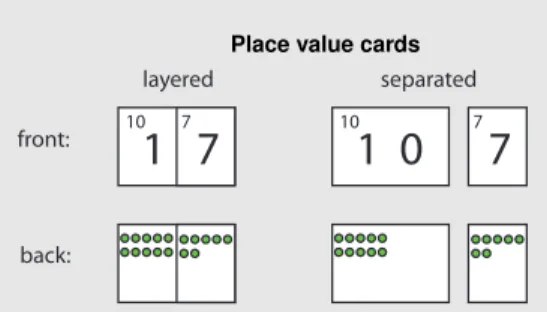
Decomposing 17 as 10 and 7
Equation
Decompositions of teen numbers can be recorded with diagrams or equations.
helpful to structure the ten ones into patterns that can be seen as ten objects, such as two fives (see the OA Progression).
5- and 10-frames
1 0
10
7
7
1 0
10
7
7
17 = 10 + 7
17 10 7 10 str ip 5 str ip Numb er B ond D ra wing la yer ed plac e v alue c ar ds la yer ed separ at ed fr on t: back : Figur e 1: Dec omp
osing 17 as 10 and 7
Equa
tion
Children can place small objects into 10-frames to show the ten as two rows of five and the extra ones within the next 10-frame, or work with strips that show ten ones in a column.
A difficulty in the English-speaking world is that the words for teen numbers do not make their base-ten meanings evident. For example, “eleven” and “twelve” do not sound like “ten and one” and “ten and two.” The numbers “thirteen, fourteen, fifteen, . . . , nineteen” reverse the order of the ones and tens digits by saying the ones digit first. Also, “teen” must be interpreted as meaning “ten” and the prefixes “thir” and “fif” do not clearly say “three” and “five.” In contrast, the corresponding East Asian number words are “ten one, ten two, ten three,” and so on, fitting directly with the base-ten structure and drawing attention to the role of ten. Children could learn to say numbers in this East Asian way in addition to learning the standard English number names. Difficulties with number words beyond nineteen are discussed in the Grade 1 section.
The numerals 11�12�13� � � � �19 need special attention for
chil-dren to understand them. The first nine numerals1�2�3� � � � �9, and 0are essentially arbitrary marks. These same marks are used again
to represent larger numbers. Children need to learn the differences in the ways these marks are used. For example, initially, a numeral such as 16 looks like “one, six,” not “1 ten and 6 ones .” Layered
place value cards can help children see the 0 “hiding” under the
Place value cards
1 0
10 7
7
1 0
10 7
7
17 = 10 + 7 17 10 7 10 strip 5 strip Number Bond Drawing
layered place value cards
layered separated
front:
back:
Figure 1:
Decomposing 17 as 10 and 7
Equation
Children can use layered place value cards to see the 10 “hiding” inside any teen number. Such decompositions can be connected to numbers represented with objects and math drawings.
ones place and that the1 in the tens place really is10(ten ones).
By working with teen numbers in this way in Kindergarten, stu-dents gain a foundation for viewing 10 ones as a new unit called a ten in Grade 1.
Grade 1
In first grade, students learn to view ten ones as a unit called a ten. The ability to compose and decompose this unit flexibly and to view the numbers11to19as composed of one ten and some ones allows
development of efficient, general base-ten methods for addition and subtraction. Students see a two-digit numeral as representing some tens and they add and subtract using this understanding.
Extend the counting sequence and understand place value Through practice and structured learning time, students learn patterns in spo-ken number words and in written numerals, and how the two are related.
Grade 1 students take the important step of viewing ten ones
as a unit called a “ten.”1.NBT.2a They learn to view the numbers 11 1.NBT.2resent amounts of tens and ones. Understand the following asUnderstand that the two digits of a two-digit number rep-special cases:
a 10 can be thought of as a bundle of ten ones—called a “ten.”
through 19 as composed of 1 ten and some ones.1.NBT.2bThey learn
b The numbers from 11 to 19 are composed of a ten and one, two, three, four, five, six, seven, eight, or nine ones.
to view the decade numbers 10� � � � �90, in written and in spoken
form, as1ten, . . . ,9tens.1.NBT.2cMore generally, first graders learn
c The numbers 10, 20, 30, 40, 50, 60, 70, 80, 90 refer to one, two, three, four, five, six, seven, eight, or nine tens (and 0 ones).
that the two digits of a two-digit number represent amounts of tens and ones, e.g., 67 represents 6 tens and 7 ones.
The number words continue to require attention at first grade because of their irregularities. The decade words, “twenty,” “thirty,” “forty,” etc., must be understood as indicating2tens, 3 tens,4 tens,
etc. Many decade number words sound much like teen number words. For example, “fourteen” and “forty” sound very similar, as do “fifteen” and “fifty,” and so on to “nineteen” and “ninety.” As discussed in the Kindergarten section, the number words from13to 19 give the number of ones before the number of tens. From20 to 100, the number words switch to agreement with written numerals
by giving the number of tens first. Because the decade words do not clearly indicate they mean a number of tens (“-ty” does mean tens but not clearly so) and because the number words “eleven” and “twelve” do not cue students that they mean “1 ten and 1” and “1 ten and 2,” children frequently make count errors such as “twenty-nine, twenty-ten, twenty-eleven, twenty-twelve.”
Grade 1 students use their base-ten work to help them recognize that the digit in the tens place is more important for determining
the size of a two-digit number.1.NBT.3 They use this understanding 1.NBT.3the tens and ones digits, recording the results of comparisonsCompare two two-digit numbers based on meanings of with the symbols , , and .
to compare two two-digit numbers, indicating the result with the symbols , , and . Correctly placing the and symbols is a challenge for early learners. Accuracy can improve if students think of putting the wide part of the symbol next to the larger number. Use place value understanding and properties of operations to add and subtract First graders use their base-ten work to com-pute sums within 100 with understanding.1.NBT.4 Concrete objects,
1.NBT.4Add within 100, including adding a two-digit number and
a one-digit number, and adding a two-digit number and a multiple of 10, using concrete models or drawings and strategies based on place value, properties of operations, and/or the relationship between addition and subtraction; relate the strategy to a writ-ten method and explain the reasoning used. Understand that in adding two-digit numbers, one adds tens and tens, ones and ones; and sometimes it is necessary to compose a ten.
cards, or drawings afford connections with written numerical work and discussions and explanations in terms of tens and ones. In particular, showing composition of a ten with objects or drawings
affords connection of the visual ten with the written numeral 1 that indicates 1 ten.
Adding tens and ones separately as illustrated in the margin is a
General method: Adding tens and ones separately
46 +37
46
+37 46
56 66 76 77 78 79 80 81
82 83
starting from 46 count on 3 tens then count on 7 ones combine ones view 6+7 as 1 ten and 3 ones combine 4 tens and 3 tens with the new group of 1 ten (shown below on the addition line)
Using a sequence conception to add: Adding tens and ones separately: Figure 3:
combine ones view6 7as1ten and
3ones
combine 4 tens and
3 tens with the newly composed ten (shown on the addition line) This method is an application of the associative property.
general method that can extend to any sum of multi-digit numbers. Students may also develop sequence methods that extend their Level 2 single-digit counting on strategies (see the OA Progression) to counting on by tens and ones, or mixtures of such strategies in which they add instead of count the tens or ones. Using objects or
Special strategy: Counting on by tens
46 +37
46
+37 46
56 66 76 77 78 79 80 81
82 83
starting from 46 count on 3 tens then count on 7 ones combine ones
view 6+7 as 1 ten and 3 ones combine 4 tens and 3 tens with the new group of 1 ten (shown below on the addition line)
Using a sequence conception to add: Adding tens and ones separately: Figure 3:
starting from 46 count on3tens then count on
7ones
This strategy requires counting on by tens from 46, beginning 56, 66, 76, then counting on by ones.
drawings of 5-groups can support students’ extension of the Level 3 make-a-ten methods discussed in the OA Progression for single-digit numbers.
First graders also engage in mental calculation, such as mentally finding 10 more or 10 less than a given two-digit number without having to count by ones.1.NBT.5 They may explain their reasoning
1.NBT.5Given a two-digit number, mentally find 10 more or 10
less than the number, without having to count; explain the rea-soning used.
by saying that they have one more or one less ten than before. Drawings and layered cards can afford connections with place value and be used in explanations.
In Grade 1, children learn to compute differences of two-digit numbers for limited cases.1.NBT.6Differences of multiples of10, such
1.NBT.6Subtract multiples of 10 in the range 10–90 from
multi-ples of 10 in the range 10–90 (positive or zero differences), us-ing concrete models or drawus-ings and strategies based on place value, properties of operations, and/or the relationship between addition and subtraction; relate the strategy to a written method and explain the reasoning used.
as 70 40 can be viewed as 7 tens minus 4 tens and represented
with concrete models such as objects bundled in tens or draw-ings. Children use the relationship between subtraction and addition when they view 80 70 as an unknown addend addition problem, 70 80, and reason that 1 ten must be added to 70to make
80, so80 70 10.
First graders are not expected to compute differences of two-digit numbers other than multiples of ten. Deferring such work until Grade 2 allows two-digit subtraction with and without decomposing to occur in close succession, highlighting the similarity between these two cases.
Grade 2
At Grade 2, students extend their base-ten understanding to hun-dreds. They now add and subtract within 1000, with composing and decomposing, and they understand and explain the reasoning of the processes they use. They become fluent with addition and subtraction within 100.
Understand place value In Grade 2, students extend their under-standing of the base-ten system by viewing 10 tens as forming a new unit called a “hundred.”2.NBT.1aThis lays the groundwork for
under-2.NBT.1aUnderstand that the three digits of a three-digit number
represent amounts of hundreds, tens, and ones; e.g., 706 equals 7 hundreds, 0 tens, and 6 ones. Understand the following as special cases:
a 100 can be thought of as a bundle of ten tens—called a “hundred.”
standing the structure of the base-ten system as based in repeated bundling in groups of 10 and understanding that the unit associated with each place is 10 of the unit associated with the place to its right.
Representations such as manipulative materials, math drawings and layered three-digit place value cards afford connections be-tween written three-digit numbers and hundreds, tens, and ones.
Drawings to support seeing 10 tens as 1 hundred
drawingstosupportseeing10tensas1hundred
10tens 1hundred 1hundredbox (quickdrawingto
show1hundred) Number words and numbers written in base-ten numerals and as
sums of their base-ten units can be connected with representations in drawings and place value cards, and by saying numbers aloud and in terms of their base-ten units, e.g.,456 is “Four hundred fifty
six” and “four hundreds five tens six ones.”2.NBT.3
2.NBT.3Read and write numbers to 1000 using base-ten
numer-als, number names, and expanded form.
Unlike the decade words, the hundred words indicate base-ten units. For example, it takes interpretation to understand that “fifty” means five tens, but “five hundred” means almost what it says (“five hundred” rather than “five hundreds”). Even so, this doesn’t mean that students automatically understand 500 as 5 hundreds; they may still only think of it as the number reached after 500 counts of 1.
Students begin to work towards multiplication when they skip count by 5s, by 10s, and by 100s. This skip counting is not yet true multiplication because students don’t keep track of the number of
groups they have counted.2.NBT.2 2.NBT.2Count within 1000; skip-count by 5s, 10s, and 100s.
Comparing magnitudes of two-digit numbers draws on the un- 2.NBT.4Compare two three-digit numbers based on meanings of
the hundreds, tens, and ones digits, using , =, and symbols to record the results of comparisons.
derstanding that 1 ten is greater than any amount of ones repre-sented by a one-digit number. Comparing magnitudes of three-digit
2.NBT.5Fluently add and subtract within 100 using strategies
based on place value, properties of operations, and/or the re-lationship between addition and subtraction.
2.NBT.6Add up to four two-digit numbers using strategies based
on place value and properties of operations.
numbers draws on the understanding that 1 hundred (the smallest three-digit number) is greater than any amount of tens and ones represented by a two-digit number. For this reason, three-digit numbers are compared by first inspecting the hundreds place (e.g.
845 799;849 855).2.NBT.4
Use place value understanding and properties of operations to add and subtract Students become fluent in two-digit addition and subtraction.2.NBT.5, 2.NBT.6Representations such as manipulative
mate-rials and drawings may be used to support reasoning and explana-tions about addition and subtraction with three-digit numbers.2.NBT.7
2.NBT.7Add and subtract within 1000, using concrete models or
drawings and strategies based on place value, properties of op-erations, and/or the relationship between addition and subtrac-tion; relate the strategy to a written method. Understand that in adding or subtracting three-digit numbers, one adds or sub-tracts hundreds and hundreds, tens and tens, ones and ones; and sometimes it is necessary to compose or decompose tens or hundreds.
When students add ones to ones, tens to tens, and hundreds to hun-dreds they are implicitly using a general method based on place
value and the associative and commutative properties of addition. Examples of how general methods can be represented in numeri-cal work and composition and decomposition can be represented in math drawings are shown in the margin.
Addition: Recording combined hundreds, tens, and ones on separate lines
4 5 6
+ 1 6 7 + 1 6 74 5 6 5 0 0
4 5 6 + 1 6 7 5 0 0 1 1 0
4 5 6 + 1 6 7 5 0 0 1 1 0 1 3 6 2 3 Addition proceeds from left to right, but could also have gone from right to left. There are two advantages of working left to right: Many students prefer it because they read from left to right, and working first with the largest units yields a closer approximation earlier.
Drawings and diagrams can illustrate the reasoning repeated in general methods for computation that are based on place value. These provide an opportunity for students to observe this regular-ity and build toward understanding the standard addition and sub-traction algorithms required in Grade 4 as expressions of repeated reasoning (MP.8).
At Grade 2, composing and decomposing involves an extra layer of complexity beyond that of Grade 1. This complexity manifests itself in two ways. First, students must understand that a hundred is a unit composed of 100 ones, but also that it is composed of 10 tens. Second, there is the possibility that both a ten and a hundred are composed or decomposed. For example, in computing398 7a
new ten and a new hundred are composed. In computing302 184,
a ten and a hundred are decomposed.
Students may continue to develop and use special strategies for particular numerical cases or particular problem situations such as Unknown Addend. For example, instead of using a general method
Addition: Recording newly composed units on the same line
4 5 6
+ 1 6 7 + 1 64 5 6
17
3 Add the ones,
6 7, and record these 13 ones with 3 in the ones place and 1 on the line under the tens column.
4 5 6 + 1 6 7
1 1
2 3 Add the tens,
5 6 1, and
record these12
tens with2in the tens place and1
on the line under the hundreds column.
4 5 6 + 1 6 7
1 1
6 2 3 Add the hundreds,
4 1 1and record these6
hundreds in the hundreds column.
Digits representing newly composed units are placed below the addends. This placement has several advantages. Each two-digit partial sum (e.g., “13”) is written with the digits close to each other, suggesting their origin. In “adding from the top down,” usually sums of larger digits are computed first, and the easy-to-add “1” is added to that sum, freeing students from holding an altered digit in memory. The original numbers are not changed by adding numbers to the first addend; three multi-digit numbers (the addends and the total) can be seen clearly. It is easier to write teen numbers in their usual order (e.g., as 1 then 3) rather than “write the 3 and carry the 1” (write 3, then 1).
Subtraction: Decomposing where needed first decomposing left to right,
1 hundred, then 1 ten now subtract
425
-278 -278425
Standardalgorithm,ungroupwhereneeded rst,thensubtract:
ungroupinglefttoright,
1hundred,then1ten
425
-278
nowsubtract
[This is part3ofFigure5.Doug Clements drewthe rsttwoparts.]
All necessary decomposing is done first, then the subtractions are carried out. This highlights the two major steps involved and can help to inhibit the common error of subtracting a smaller digit on the top from a larger digit. Decomposing and subtracting can start from the left (as shown) or the right.
to add398 7, students could reason mentally by decomposing the 7ones as2 5, adding2 ones to398to make400, then adding the
remaining 5 ones to make 405. This method uses the associative
property of addition and extends the make-a-ten strategy described in the OA Progression. Or students could reason that398 is close
to 400, so the sum is close to400 7, which is 407, but this must
be2too much because400is2more than398, so the actual sum is 2 less than407, which is405. Both of these strategies make use of
place value understanding and are practical in limited cases. Subtractions such as302 184can be computed using a general
method by decomposing a hundred into10 tens, then decomposing
one of those tens into 10 ones. Students could also view it as an
unknown addend problem184 302, thus drawing on the
rela-tionship between subtraction and addition. With this view, students can solve the problem by adding on to184: first add6to make190,
then add10to make200, next add100to make300, and finally add 2 to make302. They can then combine what they added on to find
the answer to the subtraction problem: 6 10 100 2 118. This
strategy is especially useful in unknown addend situations. It can be carried out more easily in writing because one does not have to keep track of everything mentally. This is a Level 3 strategy, and is easier than the Level 3 strategy illustrated below that requires keeping track of how much of the second addend has been added on. (See the OA Progression for further discussion of levels.)
When computing sums of three-digit numbers, students might use strategies based on a flexible combination of Level 3 compo-sition and decompocompo-sition and Level 2 counting-on strategies when finding the value of an expression such as 148 473. For
exam-ple, they might say, ”100and400 is500. And70and30is another
hundred, so 600. Then 8, 9, 10, 11 . . . and the other 10 is 21. So, 621.” Keeping track of what is being added is easier using a
writ-ten form of such reasoning and makes it easier to discuss. There are two kinds of decompositions in this strategy. Both addends are decomposed into hundreds, tens, and ones, and the first addend is decomposed successively into the part already added and the part still to add.
Students should continue to develop proficiency with mental computation. They mentally add 10 or 100 to a given number be-tween 100 and 900, and mentally subtract 10 or 100 from a given
number between 100 and 900.2.NBT.8 2.NBT.8Mentally add 10 or 100 to a given number 100–900, and mentally subtract 10 or 100 from a given number 100–900.
Grade 3
At Grade 3, the major focus is multiplication,• so students’ work •See the progression on Operations and Algebraic Thinking.
with addition and subtraction is limited to maintenance of fluency within 1000 for some students and building fluency to within 1000 for others.
Use place value understanding and properties of operations to perform multi-digit arithmetic Students continue adding and
sub-tracting within 1000.3.NBT.2They achieve fluency with strategies and 3.NBT.2and algorithms based on place value, properties of operations,Fluently add and subtract within 1000 using strategies and/or the relationship between addition and subtraction.
algorithms that are based on place value, properties of operations, and/or the relationship between addition and subtraction. Such flu-ency can serve as preparation for learning standard algorithms in Grade 4, if the computational methods used can be connected with those algorithms.
Students use their place value understanding to round numbers
to the nearest 10 or 100.3.NBT.1 They need to understand that when 3.NBT.1Use place value understanding to round whole numbers to the nearest 10 or 100.
moving to the right across the places in a number (e.g., 456), the digits represent smaller units. When rounding to the nearest 10 or 100, the goal is to approximate the number by the closest number with no ones or no tens and ones (e.g., so 456 to the nearest ten is 460; and to the nearest hundred is 500). Rounding to the unit represented by the leftmost place is typically the sort of estimate that is easiest for students. Rounding to the unit represented by a place in the middle of a number may be more difficult for students (the surrounding digits are sometimes distracting). Rounding two numbers before computing can take as long as just computing their sum or difference.
The special role of 10 in the base-ten system is important in
understanding multiplication of one-digit numbers with multiples of
10.3.NBT.3For example, the product3 50 can be represented as3
3.NBT.3Multiply one-digit whole numbers by multiples of 10 in
the range 10–90 (e.g.,9 80,5 60) using strategies based on place value and properties of operations.
groups of5tens, which is15tens, which is150. This reasoning relies
on the associative property of multiplication: 3 50 3 5 10 3 5 10 15 10 150. It is an example of how to explain an
instance of a calculation pattern for these products: calculate the product of the non-zero digits, then shift the product one place to the left to make the result ten times as large.•
•Grade 3 explanations for “15 tens is 150”
• Skip-counting by 50. 5 tens is 50, 100, 150.
• Counting on by 5 tens. 5 tens is 50, 5 more tens is 100, 5 more tens is 150.
• Decomposing 15 tens. 15 tens is 10 tens and 5 tens. 10 tens is 100. 5 tens is 50. So 15 tens is 100 and 50, or 150.
• Decomposing 15.
15 10 10 5 10
10 10 5 10
100 50
150
All of these explanations are correct. However, skip-counting and counting on become more difficult to use accurately as
numbers become larger, e.g., in computing5 90or explaining
why45tens is450, and needs modification for products such as
Grade 4
At Grade 4, students extend their work in the base-ten system. 4.NBT.1one place represents ten times what it represents in the place toRecognize that in a multi-digit whole number, a digit in its right.
They use standard algorithms to fluently add and subtract. They use methods based on place value and properties of operations sup-ported by suitable representations to multiply and divide with multi-digit numbers.
Generalize place value understanding for multi-digit whole num-bers In the base-ten system, the value of each place is10 times
10 30represented as3tens each taken10times
10 × 30 10 groups of 30
10 10 10 ones tens hundreds
10 10 10 10 10 10 10 10 10 10 10 10 10 10 10 10 10 10 10 10 10 10 10 10 10 10 10 10 10 10
ones tens hundreds 10 × 30 = 300
100 100 100
ones tens hundreds 30
10 of each of the 3 tens 3 tens
10 times 3 tens is 3 hundreds
Each of the 3 tens becomes a hundred and moves to the left. In the product, the 3 in the tens place of 30 is shifted one place to the left to represent 3 hundreds. In 300 divided by 10 the 3 is shifted one place to the right in the quotient to represent 3 tens.
the value of the place to the immediate right.4.NBT.1Because of this,
multiplying by 10yields a product in which each digit of the
multi-plicand is shifted one place to the left.
To read numerals between 1�000 and 1�000�000, students need
to understand the role of commas. Each sequence of three digits made by commas is read as hundreds, tens, and ones, followed by the name of the appropriate base-thousand unit (thousand, million, billion, trillion, etc.). Thus,457�000 is read “four hundred fifty seven
thousand.”4.NBT.2 The same methods students used for comparing
4.NBT.2Read and write multi-digit whole numbers using
base-ten numerals, number names, and expanded form. Compare two multi-digit numbers based on meanings of the digits in each place, using , =, and symbols to record the results of com-parisons.
and rounding numbers in previous grades apply to these numbers, because of the uniformity of the base-ten system.
Decimal notation and fractions Students in Grade 4 work with fractions having denominators 10 and 100.4.NF.5
4.NF.5Express a fraction with denominator 10 as an equivalent
fraction with denominator 100, and use this technique to add two fractions with respective denominators 10 and 100.2
The structure of the base-ten system is uniform
ones tens ten ths hundr edths ÷ 10 ÷ 10
÷ 10 ÷ 10
.1 .1 .1 .1 .1 .1 .1 .1 .1 .1 1 100 1 10
each piece is .01 or
each piece is .1 or ÷ 10 1 $1 ones tens ten ths hundr edths ÷ 10 ÷ 10
÷ 10 ÷ 10
.1 .1 .1 .1 .1 .1 .1 .1 .1 .1 1 100 1 10 each piece is .01 or
each piece is .1 or ÷ 10
1
$1
dime penny dollar
Because it involves partitioning into10equal
parts and treating the parts as numbers called one tenth and one hundredth, work with these fractions can be used as prepa-ration to extend the base-ten system to non-whole numbers.
Using the unit fractions 1 10 and
1 100, non-whole numbers like 237
10 can be written in an expanded form that extends the form used with whole numbers: 2 10 3 1 7
1
10.4.NF.4b As with whole-number expansions
4.NF.4b Apply and extend previous understandings of
multipli-cation to multiply a fraction by a whole number.
b Understand a multiple of� �as a multiple of1�, and use this understanding to multiply a fraction by a whole number.
in the base-ten system, each unit in this de-composition is ten times the unit to its right. This can be connected with the use of base-ten notation to represent2 10 3 1 7 101
as 23�7. Using decimals allows students
to apply familiar place value reasoning to
fractional quantities.4.NF.6 The Number and 4.NF.6Use decimal notation for fractions with denominators 10 or 100.
Operations—Fractions Progression discusses decimals to hundredths and comparison of decimals4.NF.7 in more detail.
4.NF.7Compare two decimals to hundredths by reasoning about
their size. Recognize that comparisons are valid only when the two decimals refer to the same whole. Record the results of com-parisons with the symbols , =, or , and justify the conclusions, e.g., by using a visual model.
Symmetry with respect to the ones place
1
hundred ten tenth hundredth
The decimal point is used to signify the location of the ones place, but its location may suggest there should be a “oneths" place to its right in order to create symmetry with respect to the decimal point.
However, because one is the basic unit from which the other base-ten units are derived, the symmetry occurs instead with respect to the ones place.
Ways of reading decimals aloud vary. Mathematicians and sci-entists often read0�15 aloud as “zero point one five" or “point one
five." (Decimals smaller than one may be written with or without a zero before the decimal point.) Decimals with many non-zero digits are more easily read aloud in this manner. (For example, the number
π, which has infinitely many non-zero digits, begins3�1415� � �.)
Other ways to read0�15 aloud are “1 tenth and 5 hundredths”
and “15 hundredths,” just as1�500 is sometimes read “15 hundred”
or “1thousand,5hundred.” Similarly, 150is read “one hundred and
fifty” or “a hundred fifty” and understood as15tens, as10tens and 5 tens, and as100 50.
Just as15is understood as 15ones and as1 ten and5ones in
computations with whole numbers,0�15is viewed as15hundredths
and as1 tenth and5hundredths in computations with decimals.
It takes time to develop understanding and fluency with the dif-ferent forms. Layered cards for decimals can help students become fluent with decimal equivalencies such as three tenths is thirty hun-dredths.
Use place value understanding and properties of operations to perform multi-digit arithmetic At Grade 4, students become
flu-ent with the standard addition and subtraction algorithms.4.NBT.4As 4.NBT.4Fluently add and subtract multi-digit whole numbers us-ing the standard algorithm.
discussed at the beginning of this progression, these algorithms rely on adding or subtracting like base-ten units (ones with ones, tens with tens, hundreds with hundreds, and so on) and composing or decomposing base-ten units as needed (such as composing 10 ones to make 1 ten or decomposing 1 hundred to make 10 tens). In mathe-matics, an algorithm is defined by its steps and not by the way those steps are recorded in writing. With this in mind, minor variations in methods of recording standard algorithms are acceptable.
In fourth grade, students compute products of one-digit numbers and multi-digit numbers (up to four digits) and products of two two-digit numbers.4.NBT.5 They divide multi-digit numbers (up to four
4.NBT.5Multiply a whole number of up to four digits by a one-digit
whole number, and multiply two two-digit numbers, using strate-gies based on place value and the properties of operations. Illus-trate and explain the calculation by using equations, rectangular arrays, and/or area models.
Computation of8 549connected with an area model
549
× 8 8
549 = 500 + 40 + 9 Simplified array/area drawing for 8 × 549
8 × 500 = 8 × 5 hundreds = 40 hundreds
8 × 40 = 8 × 4 tens = 32 tens
8 × 9 = 72
Three accessible ways to record the standard algorithm: Left to right
showing the partial products
Right to left showing the partial products
Right to left recording the carries below
4000 320
thinking: 8 × 5 hundreds 8 × 4 tens
549
× 8
549
× 8 72
320 thinking: 8 × 4 tens
8 × 9 4022
4392 3 7 Each part of the region above corresponds to one of the terms in the computation below.
8 549 8 500 40 9
8 500 8 40 8 9�
This can also viewed as finding how many objects are in8
groups of549objects, by finding the cardinalities of8groups of
500,8groups of40, and8groups of9, then adding them.
digits) by one-digit numbers. As with addition and subtraction, stu-dents should use methods they understand and can explain. Visual representations such as area and array diagrams that students draw and connect to equations and other written numerical work are use-ful for this purpose. By reasoning repeatedly about the connection between math drawings and written numerical work, students can come to see multiplication and division algorithms as abbreviations or summaries of their reasoning about quantities.
Students can invent and use fast special strategies while also working towards understanding general methods and the standard algorithm.
14 One component of understanding general methods for multiplica-tion is understanding how to compute products of one-digit numbers and multiples of10,100, and1000. This extends work in Grade 3 on
Computation of8 549: Ways to record general methods
549
× 8
8
8 × 500 = 8 × 5 hundreds = 40 hundreds
8 × 40 = 8 × 4 tens = 32 tens
8 × 9 = 72
Three accessible ways to record the standard algorithm:
Left to right showing the partial products
Right to left showing the partial products
Right to left recording the carries below 4000 320 72 4392 thinking: 8 × 5 hundreds 8 × 4 tens 8 × 9
549
× 8
549
× 8 72
320 4000 4392
thinking:
8 × 5 hundreds 8 × 4 tens
8 × 9 4022
4392 3 7
The first method proceeds from left to right, and the others from right to left. In the third method, the digits representing new units
are written below the line rather than above549, thus keeping
the digits of the products close to each other, e.g., the7from
8 9 72is written diagonally to the left of the2rather than
above the4in549.
products of one-digit numbers and multiples of10. We can calculate 6 700 by calculating6 7and then shifting the result to the left
two places (by placing two zeros at the end to show that these are hundreds) because6groups of7hundred is6 7hundreds, which is 42hundreds, or4�200. Students can use this place value reasoning,
which can also be supported with diagrams of arrays or areas, as they develop and practice using the patterns in relationships among products such as6 7,6 70,6 700, and6 7000. Products of 5
and even numbers, such as5 4,5 40,5 400,5 4000and4 5,
4 50,4 500,4 5000might be discussed and practiced separately
afterwards because they may seem at first to violate the patterns
by having an “extra” 0that comes from the one-digit product. Computation ofSimplifi36ed array/area drawing for 36 94connected with an area model× 94
30 + 6
90 + 4 30 × 90 =
3 tens × 9 tens = 27 hundreds = 2700
6 × 90 = 6 × 9 tens 54 tens = 540
30 × 4 = 3 tens × 4 = 12 tens = 120
6 × 4 = 24
Two accessible, right to left ways to record the standard algorithm:
Showing the
partial products Recording the carries belowfor correct place value placement 94
× 36 94× 36
24 540 120 2700
thinking:
3 tens × 4 3 tens × 9 tens 6 × 9 tens 6 × 4
3384 5 2 2 1 1 1 3384 44 720 0 because we are multiplying by 3 tens in this row
The products of like base-ten units are shown as parts of a rectangular region.
Computation of36 94: Ways to record general methods
Simplified array/area drawing for 36 × 94
30 + 6
90 + 4 30 × 90 =
3 tens × 9 tens = 27 hundreds = 2700
6 × 90 = 6 × 9 tens 54 tens = 540
30 × 4 = 3 tens × 4 = 12 tens = 120
6 × 4 = 24
Two accessible, right to left ways to record the standard algorithm:
Showing the
partial products Recording the carries belowfor correct place value placement 94
× 36 94× 36
24 540 120 2700
thinking:
3 tens × 4 3 tens × 9 tens 6 × 9 tens 6 × 4
3384 5 2 2 1 1 1 3384 44 720
0 because we are multiplying by 3 tens in this row
These proceed from right to left, but could go left to right. On the right, digits that represent newly composed tens and hundreds
are written below the line instead of above94. The digits2and1
are surrounded by a blue box. The1from30 4 120is
placed correctly in the hundreds place and the digit2from
30 90 2700is placed correctly in the thousands place. If
these digits had been placed above94, they would be in
incorrect places. Note that the0(surrounded by a yellow box) in
the ones place of the second line of the method on the right is there because the whole line of digits is produced by multiplying by30(not3).
Another part of understanding general base-ten methods for multi-digit multiplication is understanding the role played by the dis-tributive property. This allows numbers to be decomposed into base-ten units, products of the units to be computed, then combined. By decomposing the factors into like base-ten units and applying the distributive property, multiplication computations are reduced to single-digit multiplications and products of numbers with multiples of 10, of 100, and of 1000. Students can connect diagrams of areas or arrays to numerical work to develop understanding of general base-ten multiplication methods.
Computing products of two two-digit numbers requires using the distributive property several times when the factors are decomposed into base-ten units. For example,
36 94 30 6 90 4
30 6 90 30 6 4
30 90 6 90 30 4 6 4�
General methods for computing quotients of multi-digit numbers and one-digit numbers rely on the same understandings as for mul-tiplication, but cast in terms of division.4.NBT.6 One component is
4.NBT.6Find whole-number quotients and remainders with up to
four-digit dividends and one-digit divisors, using strategies based on place value, the properties of operations, and/or the relation-ship between multiplication and division. Illustrate and explain the calculation by using equations, rectangular arrays, and/or area
quotients of multiples of 10, 100, or 1000 and one-digit numbers.
For example, 42 6 is related to 420 6 and 4200 6. Students
can draw on their work with multiplication and they can also reason that 4200 6 means partitioning 42 hundreds into6equal groups,
so there are7hundreds in each group.
Another component of understanding general methods for multi-digit division computation is the idea of decomposing the dividend into like base-ten units and finding the quotient unit by unit, starting with the largest unit and continuing on to smaller units. As with multiplication, this relies on the distributive property. This can be viewed as finding the side length of a rectangle (the divisor is the length of the other side) or as allocating objects (the divisor is the number of groups). See the figures on the next page for examples.
Multi-digit division requires working with remainders. In prepa-ration for working with remainders, students can compute sums of a product and a number, such as 4 8 3. In multi-digit division,
students will need to find the greatest multiple less than a given number. For example, when dividing by 6, the greatest multiple of 6 less than 50 is 6 8 48. Students can think of these “greatest
multiples” in terms of putting objects into groups. For example, when 50 objects are shared among 6 groups, the largest whole number of objects that can be put in each group is 8, and 2 objects are left over. (Or when 50 objects are allocated into groups of 6, the largest whole number of groups that can be made is 8, and 2 objects are left over.) The equation 6 8 2 50(or8 6 2 50) corresponds
with this situation.
Cases involving 0 in division may require special attention.
Cases involving0in division
2 ) 83
6 ) 901
- 6
3
4
1
- 8
0
12 ) 3714
-36
11
3
Stop now because of the 0? No, there are still 3 ones left.
Stop now because 11 is less than 12? No, it is 11 tens, so there are still 110 + 4 = 114 left. Case 1
a 0 in the dividend:
Case 2 a 0 in a remainder part way through:
Case 3 a 0 in the quotient:
What to do about the 0? 3 hundreds = 30 tens
Division as finding group size 745 ÷ 3 = ?
3 g roups 3 g roups Thinking: Divide
7 hundreds, 4 tens, 5 ones equally among 3 groups, starting with hundreds.
7 hundreds ÷ 3 each group gets 2 hundreds; 1 hundred is left.
Unbundle 1 hundred. Now I have 10 tens + 4 tens = 14 tens.
14 tens ÷ 3 each group gets 4 tens; 2 tens are left.
Unbundle 2 tens. Now I have 20 + 5 = 25 left.
25 ÷ 3 each group gets 8; 1 is left.
3 )745
3 )745 - 6 1 2 hundr. 2 hundr. 2 hundr. 3 g
roups 2 hundr. + 4 tens
2 hundr. + 4 tens 2 hundr. + 4 tens
3 g
roups 2 hundr. + 4 tens + 8
2 hundr. + 4 tens + 8 2 hundr. + 4 tens + 8
2
3 )745 - 6 14
2
3 )745 - 6 14 - 12 2 24
3 )745 - 6 14 - 12 25
24
3 )745 - 6 14 - 12 25 - 24 1 248
Each group got 248 and 1 is left.
1 2 3
745 3can be viewed as allocating745objects bundled in7
hundreds,4tens, and3ones equally among3groups. In Step
1, the2indicates that each group got2hundreds, the6is the
number of hundreds allocated, and the1is the number of
Division as finding side length
266 - 210 56
7
)
966 - 700 266 - 210 56 - 56 0 8 30 100 7 )966 1387
? hundreds + ? tens + ? ones
7
100 + 30 + 8 = 138
966
??? 966 -700 266 56 -56 0966 ÷ 7 = ? Thinking: A rectangle has area 966 and one side of length 7. Find the unknown side length. Find hundreds first, then tens, then ones.
966 7is viewed as finding the unknown side length of a
rectangular region with area966square units and a side of
length7units. The amount of hundreds is found, then tens, then
ones. This yields a decomposition into three regions of
dimensions7by100,7by30, and7by8. It can be connected
with the decomposition of966as7 100 7 30 7 8. By
the distributive property, this is7 100 30 8 , so the
unknown side length is138. In the recording on the right,
amounts of hundreds, tens, and ones are represented by
numbers rather than by digits, e.g.,700instead of7.
Grade 5
In Grade 5, students extend their understanding of the base-ten sys-tem to decimals to the thousandths place, building on their Grade 4 work with tenths and hundredths. They become fluent with the stan-dard multiplication algorithm with multi-digit whole numbers. They reason about dividing whole numbers with two-digit divisors, and reason about adding, subtracting, multiplying, and dividing decimals to hundredths.
Understand the place value system Students extend their under-standing of the base-ten system to the relationship between adjacent places, how numbers compare, and how numbers round for decimals to thousandths.
New at Grade 5 is the use of whole number exponents to de-note powers of 10.5.NBT.2 Students understand why multiplying by
5.NBT.2Explain patterns in the number of zeros of the product
when multiplying a number by powers of 10, and explain patterns in the placement of the decimal point when a decimal is multiplied or divided by a power of 10. Use whole-number exponents to denote powers of 10.
a power of 10 shifts the digits of a whole number or decimal that many places to the left. For example, multiplying by 104 is multi-plying by 10 four times. Multimulti-plying by 10 once shifts every digit of the multiplicand one place to the left in the product (the product is ten times as large) because in the base-ten system the value of each place is 10 times the value of the place to its right. So multiplying by 10four times shifts every digit 4 places to the left. Patterns in
the number of 0s in products of a whole numbers and a power of 10 and the location of the decimal point in products of decimals with powers of 10 can be explained in terms of place value. Because students have developed their understandings of and computations with decimals in terms of multiples (consistent with 4.OA.4) rather than powers, connecting the terminology of multiples with that of powers affords connections between understanding of multiplication and exponentiation.
Perform operations with multi-digit whole numbers and with dec-imals to hundredths At Grade 5, students fluently compute
prod-ucts of whole numbers using the standard algorithm.5.NBT.5Underly- 5.NBT.5Fluently multiply multi-digit whole numbers using the standard algorithm.
ing this algorithm are the properties of operations and the base-ten system (see the Grade 4 section).
Division strategies in Grade 5 involve breaking the dividend apart into like base-ten units and applying the distributive property to find the quotient place by place, starting from the highest place. (Divi-sion can also be viewed as finding an unknown factor: the dividend is the product, the divisor is the known factor, and the quotient is the unknown factor.) Students continue their fourth grade work on division, extending it to computation of whole number quotients with dividends of up to four digits and two-digit divisors. Estima-tion becomes relevant when extending to two-digit divisors. Even if students round appropriately, the resulting estimate may need to be adjusted.
Recording division after an underestimate
27 ) 1655 -1350 305 -270 35 -27 1 10 50 61 1655 ÷ 27
Rounding 27 to 30 produces the underestimate 50 at the first step but this method allows the division process to be
(30)
Because of the uniformity of the structure of the base-ten sys-tem, students use the same place value understanding for adding and subtracting decimals that they used for adding and subtracting whole numbers.5.NBT.7 Like base-ten units must be added and
sub-5.NBT.7Add, subtract, multiply, and divide decimals to
hun-dredths, using concrete models or drawings and strategies based on place value, properties of operations, and/or the relationship between addition and subtraction; relate the strategy to a written method and explain the reasoning used.
tracted, so students need to attend to aligning the corresponding places correctly (this also aligns the decimal points). It can help to put 0s in places so that all numbers show the same number of places to the right of the decimal point. Although whole numbers are not usually written with a decimal point, but that a decimal point with
0s on its right can be inserted (e.g.,16can also be written as 16�0
or 16�00). The process of composing and decomposing a base-ten
unit is the same for decimals as for whole numbers and the same methods of recording numerical work can be used with decimals as with whole numbers. For example, students can write digits rep-resenting new units below on the addition or subtraction line, and they can decompose units wherever needed before subtracting.
General methods used for computing products of whole numbers extend to products of decimals. Because the expectations for deci-mals are limited to thousandths and expectations for factors are lim-ited to hundredths at this grade level, students will multiply tenths with tenths and tenths with hundredths, but they need not multiply hundredths with hundredths. Before students consider decimal mul-tiplication more generally, they can study the effect of multiplying by0�1 and by0�01 to explain why the product is ten or a hundred
times as small as the multiplicand (moves one or two places to the right). They can then extend their reasoning to multipliers that are single-digit multiples of0�1and0�01(e.g.,0�2 and0�02, etc.).
There are several lines of reasoning that students can use to explain the placement of the decimal point in other products of dec-imals. Students can think about the product of the smallest base-ten units of each factor. For example, a tenth times a tenth is a hun-dredth, so3�2 7�1will have an entry in the hundredth place. Note,
however, that students might place the decimal point incorrectly for
3�2 8�5 unless they take into account the0 in the ones place of 32 85. (Or they can think of0�2 0�5as10hundredths.) They can
also think of the decimals as fractions or as whole numbers divided
by10or100.5.NF.3When they place the decimal point in the product,
5.NF.3Interpret a fraction as division of the numerator by the
de-nominator (� � � �). Solve word problems involving division of whole numbers leading to answers in the form of fractions or mixed numbers, e.g., by using visual fraction models or equations to represent the problem.
they have to divide by a10from each factor or100 from one factor.
For example, to see that0�6 0�8 0�48, students can use fractions:
6 10
8 10
48
100.5.NF.4Students can also reason that when they carry 5.NF.4Apply and extend previous understandings of
multiplica-tion to multiply a fracmultiplica-tion or whole number by a fracmultiplica-tion.
out the multiplication without the decimal point, they have multi-plied each decimal factor by10 or100, so they will need to divide
by those numbers in the end to get the correct answer. Also, stu-dents can use reasoning about the sizes of numbers to determine the placement of the decimal point. For example, 3�2 8�5 should
be close to3 9, so27�2is a more reasonable product for3�2 8�5
than 2�72 or 272. This estimation-based method is not reliable in
all cases, however, especially in cases students will encounter in later grades. For example, it is not easy to decide where to place
the decimal point in0�023 0�0045based on estimation. Students
can summarize the results of their reasoning such as those above as specific numerical patterns and then as one general overall pattern such as “the number of decimal places in the product is the sum of the number of decimal places in each factor.”
General methods used for computing quotients of whole numbers extend to decimals with the additional issue of placing the decimal point in the quotient. As with decimal multiplication, students can first examine the cases of dividing by 0�1 and 0�01 to see that the
quotient becomes 10 times or 100 times as large as the dividend
(see also the Number and Operations—Fractions Progression). For example, students can view7 0�1 as asking how many tenths
are in 7.5.NF.7b Because it takes10 tenths make 1, it takes7 times
5.NF.7b Apply and extend previous understandings of division
to divide unit fractions by whole numbers and whole numbers by unit fractions.3
b Interpret division of a whole number by a unit fraction, and compute such quotients.
as many tenths to make 7, so7 0�1 7 10 70. Or students
could note that 7 is70 tenths, so asking how many tenths are in 7 is the same as asking how many tenths are in 70tenths, which
is 70. In other words, 7 0�1 is the same as 70 1. So dividing
by 0�1 moves the number 7 one place to the left, the quotient is
ten times as big as the dividend. As with decimal multiplication, students can then proceed to more general cases. For example, to calculate7 0�2, students can reason that0�2is2tenths and7is70
tenths, so asking how many2tenths are in7is the same as asking
how many 2 tenths are in70tenths. In other words,7 0�2 is the
same as70 2; multiplying both the7 and the0�2 by10results in
the same quotient. Or students could calculate 7 0�2 by viewing 0�2 as 2 0�1, so they can first divide 7 by 2, which is 3�5, and
then divide that result by 0�1, which makes 3�5 ten times as large,
namely 35. Dividing by a decimal less than1 results in a quotient
larger than the dividend5.NF.5 and moves the digits of the dividend 5.NF.5Interpret multiplication as scaling (resizing), by:
a Comparing the size of a product to the size of one factor on the basis of the size of the other factor, without per-forming the indicated multiplication.
b Explaining why multiplying a given number by a frac-tion greater than 1 results in a product greater than the given number (recognizing multiplication by whole num-bers greater than 1 as a familiar case); explaining why multiplying a given number by a fraction less than 1 results in a product smaller than the given number; and relating the principle of fraction equivalence� � � � � �
to the effect of multiplying� �by1.
one place to the left. Students can summarize the results of their reasoning as specific numerical patterns then as one general overall pattern such as “when the decimal point in the divisor is moved to make a whole number, the decimal point in the dividend should be moved the same number of places.”
Extending beyond Grade 5
At Grade 6, students extend their fluency with the standard algo-rithms, using these for all four operations with decimals and to com-pute quotients of multi-digit numbers. At Grade 6 and beyond, stu-dents may occasionally compute with numbers larger than those specified in earlier grades as required for solving problems, but the Standards do not specify mastery with such numbers.
In Grade 6, students extend the base-ten system to negative numbers. In Grade 7, they begin to do arithmetic with such numbers. By reasoning about the standard division algorithm, students learn in Grade 7 that every fraction can be represented with a dec-imal that either terminates or repeats. In Grade 8, students learn informally that every number has a decimal expansion, and that those with a terminating or repeating decimal representation are rational numbers (i.e., can be represented as a quotient of integers). There are numbers that are not rational (irrational numbers), such as the square root of 2. (It is not obvious that the square root of 2 is not rational, but this can be proved.) In fact, surprisingly, it turns out that most numbers are not rational. Irrational numbers can always be approximated by rational numbers.
In Grade 8, students build on their work with rounding and expo-nents when they begin working with scientific notation. This allows them to express approximations of very large and very small numbers compactly by using exponents and generally only approximately by showing only the most significant digits. For example, the Earth’s circumference is approximately40�000�000m. In scientific notation,
this is4 107 m.
The Common Core Standards are designed so that ideas used in base-ten computation, as well as in other domains, can support later learning. For example, use of the distributive property occurs together with the idea of combining like units in the NBT and NF standards. Students use these ideas again when they calculate with polynomials in high school.
The distributive property and like units: Multiplication of whole numbers and polynomials
52 73
5 10 2 7 10 3
5 10 7 10 3 2 7 10 3
35 102 15 10 14 10 2 3
35 102 29 10 6
5� 2 7� 3
5� 2 7� 3
5� 7� 3 2 7� 3 35�2 15� 14� 2 3 35�2 29� 6
decomposing as like units (powers of10or powers of�) using the distributive property
using the distributive property again