Volume III (2014), Page 67- 80
HISTORICAL INFLUENCES TO PRESENT LEGAL SETTING OF PLANNING LAW IN MALAYSIA
Azila Ahmad Sarkawi1 and Muhammad Faris Abdullah2
1&2
Kulliyyah of Architecture and Environmental Design
INTERNATIONAL ISLAMIC UNIVERSITY MALAYSIA
Abstract
Malaysia is a federation of thirteen states and three federal territories. Thus, it is a challenge to achieve uniformity of laws among the states. Presently, there are four sets of planning laws applicable in Malaysia. This paper looks at the historical factors that led to the non-uniformity of planning law in Malaysia. By using historical research methodology, this study found that the emergence of individual states back in the year 1400 AD is among the historical factors contributing to this non-uniformity of law. Additionally, the colonisation and the British influence over Malay Peninsula and the Borneo region, the formation of the Malaya Federation and the creation of federal territories also have strong implications in terms of administration and law uniformity. Despite the states eventually united under the essence of federation in 1963, this did not entail uniformity of laws among them. Additionally, states also have no obligation to adopt laws enacted by the Federal Government. Nevertheless, efforts to harmonise planning in the country have been undertaken. These include the amendment of planning laws and the establishment of national level planning committee.
Keyword: planning law, planning structure, constitution, federation, states.
1
Associate Professor at Department of Urban and Regional Planning. Email:[email protected]
2
INTRODUCTION
Malaysia is a federation made up of thirteen States and three Federal Territories. The States are Johor, Kedah, Kelantan, Melaka, Negeri Sembilan, Pahang, Perak, Perlis, Pulau Pinang, Sabah, Sarawak, Selangor and Terengganu. Meanwhile, the three Federal Territories are Kuala Lumpur, Labuan and Putrajaya. Being a Federation, Malaysia subscribes to the essence of federalism that is ‗…the establishment of a single political system, within which, general and regional governments are assigned to coordinate authority such that neither level of government is legally or politically subordinate to the other‖ (Watts, 1966:13). As such, the States Government are not obliged to adopt laws enacted by the Federal Government. This partly contributed to the non-uniformity of planning laws in Malaysia. Presently, there are four sets of planning law applicable to different parts of Malaysia.
This study adopted historical methodology to examine historical events and to determine their influences towards planning law scenario in Malaysia. Historical methodology can be described as method to objectively and systematically identify and evaluate evidence to obtain facts and to summarily explain the past happenings. Secondary data were used throughout the study.
DIFFERENT SETS OF PLANNING LAW COVERAGE IN MALAYSIA
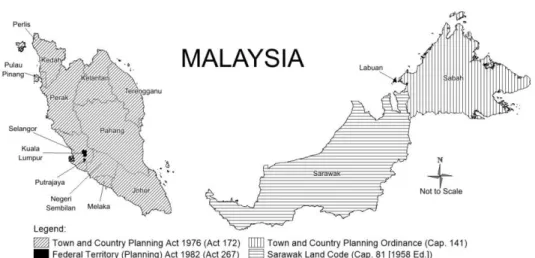
The four sets of planning law applicable in Malaysia presently are:
i. Town and Country Planning Act 1976 (Act 172); ii. Federal Territory (Planning) Act 1982 (Act 267);
iii. Town and Country Planning Ordinance 1950 (Cap. 141); and iv. Sarawak Land Code (Cap. 81 [1958 Ed.]).
Figure 1: Different sets of planning law coverage in Malaysia
HISTORICAL INFLUENCES TO PRESENT TOWN AND COUNTRY PLANNING LEGAL SETTING
This study has found that the present situation where there exists a different set of planning law being applicable within Malaysia was partly influenced by the history of the development of the country. Table 1 below outlines important historical events from 1400 AD to 1965 that have partly influenced the present legal setting in Malaysian town and country planning.
Table 1: Important historical events that influenced the present legal setting in Malaysian planning.
Year Event
1400 Malacca established by Parameswara.
1824 British acquired Malacca and formed Straits Settlements with Penang and Singapore
1843-1917
Sarawak and British North Borneo established incrementally. 1846 British acquired Labuan.
1874 Pangkor Treaty with Perak sets scene for British to extend control throughout the Malay Peninsula.
1896 Establishment of Federated Malay States (FMS). 1914 Grouping of Unfederated Malay States (UMS).
1945 Sarawak and British North Borneo became the responsibility of the British.
1948 Federation of Malaya formed.
1957 Independence granted and Malaya formed.
1963 Malaysia formed through the unification of Malaya, Singapore, Sabah and Sarawak with Tunku Abdul Rahman elected Prime Minister. 1974 Kuala Lumpur became a federal territory.
1984 Labuan became a federal territory. 2001 Putrajaya became a federal territory.
Source: Adapted from Church, 1999 as cited in Bruton, (2007).
Historically, Malacca was found in 1400 AD by Parameswara. From a traditional fishing village, Malacca grew into an international trading port and enjoyed economic prosperity and had become ‗…new standard for Malays achievement‘ (Andaya & Andaya, 2001:78). One hundred years on, in 1511, Malacca fell to the Portuguese who aimed to control maritime trade throughout the region. This led to the setting up of the Kingdom of Johor by Sultan Alauddin Riayat Shah, an heir to the Malacca sultanate. Later, with the assistance of the Dutch in Java, Johor ousted the Portuguese from Malacca. This put Malacca under Dutch influence through its United Netherlands Chartered East India Company.
At the same time, the British were also eyeing on Malacca to be under its sphere of influence. The British had already acquired Penang in 1786 and Singapore in 1819. Thus, in 1824, following the Anglo-Dutch Treaty, Malacca and the Malay Peninsula were transferred under the British sphere of influence.
However, British sphere of influence was restricted as far as the northern states of the Peninsula were concerned. This is because, during Malacca‘s territorial expansion back in the early 15th century, the northern Malay states of Kelantan, Terengganu, Perlis and Kedah acknowledged Siam as overlord and Malacca‘s influence was only felt here towards the end of the 15th
century (Suhana, 1999; Rutter, 1989). After the fall of Malacca in 1511 and the decline of Johor in 1699, other states in the Peninsular emerged as individual states which generally recognized Siam as overlord and sent the ‗golden flower‘ (bunga mas) as a sign of overlordship. This continued until the 1909 treaty between the British and Siam that transferred the suzerainty of Siam over the northern states to the British. These states became the Unfederated Malay States (UMS) under British administration.
Britain and the Brookes also helped to reinforce the connection between northwest Borneo and the Malay Peninsula. This connection was important as it also contributed to the inclusion of the Borneo states into Malaysia. By 1846, British continued to reinforce its influence in the Borneo region by acquiring the island of Labuan (Rozan Yunos, 2008). By 1868, Britain had made clear of her interest in northern Borneo (Sabah), which was now included in the British sphere of influence (Rutter, 1989).
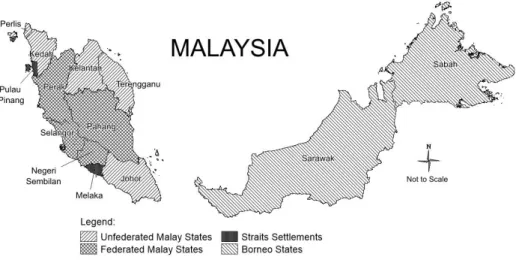
Up to this point, a process which stretched back to a series of conquests of Malacca and British colonisation of the states of the Malay Peninsula had reached its conclusion under the British administrative system. As a result, the Peninsula was divided into the Straits Settlements, the Federated Malay States, the Unfederated Malay States and Borneo, which consisted of three protectorates including Labuan Island. This division of administrative units is shown in Figure 2 below.
Figure 2: Malaya Administrative Units under British Colonization
Federation, the North Borneo state proposed a 20-points agreement, which in part requires the provisions of the Federal Constitution with regard to land, forest and local government do not apply in the state. Hence, planning also remains within the domain of the state to regulate.
In more recent times, several areas of the states have also been handed over to the Federal Government of Malaysia to administer. Kuala Lumpur, the capital of Malaysia, became a federal territory in 1974. Meanwhile, Labuan Island became the second federal territory in 1984. The most recent addition to the list of federal territories in Malaysia was in 2001 when Putrajaya, the new Federal Government administrative centre became a federal territory.
These historical events, especially the colonisation and the British influence over Malay Peninsula and the Borneo region, the formation of the federation and the 20-point agreement, and the creation of federal territories have strong implications in terms of administration and law uniformity. As a result, at present time, each state in Malaysia has no obligation to adopt the laws enacted by the Federal Government. In other words, it is the state legislatures‘ discretion to adopt federal laws to be operated in the state. In the circumstance that federal law is to be adopted by the state, it will be gazetted as state law1. Additionally, when land is under state jurisdiction as stipulated in the State List of the Federal Constitution, it inevitably affects the development planning process in Malaysia, in terms of final approvals of land matters2.
Undeniably this historical account has some legal and administrative impact on current planning practice in Malaysia as affirmed by Bruton (2007:1) when he commented that ―Planning in any country is inextricably linked with the history, politics and administrative structure of that country […] given the different colonial histories of east and west Malaysia they have developed differently and have different systems of planning‖. This is manifested in the application of different planning laws in different region of Malaysia. As mentioned earlier, the states in the Peninsular (West) Malaysia apply the Town and Country Planning Act 1976 (Act 172), while planning in the federal territories is governed by the Federal Territory (Planning) Act 1982 (Act 267). In the meantime, states in East Malaysia (Sabah and Sarawak) have their own planning laws.
1 Section 1 (2) of the TCPA 1976; ―subject to subsection (3), this Act shall come into operation in a State on a date or dates to be appointed by the State Authority, with the concurrence of the Minister, by notification in the State Gazette‖
2
PLANNING STRUCTURE IN MALAYSIA IN THE CONTEXT OF FEDERALISM
It is worth to look at the planning structure in Malaysia within the Federal Constitution ambit. This is because the current planning system in Malaysia embodied in the Town and Country Planning Act 1976 (TCPA 1976) originated from the Federal Constitution, notably Clause (1) of Article 74, Clause (4) of Article 76 and Clause (2) of Article 80. However, the Act which is meant for the uniformity of law and policy related to proper control of town and country planning is only applicable in Peninsular Malaysia, subject to notification in the State Gazette by the State Authority with the concurrence of the Minister for Housing and Local Government.
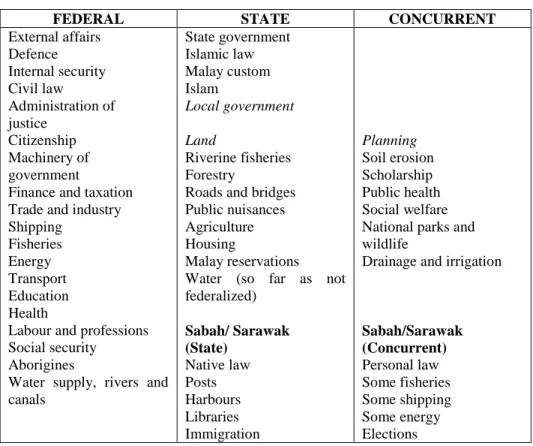
The ‗Federal Constitution‘ is the ‗supreme law‘ of the Federation (Article 4). By virtue of the supremacy of the ‗Federal Constitution‘ (hereafter referred to as the Constitution), any law which is inconsistent with the Constitution, to the extent of the inconsistency, is void. Thus, the Constitution is recognised as a written law of the Federation that prescribes the manner in which the governmental system in Malaysia is carried out. Furthermore, it confers the legislative power to the Federal Government and the State Government, and the Local Government as far as planning is concerned. Accordingly, the planning administration in Malaysia is effectively carried out at these three governmental levels.
Table 2: Federal, State and Concurrent Powers in Malaysia (A simplified scheme based on Arts. 74, 95B and Schs. 9-10)
FEDERAL STATE CONCURRENT
External affairs Defence Internal security Civil law Administration of justice Citizenship Machinery of government
Finance and taxation Trade and industry Shipping Fisheries Energy Transport Education Health
Labour and professions Social security
Aborigines
Water supply, rivers and canals State government Islamic law Malay custom Islam Local government Land Riverine fisheries Forestry
Roads and bridges Public nuisances Agriculture Housing
Malay reservations Water (so far as not federalized) Sabah/ Sarawak (State) Native law Posts Harbours Libraries Immigration Planning Soil erosion Scholarship Public health Social welfare National parks and wildlife
Drainage and irrigation
Sabah/Sarawak (Concurrent) Personal law Some fisheries Some shipping Some energy Elections
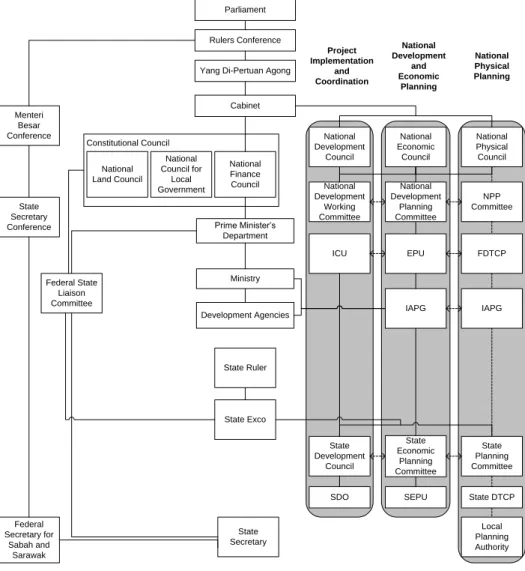
At the national level, Malaysia practices an integrated system of national development planning (Figure 3). Within this system, a cabinet of ministers is appointed by the King to advise him in the exercise of his functions. It consists of the Prime Minister as chairman and unspecified number of ministers. Three advisory bodies are established under the constitution, which are the National Land Council (NLC), the National Council for Local Government (NCLG) and the National Finance Council (NFC). Menteri Besar Conference State Secretary Conference Federal Secretary for Sabah and Sarawak Parliament Rulers Conference
Yang Di-Pertuan Agong
Cabinet Constitutional Council National Land Council National Council for Local Government National Finance Council Prime Minister’s Department Ministry Federal State Liaison Committee State Ruler State Exco State Secretary Project Implementation and Coordination National Development Council National Development Working Committee ICU State Development Council SDO National Development and Economic Planning National Economic Council National Development Planning Committee EPU IAPG State Economic Planning Committee SEPU National Physical Planning National Physical Council NPP Committee FDTCP IAPG State Planning Committee State DTCP Local Planning Authority Development Agencies
Figure 3: Integrated National Development Planning
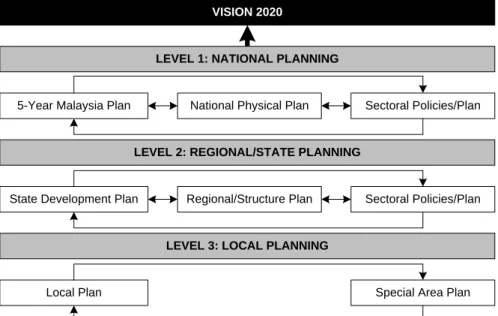
This integrated national development planning system is simplified by the diagram below (Figure 4) focusing on hierarchical structure of town and country planning for socio-economic, and physical planning and development in Malaysia.
VISION 2020
LEVEL 1: NATIONAL PLANNING
5-Year Malaysia Plan National Physical Plan Sectoral Policies/Plan
LEVEL 2: REGIONAL/STATE PLANNING
State Development Plan Regional/Structure Plan Sectoral Policies/Plan
LEVEL 3: LOCAL PLANNING
Local Plan Special Area Plan
Figure 4: Malaysia: National Development Planning Framework after 2001 Source: Adapted from Nur Sallehi Kassim & Islam (2006)
In the Peninsular Malaysia, the TCPA 1976 was amended in 2001 to overcome the lack of coordination of planning policies among states and between the Federal and States Government (Taye, 2002:6). It introduces radical changes to the administrative responsibilities of the States and the Federal Government, and strengthened the role of the Federal Government in planning with the following insertions;
i. Provides for the establishment of the National Physical Planning Council (NPPC) chaired by the Prime Minister;
ii. Formally establishes the position of Director-General of Town and Country Planning heading the Federal Town and Country Planning Department;
iv. Amends the development control system to require that the state committee seek advice of the NPPC on application for new townships with a population exceeding 10,000 or covering an area of more than 100 hectares or both; a construction of any major infrastructure or utility; and developments affecting hill tops or hill slopes in environmentally sensitive areas;
v. The National Physical Plan prepared by the Director-General of Town and Country Planning is to be translated in State Structure Plan and cascaded to Local Plan.
With regard to Sabah and Sarawak, the Constitution conferred on them greater legislative powers compared to those states in Peninsular Malaysia. Parliament‘s powers under Article 76A to extend the legislative powers of the States may, in the cases of Sabah and Sarawak, be exercised instead by an order of the Yang di-Pertuan Agong. Parliament‘s powers to legislate for land and local government do not apply to Sabah and Sarawak, which allows these States exclusive legislative control over these two matters. Although Sabah and Sarawak are represented in the NLC and the NLGC but their representatives may not vote, and they are not obliged to follow any policy laid down by these bodies; this position may, however, be altered by Parliament with the concurrence of the State Government (in relation to the NLC) or the state legislature (in relation to the NLGC). Furthermore, no area in Sabah and Sarawak may be included in a development area proclamation without the consent of the State Government (Harding, 1996:174).
CONCLUSION
In short, this paper revealed the historical influences on present planning legal structure in Malaysia. The historical events since 1400AD until the creation of federal territories in more recent times give implications in terms of application of planning law throughout Malaysia. Historically, states were individual kingdoms administered by the Sultans. Throughout time, they were colonised and later formed into a federation, which is Malaysia. Nevertheless, until present day they retain the authority to accept or not to accept Federal laws, which is a result of the negotiation undertaken during the formation of Malaya. Consequently, this has led to the application of different sets of planning law in different regions of Malaysia.
REFERENCES
Andaya, B.W. & Andaya, L.Y. (2001). A History of Malaysia. 2nd Edition. Hampshire: Palgrave.
Bruton, M.J. (2007). Malaysia: The Planning of a Nation. Kuala Lumpur: Persatuan Pegawai Perancang dan Desa Malaysia (PERSADA).
Federal Town and Country Planning Department Peninsular Malaysia (2002).
Encyclopaedia of Law and Administration of Urban and Regional Planning. Kuala Lumpur: Ministry of Housing and Local Government, Malaysia.
Foziah Johar (1989). An Evaluation of Malaysian Town Planning Legislation. Unpublished Master‘s Dissertation, Faculty of Law, Newcastle Upon Tyne.
Goh, B.L. (1991). Urban Planning in Malaysia: History, Assumptions and Issues. Selangor: Tempo Publishing.
Grant, M. (1982). Encyclopaedia of Planning law and Practice. London: Sweet & Maxwell.
Harding, A. (1996). Law, Government and the Constitution in Malaysia. London: Kluwer Law International.
Harding, A. (2003). Planning, environment and development: a comparison of planning law in Malaysia and England. Environmental Law Review, 5, pp. 231-255.
Hishamudin, M. (1995). An essay on the constitutional history of Malaysia.
Current Law Journal, 3 (xiv).
Ibrahim, A. & Ahilemah, J. (1995). The Malaysian Legal System. Kuala Lumpur: Dewan Bahasa dan Pustaka.
Lee, L.M., Mutalip, A.A. and Alip, R. (1990). Town Planning in Malaysia: History and Legislation. Penang: School of Housing, Building and Planning, University Science Malaysia.
Liaw, Y.F. (1976). The Laws of Melaka. The Hague: Martinus, Nijhoff.
Liam, H.K. (1978). The Evolution of the Urban System in Malaysia. Kuala Lumpur: University Malaya.
Pillay, S. (1999). The changing faces of administrative law in Malaysia.
Malayan Law Journal, 1 (140).
Rozan Yunos (2008). Loss of Labuan: a former Brunei Island. The Brunei Times, 7th September 2008.
Rutter, M. (1989). The Applicable Law in Singapore and Malaysia. Kuala Lumpur: Malayan Law Journal Sdn Bhd.
Suhana, S. A. (1999). Malaysian Legal System. Kuala Lumpur: Malayan Law Journal Sdn Bhd.