*Correspondence to Author:
G. P. Gladyshev
Russian Academy of Arts; Inter-national Academy of Creative En-deavors; N.N. Semenov Institute of Chemical Physics, Russian Acad-emy of Sciences, 117977 Moscow, Kosygin, 4
How to cite this article:
G. P. Gladyshev.Thermodynamics of the origin of life, evolution, and aging. International Journal of Nat-ural Science and Reviews, 2017; 2:7.
eSciPub LLC, Houston, TX USA. Website: http://escipub.com/
G. P. Gladyshev., IJNSR, 2018; 2:7
International Journal of Natural Science and Reviews
(ISSN:2
5
7
6-5
08
6
)
Review Article IJNSR (2018) 2:7
Thermodynamics of the origin of life, evolution, and aging
The main provisions of hierarchical thermodynamics created on the basis of Gibbs thermodynamics are presented. The thermo-dynamic theory of the origin of life, its evolution and the aging of living beings is presented. The theory considers the change in the specific Gibbs function of the formation of structures of differ-ent hierarchies, that is, the change in the comparative stability of these structures in the course of their evolutionary transforma-tions. The described approach should be considered structural kinetic thermodynamics, which allows us not to consider any kinetic mechanisms of processes in the evolution of various hier-archical structures. It is asserted that the principle of substance stability determines the direction of the processes of the origin of life and its evolutionary transformations. The thermodynamic theory of aging and thermodynamic nutrition allows predictions concerning healthy life and its duration. It is shown that hierar-chical thermodynamics is the physical foundation of expanded Darwinism. All the conclusions and predictions of the theory are confirmed by numerous observations and experimental facts.
Keywords: thermodynamics, hierarchy, origin of life, evolution, chemical evolution, aging, Darwinism, natural design.
G. P. Gladyshev
Russian Academy of Arts; International Academy of Creative Endeavors; N.N. Semenov Institute of Chemical Physics, Russian Academy of Sciences, 117977 Moscow, Kosygin, 4
ABSTRACT
Epigraphs
“The simplicity - the only ground on which it is possible to erect a building of generalizations”
Henri Poincare
“… The true and only goal of science is to reveal unity rather than mechanism.”
Henri Poincare
“One of the principal objects of theoretical research in any department of knowledge is to find the point of view from which the subject appears in its greatest simplicity.”
J. Willard Gibbs
“…nothing at all takes place in the universe in which some rule of maximum or minimum does not appear …”
Leonhard Euler
In early 1975, the author proceeded to study biological evolution from the standpoint of classical thermodynamics [1, 2]. In the middle of 1976 the first version of the article was written, in which biological evolution, phylogeny and ontogeny were considered as a successive hierarchical condensation of structures of living matter [3]. It was argued that these processes of condensation or structure formation can be viewed from the standpoint of the quasi-equilibrium extended thermodynamics of J. W. Gibbs, that is, the thermodynamics of systems close to the equilibrium state.
In order to avoid misunderstandings, it should be noted that the hierarchical thermodynamics of the author presented in this paper has nothing to do with the "thermodynamics of the dissipative living structures" of Ilya Prigogine, which is far from equilibrium [4, 5]. This thermodynamics of I. R. Prigogine is in fact a kind of kinetics, since it does not use state functions, functions that have full differentials. For example, I. Prigogine's entropy in this case
does not have a full differential and therefore it should be considered a kinetic function [4-13]. In constructing the theory, the author sought to follow the principles of simplicity and generality and to single out systems in which interactions of one-type objects take place. The necessity of using these principles in the creation of truly scientific theories was repeatedly drawn to the attention of Henri Poincare, J. W. Gibbs and other classics of science. Separate statements of these creators are given as epigraphs in this paper. Striving for the generality and simplicity of his approximate theory, the author remembered that one should not forget that the models created should preserve the real physical meaning of the phenomena.
The law of temporal hierarchies was formulated, which allowed considering transformations in each separate hierarchy (the sub-hierarchy) of structures regardless of the processes taking place in the structures of other hierarchies. In general, this law can be formulated in the form [3-5]:
t j << t j+1 . (1)
Here t j - average lifetime of structures j of lower
hierarchical level, t j+1 - average lifetime of
structures (j+1) of higher hierarchical level. In the expanded form it is possible to write:
… << t m << t im << t organelle << t cell << t organisms
<< t pop << t soc << … (2)
Here t – average lifetime of “free” molecules-metabolites (m), supramolecular structures (im), organelles (organelle), cells in the tissue (cell); organisms (org); populations (pop); societies (soc).
It is easily shown that the existence of series (2) allows us to pick out the summation of structures of one hierarchy as a subsystem and to consider this subsystem as a quasi-closed system. It is understood that in order to study such a system, it is possible to use the methods of equilibrium (quasi-equilibrium) hierarchical thermodynamics.
Bogolubov [14]. This clearly proves the possibility of using thermodynamics for describing each hierarchical level.
The law of temporal hierarchies allowed to lay the foundations of quasi-equilibrium hierarchical thermodynamics (thermodynamics of quasi-closed systems), which uses state functions that have real physical meaning. It was argued that the transitions from one hierarchy to another in the chemical and biological evolution can be viewed like the phenomena of phase transitions - the crystallization of chemical substances in systems close to the equilibrium state.
The author realized that in the study of evolution it is convenient (despite the approximate character of the theory) to study the change in the specific Gibbs function (the free energy) of the formation of living structures (for example, the Gibbs specific function of the formation of living structures in quasi-closed systems). This awareness was the key point of the theory. It became possible (with a certain approximation) to talk about the evolution of the stability of structures, more precisely, the thermodynamic evolutionary trend of the development of these structures.
It became possible not to take into account the kinetics and mechanisms of numerous
chemical, supramolecular and other
evolutionary processes (for example, the
phenomena of the existence of kinetic barriers and kinetic traps). Thus, kinetics, as well as chemical and other evolutionary mechanisms, were, as it were, excluded from consideration.
It became possible to talk only about the thermodynamic kinetics of the change in the stability of a substance in chemical evolution, in the processes of life formation, its evolution, phylogenesis, ontogenesis or aging of living beings.
In other words, the author proposed to study the change in the specific function of Gibbs (or Helmholtz) of the formation of various hierarchical structures with the time of evolutionary transformations. For example,
changes in the specific Gibbs function of the formation of chemical and supramolecular structures in chemical evolution, in the process of life formation, biological evolution, phylogenesis, ontogeny (aging of living beings) were considered:
Δ𝑮̃̅ch = f (t) and Δ𝑮̃̅im = f (t), where the wavy line
above G indicates that the system under study is heterogeneous, and the straight line indicates that the specific value is being considered. Note that in a number of publications, the subscript was used instead of the upper index, which was equivalent to the upper index.
energy capacity) during evolutionary transformations of chemical and supramolecular structures in evolution, phylogenesis, and ontogenesis [3-9]. Subsequently, similar considerations were used to explain the growth in the energy capacity of systems at all hierarchical levels. These statements made it possible to identify the direction of chemical evolution, as well as other components of the overall evolution - particular evolutions at different levels and sublevels. It was consciously [3-5] that the transition from one hierarchy to another (or the transition between sub-hierarchies) is the result of action of the principle of feedback, which was called
the principle of substance stability or the principle of Georgi Gladyshev.
One of the known formulations of the principle can be represented in the form [6, 7, 12]: During the formation (self-assembly) of the most thermodynamically stable structures at the highest hierarchical level (j), e.g., the supramolecular level, in accordance with the second law, Nature spontaneously uses predominantly the (available for the given local part of the biological system) least thermodynamically stable structures belonging to a lower level, for example, the molecular level (j-1).
Fig.1. Scheme of changes in the specific chemical energy capacity of the biomass (biological tissue), (ch) - (A) and thermodynamic stability of its supramolecular structures during ontogenesis of living beings (im) – B.
night, change of seasons, etc., lead to variation of Δ𝑮̃̅ch and Δ𝑮̃̅im . The organisms adapt to this
variation only within the limits of the adaptive zone.
In other words, the principle of substance stability asserts that each hierarchical structure of the biologic world evolves in the search for a minimum of the specific Gibbs free energy of its formation. In this case, enrichment of the said structure by the energy-intensive substance of the adjacent lower structure is observed. The desire to minimize this parameter is observed against the background of non-spontaneous processes initiated by the environment.
The author often noted that the principle of substance stability is an approximate thermodynamic principle, since it is used for systems of variable chemical composition (or composition of other hierarchies), when thermodynamic stability, strictly speaking, cannot be considered equivalent to the value of the Gibbs specific function of the formation of these structures. To put it more strictly: the principle of substance stability determines the tendency of the development of chemical, biological and other hierarchical systems in the evolution of matter. It should be remembered that the principle is applicable to evolutionary transformations, when the environment of the systems under study practically does not change. In this case, insignificant fluctuations of the parameters of this medium in the adaptive zone can be observed. In case of revolutionary (abrupt) changes in the environment, the living system may die. For example, this was the case with the death of dinosaurs. There are many examples of applying the principle to chemical, supramolecular, social processes. The validity of the principle of substance stability was proved when comparing the chemical and supramolecular stability of various hydrocarbons of some homologous series [5].
A good illustration of the principle is also its use in comparing the structure of DNA and RNA.
So the principle of substance stability explains the reasons for the existence of DNA in the form of double helices, and RNA in the form of less regular (less ordered) structures containing single-chain fragments of polymer chains. Deoxyribose in real conditions is chemically less stable than ribose. Similarly, thymine is chemically less stable than uracil. Therefore, in physiological solutions of DNA macromolecules (which contain fragments of deoxyribose and thymine) participate in the formation of supramolecular structures of increased stability in comparison with the stability of supramolecular structures formed by RNA macromolecules (which contain ribose and uracil fragments).
The above statements are confirmed by comparing the values of the standard free Gibbs energy of formation (the standard isobaric formation potentials at 25 ° C) of the substances mentioned above [16], which (practically unchanged) are DNA and RNA fragments.
ΔGfо298(kcal/mole) = -76.83 ΔGfо298(kcal/mole) = -38.79
ΔGfо298(kcal/mole) = -10,08 ΔGfо298(kcal/mole) = -28,00
The author emphasizes in many recent publications [6-12, 15] that all processes of evolution are taken into account by the
advanced hierarchical generalized Gibbs equation, the generalized equation of the first and second laws of thermodynamics [5-7]:
(1) Where G is the Gibbs free energy; T is the temperature; S is the entropy; V is the volume; p is the pressure; X is any generalized force except pressure; x is any generalized coordinate except volume; µ is the chemical (evolutionary) potential; m is the mass of the k -substance; the work performed by the system is negative. The subscript i pertains to the specific evolution, and k to the component i evolution. The superscript * means that behavior of a quasi-equilibrium complex system is considered.
Aging of living systems, in particular living things, obeys the laws of hierarchical thermodynamics.
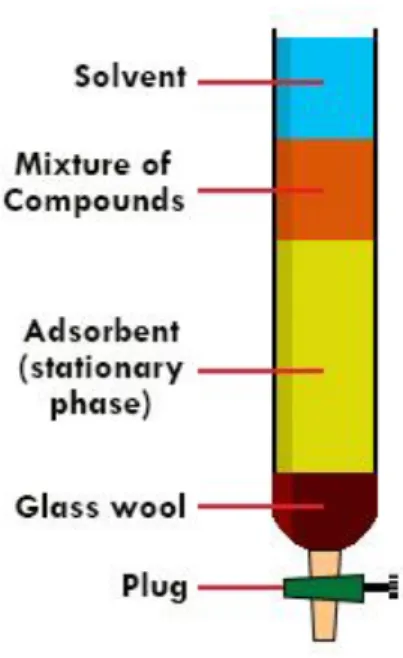
The thermodynamic theory of aging is sometimes called the chromatographic theory of aging [17], because it is based on the model of the operation of non-stationary chromatographic columns. It is believed that aging of organisms is an analog of the aging of adsorbents of stationary phases of separation columns.
Fig.3. Сhromatographic column
Fig.4. Diagram of variation in the specific Gibbs function (the free energy) of formation of supramolecular tissue’s structures in the process of development and aging. Curve 1 indicates body development and aging under normal living conditions. Curves 1+ and 1- refer to improved
and bad living conditions correspondingly. The scheme conforms to the change in chemical composition of tissues.
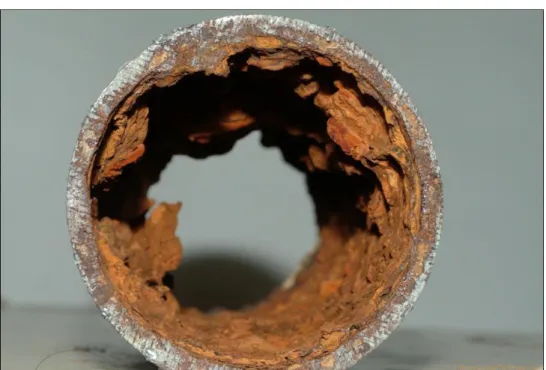
The aging process of the wick of a burning candle and the accumulation of rust in water pipes is considered an analogue of the aging of living systems and the formation of thrombi in blood vessels. Below are the photos (Fig.5 – Fig.8.) that illustrate the mentioned phenomena.
The formation of rust in water pipes is a "thermodynamic analogue" of the formation of thrombi in blood vessels. It's amazing, but it's a fact. In both cases, the laws of thermodynamics are inexorably acting. The stability of the systems in both cases increases. The accumulation of an energy-capacity substance is observed as a result of the action of the second principle at various hierarchical levels of living and non-living matter.
Undoubted success is the birth of the foundations of dietetics thermodynamics, which
allows determining the gerontological value of food.
As applied to natural fats and oils [4-8], it can be written down as:
im i
G~
= ( mim
i H~
/Tmi) (Tmi-To), (2)
where G~iim is the Gibbs specific function or Gibbs specific free energy of the supramolecular or intermolecular formation of the condensed phase i, mim
i H~
is the change of
specific enthalpy during the solidification of natural fat (oil); Tmi is the pour (the congeal
Fig.5. Aging is accompanied by dehydration of the body.
Δ𝑮̃̅im < 0
Δ𝑮̃̅im < 0
Fig.7. Rust in the pipe.
ΔG fо298 < 0
Fig. 8. Thrombus formation.
Δ𝑮̃̅im < 0
Comparison of the data presented on Figure 9 shows that the known nutritional and medical recommendations correspond with physical chemical calculations made on the basis of
Fig.9. Dependence of the indicator of gerontological (anti-aging) value of oils and fats, GPGi, on
their congeal point, T Cong .
In some works [5, 18] the author made a number of predictions. This prediction and the corresponding facts were used by many researchers without reference to the thermodynamic theory of aging. So, in the article [18] it is possible to read:
“From the perspective of the thermodynamic theory of aging, it is advisable to take into account gerontological G. P. Gladyshev’s value indicators of food products and medicinal preparations, gerontological purity of drinking water... However, in practice, it is convenient to follow the recommendations listed below. To use as much as possible clean drinking water, the consumption of which is not contrary to medical indications. To eat biomass of phylogenetically young (ancient) species of plants and animals — relatively young food (for instance, algae, some species of fish and amphibians) . To eat biomass of ontogenetically young plants and animals—relatively young food (germinated seeds, animals’ germs, maggots, roe, young mammals, juvenile fish,
However, in [19], where the important results obtained in the study of the aging of various living beings (which fully correspond to the thermodynamic theory) are presented, there are no references to the thermodynamic theory of aging. It can be noted that the basis of the author's thermodynamic theory was created by him without co-authors, and his predecessors are classics, primarily J. W. Gibbs.
It can again be noted that the composition and amount of food (as well as other factors, for example, the optimal temperature of life and others) affect the life span of living beings according to the thermodynamic theory of aging. For example, it seems that the relatively long life expectancy of a naked mole-rat (Heterocephalus glaber) is essentially dependent on the food consumed by it. This animal basically eats tubers of plants, which is equivalent to the predominant human nutrition of vegetables.
In general, it can be argued that hierarchical thermodynamics is the foundation of extended Darwinism, which describes chemical and biological evolution at all hierarchical levels [11, 15]. Hierarchical thermodynamics creates the design of living systems and natural objects.
Evolution can be represented in the form of a spiral (Fig.10), which can be significantly transformed during periods of revolutionary change, when the parameters of the environment change drastically.
The thermodynamic theory of evolution claims that Darwin and Lamarck are both right. The reason is that "transformations" of Darwin and Lamarck occur at substantially different times (i.e. in different time scales).
Fig.11 below symbolically represents the origin and evolutionary transformations of life, which occurs against the background of unpredictable changes in the environment [20].
When creating a thermodynamic theory of the origin of life, its development in the phylogenesis, ontogenesis or aging of living beings, many assumptions and approximations were made. However, known facts and true predictions of the theory, mentioned in numerous publications of the author, make it possible to verify the validity of the theory. General works of the author are presented in the well-known open access journals - on line. In these works, references to other author's studies in the field under discussion can be found.
Рис. 11. Life - a spontaneous process takes place against the background of non-spontaneous processes initiated by the environment.
In conclusion, it should be noted that many biologists and non-professional representatives of the exact sciences do not want to recognize the thermodynamic theory of the origin of life, biological evolution and the aging of living beings. At the same time, many from these researchers rewrite whole pages and fragments from the author's works without referring to his
research. This is mainly happening in Russia, where plagiarism is practically not condemned. However, a number of well-known physicists and physical chemists welcome this theory and outline the ways of its development [4, 5, 21-27]. This allows us to hope that thermodynamic theory will reach a worthy place in the life sciences.
References
[1]. Gibbs, J.W. (1876). The Scientific Papers of J. Willard Gibbs: “On the Equilibrium of Heterogeneous Substances”, Vol. 1, Thermodynamics, Ox Bow Press, Connecticut.
[2]. Сычев В. В. Сложные термодинамические системы. М.: Изд. дом МЭИ, 2009.
[3]. Gladyshev Georgi P., On the Thermodynamics of Biological Evolution, Journal of Theoretical Biology, Vol. 75, Issue 4, Dec 21,1978, pp. 425-441 (Preprint, Chernogolovka, Institute of Chem. Phys. Academy of Science of USSR, May, 1977, p. 46).
[4]. Gladyshev Georgi P., Thermodynamics Theory of the Evolution of Living Beings, Commack, New York: Nova Science Publishers, Inc., 1997. 142 P. In Russian: Гладышев Г.П., Термодинамическая
теория эволюции живых существ, М.: ”Луч”, 1996.-86с. http://creatacad.o rg/?id=58&lng=eng
http://www.statemaster.com/encyclopedia/History-of-thermodynamics
[5]. Гладышев Г.П. Супрамолекулярная термодинамика – Ключ к осознанию явления жизни. Что такое жизнь с точки зрения физико-химика. Издание второе,М – Ижевск. ISBN: 59397-21982 (2003).
[6]. Gladyshev G. P., Natural Selection and Thermodynamics of Biological Evolution, Natural Science, 7, pp. 117-126(2015). http://dx.doi.org/ 10.4236/ns.2015.73013
270-286(2015). http://www.scirp. org/Journal/PaperInformation.aspx?PaperID=56613
[8]. Gladyshev G.P., The Thermodynamic Theory of Evolution and Ageing, Advances in Gerontology, 4, 109-118(2014). http://dx.doi.or g/10.1134/S2079057014020064
[9]. Гладышев Г. П. Иерархическая термодинамика и эволюция химической и биологической материи. (Gladyshev G.P., Hierarchical thermodynamics and evolution of chemical and biological matter). The scientific heritage: Budapest, Hungary. Vol. 1, № 3 (3), pp. 102-121(2016).
https://www.researchgat
e.net/publication/309533110_Hierarchical_thermodyn amics_and_evolution_of_chemical_and_biological_m atter
[10]. Gladyshev Georgi, Thermodynamics Optimizes the Physiology of Life, p. 152 – 163.
In: Philosophy & Cosmology, v. 12(2014), pp. 152-163. ISSN 2307-3705.
http://ispcjournal.org/journal s/2014/PhC_2014.pdf
[11]. Gladyshev G. P. On General Physical Principles
of Biological Evolution, International Journal of
Research Studies in Biosciences. Volume 5, Issue 3,
2017, Page No:
5-10. https://www.arcjournals.org/pdfs/ijrsb/v5-i3/2.pdf https://www.researchgate.
net/publication/314187646_On_General_Physical_Pri nciples_of_Biological_Evolution
[12]. Gladyshev G. P., The principle of substance stability is the driving force of evolution.
http://escipub.com/Articles/IJNSR/IJNSR-2017-11-1201 http://escipub.com/ijnsr-2017-11-http://escipub.com/Articles/IJNSR/IJNSR-2017-11-1201/
https://www.researchgate.net/publication/321146047_ The_principle_of_
substance_stability_is_the_driving_force_of_evolution
[13]. Thims Libb, Georgi Gladyshev -
Thermodynamics of evolution
(2010).https://www.youtube.com/watch?v=CYr1G5TZ O50
[14]. Bogolubov N. N. Selected works. Part 1. Dynamical Theory. - New York: Gordon and Breach Science Publishers, 1990.
[15]. Gladyshev G. P. Hierarchical Thermodynamics: Foundation of Extended Darwinism. Imperial Journal of Interdisciplinary Research (IJIR) Vol-3, Issue-2, 2017, ISSN: 2454-1362,
https://www.researchgate.net/publication/314082150_ Hierarchical_Thermodynamics_Foundation_of_Exten ded_Darwinism
16. MetaCyc. Computing Gibbs Free Energy of
Compounds and Reactions in MetaCyc
https://www.researchgate.net/publication/320016231_ The_principle_of_substance_stability_forms_a_struct ure_and_design_of_nucleic_acids
17. Aging http://www.eoht.info/page/Aging Хром кол 18. Gladyshev, G.P. (2004) Macrothermodynamics of Biological Evolution: Aging of Living Beings. International Journal of Modern Physics B, 18, 801-825. http://dx.doi.org/10.1142/S0217979204023970
[19]. Sang-Goo Lee at all, Age-associated molecular changes are deleterious and may modulate life span through diet. Science Advances, Vol. 3, no. 2, 17 Feb 2017
http://advances.sciencemag.org/content/3/2/e160183 3.full
[20]. Gladyshev G.P. J Thermodyn Catal , 2017, 8: 2 DOI: 10,4172 / 2157-7544.100018,
Life - A Complex Spontaneous Process Takes Place against the Background of Non-Spontaneous Processes Initiated by the Environment https://www.researchgate.net/publication/319105338_ Life_-_A_Complex_Spontaneous_Process_Takes_Place_a gainst_the_Background_of_Non-Spontaneous_Processes_Initiated_by_the_Environm ent
[21]. Yuri S. Lipatov, Book Review “G.P. Gladyshev, Thermodynamic Theory of the Evolution of Life Forms”, J Biol Phys . 1997 г .; 23 (2): 129-131. doi: 10.1023 / A: 1004904703383 https://www.ncbi.nlm.nih.gov/pmc/articles/PMC34560 72/pdf/10867_2004_Article_129260.pdf
[22]. Ершов Ю. А. Термодинамика квазиравновесий в биологических системах. Итоги науки и техники, Серия: Химическая термодинамика и равновесия, Том 5, с. 1-140. Государственный комитет по науке и технике - Академия наук СССР - Всесоюзный институт научной и технической информации. Москва, 1983, 1-8039.
[23]. Козлов Г. В., Новиков В. У. Кластерная
модель аморфного состояния
полимеров (рус.) // Успехи физических наук. — Т.
171, № 7. — С. 717—764.
http://elibrary.lt/resursai/Uzsienio%20leidiniai/Uspechi _Fiz_Nauk/2001/N07/2001-7-02.pdf
[24]. Харитонов Ю. Я. Физическая химия, Министерство образования и науки РФ, Москва, издательская группа "ГЭОТАР - Медиа", 2013 г. Гл. 4. Универсальные законы. Неравновесная
термодинамика. Закон временных иерархий
Гладышева,
[25]. Элошвили C. А. (г. Тбилиси, Грузия). О математических основах иерархической термодинамики
http://ispcjournal.org/journals/2008/2008-1-9.pdf
http://www.bazaluk.com/conference/o- matematiceskih-osnobah-ierarhiceskoy-termodinamiki.html
[26]. El-Diasty. F., (2011). Origin of Order: Emergence and Evolution of Biological Organization as a Problem in Thermal Physics. Advances in Life
Sciences, 1,
30-39.http://article.sapub.org/10.5923.j.als.20110101.06. html
[27]. Encyclopedia Nation Master (USA):
http://www.statemaster.com/encyclopedia/Georgi-Pavlovich-Gladyshev
History of thermodynamics:.
http://www.statemaster.com/encyclopedia/History-of-thermodynamics
Thermodynamic evolution