Saifon Chawanpaiboon, M.D., Vitaya Titapant, M.D.
Department of Obstetrics & Gynaecology, Faculty of Medicine Siriraj Hospital, Mahidol University, Bangkok 10700, Thailand.
A Randomized Controlled Trial of the Correlation
between Iodine Supplementation in Pregnancy and
Maternal Urine Iodine and Neonatal Thyroid
Stimulating Hormone Levels
Corresponding author: Saifon Chawanpaiboon E-mail: [email protected]
Received 31 July 2018 Revised 22 August 2018 Accepted 18 October 2018 ORCID ID: 0000-0002-3207-6187
http://dx.doi.org/10.33192/Smj.2019.10 ABSTRACT
Objective: To establish the correlation of maternal urine iodine and neonatal thyroid stimulating hormone (TSH)
in iodine supplemented and non-iodine supplemented pregnant women.
Materials and Methods: The study was a prospective, randomized, controlled trial, which was conducted at the
antenatal care unit, labor ward, and neonatal unit of Siriraj Hospital, Mahidol University, Bangkok, Thailand. In all, 224 pregnant women were recruited during 1 October 2015 and 31 July 2017. They were randomized into 2 groups: an iodine and a non-iodine supplemented group. One woman in the control group left the study as she had delivery at another hospital.
Results: There were no statistically significant differences in the demographic data, original area of domicile, and
adverse neonatal outcomes (including preterm labor and low birth weight) of the patients in the two groups. The maternal urinary iodine levels were 84.14 ± 61.85 and 58.41 ± 41.36 microgram/L, and the median values of the neonatal TSH levels were 3.7 ± 1.87 and 4.4 ± 1.99 mIU/ml, in the iodine and non-iodine supplemented groups, respectively. The differences in both values were statistically significant (p-value < 0.05).
Conclusion: This study determined that there were statistically significant differences in the maternal urinary iodine
levels and the median values of the neonatal TSH levels of the iodine and non-iodine replacement groups of pregnant women. Even though there were no clinically significant differences and none of the newborns was diagnosed with hypothyroidism, iodine supplementation in all pregnant women should be considered. A larger prospective, RCT trial would confirm the benefits of a strategy of routinely administering iodine to pregnant women at Siriraj Hospital.
Keywords: Iodine supplementation; maternal urine iodine; neonatal TSH; hypothyroidism (Siriraj Med J 2019;71:
59-65)
INTRODUCTION
Iodine is an essential substance for fetal brain development; cell metabolism; cell growth; and the myocardial, hepatic, and muscle functions. Thyroid hormone production requires iodine as the major substance. Iodine deficiency results in impaired thyroid
totally dependent during early pregnancy on maternal thyroxine for normal brain development.3 Maternal dietary supplementation of iodine during pregnancy is also beneficial. Irreversible fetal brain damage can result from inadequate iodine supplementation during pregnancy, which may lead to inadequate production of thyroid hormones and hypothyroidism in pregnant women.3 Iodine supplementation before and during pregnancy can prevent cretinism and improve the cognitive function of the general population.1
The growing requirement for iodine in pregnancy arises from the progressive increase in maternal thyroxine (T4) production needed to maintain maternal euthyroidism and to transfer thyroid hormone to the fetus during the first trimester, before the fetal thyroid begins to function. Other reasons are an iodine transfer to the fetus, particularly in later gestation, and an increase in renal iodine clearance.4 The US Institute of Medicine5 and the World Health Organization (WHO)6 recommendations for iodine intake during pregnancy are 220 and 250 micrograms/day, respectively. From WHO global estimates of iodine status, more than half of the children with iodine deficiency came from Southeast Asia and Africa.7
Thailand has an iodine deficiency, even though the south and southeast parts of the country have substantial coastal areas. In 2013, a national survey found that iodine deficiency was a major problem among pregnant Thai women. Nearly half of all the women suffering from iodine deficiency were reported to be located in the north and northeast of Thailand, neither of which are near the coast.8 Thailand’s capital city, Bangkok, has plenty of sea food available for consumption. Almost all Thai food in that city is cooked with the ingredients of fish sauce and iodized salt, which may result in adequate iodine intake by pregnant Thai women; hence, iodine supplementation may be unnecessary for pregnant women in Bangkok.
Prior to the present study, no research had been conducted of the degree of correlation between iodine supplementation in pregnancy and the maternal urine iodine and neonatal TSH levels of patients at Siriraj Hospital. This research was carried out to determine the need for iodine-containing medicated supplementation by pregnant Thai women. We hypothesized that iodine supplementation would still be necessary despite pregnant Thai women having access to adequate seafood nutrition.
MATERIALS AND METHODS
The study was approved by the Ethics Committee of the Siriraj Institutional Review Board (Si 524/2014). This prospective, randomized, controlled trial was conducted at the antenatal clinic and labor ward, Faculty of Medicine
Siriraj Hospital, Mahidol University, from October 2015 to July 2017. Using nQuery Advisor (Statistical Solutions Ltd., Cork, Ireland), the calculation of the sample size was based on the findings of a study from Denmark9, which reported that the median values of the neonatal TSH levels in pregnant women with and without iodine supplementation were 9 mU/l and 7.07 mU/l, respectively. However, the standard deviation (SD) employed in the present study’s calculations was 4 times greater than that used in the Danish study to account for the variations in the populations of many parts of Thailand. A 10% follow-up loss was also factored in. The final sample size was determined to be 112 cases for each group.
Included in the study were all pregnant women who were older than 18 years and who had a singleton fetus at a gestational age of less than 18 weeks on the day the women commenced participation. The exclusion criteria were patients who had any of the following: a contraindication to the use of iodine, a previous administration of other iodine-containing drugs, a multifetal pregnancy, a pregnancy with a fetal anomaly, or a pregnancy with an abnormal thyroid function (hyperthyroidism or hypothyroidism).
The total of 224 pregnant women were recruited and divided into 2 groups of 112 by block randomization (block sizes of ten). One group received an iodine-containing ferrous tablet, and the other a no iodine-containing ferrous tablet. The patient’s demographic data were obtained; the data items comprised age, pre-pregnant body weight, height, occupation, income, area of domicile, socioeconomic status, parity, antenatal care history, and medications received during pregnancy.
All of the pregnant women were given the standard care afforded to other patients, such as gestational diabetes mellitus and thalassemia screening, ultrasonography, and other indicated fetal surveillances. In the case of anemic patients (defined as a hematocrit level under 33%), an iron supplement (FeSO4 tablets) was prescribed.
The primary objective was to find any correlations between the neonatal TSH levels at 48-hours of life in the iodine supplemented and non-iodine supplemented groups. The reference cut-off value of an abnormally high TSH level used by the study was 12 mIU/L. This value was based on the laboratory reference range provided by the Genetics Division, Pediatrics Department, Siriraj Hospital.
RESULTS
Of the total of 224 pregnant women initially recruited, 1 woman in the control group left the study as she had delivery at another hospital.
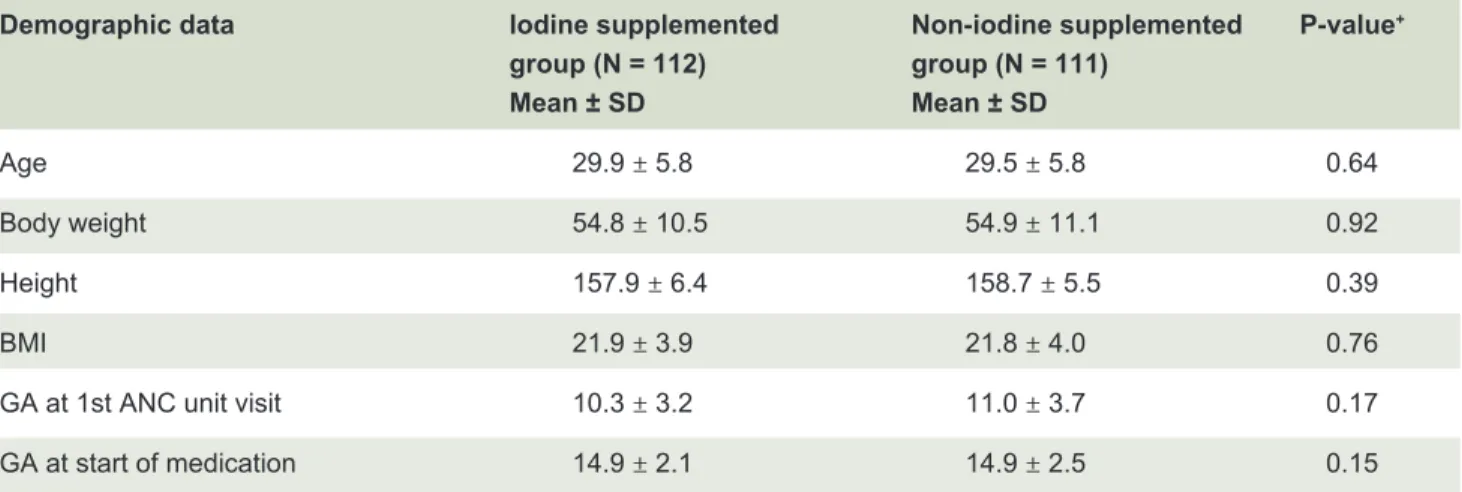
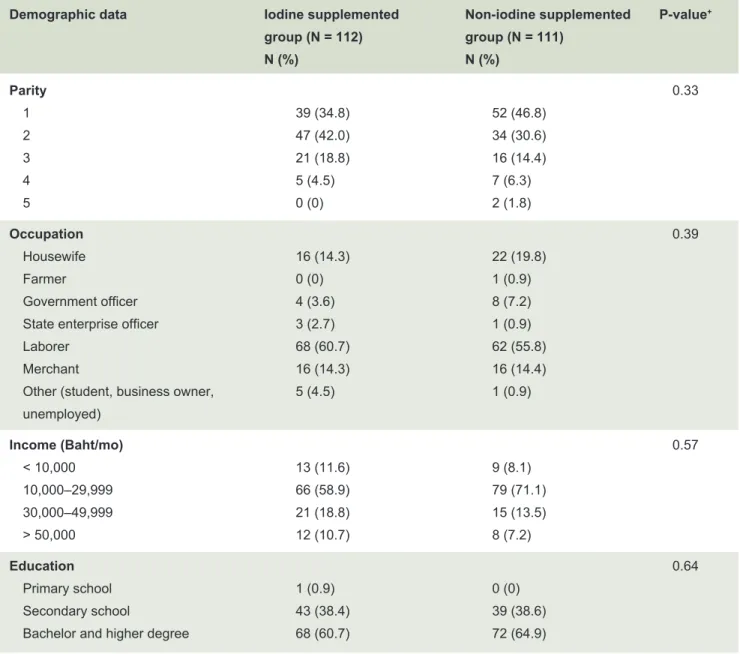
The demographic data and neonatal outcomes are presented in Tables 1 and 2. The patients’ data included the mean age, parity, body weight, height, body mass index (BMI), gestational age at the first antenatal care unit visit and later at the start of medication, occupation, education level, and monthly income. There were no statistically significant differences between the data for the two groups (p-value < 0.05).
As to the neonatal outcomes, the preterm birth rates of the patients in the iodine and non-iodine supplemented groups were 8.2% and 7.1%, and the rates of low birth weights were 6.1% and 10.1%, respectively. No statistically significant differences were detected in those figures. The mean gestational ages at delivery were 38.1 and 38.3 weeks, and the mean neonatal birth weights were 3,061.8 + 474.7 and 3,075.9 + 407.4 grams, respectively, again with no statistically significant differences (Table 3).
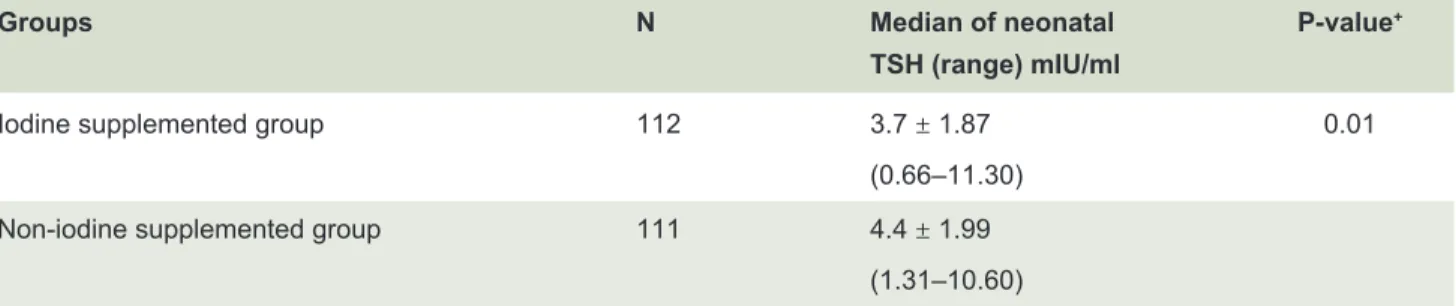
The mean urinary iodine level of the patients in the iodine supplement group was 84.14 ± 61.85 microgram/L, which was higher than that of the patients in the non-iodine supplemented group (58.41 ± 41.36 micrograms/L; Table 5). However, the median neonatal TSH level of the patients in the iodine supplemented group was 3.7 ± 1.87 mIU/L, which was lower than the figure of 34.4 ± 1.99 mIU/L for the patients in the non-iodine supplemented group. There were statistically significant differences in the results for the two groups (p-values 0.001 and 0.01, respectively; Table 6).
DISCUSSION
The most authoritative guidelines on how to assess iodine nutrition in a population were published in 2007 by the WHO, the United Nations Children’s Fund (UNICEF), and the International Council for Control of Iodine Deficiency Disorders (ICCIDD, currently named the Iodine Global Network).10 Iodine deficiency is the most common micronutrient deficiency in the world, especially in Asia.7 Thailand also has an iodine deficiency even though plenty of seafood is available in most areas of the country. The WHO and the ICCIDD have promoted the usage of iodized table salt to alleviate endemic cretinism in many parts of the world.10 Despite iodine deficiency affecting both the mother and the child, iodine supplementation during pregnancy tends to be of low concern among physicians in Thailand. Pregnant women require a 50% increase in their iodine intake to ensure there is sufficient available for thyroid hormone production by fetuses.11 However, inadequate iodine supplementation may result in an iodine deficiency for both mothers and fetuses; alternatively, the mother may achieve euthyroidism, yet the fetus becomes hypothyroid.
In 2013, the annual statistical report of the Pediatric Genetic Division of the Pediatrics Department, Faculty of Medicine Siriraj Hospital, reported a case of a neonate that had an abnormally high TSH level of 0.17%, yet only 0.02% of the neonates in the group of neonates with abnormally high TSH levels had been diagnosed with hypothyroidism.12 This proportion seems to be small and may not be representative of the extent of hypothyroidism among Thai children generally. However, the current study found that the urine iodine and neonatal TSH levels for
TABLE 1. Demographic data of the study groups.
Demographic data Iodine supplemented Non-iodine supplemented P-value+
group (N = 112) group (N = 111) Mean ± SD Mean ± SD
Age 29.9 ± 5.8 29.5 ± 5.8 0.64
Body weight 54.8 ± 10.5 54.9 ± 11.1 0.92
Height 157.9 ± 6.4 158.7 ± 5.5 0.39
BMI 21.9 ± 3.9 21.8 ± 4.0 0.76
GA at 1st ANC unit visit 10.3 ± 3.2 11.0 ± 3.7 0.17
GA at start of medication 14.9 ± 2.1 14.9 ± 2.5 0.15
TABLE 2. Demographic data of the study groups.
Demographic data Iodine supplemented Non-iodine supplemented P-value+
group (N = 112) group (N = 111)
N (%) N (%)
Parity 0.33
1 39 (34.8) 52 (46.8)
2 47 (42.0) 34 (30.6)
3 21 (18.8) 16 (14.4)
4 5 (4.5) 7 (6.3)
5 0 (0) 2 (1.8)
Occupation 0.39
Housewife 16 (14.3) 22 (19.8)
Farmer 0 (0) 1 (0.9)
Government officer 4 (3.6) 8 (7.2)
State enterprise officer 3 (2.7) 1 (0.9)
Laborer 68 (60.7) 62 (55.8)
Merchant 16 (14.3) 16 (14.4)
Other (student, business owner, 5 (4.5) 1 (0.9) unemployed)
Income (Baht/mo) 0.57
< 10,000 13 (11.6) 9 (8.1)
10,000–29,999 66 (58.9) 79 (71.1)
30,000–49,999 21 (18.8) 15 (13.5)
> 50,000 12 (10.7) 8 (7.2)
Education 0.64
Primary school 1 (0.9) 0 (0)
Secondary school 43 (38.4) 39 (38.6)
Bachelor and higher degree 68 (60.7) 72 (64.9)
+, chi-square test
TABLE 3. Neonatal outcomes.
Neonatal outcome Iodine supplemented Non-iodine supplemented P-value+
group (N = 112) group (N = 111)
Mean (SD) Mean (SD)
GA at delivery 38.1 ± 1.7 38.3 ± 1.9 0.97
Neonatal birth weight 3,061.8 ± 474.7 3,075.9 ± 407.4 0.58
TABLE 4. Incidences of preterm births and low birth weights.
Iodine supplemented Non-iodine supplemented P-value+
group (N = 112) group (N = 111)
N (%) N (%)
Preterm birth (GA < 37 wk) 11 (9.8) 10 (9.0) 0.9
Extremely preterm(< 28 wk) 0 (0) 0 (0)
Very preterm (28– < 32 wk) 2 (1.7) 1 (0.1)
Moderate to late preterm (32– < 37 wk) 7 (6.2) 6 (5.4)
LBW (birth weight < 2,500 g) 8 (7.1) 10 (9.0) 0.36
Extremely LBW (< 1,000 g) 0 (0) 0 (0)
Very low birth weight (1,000– < 1,500 g) 2 (1.8) 0 (0) Low birth weight (1,500– < 2,500 g) 6 (5.3) 10 (9.0)
GA, gestational age; +, chi-square test
TABLE 5. Urinary iodine levels of the two groups.
Groups N Mean of urinary iodine P-value+
(range) microgram/L
Iodine supplemented group 112 84.14 ± 61.85 0.001
(9.40 – 437.00) Non-iodine supplemented group 111 58.41 ± 41.36
(3.01–215.60)
+, chi-square test
TABLE 6. Median of neonatal TSH levels of the two groups.
Groups N Median of neonatal P-value+
TSH (range) mIU/ml
Iodine supplemented group 112 3.7 ± 1.87 0.01
(0.66–11.30) Non-iodine supplemented group 111 4.4 ± 1.99
(1.31–10.60)
+, chi-square test
those mothers with iodine supplementation were higher and lower, respectively, than the corresponding figures for the mothers without iodine supplementation. It has been reported that children born from mothers with an iodine deficiency may lose up to 13.5 IQ points.13 The International Child Development Steering Group has identified that iodine deficiency is one of the four, key,
global health factors for impaired child development that have the most urgent need for intervention.14
150 to 249 mcg/L. In our study, the MUIC in the group of pregnant women with iodine supplementation was only 84.14 ± 61.85 (9.4–437) mcg/L, which was lower than the standard requirement.
The neonatal TSH level is a biological indicator in national congenital hypothyroid screening programs. The guidelines of WHO/ICCIDD/UNICEF state that a < 3% frequency of TSH values > 5 mIU/L (in whole blood spots) indicates iodine sufficiency in a population. This numerical value was measured from 72 hour–old neonates who were born in iodine sufficient areas. Our study found that the median value of the TSH from the neonates of the mothers receiving iodine supplementation was 3.7 ± 1.87 (0.66–11.3) mIU/ml, which was lower than those without iodine supplementation. However, Smyth16 and Li17 suggested that using neonatal TSH levels may not be a reliable method for indicating an iodine deficiency in newborns because of the discrepancy between the MUIC and neonatal TSH levels.
The results of our study indicated that even in pregnant women receiving iodine supplementation, the MUIC and neonatal TSH levels were still abnormal. The main consensus in the WHO/UNICEF/ICCIDD guidance on achieving an adequate iodine intake in the general population as well as in pregnant women is that salt iodization is the key strategy.10 Iodine supplementation during pregnancy is important, but encouraging the usage of iodized salt should be the primary strategy for all pregnant women. The consensus reached by WHO/ UNICEF/ICCIDD was that pregnant women should not be advised to take iodine-containing supplements if the general population they come from is iodine sufficient, indicated by that population having a median UIC ≥ 100 µg/l for at least 2 years.18 In Thailand’s case, the country generally has an iodine deficiency; therefore, household iodized-salt usage and supplementation with iodine-containing iron during pregnancy should prevent iodine deficiency in newborns.
Encouraging the long-term use of household iodized salt is the most effective strategy for eradicating iodine deficiency.10 Even though the Thai National Iodine Deficiency Disorder Control Project has promoted the regular use of household iodized salt since 1989, an iodine deficiency among pregnant Thai women was still reported in national surveys conducted during the years 2000–2006.19 The dual promotion of household iodized salt usage and of the prescribing of iodine-containing iron supplementation during pregnancy has been in force since October 2010. A previous study from Thailand reported an improvement in the iodine nutrition of pregnant women after the implementation of those health
policies.20 However, our study showed that although the iodine-containing iron supplementation affected the MUIC and neonatal TSH levels, the MUIC level was still lower than that recommended by WHO/UNICEF/ ICCIDD. Extensive repromotion of household iodized salt should be considered in order to improve the iodine nutrition of pregnant women.
The limitation of this study was that the baseline iodine status before the iodine supplementation was not measured. Therefore, some of the pregnant women may have had a severe iodine deficiency status prior to attending the study, which would have affected the MUIC and neonatal TSH levels. Moreover, it was not possible to control the daily iodine level of the participants’ diets, which could have affected the iodine status of some of the pregnant women.
Many studies have supported the view that iodine supplementation during pregnancy can improve iodine status and neonatal TSH levels.20–22 Providing iodine supplementation to all pregnant women is still beneficial to neonatal brain development.
The strength of our study was that it was a randomized controlled trial. The sequence generation and allocation were well designed, which was evidenced by there being no significant differences in the demographic data of the 2 groups. Nevertheless, the study had some limitations. These were some foreign babies missed the screening of the TSH levels due to their parents being unable to afford the related costs, an incompleteness of iodine supplementation, a lack of assessment of the medication adherence by both groups, and the absence of basis data relating to iodine status before participation in the study.
In order to obtain more precise data on the benefits of iodine supplementation during antenatal care, a larger prospective RCT should be performed. Moreover, the baseline iodine status should be determined before commencing the iodine supplementation.
CONCLUSION
There were statistically significant differences in the mean levels of the urinary iodine and the median values of the neonatal TSH levels of the iodine and non-iodine supplement groups of pregnant women. Even in areas with plentiful supplies of iodized food, pregnant women still had an iodine deficiency. Thus, iodine supplementation for all pregnant women should be encouraged, even if only to ensure proper fetal brain development.
What is already known on this topic
and it is recommended for all pregnant women. However, the administration of iodine supplementation for pregnant women is not routinely applied at all centers in Thailand, especially at Siriraj Hospital, which is a tertiary center. The general belief among health professionals that there is sufficient iodine intake during pregnancy has led to a lack of concern about the need for iodine supplementation during pregnancy at Siriraj Hospital. The objective of this study was to ascertain the TSH levels of neonates of iodine- and non-iodine-supplemented mothers during pregnancy.
What this study adds
The study found a statistically significant difference in the median values of the neonatal TSH levels of the iodine and non-iodine supplemented groups. Even though there were no clinical signs of hypothyroidism in the neonates, iodine is still beneficial for brain development. This study indicated that iodine supplementation affected the TSH levels of neonates and should therefore be adopted for all pregnant women in Thailand, especially at Siriraj Hospital. A larger study is needed to confirm the benefits of widespread iodine supplementation.
ACKNOWLEDGMENTS
The authors thank Professor Prasit Watanapa, Dean of the Faculty of Medicine, Siriraj Hospital, for his support of research in residency training, and Nattacha Palawat for her administrative support. This research project was supported by Faculty of Medicine, Siriraj Hospital, Mahidol University (Grant Number [IO] R015831068).
Potential conflicts of interest
We have no potential conflicts of interest.
REFERENCES
1. Zimmermann MB, Jooste PL, Pandav CS. Iodine-deficiency disorders. Lancet. 2008;372(9645):1251-62.
2. Zimmermann MB. Iodine deficiency. Endocr Rev. 2009;30(4):376– 408.
3. Public Health Committee of the American Thyroid A, Becker DV, Braverman LE, Delange F, Dunn JT, Franklyn JA, et al. Iodine supplementation for pregnancy and lactation—United States and Canada: recommendations of the American Thyroid Association. Thyroid. 2006;16(10):949-51.
4. Glinoer D. The regulation of thyroid function during normal pregnancy: importance of the iodine nutrition status. Best Pract Res Clin Endocrinol Metab. 2004;18(2):133-52.
5. Dietary Reference Intakes for Vitamin A, Vitamin K, Arsenic, Boron, Chromium, Copper, Iodine, Iron, Manganese, Molybdenum, Nickel, Silicon, Vanadium, and Zinc. Washington (DC)2001.
6. Assessment of Iodine Deficiency Disorders and Monitoring Their Elimination. WHO 2007.
7. Andersson M, Karumbunathan V, Zimmermann MB. Global
iodine status in 2011 and trends over the past decade. J Nutr. 2012;142(4):744-50.
8. Department of Obstetrics & Gynaecology, Faculty of Medicine, Khonkane University. Annual Statistical Report 2013.
9. Nohr SB, Laurberg P. Opposite variations in maternal and neonatal thyroid function induced by iodine supplementation during pregnancy. J Clin Endocrinol Metab. 2000;85(2):623-7.
10. WHO, UNICEF, ICCIDD. Assessment of Iodine Deficiency Disorders and Monitoring Their Elimination: A Guide for Programme Managers. Geneva: WHO; 2007.
11. Nutrient Reference Values for Australia and New Zealand including Recommended Dietary Intakes. Commonwealth Department of Health and Ageing, Ministry of Health, National Health and Medical Research Council, Commonwealth of Australia and New Zealand Government; Canberra, Australia: 2006.
12. Division of Pediatric Genetic, Department of Pediatrics, Faculty of Medicine, Siriraj Hospital. Annual Statistical Report 2013.
13. Qian M, Wang D, Watkins WE, Gebski V, Yan YQ, Li M, et al. The effects of iodine on intelligence in children: a meta-analysis of studies conducted in China. Asia Pac J Clin Nutr. 2005;14(1): 32-42.
14. Walker SP, Wachs TD, Gardner JM, Lozoff B, Wasserman GA, Pollitt E, et al. Child development: risk factors for adverse outcomes in developing countries. Lancet. 2007;369(9556):145- 57.
15. World Health Organization. Assessment of iodine deficiency disorders and monitoring their elimination: A guide for programme managers. 3rd ed. Geneva: World Health Organization, 2007. http://whqlibdoc.who.int/publications/2007/9789241595827_eng. pdf.
16. Burns R, Mayne PD, O’Herlihy C, Smith DF, Higgins M, Staines A, et al. Can neonatal TSH screening reflect trends in population iodine intake? Thyroid. 2008;18(8):883–8.
17. Li M, Eastman CJ. Neonatal TSH screening: is it a sensitive and reliable tool for monitoring iodine status in populations? Best Pract Res Clin Endocrinol Metab. 2010;24(1):63-75.
18. Secretariat WHO, Andersson M, de Benoist B, Delange F, Zupan J. Prevention and control of iodine deficiency in pregnant and lactating women and in children less than 2 years old: conclusions and recommendations of the Technical Consultation. Public Health Nutr. 2007;10(12A):1606-11.
19. Division of Nutrition, Ministry of Public Health. Surveillance System for “Tracking Progress Towards the Sustainable Elimination of Iodine Deficiency Disorders in Thailand: Result of 2000–2004”. Division of Nutrition, Ministry of Public Health: Bangkok, 2005.
20. Sukkhojaiwaratkul D, Mahachoklertwattana P, Poomthavorn P, Panburana P, Chailurkit LO, Khlairit P, et al. Effects of maternal iodine supplementation during pregnancy and lactation on iodine status and neonatal thyroid-stimulating hormone. J Perinatol. 2014;34(8):594-8.
21. Jaruratanasirikul S, Sangsupawanich P, Koranantakul O, Chanvitan P, Ruaengrairatanaroj P, Sriplung H, et al. Maternal iodine status and neonatal thyroid-stimulating hormone concentration: a community survey in Songkhla, southern Thailand. Public Health Nutr. 2009;12(12):2279-84.