Nitaya Viriyatharakij, Ph.D.*, Jurai Ratvongsa, M.Sc.(PT) **, Siriwan Manopanjasiri, B.Sc. (PT)*** *Faculty of Physical Therapy, Srinakharinwirot University, ** Unit of Physical Therapy, Queen Savang Vadhana Memorial Hospital (Thai Red Cross Society), ***Unit of Physical Therapy, Lerdsin Hospital, Bangkok 10500, Thailand.
Responsiveness and Minimal Clinically Importance
Difference of Thai QuickDASH in Individuals with
Adhesive Capsulitis
Correspondence to: Nitaya Viriyatharakij E-mail: [email protected]
Received 4 April 2018 Revised 26 July 2018 Accepted 24 August 2018 doi:10.14456/smj.2018.69
ABSTRACT
Objective: To explore consistency between clinical outcomes derived from patient self-assessment and physical therapy evaluation. Also, to determine the minimal clinically importance difference (MCID), responsiveness, and optimal cut-off point specific to adhesive capsulitis for conditions of high and low disability, using the Thai version of QuickDASH.
Methods: A cohort study was conducted in two hospitals over six weeks of physical therapy. Eighty-seven adhesive capsulitis patients participated in this study. Clinical outcomes provided by participant self-assessment using Thai QuickDASH and Global Rating of Change (GRoC) scales were compared with irritability outcomes provided by a physical therapist. Thai QuickDASH is the validated outcomes measurement tool for adhesive capsulitis and GRoC is recommended as a standard external anchor. This anchor-based method and receiver-operating characteristics (ROC) were analysed to clarify MCID and responsiveness.
Results: The highest correlation was between the Thai QuickDASH and pain during passive shoulder elevation (rho = 0.638). MCID scores ranged from 9.1 to 20.4. The optimal cut-off point between high and low disability was 31.8, attained by a combination of two references; one was a score of at least GRoC+1 and the other was irritability outcome defined by pain during passive shoulder elevation.
Conclusion: Responsiveness and MCID measured by the Thai QuickDASH is specific to adhesive capsulitis. A combination of GRoC as a standard external anchor and irritability outcome gave a precise cut-off point for improvement. Overall management of adhesive capsulitis, including continuing evaluation, treatment justification, and decision planning, should be based on qualified confirmation of MCID and responsiveness.
Keywords: MCID; adhesive capsulitis; Thai QuickDASH; irritability outcome (Siriraj Med J 2018;70: 442-448)
INTRODUCTION
Adhesive capsulitis is a significant cause of pain and function deficit due to pathomechanics of the Glenohumeral (GH) joint and surrounding tissue.1
Management of adhesive capsulitis needs to focus on change over time or responsiveness in the context of both pain and function outcomes. Responsiveness, identified by a combination of physical therapist evaluation and
patient perception of improvement, corresponds to true change.2 An outcome evaluation by diagnosing level of
tissue irritability was used in the study; this is a clinical practice guideline for adhesive capsulitis,3 providing
self-reporting instrument for direct perception of improvement, was used as a reference standard or external criterion of change for clinical outcome measurement.4 Despite
the subjectivity of perception, clinical outcomes must take into consideration reliable sources of information including validating measurement tools. Consequently, the QuickDASH self-reporting questionnaire was used. QuickDASH is a short version of the disability of arm shoulder and hand (DASH) outcome measure, and the most widely used patient outcome measurement tool in both clinical practice and research, providing evaluation of symptoms and pain. Interpretation of responsiveness of outcome is confirmed for various shoulder pathologies5
and is clarified by measuring against the minimal clinically importance difference (MCID),6–8 except for adhesive
capsulitis. The Thai version of QuickDASH9,10 (Thai
QuickDASH) has high reliability (ICC2,1 = 0.83; 95% CI 0.515, 0.947), moderate correlation (rho = 0.733) with pain score,11 and validation for adhesive capsulitis.12 Clinical
outcome, judged by patient self-evaluation and physical therapists, for responsiveness and discrimination of high and low disability in the context of adhesive capsulitis have not yet been confirmed. To determine clinically meaningful change, comparing the responsiveness of Thai QuickDASH to changes in other variable-related measures of outcome is a useful approach to this issue. The objectives of this study were to explore consistency between clinical outcomes derived from patient self-assessment and physical therapy evaluation and to use Thai QuickDASH to clarify MCID and responsiveness in adhesive capsulitis. For discrimination of high and low disability, an optimum cut-off point of Thai QuickDASH needed to be determined.
MATERIALS AND METHODS
Study design and participants
A cohort study was conducted in the physical therapy units of two hospitals in Thailand. Six weeks of physical therapy treatment were performed to reduce pain and increase range of movement, using modalities, mobilisation, and exercise therapy. For each participant, an average of one hour for each session of treatment and two treatment sessions per week were assigned by physical therapists. All participants signed informed consent documents before participation. A physical therapist (JR) with more than 10 years clinical experience enrolled participants using purposive sampling and conducted evaluation procedures for this study. Inclusion criteria were adhesive capsulitis as follows.7
1. The GH joint was limited in multiple directions, especially in passive range of motion (ROM) of external rotation
(ER). Most movements were restricted whilst evaluating accessory movements or joint glides.
2. The GH joint had evenly decreased ROM in ER and internal rotation (IR) when the arm was abducted between 45 and 90°.
3. Pain was reproduced at the end ranges of passive GH motion.
Exclusion criteria were evidence of fractures of the humerus or clavicle or pathological disease in brain, central, or peripheral nervous system.
This study was approved by the Ethics Committees for Human Research in both hospitals (No.12/2558).
Procedure
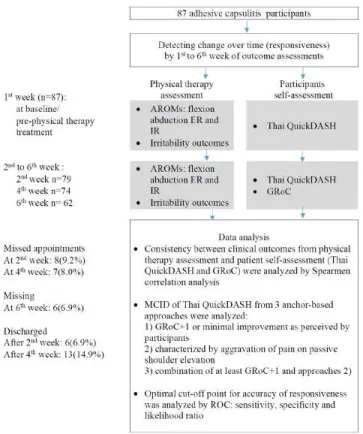
For consistency of clinical outcomes, physical therapist assessment and participant self-assessment were conducted in parallel. Four assessments were recorded pre-treatment to provide a base line (in the 1st week)
and after treatment in the 2nd, 4th, and 6th week. The
physical therapist (JR) recorded 2 clinical outcomes, including GH active range of motions (AROMs), as standard examination and irritability outcomes. All AROMs were repeated three times and measured by a digital inclinometer with tolerances of ± 0.1°. The intra-rater reliability test of all AROMs was presented in a previous study.12 Test-retest reliability results were good
to excellent (ICC3,1: 95% CI range from 0.835 to 0.987). The duration of symptoms from their onset was also recorded. Irritability outcome evaluation was adapted from diagnosis of tissue irritability level,5 and was used as
an objective outcome assessment in this study. Irritability outcome is composed of irritability level and pain pattern. Irritability level was categorised into three levels on a numeric rating scale comprising a 10 cm-straight line with even gaps; zero is no pain and 10 corresponds to extreme pain. High irritability level was 7-10, moderate level was 4-6, and low level was 0-3. Pain pattern was also categorised based on the extent of pain during the night and during passive shoulder elevation. Patterns of pain at night were subcategorised as: consistent throughout, intermittent, and no pain. Pain during passive shoulder elevation was also defined as aggravated before end range, at end range, and overpressure into end range. The data collection procedure is shown in Fig 1.
Fig 1. Flow chart of procedure.
most severe difficulty or inability to use the arm actively. The GRoC 7-point Likert scale was used as a standard external anchor to rate change after each treatment. A GRoC of zero was considered as unchanged. GRoC+1, +2, and +3 represented minimal, moderate, and large improvements respectively. In contrast, GRoC -3, -2, and -1 indicated perception of deterioration. New recording forms and Thai QuickDASH questionnaires were used for each assessment, thus previous outcomes were blinded to the physical therapist (JR) and participants.
Data analysis
Only completed Thai QuickDASH questionnaires were analysed, representing completion of 10 of the 11
items. All participants’ outcomes were analysed for each follow-up. To determine improvements in irritability outcome from the adhesive capsulitis baseline, data was analysed using Chi square. The average AROM for each motion was recorded. Repeated measures for improvement of AROMs were analysed using ANOVA and Bonferroni correction methods with expected significance values of p < 0.05. Consistency between self-assessments and physical therapy assessment outcomes were analysed using Spearman’s correlation. The MCID was reported by median and 95% CI on changes of Thai QuickDASH score. The anchor-based method was used to determine MCID and responsiveness. The anchor-based analysis used three approaches based on two specific criteria from this study. In the first approach, MCID was defined as GRoC+1, or minimal improvement as perceived by participants. In the second approach, MCID was defined by passive shoulder elevation, physical therapy and characterised as no pain or aggravation of pain (either before end range, at end range, or with over-pressure into end range). The third approach was a combination of a rating of at least GRoC+1 and the second approach. Comparisons of MCID and responsiveness from all approaches were analysed. To detect all measures of responsiveness in this study, MCID and ROC analysis were conducted on all outcomes of completed follow-up after treatment in the 2nd, 4th, and 6th week. ROC,
area under the curve (AUC), sensitivity, specificity, and likelihood ratio (LR) analysis was used to produce an optimal QuickDASH cut-off point between high and low disability, for adhesive capsulitis during the six weeks of physical therapy.
RESULTS
The characteristics of the 87 adhesive capsulitis participants are shown in Table 1.
TABLE 1. Characteristics of the participants.
Characteristics of participants (n=87)
Gender: Male/Female n (%) 22 (25.3) / 65 (74.7)
Age (years) Mean (SD) 55.1 (6.2)
Duration of symptom (weeks) 19.8 (15.2)
Pain intensity Median (95%CI)
Resting pain (NRS 0-10) 0 (0-2)
Fig 2 shows that participants had irritability levels distributed from high to low levels, as shown by the baseline of irritability outcome (A). The overall presentation of pain pattern is shown in (B) and (C). Compared to baseline, significant improvements (p < 0.001) were found in irritability level, pain pattern, and AROM in flexion, abduction, ER, and IR after six weeks of treatment. Thai QuickDASH scores for each follow-up showed consistently significant values with regard to improvement (p < 0.05) (F). Spearman’s correlation coefficients (rho) revealed significant correlation between participant self-assessments and physical therapy assessments (p < 0.05), these ranged from low to moderate (0.2-0.638 or less than 0.7), as shown in Table 2.
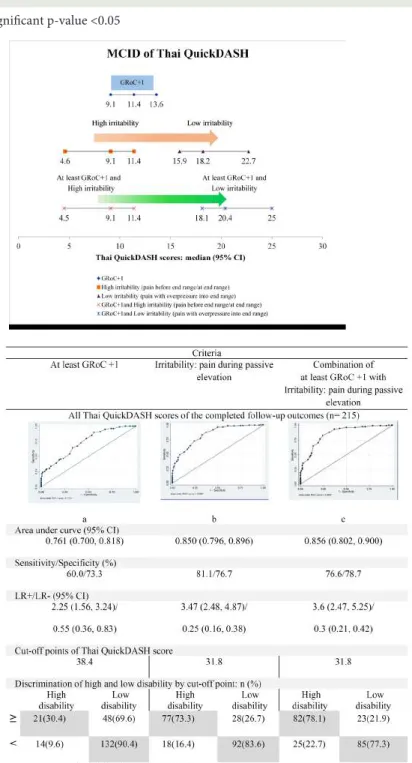
The MCID of Thai QuickDASH by participants who expressed minimal improvement (GRoC+1), ranged from a score of 9.1 to 13.6 (Fig 3). For cases of pain aggravated with overpressure into end range by passive shoulder elevation (lower irritability), the MCID was at least 15.9. For participants that showed improvement, but where pain was more easily aggravated than the pain presented before end range or at end range (higher irritability), the MCID score was at least 4.6. The score resembled the MCID of QuickDASH, defined by the combination criteria of pain presented before end range, or at end range with at least a score of GRoC+1. Alternatively, the combination criteria of at least GRoC+1 with physical therapy assessment of pain with overpressure into end
range, the MCID was a trade-off and was at least 18.1. All 215 of the completed follow-up outcomes were used in the ROC analysis (Fig 4). The QuickDASH cut-off point for disability of adhesive capsulitis by at least GRoC+1 was 38.4. Sensitivity and specificity were 60.0% and 73.3%, respectively (Fig 4a). For the next cut-off point, 31.8, based on the criteria of physical therapy assessment where pain presented with overpressure into end range, the sensitivity and specificity were 81.1% and 76.7%, respectively (Fig 4b). The score of 31.8 was the same value as the cut-off point defined by the combination criteria of at least GRoC+1 of pain presented with overpressure into end range, and here sensitivity and specificity were 76.6% and 78.7%, respectively (Fig 4c). In the comparison of AUCs, the highest AUC (95% CI) was 0.856 (0.802, 0.900) obtained by the third approach. LR+ (95% CI) was 3.6 (2.47, 5.25) and LR- was 0.3 (0.21, 0.42). During the 2nd and 4th week, 8 (9.2%) and 7 (8.0%) participants
were absent, respectively, but they returned to physical therapy and continued through to the last follow-up, in the 6th week. In addition, 6 (6.9%) and 13 (14.9%) of the
participants were discharged after the 2nd and 4th week of
treatment because their improvement was acceptable. Their Thai QuickDASH values had reduced from baseline, the median (95% CI) scores of the changes which were 27.3 (52.3; 15.9) and 22.7 (43.2; 11.3), respectively. However, 6 (6.9%) participants who showed no improvement were absent at the last follow-up.
Fig 2. Clinical outcomes of adhesive capsulitis participants: at baseline and the follow-ups
TABLE 2. Correlation between clinical outcomes of participant self-assessments and physical therapy assessments
(total six weeks of follow-ups n = 302).
Physical therapy assessment outcomes
Self-assessment AROM Irritability outcomes outcomes Flexion Abduction External Internal Irritability Pain during Pain at
rotation rotation level passive night
elevation
QuickDASH -0.541* -0.566* -0.358* -0.338* 0.538* 0.638* 0.581*
score
GRoC+1 0.267* 0.332* 0.200* 0.237* -0.346* -0.350* -0.341*
*significant p-value <0.05
Fig 3. Comparison of the minimal clinically importance difference (MCID) of the Thai QucikDASH, measured by different approaches.
DISCUSSION
Clinical outcome evaluation of adhesive capsulitis during six weeks of physical therapy was significantly improved in three ways. Firstly, significantly improved functional outcomes, represented by responsiveness, were greater than the Thai QuickDASH MDC. Secondly, there were three aspects of decreased irritability outcomes: significantly lowered irritability levels, more participants experiencing no pain at night, and pain with overpressure into end range of passive shoulder elevation. Thirdly, increased AROM was observed in flexion, abduction, and internal rotation (although, external rotation was not affected). All of these changes reinforced the consistency of the measurement methods.
The distribution of participant’s characteristics in this study covered all three phases of adhesive capsulitis. Irritability outcomes represented by irritability level, pain at night, and pain during passive elevation showed significant improvement (p < 0.001). The highest degree of consistency between self-assessment outcomes and physical therapy evaluation was observed with Thai QuickDASH and pain during passive shoulder elevation, whereas GRoC revealed lower levels of correlation with all the physical therapy assessment outcomes. These findings suggest that, in adhesive capsulitis, pain during passive shoulder elevation may be another optimal external reference for the analysis of actual change.
In respect of the progression of adhesive capsulitis, the patient gains more function at stages of less irritability. The variety in condition of low to higher irritability which corresponds to the range of MCID may be a more practical measure to assess clinical change.3 Therefore,
we suggest that MCID scores between 9.1 and 20.4 may be a more suitable way to confirm that participants have shown true improvement from baseline, whilst perhaps still suffering from irritability. It is worth noting that this range of MCID included professional information on patient perception. The use of MCID values less than 9.1 are not recommended because they were in the range of MDC (MDC90, or measurement error was 7.4)11 and
a valid MCID has to be at least as large as the MDC.2
Compared to improvements from baseline for less severe conditions, or where pain exists with overpressure, the MCID score was at least approximately 18.1 (twice the lower bound of the MCID). The range of MCIDs in this study, were provided by the longitudinal study design that was suitable for assessing changes across time for adhesive capsulitis.
For discrimination between the high and low disability effects of adhesive capsulitis, the Thai QuickDASH cut-off point of 31.8 was recommended, this was consistently
confirmed by both patient and physical therapy assessment during six weeks of treatment, as shown in the ROC results. The ROC provides an indication of the relationship between Thai QuickDASH and the criteria for defining improvement of outcome and decrease in disability. Three approaches were analysed in this study. The first approach was GRoC, which is recommended as an external standard for measuring change,7 which showed high validation
of clinician and patient-rated change (rho = 0.87).4 The
second approach, which was pain with overpressure into end range on passive elevation,2 evaluated by the physical
therapist, was adapted for quantifying objective assessment. The combination of a rating of at least GRoC+1 and the second approach achieved more consistent outcomes by adjusting the information from both participant perception and professional evaluation. Throughout, internal consistency was confirmed and error from recall bias or bias from over- or under-estimates was under control. As a consequence of the combination approach, specificity was improved to 78.7% and the highest AUC of 0.856 was achieved (95% CI 0.802, 0.900). This also represented true improvement by integrating the overall improvements and led to a decrease in the false positive rate to 21.9%. The AUC gives the range of values in which the true value lies. An AUC of less than 0.5 represents a high chance of incorrectly classifying participants with improvements as positive, and participants with non-improvements as negative; the lower limit of the 95% CI of AUCs for Thai QuickDASH of this study was at least 0.7.
In addition, the LR of any clinical finding is discrimination between patients with and without a specific condition. LR+ increases the probability of an event or outcome, once the test is positive. In contrast, LR- decreases the probability of an event or outcome, once the test is negative. Moreover, LR is defined in terms of sensitivity and specificity as: LR+ = sensitivity/ (1-specificity) and LR- = (1-sensitivity)/specificity. The LR range is from 0 to infinity. In this study, the LR+ and LR- (with upper and lower limits of 95% CI) were 3.6 (2.47, 5.25) and 0.3 (0.21, 0.42), respectively, and this means that improvement during six weeks of physical therapy for adhesive capsulitis, determined by a Thai QuickDASH cut-off point of 31.8, is clinically significant. The discrimination of improved from non-improved participants may be of practical value in clinical situations, and applicable to the progression of adhesive capsulitis. The responsiveness of QuickDASH in this study and Chester et al.,13 were both evaluated by using the GROC
responsiveness being found between improvers and non-improvers. However, some of the methods used were different since we rated clinical improvement of at least GRoC+1, but Chester et al., started with GRoC+2. ROC analysis in this study was used to discriminate high disability from low disability, whereas Chester et al., used this analysis to confirm MCID. In addition, our responsiveness results were anchored by a combination of irritability level and GRoC. Chester et al., used each increment of GRoC. Lastly, our MCID and responsiveness were specific to adhesive capsulitis, not revealed for shoulder pain of musculoskeletal origin as in Chester et al.
Limitations of the study
Our study had some limitations. Passive range of motion was not reported as a clinical outcome, although we implied actual movement of all patients by assessing pain during passive shoulder elevation. A further limitation was that the assessor was not blinded.
Weak correlation of AROMs, irritability outcomes, and GRoC may reflect relative differences of the expected outcomes by patient perception and physical therapist assessment.
CONCLUSION
The specific range of MCID established in this study represented true improvements in irritability outcome from baseline, while the ability to discriminate between high and low disability clarified the severity of functional disability. These MCIDs represented both clinical and statistical significance (p < 0.05). Moreover, these clinical outcomes were achieved by a combination of evaluations from patients’ perception and professional experience. The specific range of MCID and the Thai QuickDASH cut-off point for adhesive capsulitis may optimise benefits for patients.
ACKNOWLEDGEMENTS
We are thankful to all participants, the Faculty of Physical Therapy of Srinakharinwirot University for funding, Asst. Prof. Junya Pattaraarchachai for advice on statistics, and Dr. Jeeranan Rapipong, Dr. Montana Buntragulpoontawee, Dr. Siam Tongprasert, Faculty of Medicine, Chiang Mai University, for permission to use translated Thai QuickDASH for this study. This research did not receive specific grants from funding agencies in the public, commercial, or not-for-profit sectors.
REFERENCES
1. Hsu JE, Anakwenze OA, Warrender WJ, Abboud JA. Current review of adhesive capsulitis. J Shoulder Elbow Surg [Internet]. 2011 Apr [cited 2016 Feb 25];20(3):502–14. Available from: http://www.sciencedirect.com/science/article/pii/ S1058274610003800
2. Copay AG, Subach BR, Glassman SD, Polly DW, Schuler TC. Understanding the minimum clinically important difference: a review of concepts and methods. Spine J [Internet]. 2007;7(5):541–6. Available from: http://www.sciencedirect.com/science/article/ pii/S1529943007000526
3. Kelley MJ, Shaffer MA, Kuhn JE, Michener LA, Seitz AL, Uhl TL, et al. Shoulder pain and mobility deficits: adhesive capsulitis. J Orthop Sports Phys Ther [Internet]. 2013;43(5):A1–31. Available from: http://www.ncbi.nlm.nih.gov/pubmed/23636125
4. Kamper SJ, Maher CG, Mackay G. Global rating of change scales: a review of strengths and weaknesses and considerations for design. J Man Manip Ther [Internet]. 2009;17(3):163-70. Available from: http://www.pubmedcentral.nih.gov/articlerender. fcgi?artid=2762832&tool=pmcentrez&rendertype=abstract
5. Kennedy CA, Beaton DE, Smith P, Van Eerd D, Tang K, Inrig T, et al. Measurement properties of the QuickDASH (Disabilities of the Arm, Shoulder and Hand) outcome measure and crosscultural adaptations of the QuickDASH: A systematic review. Qual Life Res [Internet]. 2013;22(9):2509-47. Available from: http://www.ncbi.nlm.nih.gov/pubmed/23479209
6. Beaton DE, Bombardier C, Katz JN, Wright JG. A taxonomy for responsiveness. J Clin Epidemiol [Internet]. 2001 Dec [cited 2016 Mar 24];54(12):1204–17. Available from: http:// www.sciencedirect.com/science/article/pii/S0895435601004073
7. Husted JA, Cook RJ, Farewell VT, Gladman DD. Methods for assessing responsiveness. J Clin Epidemiol [Internet]. 2000 May [cited 2016 Feb 10];53(5):459–68. Available from: http:// www.sciencedirect.com/science/article/pii/S0895435699002061
8. de Vet HCW, Terwee CB, Mokkink LB, Knol DL. Measurement in Medicine: a Practical Guide [Internet]. Cambridge University Press. Cambridge University Press; 2011. 338 p.
9. Thai translation courtesy of Dr. Jeeranan Rapipong et al, Dept. of Rehabilitation Medicine, Faculty of Medicine CMU, Thailand. Thai QuickDASH [Internet]. Institute for Work & Health 2006-2013. [cited 2017 Feb 8]. Available from: http://www.dash. iwh.on.ca/sites/dash/public/translations/QuickDASH_Thai.pdf
10. Tongprasert S, Rapipong J, Buntragulpoontawee M. The cross- cultural adaptation of the DASH questionnaire in Thai (DASH- TH). J Hand Ther [Internet]. 2014;27(1):49–54. Available from: http://www.ncbi.nlm.nih.gov/pubmed/24100056
11. Viriyatharakij N, Buapli T, Yampraserd T, Siriwanitchaphan W. Upper extremity pain evaluation with Thai version of QuickDASH and numeric pain scale in office workers. J Heal Res [Internet]. 2016;30(1):47-51. Available from: http://www. thaiscience.info/Journals/Article/JHRE/10980369.pdf
12. Ratvongsa J, Viriyathalakij N, Manopanjasiri S. Validity of Thai version of QuickDASH in Adhesive Capsulitis. Chonburi Hosp J. 2017;42(1):11-18.