Toward Specifying Multimedia
Requirements Using a New Time
Petri Net Model
Abdelkrim Abdelli and Nadjib Badache
Computer Science Department, UniversityUSTHBof Algiers, Algeria
In this paper, we define a model dedicated to the specifi-cation of multimedia applispecifi-cations called Preemptive Time Petri Nets with synchronizing transitions(STPTPN)as an extension of T-time Petri nets where time is asso-ciated with transitions. The model is proposed in the general purpose to model a large scale of multimedia requirements. Thus, resource requirement issues are discussed in this paper, and addressed in the model. To deal with, resources are modelled as special places using a new mechanism called preemptor hyperarc
which lets a transition beresource strongly−enabled,
resource−violatedorresource−violating. Moreover, two additional mechanisms are considered: A time suspension mechanism that uses inhibitor arcs associated with stopwatches and synchronization mechanisms that allow the simultaneous firing of a set of transitions(called
Rendezvous), according to different schemes. Compared to other existing models, our model is provided with an adapted semantics, designed to represent clearly and accurately time requirements, as well as the complex resource-preempting mechanisms that are observed in multimedia systems.
Keywords: time Petri net, preemptor hyperarc, synchro-nizing scheme, stopwatch, inhibitor arc, multimedia requirement
1. Introduction
In recent years, several papers were focused on the development of the interactive multimedia documents based on different standards: SMIL [1],Hitime[14],MHEG[13], etc.
In fact, multimedia documents become a power-ful medium of communication integrating dif-ferent media types such as video, audio, ani-mation, text and image, characterized by real time requirements, as well as specific synchro-nisation schemes. These constraints are gen-erally difficult to describe and to handle,
par-ticularly when building large-scale distributed multimedia architectures. Hence, an important issue of the design of a multimedia system is the definition of its temporal and logical struc-ture which will be used later for enforcing the required synchronizations when processing its different components. The capacity to define this structure entails the availability of an ade-quate model capable to specify accurately and clearly all the system requirements.
Given the complexity of multimedia/hyper -media authoring in terms of spatial and tempo-ral synchronizations, formal methods have been widely used for specification, validation and testing multimedia requirements, such as me-dia synchronizations, user interaction, resource allocation, etc. For instance, Petri nets[12]and algebraic specifications have proved to be of very high interest. Thus, extending these for-malisms to handle multimedia and hypermedia requirements has been investigated through dif-ferent works[3, 4, 6, 11, 16, 17].
and complex multimedia hypermedia systems, the model should be able to satisfy some impor-tant requirements[2, 3, 4]:
• The capacity to describe hierarchically the document structures as well as the synchro-nizations levels.
• The capacity to express incomplete timing specifications.
• The capacity to express the user interaction-based synchronizations.
• The capacity to express a media object as logical unit, abstracting its content, without hindering however the capacity of express-ing temporal relations that refer to parts of this media object.
• The capacity to express a wide range of syn-chronization patterns.
• The availability of a formal semantics to-gether with verification techniques for de-tecting potential inconsistencies in large and complex multimedia documents.
• And finally, the simplicity and intuitive na-ture of the modelling concepts provided to the users.
Taking into account the previous requirements, we propose in this paper a new model that han-dles, in addition to logical, spatial and time re-quirements of multimedia systems, two specific issues that are not addressed in other existing models:
a) The model should be able to design the media resource demands providing thereto an adapted resource preempting mechanism, which resolves resource conflicts by means of a given priority order. In such systems, some resources (e.g. audio device, layout) are not mandatory to perform a media pre-sentation. However, the unavailability of a resource handicaps the presentation since the latter will be devoid of information vector, affecting thus the information perceived by the user. On the other hand, a media may violate the resource required for its presen-tation, if held by a media having less priority, even if the latter has not finished its own pre-sentation.
b) The model should consider the semantics in-troduced, for instance, in theSMILlanguage [1]. We think especially of time suspension mechanism encountered when performing
anchor objects, where a media presentation can be suspended for an indefinite time and resumed afterwards.
Consequently, in this paper we define an ex-tension of time Petri nets[16] calledSTPTPN (Preemptive time Petri nets with synchronizing transitions)dedicated to modelling multimedia requirements, usingTPN model extended with specific mechanisms and provided with adapted semantics:
— Taking into account the issue a), the re-sources are modelled as special places, while adapting the firing-rule semantics. Thus, since the resources availability does not condition the transitions firing (i.e., the transition may fire even if the resources are not available), we in-troduce three special events when firing a tran-sitiont:
• The strong event notedt, denoting thatt is fired while getting all the resources required; • A violated event, noted t∗ denoting that t is fired while missing one of the resources required; and
• A violator eventnoted∗t, meaning thatt is fired when violating the resources from other less-priority transitions.
Thus, a new mechanism, which we callpreemptor hyperarc, is introduced to decide what event must be generated when firing a transition. — In our model, a stopwatch[10]is associated with each transition, allowing to start, stop, and resume its time passage, by using classical arcs and inhibitor arcs [20]. This additional mech-anism models the time suspension of a media presentation, as mentioned in b).
demands, we define progressively a general framework by using preemption, inhibition and synchronization mechanisms towards a correct design of the system requirements. Section 4 presents the syntax and the formal semantics of our proposed model, calledSTPTPN( Synchro-nized Transitions Preemptive Time Petri Net). Section 5 shows how the model can be used to specify SMILrequirements. At last, Section 6 compares our model with other existing models.
2. An Overview of some Petri Net Models
Petri nets[12]are powerful models, mainly be-cause they can model both the concurrency and parallelism in a natural way. A Petri net is characterized by a set of places representing the system resources as well as the conditions that govern the occurrence of the system events. Each place is represented by a circle and char-acterized by a number of tokens modelling the number of available resources of a given state also called Marking. On the other hand, the sys-tem events are modelled by a set of transitions represented generally by rectangular boxes: the occurrence of an event, namely, firing a tran-sition, requires the availability of a number of tokens in each entry place(i.e., the number of tokens is stamped on the oriented arc linking the place to the transition). We say then that the transition is enabled or firable for the current
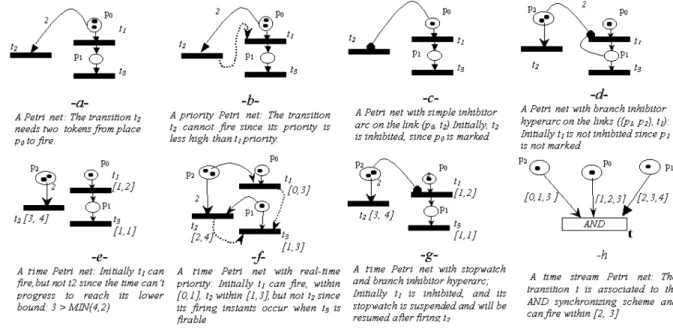
marking. After firing a transition, the tokens in the entry places are consumed while tokens on each exit place(the number of which is stamped on the arc linking the transition to the place), are produced(see Figure 1.a). The main timed ex-tension of Petri net is Time Petri Nets (TPN) [16].
An interval is associated therein, with each tran-sition, in order to allow expressing either delay duration, or event duration. An interval [a,b] means that a transition t can fire after a +δ and beforeb+δ (whereδ representstenabling date), providing thattremains continuously en-abled before, and no firing interval of an enen-abled transition has been overtaken(see Figure 1.e).
Furthermore, many Petri nets extensions have been investigated to resolve non determinism and conflict when different transitions are en-abled and conflicting for the same marking. For example, the priority net [19]defines a bi-nary priority relation (which is assumed to be non-reflexive and anti-symmetric)on conflict-ing transitions. In this model, an enabled tran-sition can fire only if no other trantran-sition with higher priority is enabled for the same marking. Notice that in Figure 1.b, we represent the pri-ority relation by an oriented arc going from the transition of lower priority to the transition of higher priority.
Besides, to avoid inter-blocking and famine sit-uations due to the use of priority mechanism, Abdelli at al. proposed in [22] a mechanism so that the priority assigned to each transition is considered in real time, namely, an enabled transition can fire at instant δ if no other en-abled transition with higher priority can fire at the same instant(see Figure 1.f).
For the same purpose, Petri nets with inhibitor arcs were introduced by Agerwela [20]. The standard execution rule for inhibitor arcs says that an inhibitor arc between condition placep and an event transition t means thatt can only fire ift is unmarked. Recently, authors of [21] introduced inhibitor hyperarcs linking a set of places p1, ...,pk to a transitiont, the semantics
of which means thattis unfirable if all the places are marked (see Figure 1.(c,d)). Inhibitor hy-perarcs do not increase the expressivity of the model compared to inhibitor arcs, but, nonethe-less, greatly improve the convenience of the modelling. To improve the expressivity of time Petri nets, additional mechanisms [9, 18] were introduced with the general purpose of mod-elling scheduling problems where clocks are as-sociated with tasks and which can be suspended, resumed or reset. This clock mechanism named stopwatch has been applied on time Petri nets in[10, 18]so that each transition’s clock can be reset, stopped and started by using classical arcs and branch inhibitor hyperarcs[10] (see Figure 1.g). Moreover, some authors have investigated extension of TPN semantics to different syn-chronizing schemes [5, 6, 11]. In this context, TSPN (Time Stream Petri Net) model [6] has been proposed for modelling complex parallel timed scenarios, and used particularly in mod-elling multimedia systems. This model extends timed link Petri net [8] to the seven synchro-nizing schemes defined in OCPN [11] so that processes are represented with places and their temporal characteristics are represented as arcs labeled with temporal intervals called temporal validity intervals(TVI). These are defined as a 3-tuple[x,n,y], wherex,nandyare, respectively, the minimum, nominal and maximum allowed durations of the related process. There are three fundamental synchronizing strategies in TSPN (see Figure 5.b) which entail nine firing rules obtained from a consistent and complete combi-nation of the absolute temporal validity intervals of arcs associated with a marked transition(see Figure 1.h).
3. Modelling Multimedia Requirements Using TPN
We investigate thereafter how to useTPNmodel for the specification of multimedia requirements. First we show how to model basic media ob-ject and then, progressively, we consider com-plex presentations wherein TPN semantics is extended to preemptor hyperarcs, inhibitor arcs, stopwatches, and finally to synchronization like mechanisms.
3.1. Modelling a Basic Media Object
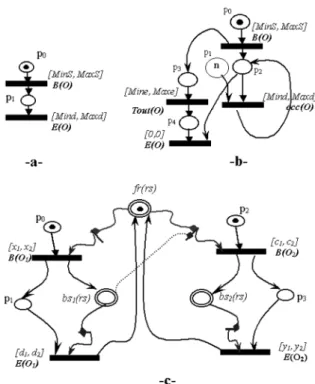
A basic media object denoted O is character-ized usually by two events, its starting event B(O)and its ending eventE(O). Besides, these events can be temporally constrained accord-ing to time requirements linked to the media. Thus, a basic characterization of a media object O can be specified by the TPN of Figure 2.a, where[MinS, MaxS]represents the time delay before the start of the presentation of O, and [Mind, Maxd]delimits the total duration of one occurrence of the media presentation. Notice that the time used here is relative.
However, a complete characterization of media object requirements entails, for instance, to con-sider additional occurrences of the same presen-tation. Within this intention, Figure 2.b shows how this specification can be modelled using a TPN model. We use the place p1 to represent
the number of repetitions to perform, according to the number of tokens(n) contained in place p1.
Once fired, the transition labelled with the event “occ(O)” denotes one occurrence among the repetitions required for the presentation of O. The interval[Mine,Maxe]denotes the time con-straints within which all repetitions have to be performed. Thus, when this timeout is met(i.e., firingtout(O)), the presentation of Ois ended (i.e., the token in place p2 is definitely
con-sumed when firingE(O)).
On the other hand, modelling multimedia appli-cations implies taking into account, in addition to their time requirements, their resource de-mands which are quite different. For instance, audio presentations need the audio device to be user-perceived, whereas video presentations necessitate the availability of the layout to be displayed. However, the availability of such resources is not mandatory to perform the pre-sentation. The latter can occur, even if some resources are not available, but without provid-ing all the information vectors carried by the media. For instance, a video can be shown in its target layout, but its accompanying sound might not be delivered if the sound device is unavailable.
For example, in SMIL presentations [1], the layout is decomposed in different areas called “regions”, a media presentation (text, image andvideo)has to be displayed in one of the de-fined regions. However, several media might be conflicting for the same region. In this situation, the priority is given, for instance by Real one player [7], to the last inserted media tag in the SMILdocument. By the way, for such presenta-tions, the layout seems to be the main resource liable to conflicting situations. Hence, specify-ing the layout time constraints in the model has to be performed accurately in order to achieve a complete specification of the system require-ments.
Therefore, regarding media presentation require-ments and for the sake of simplicity, we assume that, in the model, a presentation can require
only one resource. Notice that associating with each media more than one resource in the model yields a complex modelling which might lead to incoherent specifications.
We model hereafter a resource(a region, for in-stance), as a specific place represented with a double line circle. More precisely, the alloca-tion scheme of a resourcerswill be modelled as a pair(fr(rs), bsi(rs)i=1..p), wherefr(rs)is
a resource place denoting, when marked, thatrs is free; and bsi(rs)i=1..pis a set of resource
places, so that each place bsi(rs) is associated
with a media presentationOi(requiringrs)and
denotes, once marked, that rs is held by the presentationOi.
For instance, Figure 2.c models two media,O1
and O2, which need the same resource rs for
their presentations. Consequently, special arcs linking the placefr(rs)to transitionsB(O1)and B(O2) specify that the start of both
presenta-tions O1 and O2 needs the availability of the
resourcers.
Therefore, we assume that the semantics of a resource place is different from one of the stan-dard place in the sense that, to be enabled, a transition does not need the availability of the required token in its entry resource place (i.e., only tokens in the standard places are required). Note that this working scheme is inspired by players acting likeReal one player and Ambu-lant player[7, 23], and encountered in particular when playingSMILpresentations[1].
Besides, based on our survey made on player functioning, we notice that the time constraints imposed on a media presentation are observed from the date when the media start-event occurs, even if the resources required are unavailable at the beginning.
Therefore, a mediaO1, which is performing its
presentation, might get its resource withdrawn from a media presentation with higher priority O2. Thus, a media is not guaranteed to hold the
resource during its entire presentation.
different event types when firing a transition: — A strong event noted t denoting that the transition t is fired while getting the required resource (i.e., the resource is free when firing t).
— Two special events called violation events: The first event noted t∗(which we call“the vi-olated event”)defining the situation where the transition t is fired when the resource is not free (i.e., the media can’t get its required re-source held by a higher priority presentation). The second event noted∗t(which we call “the violator event”)is generated when a transition is fired when the resource is not free, while vio-lating the resource from a lesser priority transi-tion(i.e., the media preempts a presentation of lower priority, to get its required resource). To model the previous behaviours, we define a new mechanism which we call “preemptor hyperarc”. The latter allows linking, in the in-put, a set of resource places to one transition. It uses two types of simple arcs: a strong arc represented as a continuous oriented arc; and a violator arc represented as a doted oriented arc. Hence, being given a preemptor hyper-arc, the place linked through itsviolator arcis called a “violator resource place”, whereas the place linked through its strong arc is called a “strong resource place”. For instance, in the example given in Figure 2.c, the preemptor arc linked to the transition B(O2), is connected to
the strong resource placefr(rs)and to the vio-lator resource placebs1(rs).
Consequently, a strong eventtis generated when firing a transitiontif its strong resource places are all marked. Otherwise, the violated event t∗ is generated if both strong and violator re-source places are unmarked. Finally, the vio-lator event∗tis generated if no strong resource place is marked, and there is at least one viola-tor resource place marked. By the way, we can notice that the occurrences of strong events as the violated event deal with the input resource places of the linked transition, whereas the oc-currences of violator events deal besides, with the output resource places of transitions of lesser priority. Hence, we assume that each mediaO has a fixed priority denoted byPr(O), and there-fore all transitions involved in the modelling of the same object hold the same priority. We denote therefore by Pr(t)the priority assigned to the transition t. Furthermore, the notation
t1(rs)→t2denotes that the transitiont1has got
its resourcersviolated by the transitiont2, and
this necessarily implies thatPr(t1) Pr(t2).
Note: According to the hypothesis made pre-viously that a media presentation may require at most one resource, we assume that each pre-emptor hyperarc can contain at most one strong arc and each resource place contains at most one token. Moreover, to be coherent with the previ-ous hypothesis, we admit that an occurrence of aviolated event t∗ can’t produce a token in its output resource place since the resource is no longer held by the fired transition.
For example, Figure 2.c models two presenta-tionsO1andO2 in conflict for the resourcers,
whereon we assume that O2 has priority (i.e., Pr(O1) Pr(O2)). To model the resource
allocation scheme, we use four preemptor hy-perarcs: Two of them are linked to transitions B(O1) andB(O2)meaning that both media O1
andO2 need the availability of the resource rs
to start their presentations(i.e., a strong event is generated if the placefr(rs)is marked). Other-wise, if the resourcersis unavailable for one of the two presentations,(the resource placefr(rs) is unmarked and one of the resource places bs1(rs) or bs2(rs) is marked), then only O2,
which has priority(modelled using the violator arc linked to the resource placebs1(rs)), might
withdrawrsfromO1, violating thus the resource rs: E(O1)(rs)→B(O2) (i.e., theviolator event
∗B(O2)is generated since the violator resource
place bs1(rs) is marked). The other two
pre-emptor hyperarcs are linked to the transitions E(O1) and E(O2) denoting that the
presenta-tions of O1 and O2 need to hold the resource rs throughout the presentation. Hence, if the resource placebs1(rs)is unmarked when firing E(O1), a violated event is generated, denoting
that the resourcershas been withheld fromO1
by O2 during its presentation. Notice that in
the example in Figure 2.c, only E(O1) can be
violated since O2 has priority. To model the
case where no presentation has priority, (i.e., Pr(O1) = Pr(O2)) we need to add a violator
arc going from the resource placebs2(rs)to the
transitionB(O2), namely both presentations can
Note: For a given marking, only one place amongf r(rs),bs1(rs),bs2(rs)should be marked.
To highlight the semantics of the proposed mech-anism, we give hereafter all possible scenarios in terms of events sequence obtained when per-forming the presentations O1 and O2 as
mod-elled in Figure 2.c:
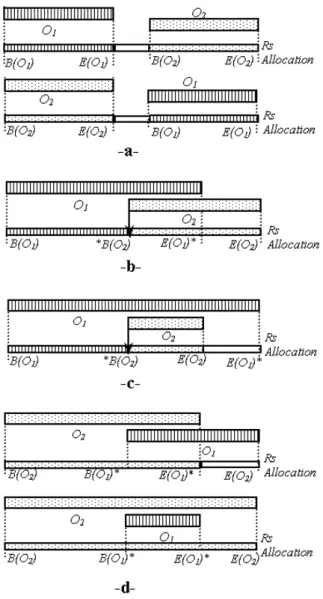
— B(O1) →E(O1) → B(O2) → E(O2) and B(O2) → E(O2) → B(O1) → E(O1): both
scenarios model the case where the presenta-tionsO1 andO2are not overlapping according
to their time requirements (i.e., the presenta-tions are performed in sequence). In this con-figuration, transitions are fired while generating strong events, since the strong resource places are marked(see Figure 3.a).
— B(O1) → ∗B(O2) → E(O1)∗ → E(O2):
In this case, O1 starts its presentation first(i.e.
Figure 3.Resource allocation schemes.
the strong eventB(O1)is generated sincefr(rs)
is marked) then, O2 needs to violate the
re-source ofO1 to start its own presentation (i.e.,
the violator event ∗B(O2) is generated since fr(rs) is unmarked while bs1(rs) is).
How-ever, to express thatO1has got its resource
vio-lated during its presentation, the viovio-lated event E(O1)∗ is generated sincebs1(rs)is no longer
marked E(O1)(rs) → B(O2). Finally, firing E(O2) generates a strong event since bs2(rs)
was marked after firing B(O2). Further, fr(rs)
will be marked again only after firingB(O2)
be-cause firingE(O1)as a violated event does not
produce token infr(rs) (see Figure 3.b). — B(O1) → ∗B(O2) → E(O2) → E(O1)∗:
This scenario is the same as the previous one, but we consider here thatO2 finishes first. As bs1(rs)becomes unmarked after firing∗B(O2);
the generated eventE(O1)∗denotes that the
me-diaO1has got its resource violated byO2during
its presentation(see Figure 3.c).
— B(O2) → B(O1)∗ → E(O1)∗ → E(O2)
and B(O2) → B(O1)∗ → E(O2) → E(O1)∗:
Both scenarios describe the case whereO2starts
first. Consequently, the mediaO1 can’t get the
resource required for its presentation i.e., the vi-olated eventsB(O1)∗andE(O1)∗are both
gen-erated since fr(rs) and bs1(rs) are unmarked
denoting that O1 could not get the resource rs
from the start and therefore for the whole pre-sentation(see Figure 3.d).
Notice that the preemption mechanism can be extended for more than two objects. For in-stance, let O1, O2,. . ., Op be a set of media
objects that are conflicting for the same re-source rs, and let’s assume that Pr(O1). . . ≺ Pr(Oi). . . ≺ Pr(Op). Hence, to model a
gen-eral preempting process, we need to consider first the resource allocation scheme given by (fr(rs),bsi(rs)i=1..p)wherefr(rs)is marked
initially and connected as an input to all tran-sitions B(Oi) (i = 1..p) using strong arcs,
de-noting that the objects Oi i = 1..p need the
availability of rs to be performed. Therefore, each resource place bsi(rs) is connected as an
output to transition B(Oi) using standard arc,
and as an input to E(Oi) using a strong arc.
Thus, if bsi(rs) is marked, it denotes that the
resource rs is held by the object Oi. Besides,
violator arc gives the right to B(Oj) to violate
transitions of lesser priority, when the required resource rs is held by one of them, namely, when there is one among the resources places {bsi(rs)i=1..j−1 which is marked.
Other-wise, if the resource is held by a higher priority object (i j), B(Oj) cannot get the resource
since there is no violator arc linking the resource placebsi(rs)to transitionB(Oj).
3.2. Modelling a Link Object
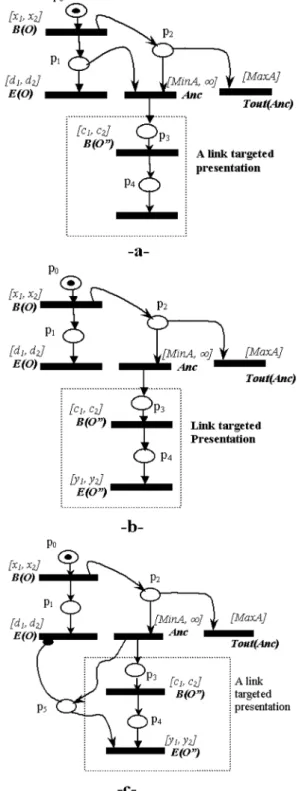
A link object is an anchor associated with the presentation of a media object. Therefore, an interval [MinA,MaxA] delimiting the time constraints within which the anchor must be available can be specified. Thus, if the user “may clickon the Anchor, the presentation tar-geted by the link is started and the behavior of the old presentation can take different courses [1]:
• The presentation is stopped and replaced by the linked one.
• The presentation continues to be shown par-allelly with the new one, but in a different context.
• The presentation is paused and will be re-sumed once the new presentation ends.
The first case can be modelled as in Figure 4.a, where the current presentation O is linked to a presentation O through an anchor, which is available after startingO, during the time inter-val [MinA,MaxA]. The transition Anc models the user interaction event, which mayfire only afterMinA. Hence, to model the weak seman-tics of this event, the time interval associated here with the transitionAncis[MinA,∞]. This is because the occurrence of the event Anc is not mandatory and may not occur. Thus, firing the transitionAnc consumes the token in place p1, implying to stopOand to start the new
pre-sentationO. Otherwise, if the user interaction could not occur beforeMaxA, the event transi-tion Tout(Anc) denoting the timeout linked to the eventAncis fired, thus removing the avail-ability of the latter(the anchor is no longer dis-played).
Figure 4. Modelling a link object.
The second case can be modelled as the first one, but while removing the arc linking the placep1
to the transitionAnc(see Figure 4.b).
Finally, the third case is more complex since it implies the use of a mechanism which has the capacity to stop the time progression for some transitions and to resume it afterwards. To deal with it, we consider the stopwatch mecha-nism[10]which associates with each transition in the model a clock which could be started, stopped, and reset. Therefore, as in [9], in-hibitor arc mechanism is used to decide about the action to apply on the transition’s clock. This configuration can be modelled as in Fig-ure 4.c, where the place p5 is added to trigger
the inhibition of E(O), once marked. The in-hibition of E(O)provokes the time suspension of its stopwatch, which will be resumed once the transition E(O) is fired (i.e., the firing of E(O)will consume the token in the place p5,
thus removing the inhibition ofE(O)).
3.3. Modelling Synchronisation Requirements
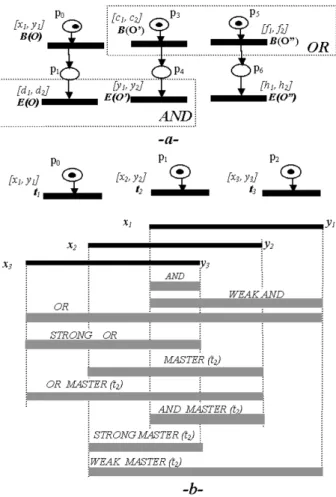
In addition to previous requirements, the model should be able to handle media presentations that require a synchronizing requirement. Thus, events’ synchronization (which we call ren-dezvous) is performed when firing simultane-ously their related transitions according to a pre-defined scheme. For instance,Senac et al[5, 6] have defined different synchronizing schemes between several actions which occur in paral-lel. This proposition, which is adopted in our model, offers three basic synchronization strate-gies(see Figure 5.b):
• Dynamic synchronization strategiesAnd, Weak-And, And-Master driven by the latest transition that gets its minimum bound. • Dynamic synchronization strategies,Or,
Strong-Or, Or-Masterdriven by the earliest transition that gets its minimum bound. • Static synchronization strategiesMaster,
Strong-Master, Weak-Masterdriven by a se-lected transition also called the master tran-sition.
For example, Figure 5.a shows three media pre-sentationsO,OandOwhich have to synchro-nize as follows: The start of bothOandOhas
to be synchronized according to theORscheme,
which means that the transition betweenB(O) andB(O)which fires first, provokes the firing of both, even if the time constraints of the other one are not satisfied. On the other hand, it is assumed that the end of the presentationsOand O must occur in synchronous manner, which means thatE(O)fires only ifE(O)can fire on the same date.
Note: Only the transition which is not inhib-ited can synchronize. Hence, a rendezvous which gets one of its transitions inhibited cannot fire. Therefore, a rendezvous can occur even if one of its transitions is violated, since the re-source availability is not mandatory to perform the event synchronization.
Figure 5.Synchronization schemes.
order set previously to resolve the conflict be-tween resource-conflicted transitions when fir-ing a rendezvous.
On the other hand, additional places and transi-tions may be used to ease the modelling when necessary. For instance, when performing se-quential and parallel composition of several ob-jects. In these specific cases, synchronization and time requirements that concern more than one object (a block of objects)is held by these transitions (e.g. transitionsSynand B(par2)in
the application example of Section 5.3.
4. Synchronizing Transitions Preemptive Time Petri Net
In this section we introduce a new Petri net model, dedicated to multimedia requirement specification. This proposition is based on the survey presented in the previous section and aims to provide a general framework which can be used to model a large range of multimedia applications. First we present the syntax of the model, and then its formal semantics.
4.1. STPTPN Syntax
Definition 4.1. An STPTPN model ( synchro-nizing transitions preemptive time Petri net) is defined by the tuple (P,T,Res,B,F,M0,FI, IH,PH,RDVs,RDVm,Pr), where:
— PandTare two finite disjoint sets of places and transitions respectively;
— Res is a finite set of special places repre-senting the resources;
— B and F are two functions called back-ward and forback-ward incidence functions such that: B : P×T −→ N and F : (P∪Res)×T −→ N. However, we assume that F(r,t) ∈ {0,1} when r ∈ Res i.e. the resource places are 1-marked:r∈Res F(r,t)1, namely a transition is linked in its output to at most one resource place using a standard arc;
— M0is a function called the initial marking,
so that: M0 : (P∪Res) −→ N. We assume,
therefore, thatM0(r)∈ {0,1}whenr∈Res;
— FI is a delay interval mapping function which associates with each transitiont ofT an interval defined onQ+ ×(Q+∪ ∞). Thus,FI
gives the time interval within which the transi-tiont can fire: FI(t) = [EFT(t),LFT(t)]with EFT(t)LFT(t). The interval is delimited by an earliest firing timeEFT(t), and a latest firing timeLFT(t), taking values in the set of rational numbers;
— IH is the inhibitor arc function defined fromP×T −→N, so that there is an inhibitor arc linking the place p to the transition t, if IH(p,t)=0;
— PH is a finite set of preemptor hyperarcs: each hyperarc is a tuple (srp,Vrp,t) where t ∈ T is a transition, srp is an input resource place from Res, called strong resource place, and Vrpis a set of input resource places from Res, calledviolator resource places, where we assume thatVrp∩srp =∅, and the number of t-input strong resource places is at most equal to one i.e. the number of preemptor hyperarcs linked to each transition is at most equal to one.
— RDVs denotes a finite set of simple ren-dezvous. Arendezvous RsofRDVshas the form (typ,{t1, . . . ,tr}), where{t1, . . . ,tr}is a set of
transitions fromT andtypdefines the synchro-nization rule and takes one of the following val-ues: typ∈ {And, Weakand, Or, Strong−Or};
— RDVmis a finite set ofmaster rendezvous.
Amaster rendezvous Rmis given by(typ, {tm}
⇒ {t1, . . . ,tr})so that{tm} ∩ {t1, . . . ,tr}=∅,
where t1, . . . ,tr and tm are transitions from T, and typ defines the synchronization rule which takes one of the following values: typ ∈ {Master, Or−Master, And−Master, Weak− Master, Strong−Master}. The transition tm
is denoted by MA(Rm), and called the master transition;
— Pr: is a priority function assigning for each transition a priority level,Pr : T −→ N. This order operates when the transitions synchroniz-ing for a rendezvous are in conflict for same resources. In this case, the defined order deter-mines which transitions get the resources while firing the rendezvous.
4.2. STPTPFormal Semantics
The STPTPN model progresses at each step by firing a rendezvous, denoting the occurrence of an event’s synchronization. Hence, firing a rendezvous is conditioned by its correspond-ing synchronization rule which entails to fire simultaneously all its transitions, taking there-fore into account the time constraints as well as the availability of the required resources, in order to determine what event’s types should be generated when performing the rendezvous.
Definition 4.2. LetMbe an accessible marking: — A transitiontis said to beenabled for the markingM, if and only if the number of tokens in M in each t input standard place is greater or equal to the valuation of the arc between this place and t: ∀p ∈ P, B(p,t) M(p). We de-note thereafter by Te(M) the set of transitions enabled forM.
— A transition is said to be inhibited by the marking M if it is enabled and one of its in-hibitor arcs is enabled: t ∈ Te(M) ∧ ∃p ∈ P, IH(p,t) M(p). We denote by Ti(M)the set of transitions that are inhibited forM. — A transitiontis said to bestrongly enabled for the markingMif it isenabled, notinhibited, and its input strong resource place is marked: t ∈ Te(M) ∧ t ∈/ Ti(M) ∧ (∀ v ∈ PH, v = (srp,Vrp,t), M(srp) = 1). We denote by Ts(M) the set of transitions strongly enabled forM.
— A transition t is said to be violated for the marking M if it is enabled, not inhibited, and both input strong and violator resource places are unmarked: t ∈ Te(M) ∧ t ∈ Ti(M) ∧ (∀v ∈ PH, v = (srp,Vrp,t), ∀r ∈ {srp} ∪Vrp,M(r) =0). We denote byTv(M) the set of transitions violated forM.
— A transition t is said to be violating or (preempting)for the markingMif it isenabled, not inhibited, its strong resource place is un-marked and at least one of its violator resource places is marked: t∈Te(M)∧t ∈/ Ti(M)∧t∈/ Tv(M) ∧ t ∈/ Ts(M)We denote thereafter by Tp(M)the set of violating transitions forM.
Note: We can notice that both strongly enabled and violated transitions are decided by the avail-ability of tokens in their input resource places whereas violating transitions deal in addition to its input resource place with the output resource places linked to transition with lesser priority.
On the other hand, we suppose that the model is aT – safenet: for any marking, a transitiontis at most 1−enabled(A marking cannot enable the same transition several times).
Notation 4.1. LetRDVbe the set ofrendezvous that might fire in the model. This set con-tains rendezvous fromRDVsandRDVm, as well
as the set of asynchronous rendezvous denoted RDVa. An asynchronous rendezvous Ra is a
single transition ofT, which is not involved in any rendezvous ofRDVs∪RDVm.
Let R be a rendezvous from RDV, we denote thereafter byTrans(R)the set of synchronizing transitions inR.
Definition 4.3. LetMbe an accessible marking of anSTPTPN:
— A rendezvous R is said to beenabled for the markingM if all its transitions are enabled for M and we denote by enable(M) the set of all rendezvous of RDV that are enabled for M. enable(M) = {R ∈ RDV | Trans(R) ⊆ Te(M)}.
— A rendezvous R is said to be inhibited for the marking M if it is enabled for M and at least one of its transitions is inhibited for the marking M. We denote by inhibit(M) the set of rendezvous of RDV, that are inhibited for M. Inihibit(M) = {R ∈ RDV | R ∈ enable(M) ∧ (∃t ∈Trans(R), t ∈Ti(M))}. — A rendezvous R is said to be strongly enabledfor the markingM if it is enabled and not inhibited forM. We denote bySenable(M) the set of rendezvous that are strongly enabled for M. Senable(M) = {R ∈ RDV | R ∈ enable(M) ∧ R∈/ inhibit(M)}.
Definition 4.4. (STPTPN state). A state of an STPTPN is a couple S = (M,V), where M is the current marking, and V is a function associating with each enabled transition, a dy-namic interval representing its time constraints: V(t) = [EFTs(t),LFTs(t)]. The initial state of
the model is given by the pair(M0,V0), where M0is the initial marking, andV0associates with
each enabled transition, its static firing interval:
∀t ∈Te(M0) V0(t) =FI(t).
given by TVI(R) = [Lows(R),Ups(R)], where Lows(R)andUps(R)represent the lower bound
and the upper bound of R, respectively. The interval TVI(R) determines the interval of po-tential dates within which R has to fire from state S. Therefore, R can occur from state S at relative date δ if Lows(R) δ Ups(R).
Where Lows(R) andUps(R)are computed
ac-cording to the synchronization rule provided by typ(R):
Lows(R):=
⎧ ⎪ ⎪ ⎪ ⎪ ⎪ ⎨ ⎪ ⎪ ⎪ ⎪ ⎪ ⎩
if typ(R)∈ {And,Wand,Amas,Async}then MAXt∈Trans(R)EFTs(t)
if typ(R)∈ {Or, Sor, Omas}then MINt∈Trans(R)EFTs(t)
if typ(R)∈ {Mas, Smas, Wmas}| ∧(tm =MA(R))then EFTs(tm) Ups(R):=
⎧ ⎪ ⎪ ⎪ ⎪ ⎪ ⎨ ⎪ ⎪ ⎪ ⎪ ⎪ ⎩
if typ(R)∈ {And, Sor, Smas}then MINt∈Trans(R) LFTs(t)
if typ(R)∈ {Wand, Or, Wmas}then MAXt∈Trans(R) LFTs(t)
if typ(R)∈ {Mas, Omas, Amas} ∧(tm =MA(R))then LFTs(tm)
.
However, the above formulae can compute three types of intervals according to the time con-straints of the transitions that are synchronizing for the rendezvous:
— A temporal validity interval of a rendezvous is coherent, if 0 Lows(R) Ups(R) thus
providing the interval of dates within whichR might occur.
— Otherwise, the computed interval might be empty(incoherent)if 0 Ups(R) Lows(R),
describing the behavior wherein R cannot fire since its synchronizing scheme could not be per-formed, being given the time constraints of its synchronizing transitions.
— The interval might be temporally inconsi -stent ifUps(R) ≺ 0 Lows(R), denoting the
case where a rendezvous has its interval over-taken by the time passage before its enabling. This situation models a blocking state wherein a synchronizing event could not be provided in due time for its rendezvous, leading to a tem-poral violation. Hence, states modelling such inconsistencies are called temporally inconsis-tent states, and are determined formally within the space of accessible states, using next defini-tion.
Definition 4.6. (temporally inconsistent state).
A state S = (M,V), is said to be temporally inconsistent if the upper bound of the tem-poral validity interval of a strongly enabled rendezvous has been overtaken by the time passage (i.e., its value is negative): ∃R ∈ Senable(M) Ups(R)<0.
Contrary toTPNwhere time constraints related to transitions are strong, inSTPTPNthese con-straints are weak, namely, a transition is never forced to fire within its interval. It depends on the synchronizing rule of the corresponding rendezvous. However, a rendezvous is forced to occur within its validity interval and firing R implies to have all its transitions enabled. Thus, time passage can overtake the transition interval before the enabling of its related ren-dezvous. As the temporal validity interval ofR is computed from the intervals of its own tran-sitions, the upper bound of the computedTVI might be surpassed when R becomes strongly enabled, which yields a time constraint viola-tion represented by the accessible state called temporally inconsistent state. Thus, a tempo-rally inconsistent state models a blocking state wherein no rendezvous can fire since it models a time constraints violation, thus denoting the impossibility for the system to progress. For instance, in the STPTPN in Figure 6, the transitionst2andt3 should fire in synchronous
manner whereast1evolves asynchronously.
Ini-tially, only the asynchronous rendezvousR1 =
{t1} is strongly enabled and can occur within [3,4]. Then all the states accessible are tempo-rally inconsistent since the upper bound of the TVIrelated to rendezvousR2 = (And,{t3,t2})
is surpassed by the time passage. TVI (R2) = [Max(1− δ,0), Min(1−δ,3)] = [0,1 −δ] so that d ∈ [3,4], which leads us to state that: 1−δ <0.
Taking into account the previous hypotheses, next we give a necessary and sufficient con-dition to fire a rendezvous from a temporally consistent state.
Definition 4.7. (firing a rendezvous). A ren-dezvous R isfirable from a temporally consis-tent state S = (M,V) at relative dateδ, if: (i) R is strongly enabled for the marking M; (ii) The time passage reaches the lower bound ofR; (iii)No upper bound of a strongly enabled ren-dezvous has been overtaken and (iv)no lower bound of a strongly enabled rendezvous embed-dingR, is reached: ∃δ ∈Q+ such that:
(i) R∈Senable(M) (ii) 0Lows(R)δ
(iii) δ MINR∈Senable(M){Ups(R)} (iv) δ ≺ MINTransR∈Senable(R)⊂Trans(M) (R){Lows(R)}.
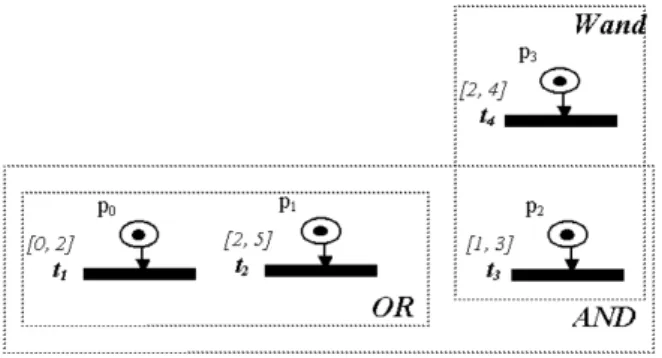
The hypothesis(iv)handles the case where sev-eral rendezvous are sharing same transitions (namely a transition event can occur according to different synchronisation schemes). There-fore, the model can fire a rendezvous Ronly if there is not a strongly enabled rendezvous R embedding R that can fire at the same instant. Otherwise, if the two rendezvous are conflict-ing for the same transition, then the model fires one of the rendezvous in a non deterministic manner. For instance, let’s consider the exam-ple given in Figure 7. Initially, t1, t2, t3 and t4 are strongly enabled, and can fire according
to three schemes: R1 = (Or,{t1,t2}), R2 = (AND,{t1,t2,t3}) and R3 = (Wand,{t3,t4}).
Therefore, the computedTVIof these rendezvous are: TVI(R1) = [0,5], TVI(R2) = [2,2] and TVI(R3) = [2,4]. Hence,R1can fire only when R2 is not firable, namely [0,2]; the priority is
given to R2 since it embeds R1. However, R2
andR3are conflicting fort3and can fire within [2,2]and[2,2]respectively.
Figure 7.Conflicting rendezvous.
Besides, notice that firing a rendezvous R im-plies simultaneous firings of all its transitions (i.e.,t ∈Trans(R)), which yields a new acces-sible stateS where the corresponding marking
M is obtained from M after firing the transi-tions ofTrans(R). As the resource place mark-ing denotes the resource availability, the tran-sitions involved in a firable rendezvous might be in conflict for the current marking; namely, they require the same resources. Therefore, fir-ing a rendezvous implies to resolve the conflict by determining which transition will get the resource needed. The evolution of the mark-ing is carried out by firmark-ing the synchronizmark-ing transitions sequentially from the highest prior-ity one to the least priorprior-ity one, according to Pr. Then, the sub marking computed at each step allows to determine the status of the transi-tion(strongly-enabled, violated, violating)and hence, the event to be generated.
Definition 4.8. LetS= (M,V)be an accessible temporally consistent state. S[(L(R),δ) > S denotes the firing of the rendezvousRfrom state S at relative date δ, so that S = (M,V) is the state accessible, and L(R) is the generated events-label:
— M is computed from M, after firing the transitions ofTrans(R)following their priority order given by the functionPr, starting from the highest priority transition to the lowest priority one.
Let Trans(R) = {t1, . . . ,tn} where, Pr(t1) Pr(t2). . .Pr(tn), and we denote by:
M0[event(t1)]>M1. . .Mn−1[event(tn)]>Mn
the sequence of accessible markings after fir-ing sequentially the transitionst1, . . . ,tn, where M = M0 and M = Mn. Therefore, event(ti)
represents the event induced when firing the transition ti, and could be: a standard event
notedt if the transition is strongly enabledfor Mi−1; aviolated event notedt∗if the transition
is violated forMi−1; aviolator eventnoted∗tif
the transition is violating forMi−1:
events(t
i):=“ti” if ti∈Ts(Mi−1) events(ti):=“t∗i” if ti ∈Tv(Mi−1) events(ti):=“∗ti” if ti∈Tp(Mi−1)
.
Each marking Mi is computed from Mi−1, as a standard way for standard places, and when considering the status of each fired transition for resource places. We assume that the number of tokens in each resource place is bounded by one and that a violated transition cannot produce to-kens in its output resource places:
∀p∈P,
Mi(p):=Mi−1(p)−B(p,ti) +F(p,ti)
If F(r,ti)=0∨ ∃(srp,Vrp,ti)∈PH, r ∈ {srp} ∪Vrp
then
⎧ ⎨ ⎩
If ti∈Ts(Mi−1)then Mi(r):=F(r,t) If ti∈Tv(Mi−1)then Mi(r):=0 If ti∈Tp(Mi−1)then Mi(r):=F(r,t)
else
Mi(r) =Mi−1(r).
— The functionVis computed in three steps: a) Remove the transitions that are disabled for M; these disabled transitions are those enabled by M and not enabled byM, or those enabled for both markings while being in conflict with transitions of rendezvousR.
b) For each transition t that was enabled for M and remains enabled in M, two cases can follow:
* Iftis not inhibited forM, then shiftV(t)by the valueδ towards the origin of time, and truncateV(t)on its lower bound when nec-essary to non negative value:
V(t) = [Max(0,EFTs(t)−δ), LFTs(t)−δ]
* Iftis inhibited for the markingM, then its fir-ing interval remains the same:V(t) =V(t). c) Introduce the transitions that are newly en-abled for M by assigning their static firing in-tervals: V(t) =FI(t).
Note: Notice that the upper bound ofV(t)is not truncated to a non negative value, thus al-lowing to detect temporally inconsistent states. — The label L(R) is given by the set of events generated when firing the transitions synchro-nizing inR:L(R) ={event(t) | t∈Trans(R)}.
5. Application
The SMIL language, which has become the dominant reference for the characterization of multimedia presentations, suggested several works, in particular those related to the study of the consistency of its documents[28]. Algo-rithms based on formal methods were integrated into SMIL authoring tools and SMIL players too, in order to control the consistency of their presentations.
Within this context, in this section we show how to specifySMILdocument requirements thanks to theSTPTPN model. The resource
require-ments are particularly taken into account, em-phasizing a new cause of inconsistency which has not been dealt with in existing approaches that performSMILdocument consistency check-ing.
5.1. SMIL Language
SMIL (Synchronized Multimedia Integration Language) [1] is a declarative language based onXMLdescribing the spatial and the temporal aspects of different media-object presentations. A basic object can be animage, atext, avideo or anaudio clip. Each object is declared using its associated tag, and it is mainly characterized by its own parameters like its identificationId, its URL, its duration, its start, its end, and its target display area(region), etc.
Figure 8.A SMIL multimedia presentation.
5.2. Example
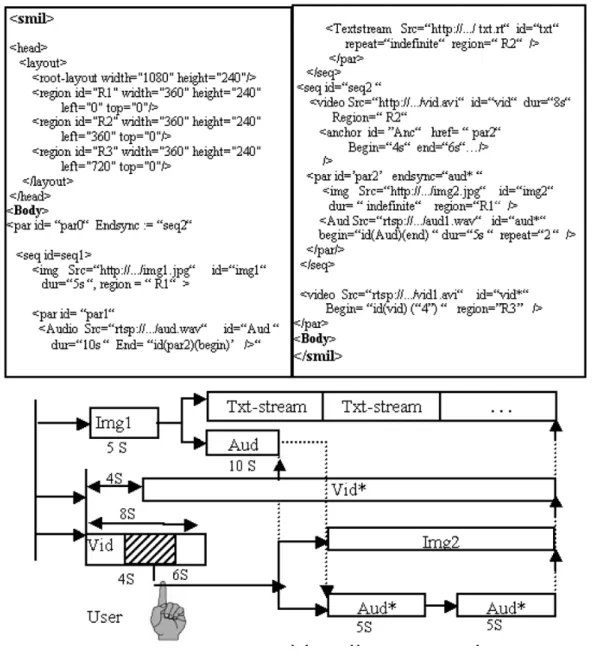
Let’s consider theSMILdocument described in Figure 8, which consists of a sequence seq1,
of an image Img1 followed by a parallel
pre-sentation of an audio clip Aud and of an un-defined number of a text stream Txt. This se-quence must be presented simultaneously with two other sequences: The first of the two se-quences seq2 shows a video clip Vid followed
by the parallel presentation par2 of an image Img2 and a double repetition of an audio clip Aud∗. The other sequence presents a video clip Vid∗ that begins 4s after the start of Vid. We
assume that the duration ofImg1,Aud,Vid, and Aud∗ are, respectively, 5, 10, 8 and 5 seconds,
and that the mediasImg2, Txt andVid∗do not
have an explicit duration.
Besides, notice that the start of the block par2
entails the end of the mediaAud and thatAud∗ must begin when the mediaAudends. Further-more, the presentation of Vid can be stopped by a user interaction, which may occur between 4 and 6 seconds after startingVid. Therefore, it is assumed that the end of the sequenceseq2
is determined by the end of Aud∗ and the end of the whole presentation is determined by the end of the sequence seq2. Hence, the SMIL
presentation finishes when Aud∗ ends. On the other hand, the presentation uses three regions R1, R2 and R3 wherein the media to visualize
andImg2 whereas the regionR2 is allocated to
media Vid and Txt. Finally, the region R3 is
dedicated to mediaVid∗.
5.3. Modelling the SMILRequirements
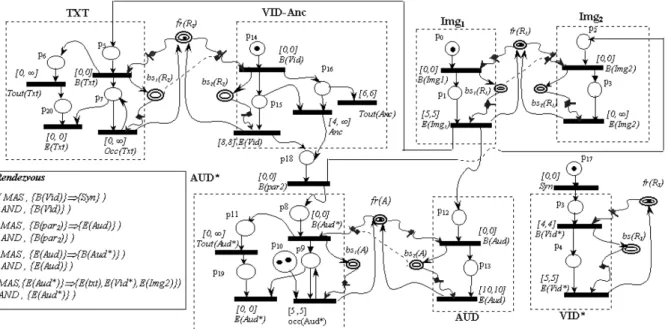
The requirements that concern theSMIL docu-ment given in Figure 8 can be modelled by the STPTPNin Figure 9. The requirements related to each media are described as a single Petri net unit. Then, the various units are organized ac-cording to the structuring schema given in the SMIL document. Initially, the standard places P14, P0 and P17 are marked thus enabling the
starts of the units Vid, Img1 andVid∗,
respec-tively. As regards resource requirements, they are expressed using preemptor hyperarc mecha-nism. Note that the policy of order is established byReal−player[7]by giving the priority to the media tag introduced in the last among the tags of the same block. For instance, mediaVid has priority over the other media for the resources of which it requires for its presentation. By the way, the resources liable to conflict in theSMIL document are of two types:
— The layout resources introduced here, through the three regions denoted by R1 R2
and R3, the allocation schemes of which are
modelled using resources places. For instance, the region R1 is modelled using the set of
re-source places (fr(R1),bs1(R1),bs2(R2)).
No-tice that fr(R1), once marked, denotes that the
regionR1 is available whereasbs1(R1)
respec-tivelybs2(R1), once marked, denotes thatR1is
used to display the media Txt respectively the mediaVid. However, Vid has priority onTxt, which is set using the violator arc going from the resource placebs1(R1)to transitionB(Vid).
— The audio device denoted by “A” is spec-ified using the resource places (fr(A), bs1(A), bs2(A)), and is liable to conflict between medias AudandAud∗.
The SMIL synchronization requirements are specified by the set of rendezvous using the rules AND and MASregarding the semantics of the SMIL language. For this effect, the transition Syn is added in unit Vid∗, to synchronize the starts of both media Vid and Vid∗, sinceVid∗ should start 4 seconds afterVid. Moreover, to model the synchronization between the start of bothImg2andAud∗ (i.e., blockPar2), and the
end ofAud, we add the transition B(par2)
de-noting the start event of the parallel block that has to synchronize with the transitionE(Aud), as required in theSMILdocument.
Notice that the transition,B(par2)is connected
in its input to unitVid and in its output to units Img2andAud∗, following the structuring of the
presentation shown in Figure 8. Moreover, the unitImg1is connected on its output to unitAud
andTxt.
It should be noted that the SMIL synchroniza-tion requirement of typeA:=“B” denotes that eventAcan occur only if the eventBcan occur too. However,Bdoes not need the availability ofAto be performed. This semantics does not exactly match theSTPTPNone. Consequently, we need to express eachSMILsynchronization, using two rendezvous, one for modelling the occurrence of the master synchronization when all events are provided, the second one mod-elling the case where the master event has to occur alone, because of the unavailability of the slave event. For instance, the start of me-dia Aud∗ is decided by the end of media Aud, which is specified by the master rendezvous (MAS, {E(Aud)} ⇒ {B(Aud∗)}). However, if the master scheme cannot be performed, then E(Aud)can evolve in asynchronous manner, ac-cording to the rendezvous(AND,E(Aud)). To summarize, the purpose of this modelling process is to specify the different constraints im-posed on the document. Hence, the availability of an algorithm enumerating the system behav-iors based on the semantics given in Section 4.2 will make it possible to clarify the dysfunctions of theSMILpresentation, the origin of which is a bad characterization of the time and synchro-nization constraints, even of resource conflicts. Identification of the cause of these inconsisten-cies will permit to cure it by carrying out the formatting of theSMILdocument. Besides, an algorithm deriving the reach-ability graph of the model will allow deducing an efficient access pattern which could be used in the management of a pre-fetching scheme that could be set up at different levels(client, Proxy and server)[29].
6. Comparison with Other Models
In this section, we compare theSTPTPNmodel with other existing models, particularly those which have been dedicated to model multime-dia requirements.
— Timed automata [24]: Timed Automata [24, 25]seem to be a powerful model, since they allow expressing many of the seman-tic features introduced in STPTPN, as for instance thestopwatchone [10]. However, timed automata are not dedicated to speci-fication, since they have not the natural ex-pressiveness of algebraic and Petri net mod-els. They are used specifically as an interme-diate model, whereon temporal logics can be
applied for analysing the real time properties of the basic specification[26].
—RT-LOTOS language [27]: Algebraic spec-ifications have been particularly used to mo-del the time requirements of multimedia sys-tems. For instance,RT−LOTOSlanguage, which is one of the most powerful alge-braic languages, has been widely used to model multimedia systems[4, 27]. However, RT −LOTOS is not provided with mecha-nisms like time suspension, as well as re-source preempting mechanisms. Hence, the RT −LOTOSlanguage has been only ded-icated to temporal consistency analysis of multimedia systems, without taking into ac-count the issues considered in this paper. —TSPN MODEL [5, 6]: TSPN, which has
been defined to model weakly synchronous multimedia systems, seems to be the clos-est model to STPTPN. Thus, the compari-son between both models allows us to point out some differences: In TSPN, time inter-vals are associated with ingoing arcs. The TSPN places model the different processes of the system called streams (see Figure 1.h). Each synchronization scheme between different processes is given by a rule asso-ciated with the related transition. Conse-quently, TSPN cannot be considered as a straightforward extension of TPN, Thus, it is not adapted to model event-based speci-fication since each process is modelled as a place. Moreover, some behaviors cannot be modelled easily and naturally with TSPN, leading to ambiguous specification[17]. As a particular case, modelling the resource re-quirements of a process in TSPN is quite fuzzy since the place is used to model a pro-cess. Consequently, as STPTPN allows to take into account the synchronizing schemes introduced inTSPN, and this in addition to some features like time suspension and re-source preempting mechanism, which have not been considered in TSPN, it provides a more powerful and adapted model in the general purpose to model a large range of multimedia requirements, while preserving all the accuracy and the natural expression power that madeTPN, a widely used practi-cal model.
must provide the latter with techniques allowing its analysis and an environment performing the different stages of the verification:
• Proposing an algorithm that allows deriv-ing the reachability graph of the STPTPN model. Within this intention, two issues have to be considered: the first issue deals with the stopwatch semantics which is well known to harden the construction of theTPN reachability graph. Within this context, dif-ferent approaches[10, 18, 30, 31]have been addressed in the literature, aiming to approx-imate and to ease the graph construction. The latter could be adapted in the case of theSTPTPNmodel. The second issue deals with the synchronization semantics that im-plies to extend the existing algorithms [32] to handle more complex firing semantics, • An authoring module with a graphical
inter-face,
• A translator module which parses the multi-media document into anSTPTPNmodel, • An interpreting module allowing to parse
the STPTPN model into its corresponding reach-ability graph and to check therein the properties of the specification,
• A simulator performing simulation tests, by processing a given STPTPN specification, based on the formal semantics of the model.
7. Conclusion
In this paper we defined a new model called STPTPN (Preemptive time Petri nets with syn-chronizing transitions)towards specifying mul-timedia requirements. In this model, the re-sources are modelled as special places while adapting the firing-rule semantics. Thus, we in-troduced three special events when firing a tran-sitiont: (i)Astrong eventnotedt, denoting that t was fired while getting the resource required; (ii)aviolated eventnotedt∗, denoting thatthas its resource violated by a higher priority transi-tion; and(iii)aviolator eventnoted∗t, meaning thattis violating the resource of a lesser prior-ity transition. The priorprior-ity is set by using a new mechanism called preemptor hyperarc, which determines the event type generated when firing a transition. Furthermore, to express time sus-pension mechanism, a stopwatchis associated with each transition which lets time-passage be
stopped, resumed and started, by using classi-cal arcs and inhibitor arcs. Therefore, to model the different synchronization schemes as those defined inTSPN, we consider the simultaneous firing of a set of transitions(calledrendezvous), according to different synchronizing rules. Finally, we have presented theSTPTPNsyntax and formal semantics. Then, we compared our model to other existing models. Further works will lead us to develop an algorithm by adapting existing methods[18, 30, 31, 32]for building the STPTPNreachability graph in order to perform some analysis, thus allowing to check the real time properties and the consistency of multime-dia systems.
8. Acknowledgment
Author A. Abdelli would like to thank Professor Daniel Kayser of Paris XIII university(France), for his support in writing this paper during au-thor’s stay in the LIPN laboratory.
References
[1] SMIL 2.0: W3C Recommendations, SMIL 2.0 Specification.
http://www.w3.org/TR/SMIL20
[2] G. BLAKOWSKI, R. STEINMETZ. A media
synchro-nization survey: Reference model, specification, and case studies.IEEE JSAC, Vol. 14, No. 1, Jan. 1996, pp. 5–35.
[3] M. HAINDL. A new Multimedia synchronization
model.IEEE Journal on selected area in communi-cations, Vol. 14, No. 1, Jan. 1996, pp. 73–88.
[4] J. P. COURTIAT, M. DIAZ, R. C. DE OLIVEIRA, P.
SENAC. Proving temporal consistency in a new
mul-timedia synchronization model. In Proc of ACM Multimedia, Boston Nov. 1996.
[5] P. SENAC. Modeling logical and temporal synchro-nizations.In IEEE JSAC, Vol. 14, No. 1, Jan. 1996, pp. 84–103.
[6] M. DIAZ, P. SENAC. Time Stream Petri Nets: A
model for timed multimedia information.In Proc of the 15th ICATPN, Vol. 815 of LNCS, Zaragosse, Spain, June 1994, pp. 219–238.
[7] Real Player Home pagehttp://real.com
[8] B. WALTER. Timed net for modelling and analysing