ORIGINAL RESEARCH ARTICLE
The Effect of Peer Education in Dispelling Myths and
Misconceptions about Long-Acting Reversible Contraception among
Ethiopian Youth
DOI: 10.29063/ajrh2018/v22i3.10
Fariyal F. Fikree
1*, Worknesh K. Abshiro
2, Murtala M. Mai
3, Kidest L. Hagos
2and Mengistu
Asnake
2Evidence to Action/PATH1; Pathfinder International, Ethiopia2; Evidence to Action/Pathfinder International3
*For Correspondence: E-mail: [email protected]; Phone: 202-804-4636
Abstract
Robust evidence, including systematic reviewsand recommendations from the 2016 Lancet Commission on Adolescent Health and Wellbeing, does not wholly support the unambiguous endorsement of peer-led community-based interventions. This study evaluated the effectiveness of an intensive three-day training for peer educators (PE) on dispelling myths and misconceptions about long-acting reversible contraceptives (LARCs) among Ethiopian youth. Post-training, PEs conducted demand-generation activities with their peers to encourage LARCs referrals. A convenience purposive sampling technique was used to select 20 health centers where peer educators referred clients: 10 each in Amhara and Tigray regions. The health centers were randomly allocated to the intervention (five) and non-intervention (five) study arms. Data were abstracted from the peer educators‘ monthly reporting forms over an 11-month period: 5 months pre-intervention and 6 months post-intervention. Analysis of family planning and LARCs referrals and chi-square tests of association were conducted. Odds of LARCs referrals at pre-intervention (0.96), fell to 0.83 for the post-intervention phase (p-value <0.6). Challenges, largely with data collection and reporting, may have exposed the study to Type II errors. We recommend focused and rigorous data collection in a multi-country 2X2 factorial design cluster randomized holistic intervention (service providers/clinic and PEs/community) trial to comprehensively determine effectiveness on demand for and uptake of LARCs among youth. (Afr J Reprod Health 2018; 22[3]: 90-99).
Keywords: Peer educators, demand generation, youth, family planning referrals, long-acting reversible contraceptive referrals
Résumé
Des preuves solides, y compris des examens systématiques et des recommandations de la Commission Lancet sur la santé et le bien-être des adolescents de 2016, ne soutiennent pas entièrement l‘approbation sans ambiguïté des interventions communautaires menées par les pairs. Cette étude a évalué l'efficacité d'une formation intensive de trois jours pour les éducateurs pairs (EP) sur la suppression des mythes et des idées fausses sur les contraceptifs réversibles à longue durée d'action (CRLDA) chez les jeunes Ethiopiens. Après la formation, les EP ont mené des activités de génération de la demande avec leurs pairs afin d'encourager les renvois des CRLDA. Une technique d'échantillonnage pratique a été utilisée pour sélectionner 20 centres de santé où les éducateurs pairs ont référé des clients: 10 dans les régions d'Amhara et de Tigray. Les centres de santé ont été répartis au hasard entre les groupes d‘intervention (cinq) et non-intervention (cinq). Les données ont été extraites des formulaires de déclaration mensuelle des éducateurs pairs sur une période de 11 mois: 5 mois avant l'intervention et 6 mois après l'intervention. Une analyse de la planification de la famille et des renvois aux CRLDA et des tests d‘association ont été effectués. Les probabilités de référence aux CRLDA lors de la pré-intervention (0,96) sont tombées à 0,83 pour la phase post-intervention (valeur de p <0,6). Les défis, en grande partie avec la collecte de données et les rapports, ont peut-être exposé l'étude aux erreurs de type II. Nous recommandons une collecte de données ciblée et rigoureuse dans le cadre d'un essai d'intervention randomisé (fournisseurs de services / clinique et EP / communauté) de groupes de conception factoriels 2X2 multi-pays afin de déterminer de manière exhaustive l'efficacité des demandes de CRLDA chez les jeunes. (Afr J Reprod Health 2018; 22[3]: 90-99).
Introduction
During peer education, ‗a minority of peer representatives from a population group actively attempts to inform and influence the majority‘1
. Peer educators (PEs) engage in a variety of public health interventions for youth (ages 15-24), including health promotion, and prevention of pregnancies. Systematic reviews2-6 examining the effectiveness of peer education on objective biological outcome measures describe minimal effect, though varying levels of improvement in its effectiveness on knowledge, attitude and behavior has been reported. A systematic review of 24 peer-education interventions5 found a non-significant or negative change, in fertility knowledge, though knowledge related to HIV likely exhibited positive change. Furthermore, 8 of the 24 studies documented success in distributing educational print materials and condoms5. A recent systematic review of 15 adolescent sexual and reproductive health education studies3 in sub-Saharan Africa, evaluating feasibility, social acceptability, and effectiveness, identified only three peer-education programs that met systematic review study criteria; of these, only one study showed positive impact on reducing number of sexual partners and increasing condom use3. In peer-led community-based interventions, the positive influence on HIV prevention and knowledge, and condom use are encouraging, though their influence on fertility knowledge and contraceptive use (other than condoms) are sparse. The 2016 Lancet Commission on Adolescent Health and Wellbeing7 recommended peer education programs as promising and recommended further research in low- and middle-income countries with respect to evidence of impact on safe sex behaviors and health service utilization. Thus, this evidence2-7 does not support unambiguous endorsement of peer-led community-based interventions. Rather, the daunting challenge lies in unpacking the possible factors influencing these peer-education interventions through robust study designs that include process and outcome evaluations.
Responding to Ethiopia‘s Federal Ministry of Health‘s national reproductive health (RH) (2006-2015)8 and adolescent and youth sexual reproductive health (AYSRH) (2007-2015)
strategies9, the United States Agency for International Development (USAID) launched, in 2008, its Integrated Family Health Program Plus (IFHP+). IFHP+ used an integrated model for strengthening RH10: demand generation through PEs at community level and preventive and curative AYSRH services at youth-friendly service (YFS) units11-12 for offering comprehensive and integrated quality SRH services in a ‗safe‘ environment10.
Despite IFHP+‘s success in implementing this strategy13, increasing uptake of long-acting reversible contraceptives (LARCs) was challenging. The Ethiopia Demographic and Health Surveys, 201114 and 201615, however, did convey increased uptake of implants among currently married youth, with differences between the 20-24 age group (2.9%14 to 8.7%15) and 15-19 age group (1.6%14 to 4.9%15).
This paper describes how the LARCs and Youth study supported peer educators to dispel misconceptions about LARCs among their peers; counsel on all contraceptive methods; and refer prospective family planning (FP) clients, including LARCs clients, to YFS units; and assesses PEs contribution to increasing FP referrals, including LARCs (the indicator of primary interest).
Methods
settings), generally on Friday afternoons/evenings. Monthly, PEs conducted coffee ceremonies, an indigenous Ethiopian social platform, engaging youth in discussions about SRH. Also, monthly, PEs compiled and submitted reporting forms documenting their demand-generation activities to YFS providers, and YFS providers conducted review meetings with PEs. Quarterly, YFS providers conducted meetings with health center heads, Health Extension Workers (HEWs), and IFHP+ technical staff to review performance, share best practices, identify problems, and discuss solutions. Annually, IFHP+ offered refresher trainings, with relevant training topics pre-selected, including FP, fistula identification and referral, and gender-based violence.
The study used multi-stage convenience purposive sampling to select the 20 intervention and non-intervention sites from the 43 and 35 YFS units, respectively, in Amhara and Tigray. These 20 sites were randomly allocated to intervention (five sites per region) and non-intervention study arms (five sites per region); details are described elsewhere16.
Intervention approach
LARCs Demand Generation: PEs associated with respective intervention clinics received an intensive three-day refresher training in October 2014 to dispel LARCs myths and misperceptions, refer prospective LARCs clients to YFS units, and conduct routine demand-generation activities described earlier. Regional IFHP+ AYSRH program officers, with the AYSRH Senior Advisor, developed curricula and a training assessment questionnaire and conducted the training. The study trained 250 PEs (Amhara 130; Tigray 120). During the six-month post-intervention period, 50 PEs resigned and 18 were dismissed from the original cohort. The program officers administered the refresher training assessment tool, organized into three modules, at three stages (pre, post, and six months later):
1. Module I: RH/FP knowledge - 6 questions (3 true/false; 3 multiple choice)
2. Module II: FP Counseling - 6 questions (6 multiple choice)
3.
Module III: LARCs (knowledge) - 4 questions (3 true/false; 1 multiple choice)YFS providers LARCs training
This intervention provided LARCs competency-based training and supportive supervision to YFS providers but did not include provision of equipment and supplies for LARCs insertion and removal16.
Non-Intervention approach
PEs affiliated with the non-intervention YFS units received a one-day FP refresher training that included LARCs. They continued their routine FP demand-generation activities, offering condoms and referring clients to respective YFS units.
The analysis of PEs‘ demand-generation activities uses data extracted from the PEs‘ monthly reporting forms and ‗referral source‘ data extracted from the FP service registers at the YFS units. Results also describe PEs‘ demographic profiles and reasons for opting and continuing to be a PE.
Data collection
Chi-squared tests of association were conducted to assess subsequent shifts (pre-intervention to post-intervention phases) in FP referrals (gender disaggregated) among those counseled and referred for LARCs to intervention and non-intervention study arms. Average scores for each of the training assessment modules and paired t-tests for differences in average scores, immediate (pre-post training assessment) and retention (post-training-six months later assessment), were computed. Data were analyzed using SPSS Version 22.
Results
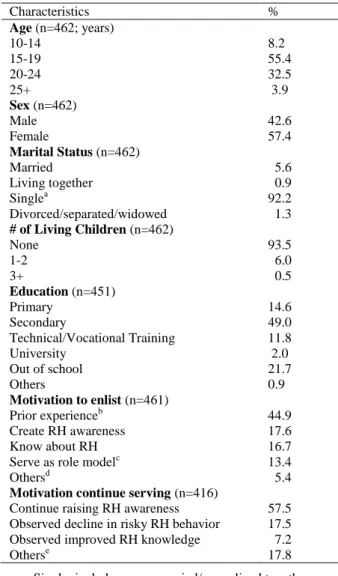
The profile questionnaire was administered to 462 PEs affiliated with the 20 YFS units; 63.6% were adolescents and 21.7% were out-of-school. (Table 1). PEs frequently mentioned prior experience (44.9%) in anti-AIDs or girls‘ clubs, RH awareness creation (17.6%), and acquiring RH knowledge (16.7%) as the enlisting motivating factors:
“I had been member of anti-AIDS club and I had information that many youths exposed to bad behavior, so I want to support them.”
Age 20, single, educated female
“…to understand and help young people to prevent themselves from risky behavior such as „khat‟ use, unprotected sexual intercourse, unintended pregnancy.” Age 20, single, educated male
“I want to save myself from risky behaviors.”
Age 18, single, educated female
Motivating factors to continue as a volunteer were ‗raising RH awareness‘ (57.5%) and ‗observing declining risky RH behavior‘ (17.5%):
“The prevalence of unwanted pregnancy and unsafe abortion in my college is still high and need my effort to reduce it.‖ Age 20, single, college-educated female
Table 1: Percentage distribution of peer educators‘
demographic characteristics and motivation to serve
Characteristics %
Age (n=462; years)
10-14 8.2
15-19 55.4
20-24 32.5
25+ 3.9
Sex (n=462)
Male 42.6
Female 57.4
Marital Status (n=462)
Married 5.6
Living together 0.9
Singlea 92.2
Divorced/separated/widowed 1.3 # of Living Children (n=462)
None 93.5
1-2 6.0
3+ 0.5
Education (n=451)
Primary 14.6
Secondary 49.0
Technical/Vocational Training 11.8
University 2.0
Out of school 21.7
Others 0.9
Motivation to enlist (n=461)
Prior experienceb 44.9
Create RH awareness 17.6
Know about RH 16.7
Serve as role modelc 13.4
Othersd 5.4
Motivation continue serving (n=416)
Continue raising RH awareness 57.5 Observed decline in risky RH behavior 17.5 Observed improved RH knowledge 7.2
Otherse 17.8
a. Single: includes never married/never lived together b. Prior Experience: anti-AIDs club, project, girls club,
school, kebele, or volunteer
c. Role Model: Impressed by, follow or learn from peer educators
d. Others: Interest, serve youth, or support peer educators e. Others: Team spirit, peer educators‘ performance
recognition, youth participation in sessions, encourage youth to join peer educators, working with peers, helping others, client/personal satisfaction
―…to help girls to prevent themselves from unintended pregnancy, HIV and STI.”
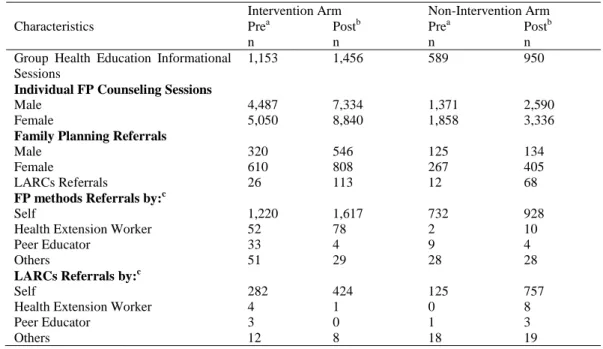
Table 2: Number of health education informational/counseling sessions and referrals (family planning and LARCs); disaggregated by intervention and non-intervention study arms; June 2014 - April 2015
Characteristics
Intervention Arm Non-Intervention Arm Prea
n
Postb n
Prea n
Postb n Group Health Education Informational
Sessions
1,153 1,456 589 950
Individual FP Counseling Sessions
Male 4,487 7,334 1,371 2,590
Female 5,050 8,840 1,858 3,336
Family Planning Referrals
Male 320 546 125 134
Female 610 808 267 405
LARCs Referrals 26 113 12 68
FP methods Referrals by:c
Self 1,220 1,617 732 928
Health Extension Worker 52 78 2 10
Peer Educator 33 4 9 4
Others 51 29 28 28
LARCs Referrals by:c
Self 282 424 125 757
Health Extension Worker 4 1 0 8
Peer Educator 3 0 1 3
Others 12 8 18 19
a. Pre: Pre-Intervention Phase (June - October 2014)
b. Post: Post-Intervention Phase (November 2014 - April 2015) c. Family Planning Register: New acceptors
Table 3: Percentage distribution and odds of family planning and LARCs referrals in the pre-intervention (June-October 2014) and post-intervention (November 2014-April 2015) phases; disaggregated by intervention and non-intervention study arms; June 2014-April 2015
Referrals Intervention Arm (%)
Non-Intervention Arm (%)
Odds of family planning and LARCs referrals in intervention Sites
p-value
Prea Postb Prea Postb Prea Postb
FP: Male 7.1 7.4 9.1 5.2 0.78 1.40 <0.0001
FP: Female 12.1 9.1 14.4 12.1 0.84 0.75 <0.7
LARCs 4.3 14.0 4.5 16.8 0.96 0.83 <0.6
a. Pre: Pre-Intervention Phase (June-October 2014)
b. Post: Post-Intervention Phase (November 2014-April 2015)
―Young people using family planning and condom use is increased as a result of our peer education and counselling activity.‖ Age 22, single, educated female
PEs reported hosting 4,148 group health educational sessions; and 15,782 and 19,084 FP counseling sessions, respectively, with men and women during the 11-month study period. See Table 2 for details reported in the intervention and non-intervention study arms. Non-significant differences in female FP referrals and LARCs referrals are noted, comparing pre-intervention to post-intervention phases. The odds of female
referrals at pre-intervention (0.84) declined to 0.75 for the post-intervention phase (p-value <0.7); and the odds of LARCs referrals at pre-intervention (0.96) fell to 0.83 for the post-intervention phase (p-value <0.6). (Table 3)
Table 4: Peer educator refresher training assessment (n=168); average scores for Modules I, II and III
Modules
Immediate Assessment Retention Assessment
Pre-Traininga
Post-Trainingb p-value
c Post-Trainingb
Six
Monthsd p-value c
Module I: RH/FP Knowledge 5.07 5.36 0.001 5.36 5.33 0.734 Module II: FP Counseling 3.96 4.69 0.000 4.69 4.34 0.002 Module III: LARCs Knowledge 2.67 3.14 0.000 3.14 3.13 0.824
a. Pre-Training: Prior to refresher training (October 2014)
b. Post-Training: Immediately after refresher training (October 2014) c. Paired t-test
d. Six months: Six months after training (April 2015)
numbers referred for FP, or specifically LARCs, in either study arm, as shown in Table 2.
Average scores for each assessment module improved from pre-training scores with, as expected, some decline in average retention assessment scores. Module III (LARCs knowledge) immediate assessment average scores improved significantly (p-value 0.000) whereas the retention assessment average scores depicted a non-significant decline. On the other hand, the decline in Module II (FP counseling) retention assessment average scores was statistically significant. (Table 4).
Discussion
The LARCs refresher training did not effectively alter the number of LARCs referrals made by PEs. Our results indicate a small negative association on the primary indicator of interest—LARCs referrals. The finding that ‗for every 100 women referred for LARCs in the non-intervention study arm, the number of women referred for LARCs in the intervention study arm declined from 90 (pre-intervention phase) to 83 women (post-intervention phase) was non-significant and elucidates lack of compelling evidence of our intervention‘s demand-generation effectiveness.
We could not find a rigorous, evidence-based explanation for this observation. Our underlying assumption for a trajectory of subsequent input, output, and outcome metrics demonstrating the positive influence of PE refresher training, and specifically LARCs training, was a rising pattern in: (a) number of general FP sessions conducted; segueing into (b) increasing individual male or female FP counseling conducted; (c) increasing male or
female FP referrals; and ultimately (d) increasing LARCs referrals. However, the findings depicted an inconsistent, erratic pattern in these postulated sequential metrics reflecting perhaps PEs‘ inconsistent daily activity schedules; their daily demand-generation activities declined substantially during examinations, vacations, and other school-based commitments. For out-of-school PEs, involvement in income-generating or other job-related activities impacted daily activity rosters (Personal communication – IFHP+ technical staff). On the other hand, the service provider intervention (LARCs training, supportive supervision) significantly increased LARCs uptake among new acceptors+16, although most reported ‗self‘ rather than ‗PE‘ as their referral source.
We therefore postulate that the demand-generation strategy contributed to new acceptor growth rate and LARCs uptake, 16 although these findings are not depicted in our results. This reflects, perhaps, PEs‘ inconsistent monthly reporting pattern: fewer or none reporting in one month or more, and then submitting monthly. This postulation could possibly indicate that the PE LARCs refresher training succeeded in dispelling LARCs myths and misperceptions by creating a positive, less stigmatizing environment for LARCs acceptability, and hence succeeded in drawing LARCs out of the taboo sphere for sexually active adolescents and youth, including nulliparous youth.
showed limited long-term effects on contraceptive use, suggesting that long-term effects might only be achieved by implementing peer-led AYSRH programs regularly. Michielsen et al18 identified several factors that might dampen the impact of AYSRH PE strategies, including underlying assumptions about AYSRH PE, appropriate sexual behavior indicators, and the design and implementation of the intervention. In their research, they indicated that effectiveness may increase through integration in holistic interventions and redefinition of PEs as focal points for sensitization and referral for services. Moreover, Chandra-Mouli et al19 argue that piecemeal interventions result in limited effectiveness and recommend coordinated and complementary AYSRH interventions.
Our two-pronged intervention approach— service delivery through LARCs training of providers at YFS units and supportive supervision, and LARCs demand generation by PEs—was holistic. The PEs defined role was sensitization (dispelling LARCs myths and misperceptions) through group and individual counseling sessions and referrals to their affiliated YFS units. We describe sufficiently strong evidence regarding the effectiveness of the LARCs training for YFS providers‘ elsewhere16. However, this paper‘s findings that PEs increased the number of LARCs referrals is not promising. We recognize that there are multiple direct and indirect causal pathways that operate to influence young persons‘ contraceptive behavior and argue that the factors contributing to this weak negative evidence is better explained by poor specificity and sensitivity of the indicators collected rather than a lack of PE effectiveness.
Our results shed light on the motivating factors that we feel might contribute to the potential sustainability of IFHP+‘s PE cadre. The esprit de corps that motivated the PEs to volunteer and continue in their role, we believe, was rooted in either their prior volunteer experience or their knowledge of and ability to create SRH awareness among themselves and their peers; for example, observing positive changes among their peers in reducing risky SRH behavior was a powerful motivating factor. While our results depict PEs‘ strong motivation to continue volunteering, the
non-significant results related to demand generation for female FP and LARCs referrals are, we believe, constrained by other ‗data-related‘ challenges, as described above.
Literature on PEs2-6, 17-19 has seldom examined the motivating factors of PEs. We conclude, albeit tentatively, that the voluntary spirit inculcated in Ethiopian PEs is a powerful facilitator for continuation and sustainability of their work. We therefore recommend that PEs be engaged to complement Ethiopia‘s HEW program. The HEWs conduct demand generation and service delivery at health posts and households, while the PEs reach their peers at schools and universities, coffee ceremonies, and in the waiting areas of YFS units. HEWs work collaboratively and provide technical support to the PEs. While the HEWs program is significantly broader in scope as compared to the PEs program, the complementarity of their efforts will, we believe, contribute to meeting the unmet need for FP among sexually active young Ethiopians through expanded contraceptive choice, including LARCs.
We acknowledge several limitations in the study design and implementation that marred demonstrating the effectiveness of the LARCs refresher training for PEs on demand generation for LARCs. First, data were extracted from PEs monthly reporting forms due to logistic convenience, feasibility, and costs. These monthly reports collected information on a range of input, output, and outcome metrics that described PE activities, but did not capture the change in AYSRH knowledge, attitude, or behavior of the young people they served. Consequently, the indicator for demonstrating the effectiveness of the PEs‘ work on LARCs referrals lacked specificity and sensitivity to gauge the effectiveness of the PEs‘ defined role—dispelling LARCs myths and misperceptions. Community-based knowledge, attitude, and behavioral surveys conducted pre- and post-intervention among the youth catchment population would have generated more compelling evidence.
income-generation schemes, examinations, and school vacations. Moreover, monthly reporting varied inconsistently; while sometimes none of the PEs reported to their respective facility in a month or more, in other instances fewer numbers reported per month, and, at other times, PEs skipped a month or more of reporting but then filed consistently in the months going forward.
Third, discordance between the ‗referral source‘ results from FP registers and the PE forms indicates that one of our data-extraction tools was insufficient to assess peer-led sensitization in contributing to LARC referrals; however, we suggest a more nuanced interpretation rather than solely data-extraction tool inadequacies. Youth, especially younger than 20 or unmarried, might be shy, embarrassed, hesitant, and unwilling to trust an adult provider. They may fear a lack of confidentiality and may not want to reveal their referral source. They may then be more likely to report the non-controversial ‗self‘ rather than their own peers as their referral source (PEs raised these concerns during informal discussions). Hence, we believe that many of the ‗self‘ referrals might, in fact, be ‗PE‘ referrals, as suggested by PEs during informal discussions. Finally, we did not ascertain the quality of the PE sensitization activities, indicating caution when interpreting negative, non-significant findings.
In summary, we have described the many challenges and pitfalls that our peer-led community sensitization and referrals to YFS units encountered, hindering a valid assessment and exposing our conclusions to Type II errors (i.e. concluding non-significant impact when there was one). Our non-significant negative study findings contribute to the insufficient body of robust evidence on the multi-dimensional role that volunteer PEs play in raising FP/RH awareness among youth. The Lancet Commission on Adolescent Health and Wellbeing7 categorized peer education as a ―promising intervention in low and middle-income countries‖ and advocated for ―further research.‖ We recommend a well-funded multi-country cluster randomized holistic intervention (service providers/clinic and PEs/community) trial including 2X2 factorial design cluster randomized trial20-22 that would seek to reduce Type II errors and justify the rationale
for PE programs in equipping all sexually active youth with appropriate knowledge and skills to address their SRH needs in a safe environment.
Ethical Considerations
The study did not include data collection directly from clients, individuals counseled, or PEs; all relevant PE data were extracted from PEs‘ monthly reporting forms, and no identifying information was recorded that linked data to an individual. The assessment questionnaires of PEs directly related to their trainings and meant to inform the program. The interviews were not intended to develop or contribute to ‗generalizable‘ knowledge. The two research assistants were trained to protect the privacy of PEs and keep data confidential.
Acknowledgements
The authors thank Venkatraman Chandra-Mouli, Katie Chau and Regina Benevides for their valuable feedback on the article and to Laurel Lundstrom and Ashley McCampbell for their help preparing the article for submission. The authors are grateful to Bamikale Feyisetan, Abdulmumin Saad, Maernet Mezgebe, Yewondwossen Bitew, Kellali Tsegay, Almaz Bekele, Girmay Adane, Seid Ali, Awala Equar and Tilahun Yimaldu for their significant contribution during the various stages of project design, implementation, data collection and analysis.
Funding Source
US Agency for International Development under the terms of Award No. AID-OAA-A-11-00024 (Evidence to Action and Integrated Family Health Program Plus). The opinions expressed herein are those of the author(s) and do not necessarily reflect the views of Pathfinder International or the U.S. Agency for International Development.
Contribution of Authors
tools, data collection, the write-up, review and edit of the manuscript. All authors read and approved the final manuscript. The opinions expressed herein are those of the authors and do not necessarily reflect the views of Pathfinder International or the U.S. Agency for International Development.
References
1. Svenson GR. European Guidelines for Youth AIDS Peer Education. European Commission. 1998. http://projects.exeter.ac.uk/europeeruk/EUPguide.p df. Accessed August 22, 2016.
2. Harden A, Oakley and Oliver S. Peer-delivered health promotion for young people: A systematic review of different study designs. Health Educ J. 2001;60(4):339-353.
3. Kalembo FW, Zgambo M and Yukai D. Effective adolescent sexual and reproductive health education programs in sub-saharan Africa. Calif J Health
Promot. 2013;11(2):32-42.
4. Kim CR and Free C. Recent evaluations of the peer-led approach in adolescent sexual health education: a systematic review. Perspect Sex Reprod Health. 2008;40(3):144-151.
5. Maticka-Tyndale E and Barnett JP. Peer-led interventions to reduce HIV risk of youth: a review. Eval
Program Plann. 2010;33(2):98-112.
6. Tolli MV. Effectiveness of peer education interventions for HIV prevention, adolescent pregnancy prevention and sexual health promotion for young people: a systematic review of European studies.
Health Educ Res. 2012;27(5):904–913.
7. Patton GC, Sawyer SM, Santelli JS, Ross DA, Afifi R, Allen NB, Arora M, Azzopardi P, Baldwin W, Bonell C, Kukuma R, Kennedy E, Mahon J, McGovern T, Mokdad AH, Patel V, Petroni S, Reavley N, Taiwo K, Waldfogel J, Wickremarathne D, Barroso SC, Bhutta Z, Fatusi AO, Mattoo A, Diers J, Fang J, Ferguson J, Sewamala FS and Vine RM. Our future: a Lancet commission on adolescent health and wellbeing. The Lancet. 2016; 387(10036):2423–2478.
8. Federal Democratic Republic of Ethiopia; Ministry of Health. National Adolescent and Youth Reproductive Health Strategy 2007-2015. http://countryoffice.unfpa.org/filemanager/files/ethi opia/ayrh_strategy.pdf. Accessed March 24, 2017. 9. Federal Democratic Republic of Ethiopia; Ministry of
Health. National Reproductive Health Strategy
2006-2015.
http://phe- ethiopia.org/admin/uploads/attachment-161-National_RH_strat%5B1%5D.pdf. Accessed March 24, 2017.
10.Worknesh K, Nigatu T, Asnake M, Lundstrom L and Mussa A. Peer Educators as Agents of Change: Experience of the Integrated Family Health
Program (IFHP).
http://www2.pathfinder.org/site/DocServer/IFHP_T echnical_Brief_on_Peer_Educators_2014.pdf?docI D=20201. Accessed August 22, 2016.
11.World Health Organization, Department of Maternal, Newborn, Child and Adolescent Health. Making Health Services Adolescent Friendly. Developing National Quality Standards for Adolescent Friendly Health Services. World Health Organization. 2012. http://apps.who.int/iris/bitstream/10665/75217/1/97 89241503594_eng.pdf. Accessed March 24 2017 12.World Health Organization. Global Standards for Quality
Health-Care Services for Adolescents: A Guide to Implement a Standards-Driven Approach to Improve the Quality of Health Care Services for Adolescents. Volume 1: Standards and Criteria. World Health Organization. 2015. http://apps.who.int/iris/bitstream/10665/183935/1/9 789241549332_vol1_eng.pdf. Accessed March 24 2017.
13.Kassie G, David P, Asnake M, Zerihun H and Ali I. Integrated Family Health Program: Endline Household Survey Summary Report. 2015.
http://www.pathfinder.org/publications- tools/pdfs/Integrated-Family-Health-Program-Endline-Household-Survey-Summary-Report.pdf. Accessed August 22, 2016.
14.Central Statistical Agency [Ethiopia] and ICF
International. Ethiopia Demographic and Health
Survey 2011. 2012.
http://www.dhsprogram.com/pubs/pdf/FR255/FR25 5.pdf. Accessed May 30, 2016.
15.Central Statistical Agency (CSA) [Ethiopia], ICF. Ethiopia Demographic and Health Survey 2016. 2017.https://dhsprogram.com/pubs/pdf/FR328/FR3 28.pdf. Accessed August 11, 2017.
16.Fikree FF, Abshiro WK, Mai MM, Hagos KL and Asnake M. Strengthening youth friendly services through expanding method choice to include long-acting reversible contraceptives for Ethiopian youth. Afr J
Reprod Health. 2017; 21(3):37-48
17.Tu X, Lou C, Gao E and Shah IH. Long-term effects of a community-based program on contraceptive use among sexually active unmarried youth in Shanghai, China. J Adolesc Health. 2008; 42:249– 258.
18.Michielsen K, Beauclair R, Delva W, Roelens K, Van Rossem R and Temmerman M. Effectiveness of a peer-led HIV prevention intervention in secondary schools in Rwanda: results from a non-randomized controlled trial. BMC Public Health. 2012; 12:729-740.
19.Chandra-Mouli V, Lane C and Wong S. What does not work in adolescent sexual and reproductive health: A review of evidence on interventions commonly accepted as best practices. Glob Health Sci Pract. 2015;3 Supple 3:333-340.
21. Schulz KF, Altman DG and, Moher D. CONSORT 2010 statement: updated guidelines for reporting parallel group randomised trials. BMC. 2010; 8:18. http://www.biomedcentral.com/1741-7015/8/18.
Accessed April 12, 2017.