Cetisli et al Disable Mothers, Infant- Child Care
African Journal of Reproductive Health December 2018; 22 (4):
81
ORIGINAL RESEARCH ARTICLE
Experiences of Infant and Child Care of Mothers with Disabilities in
Turkey: A Qualitative Study
DOI: 10.29063/ajrh2018/v22i4.9
Nuray Egelioglu Cetisli*, Gulsen Isık, Esra Ardahan Akgul, Ekin Dila Topaloglu Oren, Beste
Ozguven Oztornacı, Hatice Yıldırım Sarı
Department of Nursing, Faculty of Health Science, Izmir Katip Celebi University, Izmir, Turkey
*For Correspondence: Email: [email protected]; Phone: +90 232 3293535-4813
Abstract
Mothers with disabilities have difficulties fulfilling their gender and motherhood roles. The purpose of this study was to determine the infant and child care-related experiences of mothers with disabilities in Turkey. A conventional content analysis was used in this qualitative design. Fourteen mothers with disabilities participated in semi-structured in-depth interviews consisting of open-ended questions about their infant and child care experiences. Three themes and eight subthemes emerged from the data analysis. The themes were: role fulfillment, barriers, and coping and support. All of the women said that they wanted to become mothers, and when they did so, they felt they had fulfilled their roles in society. However, there was a societal misconception that woman with disabilities ‘could not give birth to children or would not properly care for them. Measures should be taken to eliminate negative social perceptions of mothers with disabilities. Public support should be provided to meet the needs of mothers with disabilities. (Afr J Reprod Health 2018; 22[4]: 81-91).
Keywords: Motherswith disabilities; child care; infant care; qualitative research, Turkey
Résumé
Les mères handicapées ont des difficultés à remplir leurs rôles liés au genre et à la maternité. Le but de cette étude était de déterminer les expériences vécues par les mères handicapées en matière de soins des nourrissons et des enfants. Une analyse de contenu conventionnelle a été utilisée dans cette conception qualitative. Quatorze mères handicapées ont participé à des entretiens approfondis semi-structurés qui comprenaient des questions ouvertes sur leurs expériences en matière de soins des nourrissons et des enfants. Trois thèmes et huit sous-thèmes ont émergé de l'analyse des données. Les thèmes étaient les suivants: accomplissement du rôle, obstacles, adaptation et soutien. Toutes les femmes ont déclaré vouloir devenir mères et ont eu le sentiment d'avoir rempli leur rôle dans la société. Cependant, la société croyait à tort que les femmes handicapées ne pourraient pas donner naissance à des enfants ou ne s‘en occuperaient pas correctement. Des mesures devraient être prises pour éliminer les perceptions sociales négatives des mères handicapées. Un soutien public devrait être fourni pour répondre aux besoins des mères handicapées. (Afr J Reprod Health 2018; 22[4]: 81-91).
Mots-clés: Mèreshandicapées; garde d'enfants; soins aux nourrissons; recherche qualitative, Turquie
Introduction
Disability is the limitation or inability to fulfill the role(s) expected from a person due to an inadequacy related to age, gender, and social and cultural factors1. According to the results of a household survey conducted by the World Health Organization (WHO) in 59 countries between 2002 and 2004 reflecting 64% of the worldwide population, the rate of disability was 15.6%
Cetisli et al Disable Mothers, Infant- Child Care
African Journal of Reproductive Health December 2018; 22 (4):
82
the results of the Population and Housing Censuspublished by the Turkish Statistical Institute (TURKSTAT) in 2011, the rate of the population older than the age of three who had at least one disability was 6.9%. A gender-related analysis of the TURKSTAT report revealed that the disability rate was 5.9% in males and 7.9% in females4.
Women with disabilities suffer many problems such as economic inequality, not receiving recompense for their work and inadequate educational facilities. Inadequate legislation and service on medical care and rehabilitation, discriminatory attitudes and behaviors are also other crucial problems that disabled people face. In addition to these, architectural and environmental obstacles to access to social services and activities are other issues that disabled people suffer. They also have problems fulfilling and sustaining their reproductive and motherhood roles1,5. In all societies, women are expected to thoroughly fulfill their motherhood roles. In Grue and Laerum‘s study of 30 mothers with physical disabilities in the 28-49 age groups, the participants stated that having a child played an important role in being accepted by their society. They also stated that being a mother drew other people‘s attention away from their disability; others viewed them as a mother rather than as a disabled person6.
Children who interact with their environment throughout their lives engage in these interactions first with their parents, especially with their mothers in the home environment. Women with disabilities may have difficulties in fulfilling their baby‘s and/or children‘s care and may need support1,7,8
. Therefore, family members, friends, and health personnel tend to discourage women with disabilities from having children. In a study of 24 women with disabilities and 25 health personnel working in childbirth and reproductive health units, Smith et al.9 found that women with disabilities faced various social, behavioral and physical obstacles accessing these facilities. According to the same study, health personnel believed that the over-willingness of disabled women to have children might increase their exposure to sexual abuse and because women with
disabilities had no sexuality, they did not need to access reproductive health units9. It was also reported that nurses referred women with disabilities to advanced maternity services in the same city or to maternity services in other cities because they thought that these women were unprepared for birth and were afraid of giving birth, which posed more difficulties for disabled women with limited mobility9. A qualitative study by Morrison et al. of 27 women with disabilities who gave birth in the last decade reported that the women considered becoming pregnant and having children as normal and preferred to give birth at home because health professionals were unprepared to provide women with disabilities health care services in maternity units10. Health professionals should provide guidance, support, and facilitation to women with disabilities during the preparation for and transition to motherhood11. The quality of the relationship and interaction between the mother and child is of great importance for the child‘s healthy growth and development. The mother‘s mental health and capacity for the motherhood role is one of the factors affecting the quality of this relationship. Children who spend most of their time with their primary caregivers (usually their mothers) are most affected by their childhood environment, and what they learn from their parents in the home environment affects their psychomotor, cognitive, language, and social-emotional development12,13. Despite the high rates of parenthood among adults with disabilities, there is little research on their experiences5. The goal of the present study was to determine the infant and child care-related experiences of mothers with disabilities in Izmir, Turkey.
Methods
Cetisli et al Disable Mothers, Infant- Child Care
African Journal of Reproductive Health December 2018; 22 (4):
83
not be revealed through structured discussions.The depth interview method allows the in-depth investigation of previously uninvestigated, complex, and sensitive topics through one-on-one interviews.
This study was conducted with mothers who had a child and were registered with orthopedic, hearing, and visually disabled associations in Izmir, Turkey. Thirty-two disabled mothers with a child registered with 15 associations were admitted to the study. Inclusion criteria were a) orthopedically disabled, visually disabled, or hearing disabled, b) having a child, c) mothers who were not mentally retarded, d) mothers with no psychiatric disorders, and e) consent to participate in the study. Participants were accepted into the study until a data saturation point was reached and the study was eventually completed with 14 disabled mothers. Eight of the participants were orthopedically disabled, four were sight disabled, and two were hearing disabled.
Data were collected through 14 semi-structured in-depth face-to-face interviews that were conducted between May 2015 and December 2016. To ensure the validity of the interview form, opinion of professional experts, who were specialized on subjects of disabilities, women‘s and child‘s health, were asked. A pilot interview was then conducted with three mothers with disabilities and the interview guide‘s final form was established. The final form had open-ended questions related to the child care experiences of disabled mothers (Table 1).
To provide a quiet and comfortable atmosphere for the in-depth interviews, they were conducted in the participants‘ homes or in an appropriate room at the association. Each interview required an average of 60-75 minutes. All of the interviews were recorded using a digital voice recorder after the participants‘ permission was obtained. While one of the researchers conducted the in-depth interviews, the other observed and maintained the interview records.
The data were analyzed using conventional content analysis. The records were transcribed verbatim right after the interviews. No one except the researchers could listen to the audiotapes on which the interviews were recorded.
While the interviews were transcribed, the mothers‘ and children‘s names were not used. Each mother‘s voice recordings were assigned numbers that referred to a different mother.
In this study, 161 pages of data were analyzed and transcribed. The data were analyzed by each researcher and grouped according to their semantic similarities. Code names representing their characteristics were assigned. Throughout this period, the numbers and depths of the code names changed many times. As a result, a code list was prepared to help group the content of the interviews. These codes gathered and analyzed the common properties that were elucidated. The thematic coding process was completed by categorizing the data. The codes were grouped according to their content integrity, and main themes and subthemes that might represent these codes were generated. The data were organized according to these themes, and the research findings were reported by providing examples14.
Credibility, transferability, consistency, and validity criteria were provided to ensure the study‘s validity and reliability. To assure reliability, strategies such as depth-focused data collection, expert analysis, and participant confirmation were accepted. While one researcher conducted the in-depth interviews, the other participated as an observer. The researcher avoided leading questions and was careful to utilize summarization and concretization principles appropriate to communication rules. The interviews were conducted in a silent room where the participants felt comfortable and their privacy was ensured. At the end of the interview, the results were provided to the participant and her confirmation was obtained.
Cetisli et al Disable Mothers, Infant- Child Care
African Journal of Reproductive Health March 2018; 22(1):
84
Table 1: Semi-structured interview questions1. How would you describe motherhood?
2. Could you please explain your positive experiences in child care? 3. What were the difficulties you had with your child care?
4. Could you please explain who was supportive and how they were supportive in your child care?
5. According to you, what kind of support do disabled mothers need for child care?
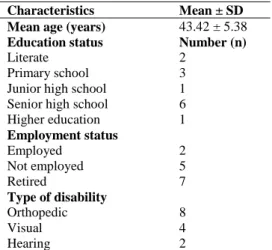
Table 2: Characteristics of mothers with disabilities in Izmir, Turkey (n = 14)
Characteristics Mean ± SD Mean age (years) 43.42 ± 5.38
Education status
Literate Primary school Junior high school Senior high school Higher education
Number (n)
2 3 1 6 1
Employment status
Employed Not employed Retired
2 5 7
Type of disability
Orthopedic Visual Hearing
8 4 2
Results
The mothers‘ mean ages were 43.42 ± 5.38 years. Six were high school graduates and seven were retired. Two were hearing disabled, four were visually disabled, and eight were orthopedically disabled (Table 2).
The main themes (role fulfillment, barriers, and coping and support) and subthemes were determined during the in-depth interviews conducted to determine the study subjects‘ child care experiences (Table 3).
Role fulfillment
Perceptions of motherhood
According to the study subjects, motherhood was a wonderful feeling. It meant ―self-sacrifice,‖ ―responsibility,‖ or an ―indescribable feeling.‖ One of the participants stated that being a disabled mother increased her emotionality and was different from being a non-disabled mother. She said she displayed more tolerant disciplinary attitudes toward her children.
If you have a disability and become a mother, you become more emotional. We are different from non-disabled mothers ... we don‘t have the heart to punish our children ... if the child does not do what we ask them to do, we cannot insist on that ... (Interview #4; the mother is visually disabled and has a 4-year-old child).
According to one of the subjects, disabled women want to be mothers similar to any other woman. She felt that when a woman with a disability becomes a mother, she fulfills her task in society.
It is a very beautiful feeling. As any woman, women with disabilities‘ wishes to become mothers are very strong ... When we give birth, we regard ourselves as having fulfilled our task in society ... (Interview #11; the mother is orthopedically disabled and has a 20-year-old child).
Concern and difficulty with the caregiver
role
One of the visually disabled mothers stated that her children without visual disabilities were guides for her. She thought that she was a burden to her children.
Normally, children are burden to the mother, they mess up the rooms, mothers clean up their rooms, but it is just the opposite in our house ... I am a burden to my child ... I know he is more responsible than other children, and this makes me sad (Interview #10 the mother is visually disabled and has a 19-year-old child).
Cetisli et al Disable Mothers, Infant- Child Care
African Journal of Reproductive Health March 2018; 22(1):
85
Table 3: Main themes and subthemes related to child care experiences of mothers with disabilities in Izmir, TurkeyRole fulfillment Barriers Coping and support
Perception of motherhood Stigma/social perception Exchanging roles and using technological devices Concern and having difficulty in
caregiver role
Environmental and structural factors Struggle and success
Fear Obtaining support
stated that her child started to speak late because of her disability.
One of the problems we have is the child‘s having a high fever, as we cannot measure the temperature when the child has fever ... (Interview #5; the mother is visually disabled and has a 2-year-old child).
She couldn‘t speak last year ... she started speaking recently ... she‘s always speaking using sign language, she does not speak normally. She started to speak rather late (Interview #9; the mother is hearing disabled and has a 4-year-old child).
Fear
Most of the study subjects were afraid that they would not provide safety for their children due to their disability and that there should be someone else to support them. The visually disabled mothers stated that they had to be in constant physical contact with their children or they had to be very careful.
I was afraid that my son might get lost or something might happen to him because I am blind ... once I went to a concert with him ... while I was singing on the stage, he disappeared ... when I came off the stage my son wasn‘t there. I was in panic; when I looked for him I found him ... for a visually disabled mother, to look after a child alone is very difficult ... (Interview #10; the mother is visually disabled and has a 19-year-old child).
Most of the orthopedically disabled mothers thought that there may be safety issues and that their children could be kidnapped because of their mobility problems and inability to follow their children.
Because I have difficulty getting on public transportation I‘m afraid I might drop my child. I am afraid he might get lost ... So, when I go somewhere I always try to go with my husband ... (Interview #1; the mother is orthopedically disabled and has a 3-year-old child).
One of the study subjects expressed fear that her child might not love her when he grew up. She also stated that she did not go anywhere without him.
I cannot go anywhere without my son because I think if I lose contact with him, we might part company... I have the fear that my son might not love me ... if he doesn‘t want me; if he thinks I am disabled … I‘m afraid that he might leave me ... (Interview #2; the mother is orthopedically disabled and has a 5-year-old child).
Barriers
Stigma/social perceptions
One of the study subjects stated that she and her children had difficulty socializing due to social perceptions and labeling.
It is serious trouble to take the child to the park ... as if your disability were contagious, some parents do not allow their children to play with my child ... we have trouble when we are outdoors ... dealing with over-attention or ignorance of people. The problem is the life outdoors ... (Interview #8; the mother is orthopedically disabled and has a 14-year-old child).
Cetisli et al Disable Mothers, Infant- Child Care
African Journal of Reproductive Health December 2018; 22 (4):
86
experienced some communication problems andfelt helpless in such cases.
The elevator broke down in the shopping center; a lady in the elevator talked about the breakdown and us in good faith. What she said was not important. When we got out of the elevator, my daughter was sobbing and yelled at me: ―I hate you, Mom; I hate your being disabled. I do not want people to communicate with us and talk to us everywhere we go. I want to go into a store, do my shopping, and leave the store silently. Everywhere we go, something happens. I hate you; I do not want to live with you ...‖ (Interview #14; the mother is orthopedically disabled and has a 14-year-old child).
Environmental and structural factors
One of the study subjects stated that their family had problems participating in social activities due to environmental and structural factors. She stated that her child was unhappy because of this.
We cannot go anywhere as a whole family. Because we have two battery-operated wheelchairs, no taxi driver accepts us. We do not have a private car, so we cannot go out. If we want to go out and walk at the seaside, three of us cannot go side by side like other families because the roads are not appropriate. Or if we want to go to a play, we cannot ... (Interview #11; the mother is orthopedically disabled and has a 20-year-old child).
An orthopedically disabled mother stated that when her child was sick, she could not take him to the doctor because of road construction in front of her house, and that people with disabilities were ignored when landscaping plans were made.
The roads were under construction, and my daughter got sick. She was three years old... but I had no way to go out of my house because the road was dug in front of the street door. I had no chance to get out of the house… her aunt signed the papers in the hospital... the doctor used his initiative and
treated her… We communicated with the doctor on the phone. I kept calling. I was very upset that day. You cannot reach your sick child. My child stayed in that hospital for three days; I wasn‘t near her, I just talked to her on the phone ... I would not want that to happen to her ... the most natural right of the child is to be with her parents when she is sick (Interview #8; the mother is orthopedically disabled and has a 14-year-old child).
Coping and Support
Exchanging roles and using technological
devices
One of the orthopedically disabled mothers stated that her non-disabled partner took more responsibility caring for the child. Her husband was skilled in child care, so he watched the children while she worked outside the home.
For example, the doorbell rings and the kids open the door right away. I had the feeling that they might be kidnapped. So, I can sell lottery tickets where I sit; you [she means her husband] quit working at the construction site. We‘ll go on like this, I mean until the kids grow up ... (Interview #3; the mother is orthopedically disabled and has a 1.5-year-old child).
A visually disabled mother stated that the introduction of technological devices for those with disabilities made her life easier and she did not have any trouble raising her child.
I used to think that I wouldn‘t match the colors of the clothes when I dressed my child ... my husband bought me a color-identifying device as a birthday present, and now I don‘t have such trouble. There‘s a talking phone, a computer, and a color-identifying device (Interview #6; the mother is visually disabled and has a 21-month-old child).
Struggle and success
Cetisli et al Disable Mothers, Infant- Child Care
African Journal of Reproductive Health December 2018; 22 (4):
87
noticed although she was unable to see. Shenevertheless managed to handle it.
Well, I noticed it and treated it ... I massaged my son‘s foot and it recovered ... I cannot see, but I managed it (Interview #5; the mother is visually disabled and has a 2-year-old child).
Many of the participating mothers reported that they made arrangements at home to avoid injuring their children. Because they were more cautious about accidents, they had no domestic accidents and tried to do housework especially when the child was asleep.
I did no housework while the child was awake. I waited until he went to sleep. I was doing the housework when he was sleeping. I paid all my attention to him so that he wouldn‘t do anything to harm himself or wouldn‘t fall (Interview #10; the mother is visually disabled and has a 19-year-old child).
One of the participating mothers considered herself sufficiently competent to care for her child.
How a normal person looks after her child, I did the same as he grew up. I said to myself, ―Thank goodness, how well I have managed to look after him although I am physically disabled‖ (Interview #12; the mother is orthopedically disabled and has a 12-year-old child).
One of the participating mothers said she realized that nothing in life was impossible after having a child.
Thanks to my son, I found out that nothing was impossible ... and when I was very tired, I sometimes gave up. In such cases, I used to retreat for a few days. But now I never give up (Interview #7; the mother is hearing disabled and has a 12-year-old child).
All of the mothers participating in this study said that they were successful in fulfilling the motherhood role and caring for their children. They considered themselves adequate in this regard and were happy when this was appreciated by others.
I managed to do everything you do but making tenfold effort. I kept up with everything perfectly, I mean I managed to do everything (Interview #13; the mother is orthopedically disabled and has a 20-year-old child).
The neighbors say, ―Would this disabled woman give birth and take care of the child?‖ ... just to spite them, I take my child clean, sit him on my lap on the balcony, and have him look around. As if to say, I gave birth and I can do what you can do. Am I any different from you? I wanted them to feel like that ... (Interview #6; the mother is visually disabled and has a 21-month-old child).
Obtaining support
Most of the participating mothers stated that they preferred to receive public support rather than support from family, relatives, or friends, and that their health needs should be provided free of charge by the state.
Constantly asking a favor of someone wears you out ... you are worried about being a burden to others ... This can lead to trauma on us (a feeling of a favor of neighbor) ... We demand more public support rather than our neighbors. Our dependence on others affects our psychology. If the service were given by a public organization, if there were legislation on the issue, we would feel freer and more independent ... (Interview #4; the mother is visually disabled and has a 4-year-old child).
A visually disabled mother said that she was worried about teaching reading and writing when her child started school and wanted to receive support from the Ministry of National Education.
When she starts school; I cannot see; how would I teach my child how to read and write? ... for example, the Ministry of National Education can help us (Interview #6; the mother is visually disabled and has a 21-month-old child).
Discussion
Cetisli et al Disable Mothers, Infant- Child Care
African Journal of Reproductive Health December 2018; 22 (4):
88
viewed as a task that a woman, as an adultindividual, must assume15. However, women with disabilities are not expected to become mothers. They are generally regarded as unable to care for children and passive and needing help and social services. From a medical perspective, they are mostly perceived as sick people who are unable to give birth6,16. Buz and Karabulut reported that all the disabled women in their study defined motherhood as a wonderful feeling and stated that they wanted to become mothers as any other woman did, and when they became mothers, they felt that they had fulfilled their societal duties15. In another study, women with disabilities stated that becoming a mother was the best thing that ever happened to them; they were viewed as adults rather than disabled individuals, fulfilled their roles as women in society, and successfully achieved their societal tasks6, this is similar to the findings in this study. In another study, mothers with disabilities declared that they gain self-confidence after giving birth17.
According to the results of the present study, the participating mothers stated that there is a misperception in society that women with disabilities could not give birth and care for children. The results of a study of the experiences of orthopedically disabled women within the context of gender roles in Turkey were consistent with those of the present study. The subjects reported that society objected to women with disabilities having children and this attitude caused such women to be hesitant about having children15. According to the results of the present study, mothers with disabilities wanted to prove that they could care for their children as could non-disabled mothers. Similarly, in another study, because of social perceptions, women with disabilities felt that they had to prove they were able to achieve traditional motherhood roles and they perceived themselves as non-disabled in terms of fulfilling their tasks18. In Malacrida‘s study, a mother with a physical disability stated that she sent her child to school in clean and beautiful clothes because she wanted to prove that she took good care of her child19. Another study investigating the cultural aspects of being disabled found that the greatest fear of mothers with disabilities was being reported to child protective
services when their children cried or when they were unable to carry them. Furthermore, the mothers in that study thought that although there were no complaints about them, child protective services constantly observed them20. As can be seen from the study results, society disapproves of women with disabilities having children and some people believe that they can harm their children. These factors create social pressure on mothers with disabilities.
In the present study, one of the visually disabled mothers stated that her child was a guide, but she was worried that this would have a negative effect on her child and thought that she was a burden to her child. The results of the present study are consistent with those in the literature. Some studies reported that children of parents with disabilities assume responsibilities at an early age and are called ―little helpers‖ or ―parental children‖ and that this had an adverse effect on them6,21,22. A study of children of hearing disabled parents indicated that the children‘s ability to use sign language led them to assume excessive responsibility on behalf of their parents and other hearing-disabled people, which those children considered a burden. The children felt that their roles as interpreters for their hearing-disabled parents placed too much responsibility on them23.
hearing-Cetisli et al Disable Mothers, Infant- Child Care
African Journal of Reproductive Health December 2018; 22 (4):
89
disabled parents was because they assumedresponsibility of taking care of their parents and that their parents could not support their academic achievement23. One of the mothers in the present study stated that she was more emotional and thus had difficulty setting up rules for and being tolerant toward the child. Similarly, a study by Shpigelman reported that a mother with physical disabilities had difficulty saying no to her child and setting limits, which may have resulted from the fact that those mothers resorted to other factors to compensate for their deficiency18. In the current study, the participating mothers stated that they were afraid that their disabilities would compromise their children‘s safety. Similarly, another study on the experiences of mothers with physical disabilities reported that they were worried about their children‘s safety. A physically disabled mother said that when they were at the beach or close to a water source, she tied a rope around her child‘s waist and held the other end to prevent the child from falling into the water6.
Having a disability and feeling helpless can motivate some people. In the present study, one of the mothers with disabilities said that after having a child, she realized that nothing in life was impossible. She also learned not to give up when she encountered difficulties. Mothers in another study stated that their disabilities motivated them to become ―super mothers,‖ and that after becoming mothers, they never capitulated to obstacles, defended their children‘s and their own rights, and overcame all difficulties18. This revealed that the mothers with disabilities developed coping mechanisms to overcome difficulties resulting from their disabilities and thus enjoyed a sense of achievement.
The mothers in the present study stated that being dependent on others or having to ask for help drained and traumatized them; therefore, they demanded public support instead of support from their families, relatives, and friends. They said that receiving state support would help them feel independent. In another study, one mother with disabilities said that it was difficult for her to follow her children on the playground; it was hard for her to depend on someone else in this regard and her husband‘s assuming more responsibility
caused her feelings of remorse. However, these mothers still preferred to appeal to family members rather than receive state support18. Another study reported that within the family, relatives intervened in the way hearing-disabled parents raised their children and tried to undermine their parental authority, Outside the family, teachers or physicians who wanted to communicate with the family preferred to do so with a child or relative without a hearing disability25. That the families with a member having a disability sought public support instead of assistance from close relatives might be due to their fear of losing their parental authority.
Limitations
This study‘s main limitation was the wide range of the children‘s ages. Also, some of the mothers had difficulties remembering their child care experiences.
Conclusion
Cetisli et al Disable Mothers, Infant- Child Care
African Journal of Reproductive Health December 2018; 22 (4):
90
determined that parents with disabilities receivedchild care assistance from their families, which they thought caused a burden; they preferred to receive public support to feel more independent. Measures should be taken to eliminate negative societal perceptions of mothers with disabilities and public support should be provided for these mothers when they need it. The present study is expected to contribute to the literature in this regard. To further contribute to the literature on this subject, it is recommended that more research be conducted on the child care experiences of mothers with disabilities.
Acknowledgments
Authors thank all participants that spared their time to participate and assist with recruitment in the study. Thanks also to The Scientific Research Projects Coordinatorship at Izmir Katip Celebi University for financial support.
Contribution of Authors
NEC and HYS conceived and designed the study. GI, EAA, EDTO and BOO were involved in the data collection. All authors participated in data analysis. All the authors were involved in the writing and review of the manuscript. All the authors approved the final version of this manuscript.
Conflict of Interest
All authors declare no conflict of interest.
References
1. State Institute of Statistics Turkey Disability Survey (2002). Retrieved from Ankara-Turkey. http://www.turkstat.gov.tr/Kitap.do?metod=KitapD etay&KT_ID=11&KITAP_ID=14 2009
2. WHO World Report on Disability. Retrieved from
Geneva. 2011
www.who.int/disabilities/world_report/2011/report. pdf
3. WHO The Global Burden of Disease: Update 2004. Retrieved from Geneva. 2008 http://www.who.int/healthinfo/global_burden_disea se/2004_report_update/en/
4. Turkish Statistical Institute Population and Housing
Census. Retrieved from Ankara-Turkey. http://www.turkstat.gov.tr/PreHaberBultenleri.do?i d=15843. 2011
5. Parish SL, Magaña S and Cassiman SA. It‘s just that much harder: multilayered hardship experiences of low-income mothers with disabilities. Affilia 2008;23(1):51-65.
http://dx.doi.org/10.1177/0886109907310463 6. Grue L and Laerum KT. ‗Doing motherhood‘: some
experiences of mothers with physical disabilities. Disability & Society 2002;17(6):671–683. http://dx.doi.org/10.1080/0968759022000010443 7. Laerum KT and Grue L. Women like us do bear
children: disabled mothers on experiencing healthcare services. Tidsskrift for den Norske Laegeforening: Tidsskrift for Praktisk Medicin, ny Raekke 2003;123(13-14):1852-1853.
8. Parish S and Huh J. Health care for women with disabilities: population-based evidence of disparities. Health and Social Work 2006;31(1):7-15. http://dx.doi.org/10.1093 /hsw/31.1.7
9. Smith E, Murray SF, Yousafzai AK and Kasonka L. Barriers to accessing safe motherhood and reproductive health services: the situation of women with disabilities in Lusaka, Zambia. Disability and Rehabilitation 2004;26(2):121-127. http://dx.doi.org/10.1080/09638280310001629651 10. Morrison J, Basnet M, Budhathoki B, Adhikari D,
Tumbahangphe K, Manandhar D, Costello A and Groce N. Disabled women‘s maternal and newborn health care in rural Nepal: A qualitative study.
Midwifery 2014;30(11):1132-1139.
http://dx.doi.org/10.1016/j.midw.2014.03.012 11. Lawlery D, Begley C and Lalor J. (Re)constructing
myself: the process of transition to motherhood for women with a disability. Journal of Advanced
Nursing 2015;71(7):1672-1683.
http://dx.doi.org/10.1111/jan.12635
12. Özmert EN. Early childhood development and the family. Cocuk Sagligi ve Hastaliklari Dergisi 2006;9(3):256-273.
13. Yılmaz E and Uyanık GB. Analysing child rearing attitudes and parental self-efficacy perception of mothers of preschool children. NWSA-Education Sciences 2014;9(4):394-402.
14. Hsieh HF and Shannon SE. Three approaches to qualitative content analysis. Qualitative Health
Research 2005;15(9):1277-1288.
http://dx.doi.org/10.1177/1049732305276687 15. Buz S and Karabulut A. Orthopedically handicapped
women: a study in the framework of gender. Igdir
University Journal of Social Sciences,
2015;7(1):25-45.
16. Karataş K and Çifci EG. Being a handicapped woman in Turkey: Experiences and suggestion for solution. The Journal of International Social Research 2010;3(13):147-153.
Cetisli et al Disable Mothers, Infant- Child Care
African Journal of Reproductive Health December 2018; 22 (4):
91
pregnancy, childbirth and motherhood: aphenomenological understanding. Midwifery 2012;28(2):156–162.
http://dx.doi.org/10.1016/j.midw.2011.01.003 18. Shpigelman CN. How to support the needs of mothers
with physical disabilities? Disability and
Rehabilitation 2015;37(11):928–935.
http://dx.doi.org/0.3109/09638288.2014.948133 19. Malacrida C. Performing motherhood in a disablist
world: dilemmas of motherhood, femininity and disability. International Journal of Qualitative
Studies in Education 2009;22(1):99–117.
http://dx.doi.org/10.1080/09518390802581927 20. Lipson JG and Rogers J. Cultural aspects of disability.
Journal of Transcultural Nursing 2000;1(3):212-219.
http://dx.doi.org/10.1177/104365960001100308 21. Hobfoll SE. The influence of culture, community, and
the nested-self in the stress process: advancing conservation of resources theory. Applied
Psychology 2001;50(3):337-421.
http://dx.doi.org/10.1111/1464-0597.00062 22. Nosek MA, Howland C, Rintala DH, Young ME and
Chanpong GF. National study of women with physical disabilities: Final report. Sexuality and
Disability 2001;19(1):5-40.
http://dx.doi.org/10.1023/A:1010716820677 23. Seven Y and Göl-Güven M. A language two worlds:
Becoming a deaf mother's hearing child. In Arık E (Ed.). Talking with hands: studies on Turkish sign language. Koç University Press, 2016.
24. Hadjikakou K, Christodoulou D, Hadjidemetri E, Konidari M and Nicolaou N. The experiences of cypriot hearing adults with deaf parents in family, school, and society. Journal of Deaf Studies and
Deaf Education 2009;14(4):486-502.
http://dx.doi.org/10.1093/deafed/enp011
25. Levinger M and Orlev L. What deaf parents ―hear‖. The
Journal of International Social Research