ISSN: 2231-7716
DOI: http://10.24191/ji.v14i2.208 Copyright © Universiti Teknologi MARA
Algorithm
Dang Suria Shariffuddin 1, Nor Azriani Mohamad Nor 2, Balkiah Moktar 3
1
Bachelor of Science (Hons.) Management Mathematics, Universiti Teknologi MARA, 02600
Arau, Perlis, Malaysia
2,3 Faculty of Computer and Mathematical Science, Universiti Teknologi MARA, 02600 Arau,
Perlis, Malaysia
Authors’ Email Address: [email protected], 3[email protected] Received Date: 25 July 2019
Accepted Date: 11 October 2019
ABSTRACT
In present years, many cities face way more challenges than before especially those related to the mobility of people and land usage. Parking management which links transportation and land use is one of the most challenging problems to encounter. Parking can be a nuisance when there is a shortage of available parking spaces, especially during peak hours. The main challenge is the scarcity and management of parking spaces. This is because of the unmet demand due to lack of parking spaces and ineffective use of available facilities. It is a common issue in overcrowding area where drivers need to face this critical situation as the parking spaces provided are not enough to support the increasing number of the automobile on roads due to economic growth. KTMB Ipoh faced the same situation especially during peak hours where the parking area is always congested with drivers who drive in circles to find parking spot. The average time spent by drivers to find the parking spot is estimated to be half an hour. Thus, this research is done to help the parking management team to improvise the efficiency of parking spaces provided to optimize the parking area. Furthermorem the purpose of this study is to maximize the number of parking. A firefly algorithm method is used to find the maximum number of parking lot that can optimize the parking area. It is shown that with the current parking area, the number of parking spaces can be increased by 48 lanes which can optimize the parking spaces to the fullest.
Keywords: firefly algorithm, parking spaces, optimization.
INTRODUCTION
2 determine the optimum number of parking slots by using the firefly algorithm. The focus of this study is at KTMB Ipoh, Perak. This KTMB branch is chosen as it is located at the capital of Perak; Ipoh, where many people gather to go about their business.
RELATED WORKS
i. Parking Problems
There is a need to improve parking spaces to reduce traffic delay due to the bad habit of street parking on the roadside (Munzir et al., 2010). Teichmann et al. (2015) said that mathematics programming offers an effective method to solve problems regarding transportation. A study to solve the problem of parking availability inside the campus has been conducted to find the main factor and solutions to the problem faced by the university community. The ultimate problem faced by most of the community is the availability of parking lot. Thus, Anuradha and Samanta (2017) prepared a survey on what time and where the parking spaces would be fully utilized. Abdelfatah and Taha (2014) intended to design parking lots with an ideal angle to help to utilize space more efficiently. There are three types of parking design proposed by Ibrahim and Ab. Aziz (2017) which are parallel, perpendicular, and diagonal. Abdullah et al. (2012) conducted research on optimizing parking spaces at Dataran Mawar, UiTM Shah Alam by introducing three types of parking designs; parallel parking, diagonal (angle) parking and perpendicular parking.
A study by Mantecchini (2015) presents an effective tool for optimizing size and location of the airport parking capacities. To deal with the critical shortage of parking spaces around the airport terminal (Postorino and Mantecchini, 2014), most airport operators would normally build-remote parking facilities in the outer area. Research done by Chen et al. (2016) discusses the trouble of producing a parking survey in an intelligent way. This is done by the detection of the entrance, exit and parking spaces to occupy the available spots. Chen introduced such a system with the installation of a magnetic sensor where the presence of it enables drivers to find empty slots easily and swiftly. Research by Fraifer and Fernström (2016) makes use of the wireless connectivity to design the prototype by using User Centered Design (UCD) to design a system prototype (IoTcam and server). The detection system for a vacant parking spot will become an efficient way of parking in smart cities or project related to it (Belsare et al., 2016). Duvanova et al. (2016) examined that most designers did not pay attention to the organization of parking lots. Due to that, most cars are not properly parked in the residential area. To overcome such situation, Dike parking was introduced to optimize the organization of parking spaces by maximizing the usage of intrayard space.
ii. Firefly Algorithm
Dr. Xin-She Yang introduced the firefly algorithm in 2007 at Cambridge University. The algorithm is inspired by flashing or mating behavior of fireflies (Hashmi A et al., 2013). Firefly algorithm is classified as one of the methods of swarm intelligence and can be applied to solve optimization problems such as parking optimization, route planning, and travel salesman problem, etc. Wang et al. (2014) describe this algorithm as a new ecology intelligence metaheuristic method where it is inspired by the social behavior of Firefly.
3 on direct current (DC) series motor by a photovoltaic system where firefly algorithm (FA) is employed to find the optimal parameter of Proportional Integral (PI) controller.
METHODOLOGY
The methodology of this study focused on optimizing the number of parking space at KTMB Ipoh, Perak using Firefly Algorithm. The number of parking space area, the current number of parking spaces utilized and measurement for a lane are the constraints used in this study is shown in Table 1. The measurement for a lane is considered fixed since KTMB Ipoh is classified under the “Park and Ride” type which the aim is to encourage less traffic congestion around the KTMB area. The minimum number of parking for “Park and Ride” type is 100 parking lots which implies that the KTMB should provide a minimum of 100 parking lots and the number of parking cannot be below than the benchmark level set by JBPD Ipoh. Currently, KTMB Ipoh provides an extra 33 parking lots that made the total number of parking lots to be 133.
Table 1: Data Summary
Type of Data Data Value Area of parking 2175m2 Measurement of a lane (fixed) 4.8 m x 2.5 m
Current number of parking 133
Based on the data obtained, Firefly Algorithm were applied. First, the objective function for this study is defined as follows:
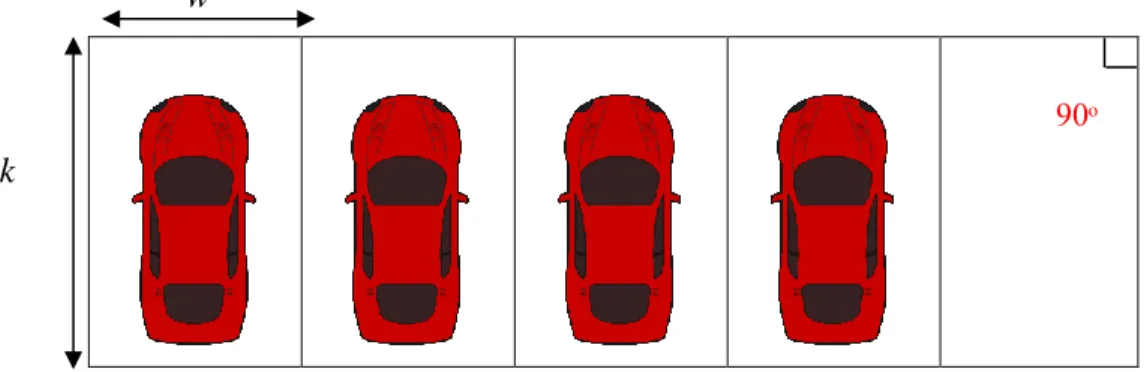
Step 1: All variables such as lane width (w), lane height (k) and area of parking which are related to perpendicular parking design is set up as in the Figure 1.
w
k
Figure 1: Perpendicular Parking Design with Respective Variables (Source: Abdullah et al., 2012)
Step 2: Minimum space for a lane is defined by using the following formulae:
Min space k w
=
(1)where,
4
(
)
(
)
w
lane width fix
k
lanelength fix
=
=
Step 3: Optimization area of parking spaces is calculated as follows:
Area of parking
Number of parking
Min space
=
(2)where,
area of parking
is the total area of parking space provided by KTMB.This objective function will be used in RStudio software to generate the output on the optimum number of parking.
# NOT RUN {
########################### ## Optimizing the parking space
# Define parking function space <- function(X){ return(2175/(12)) }
# Define parameter beta <- 0
gamma <- 1 alpha <- 0.2 numVar <- 2
rangeVar <- matrix(c(-10,10), nrow=2)
# Calculate optimum solution using Firefly Algorithm
resultFFA <- FFA(space, optimType="MAX", numVar, numPopulation=20, maxIter=50, rangeVar, beta, gamma, alpha)
# Calculate the optimum value using parking function optimum.value <- space(resultFFA)
optimum.value
# }
5
RESULT
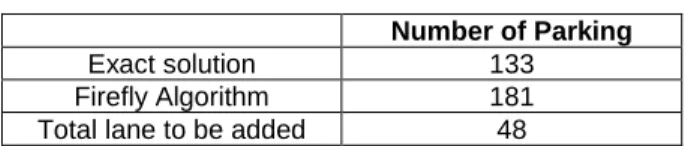
Table 2: Result Summary
Number of Parking Exact solution 133 Firefly Algorithm 181 Total lane to be added 48
The result in Table 2 shows that with the existing area of 2175m2 at KTMB Ipoh, the maximum number of a lane that can optimize the area is 181 lanes. Currently, the number of lanes provided by KTMB is 133 parking. Based on the Firefly Algorithm model, a total of 48 lanes can be suggested to be added to the current number of parking to optimize the available area.
CONCLUSION
Parking lot is an essential element since it gives an impact on transportation system performance. The demand for parking spaces is increasing rapidly due to a large number of vehicles on the road nowadays. Thus, most people encounter a challenge to make use of parking facilities efficiently. This is due to the demand that exceeds supply, causing imbalance between the two elements. According to the result above, the number of parking that can optimize the parking spaces is 181 lanes. The result is compared with the current number of parking which is 133 lanes. The objectives for this study are achieved as the result shows that the current parking can be increased to avoid waste of area as well as optimizing the area. Furthermore, it shows that the FA used in this study is proficient and valid to be used.
REFERENCES
Abdelfatah, A. S., & Taha, M. A. (2014). Parking capacity optimization using linear programming. Journal of traffic and logistics engineering, 2(3).
Abdullah, K., Kamis, N. H., Azahar, N. F. N., Shariff, S. F., & Musa, Z. C. (2012, December). Optimization of the parking spaces: A case study of dataran mawar, UiTM Shah Alam, Colloquium on Humanities, Science & Engineering Research, 684-687.
Ali, E. S. (2015). Speed control of DC series motor supplied by photovoltaic system via firefly algorithm. Neural Computing and Applications, 26(6), 1321-1332.
Anuradha, D., & Samanta, D. (2017, August). A case study on the parking system in Vit University, Vellore Campus. International Journal for Research in Applied Science & Engineering Technology (IJRASET), 5(8), 2310-2314.
Belsare, A., Jawalkar, S., Kachhap, J., & Padwal, R. (2016, March). Vacant parking space detection system. International Journal of Advance Engineering and Research Development, 3(3), 729-731. Chen, N., Wang, L., Jia, L., Dong, H., & Li, H. (2016). Parking survey made efficient in intelligent
parking systems. Procedia Engineering, 137, 487-495.
Duvanova, I., Simankina, T., Shevchenko, A., Musorina, T., & Yufereva, A. (2016). Optimize the use of a parking space in a residential area. Procedia Engineering, 165, 1784-1793.
Fraifer, M., & Fernström, M. (2016). Designing an IoT smart parking prototype system, 1-12.
6 Ibrahim, S., Syahir, A., & Aziz, A. (2017). Customized fitness function of evolutionary algorithm for optimization of car park space. International Journal for Research in Applied Science & Engineering Technology (IJRASET), 5(6), 500-505.
Mantecchini, L. (2015). Optimization of airport parking facilities size, location and connection. ARPN Journal of Engineering and Applied Sciences, 10(2), 753-758.
Munzir, S., Ikhsan, M., & Amin, Z. (2010). Linear programming for parking slot optimization: A case study at Jl.T. Panglima Polem Banda Aceh. Proceedings of the 6th IMT-GT Conference on Mathematics,Statistics and its Applications, 462-472.
Postorino, M. N., & Mantecchini, L. (2014). A transport carbon footprint methodology to assess airport carbon emissions. Journal of Air Transport Management, 37, 76-86.
Rahebi, J., & Hardalaç, F. (2016). A new approach to optic disc detection in human retinal images using the firefly algorithm. Medical & Biological Engineering & Computing, 54(2-3), 453-461.
Teichmann, D., Dorda, M., Binova, H., & Ludvik, M. (2015). Optimization of parking public transport vehicles in Ostrava. Traffic & Transportation, 27(1), 69-75.
Tsuya, K., Takaya, M., & Yamamura, A. (2017). Application of the firefly algorithm to the uncapacitated facility location problem. Journal of Intelligent and Fuzzy Systems, 32, 3201-3208.
Wang, G.-G., Guo, L., Duan, H., & Wang, H. (2014). A New Improved Firefly Algorithm for Global Numerical Optimization. Journal of Computational and Theoretical Nanoscience, 11(2), 477-485. Yang, X. (2010). Firefly algorithm. Nature-Inspired Metaheuristic Algorithms Second Edition (p. 115). Yang, X. S. (2010). Firefly algorithm, stochastic test functions and design optimisation. International
Journal Bio-Inspired Computation, 2(2), 78-84.