98
HERBORIZED PLANTS FROM ARCTIUM GENUS
ENESCU RALUCA1, DINCA MARIA1
1”Marin Drăcea”National Institute of Research and Development in Forestry
Keywords: herbarium, Arctium genus, botanists.
ABSTRACT
Arctium genus contains 65 vouchers within “Alexandru Beldie” Herbarium from Bucharest. All these vouchers are organized in a database that contains information regarding: species, harvesting place, the person that has collected them, harvesting date and the conservation degree. This was followed by a short description of the main species conserved in the herbarium. The oldest Arctium plant dates back to 1875, while the persons who have gathered these plants are renowned Romanian and foreign botanists. The harvesting place of these plants is focused in Romania but complemented by samples from outside its borders, mainly from the origin countries of the foreign botanists that have collaborated with the Romanian specialists. Even though the species of this Genus are mainly considered weeds, numerous studies show important usages in medicine.
INTRODUCTION
„Marin Drăcea” National Forestry Research-Development Institute from Bucharest hosts in adequate conditions a herbarium created in 1929 – “Alexandru Beldie” Herbarium. This collection is inscribed in Index Herbariorum, having the internationl BUCF code and contains approximately 40.000 vouchers (Dincă et al., 2017a; Vechiu et al., 2018a).
The Herbarium contains numerous plant species and genera among which we
mention: 19 Centaurea species (Dincă et al., 2017b); 29 Allysum species (Cântar et al., 2018), 41 Polygonum species (Vechiu
et al., 2018b), 15 Ornitogalum species (Enescu et al., 2017), 15 Veronica species (Dincă et al., 2017c), 80 Trifolium species (Cântar et al., 2018), 69 Potentilla species (Crișan et al., 2017), 19 Scorzonera
species (Dincă and Cântar, 2017), 16
Abies species (Enescu et al., 2018a).
MATERIALS AND METHODS
The research material was represented by a number of 65 vouchers that was then organized in a database. This was then repeatedly sorted based on more criteria, namely: species, harvesting
99
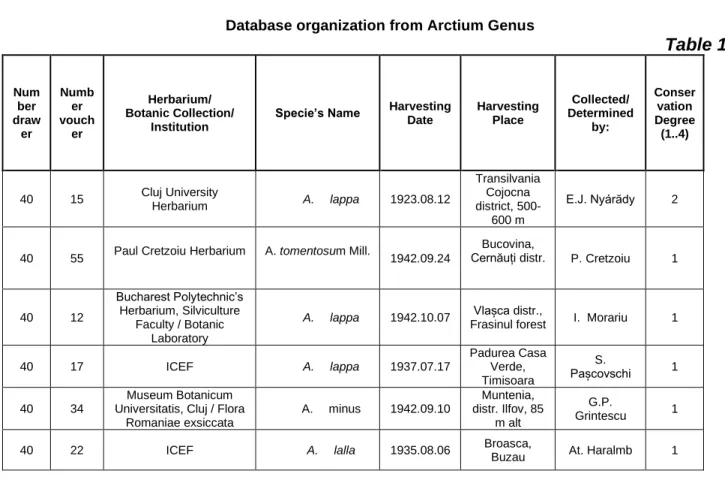
Database organization from Arctium Genus
Table 1 Num ber draw er Numb er vouch er Herbarium/ Botanic Collection/ Institution
Specie’s Name Harvesting Date Harvesting Place Collected/ Determined by: Conser vation Degree (1..4)
40 15 Cluj University
Herbarium A. lappa 1923.08.12
Transilvania Cojocna district,
500-600 m
E.J. Nyárădy 2
40 55 Paul Cretzoiu Herbarium A. tomentosum Mill. 1942.09.24
Bucovina,
Cernăuți distr. P. Cretzoiu 1
40 12
Bucharest Polytechnic’s Herbarium, Silviculture
Faculty / Botanic Laboratory
A. lappa 1942.10.07 Vlașca distr.,
Frasinul forest I. Morariu 1
40 17 ICEF A. lappa 1937.07.17
Padurea Casa Verde, Timisoara
S.
Pașcovschi 1
40 34
Museum Botanicum Universitatis, Cluj / Flora
Romaniae exsiccata
A. minus 1942.09.10
Muntenia, distr. Ilfov, 85
m alt
G.P.
Grintescu 1
40 22 ICEF A. lalla 1935.08.06 Broasca, Buzau At. Haralmb 1
RESULTS AND DISSCUTION
Arctium genus belongs to
Magnoliopsida class, Asterales order,
Asteraceae family. This genus contains biennial plants originating from Europe and Asia (www.wikipedia.org). The following paragraphs describe the most important representatives of this genus that are conserved in the herbarium.
Arctium x ambiguum (Čelak.)
Nyman – is a hybrid resulted from the crossing of A. lappa and A. tomentosum
(www.wikipedia.org).
Arctium crispum (J.Wolff) Kuntze
– synonymous with Cousinia crispa Jaub.
& Spach (www.theplantlist.org). Some molecular genetic studies have shown that the generic delimitation between
Cousinia genus and Arctium genus does not have conclusive results (Susanna et al., 2003).
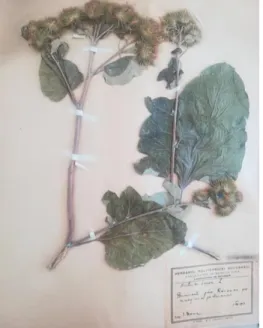
Arctium lappa L. (synonym A.
majus (Gaertn.) Bernh., Lappa major
Gaertn.) - greater burdock (Figure 1) – is a biennial plant that can reach 1,5 – 3 m in height. The stem is ramified, rough and reddish, while the leaves are alternate, ovate, with a cordate base and can
measure 50x60 cm. Their margins are complete, glabrous on the superior side and tomentose on the inferior one, with a thick petiole. The flowers are grouped in a corymb or raceme inflorescence – corymb on the lateral branches (Moore and Frankton 1974 in Gross et al., 1980). In popular medicine, the species is well known for its diuretic, depurative and digestive properties (De Almeida et al.,
100
has also antiallergenic and anti-inflammatory properties (Sohn et al., 2011). In numerous countries, it is even cultivated as edible plant (Sohn et al., 2011). As such, the roots are used worldwide for cooking, while the seeds are used in traditional medicines as diuretic and as detoxifying (Park et al., 2007). A substance named arctigenina is extracted from A. lappa, a bioactive lignin with numerous biologic activities (De Almeida et al., 2013).
Furthermore, the plant is used for treating diseases such as arterial hypertension, gout and hepatitis (Predes et al., 2011). Traditional Chinese medicine recommends these roots as aphrodisiac agent (Jiang et al., 2017). The species ca be used as nourishment as it contains a higher quantity of polyzaharids and residues than certain legumes and as it is easily accessible all year long (Huang et al.,
2010).
Figure 1. Arctium lappa
Arctium minus (Hill) Bernh. –
(synonym Lappa minor, A. pubens) -
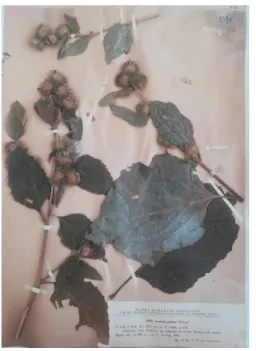
lesser burdock (Figure 2, 3) – is a
biannual herbaceous plant with large leaves and purple flowers. Starting with its second year, the plant can reach heights
ranging between 90 and 210 cm (Lubian et
al., 2010). The species multiples only through seeds, while the blooming stem grows as a rosette and is strongly ramified; the leaves are alternate, 50x35 cm in height, ovate up to cordate or rounded,
glabrous above and tormentose on the
back (Gross et al., 1980). The flowers do not have a smell but attract insects as they have an increased reflection degree of blue ultraviolet light (Duistermaat et al., 1996).
In Brazil, the plant grows spontaneously on fields, at the margin of forests and can even become an invasive species (Cavalli
101
Figure 2. Arctium minus Figure 3. Arctium pubens
Arctium nemorosum Lej.
(synonym Lappa nemorosa, L.
macrosperma, A. macrospermum) (Figure
4) – is a protected and endangered species in Finland (Galambosi, 2002), while in Lithuania is included in the list of aromatic
and medicinal plants being also mentioned in the National Red Dook (Radušienė, 2002). Onopordopicrin is extracted from its aerial parts, having an inhibiting effect on certain parasites (Zimmermann et al.,
2012).
Figure 4. Arctium nemorosum
Arctium tomentosum Mill.
(synonym A. leptophyllum, Lappa
tomentosa) – was identified in European countries, as well as in Russia, Kazakhstan, Kyrgyzstan, Tajikistan and Uzbekistan. It can also be found in Canada and the USA (Hassler, 2019). The main difference from A. lappa and A. minus is given by a corymb form inflorescence with a glandular corolla (Moore and Frankton 1974 in Gross et al., 1980).
THE PLANTS HARVESTING
YEARS
The plants of this genus were gathered in an interval of approximately 100 years, with the first plant collected in 1875 (Arctium nemorosum), and the last one in 1978 (Lappa macrosperma
102
month. However, the majority of the plants were harvested during 1940-1949 (32 samples), followed by 1930-1939, when 15 plants were collected (Figure 5). As such, 47 plants from the 65 Arctium plants conserved in “Al. Beldie” Herbarium were harvested in an interval of twenty years. In
the same interval (1940-1949), the majority of Gentiana samples were also gathered (Enescu et al., 2018b). Long intervals of time (amounting to 30 years) when plants belonging to this genus were not harvested were also identified.
Figure 5. Number of plants from Arctium genus harvested in different time periods
HARVESTING PLACE
A historical map of Romania’s counties was used in order to render correctly the harvesting locations (Figure 6). This map contains the exact names from the voucher’s labels. The majority of samples (22) were harvested from the South part, namely from Muntenia and Oltenia, with a predominance in Ilfov and
103
Figure 6. Harvesting place of Arctium plants
The persons that have collected
Arctium plants are renowned Romanian
and foreign botanists. Amongst the Romanian ones we mention G.P. Grințescu, pharmacist doctor specialized in medicinal plants who has obtained a Romanian Academy award (www.medichub.ro). He is responsible for the majority of plants belonging to this genus and conserved in the herbarium but has also collected plants with other foreign botanists such as the German mycology specialist H. Wolff (www.wikidata.org). Another important botanists were: P.
Cretzoiu, who has died at the early age of 35 (www.wikidata.org), Sergiu Pașcovschi - a Basarabian silvicultor preoccupied by the Romanian forestry typology (Doniță and Biriș, 2018), Iuliu Morariu - university professor and the founder of the Scientific Herbarium from Brasov’s Silviculture Faculty (Parascan, 2014), Erasmus Nyárády – Romanian botanists of Hungarian origins from Transylvania, professor at Cluj University and member of the Romanian Academy (Mititelu et al.,
1994), Atanase Haralamb – silviculture engineer, founding member of the Forestry Research and Development Institute,
professor at Brasov’s Silviculture Faculty (www.unitbv.ro), Marin Păun – botanist and university professor, Artur Coman – renowned botanist and silvicultor born in
Maramureș, at Borșa, where he realized detailed studies in Rodnei Mountains (Bîrda and Nădișan, 2017), with an Arctium
sample harvested by him from Maramureș,
104
CONCLUSIONS
Arctium species conserved in “Al.
Beldie” Herbarium amount to 65 vouchers that date back from 1875 up to 1978. The oldest conserved plant is an Arctium
nemorosum gathered from Hungary by the
famous botanist G. P. Grintescu. The last collected plant is a Lappa macrosperma.
The majority of plants are harvested from
Romania, with a focus on the South part (Muntenia and Oltenia). These plants are widespread in both Europe and Asia, as well as in North and South America. Some of these plants (A. lappa, A. minus) have numerous usages in traditional medicine such as detoxification, as diuretic or digestive stimulant.
BIBLIOGRAPHY
1. De Almeida, A. B. A., Sanchez-Hidalgo, M., Martín, A. R., Luiz-Ferreira, A., Trigo, J. R., Vilegas, W., ... & de la Lastra, C. A., 2013. Anti-inflammatory
intestinal activity of Arctium lappa
L.(Asteraceae) in TNBS colitis model. Journal of ethnopharmacology, 146(1), p. 300-310.
2. Bârda, M., Nădișan, I., 2017. Artur
Coman – botanist maramureșean de
anvergură europeană. Revista de
Silvicultura si Cinegetica, 41, p. 114-119.
3. Cavalli, V. L. L. O., Sordi, C., Tonini, K., Grando, A., Muneron, T., Guigi, A., Roman Júnior, W. A., 2007. Avaliação in vivo do efeito hipoglicemiante de extratos obtidos da raiz e folha de bardana Arctium minus (Hill.) Bernh. Rev Bras Farmacogn, 17, p. 64-70.
4. Cântar, I.C., Dincă, L., 2018. Trifolium genus species present in "Alexandru Beldie" Herbarium from “Marin Drăcea”
National Institute for Reseach and
Development in Forestry, Annals of West University of Timisora, ser. Biology, 21(2), p. 123-132.
5. Crișan, V., Dincă, L., Oneț, C., Oneț,
A., 2017. Collection species from Potentilla genus. Natural Resources and Sustainable Development, 21(70), p. 27-34.
6. Dincă, M., Dincă, L., Vasile, D., 2017a.
A short description of Androsace genre
plants present in Alexandru Beldie
Herbarium from I.N.C.D.S. Bucharest. Currents Trends in Natural Sciences, 6(12), p. 16-24.
7. Dincă L., Cântar, I.C., 2017. A short description of Scorzonera plant species present in Alexandru beldie Herbarium from I.N.C.D.S. Bucharest. Annals of
University of Craiova - Agriculture,
Montanology, Cadastre Series, 47, p.118-126.
8. Dincă, L., Vasile, D., Dincă, M., 2017b.
Short characterisation of plant species from Centaurea genus present in Al.Beldie Herbarium from Marin Dracea National Institute for Reseach and Development in Forestry Bucharest. Annals of University of
Craiova - Agriculture, Montanology,
Cadastre Series, 47, p. 127-135.
9. Dincă, L., Enescu, R., Oneț, A., Laslo,
V., Oneț, C., 2017c. Plant species from "Al. Beldie" Herbarium - Veronica genus - short
description. Natural Resources and
Sustainable Development, 9, p. 43-50. 10. Doniță, N. Biriș, I.A., 2018. Contribuții
ale unor silvicultori basarabeni la
105
11. Duistermaat, H. 1996. Monograph of
Arctium L. (Asteraceae). Generic
delimitation (including Cousinia Cass, pp), revision of the species, pollen morphology, and hybrids. Gorteria-Supplement, 3(1), p. 1-143.
12. Enescu, C.M., Dincă, L., Cântar, I., 2018a. Firs of “Alexandru Beldie”
herbarium. Research Journal of
Agricultural Science, 50 (1), p. 57-61. 13. Enescu, R., Dincă, L., Cântar, I.C., 2017. Description of plant species of Ornithoghalum genus present in Al. Beldie Herbarium from "Marin Drăcea" Bucharest
N.I.R.D.F. JOURNAL of Horticulture,
Forestry and Biotechnology, 21 (3), p. 89-95.
14. Enescu, R.E., Vechiu, E., Cântar, I., 2018b. Herbarium survey of genus
Gentiana L. Research Journal of
Agricultural Science, 50 (2), p. 51-59. 15. Galambosi, B. 2002. Medicinal and aromatic plants in Finland. compilers. 2004. Report of a Working Group on Medicinal and Aromatic Plants, 91.
16. Gross, R., Werner, P., Hawthorn, W.,
1980. The biology of Canadian weeds. 38. Arctium minus (Hill) Bernch. And A. lappa L. Canadian Journal of Plant Science, 60, p. 621-634.
17. Hassler, M., 2019. World Plants: Synonymic Checklists of the Vascular Plants of the World (version Nov 2018). In: Species 2000 & ITIS Catalogue of Life,
2019 Annual Checklist.
18. Huang, T. C., Tsai, S. S., Liu, L. F., Liu, Y. L., Liu, H. J., Chuang, K. P., 2010.
Effect of Arctium lappa L. in the dextran sulfate sodium colitis mouse model. World journal of gastroenterology: WJG, 16(33), p. 4193-4199.
19. Jian Feng, C., Peng Ying, Z., Cheng Wei, X., TaoTao, H., Yun Gui, B., Kao Shan, C., 2012. Effect of aqueous extract
of Arctium lappa L. (burdock) roots on the sexual behavior of male rats. BMC complementary and alternative medicine,
12(1), p. 1-8.
20. López‐Vinyallonga, S., Arakaki, M.,
Garcia‐Jacas, N., Susanna, A.,
Gitzendanner, M. A., Soltis, D. E., Soltis, P. S., 2010. Isolation and characterization of novel microsatellite markers for Arctium minus (Compositae). American journal of botany, 97(2), p. e4-e6.
21. Lubian, C. T., Teixeira, J. M., Lund, R. G., Nascente, P. S., Del Pino, F. A. B.,
2010. Atividade antifúngica do extrato
aquoso de Arctium minus (Hill)
Bernh.(Asteraceae) sobre espécies orais de Candida. Revista Brasileira de Plantas Medicinais, 12(2), p. 157-162.
22. Mititelu, D., Vițalariu, C., Navrotescu,
T., et al., 1994. Botaniști, agronomi și
silvici, membri ai Academiei Române. Studii și Comunicări 1980-1993, 13, p. 235-270.
23. Parascan, D., 2014. Profil de magistru: Profesorul IULIU MORARIU. Bucovina forestiera, 14 (1), p. 107-112.
24. Park, S. Y., Hong, S. S., Han, X. H., Hwang, J. S., Lee, D., Ro, J. S., Hwang, B. Y., 2007. Lignans from Arctium lappa and their inhibition of LPS-induced nitric
oxide production. Chemical and
pharmaceutical bulletin, 55(1), p. 150-152. 25. Predes, F. S., Ruiz, A. L., Carvalho, J. E., Foglio, M. A., Dolder, H., 2011.
Antioxidative and in vitro antiproliferative activity of Arctium lappa root extracts. BMC complementary and alternative medicine, 11(1), p. 1-5.
106
27. Sohn, E. H., Jang, S. A., Joo, H., Park, S., Kang, S. C., Lee, C. H., Kim, S. Y., 2011. Anti-allergic and anti-inflammatory effects of butanol extract from Arctium Lappa L. Clinical and Molecular Allergy, 9(1), p. 1-11.
28. Susanna, A., Garcia-Jacas, N., Vilatersana, R., Garnatje, T., 2003.
Generic boundaries and evolution of characters in the Arctium group: a nuclear and chloroplast DNA analysis. Collectanea Botanica, 26, p. 101-118.
29. Vechiu, E., Dincă, L., Bratu, I., 2018a.
The characteristics of Polygonum plants present in the Alexandru Beldie Herbarium. Research Journal of Agricultural Science, 50(4), p. 378-384.
30. Vechiu, E., Dincă, L., Cântar, I.C., 2018b. Describing the Lycopodium Genus
based on the plants present in Al. Beldie
Herbarium. Research Journal of
Agricultural Science, 50(4), p. 385-390. 31. Zimmermann, S., Thomi, S., Kaiser, M., Hamburger, M., Adams, M., 2012.
Screening and HPLC-based activity
profiling for new antiprotozoal leads from European plants. Scientia pharmaceutica, 80(1), p. 205-214.
32. ***The Plant List 2013. Version 1.1.
Published on the Internet;
http://www.theplantlist.org/ (accessed 30 March).