www.ijte.net
The
ASPID
Model:
A
Systemic
Approach to Understand Technology
Appropriation
Thierry Karsenti, Julien Bugmann Université de Montréal, Canada
To cite this article:
Karsenti, T. & Bugmann, J. (2018). The ASPID Model: A systemic approach to understand
technology appropriation.
International Journal of Technology in Education (IJTE), 1
(1),
12-18.
Volume 1, Issue 1, Fall 2018
ISSN: 2689-2758
The ASPID Model: A Systemic Approach to Understand Technology
Appropriation
Thierry Karsenti, Julien Bugmann
Abstract
The ASPID model (Adoption, Substitution, Progress, Innovation, Deterioration) is an interpretive framework that allows a systemic understanding of how technologies are adopted and integrated in physical education (PE). The ASPID model was inspired by ten years of research work with over 50,000 teachers and athletes. The ASPID model also implies that technology integration in the classroom is not necessarily smooth sailing. Both teachers and students can progress through the different ASPID phases. A successful technology-assisted approach requires a good understanding of these phases.
Keywords:Education, Teacher, Technology, Physical education, ASPID
Introduction
The integration of technology in integration is a complicated, multifactorial process. Theoretical models are useful for mapping this pedagogical transformation and for appraising the added value of technology for education. In addition, teachers who want to make better use of technology for teaching can use models as blueprints. The literature contains many theoretical models of technology integration in education, including the TPACK, SAMR, TAM, and TIM models and the UNESCO Continuum of approaches. This chapter presents a recent representation, the ASPID model (Adoption, Substitution, Progress, Innovation, Deterioration) and proposes a systemic modeling of how technology can be appropriated in the field of physical education (PE). The ASPID model depicts a series of integration phases, each with an alternate “deterioration” pathway, where technologies can actually get in the way of teaching. This representation also considers how students use technology for learning and the impacts of technology use on student outcomes. We present the ASPID model and show how PE teachers can be situated in the different phases for different forms of technology, along with the associated impacts on students.
Why Do We Need a Systemic Interpretation of Technology Use in PE?
International Journal of Technology in Education (IJTE) 13
for teaching and learning a variety of subjects has predominated more recent models. Consequently, technology as a subject has been left by the wayside, which is not necessarily a good thing, given the all-importance of digital literacy for success at school, at work, and in society. In sum, a model provides a roadmap to walk teachers through the mysterious pathways of the technology integration process, and the ASPID model can be used as a guide by teachers and coaches who want to fully appropriate technology and use it more effectively for teaching and learning.
Theoretical Foundations of the ASPID Model
Developed by Karsenti (2013), the ASPID (Adoption, Substitution, Progress, Innovation, Deterioration) model was conceived to represent the technology adoption and integration process in education as a series of phases. The term “phase” is preferred over “stage” because the phases do not necessarily occur in strict sequential order. ASPID was inspired by ten years of research with over 50,000 students and teachers combined with 1,500 hours of classroom observations of technology use, including the laptop, touchpad, interactive white board (IWB), and smart phone. Other teaching settings around the world were also observed, from kindergarten to university. One notable finding was that the impacts of technology are not just positive. For example, the IWB has presented some glaring drawbacks in terms of classroom use: the results of a study with 11,683 students and 1,131 teachers revealed that the effects of the IWB were not positive. On the contrary, they were negative. Although the IWB appeared to boost motivation in the short term, motivation declined over the long term. Other studies concluded that the more that teachers had their students use the IWB in front of the class, the more positive the impacts, including higher student perceptions of academic performance and greater development of creativity.
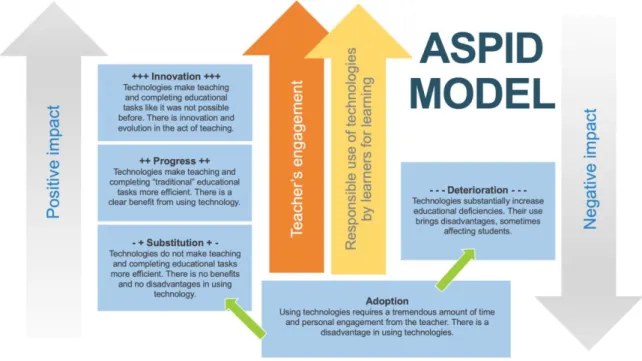
The ASPID model also implies that technology integration in the classroom is not necessarily smooth sailing. There are some headwinds to be faced. To point at some of the worst offenders, students tend to abuse technologies by hanging out on social networking sites or constantly texting their friends. The ASPID model departs from the popular vision of technology as a “universal panacea” for education. Instead, it reflects actual reports and observations on the ground, and not just in small groups of university students, but in tens of thousands of students. The resultant model covers a spectrum of integration phases: adoption, substitution, progress, innovation, and deterioration. In the initial adoption phase, the introduction of a new technology requires considerable investments in time and commitment, particularly by teachers. To adopt a technology means learning how to use it, and this can be considered as a challenge. In this phase, teachers and students alike generally struggle with issues, problems, and constraints that need resolving. We are reminded that, for teachers, adoption may entail a deep rupture in traditional teaching approaches and behaviors (Larose et al., 2002). Once this phase has been completed, teachers may use substitution: they may strike a sort of balance by doing the same traditional tasks, but with the help of technology. Substitution is meant here in the sense of Puentedura’s (2006) SAMR model. The third phase covers the progressive appropriation of technology-assisted teaching and learning. Here, technology becomes a more effective and efficient tool for carrying out routine tasks. For instance, it allows rapid feedback, even in traditional teaching situations (Odhabi, 2007), and it facilitates differentiated instruction (Karsenti & Collin, 2013). Finally, we arrive at the innovation phase, where technology appropriation knows no limits. In this sense, innovation means performing all the tasks that were formerly impossible to do without technological help. For this type of innovation, the most important aspect is the process, according to Cros (1997). Innovation may also devolve into substitution or restructuring at any time. However, the main idea is that ways of teaching are changed or transformed. This final phase is of particular interest, because in the way that we understand it, innovation means the production, animation, or presentation of teaching content in ways that would be impossible to imagine without technology. All these phases should be undertaken in the knowledge that they may actually harm the quality of teaching, in which case students tend to turn off. This negative effect can be observed at the start of an activity and will almost inevitably cause the user to abandon it (Aldunate & Nussbaum, 2013), especially when teachers haven’t taken the time to integrate the technology properly and effectively. Consequently, teachers and coaches should be aware of all the different ASPID integration phases so as to prevent the deterioration effect.
Description of the ASPID Model Dimensions
number and type of problems encountered. For instance, some teachers might decide to use a multimedia device to present videos of team sports. Others might ask their students to do a computer-assisted analysis of a sports performance. In both cases, the teachers may be adopting a technology for a specific learning context without being fully aware of the potential challenges that await them. For instance, asking students to write with a computer means that the teacher may have to guide and instruct them so they can get the full benefit from the exercise. Otherwise, the students may have only a superficial learning experience. In the adoption phase, teachers are finding their way around the benefits and challenges of technology use for teaching and learning.
Figure 1: ASPID Model
Impact on students’ outcomes; Technology use by students for developing competencies and learning; Teacher’s degree of commitment; Level of technology integration in education; INNOVATION; Technology enables teachers to teach and task in previously impossible ways. Innovative and evolved ways of teaching and learning. PROGRESS; Technology enables more efficient teaching, learning, and traditional school tasking. Technology has a positive impact. SUBSTITUTION; Technology enables teaching and tasking in new ways, but without real gains in efficiency. Technology is neither a marked advantage nor a marked disadvantage. ADOPTION; Use of technology for learning requires enormous investments of time and commitment by teachers. In this initial phase, it is normal to experience problems at first. The Appropriation Process; DETERIORATION; Technology aggravates teaching shortcomings, often to the detriment of students. Recurrent problems may send users back to the adoption phase.
International Journal of Technology in Education (IJTE) 15
project their comments onto a big screen using individual streaming apps like Reflector (http://www.airsquirrels.com/fr/reflector/). Students can take quizzes on their cell phones, and their results can be posted in real time on a big screen or IWB using apps like Poll Everywhere (https://www.polleverywhere.com/). In this phase, teachers and students fully appropriate technology.
The ASPID model covers the different levels of technology integration in education, from adoption (Level 1) to substitution (Level 2), progress (Level 3), and innovation (Level 4). As teachers and students advance through the phases, they increase the odds of successful learning.
Frame No. 1
Examples of apps for teaching sports techniques in the innovation phase: UberSense
Many apps are available for use with tablets to help PE teachers do their job. Some, like UberSense, are designed for teaching sports techniques. Teachers or coaches can start by demonstrating how top-level athletes move, using online videos uploaded by over a million UberSense users. They can then ask their students to copy the moves and compare their technique with the best of the best. UberSense is particularly good for analyzing recorded movements: it allows slow motion viewing at 120 frames per second. There is also a zoom function that lets you zero in on details. It includes tools to add free form lines, arrows, and circles to highlight points for analysis (see image on the right). Teachers can also compare side-by-side videos and add voiceovers. This makes it easier to analyze athletes’ movements, and athletes can use the visual and audio comments to work on their technique after class. UberSense content can be projected from an iPad onto a big screen for group lessons. Teachers can import videos with a camera, an email attachment, or a Dropbox file (in time-saving background mode). UberSense makes it easy to manage and retrieve videos by student’s or athlete’s name or by technique, sport, or functional skill. This feature is well appreciated by PE teachers and coaches
with large numbers of students. Videos can be saved as favorites for rapid retrieval. UberSense also allows email sharing via Dropbox and social networking accounts(https://itunes.apple.com/ca/app/hudl-technique-slow-motion/id470428362?mt=8).
The Deterioration Phase in the ASPID Model: When Technology Integration is not
Helpful
The ASPID model proposes a parallel pathway to each phase of technology integration (adoption, substitution, progress, innovation), called a deterioration pathway, where the quality of teaching and learning declines. Deterioration sets in when technology is integrated in education but in inappropriate or uninformed ways, usually to the detriment of the students’ learning. In other words, deterioration can come into play at any time during the technology integration process. Educators are reminded here of the purpose of technology integration, which is to serve the educational mission. We should also emphasize that the deterioration effect may eventually discourage teachers from using technology for certain activities, and if they feel that more traditional teaching approaches would be better for their students, they may let go of technology-assisted activities and fall back on tried-and-true approaches.
neglected to train teachers how to use it, sometimes resulting in negative effects on teaching and learning. It is important to keep in mind that the phases of the ASPID model are fluid: teachers may find themselves in more than one phase at the same time, depending on the teaching context, the group of students or athletes, and so forth. All the ASPID phases are related to the teacher’s degree of technological and pedagogical commitment. However, note that commitment by itself does not grant fast-track entry into the innovation phase. The commitment must be the fruit of reflection that is nourished by peer collaboration and student feedback, or by the teacher’s own explorations of the latest advances in educational technology. The ultimate goal is to genuinely evolve one’s practice. In sum, any model of technology adoption and integration in education will be incomplete if it fails to take into account the degree of responsible and educational appropriation by teachers and students, and in relation to student outcomes. In the ASPID model, the innovation phase shouldn’t be considered as an end goal for all people at all times. Although it certainly wouldn’t hurt teachers to try to progress toward innovation, this may not be appropriate for all teachers in every circumstance. Instead, it would be more important to contribute to the school mission, which is to instruct, socialize, and qualify. And sometimes, innovation may simply not be the best strategy. Furthermore, it would be utopian to expect innovative input from all teachers across the board. On the other hand, innovation can be highly palatable when taken in small doses, when it isn’t imposed en masse. Yet, unless the innovation extends beyond a very select few, it can’t be
qualified as truly innovative for education.
The deterioration phase reminds us that problems in assimilating any form of technology, at any integration phase, can lead to deterioration of teaching, and eventually to disinterest and abandonment.
Frame No. 2
Technology apps for PE students
New technologies have made steady inroads into the classroom, including gymnasiums and stadiums in PE and coaching programs. Today, a wide range of software, apps, and other digital supports are available to facilitate teaching, coaching, commenting, and training. Starting with the most basic devices, touchpad cameras can be used to explain the best movements to study and adopt. A number of other applications allow innovative teaching with the use of progressive steps. For example, Hudl Technique is an app that provides slow-motion playback of video recordings, with the ability to add comments, angles, and voiceovers to facilitate review and analysis. The O’See app has video delay so that athletes can watch their performance right after practice. The SprintTimer Photo Finish app has a sports timer and photo finish function to capture runners’ images at the finish line, just like on TV. iMuscle 2 – Anatomy is a medical app that includes a variety of exercises such as stretching, strength, endurance, and calorie-burning workouts. These can be programmed and statistically tracked so that athletes can focus on areas for improvement. The Plickers app lets teachers collect real-time information and give immediate feedback. It can be used, for example, to compile students’ votes or to check that everyone is on board in cases of dispute. Developed by PE teachers, the EPS: Match & Score app is used to manage sports matches, with automatic score compilation. The aPTB app lets you store statistics on basketball, football, and other team sports as you watch the game. Teachers and athletes can gather professional-quality statistics for a better analysis of performance. All these apps are compatible with Android touchpads and iPads.
Strengths and Limitations of the ASPID Model
International Journal of Technology in Education (IJTE) 17
among various school stakeholders. This means pooling the available resources, whether technological, pedagogical, didactic, or human (e.g., technicians, pedagogical counsellors), to enable optimal and appropriate technology uses. Finally, an idea that is generally espoused by other models, that technology can completely transform the classroom, is not one of the pillars of the ASPID model. Yet, is this really a drawback? If we consider technology as a one-size-fits-all solution to fix flawed education systems, wouldn’t this be the same as giving up on strategies that target specific educational problems? Regarding technology as a single, all-encompassing answer is exactly what the ASPID model seeks to avoid. If all forms of technology are viewed in a uniformly positive light, then actual classroom realities are not being considered, nor are the indispensable adjustments that have to be made, nor the inherent challenges that come with technology integration. On the contrary, it is essential to think about all these potential hurdles, and how both teachers and students can overcome them. To use the ASPID model is to respect technology users by accounting for all the issues that are part and parcel of the technology appropriation process. Hence, PE teachers and coaches should be aware that using touchpads and video recordings for analysis purposes may actually hinder learning. It is not enough to champion a technology for its positive effects on learning. Instead, the different phases of integration must be taken into account so that the technology can be used appropriately for teaching and learning, while keeping in mind the ever-present possibility of deterioration and eventual abandonment. Both teachers and students must pass through the ASPID phases in order to reap the rewards of technology. For example, referring to the above-mentioned apps, in order to analyze a sports tactic with the help of an app, teachers need to have a good understanding of all the functions and features, for example, player selection, player position, team role, and so on. Future studies on technology innovation by teachers would gain by considering the ASPID phases.
The ASPID model goes against the flow of many current models by proposing that technology use can also lead to deterioration of teaching and learning. Although this conclusion stems from observations of several thousands of teachers and students, this fledgling model needs to be empirically assessed for validation and adjustment.
Conclusion
At the beginning of this chapter, we explained that in order to effectively integrate technology in their teaching practice, physical education (PE) teachers and coaches must be able to grasp the complexity of the issues involved, issues that go far beyond simply knowing how to use a few tools. We can also take away the idea that appraising the educational potential of technology is a complex process as well. This process does not necessarily gain from being simplified, which could end up harming the quality of education and limiting the potential of technology. In addition, the technology integration process should be guided by a systemic understanding of how technology can best serve PE and coaching. But why the ASPID model in particular? Because of the complexity of the integration process, and the fact that teachers need signposts to guide them through the phases of technology integration and help them evolve their practice. However, when this process is made overly complicated (e.g., the TPACK model – Technology PedAgogy Content Knowledge), its relevance for education may become incomprehensible. PE teachers and coaches can grasp and implement the various integration phases proposed in the ASPID model in order to fully appropriate technology while limiting the deterioration effect, which leads to discouragement and abandonment. By including the deterioration phase, the ASPID model aims to contribute to the development of reflective practice (see Schön, 1996). This more finely nuanced and reflective approach to technology integration appears to be essential for preventing the cycles of alternating technoeuphoria and technophobia that we have seen recently. Furthermore, the ASPID model removes the pressure to implement continuous innovation, at all times and in all cases, in order to effectively integrate technology in education. Clearly, innovation is a good thing, but it should never be the only yardstick for technology use at school. To put it another way, PE teachers and coaches should be able to consider a wide spectrum of technology integration, knowing that it is possible, perhaps even desirable, to move fluidly among the different phases according to the task and teaching context.
References
Aldunate, R. and Nussbaum, M. (2013). Teacher adoption of technology. Computers in Human Behavior, 29(3), 519-524.
Arizone K12 Center. (2012). Arizona Technology Integration Matrix. Retrieved from: www.azk12.org Cros, F. (1997). L’innovation en éducation et en formation. Revue française de pédagogie, 118(1), 127-156. Cuban, L. (2001). Oversold and underused: computers in the classroom. Cambridge, MA : Harvard University
Karsenti, T. et Collin, S. (2013). TIC, technologies émergentes et Web 2.0 : Quels impacts en éducation? Québec : Presses de l’Université du Québec.
Karsenti, T. (2016). Le tableau blanc interactif : usages, avantages et défis. Une étude auprès de 11 683 élèves et 1 131 enseignants. Montréal : CRIFPE.
Karsenti, T. (2013). Le modèle ASPID : modéliser le processus d’adoption et d’intégration pédagogique des technologies en contexte éducatif. Formation et profession, 21(1), 74-75.
Karsenti, T. & Collin, S. (2013). Avantages et défis inhérents à l’usage des ordinateurs portables au primaire et au secondaire. Éducation et francophonie, 41(1), 94-122.
Larose, F., Grenon, V., Lafrance, S. (2002). « Chapitre 1. Pratique et profils d’utilisation des TICE chez les enseignants d’une université », Pratiquer les TICE, Bruxelles, De Boeck Supérieur, Pédagogies en développement.
Mishra, P. and Koehler, M. J. (2006). Technological Pedagogical Content Knowledge: A framework for teacher knowledge. Teachers College Record, 108(6), 1017-1054.
Odhabi, H. (2007). Investigating the impact of laptops on students’ learning using Bloom’s learning taxonomy. British Journal of Educational Technology, 38(6), 1126-1131.
Puentedura, R. R. (2006). Transformation, technology, and education. Retrieved from: www.hippasus.com Shön, D.A. (1996). Le tournant réflexif : Pratiques éducatives et études de cas. Montréal : Logiques.
UNESCO. (2004). Technologies de l’information et de la communication en éducation : un programme d’enseignement et un cadre pour la formation continue des enseignants. Retrieved from: www.unesco.org
Venkatesh, V., Morris, M. G., Davis, F. D. et Davis, G. B. (2003). User acceptance of information technology: Toward a unified view. MIS Quarterly, 27(3), 425-478.
Authors Information
Thierry Karsenti
Université de Montréal C.P. 6128, Succ. Centre-Ville Montréal, Québec, H3C 3J7 Canada
Contact e-mail: [email protected]
Julien Bugmann