Published online September 04, 2014 (http://www.sciencepublishinggroup.com/j/ijll) doi: 10.11648/j.ijll.s.2014020501.14
ISSN: 2330-0205 (Print); ISSN: 2330-0221 (Online)
Intelligence profile of Iranian domestically designed and
published ELT textbooks and students’ multiple
intelligences
Yoones Taaseh
1, Ahmadreza Mohebbi
2, Farzane Mirzaei
31
University of Tehran, Department of Foreign Languages and Literature, Tehran
2
Kharazmi University, Faculty of Humanities, Social sciences & Foreign languages, Tehran, Iran
3
Alzahra University Faculty of Literature, Language and History, Tehran, Iran
Email address:
[email protected] (Y. Taase), [email protected] (A. Mohebbi), [email protected] (F. Mirzaei)
To cite this article:
Yoones Taase, Ahmadreza Mohebbi, Farzane Mirzaei. Intelligence Profile of Iranian Domestically Designed and Published ELT Textbooks and Students’ Multiple Intelligences. International Journal of Language and Linguistics. Special Issue: Teaching English as a Foreign/Second Language. Vol. 2, No. 5-1, 2014, pp. 24-31. doi: 10.11648/j.ijll.s.2014020501.14
Abstract:
Theory of multiple Intelligences introduced by Howard Gardner (1983) is one of the most significant recent reforms in education which has been embraced enthusiastically by educationalists, curriculum developers, lesson planners, teachers and textbook designers. The main purpose of this study is to investigate domestically designed and published ELT textbooks in the light of multiple intelligences theory. Three textbooks (grade 1,2 &3) utilized in senior high school of Iranian educational system were analyzed using multiple intelligence checklist developed by B.M, de Rozario (2003). The secondary aim of this study is to probe students’ preferred intelligences regarding diverse sorts of intelligences provided in the textbooks. To this end, 314 senior high school students participated in the study. The results of the study showed that verbal/linguistic and visual/spatial were the most predominant intelligences followed by logical/mathematical, interpersonal and intrapersonal in much lower ratios. Bodily/ kinesthetic, musical and naturalistic intelligences were not found in any percent. Students’ intelligence profiles were far from textbooks representations including all kinds of intelligences in varying degrees. Pedagogical implication and suggestion are presented in the end.Keywords:
Multiple Intelligence, Textbooks, Senior High School, Intelligence Profile1. Introduction
Howard Gardner introduced the theory of Multiple Intelligences Frames of Mind (Gardner, 1983). First he proposed a list of seven intelligences including verbal
/linguistic, logical /mathematical, visual/spatial,
bodily/kinesthetic, musical, interpersonal and intrapersonal. Afterwards three other intelligences namely naturalistic, spiritual and existential ones were proposed among which naturalistic intelligence was added to the list (Gardner 1999: 52). This theory avers four main claims: “(1) Every person has all eight intelligences; (2) The majority of the population can develop intelligences to fully competent levels; (3) People with more intelligence usually operate in more complicated ways; (4) Each intelligence can be expressed through a variety of ways”. (Mindy, 2005; Osmon & Jackson, 2002). In the light of this theory, schools should heed individual differences and provide
students with more room to express themselves and show their strong abilities in any one of the eight intelligences. Moreover, the students should be respected as individuals and instructors should stimulate the growth of multiple intelligences via providing appropriate learning experiences to cater for their different needs and intelligences (Bowell, 2004; Chen, 2007). In Gardner’s view, multiple intelligences theory gives students the opportunity to choose learning activities and assessment methods, provide them with opportunities to use the dominant intelligences to develop the weaker intelligences, use the intelligences to fully comprehend broad subjects (Gardner, 1983).
setting to solve problems or create products that are of value in a culture’’ (pp. 33–34). This view of intelligence is culture-free and accounts for differences in time and place. He puts forth eight criteria for a potential ability to be considered as intelligences:
1. Intelligence root in the brain and its potential isolation by brain damage.
2. Intelligence roots in an evolutionary history and
evolutionary plausibility.
3. Intelligence identifiable core operation or set of operations.
4. Intelligence distinctive development history, along
with a definable set of 'end-state' performances. 5. Intelligence susceptibility to encoding in a symbol
system.
6. Intelligence exemplification through existence of
idiot’s savants, prodigies and other exceptional individuals.
7. Intelligence support from experimental psychological tasks.
8. Intelligence support from psychometric findings.
(Howard Gardner 1983: 62-69)
Gardner has developed eight intelligences so far; however, he considers the addition of other intelligences such as existential, spiritual and moral to the list. Following are the definitions of eight intelligences in Gardner’s words:
Verbal / Linguistic Intelligence: provides effective and persuasive use of language in oral and written forms and the ability to perceive language patterns
2. Logical/Mathematical Intelligence: represents
effective use of numbers and reason well and generally the process of problem solving in skills such as scientific investigation and recognition of abstract thinking
3. Visual/Spatial Intelligence: mental and graphical ability to visual things and ideas in space, color, form and shapes.
4. Bodily/Kinesthetic Intelligence: effectively using movement and gesture to express thoughts, emotions and ideas or using whole or parts of body to solve problems
5. Musical Intelligence: sensitivity to rhythm, pitch, and melody and effective sue of music to express emotions and thoughts
6. Interpersonal Intelligence: making effective interaction with others and recognize their distinctions to understand their feelings, motivations, and intentions and to respond effectively.
7. Intrapersonal Intelligence: self-understanding ability to recognize one's similarities to and differences from others and effectively work on one’s desired capacities and motivations.
8. Naturalist Intelligence: The capacity to perceive the natural world and environment effectively and ability to recognize and classify plants, minerals, and animals.
1.1. Education and Multiple Intelligences
Multiple intelligence theory did not rivet the psychologists attention who adhered to the psychometric
view of intelligence and however it was not designed to be applied in education in general or language teaching in particular, it has gained increasing attention in education and applied linguistics since teachers looked at the different learning styles which differ from the ways students learn the materials. Elementary, middle schools and even universities have employed MI theory. Many schools in US (Gardner, 1993; Richard and Rodgers, 2001; Sinder, 2001) like the sky school in Indianapolis and Cambridgeport school in MA and also Brazil (Botelho Maria do Rozario de Lima, 2003) have adopted multiple intelligences in their curriculum. In United States, teachers of East Elementary school in Athens have also received training in multiple intelligences. According to Stefanski (2002) human development and general courses are taught in many university education schools using multiple intelligence theory. He claims that multiple intelligences is one of the most significant developments of education in half past century. Like other fields, ELT has applied the theory of multiple intelligences widely. In a qualitative study, Green (1998) showed that diverse learners were more able in transferring learned skills and strategies from one subject to another and were more involved and curious in their learning experience; besides, their standardized test scores showed an increase. Strahan (1996) performed a study on the use of multiple intelligence in brained-based teaching, learning strategy and found that the behavior of disengaged students with the intention of destroying the classroom and the rate of students’ completion of homework and assignments improved. Furthermore, Greenhawk (1997) in an action research found that students’ performance in every aspect of language learning and their proficiency in
reading comprehension and vocabulary promoted
drastically when curriculum was designed and performed based on multiple intelligence theory.
1.2. Importance of Textbooks and Multiple Intelligences
physical features, graphics, cultural bias and authenticity. Brown (1998) puts forth an evaluation form with checklist to consider teachers’ manual, testing suggestions, and flexibility to adapt or keep exercises, appropriate proficiency level and usefulness of activities. (Pp.3-7)
Textbooks have undergone diverse analyses under the lights of MI theory in recent years to determine different sorts of intelligences embedded in their activities. Palmberg (2001) in his study presented the analysis of course books by student teachers in order to identify intelligence profile. Botelho’s study (2003) showed that the intelligence profile of the analyzed books were mainly verbal/linguistic. Carolina Leonardi de Oliviera (2009) analyzed two course books utilized in Porto Algere city, Brazil and came to
conclusion that verbal/linguistic, intrapersonal,
interpersonal and visual/spatial intelligences appeared mostly in the textbooks. Yasemin Kırkgöz (2010) investigated locally-published ELT textbooks in Turkey and found that naturalistic intelligence was the least type.
1.3. This Study
Iranian high school EFL textbooks have been evaluated and criticized from different perspectives in recent years. Azizfar et.al (2010) recognized ELT textbooks as one of the main factors for students’ achievement and suggested enough opportunity for learners to practice language communicatively. Common core features of EFL textbooks were studied by Ansari and Babai (2002). They found that approach, content presentation, physical make-up, and administration concerns were the major features. . Each set of major features of EFL textbooks consists of a number of subcategories. Revised version of Tucker’s model was used by Yarmohammadi (2002) to evaluate senior high school showing many deficiencies including lack of authenticity, interchangeable use of English and Persian names and ignorance of oral skills. Regarding the use of multiple intelligences evaluation checklist and Iranian high school textbooks, Taaseh (2012) using Botelho’s MI checklist (2003) investigated the catered-for types of intelligences in senior high school textbooks and came to conclusion that verbal-linguistic and logical-mathematical intelligences were the predominant types. The purpose of this study is two-fold: the first one is to analyze domestically published ELT textbooks taught in Iranian state senior high (secondary) school educational system to determine to what extent MI theory is reflected in these textbooks. The second aim is to investigate secondary school students’ intelligence profile to see whether there is any significant relationship between textbooks intelligence types and students’ intelligence profile.
The present study seeks to answer the following questions:
1. What type(s) of intelligence(s) is/are included in domestically designed and published ELT textbooks in Iranian senior high school?
2. What is the intelligence profile of Iranian senior high school students?
1.4. Significance of the Study
Consideration of textbooks in the light of multiple intelligence theory is essentially useful because textbooks are the main and the most applicable source of teachers in classrooms to transfer the curriculum objectives. In addition, students with different learning styles and personality types possess a variety of intelligences and it is necessary for textbooks to provide as many intelligence types as possible to meet the students’ needs. The results of this study are useful for students, teachers, domestic curriculum developers, material developers and textbooks designers. The results of the present study may lead to the improvement of the domestically designed and published EFL textbooks.
2. Method
2.1. MI Checklist and MI Inventory
The first instrument utilized in the current study was the checklist developed by Botelho, Mario do Rozario, de Lima (2003) was used which defines eight intelligences and lists the activities, techniques, materials and description related to each intelligence. According to Botelho, “this compilation of information about each intelligence was based on several sources (Christison, 1996; Christison & Kennedy, 1999; Plamberg, 2001). For example, verbal linguistic intelligence is defined as the ability to use words effectively both orally and in written form. The range of activities for this intelligence include reading books, listening to talking books, writing, note taking, memorizing and etc. (see appendix A for the definition and related activities of the eight intelligence in MI). Student-Generated Inventory for secondary level and young adult learners (Christison, 1996, 1999) was used to
assess students’ intelligence profile. The survey
questionnaire is divided to eight sections (eight intelligences), each one including six statements based on three Likert-point scale. The questionnaire was translated into Persian and piloted among 60 students. Its Cronbach Alpha’s reliability came 0.081.
2.2. Analysis of ELT Textbooks
Botelho’s (2003) MI checklist was used to carefully analyze three English textbooks presently used in Iranian senior high schools. To this purpose, all exercises and activities were taken into account to identify the catered-for types of intelligences they carried. The investigated textbooks include Right Path to English (1), Right Path to English (2) and Right Path to English (3) (Birjandi and Soheili, 1985) for grade 1, 2 and 3. Each textbook was scrutinized in terms of its inclusion for different intelligences.
blanks with correct form of verb and answer the questions
with “Yes” or “No” are definitely related to
verbal/linguistic intelligence. Some activities were a mixture of intelligences. For instance the activity like “look at the pictures and fill in the blanks” caters for both verbal/linguistic and visual/spatial intelligences. Such activities were categorized into more than one intelligence type. Considering some principles when identifying intelligences in practices and activities like type and description ( instruction) of each activity, elements accompanied with each activity( like pictures) and the skills being practiced in each activity, the number of occurrences ( frequency) of each intelligence was counted in units and then summed for each textbooks. Basic structure and review sections were not considered.
2.3. Participants and Procedure
Three hundred and fourteen secondary school students from both genders participated voluntarily in the study. They were from all three levels (level 1, 2, and 3) and their age range was between 12 and15.
Two raters identified different kinds of intelligences in each textbook independently. Because the general structure of textbooks and their inclusion for different intelligences were not complicated and various, a Cronbach Alpha inter-rater reliability of 0.92 was achieved.
3. Results
Table 1 shows the distribution of different categories of multiple intelligences in three domestically published textbooks used in the Iranian senior high school.
Table 1. Distribution of intelligences in the textbooks. Intelligence types (f %)
Textbook’s level Verbal/ linguistic Visual/ spatial Logical/ mathematical Inter personal Intra personal Bodily/
kinesthetic musical natural Total F %
Right path to English(1) 57 61.95 26 28.26 3 3.26 6 6.52 O - O - 0 - 0 - 92 100% Right path To English(2) 105 67.30 41 26.28 8 5.12 O - 2 1.28 O - 0 - O - 156 100% Right path To English(3) 94 77.68 12 9.91 10 8.26 3 2.47 2 1.65 O - 0 - O - 121 100%
Table 1 shows obviously that each one of the ELT textbooks caters predominantly for verbal/ linguistic intelligence. Between 61.95-77.68% of the activities can be used appropriately for the learners who are verbal-linguistically oriented. The next extensively used sort of intelligence is visual/spatial intelligence covering 9.91-28.26 % of the activities. Logical/mathematical intelligence was the third regularly addressed kind of intelligence comprising between 3.26-8.26% of the activities. The fourth widely used intelligence in grade 1 is interpersonal intelligence (6.52%) followed by logical/mathematical
(3.26%). Other intelligences including musical,
bodily/kinesthetic, intrapersonal and naturalistic intelligence were not found in Right Path to English for grade 1.
In grade 2 textbooks, the third widely applied kind of intelligence is logical/mathematical (5.12%) followed by intrapersonal intelligence (1.28%).
Musical, bodily/kinesthetic, interpersonal and naturalistic intelligences were not found in grade 2 textbook at all. Logical mathematical intelligence (8.26%) stands as the third frequently utilized kind of intelligence followed by interpersonal (2.47%) and intrapersonal intelligences
(0.82%). Other intelligences like musical,
bodily/kinesthetic and naturalistic intelligences were not found in grade 3 textbook. As it can be seen clearly in table 1, three kinds of intelligence including musical, bodily kinesthetic and naturalistic intelligence were not used in any percent. Among the catered for intelligences, intrapersonal type was the least used kind of intelligence. The textbook of grade 3 addressed five kinds of
intelligences including verbal/linguistic/ logical
mathematical, visual spatial, interpersonal and
intrapersonal. Grade 2 used four intelligences neglecting intrapersonal intelligence used in the textbook of grade 3. Grade 1 also addressed four kinds of intelligences neglecting interpersonal intelligence used in grade 3. It I noteworthy that verbal/linguistic and visual spatial intelligences used as the most prevalent intelligences were mixed in activities like “look at the pictures and follow the model”, “look at the pictures and ask questions with every day” and “look at the picture and answer the questions”.
The findings of this study represent that verbal/linguistic and visual/spatial predominate the intelligence profile of the investigated books followed by a fair percentage of other intelligences like logical/mathematical, interpersonal and intrapersonal types. What is more interesting in this study, is the absence of musical, bodily/kinesthetic and naturalistic intelligence in the textbooks.
3.1. Students’ Multiple Intelligences
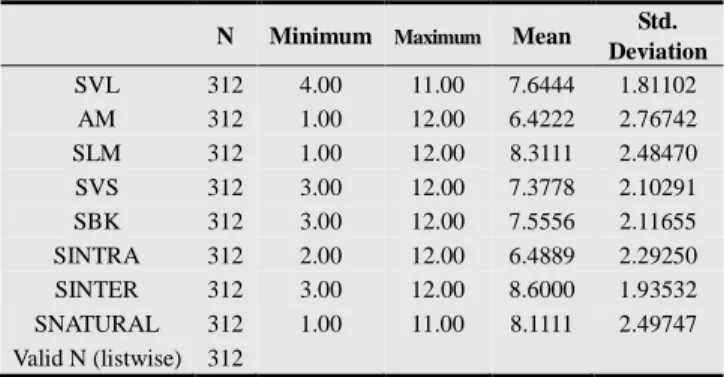
Table 2 shows the descriptive statistics of Iranian students’ preferred multiple intelligences.
While naturalistic, bodily kinesthetic and musical intelligences were not found in any extent in the textbooks, naturalistic intelligences was identified as one of the high intelligences in students followed by bodily-kinesthetic and musical intelligences in less degrees. Interpersonal intelligence which is the students’ highest kind of intelligence was identified as minimally as possible (only 2 examples in three textbooks).
Table 2. Descriptive Statistics of students’ multiple intelligences
N Minimum Maximum Mean Std. Deviation
SVL 312 4.00 11.00 7.6444 1.81102
AM 312 1.00 12.00 6.4222 2.76742
SLM 312 1.00 12.00 8.3111 2.48470
SVS 312 3.00 12.00 7.3778 2.10291
SBK 312 3.00 12.00 7.5556 2.11655
SINTRA 312 2.00 12.00 6.4889 2.29250
SINTER 312 3.00 12.00 8.6000 1.93532
SNATURAL 312 1.00 11.00 8.1111 2.49747
Valid N (listwise) 312
SVL=student verbal-linguistic intelligence, SM=student musical intelligence, SLM=student logical mathematical intelligence, SVS=students visual spatial, SBK=student bodily kinesthetic, SINTRA=student intrapersonal intelligence, SINTER=student interpersonal intelligence, SNATURAL=student natural intelligence.
4. Discussion and Conclusion
In the present study we examined high school EFL textbooks to consider application of multiple intelligence theory in their tasks and activities. Also, we investigated intelligence profile of Iranian students to evaluate their preferred types of intelligence. Being in line previous research on multiple intelligences and textbooks, (Botelho, 2003; Yasemin Kırkgöz, 2010) the results showed that verbal/linguistic and visual/spatial intelligences are the most dominant intelligences in the analyzed textbooks. Among other types logical mathematical, interpersonal and intrapersonal intelligences were found in much lower ratios but musical, bodily/kinesthetic and naturalistic intelligences were not used at all in the textbooks. The textbook have not been designed based on multiple intelligences theory. Students’ preferred intelligences were completely different from textbooks catered for intelligences and any significant relationship was not found between these two. While textbooks were predominantly designed with verbal linguistic intelligences, students possessed all the intelligences in varying degrees. In the textbooks, some of the intelligences were not found in any percent but these intelligences were among the preferred ones in students.
One of the most important principles of multiple intelligences theory is that all the people possess eight intelligences but every person has a unique profile. Accepting the fact that different students possess different intelligences, it is obvious that the same learning task may not suit all the learners. A student with strong logical mathematical intelligence may perform well in a complex
grammatical explanation but a visual spatial dominated student may need diagrams and physical demonstration. Students with strong interpersonal intelligence need an interactive atmosphere to perform well. Anning (1991) suggests that students are unique in what they bring to the learning experience meaning that learners must be thought of different individuals with different learning style and intelligence profile to create an atmosphere which pays attention to learners with different learning preferences. In Larsen-Freeman’s view (2000), one possible way is to categorize different activities frequently used in the classroom according to multiple intelligences.
Multiple intelligence theory asserts that each intelligence can be expressed and developed in a variety of ways. Gardner (1993) believes that humans possess a number of distinct intelligences that manifest themselves in different skills and abilities. According to Bas, (2008, 2010) and Berman (1998), multiple intelligences provide the teachers and students with eight ways of teaching and learning styles. So, the knowledge and application of multiple intelligences can help teachers in providing enough variety in activities and exercises to tap students’ different learning potentials. Brewster, Ellis & Girard (2003) suggests that younger learners need more physical activities to make use of their all senses. According to Berman (1998), talking or writing about something is facilitated if children can draw or visualize an image, hum or move through it first.
According to Sheldon (1988), teachers heavily rely on the textbooks and sometimes they teach all the pages of textbooks because most of them cannot create their own materials, they have lack of time to create new materials and they are faced with external pressures that restrict them. In the other hand, textbooks are the link between teachers and students to convey curriculum objectives and in the case of this study, since the textbooks are designed for nationwide use, they should be provided with more variety in activities and exercises through multiple intelligences to be more consistent with different students’ needs, potentials, uniqueness and learning styles.
Following come some pedagogical implications of this study and suggestions to improve the textbooks:
- Since students have different learning styles and
individual differences, it is crucial to consider these differences in designing the textbooks.
- Unlike traditional educational system and IQ theory which put more emphasis on verbal-linguistic and
logical-mathematical intelligences, teachers and
textbooks should consider other types as equally important.
- A rich variety of activities and exercises should be included in text books to consider students’ uniqueness, their involvement and motivation
- Since all of the teachers lack the creativity in designing their own activities and exercises, it is useful for the textbooks to include an amalgam of activities and exercises based on multiple intelligences.
preferred types of intelligences to reflect their individual differences and personal preferences
- Different intelligences and needs of students should be
met through tasks and exercises which comprise as many intelligences as possible.
- It is necessary for teachers to carefully analyze the textbooks, their teaching method and students’ needs in the light of intelligence profile.
- Regarding the age of the senior high school students (teenagers), it is very helpful to apply activities based on bodily/kinesthetic and musical intelligences to expedite their learning.
Appendix
List of activities, techniques, materials and descriptions of each intelligence.
Verbal/linguistic
1 Note taking 2. Riddles 3. Worksheets
4. Listening to lectures 5. Word play games
6. Listening to talking books 7. Reading books
8. Discussions 9. Story telling 10. Journal keeping 11. Debates 12. Memorizing 13. Writing
The ability to use words effectively both orally and in writing. Remembering information, convincing others to help and talking about language itself
Logical/mathematical
1. Science demonstrations and experiments 2. Logic puzzles and games
3. Story problems with numbers
4. Logical/sequential presentation of subject matter 5. Logical argumentation
6. Problem solving
The ability to use numbers effectively and reason well. Ability to predict, understand basic properties of numbers and principles of cause and effect, recognizing abstract patterns, creating codes.
Spatial/visual
1. Illustrations 2. Graphs 3. Tables
4. Using charts and grids 5. Videos, slides and movies 6. Using arts
7. Maps
8. Photos
9. Using graphic organizers 10. Imaginative story telling 11. Painting/picture/collage 12. Mind maps
13. Telescope/microscope 14. Visual awareness activities 15. Students’ drawings
Bodily/kinesthetic
1. Hands-on activities 2. Field trips
3. Role plays
4. Creative movements 5. Mime
6. Body language 7. Classroom aerobics 8. Cooperative group rotation
9. Cooking and other “mess” activities
The ability to use the body to express ideas and feelings and to solve problems.
Skills: coordination, flexibility, speed and balance.
Musical
1. Singing 2. Songs
3. Playing recorded music 4. Playing live music 5. Jazz chants 6. Music appreciation 7. Student made instruments 8. Background music
Sensitivity to rhythm, pitch and melody. Recognizing simple songs and being able to vary speed, tempo and rhythm in simple melodies.
Interpersonal
1. Pair work 2. Peer teaching 3. Board games 4. Group brainstorming 5. Project work 6. Work cooperatively
The ability to understand another person’s moods, feeling, motivations and intentions. Skills: responding effectively to other people, problem solving and resolving conflict.
Intrapersonal
1. Activities with a self-evaluation component 2. Interest centers
3. Options for homework. 4. Personal journal keeping 5. Checklist
6. Inventories
The ability to understand yourself, your strength, weaknesses, moods, desires and intentions. Skills: understanding how someone is similar to or different from others, reminding oneself to do something, knowing how to handle one’s feelings, knowing about oneself as a language learner.
Naturalistic
The ability to recognize and classify plants, minerals and animals including rocks, glass and all variety of flora and fauna. Classifying and categorizing activities.
Adapted from Botelho Maria do Rozario p 144-147
References
[1] Akbari, R and Hosseini, K. (2008), Multiple intelligences and language learning strategies: Investigating possible relations. System 36,141-155
[2] Anning, A. (1991). The first year at school. Ballmoor: Open University Press.
[3] Azizfar, A, Koosha, M & Lotfi, A.R. (2010). An analytical evaluation of Iranian high school ELT textbooks from1970 to the present. Procedia social and behavioral sciences3. 36-44
[4] Berman, M. (1998). A multiple intelligences road to an ELT classroom. Bencyfelin: Crown House.
[5] Ansary, H., & Babaii, E. (2002). Universal characteristics of EFL/ESL textbook: A step towards systematic Textbook evaluation. The Internet TESL Journal, 2, 1-8.
[6] Bas, G. (2008). Integrating multiple intelligences in ESL/EFL classrooms. The Internet TESL Journal, 14(5), May.
[7] Bas, G. (2010b). Ingilizce dersinde coklu zeka kuraminin ogrencilerin akademik basarilarina ve derse karsi tutumlarina katkilari. e-Journal of New World Science Academy. 5(2), 411-430.
[8] Birjandi, P. & Soheili, A. (1985). Right path to English. Tehran: Sherkat Chap va Nashr Iran.
[9] Berman, M. (1998). A multiple intelligences road to an ELT classroom. Bencyfelin: Crown House.
[10] Botelho, M. (2003) Multiple intelligence theory in English language teaching: An analysis of current textbooks, materials and teacher’s perceptions. College of arts and sciences of Ohio University
[11] Bowell, R. A. (2004). The seven steps of spiritual intelligence: The practical pursuit of purpose, success, and happiness. London, UK: Boston Nicholas Brealey Publishing
[12] Brown, J.B (1998).Textbook evaluation form. TLT online editor
http://langue.hyper.chbu.ac.jp.jalt/pub/tlt/97/oct/brown/html
[13] Brewster, J., Ellis, G. & Girard, D. (2003). The primary English teacher’s guide. (New Ed.). London: Penguin Books.
[14] Oliviera, L. C. (2009), Course books and multiple
Intelligences theory: an analysis
[15] Chen, P. S. (2007). The multiple intelligences and common leadership. Taipei, Taiwan: Sanmin
[16] Christison, M.A. (1996). Teaching and learning through multiple intelligences. TESOL journal, 6(1), 10-14
[17] Christison, M.A. (1999). Multiple intelligences inventory for EFL teachers
[18] Christison, M.A & Kennedy, D (1999).Multiple intelligences: theory and practice in adult ESL. http://www.cal.org.ncle/digests/MI.htm
[19] Gardner, H. (1983). Frames of mind. New York: Basic Books
[20] Gardner, H. (1993) "Multiple Intelligences: The Theory in Practice." New York: Basic Books
[21] Gardner, H. (1999) "Intelligence Reframed: Multiple Intelligences for the 21st Century." New York: Basic Books
[22] Garinger, D. (2001). ‘Textbook Evaluation’. TEFL web
journal. Retrieved on November
2009.http://www.teflwebj.org/garinger html
[23] Green, F (1999). Brain and learning research: implications for meeting the needs of diverse learners. Education, 119 (4), 682-687
[24] Greenhawk, L (1997). Multiple intelligences meets standards. Educational leadership, 55(1), 62-64
[25] Larsen-Freeman, D. (2000). Techniques and principles of language teaching. (Second Ed.) Oxford: Oxford University Press.
[26] Loredana-A.S & Aneliz I.C(2011). A multiple intelligences approach: intuitive English learning – a case study for k-1 students. Procedia Social and Behavioral Sciences 11, 72-76
[27] Kırkgöz, Y (2010). Catering for multiple intelligences in locally-published ELT textbooks in Turkey. Procedia Social and Behavioral Sciences3, 127-130
[28] Mindy, K. (2005). Living usage ingeniously on the multiple intelligences. Taipei, Taiwan: Yuan-Liou.
[29] Osmon, D. C., & Jackson, R. (2002). Inspection time and IQ: Fluid or perceptual aspects of intelligence? Intelligence, 30(2), 119-127.
[30] Plamberg, R (2001) catering for multiple intelligences in course books. HLT Magazine, January 2002. Retrieved on November 9, 2002. http///www.hltmag.co.uk/Jan02/sart6htm
[31] Richards, J. C. (2001). ‘The role of textbooks in a language program’. Retrieved November 12, 2, 2008, from
http://www.professorjackrichards.com/pdfs/role-of-textbooks.pdf.
[32] Richard, J. & Rodgers, T. (2001). Approaches and methods in language teaching. Second edition. Cambridge: CUP
[33] Sheldon, L. (1988). Evaluating ELT Textbooks and Materials. ELT Journal, 42(2).
[35] Stefanski, E.H. (2002). Multiple intelligences and portfolios: a window into the learner’s mind. Portmouth: Heinemann
[36] Strahan, D. (1996). Teaching to diversity through multiple intelligences: student and teacher response to Instructional improvement. Middle level education, Quarterly, 19 (2), 43-65
[37] Yarmohammadi, L. (2002). The evaluation of pre-university textbooks. The Newsletter of the Iranian Academy of
Science, 18, 70-87.