SIMULATION OF AIR- CONDITIONING SYSTEM COMPONENTS AND COMPARISON OF
PERFORMANCE FOR THREE DIFFERENT REFRIGERANTS
Dr. Boda Hadya Assistant Professor,
Mechanical Engineering Department,
U.C.E., Osmania University, Hyderabad, A.P-500007
---
Abstract-This paper presents the simulation study of three different refrigerants i.e. R22, R410A and
R32 in vapour compression refrigeration system. The available experimental data of R22 was used for air conditioning system capacity of 1.565 ‘TR’ (Ton of Refrigeration) .For system simulations the REFPROP and cool pack simulation tool was used. The main objective of selecting theR32 and R410A is to explore the possibility of developing new zero ODP and very low GWP refrigerants an alternative to R22. R22 is HCFC group refrigerant with 0.05 ODP and 1700GWP and R410A with Zero ODP and 2100 GWP which are responsible for environmental impacts. World community has decided to phase-out such refrigerants. R32 is having zero ODP and Very low GWP (650). For simulation, the range of evaporator temperatures was considered from -10°C to +10°C and condenser temperature from 35 °C to 65°C. With compare to R22 and R410A refrigerants, the refrigerant R32 yields better coefficient of performance (COP) at higher ambient temperatures.R32 is rising in the refrigeration market because of its better energy efficiency and environmental friendly. The atmospheric life for R22 is 15 years and for R32 is 4.9 years hence R32 has been accepted as safety group refrigerant under the class A2L ASHARE standers.Keywords: Ton of Refrigeration, Hydro Fluorocarbon, ODP, GWP and Coefficient of Performance
1. INTRODUCTION
Air conditioning is a process of simultaneous control of temperature, humidity, flow of air and cleanliness of air. In olden days the air conditioning was treated as luxury but now days it has become part and parcel of human being. The use of refrigerant has got more significance and HCFCs -22 is one of the important refrigerants in air conditioning all over the world, S.Devotta et al [1],explained the studies related to the alternative refrigerants. The major disadvantage of R22 is having ozone layer depletion potential and global warming effect, which causes lot of ill health and diseases for living and non living things. As per the agreement of Montreal and Kyoto protocol 1987 all CFC’S and HCFC’S must be phased out both in developed and developing countries. As per ASHRAE standard -34 all HCFC should be phased out by 2030[2&3].
2.
L
ITERATURE REVIEWboth indirect and direct impact of global warming agents resulting from the energy consumption of the system. From the vast literature studies the facts reveals that HFCs can be seen in many cases to offer the best alternative to HCFCs group refrigerants. By encouraging government-industry partnerships and existing voluntary efforts towards the effective use of containment, recovery and recycling of HFCs, the present potential global warming impact by use of these products can be minimized.Montreal Protocol the United Nations environment programme conference held in Montreal in September 1987 the decision taken to phase out ozone depleting substances (ODS) within a fixed time period is known as Montreal Protocol. Some of the feature of MP is as fallows. Developed countries will phase out CFCs by 1996.Developing countries will phase out CFCs by 2010 with freeze in 1999 and gradual reduction thereafter. Developed countries will phase out HCFCs by 2030 while developing countries have been provided a grace period of ten years i.e. phase out by 2040. Global warming is another serious issue. Some naturally occurring substances mainly cause this but CFCs have very large global warming potential.The global warming issue was addressed by the thirdconference of partiesto the United Nations Framework Conventionon Climate Change (UNFCCC) In December 1997held at Kyoto this is known as Kyoto protocol (KP). According to this, the developed countries of KP should reduce their average greenhouse gas emissions in aggregate by 5.2% below the 1990 levels within a period of 2008-2012.Developing countries do not have any obligation under KP .In the year 1988 International Panel on Climate Change (IPCC) was established for scientific intergovernmental body to evaluate the risk of climate change caused by human activity [6&7]. The IPCC provides the general accepted value for GWP, which changed slightly between1996 and 2001. The IPCC has predicted an average global rise in temperature of 1.4°C to 5.8°C between 1990 and2100.From the literature study, in selecting a refrigerant for a particular purpose its characteristic must be considered and the selection must be made on the basis of its compatibility with the system [8] .The desirable properties like Thermodynamic properties, Physical properties and Chemical Properties requires for good COP and safe to use while between different pressures
3. Air Conditioning System
metal components with thermal insulation wherever necessary. Control panel equipped with controls for operating the unit which includes a room air temperature control device.
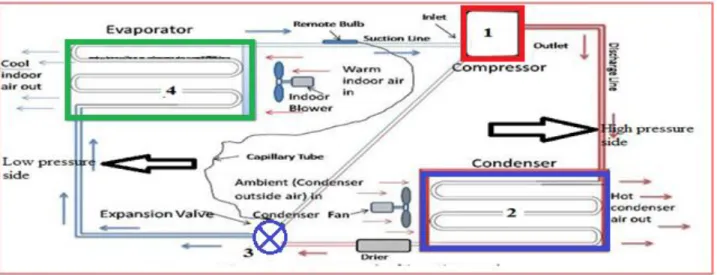
Fig .1 Block diagram of air conditioning system 3.1. Theoretical Cycle Analysis
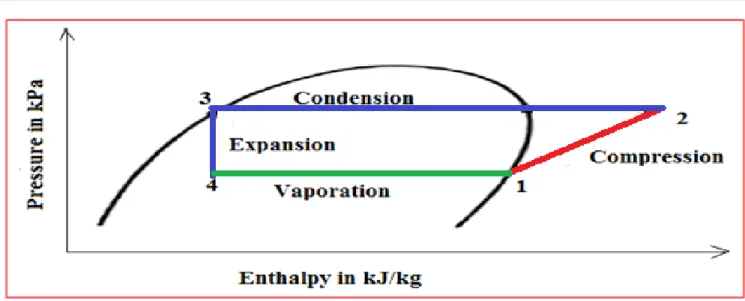
The simple Vapour Compression Refrigeration cycle it consists of following four essential parts 1.Compressor, 2.Condenser, 3.Expansion Valve, and 4.Evaporator. Compressor compresses the vapour refrigerant to the condenser with high pressure and temperature , in the condenser condensation takes place by rejecting heat in the form of latent heat of condensation with cooling medium of either water or air hence the phase transfer takes place from vapour refrigerant to liquid refrigerant and enters into the Expansion Valve , the function of the expansion valve is to reduce the pressure from high condenser pressure to low evaporator pressure by throttling process finally the liquid refrigerant enters in the Evaporator where cooling effect is produced by absorbing heat from the cooling space and only pure vapour enters into the compressor.
Fig.2 p-h diagram of single stage vapour compression cycle
4. SIMULATION OF VAPOUR COMPRESSION CYCLE
For simulation, REFPROP version 6.01 (REFPROP is an acronym for Refrigerant Properties) used for finding out the properties of R32, which gives the most accurate pure fluid property for simulation, developed by the National Institute of Standards and Technology (NIST) provides the thermodynamic and transport properties of refrigerants [9-10].REFPROP also provides high accuracy data for pure refrigerants and refrigerant mixtures. The cool pack is a collection of simulation programs used for designing, dimensioning, analyzing and optimizing the refrigeration system.
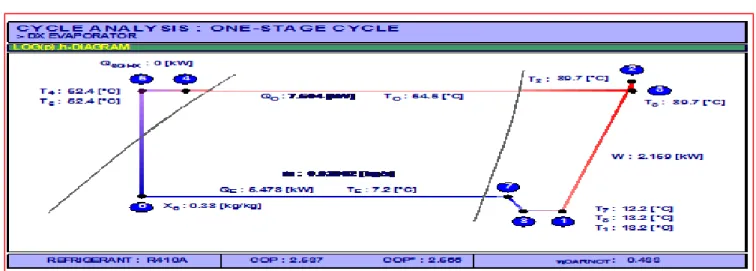
Fig. 4 Simulation of Air conditioning Cycle
The system simulation is carried out for selected three refrigerants thus obtained are compared with the available experimental test data of R22, the performance parameters like power consumption, Coefficient of Performance and Pressure ratios and mass flow rate are compared for the evaporator temperature from -10oC to 10˚C and Condenser Temperature from 35oC to 65˚C[11-14]. Fig. 3 & 4 shows simple vapour compression cycle specification and simulation parameters.
5. RESULTS AND DISCUSSION
Fig.5 Variation of COP with evaporator temperature.
Fig. 6 Mass flow rate for selected refrigerants
0 0.5 1 1.5 2 2.5 3 3.5 4
-10 0 10
Coefficient of Performance
Ev apor at or te m pe ra tur e ˚C
Variation of COP for different evaporator temperature.
R32 R410A R22 0.01 0.02 0.03 0.04 0.05
-10 -5 0 5 10
M as s fl ow r at e in kg / s
Evaporator temperature in ˚C
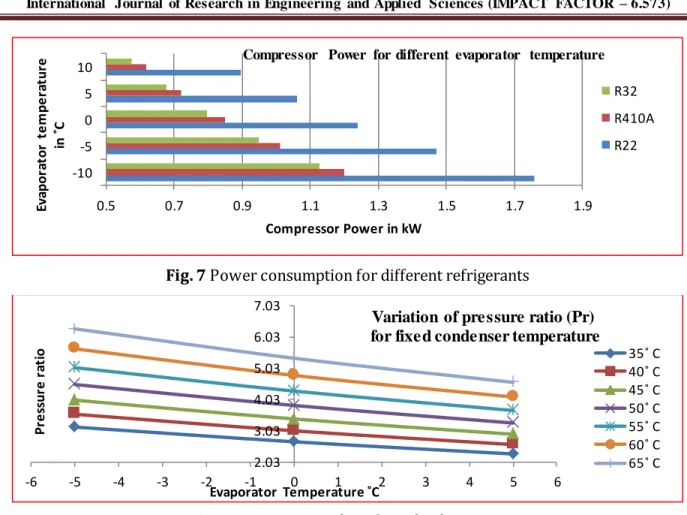
Fig. 7 Power consumption for different refrigerants
Fig. 8 Pressure ratio for selected refrigerants
From fig. 5 to 8 shows the performance characteristics for selected Refrigerants for the given input parameters and obtained output parameters are analyzed and their performance like COP, Mass flow rate and power consumption are compared. As shown in Fig. 5 for high ambient conditions if the condenser temperature at 55°C and evaporator temperature of 10˚C, Coefficient of Performance for Refrigerant 32 is 3.37, R410A is 3 and COP for R22 is 2.55. Fig. 6 shows the mass flow rate required, for evaporator temp of -10 ˚C and condenser temperature 55˚C R32 requires 0.01537kg/s, R22 requires 0.021 kg/s and for R410A requires 0.0196kg/s. With compare to R22 and R410A refrigerants, R32 is having less mass flow rate, there will be less loads on to the compressor with minimum energy (power) required for compression processes, this will be advantageous for eco-friendly refrigeration cycle. Fig. 7, shows the power consumption for 1.565Ton capacity, the power consumption of selected refrigerants with the decrease in evaporator temperature, the work of compressor increases and mass of refrigerant circulated per minute decreases which results in increase of compressor power it is observed from the simulation
0.5 0.7 0.9 1.1 1.3 1.5 1.7 1.9
-10 -5 0 5 10
Compressor Power in kW
Ev apor at or t e m pe ra tur e in ˚C
Compressor Power for different evaporator temperature R32 R410A R22 2.03 3.03 4.03 5.03 6.03 7.03
-6 -5 -4 -3 -2 -1 0 1 2 3 4 5 6
P re ss ur e r at io
Evaporator Temperature ˚C
Variation of pressure ratio (Pr) for fixed condenser temperature
temperatures for the fixed condenser temperature of 65˚C and for the evaporator temperature of -5˚C the pressure ratio obtained was 6.29.In all the cases the pressure ratio decreases for fixed condenser temperature and for the evaporator temperature of -5˚C to +5˚C. The pressure should be moderate for a given operating conditions.
6. CONCLUSIONS
The following conclusions have been drawn from the simulated results of selected refrigerants.
R32 is environmental free refrigerant which can be used in the refrigeration and air conditioning applications, because of zero Ozone Depletion Potential (ODP) and having 650 Global Warming Potential (GWP) which islow with compare to R22.
For high ambient conditions if the condenser temperature at 55°C and evaporator temperature of 10˚C, Coefficient of Performance for Refrigerant 32 is 3.37, R410A is 3 and COP for R22 is 2.55.When compare to R22 and R410A, the R32 COP is 24% and 11% more. The mass flow rate required for Refrigerant 32 is less.
The air conditioning system with fixed condenser temperature and for different evaporating temperatures. The power required for R22 is 0.8976 kW, R32 0.575 kW and R410A 0.61 kW per one “TR” capacity.
The variation Pressure ratio is the ratio of absolute discharge pressure to the absolute suction pressure, the absolute discharge pressure is always more than the absolute suction pressure, and hence the pressure ratio is always more than unity for the fixed condenser temperature of 65˚C and for the evaporator temperature of -5˚C the pressure ratio obtained was 6.29.
AS per ASHRAE standards R32 (Difluoro methane) has been identified as A2L safety group refrigerant.
REFERENCE
[1]S.Devotta, A.S.Padalkar ansN.K.Sane, “Experimental Performance Analysis of a Retrofitted Window Air Conditioner with R-407C”International Refrigeration and air conditioning confrrence.Paper 533. [2]ASHRAE, Thermo physical Properties of Refrigerants Chapter 20, ASHRAE Fundamentals.
[3] HVAC Handbook-2007 Indian Society of Heating Refrigerating and Air – Conditioning Engineers, Part I-Air-Conditioning.
[4] B.O.Bolaji, M.A. Akintundeand T.O.Falade,2011,Comparative Analysis of Performance of three Ozone- Friends HFC Refrigerants in a Vapour Compression Refrigerator”, Journal of Sustainable Energy &Environment 2, pp: 61-64.
[5] Hung Pham, 2010. Next Generation Refrigerants:Standards and Climate Policy Implications of Engineering Constraints, American Council for an Energy-Efficient Economy, PP. 282-294.
[6] S.Devotta,, A.V. Waghmare , N.N. Sawant ,B.M. Domkundwar, 2001.Alternatives to HCFC-22 For air conditioners, Applied Thermal Engineering 21(6), pp: 703-715.
[9] Hand book of BATF lab Tecumseh Products limited, Hyderabad, India.
[10] Hand book of A.C. Applications, Tecumseh Products India Ltd., Hyderabad, India.
[11] BukolaOlalekanBolaji, 2011. Performance investigation of ozone friendly R404A and R507 refrigerant as alternatives to R22 in a window air conditioner. Journal of Energy and Building. pp: 3139-3143. [12] Boda Hadya, A. M. K. Prasad, Suresh Akella, “Performance Assessment of HFC Group Refrigerants in
Window Air Conditioning System”,International Journal of Mechanical Engineering and Applications (IJMEA) ISSN 2330-0248, Vol 3, issue 5,pp;81-85, Science Publishing Group, USA, August 2015. [13] Mark O. McLinden, Eric W. Lemmon and Richard T. Jacobsen, 1998. Thermodynamic properties for
the alternative refrigerants. International Journal of Refrigeration. (21), pp.322-338.