Hungarian Association of Agricultural Informatics European Federation for Information Technology in Agriculture, Food and the Environment
Journal of Agricultural Informatics. Vol. 9, No. 1 journal.magisz.org
Analysis of logging forest residues as an energy source
Vasileios Filippou1, Ioannis Philippou2, Nikolaos Symeonidis3, Ioannis Eleftheriadis4, Kostas Tsiotas5
I N F O
Received 19 Dec 2017 Accepted 5 Feb 2018
Available on-line 23 Mar 2018 Responsible Editor: M. Herdon Keywords:
forest biomass, logging residues, energy
properties, heating value
A B S T R A C T
Forest residue extraction levels in Greece are currently very low, but logging residues have the potential to be an important component of the wood energy supply chain. Forests are a major supplier of renewable energy. Exploring the possibilities of utilizing the biomass of logging residues for energy requires analysis and knowledge of its properties. In this research work the properties (ash, volatiles, fixed carbon, carbon, hydrogen, oxygen, nitrogen and calorific value) of the various constituents of the biomass of fir (Abies borisii - regis), pine (Pinus nigra), oak (Quercus frainetto) and beech (Fagus silvatica) logging residues were determined. Bark and ash content increased with decreasing diameter of branches. Ash content was higher in bark than in wood of branches in all species. Ash and nitrogen content was several times higher in bark and in foliage or needles than in wood of branches. Oak branches and twigs of all species had ash and nitrogen content higher than that required by the EN ISO 17225-2 standard for domestic pellets and they should not be used for energy, at least for pellets production. Volatile mater, fixed carbon, carbon and hydrogen content were in the range given by other researchers. Heating value is higher in softwood (fir and pine) than in hardwood (oak and beech) and ranged from 18.72 MJ/kg to 21.00 MJ/kg. In addition, Duncan's multiple range test was used to compare the means between the various constituents in all species.
1. Introduction
The growing global energy demand and concerns about the negative effects of growing greenhouse gas (GHG) emissions from fossil fuels call for alternative energy sources, which are low cost, renewable and non-polluting. One such renewable resource is biomass and especially forest biomass (European Commission 2005, Smeets and Faaij 2007, Becker et al. 2011). The remaining biomass in the forests after logging has attracted great interest as an energy source (Malinen et al. 2001, Gan and Smith 2006, Hu, Heitmann & Rojas 2008, Eker, Çoban & Acar 2009, Bouriaud, Ştefan & Flocea 2013, Järvinen and Agar 2014, Filippou et al. 2015a, Filippou et al. 2017a). Forest biomass consists of tops, branches, bark, foliage or needles and stumps (Giuntoli et al. 2015).
1 Vasileios Filippou
Aristotle University of Thessaloniki [email protected]
2 Ioannis Philippou
Aristotle University of Thessaloniki [email protected]
3 Nikolaos Symeonidis
Aristotle University of Thessaloniki [email protected]
4 Ioannis Eleftheriadis
Centre for Renewable Energy Sources and savings, Athens [email protected]
5 Kostas Tsiotas
In the past, logging residues were not exploited mainly because their harvest and transport was technically difficult and uneconomic. Currently new harvesting technologies and transportation systems have been developed and in conjunction with the increase in petroleum prices enable their extraction from the forest (Svanaes and Jungmeier 2010). Also, new and more efficient technologies enable conversion of biomass into energy in small units (mainly gasification) or conversion into compressed forms (wood pellets) that can be installed in or near the forests (Kauriinoja and Huuhtanen 2010, Filippou and Philippou 2014). These, further limit the transportation costs and give opportunities for local employment and rural development. Thus, logging residues from final harvest are expected to play an important role in meeting renewable energy goals in many countries (Gan and Smith 2006, Aguilar 2014). Their utilization for energy production could create business opportunities and employments in local populations, generate profit from residual material and provide energy self-sufficiency for rural communities (Philippou 2014). On the other hand, the literature on removal of logging residues from the forest and their exploitation also addresses various environmental and ecological issues and puts some constrains (Hesselink 2010, Abbas et al. 2011, Wall and Hytönen 2011).
The main material properties that affect conversion into energy as well the overall energy outcome are moisture content, ash content, volatile content, elemental composition, chemical components and calorific value (Obernberger, Brunner & Bärnthaler 2006, Vassilev et al. 2010, Filippou et al. 2017b). Biomass of logging residues, differ in chemical composition from stem wood (Zeng, Tang & Xiao 2014). There also exists variability in chemical composition between the various constituents of forest biomass (Werkelin et al. 2007, Wang and Dibdiakova 2014).
Ash content of biomass is known to vary between tree species and tree components (Rhén 2004, Filippou, Philippou & Sideras 2015b, Hytönen and Nurmi 2015). High ash content can decrease the heating value of biomass. In addition, ash content and its composition affect the proper functioning of the burners and gasifiers (Bryers 1996, Nielsen et al. 2000). The ash adheres to the heat transfer surfaces and cause corrosion. During combustion burning, the elements, mainly K, Na, S and Ca can melt, form sticky particles, adhere to the surfaces of the walls and create a burner malfunction (Raask 1969, Filbakk et al. 2011). The nitrogen content of biofuel is responsible for the formation of nitrogen oxides (NOx) which have an environmental impact (Munalula and Meincken 2009). Biomass pellets, should have low ash and nitrogen content in order to meet quality standards requirements (EN ISO 17225-2:2015).
Calorific value of biomass is a function of its chemical composition (Shafizadeh, Chin & DeGroot 1977, McKendry 2002). Various researchers have determined the calorific value of various types of biomass from their elemental composition using proximity regression analysis models (Demirbaş 2003, Friedl et al. 2005, Telmo, Lousada & Moreira 2010, Singh, Singh & Gill 2015). Also, several researchers (Harris 1984, Nurmi 1997, Zeng, Tang & Xiao 2014, Singh, Singh & Gill 2015) have measured the heating value of various tree species and various tree components and found significant differences, both between species and tree biomass components.
The aim of this study is to examine the branches of fir, pine, oak and beech that remain in the forest after harvesting as an energy source, while also to determine their properties that influence the efficient conversion into energy. The properties studied included percentage of bark, ash, volatiles, fixed carbon, carbon, hydrogen, oxygen, nitrogen and calorific value. This work is a part of a research program, aiming at exploring the possibilities for the utilization of residues that remain in the forest after logging, for the production of solid biofuels. Within the framework of the program 5 research papers have been published (Filippou and Philippou 2014, Filippou et al. 2015a, Filippou, Philippou & Sideras 2015b, Filippou et al. 2017a, Filippou et al. 2017b).
2.
Material and Methods
diameters (from 2 to 9cm) were cut. The percentage of bark was calculated by measuring the diameter of the disc with the bark and after peeling the bark using the formula (1):
(1)
Where:
d1=disk diameter with bark
d2= disk diameter without bark
The branch samples were in total 127 and had diameter from 2 to 9 cm. Measurements were carried out in 4 discs (repetitions) of each branch.
For the determination of other properties, the branches were cut into three parts: thick branches (diameter > 5cm), thin branches (diameter of 2 - 5cm) and twigs (branches with a diameter < 2cm including the foliage or needles). Samples of thick and thin branches were debarked in order wood and bark to be tested separately. The samples were air-dried and milled first in a common hammer mill and then in a Willey mill to obtain particle size < 0.420mm (40 mesh). Ash content (% dry weight), the percentage of volatiles, fixed carbon, and the elemental analysis (C, H, N) were determined in accordance with CEN/TS 14775, CEN/TS 15148 and CEN/TS 15104 standards, respectively. The higher heating value (MJ/Kg dry) was determined in accordance with CEN/TS 14918 standard. Three samples of each material were used for the measurements of each property. Afterwards, Variable Analysis between different materials for each property in all species was executed. The Duncan's multiple range test was used to compare the means of chemical components between the various constituents in all species.
3. Results and Discussion
3.1 Bark percentage
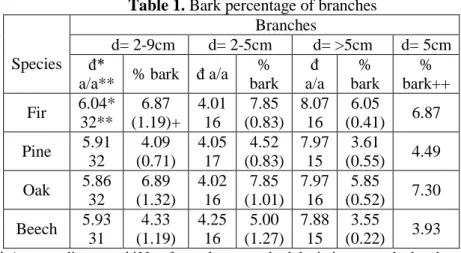
Table 1 shows the average bark percentage of all branches measured, as well as the average percentage in each of the two class sizes of branches of fir, pine, oak and beech. Bark percentage ranged from 3.55% to 7.85% and it was higher in thin than in thick branches and varied between the species in a descending order: oak>fir>beech>pine. The differences in the percentage of bark between species was more evident when it was calculated at the same branch diameter (d = 5cm) for all species.
Table 1. Bark percentage of branches
Species
Branches
d= 2-9cm d= 2-5cm d= >5cm d= 5cm đ*
a/a** % bark đ a/a % bark
đ a/a
% bark
% bark++
Fir 6.04* 32**
6.87 (1.19)+
4.01 16
7.85 (0.83)
8.07 16
6.05
(0.41) 6.87
Pine 5.91 32
4.09 (0.71)
4.05 17
4.52 (0.83)
7.97 15
3.61
(0.55) 4.49
Oak 5.86 32
6.89 (1.32)
4.02 16
7.85 (1.01)
7.97 16
5.85
(0.52) 7.30
Beech 5.93 31
4.33 (1.19)
4.25 16
5.00 (1.27)
7.88 15
3.55
(0.22) 3.93
3.2 Proximate analysis
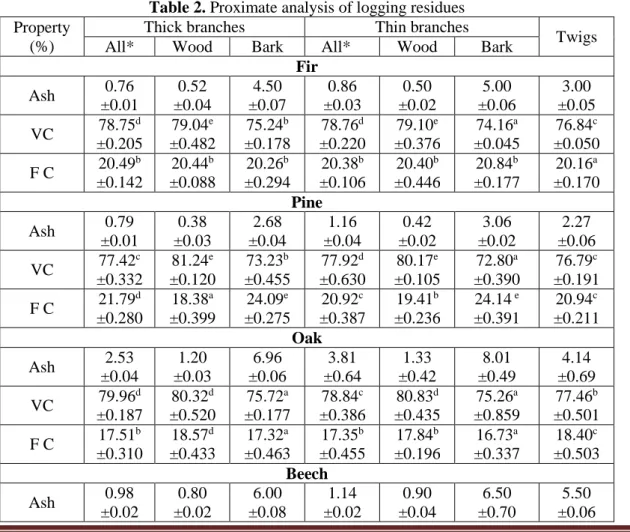
In Table 2, the ash content, volatile content (VC) and fixed carbon (FC) content of all branches and twigs is shown, as well as the wood and bark of thick (d= >5cm) and thin (d= 2 - 5cm) branches of fir, pine, oak and beech. According to Duncan's multiple range test, the constituents in all species were categorized depending on their residues fraction. Tables 2, 3 and 4 illustrate the results, where each column is followed by figures in different letters (S) that indicate the significant difference by Duncan's multiple range test (P<0.05).
3.3 Ash content
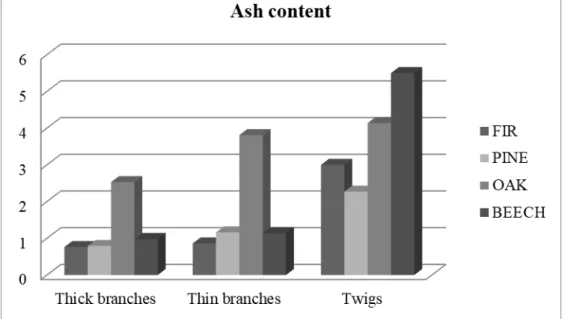
Ash content varied between the various parts of branches and between the species from 0.38% in the wood of thick branches of pine to 8.01% in the bark of thin branches of oak. It was multiple higher in bark than in wood of branches and higher in thin than in thick branches. It is obvious that ash content increases with decreasing branch diameter (see also Table 1). Twigs in all species had lower ash content than bark but higher than thick and thin branches. The ash content of the thick and thin branches (wood and bark) was in fir 0.76 to 0.86%, in pine 0.79 to 1.16%, in oak 2.53 to 3.81% and in beech 0.98 to 1.14%, respectively. The above variation of the ash content between the various materials is shown better in Figure 1. Werkelin et al. (2007) found big differences in ash content between wood and bark in branches of spruce, pine, poplar and birch. Zeng, Tang & Xiao (2014) also found significant differences in ash content between different parts of Masson pine trees.Dibdiakova, Wang, & Li (2015) measured ash content of different parts of scots pine tree and found that branch base has ash content of 0.48% and the branch twigs about 1.56%. The EN ISO 17225-2:2015 standard for domestic pellets requires ash content less than 0.7% for A1 class, less than 1.2% for A2 class and less than 2% for B class pellets, thus oak branches and twigs of all species do not meet the above standard requirements and they should not be used alone for pellet production.
Table 2. Proximate analysis of logging residues Property
(%)
Thick branches Thin branches
Twigs
All* Wood Bark All* Wood Bark
Fir
Ash 0.76 ±0.01 0.52 ±0.04 4.50 ±0.07 0.86 ±0.03 0.50 ±0.02 5.00 ±0.06 3.00 ±0.05
VC 78.75
d ±0.205 79.04e ±0.482 75.24b ±0.178 78.76d ±0.220 79.10e ±0.376 74.16a ±0.045 76.84c ±0.050
F C 20.49 b ±0.142 20.44b ±0.088 20.26b ±0.294 20.38b ±0.106 20.40b ±0.446 20.84b ±0.177 20.16a ±0.170 Pine
Ash 0.79 ±0.01 0.38 ±0.03 2.68 ±0.04 1.16 ±0.04 0.42 ±0.02 3.06 ±0.02 2.27 ±0.06
VC 77.42
c ±0.332 81.24e ±0.120 73.23b ±0.455 77.92d ±0.630 80.17e ±0.105 72.80a ±0.390 76.79c ±0.191
F C 21.79 d ±0.280 18.38a ±0.399 24.09e ±0.275 20.92c ±0.387 19.41b ±0.236
24.14 e ±0.391
20.94c ±0.211 Oak
Ash 2.53 ±0.04 1.20 ±0.03 6.96 ±0.06 3.81 ±0.64 1.33 ±0.42 8.01 ±0.49 4.14 ±0.69
VC 79.96
d ±0.187 80.32d ±0.520 75.72a ±0.177 78.84c ±0.386 80.83d ±0.435 75.26a ±0.859 77.46b ±0.501
F C 17.51 b ±0.310 18.57d ±0.433 17.32a ±0.463 17.35b ±0.455 17.84b ±0.196 16.73a ±0.337 18.40c ±0.503 Beech
VC 80.73 c ±0.050
79.51c ±0.190
76.09b ±0.156
80.32c ±0.390
81.13d ±0.320
77.01b ±0.230
75.67a ±0.190
F C 18.29 b ±0.263
19.69d ±0.194
17.91a ±0.155
18.63e ±0.407
18.02b ±0.185
16.49a ±0.113
18.83c ±0.140
*All branches (wood and bark at average diameter from Table 1). In each column, figures followed by different letters (S) indicate significant difference by the Duncan's multiple range test (P<0.05).
Figure 1. Ash content in the various types of logging residues
3.4 Volatile and Fixed Carbon content
Volatile content (VC) in fir ranged between 74.16% in the bark of thin branches and 79.10% in the wood of thin branches, in pine between 72.80% in the bark of thin branches and 81.24% in the wood of thick branches, in oak between 75.26% in the bark of thin branches and 80.83% in the wood of thin branches and in beech between 75.67% in twigs and 81.13% in the wood of thin branches. In all species, VC of wood was higher than in bark. Fixed carbon (FC) ranged in fir between 20.16% in twigs and 20.84% in the bark of thin branches, in pine between 18.38% in the wood of thick branches and 24.14% in the bark of thin branches, in oak between 16.73% in the bark of thin branches and 18.57% in the wood of thick branches and in beech between 16.49% in the bark of thin branches and 19.69% in the wood of thick branches. FC in all parts of pine was higher in bark than in wood while in oak and beech was higher in wood. In a study (Telmo, Lousada & Moreira 2010) of proximate analysis in 13 wood species, VC varied among the species between 74.7% and 87.1% and FC between 12.4% and 22.5%. In the same study VC and FC of oak wood was 81.70% and 18.00%, of pine 85.80% and 14.10% and of poplar 87.1% and 12.4%, respectively. Demirbas (1997) gives for beech wood 74.00% volatiles content and 24.6% fixed carbon content.
3.5 Ultimate analysis
Table 3 gives the carbon, hydrogen, oxygen and nitrogen content of the all branches and twigs, as well as the wood and bark of thick (d=>5cm) and thin (d=2 - 5cm) branches of fir, pine, oak and beech.
Table 3. Ultimate analysis of logging residues Sample
(%)
Thick branches Thin branches
Twigs All* wood bark All* wood bark
Fir
C 49.44
c ±0.705
49.84d ±1.397
48.69b ±0.428
48.96b ±0.262
48.26b ±0.266
47.87a ±0.269
H 6.45 b ±0.146 6.62b ±0.131 6.14a ±0.030 6.44b ±0.158 6.45b ±0.135 6.39b ±0.227 6.58b ±0.036
O 44.01 43.45 44.14 44.42 45.20 44.89 43.89
N 0.10
a ±0.015 0.09a ±0.005 0,91e ±0.185 0.18b ±0.001 0.09a ±0.001 0.85d ±0.028 0.51c ±0.045 Pine
C 50.60
c ±0.325 49.92b ±0.117 50.73c ±0.340 49.92b ± 0.272 49.02a ±0.125 49.75b ±0.310 50.00b ±0.480
H 6.19
b ±0.075 6.81d ±0.020 6.10a ±0.045 6.52b ±0.144
6.64 c ±0.123
6.36 b ±0.110
6.58c ±0.040
O 43.08 43.20 42.68 43.36 44.21 43.48 42.66
N 0.13
b ±0.011 0.07a ±0.005 0.49d ±0.042 0.20c ±0.020 0.13b ±0.026 0.41d ±0.020 0.76e ±0.020 Oak
C 46.23
b ±0.519 46.92b ±0.285 45.12a ±0.254 46.90b ±0.577 46.50b ±0.345 45.22a ±0.143 47.61c ±0.238
H 6.06
b ±0.102 6.35c ±0.051 6.33c ±0.051 6.09b ±0.015 6.27c ±0.090 5.78a ±0.119 6.22b ±0.040
O 47.42 46.52 48.33 46.70 47.01 48.59 45.00
N 0.29
b ±0.020 0.21a ±0.010 0.22a ±0.010 0.31b ±0.040 0.22a ±0.020 0.41c ±0.010 1.17d ±0.060 Beech
C 46.85
b ±0.177 47.02c ±0.794 45.88a ±0.551 47.62d ±0.276 49.73f ±0.211 46.75b ±0.529 49.09e ±0.265
H 6.25
b ±0.058 6.41c ±0.015 5.95a ±0.152 6.27b ±0.148 6.47c ±0.035 5.97a ±0.079 6.68d ±0.055
O 46.65 46.40 47.59 45.85 43.64 46.89 42.66
N 0.25
b ±0.010 0.17a ±0.005 0.58d ±0.061 0.26b ±0.032 0.16a ±0.001 0.39c ±0.017 1.57e ±0.030
*All branches (wood and bark at average diameter from Table 1). Ιn each column, figures followed by different letters (S) indicate significant difference by Duncan's multiple range test (P<0.05).
Carbon content varied in fir between 47.87% in the bark of thin branches and 49.84% in the wood of thick branches, in pine between 49.02% in the wood of thin branches and 50.73% in the bark of thick branches, in oak between 45.12% in the bark of thick branches and 47.61% in twigs and in beech between 45.88% in the bark of thick branches and 49.73% in the wood of thin branches. In fir and pine thick branches had higher carbon content while in oak and beech carbon content was higher in thin than in thick branches. With the exception in pine, wood had higher carbon content than bark, in all species. Ragland, Aerts & Baker (1991) noticed that the carbon content of softwood species varies between 50 and 53%, and that of hardwood species between 47 and 50% mainly due to the varying lignin and extractives content. They also give 52.25% and 54.90% carbon content in oak and pine bark, respectively.
Oxygen content was determined by subtracting C, H, N and ash content from the whole mass (100%). In fir oxygen content varied from 43.45% in the wood of thick branches to 45.20% in the wood of thin branches, in pine from 42.66% in twigs to 44.21 % in the wood of thin branches, in oak from 45.00% in twigs to 48.59% in the bark of thin branches and in beech from 42.66% in twigs to 47.59% in the bark of thick branches. Oxygen content was in a descending order: oak>beech>fir>pine. Oxygen content was lower than carbon content in all fir and pine biomass components.
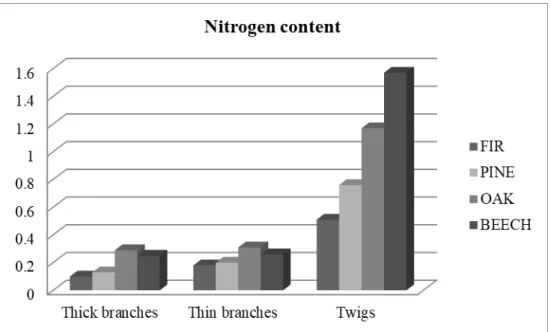
Nitrogen content in fir varied from 0.09% in the wood of thick and thin branches to 0.91% in the bark of thick branches, in pine from 0.07% in the wood of thick branches to 0.76% in twigs, in oak from 0.21 in the wood of thick branches to 1.17% in twigs and in beech from 0.16 in the wood of thin branches to 1.57% in twigs. In all cases, bark had 2-3 times higher nitrogen content than wood. It is worth mentioning in nitrogen content which is a determinant factor classification of biomass in qualities according to EN ISO 17225-2:2015 standard. According to Duncan's multiple range test it appears to be a grouping trend in softwood species (fir and pine) which have lower nitrogen content in thick than in thin branches and lower in wood than in bark. In hardwood (oak and beech) species there are no differences in thick and thin branches, while nitrogen content is higher in bark than in wood. With the exception of fir, nitrogen content was higher in twigs in all species. The above variation in nitrogen content is shown better in Figure 2. Dzurenda (2013) gives 0.36%, 0.65% and 0.46% nitrogen content for populous branch wood, branch bark and branch chip. Alakangas (2005) gives 0.30% nitrogen content for scots pine whole trees and 0.40% for pine logging residues. Oak and beech twigs have higher nitrogen content than the EN ISO 17225-2:2015 standard for domestic pellets and should not be used alone for energy uses, at least for pellet production.
Figure 2. Nitrogen content in the various types of logging residues
3.6 Heating value
Table 4. Heating values (MJ/kg) of logging residues Property
(MJ/kg)
Thick branches Thin branches
Twigs
All* Wood Bark All* Wood Bark
Fir
HHV2 20.57 d ±0.04
20.61d ±0.03
20.48b ±0.01
20.79e ±0.02
20.80e ±0.02
20.32b ±0.025
19.57a ±0.015 Pine
HHV 20.95 c
±0.020
20.84b ±0.015
21.00d ±0.020
20.80a ±0.045
20.75a ±0.025
20.84b ±0.025
20.95c ±0.015 Oak
HHV 19.26 c
±0.050
19.15b ±0.110
18.72a ±0.090
19.31e ±0.060
19.52f ±0.085
19.13b ±0.090
19.30c ±0.122 Beech
HHV 19.58 b ±0.020
19.67c ±0.040
19.41a ±0.020
19.63b ±0.025
19.70c ±0.015
19.31a ±0.04
19.42a ±0.02
*All branch (wood and bark at average diameter from Table 1), 2HHV= higher heat value. In each column,
figures followed by different letters (S) indicate significant difference by the Duncan's multiple range test
(P<0.05).
On the average, heating value was in a descending order: pine>fir>beech>oak. Heating value was higher in softwood (fir and pine) than in hardwood (oak and beech). Philippou (1982) found in oak 19.65 MJ/kg and 18.79 MJ/kg, in poplar 19.78 MJ/kg and 19.62 MJ/kg and in pine 20.35 MJ/kg and 21.60 MJ/kg for stem wood and stem bark, respectively. Järvinen and Agar (2014) making pellets from pine and logging residues found that the average caloric content for the whole pine tree was 20.80 MJ/kg and for the residues 21.60 MJ/kg. Telmo, Lousada & Moreira (2010) found an average heating value (HHV) of pellets from beech wood 19.14 MJ/kg. Phyllis2- Database (ECN 2012) gives calorific value for beech bark 21.67 MJ/kg and an average calorific value of beech wood measured by 12 researchers 19.08 MJ/kg with a range between 16.48 – 20.51 MJ/kg. Shafizadeh, Chin & DeGroot (1977), Demirbas (1997) and Gillespie et al. (2013) found a correlation between carbon content and calorific value.
4. Conclusions
This paper assessed the suitability of logging residues as an energy source. The properties of logging residues of fir, pine, oak and beech differ in some properties that are important for energy usages.
Bark percentage was higher in thin than in thick branches and varied between the species in a descending order: oak>fir>beech>pine.
Bark and ash content increased with decreasing diameter of branches. Ash content was higher in thin than in thick branches and it was higher in bark than in wood in all species.
Fixed carbon, carbon and hydrogen content differed between the various constituents of logging residues.
Nitrogen content of all branches varied from 0.10% in thick branches of fir to 0.31% in thin branches of oak. In overall nitrogen content was higher in oak and higher in thin branches in all species.
Relatively higher values of ash and nitrogen content found in the biomass of logging residues, are not as high as in the biomass of other lignocellulosic materials such as agricultural residues and annual plants which are being used for energy production.
Taking into consideration that the recovery of logging residues may be limited by other constrains such as maintaining long-term soil and site productivity, from the above results we could conclude that the branches of fir, pine and beech could be a proper material for energy usages while the branches of oak and the twigs of all species should be left to provide nitrogen and minerals to the forest soil. However, during their processing to energy, attention should be given to the proper servicing of the burners or gasifiers for avoiding accumulation or melting of the ashes.
Acknowledgment: This study was supported in part by the Green Fund, Ministry of Environment and Energy, Greece.
References
Abbas, D., Current, D., Phillips, M., Rossman, R., Hoganson, H., & Brooks, K. N., 2011. Guidelines for harvesting forest biomass for energy: a synthesis of environmental considerations. Biomass and Bioenergy, 35(11), pp. 4538-4546. https://doi.org/10.1016/j.biombioe.2011.06.029
Aguilar, F. X. (Ed.). 2014. Wood energy in developed economies: Resource management, economics and policy. Routledge.
Alakangas, E., 2005. Properties of wood fuels used in Finland–Biosouth-project. Technical Research Centre of Finland Research Report, VTT Processes, Jyväskylä, Finland, 100.
Becker, D. R., McCaffrey, S. M., Abbas, D., Halvorsen, K. E., Jakes, P., & Moseley, C., 2011. Conventional wisdoms of woody biomass utilization on federal public lands. Journal of Forestry, 109(4), pp. 208-218.
Bouriaud, O., Ştefan, G., & Flocea, M., 2013. Predictive models of forest logging residues in Romanian spruce and beech forests. Biomass and bioenergy, 54, pp. 59-66. https://doi.org/10.1016/j.biombioe.2013.03.022
Bryers, R. W., 1996. Fireside slagging, fouling, and high-temperature corrosion of heat-transfer surface due to impurities in steam-raising fuels. Progress in energy and combustion science, 22(1), pp. 29-120. https://doi.org/10.1016/0360-1285(95)00012-7
CEN/TS 14775, 2005, Solid Biofuels – Method for the Determination of Ash.
CEN/TS 14918, 2005. Solid Biofuels – Method for the Determination of Calorific Value.
CEN/TS 15104, 2005. Solid Biofuels – Determination of Total Content of Carbon, Hydogen and Nitrogen.
CEN/TS 15148, 2005. Solid Biofuels – Method for the Determination of the Content of Volatile Matter.
Demirbaş, A., 2003. Relationships between lignin contents and fixed carbon contents of biomass samples.
Energy Conversion and Management, 44(9), pp. 1481-1486. https://doi.org/10.1016/S0196-8904(02)00168-1
Dibdiakova, J., Wang, L., & Li, H., 2015. Characterization of ashes from Pinus Sylvestris forest biomass. Energy Procedia, 75, pp. 186-191. https://doi.org/10.1016/j.egypro.2015.07.289
Dzurenda, L., 2013. Energetic properties of green chips made of branches of wood species Populus x euroamericana clone Pannonia grown on plantations. Annals of Warsaw University of Life Sciences-SGGW. Forestry and Wood Technology, 82.
Eker, M., Çoban, H. O., & Acar, H. H., 2009. The procurement problem of logging residues in Turkish forestry. Proceedings in FORMEC, 9, pp. 115-124.
EN ISO 17225-2:2015. Solid biofuels ― Fuel specifications and classes. Part 2: Graded wood pellets. European Committee for Standardization.
European Commission, 2005. Biomass. Green Energy for Europe. Directorate-General for Research, Sustainable Energy Systems, EUR 21350.
Filbakk, T., Jirjis, R., Nurmi, J., & Høibø, O., 2011. The effect of bark content on quality parameters of Scots pine (Pinus sylvestris L.) pellets. Biomass and Bioenergy, 35(8), pp. 3342-3349. https://doi.org/10.1016/j.biombioe.2010.09.011
Filippou, V. and Philippou, I. L., 2014. Harvesting methods of logging residues. Proceedings of 10th National
Congress on Renewable Energy. 26-28 November, Thessaloniki Greece, pp 287-297.
Filippou, V., Tsanaxidou, Z., Sideras, A., & Philippou, I. L., 2015a. Weight characteristics of logging residues of fir and beech as an energy source. Pro Ligno, 11(4), pp. 663-672.
Filippou, V., Philippou, I. L. & Sideras, A., 2015b. Utilization of logging residues for production of biofuels: I. Percentage (%) of bark and ash of branches of fir, pine, beech, poplar and oak. Conference Proceedings, 17th
international forestry conference, Nov. 4-7, Kefalonia Greece, pp. 809-819.
Filippou V., Philippou L., Eleftheriadis I., Tsiotas K., 2017a. Energy and other properties of fir and beech logging residues. Conference Proceedings, International Workshop, Information Technology, Sustainable
Development, Scientific Network and Nature Protection, Okt. 8-11, Edessa Greece, pp. 1340-1348.
Filippou V., Philippou I., Eleftheriadis I., Tsiotas K., 2017b. Fuel properties of oak, poplar and pine logging residues. Proligno. 13(4), pp. 570-578.
Friedl, A., Padouvas, E., Rotter, H., & Varmuza, K., 2005. Prediction of heating values of biomass fuel from elemental composition. Analytica Chimica Acta, 544(1), pp. 191-198. https://doi.org/10.1016/j.aca.2005.01.041
Gan, J., & Smith, C. T., 2006. Availability of logging residues and potential for electricity production and carbon displacement in the USA. Biomass and Bioenergy, 30(12), pp. 1011-1020. https://doi.org/10.1016/j.biombioe.2005.12.013
Gillespie, G. D., Everard, C. D., Fagan, C. C., & McDonnell, K. P., 2013. Prediction of quality parameters of biomass pellets from proximate and ultimate analysis. Fuel, 111, pp. 771-777. https://doi.org/10.1016/j.fuel.2013.05.002
Giuntoli, J., Caserini, S., Marelli, L., Baxter, D., & Agostini, A., 2015. Domestic heating from forest logging residues: environmental risks and benefits. Journal of Cleaner Production, 99, pp. 206-216. https://doi.org/10.1016/j.jclepro.2015.03.025
Harris, R. A., 1984. Fuel values of stems and branches in white oak, yellow-poplar, and sweetgum. Forest products journal, 34(3), pp. 25-26.
Hesselink, T. P., 2010. Increasing pressures to use forest biomass: A conservation viewpoint. The Forestry Chronicle, 86(1), pp. 28-35. https://doi.org/10.5558/tfc86028-1
Hu, G., Heitmann, J. A., & Rojas, O. J., 2008. Feedstock pretreatment strategies for producing ethanol from wood, bark, and forest residues. BioResources, 3(1), pp. 270-294.
Järvinen, T., & Agar, D., 2014. Experimentally determined storage and handling properties of fuel pellets made from torrefied whole-tree pine chips, logging residues and beech stem wood. Fuel, 129, pp. 330-339. https://doi.org/10.1016/j.fuel.2014.03.057
Kauriinoja, A., & Huuhtanen, M., 2010. Small-scale biomass-to-energy solutions for northern periphery areas (Doctoral dissertation, MSc Thesis, Oulu).
Malinen, J., Pesonen, M., Määttä, T., & Kajanus, M., 2001. Potential harvest for wood fuels (energy wood) from logging residues and first thinnings in Southern Finland. Biomass and Bioenergy, 20(3), pp. 189-196. https://doi.org/10.1016/S0961-9534(00)00075-1
McKendry, P., 2002. Energy production from biomass (part 1): overview of biomass. Bioresource technology, 83(1), pp. 37-46. https://doi.org/10.1016/S0960-8524(01)00118-3
Munalula, F., & Meincken, M., 2009. An evaluation of South African fuelwood with regards to calorific value and environmental impact. Biomass and bioenergy, 33(3), pp. 415-420. https://doi.org/10.1016/j.biombioe.2008.08.011
Nielsen, H. P., Baxter, L. L., Sclippab, G., Morey, C., Frandsen, F. J., & Dam-Johansen, K., 2000. Deposition of potassium salts on heat transfer surfaces in straw-fired boilers: a pilot-scale study. Fuel, 79(2), pp. 131-139. https://doi.org/10.1016/S0016-2361(99)00090-3
Nurmi, J., 1993. Heating values of the above ground biomass of small-sized trees. Acta Forestalia Fennica 236. The Finish Research Institute.
Nurmi, J., 1997. Heating values of mature trees. The Society of Forestry in Finland.
Obernberger, I., Brunner, T., & Bärnthaler, G., 2006. Chemical properties of solid biofuels—significance and impact. Biomass and Bioenergy, 30(11), pp. 973-982. https://doi.org/10.1016/j.biombioe.2006.06.011
Philippou, I., 1982. Calorific value of various types of forest biomass. Proceedings of 1th National Congress on Renewable Energy. Thessaloniki.
Philippou, I., 2014. Utilization of forest biomass for energy production. Environmental and rural development contribution. Proceedings of 10th National Congress on Renewable Energy. 26-28 November, Thessaloniki. pp. 273-287.
Raask, E., 1969. Tube erosion by ash impaction. Wear, 13(4-5), pp. 301-315. https://doi.org/10.1016/0043-1648(69)90252-X
Ragland, K. W., Aerts, D. J., & Baker, A. J., 1991. Properties of wood for combustion analysis. Bioresource technology, 37(2), pp. 161-168. https://doi.org/10.1016/0960-8524(91)90205-X
Rhén, C., 2004. Chemical composition and gross calorific value of the above-ground biomass components of young Picea abies. Scandinavian journal of forest research, 19(1), pp. 72-81. https://doi.org/10.1080/02827580310019185
Shafizadeh, F., Chin, P. P., & DeGroot, W. F., 1977. Effective heat content of green forest fuels. Forest Science, 23(1), pp. 81-89.
Singh, M. Singh, R. and G. Gill. 2015. Estimating the correlation between the caloric value and elemental components of biomass using regression analysis. Proceedings of 33th IRF International Conference, July 26, 2015, Pune, India, ISBN: 97893-85465-62-8.
Smeets, E. M., & Faaij, A. P., 2007. Bioenergy potentials from forestry in 2050. Climatic Change, 81(3-4), pp. 353-390. https://doi.org/10.1007/s10584-006-9163-x
Svanaes, J., & Jungmeier, G., 2010. Energy generation techniques. A state of the art overview of available techniques for energy generation through direct combustion of recovered wood. COST. Norsk Treteknisk Institutt.
Telmo, C., Lousada, J., & Moreira, N., 2010. Proximate analysis, backwards stepwise regression between gross calorific value, ultimate and chemical analysis of wood. Bioresource technology, 101(11), PP. 3808-3815. https://doi.org/10.1016/j.biortech.2010.01.021
Wall, A., & Hytönen, J., 2011. The long-term effects of logging residue removal on forest floor nutrient capital, foliar chemistry and growth of a Norway spruce stand. Biomass and Bioenergy, 35(8), PP. 3328-3334. https://doi.org/10.1016/j.biombioe.2010.08.063
Wang, L., & Dibdiakova, J., 2014. Characterization of ashes from different wood parts of Norway spruce tree. Chemical engineering transactions, 37, PP. 37-42.
Werkelin, J., Johan, B., Skrifvars, B. J., & Hupa, M., 2007. Ash-forming elements in four Scandinavian wood species. Part 1: Summer harvest. Biomass and Bioenergy (29): PP. 451-466.
Wilén, C., Moilanen, A., & Kurkela, E., 1996. Biomass feedstock analyses. VTT Publications 282, Espoo. Finland.