200 Puzzling Physics Problems
P. GnadigEotvos University, Budapest
G. Honyek
Radn6ti Grammar School, Budapest
K. F. Riley
Cavendish Laboratory, Fellow of Clare College, Cambridge
CAMBRIDGE
UNIVERSITY PRESSThe Pitt Building, Trumpington Street, Cambridge, United Kingdom CAMBRIDGE UNIVERSITY PRESS
The Edinburgh Building, Cambridge CB2 2RU, UK 40 West 20th Street, New York, NY 10011-4211, USA 477 Williamstown Road, Port Melbourne, VIC 3207, Australia
Ruiz de Alarcon 13, 28014 Madrid, Spain
Dock House, The Waterfront, Cape Town 8001, South Africa
http:/ /www.cambridge.org © Cambridge University Press 2001
This book is in copyright. Subject to statutory exception and to the provisions of relevant collective licensing agreements,
no reproduction of any part may take place without the written permission of Cambridge University Press
First published 2001 Reprinted 2002, 2003
Printed in the United Kingdom at the University Press, Cambridge
Typeface Monotype Times 10/13 pt System lbTEX [UPH] A catalogue record for this book is available from the British Library
Library of Congress Cataloguing in Publication data Gnadig, Peter,
1947-200 Puzzling Physics Problems / P. Gnadig, G. Honyek, K. F. Riley. p. em.
Includes bibliographical references and index. ISBN 0 521 77306 7 - ISBN 0 521 77480 2 (pb.)
1. Physics-Problems, exercises, etc. I. Title: Two hundred puzzling physics problems. II. Honyek, G. (Gyula), 1951- III. Riley, K. F. (Kenneth Franklin), 1936- IV. Title.
QC32.G52 2001
530'.076-dc21 00-053005 CIP
ISBN 0 521 77306 7 hardback ISBN 0 521 77480 2 paperback
Preface
How to use this book
Thematic order of the problems Physical constants
Problems Hints Solutions
page vn
X
XI
Xlll 1 50 69
In our experience, an understanding of the laws of physics is best acquired by applying them to practical problems. Frequently, however, the problems appearing in textbooks can be solved only through long, complex calcu-lations, which tend to be mechanical and boring, and often drudgery for students. Sometimes, even the best of these students, the ones who possess all the necessary skills, may feel that such problems are not attractive enough to them, and the tedious calculations involved do not allow their 'creativity' (genius?) to shine through.
This little book aims to demonstrate that not all physics problems are like that, and we hope that you will be intrigued by questions such as:
• How is the length of the day related to the side of the road on which traffic travels?
• Why are Fosbury floppers more successful than Western rollers? • How far below ground must the water cavity that feeds Old Faithful
be?
• How high could the tallest mountain on Mars be?
• What is the shape of the water bell in an ornamental fountain? • How does the way a pencil falls when stood on its point depend
upon friction?
• Would a motionless string reaching into the sky be evidence for UFOs?
• How does a positron move when dropped in a Faraday cage? • What would be the high-jump record on the Moon?
• Why are nocturnal insects fatally attracted to light sources? • How much brighter is sunlight than moonlight?
• How quickly does a fire hose unroll?
• How do you arrange two magnets so that the mutual couples they experience are not equal and opposite?
• How long would it take to defrost an 8-tonne Siberian mammoth? • What perils face titanium-eating little green men who devour their
own planet?
• What is the direction of the electric field due to an uniformly charged rod?
• What is the catch in an energy-generating capacitor?
• What is the equivalent resistance of an n-dimensional cube of resis-tors?
• What factors determine the period of a sand-glass egg timer? • How does a unipolar dynamo work?
• How 'deep' is an electron lying in a box?
These, and some 180 others, are problems that can be solved elegantly by an appropriate choice of variables or coordinates, an unusual way of thinking, or some 'clever' idea or analogy. When such an inspiration or eureka moment occurs, the solution often follows after only a few lines of calculation or brief mental reasoning, and the student feels justifiably pleased with him-or herself.
Logic in itself is not sufficient. Nobody can guess these creative approaches without knowing and understanding the basic laws of physics. Accordingly, we would not encourage anybody to tackle these problems without first having studied the subject in some depth. Although successful solutions to the problems posed are clearly the principal goal, we should add that success is not to be measured by this alone. Whatever help you, the reader, may seek, and whatever stage you reach in the solution to a problem, it will hopefully bring you both enlightenment and delight. We are sure that some solutions will lead you to say 'how clever', others to say 'how nice', and yet others to say 'how obvious or heavy-handed'! Our aim is to show you as many useful 'tricks' as possible in order to enlarge your problem-solving arsenal. We wish you to use this book with delight and profit, and if you come across further similar 'puzzling' physics problems, we would ask you to share them with others (and send them to the authors).
The book contains 200 interesting problems collected by the authors over the course of many years. Some were invented by us, others are from the Hungarian 'Secondary School Mathematics and Physics Papers' which span more than 100 years. Problems and ideas from various Hungarian and international physics contests, as well as the Cambridge Colleges' entrance examination, have also been used, often after rewording. We have also been
guided by the suggestions and remarks of our colleagues. In particular, we would like to thank Masaaki Kato for several helpful observations and suggested clarifications and Alfonso Diaz-Jimenez for an interesting note on the launching of space probes (see solution 17). It is impossible to determine the original authors of most of the physics problems appearing in the international 'ideas-market'. Nevertheless, some of the inventors of the most puzzling problems deserve our special thanks. They include Tibor Biro, Laszlo Holies, Frederick Karolyhazy, George Marx, Ervin Szegedi and Istvan Varga. We thank them and the other people, known and unknown, who have authored, elaborated and improved upon 'puzzling' physics problems.
P.G. G.H.
Budapest 2000
K.F.R.
How to use this book
The following chapter contains the problems. They do not follow each other in any particular thematic order, but more or less in order of d!tficulty, or in groups requiring similar methods of solution. In any case, some of the problems could not be unambiguously labelled as belonging to, say, mechanics or thermodynamics or electromagnetics. Nature's secrets are not revealed according to the titles of the sections in a text book, but rather draw on ideas from various areas and usually in a complex manner. It is part of our task to find out what type of problem we are facing. However, for i~/(Jrmation, the reader can find a list of topics, and the problems that more or less belong to these topics, on the following page. Some problems are listed under more than one heading. The symbols and numerical values of the principal physical constants are then given, together with astronomical data and some properties of material.
The majority of the problems are not easy; some of them are definitely dif-ficult. You, the reader, are naturally encouraged to try to solve the problems on your own and, obviously, if you do, you will get the greatest pleasure. If you are unable to achieve this, you should not give up, but turn to the relevant page of the short hints chapter. In most cases this will help, though it will not give the complete solution, and the details still have to be worked out. Once you have done this and want to check your result (or if you have completely given up and only want to see the solution), the last chapter should be consulted.
Problems whose solutions require similar reasoning usually follow each other. But if a particular problem relates to another elsewhere in this book, you will find a cross-reference in the relevant hint or solution. Those requiring especially difficult reasoning or mathematically complicated calculations are marked by one or two asterisks.
Some problems are included whose solutions raise further questions that are beyond the scope of this book. Points or issues worth further considera-tion are indicated at the end of the respective soluconsidera-tions, but the answers are not given.
Kinematics: 1, 3, 5, 36, 37, 38*, 40, 41, 64, 65*, 66, 84*, 86*.
Dynamics: 2, 7, 8, 12, 13, 24, 32*, 33, 34, 35, 37, 38*, 39*, 70*, 73*, 77, 78*, 79*, 80**, 82, 83, 85**, 90, 154*, 183*, 184*, 186*, 193*, 194.
Gravitation: 15, 16, 17, 18, 32*, 81**, 87, 88, 109, 110*, 111*, 112*, 116, 134*.
Mechanical energy: 6, 7, 17, 18, 32*, 51, 107.
Collisions: 20, 45, 46, 47, 48, 71, 72*, 93, 94, 144*, 194, 195.
Mechanics of rigid bodies: 39*, 42**, 58, 60*, 61 **, 94, 95*, 96, 97*, 98, 99**.
Statics: 9, 10*, 11, 14*, 25, 26, 43, 44, 67, 68, 69*.
Ropes, chains: 4, 67, 81 **, 100, 101 *, 102**, 103*, 104*, 105**, 106*, 108**. Liquids, gases: 19, 27, 28, 49*, 50, 70*, 73*, 74, 75*, 91*, 115**, 143, 200. Surface tension: 29, 62, 63, 129, 130*, 131 *, 132**, 143, 199*.
Thermodynamics: 20, 21*, 133, 135**, 136, 145, 146*, 147, 148. Phase transitions: 134*, 137*, 138, 140*, 141 *.
Optics: 52, 53, 54, 55, 56, 125*, 126, 127, 128*.
Electrostatics: 41, 90, 91*, 92, 113*, 114, 117*, 118, 121, 122, 123*, 124*, 149, 150, 151*, 152, 155, 156, 157, 183*, 192*, 193*.
Magnetostatics: 89**, 119, 120**, 153*, 154*, 172, 186*.
Electric currents: 22, 23, 158, 159, 160*, 161, 162*, 163*, 164*, 165, 169, 170*, 172.
Electromagnetism: 30, 31, 166, 167, 168*, 171*, 173*, 174*, 175*, 176, 177, 178*, 179, 180, 181*, 182*, 184*, 185*, 186*, 187*.
Atoms and particles: 93, 188, 189*, 190*, 191, 194, 195, 196, 197*, 198*. Dimensional analysis, scaling, estimations: 15, 57, 58, 59*, 76*, 77, 126, 139,
142, 185*, 199*.
*• **A single or double asterisk indicates those problems that require especially difficult reasoning or mathematically complicated calculations.
Gravitational constant, G Speed of light (in vacuum), c Elementary charge, e
Electron mass, me
Proton mass, mp
Boltzmann constant, k Planck constant, h Avogadro constant, NA Gas constant, R
Permittivity of free space, Bo
Coulomb constant, k = 1
I
4n8()Permeability of free space, J.lO
Some astronomical data Mean radius of the Earth, R
6.673 X lo-ll N m2 kg-2
2.998 x 10⁸m s-1
1.602 X 10⁻¹⁹ C
9.109 X 10⁻³l kg 1.673 X 10⁻²⁷ kg
1.381 X 10⁻²³ J K-1
6.626 X 10⁻³⁴ J S
6.022 x 10²³ mol-1
8.315 J mol-1 K-1
8.854 x 10⁻¹² C
v-
1 m-18.987 X 10⁹ V m c-l
4n X 10-7 V s2 c-l m-l
6371km Sun-Earth distance (Astronomical Unit, AU)
Mean density of the Earth, p
1.49 x 10⁸ km
5520kgm-3
9.8lms-2
Free-fall acceleration at the Earth's surface, g
Some physical properties
Surface tension of water, y 0.073Nm-1
Heat of vaporisation of water, L Tensile strength of steel, u
2256kJkg-1 = 40.6kJmol-1 500-2000 MPa
Densitiesa, p (kg m-3)
Hydrogen 0.0899
Helium 0.1786
Air 1.293
Water (at 4
oq
1000a Densities quoted in normal state.
Optical Refractive Indicesb, n
Water 1.33 Glass
Ice 1.31 Diamond
bAt).= S90nm.
Titanium Iron Mercury Platinum
1.5-1.8 2.42
4510 7860 13550 21450
Pl Three small snails are each at a vertex of an equilateral triangle of
side 60 em. The first sets out towards the second, the second towards the third and the third towards the first, with a uniform speed of 5 em min-1•
During their motion each of them always heads towards its respective target snail. How much time has elapsed, and what distance do the snails cover, before they meet? What is the equation of their paths? If the snails are considered as point-masses, how many times does each circle their ultimate meeting point?
P2 A small object is at rest on the edge of a horizontal table. It is pushed in such a way that it falls off the other side of the table, which is 1 m wide, after 2 s. Does the object have wheels?
P3 A boat can travel at a speed of 3 m s-1 on still water. A boatman wants to cross a river whilst covering the shortest possible distance. In what direction should he row with respect to the bank if the speed of the water is (i) 2 m s-1, (ii) 4 m s-1? Assume that the speed of the water is the same everywhere.
P4 A long, thin, pliable carpet is laid on the floor. One end of the carpet is bent back and then pulled backwards with constant unit velocity, just above the part of the carpet which is still at rest on the floor.
0
- - - I } = l c===
Find the speed of the centre of mass of the moving part. What is the minimum force needed to pull the moving part, if the carpet has unit length and unit mass?
P5 Four snails travel in uniform, rectilinear motion on a very large plane surface. The directions of their paths are random, (but not parallel, i.e. any two snails could meet), but no more than two snail paths can cross at any one point. Five of the (4 x 3)/2
=
6 possible encounters have already occurred. Can we state with certainty that the sixth encounter will also occur?P6 Two 20-g flatworms climb over a very thin wall, 10 em high. One of the worms is 20 em long, the other is wider and only 10 em long. Which of them has done more work against gravity when half of it is over the top of the wall? What is the ratio of the amounts of work done by the two worms?
P7 A man of height ho
=
2 m is bungee jumping from a platform situated a height h = 25 m above a lake. One end of an elastic rope is attached to his foot and the other end is fixed to the platform. He starts falling from rest in a vertical position.h
--=~----_-:_-_. __ ---:---==
The length and elastic properties of the rope are chosen so that his speed will have been reduced to zero at the instant when his head reaches the surface of the water. Ultimately the jumper is hanging from the rope, with his head 8 m above the water.
(i) Find the unstretched length of the rope.
(ii) Find the maximum speed and acceleration achieved during the jump. P8 An iceberg is in the form of an upright regular pyramid of which 10 m shows above the water surface. Ignoring any induced motion of the water, find the period of small vertical oscillations of the berg. The density of ice is 900 kg m-3.
P9 The suspension springs of all four wheels of a car are identical. By how much does the body of the car (considered rigid) rise above each of the wheels when its right front wheel is parked on an 8-cm-high pavement? Does the result change when the car is parked with both right wheels on
the pavement? Does the result depend on the number and positions of the people sitting in the car?
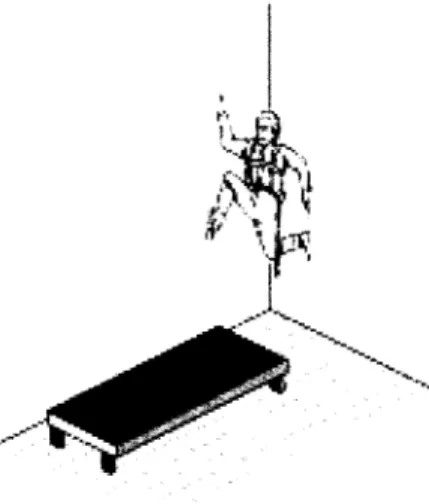
PlO* In Victor Hugo's novel les Miserables, the main character Jean Valjean, an escaped prisoner, was noted for his ability to climb up the corner formed by the intersection of two vertical perpendicular walls. Find the minimum force with which he had to push on the walls whilst climbing. What is the minimum coefficient of static friction required for him to be able to perform such a feat?
Pll A sphere, made of two non-identical homogeneous hemispheres
stuck together, is placed on a plane inclined at an angle of 30° to the horizontal. Can the sphere remain in equilibrium on the inclined plane?
P12 A small, elastic ball is dropped vertically onto a long plane inclined at an angle IX to the horizontal. Is it true that the distances between
con-secutive bouncing points grow as in an arithmetic progression? Assume that collisions are perfectly elastic and that air resistance can be neglected.
P13 A small hamster is put into a circular wheel-cage, which has a frictionless central pivot. A horizontal platform is fixed to the wheel below the pivot. Initially, the hamster is at rest at one end of the platform.
When the platform is released the hamster starts running, but, because of the hamster's motion, the platform and wheel remain stationary. Determine how the hamster moves.
P14* A bicycle is supported so that it is prevented from falling sideways but can move forwards or backwards; its pedals are in their highest and low-est positions. A student crouches beside the bicycle and applies a horizontal force, directed towards the back wheel, to the lower pedal.
200 Puzzling Physics Problems
(ii) Does the chain-wheel rotate in the same or opposite sense as the rear wheel?
(iii) Which way does the lower pedal move relative to the ground?
P15 If the solar system were proportionally reduced so that the average distance between the Sun and the Earth were 1 m, how long would a year be? Take the density of matter to be unchanged.
lm
0
Sun Earth•
P16 If the mass of each of the members of a binary star were the same as that of the Sun, and their distance apart were equal to the Sun-Earth distance, what would be their period of revolution?
P17 (i) What is the minimum launch speed required to put a satellite into a circular orbit?
(ii) How many times higher is the energy required to launch a satellite into a polar orbit than that necessary to put it into an Equatorial one?
(iii) What initial speed must a space probe have if it is to leave the gravitational field of the Earth?
(iv) Which requires a higher initial energy for the space probe-leaving the solar system or hitting the Sun?
P18 A rocket is intended to leave the Earth's gravitational field. The fuel in its main engine is a little less than the amount that is necessary, and an auxiliary engine, only capable of operating for a short time, has to be used as well. When is it best to switch on the auxiliary engine: at take-off, or when the rocket has nearly stopped with respect to the Earth, or does it not matter?
P19 A steel ball with a volume of 1 cm3 is sinking at a speed of 1 em s-1 in a closed jar filled with honey. What is the momentum of the honey if its density is 2 g cm-3?
P20 A gas of temperature T is enclosed in a container whose walls are (initially) at temperature Tt. Does the gas exert a higher pressure on the walls of the container when T1 < T or when T1 > T?
P21* Consider two identical iron spheres, one of which lies on a thermally insulating plate, whilst the other hangs from an insulating thread.
Equal amounts of heat are given to the two spheres. Which will have the higher temperature?
P22 Two (non-physics) students, A and B, living in neighbouring college rooms, decided to economise by connecting their ceiling lights in series. They agreed that each would install a 100-W bulb in their own rooms and that they would pay equal shares of the electricity bill. However, both decided to try to get better lighting at the other's expense; A installed a 200-W bulb and
B installed a 50-W bulb. Which student subsequently failed the end-of-term examinations?
P23 If a battery of voltage V is connected across terminals I of the black box shown in the figure, a voltmeter connected to terminals II gives a reading of V /2; while if the battery is connected to terminals II, a voltmeter across terminals I reads V.
0=[]=0
I II0
0
The black box contains only passive circuit elements. What are they?
P24 A bucket of water is suspended from a fixed point by a rope. The bucket is set in motion and the system swings as a pendulum. However, the bucket leaks and the water slowly flows out of the bottom of it. How does the period of the swinging motion change as the water is lost?
P25 An empty cylindrical beaker of mass 100 g, radius 30 mm and neg-ligible wall thickness, has its centre of gravity lOOmm above its base. To what depth should it be filled with water so as to make it as stable as possible?
P26 Fish soup is prepared in a hemispherical copper bowl of diameter 40 em. The bowl is placed into the water of a lake to cool down and floats with 10 em of its depth immersed.
A point on the rim of the bowl is pulled upwards through 10 em, by a chain fastened to it. Does water flow into the bowl?
P27 A circular hole of radius r at the bottom of an initially full water container is sealed by a ball of mass m and radius R (> r). The depth of the water is now slowly reduced, and when it reaches a certain value, ho, the ball rises out of the hole. Find ho.
• P28 Soap bubbles filled with helium float in air. Which has the greater mass-the wall of a bubble or the gas enclosed within it?
P29 Water which wets the walls of a vertical capillary tube rises to a height H within it. Three 'gallows', (a), (b) and (c), are made from the same tubing, and one end of each is placed into a large dish filled with water, as shown in the figure.
H'
P30 A charged spherical capacitor slowly discharges as a result of the slight conductivity of the dielectric between its concentric plates. What are the magnitude and direction of the magnetic field caused by the resulting electric current?
P31 An electrically charged conducting sphere 'pulses' radially, i.e. its radius changes periodically with a fixed amplitude (see figure). The charges on its surface-acting as many dipole antennae-emit electromagnetic radiation. What is the net pattern of radiation from the sphere?
P32* How high would the male world-record holder jump (at an indoor competition!) on the Moon?
P33 A small steel ball B is at rest on the edge of a table of height 1 m. Another steel ball A, used as the bob of a metre-long simple pendulum, is released from rest with the pendulum suspension horizontal, and swings against B as shown in the figure. The masses of the balls are identical and the collision is elastic.
',, :B
~~-~---~-~
---' ---' lm ' ' '
' ' '
Considering the motion of B only up until the moment it first hits the ground:
(i) Which ball is in motion for the longer time? (ii) Which ball covers the greater distance?
consequence of the appropriate forced motion of the other end of the string, the bob moves in a vertical circle of radius 50 em with a uniform speed of 3.0 m s-1. Plot, at 15° intervals on the circular path, the trajectories of both ends of the string, indicating on each the points belonging together.
P35 A point P is located above an inclined plane. It is possible to reach the plane by sliding under gravity down a straight frictionless wire, joining P to some point P' on the plane. How should P' be chosen so as to minimise the time taken?
P36 The minute hand of a church clock is twice as long as the hour hand. At what time after midnight does the end of the minute hand move away from the end of the hour hand at the fastest rate?
P37 What is the maximum angle to the horizontal at which a stone can be thrown and always be moving away from the thrower?
P38* A tree-trunk of diameter 20 em lies in a horizontal field. A lazy grasshopper wants to jump over the trunk. Find the minimum take-off speed of the grasshopper that will suffice. (Air resistance is negligible.)
P39* A straight uniform rigid hair lies on a smooth table; at each end of the hair sits a flea. Show that if the mass M of the hair is not too great relative to that m of each of the fleas, they can, by simultaneous jumps with the same speed and angle of take-off, exchange ends without colliding in mid-air.
P40 A fountain consists of a small hemispherical rose (sprayer) which lies on the surface of the water in a basin, as illustrated in the figure. The rose has many evenly distributed small holes in it, through which water spurts at the same speed in all directions.
What is the shape of the water 'bell' formed by the jets?
P41 A particle of mass m carries an electric charge Q and is subject to the combined action of gravity and a uniform horizontal electric field of strength E. It is projected with speed v in the vertical plane parallel to the field and at an angle () to the horizontal. What is the maximum distance the particle can travel horizontally before it is next level with its starting point? P42** A uniform rod of mass m and length t is supported horizontally
at its ends by my two forefingers. Whilst I am slowly bringing my fingers together to meet under the centre of the rod, it slides on either one or other of them. How much work do I have to do during the process if the coefficient of static friction is J.lstat. and that of kinetic friction is J.lkin (J.Lkin ~ J.lstat)?
P43 Four identical bricks are placed on top of each other at the edge of a table. Is it possible to slide them horizontally across each other in such a way that the projection of the topmost one is completely outside the table? What is the theoretical limit to the displacement of the topmost brick if the number of bricks is arbitrarily increased?
P44 A plate, bent at right angles along its centre line, is placed onto a horizontal fixed cylinder of radius R as shown in the figure.
How large does the coefficient of static friction between the cylinder and the plate need to be if the plate is not to slip off the cylinder?
P45 Two elastic balls of masses m1 and m2 are placed on top of each other
(with a small gap between them) and then dropped onto the ground. What is the ratio m1/m2, for which the upper ball ultimately receives the largest possible fraction of the total energy? What ratio of masses is necessary if the upper ball is to bounce as high as possible?
P46 An executive toy consists of three suspended steel balls of masses M,J.L and m arranged in that order with their centres in a horizontal line. The ball of mass M is drawn aside in their common plane until its centre has been raised by h and is then released. If M =f m and all collisions are elastic, how must J.L be chosen so that the ball of mass m rises to the greatest possible height? What is this height? (Neglect multiple collisions.)
P47 Two identical dumb-bells move towards each other on a horizontal air-cushioned table, as shown in the figure. Each can be considered as two point masses m joined by a weightless rod of length 2t. Initially, they are not
rotating. Describe the motion of the dumb-bells after their elastic collision. Plot the speeds of the centres of mass of the dumb-bells as a function of time.
m v ···-~·-· ~ 2t m
··-·
·--
-
--
~
---.
v m 2t---=--... . ...
m
P48 Two small identical smooth blocks A and B are free to slide on a frozen Jake. They are joined together by a light elastic rope of length
Jj.L
which bas the property that it stretches very little when the rope becomes taut. At time t = 0, A is at rest at x = y = 0 and B is at x = L, y = 0 moving in the positive y-direction with speed V. Determine the positions and velocities of A and B at times (i) t
=
2L/ V and (ii) t=
toOL/ V.P49• After a tap above an empty rectangular basin has been opened, the basin fills with water in a time T1• After the tap has been closed, opening a
plug-hole at the bottom of the basin empties it in a time T2. What happens if both the tap and the plug-hole are open? What ratio of T1/T2 can cause the basin to overflow? As a specific case, let T1 = 3 minutes and T2
=
2minutes.
PSO A cylindrical vessel of height h and radius a. is two-thirds filled with liquid. It is rotated with constant angular velocity ro about its axis, which is verticaL Neglecting any surface tension effects, find an expression for the greatest angular velocity of rotation
n
for which the liquid docs not spill over the edge of the vessel.PSl Peter, who was standing by a racetrack, calculated that as one of the cars, in accelerating from rest to a speed of 100 km h-1, used up x litres
of fuel, it could increase its speed to 200 km h-1, by using a further 3x litres of fuel. Peter, who bas learned in physics that kinetic energy is proportional to the square of the speed, assumed that the energy content of the fuel was mainly converted into kinetic energy. i.e. he neglected air resistance and other types of friction.
A railway runs by the racetrack. Paul, who also knows some physics, saw the start of the race from the window of a train travelling at a speed of 100 km h-1 in the opposite direction to that of the car. He reasoned as
follows: since the car's speed increased from 100 to 200 km h-1 during the first stage, when the car accelerates from 200 to 300 km h-1 in the second stage, it will need (3002 - 2002)/(2002 - 1002) x = (5/3)x litres of fuel.
Who is right, Peter or Paul?
P52 The distance between a screen and a light source lined up on an optical bench is 120 em. When a lens is moved along the line joining them, sharp images of the source can be obtained at two lens positions; the size (area) ratio of these two images is 1 : 9. What is the focal length of the lens? Which image is the brighter? Determine the ratio of the brightness values of the two images.
P53 A short-sighted person takes off his glasses and observes a fixed object through them, while moving the glasses away from his eyes. He is surprised to see that at first, the object looks smaller and smaller, but then becomes larger and larger. What is the reason for this?
P54 A glass prism whose cross-section is an isosceles triangle stands with its (horizontal) base in water; the angles that its two equal sides make with the base are each f).
Water
An incident ray of light, above and parallel to the water surface and perpendicular to the prism's axis, is internally reflected at the glass-water interface and subsequently re-emerges into the air. Taking the refractive indices of glass and water to be ~ and ~. respectively, show that f) must be
at least 25.9°.
PSS A glass prism in the shape of a quarter-cylinder lies on a horizontal table. A uniform, horizontal light beam falls on its vertical plane surface, as shown in the figure.
Lig~~~
- R
- n
200 Puzzling Physics Problems
If the radius of the cylinder is R
=
5 em and the refractive index of the glass is n=
1.5, where, on the table beyond the cylinder, will a patch of light be found?P56 How much brighter is sunlight than moonlight? The albedo (reflec-tivity) of the Moon is oc
=
0.07.P57 Annie and her very tall boyfriend Andy like jogging together. They
notice that when running they move at more or less the same speed, but that Andy is always faster when they are walking. How can this difference between running and walking be explained using physical arguments?
P58 A simple pendulum and a homogeneous rod pivoted at its end are
released from horizontal positions. What is the ratio of their periods of swing if their lengths are identical?
~ F F
•
P59* A helicopter can hover when the power output of its engine is P.
A second helicopter is an exact copy of the first one, but its linear dimensions are half those of the original. What power output is needed to enable this second helicopter to hover?
P60* A uniform rod is placed with one end on the edge of a table in a nearly vertical position and is then released from rest. Find the angle it makes with the vertical at the moment it loses contact with the table. Investigate the following two extreme cases:
.
..·
'(a)
~
~
(b)
I
(i) The edge of the table is smooth (friction is negligible) but has a small, single-step groove as shown in figure (a).
(ii) The edge of the table is rough (friction is large) and very sharp, which means that the radius of curvature of the edge is much smaller than the flat end-face of the rod. Half of the end-face protrudes beyond the table edge (see figure (b)), with the result that when it is released from rest the rod 'pivots' about the edge. The rod is much longer than its diameter.
P61.. A pencil is placed vertically on a table with its point downwards. It is then released and tumbles over. How does the direction in which the point moves, relative to that in which the pencil falls, depend upon the coefficient of friction? Will the pencil point lose contact with the table (other than when the 'shoulder' of the pencil ultimately comes into contact with the table)?
P62 Two soap bubbles of radii R1 and R2 are joined by a straw. Air
goes from one bubble to the other (which one?) and a single bubble of radius R3 is formed. What is the surface tension of the soap solution if the atmospheric pressure is Po? Is measuring three such radii a suitable method for determining the surface tension of liquids?
P63 Water, which wets glass, is stuck between two parallel glass plates.
The distance between the plates is d, and the diameter of the trapped water 'disc' is D ~ d.
,.:.._ _ _ D _ _ __,:
:
200 Puzzling Physics Problems
P64 A spider has fastened one end of a 'super-elastic' silk thread of length
1 m to a vertical wall. A small caterpillar is sitting somewhere on the thread.
vo ~
~=' =======mmn~~======~~
The hungry spider, whilst not moving from its original position, starts pulling in the other end of the thread with uniform speed, v0
=
1 em s-1.Meanwhile, the caterpillar starts fleeing towards the wall with a uniform speed of 1 mm s-1 with respect to the moving thread. Will the caterpillar
reach the wall?
P65* How does the solution to the previous problem change if the spider
does not sit in one place, but moves (away from the wall) taking with it the end of the thread?
P66 Nails are driven horizontally into a vertically placed drawing-board.
As shown in the figure, a small steel ball is dropped from point A and reaches point B by bouncing elastically on the protruding nails (which are not shown in the figure).
2 m
-A@
t
Is it possible to arrange the nails so that:
B
1
lm
j
(i) The ball gets from point A to point B more quickly than if it had slid without friction down the shortest path, i.e. along the straight line AB?
(ii) The ball reaches point B in less than 0.4 s?
P67 One end of a rope is fixed to a vertical wall and the other end pulled
by a horizontal force of 20 N. The shape of the flexible rope is shown in the figure. Find its mass.
P68 Find the angle to which a pair of compasses should be opened in order to have the pivot as elevated as possible when the compasses are suspended from a string attached to one of the points, as shown in the figure. Assume that the lengths of the compass arms are equal.
P69* Threads of lengths ht, h2 and h3 are fastened to the vertices of a homogeneous triangular plate of weight W. The other ends of the threads are fastened to a common point, as shown in the figure.
What is the tension in each thread, expressed in terms of the lengths of the threads and the weight of the plate?
P70* A tanker full of liquid is parked at rest on a horizontal road. The brake has not been applied, and it may be supposed that the tanker can move without friction.
In which direction will the tanker move after the tap on the vertical outlet pipe, which is situated at the rear of the tanker, has been opened? Will the tanker continue to move in this direction?
P71 Two small beads slide without friction, one on each of two long,
horizontal, parallel, fixed rods set a distance d apart. The masses of the beads are m and M, and they carry respective charges of q and Q. Initially, the larger mass M is at rest and the other one is far away approaching it at speed
vo.
M,Q
Describe the subsequent motion of the beads.
P72* Beads of equal mass are strung at equal distances on a long, horizontal wire. The beads are initially at rest but can move without friction.
m m m m m m
One of the beads is continuously accelerated (towards the right) by a constant force F. What are the speeds of the accelerated bead and the front of the 'shock wave', after a long time, if the collisions of the beads are:
(i) completely inelastic, (ii) perfectly elastic?
P73* A table and a large jug are placed on the platform of a weighing machine and a barrel of beer is placed on the table with its tap above the jug. Describe how the reading of the machine varies with time after the tap has been opened and the beer runs into the jug.
P74 A jet of water strikes a horizontal gutter of semicircular
cross-section obliquely, as shown in the figure. The jet lies in the vertical plane that contains the centre-line of the gutter.
Water jet
~
Calculate the ratio of the quantities of water flowing out at the two ends of the gutter as a function of the angle of incidence ri of the jet.
P75* An open-topped vertical tube of diameter Dis filled with water up to a height h. The narrow bottom-end of the tube, of diameter d, is closed by a stop as shown in the figure.
D
h
When the stop is removed, the water starts flowing out through the bottom orifice with approximate speed v =
JiiJi.
However, this speed is reached by the liquid only after a certain time •· Obtain an estimate of the order of magnitude of •· What is the acceleration of the lowest layer of water at the moment when the stop is removed? Ignore viscous effects.P76* Obtain a reasoned estimate of the time it takes for the sand to run down through an egg-timer. Use realistic data.
_-_[~
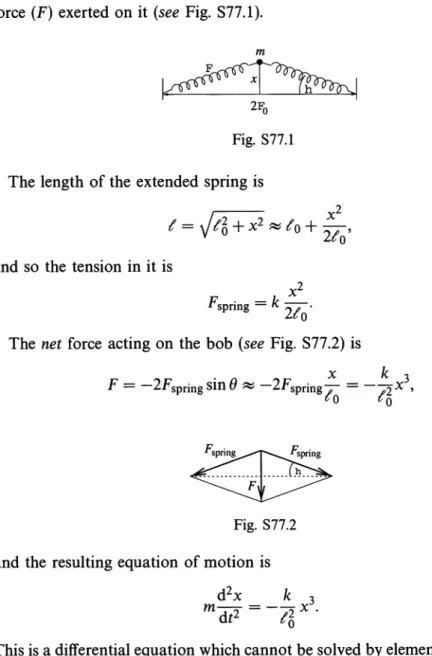
P77 A small bob joins two light unstretched, identical springs, anchored
at their far ends and arranged along a straight line, as shown in the figure.
The bob is displaced in a direction perpendicular to the line of the springs
~-1 em and then released. The period of the ensuing vibration of the bob is
2 s. Find the period of the vibration if the bob were displaced by 2 em before
ldease. The unstretched length of the springs is to ~ 1 em, and gravity is
P78* One end of a light, weak spring, of unstretched length L and force constant k, is fixed to a pivot, and a body of mass m is attached to its other end. The spring is released from an unstretched, horizontal position, as in the figure.
What is the length of the spring when it reaches a vertical position? (Describing a spring as weak implies that mg ~ kL, and that the tension in the spring is directly proportional to its extension at all times.)
P79* A heavy body of mass m hangs on a flexible thread in a railway carriage which moves at speed v0 on a train-safety test track, as shown in
the figure.
The carriage is brought to rest by a strong but uniform braking. Can the pendulum travel through 180°, so that the taut thread reaches the vertical?
P80** A glass partially filled with water is fastened to a wedge that slides, without friction, down a large plane inclined at an angle ex as shown in the figure. The mass of the inclined plane isM, the combined mass of the wedge, the glass and the water is m.
If there were no motion the water surface would be horizontal. What angle will it ultimately make with the inclined plane if
(i) the inclined plane is fixed,
(ii) the inclined plane can move freely in the horizontal direction? Examine also the case in which m ~ M. What happens if the handle of the inclined plane is shaken in a periodic manner, but one that is such that it does not cause the wedge to rise off the plane?
P81 ** If someone found a motionless string reaching vertically up into the sky and hanging down nearly to the ground, should that person consider
it as an evidence for UFOs, or could there be an 'Earthly' explanation in agreement with the well-known laws of physics? How long would the string need to be?
P82 There is a parabolic-shaped bridge across a river of width 100 m. The highest point of the bridge is 5 m above the level of the banks. A car of mass 1000 kg is crossing the bridge at a constant speed of 20 m s-1.
Using the notation indicated in the figure, find the force exerted on the bridge by the car when it is:
(i) at the highest point of the bridge, (ii) three-quarters of the way across. (Ignore air resistance and take g as 10 m s-2.)
P83 A point mass of 0.5 kg moving with a constant speed of 5 m s-1
on an elliptical track experiences an outward force of 10 N when at either endpoint of the major axis and a similar force of 1.25 N at each end of the minor axis. How long are the axes of the ellipse?
P84* A boatman sets off from one bank of a straight, uniform canal for a mark directly opposite the starting point. The speed of the water flowing in the canal is v everywhere. The boatman rows steadily at such a rate that, were there no current, the boat's speed would also be v. He always sets the boat's course in the direction of the mark, but the water carries him downstream. Fortunately he never tires! How far downstream does the water carry the boat? What trajectory does it follow with respect to the bank?
P85** Two children stand on a large, sloping hillside that can be con-sidered as a plane. The ground is just sufficiently icy that a child would fall and slide downhill with a uniform speed as the result of receiving even the slightest impulse.
For fun, one of the children (leaning against a tree) pushes the other with a horizontal initial speed vo
=
1 m s-1. The latter slides down the slope with a velocity that changes in both magnitude and direction. What will be the child's final speed if air resistance is negligible and the frictional force is independent of the speed?P86* Smugglers set off in a ship in a direction perpendicular to a straight shore and move at constant speed v. The coastguard's cutter is a distance a from the smugglers' ship and leaves the shore at the same time. The cutter always moves at a constant speed in the direction of the smugglers' ship and catches up with the criminals when at a distance a from the shore. How many times greater is the speed of the coastguard's cutter than that of the smugglers' ship?
P87 Point-masses of mass m are at rest at the corners of a regular n-gon, as illustrated in the figure for n
=
6.How does the system move if only gravitation acts between the bodies? How much time elapses before the bodies collide if n = 2, 3 and 10? Examine the limiting case when n ~ 1 and m = Mo/n, where Mo is a given total mass. P88 A rocket is launched from and returns to a spherical planet of radius
R in such a way that its velocity vector on return is parallel to its launch vector. The angular separation at the centre of the planet between the launch and arrival points is (J. How long does the flight of the rocket take, if the period of a satellite flying around the planet just above its surface is To? What is the maximum distance of the rocket above the surface of the planet? Consider whether your analysis also applies to the limiting case of (J ~ 0.
P89** Two identical small magnets of moment 11 are glued to opposite ends of a wooden rod of length L, one labelled C, parallel to the rod, and the other labelled D, perpendicular to it.
L
(i) Show that the couples that the magnets exert on each other are not
equal and opposite.
(ii) Ignoring the Earth's magnetic field, explain quantitatively what would happen if the system were freely suspended at its centre of gravity.
P90 A point-like body of mass m and charge q is held above and close to a large metallic fixed plane and released when a distance d from it. How much time will it take for the body to reach the plane? Ignore gravity.
P91 * A plastic ball, of diameter 1 em and carrying a uniform charge of 10-8 C, is suspended by an insulating string with its lowest point 1 em
above a large container of brine (salted water). As a result, the surface of the water below the ball wells up a little.
How large is the rise in water level immediately below the ball? Ignore the effect of surface tension, and take the density of salted water to be 1000 kg m-3.
P92 A point charge is at rest inside a thin metallic spherical shell, but is not at its centre. What is the force acting on the charge?
P93 Boron atoms of mass number A
=
10 and a beam of unidentified particles, moving in opposite directions with the same (non-relativistic) speed, are made to collide inside an ion accelerator. The maximum scattering angle of the boron atoms is found to be 30°. What kind of atoms does the particle beam consist of?P94 A billiard ball rolling without slipping hits an identical, stationary billiard ball in a head-on collision. Describe the motion of the balls after the collision. Prove that the final state does not depend on the coefficient of sliding friction between the balls and the billiard table. (Rolling friction is negligible.)
P95* A long slipway, inclined at an angle octo the horizontal, is fitted with many identical rollers, consecutive ones being a distance d apart. The rollers have horizontal axles and consist of rubber-covered solid steel cylinders each of mass m and radius r. Planks of mass M, and length much greater than d,
Find the terminal speed Vmax of the planks. Ignore air resistance and
friction at the pivots of the rollers.
P96 A tablecloth covers a horizontal table and a steel ball lies on top of it. The tablecloth is pulled from under the ball, and friction causes the ball to move and roll.
~
r"i"l====0!!::::·~=---.,
II
II
What is the ball's speed on the table when it reaches a state of rolling without slipping? (Assume that the table is so large that the ball does not fall off it.)
P97* If the law were changed so that traffic in Great Britain travelled on the right-hand side of the road (instead of on the left), would the length of the day increase, decrease, or be unaltered?
P98 In a physics stunt, two balls of equal density, and radii rand R
=
2r, are placed with the centre of the larger one at the middle of a cart of massM
=
6 kg and length L=
2 m. The mass of the smaller ball is m=
1 kg. The balls are made to roll, without slipping, in such a way that the larger ball rests on the cart, and a straight line connecting their centres remains at a constant angle 4>=
60° to the horizontal. The cart is pulled by a horizontal force in the direction shown in the figure.(i) Find the magnitude of the force F.
(ii) How much time elapses before the balls fall off the cart?
P99** The following equipment can be seen in the Science Museum in Canberra, Australia. A disc of radius R has been cut from the centre of a horizontal table, and then replaced into its original place mounted on a axle.
As illustrated in the figure, the disc is spun and a solid rubber ball is rolled onto the table. When it reaches the spinning disc, the ball leaves its straight-line course and follows a curve. On leaving the disc, it continues its
original course, rolling without slipping, along a straight line. The final speed of the ball is the same as it was before it reached the disc.
What are the conservation principles underlying this motion?
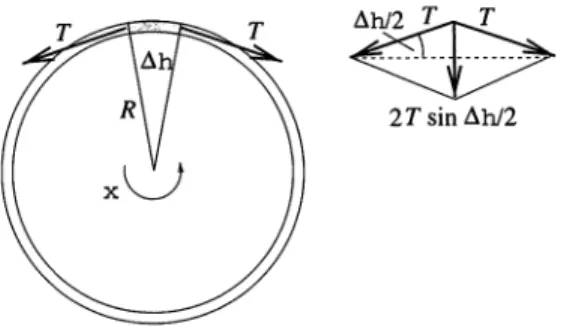
PlOO A thin ring of radius R is made of material of density p and Young's modulus E. It is spun in its own plane, about an axis through its centre, with angular velocity w. Determine the amount (assumed small) by which its circumference increases.
PlOt* A light, inelastic thread is stretched round one-half of the circum-ference of a fixed cylinder as shown in the figure.
A ~
0
B ...~
~
As a result of friction, the thread does not slip on the cylinder when the magnitudes of the forces acting on its ends fulfil the inequality
1
2FA::;; FB::;; 2FA.
Determine the coefficient of friction between the thread and the cylinder.
P102** Charlie is a first-year student at university, studying integral calculus in mathematics. As an exercise, he has to determine the position C of the centre of mass of a semicircular arc which has radius R and a homogeneous mass distribution.
His younger sister, Jenny, only attends secondary school, but is studying rotation in physics. She eagerly watches the calculations of her brother, but as she has never heard of integral calculus, she does not understand much of it. The only clear thing to her is the problem itself.
After thinking and calculating for a while, she calls out: 'I have got the result, and I can determine not only the position of the centre of mass of a semicircle but also that of any part of a circle or any sector of it!'
How has she done it?
P103* A table of height 1 m has a hole in the middle of its surface. A thin, golden chain necklace, of length 1 m, is placed loosely coiled close to the hole, as shown in the figure.
One end of the chain is pulled a little way through the hole and then released. Friction is negligible, and, as a result, the chain runs smoothly through the hole with increasing speed. After what times will the two ends of the chain reach the floor?
P104* A flexible chain of uniform mass distribution is wrapped tightly round two cylinders so that its form is that of a stadium running-track, i.e. it consists of two semicircles joined by two straight sections. The cylinders are made to rotate and cause the chain to move with speed v.
V ? >
-- v
For some reason, the chain suddenly slips off the cylinders and falls vertically. How does the shape of the chain vary during the fall?
According to Steve, it takes a circular shape because of the centrifugal force. Bob accepts this point, but he considers that the initially 'elliptical' chain will be deformed beyond the circular by this effect and become a vertical ellipse with its new major axis at right angles to the original one. He expects that this process will repeat itself and that the chain shape will cycle
between the two 'ellipses'. Frank guesses that the chain retains its original shape, but he cannot give any reasons for his guess. Who is right- or are they perhaps all wrong?
P105** A heavy, flexible, inelastic chain of length L is placed almost symmetrically onto a light pulley which can rotate about a fixed axle, as shown in the figure.
What will the speed of the chain be when it leaves the pulley?
P106* A long, heavy, flexible rope with mass p per unit length is stretched by a constant force F. A sudden movement causes a circular loop to form at one end of the rope. In a manner similar to that in which transverse waves propagate, the loop runs (rolls) along the rope with speed cas shown in the figure.
(i) Calculate the speed c of the loop.
(ii) Determine the energy, momentum and angular momentum carried by a loop of angular frequency ro. What is the relationship between these quantities?
P107 Sand falls vertically at a rate of 50 kg s-1 onto a horizontal conveyor belt moving at a speed of 1 m s-1, as shown in the figure.
What is the minimum power output of the engine which drives the belt? How is the work done by the engine accounted for?
P108** A fire hose of mass M and length L is coiled into a roll of radius R (R ~ L). The hose is sent rolling across level ground with initial speed vo (angular velocity vo/ R), while the free end of the hose is held at a fixed point on the ground. The hose unrolls and becomes straight.
M
F ~
7////7/7/////////////7/7/7//////////////////7/7///
(i) How much time does it take for the hose to completely unroll? (ii) The speed of the roll continually increases and its acceleration a is
clearly a vector pointing in the same direction as its velocity. On the other hand, the vector resultant of the horizontal external forces (frictional force plus the restraining force at the fixed end of the hose) points in the opposite direction. How are these two facts consistent with Newton's second law?
(To simplify the analysis, suppose the initial kinetic energy of the roll to be much higher than its potential energy (vo ~ jiR), thus allowing the effect of gravity to be neglected. Assume further that the hose can be considered as arbitrarily flexible, and that the work necessary for its deformation, air resistance and rolling resistance can all be neglected.)
P109 Where is gravitational acceleration greater, on the surface of the Earth, or 100 km underground? Take the Earth as spherically symmetrical. The average density of the Earth is 5500 kg m-3, and that of its crust is 3000 kg m-3. (The depth of the crust may be assumed to be at least 100 km.)
PllO* The Examining Institute for Cosmic Accidents (EXINCA) sent the following short report to one of its experts:
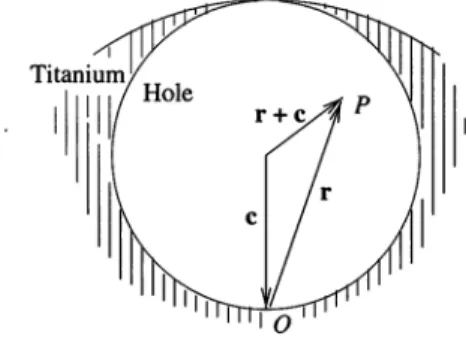
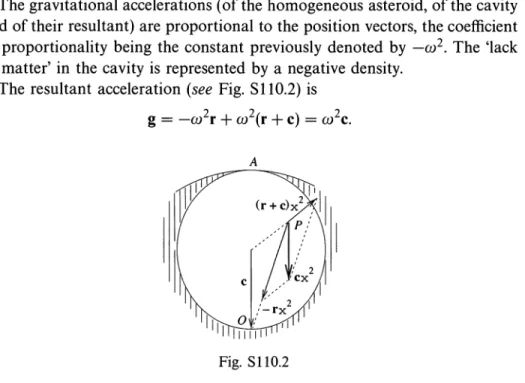
A spaceship of titanium-devouring little green people has found a perfectly spherical asteroid. A narrow trial shaft was bored from point A on its surface to the centre 0 of the asteroid. This confirmed that the whole asteroid is made of homogeneous titanium. At that point, an accident occurred when one of the little green men fell off the surface of the asteroid into the trial shaft. He fell, without any braking, until he reached 0, where he died on impact. However, work continued and the little green men started secret
excavation of the titanium, in the course of which they formed a spherical cavity of diameter AO inside the asteroid, as illustrated in the figure.
A A
0
Then a second accident occurred- another little green man similarly fell from point A to point 0, and died.
EXINCA asked the expert to calculate the ratio of the impact speeds and the ratio of the times taken to fall from A to 0 by the two unfortunate little men. What figures did the expert give in her reply?
Plll* The titanium-devouring little green people of the previous prob-lem continued their excavating. As a result of their environmentally de-structive activity, half of the asteroid was soon used up and, as shown in the figure, only a regular hemisphere remained. The excavated material was carried away from the asteroid.
What is the gravitational acceleration at the centre of the circular face of the remaining hemisphere if the gravitational acceleration at the surface of the original (spherical) asteroid was g0
=
9.81 em s-2?P112* The little green titanium-devouring people found another titanium asteroid with a radius of 10 km and a homogeneous mass distribution. They started to excavate and to convey the material of the asteroid to the surface. The excavation of the metal was effected by boring shafts along a strip 1 m wide round the equator of the asteroid until they had cut the asteroid completely in two. Then the accident happened; the props separating the two hemispheres broke and the asteroid collapsed.
The experts from EXINCA need to calculate the total force exerted on the props just before they collapsed. Please help them.
P113• A metal sphere, of radius R and cut in two along a plane whose minimum distance from the sphere's centre is h, is uniformly charged by a total electric charge Q. What force is necessary to hold the two parts of the sphere together?
P114 A small positively charged ball of mass m is suspended by an insulating thread of negligible mass. Another positively charged small ball is moved very slowly from a large distance until it is in the original position of the first ball. As a result, the first ball rises by h. How much work has been done?
h
j
f
P115** Hydrogen gas is stored at high pressure in a small, spherical container. The gas is introduced into a light balloon and its pressure becomes equal to the external atmospheric pressure. Is it possible that the balloon could lift the container in its final state? Assume that the temperature of the gas remains constant.
P116 In olden times, people used to think that the Earth was flat. Imagine that the Earth is indeed not a sphere of radius R, but an infinite plate of thickness H. What value of H is needed to allow the same gravitational acceleration to be experienced as on the surface of the actual Earth? (Assume that the Earth's density is uniform and equal in the two models.)
P117• Electrical charges are evenly distributed along a long, thin insu-lating rod AB.
Show that at an arbitrary point C (see figure), the electric field due to the rod points in the direction of the bisector of angle ACB.
P118 Using the result of the previous problem, determine the direction and magnitude of the electric field in a plane which is perpendicular to a long, charged rod, and contains one of the rod's endpoints.
P119 At the beginning of nineteenth century the magnetic field of wires carrying currents was the focus of investigations in physics, both experimen-tally and theoretically. A particularly interesting case is that of a very long wire, carrying a constant current I, which has been bent into the form of a 'V', with opening angle 28.
~I
p d
According to Ampere's computations, the magnitude B of the magnetic field at a point P lying outside the 'V', but on its axis of symmetry and at a distance d from its vertex, is proportional to tan(O /2). However, for the same situation, Biot and Savart suggested that the magnetic field at P
might be proportional to
e.
In fact they attempted to decide between the two possibilities by measuring the oscillation period of a magnetic needle as a function of the 'V' opening angle. However, for a range ofe
values, the predicted differences were too small to be measured.(i) Which formula might be correct?
(ii) Find the proportionality factor in this formula and guess the most likely factor appearing in the other one.
P120** A direct current flows in a solenoid of length L and radius R,
(L ~ R), producing a magnetic field of magnitude Bo inside the solenoid.
~cco:o:•···
---~--~~---
E 80R :
---- ----~:o:ccnn ···
(i) What is the strength of the magnetic field at the end of the coil, i.e. at the point P shown in the figure?
(ii) What is the magnetic flux at the end of the coil, i.e. through a virtual disc of radius R centred on P?
(iii) Sketch the magnetic field lines in the vicinity of P.
P121 The inner surfaces of two close parallel insulating plates are each
given a uniform charge of +Q. What force is required to hold the plates together?
P122 Two parallel plate capacitors differ only in the spacing between
their (very thin) plates; one, AB, has a spacing of 5 mm and a capacitance of 20 pF, the other, CD, has a spacing of 2 mm. Plates A and C carry charges of
+
1 nC, whilst B and D each carry -1 nC. What are the potential differencesVAB and V CD after the capacitor CD is slid centrally between and parallel to the plates of AB without touching them? Would it make any difference if
CD were not centrally placed between A and B?
P123* The distance between the plates of a plane capacitor is d and the
area of each plate is A. As shown in the figure, both plates of the capacitor are earthed and a small body carrying charge Q is placed between them, at a distance x from one plate.
A
d
~r--· Q
~
What charge will accumulate on each plate?
P124* A point-like electric dipole is placed between the earthed plates of
the plane capacitor discussed in the previous problem. Its dipole momentum vector p is perpendicular to the plates and the distances of the dipole from the plates are x and d - x, respectively.
How does the charge which accumulates on each of the plates depend on x? (Ignore edge effects.)
P125* The refractive index of the medium within a certain region, x > 0,
y > 0, changes with y. A thin light ray travelling in the x-direction strikes the medium at right angles and moves through the medium along a circular arc.