EUROCONTROL
COOPERATIVE NETWORK
DESIGN
Implementation of the 8.33
kHz Voice Channel Spacing
below FL 195
Safety Impact Assessment
Report
Ref:
:8.33<195-SAFREP-2010-0301-IR
Edition
:1.0
Edition Date :02/01/2011
Status
:Proposed Issue
Class
:CND Stakeholders
Implementation of the 8.33 kHz below
FL 195
Safety assessment report
Document Identifier Edition Number: 1.0
Edition Date: 2 Feb 2011 Abstract
This safety impact assessment is addressing the implementation of 8.33 kHz below FL195 in the ICAO EUR Region where EU Member States are responsible for the provision of air traffic services. This safety assessment is addressing the safety impact of such implementation on the air traffic services which are supported by the air-ground VHF voice communication. Furthermore it addresses also the potential safety impact on the control of the movement of ground vehicles on the manoeuvring areas.
Considering this scope, this safety assessment does address the impact on:
• Air Traffic services delivered to pilots in controlled/uncontrolled airspace and for aerodrome operation where two way radio communication is required
• The control of the movement of ground vehicle in controlled aerodromes where two way radio communication is required
The implementation of 8.33 kHz below FL195 in the ICAO EUR Region where EU Member States are responsible for the provision of air traffic services is characterised by:
• the Interim Implementation for 2014 to ensure a given number of conversions take place in the EU States area defined in the implementing rule1,
• the final Implementation for 2018 to ensure 8.33 kHz spacing of all possible voice channels in the EU Member States airspace.
The safety target was set to demonstrate that
ST#1 the risk of an accident following the complete conversion to 8.33 kHz VCS shall not be significantly greater than before the start of the introduction of 8.33 kHz VCS below FL 195 ST#2 the risk of an accident during the transition to the complete conversion to 8.33 kHz VCS below FL 195 shall be reduced as far as reasonably practicable.
The overall conclusion is that deployment of 8.33 kHz VCS in the airspace of IR applicability below FL 195 according to the draft VCS II IR [16] has the potential to satisfy the above Safety Targets, but some additional safety requirements must be added to the rule. Indeed, it has been shown that all Safety Requirements identified during this safety impact assessment have been satisfactorily addressed either by the draft VCS II IR [16] or by the future draft VCS II IR, which will include the additional/modified requirements, or by other existing regulations (e.g. ICAO).
Keywords
Implementing Rule, Safety activities, Safety Assurance, Safety Argument, Hazards
Contact Person(s) Tel Unit
Daniela Grippa [email protected] Bruno Rabiller [email protected] +32 2 729 33 30 +33 1 69 88 69 13 CND COE/ PM/ SY CND COE/ PM/ SY
Status Intended for Accessible via
Working Draft General Public Intranet
Draft CND Stakeholders Extranet
Proposed Issue Restricted Audience Internet (www.eurocontrol.int)
Released Issue
ELECTRONIC SOURCE
Path:
Host System
Software
Size
DOCUMENT CHANGE RECORD
The following table records the complete history of the successive editions of the
present document.
EDITION
NUMBER EDITION DATE
REASON FOR CHANGE
PAGES AFFECTED
WRITTEN BY CHECKED BY APPROVED BY
Rev IR
15/12/2010
Creation
All
D. Grippa/
B. Rabiller
1.0
2 Feb 2011
Internal Review
All
D. Grippa/
B. Rabiller
D. Booker,
P. Thorsen
6
Contents
1.
INTRODUCTION ... 8
1.1.
Implementation of 8.33 kHz VCS below FL 195 Overview ... 8
1.2.
Scope and process of the Safety Impact assessment... 9
2.
General Approach to Safety Assessment of 8.33 VCS below FL 195 ... 10
3.
Safety Targets... 11
4.
Description of the operational environment ... 11
4.1
Air Traffic Services and the A/G Voice Communication Infrastructure ... 11
4.2
The Operational Environment for the “Interim Phase” ... 12
4.3
The Operational Environment for the “Final Phase” ... 14
5.
Safety Assessment Results for aircraft operation. ... 15
5.1
Safety Scenarios Assessed... 16
5.2
Success Approach ... 18
5.3
Failure Approach ... 19
5.4
Risk Assessment... 23
5.4.1
Overview ... 23
5.4.2
Safety Scenario #1... 23
5.4.3
Safety Scenario #2... 24
5.4.4
Safety Scenario #3... 24
5.4.5
Risk Quantification ... 25
6.
Impact on ground vehicle operation... 25
6.1
Introduction ... 25
6.2
Safety Targets ... 26
6.3
Safety Scenarios Assessed... 26
6.4
Success Approach ... 27
6.5
Failure Approach ... 29
6.6
Risk Assessment... 33
6.6.1
Overview ... 33
6.6.2
Safety Scenario #4... 34
6.6.3
Safety Scenario #5... 34
6.6.4
Risk Quantification ... 35
7.
Caveats... 36
7.1
Assumptions... 36
7.2
Safety Issues... 36
8.
Conclusions and Recommendations... 37
8.1
Conclusions... 37
8.2
Recommendations ... 38
8.3
How the draft IR is addressing the outcome of the safety impact assessment
38
Annex 1: Glossary and References ... 40
A1-1 Glossary of Terms and Abbreviations... 40
A1-2 References ... 40
Annex 2: Air Traffic Services supported by the A/G Voice Communication
service ... 42
7
A2.1
Air Traffic Control Service ... 42
A2.2
Flight Information Service (FIS) ... 42
A2.3
Air Traffic Advisory Service... 42
Annex 3: Safety Log ... 43
A3.1 Safety Requirements ... 43
A3.2 Assumptions ... 45
A3.3 Issues ... 45
Annex 4: Identified Safety Requirements versus the content of the Draft VCS II
IR 46
1.
INTRODUCTION
1.1. Implementation of 8.33 kHz VCS below FL 195 Overview
On 15 March 2007, the mandatory carriage and operation of 8.33 kHz VCS capable radio equipment came into effect above FL 195 in the ICAO EUR Region. In October 2007, the European Commission published the Regulation ER 1265/2007 which, in particular, includes important articles concerning ground radio conversions and the requirements for State aircraft.
In spite of the recent decreasing air traffic levels, the demand for new VHF assignments continues and is expected to increase once traffic levels rise again. Therefore, Europe is reviewing the need for 8.33 kHz VCS below FL 195, as well as other measures to alleviate VHF congestion.
The Eurocontrol Stakeholder Consultation Group (SCG) 10th meeting - held 25/26 Feb 2009 – agreed the following conclusions relating to 8.33 kHz VCS below FL 195:
• Supported a phased implementation of 8.33 kHz VCS below FL 195 in the ICAO EUR Region;
• Agreed that EUROCONTROL should:
o Develop a European Implementation Plan with the participation of all affected stakeholders, also taking into account the issue of funding;
o Provide advanced notice to affected stakeholders on potential pan-European milestones and timescales;
o Ensure a coherent approach between the programme work and the European Commission (EC) Regulation 1265/2007
• Noted the related MILHAG support and consideration regarding the phased implementation in terms of time, airspace and geographical areas
The SCG was advised on the intention to modify the EC regulation 1265/2007 (the AG-VCS Implementing Rule) in order to address 8.33 kHz VCS forward-fit, frequency-usage transparency and the phased deployment below FL 195.
The 8.33 kHz VCS stakeholders have analysed the options for the phased implementation below FL 195 and a Europe-wide formal consultation took place early in 2010 to agree the way forward. Two implementation scenarios were proposed to the 8.33 kHz stake holders:
Scenario 1 – Development of regulatory provisions identifying three implementation milestones.
• Forward Fit Phase starting from 2012 to ensure all new radios comply,
• Interim Phase by the 31st December 2014 to ensure a given number of conversions take place, in the European states.
• Final Phase by the 31st December 2018 to ensure the conversion to 8.33 kHz spacing of all possible European voice channels
Scenario 2 – Development of regulatory provisions identifying two implementation milestones.
• Forward Fit Phase starting from 2012 to ensure all new radios comply,
• Final Phase by the 31st December 2018 to ensure the conversion to 8.33 kHz spacing of all possible European voice channels.
Both scenarios propose a “Forward Fit Phase” and a “Final Phase”; these are identical in each case. As result of the consultation of the 8.33 kHz stakeholders the definition of two areas where the implementation will be realised, following two different scenarios has been proposed:
9
• Part of the ICAO EUR region2, where the Interim and Final Phases would be required and
• the rest of the ICAO EUR Region3, where only the Final Phase would be required.
1.2. Scope and process of the Safety Impact assessment
This safety impact assessment is addressing the implementation of 8.33 kHz below FL195 in the ICAO EUR Region where EU Member States are responsible for the provision of air traffic services. This safety assessment is addressing the safety impact of such implementation on the air traffic services which are supported by the air-ground VHF voice communication. Furthermore it addresses also the potential safety impact on the control of the movement of ground vehicles on the manoeuvring areas. Considering this scope, this safety assessment addresses the impact on:
• Air Traffic services delivered to pilots in controlled/uncontrolled airspace and for aerodrome operation where two way radio communication is required
• The control of the movement of ground vehicle in controlled aerodrome where two way radio communication is required.
This safety assessment does not address the safety impact on:
• The performance of airline communications4 which are supported by the air-ground VHF voice communication even if OPC (OPerational Control) frequencies have to be converted in 8.33 kHz.
• Apron management services because air traffic control has normally no responsibility for control of vehicles on apron areas (ICAO Doc 9137 Part 8) and VHF voice communication might not be used (e.g. use of digital radio communication system)
Safety assessment typically start at the ATM service level – this level may be thought of as being in the interface between the service provider and the service user. Such an approach is particularly valid for the introduction of 8.33 kHz voice-channel spacing (VCS) below FL 195 since VHF voice is currently the main mean of communication across the provider / user interface for ATM services to GAT and is likely to remain so for the next two decades.
Safety Objectives are specified at the service level, for three purposes:
• to capture what has to happen in order for the services to operate as required
• to mitigate the consequences of failure / degradation of the ATM services, however caused
• to limit the frequency with which the causes of such failures may occur so as to achieve an acceptable level for the associated risk, taking account of the above mitigations.
In the first two cases, the Safety Objectives address the functionality and performance to be achieved. In the 3rd case, the Safety Objectives address the integrity to be achieved5.
In all three cases, only what has to be achieved is specified at the service level – this helps to ensure the completeness, correctness and consistency of the Safety Objectives without the unnecessary (at this level) detail of how, or by whom, the Safety Objectives will be achieved.
2
Member States for this interim phase are: Austria, France, Germany, Hungary, Ireland, Italy, Luxembourg, The Netherlands, and United Kingdom see Annex 1 of the IR.
3
Applicable to EU members States responsible for the provision of ATS
4
Airline Operational Communication (AOC) and/or Airline Administrative Communication (AAC)
5
The traditional definition of a Safety Objective (including that in EC 2096/2005) is limited to the 3rd case. However, recent experience on many EUROCONTROL projects has shown to be very useful to extend this definition to include the first two cases.
10
Safety Requirements, on the other hand, are the means by which the Safety Objectives are achieved – for this reason they are specified at the system level and result from the appropriate allocation of the Safety Objectives on to the elements of the functional system – in general, covering equipment, procedures and human resources.This safety assessment has considered the different safety materials developed prior to the initial safety Impact assessment ([1], [2] and [3] ) and the safety materials developed during the initial safety impact assessment ([4], [5], [6] , [7], [8] and [9]).
2.
GENERAL APPROACH TO SAFETY ASSESSMENT OF 8.33
VCS BELOW FL 195
Hypothetically, it could be said that if a homogeneous channel spacing (i.e. either 8.33 kHz or 25 kHz) were to exist in the airspace, and there were to be a corresponding homogeneous aircraft fit, then any hazards associated with air-ground and ground-ground RT communications would be the same whichever channel spacing was deployed - i.e.
• loss of communication - due to voice-communications equipment failure or incorrect frequency selection by an aircraft or ground vehicle
• distortion of communication - due to interference caused by incorrect frequency selection by an aircraft or ground vehicle, by inappropriate frequency assignments to proximate sectors, or by external6 events such as natural phenomena or man-made interference.
For the purposes of this safety impact assessment, it is assumed that the likelihood and consequences of any of the following are not affected by the change from 25 kHz VCS to 8.33 kHz VCS:
• voice-communications equipment failure
• external interference events
• Controller transmitting a wrong frequency to the pilot.
Therefore, any risk associated with these three hazard causes does not change and can, therefore, be excluded from this safety assessment, which is concerned specifically with the effects of the
introduction of 8.33 kHz VCS below FL 195.
Furthermore, it has already been established, from the previous deployment of 8.33 kHz VCS above FL 195, that:
• an 8.33 kHz VCS-equipped aircraft is fully able to communicate with a ground station that is equipped with either 25 kHz or 8.33 kHz VCS
• a 25 kHz VCS-equipped aircraft can communicate only with a 25 kHz VCS ground station
• The VHF air-ground communication frequency assignment planning criteria (ICAO EUR Doc 011) are properly addressing the 8.33 kHz spaced channels and no specific assignment criteria are relative to the altitude (implementation above or below FL 195).
Thus a hazardous situation related to the introduction of 8.33 kHz VCS below FL 195 would exist if:
• an 8.33 kHz VCS-equipped aircraft were to mistune a (correct) 8.33 kHz VCS frequency
• a 25 kHz VCS-equipped, non-exempt aircraft were to enter, or attempt to enter, a sector that uses primarily 8.33 kHz VCS - for example, by selecting an old 25 kHz VCS frequency or by trying to select the 8.33 kHz VCS frequency assigned to the sector.
11
• a 25 kHz VCS-equipped, exempt aircraft were to enter, or attempt to enter, a sector that uses primarily 8.33 kHz VCS, unless facilities / procedures for handling such aircraft had already been put in place.
Therefore, the safety assessment has to address the above from three perspectives:
• the specification of Safety Objectives, and then Safety Requirements, to avoid hazardous situations occurring, wherever possible
• the specification of Safety Objectives, and then Safety Requirements, such that if hazardous situations do occur, for whatever reason, then their effects in terms of safety are reduced as much as possible
• an estimation of the likely risk associated with the occurrence of hazardous situations, taking account of the above mitigations.
The first perspective is known as the success approach; the other two together are known as the failure approach.
3.
SAFETY TARGETS
Two Safety Targets for which the Safety Objectives are to be derived:
ST1 the risk of an accident following the completion of the Final Phase of conversion to 8.33 kHz VCS below FL 195 shall not be significantly greater than before the start of the Interim Phase
ST2 the risk of an accident during the period between the start of the Interim Phase and completion of the Final Phase, of conversion to 8.33 kHz VCS below FL 195 shall be reduced as far as reasonably practicable.
4.
DESCRIPTION OF THE OPERATIONAL ENVIRONMENT
4.1 Air Traffic Services and the A/G Voice Communication Infrastructure
The Air-Ground (A/G) Voice Communications infrastructure supports the Air Traffic Services (ATS) system by providing the necessary Aeronautical mobile service for safe operations.
As specified in ICAO Annex 11, the Air Traffic Services supported by the A/G voice comms are the following:
• Flight Information Service in uncontrolled airspace
• Air Traffic Advisory Service in uncontrolled airspace
• Air Traffic Control Service in controlled airspace (area, approach or aerodrome)
In addition to the above services, an Alerting Service is automatically provided to all aircraft receiving an Air Traffic Control Service and, as far as is practicable, to all other aircraft whose pilots have filed a flight plan or are otherwise known to air traffic services.
The communication requirements associated with the delivery of each of these services, to General Air Traffic (GAT), are currently provided through a VHF air/ground infrastructure supporting both voice and data communications.
Air traffic control will continue to depend heavily upon A/G voice communications. When data-link communication becomes more widespread, voice will still be used for tactical clearances and non-standard instructions (in line with the SESAR Concept of Operations). Future Communication Infrastructure (FCI) is not expected to replace the VHF AM (25 and 8.33 kHz VCS) technology before 2025.
12
A/G voice comms currently uses VHF (very high frequency), AM (amplitude modulation) with channels spaced at 25 kHz or 8.33 kHz7. For radio communication the aeronautical VHF band of 118 MHz to 137 MHz is used. In order to provide a high quality of service to many aircraft at the same time, the airspace is organized in sectors - i.e. individual blocks of three-dimensional space which are defined by a bottom and top altitude limit and geographical points (sector boundaries) - with each sector allocated specific voice communication frequencies.Continuous two-way radio-communication is required for IFR operations in all airspace classes (A to G) whereas for VFR operation it is required for class A to D, but not for class E to G. Currently, the A/G voice comms infrastructure below FL 195 uses only one channel spacing standard (25 kHz VCS). Annex 2 of this report describes the services supported by the A/G voice comms and should allow a better understanding of the safety role of the A/G voice comms service in the operational environment during the assessment.
4.2 The Operational Environment for the “Interim Phase”
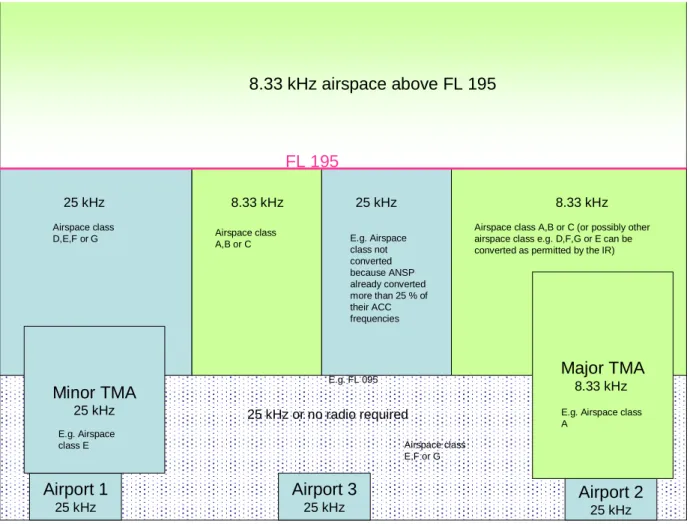
The implementation of 8.33 kHz VCS below FL 195 will start with an initial phase called the “Interim Phase” as described in Figure 1 below. The “Interim Phase” is described in more detailed in [13]. As agreed after the stakeholder consultation, the Interim Phase is applicable to a number of States in the ICAO EUR region which are listed in the Annex I of the draft IR [16].
Airport 1
25 kHzAirport 2
25 kHzMinor TMA
25 kHzMajor TMA
8.33 kHzAirport 3
25 kHz 25 kHz or no radio requiredFL 195
8.33 kHz airspace above FL 195
Airspace class E,F or G E.g. FL 095E.g. Airspace class A E.g. Airspace class E Airspace class D,E,F or G 25 kHz 8.33 kHz Airspace class A,B or C 25 kHz E.g. Airspace class not converted because ANSP already converted more than 25 % of their ACC frequencies 8.33 kHz
Airspace class A,B or C (or possibly other airspace class e.g. D,F,G or E can be converted as permitted by the IR)
Figure 1: Overview of the 8.33 kHz “Interim Phase”
7 As noted in section 1.1 above, the mandatory carriage and operation of 8.33 kHz VCS capable radio equipment came into
13
ATS airspace is classified and designated in ICAO Annex 11, Section 2.6 “Classification of Airspaces” using the seven airspace classes (A to G). Annex 11, Appendix 4 identifies for each airspace class (A to G) and type of flight (IFR or VFR), where voice radio communication is required.All the airspace of classes A, B, C, D and E is defined as Controlled airspace while the airspace of classes F and G are defined as Uncontrolled airspace.
During the Interim Phase of conversion to 8.33 kHz VCS below FL 195, the more likely scenario is that part of the airspace Class A, B and C will be converted to 8.33 kHz channel spacing while the airspace D, E, F and G will continue to operate the 25 kHz channel spacing frequencies.
This means that in the participating States all non-exempt aircraft operating in class A, B or C airspace under IFR shall be equipped with radio equipment with the 8.33 kHz voice channel spacing (VCS) capability. State aircraft are exempt from this requirement and in some States they may continue to use 25 kHz VCS.
When the Interim Phase is completed, in December 2014, it is assumed that ANSPs will have performed a number of conversions equivalent to at least 25% of their 25 kHz ACC assignments for which conversion is feasible. This means that airspace classes A, B, C will not be completely converted during the Interim Phase, and that conversions could also take place in other airspace classes (D to G) and/or for Approach/Tower services.
The conversion to 8.33 kHz VCS during this Phase is considered not to be feasible in the following cases:
• sectors where 25 kHz offset carrier system is utilised,
• assignments that must stay in 25 kHz VCS as a result of a “local” safety requirement,
• 25 kHz VCS assignments that are used to accommodate State Aircraft,
• 121.5 MHz channel (emergency frequency) and the VHF Data Link frequencies will stay in 25 kHz VCS.
This Phase is therefore characterised by airspace which, below FL 195, is converted (green in Figure 1 ) or not converted (blue in Figure 1) to 8.33 kHz VCS. Airspace users must be equipped with radio equipment with the 8.33 kHz VCS capability when flying in 8.33 kHz VCS airspace.
Because the 8.33 kHz Climax8 will not be applied (only applied in 25 kHz), the latest EUROCAE specification will not be mandatory (EUROCAE ED 23C).
The Specification of 8.33 kHz VCS will not support the use of 8.33 kHz offset carrier frequency (Climax) either for the “Interim Phase” or the “Final Phase”
From the airspace users’ perspective, it is foreseen that:
• “8.33 kHz VCS airspace” will have the same accommodation of non-8.33 kHz VCS State aircraft as is the case above FL 195,
• Airspace users will be affected only if flying in “8.33 kHz VCS airspace”,
• Airspace users equipped with or without 8.33 kHz VCS equipment will co-exist in the airspace below FL 195.
It is important to note that the “Interim Phase” objective is to reach a target number of conversions without prescribing a specific airspace to convert. This is likely to lead to “non-homogeneous” 8.33 kHz conversion of sectors/TMAs from one State to the other and even potentially within a State. Therefore, as a consequence of non-homogeneous conversion, airspace users may not be able to easily determine the VCS equipment requirements for each part of the airspace below FL 195 using a simple rule. Rather, the airspace users will have to refer to the relevant Aeronautical Information Publication (AIP) to identify the VCS equipment requirements for the airspace they are planning to use.
8
14
4.3 The Operational Environment for the “Final Phase”
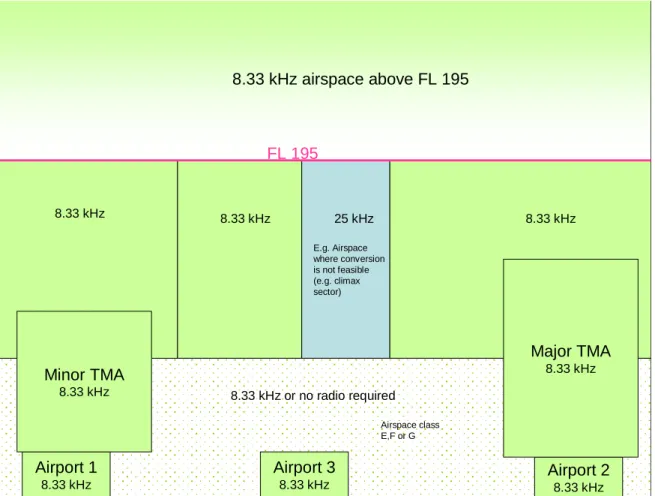
This Safety Impact Assessment addresses also the so-called “Final Phase” as described in Figure 2 below. The “Final Phase” is described in more detailed in [13] and, as agreed after the stakeholder consultation, it is applicable to the ICAO EUR Region where EU Member States are responsible for the provision of air traffic services.
Airport 1
8.33 kHzAirport 2
8.33 kHzMinor TMA
8.33 kHzMajor TMA
8.33 kHzAirport 3
8.33 kHz 8.33 kHz or no radio requiredFL 195
8.33 kHz airspace above FL 195
Airspace class E,F or G 8.33 kHz 8.33 kHz 25 kHz E.g. Airspace where conversion is not feasible (e.g. climax sector) 8.33 kHzFigure 2 Overview of the 8.33 kHz “Final Phase”
The “Final Phase” is consisting of the full deployment of 8.33 kHz VCS below FL 195. It will lead to all frequency assignments in the aeronautical mobile communications service band being converted to 8.33 kHz channel spacing, except for some very specific cases as follows:
• sectors where 25 kHz offset carrier system is utilised,
• assignments that must stay in 25 kHz as a result of a “local” safety requirement,
• 25 kHz assignments used to accommodate State Aircraft,
• 121.5 MHz channel (emergency frequency) and the VHF Data Link frequencies will stay in 25 kHz spacing.
The Final Phase is therefore characterised by airspace / sectors which, below FL 195, are largely converted (green in Figure 2) but exceptionally not converted (blue in Figure 2) to 8.33 kHz channel spacing. Airspace users must be equipped with radio equipment with the 8.33 kHz channel spacing capability when flying in the airspace of IR applicability except if exempted.
From the airspace user’s perspective, it is foreseen that:
• “8.33 kHz VCS airspace” will have the same accommodation of non-8.33 kHz State aircraft as is the case above FL 195 (exemption policy)
15
• All airspace users shall be equipped with radio equipment with 8.33 kHz VCS except the “exempted” users.
Any mismatch of the flight crew frequency selection and the instructed frequency can lead to an ineffective voice communication service jeopardizing the transmission of ATC clearance or ATS information.
As all the airspace users will be impacted by the change, those that were not operating above FL 195 hitherto will be new to the use of the 8.33 kHz VCS, potentially increasing the wrong frequency selection by flight crew, in the short term.
The following Figure 3 summarise the implementation milestone for the introduction of the 8.33 kHz below FL 195 as defined in the draft IR [16].
2012 2013 2014 2015 2016 2017 2018
6&7 All new radios to be 8.33 kHz capable 8 All radio updates to be 8.33 kHz capable 17-20 All remaining possible freqs to be converted to 8.33 kHz 10-14 More than 25% of possible freqs in Class A-C to be converted to 8.33 kHz for the IR applicability area defined in Appendix 1
15 All OPC freqs to be converted to 8.33 kHz
16 All aircraft and ground radios to be 8.33 kHz capable n Article 3(n) IR reference After (date) Before (date) Key 9
All IFR aircraft flying in class A-C airspace of the IR applicability area defined in Appendix 1 to be 8.33 kHz capable
Figure 3 8.33 kHz Implementation Milestones
Important Note:
For States where only the Final Phase is foreseen, a transition period must take place so that the Final Phase will be completed by the 31st December 2018.
If some States were start this transition before 1 January 2018 it is likely that the situation would be very similar to the one described for the Interim Phase – i.e. there would be a non-homogeneous use of 8.33 kHz VCS (i.e. a mix of aircraft capability and a mix of airspace assignments). The main difference between the transition period and the “Interim Phase” would be that no earliest date is fixed at moment for the start and the end of the transition.
5.
SAFETY ASSESSMENT RESULTS FOR AIRCRAFT
OPERATION.
This safety impact assessment is addressing the impact of the 8.33 kHz implementation below FL 195 on air traffic services delivered to aircraft operation in Enroute, Terminal airspace and during landing and taxiing.
16
The implementation of 8.33 kHz below FL195 in the ICAO EUR Region where EU Member States are responsible for the provision of air traffic services is characterised by:• the Interim Implementation for 2014 to ensure a given number of conversions take place in the EU States area defined in the implementing rule9,
• the Final Implementation for 2018 to ensure 8.33 kHz spacing of all possible voice channels in the EU member States airspace.
5.1 Safety
Scenarios Assessed
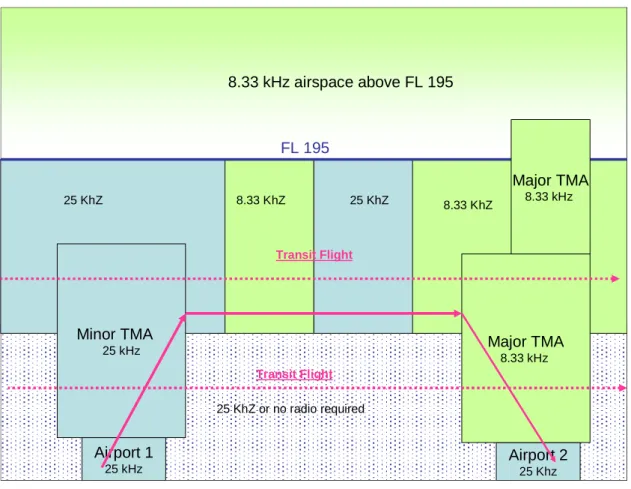
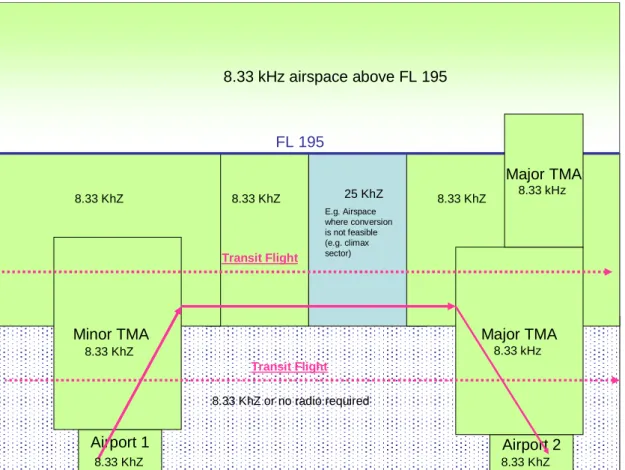
The possible aircraft operations when considering the Interim Phase is depicted in Figure 4 and is applicable to European States listed in the VCSII IR Annex 1. For the Final Phase, which is applicable to all EU member States, Figure 5 is depicting such case. It should be noted that for the Final Phase and outside of the airspace where EU Member States are responsible for the provision of air traffic services, the 25 kHz VCS might continue to be used and this aspect has to be considered during the safety assessment. Airport 1 25 kHz Airport 225 Khz Minor TMA 25 kHz Major TMA 8.33 kHz 25 KhZ or no radio required FL 195 Transit Flight Transit Flight 8.33 KhZ 8.33 KhZ 25 KhZ 25 KhZ 8.33 kHz airspace above FL 195 Major TMA 8.33 kHz
Figure 4 : A/C operations when considering the Interim Phase
17
Airport 1 Airport 2
Minor TMA Major TMA
8.33 kHz 8.33 KhZ or no radio required FL 195 Transit Flight Transit Flight 8.33 KhZ 8.33 KhZ 25 KhZ 8.33 kHz airspace above FL 195 Major TMA 8.33 kHz E.g. Airspace where conversion is not feasible (e.g. climax sector) 8.33 KhZ 8.33 KhZ 8.33 KhZ 8.33 KhZ
Figure 5: A/C operations when considering the Final Phase
The following scenarios for the safety assessment were deduced from the above description:
Safety Scenario #1 – 8.33 kHz VCS-equipped aircraft operating in a 8.33 kHz airspace Safety Scenario #2 – 25 kHz VCS-equipped, exempt aircraft operating in 8.33 kHz VCS
airspace
Safety Scenario #3 – 25 kHz VCS-equipped, non-exempt aircraft operating in 25 kHz VCS
airspace close to the boundary with 8.33 kHz VCS airspace .
Safety Scenario #1 describes the normal operation in the 8.33 environment and applies indefinitely from the beginning of the airspace conversion to 8.33 kHz VCS, in the area of applicability defined in IR annex I [16]. It is used to address the problem that an 8.33 kHz equipped aircraft could encounter in an 8.33 kHz sector due to the mistuning of the assigned frequency.
Safety Scenario #2 addresses the (legitimate) presence of 25 kHz VCS-equipped, exempt aircraft in 8.33 kHz VCS airspace. Such aircraft are likely to exist for many years, even after 31 December 201810. Therefore, this Safety Scenario applies:
• to 8.33 kHz VCS airspace in the area of applicability defined in IR Annex I;
• to 8.33 kHz VCS airspace in the IR applicability area11, from the start of the transition period of the Final Phase;
• thereafter, in the IR applicability area, until all non-8.33 kHz VCS, exempt aircraft have been either retrofitted to 8.33 kHz VCS or eventually withdrawn from service.
10 Articles 5(9) and 5(10) of the IR allows this situation to exist even after 2025 as some exemptions are open. 11 ICAO EUR Region where EU Member States are responsible for the provision of air traffic services
18
Safety Scenario #3 applies in the IR applicability area12 due to some airspace and/or individual sectors being converted to 8.33 kHz VCS before 31 December 2018. It applies therefore:• in the area of applicability defined in IR Annex I during the Interim Phase
• in the IR applicability area, due to the fact that States with a particular serious frequency congestion problem are permitted to convert sectors to 8.33 kHz before the 1 January 2018 (target date for conversion of all installed ground and aircraft radios to 8.33 kHz VCS).
Safety Scenario #3 applies also at the boundary of the IR applicability area, as follows:
• as soon as any airspace /sectorclose to the boundary is converted to 8.33 kHz VCS
• indefinitely thereafter, because conversion to 8.33 kHz VCS in neighbouring States is outside the scope of the implementation
These Safety Scenarios are next used to derive Safety Objectives and Safety Requirements for the success and failure cases.
5.2 Success Approach
Table 1 lists the Safety Objectives derived from the success approach for the scenarios indicated.
ID
Safety Objective
Scenario
SO#1. 25 kHz VCS-equipped, non-exempt aircraft shall not be routed through 8.33 kHz VCS airspace (except where this is unavoidable for overriding safety reasons)
#3
SO#2. States shall ensure that provision is made for providing adequate air traffic services to exempt aircraft in 8.33 kHz VCS
#2 SO#3. States shall ensure that all frequency assignments, for the purposes of
providing air traffic services to exempt and non-exempt aircraft, are made so as to avoid interference to 8.33 kHz VCS and 25 kHz VCS
communications in, or from, proximate airspace
#1, #2 and #3
SO#4. Prior to entering a 8.33 kHz sector ,the flight crew shall select the correct 8.33 kHz VCS frequency for the sector
#1
Table 1: Safety Objectives from the Success Approach
The Table 2 shows the Functional Safety Requirements for the system elements and the Safety Objectives from which they were derived.
ID
Functional Safety Requirement
Parent SO
SR#1 State AIPs (supported as necessary by NOTAMs) shall provide up-to-date information to all Aircraft Operators and Flight Crew concerning the VCS requirements of the airspace for which the State is responsible
SO#1
SR#2 Aircraft Operators and Flight Crew shall be made aware of the consequences of using 25 kHz VCS radios in 8.33 kHz VCS airspace unless specifically authorised (i.e. State aircraft)
SO#1
SR#3 Aircraft Operators and Flight Crew of 25 kHz VCS-equipped, non-exempt aircraft shall not submit Flight Plans that would take the aircraft through any part of 8.33 kHz VCS airspace
SO#1
19
SR#4 Aircraft Operators and Flight Crew shall ensure that the Flight Plan forany flights which pass through any part of the EUR Region indicates the VCS capability and status (exempt / non-exempt)of the aircraft concerned
SO#1
SR#5 Controllers shall not route a 25 kHz VCS-equipped, non-exempt aircraft through 8.33 kHz VCS airspace unless there is an overriding safety reason for so doing and they apply published procedures covering this situation
SO#1
SR#6 Controllers shall not accept a 25 kHz VCS-equipped, non-exempt aircraft into an 8.33 kHz VCS sector unless there is an overriding safety reason for so doing and they apply published procedures covering this situation
SO#1
SR#7 Before handing over an aircraft to an 8.33 kHz VCS sector, Controllers shall ensure that the receiving sector is advised of the VCS capability and status (exempt / non-exempt) of the aircraft concerned
SO#1
SR#8 ANSPs shall develop and implement strategies to ensure the safe handling of (non-8.33 kHz) exempt aircraft in 8.33 kHz VCS airspace
SO#2 SR#9 State’s frequency assignment plan shall comply with EUR Frequency
Management Manual – ICAO EUR Doc 011 (2009) in order to ensure that any ATS assigned frequency does not interfere with other assigned frequencies and is free from harmful interference.
SO#3
SR#10 Flight Crew shall be adequately trained in the use of the 8.33 kHz radios
SO#4
Table 2: Functional Safety Requirements from the Success Approach
5.3 Failure Approach
The assessment considered both abnormal conditions in the operational environment (e.g. airport / or airspace closure requiring aircraft to be diverted) as well as failures within the comms services (e.g. operational errors).
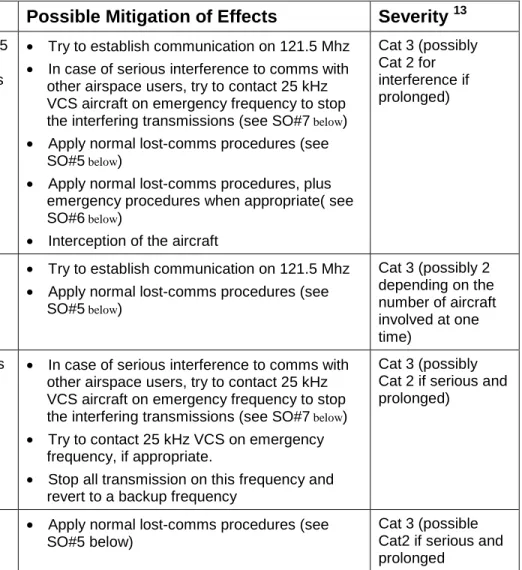
Table 3 illustrates the hazards identified, along with their operational effects. The table also illustrates the possible mitigation means that could be implemented to reduce the effects (or consequences) of the hazards and the severity of the consequences that the hazards may lead to.
It must be noted that the severity allocated to the hazards is done at very general level, and may be influenced by the several parameters, specific to the local implementation, such as the traffic level in the sector, the operational environment, the particular system architecture etc. Therefore allocation of the severity should be re-evaluated during the local safety assessment.
ID
Hazard
Operational Effects
Possible Mitigation of Effects
Severity
13Haz#1 A 25 kHz VCS-equipped,
non-exempt aircraft enters 8.33 kHz VCS airspace – failure of SO#1
Inability to communicate with 25 kHz VCS aircraft and/or
interference to communications with 8.33 kHz VCS aircraft
• Try to establish communication on 121.5 Mhz
• In case of serious interference to comms with
other airspace users, try to contact 25 kHz VCS aircraft on emergency frequency to stop
the interfering transmissions (see SO#7 below)
• Apply normal lost-comms procedures (see
SO#5 below)
• Apply normal lost-comms procedures, plus
emergency procedures when appropriate( see SO#6 below)
• Interception of the aircraft
Cat 3 (possibly Cat 2 for interference if prolonged)
Haz#2 Inadequate provision of facilities /
procedures for handling of exempt aircraft in 8.33 kHz VCS sectors – failure of SO#2
Inability to communicate with (and therefore provide ATS to) exempt aircraft
• Try to establish communication on 121.5 Mhz
• Apply normal lost-comms procedures (see
SO#5 below) Cat 3 (possibly 2 depending on the number of aircraft involved at one time)
Haz#3 Electromagnetic Incompatibility
between 8.33 kHz VCS and 25 kHz VCS frequencies– failure of SO#3
Interference to communications with aircraft
Reduction in communications performances
• In case of serious interference to comms with
other airspace users, try to contact 25 kHz VCS aircraft on emergency frequency to stop
the interfering transmissions (see SO#7 below)
• Try to contact 25 kHz VCS on emergency
frequency, if appropriate.
• Stop all transmission on this frequency and
revert to a backup frequency
Cat 3 (possibly Cat 2 if serious and prolonged)
Haz#4 Incorrect frequency selection by
the Flight Crew of an 8.33 VCS-equipped aircraft – failure of SO#4
Loss of communications with the offending aircraft
• Apply normal lost-comms procedures (see
SO#5 below)
Cat 3 (possible Cat2 if serious and prolonged
Table 3
Hazard Identification and Effect Analysis.
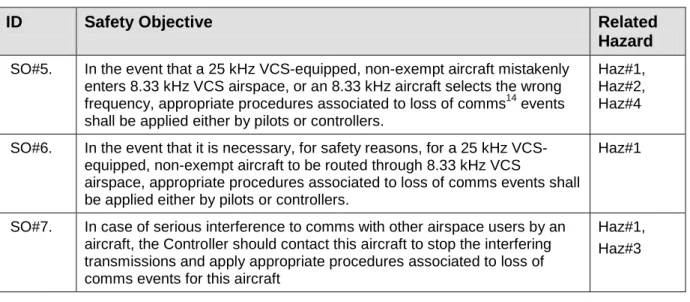
The Safety Objectives to provide the above mitigations are as follows.
ID
Safety Objective
Related
Hazard
SO#5. In the event that a 25 kHz VCS-equipped, non-exempt aircraft mistakenlyenters 8.33 kHz VCS airspace, or an 8.33 kHz aircraft selects the wrong frequency, appropriate procedures associated to loss of comms14 events shall be applied either by pilots or controllers.
Haz#1, Haz#2, Haz#4 SO#6. In the event that it is necessary, for safety reasons, for a 25 kHz
VCS-equipped, non-exempt aircraft to be routed through 8.33 kHz VCS
airspace, appropriate procedures associated to loss of comms events shall be applied either by pilots or controllers.
Haz#1
SO#7. In case of serious interference to comms with other airspace users by an aircraft, the Controller should contact this aircraft to stop the interfering transmissions and apply appropriate procedures associated to loss of comms events for this aircraft
Haz#1, Haz#3
Table 4: Safety Objectives for Mitigation of Operational Effects of the Hazards
Specific Safety Objectives are not specified for the other suggested mitigations because they rely on the Controller exercising his/her professional judgement in determining the appropriate course of action for a given situation.
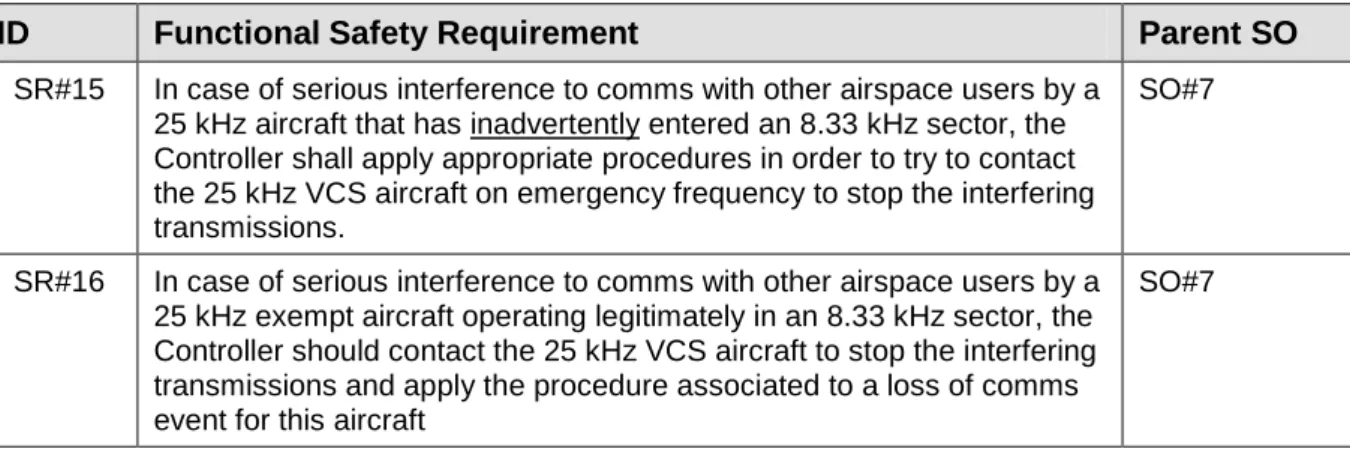
The Functional Safety Requirements listed in Table 5 below will ensure the satisfaction of the Safety Objectives identified in Table 4.
ID
Functional
Safety Requirement
Parent SO
SR#11 In the event that a 25 kHz VCS-equipped aircraft is unable to communicate with ATC, the Flight Crew shall apply the appropriate procedures associated to a loss of comms event.
SO#5
SR#12 In the event that ATC is unable to communicate with an aircraft in 8.33 kHz VCS airspace, the Controller shall apply the appropriate
procedures associated to a loss of comms event.
SO#5
SR#13 In the event that a 25 kHz VCS-equipped, non-exempt aircraft has to be routed through 8.33 kHz VCS airspace, the transferring Controller shall instruct the Flight Crew to either switch to a 25 kHz VCS frequency (if available) or to apply the appropriate procedures associated to a loss of comms event (or emergency event).
SO#5, SO#6
SR#14 In the event that a 25 kHz VCS-equipped, non-exempt aircraft has to be routed through 8.33 kHz VCS airspace, the receiving Controller shall apply the appropriate procedures associated to a loss of comms event (or emergency event).
SO#5, SO#6
14 the procedures for the loss of comms cases are defined locally and include the procedures to contact the
transferring controllers, to contact other pilots in the vicinity to request assistance, the use of other available frequencies or communications means, the ICAO Communication Loss procedures and other measures that may be available locally.
ID
Functional
Safety Requirement
Parent SO
SR#15 In case of serious interference to comms with other airspace users by a25 kHz aircraft that has inadvertently entered an 8.33 kHz sector, the Controller shall apply appropriate procedures in order to try to contact the 25 kHz VCS aircraft on emergency frequency to stop the interfering transmissions.
SO#7
SR#16 In case of serious interference to comms with other airspace users by a 25 kHz exempt aircraft operating legitimately in an 8.33 kHz sector, the Controller should contact the 25 kHz VCS aircraft to stop the interfering transmissions and apply the procedure associated to a loss of comms event for this aircraft
SO#7
Table 5: Functional Safety Requirements for Mitigation of Hazardous Operational Effects
The final step in the failure approach was to identify all the possible causes of the hazards and to identify Functional Safety Requirements that would reduce the likelihood that the cause will occur and/or reduce the likelihood that the cause would actually lead to a hazard. These are shown in Table 6, for each hazard.
ID
Hazard
Causes
Safety Requirement
Haz#1 A 25 kHz VCS-equipped, non-exempt aircraft enters 8.33 kHz VCS airspace
Incorrect airspace information Aircraft Operator / Flight Crew error
Controller error
Unexpected and unavoidable operational situation or emergency SR#1 to SR#7, SR#11to SR#16, SR#17 below, SR#18 below
Haz#2 Inadequate provision of facilities / procedures for handling of exempt aircraft in 8.33 kHz VCS sectors
Inadequate strategy e.g. due to too many exempted aircraft in the considered sector
SR#8, SR#11, SR#12 Haz#3 Electromagnetic incompatibility between 8.33 kHz VCS and 25 kHz VCS frequencies Inappropriate frequency assignments Uncoordinated frequency assignments SR#9, SR#15, SR#16, SR#19 below Haz#4 Incorrect frequency selection
by the Flight Crew of an 8.33 VCS-equipped aircraft
Flight Crew error SR#1,
SR#10
Table 6: Hazard Causal Analysis
ID
Functional
Safety Requirement
Related
Hazard
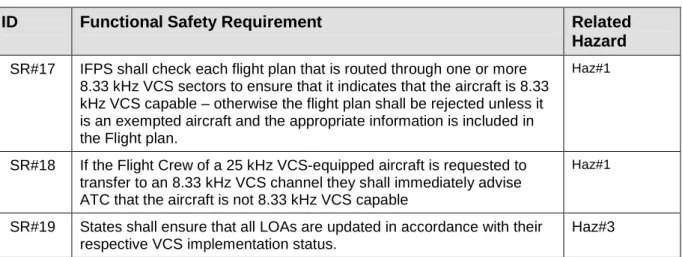
SR#17 IFPS shall check each flight plan that is routed through one or more8.33 kHz VCS sectors to ensure that it indicates that the aircraft is 8.33 kHz VCS capable – otherwise the flight plan shall be rejected unless it is an exempted aircraft and the appropriate information is included in the Flight plan.
Haz#1
SR#18 If the Flight Crew of a 25 kHz VCS-equipped aircraft is requested to transfer to an 8.33 kHz VCS channel they shall immediately advise ATC that the aircraft is not 8.33 kHz VCS capable
Haz#1
SR#19 States shall ensure that all LOAs are updated in accordance with their respective VCS implementation status.
Haz#3
Table 7: Additional Functional Safety Requirements for Mitigation of Hazard Causes
5.4 Risk Assessment
5.4.1 Overview
As it is not practicable for a generic safety assessment such as this to address the factors specific to local operational environments, it is not possible to assign meaningful quantified Safety Objectives / Safety Integrity Requirements for 8.33 kHz VCS or to draw quantitative conclusions regarding the risk of its deployment below FL 195.
That said, however, it is possible for the safety assessment to draw some qualitative conclusions, as follows.
In the long term, when all aircraft operating in Europe are 8.33 kHz VCS equipped (Safety Scenario #1), then for flights that originate in airspace of IR applicability (and for 8.33 kHz VCS-equipped flights originating outside this airspace) the only increased risk of an accident, compared with today’s 25 kHz VCS communications, arises from incorrect selection (mistuning) of an 8.33 VCS frequency as explained in section 5.4.2 below.
Risk increases arising in the shorter-term and/or from equipage exceptions (Safety Scenarios #2 and #3) are discussed in sections 5.4.3 and 5.4.4 below.
5.4.2 Safety Scenario #1
This scenario covers 8.33 kHz VCS-equipped aircraft operating in 8.33 kHz VCS airspace. It reflects what will be normal operations in 8.33 VCS below FL195 and applies indefinitely.
There is only one hazard associated with Safety Scenario #1:
Haz#4: Incorrect frequency selection by the Flight Crew of an 8.33 VCS-equipped aircraft
Haz#4 addresses in general mistuning of the correct frequency - in human factors terms this would be a “slip”, that is correct intention but incorrect execution15.
It should be noted that below FL 195 the airspace users will range from General Aviation to Commercial Air Transport and State aircraft and some risk increase is likely to occur because of:
15
In contrast, selection of an incorrect frequency - in human factors terms a “mistake” (ie incorrect intention) - is out of scope of this safety assessment as explained in section 2 above.
• an increase of one in the number of digits to be selected for 8.33 kHz VCS frequencies - this is already the case above FL 195
• part of the airspace user population, who have limited or no experience of 8.33 kHz VCS operations above FL 195 - that was of course the case for all airspace users when 8.33 kHz VCS was first introduced above FL 195.
For Haz#4, satisfaction of Functional Safety Requirements SR#1 and SR#10 should ensure that any risk involved is reduced significantly. This hazard has been assessed as Cat 3 (possibly Cat 2, depending on the specific local circumstances).
5.4.3 Safety Scenario #2
This scenario covers 25 kHz VCS-equipped, exempt aircraft operating (legitimately) in 8.33 kHz VCS airspace. It applies until all 25 kHz VCS-equipped, exempt aircraft have been retrofitted to 8.33 kHz VCS or have eventually been withdrawn from service – probably many years after the 1st of January 2018.
There are two hazards associated with Safety Scenario #2:
Haz#2: inadequate provision of facilities / procedures for handling of 25 kHz VCS-equipped, exempt aircraft in 8.33 kHz VCS sectors.
Haz#3: Electromagnetic incompatibility between 25 kHz VCS and 8.33 kHz VCS frequencies. These two hazards (Haz#2 and Haz#3) have been assessed as Cat 3 (possibly Cat 2, depending on the specific local circumstances); however, they are entirely avoidable by satisfaction of Functional Safety Requirements SR#8 and SR#9 respectively.
5.4.4 Safety Scenario #3
This scenario covers 25 kHz VCS-equipped, non-exempt aircraft operating in 25 kHz VCS airspace close to the boundary with 8.33 kHz VCS airspace.
It applies, for the area of applicability defined in IR Annex I, to the Interim Phase and is assumed to apply indefinitely in States bordering the IR applicability area because conversion to 8.33 kHz VCS, outside of this area, is not regulated by the IR.
There are two hazards associated with Safety Scenario #3:
Haz#1: a 25 kHz VCS-equipped, non-exempt aircraft enters 8.33 kHz VCS airspace – this has been assessed as a Severity Category (Cat) 3 hazard and may be due to an operational error or as a result of the need to divert an aircraft into 8.33 kHz VCS airspace for some reason
Haz#3: Electromagnetic incompatibility between 8.33 kHz VCS and 25 kHz VCS frequencies - this has been assessed as a Cat 3 (possibly Cat 2) hazard
The risk associated with Haz#3 would be reduced substantially, probably to a very low level, by satisfaction of Functional Safety Requirement SR#9.
For Haz#1, the satisfaction of Functional Safety Requirements SR#1 to SR#7, SR#11 to SR#16 and SR#17 to SR#18 (inclusive) should ensure that any risk involved is reduced substantially. However, what it would not ensure is that the risk is reduced as far as reasonably practicable, for two reasons, as follows.
Firstly, Article 3(10) of the draft IR [16] requires those States listed in Annex I thereto to convert at least 25% of possible frequency assignments to 8.33 kHz VCS by 31 December 2014. Although this enables the possible occurrence of Haz#1, it is justifiable on the basis of the pressing need for an increased number of voice channels in those States and is reinforced by Article 3(9) of the IR which
requires aircraft flying as IFR in Classes A to C airspace in those States to be 8.33 kHz VCS equipped. However, the issue associated to the possible inconsistency between the equipment carriage requirement (article 3(9)) and the airspace conversion requirement (article 3(10)) needs to be addressed in order to satisfy Safety Target ST2 - see Safety Issue Iss001 described in section 7.2 below
Secondly, the draft IR does not prevent the other States in the IR applicability area from converting some (if not all) of their possible frequency assignments to 8.33 kHz VCS well before 31 December 2018. This would not be a safety problem if no conversions took place until all non-exempt aircraft had been fitted with 8.33 kHz VCS radios and therefore ST2 would be satisfied in this respect if the draft IR [16] were amended so that:
• Article 3(16) makes it clear that it applies to all installed radios - see Safety Issue Iss002 described in section 7.2 below.
• in relation to Article 3(17) and when considering the whole IR applicability area prior to the date of mandatory carriage of 8.33 kHz VCS radios (1 January 2018), unnecessary conversions should be limited or a local safety assessment should show that such conversions are safe considering all the potential airspace users impacted by such change - see Safety Issue Iss003 described in section 7.2 below
5.4.5 Risk Quantification
The absolute assessment of risk for Haz#1 (“a 25 kHz VCS-equipped, non-exempt aircraft enters 8.33 kHz VCS airspace”) is very difficult at a generic level because it will depend on the number of opportunities for the hazard to arise – i.e. on the number of interfaces between 8.33 kHz VCS and 25 kHz VCS sectors – which, in turn, will depend on local factors including the number and distribution of sectors to be converted and the actual rate of 8.33 kHz VCS aircraft equipage.
It is necessary, therefore for individual States to carry out a full safety assessment, specific to their areas of responsibility, prior to the deployment of 8.33 kHz VCS comms - see Assumption A004 described in section 7.1 below.
For Haz#4 (“Incorrect frequency selection by the Flight Crew of an 8.33 VCS-equipped aircraft”), a similar conclusion can be raised even it applies to a different topic. Indeed local factors like category of airspace users (GA, VFR, Gliders,…) in the converted airspace, their training, their experience, the level of information provided to them by States will impact the number of opportunities for the hazard to arise. A proper satisfaction of SR#10 is essential.
For Hazards #2 (“inadequate provision of facilities / procedures for handling of 25 kHz VCS-equipped, exempt aircraft in 8.33 kHz VCS sectors”) and #3 (“Electromagnetic incompatibility between 25 kHz VCS and 8.33 kHz VCS frequencies”), it has been assessed that proper implementation of the identified SRs will prevent the occurrence of the Hazards. However for Haz#2, it is important that the service provider determine very precisely the amount of exempted aircraft they have to handle in their airspace. Indeed a large amount of exempted aircraft in a given airspace could lead to an unachievable SR#8.
6.
IMPACT ON GROUND VEHICLE OPERATION
6.1 Introduction
The movement of vehicles on the manoeuvring area of an aerodrome shall be controlled by the relevant air traffic services. When so prescribed by the service provider continuous two way radiotelephony is necessary. It must be noted that the rules for the control of the vehicles on ground may be different from one airport to another one.
Air Traffic control is responsible for the control of the movement of vehicles on the manoeuvring area. To maintain such control and if so prescribed, vehicles operating on the manoeuvring area should be fitted with VHF-Com R/T on the appropriate channel (Ground or tower frequency), or closely escorted
by an R/T equipped vehicle. The Airport operator is responsible for ensuring that operational R/T equipment is provided on vehicles being operated on the manoeuvring area and drivers are fully conversant with proper R/T procedures.
On apron areas, ATS has normally no responsibility for control of vehicles. The airport operator is responsible for regulating vehicular traffic movement on the apron in order to reduce to a minimum the risk of aircraft/vehicle and vehicle/vehicle conflict and to promote the safety of pedestrians. The Apron Control service can be exercised by regulating the vehicles that can enter the apron and by instruction of driver.
ICAO is providing detailed information relative to the ground vehicle communication aspect in the following documents: [20], [21], [22], [23] and [24].
Taking into account that the arrangement in each airport might be different, it is necessary to perform a local safety impact assessment which will consider the local aerodrome environment (runway, manoeuvring and apron physical layout, traffic density,…) and the possible different actors delivering services to vehicles (i.e. ANSPs, Airport operator).
This generic safety impact assessment does not address the Apron area environment because normally no ATS service is delivered in such area. If however it is the case for a specific environment and if VHF voice communication is used, the local safety assessment should address this aspect and scenarios identified in this section could be extended also to the Apron area.
The implementation of 8.33 kHz below FL 195 will impact any vehicle equipped with a radio operating on the manoeuvring area where the ATC is supported by 8.33 kHz VCS. Indeed each vehicle shall be equipped with 8.33 kHz VCS (or the driver shall have an appropriate hand-held equipment) for e.g. movement instructions and for crossing runways or if not-equipped should be guided/escorted by an 8.33 kHz equipped vehicle in order to operate in the manoeuvring area.
6.2 Safety Targets
Safety targets identified in section 3 above are referring to the implementation of the 8.33 kHz in general and are applicable also to the airport operation when considering ground vehicles on the manoeuvring area.
6.3 Safety
Scenarios Assessed
The following scenarios for the safety assessment were deduced from section 6.1:
Safety Scenario #4 – Non 8.33 kHz capable vehicle operating near the manoeuvring area where ATC
is supported by 8.33 kHz VCS.
Safety Scenario #5 – 8.33 kHz capable vehicle operating in a manoeuvring area where ATC is
supported by 8.33 kHz VCS. Note that:
• Safety Scenario #4 addresses the possible presence of a vehicle on or near the manoeuvring area unable to communicate for e.g. one of the following reasons:
o is equipped with the wrong radio (alias with non compatible 8.33 kHz radio);
o radio failure;
• Safety Scenario #5 addresses the normal operation where the vehicle is 8.33 kHz VCS equipped and the air traffic service delivered in the manoeuvring area is supported by 8.33 kHz VCS.
These Safety Scenarios are next used to derive Safety Objectives and Safety Requirements for the success and failure cases.
Note: In the rest of this document when the term “VCS-equipped vehicle” is used, it means either a fix installation onboard the vehicle or the use of hand-held equipment by the vehicle driver.
6.4 Success Approach
ID
Safety Objective
Scenario
SO#8. A non-8.33 kHz VCS-equipped vehicle shall not operate on 8.33 kHzVCS manoeuvring area unless escorted.
#4 SO#9. Airport Operator shall ensure that provision is made for authorising
non-8.33 kHz equipped vehicle to operate on non-8.33 kHz manoeuvring area for overriding safety reasons (e.g. fire fighting vehicle not equipped)
#4
SO#10. The ANSP shall ensure that the assignment of frequency for ATS delivered in the manoeuvring area is done so as to avoid interference from other ground/airborne transmissions
#5
SO#11. Airport operator shall ensure that ground radio equipment used by ground vehicle drivers are interoperable with 8.33 kHz standard
#5
Table 8: Safety Objectives from the Success Approach
With regard to the SO#11, it should be noted that airborne equipment should be compliant with the Eurocae Standard ED23B[18] derived from the ICAO Annex10 [14], while ATS ground base stations should be compliant with the Standard ETSI EN 300 676 [17] also derived from the ICAO Annex10 [14]. For ground vehicle radio equipment, it is assumed that compliance with ICAO Annex 10 [14] is sufficient to ensure the interoperability between ground vehicle and the ATS. It should be noted that the Standard ETSI EN 300 676[17] is also applicable to ground mobile and hand-held radios for ground use.
The Table 9 shows the Functional Safety Requirements for the system elements and the Safety Objectives from which they were derived.
ID
Functional Safety Requirement
Parent SO
SR#20 Aerodrome information/publication (aerodrome manual) shall provide up-to-date information to all vehicle drivers concerning the VCS requirements applicable to the aerodrome manoeuvring areas.
SO#8
SR#21 Vehicle drivers shall be made aware of the consequences of using non-8.33 kHz VCS radios in 8.33 kHz VCS manoeuvring areas unless specifically authorised.
SO#8
SR#22 Airport operator/ANSP shall develop and implement strategies to ensure the safe handling of non-8.33 kHz VCS-equipped vehicle in 8.33 kHz VCS airport area.
SO#9
SR#23 State’s frequency assignment plan shall comply with EUR Frequency Management Manual – ICAO EUR Doc 011 (2009) [15] in order to ensure that any aerodrome assigned frequency does not interfere with other frequencies assigned in the aerodrome vicinity and is free from harmful interference.
SO#10
SR#24 Airport operator shall ensure that vehicle drivers operating on the manoeuvring area are fully conversant with the proper R/T procedures associated to 8.33 kHz VCS.
SO#11
SR#25 Airport operator shall ensure that the vehicle radio equipment (including hand-held equipment) used for ATC are compliant with the ICAO Annex 10 [14] standard.
SO#11
6.5 Failure Approach
The assessment considered both abnormal conditions in the operational environment (e.g. vehicles coming from another aerodrome where 8.33 kHz is not yet implemented, fire fighting operation necessitating vehicles reinforcement but not 8.33 kHz equipped, ….) as well as failures within the comms services (e.g. operational errors).
Table 10 illustrates the hazards identified, along with their operational effects. The table also illustrates the possible mitigation means that could be implemented to reduce the effects (or consequences) of the hazards and the severity of the consequences that the hazards may lead to.
It must be noted that the severity allocated to the hazards is done at very general level, and may be influenced by the several parameters, specific to the local implementation, such as the traffic level in the manoeuvring area, the operational environment, the particular system architecture etc. Therefore allocation of the severity should be re-evaluated during the local safety assessment.
ID
Hazard
Operational Effects
Possible Mitigation of Effects
Severity
16Haz#5 A non-8.33 kHz VCS-equipped
vehicle enters in the 8.33 kHz VCS
airspace manoeuvring area –
failure of SO#8
Inability to communicate with
non-8.33 kHz VCS vehicle
and/or interference to
communications with 8.33 kHz VCS vehicle and aircraft
• Inform other vehicles operating in the vicinity
of the presence of this vehicle (SO#12 below)
• Inform aircraft landing and/or taxiing of the
presence of this vehicle (SO#12 below)
• Try to establish communication using all other available means
• Intercept and escort vehicle if situation
dictates it (SO#13 below)
Cat 3 (possibly cat 2 for interference)
Haz#6 Inadequate provision of facilities /
procedures for handling non-8.33 kHz equipped vehicle (exempted) – failure of SO#9
Inability to communicate with (and therefore provide ATS to) vehicles authorised to operate on the manoeuvring area.
• Inform other vehicles operating in the vicinity
of the presence of this vehicle (SO#12 below)
• Inform aircraft landing and/or taxiing of the
presence of this vehicle (SO#12 below)
• Try to establish communication using all other available means
• Intercept and escort the vehicle if situation
dictates it (SO#13 below)
Cat 3
Haz#7 The 8.33 kHz assigned frequency
generates interference – failure of SO#10
Interference to communications on the manoeuvring area and
possibly for Departure and
Arrival operations
• Apply normal lost-comms procedures for aircraft impacted by this interference during departure or arrival. •
•Stop all transmission on this frequency and revert to a backup frequency
Cat 3 (possibly
Cat 2 if serious and prolonged)
Haz#8 The 8.33 kHz assigned frequency is
impacted by interference – failure of SO#10
Interference to communications on the manoeuvring area
• Inform other vehicles operating in the area
affected by this interference (SO#12 below)
• Stop the traffic if interference is severe • Intercept and escort vehicle if it is shown to
be the interference source(SO#13 below)
Cat 3 (possibly
Cat 2 if serious and prolonged)
Haz#9 Wrong selection of the 8.33 kHz channel by the vehicle driver SO#11.
Loss of communication with the vehicle
• Inform other vehicles operating in the vicinity
of the presence of this vehicle (SO#12 below)
• Inform aircraft landing and/or taxiing of the
presence of this vehicle (SO#12 below)
•Try to establish communication using all other available means
• Intercept and escort the vehicle if situation
dictates it (SO#13 below)
Cat 3