Part 1: Why (or Why Not) to Integrate your AMS & Email Services
About this Series
Real Magnet is a leader in AMS – Email integrations, with hundreds of association clients using the Real Magnet application in conjunction with iMIS, Aptify, Personify, netFORUM, SalesForce.com CRM and others. Every day our team is working with the IT, marketing and web products teams to extract the greatest possible functionality and analytics out of their communications platforms in the email, social and mobile channels.
As industry leaders in email integrations, we have learned quite a bit about the process associations go through in order to decide on and prepare for an integration. Over a 4-part series, this Guide shares what we have learned, in order to:
• Inform decision-making required for AMS – ESP integrations • Identify issues that can slow or derail an integration
• Anticipate all likely user scenarios so that the completed integration meets expectations and objectives
• Ensure that the integration process goes as smoothly as possible Part 1: The Benefits of Integrating an Email Service with an AMS
Part 2: Subscription Management – Planning, Preparation and Processes (Winter 2012/2013)
Part 3: AMS – Email Integration Data Mining Decision-Making (Early Spring 2013)
Part 1: Why (or Why Not) to Integrate your AMS & Email Services
www.realmagnet.com [email protected]
301-652-4025 x131 3
Option 1: Using the AMS’s Native Email Platform
There are three options for email messaging with an AMS:
• Option 1: Using the AMS’s Native Email Platform
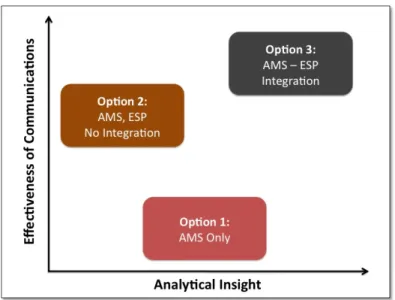
• Option 2: Sending email through an ESP, but not integrating it within the AMS • Option 3: Integrating the AMS and ESP The graphic below helps illustrate the benefits and shortcomings of each option, mapping the Analyti-cal Insight gleaned from each option against the Effectiveness of Communications resulting from each:
Figure 1: Advantages and Disadvantages of various AMS and AMS-ESP options
Option 1: Using the AMS’s Native Email
Platform
The advantage of an AMS only system is that all member data is consolidated in a single location. Mailing lists based on attributes within the system (geography, previous event attendance, member-ship type, title) are easily generated, and reports containing the member engagement data tracked by the system (conferences attended, webinars joined, number of years of membership, etc.) are easy to run. Most AMS systems include broadcast email functionality as well, allowing association marketers to compose and send messages from within the application.
More advanced email features – such as A/B test-ing, preference center management, social media integration and rich analytics – are typically not found in AMS systems, however. As an associa-tion’s dependence on email increases, it can quick-ly outgrow the basic email functionality packaged into an AMS.
IT managers experience their own set of chal-lenges. If the AMS software is installed on the association’s servers, a large volume of email could dramatically reduce system responsiveness for all users. It also puts the Association’s IP address at greater risk for blacklisting. Finally, managing large volumes of email is technically difficult and neither internal IT resources nor the resources at the AMS provider are equipped to deal with issues like deliverability, bounce management, etc. As a result, some if not all of this work will fall on the internal IT resources.
Part 1: Why (or Why Not) to Integrate your AMS & Email Services
Option 2: Using a Non-Integrated ESP
Option 2: Using a Non-Integrated ESP
Switching to an ESP gives marketers greater control and flexibility within email, social, and mobile messaging, and boosts the overall effectiveness of an organization’s communications. ESP services do come at a financial cost. Typically, they charge either a monthly fee or require an annual contract. Most associations are able to justify the incremen-tal cost because of the marketing and IT benefits. Some of these benefits include:
• Advanced marketing functionality such as dynamic content, A/B and deliverability testing tools, integrated social and SMS messaging, etc.
• Easy to use content creation tools for non-technical users
• Professional deliverability services means more messages reach their targets
• ESP Hosted email accommodates large volumes quickly and poses no risk to the association’s IP address
• Automated bounce and unsubscribe man-agement
• Enhanced analytics for deeper insights into member engagement
This approach allows an association to enjoy some of the tactical benefits of an ESP, but it gives up some of the strategic benefits of consolidated membership management. While message
effec-preferences, engagement metrics, demographic and behavioral data – exist in multiple places. Some is kept within the ESP and some in the AMS, and some data exists in both places and is fre-quently out of sync or conflicting. This hamstrings analytics, as the full picture of each member’s (and member company’s) engagement is difficult to ascertain.
For example, the data from an ESP could reveal that the primary contact at a member company has not opened or clicked on an email in six months, suggesting a lack of engagement. She may then be added to a re-engagement campaign and sent messages with discounts to upcoming conferences or other enticements to return to the fold. But the AMS application that keeps a separate record of her activities may reveal that she has registered for the last three conferences by phone (without needing any discounts), spoke on a webinar last month, is on the public policy committee and just renewed her company’s membership. Membership intelligence is mission-critical for associations, and disparate databases can compromise the member experience and association revenue.
In an attempt to gain the benefits of a full integra-tion, some associations attempt to manually in-tegrate the two through frequent data exchanges. Most commonly, lists are generated in the AMS and then transferred to the ESP. But if running lists was the only requirement, maintaining separate AMS and ESP applications would be manageable.
M
anaging a separate AMS and ESP hamstrings analytics, as the full picture of each member’s engagement is difficult to ascertain.M
embership intelligence is mission-critical for associations, and disparate databases can compromise the member experience and association revenue.Part 1: Why (or Why Not) to Integrate your AMS & Email Services
www.realmagnet.com [email protected]
301-652-4025 x131 5
What is not manageable, however, is the neces-sary process of bringing subscription, unsubscribe, bounce and tracking data from the ESP back into the AMS, record by record, after every mailing. As list size and mailing frequency increase, this pro-cess quickly becomes onerous and unsustainable. Adding insult to injury, it is a process fraught with the possibility for error. The extra effort required still results in overlooked unsubscribe requests and mis-attributed bounces, leading to compromised deliverability, frustrated members, and missed op-portunities.
For many organizations, the added complexity
Option 2: Using a Non-Integrated ESP
(con’d)
of maintaining separate membership and email databases weighs heavily on both marketing and IT resources. Yet the benefits of the ESP make return-ing to the limited email functionality of the AMS equally unattractive. A full AMS – ESP integration removes these pain points, allowing an association to unlock the full potential of both applications.
Is your Association sending too much email?
Many AMS – ESP integrations begin with this very question. Member relationships are a driving force in association marketing. Beyond qualitative ROI based on clicks and conversions, associations understand that connections and engagement at the individual level are what drive participation, renewals and a stronger membership.
In most cases, the answer to the question is both Yes and No. Members have different thresholds for email, and a one-size-fits-all email program invariably overmails to some members, while leaving other members wanting even deeper contact and engagement. Only by tailoring subscription prefer-ences around each member can an association ensure that email frequency and member engage-ment are optimized.
The targeting and subscription management functionality of an ESP combined with the whole-pic-ture engagement data of an AMS allows associations adapt their email program to meet the widely disparate needs of their entire membership bases. As with most questions of marketing optimization, the answer to email frequency is “it depends.” Having all the behavioral and engagement data in the same place allows an association to identify exactly on what optimum frequency depends, and then deliver it.
W
hat is not manageable, however, is the necessary process of bringing subscription, unsubscribe, bounce and tracking data from the ESP back into the AMS.Part 1: Why (or Why Not) to Integrate your AMS & Email Services
Option 3: Use an Integrated ESP
Option 3: Use an Integrated ESP
A fully integrated AMS – ESP solution not only al-lows both applications to perform at their best; it
actually enhances the value of the entire system. By integrating both systems and syncing data into a single location, association gain these benefits:
Best In Class Email Functionality: As association marketers’ communications strategies become more complex, a fuller suite of services is required. Leading ESPs offer features like dynamic content, deliverability services such as blacklist monitoring and reputation management, advanced analyt-ics, social media integration and SMS messaging integration to name a few. Marketers also benefit from new features ESPs release consistently to stay
Improved Email Segmentation and Targeting: An AMS – ESP integration creates incredibly rich email segmentation and targeting opportunities. Market-ers can leverage the data in both applications with no importing or exporting required. Conference marketing messages, for example, can easily be tailored with specific messages based on attendee area of expertise, staggered to reach inboxes at precise times across different time zones, and re-sent only to unresponsive recipients.
Better Member Experience Via Better Manage-ment of Subscription and Unsubscribe Data: Today many associations are sending messages to members who have unsubscribed, as well as
fail-ing to provide the communications other subscrib-ers expect – frustrating membsubscrib-ers and tarnishing the association’s image. What many associations regard as the greatest benefit of a full AMS-ESP integration is the synching subscription and unsub-scribe data between the two applications, which automates subscription and unsubscribe manage-ment and ensures members receive all - and only - the communications they want.
Should all email go through the ESP?
Associations need not employ an all-or-nothing approach when using an ESP along with their AMS, and in fact most do not. Many organizations continue to send transactional emails – conference or webinar registration confirmations, website login request responses, etc. – directly from the AMS. Because these messages are individual and highly anticipated, some of the ESP’s added functional-ity in deliverabilfunctional-ity and throughput are not worth the extra effort to fully integrate all the triggers that precipitate them.
E
ngagement is born from relevance, and deeper more actionable data lifts the rel-evance of every message the association sends.www.realmagnet.com [email protected]
301-652-4025 x131 7
Part 1: Why (or Why Not) to Integrate your AMS & Email Services
Option 3: Use an Integrated ESP
(con’d)
scription data can be complex, with many different scenarios under which members (and non-members) can express their email preferences. In addition to planning thoroughly upfront, association professionals must must also perform their due diligence in sourcing the right ESP as each one has its own approach for managing unsubscribe and subscription data.
New Doors Open in Data Mining: Your AMS application is at the core of your membership engagement and intelligence initiatives. Email opens, clicks, subscribes and unsubscribes, conversions and mobile and social media activity paint a much clearer picture of how engaged each contact and member com-pany are. Seamlessly incorporating how your members are interacting with your principal communication channel makes it possible to build much more accurate engagement matrices that allow you to identify the member companies most (or least) in need of some incremental attention.
Conclusion:
Association marketing is more than just sending enough messages to fill conference rooms, drive survey responses for research, solicit board of elections votes, or close renewals. This is because membership is very different from customership. Empathy, community and especially relevance are all escalated in im-portance, and a deeper understanding of the whole membership experience and context is necessary in order to communicate in a way that adds value and rewards membership. Engagement is born from rel-evance, and deeper more actionable data lifts the relevance of every message the association sends. An AMS- ESP integration optimizes the value of both systems by aggregating behavioral and engagement data in unique and powerful ways, creating more relevant messages and ultimately stronger ties between associations and their members.
Next in the Series:
Part 2: Subscription Management – Planning, Preparation and Processes (Winter 2012/2013)
Part 3: AMS – Email Integration Data Mining Decision-Making (Early Spring 2013)
Part 4: Advanced Applications of AMS – ESP Integrations (Late Spring 2013)
--About Real Magnet
Real Magnet is a leading Email, Social and Event Services Provider with over 1,000 clients across a range of industries, from associations, to publishing, hospitality and education. Its application combines message composition, distribution, event registration, surveys, tracking and analytics, through email, social and mo-bile channels. For more information visit http://www.realmagnet.com, or visit http://blog.realmagnet.com for more marketing tips and advice.