Transfer and Articulation
In Higher Education
Transfer and Articulation
In Higher Education
917 Lakeridge Way SW P.O. Box 43430
Olympia, WA 98504-3430 360.753.7800
www.hecb.wa.gov
Jesus Hernandez, chair
Wenatchee
Charley Bingham
Tacoma
Ethelda Burke
Lakewood
Gene Colin
Seattle
Roberta Greene
Spokane
Bill Grinstein
Seattle
Earl Hale
Lacey
Sasha Sleiman
East Wenatchee
Sam Smith
Seattle
Ann Daley
Executive Director
This publication is available on the HECB Web site at: www.hecb.wa.gov/research/issues/transfer.asp
TABLE OF CONTENTS
INTRODUCTION... 1
EXECUTIVE SUMMARY ... 2
Transfer Indicators ... 2
Progress on Policy Initiatives ... 4
CONTEXT ... 6
2008 Strategic Master Plan for Higher Education in Washington ... 6
Legislative Reference - Transfer and Articulation ... 7
Organizations and Offices Addressing Transfer Issues in Washington ... 8
TRANSFER INDICATORS ... 8
Trends in Student Transfer and Articulation ... 8
Transfer Profile ...11
Sector to Sector Transfer ...13
Proportionality ...15
Future Work Related to Proportionality ...16
Transfer Degrees by Category ...17
Major Related Programs ...17
PROGRESS ON POLICY INITIATIVES ... 19
Transfer Policy in Washington State ...19
Transfer Student Rights and Responsibilities ...20
Future Work Related to Transfer Student Rights and Responsibilities ...22
Direct Transfer Agreement (DTA) ...22
Future Work Related to the DTA ...23
Associate of Science - Transfer Degree #2 Revised ...23
Major Related Programs ...24
Future Work Related to MRPs ...27
Process for Changing Statewide Agreements ...27
Dual enrollment and Dual Credit Programs ...28
Future Work Related to Dual Enrollment and Dual Credit Programs ...29
Prior Learning Assessment (PLA) ...30
Future Work Related to PLA ...31
Transferring Veteran Skills and Education for State Licensure ...31
Future Work Related to Transferring Veteran Skills and Education ...32
Role of Transfer Study ...33
Future Work Related to Role of Transfer Study ...33
Common Course Numbering ...33
Transfer Pathways for Technical Associate Degree Graduates ...34
Bachelor of Applied Science Degrees ...35
Academic Guidance and Planning System – Academic GPS ...38
APPENDIX B ...45 Organizations and Offices Addressing Transfer Issues in Washington
APPENDIX C ...49 Appendix C: Sector to Sector Transfer - AY 2005-2006
APPENDIX D ...51 Process for Revisions and Changes to the Statewide Transfer Associate Degree Agreements
APPENDIX E ...53 Advanced Standing Placement, Awarding of Transfer Credit, and Prior Learning Assessment
APPENDIX F ...57 Draft Transfer Rights and Responsibilities
APPENDIX G ...59 Current DTA Associate Degree Guidelines
APPENDIX H ...65 Associate of Science Transfer Degree #1
APPENDIX I ...67 Associate of Science Transfer Degree #2 Revised
APPENDIX J ...71 2007-08 Transfer Degrees by Category
APPENDIX K ...73 Academic Guidance and Planning System Desired Features
January 2009
HECB Transfer and Articulation Report
Introduction
This report fulfills the biennial requirements of RCW 28B.76.250, whichdirects the Higher Education Coordinating Board (HECB) “to submit a progress report on the development of transfer associate degrees to the higher education committees of the House of Representatives and Senate each odd-numbered year.” The HECB report monitors progress on the indicators, describes development of additional transfer associate degrees, and provides other data on improvements in transfer efficiency.
The report:
Addresses progress toward achieving goals for transfer and articulation found in the 2008 Strategic Master Plan for Higher Education;
Charts progress made on transfer and articulation since the last transfer report in December 2006;
Includes responses to improvements identified by the 2008 Legislature in HB 2783 and recommended by the Governor; and
Presents useful information for those interested in the state of transfer and articulation in Washington.
The report is divided into the following sections:
Executive Summary: An overview of the main points of this report
Context: Master plan transfer and articulation goals, legislative background information, and groups serving transfer students in Washington
Transfer Indicators: How are we doing?
Progress on Policy Initiatives, Future Work to be Done: What has been done to improve student transfer in Washington? What work remains to be done?
Reference: Materials to improve transfer coordination and communicationare included in the Appendices.
Executive Summary
Washington will not be able to increase the number of bachelor‟s degrees being earned by its citizens substantially unless it improves the rate and success of students transferring from its two- to four-year institutions.
Achieving continuous improvement in transfer success is a top priority of the Governor, Legislature, HECB, and its collaborating institutions and organizations. This report addresses the progress being made to improve transfer success; responds to legislative requirements regarding transfer and articulation; and addresses goals and objectives outlined in the 2008 Strategic Master Plan for Higher Education.
This report also identifies the next steps needed to continue improving Washington‟s higher education transfer system and includes responses to improvements identified by the 2008 Legislature in HB 2783 and recommended by the Governor.
Transfer Indicators
Over the last 17 years, the number of students who have successfully transferred1 from a two-year college to a four-two-year institution has steadily increased. By 2006-07, the number of transfer students had grown to over 15,000 per year.
Even though the number of students transferring from the two- to four-year institutions has increased, the rate at which they transfer has remained about 20 percent a year. This may be attributable to a lack of capacity at the four-year institutions, a lack of adequate preparation, financial issues, difficulty in navigating the system, or other reasons not fully understood at this time.
Students who transfer from two- to four-year institutions make up more than 40 percent of those earning bachelor‟s degrees annually in Washington. More than 70 percent of the students who access higher education in our state do so first at two-year institutions.
One measure of transfer success is the percentage of students transferring with an associate degree who complete a bachelor‟s degree within three years. The state aggregate rate in the baseline period was about 63 percent, which rose to 70 percent by 2006-07.
1 Successful transfers are newly enrolled students at public and private baccalaureate institutions who most recently
attended a Washington community college. Source data is from The State Board for Community and Technical Colleges Academic Year Report, 2006-07 using data reported to the Office of Financial Management and supplemented by public and private baccalaureate institution reports.
Although the transfer process is generally understood as linear and progressive – a student moves from high school to a community/technical college and then to a four-year institution – it also needs to be examined from the standpoint of lateral movement within the higher education system.
Students do not always follow straight lines in their educational journeys. Some start at four-year institutions, step back to a community college, and then re-enter a four-four-year institution after having completed additional coursework. Students also transfer among the community and technical colleges and among the four-year colleges and universities. This phenomenon is called „swirling.‟
In 2005-2006, almost 33,000 students transferred from one Washington higher education institution to another, falling into four primary categories:
1. Almost 15,000 from two- to four-year colleges and universities; 2. More than 11,000 within two-year colleges;
3. Slightly more than 5,000 from four-year universities to two-year colleges; and 4. More than 2,000 between four-year colleges.
Possible reasons for this swirling transfer activity include common themes of convenience, financial challenges, course selection, and student preference.
Students planning to transfer in Washington follow several approaches or pathways:
The Direct Transfer Agreement associate degree (also called “the DTA”) focusing on meeting lower-division general education requirements;
The Associate of Science – Transfer (AS-T) focusing on preparation for biology, chemistry, earth science, physics, computer science, and engineering majors; and Major Related Programs (MRPs) that prepare students for majors that require careful selection of elective and general education courses.
For 2007-08, more than 13,000 transfer degrees were awarded, with 95 percent being DTA and related MRPs. In 2007-2008 academic year, 1,072 students completed MRP associate degrees, up 25 percent from the 800 students who completed them in 2006-07. More than 97 percent of MRP completers followed Business, Nursing, and Elementary Education programs. Although the number of students earning AS-T-based MRPs is very small, many MRPs are recent additions and the number of participants in these pathways is expected to grow.
Progress on Policy Initiatives
One of four strategies in the 2008 Strategic Master Plan for Higher Education is to “create a
system of support for lifelong learning” that makes it easier for students of all ages to move into and through the postsecondary system. One goal of this strategy is to make transfer more user-friendly so that greater numbers of students complete bachelors and advanced degrees.
Statewide cross-sector groups and offices are working on initiatives to address both legislative requirements and master plan goals and objectives related to transfer. Included in this work are responses to improvements identified by the legislature in HB 2783 during the 2008 session and recommended by the Governor.
The master plan identified two related objectives:
1. Further alignment of institutional policies and practice to ensure that students have flexibility in designing their path to a degree; and
2. Getting the right information to students at the right time. These initiatives include the following:
A report submitted by the Joint Access Oversight Group (JAOG) in 2007 provided an overview of state transfer policy noting: “The best designed transfer pathway does not work unless students can find and follow it.” To improve in this area, the report
recommended the state implement a central Web-based statewide advising tool kit to help students, parents, and other stakeholders find accurate and timely information on transfer requirements, course equivalencies, and degree programs.
The Associate of Science-Transfer (AS-T) degree was modified to open it to more students and incorporate language that clarifies degree requirements. These changes improve this path towards a degree. Workgroups continue to clarify components of the Direct Transfer Agreement (DTA).
To implement Major Related Programs throughout the state system of higher education, the HECB, SBCTC, and public and private institutions represented through JAOG:
o Created four new direct transfer agreements and three new associate of science-transfer degrees; and
The HECB, SBCTC, and JAOG have agreed to focus on assessment of current pathways before deciding to create additional ones.
Several workgroups have addressed the Master plan objective of making transfer more user-friendly so greater numbers of students will complete bachelor‟s degrees.
Information on the scope of dual credit and dual enrollment programs like Running Start, Advanced Placement, and College in the High School was collected and analyzed. A report on how to develop a coordinated plan for these programs will be issued in early 2009 by the Office of the Superintendent of Public Instruction (OSPI). Workgroups also reviewed institutional policies and procedures on prior learning assessments. A pilot program between a community college and baccalaureate institution is being developed. In addition, the Department of Health, Department of Licensing, and HECB are jointly reporting to the 2009 Legislature on the transfer of veterans‟ skills and education for state licensure. Further work remains in each of these areas and several suggestions are
included in this report.
Workgroups addressed improvements identified in HB 2783 during the 2008 session.
o A list of transfer students‟ rights and responsibilities was developed and is currently in the final stages of institutional review and approval.
o A taskforce continues to work on a set of frequently asked questions and responses that will disseminate the right information to transfer students at the right time.
o A proposal for a statewide transfer planning system and online tool to facilitate access to transfer information was created by a cross-sector group and became a component of the HECB Budget Request for 2010-2011. This Academic Guidance and Planning System (Academic GPS) proposal,
suggested by the Legislature, is broadly supported throughout the state, and could address many of the issues outlined in the Strategic Master Plan.
The Governor and Legislature have placed the continuous improvement of our transfer system as a top priority. The HECB will continue to work closely with its collaborating institutions and organizations to improve students‟ ability to transfer successfully and increase the number of baccalaureate degrees granted in Washington.
Context
2008 Strategic Master Plan for Higher Education in Washington2
A goal of the 2008 Strategic Master Plan for Higher Education in Washington is to “create a high-quality higher education system that provides expanded opportunity for more
Washingtonians to complete postsecondary degrees, certificates, and apprenticeships.” One of four strategies to raise educational attainmentis to “create a system of support for lifelong learning” for students of all ages and backgrounds. A goal of this strategy is to make transfer more user-friendly so that greater numbers of students will successfully transfer and complete bachelor‟s and advanced degrees.
About 41 percent of the 16,800 students awarded degrees at Washington public baccalaureate institutions in the 2000-01 academic year had completed at least 40 credits at a community or technical college. Of these students, 67 percent (27 percent of those earning baccalaureate degrees) had completed an academic associate degree, and another 5 percent (2 percent of baccalaureate degree earners) had completed both an academic and a technical associate degree prior to transfer. Despite these successes, some students who begin their academic journey at community colleges with the intention of transferring and completing a baccalaureate degree never reach their goal.
In the 2005-06 academic year, just over half of the students who had enrolled in 2002-03
intending to transfer in pursuit of a bachelor‟s degree actually had transferred to public four-year colleges in Washington.
Two separate but connected initiatives are being implemented to address increasing mobility among students: (1) further alignment of institutional policies and practice to ensure students have flexibility in designing their path to a degree and (2) getting the right information to students at the right time.
The master plan identifies the following “needs” to provide students with maximum flexibility in planning their route to a degree and address these two initiatives:
Design additional pathways that allow community and technical college students to prepare for entry to selective majors at more than one baccalaureate institution;
Connect faculty and administrators across institutions and sectors more broadly and more regularly to ensure pathways stay current with expectations of industry, and that other obstacles can be dismantled;
Regularly assess these pathways in greater depth to ensure they are providing students with the most efficient road to their educational goals; and
2
The 2008 Strategic Master Plan for Higher Education in Washington is available at
Create a clear communication system with students and their families to make transfer work well. A single, statewide Web site, with information on course articulation, transfer requirements, and other relevant information is needed.
Public and private higher education institutions work through the Joint Access and Oversight Group to continue to strengthen policy work that smoothes transfer pathways for current and future students. The expected outcome is an increase in the number of students who transfer successfully between two- and four-year institutions, as measured under our current
accountability framework.
Legislative Reference - Transfer and Articulation3
Community and technical colleges play a vital role for students obtaining baccalaureate degrees in Washington. Increased demand comes from larger numbers of students seeking access to higher education and greater expectations from employers for the knowledge and skills needed to expand the state‟s economy. Community and technical colleges are an essential partner in meeting this demand.
During the 2004 session, the Legislature expressed, through passage of HB 2382,4 a need for the higher education system to expand its capacity to enroll transfer students in baccalaureate
education. The HECB was directed to take a leadership role in working with the community and technical colleges and four-year institutions to ensure efficient and seamless transfer across the state by:
Building clearer pathways to baccalaureate degrees;
Improving statewide coordination of transfer and articulation; and
Ensuring long-term capacity in the state‟s higher education system for transfer students. In the same year, the Legislature and Governor clarified the roles and responsibilities of the HECB specific to transfer and articulation policies.5 The HECB is directedto “adopt statewide transfer and articulation policies that ensure efficient transfer of credits and courses across public two- and four-year institutions of higher education. The intent of the policies is to create a statewide system of articulation and alignment between two- and four-year institutions.” Together the bills outlined the requirements for astatewide transfer of credit policy and agreement and requirements for the development of transfer associate degrees for specific academic majors that satisfy lower-division requirements at public four-year institutions of higher education.
3
RCW related to Transfer and Articulation can be found in Appendix A.
4
Codified as 28B.76.250
HB 2783 was introduced during the 2008 session and would have required the HECB to develop workgroups to address four issues related to student success that were aligned with Strategic Master Plan objectives. These four issues were: (1) a statewide transfer planning system; (2) an online planning tool to facilitate access to this information; (3) a means to identify, at time of registration, course applicability to degree goals; and (4) a list of transfer students‟ rights and responsibilities. Although HB 2783 did not become law, the Governor directed the groups to continue work and submit a combined proposal for the 2009 legislative session.
The HECB, the SBCTC, and the institutions (through JAOG) developed work groups to address issues raised in HB 2783. The work groups met throughout 2008 and the progress to date is highlighted in the “Progress on Policy Initiatives” section of this report.
Organizations and Offices Addressing Transfer Issues in Washington
Both the Strategic Master Plan for Higher Education and the Legislature direct the HECB to convene workgroups to address transfer issues that include stakeholders from all sectors of education in Washington. These statewide cross-sector groups and offices are involved in every aspect of transfer and include within-sector groups that represent the public baccalaureates, public two-year colleges, and the Independent Colleges of Washington. Referenced throughout this report, an updated list of groups and offices is located in Appendix B.6
Transfer Indicators
Trends in Student Transfer and Articulation
The 2008 Strategic Master Plan for Higher Education outlines a policy goal to increase the total number of baccalaureate degree production by 13,800 annually by 2018 so citizens are able to compete for the best jobs in the state‟s economy – those that require bachelor‟s preparation or higher. A key strategy for increasing the number of bachelor‟s degrees is to improve the number of students who transfer successfully from community and technical colleges to four-year
institutions.
About 15,000 Washington community and technical college students transferred to four-year institutions in 2006-07. Not all transfer students have degrees and not all students with two-year degrees transfer. As shown in Figure 1, about four-fifths of the students transferred to public four-year institutions; this includes more than 2,300 Running Start students. In addition, about 2,800 students transferred to other in- or out-of-state baccalaureate institutions (including 399 students who transferred to the University of Phoenix and 165 to Portland State University).7
6
A current list is located on the HECB Transfer website: http://www.hecb.wa.gov/research/issues/transfer.asp .
Figure 1
Transfers from Community and Technical Colleges to Baccalaureate Institutions
Source:State Board for Community and Technical Colleges, Academic Year Report, 2006-07.
The overall number of students who successfully transferred from a community or technical college to a public four-year institution continues to rise from 7,646 students in 1990-91 to 12,254 in 2006-07 (Figure 2). This represents a 60-percent increase in the number of students transferring.
Figure 2
Transfers from Community and Technical Colleges to Public Baccalaureate Institutions (including Running Start)
Source: State Board for Community and Technical Colleges, Academic Year Report, 2006-07.
Even though the number of students transferring from the two- to four-year institutions has increased, the rate at which they transfer has remained relatively static (Figure 3). The transfer rate measures the percentage of students who actually transfer after entering the community colleges indicating intent to transfer. In 2001-02, the transfer rate was about 20 percent, and in 2007-08, it was 19 percent.
This static transfer rate may be attributable to lack of capacity at the four-year institutions, lack of adequate preparation, financial issues, difficulty in navigating the system, or other reasons not fully understood. Although the transfer rate has remained steady and the number of students who transfer to four-year institutions has continued to increase, these gains have not yet improved the state‟s ranking in terms of bachelor‟s degrees awarded.
Figure 3
Percentage of Community and Technical College Students Who Transfer Each Year
Source: SBCTC Academic Year Report. Transfer rate is calculated based on total transfers to public baccalaureate institutions, including Running Start, as a percentage of students who declared their intent to transfer (all funds, including Running Start, College in the High School, and International Students).
Transfer Profile8
Students who transfer from two- to four-year institutions make up more than 40 percent of those earning degrees annually in Washington. More than 70 percent of the students who access higher education in our state do so first at a two-year institution. Seen from this perspective, the transfer process is a vital link in our state‟s higher education system.
As Washington‟s population has more than doubled in the last 20 years, the state has attempted to expand its four-year capacity by developing regional affiliates. However, transfer remains a principal element of the system, and increasing transfer success rates remain a principal means of ensuring that more students earn bachelor‟s degrees.
The Washington higher education accountability framework includes several performance measures designed to track progress in transfer. One measure reports the number of students who complete at least 45 credits of core coursework with a GPA of 2.0 or higher; this data is displayed in Figure 4. Results show a steadily growing number of students reaching this benchmark between 2000 and 2005. There was a slight drop in the number of students deemed “ready for transfer” in 2005-06 and 2006-07, but that number rebounded in 2007-08 to its highest level, over 18,000 students.
8
Accountability for Student Success in Washington Higher Education available at
http://www.hecb.wa.gov/news/newsreports/documents/AccountabilityPDF-Complete.pdf. and 2009 HECB Accountability Report. 10% 12% 14% 16% 18% 20% 22% 1997-98 1998-99 1999-00 2000-01 2001-02 2002-03 2003-04 2004-05 2005-06 2006-07 2007-08
Figure 4
Source: Compiled by the HECB from data submitted by the State Board for Community and Technical Colleges.
Another measure focuses on students who declare academic transfer as their intention and excludes students who earn fewer than 15 credits. This is a measure not of the two-year college system‟s performance alone, but rather the higher education system as a whole.
The transfer rate increased from 50.3 percent of students entering two-year colleges in 2001-02 and transferring to a baccalaureate institution within three years to 53.2 percent for students entering in 2002-03 and transferring by 2005-06 (Figure 5). The most recent trend data for the cohort of students who entered in 2003-04 is under review by the SBCTC.
Figure 5
Three-year outcomes for students who completed at least 15 credits at community colleges after enrolling in 2002-2003 indicating they
intended to pursue a bachelor’s degree
0 2000 4000 6000 8000 10000 12000 14000 16000 18000 20000
2000-01 2001-02 2002-03 2003-04 2004-05 2005-06 2006-07 2007-08
Ready for Transfer
Transferred within 3 years
53.20%
Still enrolled 14.40% Left school
32.40%
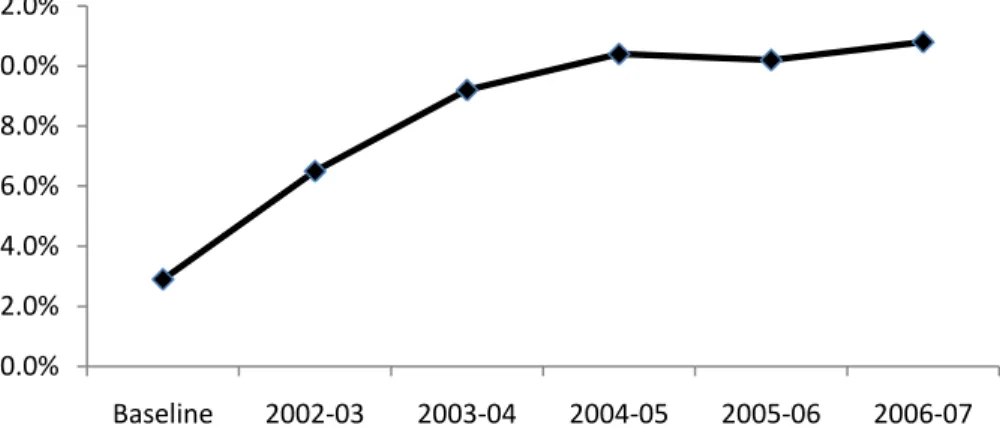
Figure 6 shows major improvements in graduation rates for the students transferring with an associate degree. The state aggregate rate in the baseline period was about 63 percent. That rose to 70.8 percent by 2006-07.
Figure 6
Sector-to-Sector Transfer9
Transfer is often described as a “pipeline” that flows in one direction from high school through postsecondary education. Sector-to-sector transfer data suggests considerable movement within our system that flows in several directions, termed “swirling.” In academic year 2005-2006, almost 30,000 students transferred from one Washington higher education institution to another. These students fell into four primary categories:
1. The largest number of students – 14,816 – followed the most common path of transferring from a community or technical college to a baccalaureate institution in Washington, either public or private.
2. The second largest group – 10,810 – transferred among community and technical colleges. Students mention various reasons for this pattern of attendance:
a. Convenience – completing prerequisite courses at a college close to work or home in preparation for a program offered at another community or technical college;
9
Student Mobility Among Washington Institutions of Higher Education: 2005-06. See detailed report in Appendix C. https://fortress.wa.gov/hecb/portal/default.aspx/Common/Mobility%20Report/default.aspx. Accessed January 22, 2009.
60.0% 62.0% 64.0% 66.0% 68.0% 70.0% 72.0%
Baseline 2002-03 2003-04 2004-05 2005-06 2006-07
State total three-year graduation rate, associate degree transfer students, Washington public baccalaureate institutions
Note: Baseline is defined as the annual average over the period from 1997-98 through 2001-02. Source: HECB, compiled from data submitted by Institutions.
b. Selection – attending two or more colleges simultaneously to register for courses needed for graduation that are unavailable at a single campus, either due to limited offerings or registration scheduling; and
c. Stop outs – students may „stop out‟ for a quarter or more and re-enter at a different college for reasons of convenience or personal choice.
3. Over 5,000 students followed a path often referred to as “reverse transfer” – from
baccalaureate institutions to community and technical colleges. Reasons students follow this path include:
a. Financial – students decide to return to a community or technical college for the financial benefits of lower tuition;
b. Environment – students go away to school and decide they would prefer to return home and be closer to family on a smaller community or technical college
campus; and
c. Performance – students perform poorly and return to the open door community and technical college to regain their successful study habits and improve their grades.
4. There were 2,266 transfers between baccalaureate institutions, including private-to-private, private-to- public, public-to-private-to-private, and public-to-public.
Sector-to-Sector Transfer - AY 2005-2006
From Institution Type To Institution Type Number of Students
CTC Baccalaureate 14,816
CTC CTC 10,810
Baccalaureate CTC 5,104
Baccalaureate Baccalaureate 2,266
Total Transfers 32,996
Although the total number of students transferring from community and technical colleges to baccalaureate institutions continues to increase, there remains a large percent of students intending to transfer who never do. The “Progress on Policy Initiatives” section of this report documents progress on several initiatives designed to improve transfer in Washington.
Proportionality
Any higher education system that emphasizes the two-plus-two model for producing bachelor‟s degrees, as Washington‟s system of higher education does, relies heavily on the transfer process. This ensures the system functions effectively and provides access for students.
In 1994, the HECB adopted as policy the proportionality agreement reached between the public community colleges and the public baccalaureate institutions. This Transfer Agreement requires each public baccalaureate institution to admit community college transfer students, as a
proportion of its newly enrolled students, based on its 1992-93 transfer levels. The purpose of this agreement was to ensure that students from the community and technical colleges wishing to transfer would be accommodated.
In the spring of 2005, the Washington Legislature passed, and the Governor signed HB 1794. This legislation-expanded authority of UW and WSU branch campuses to include lower-division offerings (freshman and sophomore) and reaffirmed the responsibility of these campuses to continue serving upper-division transfers from community and technical colleges. The
institutions signed proportionality agreements at this time to ensure continued access for these students to baccalaureate instruction at these campuses.
The HECB maintains and continues to monitor the proportionality agreements established by the institutions, and compare actual transfer numbers with the goals established for campuses in both the 1992 and 2005 agreements. Goals are specific to each institution.
Between 2001 and 2008, all but one of the public baccalaureate institutions exceeded their proportionality goals – meaning that transfer students made up a greater portion of their entering class compared to initial agreements. The only exception is the University of Washington Tacoma, a branch campus whose proportionality agreement was initiated in 2007.
In order to standardize reporting methodology, the HECB began using the Public Centralized Higher Education Enrollment System (PCHEES) to monitor proportionality for 2006-07. The calculation includes all transfer students from public community and technical colleges within a full academic year divided by the total number of new students, including running start students. Graduate and professional students are not included.
Proportionality
Future Work Related to Proportionality
This new approach results in slight variances between 2006-08 data and data historically provided by campuses. Although footnotes clarify these variances, a review of
methodology is required. The HECB is continuing to work with campuses to develop a single reporting methodology for future years.
10
EWU‟s proportionality calculations use data drawn from Table 7 of the HEER report, excluding summer term.
11
Varies from a HECB figure of 29 percent due to the inclusion of Running Start data
12 WWU proportion is decreasing for several reasons: transfer applications have decreased; freshman applicants with
Running Start credit have leveled off; significant growth in freshman applicants with AP credit; and significant growth in the entire freshman applicant pool.
13
UW Seattle identified proportionality numbers by reviewing records to assure all Running Start students with 40 or more credits were included. Four-year exchange students were eliminated (i.e., they are not degree-seeking students) from the total number of entering students. Revised calculations are reflected. In general, census day data was used except in the identification of Running Start students. For Running Start, data was collected from later in each of those terms to ensure that all transfer credit was entered in their transfer records. The addition of Running Start increases proportionality from HECB data of 24 percent for 2006-07 and 26 percent for 2007-08.
14 A WSU Pullman proportionality query for 2007-08 produced a calculation of 32 percent compared to a HECB
calculation of 33 percent. The criteria differ from the HECB set by eliminating “unclassified” and summer. New students in summer that enroll in fall are counted as new students in fall; therefore, inclusion of summer would produce duplication. Institution Goal in Proportionality Agreement (1992-93)
2001-02 2002-03 2003-04 2004-05 2005-06 2006-07 (HECB)
2007-08 (HECB)
CWU 30% 32% 44% 44% 42% 43% 43% 42%
EWU 29% 34% 29% 34% 31% 31% 29% 29%10
TESC 29% 45% 45% 45% 49% 49% 45% 43%
WWU 32% 33% 35% 35% 34% 34% 37%11 32%12
UW Seattle13 30% 29% 32% 33% 35% 32% 31% 33%
UW Bothell 52% 63%
UW Tacoma 72% 65%
WSU
Pullman 27% 29% 33% 30% 29% 29% 35% 32%
14
WSU
Tri-Cities NA* 69%
WSU
Vancouver NA* 64%
*Two WSU system campuses – WSU Vancouver and WSU Tri-Cities – requested they not be required to set proportionality targets, but rather agreed to accept all students in their special feeder CTC programs that assure joint advising. The SBCTC and HECB agreed to use this approach and to monitor outcomes. WSU Spokane is included in WSU Pullman calculations.
Transfer Degrees by Category15
Students planning to transfer in Washington may follow several approaches or pathways. These include:
Direct Transfer Agreement associate degree (also called “the DTA”): The DTA focuses on meeting the common lower-division general education requirements and preparation for the major.
Associate of Science – Transfer (AS-T): This degree focuses on the math and science courses needed to prepare for biology, chemistry, earth science, physics, computer science, and engineering majors.
Major Related Programs (MRPs): Students in some majors must carefully select their elective and general education courses to assure they will be eligible to apply for the major in their junior year. For these majors, colleges and universities have developed major specific agreements (“major related programs” or MRPs) that assure transfer students complete requirements in a manner parallel to university freshmen and sophomores. Each agreement follows either the DTA or AS-T structure. The SBCTC reports information on transfer degrees by category on an annual basis (see Appendix J). For the 2007-08 academic year 13,144 transfer degrees were awarded. As
displayed below, the vast majority of transfer degrees were DTA and related MRPs – over 95%.
Total AS-T 625 (4.80%)
Total DTA 12,519 (95.20%)
Total Transfer Degrees 13,144
Major Related Programs
The first MRPs were implemented in 2003 and data are just now being collected through the Roll of Transfer in the Baccalaureate study on the success of students completing one of the most popular pathways – the Business MRP. Data for DTA and DTA-based MRPs for academic year 2007-08 are displayed in Figure 7. Of 12,519 students awarded the DTA or a DTA-based MRP, less than 10 percent completed an MRP. Business MRP recipients were the largest at 965, with nursing a distant second at 60. However, many of the MRPs are recent additions and the number of participants in these pathways continues to grow.
15
2007-08 Transfer Degrees by Category (excludes General Studies and Technical Degrees). State Board for Community and Technical Colleges.
Figure 7
The number of students completing MRP associate degrees has grown 25.4 percent over the previous year – from 800 students in 2006-07 to 1,072 in 2007-0816. The three most popular
MRPs over the past year – Business, Nursing, and Elementary Education – made up 97.7 percent of all MRP completers.
DTA MRP Degrees Completed Percent of Total
Business 965 90.0%
Nursing 60 5.6%
Elementary Education 23 2.1%
As shown below and in Figure 8, the number of students earning AS-T based MRPs is very small. Both Biology and Computer Science are currently included in AS-T MRPs and both are being reviewed and possibly revised to meet DTA requirements in hopes of attracting more students.
16
Source: 2007-08 Transfer Degrees by Category (excludes General Studies and Technical Degrees). State Board for Community and Technical Colleges. This report is located in Appendix J.
DTA 90% Bus MRP 8% Lcl Agrmt 1.5% Nurs MRP 0.5% El Ed MRP 0.2% Math Ed MRP
Figure 8
As noted in the ―Progress on Policy Initiatives” section, The HECB, SBCTC, JAOG, and others have agreed to focus on assessment of the current MRPs before deciding on the creation of new MRPs beyond those currently under development.
Progress on Policy Initiatives
Transfer Policy in Washington State17In December 2007, a report was released by JAOG that provided an overview of transfer policy noting, “The higher education system in Washington provides many paths to a baccalaureate.” The report, written with HECB staff, described these complex pathways in detail. Components
17
The full report - Transfer Policy in Washington State - JAOG (December 2007) is available at http://www.hecb.wa.gov/research/issues/transfer.asp.
AS-T 1 36% AS-T 2 62% Engr MRP 2% Phys Ed MRP 0.1%
Associate of Science – Transfer (AS-T)
AS-T 1 227
AS-T 2 385
Engineering MRP 1 Engineering MRP 3 Engineering MRP 8 Physical Ed MRP 1
of the report are in this document, as is information about progress being achieved on the many pathways and initiatives described in JAOG report.
The JAOG report on transfer policy gives an overview of the educational system in Washington. Bachelor‟s degrees and their components are described, including definitions of different credit systems used within the state. Numerous associate degree pathways are described and tables clearly outline what types of courses transfer and to what degrees they apply.
The JAOG report noted that:
The courses that transfer best parallel those taken by freshmen and sophomores at universities seeking entry to the same major. The MRP, DTA, and AS-T pathways are designed specifically to parallel such course selections.
Courses taken in the AAS-T (workforce degree) transfer best to an applied baccalaureate degree that is specifically designed to match the focus in the workforce degree.
Otherwise, the technical coursework does not generally transfer.
Students who transfer without a degree and take courses similar to those traditionally offered by universities will have those transfer courses accepted. However, a course taken without completing a degree may not transfer if there is no parallel course offered at the student‟s baccalaureate institution.
The report also provided recommendations that have guided much of our subsequent work. Specifically, the report indicates:
“(T)he best designed transfer pathway does not work until students find and follow it. Washington State has a critical need for better use of technology to share, all in one place, the map of transfer paths . . . Better use of technology to enhance communication among institutions will also ensure that maps are clear, accurate, and up-to-date.”
“(T)he state of Washington needs a Web-based statewide advising tool kitto guide students toward the most efficient pathways to achieve their goals and to connect and organize each college‟s and university‟s course data in a way that is easy for students and families to navigate.”
Transfer Student Rights and Responsibilities
In her veto message to HB 2783 last year, Governor Gregoire asked the HECB and SBCTC to continue working on transfer issues through JAOG. In addition to a list of student rights
regarding transfer, the Governor requested that these agencies develop ways to inform students, in clear language, about the transfer process and the information they need to continue their educational careers. Legislators and other policy makers shared this gubernatorial interest.
In 2008, a work group consisting of students and cross-sector representatives was formed to address:
Development of a transfer student rights and responsibilities document; and Ways to inform students, in clear language, about the transfer process and the information they need to continue their educational careers, including answers to frequently asked questions.
After several meetings, a draft rights and responsibilities document was developed. This document clearly outlines both student and institutional rights and responsibilities and mirrors concepts delineated in the 1986 Policy on Intercollege Transfer and Articulation among Washington Public Colleges and Universities (Umbrella Policy).18
The document presents seven guidelines that delineate fair and equitable treatment of transfer students by the colleges and universities of Washington. These include rights to clear, accurate, and current information about transfer, treatment of transfer students equal to students admitted directly to baccalaureate institutions, and clearly defined methods to clarify transfer decisions and resolve transfer difficulties with the receiving institution. Guidelines for colleges and universities mirror those for students and include the responsibility to communicate transfer-related decisions to students in writing and include information about student transfer rights and responsibilities.
This document was approved by JAOG in December 2008 and is currently being reviewed by baccalaureate and community and technical college educational leadership for approval. A copy of this draft document is located in Appendix F.
The work group began its second task of creating simple statements for students using a
Frequently Asked Questions format. These statements are based on current policy and practice. Tentative completion is planned for March 2009; the final document will be available on the HECB transfer Web site. This document will include:
A glossary of terms used in higher education and transfer.
Tips for transferring students, a timeframe for successful transfer. Q and A to inform transfer students what they need to know.
A proposed new Academic Guidance and Planning System (Academic GPS) was seen by the group as an obvious vehicle for communicating both the rights and responsibilities and transfer information to students. In 2009, the work group will continue to identify any transfer areas that need additional broad discussion or policy change and make recommendations.
Future Work Related toStudent Rights and Responsibilities
The next steps for this workgroup include creation of a glossary of terms used in higher education and transfer, tips for transferring students, a timeframe for successful transfer, and a Q and A to inform transfer students what they need to know. These will be available for all campuses to use in addition to being posted on the HECB transfer website.
A proposed new Academic GPS was seen by the group as an obvious vehicle for communicating both the rights and responsibilities and transfer information to students. The HECB will continue working to develop this web-based tool.
The work group will continue to identify any transfer areas that need additional broad discussion or policy change and make recommendations.
Direct Transfer Agreement (DTA)19
The Direct Transfer Agreement (DTA) Associate Degree – sometimes called the Associate in Arts or Associate in Arts and Sciences – is the community college degree designed to transfer to Bachelor of Arts degrees at Washington baccalaureate institutions and satisfy the lower-division general education program at those institutions. For most majors in the arts, humanities, and social sciences, the DTA is the primary transfer tool. Characteristics of degrees structured under the DTA umbrella provide:
Priority consideration in the admissions for most humanities and social science majors at public universities ahead of non-degreed transfers;
Completion of lower-division general education requirements;
Credit for all courses completed within the DTA up to and, in some cases, beyond 90 credits;
Opportunity to explore several fields of study through the category of up to 30 credits of elective courses; and
Opportunity to complete prerequisites for a future major.
The DTA includes course and credit requirements in the basic areas of communication and quantitative and symbolic reasoning and distribution areas of humanities, social sciences, and natural sciences. An elective category is included that allows students to explore or prepare for possible majors at the baccalaureate level or include other college level courses as defined by the community college or receiving institution.
19
The current Direct Transfer Agreement with Provisos is located in Appendix G and on the HECB transfer website at http://www.hecb.wa.gov/research/issues/transfer.asp .
Groups interested in transfer monitor courses used to satisfy requirements of the DTA. In 2008, issues related to the intermediate algebra proficiency requirement of the DTA were raised at JAOG. A taskforce was charged with making a recommendation that specifically delineates the math proficiency requirement in the DTA.
Desired outcomes of this cross sector taskforce include:
Development of agreed-upon student abilities that define “college-readiness” in mathematics for the purposes of transfer and transfer admissions.
Development of agreed-upon descriptors for the courses that meet those standards. Communication to Community and Technical Colleges how to develop and maintain courses that meet the requirements.
Communication to baccalaureate institutions how to identify and treat such courses in transcript evaluations, both for transfer of credit and transfer admission.
The task force met throughout the fall of 2008 and developed a short-term agreement that clarified how baccalaureate institutions would treat various intermediate algebra courses in transfer admissions. In addition, the task force charged three work groups to develop long-range solutions for the taskforce to review. The work groups will report to the task force in January 2009.
Future Work Related to the DTA
The task force will recommend solutions that specifically delineate the math proficiency requirement in the DTA and clarifies quantitative and symbolic reasoning requirements; and
Other components of the DTA are being evaluated by JAOG for review and clarification.
Associate of Science-Transfer (AS-T) Degree #2 Revised20
The Associate of Science Transfer (AS-T) Degree #2 is one of two statewide master agreements related to transfer adopted by the HECB21. The degree is designed to prepare students for upper-division study in engineering, computer science, physics, and atmospheric science. The AS-T
20 The revised AS-T #2 is located in Appendix I and on the HECB transfer website at
http://www.hecb.wa.gov/research/issues/transfer.asp .
21 The AST has two degree options. Degree #1 is designed to best serve students intending to transfer into
Biological Sciences, Environmental/Resource Sciences, Chemistry, Geology, and Earth Science (this degree is located in Appendix H). Degree #2 is designed for student planning to enroll in of engineering, computer science, physics, and atmospheric science majors. The other statewide agreement is the Direct Transfer Agreement (DTA), adopted by the Board in 1996, effective beginning 1998.
agreement was originally adopted by the HECB in spring 2000. In September 2008, the HECB approved changes to the AS-T Degree #2.
In response to feedback from faculty and advisors, the degree was modified to reduce the number of computer programming credits required to a minimum of four credits and increased elective credits by the same amount. This change was seen as a way to open the degree to more students while continuing to satisfy updated ABET22 accreditation requirements. In addition, AS-T Degree #2 changes included 2005 agreement language regarding acceptance of social science and humanities credits.
The modified AS-T Degree #2 was sent to participating colleges and universities July 1, 2008 with a recommendation of approval. The changes were approved by the HECB in 2008 and will take effect for transfer students entering in fall 2009. This revised AS-T #2 can be found in Appendix I.
A second document – the Engineering MRP – was modified to adjust requirements to match changes in the AS-T # 2 agreement above. Major Related Programs may be modified by the institutions that developed the agreement and requires no action by the HECB. This modified MRP agreement will be effective the same date as the master agreement change – for students accepted in transfer for fall 2009.
Major Related Programs23
The purpose of Major Related Programs (MRP) is to help transfer students better prepare for the junior year. Two- and four-year institutions work together to create transfer associate pathways outlining the appropriate courses in order for students to be well prepared to enter the major upon transfer. Pathways follow one of the two statewide transfer agreements outlined above - the DTA or the Associate in Science (AS-T).
JAOG established criteria to identify where MRPs may need to be developed for a given major. An MRP will be considered when the following are applicable:
The number of courses specified as preparation for the major and needed in the first two years is substantial.
Several institutions award the bachelor‟s degree in the field.
22
Accreditation Board for Engineering and Technology (ABET) is the recognized accreditor for college and university programs in applied science, computing, engineering, and technology. ABET currently accredits 2,800 programs at more than 600 colleges and universities nationwide. ABET is recognized by the Council for Higher Education Accreditation (CHEA).
23
Includes updated information from Transfer Policy in Washington State: Report of the Joint Access Oversight Group – December 2007available athttp://www.hecb.wa.gov/research/issues/transfer.asp .
A credit gap exists: total credits earned by transfers who graduate are substantially higher than credits earned by students who started at a baccalaureate institution.
A pattern of under-preparation exists for most transfer students. The major is in high demand by students.
Following is a current list of all MRPs, including those completed since the last update report in December 2006 and those in process.24
MRP Pathways Based on the Direct Transfer Agreement (DTA)
Associate inEarth Space Secondary Education DTA/MRP Preparation for secondary teaching in earth and space science. Approved spring 2008. Institutions: CWU, EWU, WWU, WSU, and PLU.
Associate in Construction Management DTA/MRP. Approved spring 2008. Institutions: UW, WSU, CWU, and EWU.
Associate inTechnology DTA/MRP for transfer to CWU‟s Construction Management, Safety and Health Management, Industrial Technology & Technology Education or EWU‟s Design, Construction, Manufacturing, and Electronics Technology. Approved winter 2007.
Associate in TechnologyDTA/MRP for transfer to CWU‟s industrial technology and EWU‟s technology majors. Implemented in 2007. Institutions: CWU and EWU (these are the only institutions offering these degrees).
Associate in BusinessDTA/MRP for transfer to business and accounting bachelors degree programs. Implemented in 2003, revised in 2006. Institutions: CWU, EWU, WWU, UW, WSU, Gonzaga U, Heritage U, Pacific Lutheran U, St. Martin’s U, Seattle Pacific U, Seattle U, and Walla Walla U.
Associate in Pre-Nursing Science DTA/MRP to transfer into basic nursing (not RN to BSN pathway – see below) programs. Implemented 2005. Institutions: UWS, WSU, Northwest U, Seattle U, Seattle Pacific U, Pacific Lutheran U, and Walla Walla U.
Associate in Elementary Education DTA/MRP to transfer to teacher certification programs. Implemented in 2005. Institutions: CWU, EWU, WSU, WWU, City U,
Gonzaga U, Heritage U, Lesley U, Pacific Lutheran U, St. Martin’s U, Seattle Pacific U, Walla Walla U, Whitworth U.
Associate in Math Education DTA/MRP to transfer to teacher certification programs in secondary math. Implemented 2003. Institutions: CWU, EWU, WWU, WSU.
MRP Pathways Based on the Associate in Science (AS-T)
Three engineering technology pathways– Electronics Engineering Tech, Computer Engineering Tech, and Mechanical Engineering TechAS-T/MRP for engineering
technology transfer. Implemented 2007. Institutions: CWU, EWU, and WWU (these are the only institutions offering these degrees).
Three engineering pathways– Bioengineering and Chemical Engineering, Computer and Electrical Engineering, and Mechanical/Civil/Aeronautical/Industrial/Materials Science Engineering AS-T/MRP, for engineering transfer. Implemented in 2005. Institutions: EWU, UW, WSU, Gonzaga U, St. Martin’s U, Seattle Pacific U, Seattle U, and Walla Walla U.
Four secondary science teacher pathways– Associate in Biology Education, Associate in Chemistry Education, Associate in General Science Education, and Associate in Physics Education AS-T/MRP to transfer for teacher certification in secondary sciences.
Implemented 2003. Institutions: CWU, EWU, WWU, WSU, and St. Martin’s U.
Two Additional Pathways Currently Under Development Biology
The current transfer pathway is the Associate in Science–Transfer (AS-T). Although the AS-T works well for engineering and math, it does not appear to work for biology due to the extensive math requirements that may discourage prospective Biology majors. In addition, an Intercollege Relations Commission (ICRC) review of the best-matched associate degrees for biology majors provided evidence that the existing AS-T pathway was not working.
A work group formed by ICRC in 2008 identified commonalities in programs across the state and discussed the pluses and minuses of a taxonomic or concept-oriented curriculum. In addition, the work group agreed that all participating baccalaureate institutions would want the following four areas covered: ecology, evolution, major cell and molecular biology, and organismal (plant and animal) physiology. A draft DTA-based MRP was developed that addressed all major issues and is being circulated for comment with final approval anticipated March 2009.
Computer Science
The current transfer pathway is the Associate in Science–Transfer (AS-T). Although the AS-T works well for engineering (including computer engineering) and math, it does not appear to work for the various types of computer science degrees at Washington baccalaureate institutions. A work group was formed in 2008 to evaluate the most discipline-appropriate choices for
courses that would complete DTA or AS-T requirements and determine which pathway works best.
The work group met and compared DTA and AS-T requirements with baccalaureate institution computer science and related degree requirements. Due to variations in programs in this
still-emerging discipline, it was determined that a DTA-based MRP should be developed and there needs to be at least two tracks with a goal across all institutions to make the computer science discipline accessible to all interested students with an aptitude for computing. Track I would prepare students for a degree similar to the Bachelor of Science degree in Computer Science; Track II would prepare students for a bachelor‟s degree in a field related to Computing Systems/Technology, Applied Computing, or Computing and Information Systems. The target date for a draft DTA-based Computer Science MRP is March 2009. Issues that continue to be addressed by this work group include:
Flexibility that will be required within a successful MRP as well as from the baccalaureate institutions signing on to the agreement due to the diverse nature of computer science programs across institutions.
Quantitative and natural science requirements are still under review.
Some universities may review their requirements and make changes to adapt to suggested CS MRP requirements. Others will require provisos that specify institution-specific area requirements for the MRP to move forward.
Future Work Related to MRPs
Complete Biology and Computer Science MRPs
The HECB, SBCTC, JAOG, and other groups have agreed to focus on assessment of the current MRPs before deciding on the creation of new MRPs beyond those currently under development.
Process for Changing Statewide Agreements25
In 2008, JAOG, in conjunction with the HECB, adopted a policy to guide changes in the DTA and AS-T statewide transfer agreements. Transfer documents are reviewed often and updated as necessary to stay current and provide for maximum efficiency.
The process for revisions and changes to the statewide transfer associate degree agreements, both the Direct Transfer Agreement (DTA) and Associate in Science – Transfer (AS-T) Agreement, are the same. Proposed revisions are brought to JAOG for discussion. If a determination is made that the proposal conforms to transfer policy, broader stakeholder discussions (including students, faculty, and staff) are initiated. Results and feedback from these discussions are brought back to JAOG for review, and recommendations are developed. JAOG recommends
25
The official process is located in Appendix D and can be found on the HECB transfer Web site: http://www.hecb.wa.gov/research/issues/transfer.asp.
approval by the academic leadership of the state‟s public and independent institutions party for the agreement under consideration. Academic leadership across all college and university sectors transmits their approval of the proposed change(s) to JAOG to ensure a coordinated response.
The HECB participates in every step of this policy discussion as the issue moves through this process. After approval, JAOG assists leadership groups in forwarding a recommendation to the HECB for adoption of the proposed change. Policies adopted by Board resolution at a regularly scheduled meeting become effective on the date of adoption, or another date, if specified in the resolution.
The MRPs are based on negotiated agreements by MRP work groups and may be updated or altered by a process slightly different from DTA and AS-T agreements. Specifically, proposals are brought to JAOG‟s attention when substantive changes to the prerequisites to majors are proposed that affect lower-division course taking. Following discussion, JAOG establishes a review process for updating the MRP agreement. Changes to agreements that affect lower-division course taking require review by JAOG and approval by those institutions signatory to the agreement. If the changes alter the published transfer associate degrees, JAOG will establish an implementation timeline appropriate to the type of proposed change with a goal of minimizing impact on students already enrolled and progressing under the existing agreement.
Dual Enrollment and Dual Credit Programs
College-level work completed by students while in high school is a component of the transfer and articulation system in Washington. The 2008 Strategic Master Plan for Higher Education in Washington calls for increasing participation in postsecondary education by developing new strategies and creating multiple pathways from high school to college or workforce training. Running Start, Tech Prep, College in the High School, Advanced Placement (AP), International Baccalaureate (IB), Early College, Gateway to College, and Technical College Direct Funded Enrollment Programs are important strategies to help students move to more advanced levels of education more efficiently.
In line with the Strategic Master Plan, House Bill 2687 was passed by the 2008 Legislature, and allocated funding for fiscal year 2009 for a cross-sector and agency workgroup brought together by the Office of the Superintendent of Public Instruction (OSPI) to develop a strategic plan for statewide coordination of dual credit programs. Although the Governor vetoed funding for this part of the bill, OSPI convened a work group in fall 2008 to begin development of a statewide coordinated plan for dual credit programs. This work group consisted of high school
representatives, the SBCTC, representatives from public and private four-year institutions of higher education, the Workforce Training and Education Coordinating Board (WTECB), the Council of Presidents (COP), and the HECB.
The work group met throughout fall 2008. Subgroups were formed to collect data in each dual enrollment/credit program. This data consisted of the purpose and definition of each program, the goals associated with each program, the personnel required to administer and teach each program, the benefits to students, and the barriers to access. In addition, work group members identified supplementary data for collection, if available: the reach of each program, the number of students served, where programs are available, profiles of students served or not served, the benefits of the program, challenges to the program, barriers to attendance, and program impact on time to degree. Models in other states where similar programs exist were reviewed.
Preliminary results of the environmental scan demonstrate that Washington offers a breadth of dual enrollment and credit programs not available in many other states. There are funding challenges for many programs and no current coordinated plan for communicating information about programs or maximizing enrollments within each program. Further study is required to determine each program‟s impact on time to degree. A final report is scheduled for release January 2009 by OSPI.
Future Work Related to Dual Credit and Dual Enrollment Programs
Growth in dual enrollment and dual credit programs is constrained by insufficient funding and lack of student knowledge about options.
Review and assess feasibility of implementing Dual Credit and Enrollment Work Group recommendations.
Include information on all Dual Credit Programs on HECB Web site and Academic GPS portal to increase awareness.
Encourage expansion of Running Start, Tech Prep, Early College, Gateway to College, and Technical College Direct Funded Enrollment Programs for early start in workforce training programs.
Survey colleges and universities regarding their policies and practices for each dual enrollment/credit program and solicit suggestions for developing model advising and admissions processes to facilitate enrollment and improve efficiency.
Collect additional data addressing impact on time to degree for each dual enrollment/dual credit program.
When data is available, re-convene work group to continue development of a coordinated plan for dual enrollment and credit programs, including funding options.
Prior Learning Assessment (PLA)26
Creating a system of support for lifelong learning is a strategy to raise educational attainment in Washington outlined in the 2008 Strategic Master Plan. Students are entering our higher education system with a wide range of previous educational experiences. Assessment of prior learning is a broad category that can include many options for awarding credit or advanced standing placement, including:
Direct transfer and awarding of credits or advanced standing from a nationally accredited postsecondary institution. The accrediting body is generally recognized by the Council for Higher Education Accreditation (CHEA);
Course challenge exams sponsored by departments in colleges and universities; Nationally recognized standardized examinations like: Advanced Placement (AP), International Baccalaureate (IB), or College-Level Examination Program (CLEP); ACE Educational Credit by Examination, including military formal courses and/or occupations; University of the State of New York Board of Regent‟s National Program on Non-collegiate Sponsored Instruction (National PONSI), and International
Association for Continuation Education and Training (IACET); and
Prior Learning Assessment (PLA). Awarding of credit or advanced standing from Portfolio Assessment. The broad category of “PLA” in Washington primarily refers to a process of portfolio assessment.
In 2008, the Legislature considered HB 2933 – an act relating to assessment of prior learning at institutions of higher education.27 While the bill did not pass, language and funding was added to the budget. In the Governor‟s veto message on that budget line item, the HECB, SBCTC, and WTECB were directed to continue to work “to develop ways to inform students, in clear
language, about the transfer process and to address barriers to student transfers, especially for those transferring from technical programs or career schools.”
Both the Legislature and Strategic Master Plan point out important reasons for addressing PLA: Adult learners entering workforce and academic programs will comprise a growing percentage of higher education enrollments in coming years.
For a vital economy and global competitiveness, adult learners need to move through postsecondary education in the most efficient manner possible and enter the workforce well prepared.
26
A HECB Summary on Prior Learning Assessment is in Appendix E.
Washington can more effectively use resources at the state's public two-year and four-year institutions of higher education to facilitate wider and deeper adult participation in postsecondary education.
To address these concerns, the HECB invited representatives from The College Board to Olympia to discuss the application of the College Level Examination Program (CLEP) as a method for increasing adult participation in postsecondary education and as a way to facilitate the efficiency of our system for adult learners. In 2008, JAOG discussed portfolio assessment and Eastern Washington University and Spokane Community Colleges agreed to begin work on a pilot to expand an existing portfolio assessment program at EWU.
Future Work Related to PLA
The Legislature found that institutional policies and procedures regarding the acceptance of prior learning credits are not aligned with accreditation rules and national best
practices. A survey of institutional options within prior learning assessment will be conducted by the HECB and compiled into a single chart posted to the HECB transfer Web site. Special consideration will be given to recommendations made by the Council for Adult and Experiential Learning and accreditation rules adopted by the Northwest Commission on Colleges and Universities.
Transferring Veteran Skills and Education for State Licensure – A Report to the Legislature
As part of the 2008 Supplemental Budget approved in the 2008 legislative session, the Washington State Legislature directed the Department of Health (DOH), the Department of Licensing (DOL), and the HECB to jointly review and report on barriers and opportunities for veterans separating from duty to apply skills sets and education required while in service to certification, licensure, and degree requirements. Higher education options with sample college policies regarding tuition waivers and the acceptance of military course work were included. The final report is being presented to the 2009-11 Legislature by the Department of Health. Colleges and universities in Washington use the American Council on Education (ACE) Military Guide recommendations to award credit towards certificates and degrees, speeding academic progress and enabling veterans to reach their educational goals. Since 1945, ACE has provided a collaborative link between the U. S. Department of Defense and higher education through the review of military training and experiences for the award of equivalent college credits for members of the Armed Forces. Registrars, admissions officers, academic advisors, and career