Payroll Posting Outsourcing Solutions
ADP Posting Interface to FICO
Product Description
-Author: Andreas Mau [email protected]
Klaus-Dieter Spatz [email protected]
KDS Software & Consulting, Inc 3715 Jefferson Court Redwood City, CA 94062
NOTICE
KDS Software & Consulting, Inc., reserves the right to claim the following document as intellectual property. No part of this document may be reproduced or transmitted in any form or for any purpose without the express permission of KDS Software & Consulting, Inc.. The information contained herein may be changed without prior notice.
01/14/10 Page 2
Table of Contents
1 PAYROLL POSTING OUTSOURCING SOLUTION ... 3
1.1 Description... 3
1.2 Customer Priorities ... 4
2 DEFINITION AND SPECIFICATIONS... 5
2.1 Definition... 5
2.2 Specifications... 5
2.2.1 Key features ... 5
2.2.2 General Features... 6
2.2.3 System Requirements ... 6
2.3 Application ... 6
2.3.1 Description ... 6
2.3.2 Shortcomings of the SAP Business Process Outsourcing for Payroll ... 7
2.3.3 Solution ... 7
2.4 Performance ... 11
2.5 Reliability ... 11
2.6 Durability... 12
2.7 Simplicity and Aesthetics ... 12
1 Payroll Posting Outsourcing Solution
1.1 Description
Currently SAP does not provide an outsourcing interface for payroll posting to FICO. The application introduced in this Product Description can handle the complexity of a generic posting interface to FICO. This inherently applies to all third party posting requirements or partial payroll outsourcing.
The application integrates non SAP payroll systems with SAP FICO. The following features are available
Basic
Supports all vendors like ADP, ProBusiness, and other vendors
Integrates in a familiar SAP way via standard HCM FI/CO process
Simple installation
Uses SAP standard symbolic account configuration
Displays the exported IDOC file in a readable format
Custom Options
Optional Grid/Tree view
Multiple Outsourcing Provider Interface for subsidiaries with different implementations
Custom Notifications
Project Services Interface to WBS element assignments
Overrides for incoming cost centers
Public Sector: Funds/Grants assignments
Public Sector: Distribution of liabilities according to Expenses possible
This solution does not require any modification to the current SAP Payroll Posting and Outsourcing applications. All components developed in this custom solution are standalone or interfaced with SAP applications via standard interfacing and service methods. The application seamlessly integrates with any partial SAP Payroll implementation.
01/14/10 Page 4
1.2 Customer Priorities
Here a comprehensive list of high customer priorities for Payroll Posting Outsourcing Solution: 1. Easy to use applications
2. Fast determination of payroll postings and their distribution 3. Ability to monitor posting details
4. Ability to extend the use of existing SAP components rather than solution replacements 5. Efficient performance
2 Definition and Specifications
2.1 Definition
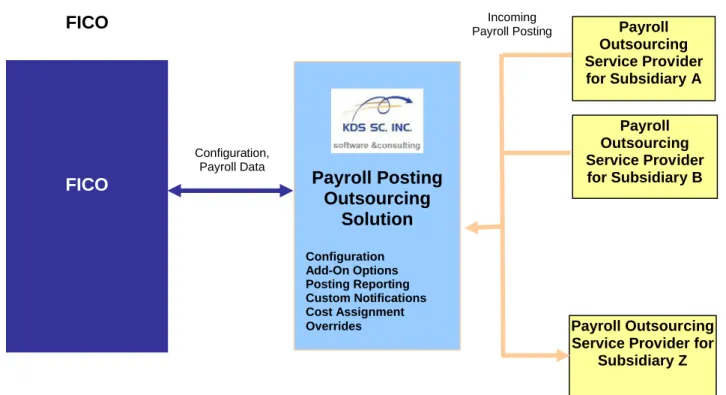
The scope of the payroll posting outsourcing solution is to allow generic interfacing with the currently existing SAP Payroll and FICO modules as well as utilizing parts of SAP’s ABAP infrastructure to support the data traffic in all processes.
Fig. 1.: Component diagram of a Payroll Posting Outsourcing Solution
2.2 Specifications
2.2.1 Key features Integrates all non SAP payroll systems with SAP FICO
ADP, ProBusiness, and other vendors
Integrates in a familiar SAP way via standard HCM FI/CO process
FICO Payroll Posting
Outsourcing Solution Configuration Add-On Options Posting Reporting Custom Notifications Cost Assignment Overrides Payroll Outsourcing Service Provider for Subsidiary A
Payroll Outsourcing Service Provider for Subsidiary B
Payroll Outsourcing Service Provider for
Subsidiary Z
Configuration, Payroll Data
01/14/10 Page 6
Simple installation
Uses SAP standard symbolic account configuration
Seamless integration of traditional SAP Payroll Posting and custom add-on Posting Outsourcing
Optional custom extensions
Display exported IDOC (Master Data or Time IDOC) in a simple, readable format to the payroll user.
2.2.2 General Features
define cost accounting assignments
storage for incoming posting documents
utilize cost accounting entities like cost center, fund, grant, profit center, etc. as balance base
custom notification options for pre-/post-processing
Configuration:
o Custom overrides for account assignments o SAP standard account assignments
2.2.3 System Requirements
SAP HR release 4.6C, 4.70, ERP2003, ERP2004, ERP2005, or higher
2.3 Application
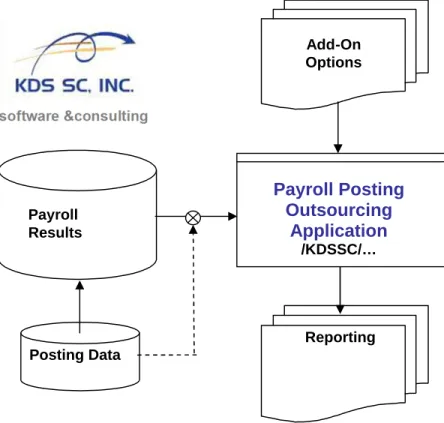
2.3.1 DescriptionFig. 2.: Data flow diagram of the Payroll Posting Outsourcing Solution
2.3.2 Shortcomings of the SAP Business Process Outsourcing for Payroll
The SAP system supports payroll outsourcing for net payroll on a complex level but only for no solution for complete payroll outsourcing. For example you want to outsource your entire payroll to a provider and only import the final FICO posting results. In such a case SAP does not provide a solution that can store the incoming posting documents.
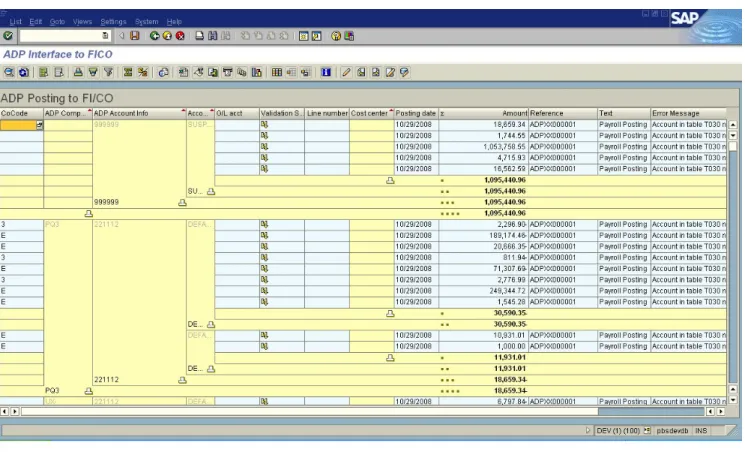
As a supervisor you only want to have a list of all incoming posting items and see the total balance before posting to FICO. The custom solution proposed here will allow this in an easy way.
2.3.3 Solution
Outbound SAP IDOC (OTMU and OTTM) Display
Payroll Results
Payroll Posting Outsourcing
Application
/KDSSC/… Add-On Options
Reporting Posting Data
01/14/10 Page 8 This report allows you to display all segments in a readable format, instead of using the IDOC display transaction.
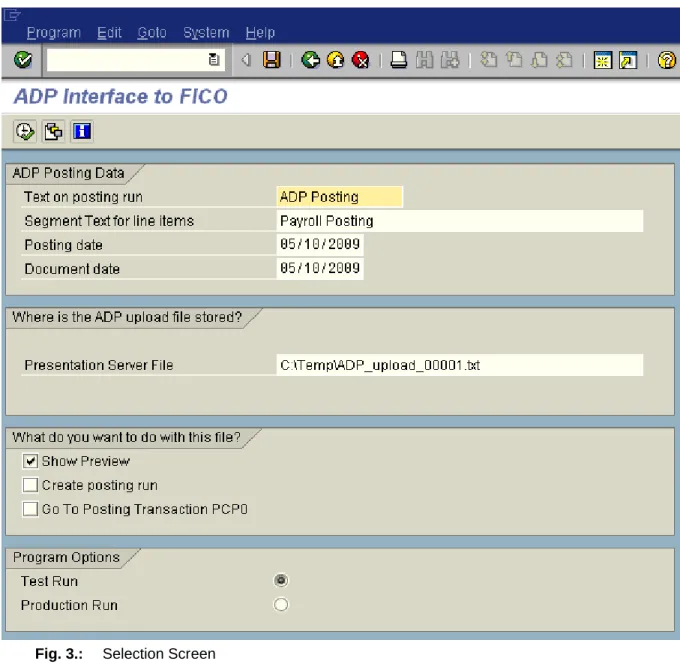
Inbound Posting Process
This process allows you to post the incoming posting file from the 3rd party vendor into your SAP FI/CO system.
01/14/10 Page 10
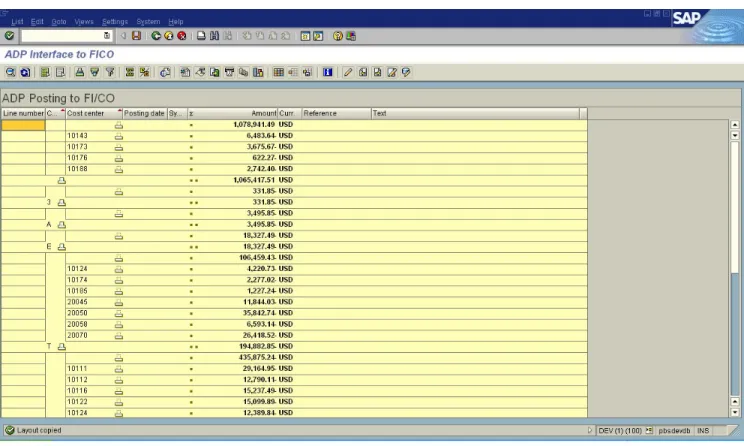
Fig. 5.: Summary view
2.4 Performance
The application will perform very fast. Only in the case that massive incoming posting data needs to be analyzed will performance be impacted.
2.5 Reliability
To approach software reliability1we utilize the best engineering methods to improve software reliability of our solutions. Before the deployment of software solutions, testing, verification and validation will be performed. Software testing in form of unit and acceptance tests is used to minimize the possibility of defect occurrences after release and therefore improve our
1
According to ANSI, Software Reliability is defined as: the probability of failure-free software operation for a specified period of time in a specified environment. Software Reliability is an important attribute of software quality, together with functionality, usability, performance, serviceability, capability, installability, maintainability, and documentation. Software Reliability is usually hard to achieve, because the software complexity tends to be high.
01/14/10 Page 12 software reliability. After deployment of our software solutions, field data will be gathered and analyzed to improve the software and provide updates as necessary.
2.6 Durability
We achieve software durability2through an pragmatic approach that combines object oriented techniques (OOTs) with formal description techniques (FDTs). OOTs help system analysts and designers to bring modularization and structure to the programs to permanently commit data changes. The main focus of FDTs is to ensure the correctness of the final system by the provision of extensive validation and verification methods.
2.7 Simplicity and Aesthetics
It is a requirement that the solution will be easy to use and to maintain. There should be no special knowledge needed to run the application. All of this should ultimately lead to a good user-perceived quality of the solution.
2
In computer science, durability is the property that guarantees that transactions that are successfully committed will survive permanently and will not be undone by system failure.
3 Serviceability and Maintenance
As defined in the Solution Definition and Specifications above various tables are to be created to allow proper configuration of the solution.
01/14/10 Page 14
Disclaimer
Some software products marketed by KDSSC contain proprietary software components of other software vendors.
PDFTM, Adobe®, Adobe Acrobat®, and other related products are trademarks or registered trademarks of Adobe Systems, Inc.
SAP, R/3, mySAP, mySAP.com, xApps, xApp, and other SAP products and services mentioned herein as well as their respective logos are trademarks or registered trademarks of SAP AG in Germany and in several other countries all over the world.
Microsoft®, WINDOWS®, NT®, EXCEL®, Word®, PowerPoint® and SQL Server® are registered trademarks of Microsoft Corporation.
HTML, DHTML, XML, XHTML are trademarks or registered trademarks of W3C®, World Wide Web Consortium, Massachusetts Institute of Technology.
JAVA® is a registered trademark of Sun Microsystems, Inc., JAVASCRIPT® is a registered trademark of Sun Microsystems, Inc., used under license for technology invented and implemented by Netscape.
All other products and services mentioned within this document are the trademarks of their respective companies.