ANALYSIS OF TIME-TO-EVENT DATA, INTERMEDIATE PHENOTYPES, AND SPARSE FACTORS IN THE OPPERA STUDY
Naomi C. Brownstein
A dissertation submitted to the faculty of the University of North Carolina at Chapel Hill in partial fulfillment of the requirements for the degree of Doctor of Philosophy in
the Department of Biostatistics.
Chapel Hill 2013
Approved by:
Eric Bair
Jianwen Cai
Michael Kosorok
Gary Slade
c 2013
ABSTRACT
NAOMI C. BROWNSTEIN: Analysis of Time-to-event Data, Intermediate Phenotypes, and Sparse Factors in the OPPERA Study
(Under the direction of Drs. Eric Bair and Jianwen Cai)
Motivated by the Orofacial Pain: Prospective Evaluation and Risk Assessment
(OPPERA) project, a large study of temporomandibular disorders (TMD), this dissertation
develops statistical methods applicable to three facets of chronic pain.
First, we propose a method for parameter estimation in survival models with missing
censoring indicators. These result because conducting multiple invasive examinations
for incidence on all participants in large prospective studies is infeasible. We estimate
the probability of being an incident case for those lacking a gold standard” examination
using logistic regression. Multiple imputations of case status for each missing examination
are generated using these estimated probabilities. Imputed and observed data are
combined in Cox models to estimate the incidence rate and associations with putative
risk factors. The variance is estimated using multiple imputation. Our method performs
as well as or better than competing methods and highlighted new discoveries for
OPPERA.
Secondly, we propose a general method to analyze secondary phenotypes and apply
it to the OPPERA baseline case-control study. Traditional case-control genetic association
studies examine relationships between case-control status and one or more covariates.
Investigators now commonly study additional phenotypes and their association with
the original covariates as secondary aims. Assessing these associations is statistically
interest. Standard methods may be biased and lack coverage and power. Utilizing
inverse probability weighting and bootstrapping for standard error estimation, our
method performs as well as competitors when they are applicable and provides promising
results for outcomes to which other methods do not apply.
Third, we propose a method for sparse factor analysis. Psychometric studies frequently
measure numerous variables that may be noisy manifestations of a few underlying
constructs. Aims include identifying these latent variables and their relationship to
the observed variables and reducing the data to a few key variables that explain the
majority of variance. While variable reduction methods exist for principal component
analysis, none have been proposed to date for factor analysis. Our method retains
predictive accuracy for many thresholds in simulations while providing sparse loadings.
To my little sister, Shira Brownstein, in loving memory. Both her presence and
absence have shaped my progress throughout the program and continue to inspire me
ACKNOWLEDGMENTS
People commonly say that it takes a village to raise a child. It also takes a villiage to
complete a PhD. There are numerous individuals to whom I owe gratitude in regards to
this endeavor. I apologize in advance to any individuals I have inadvertently omitted.
First and foremost, I am deeply appreciative of my co-advisors, Drs. Eric Bair
and Jianwen Cai. Both have shaped me immeasurably throughout my time at UNC,
providing not only technical insight on the research, but serving as caring mentors and
encouraging me to work hard and develop to my full potential. This dissertation would
not have been completed, especially not in this time frame, without their dedication
and support. Secondly, I am grateful for the committee members, namely Drs. Michael
Kosorok, Gary Slade and Donglin Zeng, for taking the time to meet with me and provide
helpful questions and comments that strengthened the research. I also appreciate the
staff at UNC, such as Melissa Hobgood, Veronica Stallings, Christine Kantner, and
especially Mae Beale and Dean Barbara Rimer, without whom I likely would not have
finished this degree.
Peers have been invaluable, as we’ve navigated through this journey together.
Thank you to Steve Hoberman, Lan Liu, Amy Richardson, Joe Rigdon, and Eugene
Urrutia, among others, for studying together in courses and qualifying exams, creating
a cooperative atmosphere in which to grow as statisticians, and for your friendship.
Thank you to those who came or finished beforehand and offered helpful advice, such
as Eric Daza, Beth Horton, Diana Lam, Che Smith, and Alison Wise, and Drs. John
Leann Long, and Greg Mayhew.
My graduate study was made financially possible by generous support from the NSF
Graduate Research Fellowship Program grant #0646083 and NIH/NIEHS T32ES007018,
led by Dr. Amy Herring. I would like to acknowledge and thank the principal
investigators of the OPPERA study for providing the data which was analyzed in
this dissertation. Specifically, this includes Drs. William Maixner, Luda Diatchenko,
Bruce Weir, Richard Ohrbach, Roger Fillingim, Joel Greenspan, and Ronald Dubner.
The OPPERA study was supported by NIH/NIDCR grant U01DE017018.
Finally, I am grateful for the vast emotional support of family and friends. Thank
you to my parents, sisters, grandparents, and extended family, for being here for me
throughout the many ups and downs of this time. I especially appreciate the company
of and opportunity to become closer with the Reed family. Thank you to the many
friends who offered advice, comfort and joy when it was most needed including, but not
limited to Jessica Meed and Bronco Suzuki, Charlotte and Michael Hall, Laenja and
Matt Brackett, Elizabeth Clendinning, Paul Baek, Anthony Kuhns, Correai Moore,
Jonathan Rowell, Alyssa Manning, and many others on the UNC Ballroom Dance
Team and in UNC Hillel. Last but not least, thank you to Jesse Haskins for supporting
me, especially around the qualifying exam and during our year of long distance while
I completed the dissertation. I look forward to beginning the next chapter of our lives
TABLE OF CONTENTS
LIST OF TABLES . . . xi
LIST OF FIGURES . . . xv
1 INTRODUCTION . . . 1
2 LITERATURE REVIEW . . . 4
2.1 Survival Analysis . . . 4
2.1.1 Cox Proportional Hazards Model . . . 5
2.2 Bootstrapping . . . 6
2.2.1 Standard Error and Confidence Intervals . . . 7
2.3 Missing Data: General Theory and Methods . . . 8
2.3.1 The EM Algorithm . . . 10
2.3.2 Multiple Imputation . . . 10
2.3.3 Bootstrapping and Missing Data . . . 11
2.4 Missing Data Methods and Survival Analysis . . . 12
2.4.1 Cox Models with Missing Covariates . . . 13
2.4.2 Cox Models with Missing Censoring Indicators . . . 13
2.5 Genetics and Case-Control Data . . . 17
2.6 Sparse Factor Analysis . . . 19
3 PARAMETER ESTIMATION IN COX PROPORTIONAL HAZARD MODELS WITH MISSING CENSORING INDICATORS . . . 22
3.1 Introduction . . . 22
3.3 Model . . . 25
3.3.1 Notation and Assumptions . . . 25
3.3.2 Estimating Event Probabilities . . . 27
3.3.3 Multiple Imputation . . . 27
3.3.4 Estimation of Incidence . . . 29
3.4 Simulations . . . 30
3.5 Analysis of the OPPERA Study . . . 34
3.5.1 Hazard Ratios . . . 35
3.5.2 Incidence Rates . . . 37
3.6 Discussion . . . 38
4 MODELING SECONDARY PHENOTYPES CONDITIONAL ON GENOTYPES IN CASE-CONTROL STUDIES . . . 44
4.1 Introduction . . . 44
4.2 Proposed Method . . . 47
4.3 Simulation Study . . . 49
4.3.1 General Setup . . . 49
4.3.2 Continuous Phenotypes . . . 50
4.3.3 Ordinal Phenotypes . . . 51
4.3.4 Time-to-Event Phenotypes . . . 54
4.4 Data Application . . . 54
4.5 Discussion . . . 55
5 SPARSE FACTOR ANALYSIS . . . 61
5.1 Introduction . . . 61
5.2 Proposed Methodology . . . 62
5.2.1 Notation . . . 62
5.2.3 Our Algorithm . . . 65
5.3 Simulations . . . 66
5.4 Data Application . . . 69
5.4.1 The Baseline Case-Control Study of Chronic TMD . . . 70
5.4.2 Application to the Full OPPERA Cohort . . . 73
5.5 Discussion . . . 77
6 CONCLUSION . . . 94
APPENDIX 1: SUPPLEMENTARY MATERIAL FOR CHAPTER 3 . . . 96
APPENDIX 2: SUPPLEMENTARY MATERIAL FOR CHAPTER 5 . . . 114
LIST OF TABLES
3.1 Simulation Results for MAR . . . 41
3.2 Results from the OPPERA Study . . . 42
3.3 Estimated TMD Incidence Rates With and Without
Imputation . . . 43
4.1 Results of Simulations for Intermediate Continuous
Phenotypes . . . 52
4.2 Results of Simulations for Intermediate Ordinal Phenotypes . . . 59
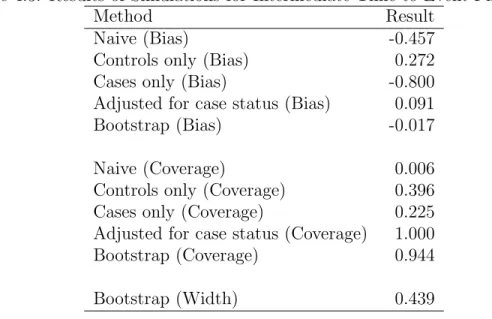
4.3 Results of Simulations for Intermediate
Time-to-Event Phenotypes . . . 60
5.1 Parameters for Different Thresholds and Other Methods . . . 79
5.2 P-Values for Different Thresholds and Other Methods . . . 80
5.3 Number of Variables Retained for Different Thresholds
and Other Methods . . . 81
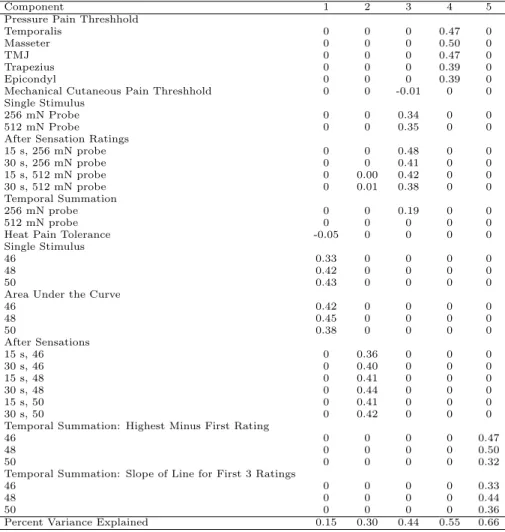
5.4 PCA/SFA QST Results for Controls, c=0.4 . . . 82
5.5 Autonomic Parameter Estimates and Different
Thresholds, Component 2 . . . 83
5.6 Autonomic Parameter Estimates and Different
Thresholds, Component 3 . . . 84
5.7 Autonomic Parameter Estimates and Different
Thresholds, Component 4 . . . 85
5.8 Autonomic Results for the OPPERA Case Control
Study, c=0.7 . . . 86
5.9 PCA/SFA QST Results for the Entire OPPERA
Cohort, c=0.8 . . . 87
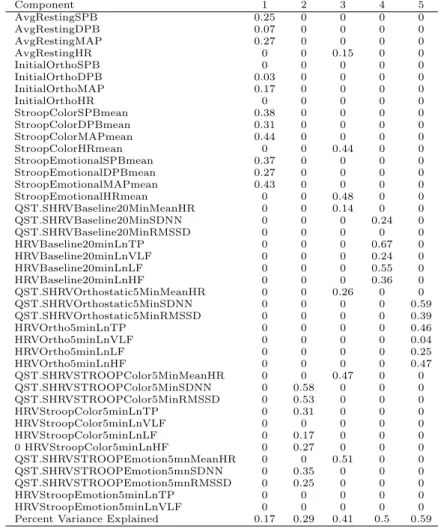
5.10 PCA/SFA Autonomic Results for the OPPERA
5.11 Autonomic Parameter Estimates and Different
Thresholds for Component 1, First-Onset TMD . . . 89
5.12 PCA/SFA Psychosocial Results for the Entire OPPERA Cohort, c=0.6 . . . 90
5.13 Psychosocial Parameter Estimates and Different Thresholds, Component 1 (Chronic) . . . 91
5.14 Psychosocial Parameter Estimates and Different Thresholds, Component 3 (Chronic) . . . 92
5.15 Psychosocial Parameter Estimates and Different Thresholds, Component 4 (Chronic) . . . 93
A1.1 Simulation Results for MCAR . . . 103
A1.2 Simulation Results for MCAR . . . 104
A1.3 Results for an Extra Covariate Included in the Logistic Regression Model . . . 105
A1.4 Results when a Relevant Covariate is Omitted frin the Logistic Regression Model . . . 106
A1.5 Results when the Logistic Regression Model is Applied to Observations with Qi = 0 . . . 107
A1.6 Results when an Extra Covariate is Included in the Logistic Regression Model and the Model is Applied to Observations with Qi = 0 . . . 108
A1.7 Results when a Relevant Covariate is not Included in the Logistic Regression Model and the Model is Applied to Observations where Qi = 0 . . . 109
A1.8 Simulation Results for MNAR, scenario A . . . 110
A1.9 Simulation Results for MNAR, scenario B . . . 111
A1.10Simulation Results for Poisson Models, MAR . . . 112
A1.11Simulation Results for Incidence Rates . . . 113
A2.2 PCA/SFA QST Results for the Entire OPPERA
Cohort, c=0.5 . . . 116
A2.3 PCA/SFA QST Results for the Entire OPPERA
Cohort, c=0.6 . . . 117
A2.4 PCA/SFA QST Results for the Entire OPPERA
Cohort, c=0.7 . . . 118
A2.5 PCA/SFA QST Results for the OPPERA
Follow-up Cohort, c=0.4 . . . 119
A2.6 PCA/SFA QST Results for the OPPERA
Follow-up Cohort, c=0.5 . . . 120
A2.7 PCA/SFA QST Results for the OPPERA
Follow-up Cohort, c=0.6 . . . 121
A2.8 PCA/SFA QST Results for the OPPERA
Follow-up Cohort, c=0.7 . . . 122
A2.9 PCA/SFA QST Results for the OPPERA
Follow-up Cohort, c=0.8 . . . 123
A2.10PCA/SFA Autonomic Results for the OPPERA
Followup Cohort, c=0.4 . . . 124
A2.11PCA/SFA Autonomic Results for the OPPERA
Followup Cohort, c=0.5 . . . 125
A2.12PCA/SFA Autonomic Results for the OPPERA
Followup Cohort, c=0.6 . . . 126
A2.13PCA/SFA Autonomic Results for the OPPERA
Followup Cohort, c=0.8 . . . 127
A2.14PCA/SFA QST Results for Cases, c=0.4 . . . 128
A2.15Autonomic Results for the OPPERA Case Control
Study, c=0.4 . . . 129
A2.16Autonomic Results for the OPPERA Case Control
Study, c=0.5 . . . 130
A2.17Autonomic Results for the OPPERA Case Control
A2.18Autonomic Results for the OPPERA Case Control
Study, c=0.8 . . . 132
A2.19PCA/SFA Psychosocial Results for the Entire
OPPERA Cohort, c=0.4 . . . 133
A2.20PCA/SFA Psychosocial Results for the Entire
OPPERA Cohort, c=0.5 . . . 134
A2.21PCA/SFA Psychosocial Results for the Entire
OPPERA Cohort, c=0.7 . . . 135
A2.22PCA/SFA Psychosocial Results for the Entire
OPPERA Cohort, c=0.4 to 0.55 . . . 136
A2.23PCA/SFA Psychosocial Results for the Entire
OPPERA Cohort, c=0.6 to 0.45 . . . 137
A2.24PCA/SFA Psychosocial Results for the Entire
LIST OF FIGURES
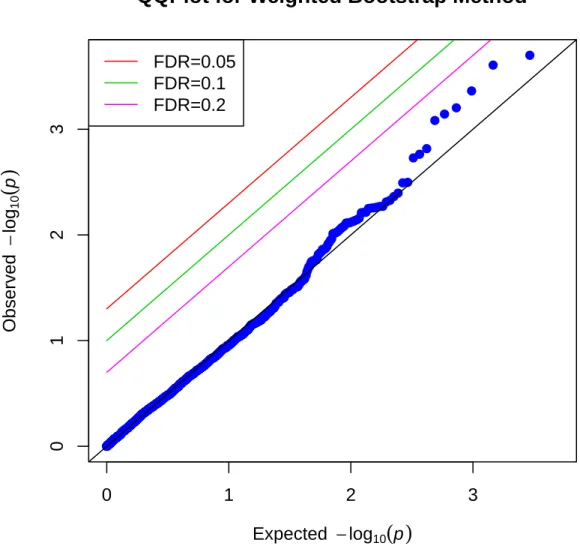
4.1 QQ Plot for the Unweighted Method . . . 57
CHAPTER 1: INTRODUCTION
Time-to-event analyses are frequently conducted in medicine, actuarial science, and
numerous other fields of applied science. Actuaries study the time until death of
individuals for the purpose of calculating and offering fair life insurance rates. In
clinical trials, researchers note whether and when participants experience the event of
interest and compare the times between the treatment and control groups. Similarly,
in cohort studies, researchers compare survival times and want to know if survival time
is related to a risk factor of interest. Additionally, it may be of interest to study the
hazard of death over time.
There is a well-developed set of standard time-to-event analysis methods implementable
in standard statistical software packages. Logrank tests allow testing of differences of
survival times between a finite number of groups. The survival distribution may be
eassily estimated non-parametrically and plotted using SAS or R. Semi-parametric
methods, such as the Cox proportional hazards model, allow robust estimation of the
hazard function in the presence of covariates. Yet, these methods require knowledge
of both the event time and status for all individuals. The event status may not be
known for all individuals, especially when one is interested in studying death due to a
particular cause.
Additionally, current methods do not work for secondary time-to-event outcomes
in case-control studies, in which study participants are sampled based on the primary
of interest. In fact, arbitrary analysis of one or more secondary phenotypes is a
non-trivial problem and has spawned a great deal of research in recent years.
Often, the outcome of interest may be difficult to ascertain. For example, an
autopsy by expert medical examiner may be needed to determine if a death was due
to myocardial infarction, a cancer tumor, or other factors. In order to mitigate this
problem, some studies employ delayed event adjudication. That is, possible cases are
identified using simple, but possibly error-prone methods. Then, one or more experts
examines the possible cases using a more accurate, but also more costly and
time-consuming method to determine the true event status. For example, a specialized
dental examination is required for accurately diagnosing temporomandibular disorders
(TMD). It is impractical to subject large number of subjects to such an examination,
especially if they are unlikely to have the condition. Instead, the “gold standard”
examination is performed only on subjects who screen positive on a simpler assessment,
such as a questionnaire designed to measure recent orofacial pain. However, some
subjects do not receive the “gold standard” examination due to inability or unwillingness
to attend research centers. A time-to-event analysis would then have some subjects
with self-reported symptoms but missing censoring indicators. This setting presents
statistical challenges, which require care in order to avoid bias and maintain efficiency.
In other settings, cause of death may be unknown or death certificates may be
missing entirely. This frequently arises when there are multiple failure types. In
oncology studies, for example, researchers may want to differentiate between deaths
due to cancer and deaths due to car accidents or other unrelated causes. For such
studies, a death certificate is insufficient to classify a subject. Moreover, it may be
impossible to determine if a death occurred if a subject dies abroad or national death
registries are incomplete.
There is a clear need for new methodology to handle this challenging situation. In
the first paper, we propose a method for parameter estimation in the case of missing
censoring indicators. In the second paper, we seek an unbiased and efficient method to
model the relationship between a genotype and a secondary phenotype in case-control
studies. The third paper extends the framework of the first paper to allow for Cox
CHAPTER 2: LITERATURE REVIEW
Our methods, detailed in chapters 3-5, rely on basic knowledge of survival analysis,
missing data, imputation, bootstrapping, joint-modeling, case-control genetic studies
and factor analysis. This chapter reviews the literature pertaining to these fields.
2.1 Survival Analysis
Actuaries, medical experts, and statisticians alike are frequently confronted with
failure time data. One important quantity of interest is the survival function. The
nonparametric maximum likelihood estimate of the survival distribution is given by
(60). Nonparametric estimation in the accelerated failure time model is discussed in
(72). The shape of the survival function is instructive in studying the progression of
the event of interest over time.
Yet, it is often of interest to model the relationship between the failure times and
a set of covariates. A parametric model with one covariate assuming that the failure
time has an exponential distribution is proposed in (36). Unfortunately, the stringent
distributional assumption and limit of one covariate prevent this method from being
useful in most situations. Instead, the classic semi-parametric model of the hazard
function in the presence of covariates is defined in (10). The field of survival analysis
in the past forty years has been centered around this model. In fact, in prospective
approximate the incident rate ratio. The pervasiveness of this model is evident in, for
example, (40), a review of developments in survival analysis in clinical trials through
the turn of the century.
2.1.1 Cox Proportional Hazards Model
One of the most popular statistical tools today, the Cox model combines the ability
to handle covariates with the flexibility resulting from leaving the baseline hazard
unspecified. Cox defines a partial likelihood, which allows for maximum likelihood
estimation of the regression parameters, and extends results for bivariate life table
data. Further details on the partial likelihood are provided in (11).
The Fisher information matrix for the regression parameter from the standard
likelihood is calculated in (26) and shown under broad conditions to be asymptotically
equal to the information based on the partial likelihood. Thus, the Cox likelihood is
asymptotically efficient. Efron also estimates the hazard rate and connects it to the
Kaplan-Meier estimate of the survival function. Accelerated failure time model and
inference and parameter estimation in the Cox model is discussed in (59) as well as
extensions to multivariate failure data, time-dependent covariates, and case control
studies. A heuristic method for computing the asymptotic variance of the estimated
survival function is proposed in (68) and used it to construct confidence intervals, which
are shown in simulations to have adequate coverage.
The applicability of Cox models continued to grow. Methodology were generalized
to competing risks and multivariate outcomes. The framework for competing risks is
detailed in (81), (50) and (94).
Another important question is how robust the Cox model is to mis-measured or
missing data and what modifications are appropriate in the presence of such data.
with missing data are discussed in section 2.4. Specifically, the setting of uncertain
outcomes are discussed in section 2.4.2.
2.2 Bootstrapping
Bootstrapping is an estimation method that may be applied in a wide variety of
situations with or without missing data. The goal is to estimate a statistical quantity
and its variability. Bootstrapping is especially useful for quantities whose standard
error is difficult or impossible to calculate mathematically. Over the past 30 years, the
original method has evolved dramatically, with new methods applicable to frequentist,
Bayesian, parametric, nonparametric, and semiparametric situations alike.
The nonparametric bootstrap was originally proposed in (27) as a modification of
the jackknife. The first step is to find the empirical distribution function of the data.
Next, one creates a large number of boostrap samples by sampling with replacement
from this empirical distribution function. Third, one combines the results from each of
the replications. The estimate of the quantity of interest is the mean of theRestimates
from the replicates and the estimated standard error is the standard deviation of the
estimates from the replicates. Details may be found in (27) and (29).
This simple procedure, available in standard statistical software, originally allowed
estimation of the parameter of interest and of bias, but now also routinely provides
several confidence intervals. Asymptotic properties, including second order accuracy,
are discussed in (111), (5) and (112). Literature on standard errors and confidence
interval estimation is discussed in more detail in section 2.2.1.
In its classical form, bootstrapping is a nonparametric frequentist method, though
it has been adapted to the parametric and Bayesian frameworks as well. One example
distribution for the unknown sampling distribution, Efron substitutes a normal distribution
with mean and variance equal to the sample mean and sample variance. This procedure
is called the normal smoothed bootstrap. (102) first described the Bayesian bootstrap.
Weighted bootstrapping, which is applicable to hypothesis testing, is discussed in (62).
Bootstrapping has emerged as a useful tool for practitioners and the foundation of
numerous papers on its theoretical properties, scope, and limitations.
In his silver anniversary review paper, (31) stresses that boostrapping is founded
on the “plug-in principle”, which he defines as the act of simply “plugging in” the
empirical distribution function for the unknown distribution function. He notes that
while the literature as of 2003, (19), indicates that this is generally valid to the second
order, there are notable situations where it can be problematic. According to a similar
review paper by (14), it is the simplicity of the bootstrap and its connection with other
methods, such as the jackknife, that make it both widely utilized in applications and
extensively studied from a theoretical standpoint.
2.2.1 Standard Error and Confidence Intervals
One important benefit of bootstrap methods is the ability to calculate standard
errors and confidence intervals. For many estimators of interest in practice, standard
errors are, at best, difficult to calculate, or worse, impossible to evaluate analytically.
Moreover, even when the standard error can be found, standard confidence intervals
based on the central limit theorem may be inadequate for statistics whose distribution
are non-normal. On the other hand, according to (32), the bootstrap can always provide
numerical standard error estimates. A simple example of the bootstrapping in the Cox
proportional hazards model can be found in (32).
namely percentile, bias corrected and acclerated (BCa), approximate bootstrap confidence
intervals (ABC) and bootstrap ‘t’. The percentile method simply reports the estimated
percentiles of the bootstrap distribution. A quick theoretical justification for percentile
intervals is provided in (28). BCa intervals are motivated by the assumption that a
simple monotone transformation of the parameter of interest is normally distributed
with slight bias with respect to the transformed mean and a variance that may not
be constant for all possible parameter values. The user does not need to specify the
transformation. In order for BCa confidence intervals to be accurate, it is only required
that such a transformation exists. Monte Carlo sampling yields adequate estimates of
the standard error in about 50-200 replications for most statistics and adequate BCa
confidence intervals in about 1000 replications (32, 19). The bootstrap ‘t’ interval is
conceptually simpler than BCa intervals. However, unlike percentile intervals, they are
not transformation invariant and can result in confidence intervals that are much too
wide. ABC intervals do not require Monte Carlo simulations at all, relying instead on
an analytic approximation to the BCa interval.
2.3 Missing Data: General Theory and Methods
The problem of missing data is nearly ubiquitous in practical statistical problems.
Consequently, there is a rich body of research on analysis with missing data, including
methods such as the EM algorithm, single imputation, and multiple imputation. There
are also a wide variety of ad-hoc techniques that may introduce severe bias. This section
summarizes the literature on missing data and proper data analyses.
In the classic paper, (101) defines three missing data mechanisms and ignorability.
Before proceeding, necessary definitions from Rubin’s work are introduced. Additional
of having missing data. Data are called missing completely at random (MCAR) if
the probability of having a missing value is independent of the data, both observed
and missing. Data are called missing at random (MAR) if the probability of having a
missing value is independent of the missing values, but may depend on the observed
values or on observed covariates. Under MAR or MCAR, the missing data mechanism
is said to be ignorable. If the probability of having a missing value depends on that
unobserved value, then the data is missing not at random (MNAR) and the mechanism
is non-ignorable.
When confronted with missing data, data users face a dilemma. They may know
that, in theory, disregarding observations that are not fully observed is inefficient, at
best. The loss in efficiency increases with the proportion of missing data. It may
bias inference and lead to misleading conclusions. Yet, most software is not equipped
to handle missing observations. Typically, observations with any missing values are
dropped. This can be problematic in studies with a large number of covariates of
interest. Subjects with one or more of the covariates missing would be excluded.
Denoted a “complete-case” analysis, the results may be severely biased when the
missing data mechanism is non-ignorable. Similarly, “available-case” analyses, which
use all cases with observed values for at least one of the variables under consideration,
may be invalid. Mean-imputation, in which missing values are imputed by the mean of
observed values, may also introduce bias, (103). While it may be tempting to use these
or other more convenient approaches, it is usually not appropriate. There is a rich set
of methodology for handling missing data without introducing bias and maintaining as
2.3.1 The EM Algorithm
One common method for handling missing data is the Expectation-Maximization
(EM) Algorithm. There are three steps: first, finding the expected value of the
full log-likelihood given the observed data and current parameter estimate, second
maximizing the expectation to update the parameter estimates, and third, iterating
until convergence. The method was formally introduced in (16) with details of the
E-step and M-E-step. The authors demonstrate why the EM algorithm works, that is, the
fact that the likelihood always increases with each iteration. They also give examples
and suggest the ability to generalize the EM algorithm in a Bayesian framework.
The EM-algorithm in some form is instrumental in most papers that develop new
methods for analysis of data with missingness. One noteworthy example is in the
context of logistic regression with uncertain outcomes. The EM-algorithm and known
or estimated values of sensitivity and specificity are used in (74) to improve upon
parameter estimates in standard logistic regression. Section 2.4 discusses additional
examples of methods that employ the EM-algorithm for missing data in survival analysis.
2.3.2 Multiple Imputation
Multiple imputation, discussed in section 2.3, is a Bayesian method for analyzing
data with some degree of missingness. It was first presented as a way to handle
non-response in sample surveys. The framework is summarized in (103) as containing
a database constructor often separate from the person who will analyze data. He
states that multiple imputation is a statistically valid method within this framework.
Multiple imputation definitions and equations are reviewed. He defines proper multiple
Finally, Rubin compares multiple imputation to competing methods, i.e. single imputation,
jackknife, bootstrapping.
Missing data mechanisms are discussed in (155) from frequentist and Bayesian
points of view as well as the consequent challenges under various assumptions and
appropriate missing data analysis methods. Imputation in general is explored in (155),
specifically two multiple imputation methods – propensity score and predictive model
– under monotone missingness, and one method of multiple imputation under
non-monotone missingness utilizing Markov Chain Monte Carlo (MCMC). Readily vailable
multiple imputation software procedures, such as PROC MI and PROC MIANALYZE
in SAS, frequently assume data are MAR.
Often, especially for binary data, values generated with multiple imputation are
rounded. Yet, rounding can cause excessive bias, as shown in (51). One solution is
to keep the raw imputed values, as they introduce less bias than the rounded values.
They urge instead to posit a more appropriate posterior, for example to refer to Rubin’s
detailed instructions for how to impute missing binary data.
2.3.3 Bootstrapping and Missing Data
For missing data problems, (30) provides a comparison of three bootstrapping
methods and multiple imputation. Non-parametric bootstrapping, the simplest form
of bootstrapping, requires no knowledge of the missing data mechanism. It may be
applied to virtually any reasonable estimator. However, nonparametric bootstrapping
may be too slow or infeasible to use in practice due to the comparatively large number
of replications required. This is especially true when BCa confidence intervals are of
utmost interest.
of the missing data mechanism. Thus, it is most appropriate for non-ignorable missing
data, when this is required anyway. The multiple-imputation bootstrap begins with
the Bayesian bootstrap and calculates confidence intervals via the ABC method. It is
most appropriate for Bayesian settings, because it requires knowledge of the conditional
density of the full data given the observed data. Note that the requirement to know the
conditional density is less stringent than the requirement of full-mechanism bootstrapping
to know the missing data mechanism. For censored surival data, full mechanism and
nonparametric bootstrapping are identical (29, 30).
An important type of partially incomplete data is censored failure-time data. Under
the assumption of random censoring, (29) argues that bootstrapping is valid for survival
data. Similarly, it is straightforward to use bootstrapping to estimate the survival
function and its standard error.
2.4 Missing Data Methods and Survival Analysis
This section discusses specific developments in missing data methods for
time-to-event data. As discussed previously, survival analysis already has incomplete data in
the sense that the failure time is unknown for censored individuals. Most methods
assume that data are censored randomly. In the literature, this is termed as ignorable
censoring. When this assumption is not tenable, censoring is termed non-ignorable and
adjustments must be made.
When modeling time-to-event data with covariates, there are additional types of
missing data that may arise. Most commonly, some subjects may have one or more
unobserved covariates. A less studied situation is when the censoring indicator is
missing for a subset of the observations. While it is possible for a single dataset to
have been found to date.
The following subsections detail, respectively, the literature for survival analysis
with missing covariates and missing censoring indicator models.
2.4.1 Cox Models with Missing Covariates
There have been numerous papers on modeling proportional hazards with missing
covariates. Estimating equations are propposed in (65) to yield what they call an
“approximate partial likelihood estimator” (APLE), which is consistent and asymptotically
normal under MCAR covariates. The assumption is relaxed to MAR by (89) and
impute the covariates using the conditional expectation based on observed information.
Through simulations, they demonstrate the superiority of their method to that of
Lin and Ying in terms of efficiency under MCAR and consistency under MAR. A
nonparametric model for estimation of relative risk with the missing covariates is given
in (156) based on additional auxiliary covariates. An EM-type algorithm for missing
covariates in Cox models is detailed in (49). Additional papers include the inverse
selection probability weighted estimator of (139), among others.
2.4.2 Cox Models with Missing Censoring Indicators
Missing censoring indicators frequently arise when there are multiple failure types.
Investigators may easily record the mortality of all subjects, but it may be extremely
difficult or costly to find out exactly why each subject died. Consequently, there has
been much more work done on missing censoring indicators in the context of competing
risks than when there is only one type of failure. Over the past three decades, authors
for the missing censoring indicator model. The logrank test has been generalized for
missing censoring indicators. Yet, there have been fewer papers on the more difficult
problem of Cox regression.
First, (20) uses the EM algorithm to estimate the survival function under various
types of partially observed competing risk data. Observations may be either fully
observed, censored, or observed failures with unobserved causes. He estimates the
information matrix and provide clear examples of the method applied in practice. The
survival function is estimated non-parametrically in (96) when death status is known
but its cause is uncertain for some subjects, while the Kaplan-Meier estimate may be
biased for such data. Causes of failure are said to be masked when it is unknown but
at least one type of cause may be eliminated from consideration. For competing risks
data with masked causes of failure, (39) estimate the survival function.
A modified logrank test for competing risk data for which cause of failure is unknown
and missing at random, (44). A slight modification to their partial likelihood is
proposed in (17) to increase the information and improve the test. Multiple imputation
of the cause of failure and a corresponding asymptotically valid modified log-rank test
is detailed in (133).
For standard survival data, there have been a number of methods proposed for
estimating the survival function under the missing censoring indicator model. An
asymptotically efficient estimator of the survival function under missing at random,
or more generally, “coarsening at random” censoring indicators, is proposed by (136).
Namely, they use the nonparametric MLE of the survival function based on reduced
data produced by a discretization of the failure time. A comparable alternative is
proposed by (123) that requires less computational resources and time. Kernel estimation
is employed in (124) to provide a weakly convergent estimator of the survival function.
the choice of bandwidth sequence. It follows that clever estimation of the bandwidth
would improve the kernel estimation performance. Three methods of bootstrapping the
bandwidth are compared to each other and to existing methods, (129). Semiparametric
random censorship models for hazard function estimatiors, both nonparametric and
semiparametric, are given in (128). In addition, they compute and minimize the
asymptotic mean squared error to find the optimal bandwidth. An augmented inverse
probability weighted estimator of the survival function under MAR is proposed in
(127) and shown that it is robust even under partial model misspecification. Improving
the survival function estimate in the missing censoring indicator model via multiple
imputation is discussed in (125) and (126).
An important research question is how Cox models are affected when case status
is uncertain. Competing risks proportional hazards regression models are proposed
in (45) using estimating equations assuming that observations are known either to be
censored or to have failed by some cause. They assume proportional hazards for each
failure type and between the two failure types. For the linear transformation model,
An augmented inverse probability weighted estimator and algorithm are proposed in
(41) along with asymptotic and double robustness properties.
Time-to-event data which may not be classified and confirmed is modeled in (8)
by weighting each subject by their estimated probability of being a true case. Their
methods include estimation of the survival function, Cox models, and a logrank test.
They propose an asymptotic variance expression which may be used as an approximation
for finite samples. Alternatively, they suggest estimating the variance by bootstrapping.
Empirical processes are employed to prove consistency and weak convergence of the
estimators to Gaussian processes.
For the usual survival setting with only one cause of failure, (43) estimate the
estimation in the Cox model and prove consistency and asymptotic normality of the
estimators. The survival function is also estimated without covariates and Cox proportional
hazards models are proposed in (78) by modifying the Nelson-Aelen estimator and
taking the product-integral. The advantage of their method is that it does not require
discretization of the failure times or estimation of the unconditional probability of
having an observed censoring indicator. Simulations demonstrate that the (78) is
superior to previous estimators, such as the earlier version of (43). Yet, the methods
of (78) and (43) both depend on the MCAR assumption, which they state that it is
non-trivial to relax. Parameter estimation in the Cox model under the assumptions of
proportional censorship and MCAR censoring indicators is conducted in (122).
Weights are recommended for each potential event, of which individuals may have
more than one, along with a weighted partial likelihood, (116). That is, he suggests
screening out observations that are unlikely to be true events, and weighting each
observation by the probability that the subject had first failed at the observed time. The
weights may be known or estimated using auxiliary covariates. Taking this uncertainty
into account reduces bias and increases power. However, estimating the weights depends
upon the presence of a normally distributed diagnostic variable and either knowing or
having experts guess the relative frequency of true endpoints to false endpoints. In
addition, the variance of the method is mentioned but not described in detail.
Adjusting a proportional hazards model based on discrete survival times and measurement
error of case status is discussed in (79). They show that mis-measured outcomes can
bias the usual proportional hazards model parameter estimates toward the null and poor
coverage probability for confidence intervals, but this can be mitigated by incorporating
information about sensitivity and specificity.
Estimators for the regression parameters in the Cox proportional hazards model
their consistency is established under basic regularity conditions. The authors then
estimate the non-missing rate of censoring indicators with the kernel estimator and use
it to estimate the information matrix. Their approach depends on the assumption of
piecewise constant hazard functions and proportional hazards for not only the event
time, but also for the censoring time.
Multiple imputation is also discussed for repeated failure times where the event is
known to have occurred at a certain time but the event type is missing (107). The
method is compared to multiple imputation under the Cox proportional hazards model
without repeated events.
2.5 Genetics and Case-Control Data
Investigators are frequently interested in reusing case-control data to evaluate associations
between measured risk factors and outcomes other than the outcome to define case
status. These other outcomes are often referred to as secondary phenotypes, which may
be associated with the primary disease used to define case status. Utilizing one study
to investigate more than one outcome is important for financial reasons, as the process
of attaining genetic information and other putative risk factors for all participants is
time-consuming and expensive. While logistic regression is known to be invariant to
the sampling method for primary analyses, this does not hold for secondary phenotype
analyses. Simple logistic and linear regression may be severely biased. Restricting
analyses to cases only or controls only results in decreased efficiency. These methods
are considered “naive” methods. There has been a great deal of recent interest in
developing unbiased and efficient methodology for analyzing secondary phenotypes in
case-control studies.
standard logistic regression model with a covariate adjusting for original case status.
The second is to use stratum-weighted logistic regression, i.e. logistic regression in
which cases and controls are weighted by the reciprocal of their sampling fractions.
For population studies, it is often easier to estimate the ratio of the sampling fractions
than to estimate the sampling fractions for cases and controls separately. Hence, (97)
proposes using a unit weight for the cases and the ratio of the sampling fractions for
controls. In a nested case-control study, the ratio is the number of cases in the whole
study divided by number of controls.
Simulations are conducted in (82) to estimate size and power for the naive methods
and the inverse probability weighting (IPW) method and dummy variable adjustment
method in (97). They conclude that IPW has adequate type I error but has increased
variance and sometimes decreased power compared to the naive approaches. Note,
however, that the simple unweighted analysis and the analyses that adjust for case
status with a binary variable or restrict to either cases or controls have slightly inflated
type I error when the primary disease is not rare and both the genetic profile and
secondary phenotype are related to the primary disease. There are also situations in
which the IPW method is more efficient than the method that adjusts for case-control
status with an indicator variable for case status.
A rigorous likelihood based approach is derived in (66). However, (63) points out
that (66) assumes no interaction between the covariate information (genotypes) and the
secondary phenotype and that in the case of interaction in modeling the probability
of having the primary disease, the results may be biased. They propose an adaptive
weighting parameter estimate motivated by a Bayesian shrinkage estimator for
gene-environment interaction when the disease is rare.
The bias may be corrected by solving iterated non-linear equations relating regression
and using bootstrapping to calculate confidence intervals via the percentile method,
(140). Their method assumes that the secondary phenotype may be modeled by logistic
regression given a set of binary covariates and the primary disease may be model by
logistic regression given the covariates and the secondary phenotype but no interaction.
They describe the IPW method in (97) and extend it to retrospective case-control
studies using an estimate of disease prevalence. They also adapt their bias correction
method to the frequency-matched case-control study design. Their method produced
narrower confidence intervals than the IPW method.
In their second paper, (141) conduct simulations, which show that the method
in (140) has adequate size and is more powerful than the naive logistic regression
approaches. A joint model based on a Gaussian copula is proposed by (47) for one
or more secondary phenotypes in the exponential family and the disease of interest
given the covariate, i.e. genotype. Their simulations confirm that their method is more
powerful than the IPW method. Unlike other methods, this one allows joint modeling of
multiple secondary phenotypes that is more powerful than multiple univariate analyses.
2.6 Sparse Factor Analysis
Latent variable models are frequently used in statistics. In certain situations, it
is reasonable to assume that observed variables are random variations of one or more
unobserved random variables. Within the field of psychometrics, studies often consist
of a large number of correlated measured variables, which may be manifestations
of a smaller number of underlying constructs. Factor analysis is commonly used
for this purpose. In factor analysis models, the observed data is assumed to be
a linear combination of the unobserved factors, plus random error. See (9) for an
theoretical description of the problem of factor analysis is provided in (3) along with a
demonstration that it may fall into the Bayesian framework.
Factor analysis may be either exploratory or confirmatory in nature. Exploratory
factor analysis (EFA) aims to discover underlying relationships between the observed
variables and is more commonly used (91). Confirmatory factor analysis (CFA) begins
with an a priori structure and tests hypotheses about those structures using the factor
analysis setting. Researchers such as (137, 55) have debated quite heatedly about when
each type of factor analysis is appropriate.
Principal component analysis (PCA) is more frequently used in statistics than
is factor analysis. In principal component analysis, instead of assuming that there
are unobserved variables driving the observed data, it is desired to extract linear
combinations of the observed variables. The first linear combination, or component,
explains the largest amount of variability in the data. The second component explains
the next largest amount of variance, and so on. Traditionally, principal component
analysis extracts the same number of components as there are observed variables.
However, since data reduction is commonly a goal of PCA, usually the analyst selects
a smaller number of components that explains a sufficient amount of variance.
It is desired to have sparse loadings, meaning that many of the loadings are equal to
zero. Unfortunately, neither principal component analysis nor factor analysis produce
sparse loadings. This can be problematic, especially in genetic settings, where the
number of variables present in the study can be very large. Two methods (157,
147) have recently been proposed for sparse principal component analysis. (147)
uses a penalized matrix decomposition to produce more sparse results than traditional
principal component analysis.
The aforementioned sparse principal component analysis methods do not immediately
CHAPTER 3: PARAMETER ESTIMATION IN COX PROPORTIONAL
HAZARD MODELS WITH MISSING CENSORING INDICATORS
3.1 Introduction
Time-to-event analyses are frequently conducted in medicine, actuarial science, and
numerous other fields of applied science. There is a well-developed set of survival
analysis methods implemented in standard software. Semi-parametric methods, such as
the Cox proportional hazards model, allow robust estimation of the effects of covariates
on the hazard function. However, these methods require the analyst to know the
censoring status of each participant, which may not always be available.
In some cases the outcome of interest may be difficult to ascertain. For example, in
oncology studies, researchers may want to differentiate between deaths due to cancer
and deaths due to car accidents or other unrelated causes. Investigators may easily
record the mortality of all subjects, but it may be extremely difficult or costly to find
out exactly why each subject died. One possible solution to this problem is delayed
event adjudication (8). This means that possible cases are not identified immediately
but screened using simple methods that may have poor sensitivity or specificity. Later,
the screened candidate cases are re-examined using a more precise, but also more costly
and time-consuming, method to determine the true event status.
The study that motivates our work is Orofacial Pain: Prospective Evaluation and
Risk Assessment (OPPERA), a prospective cohort study to identify risk factors for the
study participant was followed for a median of 2.8 years to identify cases of
first-onset TMD. However, it was impractical to perform a physical examination on every
participant. It would also have been inefficient given that most study participants did
not develop the condition. Instead, this “gold standard” examination was performed
only on participants who screened positively on a quarterly screening questionnaire
that was designed to assess recent orofacial pain (1). However, some participants
who screened positively were lost to follow-up before receiving the “gold standard”
examination. Thus a time-to-event analysis would have some participants with missing
censoring indicators.
Cook and Kosorok (8) estimate parameters in Cox proportional hazard models with
missing censoring indicators by weighting observations according to their probability
of being a true case. They show that the estimators are consistent and asymptotically
normally distributed. However, the standard error of their proposed estimate cannot
be easily obtained using existing software without bootstrapping. For the OPPERA
data, a separate Cox model was calculated for each putative risk factor of interest,
including approximately three thousand genetic markers. Consequently, applying this
method to the OPPERA genetic data would be computationally intractable.
In the OPPERA study, the likelihood that a participant who screened positively
was examined was associated with demographic variables such as gender, race, or
socioeconomic status (1). This indicated that the censoring indicators in the OPPERA
study were not missing completely at random (MCAR). Application of models that
assume MCAR censoring indicators may result in biased estimates of hazard ratios for
covariates of interest. More importantly, a participant’s responses to their screening
questions are predictive of whether or not they are an incident case of TMD. This
setting presents statistical challenges, which require care in order to avoid bias and
methods currently available allow for estimation of the incidence rate. There is a clear
need for new methodology to effectively answer the research questions of the OPPERA
study.
In this paper, we propose a method for parameter and variance estimation in
Cox regression models with missing censoring indicators. The motivating data set
is introduced in section 3.2. We describe our method in section 3.3. In section 3.4, we
report the results of simulations. Finally, in section 3.5 we apply our method to the
OPPERA study. We conclude with a discussion in section 3.6.
3.2 Motivating Data Set: The OPPERA Study
OPPERA is a prospective cohort study designed to identify risk factors for
first-onset TMD. A total of 3,263 initially TMD-free subjects were recruited at four study
sites between 2006 and 2008. TMD status was confirmed by physical examination of
the jaw joints and muscles using the Research Diagnostic Criteria for TMD (25), which
is the gold standard for diagnosing TMD.
Upon enrollment in the study, each OPPERA participant was evaluated for a wide
variety of possible risk factors for TMD, including psychological distress, previous
history of painful conditions, and sensitivity to experimental pain. For a brief overview
of the risk factors of interest in the OPPERA study, see Section 6 in the Web Appendix.
See Ohrbach et al. (86), Fillingim et al. (37), Greenspan et al. (46), and Maixner et al.
(76) for a complete description of the baseline measures that were collected in OPPERA.
After enrollment, each participant was asked to complete questionnaires to evaluate
recent orofacial pain once every three months. These questionnaires (hereafter referred
to as “screeners”) evaluated the frequency and severity of pain in the orofacial region
during the previous three months. The purpose of the screener was to identify participants
screener, see Slade et al. (114). Participants who screened positively were asked to
undergo a follow-up physical examination by a clinical expert to diagnose presence or
absence of TMD.
Of the 3,263 subjects, 2,737 filled out at least 1 screener, and the remaining 521 did
not fill out any screeners. The total number of screeners was 26,666. There were 717
positive screeners, 486 (about 68%) of which were followed by a clinical examination.
As reported in Bair et al. (1), case classifications made by one examiner (hereafter,
“Examiner #4”) were deemed unreliable because the examiner diagnosed a much higher
percentage of individuals with TMD compared to other examiners. We therefore set
all of Examiner #4’s physical examination findings to be missing and imputed them
using the methods in this paper. This left 404 positive screeners (56%) resulting in
valid clinical exams. On the individual level, after setting the exams from Examiner
#4 to missing, there were 404 people who had one positive screener, and 114 people
who had two or more positive quarterly screening questionnaires.
3.3 Model
3.3.1 Notation and Assumptions
Assume there aren independent participants. For each participanti (i= 1, . . . , n),
let Ci and Ti denote the potential times until censoring and failure, respectively, let
Vi = min(Ti, Ci), ∆i =I(Ti ≤Ci),Ni(t) =I(Ti < t). LetZi ap×1 vector of covariates
measured at baseline and letXi be aq×1 vector of covariates measured at the time of
the putative event. We assume the hazard for participant ifollows a Cox proportional
hazards model
whereλ0(t) is an unspecified baseline hazard function. Let ξi denote the indicator that
∆i is observed and σi =ξi∆i. We observe (Vi, ξi, σi) fori= 1, . . . , n.
In the OPPERA study,Vi is the length of time for participantibetween enrollment
in the study and either of two events
(a) a screener which resulted in a diagnosis of incident TMD
(b) the last-completed screener before loss-to-follow-up.
If participant i either screened positively and subsequently was diagnosed with TMD,
then ∆i = 1. If participant i either screened negatively on the last quarterly screener
before loss-to-follow up or screened positively and was diagnosed to be free of TMD,
then ∆i = 0. If participant i screened positively on the last screener but was not
examined, then ∆i is missing and ξi = 0. The putative risk factors for TMD that were
assessed at enrollment are denoted by the vector Zi. Responses to the screener for
participant i at time Vi are denoted by the vector Xi. For OPPERA, we also define
Qi = 1 if participant i screens positively on the last screener before either a positive
diagnosis of TMD or loss to follow-up and Qi = 0 otherwise.
We assume the censoring indicators are missing at random (MAR) as follows:
P(ξi = 0|Xi, Vi,∆i, Qi = 1) =P(ξi = 0|Xi, Vi, Qi = 1) (3.2)
In other words, the probability of having a missing censoring indicator may depend on
measured factors, but it does not depend on whether or not an event occurred. We will
3.3.2 Estimating Event Probabilities
We model the probability that participant iwith a missing censoring indicator is a
case by a logistic regression model based onXi and Vi:
P(∆i = 1|Xi, Vi, Zi, ξi = 0, Qi = 1)
= P(∆i = 1|Xi, Vi, Qi = 1)
= exp(α
0X
i+γVi)
1 + exp(α0X
i+γVi)
I(Qi = 1) (3.3)
That is, we estimate the probability of examiner-diagnosed TMD in a participant
who was not examined as intended. (Here I(x) denotes an indicator function.) The
probability was estimated using the time between enrollment and their last positive
screener as well as their answers on that screener. Then, for those individuals who
screened positively on the last screener (i.e. those withQi = 1) and were not examined,
the estimated probability of being a case is estimated by (3.3) with the parameters
replaced by their respective estimates based on individuals who were examined.
Note that if there are repeated measures, we may use a generalized linear mixed
effects logistic regression model rather than a standard univariate logistic regression
model. For example, if some participants screen positively on more than one screener
and are examined at least once, then we have multiple observations per participant.
In that case, fitting a generalized linear mixed effects logistic regression model rather
than a standard logistic regression model would account for correlations between the
responses of the same participant.
3.3.3 Multiple Imputation
One popular method for handling missing data is multiple imputation. For a
is as follows:
(i) Estimate predicted probabilities as described in the previous section for observations
with missing censoring indicators. These are the individuals who screen positively
but are not examined by a clinician.
(ii) For each observation with a missing censoring indicator, generate a Bernoulli
random variable with success probability equal to the predicted probability found
in step (i).
(iii) Combine the raw data and imputed data from step (ii) to form a completed data
set.
(iv) Fit the Cox proportional hazards model to the completed data set.
(v) Record each parameter estimate ˆβj and covariance matrix ˆUj.
(vi) Repeat steps (ii)-(v) for a total of m times, where m is the desired number of
imputations.
Next, we combine all of the estimates. The average parameter estimate is
¯
β = 1
m m
X
j=1
ˆ
βj, (3.4)
the within-imputation variance estimate is
¯
U = 1
m m
X
j=1
ˆ
Uj, (3.5)
and the between-imputation variance
ˆ
B = 1
m−1
m
X
j=1
Finally, the estimated covariance matrix is
ˆ
V ar( ¯β) = ¯U+ (1 + 1
m) ˆB. (3.7)
3.3.4 Estimation of Incidence
Previous sections of this paper described how to estimate hazard ratios in the
presence of missing censoring indicators. It may also be of interest to estimate incidence
rates for the same event using Poisson regression instead of Cox regression. For example,
one of the aims of the OPPERA study is to estimate the incidence rate of first-onset
TMD.
In order to estimate incidence rates, we estimate the case probabilities as described
previously based on participants who screened positively and were examined. Then we
impute case status as described in section 3.3.3 for those who screened positively but
were not examined. However, in this case we fit Poisson regression models, rather than
Cox models, to the completed data sets. Finally, we calculate the incidence rate based
on the estimates of the regression coefficients in the Poisson model. Specifically, we use
the data from imputationj to fit the model
log(E(∆ij|Zi, Vi)) = α+β0Zi+ log(Vi) (3.8)
where ∆ij denotes the jth imputation for observation i, j = 1, . . . , m. We combine the
m imputations using equation (3.4) and
¯
α = 1
m m
X
j=1
ˆ
αj. (3.9)
The estimated incidence rate for an individual with covariate Z∗ is given by exp( ¯α+
¯
3.4 Simulations
Data with missing censoring indicators were simulated, and several possible methods
were compared with respect to bias, coverage, and confidence interval width. Survival
times for 1,000 individuals were generated with exponentially distributed failure times
under a proportional hazards model with covariates as proposed by Bender et al. (4).
That is, the survival time for each individual was distributed according to (3.1) where
λ0(t) = 1 is the baseline hazard. For our simulations, Zi = Xi1 was a single baseline
covariate following a normal distribution with mean 2 and unit variance. In other words,
the failure timesTi followed an exponential distribution with hazard exp(β0Xi1) where
β ∈ {−0.5,−1.5,−3}. The censoring times Ci followed an exponential distribution
with mean 5. This yielded about 35%, 75% and 90% censoring forβ=−0.5,β =−1.5, and β =−3, respectively.
Covariates are represented by Xi1, a risk factor for TMD measured at enrollment,
andXi2, a measurement collected on the last screener. For each observation, a normally
distributed covariate Xi2 was generated with mean ∆i and standard deviation 0.3,
representing a continuous measure of the likelihood of being identified as an incident
case of TMD. This was used to generate Qi = I(Xi2 > 0.5), an indicator of whether
participant i screened positive on their last screener. Also, ξi = I(∆i is observed)
corresponds to the indicator of whether participanti came in for their clinical exam if
Qi = 1. In all simulations, we set ∆i = 0 if Qi = 0 (i.e. the participant’s final screener
was negative). This decision was made to reflect the fact that OPPERA participants
who screened negatively were not examined.
We created missing censoring indicators under the following classical missing data
mechanisms of Rubin (101):
data. This is known as missing completely at random (MCAR).
(II) The probability of having a missing censoring indicator depends on an observed
covariate. This is known as missing at random (MAR).
(III) The probability of having a missing censoring indicator depends on the (potentially
unobserved) censoring indicator. This is known as missing not at random (MNAR).
Our method assumes that the data are MAR, which includes MCAR as a special
case. Our simulations under MAR and MNAR parallel the study protocol in that
censoring indicators can only be missing for those with positive screeners. In other
words, observations were potentially missing if and only if Qi = 1. (Individuals with
negative screeners have Qi = 0 and are assumed to be censored. Those with positive
screeners haveQi = 1 and may have missing clinical examinations.) Details and results
for MCAR and MNAR data are shown in Sections 6 and 6 in the Web Appendix.
We also considered several simulation scenarios where the logistic regression model for
predicting the censoring indicator was misspecified; see Section 6 in the Web Appendix.
For MAR data, we set censoring indicators to be missing with probability
ρi(Xi, Vi) = P(ξi = 0|Xi, Vi, Qi = 1) (3.10)
= exp(−0.2−0.3Xi1+ 0.1Vi) 1 + exp(−0.2−0.3Xi1+ 0.1Vi)
. (3.11)
In each simulated data set, all observations with observed censoring indicators who
had screened positively were used to fit a logistic regression model for case status with
covariates Xi1, Xi2 and Vi. That is, using the complete data (i.e. observations with
Qi = 1 and ξi = 1), we fit the logistic regression model for the event probability
conditional on Xi0 = (1, Xi1, Xi2) and Vi, namely
The estimated probabilities ˆpi =
exp( ˆα0X i+ˆγVi)
1+exp( ˆα0X
i+ˆγVi) were calculated for individuals with Qi = 1.
To evaluate the performance of our method, multiple imputation was employed
to calculate 100 imputed estimates of β for each simulation as described in Section
3.3.3. For each observation i with Qi = 1 and ξi = 0, we estimated failure indicators
ˆ
∆ij ∼Bernoulli(ˆpi) independently for each imputationj.
A Cox proportional hazards model was fit for each imputed data set, and the
imputed estimates of the regression coefficient and their variances were recorded. These
were aggregated using equations (3.4) and (3.7) to create confidence intervals for the
multiple imputation estimates.
The performance of our method was compared with that of the method of Cook and
Kosorok (8). To obtain the estimates of (8), for each simulated data set, we estimated
the probabilities ˆpi that the (potentially unobserved) event for participant i is a true
event, as described previously. We then fit a weighted Cox proportional hazards model
to the data set. Two new observations were generated for observations with missing
censoring indicators. Each such pair of observations had the same failure time and
covariates, but different failure indicators and weights. The first observation had weight
ˆ
pi and ˆ∆i = 1, and the second observation had weight 1−pˆi and ˆ∆i = 0. Participants
with fully observed data had unit weight. The estimated regression coefficient, ˆβ was
recorded. The variance of this estimate was estimated by generating 1000 bootstrap
replicates of each simulated data set and refitting the model for each bootstrap replicate.
The average parameter estimate, β¯ˆ and percentile confidence intervals (β0.025, β0.975)
were all recorded, whereβα is the αth quantile among the 1000 bootstrap replicates.
We also compared our method to the ideal situation in which all data were observed,
complete case analysis (meaning that we exclude from the data set all observations with
indicators either all as censored or all as failures. Results under the assumption of MAR
are shown in Table 3.1. We estimated the bias of each method by calculating the mean
difference between the estimated Cox regression coefficient and the true coefficient over
the 1000 simulations. We also calculated the mean width of the confidence intervals
produced by each method over the 1000 simulations. Similarly, we calculated the
empirical coverage probability for the confidence intervals produced by each method by
dividing the number of times that the confidence intervals contained the true value of
the parameter by 1000. Finally, we report the Monte Carlo error for the coverage rate,
which is the error in the empirical coverage probability due to conducting only a finite
number of simulations (which would bepα(1−α)/n for n simulations).
The empirical coverage probability of the imputed confidence intervals is close to
the nominal level (0.95) in all simulations. Our multiple imputation method and the
method of Cook and Kosorok (8) produced approximately unbiased estimates and valid
confidence intervals in all the scenarios we considered. The estimates produced by the
other methods showed a larger amount of bias and did not always achieve the desired
coverage level. Our multiple imputation method also yielded the narrowest confidence
intervals in each scenario, although the method of Cook and Kosorok (8) produced
confidence intervals that were only slightly wider. Moreover, for most parameter values,
the coverage probabilities for the complete case and ad hoc methods were significantly
different (p <0.01) from the nominal rate.
In addition, we examined the performance of our proposed methods when we
changed the logistic regression model for ∆i. We investigate two additional types
of models: one in which the model contained a variable unrelated to case status
and another in which the model does not include one variable related to case status.
As in the previous simulations, the failure times were generated by (3.1), censoring