‘GO UP’, ‘GO WEST’, AND ‘GO OUT’: CHANGING INDUSTRIAL POLICY AND FIRM STRATEGIES IN CHINA’S APPAREL INDUSTRY
Shengjun Zhu
A dissertation submitted to the faculty at the University of North Carolina at Chapel Hill in partial fulfillment of the requirements for the degree of Doctor of Philosophy in the Department of Geography.
Chapel Hill 2014
1
ABSTRACT
Shengjun Zhu: ‘Go Up’, ‘Go West’, and ‘Go Out’: Changing Industrial Policy and Firm Strategies in China’s Apparel Industry
(Under the direction of John Pickles)
TABLE OF CONTENTS
LIST OF TABLES ... vii
LIST OF FIGURES ... viii
LIST OF ABBREVIATION ... x
CHAPTER 1 INTRODUCTION ... 1
Background ... 1
The case of Ningbo ... 4
Overview of the chapters... 9
Methodology ... 13
CHAPTER 2 BRING IN, GO UP, GO WEST, GO OUT: UPGRADING, REGIONALIZATION AND DELOCALIZATION IN CHINA’S APPAREL PRODUCTION NETWORKS ... 16
Introduction ... 16
Bring in: export-led assembly and the rise of China in global apparel value chains ... 17
The limits of export-led, low-wage industrialization ... 22
Upgrading, regionalization and delocalization... 26
Conclusion ... 52
CHAPTER 3 GLOBAL, REGIONAL AND LOCAL: NEW FIRM FORMATION AND SPATIAL RESTRUCTURING IN CHINA’S APPAREL INDUSTRY... 55
Introduction ... 55
Research Design ... 63
Industrial Relocation and Transforming Pattern of New Firm Formation ... 68
Statistical Results ... 71
Conclusion and Discussion ... 80
CHAPTER 4 GEOGRAPHICAL DYNAMICS AND INDUSTRIAL RELOCATION: SPATIAL STRATEGIES OF APPAREL FIRMS IN NINGBO, CHINA ... 84
Introduction ... 84
Conceptualization of spatial dynamics: towards an analytical framework ... 85
Geographical dynamics and firm relocation ... 92
Relocation in the global, regional and local context ... 100
Conclusion and discussion ... 106
CHAPTER 5 PROCESS, PRODUCT, AND FUNCTIONAL UPGRADING IN A GLOBALIZED AND LOCALIZED WORLD: FIRM-LEVEL EVIDENCE FROM CHINA’S APPAREL INDUSTRY ... 110
Introduction ... 110
Process, product, and functional upgrading in a globalized and localized world... 113
Research design ... 117
Statistical results ... 125
Conclusion ... 141
CHAPTER 6 UPGRADING IN APPAREL GLOBAL VALUE CHAINS: A HEURISTIC ANALYTICAL FRAMEWORK ... 144
Introduction ... 144
Different firms, different upgrading trajectories ... 155
A tentative analytical framework of upgrading... 165
CHAPTER 7 PATH DEPENDENT AND PATH BREAKING: AN AGENT-BASED MODEL OF EVOLUTION, CO-EVOLUTION, AND
LOCK-IN IN A CHINESE APPAREL CLUSTER... 178
Introduction ... 178
Lock-in and lock-out ... 181
Pipelines to external knowledge and negative lock-in ... 187
Harmonies and disharmonies in the processes of co-evolution ... 192
Conclusion ... 202
CHAPTER 8 SUMMARY AND CONCLUSION ... 206
Changing industrial policies from various levels of governments ... 207
Firm strategies to increasing competitive pressures ... 208
Articulation between changing industrial policies and firm strategies ... 211
LIST OF TABLES
Table 1 Export of apparel products (1994-2010) ... 18
Table 2 Key Points of China’s New Labor Contract Law ... 33
Table 3 Policy Initiatives Launched by Chinese Governments on GO WEST ... 36
Table 4 Policy Initiatives Offered by Inland Provinces/Cities to Entice Relocating Enterprises ... 42
Table 5 Estimation Results from the Tobit Model for New Firm Formation during 1999-2009 ... 72
Table 6 Estimation Results from the Tobit Model based on Temporal Expansion (1999-2009) ... 75
Table 7 Estimation Results for High- and Low-Capability New Entrants (2009) ... 77
Table 8 Types of Firm Relocation ... 86
Table 9 Comparison of Apparel Firms in Ningbo ... 102
Table 10 Firm Entry and Exit in China’s Apparel Industry (1998-2007)... 118
Table 11 Temporal Change of the Mean Value of Process, Product and Functional Upgrading Indicators at the Firm Level in China’s Apparel Industry (1998-2007) ... 122
Table 12(a) Determinants of Firm Upgrading (1998-2001) ... 126
Table 13 Determinants of Upgrading of Domestic-owned Firm ... 133
LIST OF FIGURES
Figure 1 Location of Ningbo... 5
Figure 2 Output and Export Delivery Value of Ningbo’s Apparel Industry ... 7
Figure 3 Spatial Distribution of Gross Industrial Output in Garments by County ... 20
Figure 4 Chinese Provinces and Centrally Administered Municipalities ... 21
Figure 5 Temporal Changes of Distribution of Employment in Garments by Province ... 25
Figure 6 Restructuring Strategies Adopted by the Export-oriented Apparel Firms ... 29
Figure 7 Economic Regions in China ... 37
Figure 8 Priority Relocation Destinations of the Processing Industry Identified by the Ministry of Commerce (2007 and 2008) ... 38
Figure 9 Industrial Transfer Demonstration Zone of the Wanjiang River Urban Belt ... 39
Figure 10 Distribution of Investment in Textile and Apparel Industry (2005 and 2010) ... 41
Figure 11 Annual Growth Rate (YOY) of the Number of Newly- commenced Projects in Textile and Apparel Industry (2006-2010) ... 41
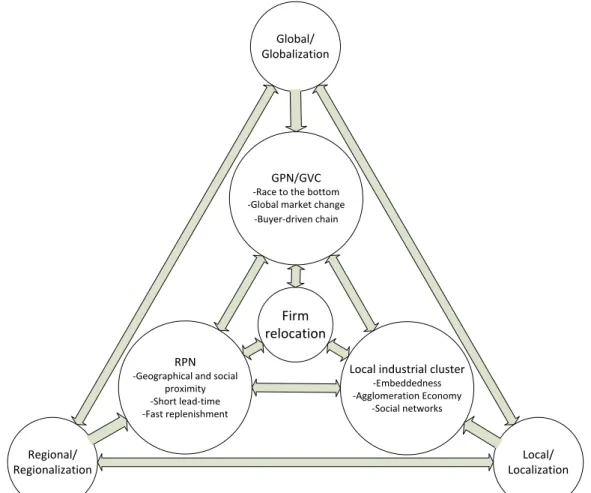
Figure 12 A Tri-polar Analytical Framework of Industrial Relocation and New Firm Formation ... 61
Figure 13 Temporal Changes of Distribution of Employment in Garments by Province (1992, 1998, 2004, and 2010) ... 69
Figure 14 Changes in Regional Shares of the Number of Newly Established Apparel Firms (1998-2009) ... 70
Figure 15 A Tri-polar Analytical Framework of Firm Relocation ... 87
Figure 16 Peace Bird’s Production Networks ... 95
Figure 17 Import and Export of China’s Apparel Products (1994-2010) ... 112
Figure 19 Is there a hierarchy of upgrading? ... 149
Figure 20 Horizontal and vertical upgrading framework ... 158
Figure 21 Upgrading trajectories of Peace Bird ... 160
Figure 22 Upgrading trajectories of GXG ... 161
Figure 23 Upgrading trajectories of Seduno ... 163
Figure 24 Upgrading trajectories of Baimu ... 165
LIST OF ABBREVIATION
EEG Evolutionary economic geography
GPN Global production network
GVC Global value chain
OBM Originial branding manufacturing
ODM Original design manufacturing
CHAPTER 1 INTRODUCTION
Background
The central question of this research is: how, since the early 2000s, the Chinese state and private firms are dealing with negative consequences of low-wage export-oriented production in apparel. Specifically, my research seeks to understand how, as competitive pressures increase, new government policies and emerging firm strategies are restructuring the geography and organization of the Chinese apparel industry in conflicting and/or complementary ways. This research builds on recent insights in economic geography and economic sociology on industrial relocation/delocalization, upgrading, governance, global value chains and global production networks (Bair, 2009; Coe et al., 2008a; Gereffi et al., 2005; Pickles and Smith, 2011).
in 2008. China had become the leading global exporter in 774 items by 2005 and the world’s largest exporter with a world export share of 8% in 2009 (Inman, 2010; Yang et al., 2006).
With the shift from import substitution to export-oriented strategies, producers dependent on low-wage and unskilled or semi-skilled labor and the leveraging of domestic advantages, including China’s large potential market and the comparatively low cost of its other factor inputs, land, electricity and other raw materials were able to expand their role in export markets (Gereffi, 2009). One notable example has been the apparel industry, which accounts for a considerable part of China’s economic growth and job creation during this period. China has the largest apparel industry in the world with more than 3.82 million workers in 2011, predominantly focused on assembly or OEM (Original Equipment Manufacturing) production for global buyers (Feenstra and Hamilton, 2006; Hamilton and Petrovic, 2006). Between 1995 and 2008, China more than doubled its share of global apparel exports from 15.2% to 33.2% (Gereffi and Frederick, 2010). Production and employment of the apparel industry have become heavily concentrated in the coastal regions of East and Southeast China (Fujita and Hu, 2001; He et al., 2008; Wen, 2004).
In recent years this model of industrialization has encountered serious limits. These limits are now forcing major changes in the organization and geography of economic activity in the industry (Wang and Mei, 2009; Yang, 2012). Most Chinese apparel factories have focused on assembly or OEM (Original Equipment Manufacturing) production supplying global buyers and few have been able to establish a strong position in high-value-added, high-tech, and high-end products (Feenstra and Hamilton, 2006; Hamilton and Petrovic, 2006). As with general
(Appelbaum et al., 2005; Arnold and Pickles, 2011). As billions of workers and consumers have become more direct participants in the global economy as workers and consumers (Gereffi, 2009), this process has increasingly come to drive China’s rapidly changing economic geography creating upward pressure on wages and working conditions that are beginning to challenge the “China price” and the “race to the bottom” it has created (Appelbaum, 2004; Appelbaum et al., 2005; Henderson and Nadvi, 2011).
While China has traditionally been seen as a cheap labor pool, with an almost infinite supply of labor, workers have responded quickly to new opportunities, forcing wages up and encouraging better work by exiting low paying and low quality jobs (Drewry Supply Chain Advisors, 2007). Other factors have also been important, including labor shortages fuelled by low wages and poor working conditions, the appreciation of China’s currency, slackening global demand especially after the outbreak of the financial crisis and new regulations dealing with environment, labor law and an expanded role for corporate social responsibility (CSR). These factors have squeezed profit margins to such a degree that some manufacturers have been forced to shed labor or shut down altogether, creating a dilemma for policy makers particularly in regions that are highly dependent on the industry for employment (Wang and Mei, 2009).
The “race to the bottom” that typified the “China price” and the rapid rise of China as a global supplier of clothing over the past decade is thus now changing in ways that are having profound effects on the industrial organization and spatial structure of production and
segments of the Chinese apparel industry. I shall focus on the interaction between the different and related roles of governments and firms and their complementary and/or conflicting effects in restructuring the geography and organization of the Chinese apparel industry. I seek to
demonstrate that the model of inward investment, global sourcing, and export orientation is already undergoing fundamental restructuring, producing new geographies of production and employment, with the consequent need to re-assess the policy implications of China in the global production networks.
The case of Ningbo
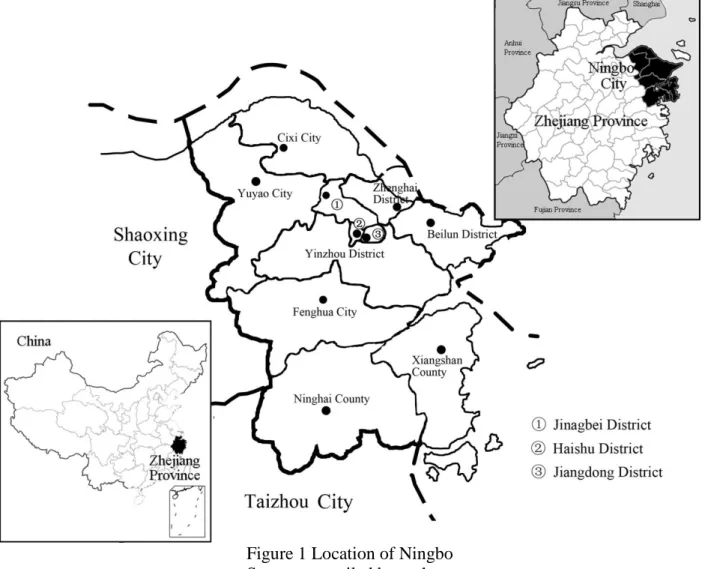
The impact of the transforming business environment and the subsequent intensification of competitive pressures is especially marked in the main manufacturing centers of Chinese apparel industry, such as Zhejiang, Guangdong, and other coastal provinces. I have selected Ningbo city as the primary case study for this research (Figure 1). Ningbo is one of the biggest clothing industrial clusters in China—it produces around 1.3 billion pieces of apparel products each year, which accounts for 40% of the provincial production capacity and 12% of the national total domestic garment production (Li & Fung Research Centre, 2006). By the end of 2006, there were around 131,600 workers employed directly in Ningbo’s more than 2,000 apparel
Figure 1 Location of Ningbo Source: compiled by authors
Zhang, 2008). Ningbo’s apparel products began to penetrate the domestic markets, which were still dominated by central and regional planning and its shortage economy.
Since the initiation of Reform and Opening-Up Policies in the late 1970s, Ningbo’s apparel industry has experienced two rounds of industrial restructuring. The first round, catalyzed by the Reform, was centered on a process of transformation from small
family business units to real registered enterprises (shareholding enterprises or limited liability corporations) and a process of privatization from state-owned enterprises to private or joint-venture enterprises. From 1980s to 1990s, the first generation of apparel enterprises emerged. As marketization, privatization and globalization deepened, firms also developed their own brands for domestic markets while taking on export contracts as global buyers increasingly relocated apparel production from Hong Kong, Taiwan and South Korea to mainland China. In 1990s, export-oriented production surpassed domestic-oriented production and soon comprised the bulk of Ningbo’s apparel industry. In the late 1990s and early 2000s, nearly two-thirds of Ningbo’s apparel firms export over 90% of their production, making Ningbo one of the largest apparel manufacturing and marketing bases in Asia (Li & Fung Research Centre, 2006; Zhao and Gu, 2009). This first round of restructuring was stimulated by an enormous increase in international demand for export goods, especially those dependent on low-wage and unskilled or semi-skilled labor and low-cost factor inputs. As a result, Ningbo’s apparel firms quickly improved
productivity, expanded their capacity and captured economies of scale, and tied their production process more closely to the demands of global buyers (Gereffi, 2009).
In the mid-to late-2000s, this export-oriented, low-wage model started to be
have also been important, including the appreciation of China’s currency, slackening global demand especially after the effects of the Asian financial crisis in the late 1990s and the global financial crisis of 2008, new environment regulations, the effects of China’s new Labor Law, and the spread of expanded Corporate Social Responsibility (CSR) requirements in the industry (Li & Fung Research Centre, 2008; Yang, 2012). Dwindling international demand and rising production costs together formed an exogenous shock and further led to the second round of industrial restructuring in Ningbo’s apparel firms (Figure 2), as many more took advantages of the new opportunities generated by a booming domestic market to adjust to weakening export orders.
Figure 2 Output and Export Delivery Value of Ningbo’s Apparel Industry Data Source: Annual Report of Ningbo’s Apparel Industry (2011)
(Note: Export Delivery Value refers to the value of exported goods on delivery. It is an indicator widely used by the China Statistical Bureau.)
This second round of restructuring has been characterized by a growing
production, and sought to establish core competencies in high-value OEM, ODM and OBM production. Ningbo’s entrepreneurs either opted for upgrading to high-value OEM, ODM and OBM production after years of supplying global brands, or started new businesses directly with high-value OEM, ODM or OBM production. As a result, from the mid-to late-2000s a second generation of enterprises emerged whose characteristics were increasingly related to medium- and high-value production for domestic markets. In recent years, a third generation of enterprise is emerging. These focus on providing industrial intermediary services. They either receive orders from global brands and then outsource to competent subcontractors, or perform integrated product development, sourcing, shipping and logistics for global buyers. Their number and impacts are still limited, but their emergence signals a new way to participate in GVCs where the capture of rents is heavily dependent on the ability of an actor to pull apart the GVC, mediate transactions among its parts, and optimize each step.
This evolution of Ningbo’s apparel industry has been shaped by the broader context of economic regulations and policies; the parallel and linked transformation of other manufacturing, agricultural, and service sectors in the region; and by the ways in which locally rooted
institutions operated under state socialism and continue to do so (see (Pickles and Smith, 1998) for a similar argument about post-socialist European transformations). First, firms benefit from labor pools and inter-firm synergies they have cultivated over time, resulting in complicated vertical and horizontal linkages within the cluster. Far from the independent producers assumed to typify many export processing platforms, Ningbo’s apparel enterprises emerged within
locally-based intensely interwoven networks of trust and personal relationship (also see (Begg et al., 2005; Pickles, 1995, 1998) for analyses of these social networks in European socialist
economic growth and export boom in Ningbo had been partly driven by China’s central government’s commitment to encouraging private sector-led export-oriented industrialization (He et al., 2008; Wei, 2000). Furthermore, China’s decentralization has also empowered local governments to get involved in shaping the regional economy as planners, developers and policy-makers, and some of them have become heavy-handed actors that are ever more convinced of the importance of their ‘steering’ role (He et al., 2008; Wei, 2001b; Wei et al., 2007). The Ningbo Government has been especially active in pushing forward its apparel industry by offering generous financial and technological support to key enterprises, supporting the Annual Ningbo International Fashion Fair (ANIFF), and coordinating between large and small firms. Industry-based local institutions have flourished in recent years, exemplified by the Ningbo Garment Association (NGA). Established in 1998, NGA is one of the most
influential business associations in Ningbo and it took over the running of the ANIFF since its initiation. In addition, it has been organizing visits of Ningbo’s apparel firm managers to successful enterprises in China and abroad each year, often including factory tours and
experience exchange. It represents the apparel industry in negotiating resource allocation, as well as helping local firms to establish design centers and training facilities. NGA has also lobbied nationally and regionally for industry supports for land, bank loans, and tax rebates.
Overview of the chapters
Until recently, the dominance of this model has fuelled growth in low-wage employment in the coastal regions and has provided few opportunities for economic and social upgrading. Since the early 2000s, coastal factories have increasingly had to confront difficulties generated by the increasing social and economic costs of this regionally concentrated low wage growth model. Specifically, Chapter 2 focuses on the role of the apparel industry in this process. It documents the major changes in organization and geographies of economic activity in the industry, and demonstrates how the central and local state, domestic and international capital and Chinese and other Asian workers are shaping the changing organization and geography of China’s apparel industry. This chapter focuses particularly on firm strategies and state policies that have arisen in response to pressure to increase wages from workers, rising materials and energy costs and competition from other low-cost producers in Asia.
Chapter 3, “Global, Regional and Local: New Firm Formation and Spatial Restructuring in China’s Apparel Industry.” Using a large firm-level dataset on new firm formation, this chapter shows the articulation of global, regional and local factors are shaping the new firm formation pattern and industrial relocation in interactional and collective ways. The econometric estimations indicate the ways in which and the extents to which these factors affect firm location choice are highly determined by firm-specific capability.
Chapter 4, “Geographical Dynamics and Industrial Relocation: Spatial Strategies of Apparel Firms in Ningbo, China.” This chapter examines the diverse trajectories of firm
Ningbo. Through an analysis of several case studies I show the articulation of global, regional and local factors are co-shaping firm’s relocation processes and the extent to which these factors affect firm’s spatial strategies is highly dependent on firm’s characteristic. The chapter also examines the opportunities for local suppliers generated by firm relocation.
Chapter 5, “Process, Product, and Functional Upgrading in a Globalized and Localized World: Firm-level Evidence from China’s Apparel Industry.” In this chapter, I focus on one of the central analytical heuristics in GVC research: the concept of upgrading, particularly as it has been used to highlight paths for developing countries firms to ‘move up the value chain’ usually through the lenses of four categories—product, process, functional, and inter-sectoral upgrading. While process and product upgrading have been linked to ‘learning from
global buyers’, the sources of capabilities that lead to functional upgrading, are conventionally
understood to derive from local knowledge transmission and local institutional context. This chapter seeks to test these findings and it does so by using an empirical, firm-level approach to measure upgrading at the firm level, which allows me not only to evaluate the extent of
upgrading in the industry as a whole and to compare its extent among individual firms and selected groups of firms, but also to differentiate and measure different types of upgrading (i.e., functional, process and product upgrading). Empirical results confirm that the heterogeneity of firms, complexity of the effects of global and local linkages over firm upgrading, and the wider historical, political, institutional, economic and social context have all played a critical role in the process of firm upgrading and its articulation with global and local factors.
Chapter 6, “Upgrading in Apparel Global Value Chains: A Heuristic Analytical Framework.” Recent literature dealing with economic upgrading has increasingly been
assumptions about linear, unidirectional upgrading trajectories have been brought into question. As trajectories and sources of upgrading have changed in recent years, the model of the global value chain has itself been adjusted to focus on emerging and new power relationships and upgrading trajectories, particularly with its emerging focus on social as well as economic upgrading. After a discussion of some limits to the treatment of upgrading in the global value chain literature, the chapter interrogates three key assumptions in the GVC model of economic upgrading and the development models it works with. These assumptions have become more problematic with the further development of GVCs. They relate to how we understand functional upgrading and GVC success, the binary of high and low roads to upgrading, and differential learning paths that presuppose specific forms of agency for local and global actors. The chapter concludes by outlining a tentative analytical framework to better guide innovative empirical research and policy making.
Chapter 7, “Path dependent and path breaking: An agent-based model of evolution, co-evolution, and lock-in in a Chinese apparel cluster.” In recent years, former assumptions about the flexibility industrial clusters provide to firms within them has been questioned as inter-firm linkages have, in some cases, locked-in path dependent practices thereby increasing economic rigidities. Not only has the canonical path dependence model overlooked other trajectories of cluster evolution, but it also rarely pays attention to the role of individual agency in affecting path-dependent processes. In this chapter, I build on this critique which has largely been
is subjected to an external shock, leading to a round of far-reaching restructuring. The chapter then investigates some of the ways in which different kinds of agents are co-evolving in response to the external shock and the dilemmas it pose. It does so by portraying the co-evolution of governments and firms as a process fraught with tensions and divergences.
Methodology
Data sources
One database on firm-specific economic and financial variables is central to the firm level analysis in this research: China’s Annual Survey of Industrial Firms (ASIF) (1998-2009). The study time period from 1998 to 2009 is critical in terms of the development of China’s apparel industry as well as its entire manufacturing. This time period is often described as a turning point laden with a variety of far-reaching events which have potentially transformed China’s apparel industry in fundamental ways, such as China’s entry into the WTO in 2001, the removal of quotas on apparel exports to the developed countries in 2005, the appreciation of China’s currency since 2005, and the emerging labor shortage and rising production costs along China’s coastal area since the early 2000s. The 2007/8 global financial crisis which has
stimulated Chinese apparel restructuring, upgrading and relocation also falls into this time period, though its complete effects may take more than two or three years to be seen.
(Number 18 two-digit industry in the Industrial Classification for National Economic Activities GB/T 4754-1994 and GB/T 4754-2002).
Fieldwork
The empirical study was undertaken based also on recent field investigation during the periods of 2011 and 2012. The interviews were carried out with four groups of agents to understand the firm’s geographical and organizational strategies in the face of intensified
competitive pressures. A total of twenty-two face-to-face interviews were conducted with twenty firms. Each interview was with a senior manager, and was accompanied by a shop floor visit to see the plant in operation. In addition, two interviews were conducted with local government officials. Three interviews were conducted with representatives from the local apparel industry association (i.e. Ningbo Garment Association) and another two interviews with representatives from national apparel industry association (China National Textile & Apparel Council and China Textile Planning Institute of Construction). Moreover, four interviews were conducted with the leading scholars of the apparel industry in China, including professors from Peking University, Zhejiang Normal University and Zhejiang Textile & Fashion College. Each interviews lasted at least two hours, and those with key interviewees such as representatives from apparel association and government officials, and several leading entrepreneurs took half a day. Local government and apparel association were first contacted and interviewed, to understand the general structure of Ningbo’s apparel industry. After this, interviews with local apparel entrepreneurs were organized with the guidance of local government and apparel association.
In the first hour of interview, I used a semi-structured method, conversed with
researcher-dominated conversation and unconsciously mentioned something of importance. For example, the extent to which his/her firm was embedded into local cluster might highly depend on how close he/she was with other entrepreneurs in the same cluster. Discussion of such personal information cannot be explored thoroughly with predefined specific questions. Sometimes, entrepreneurs who were unwilling to evaluate their own geographical and organizational strategy if it was not a great success, however, would likely mention and judge other firms’ strategies. This enabled me to triangulate key information of one firm based on the comments from other entrepreneurs, and sometimes from government officials and apparel association representatives.
CHAPTER 2 BRING IN, GO UP, GO WEST, GO OUT: UPGRADING, REGIONALIZATION AND DELOCALIZATION IN CHINA’S APPAREL
PRODUCTION NETWORKS
Introduction
In recent years, a great deal of research in economic sociology, political economy, international studies and economic geography has focused on the globalization, governance and rapidly changing geographies of Global Commodity Chains (GCCs), Global Value Chains
(GVCs) and Global Production Networks (GPNs) (Bair, 2009; Gereffi, 1999; Gereffi et al., 2005; Henderson et al., 2002; Smith, 2012). These attempts to account for the shifting patterns of manufacturing and work and the state and its industrial and regional policies are seen to be playing an increasingly important role in mediating the potentially destabilizing effects of what Gereffi and Mayer (2006) refer to as the “governance deficit.” In this process, a reconsideration of the role of national industrial policies, trade policies and labor regulations is emerging. This is particularly the case in China, where, despite the apparent retreat of the state since its market-oriented reforms, the state has continued to be an active participant not only in strategically critical industries such as the manufacture of transport equipment, but also in the “most
I focus on these industrial and regional dynamics and the various adaptations the apparel industry is undergoing in response. The chapter documents some of the ways in which different levels of government and different kinds of firms are attempting to deal with these limits and the dilemmas they pose. It does so by focusing specifically on spatial and organizational responses including factory consolidation, plant closure, product, process chain upgrading and
geographical relocation (Liao and Chan, 2011; Yang, 2012). I draw on fieldwork in China in 2011 and 2012, interviews with firm managers, CSR officers, labor organizations, regional administration and central government officials and industry association officials, as well as firm-level data to assess spatial changes over time. I seek to demonstrate that the model of inward investment, global sourcing and export orientation is already undergoing fundamental restructuring, producing new geographies of production and employment, with the consequent need to re-assess the policy implications of China in globalproduction networks. Section II contextualizes the development of the apparel industry in terms of a specific export-led model of industrialization (its spatial distribution, export, output value, employment and the temporal changes of these indicators), with a particular focus on the pressures that have cut manufacturers’ profit margins and are now forcing the government and manufacturers to implement new
strategies to manage competitiveness and the social costs of growth. Section III outlines the emerging limits of this model of industrialization. Section IV deals explicitly with three policies and enterprise responses to these pressures: upgrading, westernization (or regionalization) and
delocalization (or outsourcing). The chapter concludes with an analysis of the impacts of these
policy initiatives on apparel production networks and global value chains.
Bring in: export-led assembly and the rise of China in global apparel value chains
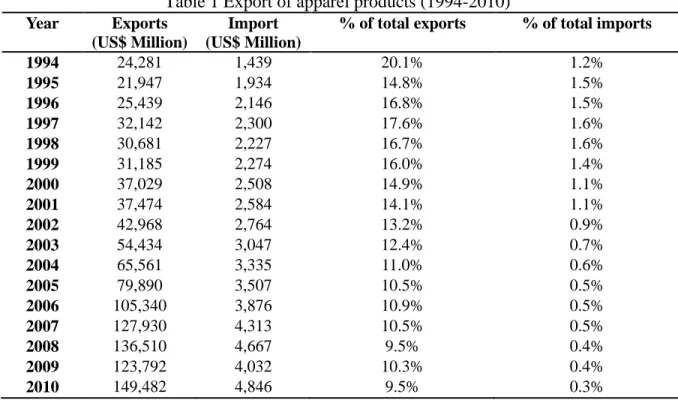
Between 1994 and 2010, despite declines in 1998 and 1999 as a result of the Asian Financial Crisis, China increased its apparel exports from US$24.3 billion to US$149.5 billion (Table 1). In the 1990s, apparel exports were driven largely by demand from US markets, but with entry into the WTO in 2001 and the removal of quotas worldwide after 2004, Chinese apparel exports expanded to all world markets.
Table 1 Export of apparel products (1994-2010)1
Year Exports
(US$ Million)
Import (US$ Million)
% of total exports % of total imports
1994 24,281 1,439 20.1% 1.2%
1995 21,947 1,934 14.8% 1.5%
1996 25,439 2,146 16.8% 1.5%
1997 32,142 2,300 17.6% 1.6%
1998 30,681 2,227 16.7% 1.6%
1999 31,185 2,274 16.0% 1.4%
2000 37,029 2,508 14.9% 1.1%
2001 37,474 2,584 14.1% 1.1%
2002 42,968 2,764 13.2% 0.9%
2003 54,434 3,047 12.4% 0.7%
2004 65,561 3,335 11.0% 0.6%
2005 79,890 3,507 10.5% 0.5%
2006 105,340 3,876 10.9% 0.5%
2007 127,930 4,313 10.5% 0.5%
2008 136,510 4,667 9.5% 0.4%
2009 123,792 4,032 10.3% 0.4%
2010 149,482 4,846 9.5% 0.3%
Source: (National Bureau of Statistics of China, 2011)
Between 1995 and 2008, China more than doubled its share of global apparel exports, from 15.2% to 33.2%, and it experienced a fivefold increase in the value of its apparel exports, from US$24 billion to US$120 billion. With expanded exports, dependence on specific markets was reduced (Gereffi and Frederick, 2010). Thus, while China’s top ten export destinations accounted for 91.5% of apparel exports in 1996, the top ten markets accounted for only 79.1% in
1Data on exports of apparel products are calculated by adding up four categories of Textile and Apparel Articles: 1.
2008. In 1996, Japan alone accounted for 32.6% of China’s apparel exports and the US and the EU-15 accounted for another 22% (Hong Kong’s 26.4% of exports was largely for re-export). While by 2008 the EU-15 and the US had become the top two export destinations, they then
accounted for less than 40% of total apparel exports and exports to Japan had dropped from 32.6% to 14.7%.
As the structure of China’s industry changed and as producers shifted their comparative advantages from low-wage labor and low-end technology to medium technology and higher quality goods, the apparel share of total exports, particularly manufacturing exports, continued to decline. As a share of total exports, apparel declined from 20.1% in 1994 to 9.5% in 2010 and the value of apparel imports (always relatively small) declined from 1.2% to 0.3%, but as an
employment generator apparel remained important, accounting for more than 5% of employment in all industrial sectors in 2009.
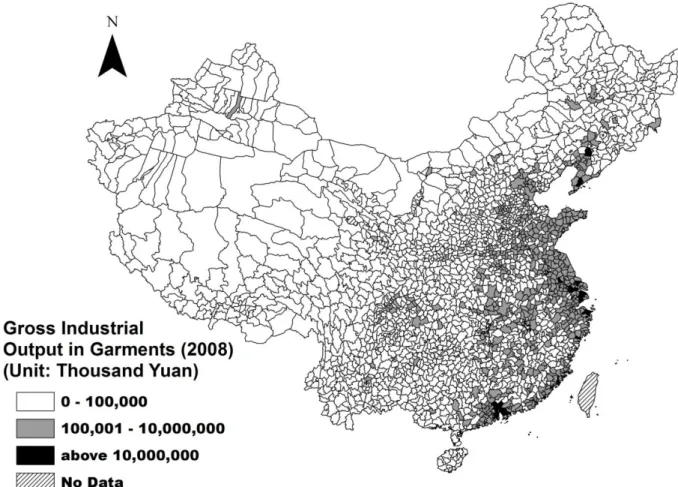
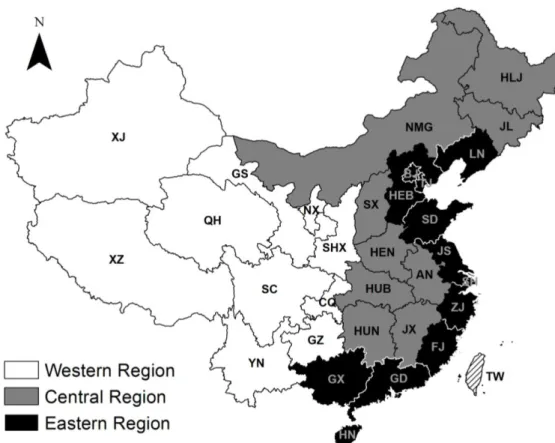
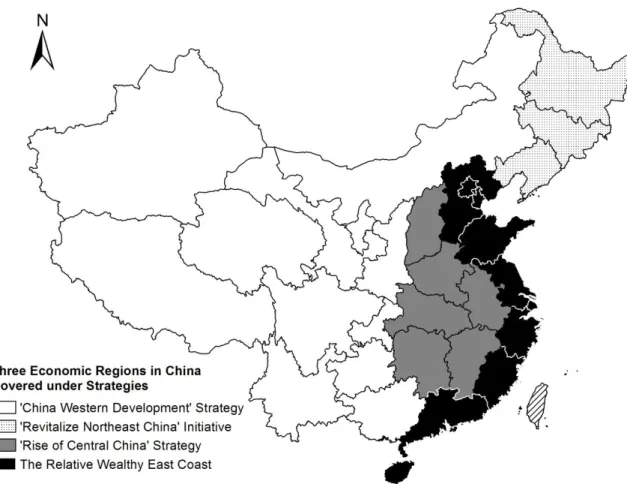
The resulting geographies of apparel manufacture and employment were shaped increasingly – at least until recently – by these shifts in global sourcing for export markets. Export production was concentrated in eastern coastal regions, with primary concentrations in Shandong, Jiangsu, Zhejiang and Guangdong provinces and some outliers in regional centers such as those in central China along the Yangtze River (Figure 3). The three planning regions in Figure 4 – Western, Central, and Eastern – are China’s formal administrative planning regions. I introduce them here to provide a clearer picture of patterns of employment growth and
dependent on expanded flows of low-wage migrant workers from the countryside, particularly from inland regions.
Figure 4 Chinese Provinces and Centrally Administered Municipalities (Note: AH: Anhui, BJ: Beijing, CQ: Chongqing, FJ: Fujian, GD: Guangdong, GS: Gansu, GZ: Guizhou, GX: Guangxi, HEB: Hebei, HEN: Henan, HLJ: Heilongjiang, HN: Hainan, HUB: Hubei, HUN: Hunan, JL: Jilin, JS: Jiangsu, JX: Jiangxi, LN: Liaoning, NMG: Neimenggu (Inner Mongolia), NX: Ningxia, QH: Qinghai, SC: Sichuan, SD: Shandong, SH: Shanghai, SHX: Shaanxi, SX: Shanxi, TJ: Tianjin, TW: Taiwan, XJ: Xinjiang, XZ: Xizang (Tibet), YN: Yunnan, ZJ: Zhejiang)
For many, this was a “race to the bottom” with intensification of the labor process, low wages, poor labor and environmental standards and weak enforcement of national and local laws (Appelbaum et al., 2005). For others, China is simultaneously engaged in a “race to the top,” with some enterprises aggressively trying to move up the value chain through investments in R&D, design and advanced manufacturing, with an emphasis on domestic innovation. This export boom – officially referred to as the BRING IN policy – was predicated on low-wage assembly production, but has quickly generated greater capacity, vertical and horizontal
internationally competitive prices while offering progressively higher quality products in expanded economies of scope and scale.
The limits of export-led, low-wage industrialization
Since the early 2000s, factories in eastern China have increasingly confronted difficulties generated by this export-led low-wage growth model. The first dramatic transformation was driven by appreciation of China’s currency, inflation, increased raw materials costs, lack of water and electricity as industrial capacity expanded, and increasing labor costs and labor shortages as local and migrant workers shifted away from jobs with low wages and poor working conditions, prevalent in the industry. Export-oriented firms, in particular, found themselves
squeezed between low contract prices, rising input costs and the struggles of migrant workers for better wages and working conditions, increasing numbers of whom have found it
progressively easier to shift into other industries and occupations (Inagaki, 2006). According to the Ministry of Human Resources and Social Security of China, the average monthly salary for the country’s migrant workers reached 2,049 Yuan ($325) in 2011, up 21.2% from 2010 (China
Daily, February 29, 2012). Currency exchange rates were also important with – in the case of
Zhejiang province for example – every 1% rise in the value of the RMB leading to 3.19%, 2.27% and 6.18% declines in profit margins for cotton textiles, wool textiles and apparel, respectively
(Global Textiles, December 1, 2004). As a result, in 2008, two thirds of textile and apparel
enterprises in six provinces (including Jiangsu, Zhejiang and Shandong) were operating with profit margins as low as 0.62%, and the profit margins for the remaining enterprises were only 6-10%, with an average as low as 3.9% for all textile and apparel enterprises (First Financial Daily, March 27, 2008).
production costs. Labor costs have been affected by the 2008/9 new Labor Contract Law (LCL) and by China’s Social Compliance 9000 for the Textile & Apparel Industry (CSC9000T). These have extended labor rights, particularly concerning overtime, delayed wage payment and job security. As one firm manager in Ningbo commented:
The new labor law did lead to a substantial increase of production costs, in particular for small firms which only do OEM production and work on low margins. They had
difficulties in absorbing such costs as easily as firms doing OBM and ODM
(General Manager of Peace Bird, translated from Chinese) At the same time, the apparel industry has been confronted by more environmental regulations, particularly those based on the 2007 State Council Comprehensive Work Plan of Saving Energy
and Diminishing Pollution, which increased the expense of pollution control for producers.
During the 1990s, apparel employment became increasingly concentrated in coastal regions (see Figure 5).2Since the early 2000s, the pressures on coastal apparel manufacturers have forced drastic changes in firm behavior, leading to upgrading, expansion of operations to new products or centers or relocation to lower cost locations. Guangdong has succeeded in keeping its dominant position with about 12.8% of the market share in 1988 and 24.2% in 2007. Zhejiang nearly tripled its share, from 6.7% in 1988 to 17.2% in 2007. Jiangsu significantly increased its share, from 11.2% in 1988 to 17.1% in 2007 and maintained one of the dominant positions. The apparel industry in Shanghai was the first to experience these pressures, with some firms investing in new forms of product, process, functional or market upgrading and others relocating production to regions with lower costs. As a consequence, apparel employment in Shanghai declined from 603,000 in 1998 to 146,000 in 2007. As the 2007 map of employment shows, apparel employment has already started to shift westward to Henan and Jiangxi provinces.
2Longitudinal analysis of industrial employment in textiles and apparel has to take into account the administrative
Figure 5 Temporal Changes of Distribution of Employment in Garments by Province Source: Compiled by authors from annual issues of China Industry Economy Statistical
Yearbook
experience competition for workers and upward pressure on wages, different organizational and spatial strategies have emerged with some firms investing rapidly in various forms of industrial upgrading and labor market development, while others are moving out of these clusters and seeking to agglomerate in new geographies. The challenge facing the resulting delocalization of apparel production will be the extent to which new competitive advantages emerge or can be built in these new spaces, and the extent to which “thick ties,” embedded institutions and deep labor markets can be reproduced in the emerging geographies of production. Who is moving and who is staying, and to what extent is the re-institutionalization of new productive spaces being driven by firms and by government policy?
Upgrading, regionalization and delocalization
While most studies of GVCs and GPNs have focused on the diversity of forms of governance within the value chain, rather than on the role of state actions and government policies, recent work on GVCs and production networks has stressed the significant role that state action plays in the international, national and sub-national formation, constitution and restructuring of firms in global production networks (Gereffi et al., 2005). In this section I analyze upgrading, regionalization and delocalization strategies in the context of national economic regulation and policies. The state, in particular, has played an important role through national economic regulation and policies in shaping patterns of industrial upgrading,
regionalization and delocalization (Coe et al., 2008a; Dicken, 2007; Liu and Dicken, 2006). GVC analysis defines “governance” as the functional integration and coordination of internationally dispersed activities (Gereffi, 1999) and often argues that the action and
possibilities for local institutions to affect outcomes, state policies and institutional context have been under-estimated (Gereffi et al., 2005). Bair (2009) has argued that in such analyses institutional context was too often added later and still remains the least developed dimension of value chain analyses. Most recently, Adrian Smith (2012) has called for a much fuller
engagement within GVC analysis with state theory and the role of institutional actors and regulations. Because globalization destabilized the governance of nation state and local institutions through its footloose sourcing practices, an increasing proportion of work for the global market took place in locations where governance capacities were weak, if developed at all (Mayer and Pickles, 2010). As a result, the absence of public and private regulation – the global “governance deficit” – has been the focus of much subsequent political, economic and non-governmental analyses and interventions (Gereffi and Mayer, 2006). GPN analysis has been more explicit in its attention to the importance of institutional context and the whole range of factors that contribute to shaping global production and focuses on moving away from the firm- and chain-centered claims of GVC work, but even here the state is theorized in a limited sense as a single institutional ensemble wielding uneven forms of power over global production networks (Coe et al., 2004; Dicken and Henderson, 2003; Henderson et al., 2002).
It is increasingly acknowledged that developing economies need to embed private
increasingly serious, forcing the central government and regional administrations to become more active in regulating the trajectories and geographies of change in the industry.
After a period of liberalization during which the direct role of the state in shaping industrial locational and organizational decisions was diminished in apparel firms, government strategies are now playing an increasingly leading role in shaping industrial policy in labor-intensive and low-value enterprises, pushing and encouraging them to relocate from the higher-cost eastern regions to release space and resources for higher-value apparel and other industries while simultaneously encouraging economic development in less developed inland locations, particularly in areas from which migrant workers have been drawn. Thus, in addition to China’s continued commitment to encouraging inward investment (BRING IN policy), these adjustments have given rise to three broad additional state policies: upgrading (GO UP policy),
regionalization or westernization (GO WEST policy) and delocalization (GO OUT policy). The GO UP policy refers to Chinese manufacturers that are being encouraged to upgrade production and working conditions in situ with the goal of branding Chinese goods for national and
increasingly for international markets. The GO WEST policy refers to low-wage assembly industries that are being encouraged through subsidies, contracts, and infrastructural
development to relocate to or expand in new lower-cost and less developed locations inside
China(mainly, but not limited to, Western and Central provinces), often regions from which
migrant workers have traditionally been drawn. The GO OUT policy refers to low-wage assembly work that is being encouraged to outsource to low-cost producing centers outside
China, particularly under the auspices of emerging, large-scale Chinese manufacturers and
network organizers.
and delocalization have emerged as major drivers of industrial upgrading, regionalization, and delocalization in many traditional manufacturing and export hubs for apparel products,
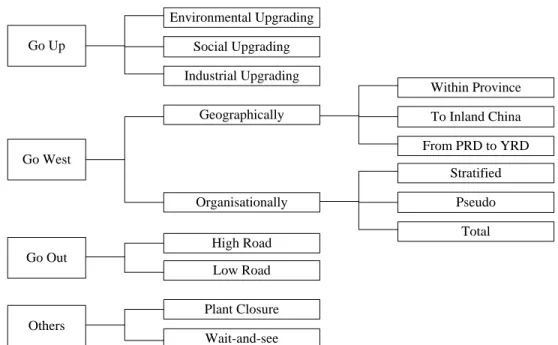
particularly in the coastal region. Manufacturers have responded in four ways (Figure 6).3 In the subsequent sections I describe each in turn.
Go Up
Go West
Go Out
Environmental Upgrading Social Upgrading Industrial Upgrading
Geographically
Organisationally
High Road Low Road
Within Province To Inland China From PRD to YRD
Stratified Pseudo
Total
Others
Plant Closure Wait-and-see
Figure 6 Restructuring Strategies Adopted by the Export-oriented Apparel Firms Source: Compiled by Authors.
GO UP: policies initiatives on industrial upgrading
One of the key drivers of the complex regional production network dynamics is the role of industrial and value chain upgrading. Upgrading involves producers’ capability “to
make better products, to make products more efficiently, or to move into more skilled activities” (Kaplinsky, 2000; Pietrobelli and Rabellotti, 2006: 1; Porter, 1990). It is an increasingly central
3GO WEST here refers to one general tendency to expand or relocate from the Pearl River Delta (PRD), Yangtze
element in shaping new geographies of production, as economic actors (countries, firms, workers and regional economies) shed low-value activities, and the social and economic problems they can generate, in favor of higher-value activities (Bair, 2005; Gereffi, 2005; Humphrey and Schmitz, 2002b; Ponte, 2002).
Industrial upgrading is central to the state’s central planning mechanism. In China’s Eleventh Five-Year Plan, the upgrading and optimization of industrial structure ranks second among the main goals of economic development from 2006 to 2010, aiming at increasing
industrial competitiveness through expanded R&D, branding, and expansion of tertiary industries, accelerating development of high tech industries, improving efficiency in energy use,
encouraging independent innovation and supporting advanced technical education. Between 2000 and 2005, the proportion of expenditure on R&D to the total GDP increased from 0.9% to 1.3%. According to the Eleventh Five-Year Plan, more than 100 national engineering laboratories were to be built between 2006 and 2010. Education and skill training for labor are being
promoted at both national and local levels. Many local governments also offer free training for migrant workers, such as the “Sunshine Project: Training for Labor Transferred from Rural Areas” (The State Council of the PRC, 2004).
In order to variously support and compel apparel firms to upgrade, the Adjustment and
Revitalization Plan of Textile and Apparel Industry released by the State Council in 2009,
identified several adjustment and revitalization tasks for the textile and apparel industry in 2009-11. These tasks included an increase in the export tax rebate rate from 14% to 15%, support for expansion of domestic consumption, new investments in autonomous innovation and
optimization of the regional structure of production to promote industrial upgrading in the eastern coastal areas and enhanced credit and other financial support for SMEs. The Plan placed particular emphasis on building a strong textile and apparel industry to survive the financial crisis and shifts in global demand.
As a result, in recent years apparel enterprises have rapidly been adopting new
technologies and experimenting with product development, environmentally friendly methods, focusing more on brand building and product design and exploring international markets for higher value products and domestic markets to stabilize production runs (Mayer and Pickles, 2009). One such company is the Hongdou Group. In 1980s, Hongdou began hiring engineers and technicians, and investing in new technology and product innovation. In 1993, it made the
decision to extend its production capacity and industrial chain, producing suits, shirts and other apparel products of much higher quality and value. In 1995, Hongdou also adopted a strategy of chain upgrading by annexing capital intensive motorcycle and tire manufacturing enterprises, as well as investing 90 million Yuan in the pharmaceutical industry. Meanwhile, with growing skilled labor shortages, Hongdou changed its recruitment policy in its apparel factories. Instead of attempting to recruit skilled labor in increasingly tight labor markets, it built up its own Wuxi Hongdou Vocational School and trained workers internally. In addition, Hongdou upgraded this vocational school to Hongdou College so as to teach not only production and manufacturing tasks but also R&D, marketing and design (Hongdou Group News, June 7, 2010).
through increased discipline, extended hours and speeding-up of production lines, with the unfortunate consequence that technical and organizational upgrading has resulted in the
downgrading of social conditions and, in some cases, job loss (Mayer and Pickles, 2009; Pickles et al., 2006). The relationships between industrial upgrading/downgrading and social
upgrading/downgrading are not linear and one form does not easily follow another within any specific regional economy (Pickles and Smith, 2011).
Recognizing the importance of this issue and the need for explicit state action to support social upgrading, the 2007 National People’s Congress of China promulgated a new Labor Contract Law (LCL), which took effect on 1 January, 2008, with the objective of improving working conditions. Labor law is a relatively new phenomenon. The first comprehensive labor law was passed in 1994. Prior to the LCL’s passage, most employees in SMEs did not have employment contracts. Even those with contracts often only had short-term agreements, providing employers with the flexibility to bring in new, often cheaper, workers as needed. Employers often refused to pay overtime and some even relied on forced labor (Interview, textile association staff, Beijing, June 2011). The new LCL has made many changes to prevailing contracting and employment practices (Table 2). The main intention of the new LCL was to expand protection to employees by offering an “employee-friendly” environment (BMU Service, January 1, 2008). One consequence has been the formalization of labor contracts and the
enforcement of worker rights after specific periods of employment. The indirect effect in many factories has been the adoption of a more cautious hiring policy and the consolidation of work contracts around key technical personnel, with a parallel increase in short-term and temporary work contracts. As one firm manager in Ningbo commented
Firms which rely on short-term and temporary workers and fire them before the
the first few month. Firing them before they can really create profits is like killing the goose before it can lay eggs. A smart employer should get through this challenge through upgrading his firm.
(Founder of Baimu, translated from Chinese) It remains too early to draw any determinate conclusions about the effect of the new labor law on firm strategies, but initial evidence points to a range of responses from workforce upgrading to the outsourcing of production (Lan and Pickles, 2011).
Table 2 Key Points of China’s New Labor Contract Law Key Provisions
1 In drafting or revising work rules and regulations, an employer must consult with the applicable labor union, employee representatives or the employees. If the work rules are deemed to be inappropriate, the labor union, employee representatives or the employees may raise issues during the consultation process.
2 Employers are required to execute a written labor contract with an employee within one month of hiring or face statutory penalties.
3 The probationary period of an employee is determined according to the length of term of the labor contract.
4 An employer may require an employee to sign a service agreement requiring a period of service for, and imposing an early termination penalty on, an employee who receives training at the employer’s expense. Only senior management personnel, senior technical employees or other employees who have access to an employer’s trade secrets may be required to sign confidentiality and non-compete agreements, which may extend for a period of up to two years.
5 Three types of labor contracts are authorized: fixed-term contracts, non-fixed-term contracts and project-based contracts.
6 Severance payments are required in many circumstances under which an employee is terminated.
Source: BMU Service (2008).
The former Ministry of Textiles and Clothing, now organized as a series of public-private associations, has also actively responded to the need to improve workplace and product
which is the only lawful trade union. It is a combination of the management standard ISO 9000 and the CSR standard SA8000 (Asia Portal, July 13, 2008). SA8000 is based on international labor and human rights law, while CSC9000T is based on China’s labor law. The latter refers to an extensive list of international human and labor rights declarations and conventions, such as the United Nations Conventions on the Rights of the Child, the Universal Declaration of Human Rights, the International Covenant on Social, Economic and Political Rights, the UN Convention on the Elimination of all Forms of Discrimination Against Women and the International
Covenant on Civil and Political Rights. Also important are ILO Conventions on weekly rest, accident compensation, minimum age, tripartite consultation and equal remuneration. The CSC9000T contains three main sets of principles: (i) Enterprises are required to set up a CSR management system based on the Plan-Do-Check-Act model; (ii) Employees must be offered written employment contracts and employers must not use child or forced labor, observe legally stipulated working hours, and pay legally required wages; and (iii) Employers are required to respect the rights of employees to form and join the trade union and to bargain collectively, not to discriminate against workers, to prohibit harassment and abuse and to pay attention to occupation health (Responsible Supply Chain Association, November 14, 2010).
CSC9000T and LCL aim to contribute to the promotion of employee well-being and social upgrading, but they too are not without their limits. Thus, while China’s LCL allows employees to establish local or industrial branches of the official trade union, it does not allow independent trade unions. As a result claims that the LCL provides better protection for
pushing social upgrading and local authorities focusing more on enterprise competitiveness and potential job loss resulting from enterprises relocation.
GO WEST: regionalization policies and inter-regional competition
Table 3 Policy Initiatives Launched by Chinese Governments on GO WEST
Time Organisation Policy Initiatives Summary 2000 State Council “China Western
Development” The main policies of the plan include
5
: (1) the development of infrastructure (transport, hydropower plants, and telecommunications), such as the “West-East Gas Pipeline” and Qinghai-Tibet Railway (from Beijing to Tibet); (2) adjustment of industrial structure; and (3) deepening the reform and increasing openness of the economy to entice foreign investment to the western region (Figure 7).
2001 State Council “Outline of National Economic and Social Development of the Tenth Five-Year Plan from 2001-2005”
2006 State Council “Eleventh Five-Year Plan on Western Region Development” 2006
-2009
Ministry of Commerce
“10,000 Businesses Go
West” program To encourage about 10,000 companies located in eastern areas to invest in central and western China
2008 -2010
Ministry of Commerce
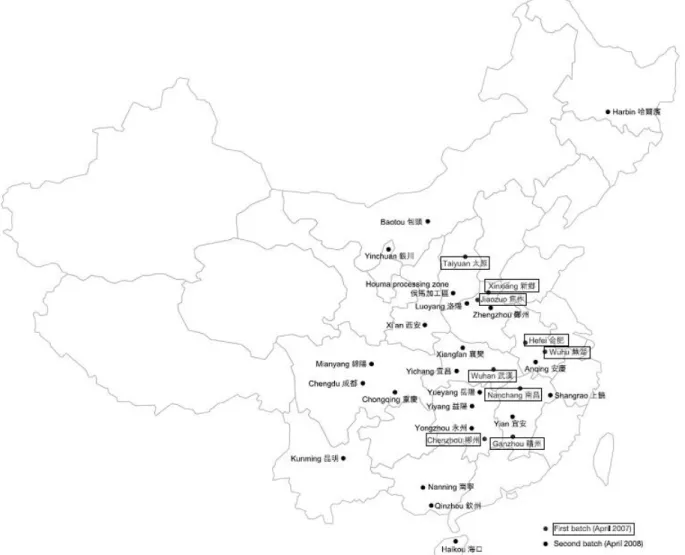
Priority Relocation Destinations of the Processing Industry
The Ministry of Commerce set a goal for 2010 of the creation of 50 priority relocation destinations in central and western China to attract processing enterprises that would relocate from coastal regions (Figure 8). The State Development Bank provided loans, tax incentives, and building supporting facilities to encourage relocation, including investments in water and electricity supply, waste management, education, warehousing and transportation. 2010 National
Development and Reform Commission
Industrial Transfer Demonstration Zone of the Wanjiang River Urban Belt
This is China’s first national-level industrial transfer zone to encourage the relocation of low-end industries from coastal to inland areas (Figure 9). The zone is part of the government’s project to help eastern China move up the value chain while keeping low-end and low-value-added manufacturers inside the country. In the plan priority is given to equipment
manufacturing, raw materials, textile and apparel, high-technologies, services and agriculture.
5The same policies motivate the “Revitalize Northeast China” program, which is intended to rejuvenate the old
Figure 8 Priority Relocation Destinations of the Processing Industry Identified by the Ministry of Commerce (2007 and 2008)
Note: The third batch issued in 2010 is not shown on this map.
Figure 9 Industrial Transfer Demonstration Zone of the Wanjiang River Urban Belt Source: Anhui Provincial Development and Reform Commission reproduced from China.org.cn,
March 14, 2011
(http://www.china.org.cn/china/anhui_media_tour/2011-03/14/content_22135889.htm) For the apparel industry, in 2010 the Ministry of Industry and Information Technology released the Guideline on Pushing Forward Relocation of Textile and Apparel Industry (Ministry of Industry and Information Technology of China 2010).According to the Guideline, there are several industrial relocation tasks for the textile and apparel industry in order to integrate
industrial location with upgrading strategies. In the eastern coastal region, state policies are to be aimed at accelerating industrial upgrading and the shift to high-end textiles and apparel,
developing brands and strengthening design and marketing capacities, the relocation of spinning, silk reeling, weaving, and other labor-intensive or/and low-tech production activities to western, central and north-western regions by means of mergers and enterprise reorganization or
inland regions. In central China the Guideline is aimed at strengthening the textile and apparel manufacturing system, actively facilitating the shift of textiles from east to west, and developing an integrated cotton textile, wool textile, knitting, garment, home textile and industrial textile manufacturing system in the region. In the western region, the Western Development strategy encourages the development of the textile and apparel industries, especially those with local characteristics such as cotton textile, silk, and garment industries. In the north-eastern region, the policy aims to develop chemical fiber, flax, garment and other labor-intensive processes which have some comparative advantage there. In all these policy environments, a key aim is to prevent the unwarranted transfer of discarded, obsolete industrial equipment and polluting enterprises from the east to other regions.
In 2007, China’s Ministry of Commerce and China Customs promulgated the “List of Restricted Commodities in Processing Trade,” differentiating between allowed labor-intensive processes inland and those that are now restricted in the east. Importantly for my purposes, textile and apparel products made up most of the restricted labor-intensive processes and products. As a result, apparel enterprises in coastal regions (which account for 85% of apparel industry) had little option but to upgrade or to relocate inland.6
The impacts of these policies on the industrial geography of textiles and apparel are marked. By 2010, investment in central and western regions accounted for 39.13% and 7.90%, respectively, of the total investment in textiles and apparel, an increase of 19.71% and 1.29%
6The government has also actively encouraged and, in some cases, compelled textile and apparel enterprises to
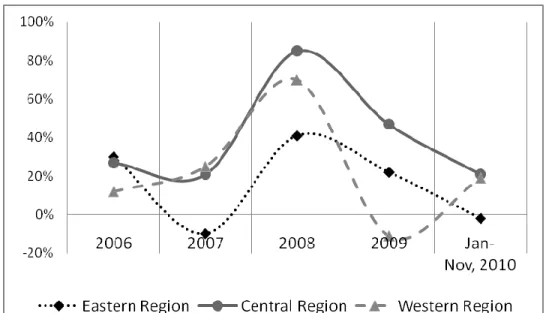
from 2005 (Figure 10). The global financial crisis has further stimulated Chinese textile and apparel restructuring and relocation. For example, annual growth rates of new textile and apparel projects have continued to decline in eastern and central regions, but in the western region growth rates have rebounded after a dramatic decrease in 2008-09 (Figure 11).
Figure 10 Distribution of Investment in Textile and Apparel Industry (2005 and 2010) Source: Adapted by the authors from Annual Report on Corporate Social Responsibility in
Chinese Textile and Apparel Industry-2010/2011 (CNTAC 2011)
Figure 11 Annual Growth Rate (YOY) of the Number of Newly-commenced Projects in Textile and Apparel Industry (2006-2010)
Local Government Policy: Inter-regional Competition for New Investments
Local administrations in the coastal and inland regions have remained active in
promulgating their own policies based on local needs to attract investment and create jobs (Wang and Mei, 2009). Local governments in the less-developed inland regions regard industrial
relocation policy as an opportunity to attract investment and boost economic development. As a regional administration officer in Anhui expressed it, “The coastal provinces became wealthy and their economy took off by developing labor-intensive industries like apparel. Now it is our turn and we should be prepared in the new round of industrial relocation” (Interview, regional administration, Anhui, July 2011). These local administrations lobby firms and offer low land rent and other favorable policies, which – they claim – make their enterprises competitive with those in other provinces and even with emerging export production in Southeast Asian countries (see Table 4).
Table 4 Policy Initiatives Offered by Inland Provinces/Cities to Entice Relocating Enterprises Provinces/Cities Examples of Policy Initiatives
Anhui Industrial relocation park, designated funds to support relocation, improving infrastructure, simplifying custom procedures, improving job training
Hunan Financial support for relocation, improving services in logistics centers and customs, simplifying the approval procedures of relocation projects Hubei Designated funds to support relocation, improving transport
infrastructure
Yueyang (Hunan) Tax breaks, simplifying customs procedures
Chenzhou (Hunan) Subsidies on construction of production plants, improving transport infrastructure
Ganzhou (Jiangxi) Tax breaks, subsidies on usage of electricity and water
Wuhu (Anhui) Improved government services, waiving of administration fees of some of the government services during the course of relocation, providing financial support, developing industrial relocation park, strengthening collaboration with Shanghai
Source: Compiled by authors from data in (Li & Fung Research Centre, 2008).
weakening their own plans for local economic development. In the view of a Ningbo regional administration official: “It is all about GDP” (Interview, firm manager, Ningbo, August 2012). Consequently, they too have become increasingly active in encouraging enterprises to adopt one of three policies: (i) to upgrade locally, (ii) to maintain their headquarters and R&D centers while relocating only low-end and labor-intensive activities to inland China, or (iii) to relocate but
within the province. For instance, Jiangsu announced the “Relocation across the Yangtze River”
plan to provide financial support, offer acres of cheap land and favorable investment policies to firms in South Jiangsu that are willing to relocate to North Jiangsu. Similarly, by issuing “173 Plan,” Shanghai collaborated with neighboring areas to prevent firms from relocating out of the province. In 2008, Guangdong announced the Decision on Encouraging Industry and Labor
Relocation (also known as “Double Relocation”) in which measures and funds are designated to
facilitate industry and labor relocation within the province. These include inducements for labor-intensive, resource-consuming, processing industries to move from the central Pearl River Delta (PRD) to less developed areas, such as northern, western and eastern Guangdong. Provincial policies also support the relocation of labor from agriculture to the secondary and tertiary sectors in order to concentrate the skilled labor force in the central PRD, as a way to favor the
technological upgrading of industry. In addition, 24 government-driven “Industrial Relocation Parks” have been set up within Guangdong province, mostly located in less developed areas, to encourage internal relocation (Interview, China National Textile and Apparel Council, Beijing, June 2011).
Regionalization of Enterprises
traditions and laws, and these are perceived to offer lower relocation risks. By contrast, going out requires relocating apparel enterprises and training staff to become familiar with local culture and laws, which might lead to high operational risks. Second, as long as the importance of domestic markets continues to grow, going west also provides opportunities for market capture as well as reducing production costs. Third, as technical demands increase, technical and
managerial workers become an increasingly important asset and one for which westernization is more easily managed than overseas relocation, especially for smaller firms with more limited capacities.
For example, the Youngor Group, China’s leading menswear manufacturer based in the eastern region, Ningbo, Zhejiang province, has turned to a delocalization strategy. Youngor started to go west in 2004, when a manufacturing base was built in Chongqing for 100 million Yuan (US$14.65 million). The labor force and energy resources in Chongqing are relatively cheap compared with Zhejiang province. Subsequently, Youngor invested an additional 100 million Yuan (US$14.65 million) to increase productivity in the Chongqing plant and now
this base can produce 15,000 shirts every day, with a planned increase to 24,000 per day by 2011. As domestic markets have grown, Youngor has been increasingly able to sell most of its products locally in the western region, further saving Youngor on transportation and logistics costs.7 In 2005, Youngor established a cotton textile company in Xinjiang, and has now begun to expand its value chain into raw material production. More than 2,000 employees were hired locally in Chongqing and over 1,000 employees in Xinjiang.
Not all enterprises find these policy and cost incentives sufficient to induce them to
7
relocate. Many apparel enterprises have adopted a wait-and-see attitude (see Figure 6). For some enterprises, relocation to underdeveloped regions is not commercially viable unless the entire supply chain moves and, even then, they indicate that they would only relocate if enough government incentives were offered (Li & Fung Research Centre, 2008). A 2008 Federation of Hong Kong Industries survey of 200 enterprises in the PRD found that shortage of labor, high logistics costs and inadequate support from local governments in less developed regions were major obstacles preventing enterprises from relocating to western and central China (Federation of Hong Kong Industries, 2008). On the other hand, the Yangtze River Delta (YRD) region, with well-developed infrastructure, abundant skilled labor, strong support from local governments, good business environment and access to global markets, was seen as an optimal destination for such relocation. For some firms, relocation from PRD to YRD is considered to be the first step to the further possible relocation to and expansion in less developed inland regions. The Industrial Cluster Research Group from the China National Garment Association interviewed children’s wear enterprises in Huzhou, Zhejiang (in the YRD) in February 2009 and found that most of the 800 new enterprises had moved from PRD in this way (China Apparel (EFU), September 14, 2009).