Accessing Intermediate and High Oxidation States with
Tungsten and Iridium Pincer Complexes
Leah Wingard
A dissertation submitted to the faculty of the University of North Carolina at Chapel Hill in partial fulfillment of the requirements for the degree of Doctor of Philosophy in the
Department of Chemistry
Chapel Hill 2012
i ABSTRACT
LEAH A. WINGARD: Accessing Intermediate and High Oxidation States with Tungsten and Iridium Pincer Complexes
(Under the direction of Joseph L. Templeton)
The silazane PNP ligand [HN(SiMe2CH2PPh2)2] has been coordinated to tungsten(0) in three different conformations and these three complexes can be interconverted. The PHNP ligand can be bound as a bidentate ligand through the two phosphine arms as in W(PHNP)(CO)4, as a tridentate facial ligand in W(PHNP)(CO)3, or as a tridentate meridional ligand in W(PHNP)(CO)3. Formal oxidation by protonation of the metal center occurred to form a cationic tungsten hydride species. A related series of cationic tungsten(II) halide complexes was synthesized, [W(PHNP)(CO)3X]+ (X= I, Br, Cl, F) by various routes. All of the tungsten(II) complexes underwent deprotonation at the amine site of the PHNP ligand when triethylamine was added, resulting in neutral seven-coordinate complexes.
ii
could be abstracted from (NCN)Ir(CH2CH3)(Cl) to access various neutral and cationic species.
Oxidation of (NCN)Ir(CH2CH3)(Cl) to iridium(V) intermediates occurs by electrophilic addition and oxidative addition pathways. Addition of iodine appears to follow an electrophilic addition pathway, resulting in a cationic Ir(V) intermediate, [(NCN)Ir(CH2CH3)(Cl)(I)][I]. The nucleophilic iodide counterion attacks the ethyl group, resulting in ethyl iodide and a mixed halide species. The mixed halide complex undergoes halide exchange to produce a diiodide complex and a dichloride complex. Oxidative addition of a Si-H bond to (NCN)Ir(CH2CH3)(Cl) occurs with triethylsilane, resulting in a seven-coordinate Ir(V) intermediate observed by 1H NMR. Reductive elimination of ethane is fast from the Ir(V) complex and produces an Ir-silyl complex.
iii
ACKNOWLEDGEMENTS
There are many people who have helped me through the past five years of graduate school, and completion of this program would not have been possible without them. Many thanks go to my advisor, Professor Joseph Templeton, for all his guidance and support. Joe truly cares about his students, both as graduate students and as individuals. He has a wonderful sense of humor and a unique ability to phrase his thoughts so that they are conveyed as fully as possible. I could not have asked for a better mentor.
I also thank my fellow labmates for support, discussions of chemistry, laughter, and stimulating new ideas. Thanks to Dr. Bryan Frauhiger, Dr. Kristi Engleman, Dr. Chetna Khosla, Dr. Jonah Jurss, Mike Norris, Chris Turlington, Dennis Ashford, Matt Ondisco, and Mat Finniss for working with me. Professor Maurice Brookhart and the members of his lab have also been excellent colleagues over the years. Thanks to Dave Harris and Marc ter Horst for much assistance with NMR work and to Peter White for solving my crystal structures.
Deep gratitude goes to my family for their unwavering support. My parents Michele and Gary, my brother Mark, and my husband Zac have provided the reassurance and
iv
TABLE OF CONTENTS
LIST OF FIGURES ... ix
LIST OF SCHEMES... xii
LIST OF TABLES ...xv
LIST OF ABBREVIATIONS AND SYMBOLS ... xvii
Chapter I. An Introduction to the Chemistry of Pincer Complexes ...1
An Overview of Pincer Ligands ...1
Pincer Complexes of Group 8-10 Transition Metals ...4
Pincer Complexes of Group 6 Transition Metals ...8
References ...13
II. Coordination of a PNP Pincer Ligand to Tungsten and Molybdenum ...18
Introduction ...18
Results and Discussion ...21
Summary ...33
Experimental ...35
References ...39
III. Oxidation of a Tungsten(0)(PHNP) Tricarbonyl Complex to Cationic and Neutral Tungsten(II) Hydridocarbonyl and Halocarbonyl Complexes ...42
v
Results and Discussion ...43
Summary ...58
Experimental ...60
References ...66
IV. Synthesis and Characterization of Iridium(III) Complexes Containing a 4,6-Dimethyl-1,3-benzenediphenylimine Pincer Ligand ...68
Introduction ...68
Results and Discussion ...70
Summary ...94
Experimental ...97
References ...102
V. Observation of Iridium(V) Intermediates From Oxidation of (NCN)Ir(CH2CH3)(Cl) ...105
Introduction ...105
Results and Discussion ...106
Summary ...116
Experimental ...118
References ...121
VI. Accessing Water Oxidation Intermediates and Electrochemistry of Solution and Surface-Bound Water Oxidation Catalysts ...125
Introduction ...125
Results and Discussion ...128
Summary ...142
vi
References ...188 Appendix A Bond lengths (Å) and angles (°) for W(PHNP)(CO)4
(Chapter 2, 1) ...147 Atomic coordinates and isotropic displacement parameters ...150
Appendix B Bond lengths (Å) and angles (°) for meridional W(PHNP)(CO)3
(Chapter 2, 3) ...152 Atomic coordinates and isotropic displacement parameters ...155 Appendix C Bond lengths (Å) and angles (°) for [W(PN)2(CO)2][I]
(Chapter 2, 4) ...156 Atomic coordinates and isotropic displacement parameters ...159 Appendix D Bond lengths (Å) and angles (°) for [W(PHNP)(CO)3H][BF4]
(Chapter 3, 7) ...161 Atomic coordinates and isotropic displacement parameters ...164 Appendix E Bond lengths (Å) and angles (°) for Ir(NCN)(Et)(Cl)(OH2)
(Chapter 4, 3) ...166 Atomic coordinates and isotropic displacement parameters ...167 Appendix F Bond lengths (Å) and angles (°) for Ir(NCN)(Et)(Cl)(PPh3)
(Chapter 4, 4) ...168 Atomic coordinates and isotropic displacement parameters ...170 Appendix G Bond lengths (Å) and angles (°) for Ir(NCN)(Et)(OAc)
(Chapter 4, 6) ...172 Atomic coordinates and isotropic displacement parameters ...173 Appendix H Bond lengths (Å) and angles (°) for
[Ir(NCN)(Et)(NCCH3)2][BF4] (Chapter 4, 7) ...175 Atomic coordinates and isotropic displacement parameters ...176 Appendix I Bond lengths (Å) and angles (°) for
vii
Atomic coordinates and isotropic displacement parameters ...180 Appendix J Bond lengths (Å) and angles (°) for Ir(NCN)(I)2(NCCH3)
(Chapter 5, 11●NCCH3) ...183 Atomic coordinates and isotropic displacement parameters ...184 Appendix K Bond lengths (Å) and angles (°) for Ir(NCN)(Cl)2(NCCH3)
viii
LIST OF FIGURES
Figure
1.1 General binding mode of a pincer ligand with or without a
central aromatic ring ...3
1.2. Iridium pincer complexes used for alkane dehydrogenation ...7
1.3. NCN-type pincer ligands known to coordinate Ir(III) include those with heterocyclic N-donor moieties including pyridyl (A), benzimidazolyl (C), mixed pyridyl/imidazolyl (D), oxazolyl (B, E), and non-heterocyclic N-donors like bis(imino)aryl groups (F) ...7
2.1. ORTEP plot of W(PHNP)(CO)4 (1) ...23
2.2. ORTEP diagram of meridional W(PHNP)(CO)3 (3) ...27
2.3. ORTEP diagram of [W(PHN)(PN)(CO)2][I] (4) ...29
3.1. ORTEP diagram of [W(PHNP)(CO)3H][BF4] (7) ...45
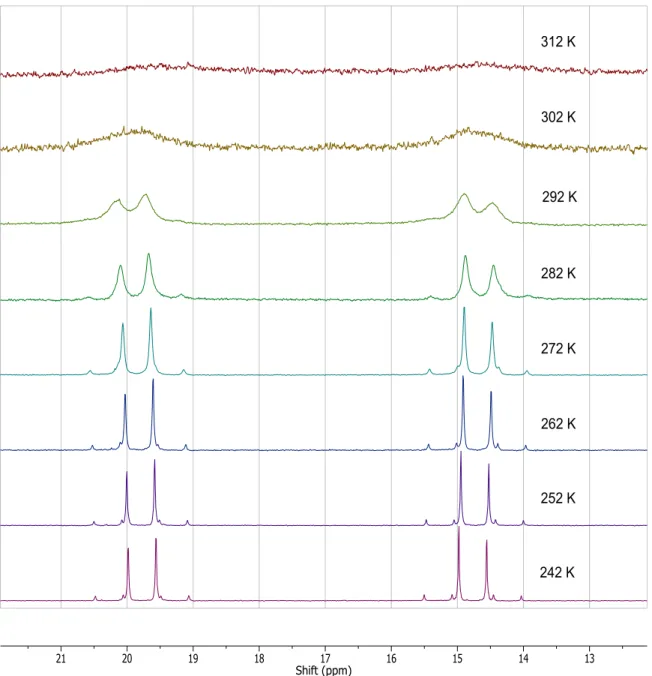
3.2. Variable temperature 1H NMR of alkyl region of 7 ...47
3.3. Variable temperature 1H NMR of hydride region of 7 ...48
3.4. Variable temperature 31P{1H} NMR of 7 ...49
4.1. 1H NMR spectrum of NCHN (1) ...72
4.2. 1H NMR spectrum of (NCN)Ir(CH2CH3)(Cl) (2) ...74
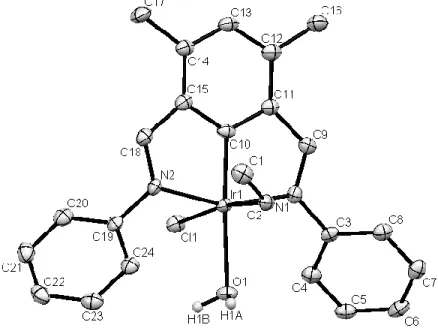
4.3. 1H NMR spectrum of (NCN)Ir(CH2CH3)(Cl)(OH2) (3) ...76
4.4. ORTEP diagram of (NCN)Ir(CH2CH3)(Cl)(OH2) (3) ...77
4.5. 1H NMR spectrum of (NCN)Ir(CH2CH3)(Cl)(PPh3) (4) ...79
4.6. ORTEP of (NCN)Ir(CH2CH3)(Cl)(PPh3) (4) ...80
4.7. 1H NMR spectrum of [(NCN)IrCl]2[OTf]2 (5) ...82
4.8. 1H NMR spectrum of (NCN)Ir(CH2CH3)(OAc) (6) ...83
ix
4.10. 1H NMR spectrum of [(NCN)Ir(CH2CH3)(NCCH3)2][BF4] (7) ...86
4.11. Cyclic voltammogram of 7 in acetonitrile at a scan rate of 50 mV/s ...87
4.12. ORTEP of [(NCN)Ir(CH2CH3)(NCCH3)2][BF4] (7) ...88
4.13. 1H NMR spectrum of [(NCN)Ir(CH2CH3)(bpy)][BF4] (8) ...90
4.14. Variable temperature 1HNMR spectrum of [(NCN)Ir(Et)(OH2)2][OTf] (9) ...92
4.15. ORTEP of [(NCN)Ir(CH2CH3)(OH2)2][BF4] (9) ...93
5.1. Proposed halide-bridged dinuclear intermediate for Scheme 5.5 ...109
5.2. 1H NMR spectrum showing the production of dihalide complexes 11 and 12 as mixed halide complex 10 disappears ...109
5.3. ORTEP diagram of (NCN)Ir(I)2(NCCH3) (11·NCCH3) ...111
5.4. ORTEP diagram of (NCN)Ir(Cl)2(NCCH3) (12·NCCH3) ...113
5.5. 1H NMR spectrum taken 3 minutes after addition of triethylsilane to 1 at room temperature. Complexes 1, 13, and 14 are labeled ...115
5.6. 1H NMR spectrum of (NCN)Ir(Cl)(SiEt3) (14) ...116
6.1. Reported iridium water oxidation catalysts include phenylpyridine (A, B), bipyridine (C), Cp* (B, C, D, E, F), carbene (F), and porphyrin (G) ligands ...127
6.2. 1H NMR spectrum of 15 ...130
6.3. 1H NMR spectra of the reaction of 1 with sPhIO showing the formation of an intermediate at 250K followed by disproportionation of sPhIO and regeneration of 1 ...131
6.4. 1H NMR spectrum of 16 ...132
6.5. 1H NMR spectrum of 17 ...133
x
6.7. 1H NMR spectrum of the reaction of 9 with NaIO4 at 275K, three minutes after initial mixing. Complex 9 and the
intermediate appear in a 3:1 ratio ...136 6.8. Normalized CVs of 9 at pH 6.86 (I = 0.1 M, NaH2PO4/Na2HPO4
buffer; various scan rates). The dotted line is the background
current under the same experimental conditions ...138 6.9. Schematic representation of the phosphonate binding in 20|FTO ...140 6.10. CV of 20|FTO at pH 7.008 (I = 0.1 M, NaH2PO4/Na2HPO4
buffer; scan rate 100 mV/s). The dotted line is the FTO background
under the same experimental conditions ...140 6.11. Normalized CVs of 20|FTO at pH 7.008 (I = 0.1 M,
NaH2PO4/Na2HPO4 buffer; various scan rates) ...141 6.12. Pourbaix diagram showing of E1/2 vs. pH for the Ir(IV/III)
and Ir(V/IV) surface-bound redox couples of 20|FTO
xi
LIST OF SCHEMES
Scheme
1.1 General routes to metallation of a pincer ligand with a central aryl ring ...4
1.2 Dehydrogenation of cycloalkanes by Ir(PCP)H2 ...6
1.3. Bidentate coordination of non-heterocyclic bis(imino)aryl ligands ...8
1.4. Formation of an azatungstacyclopropane ring and subsequent conversion to an alkylidene comeplex ...9
1.5. Nitrile synethesis via oxygen atom abstraction from an azametallocycobutene molybdenum intermediate ...9
1.6. Polymerization of substituted phenylacetylenes by a tungsten (OCO) alkylidyne complex ...10
1.7. Reaction of sulfuric acid with PNP molybdenum- and tungsten-dinitrogen complexes yields ammonia and hydrazine ...11
1.8. Facial and meridional isomers of a M(PNP)(CO)3 (M = Mo, W) complex interconvert and can be protonated by triflic acid to yield a cationic M(II) hydride complex ...12
2.1. Synthetic route to HN(SiMe2CH2PPh2)2 (PHNP) and LiN(SiMe2CH2PPh2)2 (PNP-)...19
2.2. Amine deprotonation and coordination of nitrogen ...20
2.3. Reactions of tridentate Ru(PNP) complexes...20
2.4. Preparation of a bidentate tungsten(0) complex (1) ...22
2.5. Synthetic route to tridenate facial W(PHNP)(CO)3 (2) and tridentate meridional W(PHNP)(CO)3 (3) ...25
2.6. Interconversion of tungsten (0) complexes (1), (2), and (3) ...25
2.7. Synthetic route to [W(PHN)(PN)(CO)2][I] (4) ...28
2.8. Synthetic route to W(PHNP)(CO)2Br(≡-CH3) (5) ...31
xii
3.1. Synthetic route to [W(PHNP)(CO)3H][BF4] (7) ...43
3.2. Synthesis of W(PNP)(CO)3H (8) ...50
3.3. Synthetic route to [W(PHNP)(CO)3I][I](9) ...51
3.4. Proposed decomposition of 9 ...52
3.5. Synthetic route to [W(PHNP)(CO)3Br][OTf] (10) ...53
3.6. Synthetic route to [W(PHNP)(CO)3Cl][SbCl5] (11) ...54
3.7. Synthetic route to [WPHNP)(CO)3F][BF4] (12) ...55
3.8. Synthetic route to neutral W(PNP)(CO)3X, where X = I (9a), Br(10a), Cl (11a), and F (12a) ...56
3.9. Synthetic route to [W(PHNP)(CO)2(NO3)][I] (13) ...58
4.1. Bidentate coordination of non-heterocyclic bis(imino)aryl ligands ...70
4.2. Tridentate coordination of non-heterocyclic bis(imino)aryl ligands with methyl substituents blocking the 4- and 6- positions ...70
4.3. Synthetic route to 4,6-dimethyl-1,3-bis(phenylimino)benzene ...71
4.4. Synthetic route to (NCN)Ir(CH2CH3)(Cl) (2) ...73
4.5. Synthetic route to (NCN)Ir(CH2CH3)(Cl)(OH2) (3) ...75
4.6. Synthetic route to (NCN)Ir(CH2CH3)(Cl)(PPh3) (4) ...78
4.7. Synthetic route to [(NCN)IrCl]2[OTf]2 (5) ...81
4.8. Synthetic route to (NCN)Ir(CH2CH3)(OAc) (6) ...83
4.9. Synthetic route to [(NCN)Ir(CH2CH3)(NCCH3)2][BF4] (7) ...85
4.10. Synthetic route to [(NCN)Ir(CH2CH3)(bpy)][BF4] (8) ...89
4.11. Synthetic route to [(NCN)Ir(CH2CH3)(OH2)2][BF4] (9)...91
4.12. Ligand exchange from 9 ...92
xiii
5.2. General scheme for oxidation addition of iodine to Ir(I) complexes ...106 5.3. 1 reacts with iodine to form an Ir(V) intermediate followed by
formation of ethyl iodide and (NCN)Ir(Cl)(I) (10) ...107 5.4. Reaction of 1 with 1,3-diiodo-5,5-dimethylhydantoin results in
an Ir(V) cationic intermediate. Addition of tetraethylammonium
iodide produces the mixed halide product ...108 5.5. Halide exchange from 2 in methylene chloride results in
(NCN)Ir(I)2 (11) and (NCN)Ir(Cl)2 (12) ...108 5.6. Addition of acetonitrile to diiodide complex 11 or to dichloride
complex 12 to form 11·NCCH3 or 12·NCCH3 ...110 5.7. Oxidative addition of triethylsilane to 1 produces an Ir(V)
intermediate (13) from which reductive elimination of
ethane occurs, producing (NCN)Ir(Cl)(SiEt3) (14) ...114 6.1. Net reaction of water oxidation...126 6.2. Proposed reaction mechanism for mononuclear iridium-catalyzed water
oxidation. ...128 6.3. Reaction of 1 with pyridine N-oxide forms a simple adduct (15). ...129 6.4. Reaction of 1 with sPhIO at low temperature. ...130 6.5. Reaction of (NCN)Ir(CH2CH3)(Cl) (1) with MCPBA produces an MCPBA
adduct (16) followed by proton transfer to form ethane and 17. ...132 6.6. Reaction of [(NCN)Ir(CH2CH3)(OH2)2][BF4] (9) with MCPBA produces
ethylene gas and a neutral iridium species (18) ...134 6.7. Proposed mechanism for the reaction of MCPBA with 9...134 6.8. Reaction of complex 9 with NaIO4 results in formation of ethylene and
xiv
LIST OF TABLES
Table
2.1. Bond lengths and bond angles of 1 ...23
2.2. Bond lengths and bond angles of 3 ...27
2.3. Selected bond lengths (Å) and bond angles (°) in [W(PHN)(PN)(CO)2][I] (4) ...30
2.4. IR data for complexes 1-6 ...37
2.5. Crystal and data collection parameters for W(PHNP)(CO)4 (1), meridional W(PHNP)(CO)3 (3) and [W(PHN)(PN)(CO)2H][I] (4) ...34
3.1. Selected bond lengths (Å) and bond angles (°) in [W(PHNP)(CO)3H][BF4] (7) ...45
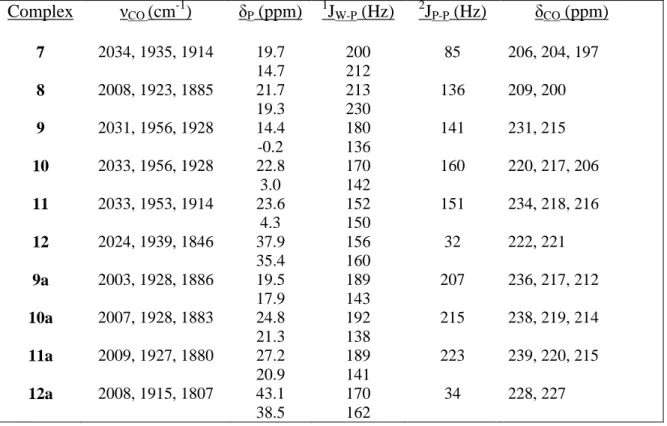
3.2. IR, 31P NMR, and 13C carbonyl NMR data for tungsten(II) complexes...57
3.3. Crystal and data collection parameters for [W(PHNP)(CO)3H][BF4] (7) ...59
4.1. Bond lengths and bond angles of (NCN)Ir(CH2CH3)(Cl)(OH2) (3) ...77
4.2. Bond lengths and bond angles of (NCN)Ir(CH2CH3)(Cl)(PPh3) (4) ...80
4.3. Bond lengths and bond angles of (NCN)Ir(CH2CH3)(OAc) (6) ...85
4.4. Bond lengths and bond angles of [(NCN)Ir(CH2CH3)(NCCH3)2][BF4] (7) ...88
4.5. Bond lengths and bond angles of [(NCN)Ir(CH2CH3)(OH2)2][BF4] (9) ...94
4.6. Crystal and data collection parameters for (NCN)Ir(Et)(Cl)(OH2) (3), (NCN)Ir(Et)(Cl)(PPh3) (4), and (NCN)Ir(Et)(OAc) (6) ...95
4.7. Crystal and data collection parameters for [(NCN)Ir(Et)(NCCH2)2][BF4] (7) and [(NCN)Ir(Et)(OH2)2][BF4] (9) ...96
5.1. Bond lengths and bond angles of 11·NCCH3...111
xv
5.3. Crystal and data collection parameters for (NCN)Ir(I)2(NCCH3)
xvi
LIST OF ABBREVIATIONS AND SYMBOLS
° degree(s)
α Greek alpha: crystallographic angle β Greek beta: crystallographic angle γ Greek gamma: crystallographic angle δ Greek delta: chemical shift
η Greek eta: ligand hapticity
κ Greek kappa: denotes coordination to metal by x atoms ν Greek nu: IR absorption band frequency
θ Greek theta: general angle
σ Greek sigma: denotes coordination to a metal via a single atom Δ Greek capital delta: denotes separation between values
a, b, c crystallographic unit cell parameters
Å angstrom(s)
Ar general aromatic
br broad
C Celcius
cm-1 wavenumber
d doublet
Cy cyclohexyl
ESI ElectroSpray Ionization
Et ethyl, -CH2CH3
xvii
HMQC Heteronuclear Multiple Quantum Coherence
Hz Hertz
IR infrared
x
JYZ magnetic coupling between atoms X and Y through a distance of x bonds
K Kelvin
L general ligand, usually a neutral 2 e- donor
M general metal atom
m multiplet
m meta
Me methyl, -CH3
min minute(s)
mol mole
MS mass spectroscopy
nBu n-butyl, -C4H9
NMR nuclear magnetic resonance
o ortho
ORTEP Oak Ridge Thermal Ellipsoid Plot
OTf triflate, trifluoromethane sulfonate: CF3SO3
-p para
Ph phenyl, -C6H5
ppm parts per million
q quartet
xviii
R, RW crystallographic refinement quality indicators
s singlet
s second
t triplet
t
Bu tertiary butyl, -C(CH3)3 THF tetrahydrofuran
Chapter 1
An Introduction to the Chemistry of Pincer Complexes
An Overview of Pincer Ligands
Designing new ligands with desirable properties is one of the most important goals in organometallic chemistry. Altering ligand frameworks allows for systematic variation of the chemical properties of metal complexes in a controlled and predictable manner. Pincer ligands, which are defined by tridentate meridional coordination to a metal center in accord with the picturesque name, have been known since the 1970s.1-6 Due to the ease with which synthetic variations of pincer substituents can be accomplished and the ability of pincer ligands to stabilize mononuclear complexes, the use of pincer ligands has rapidly expanded across organometallic chemistry.7,8 Pincer complexes have found widespread use as catalysts in transition metal mediated processes such as C-C bond forming reactions, polymerizations, transfer hydrogenation, and dehydrogenation reactions.9,10 Pincer complexes can also be used as sensors11-13 and they are particularly helpful in initiating C-C, C-H, and C-O bond activation processes14.
2
and anionic pincers are common, but dianionic19,20 and trianionic21-23 pincers can be found in the literature as well. The central coordinating atom is most commonly carbon or nitrogen, often present in the form of a benzene, pyridine, carbene, or amine group. The presence of a metal-carbon σ-bond in particular is thought to be responsible for the high stability of these complexes due to the decreased probability of ligand dissociation and subsequent
decomposition24. Terminal two electron donating heteroatom groups include amines (NR2), phosphines (PR2), phosphites (P(OR)2), ethers (OR), thioethers (SR), N-heterocyclic
3
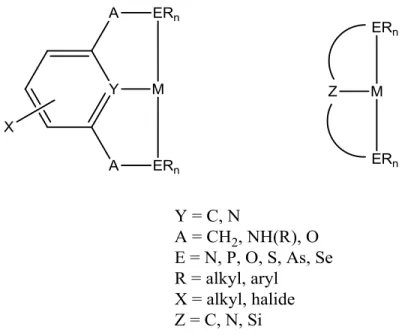
Figure 1.1. General binding mode of a pincer ligand with or without a central aromatic ring.
Electronic and steric effects can be manipulated in pincer systems by systematic alteration of the tridentate ligand while maintaining the coordination geometry8. This feature of pincer complexes facilitates optimization of chemical properties for reaction or
catalysis14,31. Steric control can be exerted by varying the R groups (Figure 1.1). The Y atom affects the electronic properties of the metal through its trans influence. Varying the E atoms allows control over the electron density and lability of the arms of the pincer. The A moieties also contribute to the electron density and steric properties of the system. The X group(s) can remotely participate in electron density control and aid in solubility properties of the complex.
4
since the first pincer ligands were developed3. C-H activation of these types of pincer ligands is chelation-assisted and is directed by initial heteroatom (E) coordination. A second method for metallation involves prefunctionalizing the 2-position of the aryl ring with a halide, commonly chloride or bromide. Oxidative addition of the carbon-halide bond then occurs, selectively forming the desired pincer complex. A third route is transmetallation from a main-group metal like lithium or tin. Metallation of pincer ligands with a neutral central atom like nitrogen occurs by simple chelation.
Scheme 1.1. General routes to metallation of a pincer ligand with a central aryl ring.
Pincer Complexes of Group 8-10 Transition Metals
5
complexes exhibit a wide range of reactivity, with applications which include electrocatalytic reduction of CO233,34, C-H bond cleavage35-39, alkane metathesis40,41, and various
dehydrogenation reactions8,42-55. The pincers used have typically been PCP34,39,55 or
POCOP56,57-type ligands. When occupying the central site of the tridentate pincer ligand, the M-C bond exhibits excellent thermal stability.
Iridium pincers complexes are useful for many dehydrogenation reactions including alkane dehydrogenation and dehydrogenation involving heteroatom-H bonds, as well as alkane metathesis reactions. Use of rhodium bis(trialkyl)phosphine complexes in alkane dehydrogenation led to the synthesis of pincer complexes (tBu4PCP)IrH2 and
(tBu4PCP)RhH245. When tested for activity for transfer dehydrogenation of cyclooctane in the presence of a sacrificial hydrogen acceptor 3,3-dimethyl-1-butene (TBE), the iridium
complex showed high activity and high thermal stability, giving 82 turnovers/hour at 150°C and 12 turnovers per minute at 200°C for a full week (Scheme 1.2). Dehydrogenation of other cycloalkanes, including cyclohexane, methylcyclohexane, and decalin was also
6
Scheme 1.2. Dehydrogenation of cycloalkanes by Ir(PCP)H2.
7
Figure 1.2. Iridium pincer complexes used for alkane dehydrogenation.
Changing to nitrogen donors from phosphorus donors may increase ligand stability under oxidative conditions. Bis(imino)aryl pincer metal complexes have increased in
popularity over the past decade63-67. Known Ir(III) complexes with NCN type pincer ligands include those with heterocyclic N-donor moieties including pyridyl68,69, benzimidazolyl70, mixed pyridyl/imidazolyl71, and oxazolyl72,73 groups (Figure 1.3). Non-heterocyclic bis(imino)aryl iridium complexes are less common74, and
Figure 1.3. NCN-type pincer ligands known to coordinate Ir(III) include those with heterocyclic N-donor moieties including pyridyl (A), benzimidazolyl (C), mixed pyridyl/imidazolyl (D), oxazolyl (B, E), and non-heterocyclic N-donors like bis(imino)aryl
8
synthetic routes are limited. Metallation of non-heterocyclic bis(imino)aryl ligands at the aryl 2- position can be challenging because C-H activation at the 4- or 6- position resulting in bidentate binding is kinetically favored (Scheme 1.3). Since only C-H activation at the 2- position results in tridentate ligand binding, yields of κ3
complexes are often low. Synthetically, blocking both the 4- and 6- sites with substituents has resulted in more favorable metallation of the central 2- site72. These NCN-type pincer complexes of iridium have been shown to have catalytic hydrogen-transfer abilities74, applications to asymmetric synthesis72, and luminescent and emissive properties68-71.
Scheme 1.3. Bidentate coordination of non-heterocyclic bis(imino)aryl ligands.
Pincer Complexes of Group 6 Transition Metals
While pincer ligands have been coordinated to a wide variety of transition metals and used in many different reactions, their chelation to group 6 metals has not been as thoroughly explored as their late metal analogs. One such example of a group 6 complex has an NCN pincer ligand, C6H3(CH2N(Me)2)2, bound meridionally to W(VI) d0 through a
transmetallation reaction75. In an example of non-innocent ligand participation, one of the N-CH3 groups undergoes C-H activation, forming an azatungstacyclopropane ring with the now tetradentate dianionic ligand (Scheme 1.4). Conversion to an alkylidene complex is
9
Scheme 1.4. Formation of an azatungstacyclopropane ring and subsequent conversion to an alkylidene comeplex.
More recently, an OCO trianionic pincer ligand has been synthesized and coordinated to molybdenum (Scheme 1.5)76. The rigid terphenyl backbone enforces meridional
coordination, while the trianionic nature of the ligand gives access to high oxidation state molybdenum77. Nitriles can be synthesized via oxygen abstraction from an acylimido ligand. Initially, DMF disassociates accompanied by simultaneous formation of an
azametallocyclobutene intermediate, followed by oxygen transfer to molybdenum and nitrile loss. The trianionic OCO ligand has also been coordinated to a d0 tungsten alkylidyne complex78,79. This complex is a highly active catalyst for the polymerization of phenylacetylenes (Scheme 1.6).
10
Scheme 1.6. Polymerization of substituted phenylacetylenes by a tungsten (OCO) alkylidyne complex.
While there are few group 6 pincer complexes, examples of tridentate W(PNP)
complexes in the literature are even scarcer80,81. Phosphine-based pincer complexes are often used due to their balance of stability and reactivity14. Chelating phosphines are known to increase the basicity of the metal center82, which can also be affected by the isomeric form of the chelate. Meridional coordination results in greater electron richness and therefore
increases basicity at the metal center relative to the facially coordinated isomer. The order of attachment can vary depending on the chelating substituents, but the sequence has been established for mixed P,N ligands on d6 carbonyl complexes. The soft phosphorus donor ligands tend to coordinate to the metal center first followed by chelation of the hard nitrogen donor83,84. A weak trans influence is observed in the shortened metal-carbon bond of the carbonyl ligand trans to the N donor ligand.
11
coordinated molecular dinitrogen81. When treated with excess sulfuric acid, ammonia and hydrazine were generated. The molybdenum-dinitrogen complexes yield primarily ammonia with trace amounts of hydrazine while the tungsten-dinitrogen complex gives mostly
hydrazine (Scheme 1.7). The authors suggest that the greater reducing ability of
molybdenum results in the larger ammonia to hydrazine ratio. As the tungsten center is more electron rich, the proton attack likely occurs at tungsten, resulting in a hydrazido intermediate that yields hydrazine.
Scheme 1.7. Reaction of sulfuric acid with PNP molybdenum- and tungsten-dinitrogen complexes yields ammonia and hydrazine.
12
Scheme 1.8. Facial and meridional isomers of a M(PNP)(CO)3 (M = Mo, W) complex interconvert and can be protonated by triflic acid to yield a cationic M(II) hydride complex.
13
References
(1) Benito-Garagorri, D.; Kirchner, K. Acc. Chem. Res. 2008, 41, 201. (2) Nelson, S. M.; Dahlhoff, W. V. J. Chem. Soc. 1971, 13, 2184.
(3) Moulton, C. J.; Shaw, B. L. J. Chem. Soc., Dalton Trans. 1976, 1020. (4) van Koten, G.; Timmer, K.; Noltes, J. G.; Spek, A. L. J. Chem. Soc., Chem.
Comm. 1978, 250.
(5) Creaser, C. S.; Kaska, W. C. Inorg. Chim. Acta 1978, 30, L325. (6) Rimml, H.; Venanzi, L. M. J. Organomet. Chem. 1883, 259, C6. (7) van Koten, G. Pure Appl. Chem. 1989, 61, 1681.
(8) Choi, J.; MacArthur, A. H. R.; Brookhart, M.; Goldman, A. S. Chem. Rev.
2011, 111, 1761.
(9) Albrecht, M.; van Koten, G. Angew. Chem. Int. Ed. 2001, 40, 3750. (10) Singleton, J. T. Tetrahedron 2003, 59, 1837.
(11) van der Ploeg, A. F. M. J.; van Koten, G.; Brevard, C. Inorg. Chem. 1982, 21, 2878.
(12) Albrecht, M.; Gossage, R. A.; Lutz, M.; Spek, A. L.; van Koten, G. Chem. Eur. J. 2000, 6, 1431.
(13) Albrecht, M.; Schlupp, M.; Bargon, J.; van Koten, G. Chem. Comm. 2001, 1874.
(14) van der Boom, M. E.; Milstein, D. Chem. Rev. 2003, 103, 1759.
(15) Fryzuk, M. D.; Berg, D. J.; Haddad, T. S. Coord. Chem. Rev. 1990, 99, 137. (16) Nuzzo, R. G.; Haynie, S. L.; Wilson, M. E.; Whitesides, G. M. J. Org. Chem.
1981, 46, 2861.
(17) Sacconi, L.; Morassi, R. J. J. Chem. Soc. A 1968, 2997.
(18) Liang, L. C.; Lin, J. M.; Hung, C. H. Organometallics 2003, 22, 3007.
14
(20) Giesbrecht, G. R.; Shafir, A.; Arnold, J. Chem. Comm. 2000, 21, 2135. (21) Sarkar, S.; Carlson, A. R.; Veige, M. K.; Falkowski, J. M.; Abboud, K. A.;
Veige, A. S. J. Am. Chem. Soc. 2008, 130, 1116.
(22) Koller, J.; Sarkar, S.; Abboud, K. A.; Veige, A. S. Organometallics 2007, 26, 5438.
(23) Sarkar, S.; McGowan, K. P.; Culver, J. A.; Carlson, A. R.; Koller, J.; Peloquin, A. J.; Veige, M. K.; Abboud, K. A.; Veige, A. S. Inorg. Chem.
2010, 49, 5143.
(24) Morales-Morales, D. Rev. Soc. Quim. Mex. 2004, 48, 338.
(25) Castonguay, A.; Sui-Seng, C.; Zaragarina, D.; Beauchamp, A. L. Organometallics 2006, 25, 602.
(26) Danopoulos, A. A.; Tulloch, A. A. D.; Winston, S.; Eastham, G.; Hursthouse, M. B. Dalton Trans. 2003, 1009.
(27) Peveling, K.; Henn, M.; Loew, C.; Mehring, M.; Schuermann, M.; Costisella, B.; Jurkschat, K. Organometallics 2004, 23, 1501.
(28) Yao, Q.; Sheets, M. J. Org. Chem. 2006, 71, 5384.
(29) van Manen, H. J.; Nakashima, K.; Shinkai, S.; Kooijman, H.; Spek, A. L.; van Veggel, F. C. J. M.; Reinhoudt, D. N. Eur. J. Inorg. Chem. 2000, 2533.
(30) Fryzuk, M. D.; MacNeil, P. A.; Rettig, S. J.; Secco, A. S.; Trotter, J. Organometallics 1982, 1, 918.
(31) Krogh-Jespersen, K.; Czerw, M.; Zhu, K.; Singh, B.; Kanzelberger, M.; Darji, N.; Achord, P. D.; Renkema, K. B.; Goldman, A. S. J. Am. Chem. Soc. 2002, 124, 10797.
(32) Niu, J.; Hao, X.; Gong, J.; Song, M. Dalton Trans. 2011, 40, 5135.
(33) Kang, P.; Cheng, C.; Chen, Z.; Schauer, C. K.; Meyer, T. J.; Brookhart, M. J. Am. Chem. Soc. 2012, 134, 5500.
(34) Lee, D. W.; Jensen, C. M.; Morales-Morales, D. Organometallics 2003, 22, 4744.
15
(36) Mohammad, H. A. Y.; Grimm, J. C.; Eichele, K.; Mack, H.; Speiser, B.; Novak, F.; Quintanilla, M. G.; Kaska, W. C.; Mayer, H. A. Organometallics
2002, 21, 5775.
(37) Winter, A. M.; Eichele, K.; Mack, H.; Kaska, W. C.; Mayer, H. A. Organometallics 2005, 24, 1837.
(38) Zhang, X.; Kanzelberger, M.; Emge, T. J.; Goldman, A. S. J. Am. Chem. Soc.
2004, 126, 13192.
(39) Choi, J.; Choliy, Y.; Zhang, X.; Emge, T. J.; Krogh-Jespersen, K.; Goldman, A. S. J. Am. Chem. Soc. 2009, 131, 15627.
(40) Bailey, B. C.; Schrock, R. R.; Kundu, S.; Goldman, A. S.; Huang, Z.; Brookhart, M. Organometallics 2009, 28, 355.
(41) Goldman, A. S.; Roy, A. H.; Huang, Z.; Ahuja, R.; Schinski, W.; Brookhart, M. Science 2006, 312, 257.
(42) Goettker-Schnetmann, I.; Brookhart, M. J. Am. Chem. Soc. 2004, 126, 9330. (43) Goettker-Schnetmann, I.; White, P. S.; Brookhart, M. Organometallics 2004,
23, 1766.
(44) Kundu, S.; Choliy, Y.; Zhuo, G.; Ahuja, R.; Emge, T. J.; Warmuth, R.; Brookhart, M.; Krogh-Jespersen, K.; Goldman, A. S. Organometallics 2009, 28, 5432.
(45) Gupta, M.; Hagen, C.; Flesher, R. J.; Kaska, W. C.; Jensen, C. M. Chem. Comm. 1996, 17, 2083.
(46) Gupta, M.; Hagen, C.; Kaska, W. C.; Cramer, R. E.; Jensen, C. M. J. Am. Chem. Soc. 1997, 119, 840.
(47) Lee, D. W.; Kaska, W. C.; Jensen, C. M. Organometallics 1998, 17, 1. (48) Bernskoetter, W. H.; Brookhart, M. Organometallics 2008, 27, 2036. (49) Morales-Morales, D.; Cramer, R. E.; Jensen, C. M. J. Organomet. Chem.
2002, 654, 44.
(50) Morales-Morales, D.; Redon, R.; Yung, C.; Jensen, C. M. Inorg. Chim. Acta
2004, 357, 2953.
16
(52) Renkema, K. B.; Kissin, Y. V.; Goldman, A. S. J. Am. Chem. Soc. 2003, 125, 7770.
(53) Zhu, K.; Achord, P. D.; Zhang, X.; Krogh-Jespersen, K.; Goldman, A. S. J. Am. Chem. Soc. 2004, 126, 13044.
(54) Punji, B.; Emge, T. J.; Goldman, A. S. Organometallics 2010, 29, 2702. (55) Jensen, C. M. Chem. Comm. 1999, 24, 2443.
(56) Yang, J.; White, P. S.; Brookhart, M. J. Am. Chem. Soc. 2008, 130, 17509. (57) Findlater, M.; Schultz, K. M.; Bernskoetter, W. H.; Cartwright-Sykes, A.;
Heinekey, D. M.; Brookhart, M. Inorg. Chem. 2012, 51, 4672.
(58) Wang, K.; Goldman, M. E.; Emge, T. J.; Goldman, A. S. J. Organomet. Chem. 1996, 518, 55.
(59) Haenel, M. W.; Oevers, S.; Angermund, K.; Kaska, W. C.; Hua-Jun, F.; Hall, M. B. Angew. Chem. Int. Ed. 2001, 40, 3596.
(60) Gottker-Schnetmann, I.; White, P.; Brookhart, M. J. Am. Chem. Soc. 2004, 126, 1804.
(61) Gottker-Schnetmann, I.; Brookhart, M. J. Am. Chem. Soc. 2004, 126, 9330. (62) Kuklin, S. A.; Sheloumov, A. M.; Dolgushin, F. M.; Ezernitskaya, M. G.;
Peregudov, A. S.; Pertovskii, P. V.; Koridze, A. A. Organometallics 2006, 25, 5466.
(63) Lee, D. H.; Hong, S. J.; Park, S. Bull. Kor. Chem. Soc. 2008, 29, 187. (64) Fossey, J. S.; Richards, C. J. Organometallics 2002, 21, 5259.
(65) Balamurugan, R.; Palaniandavar, M.; Halcrow, M. A. Polyhedron 2006, 25, 1077.
(66) Vila, J. M.; Gayoso, M.; Pereira, T.; Torres, M. L.; Fernandez, J. J.; Fernandez, A.; Ortigueira, J. M. J. Organomet. Chem. 1996, 506, 165.
(67) Simon, P.; de Proft, F.; Jambor, R.; Ruzicka, A.; Dostal, L. A. Angew. Chem. Int. Ed. 2010, 49, 1.
(68) Wilkinson, A. J.; Goeta, A. E.; Foster, C. E.; Williams, J. A. G. Inorg. Chem.
17
(69) Whittle, V. L.; Williams, J. A. G. Inorg. Chem. 2008, 47, 6596.
(70) Yutaka, T.; Obara, S.; Ogawa, S.; Mozaki, K.; Ikeda, N.; Ohno, T.; Ishii, Y.; Sakai, K.; Haga, M. Inorg. Chem. 2005, 44, 4737.
(71) Ashizawa, M.; Yang, L.; Kobayashi, K.; Sato, H.; Yamagishi, A.; Okuda, F.; Harada, T.; Kuroda, R.; Haga, M. Dalton Trans. 2009, 10, 1700.
(72) Ito, J.; Shiomi, T.; Nishiyama, H. Adv. Synth. Catal. 2006, 348, 1235. (73) Ito, J.; Kaneda, T.; Nishiyama, H. Organometallics 2012.
(74) Oakley, S. H.; Coogan, M. P.; Arthur, R. J. Organometallics 2007, 26, 2285. (75) Brandts, J. A. M.; Kruiswijk, E.; Boersma, J.; Spek, A. L.; van Koten, G. J.
Organomet. Chem. 1999, 585, 93.
(76) Sarkar, A.; Carlson, A. R.; Veige, M. K.; Falkowski, J. M.; Abboud, K. A.; Veige, A. S. J. Am. Chem. Soc. 2008, 130, 1116.
(77) Sarkar, S.; Abboud, K. A.; Veige, A. S. J. Am. Chem. Soc. 2008, 130, 16128. (78) Kuppuswamy, S.; Peloquin, A. J.; Ghiviriga, I.; Abboud, K. A.; Veige, A. S.
Organometallics 2010, 29, 4227.
(79) Sarkar, S.; McGowan, K. P.; Kuppuswamy, S.; Ghiviriga, I.; Abboud, K. A.; Veige, A. S. J. Am. Chem. Soc. 2012, 134, 4509.
(80) Siclovan, O. P.; Angelici, R. J. Inorg. Chem. 1998, 37, 432.
(81) Arashiba, K.; Sasaki, K.; Kuriyama, S.; Miyake, Y.; Nakanishi, H.; Nishibayashi, Y. Organometallics 2012, 31, 2035.
(82) Rottink, M. K.; Angelici, R. J. J. Am. Chem. Soc. 1993, 115, 7267. (83) Dobson, G. R.; Taylor, R. C.; Walsh, T. D. Inorg. Chem. 1967, 6, 1929.
Chapter 2
Coordination of a PNP Pincer Ligand to Tungsten and Molybdenum
Introduction
Though many tungsten complexes containing tridentate ligands are known1-26, relatively few contain PNP-type ligands27,28. First synthesized in 1981 by Fryzuk,
HN(SiMe2CH2PPh2)2 (PHNP) is a neutral multidentate hybrid pincer ligand29. Chosen for use in this research project, this silazane PNP ligand has two soft phosphine donor ligands linked to a hard amine donor ligand. Synthesis of PHNP is accomplished by the nucleophilic displacement of two chlorides from a commercially available silazane, HN(SiMe2CH2Cl)2, with lithium diphenylphosphide30 (Scheme 2.1). Addition of n-butyllithium deprotonates the amine, resulting in a monoanionic ligand LiN(SiMe2CH2PPh2)2 (PNP-). The flexible silazane backbone is capable of binding either facially29,31-35 or meridionally36, in addition to
coordinating in either bidentate30 (PHNP) or tridentate (PHNP) chelation modes. The stereoelectronic requirements of the metal center will also affect the coordination mode.
19
Scheme 2.1. Synthetic route to HN(SiMe2CH2PPh2)2 (PHNP) and LiN(SiMe2CH2PPh2)2 (PNP-).
Fryzuk et al. initially coordinated their PNP ligand to group 10 metals in the +2 oxidation state29. From the reaction of anionic ligand 2 with an appropriate Ni(II), Pd(II), or Pt(II) complex, either Cl2M[NH(SiMe2CH2PPh2)2] or ClM[N(SiMe2CH2PPh2)2] complexes can be obtained with distorted square planar geometries depending on reaction conditions and starting material. Furthermore, Cl2M[NH(SiMe2CH2PPh2)2] can be converted to ClM[N(SiMe2CH2PPh2)2] by addition of a base to deprotonate the amine, leading to
20
Scheme 2.2. Amine deprotonation and coordination of nitrogen.
Fryzuk’s PNP ligand has also been chelated to the heavy group 4 metals Zr and Hf in the +4 oxidation state36. Both the facial and meridional coordination modes of the ligand in Cl3M[N(SiMe2CH2PMe2)2] (M = Zr, Hf) complexes have been observed, though the facial mode was seen only in a crystal structure and was believed to be a phenomenon of crystal packing. In solution, only the meridional coordination mode was observed. The PNP ligand has also been used in yttrium hydrocarbyl complexes37, dinuclear chromium complexes38, paramagnetic iron(II) and iron (III) complexes39, and paramagnetic cobalt complexes40. Additionally, the silazane PNP ligand as the monoanionic ligand has been coordinated to ruthenium33-35,41,42. Addition of one equivalent of methyl lithium to
ClRu[N(SiMe2CH2PtBu2)2] results in a Ru(PNP)Me intermediate, which could be reacted with excess benzonitrile to give a low-spin five-coordinate ruthenium complex (Scheme 2.3).
21
The order of attachment of the P and N donor atoms can vary depending on the chelating substituents, but the sequence has been established for mixed P,N ligands on d6 carbonyl complexes where the “soft” phosphorus donor ligands tended to coordinate to the metal center first followed by chelation of the “hard” nitrogen donor27,43-45
. A weak trans influence was observed in the shortened metal-carbon bond of the carbonyl ligand trans to the N donor ligand30.
We report here the synthesis of three d6 tungsten carbonyl complexes with different coordination modes of PHNP: bidentate, tridentate facial, and tridentate meridional. The PHNP ligand has also been coordinated to d6 molybdenum and d2 tungsten. Metallation of the anionic PNP ligand resulted in ligand cleavage and formation of a six-coordinate d4 tungsten complex.
Results and Discussion
22
Scheme 2.4. Preparation of a bidentate tungsten(0) complex (1).
Yellow, needle-like crystals of 1 were obtained by slow evaporation of methylene chloride at 0 °C. The molecular structure of 1 determined by single-crystal X-ray diffraction is depicted in Figure 1. The crystal structure showed a tetracarbonyl complex with a
23
Figure 2.1. ORTEP plot of W(PHNP)(CO)4 (1).
Table 2.1. Bond lengths and bond angles of 1.
__________________________________________________________ Bond distances (Å) Bond angles (deg)
W(1)-C(7) 1.973(5) P(1)-W(1)-P(2) 104.20(4) W(1)-C(3) 1.980(6) C(1)-W(1)-C(5) 173.31(19) W(1)-C(1) 2.024(6) C(3)-W(1)-C(7) 81.7(2) W(1)-C(5) 2.039(6) C(1)-W(1)-P(1) 90.43(16) W(1)-P(1) 2.5351(14)
W(1)-P(2) 2.5431(13)
24
The 1H NMR spectrum of 1 showed one sharp singlet for the four silazane methyl groups, indicating equivalence of the methyl groups on both sides of the eight-membered ligand metallocycle. A doublet with splitting of 10.4 Hz due to geminal phosphorus coupling was observed for the four methylene protons. No signal was observed for the amine N-H proton. The 31P NMR spectrum showed a single peak at -0.37 ppm with one bond tungsten-phosphorus coupling of 233 Hz indicating that both phosphines experience the same
magnetic environment. Tungsten-phosphorus coupling was evident as a doublet satellite due to 183W, 14% abundant with I = ½ symmetrically superimposed over the dominant singlet. Overall, the 1H and 31P NMR data suggested an effective C2v molecular symmetry on the NMR timescale as the eight-membered metallocycle rapidly flips through planarity, thus equilibrating both sides of the ring.
25
1847, and 1798 cm-1, with the highest frequency no doubt predominantly due to the trans carbonyls. The 31P NMR spectrum of 2 showed a singlet at ppm with 1JW-P = 238 Hz, which was comparable to the 1JW-P coupling constant for 1, which also had cis-phosphines. The trans-phosphines in 3 resulted in a downfield shift to 20.4 ppm and the one bond tungsten-phosphorus coupling increased significantly to 311 Hz.
26
Scheme 2.6. Interconversion of tungsten (0) complexes (1), (2), and (3).
Orange rod-like crystals of 3 were obtained by slow diffusion of methylene chloride at -32 °C. The crystal structure of 3 showed coordination of the amine to tungsten in a
distorted octahedral tricarbonyl complex (Figure 2.2). This locked the ligand in the tridentate meridional orientation, and the pyramidal amine forced puckering of the bicyclic ring system. Furthermore, the pyramidal amine group created distinctly different chemical environments on each side of the ring system, resulting in diastereotopic methyl groups on each silicon and diastereotopic methylene protons. The trans phosphines span an angle of 166º, as do the trans carbonyl ligands. The acute P-W-N bond angles of the pincer ligand averaged 83.3º.
27
Figure 2.2. ORTEP diagram of meridional W(PHNP)(CO)3 (3).
Table 2.2. Bond lengths and bond angles of 3.
__________________________________________________________
Bond distances (Å) Bond angles (deg)
W(1)-C(1) 1.947(7) P(1)-W(1)-P(2) 166.42(6) W(1)-C(3) 2.009(6) P(1)-W(1)-N(1) 83.28(13) W(1)-C(2) 2.043(6) P(2)-W(1)-N(1) 83.53(13) W(1)-N(1) 2.443(5) C(2)-W(1)-C(3) 166.1(3) W(1)-P(1) 2.4606(16) C(1)-W(1)-C(2) 82.5(3) W(1)-P(2) 2.4731(17) C(1)-W(1)-C(3) 83.8(3)
28
Coordination of PNP- to Tungsten(II). Efforts to add the anionic PNP ligand to tungsten(0) complexes were unsuccessful. When added to a tungsten(II) complex, cleavage of the ligand at the N-Si bond occurred. A THF solution of [W(NCCH3)2(CO)3I][I] was generated by addition of one equivalent of iodine to W(NCCH3)3(CO)3. This solution was transferred into a THF solution containing one equivalent of the anionic PNP ligand, and this solution was stirred overnight to give 4 (Scheme 2.7). Cleavage of the PNP ligand occurred between the silicon and nitrogen atoms and then two of the PN fragments coordinated in bidentate fashion to a tungsten(II) center. The amine nitrogens share one proton. Two carbonyls remain bound to tungsten, and have IR stretches of 1923 and 1831 cm-1.
Scheme 2.7. Synthetic route to [W(PHN)(PN)(CO)2][I] (4).
29
hydrogen bonded to a water molecule in the crystal structure. The tungsten-nitrogen distance is similar for both amines, 2.031 Å and 2.045 Å. These distances are significantly shorter than the tungsten-nitrogen bond distance of 2.443 Å in 3, explained by the tungsten(II) electron deficiency in 4 and the shared negative charge between the two amines. The two tungsten-phosphorus distances are nearly identical at 2.4663 Å and 2.4658 Å, distances which are comparable to those in 3. The two tungsten-carbon distances are likewise comparable at 1.956 Å and 1.960 Å. These are on order with the tungsten-carbon bond distance of 1.947 Å for the carbon trans to nitrogen in 3. A THF molecule is crystallized in the cell.
30
Table 2.3. Selected bond lengths (Å) and bond angles (°) in [W(PHN)(PN)(CO)2][I] (4).
__________________________________________________________ Bond distances (Å) Bond angles (deg)
W(1)-C(1) 1.956(4) C(1)-W(1)-C(3) 103.30(18) W(1)-C(3) 1.960(4) P(1)-W(1)-P(2) 131.36(4) W(1)-P(1) 2.4663(11) N(20)-W(1)-N(22) 76.69(12) W(1)-P(2) 2.4658(10) C(1)-W(1)-N(20) 135.84(14) W(1)-N(20) 2.031(3) C(3)-W(1)-N(20) 103.35(15) W(1)-N(22) 2.045(3) C(1)-W(1)-N(22) 105.81(15) C(3)-W(1)-N(22) 136.45(15) C(1)-W(1)-P(1) 75.15(12) C(3)-W(1)-P(1) 73.69(13) C(1)-W(1)-P(2) 72.26(12) C(3)-W(1)-P(2) 79.82(13) P(1)-W(1)-N(20) 79.41(9) P(2)-W(1)-N(20) 147.25(9) P(1)-W(1)-N(22) 145.25(8) P(2)-W(1)-N(22) 79.07(8) __________________________________________________________
The proton and phosphorus NMR spectra showed a C2v symmetric molecule at room temperature. The two phosphorus atoms are equivalent at 36.7 ppm and had one bond tungsten-phosphorus coupling of 141 Hz. One doublet appeared in the proton spectrum for the four methylene protons with geminal phosphorus coupling of 13.2 Hz, and one singlet appeared for all twelve methyl protons.
Coordination of PHNP to Tungsten(IV). W(py)2(CO)2Br(≡CCH3) was dissolved in
31
Scheme 2.8. Synthetic route to W(PHNP)(CO)2Br(≡-CH3) (5).
The two phosphines were equivalent in the 31P NMR spectrum at 0.8 ppm with one-bond coupling to tungsten of 235 Hz. In the proton NMR spectrum, there were two triplets for the methylene protons due to a distinct “top” and “bottom” of the molecule. There were also two signals for the methyl groups, one of which corresponded to the two methyls pointing up toward the carbyne ligand and the other corresponded to the two methyls pointing down toward the bromide ligand.
Though synthesis of 5 proved to be simple and high-yielding, further manipulation of
5 yielded mixed results. Photolysis was tried with the intention of trying to promote carbonyl loss and nitrogen chelation, but the conversion was incomplete and the products were
difficult to separate. Deprotonation of the amine proton with triethylamine or methyl lithium resulted in formation of several complexes and was accompanied by extensive
decomposition.
32
solution of Mo(NCCH3)2(CO)4 and the solution was stirred overnight (Scheme 2.9). The phosphines coordinated, but the nitrogen atom did not bind. The IR spectra showed carbonyl stretches at 2017, 1915, and 1895 cm-1, and these frequencies corresponded closely to the stretching frequencies for the bidentate tungsten analogue, 1. However, photolysis of 6 did not cleanly proceed to the tridentate PHNP tricarbonyl molybdenum complex. Oxidation of 6
with iodine or bromine resulted in decomposition.
Scheme 2.9. Synthetic route to Mo(PHNP)(CO)4 (6).
33
Table 2.4. IR data for complexes 1-6.
Complex νCO (cm-1)
1 2016, 1922, 1885
2 1923, 1831, 1800
3 1957, 1847, 1798
4 1923, 1831
5 2008, 1931
6 2017, 1915, 1895
Summary
In summary, the silazane PNP ligand has been coordinated to tungsten(0) in three different conformations and these three complexes could be interconverted. The PHNP ligand can be bound as a bidentate ligand through the two phosphine arms as in
34
Table 2.5. Crystal and data collection parameters for W(PHNP)(CO)4 (1), meridional W(PHNP)(CO)3 (3) and [W(PHN)(PN)(CO)2H][I] (4).
Complex 1 3 4
Empirical Formula C37H40NO4P2Si2W C33H36NO3P2Si2W C34H40BCl2F4NO3P2Si2W
Formula Weight 864.67 796.60 970.35
Color Yellow Orange Clear
Temperature 100(2) K 296(2) K 100(2) K
Wavelength 0.71073 Å 1.54178 Å 1.54178 Å
Crystal System Monoclinic Monoclinic Monoclinic
Space Group P21/n P21/n P 1 21/c 1
Unit Cell Dimensions a = 8.9073(3) Å b = 24.0432(10) Å c = 17.5465(8) Å α = 90°
β = 94.894(3)° γ = 90°
a = 12.8236(8) Å b = 18.5277(13) Å c = 14.1186(8) Å α = 90°
β = 97.327(5)° γ = 90°
a = 13.1944(5) Å b = 18.9951(8) Å c = 15.4344(5) Å α = 90°
β = 90.665(2)° γ = 90° Volume 3744.1(3) Å3 3327.1(4) Å3 3868.0(3) Å3
Z 4 4 4
Density (calculated) 1.534 Mg/m3 1.590 Mg/m3 1.666 Mg/m3 Absorption Coefficient 3.273 mm-1 8.305 mm-1 8.654 mm-1
F(000) 1732 1588 1928
Crystal Size 0.30 x 0.05 x 0.05 mm3 0.15 x 0.05 x 0.05 mm3 0.04 x 0.09 x 0.27 mm3 Theta Range 2.06 to 25.71° 5.91 to 69.07° 3.35 to 67.96°
Index Ranges -10,<=h<=10 -23<=k<=29 -21<=l<=21 -15<=h<=15 -21<=k<=21 -16<=l<=17 -14,<=h<=15 -22<=k<=21 -12<=l<=18 Reflections Collected 25129 15353 31454 Data/Restraints/Parameters 7072/0/428 5881/0/384 6614/6/461 Goodness-of-fit on F2 1.045 0.979 1.053 Final R indices
[I>2sigma(I)] R Indices (all data)
R1 = 0.0361, wR2 = 0.0692 R1 = 0.0634, wR2 = 0.0788
R1 = 0.0501, wR2 = 0.1144 R1 = 0.0693, wR2 = 0.1245
35
Experimental
General Information. Reactions were performed under a dry nitrogen atmosphere using standard Schlenk techniques. Methylene chloride, hexanes, pentane, and diethyl ether were purified by passage through an activated alumina column under a dry argon atmosphere. Tetrahydrofuran (THF) was distilled from sodium benzophenone ketyl under an argon atmosphere. Methylene chloride-d2 was dried over CaH2 and degassed using standard freeze-pump-thaw techniques. HN(SiMe2CH2PPh2)2 and LiN(SiMe2CH2PPh2)2 were synthesized according to a literature method29.
NMR spectra were recorded on Bruker DRX400, 500, or AVANCE400
spectrometers. Infrared spectra were recorded on an ASI Applied Systems ReactIR 1000 FT-IR spectrometer.
[HN(SiMe2CH2PPh2)2]W(CO)4 (1). In a 200mL Schlenk flask, W(CO)6 (0.50 g, 0.14 mmol) was added to chlorobenzene (40 mL). HN(SiMe2CH2PPh2)2 (0.75g , 0.14 mmol) was dissolved in a small amount of chlorobenzene (5 mL) and cannula transferred into the hexacarbonyl solution. The mixture was heated to 120 ºC for 24 hours. The solvent was removed in vacuo and the orange-brown oil was washed several times with pentane. The product was extracted with ether, and after stripping away the ether, the residue was purified by dissolving it in methylene chloride and layering with hexanes (1:10) before placing the solution in the freezer overnight (0.17g, 14.5%). IR (diethyl ether):CO = 2016, 1922, 1885 cm-1. 1H NMR (CD2Cl2, m, 8H, Ph CH), 7.40 (m, 12H, Ph CH), 1.92 (d, 4H, 2JPH =
36 13
C{1H} NMR (CD2Cl2, t, CO, 2JP-C = 10 Hz, 1JW-C = 70.4 Hz), t, CO, 2JP-C = 7.5 Hz, 1JW-C = 65.4 Hz), Ar C), -CH2--CH3).
[HN(SiMe2CH2PPh2)2]W(CO)3 Facial (2). HN(SiMe2CH2PPh2)2 (1.5 g, 2.9 mmol) was combined with W(CH3CN)3(CO)3 (1.1 g, 2.8 mmol) in THF (30 mL) and stirred at room temperature for 1 hour. Isolation was accomplished by precipitation of product with ether and subsequent pentane washes (740 mg, 33%). IR (THF): CO = 1923, 1831, 1800 cm-1. 1
H NMR (C6D6, t, 4H, Ph CH), 7.23 (t, 4H, Ph CH), 7.11 (t, 4H, Ph CH), 6.94 (t, 2H, Ph CH), 6.66 (m, 6H, Ph CH), 1.83, 1.10 (each a dd, 2H, CH2, 2JH-H = 14.0 Hz, 2JP-H = 9.2 Hz), 0.05, 0.01 (each a s, 6H, CH3). 31P NMR (C6D6, s, 1JW-P = 238.1 Hz). 13C{1H} NMR (CD2Cl2, t, CO, 2JP-C = 5.7 Hz), each a t, CO, 2JP-C = 16.6Hz), 139.4, 139.0, 138.9, 138.7, 131.8, 130.4, 129.6, aryl C)s,
-CH2- (t, 1JP-C = 3.1Hz, -CH2-s, -CH3). HRMS (m/z, ESI+, CHCL3): found 798.1338, calcd for [M + H]+, 798.1375.
[HN(SiMe2CH2PPh2)2]W(CO)3 Meridional (3). Synthesis from
P-37
C = 36.9Hz)each a t, ortho Ar C, 2JP-C = 13.2 Hz), 129.3 (each a s, para Ar C)t, meta Ar C, 3JP-C = 9.2 Hz), t, 1JP-C = 6.0 Hz, -CH2-t, 1JP-C = 8.6Hz, -CH2-s, -CH3). Analysis: Calculated for 3: C, 49.69; H, 4.68; N, 1.76. Found: C, 49.72; H, 4.62; N, 1.71. HRMS (m/z, ESI+, MeOH): found 930.0397, calcd for [M + Cs]+, 930.0351.
[(HNSiMe2CH2PPh2)(NSiMe2CH2PPh2)W(CO)2][I] (4). W(NCCH3)3(CO)3 (1.1 g, 2.8 mmol) was dissolved in THF (30 mL) and I2 (0.71 g, 2.8 mmol) was added and stirred for 30 minutes. Full conversion to [W(NCCH3)2(CO)3I][I] was verified by IR. The solution was cannula transferred into a flask containing a THF (10 mL) solution of LiN(SiMe2CH2PPh2)2 (1.5 g, 2.8 mmol) and was stirred overnight. The solvent was removed in vacuo and the product was extracted with diethyl ether (0.20 g, 7.8%). Orange crystals were grown
overnight by dissolving the product in THF and layering pentane (1:5) over the THF at room temperature. IR (CHCl3): CO = 1923, 1831 cm-1. 1H NMR (THF-d8,
H, Ph CH), 2.2 (d, 4H, 2JP-H = 13.2 Hz, CH2), 0.18 (s, 12H, CH3). 31P NMR (THF-d8, s, 1JW-P = 140.9 Hz). HRMS (m/z, ESI+, CH3CN): found 807.1417, calcd for [M + Na]+, 807.1354.
38
NMR (CD2Cl2, s, 1JW-P = 235 Hz). 13C{1H} NMR (CD2Cl2, δ): t, 1JW-C = 186 Hz, 2JP-C = 10 Hz, W≡C-CH3), 211.0, 210.7each a s, 2C, 1JW-C = 150 Hz CO), 168.1, 150.4, 133.5-128.4Ar C), 34.7 (s, 2JW-C = 20 Hz W≡C-CH3), 16.9 -CH2--CH3).
[HN(SiMe2CH2PPh2)2]Mo(CO)4 (6). HN(SiMe2CH2PPh2)2 (1.5 g, 6.6 mmol) was added to a THF (30 mL) solution of Mo(NCCH3)2(CO)4 (2.0 g, 6.9 mmol) and stirred overnight. The solvent was removed in vacuo and the resulting residue was washed with pentane to give a yellow powder (0.66 g, 14%). IR (THF):CO = 2017, 1915, 1895 cm-1. 1
H NMR (CDCl3, t, 8H, Ph CH), 7.36 (m, 12H, Ph CH), 1.72 (d, 4H, 2JPH = 9.0 Hz,
-CH2-), -0.30 (s, 12H, -CH3). 31P NMR (CDCl3, s). 13C{1H} NMR (CDCl3,
dd, 2C, 2JP-C = 23.0Hz2JP-C = 16.5Hz, CO), 210.6 (t, 2C, 2JP-C = 9.3Hz,
CO)Ar C), 22.3 -CH2--CH3). Analysis: Calculated for
39
References
(1) Arumuganathan, T.; Mayilmurugan, R.; Volpe, M.; Mosch-Zanetti, N. C. Dalton Trans. 2011, 40, 7850.
(2) Sowa, J. R.; Zanotti, V.; Angelici, R. J. Inorg. Chem. 1993, 32, 848.
(3) Brisdon, B. J.; Cartwright, M.; Hodson, A. G. W.; Mahon, M. F.; Molloy, K. C. J. Organomet. Chem. 1992, 435, 319.
(4) Tarafder, M. T. H.; Bhattacharjee, P.; Sarkar, A. K. Polyhedron 1992, 11, 795. (5) Sowa, J. R.; Zanotti, V.; Angelici, R. J. Inorg. Chem. 1991, 30, 4108.
(6) Giraudon, J. M.; Mandon, D.; Sala-Pala, J.; Guerchais, J. E.; Kerabol, J.; Le Mest, Y.; L'Haridon, P. Inorg. Chem. 1990, 29, 707.
(7) Blower, P. J.; Dilworth, J. R.; Leigh, G. J.; Neaves, B. D.; Normanton, F. B.; Hutchinson, J.; Zubieta, J. A. J. Chem Soc., Dalton Trans. 1985, 12, 2647. (8) Chong, K. S.; Storr, A. Canad. J. Chem. 1980, 58, 2278.
(9) Hill, W. E.; Atabay, N.; McAuliffe, C. A.; McCullough, F. P.; Razzoki, S. M. Inorg. Chim. Acta 1979, 35, 167.
(10) Sproules, S.; Eagle, A. A.; Taylor, M. K.; Gable, R. W.; White, J. M.; Young, C. G. Inorg. Chem. 2011, 50, 4503.
(11) Komuro, T.; Begum, R.; Ono, R.; Hiromi, T. Dalton Trans. 2011, 40, 2348. (12) Thomas, S.; Tiekink, E. R. T.; Young, C. G. Inorg. Chem. 2006, 45, 352. (13) Wong, Y.; Ng, D. K. P.; Lee, H. K. Inorg. Chem. 2002, 41, 5276.
(14) Eagle, A. A.; Tiekink, E. R. T.; Young, C. G. Inorg. Chem. 2001, 40, 4563. (15) Cade, I. A.; Hill, A. F.; Tshabang, N.; Smith, M. K. Organometallics 2009,
28, 1143.
(16) Zhang, X.; Hong, J.; Song, H.; Tang, L. Organometallics 2007, 26, 4038. (17) Tan, R.; Hong, J.; Du, M.; Tang, L. J. Organomet. Chem. 2007, 692, 1708. (18) Kelly, B. V.; Tanski, J. M.; Janak, K. E.; Parkin, G. Organometallics 2006,
25, 5839.
40
(20) Ardon, M.; Hogarth, G.; Oscroft, D. T. W. J. Organomet. Chem. 2004, 689, 2429.
(21) Cochran, F. V.; Hock, A. S.; Schrock, R. R. Organometallics 2004, 23, 665. (22) Hazra, D.; Sinha-Mahapatra, D. K.; Vedavati, G.; Sarkar, A. J. Organomet.
Chem. 2003, 671, 52.
(23) Wong, Y.; Dilworth, J. R. J. Chem Soc., Dalton Trans. 2002, 2366.
(24) Bauer, E. B.; Ruwwe, J.; Hampel, F. A.; Szafert, S.; Gladysz, J. A.; Martin- Alvarez, J. M.; Peters, T. B.; Bohling, J. C.; Lis, T. Chem. Comm. 2000, 22, 2261.
(25) Nakayama, Y.; Ikushima, N.; Nakamura, A. Chem. Lett. 1997, 9, 861.
(26) Nakayama, Y.; Ikushima, N.; Ueyama, N.; Nakamura, A.; Harada, A. Chem. Lett. 2000, 4, 434.
(27) Siclovan, O. P.; Angelici, R. J. Inorg. Chem. 1998, 37, 432.
(28) Arashiba, K.; Sasaki, K.; Kuriyama, S.; Miyake, Y.; Nakanishi, H.; Nishibayashi, Y. Organometallics 2012, 31, 2035.
(29) Fryzuk, M. D.; MacNeil, P. A. J. Am. Chem. Soc. 1981, 103, 3592. (30) Fryzuk, M. D.; MacNeil, P. A.; Rettig, S. J.; Secco, A. S.; Trotter, J.
Organometallics 1982, 1, 918.
(31) Fryzuk, M. D.; Williams, H. D.; Rettig, S. J. Inorg. Chem. 1983, 22, 863. (32) Fryzuk, M. D.; Williams, H. D. Organometallics 1983, 2, 162.
(33) Watson, L. A.; Ozerov, O. V.; Pink, M.; Caulton, K. G. J. Am. Chem. Soc.
2003, 125, 8426.
(34) Ingleson, M. J.; Pink, M.; Huffman, J. C.; Fan, H.; Caulton, K. G. Organometallics 2006, 25, 1112.
(35) Ingleson, M. J.; Yang, X.; Pink, M.; Caulton, K. G. J. Am. Chem. Soc. 2005, 127, 10846.
41
(38) Fryzuk, M. D.; Leznoff, D. B.; Rettig, S. J.; Thompson, R. C. Inorg. Chem.
1994, 33, 5528.
(39) Fryzuk, M. D.; Leznoff, D. B.; Ma, E. S. F.; Rettig, S. J.; Young, V. G. Organometallics 1998, 17, 2313.
(40) Fryzuk, M. D.; Leznoff, D. B.; Thompson, R. C.; Rettig, S. J. J. Am. Chem. Soc. 1998, 120, 10126.
(41) Fryzuk, M. D.; MacNeil, P. A.; Rettig, S. J. Organometallics 1986, 5, 2469. (42) Fryzuk, M. D.; Montgomery, C. D.; Rettig, S. J. Organometallics 1986, 5,
2469.
(43) Dobson, G. R.; Taylor, R. C.; Walsh, T. D. Inorg. Chem. 1967, 6, 1929. (44) Nishide, K.; Ito, S.; Yoshifuji, M. J. Organomet. Chem. 2003, 682, 79. (45) Weiss, C. J.; Groves, A. N.; Mock, M. T.; Dougherty, W. G.; Kassel, W. S.;
Helm, M. L.; DuBois, D. L.; Bullock, R. M. Dalton Trans. 2012, 41, 4517. (46) Dobson, G. R.; Taylor, R. C.; Walsh, T. D. Inorg. Chem. 1967, 6, 1929. (47) Dobson, G. R.; Sayed, M. F. A. E.; Stolz, I. W.; Sheline, R. K. Inorg. Chem.
Chapter 3
Oxidation of a Tungsten(0)(PHNP) Tricarbonyl Complex to Cationic and Neutral Tungsten(II) Hydridocarbonyl and Halocarbonyl Complexes
Introduction
Halocarbonyl complexes of tungsten(II) have been studied for over 50 years1-5. Oxidation to tungsten(II) is most commonly achieved by addition of elemental halogens to zero-valent carbonyl complexes containing at least one non-carbonyl donor ligand6,7. Halogenation by iodine8, bromine9, and chlorine10 are common in the literature. Oxidative decarboxylation with hydrofluoric acid11 or addition of fluoride to a neutral tungsten (II) dicarbonyl complex12 can provide access to the less common tungsten fluoride complexes. Despite decades of study, we are only aware of one literature report that includes the entire series of halocarbonyl tungsten complexes for a single ligand system11, and the
hydridocarbonyl analogs of the halide complexes are seldom mentioned. Halocarbonyl complexes can be used as catalysts for wide-ranging reactions in homogeneous catalysis13,14, and they are also used as catalyst precursors for heterogeneous polymerization15. Chelating donor ligands anchor the coordination sphere of many seven-coordinate d4 complexes with halide ligands11,16-20.
43
behavior can also be affected by the bonding geometry adopted by the chelate. Meridional coordination typically increases basicity at the metal center compared to the facially coordinated isomer24.
Results and Discussion
Tungsten(II) Hydride Complexes. Addition of tetrafluoroboric acid to a methylene chloride solution of 3 resulted in an immediate color change from orange to pale yellow consistent with protonation at the tungsten center to formally generate a tungsten(II) hydride complex (Scheme 3.1). The IR spectrum showed full conversion to 7 with absorbance frequencies of 2034, 1935, and 1914 cm-1 for the cation, a shift of almost 100 cm-1 to higher energy for the three carbonyl frequencies.
Scheme 3.1. Synthetic route to [W(PHNP)(CO)3H][BF4] (7).
44
45
Figure 3.1. ORTEP diagram of [W(PHNP)(CO)3H][BF4] (7).
Table 3.1. Selected bond lengths (Å) and bond angles (°) in [W(PHNP)(CO)3H][BF4] (7).
__________________________________________________________ Bond distances (Å) Bond angles (deg)
46
Both the crystal structure and the low temperature NMR data showed hydride complex 7 to be a C1 point group molecule. The fluxional behavior of 7 was evident in variable temperature 1H NMR spectra (Figures 3.2, 3.3). At room temperature, the four PHNP methyl groups appeared as singlets at 0.6 and 0.0 ppm, while the methylene protons appeared as a broad signal between 2.3 and 2.5 ppm. The hydride resonance appeared upfield at -5.03 ppm as a 76 Hz doublet with a broad central hump indicative of a dynamic process involving coupling to the trans phosphines. Each peak of the doublet also had tungsten satellites reflecting one bond W-H coupling of 16 Hz, a value comparable to reported one bond tungsten(II)-hydride couplings25. The fluxional behavior of 7 at room temperature was further evident in the 31P{1H} NMR spectrum, in which the inequivalent phosphines appeared as a broad doublet of doublets (Figure 3.4).
When cooled to 242K, the methylene protons resolved into four doublets of doublets in the region of 2.2 to 2.6 ppm with two-bond coupling to phosphorus of 10.5 Hz (Figure 3.2). The diastereotopic methylene protons had a geminal H-H coupling of 15 Hz. The PHNP methyls between -0.1 and 0.6 ppm also resolved from two singlets to four singlets, indicating a distinct environment for each methyl group in the seven-coordinate tungsten coordination sphere. The hydride resonance resolved into a doublet of doublets while maintaining the same tungsten coupling of 16 Hz (Figure 3.3). The C1 symmetry
differentiated the two phosphorus atoms resulting in different geminal couplings between the hydride and the two phosphorus atoms of 53.0 Hz and 20.5 Hz. At 242K, the 31P{1H} NMR resolved into two roofed doublets at 19.7 and 14.7 ppm (Figure 3.4). The geminal
47
timescale applied to all of the cationic and neutral seven-coordinate tungsten(II) complexes reported here.
48
49
Figure 3.4. Variable temperature 31P{1H} NMR of 7.
50
remained bound to the 18 electron tungsten in the neutral product. Upon deprotonation the carbonyl stretching frequencies dropped an average of 22 cm-1 to 2008, 1923, and 1885 cm-1. When warmed to room temperature, the metal hydride 1H NMR signal disappeared as the proton was transferred from tungsten to the amide nitrogen to reform the thermodynamically favored isomer of 8, W(PHNP)(CO)3 (3), in a formal reduction to tungsten(0).
Scheme 3.2. Synthesis of W(PNP)(CO)3H (8).
The low temperature NMR data for 8 showed a C1 symmetric molecule much like 7. The methylene protons shifted upfield and had a comparable geminal coupling to phosphorus of 14.5 Hz. The hydride resonance shifted downfield about one half of a ppm from the hydride in 7 to -4.53 ppm in 8 as a doublet of doublets. The two geminal couplings between the hydride and phosphorus were slightly smaller than in 7, at 51.0 Hz and 14.5 Hz. The low temperature 31P{1H} NMR showed a roofed doublet of doublets pattern as in 7. The signals were shifter downfield to 21.7 ppm and 19.3 ppm with a larger geminal
phosphorus-phosphorus coupling of 136 Hz. The one-bond tungsten-phosphorus-phosphorus couplings had increased as well to 213 Hz and 230 Hz in 8 from 200 Hz and 212 Hz in 7.
51
complexes were fluxional at room temperature on the NMR timescale and displayed C1 symmetry when cooled. Given the differing reactivities of the halogens, different synthetic routes were required to access the full series of complexes. Note that none of the tungsten(II) halide complexes could be isolated as pure materials in the solid state nor could they be crystallized. They were thermally unstable and decomposed rapidly upon exposure to air.
To a methylene chloride solution of 3, one equivalent of iodine was added, and the solution was stirred to dissolve the reagents (Scheme 3.3). The IR spectrum shows that the carbonyl frequencies shifted to 2031, 1950, and 1928 cm-1 as the tungsten center was
oxidized to W(II). The increase in CO stretching frequencies from 3 was comparable to that observed in forming the hydride complex 7 by protonation, as formal oxidation to a cationic tungsten(II) species occurred in both cases. Iodide complex 9 decomposed over time, possibly passing through a dicarbonyl intermediate (Scheme 3.4). The nucleophilic iodide counterion may have participated in the decomposition reaction. By IR spectroscopy, CO stretches at 1931 and 1838 cm-1 grew in as the carbonyl frequencies for 9 faded away. Perhaps the iodide counterion displaced a carbonyl ligand and formed a neutral

![Figure 2.3. ORTEP diagram of [W(P H N)(PN)(CO) 2 ][I] (4).](https://thumb-us.123doks.com/thumbv2/123dok_us/8320957.2205477/48.918.197.744.494.932/figure-ortep-diagram-w-p-h-n-pn.webp)
![Figure 3.1. ORTEP diagram of [W(P H NP)(CO) 3 H][BF 4 ] (7).](https://thumb-us.123doks.com/thumbv2/123dok_us/8320957.2205477/64.918.426.764.114.607/figure-ortep-diagram-w-p-h-np-bf.webp)