WCS365 plays a role in rhizosphere competence through
maintaining the structure and function of the outer membrane
Sandra de Weert1, Linda C. Dekkers1, Wilbert Bitter2, Sietske Tuinman1, Andr ´e H. M. Wijfjes1, Ria van Boxtel3& Ben J. J. Lugtenberg1
1Institute of Biology, Leiden University, AL Leiden, The Netherlands;2Department of Medical Microbiology and Infection Control, Vrije Universiteit
Medical Center, Amsterdam, The Netherlands; and3Department of Microbiology, Utrecht University, Utrecht, The Netherlands
Correspondence:Sandra de Weert, IBL, Leiden University, Molecular Microbiology, Wassenaarseweg 64, 2333AL Leiden, The Netherlands. Tel.:131 715275075; fax:131 715275088;
e-mail: [email protected]
Present address:Linda C. Dekkers, Pharming Archimedesweg 4, 2333 CN Leiden, The Netherlands.
Present address:Andr ´e H.M. Wijfjes, Service XS, Wassenaarseweg 72, 2333 AL Leiden, The Netherlands.
Received 23 January 2006; revised 22 March 2006; accepted 27 March 2006.
First published online 12 June 2006.
DOI:10.1111/j.1574-6941.2006.00158.x
Editor: Michael Wagner
Keywords
biological control; root colonization; two-component system; outer-membrane structure.
Abstract
Pseudomonas fluorescensstrain PCL1210, a competitive tomato root tip
coloniza-tion mutant of the efficient root colonizing wild type strain WCS365, is impaired in the two-component sensor-response regulator system ColR/ColS. Here we show that a putative methyltransferase/wapQoperon is located downstream ofcolR/colS and that this operon is regulated by ColR/ColS. SincewapQencodes a putative lipopolysaccharide (LPS) phosphatase, the possibility was studied that the integrity of the outer membrane of PCL1210 was altered. Indeed, it was shown that mutant PCL1210 is more resistant to various chemically unrelated antibiotics which have to pass the outer membrane for their action. In contrast, the mutant is more sensitive to the LPS-binding antibiotic polymyxin B. Mutant PCL1210 loses growth in competition with its wild type when grown in tomato root exudate. Mutants in the methyltransferase/wapQ operon are also altered in their outer membrane permeability and are defective in competitive tomato root tip coloniza-tion. A model for the altered outer membrane of PCL1210 is discussed.
Introduction
Decreases in crop yields are a world-wide problem. To solve this problem is not only of economical importance but it is also important for the environment. An alternative for chemical pesticides can be the use of beneficial microorgan-isms. To understand the molecular basis of the control of pathogens by beneficial bacteria it is necessary to study traits essential for biocontrol. Efficient colonization of root sys-tems by beneficial microorganisms is one of the most important traits necessary to establish microbiological con-trol (Chin-A-Woenget al., 2000). After transposon muta-genesis some genes and traits involved in root colonization have been identified (Lugtenberget al., 2001). For example, mutant PCL1210, a transposon mutant of the efficient root colonizing biocontrol strainPseudomonas fluorescensWCS365
(Dekkerset al., 2000), was initially isolated as a competitive potato root tip colonization mutant (Dekkerset al., 1998). Similarly, the mutant is also impaired in root colonization on various other plants, indicating a broad host range mutation (Dekkerset al., 1998). Three ORFs (open reading frames) are present on the fragment flanking the transpo-son. The first two ORFs of the complementing region,colR and colS, show strong homology with known members of two-component regulatory systems (Dekkerset al., 1998). The third one encodes a methyltransferase. Two-component systems, of which more than 50 different sets are presumed to be present in all bacterial species (Rodrigueet al., 2000), enable bacterial cells to respond adequately to a large variety of environmental stimuli. These adaptive responses range from very fast changes necessary for a chemotactic response (Swansonet al., 1994) to changes that in the end lead to the
by guest on October 24, 2016
http://femsec.oxfordjournals.org/
production of secondary metabolites (Laville et al., 1992). The mutation in mutant PCL1210 is thought to lead to a decreased responsiveness towards the rhizosphere environ-ment that eventually leads to impaired competitive coloni-zation fitness (Dekkers et al., 1998). Here we report that further sequencing of DNA downstream colR and colS revealed the methyltransferase/wapQoperon which appears to be regulated by thecolR/Ssystem. Further studies on the methyltransferase/wapQoperon suggest involvement in the fine-tuning of the permeability function of the outer mem-brane. A possible model is proposed and discussed in this paper.
Materials and methods
Bacterial strains and growth conditions
Overnight cultures of P. fluorescens WCS365 and mutant derivatives were grown at 281C in liquid King’s medium B (KB; King et al., 1954) under vigorous aeration or on solidified medium containing 1.8% agar. When appropriate, the media were supplemented with kanamycin or tetracy-cline in final concentrations of 50 and 80mg mL1, respec-tively. To distinguish betweenP. fluorescensWCS365 (white/ yellow colonies) and mutant PCL1210 (blue colonies), 5-bromo-4-chloro-3-indolyl-b-D-galactoside (X-gal) was
used in a final concentration of 40mg mL1as an indicator forb-galactosidase activity.
Antibiotic sensitivity
For experiments in which antibiotic resistance was mea-sured, 0.1 mL of an overnight culture of PCL1210 or WCS365 in KB was diluted into 3 mL of KB top agar (0.6%). The mixture was poured onto the surface of KB plates and was allowed to solidify. Filter paper discs with a diameter of 6 mm (Filter paper GB002, Schleicher and Schuell, Dassel, Germany) were soaked in solutions of various antibiotics and placed on the agar plates. Antibiotic concentrations in the solutions were spectomycin, 100 mg mL1; tetracycline, 8 mg mL1; rifampicin, 2 mg mL1; chloramphenicol, 10 mg mL1; and streptomycin, 500 mg mL1. After overnight growth at 281C, sensitivity towards the antibiotics was measured by determining the mean (n= 8) inhibition zone. The obtained data were analyzed for significance with Student’st-test (P= 0.05), using SPSS software (SPSS Inc., Chicago, IL).
A second method used to determine and quantify sensi-tivity towards antibiotics was performed by growing bacter-ia overnight and plating these subsequently on increasing concentrations of the appropriate antibiotic.
Sensitivity towards paraquat, a superoxide-generating agent, was measured by inoculating 50mL of an overnight culture into 5 mL of liquid KB supplemented with different
concentrations of paraquat, followed by overnight growth at 281C and measurement of the OD620 nm.
Polymyxin B sensitivity was determined using overnight cells grown in BM2 succinate medium (Gilleland Jr.et al., 1974) supplemented with 0.5 mM MgSO4. Cells were
di-luted 100-fold in the same medium as was used for growth in overnight culture except that it was supplemented with different concentrations of polymyxin B. After growth over-night at 281C the OD620 nmwas measured.
Growth in competition
Competitive growth on root exudate or putrescine (5 mM) as the sole carbon source was performed using overnight grown cells of mutant PCL1210 and wild type WCS365 in liquid basic medium (BM; Lugtenberg et al., 1999). Cells were washed with sterile phosphate-buffered saline (PBS) (Hoffland et al., 1989) and subsequently diluted in BM containing root exudate or putrescine to a final OD620 nmof
0.1. Equal volumes of these cultures were mixed. The mixture was allowed to grow overnight at 281C and subse-quently diluted again 1000-fold in fresh root exudate or putrescine. This procedure was repeated twice. The ratio between the wild type and the mutant cells was determined at various time intervals by plating diluted samples on solid KB medium supplemented with or without kanamycin.
General DNA techniques
All general DNA techniques, including restriction enzyme digestion, ligations, plasmid isolations, transformation of
Escherichia coliand nucleotide sequencing were performed
as described by Sambrook & Russel (2001).
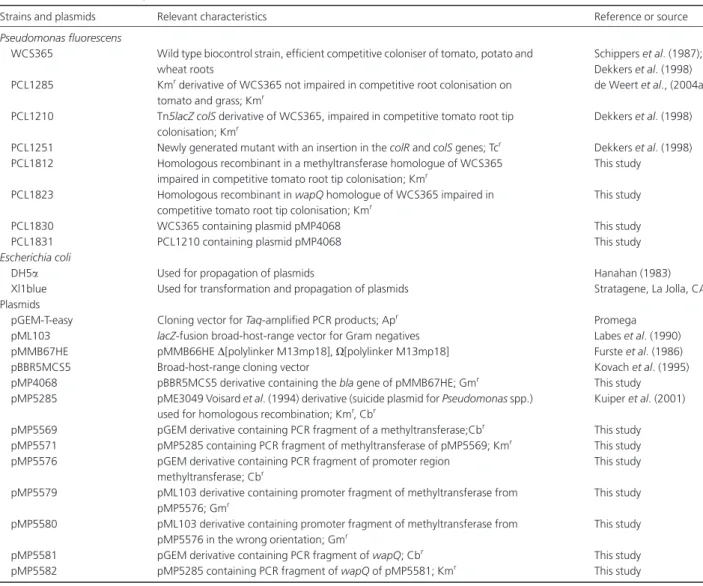
Using oMP795 (50-ACCgACCAggggTTCATCCg-30) and oMP796 (50-gCATgCCATTgATgggggCC-30), a PCR frag-ment of the methyltransferase was obtained and cloned to pGEM-T-easy which resulted in pMP5576 (Table 1). After digestion withSphI the fragment was cloned into pML103, resulting in pMP5579 (Table 1).
To construct a mutant in the WCS365 gene homologous to the methyltransferase,PCR was performed on genomic DNA of WCS365, using primers oMP747 (50 -CCgAgAAA-TACgACgAgCAgC-30) and oMP748 (50 -TgAATACgAAA-CCCTgCCTgC-30). The resulting PCR fragment was cloned into pGEM-T-easy ( = pMP5569) and subsequently cloned, after EcoRI digestion, to pMP5285, resulting in plasmid pMP5571 (Table 1). Electroporation to WCS365 resulted in mutant PCL1812 mutated in the gene homologues to a methyltransferase (Table 1).
For the construction of a mutant in the wapQ homo-logue, PCR was performed using oMP751 (50 -CgATTCTT-CACgACgACTTCg-30) and oMP752 (50-gCTgCCAAAC gCSgTCTgYTAA-30). The obtained fragment was cloned into pGEM-T-easy, resulting in pMP5581 (Table 1). After
by guest on October 24, 2016
http://femsec.oxfordjournals.org/
digestion with EcoRI, the obtained fragment was cloned into pMP5285 resulting in pMP5582, (Table 1) which was subsequently electroporated to WCS365 cells.
Analysis of membrane protein and lipopolysaccharide patterns
Analysis of cell envelope protein patterns (Lugtenberget al., 1975), and analysis of lipopolysaccharide (LPS) ladder patterns (de Wegeret al., 1987) by SDS-polyacrylamide gel electrophoresis was performed as described previously (Goldman & Leive, 1980; Palva & Makela, 1980). Cell envelope protein patterns were analyzed after growth of cells in KB and of cells in BM2 medium supplemented with low (0.02 mM) and high (0.5 mM) Mg21concentrations. Pro-teins that were tightly associated with the peptidoglycan were isolated as described by Lugtenberget al. (1977). Cell
envelopes that were treated with trypsin were prepared as described previously (Overbeeke & Lugtenberg, 1980).
Rate of permeation of ampicillin through the outer membrane
The rate of permeation of theb-lactam antibiotic ampicillin through the outer membrane of whole cells was measured using a method originally described by Zimmermann & Rosselet (1977) and modified by Overbeeke & Lugtenberg (1982). Briefly, after overnight growth in KB medium, cells were spun down and washed with buffer A (10 mM HEPES-5 mM MgCl2, pH 7.0) and set to an OD660 nmvalue of 0.1.
Subsequently the assay was started by the addition of differentb-lactam antibiotics at a concentration of 8 mM. After 15 min the reaction was stopped by the addition of freshly prepared stop-mix [containing 8 mM I2, 0.32 M KI,
2 M HAc, 1 M Na2WO4% and 2% (w/v) starch]. After an
Table 1.Bacterial strains and plasmids used
Strains and plasmids Relevant characteristics Reference or source
Pseudomonas fluorescens
WCS365 Wild type biocontrol strain, efficient competitive coloniser of tomato, potato and wheat roots
Schipperset al. (1987); Dekkerset al. (1998) PCL1285 Kmrderivative of WCS365 not impaired in competitive root colonisation on
tomato and grass; Kmr
de Weertet al., (2004a)
PCL1210 Tn5lacZ colSderivative of WCS365, impaired in competitive tomato root tip colonisation; Kmr
Dekkerset al. (1998)
PCL1251 Newly generated mutant with an insertion in thecolRandcolSgenes; Tcr Dekkerset al. (1998) PCL1812 Homologous recombinant in a methyltransferase homologue of WCS365
impaired in competitive tomato root tip colonisation; Kmr
This study
PCL1823 Homologous recombinant inwapQhomologue of WCS365 impaired in competitive tomato root tip colonisation; Kmr
This study
PCL1830 WCS365 containing plasmid pMP4068 This study
PCL1831 PCL1210 containing plasmid pMP4068 This study
Escherichia coli
DH5a Used for propagation of plasmids Hanahan (1983)
Xl1blue Used for transformation and propagation of plasmids Stratagene, La Jolla, CA Plasmids
pGEM-T-easy Cloning vector forTaq-amplified PCR products; Apr Promega
pML103 lacZ-fusion broad-host-range vector for Gram negatives Labeset al. (1990) pMMB67HE pMMB66HED[polylinker M13mp18],O[polylinker M13mp18] Fursteet al. (1986)
pBBR5MCS5 Broad-host-range cloning vector Kovachet al. (1995)
pMP4068 pBBR5MCS5 derivative containing theblagene of pMMB67HE; Gmr This study
pMP5285 pME3049 Voisardet al. (1994) derivative (suicide plasmid forPseudomonasspp.) used for homologous recombination; Kmr, Cbr
Kuiperet al. (2001)
pMP5569 pGEM derivative containing PCR fragment of a methyltransferase;Cbr This study
pMP5571 pMP5285 containing PCR fragment of methyltransferase of pMP5569; Kmr This study
pMP5576 pGEM derivative containing PCR fragment of promoter region methyltransferase; Cbr
This study
pMP5579 pML103 derivative containing promoter fragment of methyltransferase from pMP5576; Gmr
This study
pMP5580 pML103 derivative containing promoter fragment of methyltransferase from pMP5576 in the wrong orientation; Gmr
This study
pMP5581 pGEM derivative containing PCR fragment ofwapQ; Cbr This study pMP5582 pMP5285 containing PCR fragment ofwapQof pMP5581; Kmr This study
by guest on October 24, 2016
http://femsec.oxfordjournals.org/
additional incubation of 20 min for the colour development, the absorbance of the solution was measured at an optical density of 623 nm.
Competitive tomato root tip colonization assays in a gnotobiotic sand system
Competitive root tip colonization assays were performed as described by Simons et al. (1996) using the gnotobiotic system containing sterile quartz sand to which 10% (v/w) PNS (plant nutrient solution) (Hoffland et al., 1989) was added to moisten the sand. For colonization experiments, sterile germinated tomato (Lycopersicon esculentumMill. cv. Carmello; Syngenta, Enkhuizen, the Netherlands) seedlings were inoculated with a mixture of parental strainP.
fluor-escensWCS365 and one of its mutants in a 1 : 1 ratio. The
seedlings were placed in the tubes and allowed to grow in a climate-controlled growth chamber at 181C, 70% relative humidity, and 16 h of daylight. After 7 days, root tips (1 cm in length) were isolated with adhering sand, and bacteria were removed from the root parts by shaking in 1.0 mL PBS. The CFU of parental and mutant cells were determined by plating dilutions on solidified KB medium and on the same medium supplemented with kanamycin. The detection limit is 100 CFU mL1.
All results were statistically analyzed using the nonpara-metric Wilcoxon–Mann–Whitney test (Sokal & Rohlf, 1981). To avoid log 0 cases, calculations were carried out using log (CFU11) cm1root tip.
b-galactosidase assay
Cells were grown in root exudate or BM medium with 5 mM putrescine as the sole carbon source at 281C.b -galactosi-dase assays were performed as described by Miller (1972).
Results
Characterization of genes downstreamcolR/colS
Mutant PCL1210 was obtained as a result of the screening of
a Tn5lacZ mutant bank of the good root colonizer P.
fluorescensWCS365 (Dekkerset al., 1998). The transposon
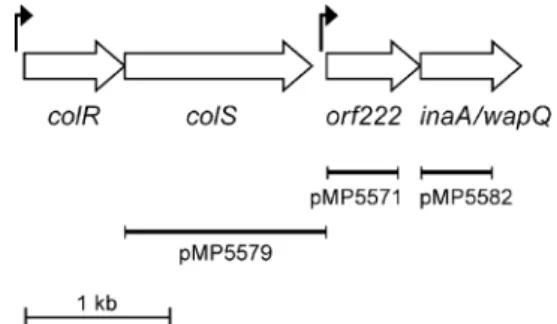
was found to be inserted in thecolSgene of acolR/colS two-component regulatory system. Further sequencing of the DNA located downstream of colR/S revealed two open reading frames (genbank accession no. Y09798). The first open reading frame, orf222, shows 80% identity and 87% similarity at the amino acid level to a SAM-dependent methyltransferase of P. fluorescens PfO1 (Genebank acces-sion no. ZP0264083). The predicted amino acid sequence of the second ORF shows significant homology with the KDO, lipopolysaccharide kinase family (pfam06 293), such asinaA
ofE. coli(Carlsonet al., 1984; Whiteet al., 1992) and the
putative heptose kinasewapQ ofPseudomonas aeruginosa (Walshet al., 2000). Upstream of the methyltransferase two putatives70 promoters could be identified, of which the first one is located at bp 2936–18 bp–2912 (-10- -35) and the second one at bp 2926–16 bp–2940 (-10- -35). Both ORFs are preceded by a Shine Dalgarno sequence that is correctly spaced from both start codons. As no putative promoter sequence could be identified between the methyltransferase andwapQ, they probably comprise one transcriptional unit
inP. fluorescensWCS365 (Fig. 1). No significant homology
could be identified further downstream of wapQ. In P.
aeruginosa PAO1 a similar highly conserved gene cluster
containing five genes can be identified (PA4377–PA4381). In contrast to the four genes we found that a very small gene, PA4377, is present inP. aeruginosaPAO1 (http://www.pseu-domonas.com/) downstream of WapQ.
ColR/colS regulates the methyltransferase/
wapQ operon
It could be possible that the ColR/S system is regulating the downstreamorf222-inaA/wapQoperon. To test this possibi-lity, the promoter of the methyltransferase gene was cloned in front of a promoterless lacZ gene in vector pML103 (Labeset al., 1990), resulting in pMP5579. As a control, a plasmid in which the promoter of the methyltransferase is present in the wrong orientation was constructed (pMP5580, Table 1). Subsequent b-galactosidase activity assays showed that pMP5579 indeed showed promoter activity, whereas the control construct did not (Fig. 2). Moreover, when cells were grown in tomato root exudate or BM containing 5 mM of putrescine, promoter expression in the colR/colS mutant, PCL1251, was significantly de-creased, relative to that in the wild type (Fig. 2). This result shows that the methyltransferase/wapQ operon belongs to the regulon of the ColR/ColS two-component system.
Outer membrane integrity
The in silico analysis of wapQ suggests that the encoded
protein could play a role in LPS modification
Fig. 1.Map of colR/colS and methyltransferase/wapQ operon from Pseudomonas fluorescensWCS365.
by guest on October 24, 2016
http://femsec.oxfordjournals.org/
(phosphorylation) and therefore in outer membrane func-tioning. Since the ColR/ColS proteins (co)regulate wapQ, we tested the effect of thecolR/colSmutation on a number of outer membrane processes. No differences were observed between the parental strain and mutant, PCL1210, concern-ing the LPS ladder patterns or cell envelope protein patterns (data not shown), however, phosphorylation and/or methy-lation differences are also not expected to change the electrophoretic mobility of a large molecule such as LPS. Subsequently, the sensitivity towards a wide range of anti-biotics was tested on plates on which filter paper discs soaked in various solutions of these compounds were placed. This analysis showed that mutant PCL1210 was slightly but significantly more resistant towards the anti-biotics streptomycin (Fig. 3), rifampicin, spectinomycin and tetracycline (data not shown). Since polymyxin B binds to
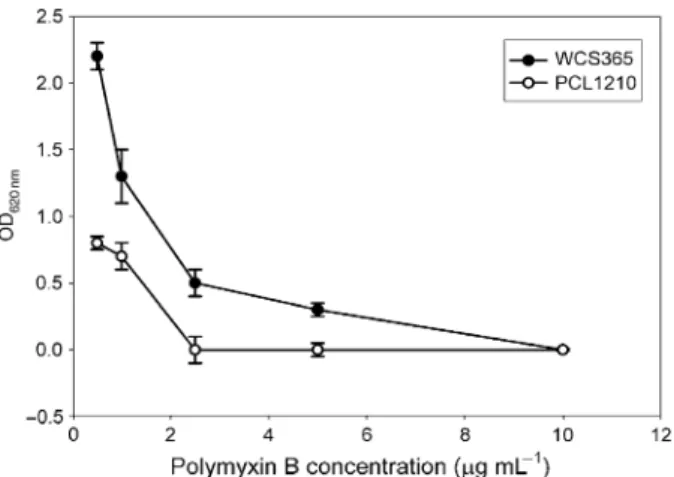
LPS (Nikaido & Vaara, 1987), the colS/colR mutant could show changed sensitivity towards this compound. The observation that the growth of this mutant is more sensitive to polymyxin B than the growth of parental strain is (Fig. 4) supports this notion. To study whether the increased sensitivity of the PCL1210 was due to the effect on the methyltransferase/wapQ expression, we also constructed mutants in both these genes. For the construction of a mutant in the wapQ homologue of WCS365, the forward primer was designed based on WCS365 sequence while the reverse primer was designed based on an alignment ofwapQ homologues ofP. aeruginosaandPseudomonas putida. The resulting mutant is referred to as PCL1823 (Table 1). The mutants were not impaired in growth rate when grown in KB medium (data not shown). Indeed, both these mutants showed similar sensitivity results (data not shown). In addition, mutant PCL1210 appeared to be more resistant towards paraquat (Fig. 5).
Fig. 2.Promoter activity of methyltransferase in wild type strain WCS365 (dark bars) andcolR/colSmutant PCL1251 (grey bars). Plasmid pMP5579 contains the promoter of methyltransferase in the correct orientation in front oflacZ. Plasmid pMP5580 contains the promoter in the wrong orientation. Strains were grown on BM with 5 mM putrescine as the sole carbon source.
Fig. 3.Sensitivity ofPseudomonas fluorescensWCS365 () and colS mutant PCL1210 () towards streptomycin.
Fig. 5. Growth of wild typePseudomonas fluorescensWCS365 () and colSmutant PCL1210 () after overnight growth in KB medium supplemen-ted with various concentrations of the superoxide forming agent paraquat. Fig. 4. Growth of Pseudomonas fluorescens WCS365 () and colS mutant PCL1210 () after overnight growth in BM2 medium supplemen-ted with 0.5 mM Mg21and with various concentrations of polymyxin B.
by guest on October 24, 2016
http://femsec.oxfordjournals.org/
Rate of permeation of ampicillin through the outer membrane
To analyze directly whether the outer membrane of the mutant is altered, the rate of permeation of ampicillin through the outer membrane was measured. Theb -lacta-mase present in the periplasmic space will open theb-lactam ring of those ampicillin molecules that have diffused through the outer membrane protein pores after exogenous application of the antibiotic (Pugsleyet al., 1987). Thebla gene of pMMB67HE (Fursteet al., 1986), a plasmid which appeared not to be stable inP. fluorescens,was cloned as a HindIII fragment into the broad host range vector pBBR5MCS5 (Kovachet al., 1995), selecting for gentamycin resistance. The resulting plasmid pMP4068 (Table 1) was electroporated into strains WCS365 and PCL1210. The respective resulting strains PCL1830 and PCL1831 (Table 1) were used to determine the rate of permeation of ampicillin through the outer membrane. The results of three experiments showed that theb-lactam antibiotic ampicillin is taken up efficiently by the wild type strain, with an average rate of permeation of 6.2 nmol1min1108cells. In contrast, the relative rate ofb-lactam uptake of mutant PCL1210 was only 18% of that of the wild type. This result indicates that the transport of ampicillin through the general porin(s) was severely affected in the mutant.
colS mutant PCL1210 loses growth in competition on root exudate and its main component putrescine
Because differences in outer membrane permeability, such as the uptake of putrescine, were observed, we reasoned that the colonization defect of thecolR/colSmutant could be due to the slower uptake of root exudates components.
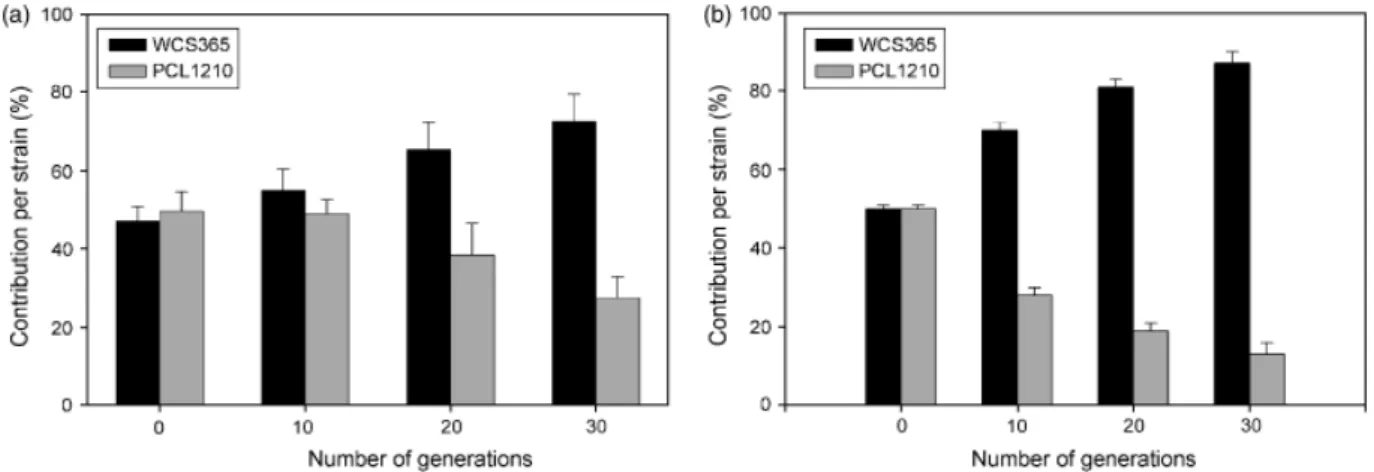
There-fore, a growth competition was performed in BM medium containing 5 mM of the major root exudate component putrescine as the sole carbon source. The results (Fig. 6) show that the mutant loses slowly but gradually in competi-tion from its parental strain. After approximately 30 genera-tions four times more wild type cells are present than mutant cells (Fig. 6).
Competitive colonization of a
methyltransferase - andwapQ mutant
To test whether the methyltransferase and wapQ genes downstream ofcolR/colSare indeed involved in root coloni-zation, new mutants were constructed by homologous recombination. Mutant PCL1812 is mutated in a gene homologous to a methyltransferase gene (Table 1). The competitive colonizing behaviour ofP. fluorescensWCS365 and its mutants on tomato roots was analyzed in the gnotobiotic sand system as described by Simons et al. (1996). Both mutants PCL1812 (methyltransferase) and PCL1823 (wapQ) showed a fivefold decrease in root tip colonizing ability (Table 2).
Discussion
For biological control root colonization is an essential trait. If a bacterium is not able to colonize the root system efficiently, its biocontrol activity is decreased or completely absent (Chin-A-Woenget al., 1998; Kamilovaet al., 2005). When root colonization is studied, CFU are determined from the root tip. Distribution of inocula along the root system shows a gradient (Simonset al., 1996). The major differences between a wild type and a colonization mutant are found on the root tip since that part of the root is most difficult to reach (Chin-A-Woenget al., 1997; de Weertet al.,
Fig. 6. Competitive growth ofPseudomonas fluorescensWCS365 (dark bars) andcolSmutant PCL1210 (grey bars) in BM with root exudate (a) or putrescine (b) as the sole carbon source. At time point zero individual cultures of both strains were mixed and the number of CFU of each strain was determined. The mixture was diluted 1000-fold, incubated overnight after which the number of CFU of each strain was determined again. This procedure was repeated twice.
by guest on October 24, 2016
http://femsec.oxfordjournals.org/
2002). A criterion for a competent root colonizer is that it can efficiently reach the root tip. Unravelling the mechanism behind root colonization is necessary to be able to improve the biocontrol abilities of microorganisms. In this way we can work in an environmentally friendly way on controlling phytopathogens. In a previous study it has been shown that colSmutant PCL1210 is impaired in competitive root tip colonization (Dekkers et al., 1998). Here we show that a two-gene operon encoding a methyltransferase and awapQ is present downstream of thecolR/colSoperon (Fig. 1).
InE.colithe geneinaAis induced by acidification of the external medium. Expression increases with decreasing intracellular pH and with decreasing temperature. In gen-eral,inaAexpression correlated with a decrease in intracel-lular pH (Whiteet al., 1992). InE. coli inaAis regulated by both the soxRS system, which regulates superoxide stress response, and the MAR system, which regulates multiple antibiotic resistance (Rosner & Slonczewski, 1994).
The wapQ gene of P. aeruginosa encodes a putative heptose kinase. LPS in the outer membrane contain several heptoses, which are generally phosphorylated. However, the extent of LPS modification is known to vary. For instance,
P. fluorescensLPS is more heavily phosphorylated at higher
temperatures and this modification is probably affecting the pore size of the main porin ofP. fluorescensOprF (El Hamel
et al., 2000). LPS is known to be strongly associated with
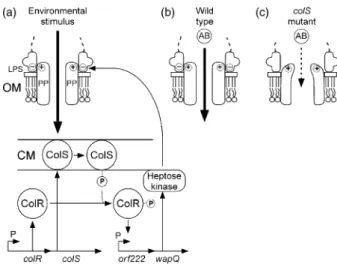
bacterial porins of P. aeruginosa and E. coli. It is among others involved in the channel activity of some porins. The negatively charged phosphates on heptose are assumed to contribute to stabilization of the outer membrane structure (Lugtenberg & van Alphen, 1983). This notion, together with the finding thatcolSmutant PCL1210 is more resistant to various chemically unrelated antibiotics, suggested to us a model (Fig. 7) in which passive diffusion of these molecules through the outer membrane pore protein, which interacts
with LPS (Lugtenberg & van Alphen, 1983) is less efficient in the mutant.
As two-component systems often regulate genes in their close proximity (Swanson et al., 1994), we tested whether
colR/colS regulates the expression of the methyltransferase/
wapQ operon. This appeared to be the case although sub-stantial expression still occurs in the ColR/ColS mutant (Fig. 2). BecauseinaAexpression inE. coliis regulated by at least two regulatory systems, soxRSand MAR (Rosner & Slonc-zewski, 1994), a similar complex regulation may occur in
Pseudomonas. This would explain the high residual activity of
the methyltransferase/wapQ promoter in a colR/colS back-ground (Fig. 2). The proposal thatcolR/colSis required for optimal expression of the methyltransferase/wapQoperon is further supported by the observation that like colSmutant PCL1210 (Dekkers et al., 1998) both mutants PCL1812 (methyltransferase) andwapQmutant PCL1823 are impaired in competitive tomato root tip colonization (Table 2).
The observation that the rate of degradation of ampicillin by periplasmic b-lactamase is 18% of wild type values in mutant PCL1210 shows that the colS mutation negatively affects the permeability of the outer membrane. Consistent with this conclusion is the observation that PCL1210 loses competition for root exudate and the major root exudate component (Kuiper et al., 2001; de Weert et al., 2006) putrescine (Fig. 6). The increased sensitivity of PCL1210 for the antibiotic polymyxin B (Fig. 4), which attacks the outer membrane from the outside by binding to LPS (Nikaido & Vaara, 1987), indicates that, in the mutant, LPS molecules have indeed changed (Ernstet al., 1999). This observation is consistent with a decrease of phosphorylation of heptose in the inner core region of LPS caused by a decreased activity of the WapQ heptose kinase as suggested by the model. It is essential that phosphate residues are present at two locations in the inner core-lipid A region per LPS molecule in wild
Fig. 7. Proposed working model for maintaining the structure and function of the outer membrane.
Table 2.Competitive tomato root tip colonization of P. fluorescens WCS365 and its mutant derivatives in the gnotobiotic system
Strains
Competitive root tip colonization [log10(CFU11 cm1) root tip]
w
Wild type Mutant
PCL1285 (kmrparent) 5.60.2a 5.60.3a
PCL1210 (colS) 5.00.3a 2.10.4a
PCL1812 (methyltransferase) 5.80.1a 5.20.1b
PCL1823 (wapQ) 5.50.2a 4.90.1b
Seedlings were inoculated with a 1:1 mixture of cells of wild type or
mutant strains and placed in the gnotobiotic sand system. Root tips were analyzed after 7 days.
w
In every experiment 10 seedlings were inoculated and plants were individually processed after growth. When values in the same row are followed by a different letter, they are significantly different atP= 0.05 on nonparametric multiple comparisons using the Wilcoxon–Mann– Whitney test.
by guest on October 24, 2016
http://femsec.oxfordjournals.org/
type cells (Wilkinson, 1981; Walshet al., 2000), however the third phosphorylation site of heptose I residue is not essential inP. aeruginosa(Walshet al., 2000).
We propose the following working model. The ColS sensor of the ColR/ColS two-component system is activated by an unknown environmental stimulus. As a consequence ColS is autophosphorylated and subsequently transfers its phosphate residue to ColR. Phosphorylated ColR activates the methyltransferase/wapQ operon. The wapQproduct is homologous to aP. aeruginosaheptose kinase responsible for phosphorylating heptose I in the LPS core region (Walsh
et al., 2000) The resulting negatively charged phosphorylated
LPS is thought to interact with a positively charged part of the pore protein, thereby contributing to keeping the pore open. Considering the possible function of this gene as a methyltransferase, it is possible that modified methylation of LPS also plays a role in the altered outer membrane proper-ties ofcolSmutant PCL1210. Several antibiotics are able to diffuse through the pore of wild type cells. In cells ofcolS mutant PCL1210 the heptose kinase encoded bywapQis less active. As a consequence, the phosphate residues that help to keep the pore open in wild type cells are absent in mutant cells which therefore have a narrower pore through which antibiotics diffuse with a slower rate. Moreover, the space between the pore protein and the LPS molecule at the outside of the cells becomes wider in the mutant which enables polymyxin B to bind to LPS more efficiently. The narrower pore opening in mutant cells makes these cells less efficient than those of the wild type in competing for the low nutrient levels in the rhizosphere. Consequently, the latter cells lose in competitive tomato root tip colonization.
In conclusion, the obtained results support the model described above and presented in Fig. 7 implying that the ColR/ColS regulatory system is required for optimal expres-sion of the methyltransferase/wapQoperon and thatwapQ encodes a heptose kinase. Under-phosphorylation of hep-tose causes a narrowing of the protein pores in the outer membrane which results in a higher resistance towards several antibiotics and a poorer uptake of the major root exudate component putrescine when presented in a low concentration. Considering the possible function of the downstream gene as a methyltransferase, it is possible that modified methylation of LPS also plays a role in the altered outer membrane properties of colS mutant PCL1210. All this leads on the tomato root to a decreased ability of the mutant, after mixed inoculation of the seed, to reach the root tip in competition with the wild type.
References
Carlson J, Fuchs JA & Messing J (1984) Primary structure of the
Escherichia coliribonucleoside diphosphate reductase operon.
Proc Natl Acad Sci USA81: 4294–4297.
Chin-A-Woeng TFC, de Priester W, van der Bij AJ & Lugtenberg BJJ (1997) Description of the colonization of a gnotobiotic tomato rhizosphere byPseudomonas fluorescensbiocontrol strain WCS365 using scanning electron microscopy.Mol Plant-Microbe Interact10: 79–86.
Chin-A-Woeng TFC, Bloemberg GV, van der Bij AJ,et al. (1998) Biocontrol by phenazine-1-carboxamide-producing
Pseudomonas chlororaphisPCL1391 of tomato root rot caused byFusarium oxysporumf. sp.radicis lycopersici.Mol Plant-Microbe Interact11: 1069–1077.
Chin-A-Woeng TFC, Bloemberg GV, Mulders IHM, Dekkers LC & Lugtenberg BJJ (2000) Root colonization by phenazine-1-carboxamide-producing bacteriumPseudomonas chlororaphis
PCL1391 is essential for biocontrol of tomato foot and root rot.Mol Plant-Microbe Interact13: 1340–1345.
Dekkers LC, Bloemendaal CJ, de Weger LA, Wijffelman CA, Spaink HP & Lugtenberg BJJ (1998) A two-component system plays an important role in the root-colonizing ability of
Pseudomonas fluorescensstrain WCS365.Mol Plant-Microbe Interact11: 45–56.
Dekkers LC, Mulders IHM, Phoelich CC, Chin-A-Woeng TFC, Wijfjes AHM & Lugtenberg BJJ (2000) The sss colonization gene of the tomato-Fusarium oxysporumf. spradicis lycopersici
biocontrol strainPseudomonas fluorescensWCS365 can improve root colonization of other wild-typePseudomonas
spp. Bacteria.Mol Plant-Microbe Interact13: 1177–1183. de Weert S, Vermeiren H, Mulders IHM, Kuiper I, Hendrickx N,
Bloemberg GV, Vanderleyden J, de Mot R & Lugtenberg BJJ (2002) Flagella-driven chemotaxis towards exudate
components is an important trait for tomato root colonization byPseudomonas fluorescens.Mol Plant-Microbe Interact15: 1173–1180.
de Weert S, Dekkers LC, Kuiper I, Bloemberg GV & Lugtenberg BJJ (2004a) Generation of enhanced competitive root tip colonizingPseudomonasbacteria through accelerated evolution.J Bacteriol186: 3153–3159.
de Weert S, Kuiper I, Kamilova FD,et al. (2006) Role of competitive root tip colonisation in the biological control of tomato foot and root rot.Biological Control of Fruit and Vegetables Diseases. Kluwer Academic Publishers, Dordrecht, The Netherlands, in press.
de Weger LA, Jann B, Jann K & Lugtenberg BJJ (1987)
Lipopolysaccharides ofPseudomonasspp. that stimulate plant growth: composition and use for strain identification.J Bacteriol169: 1441–1446.
El Hamel C, Freulet MA, Jaquinod M, De E, Molle G & Orange N (2000) Involvement of the C-terminal part ofPseudomonas fluorescensOprF in the modulation of its pore-forming properties.Biochim Biophys Acta1509: 237–244.
Ernst RK, Yi EC, Guo L, Lim KB, Burns JL, Hackett M & Miller SI (1999) Specific lipopolysaccharide found in cystic fibrosis airwayPseudomonas aeruginosa.Science286: 1561–1565. Furste JP, Pansegrau W, Frank R, Blocker H, Scholz P, Bagdasarian
M & Lanka E (1986) Molecular cloning of the plasmid RP4 primase region in a multi-host-rangetacPexpression vector.
Gene48: 119–131.
Gilleland HE Jr, Stinnett JD & Eagon RG (1974) Ultrastructural and chemical alteration of the cell envelope ofPseudomonas
by guest on October 24, 2016
http://femsec.oxfordjournals.org/
aeruginosa, associated with resistance to ethylene-di-amine-tetra-acetate resulting from growth in a Mg21-deficient medium.J Bacteriol117: 302–311.
Goldman RC & Leive L (1980) Heterogeneity of antigenic-side-chain length in lipopolysaccharide fromEscherichia coli0111 andSalmonella typhimuriumLT2.Eur J Biochem107: 145–153. Hanahan D (1983) Studies on transformation ofEscherichia coli
with plasmids.J Mol Biol166: 557–580.
Hoffland E, Findenegg GR & Nelemans JA (1989) Solubilization of rock phosphate by rape.Plant Soil113: 161–165.
Kamilova F, Validov S, Azarova T, Mulders I & Lugtenberg BJJ (2005) Enrichment for enhanced competitive plant root tip colonizers selects for a new class of biocontrol bacteria.
Environ Microbiol7: 1809–1817.
King EO, Ward MK & Raney DE (1954) Two simple media for the demonstration of pyocyanin and fluorescin.J Lab Clin Med44: 301–307.
Kovach ME, Elzer PH, Hill DS, Robertson GT, Farris MA, Roop RM & Peterson KM (1995) Four new derivatives of the broad-host-range cloning vector pBBR1MCS, carrying different antibiotic-resistance cassettes.Gene166: 175–176. Kuiper I, Bloemberg GV, Noreen GV, Thomas-Oates JE &
Lugtenberg BJJ (2001) Increased uptake of putrescine in the rhizosphere inhibits competitive root colonization by
Pseudomonas fluorescensstrain WCS365.Mol Plant-Microbe Interact14: 1096–1104.
Labes M, Puhler A & Simon R (1990) A new family of RSF1010-derived expression and lac-fusion broad-host-range vectors for gram-negative bacteria.Gene89: 37–46.
Laville J, Voisard C, Keel C, Maurhofer M, Defago G & Haas D (1992) Global control inPseudomonas fluorescensmediating antibiotic synthesis and suppression of black root rot of tobacco.Proc Natl Acad Sci USA89: 1562–1566.
Lugtenberg BJJ & van Alphen L (1983) Molecular architecture and functioning of the outer-membrane ofEscherichia coliand other gram-negative bacteria.Biochim Biophys Acta737: 51–115.
Lugtenberg BJJ, Meyers J, Peters R, van der Hoek P & van Alphen L (1975) Electrophoretic resolution of the major outer membrane protein ofEscherichia coliK12 into four bands.
FEBS51–115.
Lugtenberg BJJ, Bronstein H, van selm N & Peters R (1977) Peptido-glycan associated outer membrane proteins in gram-negative bacteria.Biochim Biophys Acta571–578.
Lugtenberg BJJ, Kravchenko LV & Simons M (1999) Tomato seed and root exudate sugars: composition, utilization by
Pseudomonasbiocontrol strains and role in rhizosphere colonization.Environ Microbiol1: 439–446.
Lugtenberg BJJ, Dekkers LC & Bloemberg GV (2001) Molecular determinations of rhizosphere colonization byPseudomonas.
Annu Rev Phytopathol39: 461–490.
Miller JH (1972)Experiments in Molecular Genetics. Cold Spring Harbor Lab, New York.
Nikaido H & Vaara M (1987) Outer membrane.Escherichia coli and Salmonella typhimurium(Ingraham JL, Brooks Low K, Magasanik B, Schaechter M & Umbarger HE, eds), pp. 1–22. American Society for Microbiology, Washington.
Overbeeke N & Lugtenberg B (1980) Major outer membrane proteins ofEscherichia colistrains of human origin.J Gen Microbiol121: 373–380.
Overbeeke N & Lugtenberg B (1982) Recognition site for phosphorus-containing compounds and other negatively charged solutes on the PhoE protein pore of the outer membrane ofEscherichia coliK12.Eur J Biochem126: 113–118. Palva ET & Makela PH (1980) Lipopolysaccharide heterogeneity
inSalmonella typhimuriumanalyzed by sodium dodecyl sulfate polyacrylamide gel electrophoresis.Eur J Biochem107: 137–143.
Pugsley AP, Zimmerman W & Wehrli W (1987) Highly efficient uptake of a rifamycin derivative via the FhuA-TonB-dependent uptake route inEscherichia coli.J Gen Microbiol133:
3505–3511.
Rodrigue A, Quentin Y, Lazdunski A, Mejean V & Foglino M (2000) Two-component systems inPseudomonas aeruginosa: why so many?Trends Microbiol8: 498–504.
Rosner JL & Slonczewski JL (1994) Dual regulation ofinaAby the multiple antibiotic resistance (mar) and superoxide (soxRS) stress response systems ofEscherichia coli.J Bacteriol176: 6262–6269.
Sambrook J & Russel D (2001)Molecular Cloning: A Laboratory Manual. Cold Spring Laboratory Press, Cold Spring Harbor NY, USA.
Schippers B, Bakker AW & Bakker PAHM (1987) Interactions of deleterious and benificial rhizosphere microorganisms and the effect of cropping practices.Annu Rev Phytopathol25: 339–358.
Simons M, van der Bij AJ, Brand J, de Weger LA, Wijffelman CA & Lugtenberg BJJ (1996) Gnotobiotic system for studying rhizosphere colonization by plant growth-promoting
Pseudomonasbacteria.Mol Plant-Microbe Interact9: 600–607. Sokal RR & Rohlf FJ (1981)Biometry. Freeman, San Franscisco. Swanson RV, Alex LA & Simon MI (1994) Histidine and aspartate
phosphorylation: two-component systems and the limits of homology.Trends Biochem Sci19: 485–490.
Voisard C, Bull CT, Keel C, Laville J, Maurhofer M, Schnider U, D´efago G & Haas D (1994) Biocontrol of root diseases by
Pseudomonas fluorescensCHAO: current concepts and experimental approaches.Molecular Ecology of Rhizosphere Microorganisms(O’Gara F, Dowling DN & Boesten N, eds), pp. 67–89. VCH Verlagsgesellschaft, Weinheim, Germany. Walsh AG, Matewish MJ, Burrows LL, Monteiro MA, Perry MB &
Lam JS (2000) Lipopolysaccharide core phosphates are required for viability and intrinsic drug resistance in
Pseudomonas aeruginosa.Mol Microbiol35: 718–727. White S, Tuttle FE, Blankenhorn D, Dosch DC & Slonczewski JL
(1992) pH dependence and gene structure ofinaAin
Escherichia coli.J Bacteriol174: 1537–1543.
Wilkinson SG (1981) 31P N.m.r. evidence for the presence of triphosphate residues in lipopolysaccharides from
Pseudomonas aeruginosa.Biochem J199: 833–835. Zimmermann W & Rosselet A (1977) Function of the outer
membrane ofEscherichia colias a permeability barrier to beta-lactam antibiotics.Antimicrob Agents Chemother12: 368–372.
by guest on October 24, 2016
http://femsec.oxfordjournals.org/