DAILY LIFE AT CERRO LEÓN, AN EARLY INTERMEDIATE PERIOD HIGHLAND SETTLEMENT IN THE MOCHE VALLEY, PERU
Jennifer Elise Ringberg
A dissertation submitted to the faculty of the University of North Carolina at Chapel Hill in partial fulfillment of the requirements for the degree of Doctor of Philosophy in the Department of Anthropology.
Chapel Hill 2012
Approved by: Brian R. Billman Vincas Steponaitis C. Margaret Scarry Patricia McAnany
ii © 2012
iii ABSTRACT
JENNIFER ELISE RINGBERG: Daily Life at Cerro León, an Early Intermediate Period Highland Settlement in the Moche Valley, Peru
(Under the direction of Brian R. Billman)
In this dissertation I examine the cultural identity and social dynamics of individuals in households through the activities and objects of daily life. The households I study are at Cerro León, an Early Intermediate period (EIP) (400 B.C. to A.D. 800) settlement in the middle Moche valley, Peru. My results support a model of migration and long-term settlement by highland groups from the upper limits of the valley. Highland people remained in settlements throughout the middle Moche valley for roughly two centuries, abandoning the region just prior to the consolidation of the Southern Moche polity (A.D.200 to 800). Understanding interaction between highland and coastal groups as they sought access to the fertile middle zones of coastal valleys provides insight into small- and large-scale social organization. Highland-coastal interaction remained an essential element in trajectories of social complexity throughout the Peruvian Andes from prehistory into the modern era.
The three residential compounds excavated at Cerro León were the largest and best preserved of the entire settlement. Members of multi-generational, extended or multi-nuclear family households created spaces for cooking, storage, and productive tasks related to intensive farming and small-scale craft production, including production of cloth and tools and ornaments of stone and copper. Results of my multi-faceted study of the origins, manufacture, and function of the pottery assemblage demonstrate that Cerro León households imported nearly all of it for their culinary needs. Plainwares were manufactured in both highlands and coast, but over 90 percent of the fineware feasting
iv
v
ACKNOWLEDGEMENTS
Numerous individuals and institutions provided support for this study. Archaeological fieldwork in Peru was carried out with permission of El Ministerio de Cultura, Lima and Trujillo. Field research took place under the auspices of MOCHE, Inc. and the UNC South American
Archaeology Field School through the Study Abroad program at the University of North Carolina at Chapel Hill. The Ford Foundation provided a pre-dissertation grant for my study of chicha (corn beer) brewers in the Moche valley in 2002. The Off Campus Dissertation Fellowship from the Graduate School at UNC–Chapel Hill provided funds during the spring 2009 semester for data collection and analysis in Peru for this dissertation project. The Timothy P. Mooney Fellowship provided funds for preparation of petrographic thin sections.
I am grateful to my dissertation advisor, Brian Billman for his training and support over the last several years at the University of North Carolina at Chapel Hill. Throughout the process he offered valuable feedback and advice and provided excellent technical commentary and constructive criticism on drafts of this manuscript. I also wish to thank my other committee members, Vin Steponaitis, Margie Scarry, Patricia McAnany, John Scarry, and Jeff Quilter for their advice,
encouragement, and assistance throughout the fieldwork and write-up of this project. In the Research Laboratories of Archaeology at UNC, I am grateful for the advice and assistance of current and former staff members, Steve Davis, Brett Riggs, and Brenda Moore. I also gratefully acknowledge Drew Coleman and Alan Glaser for their assistance and permission to use equipment in the
department of Geological Sciences at UNC–Chapel Hill.
vi
Marty Giaramita for allowing me to use the petrographic microscope in the Department of Physics, Physical Sciences, and Geology. I also want to express my gratitude to Austin Avwunudiogba of the Department of Anthropology and Geopgraphy for his technical expertise with digital geologic maps.
At UNC I benefitted from discussion with and insight from many former and current graduate students over the years including Amber VanDerwarker, Tony Boudreaux, Kandi Detwiler, Amanda Tickner, Mark Plane, Lance Green, Will Meyer, and Theresa McReynolds Shebalin. Many provided not only insightful discussion on campus but also invaluable assistance in Peru, including Celeste Gagnon, Barker Fariss, Evan Surridge, Kim Schaefer, Drew Kenworthy, Mary Beth Fitts, Ben Shields, Meg Kassabaum, Erin Stevens Nelson, Sara Simon, and John Pleasants. I especially appreciate the contributions of fellow UNC graduate students Julio Rucabado-Yong, Greg Wilson, and Jon Marcoux for their expertise as crew chiefs and their insights as pottery specialists.
Many other project members provided valuable assistance in Peru including Caitlin Lackett, who helped photograph artifacts for this dissertation, as well as Laura Burnham, Patricia Alexander, Chris Jochem, Vanessa Patchett, Nick Kier, and Rebecca Schellenberger who provided valuable assistance in the field. I’d also like to thank Gail Ryser for providing her expertise in setting up the flotation procedures. I am grateful for the work of Dana Bardolph who has begun a detailed analysis of Cerro León’s paleoethnobotanical collections and has been a great help in the lab. I am especially grateful to Alicia Boswell who over the years has generously provided assistance in the field and lab. She has become a dear friend and colleague since she first joined the field school as a student in 2004.
vii
appreciated. I owe Marina, Marielena, and Marcelina much gratitude for cheerfully inviting me into their homes and sharing their knowledge and experience of chicha brewing with me.
Finally, many project members both in Huanchaco and in the middle Moche valley have contributed hard work, knowledge, humor, and friendship over the years. In Huanchaco I am grateful for the contributions of Eloisa Piminchumo, and her family, especially sons Roby and Mateo
Valderrama Piminchumo for their patience and help in the archaeology lab. Rosa Melendez and her brother Jose Melendez Sempertegui have provided countless hours of assistance and companionship in the Huanchcaco lab house. In the field I gained invaluable experience from the contributions of skilled and experienced excavators, especially Andrés Guzman, Wilmán Guzman, Wilmer Guzman, and Americo Cruz. I also thank Justo Benavides, Casimiro Contreras, and Fernando Avelardo Guzman for many years of service to the project.
viii
TABLE OF CONTENTS
ABSTRACT ... iii
ACKNOWLEDGEMENTS ... v
LIST OF TABLES ... xv
LIST OF FIGURES ... xvi
Chapter 1 INTRODUCTION ... 1
1.1 Introduction ... 1
1.2 Project research questions and goals ... 2
1.3 Organization of dissertation ... 4
Chapter 2 CERRO LEÓN SITE SETTING ... 6
2.1 Introduction ... 6
2.2 Geological context ... 7
2.3 Climate and Paleoclimate in the Moche River valley ... 11
2.4 Environmental zones and diversity ... 15
2.5 Cerro León community setting ... 20
2.6 History of mapping and excavations at Cerro León ... 23
ix
Chapter 3 THE NORTH COAST OF PERU IN THE EIP ... 33
3.1 Introduction ... 33
3.2 EIP residence and household on the north coast ... 35
3.3 North coast society and cultural identity in the EIP ... 40
3.4 Perspectives on foodways during the north coast EIP ... 42
3.5 Connections between highland, valley, and coast during the EIP ... 48
3.6 Discussion ... 53
Chapter 4 THEORETICAL PERSPECTIVES AND PROJECT METHODOLOGY ... 56
4.1 Introduction ... 56
4.2 Household organization in central Andean and coastal regions ... 57
4.3 A household archaeology approach to Cerro León ... 63
4.4 Modeling Cerro León households: middle range theories and research objectives ... 64
4.5 Research objectives ... 65
4.6 Project Field Methods ... 76
Field methods... 77
Laboratory Methods ... 79
4.7 Discussion ... 81
x
5.1 Excavation goals and methodology ... 84
5.2 Structure identification ... 84
5.3 House construction techniques ... 97
5.4 The archaeological context at Cerro León: site formation processes ... 99
5.5 Variation in structure size and function ... 106
5.6 Residential group organization, social identities and intra-residential social relationships ... 108
Compound 1 residential group ... 110
Compound 3 residential group ... 116
Compound 6 residential group ... 116
5.7 Estimating occupation span ... 120
5.8 Interpreting the life cycles of households through residential spaces ... 123
5.9 Discussion ... 129
Chapter 6 THE CERRO LEÓN POTTERY ASSEMBLAGE: ORIGINS, MANUFACTURE, AND DISTRIBUTION ... 134
6.1 Introduction ... 134
6.2 Raw Materials Survey ... 135
Raw materials survey methods ... 135
Raw Materials Survey Results ... 136
xi
Pottery typology methods ... 147
6.4 Cerro León Pottery Descriptions ... 150
Castillo Series ... 151
Cerro León Series ... 158
Otuzco Series ... 167
Quinga Series ... 170
Other wares ... 175
6.5 The Cerro León Typology in Regional and Chronological Context ... 176
6.6 Discussion ... 180
Chapter 7 FUNCTIONAL ANALYSIS OF THE CERRO LEÓN STUDY ASSEMBLAGE ... 183
7.1 Introduction ... 183
7.2 Previous Research on Pottery Function ... 184
7.3 Methods of the Functional Analysis ... 185
Minimum Number of Vessels (MNV) ... 186
Shape and Size ... 190
Paste Composition ... 193
Surface Treatment ... 196
xii
7.4 Form and Function of Cerro León Vessel Classes ... 198
Angled-neck olla ... 199
Bulged collar olla ... 212
Neckless olla ... 213
Individual serving bowl ... 215
Red-slipped serving olla ... 221
Tostadera... 223
Bottle ... 225
Tinaja ... 227
Cántaros and Jarras ... 228
Scuptural/effigy jar ... 237
Face-neck jar ... 240
7.5 Non-vessel culinary items and vessels with dubious culinary function... 241
Miniature vessels ... 241
Canchero ... 242
Spoon ... 243
Grater bowl ... 244
xiii
Piruru spindle whorl ... 246
Crucible ... 247
Hollow figurine ... 248
Slipcast pottery ... 249
Worked sherds ... 250
7.6 Inter-assemblage Comparisons ... 251
Basic Shape Frequencies ... 251
Type Distributions ... 252
Vessel Size Comparisons ... 256
7.7 Discussion ... 259
Everyday Foodways ... 260
Feasting Foodways ... 263
Foodways and Cultural Identities ... 265
Cultural Identities and Other Pottery-related Activities ... 267
Chapter 8 CONCLUSIONS ... 268
Appendix A: Plant and Animal Resources recorded for North Coast Archaeological Sites ... 274
Appendix B: Area 1 Architectural Descriptions ... 276
xiv
B.2.1 Compound 1 ... 276
B.2.2 Compound 3 ... 293
B.2.3 Compound 6 ... 299
xv
LIST OF TABLES
Table 2.4.1. Environmental designations by ONERN (1973), Pulgar Vidal (1987), and Billman
(1996). ... 15
Table 2.6.1. Surface collected and excavated residential compounds, Area 1, Cerro León. ... 25
Table 3.1.1. Current chronologies for the Moche valley EIP (400 B.C. – A.D. 600) and Middle horizon (A.D. 600 – 1000). ... 35
Table 5.2.1. Total area surface collected and excavated in residential Compounds 1, 3, and 6. ... 85
Table 5.2.2. The functions and dimensions of Compound 1 structural features. ... 88
Table 5.2.3. The functions and dimensions of Compound 3 structural features. ... 90
Table 5.2.4. The functions and dimensions of Compound 6 structural features. ... 90
Table 5.4.1. Bulk pottery weight for excavation contexts at Cerro León, Compounds 1, 3, and 6. ... 100
Table 5.4.2. Pottery types in floor contact contexts for Compounds 1, 3, and 6, Cerro León. ... 102
Table 5.4.3. Pottery type distribution in floor contact contexts for Compound 1, Cerro León. ... 102
Table 5.5.1. Distribution of functional spaces in Compounds 1, 3, and 6, Cerro León. ... 108
Table 5.7.1. Radiocarbon dates on carbonized annuals from Cerro León and wood from the Urban Zone at the Huacas de Moche. ... 121
Table 6.3.1. Summary characteristics of the four pottery wares found at Cerro León. ... 145
Table 6.3.2. Mineral phase identification characteristics(from Neese 2000:158). ... 149
Table 7.3.1. Raw count, MNV, and metric data assemblage count for Cerro León pottery vessels. . 190
Table 7.3.2. Mechanical performance characteristics and physical properties of Cerro León pottery vessels. ... 191
Table 7.3.3. Functional vessel categories for Cerro León: their proposed morphological properties and mechanical performance characteristics... 192
Table 7.4.1. Cerro León vessel shapes in the study assemblage by basic shape. ... 199
Table 7.6.1. Relative frequencies of functional categories in Compounds 1, 3, and 6. ... 251
xvi
LIST OF FIGURES
Figure 2.1.1. Cerro León in the Moche valley, Peru. ... 8
Figure 2.2.2. Modern towns of interest to the economic geology of the Moche watershed. ... 11
Figure 2.3.1. The site of Cerro León (MV-225) in the Quebrada de los Chinos drainage basin. ... 14
Figure 2.4.1. Natural zones of the Moche watershed with sites mentioned in text. ... 16
Figure 2.5.1. Cerro León and the three Highland EIP clusters in the Moche valley. ... 20
Figure 2.5.2. Cerro León (MV-225) and its twelve site areas, Compounds 1, 3, and 6 in Area 1... 23
Figure 2.6.1. Schematic of the residential compounds in Area 1 of Cerro León investigated by the Moche Origins Project. ... 27
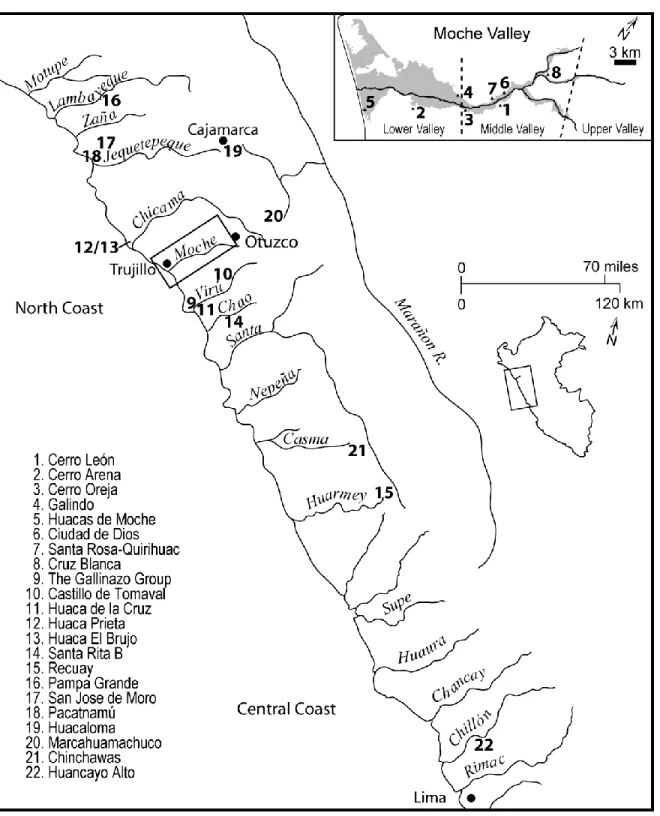
Figure 3.1.1. The north and central coast of Peru with sites discussed in Chapter 3. ... 34
Figure 5.2.1. Schematic of residential Compounds 1, 3, and 6, Area 1, Cerro León. ... 86
Figure 5.2.2. The rock outcrop hearth, Feature 58.01, in the Feature 58 kitchen, Compound 6. ... 92
Figure 5.2.3. Numerous ash pits and burned areas in the northwest corner of the Feature 5 kitchen. . 92
Figure 5.2.4. The western patio Feature 51 in Compound 6... 94
Figure 5.2.5. Terraces 43 and 44 above Patio Feature 32, an entry point into Compound 1. ... 94
Figure 5.2.6. Storage Features 53 and 52 in Compound 1. ... 95
Figure 5.2.7. Feature 48, a circular, slab-lined cist tomb in Compound 3, patio Feature 34. ... 97
Figure 5.4.1. Chimu Blackware sherds from the post-abandonment encampment, Compound 1. ... 105
Figure 5.5.1. Boxplot of area in meters2 for rooms at Cerro León classified by inferred function. ... 107
Figure 5.6.1. Public, private, and ritual sectors in the Compound 1 residence, Cerro León. ... 109
Figure 5.6.2. Fine, detailed stone work in the Feature 44 receiving area, Compound 1. ... 112
Figure 5.6.3. Kitchen, patio, and storage space in Compound 1. ... 114
Figure 5.6.4. Kitchen, patio, and storage space in Compound 3. ... 117
Figure 5.6.5. Kitchen, patio, and storage space in Compound 6. ... 118
Figure 5.7.1. Graph of Cerro León and other published calibrated dates for Moche EIP sites. ... 122
xvii
Figure 6.2.2. Sites and locales of clay collection for the raw materials survey. ... 138
Figure 6.2.3. Clay deposits near the Huacas de Moche. ... 139
Figure 6.2.4. Detail of clay strata in deposits near the Huacas de Moche. ... 140
Figure 6.2.5. Small-scale clay mining near the archaeological site of Cuidista, upper Moche valley... 143
Figure 6.2.6. White (illite) clay deposits in clay mine near Cuidista. ... 144
Figure 6.4.1. Igneous extrusive (volcanic) aplastic inclusion with fine, plagioclase lath (plain and crossed polars). ... 152
Figure 6.4.2. Shrinkage cracks in Castillo Series paste running parallel to pottery surface. ... 153
Figure 6.4.3. Possible cord-impressed Castillo Series pottery fragments. ... 154
Figure 6.4.4. Plastic decoration typical in the Castillo Series assemblage at Cerro León. ... 156
Figure 6.4.5. Representational themes in Castillo Modeled pottery at Cerro León. ... 156
Figure 6.4.6. Typical Cerro León Series paste and temper, with large grain exhibiting myrmekite secondary reaction texture (right) and presences of slip (bottom). ... 160
Figure 6.4.7. Evidence of scraping Cerro León Series vessels to thin vessel walls. ... 161
Figure 6.4.8. Representational themes in Cerro León Series sculptural vessels. ... 163
Figure 6.4.9. Slip and slip-paint common in Cerro León Series vessel assemblage. ... 164
Figure 6.4.10. Simple and elaborate resist-painted (negative) designs of the Cerro León Series. ... 165
Figure 6.4.11. Otuzco Series buff paste (left) compared to Cerro León Series red-brown (right). .... 168
Figure 6.4.12. Otuzco Series paste and aplastic inclusios in plain (right) and crossed polars. ... 169
Figure 6.4.13. Quinga Series without aplastics (left), containing hematite concentrations and with aplastics (right), including embayed volcanic quartz (center of slide). ... 172
Figure 6.4.14. A sample of Quinga Series white paste bowl sherds. ... 173
Figure 6.4.15. Other types of pottery possibly made within 5 km of Cerro León. ... 176
Figure 7.3.1. Reconstructions of Castillo Series coastal vessels. ... 187
Figure 7.3.2. Reconstructions of Cerro León Series highland vessels. ... 188
Figure 7.4.1. Cerro León Series angled-neck ollas. ... 201
xviii
Figure 7.4.3. Angled-neck ollas with other paste and temper. ... 203
Figure 7.4.4. Cut-lip (escalonado) ollas, Castillo Series are at top left: 2006-40, 2004-23, 2002- 63, and 2004-19, 2007-119 is Otuzco Series, the rest are Cerro León Series. ... 204
Figure 7.4.5. Boxplot of neck height (mm) for Castillo, Cerro León, and other ollas. ... 205
Figure 7.4.6. Angled-neck ollas with handles (Castillo are at top, Cerro León wares below). ... 206
Figure 7.4.7. Bar graph of orifice diameters for angled-neck ollas. ... 207
Figure 7.4.8. Box plot of angled-neck olla orifice diameters grouped by ware series. ... 208
Figure 7.4.9. Large-capacity angled-neck ollas of the Cerro León Plain type. ... 209
Figure 7.4.10. Castillo Incised ollas. ... 211
Figure 7.4.11. Bulged collar ollas, Cerro León Series at top, Castillo Series forms at bottom. ... 213
Figure 7.4.12. Neckless ollas of the Castillo Series. ... 215
Figure 7.4.13. Bowl profiles for the Cerro León Series... 217
Figure 7.4.14. Cerro León Polychrome, White-on-red, and Red Slipped individual serving bowls. . 219
Figure 7.4.15. Cerro León Black, Burnished, and Quinga Painted individual serving bowls. ... 220
Figure 7.4.16. Cerro León and Otuzco Series Red-slipped serving ollas. ... 222
Figure 7.4.17. Tostadera forms in Cerro León and Otuzco Series wares. ... 224
Figure 7.4.18. Castillo Series bottles. ... 226
Figure 7.4.19. Castillo Series tinaja. ... 229
Figure 7.4.20. Cerro León Series Plain and Burnished cántaros. ... 231
Figure 7.4.21. Cerro León and Otuzco Red-slipped and White-on-red cántaros. ... 232
Figure 7.4.22. Cerro León and Otuzco Red-slipped and Polychrome cántaros ... 233
Figure 7.4.23. Castillo Plain and Burnished cántaros. ... 235
Figure 7.2.24. Box plot of orifice diameter for Cerro León and Castillo Series cántaros. ... 236
Figure 7.4.25. Cerro León and Otuzco Series jarras. ... 238
Figure 7.4.26. Castillo Series jarras. ... 239
xix
Figure 7.5.1. Miniature vessels in the Cerro León assemblage. ... 242
Figure 7.5.2. Canchero forms in Cerro León pastes. ... 243
Figure 7.5.3. Spoon form in Cerro León Black with fugitive orange paint. ... 243
Figure 7.5.4. Castillo Series grater bowl potsherd. ... 244
Figure 7.5.5. A Sample of tortero spindle whorls and blanks made from Cerro León potsherds. ... 246
Figure 7.5.6. Piruru spindle whorls. ... 247
Figure 7.5.7. Possible crucible fragment profile and thin section in plain polarized light. ... 247
Figure 7.5.8. Castillo series hollow figurines. ... 248
Figure 7.5.9. Slipcast tube fragments. ... 249
Figure 7.5.10. Unusual worked sherd shapes. ... 250
Figure 7.6.1. Frequencies of Castillo plain and Cerro León plain ollas in Compounds 1, 3, and 6. .. 254
Figure 7.6.2. Frequencies of individual serving bowls in Compounds 1, 3, and 6. ... 255
Figure 7.6.3. Boxplot of orifice diameters for cooking ollas in Compounds 1, 3, and 6. ... 257
Figure 7.6.4. Boxplot of individual serving bowl orifice diameters for Compounds 1, 3, and 6. ... 258
Figure 7.6.5. Box plot of tostadera (parching pan) orifice diameters (in cm) by compound. ... 258
Figure 7.6.6. Cántaro orifice size distribution in cm by compound. ... 259
Chapter 1 INTRODUCTION
1.1 Introduction
This dissertation explores highland-coastal interaction during the Early Intermediate period (EIP) in the Moche valley, north coast of Peru, from the perspective of individual households in the middle part of the valley. Research for my dissertation took place on the north coast of Peru in the department of La Libertad, near the present day city of Trujillo. Archaeological evidence indicates that residents at the EIP settlement of Cerro León brought in material culture and other resources from both coast and sierra to supplement their middle valley, irrigation agriculture-based lifeway. The site has an absolute date range of AD 60 to 330 (2 sigma calibration1). It is the first highland EIP site in the middle Moche valley to be subject to intensive excavation and absolute dating. The data that is the subject of this dissertation was drawn from intensive excavation of a group of three residential compounds, chosen for their state of preservation as well as their prominent location, large size, and extensive remodelling compared to all other habitation areas at the site.
Similar to Cerro León, highland material culture is present at the majority of residential sites in the middle Moche valley dating roughly to this time period, indicating some form of intensive highland presence. Studying interaction of diverse highland, coastal, and middle valley groups during this time period is especially important because we may understand how highland-coastal interaction spurred increasing sociopolitical complexity in the Moche valley that led to the development of the Southern Moche state (AD 200 to 800). What kind of interaction was taking place in the core valley of this centralized polity? Currently we have relatively little information on the identities and daily lives of households or communities in the Moche valley during the EIP, except for elites and craft specialists living at the Huacas de Moche. Through this project, I explore when and why highland
2
groups came into the middle part of the Moche valley by documenting daily life. I focus on culinary practices and the use of household space as a means to understand social identity and organization.
1.2 Project research questions and goals
Heightened interaction between diverse, small-scale groups in a region is recognized as a driving force for increasing social complexity (Bray 2005; Junker 1990; Stein 2002). What are the common elements in the types of interaction involved and how did interaction vary in different times and places? Archaeologists have come to appreciate that many different forms of interaction can be studied from the perspective of the household. This is especially the case with smaller-scale, non-state societies where private, domestic life coexists in houses alongside public, political or ceremonial endeavors. In agent-based approaches to interregional interaction, the social identities of household members as they engage in daily activities and relationships have become essential to understanding how and why complexity develops in prehistory (Brumfiel 1992; Stein 2002). Studies of households that focus on groups of individuals interacting in various contexts highlight the social and political impact of economic activity and how it connects identities, action, and space (Hendon 2009:188).
Many Andeanists have provided working models of highland-coastal interaction that guided my research when modeling such interaction specifically for the Moche valley during the EIP. María Rostworowski de Diez Canseco (1981; 1988) provided a broad range of examples from the
3
and colonization (Billman 2002). John and Theresa Topic (1982; 1987) propose intensive exchange networks as the manner in which highland and coastal populations interacted.
I adapted different models of highland-coastal interaction based largely on the work of Billman (1996), Dillehay (1976), Rostworowski (1988) and Topic and Topic (1982). These models propose that:
1. Highlanders invaded the middle valley and forced out coastal native groups 2. Coastal natives lived at Cerro León and had intensive exchange relationships with
highlanders
3. Highland groups peacefully occupied the middle valley alongside local populations. John and Theresa Topic’s (1982; 1987) fortifications survey of the Chicama and Moche highlands and coast, as well as Brian Billman’s (1996) intensive, total coverage survey of the middle Moche valley, emphasize the defensive character of highland and coastal settlements during the EIP.
Rostworowski and Dillehay provided depictions of highland involvement in the middle Chillón valley in southern Peru that involved both continual conflict as well as multi-ethnic settlement. I developed research objectives geared toward identifying the daily activities and social organization of
households because social identity is manifested in both routine and special occasion tasks in a variety of ways. I focused on foodways, especially the organization of residential space and the manufacture and function of culinary equipment as expressions of social identity. I considered other daily
activities and their context within the house as well. Through the routines and objects of daily existence people reinforced social order and identity in both tacit and explicit ways.
My findings support the model that highlanders occupied the site of Cerro León and were not merely trade partners with native valley-dwelling groups. Exchanges did take place between the migrant communities living at Cerro León and coast-based communities, but highland settlers living in the middle valley focused mainly on relationships with their communities of origin in the
4
Billman’s survey demonstrates that sites with a highland presence were abandoned at roughly the same time throughout the middle Moche valley. The results of excavations at Cerro León indicate that abandonment was likely anticipated and residents did not intend to return. The process of abandonment likely coincided with developments in the consolidation and expansion of the Southern Moche polity. Residents may have withdrawn their influence over middle valley holdings under the pressure of expansion, returning to the highlands. Or they may have been drawn in to the Southern Moche polity’s orbit, resettling in one or several of the valley’s larger Moche communities.
My dissertation focuses on the origins, manufacture, and use of the pottery assemblage in three large residences at Cerro León. Raw materials survey and petrographic analysis demonstrate that Cerro León residents did not make most of their own pottery from local (within 5 km) resources. The bulk of the assemblage came from two regions; the main sources were likely in the upper Moche valley with lesser quantities coming from lower Moche valley resources. Functional pottery analysis indicates that not only did most pottery com from highland sources but that highland technical choices and identity dominated private, daily routines as well as formal, ceremonial and public life. However, daily foodways also incorporated a significant proportion of basic equipment, mainly cooking pots (ollas), from coastal sources. The results of this study indicate that in the three residences at Cerro León, people enacted and negotiated ethnic and gender identities and relationships through choices, objects, technologies, and practices related to foodways.
1.3 Organization of dissertation
5
mattered in broader, Moche valley prehistory. Chapter 4 explains the theoretical and methodological perspectives that guided my dissertation research.
The following three chapters, 5, 6, and 7, present the bulk of the data analyses and interpretations for my dissertation study. I demonstrate in these three data-oriented chapters that multiple lines of evidence support the interpretation that the three households maintained mainly a highland lifeway through generations of occupation. Chapter 5 examines architecture and context, household histories from initial occupation through abandonment, the functional significance of architecture and internal features, and the initial absolute dates for the main residential compound at the site. In chapter 6 I present the geographical and technological typology I developed for the Cerro León pottery assemblage, including the methods and results of a clay survey and petrographic analysis conducted not only for a sample of Cerro León diagnostic pottery but also for raw materials for the area surrounding the site. In chapter 7 I focus on foodways through the functional analysis of the pottery assemblage. The functional significance of the pottery assemblage from the three
Chapter 2 CERRO LEÓN SITE SETTING
2.1 Introduction
In this chapter I provide a detailed description of the physical setting of Cerro León, a synopsis of the site’s archaeological significance and a history of its scholarly investigations. The geology, climate, and environment of the northern central Andes and coast are the products of great variability in latitude, longitude, and elevation and have had a profound effect on human occupation. The geology of the Moche valley and surrounding regions is important to this project because my research marks the initial phase of investigation into pottery petrography and raw materials resources research for entire valley. Such research could lead to a much clearer understanding of the origins and distribution of pottery throughout the valley. I then focus on cultigens and ecozones of the Moche valley in order to demonstrate the great variability and potential for specialization and intensification of different, highly valued crops that may have played a role in the development of exchange or competition in intercommunity relationships between ecozones.
The Andes are lower in the north and increase in elevation moving south. The coastal valleys are wetter in the north and become increasingly drier moving south. One can cover a range of
elevation along the Moche River drainage and encounter a wide variety of ecozones from sea level to 4,000 masl in less than 100 km Euclidian distance (Fariss 2008:8). The Moche valley’s unique geology and topography and its compressed and diverse ecological zones provide a dynamic context for human occupation and interaction. Cerro León is located at an important crossroads both geographically and temporally within this system (Figure 2.1.1).
7
scholars have engaged in excavation and data collection to answer questions about the nature of Cerro León’s occupation and its role in highland-coastal interaction and the development of southern Moche complexity. All of these past and present studies of Cerro León recognize the significance of
geology, geomorphology, climate, and environment in the occupational history of the site and its unique setting.
2.2 Geological context
The central Andes comprise modern Peru, Ecuador, northern Chile, and highland Bolivia (Sandweiss and Richardson 2008:95). The mountains are at the margin of the oceanic Nazca tectonic plate and the continental South American plate. The Nazca plate pushes under the continental plate and this subduction causes continental uplift rates of up to 15 cm per year, making the Andes tectonically and volcanically active (Moseley 2001:26). However, northern and central Peru are not currently volcanically active. The lack of volcanism in this section of the Nazca plate is due to its shallow angle of subduction under the continental plate. Currently active volcanic zones in Columbia, Ecuador, Southern Peru and Chile correspond to steeply dipping segments of the
subducting slab (Winter 2001). The Andes form two linear chains of plutons2 called Cordilleras; the lower, western Cordillera Negra and the higher, eastern Cordillera Blanca. Usually, plutonic activity keeps pace with formation of volcanics but where volcanism ceased in northern and central Peru, erosion and uplift of the thickened crust exposed plutons. The Andes mountains contain several linear chains of plutons called batholiths3. The Peruvian Coastal Batholith (PCB) extends for more than 1,600 km in the western Andean cordillera and contains up to 1,000 plutons (Haederle and Atherton 2002). For the PCB, the cessation of volcanism due to the decreased angle of subduction
2 A pluton is a body of igneous intrusive rock crystallized from slow-cooling magma beneath the earth’s surface. Plutons either cut across (discordant) or run parallel to (concordant) the bedding/foliation of host rocks (Easterbrook 1999:286–291).
9
exposed a volume of intrusives that greatly exceeds the amount of volcanics (Cobbing et al. 1981; Huckleberry and Billman 2003; Pitcher 1978; 1997; Winter 2001).
The physical characteristics of the PCB affect life in northern Peru in subtle to more significant ways. For example differences in topography, elevation, exposure, and precipitation greatly affect agricultural technology, crops grown, and soil quality in all areas of the Central Andes (Brush 1977:10-16). A significant component of this dissertation focuses on differences visible in the mineralogical makeup of pottery clays and non-plastics under the petrographic microscope.
Batholiths may seem like an immense, monolithic features, however, they are emplaced over time, have complex and diverse compositions, and intrude other deposits of varied age and composition (Best 2003:225, Pitcher 1997:234-235). The PCB was emplaced from roughly 102 to 34 mya and its hundreds of intersecting plutons display a range of compositions including: hornblende gabbros, tonalites, granodiorites, and granites, with a hiatus between earlier emplacement of the mafic gabbros and the other more felsic types of igneous rock (Cobbing 1972:35; Hall 1996:365). Petrological distinctions might include the mineralogical composition of parent rocks as well as clay formation processes between regions within the highlands, between highlands and coastal valleys, and possibly between coastal valleys of the western cordillera. Although it’s less certain, differences between separate plutons within the batholith (beyond the more obvious gabbro-granite distinctions) may be identified. Moche River drainages are filled with mostly volcanic and metasedimentary rock and little or no granodiorite (Huckleberry and Billman 2003:513), a distinction that would be visible in locally gathered tempering material for pottery construction. Differences in igneous volcanics crosscut by the PCB may be spatially significant as well. Distinctions between coastal valleys may also be apparent in petrographic analysis. For example, pillow lavas and pyroclastic compositions of extrusive bedrock in the Virú valley are distinct from the greater exposure of the PCB in the Moche valley.
10
contains sedimentary, igneous, and volcanic outcrops. The oldest sedimentary deposits are part of the Chicama formation and are concentrated mostly north of the central Moche River basin and to a lesser extent in the central part of the Virú basin. The more recent Casma formation includes sedimentary and volcanic rock and is located mainly in the upper part of the Moche watershed. The most geologically recent Cretaceous-Tertiary igneous intrusives that make up the coastal batholith are found mostly in a large block in the middle and upper watershed.
Modern economic geology is concentrated mostly in the upper watershed with the exception of salt extraction which has mainly taken place in the Chao valley near the coast (ONERN 1973:76) (Figure 2.2.2). The area around Quiruvilca has the greatest volume of production of higher value ores, including silver, lead, and copper, although Salpo and Carabamba regions contain sulfites and carbonates of copper, silver, and galena that originated through hydrothermal action (ONERN 1973:76). Construction grade clays are extracted from agricultural areas of the river valley as well as mined on a small scale near Julcan and Salpo. ONERN (ibid.) also notes that good quality red and yellow ochre deposits are found in as yet unknown quantities east of the modern town of
Huamachuco beyond the eastern edge of the Moche watershed. There are many small-scale clay and pigment mining operations in the Moche valley that locals collect for either personal use or to sell to others for use in small business enterprises.
11
Figure 2.2.2. Modern towns of interest to the economic geology of the Moche watershed.
valley, the presence of modern cal mining is noteworthy because it is found in a region documented for growing exceptionally fine coca crops in Colonial times (Netherley 1988:262).
2.3 Climate and Paleoclimate in the Moche River valley
Weather in the Andes and coast is a complex combination of solar energy, the atmosphere and the ocean (Moseley 2001:26). Normally, most of the precipitation comes from the Altlantic Ocean, but in contacting the high Andes a rain shadow is created for the dry western slopes and coastal desert. Scientists now assume that beginning about 3,000 years ago, the weather and climate of the Andes has been similar to today’s conditions (Sandweiss and Richardson 2008:99).
12
diurnal temperature variation that there is change in annual temperature cycles (Sandweiss and Richardson 2008:99). Average temperature at 3,700 masl in the upper part of the Moche watershed is about 7˚ C and precipitation has a 4,000 mm annual mean (ONERN 1973:65).
Water is one of the most important resources for people living in the rain shadow of the Andes. Seasonal rains from October to April in the highlands feed irrigation in the middle and lower valleys. The Pacific Ocean phenomena of El Niño (warm currents, extensive heavy rains) and La Niña (unusually cold ocean waters and low inland precipitation) have varied interims and effects in north coast valleys (Waylan and Caviedes 1986). The effects of the presence or absence of water has shaped and reshaped the geomorphology of the Moche valley watershed for millennia. The Moche River watershed comprises a catchment area of 2,708 km2 (ONERN 1973:32) (refer to Figure 2.2.2). At 102 km in length, the Moche River is relatively short compared to its neighbors to the north (the Chicama River, 150 km long) and south (the Santa River, 347 km long).
El Niño rains can be a source of advantage or great destruction to coastal valleys. Such rain events and ocean current changes can range from weak to extremely severe and show patchy distribution from one coastal valley to the next (Waylen and Caviedes 1986:154). In terms of rains and runoff, the Moche valley may be better off than other north coast watersheds because of the altitudinal distribution of its watershed. Most of the basin lies above 1,000 masl and half is above 3,000 masl. Researchers believe that because the Moche River has such a small catchment at low elevation, it shows minimal fluctuation in runoff between El Niño and La Niña events compared to other watersheds with large low elevation catchments on the north coast (Billman and Huckleberry 2008; Mugica 1984; Waylan and Caviedes 1986). Still, the effects of a flood-causing El Niño are more severe in the middle Moche valley where the steeper gradients closed in by foothills cause faster flowing runoff and stripping of floodplain agricultural soils (Billman and Huckleberry 2008:123).
13
Peruvian coast and in the middle Moche valley (Billman and Huckleberry 2008; Moseley 2001:29). Both local proxy records and ice core data from the Quelccaya glacier suggest that the EIP was wetter than normal with more frequent flood-causing events in the Moche River valley than any other time before 1000 A.D. (Billman and Huckleberry 2008; de Menocal 2001; Huckleberry 1999; Shimada et al. 1991; Paulson 1976). It appears that proxy records for the Moche valley may be the best indicator to date of what conditions might have been like when people were living at Cerro León (Billman and Huckleberry 2008; Huckleberry 1999).
The EIP settlement of Cerro León covers most of the habitable terrain on an isolated hill located south of the Quebrada de los Chinos and Quebrada del León drainage basins (Figure 2.3.1). The Quebrada de los Chinos drains an area of 65 km2 into the Moche River (Billman and Huckleberry 2008; Huckleberry 1999). A 4- to 5- meter cut into a stream bank in the Quebrada de los Chinos showed that during a period from approximately 800 B.C. to A.D. 700, twelve floods large enough to inundate the quebrada took place (Billman and Huckleberry 2008:105). A period of 600 years, between 345 B.C. and 220 A.D. showed increases in relative frequency of flooding events (Billman and Huckleberry 2008:117). As I will discuss in the presentation of absolute dates for Cerro León in Chapter 5, this time range coincides with the occupation of the site. Although the proxy record shows only flooding caused by very strong events and not the complete record, it does indicate that this period of the EIP in the Moche valley may have experienced wetter conditions due to increased occurrence of El Niño phenomena. Whether there were many near-moderate to moderate El Niño events during these centuries remains open to question, but modern data indicate that these would probably have been positive occurrences overall providing farmers and herders in the lower and middle valleys extra moisture and not causing floods (Billman and Huckleberry 2008:122).
14
Figure 2.3.1. The site of Cerro León (MV-225) in the Quebrada de los Chinos drainage basin.
15
wetter conditions may have increased populations of wild animals, allowing agriculturalists to supplement diets with small game. Also, a broader distribution of forage may have shifted grazing opportunities for deer further down the valley to areas they would not normally have been found.
2.4 Environmental zones and diversity
Unique environmental and topographic conditions played a significant role in cultural
developments in the coastal valleys of Peru. Significant changes in elevation over the relatively short distance from the coast to the highlands create different environments within close proximity of one another. Although the Moche River basin is not large, due to major changes in elevation and climate over its course, it contains diverse environmental zones that have significant and varied impacts on people and subsistence regimes (ONERN 1973:54-67). The National Office for the Evaluation of Natural Resources (ONERN) divides the Moche River basin into five environmental zones based on differences in climate and natural vegetation, including discussion of potential for agricultural development (ONERN 1973:54-67) (Table 2.4.1). These correspond roughly to the more general scheme created by Javier Pulgar Vidal (1972) that uses Quechua terms to classify environment and ecology for the coast, sierra, and jungle environments of the Central Andes. As a more general scheme, Billman (1996:29) divides the Moche valley into lower, middle, and upper valley zones based on the ONERN (1973) designations (Figure 2.4.1).
Table 2.4.1. Environmental designations by ONERN (1973), Pulgar Vidal (1987), and Billman (1996).
ONERN (1973) Vidal (1972) Moche Valley (Billman 1996)
0–900 masl premontane desert 0–500 masl Chala Lower valley 0–300 masl 500–1,800 masl premontane scrub desert
500–2,300 masl Yunga Middle valley 300–800 masl 1,600–2,800 masl low montane thorny steppe
Upper valley 800–4,200 masl 2,600–3,700 masl humid montane grassland 2,300–3,500 masl Quechua
16
Figure 2.4.1. Natural zones of the Moche watershed with sites mentioned in text.
17
when warm water species shift down from the north Irrigation agriculture can take place year-round but the longer canals needed to reach out into the broad floodplain developed later in time (Billman 2002; Sandweiss and Richardson 2008; Vidal 1987). The earliest irrigation took place in the next inland zone where the floodplain narrows.
The middle Moche valley comprises the foothills of the Andes from 500 to 800 masl. The desert scrub environment in the middle valley has much less valley bottomland available for irrigation agriculture than the lower valley. Vidal (1972) refers to this next inland zone as the yunga, but the term chaupiyunga is also used (Dillehay 1976; Netherley 1988; Rowstworowski 1988). Netherley (1988:264) says that chaupiyunga is a 16th century term from the Quechua language meaning
“between hot and cold.” It describes the region from roughly 300 to 1,800 masl at 9˚ South Latitude. In the Moche valley, the chaupiyunga encompasses the zone roughly from Cerro León up the Moche, Sinsicap, and Cuesta valleys into the upper Moche valley. A greater variety of plants can grow here under irrigation than in both the lower and upper valleys. In the period immediately before the arrival of the Spanish, this region was known as especially well-suited to growing the Trujillo variety of coca (Erythroxylum novogranatense var. truxillense), ají peppers, and maize. Netherley (1988:264) notes that pressure from highland groups for access to the chaupiyunga was probably always intense, because for them it was the only zone in which such crops could be grown on a large scale4.
The upper Moche valley (800 to 3,700 masl.) has virtually no arable bottomland for cultivation. Significantly fewer cultigens can grow in the upper valley because of the climate and topography however the highlands still provide great quantities of pasture and farm land. Dry land farming (because of increased amounts of rainfall over lower elevation sites) and llama herding are a major part of past and present lifeways, although in many areas canal irrigation was and is practiced. The lower part of the upper valley includes the agriculturally productive quechua zone (2,300 to
4
18
3,500 masl). The zone has seasonal rainfall and some irrigation too. Especially notable in the Moche watershed is the area around the town of Sinsicap which is in a valley at the lower limit of the
quechua zone, where large areas of sloping farmland are irrigated by numerous spring-fed canals (Billman personal communication 2011). In contrast to the south where agricultural terracing is common, northern Peruvian quechua farmers do not terrace hill slopes (Sandweiss and Richardson 2008:96). The quechua is the upper limit of maize production — its highest areas are cold enough to freeze at night while daytime temperatures can be quite warm. This significant diurnal variation limits the variety of agricultural crops that can be grown but makes the production of freeze-dried potatoes (chuño) and dried llama meat (charqui) possible (ibid.). The quechua is the first of the upper elevation zones where humans face potential issues with oxygen saturation. Sandweiss and
Richardson (2008:96) note that beginning at about 2,850 masl, several generations may be required for inhabitants to fully adapt to the decrease in oxygen.
19
The compressed nature of ecological and topographic change in the coastal valleys of Peru is remarkable. Brush (1977:10) describes different types of zonation, compressed, archipelago, and extended, as having a profound effect on social and economic organization in the Andes. The Moche valley lies between the compressed (3,500 m of elevation gained in about 40 km) and extended (3,500 m of elevation gained in over 300 km) zones. Although gradients are steep, in compressed zones modern smallholders can move between multiple ecological zones on almost a daily basis and there is no need for permanent migration; only short-term seasonal movement akin to transhumance (Brush 1977:11). In contrast, extended zones have such widely separated zonation that modern populations are highly specialized in the subsistence of a single zone and travel periodically to exchange goods (Brush 1977:14). For the Moche valley in prehistory, travel between adjacent zones without
resettlement, permanent migration, trade and exchange, or any combination of strategies would have been feasible for populations living at different elevations.
Although at first the ecological zones in the Moche valley appear nearly barren, there is an incredible variety of food resources that are potentially available in an environment that in its natural state is marginal for agriculture. Along with rich marine and fresh water resources, naturally
occurring terrestrial resources, as well as resources possible through the development and spread of domestication and irrigation technology the Moche river watershed provided ample opportunities for groups to amass surplus and thrive. In the middle Moche valley chala zone, people at or near Cerro León would have had access to the ocean and been able to travel well into the chaupiyunga zone within a day’s journey on foot5
. Travel to the Moche valley quechua zone or into the middle and upper Virú valley might have been a journey of approximately a day and a half. Although the
mobility of people in prehistory is often under-considered by archaeologists as an essential element of social complexity, it is worthwhile to consider that the occupants of Cerro León were perfectly situated for intra- and inter-valley movement as a common element of daily existence.
20 2.5 Cerro León community setting
Cerro León was designated MV-225 as part of a valley-wide site numbering system following Moseley’s lower Moche valley survey conducted during the Chan Chan-Moche Valley Project (Billman 2002:372). The site of Cerro León is located 15 km inland from the Pacific coast on an isolated hill on the south bank of the Moche River (Figure 2.5.1). Billman (1996) identified three clusters of highland EIP sites in the middle valley, Cerro León being the largest site in the cluster with the same name. At this point inland, the elevation of the Moche River is about 200 masl. At the archaeological site, well outside of the floodplain, the elevation of Cerro León is 250 masl at the base of the hill and 395 masl at the summit. The closest source of drinking water for residents of the site may have been the irrigation canal to the immediate west of the hill. There is no indication that a natural spring was ever flowing on or near Cerro León.
Figure 2.5.1. Cerro León and the three Highland EIP clusters in the Moche valley.
21
survey indicates that Cerro León was one of the largest of 114 sites with highland EIP pottery in the middle Moche valley, possibly one of a group of three autonomous polities vying for resources in the region during this time frame. Of the three site clusters, Quebrada del León, Cruz Blanca, and Sinsicap, the Quebrada del León cluster is the largest. These clusters were separated by unoccupied buffer zones and possessed either a three-tier (Cerro León and Cruz Blanca clusters) or a two-tier (Sinsicap cluster) settlement hierarchy (Billman 1996:278).
Christopher Brennan (1980) and John and Theresa Topic (1983) noted the presence of prehistoric roads that passed near the site of Cerro León, potentially providing relatively easy access to the upper Moche and Virú valleys, the Carabamba plateau, and the Otuzco basin. These locales in the adjacent highlands provide links to more distant centers in highland La Libertad as well as the Cajamarca and Callejon de Huaylas regions (Topic and Topic 1983:257). The Quebrada del León at the base of Cerro León originates in the upper limit of the middle Moche valley in the yunga zone near the modern town of Poroto.
The people of Cerro León settled along important canal networks that served sites en route to the coast on the south side of the Moche River. Cerro León is less than 5 km up-valley from Cerro Oreja, the paramount Gallinazo phase site in the valley. The site of Moche is located approximately 15 km down-valley from Cerro León on the same canal system. Moche sat at the terminus of the irrigation canal network on the south bank of the river. Cerro Oreja’s residential areas have yet to be dated, but archaeologists estimate that Moche leaders likely established the Zona Urbana and Huaca de la Luna sometime during Cerro Oreja’s apogee and decline (Billman 1996; Brennan 1980:10; Shimada 1994:164; Uceda et al. 2008:214-215; Topic and Topic 1983a:255).
22
Billman 2003:508; Pitcher 1997:235). The valley bottom below the site is filled with unconsolidated debris flow deposits from past flooding events. These form discontinuous terraces that have been cut into by many now dry drainage channels (Huckleberry and Billman 2003:508).
In terms of climate and environment, Cerro León is at 8˚ South Latitude, near the division between the lower and middle valley environmental zones but within the chala or pre-montane desert zone of irrigation agriculture. Irrigation-fed agricultural fields in the vicinity of Cerro León are capable of supporting year-round intensive agriculture. However the site is located in the narrow valley neck, 5 km up valley from where the floodplain broadens significantly on the final leg of its journey to the coast. In this chala zone residents of Cerro León could have grown fruit trees, maize, peppers, beans, yucca, and squash in two growing seasons (a longer and a shorter) for maximized, year-round production. Although not fully in the chaupiyunga zone which is ideal for coca production, Cerro León is located at the transition to it. It is possible that residents could have had easy access to land ideal for raising coca and/or been in a critical location to control its distribution. As noted earlier in this chapter, a few modern farmers cultivate coca in the vicinity of Cerro León as a kitchen garden plant.
Cerro León’s occupation covered more than 10 ha and is divided into twelve site areas based on concentrations of architecture (Briceño and Billman 2009:23) (Figure 2.5.2). The bulk of
23
Figure 2.5.2. Cerro León (MV-225) and its twelve site areas, Compounds 1, 3, and 6 in Area 1.
2.6 History of mapping and excavations at Cerro León
The Cerro León hill is isolated which offered excellent views and a defensible location for settlement yet, conveniently, it is immediately adjacent to prehistoric canals and agricultural fields. Because of the terrain (e.g. massive bedrock outcrops, debris-filled quebrada chutes, and steep drop-offs), the EIP occupation is clustered in different areas, mostly on the north and east hill slopes that face up-valley. Several factors made Area 1 the best option for excavations. Although it was clearly heavily modified by the original occupants, Area 1 had the largest areas of level terrain for
24
of the hill 50 meters below. The upslope limit of habitable terrain in Area 1 is a large outcrop of steep bedrock, making access from the other side of the hill extremely difficult. Because of the large, open areas of level terrain, Area 1 suffered much less damage from colluvial activity and erosion than other site areas. Most of the damage to Area 1 was caused by wall collapse, runoff and pooling of water from flood events, and modern looting.
Most other areas with domestic occupation (Areas 2, 3, 6, and 7) did not have the advantage of relatively large, flat spaces for construction that Compounds 1, 3, and 6 in Area 1 did. Areas close to the base of the hill (Areas 3 and 11) were sparsely occupied and damaged by erosion and
colluvium. Areas 6 and 7 were smaller terraces with highland EIP domestic occupation that, in addition to erosion, were heavily damaged by a later Moche cemetery as well as some of the most severe looting activity at the site. Areas 9 and 10 near the summit had only small spaces for domestic occupation associated with defensive features (Fariss 2008). Areas 4 and 5 are at the base of the hill and have different architectural features that do not appear to have been mainly for domestic
occupation. Area 4 contained many grouped batanes (grinding stones) as well as large storage bins. Area 5 had expedient hearths, camelid bones, and possible circular stone-walled structures. Currently Area 5 is interpreted as a possible camelid corral area. Area 4 may have been for communal
processing and storage of agricultural products. In both areas, severe erosion precluded intensive excavation.
25
nearest neighbors, had some kind of relationship to the occupants and activities of Compound 1. The main point of entry into the Area 1 residential group is either through Compound 1’s large patios via the western quebrada chute or up the eastern quebrada chute that terminated in a midden dividing Area 1 from Area 2.
Table 2.6.1. Surface collected and excavated residential compounds, Area 1, Cerro León. Compound Total area (m2) Surface coll. area % Excavated area %
1 480 511.81 100+ 336.9 70
3 65 141.5 100+ 78.6 100+
6 137 137 100 82.10 60
7 89 89 100 0 0
8 18 18 100 0 0
Cerro León was first visited by John and Theresa Topic during their fortifications project, carried out in the late seventies and early eighties. The Topics identified a large occupation on Cerro León but no further investigation was carried out (Topic and Topic 1982a; 1982b; 1983; 1987). As a result of his survey, Brian Billman (1996) selected Cerro León (MV-225) as one of the HEIP sites in the Moche valley with the greatest potential to address the timing and nature of highland-coastal interaction. In 1999, field schools for the Moche Origins Project (MOP) had just finished excavating a sample of middle Moche phase rural households at MV-83, near the modern settlement of Ciudad de Dios on the north bank of the river in the middle Moche valley. In 2000, preliminary testing was first carried out at Cerro León and consisted of excavation of a 1 x 1m unit in order to date
construction of a large wall that crosses the quebrada. Setting of site datums also began at Cerro León in 2000.
26
Gallinazo-Early Moche phases (ca. A.D. 1 to A.D. 400) in North Coast chronology (Billman 2002:391; Huckleberry and Billman 2003;519). Occupation of Cerro León may overlap with later Gallinazo phase occupation of Cerro Oreja as well as the changes in settlement patterns and material culture that indicate the inception of Moche sociopolitical and ideological influence centered at the coastal site of the Huacas of Moche.
Investigation by the MOP at Cerro León, conducted between 2002 and 2008, concentrated on a group of three large residential compounds (Compounds 1, 3, and 6) in Area 1 of the Cerro León site complex (Figure 2.6.1). We chose Compounds 1, 3, and 6 because they were the best-preserved residential compounds at the site. Additionally, with dense domestic trash and evidence for structural modifications, they would likely have been some of the longest occupied at the site.
Surface collection and excavation began in 2002, focusing on the largest and best preserved of the residential compounds in Area 1 in what appeared to be the main habitation area of the site, designated Compound 1. The main portion of the compound, later determined to have constituted the oldest part of the residence was the focus of effort in this first field season. Terminal occupations of the north half of Feature 5, as well as several storage or special purpose rooms to the south were explored. The supervised student crews also began excavations on the residence’s largest interior patio, Feature 18.
Another, smaller residential compound (Compound 3) in Area 1 was divided into units based on visible architecture and surface collected during the 2002 field season. A single small residence in Area 2 was included in the 2002 field investigations. Compound 2 was located just east of the large quebrada chute separating the main habitation area from other smaller clusters of residential occupation. This small and poorly preserved residence in Area 2 abutted up slope bedrock outcrops. The compound was sketched in planview and surface collected but no further work was carried out at Compound 2.
27
slope and to the north of Compound 1. Excavations in this sector, led by Julio Rucabado Yong, focused on determining the limits of the residential space concentrated along the western bedrock outcrop that formed a natural exterior wall, and exploring the full sequence of building and remodeling in six of its nine definable rooms and patio spaces.
28
Excavations continued in Compound 1 as well, concentrating on defining the extent of occupation and the function of the main compound as well as clarifying the sequence of renovations and additions to the eastern limits of the compound bordering the east quebrada chute and flank midden. The full sequence of construction and remodeling of the Feature 5 kitchen was explored down to sterile deposits in the southwestern quarter of the large room. South of the large kitchen and several specialized storage spaces near the up slope terminus of the residential compound, crews worked to define a complex series of patio and special use areas possibly associated with public or ceremonial use.
Finally, the 2004 field season included an ambitious mapping project by MOP staff and volunteers. This included mapping of all of the site’s visible architecture. In total, 11,000 points were shot with the total station over all twelve of the Cerro León site areas. This thorough coverage determined that while some areas of the site were in a good state of preservation, many others had been so destroyed by natural and cultural processes such as wall collapse, El Niño rains, and looting that they could not be accurately mapped or safely excavated (Fariss 2008).
Archaeological excavations in the shorter field seasons of 2005, 2006, and 2007 concentrated on completing excavation of the smaller Compound 3 residence and working to near 70% completion of the Compound 1 residential space. Compound 3 was excavated to its eastern terminus, the
boundary of the residence being defined by an area of midden with no visible architecture. The project crews explored the patio Features 18 and 32 with complete coverage and some deeper cuts in buried trash deposits underneath their final occupation surfaces. Additionally, crews finished excavating the Feature 5 kitchen down to the earliest intact floor in the southeast, northwest, and northeast quadrants.
29
the project also hired a professional topographer, to complete a topographic and architecture map of the concentration of habitations on the north side of the hill. The AutoCAD map generated by his efforts supplements the finer scale planview and profile maps executed by students and supervisors for the residential architecture. Spatial information on the distribution and physical attributes of grinding stones (batanes) as well as architectural features was mapped by Barker Fariss in 2007.
The final field season in the Area 1 residential complex at Cerro León focused on excavation of Compound 6, the third of three residences on the natural and artificially modified hill terrace that includes Compounds 1, 3, and 6. Compound 6 is intermediate in size between Compounds 1 and 3 but suffered more extensive looting and post-abandonment destruction that the other residences in Area 1. Excavations focused around the perimeter of the compound in two patios that comprised the east and west termini of the compound and in rooms along the northern edge, defined by a bedrock outcrop. Surprisingly, areas that we thought were more intact had turned out to suffer substantial looting damage, but the compound perimeter rooms were relatively less disturbed than had been anticipated. Although excavations only reached around 60 percent completion of the residence, the chances that a significant proportion of the unexcavated area remains intact are fairly low.
Two M.A. theses have been produced by students working on the MOP at Cerro León and offer important results indicating patterns of lithic production and use of stone tools at the site (Surridge 2010), as well as potential functional organization of the site (Fariss 2008). Barker Fariss (2008) recorded architecture and the presence or absence of batanes to interpret sociopolitical organization and function of the different site areas. In his interpretation, the occupants of Cerro León invested significant planning and labor in site defense (Fariss 2008:42). The bulk of occupation was on the north side of the hill, leaving the south side vulnerable. Residents of the site compensated for this potential weakness by incorporating defensive features including tall walls, breastworks, and parapets in Areas 6 and 8 (refer to Figure 2.5.2 for site areas). Areas 9 through 12 were clusters of small residences with bastion features several meters above. In these areas residents located
30
León. On the north side of Cerro León, Fariss (2008:50–51) interprets “elite” (Area 1) and “middle class” (Areas 2 and 3) residential areas higher on the slopes and corporate features including areas for processing agricultural crops and camelid corals at the base of the hill. Few (Areas 9 to 12) or no (Areas 6 and 8) batanes were present on Cerro León’s south side, while elite (Area 1) and corporate (Area 4) spaces contain the highest concentrations of the largest granite and granodiorite batanes at the site (Fariss 2008:51). Smaller, Andesite grinding stones are interpreted as work surfaces for metal craft production (Fariss 2008:39–40). Such implements are found in Areas 1, 2, and 3.
Evan Surridge’s (2010) study of the chipped stone artifact assemblage provides insight into the sources of stone accessed and the intensity of production for certain tool types in which Cerro León’s Area 1 residents engaged. Mudstone, a distinct, easily-worked sedimentary rock, is the dominant material for paddle-shaped hoe tips as well as other tools and beads at Cerro León. The nearest sources for this sedimentary rock are up-valley and were surrounded by HEIP sites with pottery assemblages like Cerro León’s (Surridge 2010:36). When compared to significantly lower use of fine-grained igneous stone for tool-making at the site, it appears that Cerro León may have monopolized mudstone sources either for producing surpluses of tools for exchanges or possibly to intensify their own agricultural production tasks. The ratio of mudstone debitage to hoes and other tools is extremely high at Cerro León, but since the material is relatively soft, it is difficult to determine if the debitage is predominantly from production or maintenance activity (Surridge 2010:33). Surridge’s (2010:37) study possibly links Cerro León’s stone tool industry to intensive agricultural production through extremely high discard rates and extensive evidence of heavy use on mudstone hoe tips.
2.7 Discussion
31
well as the capabilities of humans to engineer irrigation and agricultural systems or manipulate plant and animal domestication and reproduction. The geology and geomorphology of the Moche River watershed were also important to human settlement and interaction as the sources of raw materials for a variety of goods that were important to the domestic and political economies of groups throughout the occupation of the region. In particular, geological resources and geomorphological processes provided raw materials that give clues to the source regions of resources such as pottery clays and tempering materials.
Climate and environment also affected Moche valley residents’ ability to produce items that were mundane and abundant as well as valued items that were more difficult to produce or procure. The distribution of physical features of the landscape, climate, and environment allowed people in all environmental zones of the Moche watershed to maximize their access to and production of resources. However the greatest potential for access to some of the most valued goods (i.e. coca and maize) would have been in the warm middle valley, with reasonable access to the coast and the chaupiyunga. This would not have come without some risk for people who wanted to settle at sites in the middle Moche valley, both in terms of the potential for damaging flooding during an extended period of increased precipitation, as well as the constant need to maintain some control over access to land, irrigation networks, and products. Another vital consideration would have been your group’s ability to negotiate and justify claims to such resources.
32
For my work in the middle Moche valley, I want to discover who these people were, how they lived their daily lives, and especially what strategies they used to connect themselves to the people and places they deemed most advantageous to their survival and prosperity. The analyses of material culture and architecture I carried out for my dissertation add detail to studies already
completed for Cerro León. I focused on Compounds 1, 3, and 6 in Area 1 and my results demonstrate that the three dwellings exhibited differences resulting from a combination of factors. These
included: the gendered and possibly ethnic makeup of household members, status distinctions, the length of occupation of each residence, the position of each in the household lifecycle, and the role of each household in the social, political, and economic life of the community and the region.