LONELINESS AND PERCEIVED SOCIAL SUPPORT AS POTENTIAL MEDIATORS OF THE LONGITUDINAL RELATIONSHIP BETWEEN ADOLESCENT
SOCIAL ANXIETY SYMPTOMS AND SUICIDAL IDEATION
Michelle Gallagher
A thesis submitted to the faculty of the University of North Carolina at Chapel Hill in partial fulfillment of the requirements for the degree of Master of Arts in the Department of
Psychology (Clinical).
Chapel Hill 2013
Approved by:
Mitchell Prinstein, Ph.D.
Jonathan Abramowitz, Ph.D.
iii ABSTRACT
MICHELLE GALLAGHER: Loneliness and Perceived Social Support as Potential Mediators of the Longitudinal Relationship between Adolescent
Social Anxiety Symptoms and Suicidal Ideation (Under the direction of Mitchell Prinstein)
Recent research has shown that social anxiety may be related to increased risk for
suicidal ideation in teens. A sample of 144 adolescents 12-15 years old was assessed during
psychiatric inpatient hospitalization and followed up at 9 and 18 months postbaseline.
Symptoms of social anxiety, depression, suicidal ideation, loneliness, and perceived social
support were assessed via structured interviews and self-report instruments. Structural
equation modeling revealed a significant direct relationship between baseline social anxiety
symptoms and suicidal ideation at 18 months postbaseline, even after controlling for baseline
depressive symptoms and ideation. Loneliness at 9 months postbaseline was shown to have a
significant indirect effect on the relationship between baseline social anxiety and suicidal
ideation at 18 months postbaseline. Perceived social support from parents and close friends
did not have a significant indirect effect. Findings suggest that loneliness may be particularly
iv
ACKNOWLEDGMENTS
I would like to express my sincere gratitude to my thesis advisor, Dr. Mitch Prinstein,
for his expertise and encouragement during this project. He has been an outstanding advisor,
and I thank him for his guidance and support over the past two years. I would also like to
thank my committee members, Dr. Jon Abramowitz and Dr. Lilly Shanahan, for the time and
v
TABLE OF CONTENTS
LIST OF TABLES ... vii
LIST OF FIGURES ... viii
Chapter I. INTRODUCTION ...1
Adolescent Social Anxiety and Suicidal Thoughts and Behaviors ...1
Loneliness and Low Social Support as Potential Mediators of the Social Anxiety–Suicidal Ideation Relationship ...4
The Present Study ...7
II. METHODS ...9
Participants ...9
Procedures ...10
Measures ...11
Data Analytic Plan ...15
III.RESULTS ...18
Descriptive Statistics ...18
Bivariate Correlations ...18
Longitudinal Relationship between Social Anxiety Symptoms and Suicidal Ideation...19
vi
IV.DISCUSSION ...23
vii
LIST OF TABLES
Table
1. Descriptive Statistics for Primary Study Variables
and Tests of Gender Differences...31
2. Estimated Correlation Matrix for Latent and Observed
viii
LIST OF FIGURES
Figure
1. Model Depicting Direct Relationship between Baseline Social
Anxiety and Suicidal Ideation at 18 Months...33
2. Multiple Mediation Model including Loneliness and Social
CHAPTER 1
INTRODUCTION
Adolescent Social Anxiety and Suicidal Thoughts and Behaviors
Adolescence has been identified as a period of increased risk for the onset of suicidal
thoughts and behaviors (Kessler, Borges, & Walters, 1999). In a recent review of 128
population-based studies, Evans, Hawton, Rodham, and Deeks (2005) found that 6.4% of
adolescents (mean age 15.7 years) had made a suicide attempt and 19.3% had thought about
suicide in the previous year. These 12-month prevalence rates are comparable to those found
in the most recent, nationally representative Youth Risk Behavior Survey (Centers for
Disease Control, 2010). Researchers have identified a number of psychosocial risk factors for
suicidal thoughts and behavior in youth, including depression, substance abuse, negative life
events, past physical or sexual abuse, and hopelessness (Goldston et al., 2009; Mazza &
Reynolds, 1998; Waldrop, Hanson, Resnick, Kilpatrick, Naugle, & Saunders, 2007). The
identification of additional risk factors for suicidal thoughts and behaviors represents an
important public health concern: a history of past ideation and attempts are potent predictors
of future suicidality (Lewinsohn, Rohde, & Seeley, 1994), and completed suicide remains the
third leading cause of death among adolescents (Center for Disease Control, 2011). For the
same reason, it is vital to develop more complex models of risk, in order to better understand
how suicidal thoughts and behaviors emerge during this high-risk period. The present study
2
adolescents. In addition, it explores potential mediators of this relationship, focusing
specifically on feelings of loneliness and low perceived social support.
Anxiety disorders are highly prevalent in adolescence (Costello et al., 1996), and
researchers have begun to examine the relationship between anxiety disorders and suicidality
in youth. Results have been inconsistent, however, with a number of studies showing
associations between anxiety disorders and increased risk of suicidal thoughts and behaviors
(e.g., Boden, Fergusson, & Horwood, 2007; Foley, Goldston, Costello, & Angold, 2006;
Ghaziuddin, King, Naylor, & Ghaziuddin, 2000; Gould et al., 1998), and other studies
finding no such association (e.g., D'Eramo, Prinstein, Freeman, Grapentine, & Spirito, 2004;
Palwak, Pascual-Sanchez, Rae, Fischer, & Ladame, 1999). Further complicating research in
this area is the high co-morbidity between anxiety and depression in youth (Last, Perrin,
Hersen, & Kazdin, 1992). Several studies have shown that the relationship between anxiety
disorders and suicidal thoughts and behaviors is no longer significant after accounting for
depression and other diagnoses (e.g., Beautrais, Joyce, & Bulder, 1996; Strauss et al., 2000).
Several specific anxiety disorders are linked to adolescent suicidality, including panic
disorder, generalized anxiety disorder, and separation anxiety disorder (for a review, see Hill,
Castellanos, & Pettit, 2011). Recent research also has begun to examine social anxiety
disorder in relation to adolescent suicidality. Characterized by a fear of social situations,
social anxiety disorder involves physical symptoms such as blushing and trembling,
cognitive symptoms such as worry and negative self-evaluation, and a pattern of behavioral
and situational avoidance (Mesa, Nieves, & Beidel, 2011). Social anxiety disorder generally
emerges by adolescence, with one study finding that 75% of cases had an age of onset by age
3
teenagers, with a 12-month prevalence rate of 3.0%. Furthermore, social anxiety disorder is
nearly twice as prevalent in teenage girls as it is in boys (Wittchen, Stein, & Kessler, 1999),
perhaps reflecting girls’ greater concerns about social acceptance (Rose & Rudolph, 2006).
To date, there is limited research on the relationship between social anxiety and
suicidality in adolescents. An epidemiologic study of children and teens found that a number
of current diagnoses, including social anxiety disorder, distinguished youth with recent
ideation or a lifetime attempt from nonsuicidal controls (Gould et al., 1998). The authors did
not test the independent association between social anxiety disorder and suicide-related risk,
however, raising questions about whether the relationship could be accounted for by
depression. Accounting for comorbidity is crucial given the high co-occurrence
(approximately 31%) of social anxiety disorder and depression in youth (Wittchen et al.,
1999). In a large-scale study that did control for multiple disorders, researchers found that
although adolescent girls with a lifetime social anxiety diagnosis were more likely to report
lifetime ideation, plans, and attempts as compared to controls, only ideation risk remained
significant after accounting for co-morbid depression (Nelson et al., 2000). Similarly, a study
of high-school students found that current social phobia symptoms were positively correlated
with current ideation, even after controlling for depression (Valentiner, Gutierrez, & Blacker,
2002). In a recent study of clinical outpatients stratified by age, however, the authors found
that individuals with current ideation or past attempts were no more likely to be socially
anxious than nonsuicidal patients. These results held for both younger and older youth
(Strauss et al., 2000). However, the study’s classification of patients reporting “slight
4
Although research on this topic has been sparse in adolescent populations, studies in
adult populations have consistently evidenced an association between social anxiety and
increased risk for suicidality. In community and epidemiological samples, researchers have
shown that both current and lifetime social anxiety disorder diagnoses are associated with
increased risk for suicidal ideation and attempts, even after controlling for depression and
other diagnoses (e.g., Cougle, Keough, Riccardi, & Sachs-Ericsson, 2009; Nock, Hwang,
Sampson, & Kessler, 2010; Sareen et al., 2005; Statham et al., 1998). Nearly all of the
research in this area has been cross-sectional in nature, however, limiting our understanding
of the temporal relationship between social anxiety and suicidality. In the only longitudinal
study to date, Sareen and colleagues (2005) found that a social anxiety diagnosis at baseline
was independently associated with new-onset suicidal ideation, but not new-onset attempts,
at three-year follow-up.
Loneliness and Low Social Support as Potential Mediators of the Social Anxiety–Suicidal Ideation Relationship
Interpersonal models of suicide may provide a framework for understanding the
relationship between social anxiety and increased risk for suicidal thoughts and behaviors.
According to Joiner’s Interpersonal Theory of Suicide, two factors are thought to contribute
to the desire for suicide: thwarted belongingness and perceived burdensomeness. Thwarted
belongingness encompasses feelings of isolation and loneliness as well as a perception that
one lacks mutually supportive relationships. Perceived burdensomeness, on the other hand,
involves a belief that one’s life has become a burden to friends, family, and other close
relations (Van Orden et al., 2010). A third factor called the acquired capability for suicide is
implicated in suicidal behavior. According to Joiner’s model, repeated exposure to painful or
5
in turn increase one’s capability for engaging in self-harm. Tests of this model have largely
supported its main hypotheses that thwarted belongingness and perceived burdensome are
associated with increased risk for suicidal ideation, while the acquired capability for suicide
is linked to increased risk for attempts (for a review, see Van Orden et al., 2010).
Recent research indicates that there may be a relationship between social anxiety
symptoms and thwarted belongingness (Davidson, Wingate, Grant, Judah, & Mills, 2011).
Social anxiety involves a pattern of interpersonal difficulties that may contribute to the
loneliness and low social support that is characteristic of thwarted belongingness. Socially
anxious adolescents tend to be less socially skilled (Beidel et al., 2007) and engage in more
social withdrawal (Erath, Flanagan, & Bierman, 2007) as compared to non-anxious peers.
Perhaps as a consequence of these interpersonal difficulties, socially anxious adolescents also
experience less peer support and social acceptance (La Greca & Lopez, 1998), increased peer
victimization (Erath et al., 2007), and less intimacy in their close friendships (Vernberg,
Abwender, Ewell, & Beery, 1992). Given that adolescence is marked by an increased
emphasis on social relationships and acceptance, the pattern of interpersonal problems
described above may be especially difficult for socially anxious teens. In fact, research has
shown that socially anxious adolescents report both lower perceived social support (Calsyn,
Winter, & Burger, 2005; LaGreca & Lopez, 1998) and greater feelings of loneliness (Beidel
et al., 2007). A recent study suggests that peer-related loneliness may be a particular problem
for socially anxious youth (Lasgaard, Goossens, Bramsen, Trillingsgaard, & Elklit, 2011a).
In order to more fully understand the potential link between social anxiety and
suicidality, it is necessary to identify potential mediators of this relationship. Interpersonal
6
anxious teens, suggest that loneliness and low perceived social support are two possible
mediators. Loneliness has been described as an aversive emotional state resulting from a
belief that one’s social relationships are inadequate (Heinrich & Gullone, 2006), and there is
mixed evidence supporting a link between loneliness and suicidality in teens. Studies focused
on adolescents have shown that loneliness is associated with increased risk for recent suicidal
ideation and behavior (Roberts, Roberts & Chen, 1998; Schinka, Van Dulmen, Bossarte, &
Swahn, 2012) and for lifetime attempts in adolescents (Rossow & Wichstrom, 1994).
Another study found that loneliness was related to increased risk for lifetime self-harm
behavior in a community sample of teens and for suicide attempts in a clinical sample of
teens, although the latter finding was no longer significant after controlling for other risk
factors (Groholt, Ekeberg, Wichstrom, & Haldorsen, 2000). Finally, after accounting for
depressive symptoms, Lasgaard, Goossens and Elklit (2011b) found that loneliness did not
predict suicidal ideation either concurrently or prospectively in high-school students.
There is also evidence to suggest a link between low perceived social support and
suicidal thoughts and behaviors in youth. Rigby and Slee (1999) showed that recent suicidal
ideation in adolescents is negatively associated with overall perceived support across a range
of relationships. Studies that have looked at specific sources of support suggest that low
perceived support from both family and peers is linked to suicidality in youth. Several studies
have shown that adolescent ideation and attempts are negatively associated with perceptions
of family-related support (Eskin, Ertekin, Dereboy, & Demirkiran, 2007; Kerr, Preuss, &
King, 2006; Yuen et al., 1996), particularly with perceptions of parental support (Babiss &
Gangwisch, 2009; de Man, Labrèche-Gauthier, & Leduc, 1993). However, adolescence is a
7
with this developmental shift, studies have shown that adolescent suicidal ideation is
negatively related to perceived social support from peers and close friends (Rigby & Slee,
1999) and to perceived social acceptance (Babiss & Gangwisch, 2009).
Gender-related differences may play a role in the relationship between perceived
social support and adolescent suicidality. Ehrlich (1998) found that recent suicidal ideation
was associated with lower perceived support from peers, but only among adolescent girls,
while Mazza & Reynolds (1998) showed that lower total perceived social support
prospectively predicted suicidal ideation, but only among female high-school students.
Meanwhile, Kerr and colleagues (2006) found that perceived family support was negatively
related to severity of ideation only among female patients hospitalized for suicidality. In part,
these findings may reflect teenage girls’ greater emphasis on interpersonal relationships and
their greater tendency to seek support in response to stress (Rose & Rudolph, 2006).
The Present Study
Prior research suggests that socially anxious adolescents are at increased risk for
suicidal thoughts and behaviors (Nelson et al., 2000; Valentiner et al., 2002). Past work in
this area has largely been cross-sectional in nature, however, and the present study extends
this literature by examining social anxiety symptoms as a longitudinal predictor of suicidal
ideation in adolescents. Furthermore, no studies to date have examined potential mediators of
the relationship between social anxiety and suicidal ideation in adolescents. The current
study addresses this gap by examining whether two factors that have been linked to both
social anxiety and ideation – loneliness and low perceived social support – statistically
mediate the longitudinal relationship between social anxiety symptoms and suicidal ideation
8
predict suicidal ideation at follow-up, after controlling for baseline depressive symptoms and
ideation. In addition, it is hypothesized that loneliness and low perceived close friend and
parental support will each statistically mediate the relationship between baseline social
anxiety symptoms and suicidal ideation at follow-up. Given that gender appears to play a role
in the relationship between social support and suicidality, it would be ideal to assess gender
as a moderator of the social support mediation effect. However, given the disproportionate
CHAPTER 2
METHODS
Participants
Participants were 144 adolescents (72% female) between the ages of 12 and 15 years
(M = 13.51, SD = 0.81) at baseline. Approximately 75% of the participants identified as
White/Caucasian, 4% Latino American, 3% African American, and 17% of mixed ethnicity.
As regards living situation, approximately 27% of the adolescents lived with both biological
parents, 29% lived with their biological mother only, and 15% lived with their biological
mother and a stepparent. The remaining 29% of adolescents lived with their biological father
or with extended family members, or lived in foster or temporary care. The educational status
of participants’ mothers was as follows: 19% had not received a high school diploma, 40%
had obtained a high school degree, 14% had received a trade degree, 11% had obtained some
undergraduate education, and 16% had a college degree or higher.
The participants were recruited from a psychiatric inpatient facility in the
northeastern United States. Of those admitted to the inpatient unit during the recruitment
period, a total of 246 adolescents met study inclusion criteria (12–15 years old, with no
history of mental retardation or prior psychosis). At the time data were collected, around 40%
of patients admitted to the inpatient unit were discharged or transferred within 1-2 days of
admission, a length of stay that was related to factors such as insurance restrictions and the
availability of placements in area facilities. This length of stay was not an indicator of
10
Procedures
In accordance with human subjects protocol, clinical personnel initially met with the
adolescents’ parent or guardian (typically on the second day post-admission) in order to
obtain permission for further contact about the study. Adolescents and their parents were then
approached about study participation, and assent/consent was requested from 183 of the
eligible adolescents/parents. A total of 162 (88.5%) adolescents/parents provided consent. Of
these adolescents, a total of 144 participants were available to take part in study procedures.
Adolescents and their parents initially were assessed during the adolescents’
hospitalization immediately following consent. This baseline assessment typically took place
within 2 to 4 days of admission, and the diagnoses of participants at baseline included major
depressive disorder (31.3%), oppositional defiant disorder (25.7%), conduct disorder
(17.4%), posttraumatic stress disorder (13.2%), social phobia (12.5%), and generalized
anxiety disorder (6.3%; cumulative total exceeds 100% due to comorbidity). Psychiatric
diagnoses were obtained using the Diagnostic Interview Schedule for Children
(DISC-IV-Adolescent Report; Shaffer, Fisher, Lucas, Dulcan, & Schwab-Stone, 2000). (DISC-IV-Adolescents and
parents also completed follow-up assessments at 9 and 18 months post-baseline.
The recruitment setting and longitudinal nature of this research contributed to the
presence of missing data. Inpatient data collection involves a number of practical issues (e.g.,
discharge of a patient mid-study; competition for a patient’s time) that led to missing data on
some items or measures within participants. Participant attrition over the 18-month
longitudinal period (e.g., due to relocation or dropout) also led to missing data. A variety of
strategies was used to enhance retention: frequent phone and mail contact with participants
11
information, and incentives for completion of follow-up assessments (i.e., $30 at each
follow-up for both the adolescent and a parent). Of the 144 adolescents who took part in the
baseline assessment, 105 adolescents (73%) took part in the 9-month follow-up while 101
adolescents (70%) took part in the final assessment, a retention rate that is consistent with
previous longitudinal studies of adolescent suicide ideators and attempters (see Boergers &
Spirito, 2003, for a review). There were no significant differences on age, gender, or other
baseline variables among adolescents with and without complete data. In order to avoid
biased estimates resulting from listwise deletion or other ad hoc missing data procedures,
analyses were conducted with all available data using full information maximum likelihood
procedures, a method that has been shown to produce efficient, unbiased estimates under
both missing completely at random (MCAR) and the more stringent missing at random
(MAR) conditions (Enders & Bandalos, 2001).
Measures
All adolescent questionnaire-based measures were administered during individual
meetings with a trained research assistant, who read each questionnaire aloud while
adolescents privately recorded their responses. This procedure was chosen because it allowed
research assistants to monitor adolescents’ attention and compliance, to clarify questionnaire
items when needed, and to immediately check for response inconsistencies.
Suicidal ideation. The Suicidal Ideation Questionnaire (SIQ; Reynolds, 1985) was
used to measure adolescents’ suicidal ideation at baseline and at the 18-month follow-up time
point. The SIQ is a 30-item self-report inventory that assesses specific thoughts and
cognitions about suicide in adolescents. Items are scored on a 7-point scale ranging from 0 (I
12
computed as the mean of the 30 items, with higher scores reflecting a greater
frequency/severity of suicidal ideation. At baseline, adolescents were asked about suicidal
ideation over the previous 12 months. At the 18-month follow-up time point, adolescents
were asked about ideation over the prior 3 months. Adequate internal reliability and validity
of the SIQ has been established in both nonclinical adolescents (Reynolds & Mazza, 1999)
and in adolescent psychiatric inpatients (Pinto, Whisman & McCoy, 1997). In the present
sample, the internal consistency of the SIQ was .98 at both the baseline and 18-month
follow-up time points.
Psychiatric symptoms and diagnoses at baseline. The Diagnostic Interview Schedule
for Children (DISC-IV-Adolescent Report; Shaffer et al., 2000) was administered at baseline
to assess symptoms of social phobia and major depression. The DISC-IV is a structured
diagnostic interview designed to assess symptoms consistent with the diagnostic criteria in
the Diagnostic and Statistical Manual of Mental Disorders (DSM-IV; American Psychiatric
Association, 1994). The adolescent self-report version of the DISC-IV is designed to be
completed by adolescents ages 6-17. The DISC-IV has been shown to have adequate
interrater and test-retest reliability (Shaffer et al., 2000), as well as acceptable diagnostic
sensitivity (Fisher et al., 1993). A continuous measure of symptom severity for social phobia
and major depressive disorder was created by summing the number of adolescents’ clinically
significant symptoms for each disorder. Internal consistency at baseline was .90 for major
depression symptoms and .85 for social phobia symptoms. Modules for oppositional defiant
disorder, conduct disorder, posttraumatic stress disorder, and generalized anxiety disorder
13
participants). The total number of diagnoses at baseline (excluding social phobia and major
depression) was calculated as an indicator of baseline diagnostic status and comorbidity.
The Social Anxiety Scale for Adolescents (SASA; La Greca & Lopez, 1998) was also
administered at baseline to assess participants’ social anxiety symptoms. The SASA is a
22-item self-report scale that assesses symptoms of anxiety along three dimensions: fear of
negative evaluation by peers (e.g., I worry about what others think of me), general social
avoidance and distress (e.g., It’s hard for me to ask others to do things with me), and social
avoidance and distress in novel social situations (e.g., I feel shy around people I don’t know).
The SASA includes 4 filler items (e.g., I like to play sports) and 18 descriptive
self-statements that are rated on a 5-point scale ranging from 1 (not true at all) to 5 (always true).
A total score was computed as the mean of the 18 items, with higher scores indicating greater
levels of social anxiety symptoms. The SASA has been found to be psychometrically sound,
with satisfactory internal reliability and construct validity (La Greca & Lopez, 1998), as well
as adequate convergent and divergent validity (Inderbitzen-Nolan & Walters, 2000). In the
current sample, the internal consistency of the SASA at baseline was .95.
Loneliness. The Loneliness and Social Dissatisfaction Scale (LSDS; Asher, Hymel,
& Renshaw, 1984) was administered at baseline and at the 9-month follow-up time point to
assess participants’ subjective feelings of loneliness. The LSDS is a 24-item self-report
questionnaire that measures the extent to which a child feels lonely and socially dissatisfied.
The scale includes 16 declarative items (e.g., I feel alone) that are used to calculate the total
score, along with 8 filler items (e.g., I like to draw) that are not included in the scoring.
Children are asked to rate each statement on a 5-point scale ranging from 1 (not true at all) to
14
items reverse-coded and higher scores reflecting a greater degree of loneliness. The LSDS
has been shown to have strong reliability and validity in elementary and middle school
students (Asher et al., 1984; Asher & Wheeler, 1985; Parkhurst & Asher, 1992). In the
current study, the internal consistency of the LSDS was .92 at both the baseline and 9-month
follow-up time points.
Social Support. The Social Support Scale for Children and Adolescents (SSSCA;
Harter, 1985) was administered at baseline and at the 9-month follow-up time point to
measure adolescents’ level of perceived social support. The SSSCA is a 24-item self-report
questionnaire assessing perceptions of social support and positive regard from four different
sources (6 items per subscale): parents, classmates, teacher, and close friends. The present
study included only the 12 items measuring perceived support from parents and close friends.
Each of the items on the SSSCA utilizes a forced-choice format, in which adolescents are
instructed to first choose which of two statements is more true for them (e.g., Some kids have
a close friend who they can tell their problems to BUT Other kids don’t have a close friend who they can tell problems to). After selecting one of the statements, adolescents are then
asked to rate whether the statement is “sort of true” or “really true” for them. This format
yields scores from 1 to 4 for each item, in which higher scores indicate greater levels of
perceived social support. Several items are reverse-scored, and mean scores were calculated
for each subscale. The SSSCA has been found to have strong internal reliability and validity
(Dubow & Ullman, 1989; Harter, 1985). In the present study, the internal consistency at
baseline was .83 for the Close Friend Support subscale and .92 for the Parent Support
subscale. At the 9-month follow-up time point, the Cronbach’s alpha was .89 for the Close
15
Data Analytic Plan
Descriptive statistics were used to examine the means and standard deviations for all
study variables, and to test for gender differences. In addition, estimated zero-order
correlations were examined to assess the bivariate relationships between study variables.
In order to test the direct relationship between baseline social anxiety and 18-month
suicidal ideation, as well as potential mediation effects, two hypothesized models were tested
using structural equation modeling (SEM). Recent literature suggests that it may not be
necessary to show a direct relationship between the independent variable and outcome in
order to establish mediation effects (Mackinnon, Fairchild, & Fritz, 2007). However, given
that prior research has evidenced only a cross-sectional relationship between adolescent
social anxiety and suicidal ideation, the current study was designed to test the longitudinal
relationship between social anxiety and ideation in addition to any possible mediation effects.
Thus, the first hypothesized model examined this direct relationship. A measurement model
was specified to examine adequacy of model fit to the observed data. Social anxiety was
modeled as a latent variable with two indicators measuring severity of social anxiety
symptoms at baseline, while all other variables were modeled as manifest variables. In
addition to baseline social anxiety and 18-month suicidal ideation, the model included
several covariates: gender, baseline depression symptoms and number of psychiatric
diagnoses, and baseline suicidal ideation. All covariances were freely estimated. Model
goodness of fit was evaluated, and a structural model was then specified to evaluate baseline
social anxiety as a predictor of 18-month suicidal ideation.
A second hypothesized model tested a multiple mediation model in which 9-month
loneliness and 9-month close friend and parental support were simultaneously evaluated as
16
A multiple mediation model is recommended in lieu of individual mediation tests due to its
ability to: (a) test competing theories within a single model, (b) reduce parameter bias
associated with omitted variables, i.e., other possible mediators, and (c) permit the testing of
total indirect effects (Preacher & Hayes, 2008). An initial measurement model was specified
to examine adequacy of the model fit to the observed data. The model included the primary
variables of interest (baseline social anxiety, 9-month loneliness and social support, and
18-month suicidal ideation) as well as covariates potentially related to the outcome variable
(gender, baseline depression symptoms, number of psychiatric diagnoses, and baseline
suicidal ideation). Each of the 9-month mediators was also adjusted for initial baseline levels,
as is recommended for longitudinal tests of mediation (Cole & Maxwell, 2003). All
covariances were freely estimated. Model goodness of fit was evaluated, and a structural
model was specified to evaluate the interrelationships between baseline social anxiety, the
9-month mediators, and 18-9-month suicidal ideation. To increase model parsimony, all
nonsignificant correlations among baseline variables in the measurement models were
trimmed from the structural models.
A number of methods for testing the significance of indirect effects have been
proposed in the literature. Several commonly used techniques such as Baron and Kenny’s
(1986) causal steps approach and the Sobel test have been shown to exhibit problems with
statistical power and Type I error rates (MacKinnon et al., 2007). Thus, in order to test
mediation effects, the current study used the Monte Carlo method as outlined by Preacher
and Selig (2012). This method generates a sampling distribution for the indirect effect (ab)
where a represents the unstandardized regression coefficient linking the independent variable
17
mediator and the outcome. The Monte Carlo method uses model-based point estimates of a
and b, along with their standard errors, to repeatedly generate new a and b values. These
values are then multiplied and the resulting ab sampling distribution can be used to establish
a 95% asymmetric confidence interval testing the null hypothesis that the indirect effect (ab)
is equal to zero. Confidence intervals resulting from the Monte Carlo approach have been
shown to perform as well as other well-regarded confidence interval methods such as the
bias-corrected bootstrap (Preacher & Selig, 2012). In the present study, each of the indirect
effects was evaluated using 20,000 estimations of the a and b coefficients. An indirect effect
was considered statistically significant if the 95% confidence interval did not contain zero.
All structural equation models in this study were estimated using full-information
maximum likelihood estimation in the AMOS 19 program (Arbuckle, 2010). Model
goodness of fit was evaluated using multiple fit indices. The χ2/df ratio is thought to indicate
adequate model fit when it is less than or equal to 2.0 (Byrne, 2009). The root mean square
error of approximation (RMSEA) is considered to indicate close model fit when values are
less than or equal to 0.05 and to indicate adequate model fit when values are less than or
equal to 0.08. The comparative fit index (CFI) and the incremental fit index (IFI) both
indicate good fit when values are approximately 0.95 or higher (Browne & Cudeck, 1993;
CHAPTER 3
RESULTS
Descriptive Statistics
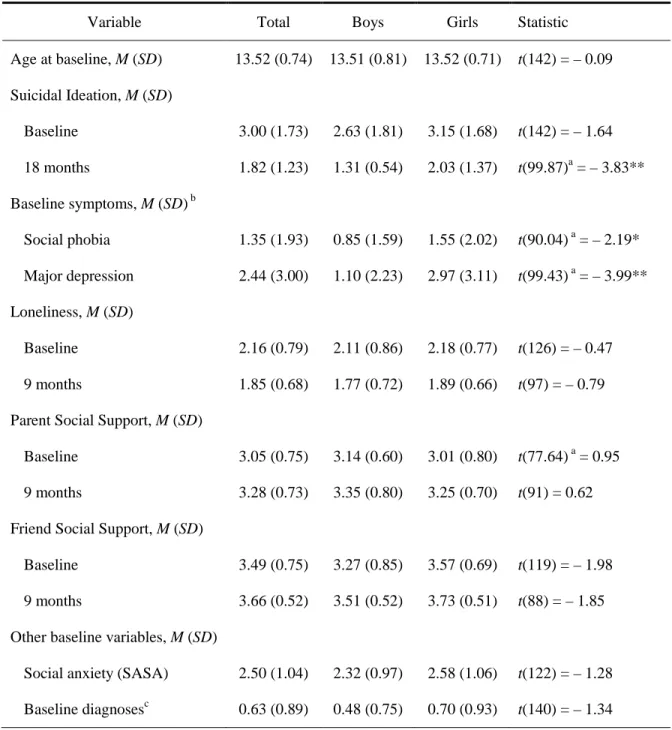
Table 1 contains the means and standard deviations for all study variables, as well as
the results of t-tests assessing gender differences. Results indicated that female participants
scored higher than male participants on all study variables, with the exception of
self-reported parental social support. However, gender differences were statistically significant
for only three variables: girls reported a greater severity of social phobia and major
depressive symptoms at baseline, and higher levels of suicidal ideation at 18 months
postbaseline. Given these differences, gender was included as a covariate in all models.
Bivariate Correlations
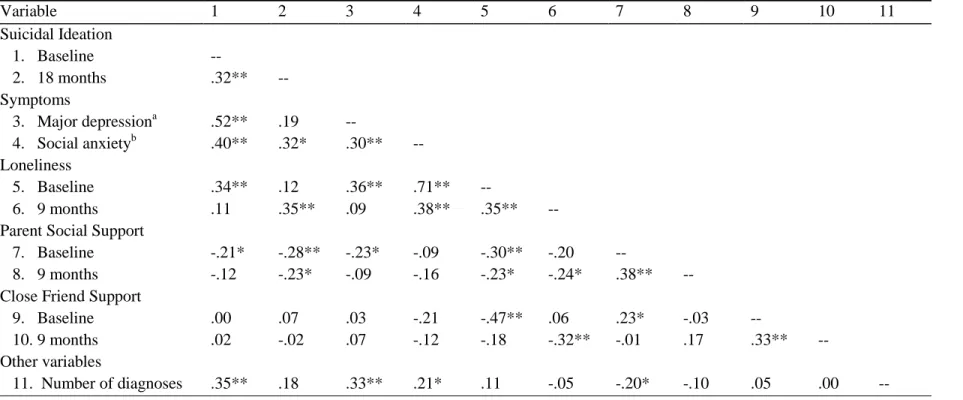
Estimated correlations between the latent social anxiety variable and all other
observed variables can be found in Table 2. Most bivariate correlations were of the expected
strength and direction. Baseline suicidal ideation, social anxiety and depression symptoms,
and number of other psychiatric diagnoses, were all found to be positively intercorrelated.
Social anxiety at baseline was also found to be positively associated with both baseline and
9-month loneliness, although it was not significantly correlated with baseline or 9-month
parental/close friend support. Suicidal ideation at 18 months was positively associated with
baseline social anxiety, baseline suicidal ideation and 9-month loneliness, and was negatively
associated with 9-month parental social support. However, suicidal ideation at 18 months
19
Longitudinal Relationship between Social Anxiety Symptoms and Suicidal Ideation
The first hypothesized model examined the longitudinal relationship between social
anxiety and suicidal ideation, adjusting for depression symptoms and other baseline
covariates. A measurement model was initially specified in order to evaluate the model’s fit
to the observed data. The model included five observed variables (gender, baseline
depression symptoms and number of psychiatric diagnoses, and baseline and 18-month
suicidal ideation) and one latent variable representing baseline social anxiety. Social anxiety
was specified by two indicators measuring the severity of social anxiety symptoms at
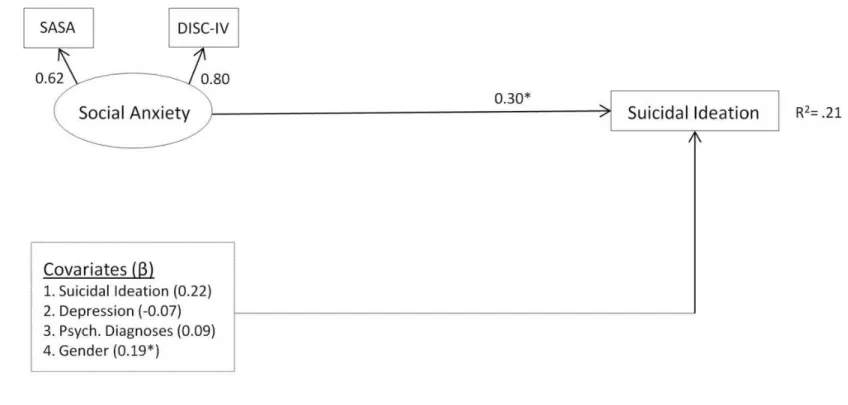
baseline. All covariances were freely estimated in the measurement model. The standardized
loadings for the two social anxiety indicators were .80 for symptom severity as measured by
the DISC-IV youth interview and .62 for symptom severity as measured by the SASA. The
model was a close fit to the observed data: χ2(11, N =144) = 12.41; χ2/df = 1.13; CFI = .99;
IFI = .99; RMSEA = .03.
A structural model was then specified to test the direct relationship between baseline
social anxiety and 18-month suicidal ideation, adjusting for gender and other covariates
(baseline depression symptoms, psychiatric diagnoses, and suicidal ideation). In the interest
of model parsimony, nonsignificant correlations among predictor variables were trimmed
from the structural model. Results of χ2 difference testing indicated that the more
parsimonious model did not lead to a significant decrease in model fit, χ2(4, N =144) = 8.41,
p = .08. The trimmed structural model exhibited adequate fit to the data: χ2(8, N =144) = 12.37; χ2/df = 1.55; CFI = .97; IFI = .97; RMSEA = .06 (see Figure 1). Consistent with
prediction, results indicated that baseline social anxiety significantly predicted suicidal
20
covariates (B = .22, β = .30, p < .05). In addition, female gender also significantly predicted
suicidal ideation at 18 months postbaseline (B = .49, β = .19, p < .05). The present model
accounted for 21% of the variance in suicidal ideation at 18 months postbaseline.
Loneliness and Perceived Social Support as Mediators of the Social Anxiety–Suicidal Ideation Relationship
The second hypothesized model examined the interrelationships among baseline
social anxiety, potential 9-month mediators (loneliness, parental support, close friend
support), and 18-month suicidal ideation. A measurement model was specified to examine
the model’s fit to the observed data. The model included eleven observed variables (gender,
baseline depression symptoms and number of psychiatric diagnoses, baseline and 18-month
suicidal ideation, and baseline and 9-month loneliness and parental/close friend support) and
a latent variable measuring baseline social anxiety. Social anxiety was specified by two
indicators measuring the severity of social anxiety symptoms at baseline. All variables were
allowed to freely intercorrelate. The standardized loadings for the two social anxiety
indicators were .62 for symptom severity as measured by the DISC-IV interview and .81 for
symptom severity as measured by the SASA. The model was a close fit to the observed data:
χ2(23, N =144) = 25.11; χ2/df = 1.09; CFI = .99; IFI = .99; RMSEA = .03.
A structural model was then specified to examine the interrelationships between
baseline social anxiety, the 9-month mediators (loneliness, parental support, close friend
support), and suicidal ideation at 18-months postbaseline. Gender, baseline depression
symptoms and number of psychiatric diagnoses, and baseline suicidal ideation were included
in the model as covariates, and each mediator was adjusted for scores at baseline. In the
interest of model parsimony, nonsignificant correlations among predictor variables were
21
model did not lead to a significant decrement in model fit, χ2(11, N =144) = 12.98, p = .30.
The structural model exhibited adequate fit to the data: χ2(45, N =144) = 63.68; χ2/df = 1.42;
CFI = .94; IFI = .95; RMSEA = .05 (see Figure 2). Consistent with study hypotheses, the
results indicated that baseline social anxiety was a significant predictor of 9-month loneliness
(B = .21, β = .36, p < .05) and that 9-month loneliness was a significant predictor of suicidal
ideation at 18 months postbaseline (B = .57, β = .32, p < .01). In keeping with a possible
mediation effect, baseline social anxiety no longer significantly predicted 18-month suicidal
ideation, with a near-zero standardized regression coefficient (B = –.07, β = –.07, p > .05).
However, contrary to prediction, baseline social anxiety was not a significant predictor of
9-month social support (parent: B = –.13, β = –.20, p > .05; close friend: B = –.04, β = –.09, p >
.05). Similarly, social support at 9 months postbaseline did not significantly predict 18-month
suicidal ideation (parent: B = –.21, β = –.13, p > .05; close friend: B = .07, β = .03, p > .05).
Results indicated that two other pathways significantly predicted 18-month suicidal ideation:
baseline ideation (B = .20, β = .28, p < .05) and female gender (B = .50, β = .19, p < .05). The
final model accounted for 25% of the variance in suicidal ideation at 18 months postbaseline.
Indirect effects were examined using 95% Monte Carlo confidence intervals. The
95% confidence interval for the total indirect effect did not contain zero (95% CI: 0.01–
0.31), indicating a significant overall indirect effect of baseline social anxiety on 18-month
suicidal ideation through the 9-month mediators: loneliness and parental/close friend social
support. The 95% confidence interval for the indirect effect of 9-month loneliness also did
not contain zero (95% CI: 0.01–0.27), indicating a significant indirect effect of baseline
social anxiety on 18-month suicidal ideation through 9-month loneliness. Given that the
22
support, and that 9-month social support did not significantly predict 18-month suicidal
ideation, it was anticipated that the 95% confidence intervals for these indirect effects would
contain zero. An examination of these confidence intervals confirmed that they did contain
zero, indicating that there was no significant indirect effect of either 9-month parental social
CHAPTER 4
DISCUSSION
Suicidal thoughts and behaviors represent an important public health concern,
particularly among adolescents, a population for whom completed suicide is the third leading
cause of death (CDC, 2011). Significant progress has been made in identifying psychosocial
risk factors for suicidality in teenagers, with recent research showing that social phobia and
other anxiety disorders may contribute to suicide risk in adolescence. However, although
prior research indicates that social anxiety symptoms are related to suicidal ideation in
teenagers (Nelson et al., 2000; Valentiner et al., 2002), only one study involving adults has
linked social anxiety symptoms to suicidal thoughts and behaviors over time (Sareen et al.,
2005). The present study sought to address this gap in the literature by examining the
longitudinal relationship between social anxiety symptoms and suicidal ideation in a sample
of clinically referred adolescents. Given that no research to date has identified variables that
may help to explain the relationship between social anxiety and suicidality, a secondary aim
of the study was to develop a more complex model of risk by examining loneliness and
perceived social support as potential mediators of this relationship.
An initial goal of the study was to examine the longitudinal relationship between
social anxiety symptoms and suicidal ideation in a clinically referred sample of adolescents.
Results indicated that social anxiety symptoms, as measured during a baseline assessment,
prospectively predicted suicidal ideation at 18 months post-baseline, even after controlling
24
This finding is in keeping with prior research suggesting that social anxiety symptoms are
concurrently related to suicidal ideation in adolescents (Nelson et al., 2000; Valentiner et al.,
2002) and are longitudinally associated with suicidal ideation in adults (Sareen et al., 2005).
Adolescence is a developmental period in which teenagers become increasingly defined by
their social relationships. Given that social anxiety disorder is linked to social withdrawal and
social skills deficits (Beidel et al., 2007; Erath et al., 2007), it is possible that social anxiety
symptoms may interfere with this critical developmental period, leading to increased feelings
of isolation, hopelessness, and suicidal ideation. The current study focused solely on suicidal
ideation, however, and more research is needed to examine whether adolescent social anxiety
is longitudinally related to suicide attempts or completed suicide.
In order to better understand the longitudinal relationship between social anxiety
symptoms and suicidal ideation, the present study investigated loneliness and perceived
social support as mediators of this relationship. Results indicated that loneliness (measured at
9 months post-baseline) significantly mediated the relationship between baseline social
anxiety symptoms and suicidal ideation at 18-months post-baseline. This indirect effect
remained significant even after adjusting for baseline depression symptoms, number of
psychiatric diagnoses, and suicidal ideation. This finding is consistent with prior research
showing that adolescent loneliness is associated with both social anxiety (Beidel et al., 2007)
and with increased risk for suicidality (Roberts et al., 1998; Schinka et al., 2012). It is also
consistent with Joiner’s Interpersonal Theory of Suicide (Van Orden et al., 2010), which
suggests that suicidal ideation stems from feelings of thwarted belongingness and perceived
burdensomeness. The current study indicates that, for socially anxious teens, thwarted
25
role in the development of suicidal ideation. Recent research has underscored this point,
showing that social anxiety is associated with thwarted belongingness but not perceived
burdensomeness (Davidson et al., 2011).
The study’s findings regarding loneliness as a mediator may reflect the unique
developmental concerns of adolescents. Loneliness has been defined as an aversive
emotional state stemming from a belief that one’s social relationships are inadequate. Given
adolescents’ focus on social relationships and acceptance, theorists have suggested that
loneliness may be particularly prevalent and salient in this age group (Heinrich & Gullone,
2006). Thus, socially anxious adolescents may be especially susceptible to loneliness, which
in turn increases their risk for suicidal ideation. Additional research is needed, however, to
more fully understand how social anxiety leads to increased loneliness. Social anxiety has
been associated with lower social acceptance and friendship intimacy as well as increased
peer victimization (Erath et al., 2007; La Greca & Lopez, 1998; Vernberg et al., 1992). It is
possible that the negative peer consequences related to social anxiety may increase feelings
of loneliness in these teens. In addition, research is needed to delineate which aspects of
loneliness increase risk for suicidal ideation in socially anxious youth. Loneliness has been
theorized to be a multi-dimensional construct involving psychosocial and affective
dimensions (DiTommaso & Spinner, 1993), and there is evidence to suggest that peer-related
loneliness may be a particular problem for socially anxious teens (Lasgaard et al., 2011a).
The present study also examined two other potential mediators of the longitudinal
relationship between adolescent social anxiety and suicidal ideation: perceived social support
from family and perceived social support from close friends. In contrast to the study’s
26
the relationship between social anxiety and suicidal ideation. In fact, the present study found
that baseline social anxiety was not significantly correlated with either parental or close
friend support at 9 months, and close friend support at 9 months was not significantly
correlated with suicidal ideation at 18 months. These results are inconsistent with prior
research showing that socially anxious adolescents report lower perceived social support
(Calsyn et al., 2005; LaGreca & Lopez, 1998), and that lower peer-related support is
associated with suicidal ideation (Rigby & Slee, 1999). However, unlike the present study,
which utilized a clinical sample, prior research has focused on community samples, which
could explain the discrepant findings. In addition, while the current study provides a strong
test of mediation by simultaneously evaluating several mediators, this design may have
obscured more complex relationships among these variables. The present study hypothesized
that loneliness and perceived social support would operate in parallel to mediate the
relationship between social anxiety symptoms and suicidal ideation. It is possible, however,
that a more complex pathway exists, such that social anxiety leads to low social support,
which in turn leads to increased loneliness and suicidal ideation. It is also possible that
feelings of loneliness may interact with low social support to increase risk for suicidal
ideation. Future research should examine these alternate pathways to suicide risk.
The lack of findings regarding parental and close friend social support may also
reflect methodological constraints. Although a strength of the current study was its use of a
longitudinal design with three time points, the lack of additional time points prohibited the
examination of indirect effects related to social support and suicidality. In fact, prior research
suggests that family-based social support may indirectly increase suicide risk through its
27
be a strong indicator of suicide risk in both adolescents and adults (Mazza & Reynolds, 1998;
Steer et al., 1993), hopelessness may also be implicated in the current study’s finding that
loneliness mediates the relationship between social anxiety and suicidal ideation. Feelings of
hopelessness have been linked to adolescent loneliness (Page, 1991), and some theorists
suggest that there may exist a domain-specific form of hopelessness that is centered on social
relationships. This form of social hopelessness is characterized by negative expectations
regarding one’s future interpersonal relations, and has been linked to suicidal ideation in
young adults (Bonanno & Hymel, 2010; Heisel, Flett, & Hewitt, 2011). More research is
needed to examine how this type of social hopelessness may influence the relationships
between social support, loneliness, and suicidality in socially anxious teens.
The present findings have implications for the prevention and treatment of suicidal
thoughts and behaviors in teens. The results indicate that feelings of loneliness may be one
mechanism through which adolescent social anxiety increases the risk of suicidal thinking
over time. Clinicians treating socially anxious adolescents may wish to evaluate these teens
for heightened levels of loneliness, the presence of which may indicate a greater risk for
eventual suicidality. The present findings also suggest that therapeutic interventions focused
on the reduction of loneliness may be particularly useful when working with socially anxious
adolescents. Both social skills training and loneliness-focused cognitive behavioral therapy
have been shown to reduce feelings of loneliness in adolescents (Adams, Openshaw,
Bennion, Mills, & Noble, 1988; McWhirter & Horan, 1996), and practitioners may find it
helpful to employ these techniques with socially anxious adolescents who are also
experiencing feelings of loneliness. Doing so may actually be of broader psychological
28
reductions in loneliness mediated overall treatment outcome in socially anxious children and
teens (Alfano, Pino, Villalta, Beidel, Ammerman, & Crosby, 2009).
As an initial exploration of the relationship between adolescent social anxiety and
suicidal ideation over time, the present study had a number of strengths. As is recommended
for longitudinal mediation, the study used multiple time lags of equal temporal length
(Gollob & Reichardt, 1987) and adjusted for prior levels of both the mediators and the
outcome variables (Cole & Maxwell, 2003). The present study also used a latent variable to
assess social anxiety and adjusted for initial levels of depressive symptoms, which, given the
high comorbidity of depression and social anxiety in youth (Wittchen et al., 1999), allowed
for a stronger test of the relationship between adolescent social anxiety and suicidal ideation.
Nevertheless, the present study had important limitations. First, the study was correlational in
nature, and thus no conclusions can be drawn about causality. Furthermore, the sample was
predominately White and was recruited from an inpatient psychiatric unit. Therefore, the
results may not generalize to ethnic minority populations or to individuals experiencing a less
severe range of psychopathology.
The sample used in the current study was also disproportionately female, and the
small sample size did not allow for the examination of gender differences in the relationship
between social anxiety, loneliness, social support, and suicidal ideation. Examining such
gender differences will be a crucial step for future research, as prior studies have shown that
gender is implicated in each of these constructs. Social anxiety disorder has been found to be
nearly twice as prevalent in teenage girls as it is in boys (Wittchen et al., 1999), and research
indicates that gender may moderate the relationship between perceived social support and
29
1998; Mazza & Reynolds, 1998; Kerr et al., 2006). Finally, a meta-analysis indicated that
gender may play a complicated role in the construct of loneliness. This study showed that
males tend to report more loneliness when it is indirectly measured via self-report. However,
when loneliness is measured via direct self-labeling (i.e., “Are you lonely?”), females more
often label themselves as lonely (Borys & Perlman, 1985). Given that gender plays a role in
each of the constructs used in the present study, future analyses may wish to include gender
as a potential moderator.
Another limitation of the present study was its reliance on self-report for many of the
study variables, including loneliness, social support, and suicidal ideation. Due to the use of
self-report measures across variables and time points, it is possible that shared method
variance could account for the present results. Finally, the specific time lag between the
assessment of the baseline variables and the mediators (9 months) and between the mediators
and the outcome variable (9 months) may be a study limitation. Although cross-sectional
studies point to associations among these variables, it is unclear whether 9 months is the
optimal timeframe for assessing these longitudinal relationships. In fact, some research
suggests that loneliness may be more stable over shorter periods (several months) as
compared to longer periods (a year or more) (for a review, see Heinrich & Gullone, 2006). It
is possible that time lags of less than 9 months may more accurately capture the dynamic
relationships between social anxiety, loneliness, social support, and suicidal ideation. Future
research may wish to follow the recommendations of Cole and Maxwell (2003), who suggest
that longitudinal mediation be examined within empirically determined timeframes.
Despite these limitations, the current study contributes to the literature on adolescent
30
testing potential mediators of the relationship. The results indicate that social anxiety
symptoms predict suicidal ideation in adolescents over an 18-month follow-up period, and
that feelings of loneliness may help to explain this relationship. These findings add to the
literature on psychosocial risk factors for suicidal ideation in adolescents, and may help to
31
Table 1. Descriptive Statistics for Primary Study Variables and Tests of Gender Differences
Variable Total Boys Girls Statistic
Age at baseline, M (SD) 13.52 (0.74) 13.51 (0.81) 13.52 (0.71) t(142) = – 0.09
Suicidal Ideation, M (SD)
Baseline 3.00 (1.73) 2.63 (1.81) 3.15 (1.68) t(142) = – 1.64
18 months 1.82 (1.23) 1.31 (0.54) 2.03 (1.37) t(99.87)a = – 3.83** Baseline symptoms, M (SD) b
Social phobia 1.35 (1.93) 0.85 (1.59) 1.55 (2.02) t(90.04) a = – 2.19* Major depression 2.44 (3.00) 1.10 (2.23) 2.97 (3.11) t(99.43) a = – 3.99** Loneliness, M (SD)
Baseline 2.16 (0.79) 2.11 (0.86) 2.18 (0.77) t(126) = – 0.47
9 months 1.85 (0.68) 1.77 (0.72) 1.89 (0.66) t(97) = – 0.79
Parent Social Support, M (SD)
Baseline 3.05 (0.75) 3.14 (0.60) 3.01 (0.80) t(77.64) a = 0.95 9 months 3.28 (0.73) 3.35 (0.80) 3.25 (0.70) t(91) = 0.62
Friend Social Support, M (SD)
Baseline 3.49 (0.75) 3.27 (0.85) 3.57 (0.69) t(119) = – 1.98
9 months 3.66 (0.52) 3.51 (0.52) 3.73 (0.51) t(88) = – 1.85
Other baseline variables, M (SD)
Social anxiety (SASA) 2.50 (1.04) 2.32 (0.97) 2.58 (1.06) t(122) = – 1.28
Baseline diagnosesc 0.63 (0.89) 0.48 (0.75) 0.70 (0.93) t(140) = – 1.34
Notes. SASA = Social Anxiety Scale for Adolescents. a Equal variances not assumed. b
Symptoms measured with the Diagnostic Interview Schedule for Children
(DISC-IV-Adolescent Report; Shaffer et al., 2000). c Number of baseline DISC-IV psychiatric
Table 2. Estimated Correlation Matrix for Latent and Observed Study Variables
Variable 1 2 3 4 5 6 7 8 9 10 11
Suicidal Ideation
1. Baseline --
2. 18 months .32** --
Symptoms
3. Major depressiona .52** .19 --
4. Social anxietyb .40** .32* .30** --
Loneliness
5. Baseline .34** .12 .36** .71** --
6. 9 months .11 .35** .09 .38** .35** --
Parent Social Support
7. Baseline -.21* -.28** -.23* -.09 -.30** -.20 --
8. 9 months -.12 -.23* -.09 -.16 -.23* -.24* .38** --
Close Friend Support
9. Baseline .00 .07 .03 -.21 -.47** .06 .23* -.03 --
10. 9 months .02 -.02 .07 -.12 -.18 -.32** -.01 .17 .33** --
Other variables
11. Number of diagnoses .35** .18 .33** .21* .11 -.05 -.20* -.10 .05 .00 --
Notes. a Symptoms were measured with the Diagnostic Interview Schedule for Children (DISC-IV-Adolescent Report; Shaffer et
al., 2000). b Latent variable, with one indicator representing social phobia symptoms as measured by the DISC-IV and one
indicator representing mean score on the Social Anxiety Scale for Adolescents. * p < .05. ** p < .01.
3
Figure 1. Model Depicting Direct Relationship between Baseline Social Anxiety and Suicidal Ideation at 18 Months
3
Figure 2. Multiple Mediation Model including Loneliness and Social Support as Mediators at 9 Months
3
35
REFERENCES
Adams, G.R., Openshaw, D.K., Bennion, L., Mills, T., & Noble, S. (1988). Loneliness in late adolescence: A social skills training study. Journal of Adolescent Research, 3, 81-96.
Alfano, C.A., Pina, A.A., Villalta, I.K., Beidel, D.C., Ammerman, R.T., & Crosby, L.E. (2009). Mediators and moderators of outcome in the behavioral treatment of
childhood social phobia. Journal of the American Academy of Child and Adolescent
Psychiatry, 48, 945-953.
American Psychiatric Association. (1994). Diagnostic and statistical manual of mental
disorders (4th ed.). Washington, DC: Author.
Arbuckle, J. (2010). IBM SPSS Amos 19 User’s Guide. Amos Development Corporation: Crawfordville, FL.
Asher, S.R., Hymel, S., & Renshaw, P.D. (1984). Loneliness in children. Child Development,
55, 1456–1464.
Asher, S.R., & Wheeler, V.A. (1985). Children’s loneliness: A comparison of rejected and neglected peer status. Journal of Consulting and Clinical Psychology, 53, 500–505.
Babiss, L.A., & Gangwisch, J.E. (2009). Sports participation as a protective factor against depression and suicidal ideation in adolescents as mediated by self-esteem and social support. Journal of Developmental and Behavioral Pediatrics, 30, 376–384.
Baron, R.M., & Kenny, D.A. (1986). The moderator-mediator variable distinction in social psychological research: Conceptual, strategic, and statistical considerations. Journal
of Personality and Social Psychology, 6, 1173–1182.
Beautrais, A.L., Joyce, P.R., & Bulder, R.T. (1996). Risk factors for serious suicide attempts among youths aged 13 through 24 years. Journal of the American Academy of Child
and Adolescent Psychiatry, 35, 1174–1182.
Beidel, D.B., Turner, S.M., Young, B.J., Ammerman, R.T., Sallee, F.R., & Crosby, L. (2007). Psychopathology of adolescent social phobia. Journal of Psychopathology
and Behavioral Assessment, 29, 47–54.
Boden, J.M., Fergusson, D.M., & Horwood, L.J. (2007). Anxiety disorders and suicidal behaviours in adolescence and young adulthood: Findings from a longitudinal study.
Psychological Medicine, 37, 431–440.
Boergers, J., & Spirito, A. (2003). Follow-up studies of child and adolescent suicide
36
Bonnano, R.A., & Hymel, S. (2010). Beyond hurt feelings: Investigating why some victims of bullying are at greater risk for suicidal ideation. Merrill-Palmer Quarterly, 56, 420-440.
Borys, S., & Perlman, D. (1985). Gender differences in loneliness. Personality and Social
Psychology Bulletin, 11, 63-74.
Browne, M.W., & Cudeck, R. (1993). Alternative ways of assessing model fit. In K.A. Bollen & J.S. Long (Eds.), Testing structural equation models (pp. 136-162). Newbury Park, CA: Sage.
Byrne, B.M. (2009). Structural equation modeling with AMOS: Basic concepts, applications,
and programming (2nd ed.). New York, NY: Routledge.
Calsyn, R.J., Winter, J.P., & Burger, G.K. (2005). The relationship between social anxiety and social support in adolescents: A test of competing causal models. Adolescence,
40, 103-113.
Centers for Disease Control and Prevention (2010). Youth Risk Behavior Surveillance – United States, 2009. Surveillance Summaries, MMWR, 59 (No. SS-5).
Centers for Disease Control and Prevention (2011). WISQARS Fatal Injury Reports. Retrieved November 26, 2011, from
http://www.cdc.gov/injury/wisqars/fatal_injury_reports.html.
Cole, D.A., & Maxwell, S.E. (2003). Testing mediational models with longitudinal data: Questions and tips in the use of structural equation modeling. Journal of Abnormal
Psychology, 112, 558–577.
Costello, E.J., Angold, A., Burns, B.J., Stangl, D.K., Tweed, D.L., Erkanli, A., & Worthman, C.M. (1996). The Great Smoky Mountains Study of Youth: Goals, design, methods, and the prevalence of DSM-III-R disorders. Archives of General Psychiatry, 53, 1129–1136.
Cougle, J.R., Keough, M.E., Riccardi, C.J., & Sachs-Ericsson, N. (2009). Anxiety disorders and suicidality in the National Comorbidity Survey-Replication. Journal of
Psychiatric Research, 43, 825–829.
Davidson, C.L., Wingate, L.R., Grant, D.M., Judah, M.R., & Mills, A.C. (2011). Interpersonal suicide risk and ideation: The influence of depression and social anxiety. Journal of Social and Clinical Psychology, 30, 842-855.
De Man, A.F., Labrèche-Gauthier, L. & Leduc, C.P. (1993). Parent-child relationships and suicidal ideation in French-Canadian adolescents. The Journal of Genetic Psychology,
37
DiTommaso, E., & Spinner, B. (1993). The development and initial validation of the social and emotional loneliness scale for adults (SELSA). Personality and Individual
Differences, 14, 127-134.
D'Eramo, K.S., Prinstein, M.J., Freeman, J., Grapentine, W.L., & Spirito, A. (2004). Psychiatric diagnoses and comorbidity in relation to suicidal behavior among
psychiatrically hospitalized adolescents. Child Psychiatry and Human Development,
35, 21–35.
Dubow, E.F., & Ullmann, D.G. (1989). Assessing social support in elementary school children: The survey of children’s social support. Journal of Clinical Child
Psychology, 18, 52–64.
Ehrlich, W.J. (1998). Suicidal ideation, depression, family relations and peer support in adolescents. Dissertation Abstracts International, 59(6B), 3054.
Enders, C.K., & Bandalos, D.L. (2001). The relative performance of full information maximum likelihood estimation for missing data in structural equation models.
Structural Equation Modeling, 8, 430–457.
Erath, S.A., Flanagan, K.S., Bierman, K.L. (2007). Social anxiety and peer relations in early adolescence: Behavioral and cognitive factors. Journal of Abnormal Child
Psychology, 35, 405–416.
Eskin, M., Ertekin, K., Dereboy, C., & Demirkiran, F. (2007). Risk factors for and protective factors against adolescent suicidal behavior in Turkey. Crisis, 28, 131–139.
Evans, E., Hawton, K., Rodham, K., & Deeks, J. (2005). The prevalence of suicidal
phenomena in adolescents: A systematic review of population-based studies. Suicide
and Life-Threatening Behavior, 35, 239–250.
Fisher, P.W., Shaffer, D., Piacentini, J.C., Lapkin, J., Kafantaris, V., Leonard, H., & Herzog, D.B. (1993). Sensitivity of the Diagnostic Interview Schedule for Children, 2nd edition (DISC-2.1) for specific diagnoses of children and adolescents. Journal of the
American Academy of Child and Adolescent Psychiatry, 32, 666–673.
Foley, D.L., Goldston, D.B., Costello, E.J., & Angold, A. (2006). Proximal psychiatric risk factors for suicidality in youth: The Great Smoky Mountains study. Archives of
General Psychiatry, 63, 1017–1024.
38
Goldston, D.B., Daniel, S.S., Erkanli, A., Reboussin, B.A., Mayfield, A., Frazier, P.H., & Treadway, S.L. (2009). Psychiatric diagnoses as contemporaneous risk factors for suicide attempts among adolescents and young adults: Developmental changes.
Journal of Consulting and Clinical Psychology, 77, 281–290.
Gollob, H.F., & Reichardt, C.S. (1987). Taking account of time lags in causal models. Child
Development, 58, 80–92.
Gould, M.S., King, R., Greenwald, S., Fisher, P., Schwab-Stone, M., Kramer, R., Flisher, A.J., . . . & Shaffer, D. (1998). Psychopathology associated with suicidal ideation and attempts among children and adolescents. Journal of the American Academy of Child
and Adolescent Psychiatry, 37, 915–923.
Groholt, B., Ekeberg, O., Wichstrom, L., & Haldorsen, T. (2000). Young suicide attempters: A comparison between a clinical and epidemiological sample. Journal of the
American Academy of Child and Adolescent Psychiatry, 39, 868–875.
Harter, S. (1985). Manual for the Social Support Scale for Children. Denver: University of Denver.
Heinrich, L.M., & Gullone, E. (2006). The clinical significance of loneliness: A literature review. Clinical Psychology Review, 26, 695–718.
Heisel, M.J., Flett, G.L., & Hewitt, P.L. (2011). Social hopelessness and college student suicide ideation. Archives of Suicide Research, 7, 221-235.
Hill, R.M., Castellanos, D., & Pettit, J.W. (2011). Suicide-related behaviors and anxiety in children and adolescents: A review. Clinical Psychology Review, 31, 1133–1144.
Kerr, D.C.R., Preuss, L.J., & King, C.A. (2006). Suicidal adolescents’ social support from family and peers: Gender-specific associations with psychopathology. Journal of
Abnormal Child Psychology, 34, 103–114.
Kessler, R.C., Berglund, P., Demler, O., Jin, R., Merikangas, K.R., & Walters, E.E. (2005). Lifetime prevalence and age-of-onset distributions of DSM-IV disorders in the National Comorbidity Survey Replication. Archives of General Psychiatry, 62, 593– 603.
Kessler, R.C., Borges, G., & Walters, E.E. (1999). Prevalence of and risk factors for lifetime suicide attempts in the National Comorbidity Study. Archives of General Psychiatry,
56, 617–626.