Advisor: Ryan Shaw
Digital collections have been a rising trend in library sciences for over a decade. However, analysis of these collections has still largely been limited to the digital specialists and the digital humanists. This paper summarizes the existing evaluation literature to propose a tool for librarians to use for their own individual collections’ evaluations. It also examines the difficulties of evaluation and emphasizes the need for further research into librarian conducted analyses, as their evaluations differ from the evaluations of an expert. It also explains the development of digitization, digital collections and digital evaluation until this point.
Headings:
Digital libraries -- Collection development Digital libraries -- Appraisal
DIGITAL COLLECTION EVALUATION: A RUBRIC FOR HOLISITC EVALUATION
by
Elizabeth Stillwell
A Master's paper submitted to the faculty of the School of Information and Library Science of the University of North Carolina at Chapel Hill
in partial fulfillment of the requirements for the degree of Master of Science in
Library Science.
Chapel Hill, North Carolina May 2019
Approved by:
TABLE OF CONTENTS
INTRODUCTION 2
LITERATURE REVIEW 5
PURPOSE 23
METHODS 24
RUBRIC 26
EVALUATION 29
DISCUSSION 32
CONCLUSION 39
APPENDICIES 40
INTRODUCTION
Since the development of digitizing technologies in the 1990s, libraries, both public and academic in nature, have attempted to come to terms with the changing technological world they now operate within. As with many great technological
advances, there have been several attempts to implement these technologies, leading to different types of digital interfaces and digitizing practices in libraries throughout the world. As digitization initiatives become more mainstream and more integral to modern library practices, it has become necessary to evaluate digitized collections based on holistic principles of quality digital information sources. Historically, evaluations have focused exclusively on one area or practice of a digital collection; however, with the continued development of digital resources, evaluations are starting to include a more nuanced picture of the included collections. In this paper, two specific digital collections will be used in the evaluation process, the Manuscriptorium of the Czech Republic, and the Cuban Historical Collection at the University of North Carolina at Chapel Hill.
includes 15,000 manuscripts and 200,000 early books. Most of these works are related to the growth of the university colleges; however, 1,200 of the volumes contain Turkish, Arabic, and Persian manuscripts, the oldest of which dates to 792. Digitizing the large manuscript collection, therefore, concerned the history and cultures of countries outside of the Czech Republic as well as within the national borders. This large-scale digitization effort quickly expanded and became the Manuscriptorium: The Digital Library of Written Cultural Heritage, with website interfaces available in Čeština and English, and whose purpose extended beyond digitization into providing information about the historic manuscript resources that can be accessed on the site.
In 2012, items from the mid nineteenth-century until 1922 from the Cuban Historical Collection at the University of North Carolina at Chapel Hill (UNC) were selected for digitization. The digitized items, 156 different documents, were placed on the Internet Archive site (found at: https://archive.org/details/unccubanhistorical). The
majority of the digitized collection focuses on history, literature, travel accounts, regional histories, and biographies of Cuba and Cuban historical figures, therefore, much like the Manuscriptorium project, the digitization of the Cuban materials also deals directly with cultures and peoples outside of USA’s national boundary. The digitized materials form only part of the whole collection on Cuba held at UNC; however, progress on future digitization has been slow to develop. By analyzing and evaluating these two digitization initiatives, issues around technological availability, funding sources, technical
LITERATURE REVIEW
History of Digitization and Definitions
According to Borissova (2017) “the preservation of cultural heritage is a systematic process of searching, studying, identifying, documenting, registering, conserving, restoring and adapting.” It is not surprising, therefore, that cultural heritage and manuscript collections have looked to the rise in digital technologies as a positive. Digitization of these artifacts can facilitate all of the aspects described as pieces of the preservation of cultural heritage process. As Capurro (2017) writes, “it is symptomatic for our era that what started as a tool [digital technologies], namely the development of search engines to deal with bibliographic data for scientific research and industry has now become a core of the digital era” (280). Through the development and expansion of these digital technologies, manuscript collections have found the tools to aid in creating and ensuring access to historic collections, promoting research, and facilitating the adaptation of the knowledge they hold for the modern world. Digitization, therefore, has had several important and positive effects of the development and sustainability of historical manuscript collections. Digitization, as a new addition to the library field, still presents questions that librarians and preservation experts must navigate in the coming years as digitization projects continue to grow.
The digitization of manuscript holdings brings to light one of the major
rise in digital technologies, as Devi (2008) discovered when studying the changes in the societal archive in response to information technologies. He found that:
the abundance of information of average and below-average quality generates paradoxically the demand for new, unusual, and exotic information. This explains the growing interest in old manuscripts. However, manuscripts are not readily available due to the lack of a complete holding list. Digitization and creation of a database are the solutions for the preservation of and access to the manuscripts (184).
To begin discussing these issues it is first of all important to define what
digitization means in the context of this paper. According to the Institute of Museum and Library Services, digitization is defined as, “the process of converting, creating, and maintaining books, art works, historical documents, photos, journals, etc. in electronic representations so they can be viewed via computer and other devices” (Rafiq, Ameen, & Jabeen, 2018, 457). Borissova (2017) discusses three types of digitization that occur specifically to cultural heritage objects, like the objects and manuscripts found on the Manuscriptorium site. She writes, “digitization occurs in three directions: Internet access to creative content, digitization of the cultural heritage for the purpose of its promotion and commercialization, digitization of the media industry for the consolidation of related creative activities.”
It is thus also important to define what a digital library is in this context. When considering the digital libraries that are constructed by digital documents, the Digital Library Federation in 1998 defined a digital library as,
organizations that provide the resources, including the specialised staff, to select, structure, offer intellectual access to, interpret, distribute, preserve the integrity of, and ensure the persistence over time of collections of digital works so that they are readily and economically available for use by a defined community or set of communities (Londhe, Desale, & Patil, 2011, 136).
Digitization Concerns
As more and more of the world’s scholarly and personal work is done online, libraries are feeling the pressure to ensure that the entirety of their collections are available online. While the issue of library relevance is not the point of this paper, the push to be active online does affect how libraries prioritize their tasks and their finances. Rafiq, Ameen, & Jabeen (2018) found that, “libraries feel a dire need to maintain their presence by offering online access to valuable contents residing in the libraries” (457), and this need drives many digitization initiatives. The problem comes when this need is not met with the specializations of the employees the library has, increasing the amount of funding needed to simply begin the process. Some of the most frequently cited issues surrounding digitization projects is the amount of time, energy, manpower, knowledge, and experience that digitization projects require of libraries.
Rafiq, Ameen, & Jabeen (2018) found that:
a vast majority of respondents [to their survey] found a lack of human resources with knowledge and needed skills as the foremost hindrance to digitization, followed by the lack of financial resources. The insufficient technological
infrastructure, absence of a resource sharing culture, low level of motivation, lack of willingness, lack of vision, lack of dedication, lack of recognition by the community and lack of national policy and legislation were other noteworthy barriers (464).
legislation.” Without national policies, libraries and other cultural heritage institutions have found the process of digitization to be difficult to successfully implement, either due to funding issues or staffing issues. National policies on digitization ensure that each library takes part in the process of digitization and has a national framework and additional support to make digitization efforts possible.
Borissova (2017) also attempts to address potential copyright concerns by saying, it appears that the cultural value, which is the object of digitization, is a work within the meaning of copyright, which means that there exists a moment of creation or an author, which in most cases is not so. Therefore, to remain within the range of copyright, we assume that cultural values are “orphan” works without a known author.
While this attempt to define and address future copyright concerns is valid for some works of cultural heritage, this does not cover many manuscripts, as manuscripts clearly have an author. However, because by their definition manuscripts are some of the oldest writings that still exist, the copyright issues surrounding them are less than the larger concern about copyright for other types of digitization and digital technologies. It is important to mention the legal issues surrounding digitization, even if the issues are not as closely tied to these specific objects being digitized.
“digital technologies might help overcoming social inequalities and forms of exclusion, but they might also aggravate these and other divides in society” (280). There are still many countries and individuals that do not have regular, guaranteed access to the internet or other forms of modern digital communication. There are individuals who struggle with digital literacy or other physical or mental handicaps that limit their ability to use digital technologies. Therefore, the digitization of manuscripts or cultural artifacts not only excludes them from the easy access provided by digitization, it also continues to increase the inequality gap between those with access to the digital world and those without. As Capurro (2017) also argues, “digitization becomes symptomatic for societal
transformation,” (278) with both positive and negative outcomes. Additionally, in some countries, technological infrastructure does exist, however there are low levels of use among the general population, as Katz, Koutroumpis, & Callorda (2013) found in Cuba, “while Cuba has wireless coverage of 80 percent, service penetration is practically nil” (17). When promoting the expansion of digitization endeavors, national libraries and manuscript holdings must continue to remember their first priority, ensuring the
protection and accessibility of documents for any and all potential users. Digitization can assist with the first of these priorities, however, it should not be at the expense of the latter.
A Case Study for Digitization Concerns
effect of this decision was that “the project restored and better preserved the manuscript, yet it inadvertently bestowed the Popol Wuj narrative with the status of a stand-alone book by extracting and individually binding Friar Ximénez’s copy and translation of it from his original manuscript” (Quiroa, 2017, 242). This decision, therefore,
fundamentally changed how the entire manuscript was viewed and studied and also changed, for future researchers, what the manuscript actually recorded. In this case, “the digitization process is a continuation and a culmination of extracting the PopolWuj narrative from its colonial physical context, which perpetuates the idea that the K’iche’ narrative is in fact the longed for “Sacred Book” of ancient Maya civilization” (Quiroa, 2017, 262). However, historians of the original text know that the manuscript written by the Friar should not be removed from its colonial context that the other portions of the manuscript provide. So, while the digitization of the manuscript provides greater access to the work and in some ways acts as a form of preservation, the decisions made by the Newberry Library during the digitization process fundamentally changed the object they were digitizing, a decision that will change how the manuscript is studied far into the future. It is, therefore, just as important for the digitization process for the digitizers to understand the object being digitized as it is for libraries to support digitization
History of Evaluation and Definitions
As with all new developments, a period of reflection and evaluation followed shortly after digitization initiatives and projects became available to the general public. The first evaluation articles, published in the early 2000s, focused firstly on the desired outcome of each individual evaluation process rather than creating a list of concrete principles of evaluation. Later articles then addressed individual evaluation metrics that relate to the question of the individual articles, for example focusing only on accessibility of a digitized collection. There are; however, few articles which have attempted to create a synthesis of digital collection evaluation principles and models. The relevance of evaluation for digital collections goes beyond their usability and can also speak to the importance of library collections to specific interest groups. As Waugh, Hamner, Klein, & Brannon (2015) found when evaluating the University of North Texas’ Digital Collections writing, “academic libraries are increasingly required to demonstrate their value to institutional stakeholders and their impact on institutional missions. The scope and content of the scholarly resources within academic libraries’ digital repositories directly relate to satisfying these requirements” (744). It is; therefore, paramount for evaluation studies to develop an increasingly holistic view of these digital collections so as to show their increased importance in modern academia and to society as a whole.
Saracevic’s (2000) article, “Digital Library Evaluation: Toward an Evolution of Concepts,” is foundational for the development of digital collections evaluation
principles and definitions. He defines evaluation as, “an appraisal of the performance or functioning of a system, or part thereof, in relation to some objective(s)” (359).
digital libraries should occur, including the selection of included materials, organization and structure, management and preservation, search and security, and integration efforts (362). Each of these facets are important for holistic analysis of a digital collection. Most importantly, Saracevic notes, “the evaluation of digital libraries should also be looking at, and contributing to, the gaining of uniformity for access and use across the landscape of digital libraries, which involves evaluation across a number of digital libraries and not only single efforts” (2000, 367). Unfortunately, digital collections evaluation has not occurred in a uniform manner across the “landscape” and this is one of the issues that the proposed rubric seeks to address.
A similarly seminal article by Marchionini (2000) posits that “evaluation serves a political/administrative role by providing the reports and data upon which decisions about funding and development may be based. Evaluation results also inform the ongoing development of the DL [digital library] both technically and conceptually” (330). This article ultimately concludes that ongoing evaluation efforts, especially when paired with clear organizational missions, strong leadership, good technical vision, and quality information management, are crucial for the development and sustainability of good digital libraries and digital collections. Additionally, this work laid the foundation for current understandings of the relationship between access and scholarly work among student users. Zhang, Liu, & Mathews (2015) argue that Marchionini’s article
has strongly affected the dominant trends of evaluation literature. Following this argument, evaluation studies and the resulting articles have largely focused on end user studies and usability studies.
In 2004, Saracevic wrote a second article concerning the evaluation of digital libraries, an article that was, once again, one of the first to look beyond the individual digital collections and into the broader concerns of digitization. He concludes, “the ultimate evaluation of digital libraries will revolve around assessing transformation of their context – determining possible enhancing changes in institutions, learning, scholarly publishing, disciplines, small worlds and ultimately society due to digital libraries” (11). In 2012, Sinn analyzed how digital archival collections have impacted historical research along the lines of Saracevic’s (2004) argument. Sinn’s project found that “digital library studies have moved from static content management (information containers) to context management – domain- or community-specific.” Because of this, Sinn (2012) argues that “what matters more [i.e., what encourages use of a certain digital collections over
another] seems to be the uniqueness of the contents and specialized topics” rather than the digital quality of the collected items (1531). These comments also point toward a need for digital collection evaluation to go beyond individual pieces of “content” and toward a broader understanding of the collection as a unique entity of its own.
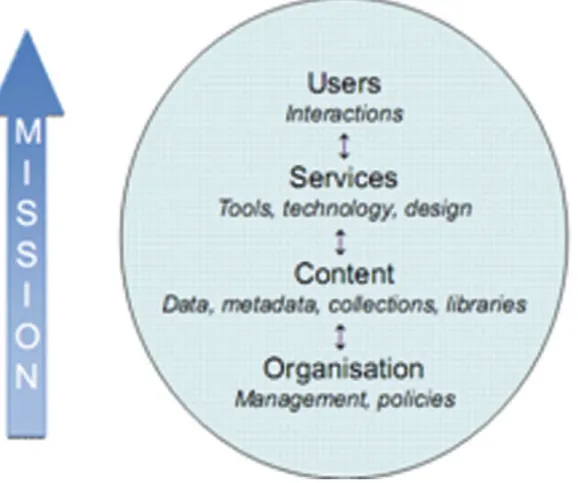
research advances on digital library evaluation and quality are especially needed considering the amount of national and international collaborative projects aiming the interoperation between diverse DLs, and their connection with individuals, groups, institutions, and societies; they can also have a crucial role within DL projects political and social acceptance (172).
He goes on to argue that digital evaluations can follow one of five different approaches: a content-based approach, a technical-based approach, a service-based approach, an
intangible goods approach, or a user-based approach (172-173). Assuming these
Figure 1: “A LIS-oriented framework for DL evaluation” from Vullo (2010)
All of these articles address the history and current frameworks of digital
collections evaluations. These discussed frameworks have served the field well; however, as digital technologies have improved, and the missions of the collecting institutions have changed, it is now imperative that more complex frameworks are created to further develop the field of digital collections evaluations.
Current Evaluation Concerns
digital collections as discussed above has focused on user studies, how can one accurately measure how much a collection is used. Evaluation studies first used the idea of views or page hits to discover how often a collection was accessed and what within the collection was most regularly requested. However, Perrin, Yang, Barba, & Winkler (2016) found that this measurement was flawed given the nature of the item they were analyzing. They write, “because digital collections are typically open access collections, there is a greater chance of accidental use and a greater need to distinguish between different kinds of use” (187). Later in their analysis they further list additional problems that are inherent in using page hit totals as informative statistics. They found that the total page hit number did not distinguish between different kinds of traffic, it did not account for items having multiple URLs, it did not address the positive bias of use statistics or the human bias toward positive results, and finally it did not account for the fact that different kinds of collections act differently with search engines (Perrin, Yang, Barba, & Winkler, 2016, 190-192). Because of these complicating factors, digital collection evaluations have had to move past the concept of page hits and to become more creative in understanding and evaluating digital collections.
representation of fonts and characters across languages, cross-cultural development of software and infrastructure, and interoperability across different system architectures (Deikema, 2011, 180). The cross-cultural and multi-lingual nature of internationally important digital collections is an area for growth and continued analysis, not only with the digital collections themselves, but also in the evaluative methods that are used to provide these necessary improvements.
Other issues surrounding digital collections are common both to traditional library spaces and to other forms of digital scholarship, i.e. funding, preservation, and
contextualization.
Because most digital initiatives are created through grant funding or specific donations, digital collections regularly seek additional sources of funding to keep the collections viable and sustained online. This in turn impacts the preservation of the digital items in digital space as the collections are always potentially on the verge of
disappearing.
Additionally, there is the difficult process of creating and managing metadata for each of the items in the digital collection to the standards that frequently change or are, in some cases, not well designed for the average user or are not specific enough for an advanced user. Because of this, current digital collections have widely different levels of metadata clarity and depth, with some collections having extensive metadata and
allow users to locate the documents they need, provide rich contextual information, and build sustainable funding models that will allow these collections to remain permanently available” (49).
These are all issues that also impact how these digital collections should be and how they are currently being evaluated. They also further complicate the measurements used for evaluating digital collections as every collection should be understood within its own context, which makes the creation of universal evaluation principles difficult and constantly evolving.
Finally, digital collections evaluations should be based on the understanding that “access to more text with better tools facilitates more than new research” (Clement, 2012, 888). The documents or items that are included in digital collections should not be
Digital Scholarship Evaluation
As discussed above, digital scholarship literature is still attempting to advance beyond user studies to look at more aspects of a digital collection during an evaluation process. Digital Scholarship, such as Digital Humanities projects, have had more experience with the holistic evaluation process, as most a lot of digital scholarship projects are tied to a classroom and it is therefore necessary for holistic analysis to be conducted. It is useful; therefore, to look at digital scholarship evaluation literature for new ways of thinking about digital collection evaluation.
Cheng’s “Why do users intend to continue using the digital library? An integrated perspective” provides a strong argument for beginning the evaluative process by
providing interesting proxy measures for digital collections evaluations. The article posits that information relevance can function as a proxy for information quality, system
accessibility can function as a proxy for system quality, and technical support can function as a proxy for service quality (2013, 643-645). While there are limits to the effectiveness of using proxy measures rather than other forms of measuring, these proxy measures are a good place for digital evaluations to start as they are based on the types of measurements that librarians are already familiar with.
example and created the following list of questions to ask when analyzing digital scholarship, and for the purposes of this paper, digital collection evaluation:
• “Is the platform merely a substrate for a ‘cool data set’ or a set of media objects –
or are individual ‘pieces’ of content (data and media in various formats, etc.) contextualized?”
• “Is the data sufficiently ‘enriched?’ Is it annotated, linked, cited, supplemented
with support media, etc., where appropriate?”
• “Is the delivery system robust? Do the chosen platforms or modes of delivery ‘fit’
and ‘do justice to’ the subject matter?”
• “Do the project creators seem to understand their potential users, and have they
designed the project so it accommodates those various audiences and uses?” These questions and categories of focus are relevant for digital collections evaluations; however, because these frameworks are designed to facilitate evaluation of digital scholarship, either in a classroom or for tenure purposes, the focus of the evaluation is different from digital collections evaluation. These questions serve as a strong starting point; however, they also highlight the current lack of these sorts of frameworks for digital collections evaluations.
PURPOSE
Current evaluation trends tend to focus on one area of a digital collection rather than taking a more holistic approach to the collection. Evaluation studies thus far focus on usability studies, infrastructure analysis, metadata quality, or user interface interaction analyses (Papachristopoulos, et. al, 2017). These studies, while important to the
development of the field and of digital collections, now need to go beyond single-issue analysis to provide more practical applications of these studies to the current issues librarians need to address for their own collections.
METHODS Process
This rubric was constructed by reading the literature on digitization, evaluation of digital collections, digital archive literature, and digital humanities literature. By the end of this analysis, the rubric developed from the current literature is a holistic tool for the analysis of digital collections. The following is a step-by-step breakdown of the creation of this rubric.
1. Evaluation of digitization, evaluation, and digital collections literature to create a list of pertinent ideas (included in the ‘Findings’ section below).
2. Consider the list of ideas and the potential structure of the rubric, i.e. what ideas must be included in the rubric and how the rubric will generate data for the user. 3. Find and confirm expert for second stage of rubric evaluation.
4. Create drafts of potential rubric structures.
5. Test drafts for comprehensiveness, readability, ease of use by referring again to the literature and testing against basic digital collections.
6. Finalize the rubric structure and content.
7. Test final rubric on two selected digital collections (listed below).
8. Have confirmed expert analyze the same two selected digital collections. 9. Analyze the results of the two rubric tests.
RUBRIC
1
None of the required attributes are met.
2
Some of the required attributes are met or attributes are met but still poor.
3
Attributes have been thoroughly met.
User Assistance Digitization Clarity Contextual Information Access (Standards Compliance) Interface Metadata Policies
Sustainability Usage Data Composite Score:
This rubric is designed to give the user an impression of the strengths of a digital
Policies
A digital collection should have easily attainable policies on the site so that others may learn about the curation of the collection and the collection development policies that have governed the site. For a quality example view the Collections Policies page at the Library of Congress, https://www.loc.gov/acq/devpol/. Additionally, intellectual property rights should be noted on the site and should be found in this area of the webpage. See Borissova (2017); Quiroa (2017).
Sustainability
A digital collection should have measures in place to ensure the permanence of the collection into the future. The steps, measures, and technologies that the collection is utilizing should documented and accessible to ensure that the collection is being sustainably created and maintained. For an example of how to analyze a site for sustainability, read this case study on the Vanderbilt Television News Archive: https://www.arl.org/storage/documents/publications/searching-for-sustainability-vanderbilt-case-nov2013.pdf.
Statistics
A digital collection as part of a library initiative must have usage or other forms of data available for demonstrating the benefits of the collection’s digitization. While usage statistics are a controversial portion of current evaluation literature, there are demands on libraries to establish their importance to the overall research process. These statistics should help to establish these ROIs. (For more information see Waugh, Hamner, Klein, & Brannon (2015); Perrin, Yang, Barba, & Winkler (2016); Sinn (2012). For a quality example of site statistics, see: https://www.lib.umich.edu/digital-content-collections-dcc/view-digital-collections-usage-size-statistics.
User Assistance
A digital collection must promote usability as one of its first priorities. User assistance may take the form of Help pages, FAQ sections, “chat with a librarian” abilities and other mechanisms that ensure the collection has effective measures for fielding user enquiries.
Digitization Clarity
A digital collection must have usable images of the items in the collection. High quality, easy to read, and easy to manipulate images are a must for a digital collection. For a quality example of digitization clarity, see the British Museum’s digital collections: https://www.britishmuseum.org/research/collection_online/collection_object_details/coll ection_image_gallery.aspx?assetId=97684001&objectId=950031&partId=1.
Contextual Information
Access
A digital collection must be able to work with adaptive technologies, should be stable for the users and should not be unduly hindered from general use. This could take the shape of compliance with government or educational standards for webpages for disabled patrons. For quality information on access and digital collections, see the Digital Preservation Coalition’s Handbook:
https://www.dpconline.org/handbook/organisational-activities/access.
Interface
A digital collection needs a searchable, navigable, and understandable interface that promotes usability for the stated user community. This includes the interoperability of the collection with other programs and the ability of the digital collection to be integrated into user workflows. For a quality example, see the Caribbean Sea Migration digitized collection at Duke: https://repository.duke.edu/dc/caribbeansea.
Metadata
A digital collection must have accurate, thorough, and well researched metadata to provide the user with accurate and complete information about the physical object. This metadata functions as the provenance and is, therefore, crucial for the scholastic
reliability of the digital collection. Metadata should follow a metadata standard, for example MARC, and this standard should be stated on the site. For quality information on Metadata in Digital Collection, see Emory University’s guidelines:
EVALUATION
The evaluation process for this rubric was completed in two stages. I first used my rubric and the created definitions to evaluate the two collections discussed in the
introduction. This step allowed me to test the rubric as a tool. Secondly, with the help of UNC SILS Ph.D. candidate Alex Chassanoff, I tested the rubric’s definitions as
workable. I sent Chassanoff the definitions I created that correspond to the different evaluation sections of the rubric, i.e. the definition of digital clarity states, “A digital collection must have usable images of the items in the collection. High quality, easy to read, and easy to manipulate images are a must for a digital collection. For a quality example of digitization clarity, see the British Museum’s digital collections:
rubric created by this project is a satisfactory tool for librarians to use when they do not have personal expertise with digital collections or digital collections evaluation.
Using the rubric, I found that the composite score of the Manuscriptorium was higher at 21 than the UNC-CH collection at 18. The Manuscriptorium (see Appendix A) scored highest in “Digitization Clarity,” “Contextual Information,” “Interface,”
“Metadata,” and “Sustainability,” while failing to score at all in “Access” and “Statistics.” “User Assistance” and “Policies” were lacking but evident on the site.
The UNC-CH Cuban Historical Collection (see Appendix B) scored highest in “Digitization Clarity,” “Metadata,” “Sustainability,” and “Statistics.” The “Interface” of the UNC-CH collection was found to be lacking, and the collection failed to score at all in “User Assistance,” “Contextual Information,” “Access,” and “Policies.”
Chassanoff’s evaluations (see Appendix C) took the form of notes based on each of the definitions I provided. Similar to the rubric, she noted concerns with the UNC-CH collections’ “Policies,” “User Assistance,” and “Interface,” and the Manuscriptorium’s “Usage Data;” however, there were several sections where she highlighted differences or issues, or lack thereof, that the rubric did not pick up. For example, she did not find that the Manuscriptorium’s “Contextual Information” was satisfactory but instead noted that “since the collection itself is aggregated, I wouldn’t necessarily expect to find much historical or contextual information provided at the item level.” She also differed from the rubric in the “Sustainability” section. When I used the rubric, I noted that the UNC-CH collection was housed on the Internet Archive and that site has information about the sustainability of the site; however, Chassanoff noted that she was not able to find
Finally, Chassanoff had a couple of comments about the definitions themselves. She found that the “Access” definition was too vague for her to use for her evaluation and she suggested that the definition be fleshed out to include more concrete examples. She also noted that the “Metadata,” while sufficient on both sites and in agreement with the rubric, was misleading as the example metadata standard listed, MARC, is a library not a digital or archival standard. She suggested changing the definition to use Dublin Core. She also mentioned that there are other standards of reliability for a digital collection beyond provenance provided by metadata. She noted, “equally important are
DISCUSSION
The process of using the rubric led to some interesting ideas, some of which had been previously stated in the Literature Review and some that were unique to this particular project. Firstly, and most obviously, there are interpretation differences inherent in evaluating an object between those who are professionals in the field and those who are unfamiliar with the evaluation process. Between the rubric evaluation process and the independent evaluation, there were several differences in the outcomes of the evaluations and the notes that Chassanoff listed to change the rubric. These were thoughts and notes that only someone who is familiar with digital collections and digital collections evaluations would have known to consider. This can influence the overall impression one has of a digital collection. This is not something that the rubric can address as it is beyond the scope of the tool to provide expert schooling in digital collections literature but rather to provide enough information for the user to be able to determine if the digital collection has enough of the qualities listed for the library to use effectively for their own needs.
collection is high quality digital images of Cuban manuscripts that have enough
information for the user to properly cite, then the other categories that the collection did not adequately address are less relevant for that particular library.
However, there were several issues with the rubric that were noted during the evaluation process. Firstly, the composite scores were found to be a little more misleading and something that I have removed from the revised rubric below. The composite scores of the two collections turned out to be quite close but the differences in individual criteria were significant enough that the composite score seemed to be
misleading, in my opinion. Another change I made to the rubric itself was to make space for the user to write their own notes as they work through the different sections. Note taking capabilities would help librarians to decipher the decisions made by the evaluator as they could write down explanations for their scoring decisions, which could also help the librarians to decide if the weaknesses of the collection are relevant for their particular needs. The other significant issue that was encountered during the evaluation process was the personal preferences of the interviewer in relation to the interface. Depending on outside factors, different evaluators have differing opinions on the usability,
attractiveness, or simplicity of the collection’s interfaces which could impact that specific quality. This is an issue that is addressed in the current literature as the ease of an
interface for some users can be limiting for others. For more information on interfaces and usability see Vaughn & Callicott (2003).
software, infrastructures, and capabilities for different issues. For example, a lack of access to the internet is an access problem that requires different measures than access for the blind. This is also an issue that is still being solved by many digital libraries and collections. Legislation now requires that public materials must meet certain access standards, however, these standards may or may not be listed on the webpage for the digital collection. It may be as difficult for a librarian to ascertain accessibility as it is to define what access for a digital collection may entail. While the rubric may be flawed in this respect, it does encourage a librarian to do more research about the accessibility of a digital collection before recommending it to their user populations. During the revising process, I have reconsidered the “Access” definition and added more information to hopefully help disambiguate this issue.
When creating the definitions I found that I had enough distinction between the “Metadata” and “Contextual Information” sections, however, when using the rubric I found that these categories are harder to clarify, especially if one assumes that the user will have less practical knowledge and experience with digital collections and standards. Because of the collections interface, the Manuscriptorium is easier to distinguish between without additional assistance, as there is a separate section of the interface titled
“Context,” but this aid will not be available for most other digital collections. The
practical differences between metadata and contextual information are in degrees and this is harder to understand without experience with digital collections and metadata
standards.
standard be listed in the definition as an example of a metadata standard, instead of MARC. The definition was created with the idea of helping a librarian without digital collections knowledge understand certain requirements of a digital collection that make the collection a usable collection. Listing MARC as the metadata standard was chosen to assist the librarian in understanding what was meant by metadata standard as it would be the standard most familiar to librarians. However, this may be a misleading aspect of the definition as MARC is not a digital library or archival standard. In revising the rubric, I have considered this critique to determine which example metadata standard would be the most beneficial for librarians to consider in this category. Ultimately, I have changed the mentioned standard to be Dublin Core as it is the standard most frequently used in digital collections; however, I have also included an additional link for the “Metadata” definition that demonstrates the similarities and differences between MARC, a metadata standard familiar to all librarians, and Dublin Core, a metadata standard for digital collections that librarians may or may not be familiar with. I have included this link as an aid for
librarians who may be more familiar with one standard over another to ensure that they can understand the differences between the two.
Secondly, Chassanoff noted that there are additional requirements for digital collections that factor into concepts of provenance, including the reputation of the digital collections’ creator. This was a note that I had not thought of while creating the definition for “Metadata,” and, in revising the rubric, I have thought about adding an additional category, or categories, that addressed the institutions involved with creating,
1
None of the required attributes are met.
2
Some of the
required attributes are met or
attributes are met but still poor.
3 Attributes have been thoroughly met. Evaluation Notes User Assistance Digitization Clarity Contextual Information Access (Standards Compliance) Interface Metadata Policies Sustainability Usage Data Institutional Authority Composite Score:
This rubric is designed to give the user an impression of the strengths of a digital
Policies
A digital collection should have easily attainable policies on the site so that others may learn about the curation of the collection and the collection development policies that have governed the site. For a quality example view the Collections Policies page at the Library of Congress, https://www.loc.gov/acq/devpol/. Additionally, intellectual property rights should be noted on the site and should be found in this area of the webpage. See Borissova (2017); Quiroa (2017).
Sustainability
A digital collection should have measures in place to ensure the permanence of the collection into the future. The steps, measures, and technologies that the collection is utilizing should documented and accessible to ensure that the collection is being sustainably created and maintained. For an example of how to analyze a site for sustainability, read this case study on the Vanderbilt Television News Archive: https://www.arl.org/storage/documents/publications/searching-for-sustainability-vanderbilt-case-nov2013.pdf.
Statistics
A digital collection as part of a library initiative must have usage or other forms of data available for demonstrating the benefits of the collection’s digitization. While usage statistics are a controversial portion of current evaluation literature, there are demands on libraries to establish their importance to the overall research process. These statistics should help to establish these ROIs. (For more information see Waugh, Hamner, Klein, & Brannon (2015); Perrin, Yang, Barba, & Winkler (2016); Sinn (2012). For a quality example of site statistics, see: https://www.lib.umich.edu/digital-content-collections-dcc/view-digital-collections-usage-size-statistics.
User Assistance
A digital collection must promote usability as one of its first priorities. User assistance may take the form of Help pages, FAQ sections, “chat with a librarian” abilities and other mechanisms that ensure the collection has effective measures for fielding user enquiries.
Digitization Clarity
A digital collection must have usable images of the items in the collection. High quality, easy to read, and easy to manipulate images are a must for a digital collection. For a quality example of digitization clarity, see the British Museum’s digital collections: https://www.britishmuseum.org/research/collection_online/collection_object_details/coll ection_image_gallery.aspx?assetId=97684001&objectId=950031&partId=1.
Contextual Information
Access
A digital collection must be able to work with adaptive technologies, should be stable for the users and should not be unduly hindered from general use. This could take the shape of compliance with government or educational standards for webpages for disabled patrons, such as closed-captioned videos, images with “alt text,” and website navigability via a keyboard only. For quality information on access and digital collections, see the Digital Preservation Coalition’s Handbook:
https://www.dpconline.org/handbook/organisational-activities/access. Additional information and examples can also be found at:
https://www.w3.org/standards/webdesign/accessibility.
Interface
A digital collection needs a searchable, navigable, and understandable interface that promotes usability for the stated user community. This includes the interoperability of the collection with other programs and the ability of the digital collection to be integrated into user workflows. For a quality example, see the Caribbean Sea Migration digitized collection at Duke: https://repository.duke.edu/dc/caribbeansea.
Metadata
A digital collection must have accurate, thorough, and well researched metadata to provide the user with accurate and complete information about the physical object. This metadata functions as the provenance and is, therefore, crucial for the scholastic
reliability of the digital collection. Metadata should follow a metadata standard, for example Dublin Core, and this standard should be stated on the site. For quality information on Metadata in Digital Collection, see Emory University’s guidelines: https://metadata.emory.edu/guidelines/index.html. For information on the differences between MARC, a traditional library standard, and Dublin Core, a digital collection standard, see the Library of Congress’ Crosswalk:
https://www.loc.gov/marc/marc2dc.html.
Institutional Authority
A digital collection is an extension of an institution, and as such, part of the concept of provenance for these collections must include institutional considerations. This
CONCLUSION
This project sought to consolidate the current literature around digital collections evaluation and by consolidating that literature, create a tool for librarians who are less familiar with the field to effectively evaluate digital collections for their own collections. As digital libraries and digital collections are becoming both more prevalent and more important as means of creating and ensuring access to otherwise rare or fragile objects, it is increasingly important for all librarians to be able to understand the necessary aspects of good digital collections and to be able to understand the current field of digital collections evaluation. The rubric created by this project seeks to be a first attempt at bridging the gap between librarians trained in other aspects of librarianship and digital collections. While the rubric has several flaws that need to be addressed, both in the rubric and in the larger field of digital collections, this attempt has started the process of creating generic tools that open up digital collections to wider audiences through
librarians. By beginning this process, one hopes that there will be continued cooperation between digital librarians and traditional librarians, as these digital spaces are more and more important in the modern world; however, they are not beyond the scope of
APPENDIX A
Completed Evaluation Rubric for Manuscriptorium 1
None of the required attributes are met.
2
Some of the required attributes are met or attributes are met but still poor.
3
Attributes have been thoroughly met.
User Assistance
x
Digitization
Clarity x
Contextual Information
x Access
(Standards Compliance)
x
Interface x
Metadata x
Policies x
Sustainability x
Statistics x
Composite Score: 21
APPENDIX B
Completed Evaluation Rubric for UNC-Chapel Hill Cuban Historical Collection 1
None of the required attributes are met.
2
Some of the required attributes are met or attributes are met but still poor.
3
Attributes have been thoroughly met.
User Assistance
x
Digitization
Clarity x
Contextual Information
x Access
(Standards Compliance)
x
Interface x
Metadata x
Policies x
Sustainability x
Statistics x
APPENDIX C
Alex Chassanoff’s Complete Evaluation Sheet for both Collections Alex Chassanoff’s evaluation notes are in bold.
Policies
A digital collection should have easily attainable policies on the site so that others may learn about the curation of the collection and the collection development policies that have governed the site. For a quality example view the Collections Policies page at the Library of Congress, https://www.loc.gov/acq/devpol/. Additionally, intellectual property rights should be noted on the site and should be found in this area of the webpage. See Borissova (2017); Quiroa (2017).
Collection 1: The Manuscriptorium aggregates together documents from different European digital libraries and archival collections. Document selection for the library is briefly described here:
http://www.manuscriptorium.com/download/archive/Documentation/manuscriptori um_document_description_ENG.pdf but I was not able to find information about why documents were chosen. Rights management and originating repository is specified at the item level and there are permissions and rights related content for contributors mentioned here: http://www.manuscriptorium.com/en/join-us Collection 2: According to the About page, the UNC Chapel Hill Cuban Collection contains materials on Cuba “published between the early nineteenth-century through 1922.The majority of the collection focuses on history, literature, travel accounts, regional histories and biographies.” This is all the information related to collection policies and intellectual property rights I could find.
Sustainability
A digital collection should have measures in place to ensure the permanence of the collection into the future. The steps, measures, and technologies that the collection is utilizing should documented and accessible to ensure that the collection is being sustainably created and maintained. For an example of how to analyze a site for sustainability, read this case study on the Vanderbilt Television News Archive: https://www.arl.org/storage/documents/publications/searching-for-sustainability-vanderbilt-case-nov2013.pdf.
http://www.manuscriptorium.com/en/tei-p5-enrich-schema-en Other than that, I don’t see any information on sustainability or long-term maintenance of the site.
Collection 2: I was not able to find any particular information about sustainability or any underlying information about technology or preservation.
Statistics
A digital collection as part of a library initiative must have usage or other forms of data available for demonstrating the benefits of the collection’s digitization. While usage statistics are a controversial portion of current evaluation literature, there are demands on libraries to establish their importance to the overall research process. These statistics should help to establish these ROIs. (For more information see Waugh, Hamner, Klein, & Brannon (2015); Perrin, Yang, Barba, & Winkler (2016); Sinn (2012). For a quality example of site statistics, see: https://www.lib.umich.edu/digital-content-collections-dcc/view-digital-collections-usage-size-statistics.
Collection 1: I am not able to find any information related to statistics or usage data for this collection.
Collection 2: This link provides statistical information about visitor views divided into “people” and “robots.”
https://archive.org/details/unccubanhistorical&tab=about User Assistance
A digital collection must promote usability as one of its first priorities. User assistance may take the form of Help pages, FAQ sections, “chat with a librarian” abilities and other mechanisms that ensure the collection has effective measures for fielding user enquiries.
Collection 1: There is a link to send messages related to the site here: http://www.manuscriptorium.com/en/support
Collection 2: You can access user help at the main Internet Archive site but not at the individual collection level (although I wouldn’t expect to since it’s hosted at the IA).
Digitization Clarity
A digital collection must have usable images of the items in the collection. High quality, easy to read, and easy to manipulate images are a must for a digital collection. For a quality example of digitization clarity, see the British Museum’s digital collections: https://www.britishmuseum.org/research/collection_online/collection_object_details/coll ection_image_gallery.aspx?assetId=97684001&objectId=950031&partId=1.
Collection 1: All images are usable and high quality.
Collection 2: All images are usable and high quality. The interface gives you a LOT of options for downloading.
Contextual Information
A digital collection should not simply be images of items in a collection. Digital collections should move beyond the basic and provide historical, contextual, or even controversial information sections to supplement the images provided. See Uhlíř (2008). For a quality example of contextual information, see Duke’s Caribbean Sea Migration collection: https://repository.duke.edu/dc/caribbeansea/csmep03180.
Collection 1: Since the collection itself is aggregated, I wouldn’t necessarily expect to find much historical or contextual information provided at the item level.
Collection 2: The item level view often gives good context for an object or image. For example, if you look at
https://archive.org/details/diccionariocuban00figa/page/n10 you can find out when an object was scanned or digitized and page information.
Access
A digital collection must be able to work with adaptive technologies, should be stable for the users and should not be unduly hindered from general use. This could take the shape of compliance with government or educational standards for webpages for disabled patrons. For quality information on access and digital collections, see the Digital Preservation Coalition’s Handbook:
https://www.dpconline.org/handbook/organisational-activities/access.
This category is defined too broadly for me to evaluate usefully – maybe provide specific bullet points that describe what makes a collection suitable for disabled patrons?
Interface
A digital collection needs a searchable, navigable, and understandable interface that promotes usability for the stated user community. This includes the interoperability of the collection with other programs and the ability of the digital collection to be integrated into user workflows. For a quality example, see the Caribbean Sea Migration digitized collection at Duke: https://repository.duke.edu/dc/caribbeansea.
Collection 1: You can search through the collection at the item and collection level. You can download images easily.
Metadata
A digital collection must have accurate, thorough, and well researched metadata to provide the user with accurate and complete information about the physical object. This metadata functions as the provenance and is, therefore, crucial for the scholastic
reliability of the digital collection. Metadata should follow a metadata standard, for example MARC, and this standard should be stated on the site. For quality information on Metadata in Digital Collection, see Emory University’s guidelines:
https://metadata.emory.edu/guidelines/index.html.
Comments related to your rubric: Digital library content might not always have a physical object counterpart (e.g., born-digital objects). Also, provenance metadata generally functions to ensure that a chain of custody has not been broken between an objects transformation (can be from physical to digital or from a hard drive to an external drive) and is only one aspect of what makes a digital collection
“reliable” from a scholarly perspective (equally important are trustworthiness, authenticity, and integrity). I would recommend using a digital library metadata standard in your rubric like Dublin Core, METS, or MODS (even though IA uses the XML version of it, MARC is a bibliographic cataloging standard so it tends to not be used in digital collections or digital libraries).
Collection 1: At the item level, collections have plenty of metadata to describe all aspects of the object.
WORKS CITED
Borissova, V. (2017). Cultural heritage digitization and related intellectual property issues. Journal of Cultural Heritage. https://doi.org/10.1016/j.culher.2018.04.023
Capurro, R. (2017). Digitization as an ethical challenge. AI & Society 32(2), 277-283. Doi: 10.1007/s00146-016-0686-z
Cheng. Y.M. (2013). Why do users intend to continue using the digital library? An integrated perspective. Aslib Journal of Information Management 66(6), 640-662. Doi: 10.1108/AJIM-05-2013-0042
Clement, T.E. (2012). Half-Baked: The State of Evaluation in the Digital Humanities. American Literary History 24(4), 876-890. doi:10.1093/alh/ajs051
Devi, T.S. (2008). Impact of information technology on the societal archive: A case study of Manipuri manuscripts. The International Information & Library Review 40, 179-184. doi:10.1016/j.iilr.2008.07.001
Katz, R.L., Koutroumpis, P., & Callorda, F. (2013). The Latin American path towards digitization. Info 15(3), 6-24. https://doi.org/10.1108/14636691311327098
Kyrillidou, M., Cook, C., & Lippincott, S. (2016). Capturing digital developments through qualitative inquiry. Performance Measurement and Metrics 17(1), 45-54. Doi: https://doi.org/10.1108/PMM-03-2016-0007
Londhe, N.L., Desale, S.K., & Patil, S.K. (2011). Development of a digital library of manuscripts: A case study at the University of Pune, India. Program 45(2), 135-148. https://doi.org/10.1108/00330331111129697
Marchionini, G. (2000). Evaluating Digital Libraries: A Longitudinal and Multifaceted View. Library Trends 49(2), 304-333. Retrieved from
https://search.proquest.com/lisa/docview/220444356/abstract/2BE49E886C54EB APQ/89
Mattern, S.C. (2012). Evaluating Multimodal Work, Revisited. Journal of Digital Humanities 1(4). Retrieved from:
http://journalofdigitalhumanities.org/1-4/evaluating-multimodal-work-revisited-by-shannon-mattern/
Chandigarh and VVRI, Hoshiarpur. International Journal of Information Dissemination and Technology 2(2), 117-123.
Perrin, J.M., Yang, L., Barba, S., & Winkler, H. (2016). All that glitters isn’t gold: The complexities of use statistics as an assessment tool for digital libraries. The
Electronic Library 35(1), 185-197. Doi: https://doi.org/10.1108/EL-09-2015-0179
Psohlavec, S. & Karen, V. (2006). Digitised Manuscripts and rare Prints in the Czech National Library and the Manuscriptorium Project. New Review of Information Networking 12(1-2), 93-98. https://doi.org/10.1080/13614570601136305
Quiroa, N.I. (2017). Friar Francisco Ximénez and the Popol Vuh: From Religious Treatise to a Digital Sacred Book. Ethnohistory 64(2), 241-270. Doi: 10.1215/00141801-3789145
Rafiq, M., Ameen, K., & Jabeen, M. (2018). Barriers to digitization in university libraries of Pakistan: a developing country’s perspective. The Electronic Library, 36(3), 457-470. https://doi.org/10.1108/EL-01-2017-0012
Rockwell, G. (2012). Short Guide to Evaluation of Digital Work. Journal of Digital Humanities 1(4). Retrieved from:
Sahoo, J., & Mohanty, B. (2015). Digitization of Indian manuscripts heritage: Role of the National Mission for Manuscripts. International Federation of Library
Associations and Institutions Journal 41(3), 237-250. Doi:
10.1177/0340035215601447
Saracevic, T. (2000). Digital Library Evaluation: Toward an Evolution of Concepts. Library Trends 49(2), 350-369. Retrieved from
https://search.proquest.com/lisa/docview/57445490/2BE49E886C54EBAPQ/4
Saracevic, T. (2004). How were digital libraries evaluated? Retrieved from http://tefkos.comminfo.rutgers.edu/DL_evaluation_LIDA.pdf.
Sinn, D. (2012). Impact of Digital Archival Collections on Historical Research. Journal of the American Society for Information Science and Technology 63(8),
1521-1537. Doi: 10.1002/asi.22650
Tsakonas, G., Mitrelis, A., Papachristopoulos, L., & Paptheodorou, C. (2013). An Exploration of the Digital Library Evaluation Literature Based on an Ontological Representation. Journal of the American Society for Information Science and Technology 64(9), 1914-1926. Doi: 10.1002/asi.22900
Vullo, G. (2010). A Global Approach to Digital Library Evaluation. Liber Quarterly 20(2), 169-178. Retrieved from
https://search.proquest.com/lisa/docview/839636068/2BE49E886C54EBAPQ/71
Waugh, L., Hamner, J., Klein, J., & Brannon, S. (2015). Evaluating the University of North Texas’ Digital Collections and Institutional Repository: An Exploratory Assessment of Stakeholder Perceptions and Use. The Journal of Academic Librarianship 41, 744-750. Doi: http://dx.doi.org/10.1016/j.acalib.2015.08.007