J
OURNAL OF
C
LINICAL
O
NCOLOGY
O R I G I N A L
R E P O R T
Monitoring of Serum DNA Methylation as an Early
Independent Marker of Response and Survival in Metastatic
Breast Cancer: TBCRC 005 Prospective Biomarker Study
Kala Visvanathan, MaryJo S. Fackler, Zhe Zhang, Zoila A. Lopez-Bujanda, Stacie C. Jeter, Lori J. Sokoll,
Elizabeth Garrett-Mayer, Leslie M. Cope, Christopher B. Umbricht, David M. Euhus, Andres Forero,
Anna M. Storniolo, Rita Nanda, Nancy U. Lin, Lisa A. Carey, James N. Ingle, Saraswati Sukumar, and
Antonio C. Wolff
A B S T R A C T
Purpose
Epigenetic alterations measured in blood may help guide breast cancer treatment. The multisite
prospective study TBCRC 005 was conducted to examine the ability of a novel panel of cell-free DNA
methylation markers to predict survival outcomes in metastatic breast cancer (MBC) using a new
quantitative multiplex assay (cMethDNA).
Patients and Methods
Ten genes were tested in duplicate serum samples from 141 women at baseline, at week 4, and at
fi
rst restaging. A cumulative methylation index (CMI) was generated on the basis of six of the
10 genes tested. Methylation cut points were selected to maximize the log-rank statistic, and
cross-validation was used to obtain unbiased point estimates. Logistic regression or Cox proportional
hazard models were used to test associations between the CMI and progression-free survival (PFS),
overall survival (OS), and disease status at
first restaging. The added value of the CMI in predicting
survival outcomes was evaluated and compared with circulating tumor cells (CellSearch).
Results
Median PFS and OS were signi
fi
cantly shorter in women with a high CMI (PFS, 2.1 months; OS,
12.3 months) versus a low CMI (PFS, 5.8 months; OS, 21.7 months). In multivariable models, among
women with MBC, a high versus low CMI at week 4 was independently associated with worse PFS
(hazard ratio, 1.79; 95% CI, 1.23 to 2.60;
P
= .002) and OS (hazard ratio, 1.75; 95% CI, 1.21 to 2.54;
P
= .003). An increase in the CMI from baseline to week 4 was associated with worse PFS (
P
,
.001)
and progressive disease at
fi
rst restaging (
P
,
.001). Week 4 CMI was a strong predictor of PFS,
even in the presence of circulating tumor cells (
P
= .004).
Conclusion
Methylation of this gene panel is a strong predictor of survival outcomes in MBC and may have
clinical usefulness in risk strati
fi
cation and disease monitoring.
J Clin Oncol 35:751-758. © 2016 by American Society of Clinical Oncology
INTRODUCTION
Signi
fi
cant therapeutic advances in the
fi
eld of
breast cancer have resulted in a growing number
of treatment options for patients with metastatic
breast cancer (MBC), and prioritization of these
agents can be challenging. In practice, many
months are often needed to determine whether
the selected treatment is effective, a decision usually
guided by clinical
fi
ndings and imaging studies.
The identi
fi
cation of highly accurate circulating
molecular markers in blood that allows earlier
evaluation of therapeutic bene
fi
t could help
sig-ni
fi
cantly in clinical decision making, minimize
morbidity from ineffective therapy, reduce costs
from additional imaging studies, and improve
clinical outcomes.
1,2The current generation of
circulating markers offers some prognostic
use-fulness but these are not predictive for clinical
bene
fi
t from individual therapies.
3Epigenetic alterations are among the most
common molecular abnormalities in human
cancers.
4DNA methylation does not change the
genomic DNA sequence and is a form of
epi-genetic alteration that is heritable during DNA
Author affiliations and support information (if applicable) appear at the end of this article.
Published atjco.orgon November 21, 2016.
Written on behalf of the Translational Breast Cancer Research Consortium. K.V. and M.S.F. contributed equally to this work. S.S. and A.C.W. were co-senior authors.
Corresponding author: Kala Visvanathan, MBBS, MHS, Johns Hopkins University, E 6142 615 N Wolfe St, Baltimore, MD 21205; e-mail: [email protected]. © 2016 by American Society of Clinical Oncology
0732-183X/17/3507w-751w/$20.00
ASSOCIATED CONTENT
See accompanying article on page793
Appendix
replication.
5,6Tumors commonly release aberrant DNA into the
bloodstream, and this can now be detected. Our group
devel-oped a highly sensitive high-throughput quantitative multiplex
methylation-speci
fi
c polymerase chain reaction assay named
cMethDNA to detect circulating cell-free methylated DNA.
7This
assay builds on the prior assays we had used to detect methylation in
tissue and in cytologic samples.
8-11A few clinical studies have since
examined the association between the presence or absence of
cell-free methylated DNA in peripheral blood and disease outcomes, but
none have quanti
fi
ed the level of methylation.
7,12-15TBCRC 005 is
the
fi
rst biomarker study designed speci
fi
cally to prospectively test as
a primary end point the role of DNA methylation in blood in
predicting disease progression and survival in breast cancer.
PATIENTS AND METHODS
Study Design
Eligible participants included female patients
$
18 years of age with
histologically con
fi
rmed MBC and measurable disease and an Eastern
Cooperative Oncology Group performance status of 0 to 2, who were
starting a new systemic therapy and being treated at one of seven
par-ticipating US academic medical centers. Measurable/evaluable disease was
de
fi
ned as a lesion
$
1 cm on computed tomography scan or magnetic
resonance imaging or a super
fi
cial/palpable lesion
$
2 cm. Patients with
a diagnosis of a second cancer in the previous 5 years were excluded, with the
exception of those women with basal or squamous cell carcinoma of the skin
and/or cervical carcinoma in situ. All patients provided written informed
consent. The institutional review board at each study site approved this study.
The study schema is outlined in Appendix
Figure A1
(online only).
Blood was collected at baseline, at week 4, and at
fi
rst restaging (which was
at the discretion of the treating oncologist). At all three time points, serum
samples were processed locally and stored at
2
80°C within 4 hours of
collection. The samples were then batched and shipped to Johns Hopkins,
where they were stored at
2
80°C. Whole blood for analysis of circulating
tumor cells (CTCs) was collected at baseline and at week 4 and was sent to
the Clinical Laboratory Improvement Amendments
–
certi
fi
ed Clinical
Chemistry Research Laboratory at Johns Hopkins for processing within
72 hours of collection.
Methylation and CTC Assays
The cMethDNA assay was used to measure duplicate samples of
a methylation panel from a previously published 10-gene panel in 300
m
L of
serum.
7,16In addition, a set of identical quality control pooled specimens
from approximately 5% of the total samples was inserted into every batch to
assess inter- and intrabatch reproducibility. All samples from one individual
were run in the same batch to minimize bias from interassay variability.
Individual gene methylation (M) was calculated as a methylation index (MI):
MI
¼
No
:
methylated copies
No
:
methylated
þ
gene standard copies
ð
100
Þ
The MI of each sample was averaged across duplicates. The cumulative
methylation index (CMI) is the sum of the MI for all genes. CTCs in 7.5 mL
of whole blood were isolated and enumerated on the basis of the Janssen
Diagnostic CellSearch System. Laboratory personnel were blinded to the
ordering of samples and to all clinical information.
Statistical Analysis
Methylation data of each gene were log transformed after a small
constant (0.1) was added to all values to account for zeros in the data. The
inter- and intrabatch variation was evaluated using the coef
fi
cient of
variation (CV) for all 10 genes and the CMI. Genes were selected for
inclusion in the
fi
nal analysis on the basis of CV, without reference to
performance. Median progression-free survival (PFS) and overall survival
(OS) with 95% CIs were estimated using the Kaplan-Meier method.
Survival distributions were compared between patients with high and low
CMIs at week 4 using the Gehan test, which gives more weight to early
differences. Landmark analyses of PFS and OS were performed with the
a priori de
fi
ned time set at 4 weeks after treatment initiation. Patients who
experienced disease progression or death before week 4 were excluded.
Hazard ratios (HRs) and 95% CIs were estimated using the Cox
pro-portional hazards models, controlling for age, ethnicity, prior therapy,
phenotype, and disease burden. For classi
fi
cation of subjects into risk
groups by CMI, a cut point was determined using an outcome-oriented
approach for PFS and OS with a selection procedure that was based on the
maximal log-rank statistic.
17A two-fold cross-validation approach
18was
applied to con
fi
rm the signi
fi
cance of the cut point and to obtain almost
unbiased estimates of the HR. The variability of the estimated HR using
this approach was assessed by repeating the cross-validation 500 times
with different choices of 1:1 random splits of the original data set.
Likelihood ratio tests were used in nested Cox models to assess the
added value of each biomarker (CMI or CTCs at baseline or week 4) in
predicting PFS and OS beyond established risk factors. The proportionality
assumption was met by graphically assessing plots of log (
2
log [survival])
versus log of survival time. Because of the limited sample size, interaction
terms (eg, potentially different effects of the biomarkers on outcomes by
hormone receptor status) were examined using the Wald test but were not
retained in the
fi
nal models. The prognostic impact of the CMI according
to each biologic subtype (hormone receptor and human epidermal growth
factor receptor 2 status) was explored. Baseline and week 4 CMI, as well as
change from baseline, were also evaluated as continuous markers with
respect to outcomes. Disease status at
fi
rst restaging was classi
fi
ed into one
of three categories, progressive disease (PD), stable disease, or responsive
disease (partial response/complete response) determined at approximately
8 to 12 weeks after the treatment started. The nonparametric
JonckheeTerpstra trend test was used to assess whether week 4 CMI levels or
re-duction at week 4 from baseline differed among ordered disease status at
fi
rst restaging. Association analyses of PD at
fi
rst restaging (PD
v
non-PD)
were performed using logistic regression.
All tests were two-sided and considered statistically signi
fi
cant at
P
,
.05 and were performed using SAS 9.4 (SAS Institute, Cary, NC) and
R version 3.1.0 (available at
http://www.r-project.org).
RESULTS
A total of 182 women were enrolled in the study. Serum samples
from the
fi
rst 33 patients (taken before the start of sample
col-lection for the CTC assay) were used for analytical validation of the
cMethDNA assay,
7leaving 149 women with available samples for
this study. Of the 149 women, eight were excluded subsequently
(Appendix
Fig A2
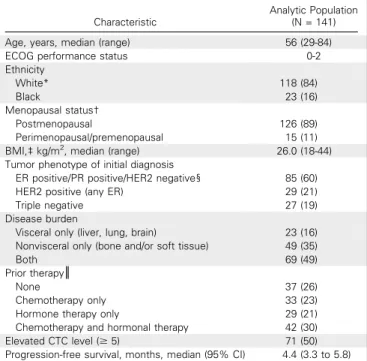
), resulting in an analytic population of 141.
Table 1
describes the patient characteristics of our analytic
pop-ulation. Serum was available to evaluate the CMI in duplicates at two
time points (at baseline and at week 4) in 129 women, and at a third
time point for 112 of the 129 women. Information on CTCs was
available at baseline and at week 4 for 96 women. Median follow-up
for the cohort was 19.5 months (range, 0.8 to 86.3 months).
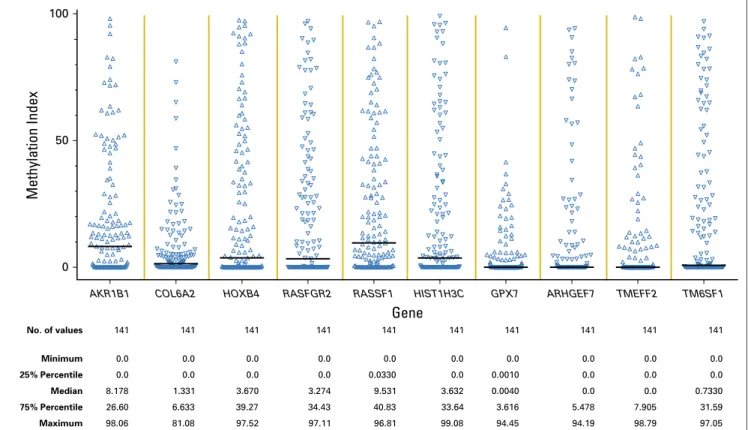
The MI at baseline was calculated for all 10 genes (Appendix
Fig A3
), and the results were highly correlated with one another
(Appendix
Table A1
, online only). Four of the genes (
COL6A2
,
HOXB4
,
RASGRF2
,
RASSF1
,
HIST1H3C
, and
TM6SF1.
The
inter-and intrabatch CVs for any of the genes were
,
18% (the majority
having a CV
,
10%), which is considered acceptable.
19The
inter-and intrabatch CVs for the CMI of the six genes were
,
2.5%.
Landmark analyses were performed on the basis of week 4.
A cut point of 9 for PFS and 21 for OS were the values selected for
the week 4 CMI that maximized the log-rank statistic. One patient
who had PD before the landmark time point was excluded. In the
multivariable models described in
Table 2
, patients with a high
CMI at week 4 had a signi
fi
cantly worse PFS (HR, 1.79; 95% CI,
1.23 to 2.60;
P
= .002) after adjusting for age, ethnicity, prior
therapy, tumor phenotype, and disease burden. Similar results for
OS (HR, 1.75; 95% CI, 1.21 to 2.54;
P
= .003) are illustrated in
Table 3
.
The median PFS among women in the high versus low CMI
group was 2.1 months (95% CI, 1.7 to 3.2 months) versus
5.8 months (95%, CI 4.7 to 7.4 months), respectively (
Fig 1A
).
The median OS was almost a year shorter for women in the high
(12.3 months; 95% CI, 8.4 to 16.5 months) versus low (21.7 months;
95% CI, 19.3 to 28.3 months) CMI group (
Fig 1B
). Baseline CMI,
modeled continuously, was not associated with PFS but was
as-sociated with OS in multivariate analyses (Appendix
Fig A4
). The
prognostic effect of the week 4 CMI was consistent across different
biologic subtypes; however, the sample size of some subtypes was
small (Appendix
Table A2
). Sensitivity analyses for factors such as
body mass index, study site, and the 10-gene panel did not alter the
observed estimates. To evaluate the robustness of the two-fold
cross-validation approach, we repeated the two-fold cross-cross-validation
procedure 500 times to allow for different choices of the 1:1 random
split of the original data set and calculated the corresponding HR.
The mean HR for PFS was 1.95 (variance, 0.048), and the mean HR
for OS was 1.87 (variance, 0.023), which is considered stable and
within the range of our original results.
The association between CMI levels at baseline, at week 4, and
at
fi
rst restaging and disease status as early as
fi
rst restaging, which
was most often at week 12, was also examined.
Figure 2A
illustrates
the distributions of log CMI levels at baseline, at week 4, and at
fi
rst
restaging by disease status. A signi
fi
cant trend was observed
between an increasing CMI at week 4 and less responsive disease
at
fi
rst restaging (
P
for trend
,
.001, Jonckheere-Terpstra test).
The median CMI at week 4 was highest in women with PD, lowest
in women with responsive disease (partial response/complete
re-sponse), and intermediate in women with stable disease at
fi
rst
restaging.
Next, the effect on disease status of a change in CMI levels
from baseline to week 4 was examined. Women with responsive
(
P
,
.001) or stable (
P
,
.001) disease were more likely to have
a reduction in median levels of the CMI from baseline to week 4
(
Fig 2A
). As illustrated in
Tables 2
and
4
, a change in log CMI
from baseline to week 4 was associated with worse PFS (HR, 1.21;
95% CI, 1.09 to 1.34;
P
,
.001) and PD at
fi
rst restaging (OR,
1.55; 95% CI, 1.20 to 2.01;
P
,
.001). When a change in the CMI
was modeled as a binary variable in multivariable analyses, an
increase in the CMI at week 4 was associated with a worse PFS
(HR, 2.18; 95% CI, 1.40 to 3.41;
P
,
.001) and a 4.6-fold increase
in the risk of PD at
fi
rst restaging (OR, 4.58; 95% CI, 1.82 to
11.60;
P
= .001) compared with a reduction or no change in the
CMI. In either case, adjusting for the baseline CMI did not alter
the point estimates.
In this study, we were also able to evaluate CTCs at baseline
and at week 4 in 96 women. The distribution of CTC values is
illustrated in Appendix
Figure A5
. As was the case with the CMI,
week 4 CTCs
$
5 cells/7.5 mL were signi
fi
cantly associated with
worse PFS (HR, 1.46; 95% CI, 1.02 to 2.10;
P
= .04) and OS
(HR, 2.24; 95% CI, 1.54 to 3.26;
P
,
.001). The median OS
for
$
5 cells/7.5 mL was 8.1 months (95% CI, 4.9 to 18.8 months)
and 20.8 months (95% CI, 17.5 to 26.6 months) for
,
5 cells/7.5 mL.
As was the case with the CMI, CTCs at week 4 were reduced in
women with responsive disease (
P
= .0001;
Fig 2B
). However, in
contrast to CMI, CTC levels were not signi
fi
cantly different by
disease status at
fi
rst restaging (
P
for trend = .457;
Fig 2B
). The
CMI was more sensitive (78%) in identifying high-risk
(pro-gressive) disease than were CTCs (30%). A change in CTCs
modeled either as a continuous marker (Appendix
Fig A6
) or as
a binary marker (increase or reduction
v
no change from baseline;
OR, 2.23; 95% CI, 0.77 to 2.47) was not signi
fi
cantly associated
with PD at
fi
rst restaging in multivariable analyses.
Finally, as an exploratory analysis, we examined the
prog-nostic signi
fi
cance of the CMI and CTCs in 96 women in whom
both markers had been measured (Appendix
Table A3
).
Likeli-hood ratio tests suggest that the addition of either the week 4 CMI
or CTCs signi
fi
cantly improved the ability of a model of
estab-lished risk factors to predict PFS (
P
,
.001and
P
= .038 for the
Table 1. Baseline Patient Characteristics of the Analytic PopulationCharacteristic
Analytic Population (N = 141)
Age, years, median (range) 56 (29-84)
ECOG performance status 0-2
Ethnicity
White* 118 (84)
Black 23 (16)
Menopausal status†
Postmenopausal 126 (89)
Perimenopausal/premenopausal 15 (11) BMI,‡kg/m2, median (range) 26.0 (18-44) Tumor phenotype of initial diagnosis
ER positive/PR positive/HER2 negative§ 85 (60)
HER2 positive (any ER) 29 (21)
Triple negative 27 (19)
Disease burden
Visceral only (liver, lung, brain) 23 (16) Nonvisceral only (bone and/or soft tissue) 49 (35)
Both 69 (49)
Prior therapy║
None 37 (26)
Chemotherapy only 33 (23)
Hormone therapy only 29 (21)
Chemotherapy and hormonal therapy 42 (30)
Elevated CTC level ($5) 71 (50)
Progression-free survival, months, median (95% CI) 4.4 (3.3 to 5.8)
NOTE. Data are presented as No. (%) unless otherwise indicated.
Abbreviations: BMI, body mass index; CTC, circulating tumor cell; ECOG, Eastern Cooperative Oncology Group; ER, estrogen receptor; HER2, human epidermal growth factor receptor 2; PR, progesterone receptor.
*Including one Asian.
†On the basis of self-report data from baseline questionnaire.
‡Excluding 12 patients who did not have baseline height or weight information available.
§Including eight subjects with unknown HER2 status.
CMI and CTCs, respectively) and OS (
P
= .043 and
P
= .007 for
the CMI and CTCs, respectively). Furthermore, the CMI at week
4 seemed to be a signi
fi
cant predictor of PFS and improved the
prediction of the base model even in the presence of CTCs
(
P
= .004). In separate models, a change in the CMI in the base
model improved PFS (
P
= .002), but a change in CTC level did
not. The improvement with the change in the CMI occurred
even in the presence of CTCs (
P
= .007). The addition of
a change in CTC level or in the CMI did not signi
fi
cantly
improve the model
fi
t for OS.
DISCUSSION
To our knowledge, this is the
fi
rst study to demonstrate the promise
of early changes in the level of circulating cell-free tumor-speci
fi
c
DNA methylation for clinical application in patients with MBC.
Our results suggest that CMI levels of a novel six-gene panel
measured 4 weeks after the initiation of a new therapy and a novel
quantitative assay known as cMethDNA have clinical usefulness as
a predictor of survival outcomes in women with MBC. A high CMI
Table 2. Association of CMI Levels and Prognostic Factors With Progression-Free Survival in Women with Metastatic Breast CancerVariable
Univariate Analysis Multivariable Analysis
No. Events HR (95% CI)* P No. Events HR (95% CI)* P
Age, years 138 0.97 (0.96 to 0.99) ,.001 126 0.97 (0.96 to 0.99) .003
Ethnicity, blackvwhite 138 1.22 (0.78 to 1.92) .79 126 1.32 (0.81 to 2.8) .270
Prior therapy, yesvno 138 1.21 (0.82 to 1.78) .331 126 0.91 (0.59 to 1.39) .649
Disease burden, visceralvnonvisceral 138 0.96 (0.68 to 1.37) .839 126 1.02 (0.69 to 1.50) .915
Phenotype 138 126
HER2 positive (any ER)vER positive/PR positive/ HER2 negative
1.31 (0.85 to 2.01) .219 1.09 (0.69 to 1.72) .727
Triple negativevER positive/PR positive/HER2 negative 0.92 (0.59 to 1.44) .702 0.75 (0.44 to 1.27) .280 HER2 positive (any ER)vtriple negative 1.43 (0.83 to 2.47) .202 1.45 (0.79 to 2.66) .231 Log week 4 CMI†(continuous) 126 1.15 (1.05 to 1.25) .002 126 1.13 (1.04 to 1.23) .006 Week 4 CMI, high‡vlow (with cross-validation) 126 1.76 (1.23 to 2.52) .002 126 1.79 (1.23 to 2.60) .002 Log CMI change from baseline to week 4†(continuous) 126 1.19 (1.07 to 1.32) .001 126 1.21 (1.09 to 1.34) ,.001
NOTE. Progression-free survival was calculated from the date treatment started to the date offirst documentation of progressive disease as determined by standard Response Evaluation Criteria in Solid Tumors, clinical deterioration, or rising tumor markers in the situation in which imaging was not performed, or the time of death from any cause, whichever camefirst. Those who remained alive without progressive disease were censored at the time of their last tumor assessment.
Abbreviations: CMI, cumulative methylation index; ER, estrogen receptor; HER2, human epidermal growth factor receptor 2; HR, hazard ratio; PR, progesterone receptor.
*HRs and 95% CIs were estimated andPvalues obtained using Cox proportional hazards models with the multivariable analysis adjusting for age, ethnicity, prior therapy, phenotype, and disease burden. For dichotomized week 4 CMI, HR was obtained using a stratified Cox regression model.
†Continuous CMI (log week 4 CMI, log CMI change from baseline to week 4) was assessed using a separate multivariable model adjusting for age, ethnicity, prior therapy, phenotype, and disease burden.
‡High in this analysis is based on a week 4 CMI.9. The remaining individuals were classified as low.
Table 3. Association of CMI Levels and Prognostic Factors With Overall Survival in Women With Metastatic Breast Cancer
Variable
Univariate Analysis Multivariable Analysis
No. Events HR (95% CI)* P No. Events HR (95% CI)* P
Age, years 133 0.99 (0.97 to 1.00) .115 121 0.99 (0.98 to 1.01) .441
Ethnicity, blackvwhite 133 1.75 (1.10 to 2.77) .018 121 1.89 (1.11 to 3.22) .020
Prior therapy, yesvno 133 1.05 (0.71 to 1.55) .813 121 1.21 (0.78 to 1.88) .393
Disease burden, visceralvnonvisceral 133 1.23 (0.86 to 1.76) .258 121 1.16 (0.79 to 1.72) .450
Phenotype 133 121
HER2 positive (any ER)vER positive/PR positive/ HER2 negative
1.00 (0.64 to 1.57) .987 1.01 (0.62 to 1.65) .964
Triple negativevER positive/PR positive/HER2 negative 1.60 (1.02 to 2.51) .041 1.76 (1.05 to 2.95) .032 HER2 positive (any ER)vtriple negative 0.63 (0.36 to 1.09) .100 0.57 (0.31 to 1.06) .078 Log week 4 CMI†(continuous) 121 1.14 (1.04 to 1.25) .004 121 1.17 (1.06 to 1.28) .001 Week 4 CMI, high‡vlow (with cross-validation) 121 1.70 (1.18 to 2.45) .005 121 1.75 (1.21 to 2.54) .003 Log CMI change from baseline to week 4†(continuous) 121 1.08 (0.98 to 1.20) .104 121 1.08 (0.98 to 1.20) .123
NOTE. Overall survival was defined as the date treatment started to the date of death from any cause. Those who remained alive were censored at the date last known to be alive.
Abbreviations: CMI, cumulative methylation index; ER, estrogen receptor; HER2, human epidermal growth factor receptor 2; HR, hazard ratio; PR, progesterone receptor. *Cox proportional hazard models and stratified Cox regression were used to estimate HRs and 95% CIs andPvalues. The multivariable analysis was adjusted for age, ethnicity, prior therapy, phenotype, and disease burden. HRs and 95% CIs were estimated andPvalues obtained using Cox proportional hazards models with the multivariable analysis adjusting for age, ethnicity, prior therapy, phenotype, and disease burden. For dichotomized week 4 CMI, HR was obtained using a stratified Cox regression model.
†Continuous CMI (log week 4 CMI, log CMI change from baseline to week 4) was assessed using a separate multivariable model adjusting for age, ethnicity, prior therapy, phenotype, and disease burden.
level at week 4 was consistently associated with PFS and OS, as well
as PD, as early as
fi
rst restaging. Furthermore, a change in the CMI
within 4 weeks of initiating therapy tracked with PFS and disease
response as early as
fi
rst restaging, supporting the potential
prog-nostic usefulness of measuring CMI levels within weeks of initiating
a new therapy. Last, both the CMI at week 4 and a change in the CMI
added to the ability of established risk factors, including CTCs, to
predict PFS.
The six-gene panel examined in this study is based on the
results of a DNA methylation array conducted in breast tumors
and sera for patients with both estrogen receptor
–
positive and
estrogen receptor
–
negative breast cancer.
7Five of the six genes in
the six-gene panel were identi
fi
ed by our group as methylated in
breast cancer.
7Two genes with some degree of commonality in
function were
RASGRF1,
a RAS guanosine triphosphate hydrolase
with nucleotide exchange function,
20and
RASSF1
, a methylation
marker common to many cancers that encodes a protein similar
to RAS effector proteins.
21Among the four other novel genes,
HIST1H3C
interacts with linker DNA between nucleosomes and
functions in the compaction of chromatin into higher-order
structures,
22the
AKR1B1
gene encodes a member of the aldo/keto
reductase superfamily and catalyzes the reduction of a number of
Time Since 4 Weeks After Treatment Started (months)
Progression−Free Survival (probability)
0.2 0.4 0.6 0.8 1.0
0 10 20 30 40 50 60 70
Week 4 CMI high
Week 4 CMI low
High: Low:
Median 2.1 months 5.8 months
95% CI 1.7 to 3.2 4.7 to 7.4
Gehan P = .0002
Stratified HR: 1.76 (95% CI, 1.23 to 2.52)
71 7 3 2 1 0 0 0
57 16 3 3 2 2 2 0
No. at risk
High
Low
A
0.2 0.4 0.6 0.8 1.0
Time Since 4 Weeks After Treatment Started (months)
Overall Survival (probability)
0 10 20 30 40 50 60 70 80 90
Week 4 CMI high Week 4 CMI low
High:
Low:
Median 12.3 months
21.7 months 95% CI 8.4 to 16.5
19.3 to 28.3
Gehan P = .001
Stratified HR: 1.70 (95% CI, 1.18 to 2.45)
62 34 19 13 7 3 1 1 1 0
67 55 36 21 10 9 6 2 0 0
No. at risk
High
Low
B
aldehydes,
23and
HOXB4
encodes a transcription factor involved
in development and, as with many members of the HOX gene
family, is regulated by methylation of dense C-phosphate-G
islands.
24There is no literature regarding the function of the
newly discovered
TM6SF1
.
7The cMethDNA assay can measure
methylation levels in gene loci coampli
fi
ed from one 300-mL
aliquot of serum. The cMethDNA assay is calibrated against a low
fi
xed physiologic level of recombinant gene-speci
fi
c reference DNA
that is copuri
fi
ed and coampli
fi
ed with target methylated DNA.
7A few other studies have evaluated the relationship between
cell-free tumor DNA in plasma and serum and disease outcome
in patients with breast cancer.
12-15,25-28Those studies did not
quantify the level of methylation either as a categorical or as
a continuous measure, as we report in this article. Most of the
studies were based in a single institution, measured a limited
number of candidate genes at a single time point, had a small
sample size, included limited clinical information, and were not
prospective.
0 1 10
CMI
100 1,000
PD (n = 39) SD (n = 48)
*
*
*
*
PR/CR (n = 16)P for trend < .001 10,000
Baseline Week 4 First restaging
A
*
PD (n = 31) SD (n = 46) PR/CR (n = 14)
P for trend = .457
0 1 10
CTCs
100 1,000 10,000
Baseline Week 4
B
Fig 2.Association of disease status atfirst restaging with (A) CMI and (B) CTCs across three time points. The length of the box is the interquartile range and represents the middle 50% of the data. The horizontal line inside the box shows the median. The lower and upper edges of the box represent the 25th and 75th percentiles, respectively. The vertical dashed lines extend from the box to the upper and lower 1.5 interquartile values from the upper and lower edges. Jonckheere-Terpstra test for trend in change from baseline among ordered disease status atfirst restaging. *Significant difference (P,.001) at the given time point compared with baseline using Wilcoxon signed rank test. Natural log transformed CMI and CTC data were graphed and they-axes were formatted with back-transformation values. CMI, cumulative methylation index; CTCs, circulating tumor cells; PD, progressive disease; PR/CR, partial response/complete response; SD, stable disease.
Table 4.Association of CMI Levels and Prognostic Factors With Progressive Disease at First Restaging (N = 134)
Variable
Univariate Analysis Multivariable Analysis
OR (95% CI)* P OR (95% CI)* P
Age, years 0.98 (0.95 to 1.01) .128 0.99 (0.95 to 1.02) .454
Ethnicity, blackvwhite 1.61 (0.64 to 4.02) .313 2.13 (0.72 to 6.30) .171
Prior therapy, yesvno 1.12 (0.51 to 2.49) .777 1.05 (0.41 to 2.67) .920
Disease burden, visceralvnonvisceral 0.96 (0.46 to 2.01) .920 0.90 (0.38–2.10) .805 Phenotype
HER2 positivevER positive/PR positive/HER2 negative 1.06 (0.45 to 2.51) .897 1.35 (0.49 to 3.74) .567 Triple negativevER positive/PR positive/HER2 negative 1.00 (0.40 to 2.50) ..999 0.56 (0.18 to 1.78) .325 HER2 positive (any ER)vtriple negative 1.06 (0.36 to 3.15) .918 2.40 (0.67 to 8.64) .180
Log week4 CMI (continuous) 1.32 (1.09 to 1.62) .006 1.32 (1.08 to 1.62) .006
Log CMI change from baseline to week 4 (continuous) 1.52 (1.18 to 1.96) .001 1.55 (1.20 to 2.01) ,.001
NOTE. Disease status atfirst restaging was classified into two categories: progressive diseasevstable disease or responsive disease (partial response/complete response) after new treatment initiated.
In our comparison of the CMI with CTCs, a clinically available
biomarker for risk strati
fi
cation in patients with breast cancer, the
CMI and CTCs at week 4 seem to be complementary as prognostic
markers, but both the CMI and a change in the CMI were stronger
predictors of PFS when contrasted directly with CTCs.
29,30When
predicting treatment response at
fi
rst restaging, CTCs were more
speci
fi
c (85%) in identifying low-risk (stable or responsive) disease
compared with the CMI (51%), whereas the CMI was more
sensitive (78%) in identifying high-risk (progressive) disease than
were CTCs (30%). Of interest, numeric changes in CTC level
between baseline and week 4 were not associated with treatment
response. Women with a high CTC level at both baseline and week
4 compared with those with a low CTC level had a worse PFS and
OS; this
fi
nding is consistent with a recent clinical trial in MBC in
which change in treatment guided by CTCs did not in
fl
uence
disease outcome.
30Although monitoring for the change in the
CMI for treatment response has prognostic usefulness, its clinical
usefulness in in
fl
uencing changes in therapy must now be
eval-uated formally in randomized clinical trials. Furthermore, whether
there is meaningful risk reclassi
fi
cation of patients with the
ad-dition of the CMI is worth careful assessment in future larger
validation studies.
To our knowledge, this is the
fi
rst prospective study to
demonstrate the potential clinical usefulness of measures of
se-rum methylation to inform clinical care in breast cancer. The CMI
of a panel of six genes and change in CMI levels were independent
predictors of survival outcomes. Limitations of the study include
the lack of central adjudication for outcomes such as PD,
al-though these results seem to align with death, a less subjective
outcome. Other limitations include the lack of blood samples
before week 4 and the modest sample size. Our
fi
ndings must be
validated to determine the clinical usefulness of the cMethDNA
assay for speci
fi
c treatments and tumor phenotypes in patients
with metastatic disease and early-stage breast cancer.
AUTHORS
’
DISCLOSURES OF POTENTIAL CONFLICTS
OF INTEREST
Disclosures provided by the authors are available with this article at
jco.org.
AUTHOR CONTRIBUTIONS
Conception and design:
Kala Visvanathan, MaryJo S. Fackler, Zhe Zhang,
Elizabeth Garrett-Mayer, Saraswati Sukumar, Antonio C. Wolff
Financial support:
Lisa A. Carey, Antonio C. Wolff
Administrative support:
Stacie C. Jeter, Antonio C. Wolff
Provision of study materials or patients:
Kala Visvanathan, MaryJo S.
Fackler, Stacie C. Jeter, Andres Forero, Anna M. Storniolo, Rita Nanda,
Nancy U. Lin, Lisa A. Carey, James N. Ingle, Antonio C. Wolff
Collection and assembly of data:
Kala Visvanathan, MaryJo S. Fackler,
Zhe Zhang, Zoila A. Lopez-Bujanda, Stacie C. Jeter, Lori J. Sokoll, Andres
Forero, Anna M. Storniolo, Rita Nanda, Nancy U. Lin, Lisa A. Carey,
James N. Ingle, Saraswati Sukumar, Antonio C. Wolff
Data analysis and interpretation:
Kala Visvanathan, MaryJo S. Fackler,
Zhe Zhang, Lori J. Sokoll, Elizabeth Garrett-Mayer, Leslie M. Cope,
Christopher B. Umbricht, David M. Euhus, Saraswati Sukumar,
Antonio C. Wolff
Manuscript writing:
All authors
Final approval of manuscript:
All authors
REFERENCES
1. Tie J, Kinde I, Wang Y, et al: Circulating tumor DNA as an early marker of therapeutic response in patients with metastatic colorectal cancer. Ann Oncol 26:1715-1722, 2015
2. Smerage JB, Hayes DF: The measurement and therapeutic implications of circulating tumour cells in breast cancer. Br J Cancer 94:8-12, 2006
3. Van Poznak C, Somerfield MR, Bast RC, et al: Use of biomarkers to guide decisions on systemic therapy for women with metastatic breast cancer: American Society of Clinical Oncology clinical prac-tice guideline. J Clin Oncol 33:2695-2704, 2015
4. Egger G, Liang G, Aparicio A, et al: Epigenetics in human disease and prospects for epigenetic therapy. Nature 429:457-463, 2004
5. Baylin S: DNA methylation and epigenetic mechanisms of carcinogenesis. Dev Biol (Basel) 106: 85-87, discussion 143-160, 2001
6. Jones PA: DNA methylation and cancer. On-cogene 21:5358-5360, 2002
7. Fackler MJ, Lopez Bujanda Z, Umbricht C, et al: Novel methylated biomarkers and a robust assay to detect circulating tumor DNA in metastatic breast cancer. Cancer Res 74:2160-2170, 2014
8. Evron E, Dooley WC, Umbricht CB, et al: Detection of breast cancer cells in ductal lavagefluid by methylation-specific PCR. Lancet 357:1335-1336, 2001
9. Fackler MJ, Malone K, Zhang Z, et al: Quan-titative multiplex methylation-specific PCR analysis
doubles detection of tumor cells in breast ductalfluid. Clin Cancer Res 12:3306-3310, 2006
10. Fackler MJ, McVeigh M, Mehrotra J, et al: Quantitative multiplex methylation-specific PCR as-say for the detection of promoter hypermethylation in multiple genes in breast cancer. Cancer Res 64: 4442-4452, 2004
11. Fackler MJ, Rivers A, Teo WW, et al: Hyper-methylated genes as biomarkers of cancer in women with pathologic nipple discharge. Clin Cancer Res 15: 3802-3811, 2009
12. Fiegl H, Millinger S, Mueller-Holzner E, et al: Circulating tumor-specific DNA: A marker for moni-toring efficacy of adjuvant therapy in cancer patients. Cancer Res 65:1141-1145, 2005
13. Chimonidou M, Tzitzira A, Strati A, et al: CST6 promoter methylation in circulating cell-free DNA of breast cancer patients. Clin Biochem 46:235-240, 2013
14. Fujita N, Kagara N, Yamamoto N, et al: Methylated DNA and high total DNA levels in the serum of patients with breast cancer following neoadjuvant chemotherapy are predictive of a poor prognosis. Oncol Lett 8:397-403, 2014
15. G ¨obel G, Auer D, Gaugg I, et al: Prognostic significance of methylated RASSF1A and PITX2 genes in blood- and bone marrow plasma of breast cancer patients. Breast Cancer Res Treat 130: 109-117, 2011
16. Fackler MJ, Umbricht CB, Williams D, et al: Genome-wide methylation analysis identifies genes specific to breast cancer hormone receptor status and risk of recurrence. Cancer Res 71:6195-6207, 2011
17. Contal C, O’Quigley J: An application of changepoint methods in studying the effect of age on survival in breast cancer. Comput Stat Data Anal 30: 253-270, 1999
18. Faraggi D, Simon R: A simulation study of cross-validation for selecting an optimal cutpoint in univariate survival analysis. Stat Med 15:2203-2213, 1996
19. Tworoger SS, Hankinson SE: Use of bio-markers in epidemiologic studies: Minimizing the
in-fluence of measurement error in the study design and analysis. Cancer Causes Control 17:889-899, 2006
20. Freedman TS, Sondermann H, Friedland GD, et al: A Ras-induced conformational switch in the Ras activator Son of sevenless. Proc Natl Acad Sci USA 103:16692-16697, 2006
21. Gordon M, Baksh S: RASSF1A: Not a pro-totypical Ras effector. Small GTPases 2:148-157, 2011
22. MacAlpine DM, Almouzni G: Chromatin and DNA replication. Cold Spring Harb Perspect Biol 5: a010207, 2013
23. Watanabe K: Recent reports about enzymes related to the synthesis of prostaglandin (PG) F (2) (PGF(2a) and 9a, 11b-PGF(2)). J Biochem 150: 593-596, 2011
24. Lin SH, Wang J, Saintigny P, et al: Genes suppressed by DNA methylation in non-small cell lung cancer reveal the epigenetics of epithelial-mesenchymal transition. BMC Genomics 15:1079, 2014
neoadjuvant chemotherapy in breast cancer patients. Int J Cancer 131:E1166-E1172, 2012
26. Van der Auwera I, Elst HJ, Van Laere SJ, et al: The presence of circulating total DNA and methylated genes is associated with circulating tumour cells in blood from breast cancer patients. Br J Cancer 100: 1277-1286, 2009
27. Ahmed SA, Hamed MA, Omar OS: Clinical utility of certain biomarkers as predictors of breast cancer with or without metastasis among Egyptian females. Tumour Biol 36:815-822, 2015
28. Dawson SJ, Rosenfeld N, Caldas C: Circulat-ing tumor DNA to monitor metastatic breast cancer. N Engl J Med 369:93-94, 2013
29. Cristofanilli M, Budd GT, Ellis MJ, et al: Circulating tumor cells, disease progression, and survival in meta-static breast cancer. N Engl J Med 351:781-791, 2004
30. Smerage JB, Barlow WE, Hortobagyi GN, et al: Circulating tumor cells and response to chemother-apy in metastatic breast cancer: SWOG S0500. J Clin Oncol 32:3483-3489, 2014
Affiliations
Kala Visvanathan
, Johns Hopkins University School of Medicine and Bloomberg School of Public Health;
MaryJo S. Fackler
,
Zhe
Zhang
,
Zoila A. Lopez-Bujanda
,
Stacie C. Jeter
,
Lori J. Sokoll
,
Leslie M. Cope
,
Christopher B. Umbricht
,
David M. Euhus
,
Saraswati
Sukumar
, and
Antonio C. Wolff
, Johns Hopkins University School of Medicine, Baltimore, MD;
Elizabeth Garrett-Mayer
, Medical
University of South Carolina, Charleston, SC;
Andres Forero
, University of Alabama at Birmingham, Birmingham, AL;
Anna M.
Storniolo
, Indiana University, Bloomington, IN;
Rita Nanda
, University of Chicago, Chicago, IL;
Nancy U. Lin
, Dana-Farber Cancer
Institute, Boston, MA;
Lisa A. Carey
, University of North Carolina, Chapel Hill, NC; and
James N. Ingle
, Mayo Clinic, Rochester, MN.
Support
Supported by the Avon Foundation for Women, the Breast Cancer Research Foundation, Janssen Diagnostics, the Rubenstein Family
Fund, the Susan G. Komen Foundation, National Institutes of Health Grants No. NIHP30CA006973 and NIHP30CA58223, and the Susan G.
Komen Leadership Grant SAC110053 (A.C.W.).
Prior Presentation
Presented in part at the ASCO Annual Meeting, May 29-June 2, 2015.
AUTHORS’DISCLOSURES OF POTENTIAL CONFLICTS OF INTEREST
Monitoring of Serum DNA Methylation as an Early Independent Marker of Response and Survival in Metastatic Breast Cancer: TBCRC 005
Prospective Biomarker Study
The following represents disclosure information provided by authors of this manuscript. All relationships are considered compensated. Relationships are
self-held unless noted. I = Immediate Family Member, Inst = My Institution. Relationships may not relate to the subject matter of this manuscript. For more
information about ASCO
’
s con
fl
ict of interest policy, please refer to
www.asco.org/rwc
or
ascopubs.org/jco/site/ifc
.
Kala Visvanathan
Patents, Royalties, Other Intellectual Property:
Inventor on one or more
patents applied for on issues relating to methylation and cancer in the past
2 years and has assigned her rights to her institution, and participates in
a royalty-sharing agreement with her institution
MaryJo S. Fackler
Consulting or Advisory Role:
Myriad Genetics (I), Cepheid
Research Funding:
Cepheid
Patents, Royalties, Other Intellectual Property:
Inventor on one or more
patents applied for on issues relating to methylation and cancer in the past
2 years and has assigned her rights to her institution, and participates in
a royalty-sharing agreement with her institution
Travel, Accommodations, Expenses:
Medtronic (I)
Zhe Zhang
Research Funding:
Avon Foundation for Women (Inst)
Patents, Royalties, Other Intellectual Property:
Inventor on one or more
patents applied for on issues relating to methylation and cancer in the past
2 years and has assigned her rights to her institution, and participates in
a royalty-sharing agreement with her institution
Zoila A. Lopez-Bujanda
Patents, Royalties, Other Intellectual Property:
Inventor on one or more
patents applied for on issues relating to methylation and cancer in the past
2 years and has assigned her rights to her institution, and participates in
a royalty-sharing agreement with her institution
Stacie C. Jeter
No relationship to disclose
Lori J. Sokoll
Research Funding:
Janssen Diagnostics (Veridex) (Inst)
Elizabeth Garrett-Mayer
Stock or Other Ownership:
Abbott Laboratories, Abbvie
Consulting or Advisory Role:
Tactical Therapeutics, Okava
Pharmaceuticals
Research Funding:
Genentech (Inst)
Leslie M. Cope
Patents, Royalties, Other Intellectual Property:
MDxHealth; Inventor on
one or more patents applied for on issues relating to methylation and
cancer in the past 2 years and has assigned his rights to his institution, and
participates in a royalty-sharing agreement with his institution
Christopher B. Umbricht
Patents, Royalties, Other Intellectual Property:
Inventor on one or more
patents applied for on issues relating to methylation and cancer in the past
2 years and has assigned his rights to his institution, and participates in
a royalty-sharing agreement with his institution
David M. Euhus
No relationship to disclose
Andres Forero
No relationship to disclose
Anna M. Storniolo
Consulting or Advisory Role:
Eli Lilly, Novartis/P
fi
zer
Rita Nanda
No relationship to disclose
Nancy U. Lin
Consulting or Advisory Role:
Shionogi Pharma
Research Funding:
Genentech, GlaxoSmithKline, Novartis, Array
BioPharma, Kadmon
Lisa A. Carey
Research Funding:
GlaxoSmithKline, Genentech
James N. Ingle
No relationship to disclose
Saraswati Sukumar
Research Funding:
Cepheid
Patents, Royalties, Other Intellectual Property:
Inventor on one or more
patents applied for on issues relating to methylation and cancer in the past
2 years and has assigned her rights to her institution, and participates in
a royalty-sharing agreement with her institution
Antonio C. Wolff
Research Funding:
Myriad Genetics
Appendix
Start new therapy
Week 4 (median = 27
days)
First restaging (median = 63
days)
Observe for disease status and survival
Whole blood
Serum
Disease assessment (clinical examination and imaging studies)
Fig A1.TBCRC-005 study schema. For this study, we had duplicate serum samples from 141 women at baseline. In addition, for 129 of the 141 women, we had duplicate measures at a second time point, and for 112 of the 129 women, duplicate measures at a third time point.
Patients enrolled in TBCRC 005
between January 2007 and June 2009
(N = 182)
cMethDNA assay performed
(n = 149) + 5% QCs (n = 72)
Patient were excluded because they did not get treated
(n = 3) or because there was not enough sample
for duplicate assays (n = 2) or because all 10 genes
were not measured in duplicate (n = 3)
Samples from women used for
analytical validation (n = 33)
Analytic population
(n = 141)
Marker
PFS Baseline CMI
Baseline CTCs Week 4 CMI
Week 4 CTCs Change in CMI
Change in CTCs
Baseline CMI
Baseline CTCs Week 4 CMI
Week 4 CTCs Change in CMI
Change in CTCs 1.01
1.06 1.13
1.11 1.21
1.08
1.12
1.20 1.17
1.20 1.08
1.02 0.92
0.99 1.04
1.02 1.09
0.97
1.01
1.11 1.06
1.11 0.98
0.92 1.11
1.14 1.23
1.20 1.34
1.20
1.24
1.29 1.28
1.31 1.20
1.13
HR
0.9 1 1.1 1.2 1.3 1.4
OS
HR 95%LCL 95%UCL
Fig A4.Forest plot of the association of CMI and CTCs as a continuous marker with both PFS and OS. Baseline and week 4 CTCs and CMI modeled as a continuous marker and both PFS and OS. All markers were treated as continuous variables and log transformed. The bars represent 95% CIs. The size of the box is indicative of the precision of the point estimate. CMI, cumulative methylation index; CTCs, circulating tumor cells; HR, hazard ratio; LCL, lower confidence limit; OS, overall survival; PFS, progression-free survival; UCL, upper confidence limit.
Methylation Index
0 50 100
AKR1B1 COL6A2 HOXB4 RASFGR2 RASSF1
Gene
HIST1H3C GPX7 ARHGEF7 TMEFF2 TM6SF1
No. of values 141 141 141 141 141 141 141 141 141 141
Minimum 0.0 0.0 0.0 0.0 0.0 0.0 0.0 0.0 0.0 0.0
25% Percentile 0.0 0.0 0.0 0.0 0.0330 0.0 0.0010 0.0 0.0 0.0
Median 8.178 1.331 3.670 3.274 9.531 3.632 0.0040 0.0 0.0 0.7330
75% Percentile 26.60 6.633 39.27 34.43 40.83 33.64 3.616 5.478 7.905 31.59
Maximum 98.06 81.08 97.52 97.11 96.81 99.08 94.45 94.19 98.79 97.05
Marker
Baseline CMI
Baseline CTCs Week 4 CMI
Week 4 CTCs Change in CMI
Change in CTCs 0.99
1.14 1.32
1.23 1.55
1.21 0.81
0.99 1.08
1.04 1.20
0.98 1.23
1.32 1.62
1.47 2.01
1.51
OR
0.8 1 1.2 1.4 1.6 1.8 2
OR 95%LCL 95%UCL
Fig A6. Forest plot of the association of CMI and CTCs as a continuous marker with disease status atfirst restaging. All markers were treated as continuous variables and were log transformed. The bars represent 95% CIs. The size of the box is indicative of precision of the point estimate. CMI, cumulative methylation index; CTCs, circulating tumor cells; LCL, lower confidence limit; OR, odds ratio; UCL, upper confidence limit.
80
60
40
20
0 10 20 30
Baseline CTC
s
(square rooted)
Frequency
40 50 60
80
60
40
20
0 10 20 30
Week 4 CTC
s
(square rooted)
Frequency
40 50 60
Table A1. Correlation Among Baseline Methylation of All 10 Genes With Each Other
Gene
Spearman Correlation Coefficients andPValues * (N = 141)
AKR1B1 COL6A2 HOXB4 RASFGR2 RASSF1 HIST1H3C GPX7 ARHGEF7 TMEFF2 TM6SF1
AKR1B1 1.0000 0.6136 0.3987 0.6914 0.5941 0.2966 0.4978 0.5428 0.6150 0.5833
,.0001 ,.0001 ,.0001 ,.0001 ,.001 ,.0001 ,.0001 ,.0001 ,.0001
COL6A2 0.6136 1.0000 0.3856 0.6844 0.5797 0.2385 0.5008 0.5916 0.5681 0.6227
,.0001 ,.0001 ,.0001 ,.0001 .0044 ,.0001 ,.0001 ,.0001 ,.0001
HOXB4 0.3987 0.3856 1.0000 0.4319 0.3392 0.2153 0.3937 0.4571 0.3271 0.4527
,.0001 ,.0001 ,.0001 ,.0001 .0103 ,.0001 ,.0001 ,.0001 ,.0001
RASFGR2 0.6914 0.6844 0.4319 1.0000 0.6081 0.2334 0.5467 0.6868 0.6715 0.7113
,.0001 ,.0001 ,.0001 ,.0001 .0054 ,.0001 ,.0001 ,.0001 ,.0001
RASSF1A 0.5941 0.5797 0.3392 0.6081 1.0000 0.2508 0.5062 0.4422 0.5731 0.5251
,.0001 ,.0001 ,.0001 ,.0001 .0027 ,.0001 ,.0001 ,.0001 ,.0001
HIST1H3C 0.2966 0.2385 0.2153 0.2334 0.2508 1.0000 0.2107 0.2909 0.2786 0.2373
0.0004 0.0044 0.0103 0.0054 0.0027 0.0121 0.0005 0.0008 0.0046
GPX7 0.4978 0.5008 0.3937 0.5467 0.5062 0.2107 1.0000 0.5028 0.4490 0.5346
,.0001 ,.0001 ,.0001 ,.0001 ,.0001 .0121 ,.0001 ,.0001 ,.0001
ARHGEF7 0.5428 0.5916 0.4571 0.6868 0.4422 0.2909 0.5028 1.0000 0.5297 0.7450
,.0001 ,.0001 ,.0001 ,.0001 ,.0001 ,.001 ,.0001 ,.0001 ,.0001
TMEFF2 0.6150 0.5681 0.3271 0.6715 0.5731 0.2786 0.4490 0.5297 1.0000 0.6081
,.0001 ,.0001 ,.0001 ,.0001 ,.0001 ,.001 ,.0001 ,.0001 ,.0001
TM6SF1 0.5833 0.6227 0.4527 0.7113 0.5251 0.2373 0.5346 0.7450 0.6081 1.0000
,.0001 ,.0001 ,.0001 ,.0001 ,.0001 .0046 ,.0001 ,.0001 ,.0001 *Pvalue: probability.|r| under H0:r= 0.
Table A2. Association of Week 4 CMI by Hormone Receptor and HER2 Status in Univariate Analysis
Subgroup
PFS OS
n HR (95% CI) P n HR (95% CI) P
Week 4 CMI, highvlow
Hormone receptor positive 96 2.28 (1.48 to 3.50) ,.001 96 1.75 (1.15 to 2.67) .009
Hormone receptor negative 32 1.69 (0.80 to 3.57) .169 33 2.36 (1.12 to 4.98) .024
HER2 positive 28 1.89 (0.85 to 4.21) .121 28 4.05 (1.58 to 10.4) .004
HER2 negative 92 2.05 (1.33 to 3.16) .001 93 1.50 (0.98 to 2.28) .061
Table A3. Assessment of the Added Value of CMI and CTCs in Predicting PFS and OS in Women With Metastatic Breast Cancer
Model (n = 96)
PFS OS
x2
Statistic* P x2
Statistic* P
A
Base model — — — —
Base model + baseline CMI 0.01 .920 6.518 .011
Base model + baseline CMI + week 4 CMI 13.649 ,.001 4.114 .043
Base model + baseline CMI + week 4 CMI + baseline CTCs 0.860 .313 2.657 .103
Base model + baseline CMI + week 4 CMI + baseline CTCs + week 4 CTCs
1.397 .237 3.329 .068
B
Base model — — — —
Base model + baseline CTCs 1.258 .262 6.017 .014
Base model + baseline CTCs + week 4 CTCs 4.298 .038 7.246 .007
Base model + baseline CTCs + week 4 CTCs + baseline CMI 1.853 .173 0.579 .447
Base model + baseline CTCs + week 4 CTCs + baseline CMI + week 4 CMI
8.507 .004 2.776 .096
C
Base model — — — —
Base model + change in CMI 9.547 .002 0.418 .518
Base model + change in CMI + change in CTCs 0.017 .896 0.004 .950
D
Base model — — — —
Base model + change in CTCs 2.231 .135 0.076 .783
Base model + change in CTCs + change in CMI 7.333 .007 0.346 .556
NOTE. Base model includes age, ethnicity, prior therapy, phenotype, and disease burden.
Abbreviations: CMI, cumulative methylation index; CTCs, circulating tumor cells; OS, overall survival; PFS, progression-free survival. *Two times the difference of the log likelihood between nested models has ax2