cyclohexadienones by dithiane addition
Matthew A. Horwitz
‡
, Elisabetta Massolo
‡
and Jeffrey S. Johnson
*
Letter
Open Access
Address:
Department of Chemistry, University of North Carolina at Chapel Hill, Chapel Hill, NC 27599-3290, USA
Email:
Jeffrey S. Johnson* - [email protected]
* Corresponding author ‡ Equal contributors
Keywords:
conjugate addition; cyclohexadienones; dearomatization; desymmetrization; dithiane; iminophosphoranes; organocatalysis; phosphazenes
Beilstein J. Org. Chem.2017,13, 762–767. doi:10.3762/bjoc.13.75
Received: 21 January 2017 Accepted: 04 April 2017 Published: 24 April 2017
Associate Editor: T. P. Yoon
© 2017 Horwitz et al.; licensee Beilstein-Institut. License and terms: see end of document.
Abstract
We report a desymmetrization of cyclohexadienones by intramolecular conjugate addition of a tethered dithiane nucleophile. Mild
reaction conditions allow the formation of diversely functionalized fused bicyclic lactones. The products participate in facially
selective additions from the convex surface, leading to allylic alcohol derivatives.
Findings
Desymmetrization has become a well-developed strategy for the
construction of complex molecular frameworks [1-6].
Cyclo-hexadienones are multipurpose synthetic building blocks that
have found a central role in desymmetrization methodologies.
The functional groups present in these symmetrical molecules
allow for a wide array of downstream transformations and they
are all formed through a single reaction from cheap and readily
available aromatic feedstocks [7-11]. These substrates have
been successfully employed in a number of stereoselective
desymmetrization reaction manifolds. Intramolecular Michael
additions via enamine intermediates have been studied by the
Gaunt [12] and Johnson groups [13]. The You group has
disclosed methods for the intramolecular addition of amine [14]
Figure 1: Chiral iminophosphorane catalysts surveyed.
You group developed an extension of this theme using the same
catalytic manifold [22]. More recently, the Corey group has
enabled the enantioselective conjugate reduction of prochiral
cyclohexadienones using copper hydride generated in situ [23].
Inspired by these advances, we sought to develop an alternative
and complementary method invoking the dithiane moiety as an
established and easily accessible glyoxylate anion surrogate
[24-29]. This would in principle provide access to highly
func-tionalized products with orthogonally protected carbonyl groups
in a novel glycolic acid scaffold.
We envisioned utilizing
para
-quinol derivatives featuring a
tethered nucleophile as desymmetrization substrates, with the
intention of implementing a Brønsted base organocatalyzed
ad-dition (Scheme 1). This reaction would lead to bicyclic systems
with the salient attribute of having a convex-concave facial
dif-ferentiation, allowing subsequent diastereoselective
transfor-mations. With the aim of using a dithiane nucleophile, we
selected 1,3-dithiane-2-carboxylic acid because of its relatively
low p
K
a(compared with non-carboxylate substituted analogs)
and the possibility of using an ester linkage as a tether. We
found that the heretofore unknown dicyclohexylcarbodiimide
(DCC) mediated coupling between
para
-quinols and
1,3-dithiane-2-carboxylic acid proceeds in a straightforward manner
in cases where R is unbranched (though it does work for
R = Ph). Using this method, we were able to easily generate
diversely functionalized dithiane-linked
para
-quinols to study
the intramolecular cyclization.
Scheme 1: Desymmetrization of cyclohexadienone by tethered nucleophile.
Based on a prior report [30] demonstrating the efficacy of
phos-phazene bases in deprotonating carboxylate dithianes, we
selected the commercially available achiral superbase P2-
t
-Bu
phosphazene to initiate the ring closure (Scheme 2) [31,32]. We
found that in the simplest case, with the methyl-substituted
para
-quinol ester (
1a
), the reaction was complete in 30 min at
ambient temperature with 20 mol % catalyst [33]. Extending the
length of the alkyl chain, the reaction proceeded similarly, even
in the presence of a methyl ester or a TBS-protected primary
alcohol (
1b–d
); a comparable result was observed with a phenyl
substituent (
1e
). We considered that if a nucleophilic group
were appended to the
para
-quinol, it would be possible to
construct a 5–6–5 fused ring system. Indeed, when R =
CH
2CH
2NHBoc (
1f
), the desired tricyclic product
2f
was
ob-tained. In all cases only a single diastereomer was observed. In
a substrate where a
β
-methyl group is present on the
cyclohexa-dienone (
1g
), the reaction proved to be completely
regioselec-tive, only allowing conjugate addition to the less substituted
po-sition.
We attempted to render the reaction enantioselective using
chiral iminophosphoranes (Figure 1) structurally related to
P2-
t
-Bu phosphazene, which are known to be substantially
more basic than trialkylamines [34]. With
C1
[34-38] and
C2
[39-55], we observed no product formation, presumably due to
insufficient basicity. Though
C3
[30,56,57] led to partial
conversion of starting material, no appreciable
enantioselectivi-ty was observed.
Scheme 2: Scope of the transformation.
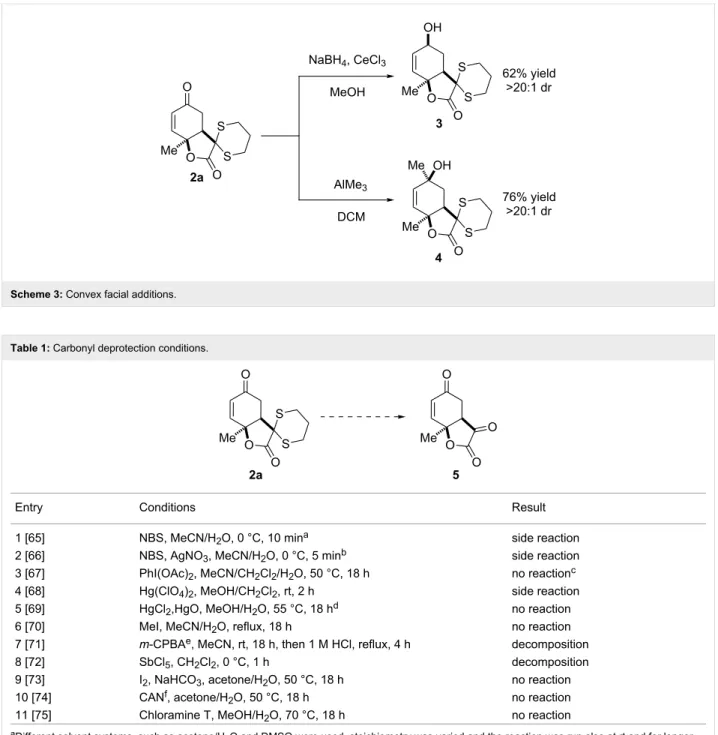
We next sought to establish the glyoxylate anion equivalency of
the dithiane substructure in our system. In order to reveal the
masked carbonyl functionality, we rigorously applied reported
dithiane deprotection conditions to
2a
(Table 1). Despite
exten-sive investigations, none of our efforts were fruitful, resulting in
either no conversion, side reactions [64], or decomposition. We
rationalized these disappointing results considering: 1) the
crowded steric environment surrounding the dithiane moiety on
the concave face of the bicycle, 2) the sensitive nature of this
class of compounds, which stems from the highly reactive
func-tional groups present, and 3) the strained character of the
five-membered
α
-ketolactone (
5
) that would result from
deprotec-tion.
We attempted to synthesize
5
via an alternative route using
Cu(II)-catalyzed aerobic oxidative deacylation [76] of the
β
-keto ester
6
(Scheme 4) [77]. The fact that this reaction also
leads to decomposition of the starting material is cause for
general concern about the feasibility of easily reaching the
target substructure. In order to minimize the observed side
reac-tions, we sought to apply the deprotection conditions to allylic
alcohol
3
. However, both the use of NBS and HgCl
2/HgO were
unsuccessful.
at-Scheme 3: Convex facial additions.
Table 1: Carbonyl deprotection conditions.
Entry Conditions Result
1 [65] NBS, MeCN/H2O, 0 °C, 10 mina side reaction 2 [66] NBS, AgNO3, MeCN/H2O, 0 °C, 5 minb side reaction 3 [67] PhI(OAc)2, MeCN/CH2Cl2/H2O, 50 °C, 18 h no reactionc
4 [68] Hg(ClO4)2, MeOH/CH2Cl2, rt, 2 h side reaction 5 [69] HgCl2,HgO, MeOH/H2O, 55 °C, 18 hd no reaction
6 [70] MeI, MeCN/H2O, reflux, 18 h no reaction
7 [71] m-CPBAe, MeCN, rt, 18 h, then 1 M HCl, reflux, 4 h decomposition 8 [72] SbCl5, CH2Cl2, 0 °C, 1 h decomposition 9 [73] I2, NaHCO3, acetone/H2O, 50 °C, 18 h no reaction 10 [74] CANf, acetone/H2O, 50 °C, 18 h no reaction 11 [75] Chloramine T, MeOH/H2O, 70 °C, 18 h no reaction
aDifferent solvent systems, such as acetone/H2O and DMSO were used, stoichiometry was varied and the reaction was run also at rt and for longer times (4 and 18 h) but in none of the cases was the desired product obtained. bThe reaction was also run at rt for 18 h, but the desired product was not obtained. cDecomposition products were also observed. dThe MeCN/H2O solvent system was also used and the reaction was also run at rt and reflux, but in none of the cases was the desired product obtained. em-CPBA= meta-chloroperbenzoic acid. fCAN = ceric ammonium nitrate.
mosphere. Under those conditions, though the dithiane function
was removed, degradation occurred.
Conclusion
In conclusion, we have developed a desymmetrizing
intramo-lecular conjugate addition of a tethered dithiane moiety to
para
-cresol-derived cyclohexadienones. The substrates are easily
accessible from cheap starting materials and the reaction
provides functionalized bicyclic lactones as a single
diastereo-mer. The products of the reaction were able to undergo
dia-stereoselective convex-facial additions. The carbonyl
deprotec-tion was unsuccessful and we hope that our efforts can serve as
a cautionary tale for future synthetic planning involving related
structures.
Supporting Information
Supporting Information File 1
Experimental procedures, characterization data and copies
of
1H and
13C NMR spectra for final compounds.
[http://www.beilstein-journals.org/bjoc/content/
supplementary/1860-5397-13-75-S1.pdf]
Supporting Information File 2
Crystallographic data.
[http://www.beilstein-journals.org/bjoc/content/
supplementary/1860-5397-13-75-S2.cif]
Acknowledgements
The project described was supported by Award R35 GM118055
from the National Institute of General Medical Sciences. X-ray
crystallography was performed by Dr. Peter White.
References
1. Poss, C. S.; Schreiber, S. L. Acc. Chem. Res.1994,27, 9–17. doi:10.1021/ar00037a002
2. Magnuson, S. R. Tetrahedron1995,51, 2167–2213. doi:10.1016/0040-4020(94)01070-G
3. García-Urdiales, E.; Alfonso, I.; Gotor, V. Chem. Rev.2005,105,
313–354. doi:10.1021/cr040640a
4. Wang, M.; Feng, M.; Tang, B.; Jiang, X. Tetrahedron Lett.2014,55,
7147–7155. doi:10.1016/j.tetlet.2014.10.152 5. Borissov, A.; Davies, T. Q.; Ellis, S. R.; Fleming, T. A.;
Richardson, M. S. W.; Dixon, D. J. Chem. Soc. Rev.2016,45,
5474–5540. doi:10.1039/C5CS00015G
6. Zeng, X.-P.; Cao, Z.-Y.; Wang, Y.-H.; Zhou, F.; Zhou, J. Chem. Rev.
2016,116, 7330–7396. doi:10.1021/acs.chemrev.6b00094 7. Felpin, F.-X. Tetrahedron Lett.2007,48, 409–412.
doi:10.1016/j.tetlet.2006.11.073 8. McKillop, A.; McLaren, L.; Taylor, R. J. K.
J. Chem. Soc., Perkin Trans. 11994, 2047–2048. doi:10.1039/P19940002047
9. Jepsen, T. H.; Jensen, A. A.; Lund, M. H.; Glibstrup, E.; Kristensen, J. L. ACS Med. Chem. Lett.2014,5, 766–770. doi:10.1021/ml500094c
10. Canesi, S.; Bouchu, D.; Ciufolini, M. A. Org. Lett.2005,7, 175–177. doi:10.1021/ol048094v
11. Brown, P. D.; Willis, A. C.; Sherburn, M. S.; Lawrence, A. L. Org. Lett.
2012,14, 4537–4539. doi:10.1021/ol302042u
12. Vo, N. T.; Pace, R. D. M.; O’Hara, F.; Gaunt, M. J. J. Am. Chem. Soc.
2008,130, 404–405. doi:10.1021/ja077457u
13. Corbett, M. T.; Johnson, J. S. Chem. Sci.2013,4, 2828–2832. doi:10.1039/C3SC51022K
14. Gu, Q.; You, S.-L. Chem. Sci.2011,2, 1519–1522. doi:10.1039/C1SC00083G
15. Gu, Q.; You, S.-L. Org. Lett.2011,13, 5192–5195. doi:10.1021/ol202073p
16. Takizawa, S.; Nguyen, T. M.-N.; Grossman, A.; Enders, D.; Sasai, H.
Angew. Chem., Int. Ed.2012,51, 5423–5426. doi:10.1002/anie.201201542
17. He, Z.-T.; Tian, B.; Fukui, Y.; Tong, X.; Tian, P.; Lin, G.-Q.
Angew. Chem., Int. Ed.2013,52, 5314–5318. doi:10.1002/anie.201300137
18. Keilitz, J.; Newman, S. G.; Lautens, M. Org. Lett.2013,15, 1148–1151. doi:10.1021/ol400363f
19. Yu, Z.; Qi, X.; Li, Y.; Liu, S.; Lan, Y. Org. Chem. Front.2016,3,
209–216. doi:10.1039/C5QO00334B
20. Rubush, D. M.; Morges, M. A.; Rose, B. J.; Thamm, D. H.; Rovis, T.
J. Am. Chem. Soc.2012,134, 13554–13557. doi:10.1021/ja3052427 21. Liu, Q.; Rovis, T. Org. Process Res. Dev.2007,11, 598–604.
doi:10.1021/op600278f
22. Jia, M.-Q.; Liu, C.; You, S.-L. J. Org. Chem.2012,77, 10996–11001. doi:10.1021/jo3022555
23. Han, Y.; Breitler, S.; Zheng, S.-L.; Corey, E. J. Org. Lett.2016,18,
6172–6175. doi:10.1021/acs.orglett.6b03186
24. Eliel, E. L.; Hartmann, A. A. J. Org. Chem.1972,37, 505–506. doi:10.1021/jo00968a043
25. Takahashi, T.; Okano, T.; Harada, T.; Imamura, K.; Yamada, H. Synlett
1994, 121–122. doi:10.1055/s-1994-22762
26. Takahashi, T.; Tsukamoto, H.; Kurosaki, M.; Yamada, H. Synlett1997,
1065–1066. doi:10.1055/s-1997-1549
27. Enders, D.; Bonten, M. H.; Raabe, G. Synlett2007, 885–888. doi:10.1055/s-2007-970787
28. Enders, D.; Bonten, M. H.; Raabe, G. Angew. Chem., Int. Ed.2007,46,
2314–2316. doi:10.1002/anie.200604802
29. Liu, Q.; Perreault, S.; Rovis, T. J. Am. Chem. Soc.2008,130,
14066–14067. doi:10.1021/ja805680z
30. Kondoh, A.; Oishi, M.; Takeda, T.; Terada, M. Angew. Chem., Int. Ed.
2015,54, 15836–15839. doi:10.1002/anie.201508178
31. Massolo, E.; Benaglia, M.; Genoni, A.; Annunziata, R.; Celentano, G.; Gaggero, N. Org. Biomol. Chem.2015,13, 5591–5596.
doi:10.1039/C5OB00492F
A significant increase in the dithiane carboxylate acidity is observed when the substrate is derivatized to an activated thioester. 32. Massolo, E.; Brenna, D.; Cozzi, F.; Raimondi, L.; Gaggero, N.;
Benaglia, M. Synlett2016,27, 2716–2720. doi:10.1055/s-0036-1588306
33. Under the same reaction conditions, we observed that triethylamine was unable to promote the transformation and tetramethylguanidine provided only trace amounts of desired product after 13 h. 34. Núñez, M. G.; Farley, A. J. M.; Dixon, D. J. J. Am. Chem. Soc.2013,
35. Goldys, A. M.; Dixon, D. J. Macromolecules2014,47, 1277–1284. doi:10.1021/ma402258y
36. Farley, A. J. M.; Sandford, C.; Dixon, D. J. J. Am. Chem. Soc.2015,
137, 15992–15995. doi:10.1021/jacs.5b10226
37. Robertson, G. P.; Farley, A. J. M.; Dixon, D. J. Synlett2016,27, 21–24. doi:10.1055/s-0035-1560530
38. Horwitz, M. A.; Zavesky, B. P.; Martinez-Alvarado, J. I.; Johnson, J. S.
Org. Lett.2016,18, 36–39. doi:10.1021/acs.orglett.5b03127 39. Uraguchi, D.; Ueki, Y.; Ooi, T. J. Am. Chem. Soc.2008,130,
14088–14089. doi:10.1021/ja806311e
40. Uraguchi, D.; Ito, T.; Ooi, T. J. Am. Chem. Soc.2009,131, 3836–3837. doi:10.1021/ja810043d
41. Uraguchi, D.; Ueki, Y.; Ooi, T. Science2009,326, 120–123. doi:10.1126/science.1176758
42. Uraguchi, D.; Ito, T.; Nakamura, S.; Sakaki, S.; Ooi, T. Chem. Lett.
2009,38, 1052–1053. doi:10.1246/cl.2009.1052
43. Uraguchi, D.; Ito, T.; Nakamura, S.; Ooi, T. Chem. Sci.2010,1,
488–490. doi:10.1039/C0SC00268B
44. Uraguchi, D.; Nakamura, S.; Ooi, T. Angew. Chem., Int. Ed.2010,49,
7562–7565. doi:10.1002/anie.201004072
45. Uraguchi, D.; Ueki, Y.; Ooi, T. Angew. Chem., Int. Ed.2011,50,
3681–3683. doi:10.1002/anie.201007752
46. Uraguchi, D.; Ueki, Y.; Ooi, T. Chem. Sci.2012,3, 842–845. doi:10.1039/C1SC00678A
47. Corbett, M. T.; Uraguchi, D.; Ooi, T.; Johnson, J. S.
Angew. Chem., Int. Ed.2012,51, 4685–4689. doi:10.1002/anie.201200559
48. Uraguchi, D.; Yoshioka, K.; Ueki, Y.; Ooi, T. J. Am. Chem. Soc.2012,
134, 19370–19373. doi:10.1021/ja310209g
49. Uraguchi, D.; Ueki, Y.; Sugiyama, A.; Ooi, T. Chem. Sci.2013,4,
1308–1311. doi:10.1039/C2SC22027J
50. Uraguchi, D.; Tsutsumi, R.; Ooi, T. J. Am. Chem. Soc.2013,135,
8161–8164. doi:10.1021/ja403491j
51. Uraguchi, D.; Tsutsumi, R.; Ooi, T. Tetrahedron2014,70, 1691–1701. doi:10.1016/j.tet.2013.12.086
52. Tsutsumi, R.; Kim, S.; Uraguchi, D.; Ooi, T. Synthesis2014,46,
871–878. doi:10.1055/s-0033-1340818
53. Uraguchi, D.; Nakamura, S.; Sasaki, H.; Konakade, Y.; Ooi, T.
Chem. Commun.2014,50, 3491–3493. doi:10.1039/C3CC49477B 54. Uraguchi, D.; Yamada, K.; Ooi, T. Angew. Chem., Int. Ed.2015,54,
9954–9957. doi:10.1002/anie.201503928
55. Horwitz, M. A.; Tanaka, N.; Yokosaka, T.; Uraguchi, D.; Johnson, J. S.; Ooi, T. Chem. Sci.2015,6, 6086–6090. doi:10.1039/C5SC02170G 56. Takeda, T.; Terada, M. J. Am. Chem. Soc.2013,135, 15306–15309.
doi:10.1021/ja408296h
57. Takeda, T.; Kondoh, A.; Terada, M. Angew. Chem., Int. Ed.2016,55,
4734–4737. doi:10.1002/anie.201601352
58. CCDC1511800 contains the supplementary crystallographic data for this paper. These data can be obtained free of charge from the Cambridge Crystallographic Centre via
http://www.ccdc.cam.ac.uk/data_request/cif.
59. Carreño, M. C.; González, M. P.; Ribagorda, M. J. Org. Chem.1996,
61, 6758–6759. doi:10.1021/jo961126a
60. Carreño, M. C.; González, M. P.; Ribagorda, M. J. Org. Chem.1998,
63, 3687–3693. doi:10.1021/jo980084i
61. Carreño, M. C.; Ribagorda, M.; Somoza, Á.; Urbano, A.
Angew. Chem., Int. Ed.2002,41, 2755–2757.
doi:10.1002/1521-3773(20020802)41:15<2755::AID-ANIE2755>3.0.CO ;2-A
62. Carreño, M. C.; Merino, E.; Ribagorda, M.; Somoza, Á.; Urbano, A.
Org. Lett.2005,7, 1419–1422. doi:10.1021/ol050287a
63. Carreño, M. C.; Merino, E.; Ribagorda, M.; Somoza, Á.; Urbano, A.
Chem. – Eur. J.2007,13, 1064–1077. doi:10.1002/chem.200601330 64. When NBS was used, the unpurified 1H NMR spectrum was suggestive
of bromination at the ketone α-position, although the product was not isolable by column chromatography. With Hg(ClO4)2, an unidentified rearomatized product was observed.
65. Corey, E. J.; Erickson, B. W. J. Org. Chem.1971,36, 3553–3560. doi:10.1021/jo00822a019
66. Burks, E. A.; Johnson, W. H., Jr.; Whitman, C. P. J. Am. Chem. Soc.
1998,120, 7665–7675. doi:10.1021/ja9808402
67. Gao, A. X.; Hamada, T.; Snyder, S. A. Angew. Chem., Int. Ed.2016,
55, 10301–10306. doi:10.1002/anie.201604744
68. Tsuboi, K.; Ichikawa, Y.; Jiang, Y.; Naganawa, A.; Isobe, M.
Tetrahedron1997,53, 5123–5142. doi:10.1016/S0040-4020(97)00230-5
69. Nicewicz, D. A.; Yates, C. M.; Johnson, J. S. Angew. Chem., Int. Ed.
2004,43, 2652–2655. doi:10.1002/anie.200353354 70. Fetizon, M.; Jurion, M. J. Chem. Soc., Chem. Commun.1972,
382–383. doi:10.1039/C39720000382
71. Smith, A. B.; Dorsey, B. D.; Visnick, M.; Maeda, T.; Malamas, M. S.
J. Am. Chem. Soc.1986,108, 3110–3112. doi:10.1021/ja00271a054 72. Kamata, M.; Otogawa, H.; Hasegawa, E. Tetrahedron Lett.1991,32,
7421–7424. doi:10.1016/0040-4039(91)80123-N 73. Nicolaou, K. C.; Bunnage, M. E.; McGarry, D. G.; Shi, S.;
Somers, P. K.; Wallace, P. A.; Chu, X.-J.; Agrios, K. A.; Gunzner, J. L.; Yang, Z. Chem. – Eur. J.1999,5, 599–617.
doi:10.1002/(SICI)1521-3765(19990201)5:2<599::AID-CHEM599>3.0. CO;2-N
74. La Claire, J. J.; Lansbury, P. T.; Zhi, B.-x.; Hoogsteen, K.
J. Org. Chem.1995,60, 4822–4833. doi:10.1021/jo00120a027 75. Emerson, D. W.; Wynberg, H. Tetrahedron Lett.1971,12, 3445–3448.
doi:10.1016/S0040-4039(01)97201-6
76. Steward, K. M.; Johnson, J. S. Org. Lett.2011,13, 2426–2429. doi:10.1021/ol200649u
77. Tello-Aburto, R.; Kalstabakken, K. A.; Volp, K. A.; Harned, A. M.
Org. Biomol. Chem.2011,9, 7849–7859. doi:10.1039/C1OB06125A