Roman Freedwomen: Their Occupations and Identity
Lindsay M. Holman
A thesis submitted to the faculty at the University of North Carolina at Chapel Hill in partial fulfillment to the requirements for the degree of Master of Arts in the Department of History.
Chapel Hill 2015
Approved By:
Richard Talbert
Fred Naiden
iii ABSTRACT
Lindsay M. Holman: Roman Freedwomen: Their Occupations and Identity (Under the direction of Richard Talbert)
This study examines seventy-one occupational epitaphs of urban freedwomen from the western half of the Roman Empire between the first century B.C. and the third century A.D. An evaluation of the occupational epitaphs of freedwomen preserved in the Corpus Inscriptionum Latinarum (CIL) reveals the breadth of jobs freedwomen held in the urban Roman economy. The choice of commemorating these women's occupations also suggests that pride was taken in their work. A study of the epitaphs in which freedwomen were commemorated with men (just over half of the corpus) suggests that it is the occupation of the freedwomen rather than any social relationship that carries force which conveys their identity. These occupational epitaphs
iv
TABLE OF CONTENTS
LIST OF TABLES...v
LIST OF FIGURES...vi
LIST OF ABBREVIATIONS...vii
CHAPTER 1: INTRODUCTION...1
CHAPTER 2: BACKGROUND...5
CHAPTER 3: FREEDWOMEN AND THEIR OCCUPATIONAL EPITAPHS...8
CHAPTER 4: COMMEMORATION OF MEN AND FREEDWOMEN...22
CHAPTER 5: CONCLUSION...24
v
LIST OF TABLES
vi
LIST OF FIGURES
Figure 1. Epitaph of the sacrinatrix Latinia (Table 1.57, CIL II 07.339)...38 Figure 2. Epitaph of the ornatrix Pollia Urbana (Table 1.46, CIL VI.37811)...38 Figure 3. Epitaph of the ornatrices Nostia Daphne and Nostia Cleopatra
vii
LIST OF ABBREVIATIONS
AE L'Année épigraphique
CIL Corpus Inscriptionum Latinarum HD Heidelberg Epigraphic Database
1
Introduction
This study is primarily concerned with urban freedwomen in the Latin West, their work, and the motivations behind commemorating it upon their epitaphs as a way to construct their identity. From this examination of freedwomen's epitaphs, it is evident that one avenue of commemorating freedwomen was to memorialize their economic contributions as a means of emphasizing their productive efforts in Roman society and deemphasizing their former slave status. The corpus analyzed consists of seventy-one epitaphs in which the economic
contributions of freedwomen can be reconstructed. A majority of these inscriptions are occupational epitaphs from the Corpus Inscriptionum Latinarum (CIL), in which the
occupational title of the deceased is emphasized.1 The epitaphs of imperial freedwomen are a significant portion of the corpus.2 The identity of those who erect the monuments is often unclear. Presumably, the family members or peers of freedwomen commemorated their work upon these epitaphs. In some instances, the freedwoman herself erected the monument for another person and commemorated her work upon the epitaph. The epitaphs that can be dated range from the 1st century B.C. to the third century A.D. The heart of the study focuses on freedwomen who are commemorated for their work as manufacturers or vendors of goods in the urban market. Personal attendants and educated professionals will also be considered. To show that freedwomen, like freedmen, are commemorated for their work as a means of constructing
1
Beginning with the list of women's occupations generated by Susan Treggiari, see her article "Jobs for Women," American Journal of Ancient History 1: 76-104 (1976), I searched the CIL volumes for instances in which freedwomen were commemorated in these occupations.
2
2
their identity, epitaphs that commemorate the work of both freedmen and freedwomen will be considered; there are thirty-nine such epitaphs in this corpus.
The Roman literary tradition is written by elites and is thus disparaging to non-elites, particularly freedmen and freedwomen. Freedmen are portrayed as avaricious and infringing upon the domain of Roman elite males, while freedwomen in Roman satires are often described as meretrices, or prostitutes. Scholars have therefore utilized occupational epitaphs as a tool for understanding the ways in which non-elites themselves constructed their identity. Yet there is a division in the approach to the utility of occupational epitaphs. Some scholars utilize them as a means of investigating the lower classes of Roman society.3 In particular, Sandra Joshel analyzed all occupational epitaphs from the city of Rome preserved in the CIL VI. From her study she concluded that due to the way in which freedpeople were marginalized in Roman society, "occupational title has a particular force. It shifts attention from birth and honor to productive activities and relations. From this perspective the freedman with occupational title no longer appears at the edges of Roman Society."4 Even so, freedwomen are not treated separately in Joshel's discussion of occupational epitaphs of freedpeople. She focuses only on the legal status and the identity conferred through the work attested upon inscriptions.
From the 1940s, scholars have studied the occupational epitaphs of women to evaluate the scope of work attributed to them in Rome.5 During the 1970s and 1980s, beginning with
3
See Pertti Huttunen, The Social Strata in the Imperial City of Rome: A Quantitative Study of the Social
Representation in the Epitaphs Published in the Corpus Inscriptionum Latinarum Volumen VI (1974), and Sandra Joshel, Work, Identity, and Legal Status at Rome: A Study of Occupational Inscriptions (1992).
4
Joshel 1992: 60. 5
The first studies of women's work attested in occupational epitaphs concerned how these epitaphs reinforced the concept of a gendered division of labor within the Roman world. See Jérôme Carcopino, La vie quotidienne à Rome à l’apogée de l’empire (1940), 180-181, and Joёl Le Gall, "Métiers des femmes au Corpus Inscriptionum
3
Susan Treggiari, scholars wishing to look beyond the city of Rome studied women's
occupational epitaphs from the Latin West.6 Treggiari's first article investigating occupational epitaphs was an attempt to expand LeGall's list of occupational titles attributed to women. Her second study focused solely on the work of lower class women in the Latin West. Here she discussed the responsibilities of each profession (so far as could be gleaned from the evidence), as well as the proportion of occupations available to men compared to women, and she drew attention to the prevalence of the women's names appearing with names of men on the epitaphs. She concluded that lower class women typically held a narrower range of occupations, mostly jobs in the "service" sector of food and clothing production, where we might expect to find them.7 However, no study has examined both issues of gender and class as they pertain to the economic contributions of a lower class group and the impetus for commemorating its work. As recently as 2012, Marc Kleijwegt asserted that a study of freedwomen's "economic activities" is a desideratum for the field.8 He himself only provides a sample of freedwomen's work by examining a few exceptional inscriptions; thus, his study is not comprehensive.
Most recently, Matthew Perry has examined the ways in which freedwomen would transition from their former status as slaves to freedpersons in Roman society. By examining epitaphs, some of which are occupational, he concludes that the former patron is the galvanizing
6
See Treggiari 1976; ead., "Lower Class Women in the Roman Economy," Florilegium 1: 65-86 (1979); Natalie Kampen, Image and Status: Roman Working Women in Ostia (1981); Rosmarie Günther,
Frauenarbeit-FrauenBindung: Untersuchungen zu unfreien und freigelassenen Frauen in den stadtrömischen Inschriften (1987); and Suzanne Dixon, Reading Roman Women (2001).
7
Treggiari 1979: 78-79. 8
4
relationship by which a freedwoman can shed her former "slavish" tinge.9 Little attention is paid here, however, to freedwomen's economic contributions except to define what legal obligations a freedwoman had to her former master after manumission in the form of obsequium (general respect paid to the former master) and operae (labor and services owed to the former master).10 In his evaluation of epigraphic evidence of the freedwoman-patron relationship, Perry does note instances where a freedwoman initiates the commemoration of her patron upon his or her death. However, in focusing upon the social obligations a freedwoman had to her patron this analysis of freedwomen commissioning epitaphs only demonstrates that there were wealthy freedwomen with enough capital to commemorate their patrons. Perry rarely considers occupational epitaphs, focusing instead on more descriptive ones. His treatment reinforces the hierarchical social
paradigm of patron and freed slave, and thereby ignores the ways in which freedwomen and their family members or peers chose to memorialize these women and their contributions.
Additionally, Perry views the sexual availability of female slaves as necessitating reliance upon their patrons to effect their transition from their "slavish" former status to the status of a
respectable Roman citizen.
The analysis of freedwomen's occupational epitaphs, in light of the occupational epitaphs of men, is essential when attempting to determine what relationships were central in the
construction of freedwomen's post-manumission identities. Perry's assertions are rooted in a corpus that reinforces the hierarchy of the patron-freedwoman paradigm. My analysis of these occupational epitaphs illustrates that relatives and peers of freedwomen, or even freedwomen themselves before their deaths, commemorated the productive efforts of the deceased upon their epitaphs to mitigate the stigma of their servile origins.
9
See Matthew Perry, Gender, Manumission, and the Roman Freedwoman (2014), 158. 10
5
Background
Roman epitaphs are a medium by which individuals could convey the aspects of character which they thought would contribute to the fama of the individual being
commemorated. The epitaph could be erected by the deceased themselves before they died, a family member, or a member of the household, such as a freedperson. Yet in this corpus the commemorator is not always noted upon the epitaph. Among those epitaphs in which the commemorator specifically mentions himself or herself, there are examples of a relative, a co-worker, a patron, and sometimes a freedwoman herself erecting the monument. The information included in these epitaphs is obviously at the discretion of the commemorator. Thus, while the language of the inscriptions can be formulaic, there is no standardization in what is
commemorated. Typically, but not always, an epitaph includes the name of the deceased and the person who erected the monument. Sometimes the age of the deceased at death is inscribed too. Romans often include in epitaphs such elements as formulaic descriptions of a person's character that highlight the ways they upheld traditional Roman morals, or a description of an individual's accomplishments, or mention of a person's occupation.
6
freedwomen represent approximately 29% of all those who are commemorated for their occupations upon their epitaphs.11 Thus, despite the sparse information preserved in some instances, these epitaphs remain a vital source of evidence for analyzing the ways in which freedpersons and their families elected to commemorate them.
While Perry is right to discuss 'libertination'-- the process by which freedpersons identify themselves as freedpersons of their patron -- among freedmen and freedwomen, this is the most obvious way in which freedpersons would commemorate their status.12 But the tendency to commemorate their status as freedpersons can hardly be interpreted as a mechanism for acknowledging their patron. Freedmen and freedwomen would not have the option to inscribe filiation-- the process by which a child acknowledges their parent -- upon their epitaph. For the status of a freedperson to be acknowledged, the patron of the freedperson would be named. This process of filiation was reflective of the practices of freeborn citizens. Therefore, ‘libertination’ replaced filiation for freedpersons. Freedpersons' manumissions from their patrons would signal that through their productive efforts their patron elected to free them as a reward for their service. Thus, if a freedperson wanted to commemorate their status as a freedperson to signify their change in status, the method for doing this was to announce that they were a libertus or liberta of their patron. Despite the characterizations of freedmen and freedwomen as avaricious, slothful, and sexually available, it would appear that those who attested their status
epigraphically did so to emphasize pride in their status. They chose to commemorate aspects of their identity that upheld Roman morals in order to combat prevailing sentiments among the
11
Joshel 1992: 46. 12
7
8
Freedwomen and their Occupational Epitaphs
The narrow occupational range preserved within the literary record differs starkly from what is recorded in the epigraphic and legal traditions. In the epigraphic record freedwomen are commemorated as sellers of particular goods, manufacturers of jewelry and clothing, as well as educated professionals. Several jurists' rulings included in Justinian's Digest show that, while freedwomen still maintained an economic obligation to their patrons in the form of obsequium and operae, they were allowed to continue the trade in which they were trained as slaves even against their former masters' wishes.13 From studies of Latin epigraphy it appears that in fact former slaves often continued in the occupation in which they were trained or the profession which their former master pursued.14
Often freedwomen are commemorated with men in their epitaphs. Sometimes the relationship freedwomen had to the men with whom they are commemorated is unclear.
Frequently, these men are freedmen who perform the same occupation as the freedwomen. It is likely that some were the husbands of the freedwomen, but that relationship is rarely emphasized in the occupational epitaphs.
The occupations attested for freedwomen are varied. Most have occupations traditionally held by Roman women, such as needle-working, clothing production, and washing clothes. Freedwomen are also mentioned in both the trade in and manufacture of luxury and bulk commodities. Some working freedwomen were successful enough to dedicate epitaphs to their
13
Dig. 37.15.11 (Papinian) and 38.1.26 (Alfenus Varus). 14
9
families and, in some instances, to their own freedmen and freedwomen. For those epitaphs in which the commemorators do not acknowledge themselves, I assume that they were family members or fellow freedpersons. There are several examples in which patrons commemorated their freedwomen and their occupations. No matter who commemorated them, what is common in their occupational epitaphs is that their productive efforts and subsequent economic affluence are the focal point to signal their change in legal and social status.
**********
As might be expected, freedwomen held occupations as attendants of other women and of children. Such positions most frequently attested are ornatrices (hairdressers) and nutrices
(nurses), with a high percentage of these women being in the employment of the imperial family (approximately 36%).15
Four of the ten freedwomen ornatrices were freedwomen of Livia, wife of Augustus and mother of Tiberius (39-41, 43). 16 One non-imperial ornatrix worked outside of Rome (38). The ornatrix Clodia Prisca, from Brixia, is commemorated by a man, Ascula Publicus.17 His
relationship to Clodia Prisca is unclear. The epitaph merely commemorates her and her occupation as an ornatrix. The other epitaphs of non-imperial ornatrices commemorate both working freedwomen and freedmen, yet they had different patrons and they are examples of women working as hairdressers in an urban setting. Pollia Urbana erects a monument in which she puts up two ollae, one for herself and one for Marcus Calidius Apolonius.18 Both worked as
15
Figures based on the eight imperial inscriptions out of the twenty-two epitaphs which record these occupations. 16
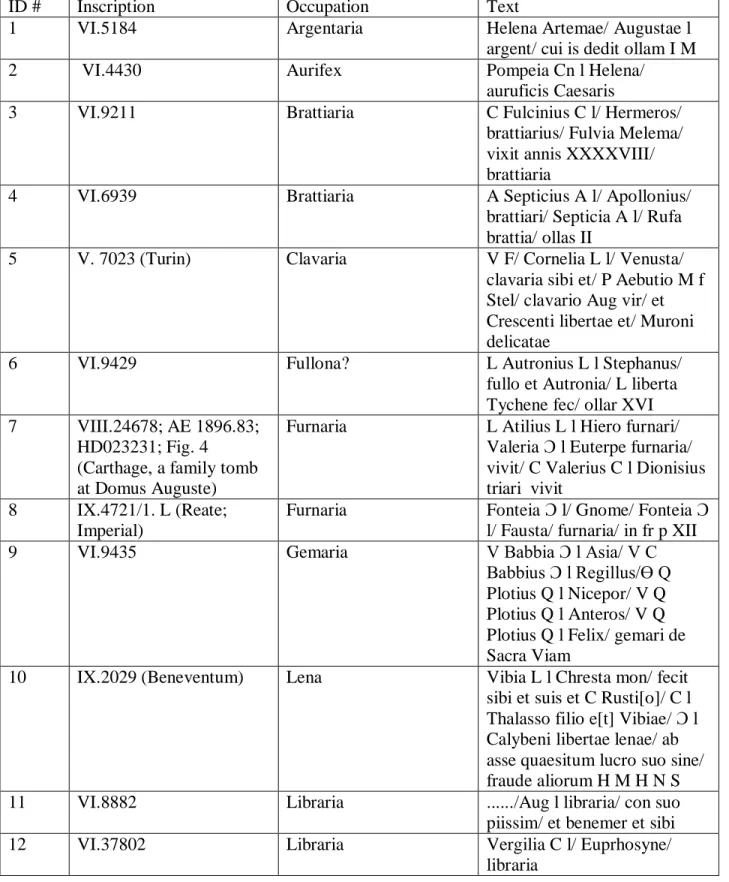
See Table 1 for transcriptions of the epitaphs commemorating freedwomen's work. All epitaphs are referred to by the identification number in this Table.
17
Ascula Publicus posuit.
18
10
hairdressers in the Aemilian region of Rome (46). The indication of a location might suggest that they ran an establishment together.19 Nostia Daphne is commemorated with a freedman aurifex (goldsmith), Marcus Nerius Quadratus, of a different patron. She appears to be a commercial hairdresser. Both she and Quadratus are commemorated for their work on the Vicus Longus (47). This epitaph represents a rare example in which a freedwoman in one occupation is
commemorated with a freedman in another. Linked with the epitaphs of Nostia Daphne and Marcus Nerius Quadratus is the epitaph of Nostia Cleopatra, a freedwoman of a Daphne (Nostia Daphne?), an ornatrix who also works on the Vicus Longus (45).20 If Nostia Cleopatra is the freedwoman of Nostia Daphne, we may imagine a degree of affluence achieved by Nostia Daphne after she was freed to run an urban barber shop; subsequently she could own and then free her own slave. It is evident therefore that freedwomen ornatrices worked not only in domestic settings (particularly among the imperial household), but also in urban shops.
Of the twelve freedwomen nutrices, only three served children of the imperial family. Prima was a freedwoman of the emperor and his wife, and the nurse of Julia, daughter of Germanicus (21). Philaenis served Livia, and Iulia Iucunda worked for Drusus, the son of
Germanicus, and for his sister, Drusilla (30, 22). Among non-imperial nutrices, four freedwomen are commemorated alone or with other freedwomen (24, 27, 29, 31). In their epitaphs, it is clear that the work these women did is the emphasis of the inscription. However, in the remaining five epitaphs which commemorate non-imperial nutrices, the relationships among those mentioned are explicit. Publiana Elpidia erected a monument for her "sweetest and most loved patron"
19
Treggiari 1979: 75. 20
11
(20).21 Arruntius Dicaeus, freedman of Lucius, is described as the conlacteus or "foster brother" of the nutrix Arruntia Cleopatra, freedwoman of Lucius (23). However, no other details about Arruntius Dicaeus are noted upon the epitaph. It is only the work of Arruntia Cleopatra which is emphasized, and then their relationship is inscribed in the last line. Flavius Gamus’ grandfather, father and nutrix, Flavia Nais, erected a monument for him (28). The closeness of the
relationship between nurse and child most likely facilitated Flavia Nais' participation in the dedication of Flavius Gamus' monument. Her occupation is the only one attested here, for it defines the relationship she had to Flavius Gamus. Marcus Antonius Tyrannus erected an epitaph for himself, Antonia Arete his contubernalis (associate), and Marcus Antonius Florus, the child they nursed (26). The intimacy of the relationship between a nurse and child would be an impetus for explicit commemoration upon an epitaph, more so than in the case of other personal attendants, like ornatrices. The epitaphs in which the relationship between those commemorated is explicitly defined only serve to reinforce the work of the freedwomen, because they are linked to the individuals who are also commemorated through their work.
**********
Freedwomen worked not only as personal attendants, but also as skilled professionals. Eleven epitaphs of freedwomen attesting their work in the medical field have been identified. All worked in Italy, with nine of the eleven epitaphs recovered in Rome. These freedwomen appear to be of the highest status among working freedpersons, due to the nature of their occupation.
Freedwomen are attested as medicae, or general medical practitioners. Among the five inscriptions recording medicae, no imperial freedwomen are found. Two freedwomen medicae, Minucia Asste and Venuleia Sosis, are commemorated for their work as medicae independently, with only their names, their status as freedwomen, and their occupations noted upon their
21
12
epitaphs (15, 17). The remaining three inscriptions mention both men and women, yet it is only the work of the freedwomen which is mentioned. In all of the cases, the men, and in one instance a man and a woman, commemorate freedwomen medicae. In one of these inscriptions, Quintus Iulius Atimetus erects a monument for his wife and freedwoman Iulia Sabina, although he only emphasizes her as his wife and as a medica (18).He provides no further details about himself and does not specifically call himself her patron. Another inscription, also erected by a freeborn man, commemorates himself and his contubernalis (14). Thus, it is the working relationship between the partners that is emphasized. No other details about their relationship are provided. Finally, Mussius Antiochus and Mussia Dionysia commemorate the freedwomen medicae Terentia Nice and Terentia Prima (16). While these three examples necessarily would emphasize the work of the freedwomen rather than the commemorators, the language used to define the relationships between the commemorators and the commemorated serves to emphasize the productive efforts of the medicae commemorated.
Freedwomen are also commemorated as obstetrices (midwives). Female obstetricians would have been preferred by Roman women. While the duties of obstetrices are much narrower than those of medicae, this does not mean that obstetrices were of a lower status or less valued than medicae.22 Three imperial freedwomen are commemorated for their work as obstetrices (32, 35, 36). Two epitaphs commemorate freedwomen's work as obstetrices on epitaphs with
freedmen whose work is not mentioned. The inscription for one commemorates a freedman and a freedwoman of the same patron; thus it is likely that they are married, but this is not stated on their epitaph (34). The other inscription commemorates Quintus Sallustius Dioges, freedman of Dioges, and Sallustia Athenais, freedwoman of Artemeodorus (33). The relationship between the
22
13
two is unclear. Nevertheless, again only the occupation of the women is attested upon these epitaphs, suggesting the high standing of obstetrices in Roman society. The high status of this occupation perhaps reflected well on male relatives, and thereby dissuaded the commemorator from recording the work of the freedman, electing instead to focus on the work of the obstetrix. The remaining freedwoman obstetrix is commemorated alone (37). The exclusion of any
commemoration of the men's occupations among these epitaphs of freedwomen obstetrices could suggest that this skill gained recognition by elites, motivating the women to take pride in their work and their relations to commemorate it epigraphically.
**********
Skilled professional freedwomen are also commemorated as educators and as educated assistants. All five of the inscriptions were found in Rome. One freedwoman of the four is a freedwoman of Augustus: a libraria (copyist) 23 (11). Sulpicia Ammia and Sulpicius Venustus, both freedpersons of Gaius, are commemorated as paedogogi by their female students, to two or more women named Sulpicia Galbilla, daughters of Gaius (49). Of the other educated
professional freedwomen commemorated, there is one libraria (12) and one paedagoga (48). Neither of these freedwomen is commemorated alongside men, suggesting that if women were able to obtain an education they could work as instructors of young women and as copyists independently of men. The status conveyed by these educated occupations is thus apparent in how these women and their occupations are commemorated.
**********
While educated freedwomen are attested to as educators or assistants, most likely in a domestic setting, skilled freedwomen are attested in other sectors of the economy. Several
23
14
female jewelers are attested in Rome. These women fulfilled some of the delicate tasks of these crafts, including setting pearls (13). Fulvia Melema is commemorated with a freedman of Gaius. Gaius Fulcinius Hermeros is commemorated as a brattiarius (a worker of gold-leaf jewelry), while Fulvia Melema, having lived 48 years, is described as brattiaria (3). Another inscription from Rome commemorates the freedman and freedwoman of Aulus who worked as jewelers: A(ulus) Septicius A(uli) l(ibertus) Apollonius brattiari Septicia A(uli) l(iberta) Rufa brattiaria, Ollas II (4). Susan Treggiari, contrary to Joël LeGall, argues that these women are not just sellers of gold-leaf jewelry, but also craftswomen, who could perform the delicate work of jewelry production, "perhaps leaving the heavy hammering work for the men."24 The freedwoman Babbia Asia is included in a commemoration with four freedmen, all five being called gemari de sacra viam (jewelers on the Sacred Way, 14). One of the freedmen has the same patron as Babbia Asia, while the other three freedmen were manumitted by Quintus. It would seem likely that their owners had these five freedpersons trained in the craft of jeweler, and upon
manumission they began to work together along the Sacra Via. Moreover, since these
freedwomen were themselves commemorated for their work alongside freedmen performing the same job, female handicraft workers were no doubt responsible for all aspects of the profession, not just the sale of the jewelry.
In other regions of Italy, freedwomen are commemorated for their work in handicrafts. At Turin, Cornelia Venusta, a freedwoman of Lucius, erects a monument for herself and her
freeborn husband. She commemorated herself as a clavaria, or maker of nails, and
commemorated Publius Aebutius as a clavarius (5). While some scholars have thought that
24
15
Cornelia Venusta was the seller of nails and Publius Aebutius was the manufacturer,25 the equivalent occupational titles and their meaning (clavarius/a refers to the action of producing rather than the selling), would suggest that both partners produced nails.26 Not only did Cornelia Venusta perform the same work as her husband, but they seem to have prospered in their
business as Cornelia also commemorated their freedwoman, Crescenti, and their slave, Muronos. The only imperial skilled craftswoman commemorated by herself is an aurifex. Upon the
monument of Marcella, daughter of Octavia, a Pompeia Helena, freedwoman of Gnaeus, is commemorated as an aurifex of the Caesars (2). Two of six craftswomen in this corpus are commemorated by themselves in handicraft occupations that were typically considered men's work (2 and 13). Among those epitaphs in which both men and women are commemorated, the use of the feminine form of the occupation used to identify their male counterparts would suggest that these freedwomen performed the same work, rather than being the sellers of the goods produced by freedmen.
**********
Freedwomen are also known to serve in a traditional occupation of Roman women, that of manufacturing clothing. The epigraphic record shows that freedwomen were involved in every stage of clothing production as needle-workers (sarcinatrices) who mended and perhaps
produced garments, and as women who actually made the clothing (vestiariae). A freedwoman, Matia Prima, worked as a needle-worker by the Six Altars in Rome. She was commemorated by her husband Titus Thoranius Salvius, freedman of Titus: Matiae C. l(ibertae) Prime coniugi suae sarcinatr ab Sex Aris (63). This epitaph is a uniquely clear instance of an urban needle-worker.
25
LeGall (1969): 125-126. 26
16
However, the limited evidence of sarcinatrices working in the urban manufacturing centers could be due to the low reputation associated with that occupation. Working as a sarcinatrix was considered a "vulgar craft," and the peculium of a female slave or filiafamilia was noted by the jurist Gaius as liable for damages if she was a weaver or sarcinatrix.27 Nevertheless, several imperial freedwomen who worked as sarcinatrices are commemorated for this work, such as Fausta: Fausta Liviae l(iberta) sarcinatr (61). Sarcinatrices would have worked on cloth brought to them by their clients. Vestiariae, on the other hand, would have produced garments from material they purchased. One freedwoman is named among a group of five libertini
commemorated as vestiarii de Cermalo minusculo, the "smaller" Germalus region on the Palatine hill. They dedicate the monument to their freedman patron (69). While the evidence is limited, unsurprisingly there are references to freedwomen working in an urban setting to
produce clothing. Literary evidence attests to women often performing these duties for their own household, but it is expected to find freedwomen also performing these activities in an urban context.
Freedwomen are also mentioned in epitaphs with male fullones-- washers of clothes -- suggesting that some women may have been working in fullonicae. Yet, no inscription attests that freedwomen worked as fullonae. One inscription commemorates the fullo Lucius Autronius Stephanus, freedman of Lucius; it is erected by a freedwoman of Lucius, Autronia Tychene (6). Although she is not called a fullona, their shared master and epitaph suggest that they could have become acquainted in the same occupation.28 One freedwoman, Cestilia Chreste, is
27
Dig. 15.1.27. 28
17
commemorated as a vestipica -- a woman who cares for and inspects clothes (71).29 While Cestilia Chreste most likely worked in a domestic context, it is plausible that vestipicae worked in fullonicae. An epitaph dedicated to one fullo, Amphio, also recognizes a vestipica, Euterpe and her three year old daughter, Musa.30 They are commemorated by people who identify themselves as mater and frater. In Flohr's view, because the responsibilities of vestispicae were associated with the last stages of the fulling process, Euterpe possibly could have worked alongside Amphio in the fullonica.31 So while there is no direct evidence for freedwomen working as fullonae, these epitaphs hint at the possibility of women working in fullonicae.
**********
Freedwomen are attested to have performed traditional female tasks within the urban economy as vendors or as managers of institutions. They sold both luxury and bulk commodities, and are commemorated even as managers of lower-class facilities. Critonia Philema,
freedwoman of Quintus, is commemorated as popa de insula, a proprietor of a popina (a lower-class restaurant) located in one of the apartment buildings of Rome (52). She is memorialized on an epitaph with her patron, a freedman himself, Quintus Critonius Dassus, who was a sculptor. Thus, the epitaph of Critonia Philema and Quintus Critonius Dassus is an unusual example of a freedman and freedwoman commemorated in distinct occupations. While Quintus Critonius Dassus became affluent enough to own his own slave after his own manumission, his status as patron is not emphasized, but the work of both himself and Critonia Philema is central.
Moreover, despite the low status of popa, Critonia Philema is commemorated for this work first,
29
See Varro, Ling. 7.2.12: vestispica, quae vestem spiceret, id est videret vestem ac tueretur. 30
AE 1985.173: V(ivit) Casos/ o(biit) Amphio fullo ann(is) LII/ o(biit) Euterpe vestipica ann(is) XXVI/ o(biit) Musa filia eius ann(is) III/ v(ivit) Callipoleis mater/ v(ivit) Nicomedes frater/ v(ivit) Lesbius mulio.
31
18
then Quintus Critonius Dassus is commemorated for his work as a sculptor. Freedwomen are also commemorated as vendors of foodstuffs. The freedwoman of Gaius, Aurelia Nais, is called a piscatrix de horreis Galbae, a fish-seller located in the warehouses of Galba (51). And the patron and husband of Abudia Megiste remembers her as negotiatrici frumentariae et legumenaria ab Scala Mediana, a seller of fruits and vegetables from the "middle stairs" in Rome (19).
Two freedwomen are commemorated for their work as bakers. One epitaph found in Reate, Italy, commemorates two freedwomen, but only one of these women is commemorated for her work. Fonteia Fausta is called a furnaria, or baker (8). The work of the other
freedwoman, Fonteia Gnome, is not recorded, only that she had a female patron. In Carthage, three freedpersons (two still living) are commemorated: "Lucius Atilius Hiero, freedman of Lucius, a baker, Valeria Euterpe, freedwoman, a baker,lives, Gaius Valerius Dionisius,
freedman of Gaius, a triarius (soldier) lives" (7, Fig. 4).32 All three are freedpersons of different patrons, and the relationship among them is not explicitly defined. What is apparent is that Valeria Euterpe and Gaius Valerius Dionisius erected the monument for Lucius Atilius Hiero (and probably themselves), and chose only to commemorate their status as freedpersons and their work. Thus, as would be expected since women were responsible for food preparation in the home, freedwomen were involved in the trade and preparation of food within the urban economy.
**********
However, freedwomen are not only attested as vendors of foodstuffs, but also as traders of luxury goods. One freedwomen unguentaria (seller of perfumes) is attested in Puteoli (68). Freedwomen incense dealers (thurariae) are also attested in Rome. Trebonia Irena and Trebonia
32
19
Mamia are the last persons of seven listed on a monument there dedicated to thurareis et liberteis (65). These freedmen and freedwomen are commemorated by three men of the Trebonii family. Another inscription memorializes the freedman, Sextus Trebonius, and the freedwoman of Sextus, Tribonia Hilara, as turareis, an alternative spelling for thurariis (66). Freedwomen
purpurariae (sellers of purple dye) are also attested. This includes a series of freedwomen (their names are not completely preserved due to the fragmented nature of the monument) who are all freedwomen of Aulus, with the abbreviated title purpurar applying to one if not all of the freedwomen (53). In another epitaph, a freedwoman her fellow freedman erects a monument for themselves, their patron, and their fellow freedmen. In their epitaph they identify themselves as purpurariae of the Marian district of Rome (54). In four of the six inscriptions (54, 55, 65, 66) freedwomen engaged in luxury trade are commemorated with a man who is also a merchant of luxury commodities.
**********
20
(10).33 Since freedpersons upon their manumission often continued to hold the occupation in which they were trained while they worked as slaves, this suggestion is plausible. Vibia Chresta does not say how she amassed her wealth, she merely proclaims that she gained her estate and erected the tombstone entirely from her own assets "without defrauding anyone" (suo sine fraude aliorum). Yet, Vibia Calybe and Vibia Chresta do not identify themselves as meretrices. Instead, these women chose to emphasize the wealth which they accumulated and the work they did upon their manumission.
**********
Like meretrices, actresses and performers held very low standing in Roman society, as they were considered sexually available, and in the Roman literary tradition had a reputation for being promiscuous. This is perhaps why few freedwomen would commemorate their work in professions where they were performers. In an epitaph erected in Rome and dated to the first century B.C., a father commemorates his young daughter who was a dancer in plays:
Eucharis, freedwoman of Licinia, an unmarried girl who was educated and learned in every skill. She lived 14 years. Ah, as you look with wandering eye at the house of death, stay your foot and read what is inscribed here. This is what a father's love gave his
daughter, where the remains of her body lie gathered. "Just as my life with its young skills and growing years brought me fame, the sad hour of death rushed on me and forbade me to draw another breath in life. I was educated and taught as if by the Muses' hands. I adorned the nobility's festivals with my dancing, and first appeared before the common people in a Greek play. But now here in this tomb my enemies the Fates have placed my body's ashes. The patrons of learning -- devotion, passion, praise, honor -- are silenced by my burnt corpse and by my death. His child, I left lamentation to my father, though born after him, I preceded him in the day of my death. Now I observe my fourteenth birthday here among the shadows in Death's ageless home. I beg you when you leave, ask that the earth lie light upon me" (50).34
33
See Robert Knapp, Invisible Romans (2011), 243.
34
21
The father of Eucharis mentions her skills, fame, and work, before emphasizing the loss of his daughter. In this way he can articulate the severity of her loss for society, first through relating how she performed in public festivals, particularly noting that these celebrations were for the nobility; then he relates his personal loss, thus attempting to elevate the status of his late daughter. No doubt the epitaphs of those women who held positions in society perceived of as denoting sexual availability would instead have monuments that focused on the non-sexual aspects of their work.
**********
Altogether, freedwomen are commemorated in a variety of occupations in their epitaphs. They held not only traditionally gendered female jobs as producers of clothing and sellers of foodstuffs, but they were also manufacturers of luxury goods in the urban economy as well as educated professionals. In over half of the inscriptions, these freedwomen are commemorated for their work by themselves or with other freedwomen. It seems that, as in the case of freedmen, economic productivity was a point of pride among those who erected monuments for working freedwomen, and that this productivity was an avenue to minimize the freedwomen's
22
Commemoration of Men and Freedwomen
Of the seventy-one inscriptions commemorating the work of freedwomen, thirty-eight mention men alongside freedwomen.35 In over half of the inscriptions in which both men and freedwomen are commemorated, the exact relationship between the freedwomen and the men with whom they are commemorated is uncertain. In those epitaphs for which the relationship between freedwomen and men is explicitly defined, in only three cases is the freedwoman commemorated by her patron (18, 33, 51); in two epitaphs the patron attests that he married the woman whom he freed (18, 33); and three inscriptions commemorate freedwomen and their husbands (5, 42, 63). There are four examples of freedwomen erecting epitaphs for themselves and their family members (5, 7, 10, 70). In three of these epitaphs the freedwomen commemorate their own freedpersons (5, 10, 70). And in one epitaph a freedwoman and her fellow freedmen erect a monument for themselves, their patron, and their conlibertus (54).
Among those epitaphs in which the relationship between freedwomen and men who are remembered is not explicit, the majority attest freedmen and freedwomen working in the same occupation (3-4, 6, 9, 14, 26, 45-47, 49, 59, 65, 66). In each of these cases, the feminine form of the occupation attested for freedmen is attested for the freedwomen, suggesting that they
performed the same functions. The language used in the epitaphs, while ambiguous, does not allude to a division of labor between "feminine" and "masculine" tasks. The formula for commemorating the work is the same for both the freedmen and freedwomen. In some cases, men and women held different occupations (43, 52). Even so, both were freedpersons, which
35
23
suggests that they were married and held different occupations. Rather than representing their relationship to the other person, both freedwoman and freedman emphasize their occupations. Moreover, in several instances in which a freedwoman's work is commemorated, the man with whom she is commemorated has no occupation attested (23, 33, 34, 38). Two of these women are obstetrices and one is an imperial nutrix, and the men associated with them are also former slaves. Therefore, the prestige of these occupations may have encouraged the commemorators of the monuments to emphasize the occupations of these freedwomen for the reputation it brought to those affiliated with her.
In seventeen cases out of thirty-nine occupational epitaphs, relationships between men and freedwomen are explicitly recorded (5, 10, 14, 16, 28, 19, 23, 24, 26, 28, 42, 43, 52, 54, 60, 63, 68). The fact that the relationships of the deceased are not always recorded may be a product of the formulaic nature of occupational epitaphs. Nevertheless, this style of epitaph alludes to the purpose of commemorating work: productive efforts more than relationships convey elevated status after manumission for freedmen and freedwomen. Moreover, freedwomen in these epitaphs are not singled out as performing different duties than men in the same occupation. Additionally, the freedwoman's occupation is the sole work commemorated in a handful of epitaphs commemorating freedmen and freedwomen, suggesting that the prestige associated with these occupations was not diminished because it was a freedwoman holding the position; this work was valued so highly in society that it conveyed a higher status, thereby being worthy of sole commemoration.
24
Conclusion
The Roman literary tradition, written by elite men, is unsurprisingly disparaging towards freedpeople. For Roman elites, freedmen and freedwomen were base, due to their servile origins, and presented a threat to elite economic and political power, as some freedpeople grew rich from their work in the urban economy. Roman satirists characterize working freedwomen as
meretrices (prostitutes), a vulgar or low occupation not held by respectable Roman women. In Petronius' Satyricon, the freedman Trimalchio buys his wife Fortunata, characterized as a meretrix and ambubaia (singing girl). Trimalchio claims to have made her equal to any other person (hominem inter homines).36 In the rare instances when Roman authors note a different occupation, they merely say what it was, without further description. By contrast, an examination of the occupational epitaphs of freedwomen suggests that freedwomen, like freedmen, were commemorated for their economic efforts to alleviate the stigma of their former servile status.
Therefore, Joshel's study of occupational epitaphs and the ways in which they convey status provides a more suitable framework for analyzing the epitaphs of freedwomen than Perry's paradigm. It would seem that among the family members and peers of these freedwomen there was an urge to commemorate productive enterprises rather than connections to their former slave status. Perry does demonstrate that some freedwomen and their patrons would commemorate one another and emphasize this relationship. However, this is a framework that reinforces the
hierarchy of status in Roman society. Occupational epitaphs, in which the commemorator is most often not mentioned but who is most likely a family member or peer of the deceased,
36
25
demonstrate an avenue by which persons of lower status commemorated their freedwomen associates.
Those freedwomen who are identified as such upon their epitaphs would necessarily have had to acknowledge their patron. Unlike freeborn women, freedwomen would not have had the option of filiation. In epitaphs in which both men and women are memorialized, rarely is the relationship between the two or more people emphasized, or made explicit. Moreover in epitaphs in which both freedmen and freedwomen are commemorated, the pattern of the epitaph is the same for the freedman as it is for the freedwoman. The only difference in the epitaph is the use of the feminine version of the occupational title for a freedwoman; hence it would seem that freedwomen and freedmen were performing the same functions in these occupations.
So evidently, freedwomen in both their work and their commemorative practices did not differ greatly from their male counterparts. Moreover, superimposing the Roman elite
26
Table 1. Freedwomen's Occupational Epitaphs. Epitaphs listed are from CIL unless otherwise stated. The epitaphs were recovered in Rome unless otherwise noted.
ID # Inscription Occupation Text
1 VI.5184 Argentaria Helena Artemae/ Augustae l
argent/ cui is dedit ollam I M
2 VI.4430 Aurifex Pompeia Cn l Helena/
auruficis Caesaris
3 VI.9211 Brattiaria C Fulcinius C l/ Hermeros/
brattiarius/ Fulvia Melema/ vixit annis XXXXVIII/ brattiaria
4 VI.6939 Brattiaria A Septicius A l/ Apollonius/
brattiari/ Septicia A l/ Rufa brattia/ ollas II
5 V. 7023 (Turin) Clavaria V F/ Cornelia L l/ Venusta/
clavaria sibi et/ P Aebutio M f Stel/ clavario Aug vir/ et Crescenti libertae et/ Muroni delicatae
6 VI.9429 Fullona? L Autronius L l Stephanus/
fullo et Autronia/ L liberta Tychene fec/ ollar XVI 7 VIII.24678; AE 1896.83;
HD023231; Fig. 4 (Carthage, a family tomb at Domus Auguste)
Furnaria L Atilius L l Hiero furnari/ Valeria Ɔ l Euterpe furnaria/ vivit/ C Valerius C l Dionisius triari vivit
8 IX.4721/1. L (Reate; Imperial)
Furnaria Fonteia Ɔ l/ Gnome/ Fonteia Ɔ l/ Fausta/ furnaria/ in fr p XII
9 VI.9435 Gemaria V Babbia Ɔ l Asia/ V C
Babbius Ɔ l Regillus/Ɵ Q Plotius Q l Nicepor/ V Q Plotius Q l Anteros/ V Q Plotius Q l Felix/ gemari de Sacra Viam
10 IX.2029 (Beneventum) Lena Vibia L l Chresta mon/ fecit sibi et suis et C Rusti[o]/ C l Thalasso filio e[t] Vibiae/ Ɔ l Calybeni libertae lenae/ ab asse quaesitum lucro suo sine/ fraude aliorum H M H N S
11 VI.8882 Libraria .../Aug l libraria/ con suo
piissim/ et benemer et sibi
12 VI.37802 Libraria Vergilia C l/ Euprhosyne/
27
13 VI.5972 Margaritaria Domitia Cn [l].../
margari[taria]/ MUS/ v a
14 V.3461 (Verona) Medica C Cornelius/ Meliboeus/ sibi
et/ Sentiai Elidi medicai/ contuber/ Sentiai Aste
15 VI.9615 Medica Minucia/ Ɔ l Asste/ medica
16 VI.9616 Medica D M/ Terentiae/ Niceni
Terentiae/ Primaes medicas li/bertae fecerunt/ Mussius Antiochus/ et Mussia
Dionysia/ fil(ii) m(atri) B M
17 VI.9617 Medica Venuleia/ Ɔ l Sosis/ medica
18 IX.5861 (Auximum) Medica Deis Manib/ Iuliae Q l/
Sabinae/ medicae/ Q Iulius Atimetus/ coniugi/ bene merenti
19 VI.9683 Negotiatrix Diis Manibus/ Abudiae M lib/
Megiste piissimae fec/ M Abudius Luminaris/ patronus idemque/ coniux bene merenti/ negotiatrici frumentariae/ et legumenaria ab scala/ mediana sibi et libertis/ libertabusque posterisq/et M Abudio Saturnino/ filio trib esq seniorum/ vixit annis VIII
20 VI.1516 Nutrix L Septimiae Pata/binane
Balbil/le Tyriae/ Nepotille Odae/nathianae c(larissimae) p(uellae)/ Aur(elia) Publiana/ Elpidia nutrix/ patronae dulcis/sime et amantissi/mae feliciter
21 VI.4352 Nutrix Prima Augusti/ et Augustae l/
nutrix Iuliae Germa/[nici] filiae
22 VI.5201 Nutrix C Papius Asclepiades/ Papia
Erotis l/ Iulia Iucunda nutrix/ Drusi et Drusillae
23 VI.5939 Nutrix Arruntia/ L l Cleopatra/ nutrix/
L Arruntius L l/ Dicaeus conlacteus
24 VI.7355 Nutrix Volusiae Ru[fae]/ Volusia
Philete/ nutrix bene merenti
25 VI.7393 Nutrix Volusiae Stratonice/ L Volusi
28
Volusius/ Zosimus f matri suae piissi/mae fecit et L Volusio Zosi/mo L Volusi patryi col/lactio Tampia Priscilla/ coniugi suo piissimo et san[c]/tissimo fecit et sibi
26 VI.12023 Nutrix M Antonius Tyran[nus]/ sibi
et/ Antoniae Arete/
contubernali suae/ nutricii/ M Antoni Flori
27 VI.14558 Nutrix Cassia L l Zmyrna/ nutrix/ v a
XXIX
28 VI.18073 Nutrix Dis Manibus/ Flavio Gamo
vix/ ann XIII fecer/ T Flavius/ Abascantus/ a[v]us et/ M Cocceius/ Philetus pater et/ Flavia Nais nutrix
29 VI.21661 Nutrix Lucretia C l/ Lais nutrix/ vix
an XXX
30 VI.24073 Nutrix Philaenis/ l Livi nutrix
31 VI.29497 Nutrix D M/ Volumniae/ Dynamidi/
Volumnia/ C f Procla/ nutrici/ assae et/ lib v a CV
32 VI.4458 Obstetrix Hygia/ Marcellae l/ obstetrix
33 VI.8192 Obstetrix Q Sallustius/ Diogae l/ Dioges
R: Sallustia/ Artemeodori l/ Athen[ais]/ opstetrix
34 VI.8207 Obstetrix Sallustia Q l Imerita opstetrix/
Q Sallustius Q l Artimideor[us]/ P
35 VI.8947 Obstetrix Antoniae Aug l/ Thallusae/
opstetric
36 VI.8949 Obstetrix [Iul]iae [diva]e Aug l/ ...siae
[obs]tetrici
37 VI.9723 Obstetrix Poblicia Ɔ l Aphe/ opstetrix
ossa tibi/ bene quiescant/ vixit annos XXI
38 V.4194 (Brixia) Ornatrix Clodiae L l/ Priscae ornat/
Ascula Publicu[s]/ posuit
39 VI.3993 Ornatrix Aucta/ Liviae l/ ornatrix
40 VI.3994 Ornatrix Gemina l Augustae/ ornatrix/
Irene l suae dat olla
41 VI.4717 Ornatrix Livia/ Calliste/ Liviae Nicenis/
ornatricis l
42 VI.8957 Ornatrix Dis Manibus/ Claudia Aug l/
29
Ti Iulius Romanus/ Ti Claudius Priscus/ Nedimus Aug ser/ coiuges eius de suo
43 VI.8958 Ornatrix Iunoni/ Dorcadis/ Iuliae
Augustae l/ vernae Caprensis / ornatricis/ Lycastus
conlibertus/ rogator coniugi/ carissimae sibi
44 VI.9462a4 Ornatrix Prima l ornat
45 VI.9736; Fig. 3 Ornatrix Nostia/ Daphnidis l/
Cleopatra/ ornatrix de Vico/ Longo
46 VI.37811; AE 1908.40; HD020384; Fig. 2
Ornatrix Pollia C l/ Urbana ornat de/ Aemilianis ollas II/ M Calidius M l tosor/ Apoloni de
Aemilianis 47 VI.37469; AE 1910.52;
HD029613; Fig. 3
Ornatrix Nostia Ɔ l/ Daphne/ ornatrix de vico longo/ M Nerius M [l]/ Quadratu[s] aurifex d[e] Vico Longo
48 VI.6331 Paedagoga [St]atilia T l Tyranis/
paedagoga/ Statiliaes
49 VI.9754 Paedagoga C Sulpicius C l/ Venustus/
Sulpicia C l Ammia/ Sulpiciae C f Galbillae/ paedagogis suis 50 I2.1214; ILLRP 803;
ILS 5213
30
deposierunt carmine/ studium patronae cura amor laudes decus/ silent ambusto copore et leto tacent/ reliqui fletum nata genitori meo/ et antecessi genita post leti diem/ bis hic septeni mecum natales dies/ tenebris tenentur ditis aeterna dom[u]/ rogo ut discedens terram mihi dic[as levem]
51 VI.9801 Piscatrix Aurelia C l Nais/ piscatrix de
horreis Galbae/ C Aurelius C l Phileros/ patronus/ l Valerius--L l Secundus
52 VI.9824 Popa Critonia Q l Philema/ popa de
insula/ Q Critoni Ɔ l Dassi/ scalptoris v(as)culari(i)/ sibi suisque poster/eor
53 VI.9846 Purpuraria N N L A/ Viciria A l ../ Viciria
A l T.../ Viciria A l NICE.../ Viciria A l Creste/ purpurar 54 VI.37820; AE 1908.102;
HD 0205019
Purpuraria V D Veturius D l Diog/ Ɵ D... D l Nicepor/ V Veturia D l Fedra/ de sua pecunia
faciund coir/ sibi et patrono et conlibert/ et liberto/ Nicepor conlibertus/ vixit mecum annos xx/ purpuraria
Marianeis/ viv/ D Veturius D Ɔ l Philarcur
55 XIV.2433 (Ager Albanus) Purpuraria L Plutio L l Eroti/ purpurario de Vico Tusco/ Plutia L l Auge/ fecit sibi et/ Veturiae C C l Atticae
56 VI.9855 Resinaria (could be
freedwoman)
commemorated by a freedwoman
Iuliae Agele resinariae/ quae vix an LXXX/ D Iulia Irene patronae M/ B M F et sibi et suis/ posterisq eorum
57 II.07.339; HD003253; AE 1981.502; Fig. 1
(Corduba, Spain; 30BC-AD30)
Sarcinatrix M Latinius M []/ l Afinius L l Ata []/Latinia M l T[]/
Demetrius fi[]/ Latinia M l Da[]/sarcinatrix []
58 V.2542 (Este) Sarcinatrix Sac Dis Man/ Lucretiae M l
Placidae/ sarcinatrici
31
[L] l Phile/ Ravenas Philenaa/ sarci Nav Lemmo/ C R Aureli
60 VI.4467 Sarcinatrix Tychius Marcell/ dec quaestor
bis/ Irena Marcellae l sarcin
61 VI.9038 Sarcinatrix Fausta Liviae l/ sarcinatr
62 VI.9881 Sarcinatrix Lais/ l Coponi/ sarcinatrix
63 VI. 9884 Sarcinatrix Matiae Ɔ l Prime/ coniugi
suae/ sarcinatr ab Sex/ Aris vix an XLVI
64 XI.5437 (Asisium) Sarcinatrix Mimisia C l Dionysia/ sarcinatrics
65 VI.9933 Thuraria C P P Treb[oni]orum P P C
[f]/ thurarie[is] et liberteis/ P Trebonius /// l Nicostratus/ M.... C P l Malchio/ D.... C l Olopantus/ M.... C P l
Macedo/ A.... C P l Alexander/ Trebonia C P l Irena/ Trebonia C P l Ammia
66 VI.9934 Thuraria [Trebonia]/ Sex l Hilara/ Sex
Treboni/us Sex l/ Trupho tura/reis in agro/ P XX in fr p XXIIX
67 VI.9941 Tonstrix Galloniae/ Ɔ l/ Paschusae/
tostrici
68 X.1965 (Puteoli) Unguentaria D M/ Liciniae Primigeniae/ unguentariae/ Lic(inius) Amomus F matri B M/ vix a LXXI
69 VI.33920 Vestiaria P Auillio P l Menandro
patrono/ post mortem liberti fecerunt et/ sibi qui infra scripti sunt/ Ɵ Auillia P l Philusa/ P Auillius P l Hilarus/ P Auillius P l Anteros/ P Auillius P l Felix/ veste///ri de Cermalo minusculo a////s obe//
70 VI.37826 Vestiaria [Carmer]ia L l Iarine Fecit/ [l.
Cam]erio L l Thrasoni patrono/ [et] L Camerio L l Alexandro/ patrono eius et / [l. C]amerio Onesimo lib et/ [vi]ro suo posterisque
omnibus/ [vest]iariis tenuariis de Vico Tusc
32
33
Table 2: Freedwomen Commemorated with Men (referred to by the numbers given in Table 1). Inscriptions Mentioning Male counterpart Occupations and Relationship
3 One freedman brattiarius and one possible
freedwoman brattiaria are commemorated and their relationship is unclear.
4 A brattiarius and a brattiaria, both
freedpersons of Aulus, are commemorated.
5 Clavaria Cornelia Venusta erects an epitaph
for herself and her husband, Publius Aebutius, a clavarius.
6 A freedwoman Autronia Tychene is
commemorated with the freedman fullo Lucius Autronius Stephanus. Perhaps she is a fullona. 7; Fig. 4; VIII.24678 (Carthage) Furnaria Valeria Euterpe and triarius Gaius
Valerius Dionisius commemorate themselves while they are still alive and the freedman furnarius Lucius Atilius Hiero.
9 Babbia Asia is commemorated with four
freedmen called gemari de Sacra Via.
10 Vibia Chresta erects a monument for herself,
her family, her freedmen and her freedwoman lena.
34
contubernalis.
16 Terentia Nice and Terentia Prima, medicae, are
commemorated by their patrons Mussius Antiochus and Mussia Dionysia.
18 A freedwoman medica is commemorated with
her husband and former owner.
19 Abudia Megiste, a negotiatrix, is
commemorated by her husband and patron Marcus Abudius Luminaris.
22 Imperial nutrix, Julia Jucunda, is
commemorated with Gaius Papius Asclepiades and Papia Erotis. The relationship among these people is unclear.
23 Nutrix Arruntia Cleopatra is commemorated
with her foster brother Lucius Arruntius Dicaeus.
25 Nutricii are commemorated with those they
nursed.
26 Nutrix Antonia Arete is commemorated with
her contubernalis Marcus Antonius Tyrannus.
28 Nutrix Flavia Nais commemorates the child
she nursed with the child's uncle and father.
35
with Quintus Sallustius Dioges. They are freedpersons of different patrons.
34 Obstetrix Sallustia Imerita is commemorated
with Sallustius Artimidiorus, both are freedpersons of Quintus.
38 Ornatrix Clodia Prisca is commemorated by
Asculus Publicus.
42 Imperial ornatrix Claudia Parata, who worked
for Tiberius Julius Romanus and Tiberius Claudius Priscus, is commemorated by her slave husband Nedimus.
43 An imperial ornatrix is commemorated by her
conlibertus and husband, who is a rogator.
44 Ornatrix Prima is commemorated on a
sepulcher with other freedmen, whose work is also commemorated.
46 (Fig. 2) Ornatrix Pollia Urbana is commemorated with
tonsor Marcus Calidius Apolonius. Both worked in the Aemilian region of Rome.
47 (Fig. 3) Ornatrix Nostia Daphne is commemorated
36
49 Sulpicia Galbilla commemorates her male and
female Paedagogi.
51 Aurelia Nais, piscatrix, is commemorated with
her patron.
52 Critonia Philema is a popa, commemorated
with her freedman husband, a sculptor.
54 Purpuraria Veturia Fedra erects a monument
with two other freedmen for their patron and conlibertus. They all worked as purpuraria.
55 Purpuraria Plutia Auge is commemorated with
her conlibertus Lucius Plutius Erotus.
57 Sarcinatrix Latinia is commemorated with
three men and one woman. The relationships between the commemorated are hard to reconstruct because the inscription is fragmentary.
59 Sarcinatrices of the same patron are
commemorated.
60 Sarcinatrix Irena is commemorated with
Tychius Marcellus, her patron, a quaestor.
63 Matia Prima, sarcinatrix, is commemorated by
her husband.
37
commemorated with five freedman of the same family of patrons.
65 Trebonia Hilara is commemorated with
another freedman of the same patron, Sextus Trebonius Trupho, as thurarii.
68 Unguentaria Licinia Primigenia is
commemorated by her son.
69 Vestiaria Auillia Philusa is commemorated
with freedmen vestiarii of the same patron.
70 Iarine erects an epitaph for her patron, and
38
Figures
Fig. 1. Epitaph of the late 1st century BC or early 1st century AD from Corduba, Spain, of the sarcinatrix Latinia (Table 1.57, CIL II (2. Aufl.) 07.339; HD003253).
http://www2.uah.es/imagines_cilii/fotos_cilii/7/CILII7,0339.jpg
39
Fig. 3. Reconstruction and photograph of an epitaph in two parts commemorating the ornatrices Nostia Daphne and Nostia Cleopatra (Table 1.45 and 1.47, CIL VI.9736, 37469; HD029613). http://www.edr-edr.it/edr_programmi/view_img.php?id_nr=072354
Fig. 4. Epitaph commemorating the furnaria Valeria Euterpe with the furnarius Lucius Atilius Hiero from Carthage (Table 1.7, CIL VIII.24678; AE 1896.83; HD023231).
40 Bibliography
Carcopino, Jérôme. 1940. La vie quotidienne à Rome à l’apogée de l’empire. Paris: Hachette. D'Ambra, Eve. 2007. Roman Women. Cambridge: Cambridge University Press.
Dixon, Suzanne. 2001. Reading Roman Women. London: Duckworth.
Flohr, Miko. 2013. The World of the Fullo: Work, Economy and Society in Roman Italy. Oxford: Oxford University Press.
Gardner, Jane. 1986. Women in Roman Law and Society. London: Croom Helm.
Günther, Rosmarie. 1987. Frauenarbeit-FrauenBindung: Untersuchungen zu unfreien und freigelassenen Frauen in den stadtrömischen Inschriften. Munich: Wilhelm Fink Verlag. Holleran, Claire. 2013. "Women and Retail in Roman Italy," pp. 313-328 in Emily Hemelrijk
and Greg Woolf (eds.), Women in the Roman City in the Latin West. Leiden: Brill.
Houston, George. 2014. Inside Roman Libraries: Book Collections and Their Management in Antiquity. Chapel Hill: The University of North Carolina Press.
Huttunen, Pertti. 1974. The Social Strata in the Imperial City of Rome: A Quantitative Study of the Social Representation in the Epitaphs Published in the Corpus Inscriptionum Latinarum Volumen VI. Oulu: University of Oulu.
Joshel, Sandra. 2010. Slavery in the Roman World. Cambridge: Cambridge University Press. ---1992. Work, Identity, and Legal Status at Rome: A Study of Occupational Inscriptions.
Norman: University of Oklahoma Press.
Kampen, Natalie. 1981. Image and Status: Roman Working Women in Ostia. Berlin: Mann Verlag.
Kleijwegt, Marc. 2012. "Deciphering Freedwomen in the Roman Empire," pp. 110-129 in Sinclair Bell and Teresa Ramsby (eds.), Free at Last! The Impact of Freed Slaves on the Roman Empire. London: Bristol Classical Press.
Knapp, Robert. 2011. Invisible Romans. Cambridge, MA: Harvard University Press. Lefkowitz, Mary R. and Maureen B. Fant. 2005. Women's Life in Greece and Rome: A
Sourcebook in Translation. Baltimore: John Hopkins University Press.
41
Perry, Matthew. 2014. Gender, Manumission, and the Roman Freedwoman. Cambridge: Cambridge University Press.
Treggiari, Susan. 1976. "Jobs for Women," American Journal of Ancient History 1: 76-104. ---1979. "Lower Class Women in the Roman Economy," Florilegium 1: 65-86.