OMG BREAK A LEGGG LOL:
DIGITAL DISCOURSE-PRAGMATIC VARIATION IN A THEATER-BASED COMMUNITY OF PRACTICE
Simon N. Wolf
A thesis submitted to the faculty at the University of North Carolina at Chapel Hill in partial fulfillment of the requirements for the degree of Master of Arts in the Department of Linguistics.
Chapel Hill 2019
ABSTRACT
Simon N. Wolf: OMG break a leggg lol: Digital discourse-pragmatic variation in a theater-based community of practice
(Under the direction of Paul T. Roberge)
This thesis investigates the structure and use of language in the digital correspondences of a university community centered around the practice of making theater. Utilizing a mixed-methods approach combining variationist and interactional sociolinguistic techniques, this study analyzes the function of three digital language phenomena (LOL, OMG, and typographic
lengthening). All three variables are shown to position discourse participants in relation to the broader community audience while contributing their particular pragmatic meanings to an interaction. Both LOL and OMG are also shown to be sensitive to syntactic structure and at times
to serve as discourse markers. In addition, use of “digital language features” is shown to be significantly impacted by relative chronology, discourse structure, and (to a limited extent) community role. These results provide support for ongoing processes of grammaticalization in digital discourse and demonstrate the importance of digital language and discourse for building ties in this community of student artists.
ACKNOWLEDGEMENTS
This project would never have been possible without the support of my community around me. Particularly, I want to thank my advisor, Paul Roberge for his unwavering belief in my ability and for his willingness to talk through crazy ideas. My readers, David Mora-Marín and Katya Pertsova were also indispensable, and their sharp eyes for detail and readiness to think outside of their personal expertise were essential to this project’s success. Furthermore, I could not be more grateful to the community of theater artists who contributed their messages to my analysis. Their investment and support were amazing, and I can’t imagine a more amazing group of people to have worked with.
It would be criminal not to acknowledge my dear friends, Melissa Klein and Kate Rustad for their constant emotional and intellectual support and commiseration through all the highs and lows of graduate school. Thank you both for all the venting, editing help, puppy playdates, drinks at Linda’s, and Bachelor watching.
TABLE OF CONTENTS
LIST OF TABLES ... vii
LIST OF FIGURES ... viii
CHAPTER 1: INTRODUCTION ... 1
CHAPTER 2: REVIEW OF LITERATURE ... 6
2.1 Defining digital language. ... 6
2.2 Focusing and regularization in digital language practice. ... 9
2.2.1 Typographic lengthening. ... 10
2.2.2 The case of LOL. ... 11
2.2.2 The case of OMG. ... 13
2.3 The question of hybridity. ... 13
2.4 Digital community and language. ... 19
2.5 Digital language performativity and play. ... 22
2.6 Structure and functioning of theatrical communities. ... 24
CHAPTER 3: DATA CONTEXT AND METHODOLOGY ... 30
3.1 Community context and functioning. ... 30
3.2 GroupMe. ... 32
3.3 Participants. ... 35
3.4 Data processing. ... 36
3.5 Corpus characterization. ... 37
CHAPTER 4: RESULTS AND DISUCSSION ... 42
4.2 Functional Analysis. ... 45
4.2.1 Lengthening. ... 45
4.2.2 LOL. ... 47
4.2.3 OMG. ... 51
4.2.4 Typographic separation. ... 53
CHAPTER 5: CONCLUSION ... 56
5.1 Summary of findings... 56
5.2 Limitations. ... 58
5.3 Future directions and community implications... 58
APPENDIX A: GLOSSARY OF THEATRICAL TERMINOLOGY ... 61
APPENDIX B: CONSENT SURVEY... 62
LIST OF TABLES
Table 1: Distribution of Roles in Each Production ... 35 Table 2: Type-to-Token Ratio, Mean Topic Length, and Mean Message Length in the TGMC . 38 Table 3: Most common features of IWD origin in the TGMC ... 42 Table 4: Generalized linear mixed-effects regression model of presence
LIST OF FIGURES
Figure 1: Three possible user-interfaces on the GroupMe application.
LIST OF ABBREVIATIONS
CMC Computer-Mediated Communication CMD Computer-Mediated Discourse
IM Instant Messaging
IRC Internet Relay Chat
CHAPTER 1: INTRODUCTION
After adding a large group of theatrically inclined, English-speaking students to a group text conversation in 2016, the message’s creator quipped, “It was only a matter of time [SMIRKING FACE]1#inevitable”. Though flippant, this comment made in reference to the
increasing popularity of mass text conversations through the mobile application GroupMe as the medium of choice for artistic organizing was quite indicative of the state of affairs at the author’s university. Beginning in 2014, students in the theatrical community there began creating a
continuous group message for each play or musical that was produced in order to better
communicate with all the individuals involved. The burgeoning group text messaging application GroupMe (newly acquired by Skype and redesigned as of 2012) was the obvious choice for a host.
There is no doubt that the developments in communication technologies of the past forty years along with increasing accessibility of those technologies have made a distinct impact on linguistic and communicative practices of the modern world. The advent of technologies such as the internet, mobile phones, text messaging, videotelephony, and others has made available a wealth of semiotic resources particular to the current period of technological advancement. Unsurprisingly, these resources have been readily adopted by each new generation to enrich their linguistic repertoire and allow for previously unattainable communicative breadth across
multiple modalities. As mobile communication technologies become an increasingly prominent
feature of life, so too do they become increasingly present in the process of acquisition and socialization through which young people cement the grammatical and interactional structures of language. For many users in the global North (Deumert, 2014), digital linguistic environments are now an inextricable element of stylistic competence, and appropriate literacy and knowledge of ever-shifting standards of mediated interaction is a social necessity. Furthermore, as
referenced above, digital sites for the organization of real-world communities are all but ubiquitous.
The functioning of the organizational discourse of student-managed community theater companies at a Southern public university is of exceptional usefulness as an example of one of these digital sites. Individuals who are university students at the present time are a particularly informative population for this research, because they are generally of an age such that they grew up and developed their interpersonal and linguistic skills alongside access to an extensive array of communication technologies. Therefore, use of these technologies (e.g., cellphones, social media, the internet) is integrated into the way they navigate the world (Baron 2010; Deumert 2014). Helsper and Eynon (2010, p. 507-508) even posit that current and recent university students (those born after 1990) are distinct from the generation of so-called “digital natives” in that the younger group has grown up immersed in the participatory performativity of Web 2.0,
acquiring knowledge of new methods of communication through social interaction with their peers instead of through academic instruction in a classroom (Deumert, 2014; p. 46). So too, as members of a university campus community, they also have extensive access to these
Furthermore, life in university environments places students amid an extensive variety of linguistic codes. Through the combination of exposure to internet and other digital media, each student’s personal language background, the combination of many regional and international linguistic varieties, and the generally standardized linguistic environment of formal education, university students have a rich inventory of linguistic tools to draw from in their lives and social endeavors. And we still have little sense of how they utilize these tools in a digital environment in comparison to other contexts; the structural understanding of this linguistic complex of digital registers is still in its infancy. And the questions of how language is utilized similarly or
differently in spoken, written, and digital media and what that understanding can tell us about language, language practice, and social interaction are still under-explored.
In the addressing of these questions, participants in student-organized theater are of exceptional interest, because they make up a community with a defined and reproduced practice that has been refined and regularized over approximately 30 years and is therefore an optimally controlled social context to observe a social practice like language. The community also has a strong organizational structure which keeps it consistent over time and creates clear social divisions across which linguistic behavior can be compared. This context presents a defined social practice navigated through mediated language, digitally archived, unedited and
uncompromised. In light of the urgings of Penny Eckert and Sally McConnell-Ginet (1992) to take Étienne Wenger’s concept of communities of practice into account when structuring sociolinguistic inquiry, it seems a source of data ripe for analysis.
in this research was present at the time of the data’s generation, so no manipulation or
monitoring was possible. No (auto)ethnographic methodologies were utilized, and though my participation does afford me some additional insight into the discourses analyzed, my messages will be treated like any other data points in the set. My personal experiences with and knowledge of the community have further aided both in insight and communication to ensure any risks to the community's interests are minimized and that the participants are as comfortable as possible with the study’s methodology.
This thesis will contribute to the budding field of digital sociolinguistics through
investigation of language structure and use by the members of a discrete community of practice in a digitally mediated environment. Following the recommendation of Jannis Androutsopoulos and Evelyn Ziegler (2004, p. 100) that a mixed-methods approach combining variationist and interactional sociolinguistic methods is informative when studying community-based linguistic usage in a digital environment, this study will address the research questions presented in (1) and (2) through a mixed-methodology approach.
(1) How are standards of contemporary spoken and written English manipulated and combined with the unique affordances of a digital medium to construct identity and index community positioning in mutually negotiated digital written discourse? (2) How does the use of these variables compare to previous findings in digital forms of
English and other languages?
Through creation of a corpus of GroupMe messages and investigation of the use and function of three distinct digital language phenomena found therein (LOL, OMG, and typographic
pragmatic meanings to an interaction. Both LOL and OMG are also shown to be sensitive to
syntactic structure and to serve as discourse markers in certain cases. In addition, use of “digital language features” is shown to be significantly impacted by relative chronology, discourse structure, and (to a limited extent) community role.
The remainder of the study will be structured as follows: Chapter 2 presents a review of relevant literature on the topics of digital language variation and the functioning of theatrical communities and organizations, Chapter 3 contains a description of the data itself and
CHAPTER 2:
REVIEW OF LITERATURE
A great deal of effort and has been expended in recent decades to describe and
characterize observed changes in language when speakers communicate in digital environments. However, this work has produced little by way of definite consensus on many issues surrounding definition and typology of digital language practice. The literature includes linguistic analysis of email, text messaging, digital discussion boards, video comment sections, and more, and many terms—including variety, register, dialect, style, and genre—have been called upon to describe these loci of Computer-Mediated Communication (CMC). David Crystal, unsatisfied with the options available from linguistic theory, even proposes “outputs” (of internet technology) over others (2011, p. 10). Two elements, however, remain fairly constant in this search for
understanding: first, that digital language practice reflects, in some way, a “hybridity” between spoken, written language, and perhaps new kinds of modality; second, that creativity and play have served as a central element of linguistic development in this area.
2.1DEFINING DIGITAL LANGUAGE.
(SMS; also, text messaging or “texting”), Facebook Messenger, the direct/private messaging functionality on applications such as Instagram or Twitter, etc. It does not include asynchronous digital communication such as email. This distinction between “synchronous” modalities (in which there is little to no delay between the sending of one message and its receipt) and asynchronous ones (in which there is a significant delay between each missive) has been centrally featured in the study of digital communication since access to the internet began to arrive in more workplaces, universities, and homes. It is this synchronous characteristic more than anything else that separates digital discourses from their paper-bound counterparts or even from email.
In order to refer to this type of communication more economically, further review and analysis presented here will follow Ferrara, Brunner, and Whittemore (1991) in their use of the term Interactive Written Discourse (IWD). Though this context for digital language practice certainly falls under the umbrella of CMC, Ferrara et al.’s definition of IWD as “the written language occurring in simultaneous2 terminal-to-terminal typed dialogues” (1991, p. 9) seems to reflect more accurately the linguistic nature of the subject of interest here, while excluding other non-linguistic elements of CMC such as video chat/video conferencing, images, memes, and other audiovisual communication. A term such as “computer-mediated discourse” or CMD (Herring, 2001) could also be used, but IWD untethers the discussion from the “computer” element in the sense of a personal laptop or desktop device, which is, for the purposes of this study and much of contemporary CMC, noticeably absent in favor of pocket-sized, hand-held devices.
Ferrara et al.’s term is a child of their 1991 study of 23 professionals, all experienced computer users, who were tasked to plan a trip by communicating digitally with a travel advisor through networked computers. In the resulting discourses, participants omitted subject pronouns, copular verbs, and articles at a rate much higher than expected for language in a written medium. This finding, when combined with additional observations of relaxed capitalization constraints and specialized use of punctuation was presented as some of the first evidence that IWD was an “emergent register” that combined features of both spoken and written English and that was seemingly beginning to develop usage norms shared by a community of speakers.
Though likely not so at the time, the answer to Ferrara et al.’s question of whether “computer users constitute a ‘discourse community’” (1991, p. 9) seems rather self-apparent in today’s world in which digital discourse so permeates multiple levels of community
organization; computer users can certainly be said to constitute a discourse community or, more likely, discourse communities. These digital discourse communities are in many ways set up optimally to develop norms within them or to become more focused in the sense of Le Page and Tabouret-Keller (1985). As is repeatedly demonstrated in descriptive accounts of the language practices of digital communities (e.g., McCulloch, 2019; McSweeney, 2018; Tagliamonte & Denis, 2008), the linguistic resources at play in digital discourse are a complex mix of features from any number of origins, including some endemic to the digital medium itself. In many ways this heterogeneity lends itself to description within a framework inspired by Le Page &
Tabouret-Keller’s (1985) acts of identity in situations of language contact3.
2.2FOCUSING AND REGULARIZATION IN DIGITAL LANGUAGE PRACTICE.
Le Page & Tabouret-Keller posit that within communities of high density and
interactivity “the sharing of rules, and the regularity of rules, can be considerable” (1985, p. 5). In her discussion of “virtual English,” Jillana B. Enteen draws attention to the fact that when communicating digitally, speakers “cannot anticipate how [they] ‘communicate’...or how the bytes [they] transmit will ‘travel’” (2010, p. 40), highlighting the doubt thrown on known communicative and linguistic resources that may be utilized in face-to-face interaction. In such an environment, the cycle of linguistically projecting inner models of the universe in search of interlocutor feedback—which Le Page and Tabouret-Keller call “the link between the individual and the community” (1985, p. 18)—becomes not only a descriptive process but one obligatory for successful communication and group formation. Through this process, individuals fine-tune their linguistic practice based on community feedback “to resemble those of the group or groups with which from time to time [they wish] to be identified, or so as to be unlike those from whom [they wish] to be distinguished” (Le Page & Tabouret-Keller, 1985, p. 181). In so doing,
and dispersion. Examples of the use of each of these features are presented in (3) and (4)4. The following subsections review the previous literature on the three most frequent IWD features from the present study.
2.2.1 Typographic lengthening.
Many (though not all) of the creative textual transformations in IWD are utilized to stand in for or replicate spoken linguistic features that can carry pragmatic information in speech (e.g., prosody, stress). Perhaps one of the most direct mappings of this sort between speech and informal writing is the use of lengthening (Lamontagne & McCulloch, 2017) or iteration
(McSweeney, 2018) to indicate similar qualities to extended duration and particular prosodic patterns from speech (see (5)).
Defined generally by Lamontagne and McCulloch (2017) to be a repetition of three or more identical segments (though two-letter sequences can of course also be lengthenings, depending on orthographic context), lengthening is widely used across textual media as a proxy
4Examples in (3), (4), and (6) are drawn both from the literature documenting each feature (sub-examples (#a)) and from parallels within the present study’s dataset (sub-examples (#b)). (3a): Collister, 2012; (4a): Collister, 2010; (6a): McSweeney, 2016.
(3) a. Azhure: olympics is overrated
Leena: ^this.
b. {{48}}: Is that even a question? {{16}}: ^that is.
(4) a. Aniko: when i run ot
Aniko: out*
b. {{61}}: on the way bro depth {{61}}: *broseph
(5) a. Yaaaas!
for duration. In informal speech this is most commonly accompanied by a heightened emotional state, whether positive or negative. Like some uses of capitalization, this process is a highly productive locus for linguistic creativity and performative language practice in digital spaces, sometimes even being used in efforts to represent singing or other vocal types of performance through text. The structural qualities of the process have been identified as being regular as well (Lamontagne & McCulloch, 2017). In data from Twitter, users prioritized linear orthographic position in a word when making lengthening decisions over phonological boundary
characteristics, most commonly lengthening the right-most segment, then the right-most “thing in some unit” (Lamontagne & McCulloch, 2017), then anything else.
2.2.2 The case of LOL.
Another example of this focusing process lies in the meaning and usage of LOL,
exemplified in (6). Originating as an initialism5 for “laugh(ing) out loud” as early as 1989 (McSweeney, 2017), LOL has experienced significant shift, losing much of its ability to
genuinely mark laughter for most speakers and gaining additional semantic and pragmatic features. Multiple claims have been made about the meaning and/or pragmatic utility of LOL, and
apart from agreeing that it isn’t inherently “funny” and no longer indicates laughter, conclusions have been broad. Hypotheses have included that it is a phatic particle predominantly serving to manage discourse or indicate turn-taking and interlocutor involvement (Baron, 2004; Markman, 2013; Tagliamonte & Denis, 2008; Uygur-Distexhe, 2014); that it is a pragmatic indicator of
giving or receiving empathy (McWhorter, 2013a, 2013b); and that it indicates emotional valence/positivity (Baron & Ling, 2011; O’Neill, 2010; Varnhagen et al., 2010).
The most recent literature describing digital usage of LOL (McSweeney, 2017, 2018)
concludes that while much of the previous description in the literature is correct, the usage in her corpus of Spanish-English bilingual youth6 in New York City indicates that it is a pragmatic particle with little to no discourse-managerial function. According to McSweeney (2017), LOL
marks a misalignment between the locutionary force of a statement and that same statement’s illocutionary force (Austin, 1962; Searle, 1969). In this vein and with comparison to similar illocutionary force-marking particles in other speech communities (c.f., Chen & He, 2001; Gupta, 1992), McSweeney argues that LOL does not function as and should not be called a
discourse marker/particle. However, the model she presents does little to account for instances of
LOL being used as a complete utterance to comment on a discourse topic without contributing
other semantic content. These emergent meanings, which feasibly may have arisen in multiple communities at once and been quickly shared and overlapped through the highways of the internet, are now part of the particle’s complex pragmatics, having moved towards the realm of uninterpretable (or at least uninterpreted) lexicalized abbreviations, such as ASCII, AT&T, etc., though certainly not opaque to that extent...yet. Continued usage may lead to such a situation,
6McSweeney (2018) also suggests that pragmatic particles (or at least LOL) are likely scoped to the language to
which they apply in discourse when the text contains code-switching. This accounts for the rarity of multiple instances of LOL in a single message and the tentative relationship between code-switching and multiple-LOL
messages.
(6) a. [NAME] me quieres hacer.un super.hiper.mega favor.me puedes compras panties hoes o como.se escriban jajaja lol
trans. [NAME] do you want to do me a super.hyper.mega favor.can you buy for me pantyhose or however you write that jajaja lol
however, and while other examples of lexicalized abbreviations abound, few have shown the tendencies towards grammaticalization that are shown here for LOL and OMG, which seem to be
acquiring discourse-pragmatic functions that were not part of the functionality of the original phrasal expressions from which they are derived.
2.2.2 The case of OMG.
Most often categorized with other digital acronyms like tbh, idk, and the like, OMG has
yet to be systematically examined for its contribution to discourse and pragmatics or described much at all in the literature. In uses like (7), OMG may be more transparently connected to its
status as an initialism of oh my god than LOL is to laughing out loud, but the abbreviated form
appears to have a more constrained usage environment than its extended counterpart (see Chapter 4).
2.3THE QUESTION OF HYBRIDITY.
In 1991, Ferrara et al. referred to IWD as a “register” or “a variety of language
appropriate for a particular situation” (p. 11), following Halliday, McIntosh, and Strevens (1964) and Ferguson (1982). Later, they specify that the “situation” at play in their data causing a new register to emerge is the real-time interactive pressure meeting with historical norms of written language. The authors also respond to possible criticism of the lack of discrete divisions between different registers by suggesting that this fact is an important element of speakers’ competence in register variation. They posit that speakers respond to new situations by combining features from registers corresponding to similar situations into a new amalgam. According to their analysis,
IWD is made up of components of postcardese, telegraphese, and headlinese (Ferrara et al., 1991, p. 12). However, these “registers” to which Ferrara and colleagues make reference seem more in line with what others (Biber & Conrad, 2009; Crystal, 2006; Herring & Paolillo, 2006) call genres, focusing on the conventions that define a complete exemplar of that type of text, and what they describe as the “situation” of the discourse could be more accurately be described as the constraints of the medium itself—that is, synchronous typed conversation mediated by a networked computer system—in comparison to other common linguistic media (i.e., speech, non-digital and/or asynchronous writing). Furthermore, even if it were the intended term, as Herring (2001) and, later, (2011) point out, the use of genre to categorize component entities of digital discourse is inaccurate in its suggested homogeneity. Digitally mediated language and interaction has proven to be much more variable and responsive to technical and situational changes than such initial analyses supposed. Despite the initial confusion surrounding its internal composition, however, the term IWD will be used here as described above simply without the added layer of presumed homogeneity and compositionality.
Classifying written texts in comparison to spoken ones is not a pursuit originating only in the study of digitally mediated communication. This presupposition of a spoken-written
dichotomy reaches well beyond the study of contemporary digital discourse and into mid-20th century contemplations of the nature of literacy and its impacts on human thinking (Havelock, 1963; Ong, 1967, 1982). This study does not seek in any way to support the reality of such a dichotomy or the idea that communication modality has an essential transformational effect on human thought or language. Instead of presuming a monolithic concept of literacy (or orality), the data from digital environments seem to support multiple, varied literacies and the
“embedding of literate practices in wider communicative repertoires” (Collins, 1995, p. 80) as discussed by Collins and many others in non-digital settings (Besnier, 1993; Bledsoe & Robey, 1993; Bloch, 1993; Kulick & Stroud, 1993).
Biber’s (1988) typology of texts based on multidimensional analysis treats both kinds of text as directly comparable, proposing a 5-dimensional typology of texts: involved vs.
informational, narrative vs. nonnarrative, elaborated vs. situation-dependent, abstract vs. non-abstract. His multidimensional method of text analysis measures clustering of types of text by comparing frequencies of selected linguistic features for each dimension, standardized based on text characteristics. This method has been applied by Jonsson (2015), who concludes through multidimensional and semiotic analysis that increasing degrees of synchronicity of the media do correspond to increased orality of the language that is communicated through them. However, he interprets his findings to be more in line with those of Crystal (2006), stating that
In their variationist comparison of IM and spoken corpora generated by the same 72 teenagers, Tagliamonte and Denis (2008) evaluate a selection of changes in progress in Toronto (intensifiers, quotatives, future temporal reference, modals of necessity) along with some features originating in CMC (acronyms/shortenings, LOL, variant spellings). They conclude that
though the digital language use of their subjects was unquestionably linked to their social and regional spoken language practices, their data do support IM’s hybridity. They even go so far as to state that juxtaposing forms from contrastive registers (“forms of a different feather”) together in a single utterance was a defining characteristic of the IM discourse of their participants.
Though a dichotomous “combination” view may not necessarily be the most accurate characterization of digital language theoretically, Dresner (2005) presents interesting cognitive perceptual elements for consideration. Digging into the basic physiological differences between the visual and auditory perceptual mechanisms, Dresner argues that the two perceptual
modalities support strikingly different uses of language and, importantly, that “IWD incorporates topological perceptual characteristics of both spoken and written language,” which allows it to occupy a liminal space between synchronous spoken and asynchronous written language (p. 2). In essence, this “topological” distinction is a spatial one. Dresner argues that text is visually experienced as “spatially structured” (p. 12) in a way that auditory linguistic communication is not. The auditory mechanism responsible for the perception of spoken language is perceived without a spatial or perspectival bias – all participants in a spoken dialogue have access to a “buffer” or channel in which they each receive auditory signal in the same way.7 IWD is realized visually, allowing for spatial structure to be used as a resource minimally to track different
conversation threads (more common in multiparticipant discourse), but it also features a single channel of unified focus that Dresner likens to that of auditory perception, concluding that synchronous linguistic media are advantageous because of this incorporation of features from both perceptual sources.
An important point that Dresner makes is that due to its mix of “visual” and “auditory” characteristics, “textual chat can offer both resources...and can therefore give rise to an array of variants combining these dimensions in different ways and to different degrees” (2005, p. 23). This line of thinking is indicative of where most contemporary digital researchers are moving with respect to the characteristics of IWD and CMC more broadly. While still avoiding a strong form of technological determinism, it places emphasis on access to a set of resources and the related affordances that accompany a particular medium for linguistic communication.
Herring (2001) describes an aspect of this concept in her distinction between medium and
channel. Medium-effects are those that occur because of the digital nature of IWD and other types of CMC. These include allowing for extreme levels of multiparticipant conversation both interwoven and independent and a situation of both speed and privacy of correspondence in an intermediate state between speech and traditional written exchanges. Because of these effects, Herring (2001, p. 614) describes participants as experiencing digital discourse as different from both writing and speaking. She also describes “richness” or “leanness” of a medium with respect to the number of input channels (“sources of communication”) that it allows. Spoken
occurs in CMD allowing for maintenance of a richly expressive repertoire. A fantastic example of this compensation is presented by McSweeney (2018), who observes the adaptation of orthographic features in her corpus of text messaging conversations between Spanish-English bilingual youth. She writes that her texters “[draw] on the unique affordances of the medium (i.e., emojis and digital stickers) to communicate pragmatic functions such as politeness, illocutionary force, and identity” (p. 2) that would be communicated via other channels in a different medium (see also Crystal, 2009; Kemp, 2010; Tagg, 2009; Tagliamonte, 2016).
Other sociolinguistic work eventually reaches a similar conclusion. Tagliamonte and Denis (2008) conclude that IWD breaks down social boundaries dividing contextually dependent features from one another, allowing individuals to “draw from the entire stylistic repertoire of the language that exists at a given point in time” (p. 27). Georgakopoulou (2006) describes a similar situation, writing that digital language choices are often less about dichotomy and placement along a unidimensional continuum as they are about creativity, agency and “re-appropriations, recastings and conglomerations of resources that suit, and are shaped by, the environment at hand” (p. 553). This influence of medium can be described even in more prototypical writing as well. In their account of changing usage of the noun phrase in conjunction with written English, Biber and Gray (2011) associate their observed extensions with “the communicative demands and production circumstances of that register” (p. 248).
Baron & Ling (2011) present an interesting case-study on the above-mentioned process of “recasting and re-appropriation” in their study of punctuation use in university student text messaging. Using 191 donated text messages from 2005, the authors found that texters follow the principle of parsimony and allow the transmission boundary of the text to represent a final
orthographic convention. Furthermore, they observe question marks to be used “correctly” at a much higher rate than periods or exclamation points (73% vs. 30%; p. 59), a fact which they attribute to a higher information load carried by questions marks in comparison to the other punctuation marks analyzed. Centrally, they conclude that punctuation use in text messaging is not random, as is so often claimed by popular commentary, and that some marks have been repurposed for specific conversational meaning (their use favoring the “rhetorical” over the “grammatical”).
2.4DIGITAL COMMUNITY AND LANGUAGE.
Separate from the structural description of digital language outputs like IWD, digital spaces and language are often described as facilitating the development and strengthening of digital communities. Early on in her wide-ranging volume Sociolinguistics and Mobile
modalities that are referred to as “synchronous” in the literature are truly zero-latency in the same manner as face-to-face speech (a text message does not truly appear immediately as it is written/sent; there may be periods of asynchronicity within or between conversations), Deumert emphasizes that the combination of metaxis and perceived co-temporality creates an interaction that is experienced as being synchronous. This requirement and expectation of engagement from involved parties joins with Le Page and Tabouret-Keller’s (1985) focusing process of projection and feedback discussed in §2.2 to define a modal language variety that is built on
unpredictability and openness, whose users constantly monitor and construct the norms of their interactions in response to the other discourse participants (cf., Alim, 2011; Bell, 1984, 2002; Thomason, 2000).
In his Milroy and Milroy-style (1992) study of the IRC chatroom #india, John Paolillo (2001) comes to conclusions in line with the situation described above. Although two of his variables—Hindi-English codeswitching and use of obscenity—seem to behave like vernacular variables as expected (used more frequently between participants with stronger social ties), his data show that the distribution of “r” and “u” (as respellings of are and you, respectively) actually look like they are responding to some “[source] of legitimization other than the
dominance of a power elite influencing their use” (Paolillo, 2001, p. 209). While he suggests that these forms may be widely used enough that they have become “standard” for this medium, it is also possible that the language variety of the chatroom he examined has become focused in such a way that the respelled realizations of those two variables carry the expected indexicality of the room itself.
a sample of German IRC channels. They find that the colloquial and regional variants that they identified were not used to the same degree and that regional features were used for a multitude of contextualization purposes that relied on the social and linguistic engagement of a user’s interlocutors with the location that was the unifying factor of the channel. That is, in order to successfully participate in the language practice of the chatroom, a speaker had to be
simultaneously aware of the spoken variants in connection with the regional community and how they are utilized online to mark topic shift or emphasis, mitigate threats to face, etc. These
examples of IRC rooms, though slightly dated technologically, are in many ways similar to the many-to-many type discourses that are the subject of the following chapters’ analysis.
Digitally grounded communities of practice may even have positive health impacts, according to Schott and Hodgetts (2006). In response to significant discussion of negative health impacts associated with practices of digital game play, they take an inverse approach in their discussion of potential health benefits of the communities associated with such practices. They refer to previous findings about game-oriented fan communities by Schott and Burn (2004) that “games stimulate cultural production through a fan community that not only offers a network of support for game play, but also for other generative practices.” The authors posit that the
engagement in and fostering of this community is an exceedingly important foundation to maintain and enhance the health of its members. Further parallels can be drawn here between communities of gamers and communities of theater creators. Both are communities grounded in a skill-based practice that must learned and developed, and both (at least in the contexts
2.5DIGITAL LANGUAGE PERFORMATIVITY AND PLAY.
A very important characteristic of theatrical communities in relation to language practice is their groundedness in performance in its most theatrical sense. The student-organized theater community explored here is united by its central practice of preparing and executing
performances. These performances are certainly more codified and rehearsed than general performance of social scripts (à la la Goffman, 1959), more carefully defined as “full performance” (Bauman, 2004) or “high performance” (Coupland, 2007). However, both the specifics of the performance currently being produced and the performativity surrounding it and the community more generally are often incorporated into individual identities and at least into moments of linguistic stylization.
Deumert (2014) skillfully draws together multiple senses of “performance” as used the study of language and social practice. Her “performance-1” is the general practice of using language in interaction: “ordinary things people say and do with language in everyday life” (p. 110). “Performance-2” is the Goffmanian sense from his dramaturgical theories in The
Presentation of Self in Everyday Life (Goffman, 1959), that is, the routine performance of social types/personae that allow us to strategize and premeditate our performance of identity.
exceptionally conducive to editing and revision and therefore, to creative sociolinguistic practices.
Contrary to the belief popularly espoused in internet click-bait think pieces throughout the last decade, digital language is not impoverished in its expressivity in comparison to language in other media. The particular modality is accompanied by its own communicative affordances that are (re)purposed to allow it to contain all the same nuance as it could otherwise (e.g., nOvEl capitalization PRACTICES, leeeeeeengthening of graphemes, and other
and iteration in its construction of language and community norms as well as identity, much in the way Le Page and Tabouret-Keller’s projection and casting does. The performative nature of membership in a community whose practice is performance may be realized in its members’ linguistic practices as it is in other elements of community avocation.
2.6STRUCTURE AND FUNCTIONING OF THEATRICAL COMMUNITIES.
As the importance of community to digital discourses has been discussed along with something of the particular relevance of performance (in multiple senses) to digital language variation, it is relevant to understand more about the type of community under investigation in the present study. Though the academic literature on theatrical communities is sparse (and the linguistic literature absent), the following is a discussion of some of the relevant description of theater communities in the United States.
participants and individuals most levels of involvement, including the audience.8 Student companies work over (generally) shorter periods of time per show but interact with a smaller, denser community during that time.
Theater production at its core is well understood and easily conceptualized: a casting process is followed by a sequence of rehearsals and then performances, etc. However, there can be variation with respect to how stringently a production holds to the prototypical process, depending on how experimental or new the work is. Though it is rare, at times, a process may be intentionally designed to flout preconceived notions of propriety or to radically reorganize or reshape organizational roles and/or power dynamics. One classic example of this transgression is the epic theater of German dramatist Bertolt Brecht, which emphasizes clarity of message above all else, avoiding “interpretation,” as such (by the actors, designers, director, etc.) and actively facilitating a Verfremdungseffekt, or “alienation effect” for the audience. While a director in the epic theater serves a rather mechanical purpose of clarifying human relationships on the stage through relative movement and positioning (blocking; see Appendix), Goodman and Goodman report that the directors they interviewed hold a very distinct place of power in the production process and feel significant ownership over it, tending to “shape the play in their own image” (p. 104), sometimes prioritizing the predominance of their design concept over the compatibility and ideas of their fellow production staff members. This can certainly go to the other extreme,
though, in which case the director is “demoted” to equal footing with actors in the process of artistic decision-making. See the description of Lawrence Goodman’s Hedda Gabler experiment
below for a salient example. For the most part, however, the present data do not contain a great deal of information about the dynamics between directors and designers, etc.
Goodman and Goodman (2012) present an especially interesting discussion of goal setting and outcome measurement in the productions they investigated. In those productions, goals were often based on the nature of the plays themselves or the composition of the cast and were therefore accomplished at the time of season selection and/or casting. For example, a high school theater program might select a play with a large cast to facilitate greater involvement opportunities. Measures of success, however, seemed to be independent from goal setting and included “critical acclaim, audience size, gross, length of run” (p. 105)—metrics showing no real connection between goals and success. Development or growth in and of itself never seemed to be a worthwhile objective for Goodman and Goodman’s interviewees. That is, there was rarely an opportunity for success outside of the standard measurements mentioned above. They report that though “innovations occurred in most of the plays discussed...learning was not spoken of...tentative approaches were not permitted” (p. 105). Importantly, this situation is markedly different for student-organized theatre. For the most part, none of the participating individuals are experts in whatever role they are filling (while they may, of course, still be very skilled). This fact, combined with each production acting as a component piece of the overall company’s history and epistemology, causes everything to have an implicit level of learning included.
theater companies discussed in this study, but there is still a significant amount of modularity. Most of the discussion and overlap is surrounding the scheduling of time and resources after the initial concept meeting(s) and planning process (see Chapter 3), though there is some variability between productions in this respect.
Goodman and Goodman do make the point that a contrast is present between
“traditional” and “group creative” strategies of theatrical management. Traditional strategies resemble the more bureaucratic organization described above, whereas the authors present an example of experimental group creative production in the latter portion of their report. Through a concerted effort to equitably distribute the creative agency among the actors, director, designers, et al. in his experimental production of Hedda Gabler, Lawrence Goodman successfully
achieved this balanced theatrical model. However, there was still a noticeable level of
prescription because the production occurred in an educational context, and, as an organizing professor, Goodman held a noteworthy amount of power and influence. Based on this reported experience, it takes significant effort and planning to break the prescriptive division between production staff (especially director) and cast.
Conclusively, considering theatrical productions to function like task forces (or other ad hoc groups/teams that might be referenced in a project management approach to research and development programs) allows for increased efficiency, predominantly due to the extreme clarity of participant roles. These roles and their limits are understood by all and act as givens in a production, setting expectations early and facilitating smoother interaction.
Michael Kramer’s extensive body of work on the functioning of community theater production processes and the communication practices therein prove instructive—his ethnographic work on group dialectics in community theater, in particular (Kramer, 2004). Operating within a
dialectical perspective of relationship maintenance, Kramer carried out an ethnographic study of a complete production in which he participated as a member of the cast, keeping observatory field notes and interviewing other members of the production process, while collecting all electronic announcements that were sent to the cast during the production as artifacts. At the end of the process, Kramer’s analysis produced 11 dialectical tensions that correspond to four
broader issues: commitment to group and commitment to other life activities, ordered activities and emergent activities, inclusion and exclusion, and acceptable behaviors and unacceptable behaviors. Given that the student theater organizations from which this study’s data are drawn function very much like community theater companies, these dialectical tensions are likely to be grounds for variable linguistic practice in the conversations under analysis.
Since contributors to GroupMe conversations all hold different roles in the production process, the following three findings from Kramer’s research are also applicable. In his study of perceived benefits and negative costs of participating in community theater groups, Kramer (2005) reports that “peer support and opportunity for social interaction, along with positive audience response” (p.159) best predicted positive response to the process as well as overall commitment to the community. Kramer also discusses ethnographic documentation of frictions both between the leadership structure and the cast and among the members of the temporary system more generally. Kramer (2002) describes how temporary theatrical systems function from a bona fide group perspective, which assumes its subjects to be negotiating their time and
members of the theater group he observed “make a strong temporary commitment that prioritizes membership in the theater group over other group memberships for a short period of time until the production ends and commitments to other groups resume normal levels” (p.151). In the high stakes social and professional environment of a university campus, individuals certainly face similar pressures. Furthermore, in Kramer (2006) he describes an example of the shared leadership structures of musical theater productions. In his data, the primary leader (director) failed to fulfill the leadership role appropriately to communicate the production’s artistic vision. This resulted in lack of direction and coordination among the secondary leaders (i.e.,
choreographer, assistant director, music director), which was finally dealt with by sharing the leadership role among the secondary leaders and the cast members, who also took on some leadership responsibilities and contributed ideas to the process. From this breakdown in
leadership, Kramer inferred that “shared leadership can or must develop in situations where the leader does not actively facilitate its development” (2006, p. 156). While this seems like a strong conclusion to draw from his data, it does appear clear that different individuals assumed a
CHAPTER 3:
DATA CONTEXT AND METHODOLOGY
The data described in this project are drawn from digital conversations, conducted during four theatrical productions (2015-2017) between members of two student-managed community theater companies (Company H and Company Q) based at a Southern public university. These student organizations are two of a number of theatrical organizations present on the university’s campus, which range in tier from those at the community level like H and Q to those that regularly mount fully professional productions. Importantly for the purposes of this study, companies H and Q are completely managed by students with little institutional support outside of a small amount of funding available through application to all student organizations and the privilege to reserve university spaces, which the companies use for rehearsals. All other funding and resources (e.g., venues, performance rights) are supplied and/or procured by the community members themselves.
3.1COMMUNITY CONTEXT AND FUNCTIONING.
members remain in the vicinity of the university after graduating and continue their engagement. Both companies produce between three and five productions a year in addition to sponsoring or co-sponsoring various outreach and workshop events and fundraising through a variety of methods. Because of the community-run nature of the groups, there are many opportunities for involvement outside of performance.
Once the material (straight play or musical) is selected—a process which varies between companies and over time—each project requires a production staff or “prod” staff to be
assembled well before the beginning of the process to make final decisions about the design of the production and other logistical elements such as securing rights, a performance space, and planning and publicizing auditions for actors. This prod staff is generally comprised of a director, stage manager, one or more producers, music director and choreographer (if required by the play), any designers (e.g., set, costumes, props, lighting) who have been identified at the time, and any assistants to aforementioned roles. All prod staff members are generally drawn from the community at large through volunteering or personal recruitment, except for the producer(s) who is a member of the executive board of the producing company. This allows the production to be monitored to ensure the organization can feasibly support the project’s artistic goals and that the functioning of the production doesn’t jeopardize the broader organization’s standing with respect to the university and other institutional groups.
group is introduced to the production process when the stage crew and (sometimes) musicians begin to work with the cast. For productions of musicals a rehearsal accompanist may have been working with the cast throughout the rehearsal process, but generally, the cast will not work with pit orchestra in its entirety until the final two weeks or so of rehearsal at a special type of
rehearsal called a Sitzprobe.
The vast majority of the communication between those involved in the production process occurs during the rehearsal period, and this is when the GroupMe conversations are initially created and used most heavily. However, other methods of communication are used in parallel, and GroupMe is certainly not the sole medium. Text messaging is ubiquitously used for one-to-one conversation among all involved groups (significantly preferred over GroupMe’s own direct messaging functionality unless one is trying to reach a party without having their phone number). In addition, Facebook groups may be used in tandem with the other means of
communication, predominantly for sharing documents and files or for more formal
announcements from members of the prod staff. There may also be an independent GroupMe conversation or Facebook group for communication within the prod staff. These additional communication media are less consistently used and serve a wider variety of purposes than GroupMe messages and, therefore, are not considered here.
3.2GROUPME.
First launched in 2010 by founders Jared Hecht and Steve Martocci and currently owned by Microsoft, GroupMe9 is a mobile application designed for digital group messaging
(Microsoft, 2019). After a smartphone user downloads the app and sets up an account, GroupMe
allows users to create virtual conversation groups with up to 500 of their contacts at a time and correspond with them using the phone’s built-in SMS functionality. The application is currently supported on Windows, iOS, and Android phones and can also be accessed through a web-based interface from any internet-connected computer. Furthermore, an individual can participate in a GroupMe message using their phone’s default SMS client; however, they would not be able to utilize the app’s secondary direct (one-to-one) messaging functionality (Spillman, 2019).
As a platform, the app has been explicitly targeted here for its history of use within the community of interest. After its release in mid-2010, GroupMe steadily gained popularity, underwent multiple acquisitions and redesigns, and in 2014 began to be adopted as the go-to technology for organizing communication within the subject community. Providing multiple media of interaction for community organizing, its use increased among other campus-based groups as well for a variety of purposes (e.g., student organizations, course discussion, general planning of social events). This fact, combined with its functional similarity to text messaging and other IM software, contribute to it being a familiar and comfortable medium for its users. Since then, GroupMe has become an inevitable element of almost all production processes for Company H and Company Q.
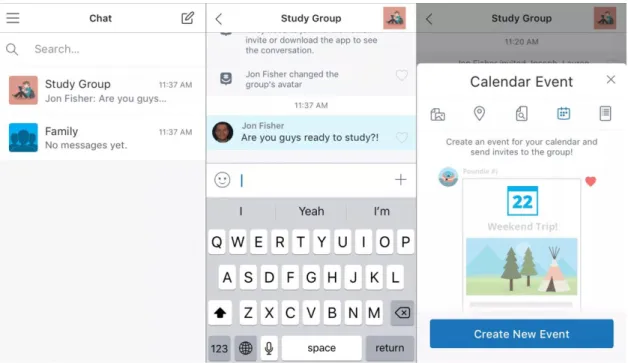
As shown in Fig. 1, the GroupMe app has two main interfaces: one which displays all of a user’s conversations (organized by time of latest message), and one which displays a particular conversation thread, once selected. The application also has other organizational and
information-sharing functionalities (e.g., a poll creator, a calendar; see Fig. 1), but these
participant can change these labels while they are active in the group. Each user is represented by a name and a small icon/image. The screen names are always an accurate semblance of the user’s own name in the present data, though in other communities this is a less dependable fact.
Conversation participants are freely able to add new members or withdraw themselves from the discourse10; however, these permissions only function one way—if one removes oneself from a conversation, they must be added back again by someone still in the group. It is also visible in Fig. 1 that it is possible to respond to GroupMe messages by “liking” them, similarly to the functionality of Facebook and Twitter. While the dynamics of this process are surely fascinating, they will not be discussed here.
Figure 1: Three possible user-interfaces on the GroupMe application. Image from recent media coverage on www.lifewire.com (Gil, 2019).
10Though not a practice of this community, leaving a conversation (which displays: “Screen Name has left the
3.3PARTICIPANTS.
Nearly all of the 81 participants were students at the university at the time the data were generated, though some had already graduated (n = 4) and a small number (n = 2) were members of the broader community and/or otherwise unaffiliated with the university. Though collection of individual demographic information was limited in order to shorten consent survey length and increase number of responses, the majority of the overall theater community at the time of data generation was made up of white individuals and those who identify as women. Many
participants are no longer affiliated with the university at the time of the present study. Participants were included on the basis of their participation in one or more of four GroupMe conversations associated with student-organized theatrical productions between 2015 and 2017. All participants were 18 years of age or older at the time of consent. With the exception of the researcher (see Chapter 1), no participant contributed to all GroupMe conversations, though two contributed to three out of the four, and 12 contributed to two. The size and role-breakdown for each production is shown in Table 1.
Table 1: Distribution of Roles in Each Production
Through conversation with the institutional review board, the conclusion was reached that this project does not constitute human subjects research and is therefore exempt from the IRB’s purview. However, in order to fulfill an ethical obligation and secure the consent of each of the contributors to the conversations, a digital consent survey was distributed—through general online methods (e.g., Facebook, email listservs), as well as directly to each GroupMe
Production Cast Prod Staff Crew Total
1 15 (60%) 8 (32%) 2 (8%) 25
2 25 (76%) 7 (21%) 1 (3%) 33
3 18 (55%) 11 (33%) 4 (12%) 33
conversation—that contained information about the research and gave each user an opportunity to attest to which conversation(s) they participated in and give consent that their communications be used in the present study. Since the author had participated in the conversations in question and maintains personal relationships to varying degrees with the other participants, they were also contacted directly with the same information about the study. The consent survey mentioned above provided the full text of a consent form, asked participants 1) for what productions they participated in GroupMe conversations and 2) to the use of which of those they consented. They were also asked to provide the year they graduated/plan to graduate with an undergraduate degree to be used as a marker of seniority within the community. Completion of the survey took approximately 5-7 minutes. There was one individual who asked that their messages not be included in the analysis. Those data will not be reported on here. Several respondents never supplied any response (n = 4). At the end of the consent survey, participants were asked if they would like to be contacted with a summary of the study's findings. If they indicated that they would, they were redirected to a separate, independent survey where they provided their contact information. They were also asked if they wanted to be entered in a random drawing in which each participant has equal odds of receiving one of two Target gift cards worth $20 each. If they indicated that they would, they were redirected to independently provide information for this purpose. This was independent of any other response on the survey; they did not have to allow any of their data to be used in the study in order to enter the drawing.
3.4DATA PROCESSING.
with the conversation. After being reformatted using the atom-beautify package for the Atom text editor, this JSON file was then processed using a custom Perl script to extract the relevant information to the present analysis: timestamp, “like” information, ID of the conversation, ID of the sender, and the message itself. All directly identifying information was masked using
Microsoft Excel and R (R Core Team, 2017), and names, email addresses, other screen names, etc. were replaced with descriptive codes such as {{PHN}} for phone number, {{ADR}} for address, and {{##}} for names of participants where “##” represents the two-digit identifier randomly assigned to each contributor.
3.5CORPUS CHARACTERIZATION.
Once cleaned and masked, the data comprised a corpus of approximately 61,000 words (hereafter the Theater GroupMe Corpus; TGMC). As a measure of lexical density, a standardized type-to-token ratio (TTR; the number of unique content words divided by the total number of words) was calculated for the entire corpus as well as for a selection of subcorpora divided by conversation and by role category (i.e., cast, crew, prod staff). These values were calculated in R using versions of the corpus with stopwords removed with the default English word list in the stopwords package for R (Benoit, Muhr, & Watanabe, 2017). This list of stopwords is drawn from the Snowball string-processing language, written by Martin Porter
(https://snowballstem.org/). In order to standardize values across the differently sized
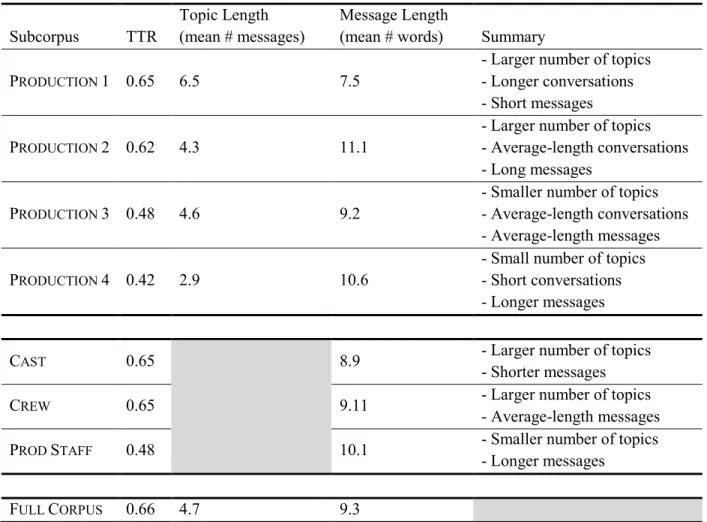
case of Production 4 this is likely because of the small size of the team and the low number of contributing individuals. This general lower utilization of GroupMe as a communicative resource is also visible in the mean topic and message lengths for Production 4; the communication there was less dialogic than others, featuring longer messages and shorter discussions of individual topics. It can also be seen that the members of Productions 1, 2, and 3 tended to finish
discussions over a larger number of messages though often accompanied by shorter message lengths, suggesting a more group-inclusive discourse environment stemming from the larger group size.
Table 2: Type-to-Token Ratio, Mean Topic Length, and Mean Message Length in the TGMC
Subcorpus TTR Topic Length (mean # messages) Message Length (mean # words) Summary
PRODUCTION 1 0.65 6.5 7.5
- Larger number of topics - Longer conversations - Short messages
PRODUCTION 2 0.62 4.3 11.1
- Larger number of topics - Average-length conversations - Long messages
PRODUCTION 3 0.48 4.6 9.2
- Smaller number of topics - Average-length conversations - Average-length messages
PRODUCTION 4 0.42 2.9 10.6
- Small number of topics - Short conversations - Longer messages
CAST 0.65 8.9 - Larger number of topics
- Shorter messages
CREW 0.65 9.11 - Larger number of topics - Average-length messages
PROD STAFF 0.48 10.1 - Smaller number of topics
- Longer messages
The differences between the role-based subcorpora are of note as well. It appears that members of the cast and crew contribute messages on a wider variety of topics than those of the production staff. This too is expected; the prod staff’s contributions are generally organizational in nature, discussing planning, schedule, and the like, while the cast and crew are more likely to discuss topics of other natures. Furthermore, we continue to see differences in conversation style when considering message length: while the production staff are making announcements, etc., the cast (and to a lesser extent, the crew) are discussing those announcements along with other topics.
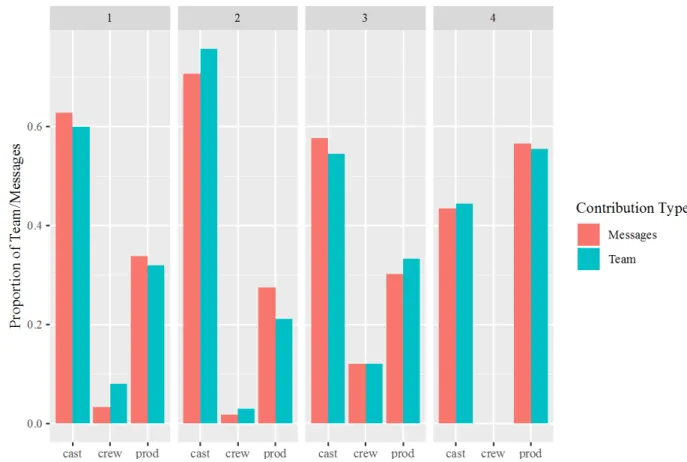
Figure 2: Comparative proportion of contribution to the production team and TGMC content11
While it is clear from the measurements presented in §3.3 that the cast make up a
significant portion of the individuals contributing to the TGMC, contributions of each group are
about equal to the proportion of the overall team that they make up (see Fig. 2). There are cross-conversation differences in the dynamics of who contributes most to the cross-conversations. However, these differences tend to almost perfectly parallel the differences in role distribution between the different projects. That is, it does not seem that any one group in any one conversation is
contributing more than would be expected based on their proportion of participation. Thus, if any of the artistic hegemony on the part of the director/prod staff that is present in some professional productions (Goodman & Goodman, 2012) is present in these processes, those interactions are not reflected in the amount of associated language as used in the TGMC. In fact, the production staff often participates markedly less than at least the cast, which could indicate a similarly uneven but reversed relationship to Goodman & Goodman’s observations. This is unlikely, however, given the rarity of contentful artistic discussion in the GroupMe conversations.
gathering?) or to address the other participants or a subset more directly to make an
announcement, request advice, etc. This is likely a factor of the “many-to-many” linguistic relationship of a group text conversation as opposed to the dyadic discourses analyzed by Tagliamonte and Denis. As a benefit of being in the South, it is quantitatively clear that group address was a fairly prominent part of the discourse, since y’all was the second most common second-person pronoun closely after you and its variants (i.e., u, youuu), which of course can all have plural reference as well. This comparison suggests that, at least as far as pronoun use is a measure, the language of GroupMe conversations in the TGMC closely resembles other forms of IWD.
CHAPTER 4:
RESULTS AND DISUCSSION
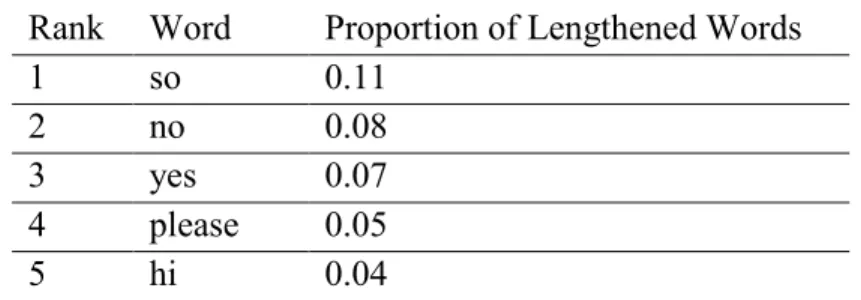
The following chapter details both a regression analysis of all digital medium-associated features in the TGMC and a functional analysis of the discourse uses of the three most frequent:
LOL, OMG, and the process of typological lengthening (see Table 3). These three phenomena are
of comparable occurrence in the corpus to also, please, and more, respectively. While used differentially across individuals (LOL, for example is only used by about half the participants),
there is no difference based on production or process role that suggests one of those subgroups to use any of these features more than others.
Table 3: Most common features of IWD origin in the TGMC
4.1REGRESSION ANALYSIS.
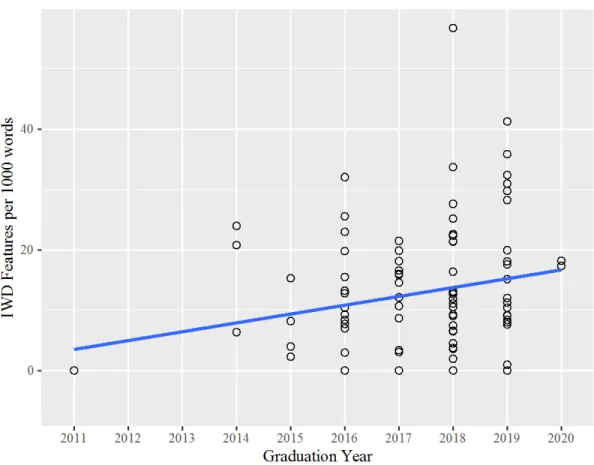
Interestingly, the overall rate of IWD features (including all respellings, initialisms, hashtags, etc.) shows a slight positive correlation with year of graduation, serving as an informal measure of apparent time within the university speech community; see Fig. 5.
Overall Rank Word Total Count Occurrence per 1000 words
NA lengthening 199 3.2
78 LOL 116 1.9
Figure 4: Frequency of IWD Features in the TGMC by Year of Graduation
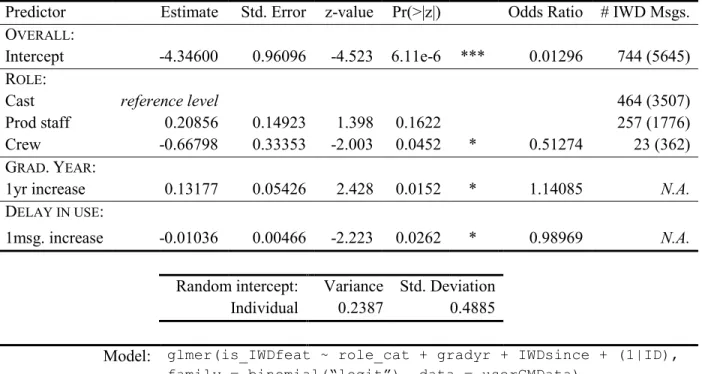
usage of IWD features, and a negative estimate indicates the opposite. Though it was tested, inclusion of conversation and/or production company in the model did not improve the fit, nor was either variable significant. The results of the regression are shown in Table 4 along with the model itself, where “is_IWDfeat” is a binary variable indicating presence of IWD features, “role_cat” is the category of role the message’s author filled at the time it was written, “gradyr” indicates year of graduation from the university, and “IWDsince” is a measure of distance to the previous usage of an IWD feature in messages.
Table 4: Generalized linear mixed-effects regression model of presence of IWD features in the TGMC (individual speaker as random intercept)
The regression results show three significant effects at the α = 0.05 level. Each one-year increase in graduation year indicates a significant increase in odds of using IWD features by a factor of about 1.14, suggesting that, at least within this community, use of these features was becoming more common during this time period. The number of messages since the last IWD feature usage was also a significant predictor of whether or not similar features would be used,
Predictor Estimate Std. Error z-value Pr(>|z|) Odds Ratio # IWD Msgs. OVERALL:
Intercept -4.34600 0.96096 -4.523 6.11e-6 *** 0.01296 744 (5645)
ROLE:
Cast reference level 464 (3507)
Prod staff 0.20856 0.14923 1.398 0.1622 257 (1776)
Crew -0.66798 0.33353 -2.003 0.0452 * 0.51274 23 (362)
GRAD.YEAR:
1yr increase 0.13177 0.05426 2.428 0.0152 * 1.14085 N.A.
DELAY IN USE:
1msg. increase -0.01036 0.00466 -2.223 0.0262 * 0.98969 N.A.
Random intercept: Variance Std. Deviation
Individual 0.2387 0.4885