CACIQUES AND COMMUNITY: HISTORICAL MAYA ARCHAEOLOGY AT RANCHO KIUIC, YUCATÁN, MÉXICO
Mary Margaret Morgan-Smith
A dissertation submitted to the faculty at the University of North Carolina at Chapel Hill in partial fulfillment of the requirements for the degree of Doctor of Philosophy in the Department of
Anthropology in the College of Arts Sciences.
Chapel Hill 2019
Approved by:
Patricia A. McAnany Anna Agbe-Davies George J. Bey, III
Rudolf Colloredo-Mansfield C. Margaret Scarry
© 2019
ABSTRACT
Mary Margaret Morgan-Smith: Caciques and Community: Historical Maya Archaeology at Rancho Kiuic, Yucatán, México
(Under the direction of Patricia A. McAnany)
This dissertation examines the socioeconomic relationships between Maya-speaking landowners and laborers at Rancho Kiuic (ca. 1760-1950): a small, privately-owned cattle ranching estate in the Puuc Hills region of Yucatán, Mexico. Owned and worked by generations of indigenous caciques and an indebted laborer population, the complex relationships between landed and laboring community members are inscribed in the community’s household and religious space, and woven throughout the oral history of the rancho. While the site’s architectural remains seem suggestive of a relatively homogeneous rural community, that narrative is complicated by the laborers’ memory of the status of the landowning family.
Three lines of evidence—archaeological materials from household and chapel contexts, archival documents related to baptisms of Rancho Kiuic residents, and oral histories from descendants and neighbors of the community—reveal the extent to which inequality and narratives of indebtedness to the Rancho’s indigenous cacique family are evident in the site’s household and chapel assemblages. Archaeological analysis of architectural and artifact remains highlight the differential realms in which status was expressed. Ecclesiastical records,
To my daughter, Nora, the best toddler research assistant and fieldwork buddy imaginable. To my husband, Austin, whose quiet strength and positivity has supported me through this
ACKNOWLEDGEMENTS
This research was supported by a Doctoral Dissertation Improvement Grant from the National Science Foundation, A Fulbright-Hays Doctoral Dissertation Abroad Fellowship. Thank you to the Research Labs of Archaeology (RLA), The Graduate School, The Institute for the Study of the Americas (ISA), The Center for Global Initiatives (CGI), and the Department of Anthropology at UNC Chapel Hill for additional funding for pilot research, language training, conference travel, and support during the “write-up.”
I arrived at UNC with only the vaguest idea of what my dissertation would look like. I cannot thank my advisor, Dr. Patricia McAnany enough for her tireless effort to see me through this process. With tremendous patience and an eye to detail, she read and provided comments on countless grant applications for this research and numerous drafts of this dissertation. When funding was finally secured, she rejoiced alongside me, and I am grateful to her for help as I saw this project to its final state. Thank you to my dissertation committee, Dr. Silvia Tomášková, Dr. Margie Scarry, Dr. Anna Agbe-Davies, Dr. Rudi Colloredo-Mansfeld, and Dr. George Bey, for their helpful comments, honest critiques, letters of support, and sincere encouragement
throughout this process. Special thanks also to Dr. Margie Scarry for her assistance with the data presentation portions of this dissertation.
I am grateful for the generous support of the Bolonchén Regional Archaeological Project, led by Dr. George Bey III, Dr. Tomas Gallareta Negrón, and Dr. Bill Ringle, over the last
those dreaded Informes, and Chris Gunn and Betsy Kohut helped me make sense of all those ceramics. This team took me on as a very green Honors thesis student from Millsaps College in 2006, and have supported this research since the very beginning. It was through my connection to this project that I came to know Rancho Kiuic and the holders of its history, and I’m grateful to the project directors for encouraging me to pursue this research, even as I filled their lab with modern garbage.
Thank you to James Callaghan, director of the Kaxil Kiuic Biocultural Reserve, whose keen interest in the historical communities in and around the reserve piqued my interest in this project, and whose early mapping of San Sebastián and connections with its former residents paved the way for my collaborations. I am especially grateful to Evelio Uc Uc for sharing his childhood memories of “Chan Kiuic” and for Manuel Uc, Eddie Dzul, and Maria Simona Us Santana, Melchor Canul, Delfina Canul, and many, many others who graciously accepted me into their homes and shared their stories.
I am thankful for the support, both professionally and personally, of countless faculty, staff, and fellow graduate students during my time at UNC. Special thanks to the Anthropology office staff, the Office of Undergraduate Curricula, and Lisa-Jean Michienzi and Jan Scopel in the RLA. I received excellent advising on qualitative data analysis from Paul Mihas in the Odum Institute, and lots of hand-holding from The Writing Center (Thanks, Gigi!) during the last few months of dissertation writing. In particular, a huge “thank you” goes to my 2008 cohort, as well as those colleagues who have become some of my dearest friends. I may not have made it without the friendship, commiseration, accountability, expert data crunching, and keen editing skills of Taylor Livingston, Lindsay Bloch, Claire Novotny, Tomas Gallareta Cervera, Anna Catesby Yant, David Cranford, Meg Kassabaum, Maia Dedrick, Liz Berger, Katie Barrett, Andrew Ofstehage, and the crew I lovingly refer to as “The Smith Building Mole Women,” Gabby Purcell, Sophie Dent, Anna Graham, Gracie Riehm, Colleen Betti, Sierra Rourke, and others.
made during my trips to Yucatánduring this research. A heartfelt thank you to the Batún family, the Arzapalo family, the Martin family, John Bradshaw and Alan DiCamillo, Raul, Randi Colli, Mercedes, Jonni Manrique, and the crew from Luz en Yucatán. Thank you for treating me and my family like family.
Outside of my home department at UNC, I have received incredible support—fiscal and otherwise—from the Office of Undergraduate Curricula (Nick Siedentop, Paula Goodman, Dean Erika Lindemann and Ben Haven, Carmen Bapat, Cynthia Demetriou and Candace Powell, in particular), The Institute for the Study of the Americas (Beatriz Riefkohl and the late Shelley Clark) and the Center for Global Initiatives, who administered my Fulbright-Hays fellowship (Thank you, Glynis Cowell and David Mora-Marin for those crucial language recommendation letters!)
For my grandparents who passed away before they could see me finish this task; my grandfather, C.J. Kehoe and my grandmother, Audrey Mae Morgan. I wish you were here to celebrate this accomplishment, and I thank you for the encouragement and appreciation for education that brought me to this point. Thank you also to my parents, Wink and Mary Beth Morgan, and grandmother, Peggy Kehoe, for always fostering my love of México and its history. I know you probably thought those high school trips to Mexico City and Cuernavaca would be the end of it, but it was barely the beginning.
TABLE OF CONTENTS
LIST OF TABLES ... xiv
LIST OF FIGURES ... xv
CHAPTER 1. INTRODUCTION TO RANCHO KIUIC AND THE PUUC REGION OF YUCATÁN, MÉXICO ... 1
1.1 Introduction ... 1
1.2 Organization of the Dissertation... 4
1.3 The Physical Setting of the Puuc Region ... 6
1.4 Kaxil Kiuic and the Helen Moyers Biocultural Reserve ... 8
CHAPTER 2. CONCEPTUAL AND HISTORICAL FRAMING ... 10
2.1 Introduction ... 10
2.2 Situating Rancho Kiuic in Time and Space ... 11
2.3 Tales from the Rancho: Oral History in Archaeology ... 20
2.4 Archaeologies of Social Memory ... 23
2.4.1 Social Memory and Power ... 27
2.4.2 Yucatec Maya Households ... 28
2.4.3 Acts of Residence ... 30
2.5 The Analytical Value of Small Finds ... 31
2.6 Conclusion ... 32
CHAPTER 3. METHODS AND DATA COLLECTION ... 34
3.1 Introduction ... 34
3.2 Oral History Collaboration... 35
3.4 Site Survey Methods ... 38
3.5 Household Sampling ... 39
3.6 The Chapels ... 46
3.7 Surface Collection and Excavation Methods ... 49
3.8 Issues in Identifying Households and Domestic Structures ... 49
3.9 Notational Methods ... 50
3.10 Artifact Identification and Cataloguing ... 51
CHAPTER 4. ORAL HISTORY ... 52
4.1 Oral History Interviews ... 52
4.2 The Rancho Remembered: Thematic Analysis of Oral History Data ... 54
4.2.1 “Then we started looking for the trees” ... 57
4.2.2 “She’s a Christian, and she’s not dancing anymore!” ... 59
4.2.3 “There, they wait for the men”... 62
4.2.4 “… everyone who works for him, buys his things, and then they have no money” ... 64
4.2.5 “The seed is running out” ... 66
4.3 Conclusion ... 67
CHAPTER 5. FROM THE ARCHIVES: RANCHO KIUIC IN TEXTS... 69
5.1 Introduction ... 69
5.2 Organization of the Archives and Collections Consulted ... 69
5.3 Documents from the Archivo General del Estado de Yucatán (AGEY) ... 72
5.4 Documents from the Archivo General del Arzobispado de Yucatán (AGAY) ... 73
5.5 Concluding Thoughts and Directions for Further Archival Research ... 77
CHAPTER 6: DESCRIPTION OF EXCAVATION CONTEXTS ... 79
6.2 Laborer Household Contexts... 79
6.2.1 Solar A (North and South) ... 79
Solar A North ... 81
Solar A South ... 82
6.2.2 Solar D ... 83
6.2.3 Solar E ... 85
6.2.4 Solar O (Operations 1 through 3) ... 87
Operation 1 ... 87
Operation 2 ... 88
Operation 3 ... 89
6.2.5 Solar R (North and South) ... 90
Solar R North ... 91
Solar R South ... 92
6.3 Landowner Household Context: Solar H ... 94
6.3.1 Solar H (Operations 1 through 4) ... 94
Solar H, Operation 1 ... 94
Solar H, Operation 2 ... 96
Solar H, Operation 3 ... 98
Solar H, Operation 4 ... 100
6.4 Summary of Chapel Excavation Contexts ... 101
6.4.1 Capilla I, The Landowner’s Chapel ... 101
6.4.2 Capilla II, The Laborer’s Chapel ... 105
CHAPTER 7. A COMMUNITY DIVIDED: RECONSTRUCTING FACTIONS THROUGH MATERIAL ANALYSIS ... 109
7.1 Introduction ... 109
7.2.1 Ceramics ... 109
7.2.2 Metal ... 121
7.2.3 Glass ... 125
7.2.4 Other Artifact Categories and Small Finds ... 130
7.3 Correspondence Analysis (CA) of Excavation Data ... 135
7.3.1 Occupation Ranges Across Rancho Kiuic’s Excavation Contexts ... 136
7.3.2 CA of the Distribution of Status Goods Across Rancho Kiuic ... 142
7.4 Laborer Identity in Social Space ... 146
7.5 Landowner Identity and the Subtleties of Small Finds ... 147
CHAPTER 8: CONCLUDING THOUGHTS AND FURTHER DIRECTIONS ... 148
8.1 Introduction ... 148
8.2 Materialized Memory: Oppression, Resistance, or Something Else? ... 149
8.3 Memory as Power: Controlling the Conversation ... 154
8.4 Insights into Indigenous Landownership ... 155
8.5 Spaces Abandoned but Remembered ... 158
8.6 Contributions to the Field of Historical Archaeology and Archaeologies of Social Memory ... 159
8.7 Final Thoughts Directions for Further Investigation ... 161
APPENDIX I: VERBAL CONSENT SCRIPTS FOR ORAL HISTORY INTERVIEWS IN ENGLISH, SPANISH, AND YUCATEC MAYA ... 166
APPENDIX II: EXCAVATION NOTES BY UNIT (CUADRO) ADAPTED FROM INFORMES FIELD REPORTS 2014-2016 ... 167
APPENDIX III: CODEBOOK FOR THEMATIC ANALYSIS OF FORMAL ORAL HISTORY INTERVIEW TRANSCRIPTIONS ... 238
APPENDIX IV: DATA TABLES FOR ARTIFACT ANALYSIS ... 243
APPENDIX V: DATA LOADINGS FOR CORRESPONDENCE ANALYSIS ... 245
LIST OF TABLES
Table 3.1 Surface Collection and Excavation Calculations ... 41
Table 4.1 Sample Questions Provided to Potential Oral History Collaborators ... 55
Table 5.1 Baptismal Documents from Archivo General del Arzobispado de Yucatán (AHAY) ... 74
Table 7.1 Ceramics Types Represented ... 112
Table 7.2 Coinage by Location and Value ... 125
Table 7.3 Complex and Production Ranges for Included Ceramic Types ... 137
LIST OF FIGURES
Figure 1.1 Rancho Kiuic, Yucatán, México in Regional Context ... 7
Figure 3.1 Map of Rancho Kiuic (adapted from map created by Alfred M. Berry) ... 40
Figure 3.2 Enlarged Map Featuring Solares A, D, E, and Capilla II ... 43
Figure 3.3 Enlarged Map Featuring Solar H and Capilla I ... 45
Figure 3.4 Enlarged Map Featuring Solares O and R ... 46
Figure 3.5 Enlarged Map Featuring Capillas I and II ... 48
Figure 4.1 The Imagen of San Isidro from Capilla II, Now Inside the Home of One of rhe Last Residents of Rancho Kiuic ... 61
Figure 6.1 Map of Household Excavation Locations ... 80
Figure 6.2 Plan View of Solar A North Excavations ... 81
Figure 6.3 Plan View of Solar A South ... 82
Figure 6.4 Plan View of Solar D Excavations ... 84
Figure 6.5 Profile Views North and East of Solar E, Cuadro N5 ... 86
Figure 6.6 Profile and Plan View of Sondeo 2 (Solar E, K6) ... 87
Figure 6.7 Plan View of Solar O, Operation 1 Excavations... 88
Figure 6.8 Plan View of Solar O, Operation 2 Excavations... 89
Figure 6.9 South and Northwest Profiles of Solar O, Operation 2, Sondeo 2 Excavations... 89
Figure 6.10 Plan View of Solar O, Operation 3 Excavations... 90
Figure 6.11 Sketch Drawing of Possible Historical Structure in Solar A North, by Tomas Gallareta Negrón and Rossana May Ciau ... 91
Figure 6.12 Plan View of Solar R North, Unit Z10, Zones 1-3 Excavations ... 92
Figure 6.13 Plan View Solar R South, Unit I5, Zones 1 and 2 Excavations ... 93
Figure 6.14 Plan View of Solar H, Operation 1 Excavations... 95
Figure 6.16 Southern Profile of Solar H, Operation 1 Excavations ... 96
Figure 6.17 Plan View of Solar H, Operation 2 Excavations... 97
Figure 6.18 Northern Profile of Solar H, Operation 2 Excavations ... 97
Figure 6.19 Western Profile of Solar H, Operation 2 Excavations ... 98
Figure 6.20 Plan View of Solar H, Operation 3 Excavations... 99
Figure 6.21 Eastern Profile of Solar H, Operation 3 Excavations ... 99
Figure 6.22 Northern Profile of Solar H, Operation 3 Excavations ... 99
Figure 6.23 Plan View of Solar H, Operation 4 Excavations... 100
Figure 6.24 Eastern Profile of Solar H, Operation 4 (Units R21, P21, Q21, and N21) Excavations ... 101
Figure 6.25 Eastern Profile of Solar H, Operation 4 (Units R17, Q17, P17 and O17) Excavations ... 101
Figure 6.26 Northern Profile of Solar H, Operation 4 (Units P17-23) Excavations ... 101
Figure 6.27 Photo of Door Jambs, Capilla I ... 102
Figure 6.28 Plan View of Capilla I Excavations ... 103
Figure 6.29 Northern Profile of Capilla I Excavations ... 103
Figure 6.30 Stucco Floor of Capilla I in Unit RR29 ... 104
Figure 6.31 Puuc-style Colonette Stones Repurposed for 19th-20th Century Apiculture ... 104
Figure 6.32 Plan View of Capilla II Excavations ... 105
Figure 6.33 Eastern Profile of Capilla II, Unit C3 Excavation ... 106
Figure 6.34 Eastern and Southern Profiles of Capilla II, Unit F5, Zone 1 Excavation ... 106
Figure 6.35 Repurposed Labradas on Platform Surface ... 107
Figure 7.1 Yuncú Unslipped Cooking Jar Fragments ... 114
Figure 7.2 Sakpokana Red or Colonial Redware Rim Examples ... 114
Figure 7.4 Total Surface Collected Ceramics by Context ... 116
Figure 7.5 Historical Surface Collected Ceramics by Context... 116
Figure 7.6 Total Excavated Ceramics by Context ... 117
Figure 7.7 Historical Excavated Ceramics by Context ... 117
Figure 7.8 Surface Collected Ceramics by Form... 119
Figure 7.9 Excavated Ceramics by Form ... 119
Figure 7.10 Coa and Machete Heads ... 121
Figure 7.11 Head of a Hatchet and an Iron Pin ... 122
Figure 7.12 Small Enameled Bowl ... 122
Figure 7.13 Surface Collected Metal by Context ... 123
Figure 7.14 Excavated Metal by Context ... 123
Figure 7.15 Glass Material Surface Collected ... 126
Figure 7.16 Glass Material Excavated ... 126
Figure 7.17 Common Clear and Brown Bottle Forms ... 128
Figure 7.18 Examples of Branded Consumer Bottles Including (Left to Right) Pepsi Cola (C. 1973), Mission Orange Soda (C. 1940), and Valle Grape Juice (Date Unknown) ... 128
Figure 7.19 Surface Collected Glass in Bottle, Jar, and Window Forms ... 129
Figure 7.20 Excavated Glass in Bottle, Jar, and Window Forms ... 129
Figure 7.21 Obsidian Blade Fragment ... 131
Figure 7.22 Grinding Stone Foot ... 132
Figure 7.23 Distribution of Excavated Lithic Materials, Standardized by Cum Excavated ... 132
Figure 7.24 Religious Medal from Solar H ... 134
Figure 7.25 Glass Marble from Solar E ... 134
Figure 7.27 Small Finds from Solar E, Including Coinage, Shoe Buckles, and
Sewing Scissors ... 135 Figure 7.28 CA Plot of Ceramic Types Based on Manufacturing End Date ... 138 Figure 7.29 CA Plot of Excavation Contexts Based on Assemblage Mean Ceramic
Date ... 140 Figure 7.30 CA of Excavation Contexts to Ceramic Type-Varieties ... 141 Figure 7.31 CA Plots of Excavation Contexts (above) and Categorized Finds
(below) ... 144 Figure 8.1 Remaining Masonry Walls of the Rancho Kiuic’s Schoolhouse,
Thought to be the Site of Catherwood’s “Casa Real” ... 162 Figure 8.2 Lithograph of Rancho Kiuic’s Casa Real by Frederick Catherwood
CHAPTER 1. INTRODUCTION TO RANCHO KIUIC AND THE PUUC REGION OF YUCATÁN, MÉXICO
1.1 Introduction
In 1913, a government official surveying the prehispanic archaeological site of Kiuic in southwestern Yucatán, México noted that the ruins were on land belonging to José Agustín Pacab, a member of a “very old and noble” lineage who “gave their obedience to Montejo1.” At the time, some 20 extended families worked under Pacab on his rancho (Martinez 1913). The community—remembered as San Sebastián by some, and as Chan K’iiwik (“little Kiuic”) or Rancho Kiuic (a reference to its proximity to the ruins) by others, and remains a part of local memory and a place of identification for former residents. Today, its cemetery is still in use by laborer families with multigenerational ties to the community who enjoy telling the stories of life on the Rancho, especially that of the indebted laborer population and their dealings with the landowning family. According to former residents and neighbors of the community, the
Rancho’s laborer families slowly abandoned the Rancho during the first half of the 20th century, citing oppressive conditions and the promise of opportunities granted to Maya speakers through agrarian reform legislation.
The architectural remains of the community stand in contrast to its narrative of stark status differences between the landowning family and the Rancho’s resident laborers. Unlike larger hacienda communities, where communal spaces and worker housing were situated around
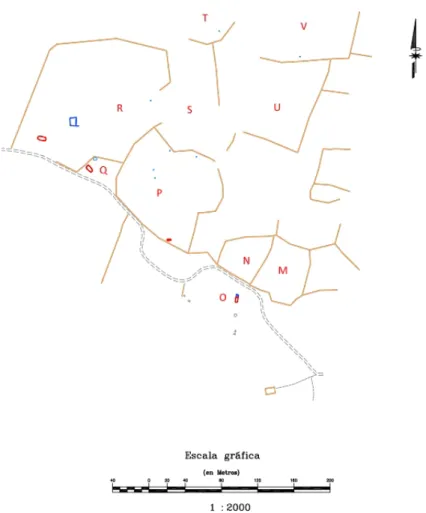
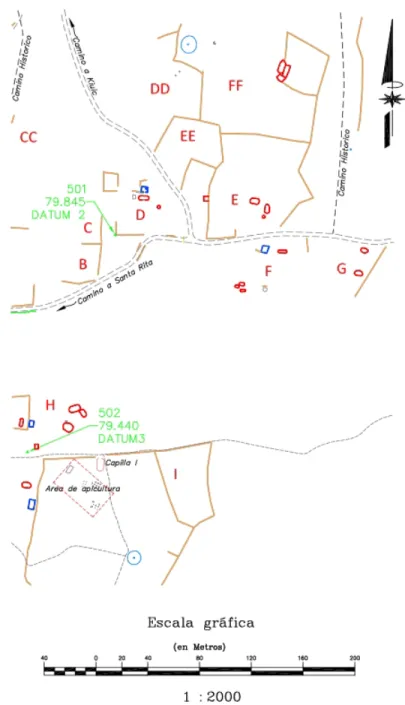
stately masonry structures occupied by landowners and managers, Rancho Kiuic is a system of dry-laid stone walls (known locally as albarradas) which delineate modest house lots. At least 30 lots radiate from the central corral and well, adjacent to a small open space once used as a baseball field, the remnants of an apsidal schoolhouse, and a small masonry stage thought to have been built as part of a rural education reform program in the early 20th century. Household architecture, when visible, consists of apsidal stone footings for perishable structures; none with obvious markers of status. The impression left by walking through the community differs from that of travel writer John L. Stephens and draftsman Catherwood, who documented
archaeological sites and their surrounding communities throughout the Maya area in the 1830’s. (1962 [1839]: 41). The pair spent a night at Rancho Kiuic, remarking on the uncommon degree of wealth expressed by the leader of such a small and remote settlement. The rancho’s cacique— a term first applied to the Rancho’s indigenous leader by Stephens and Catherwood—waseasily able to make change for a gold piece used by Stephens’ party to purchase some eggs (1962 [1839]:42).
What initially drove my archaeological interest in the community— historical household consumption and abandonment patterns on the fringes of Colonial and Republican-era
population centers—developed into an exploration of deeply felt class distinctions within the community. Though seemingly invisible in the site’s architecture, it was clear through both historic texts and conversations with the site’s descendant population that the memory of Rancho Kiuic is linked to historical narratives of inequality and oppression. According to archival
Stephens and Catherwood 1962 [1839]: 41). By the early 20th century, the community’s population had dwindled to just 73 residents (Dirección General de Estadistica 1920), as opportunities to work communal landholdings became available. The remains of the
community’s house-lots (or solares), corral and water features, school, and two chapels, are visible among the modern elements of the Kaxil Kiuic Biocultural Reserve2, but modest in comparison to the larger, corporate haciendas dotting the regional landscape.
Using household archaeological methods, archival research, and interviews conducted in Yucatec Maya with the community’s descendant population, this research addresses the
following questions:
1. How are the memories of oppression and resistance under the Rancho’s landowners materialized in household and religious spaces?
2. How do differential patterns of tenancy and inequality inform our understandings of indigenous landownership?
By focusing on inequality “writ small”, this project addresses the variability within Yucatán’s late Colonial and Republican socioeconomic landscape. As I will discuss further in chapter 2, the rancho is an underexplored site type in this region known to have been associated with indigenous landownership (e.g., Chance 1996, 2003.) As such, this research examines labor and power relationships between Yucatec-speakers. In a historical moment popularly understood to have been dominated by large, corporate estates with Euro-descendent owners and built on
indigenous labor, I ask: What does small-scale indigenous landownership look like during the Colonial-Independence periods?
I approach this question by drawing on three lines of evidence; archaeological materials from household and chapel contexts, archival documents related to baptisms of Rancho Kiuic residents, and oral histories from descendants and neighbors of the community. I will examine how assemblages in contexts used exclusively by each sector of the community shed light on the relationships between laboring and landed families, and specifically, how activity within these spaces is reflective of past relationships that shape attitudes and interactions with the site today.
1.2 Organization of the Dissertation
This chapter briefly describes the physical setting of Rancho Kiuic and the modern Kaxil Kiuic Biocultural Reserve that now surrounds the historical community. Chapter 2 provides the sociopolitical and historical context in which Rancho Kiuic functioned throughout its occupation, drawing on a body of historical research related to this region, as well as archaeological
Chapter 3 presents the mixed-methods approach used to collect oral history, archival, mapping, and excavation data for this research. These data and their related analyses are described in Chapters 4 through 6.
Chapter 4 presents the oral history component of this project. Oral histories were collected from a combination of former residents, their descendants, and visitors to the Rancho during the early-to-mid 20th century who were willing to share their knowledge about the community’s population, its history, and its position within the regional landscape. This chapter includes a description of the participant population, a synopsis of the oral history collaboration and the results of a thematic analysis of oral history transcriptions.
Chapter 5 presents an overview of the types of archival documents consulted within the Archivo Histórical del Arzobispado de Yucatán (AHAY) and Archivo General del Estado de Yucatán (AGEY) located in Mérida, Yucatán over visits between 2012 and 2016. As with many small historical communities, archival documentation is limited, and records produced by the community during its occupation are rumored to be lost. However, documents from AHAY and AGEY provide historical context for the community and insights into social relationships
between landed and laboring members of the population. This chapter provides an analysis of the baptismal records for children born at Rancho Kiuic found in AHAY which indicate generational godparent relationships between landed and laboring families.
excavation contexts were analyzed to establish temporal occupation ranges and to compare status markers within each context. I bring these results to bear on my research questions, where I argue that laborer identity, evident among descendants of the laboring population of Rancho Kiuic, is inextricably linked to the memory of oppression within the community, despite a lack of significant architectural and material markers of inequality across the site’s household spaces. Rather, household status differences are materialized in small finds that suggest greater access to non-local items among landed members of the community, and performance of elite identity. Within the site’s two chapels, different strategies for maintaining landed status and living through oppressive labor conditions are materialized in chapel assemblages, which support the site’s documentary and oral history narratives.
Finally, in Chapter 8, I conclude with a synthesis of my major findings at Rancho Kiuic, followed by a discussion of how this research contributes to the field of historical archaeology, highlighting the significance of ranchos as alternative estate forms worthy of examination. As part of ongoing efforts to increase meaningful engagement with descendant groups in
archaeological research, I discuss the value of oral history as a collaborative tool with the potential to empower storytellers as stewards of their history. I suggest directions for further investigation at Rancho Kiuic, including additional inquiry into the production spans and
variation within locally produced indigenous ceramic types from the historical period, as well as further research into economic activities within the community, including ranching operations and beekeeping.
1.3 The Physical Setting of the Puuc Region
Wilson (1980) as a Tropical Savanna climate, the rainy season in the Puuc lasts from about May to October, with the heaviest rainfall in July and September, yielding an annual rainfall of approximately 500 to 1000mm (Killion 1989). On the lower Yucatec plain, the peninsula’s karst hydrogeological landscape is expressed in caves and sinkholes, known as cenotes, but in the Puuc, surface water is scarce. While natural depressions, known as sartenejas, provide seasonal pools of rainwater, permanent water sources exist only in deep underground channels (Hodell et al.1995). Not surprisingly, water management has played a key role in this region’s economic and political development, and the most common response to water storage issues in
pre-Hispanic times was the construction of bottle-shaped cisterns, called chultúnes, dug into the soft limestone (Killion et al. 1989; McAnany 1989; Thomson 1897).
Rancho Kiuic is located within what is known as the Bolonchén District in the southeastern portion of the Puuc, where karst cone hills range in altitude from about 40-60m among arable valleys and flats with thin red soils (Wilson 1980). A thriving, distinctive culture emerged in the Puuc during the Middle Preclassic through Early Classic periods, marked by clear signs of social stratification (e.g. Bey 2006; Ringle 1999) and a distinctive architectural style (e.g. Andrews 1995; Pollock 1980). The site of Kiuic, and its surrounding hilltop communities, such as Escalera al Cielo flourished until the Terminal Classic, when it is thought that a retreat from these sites was part of larger regional sociopolitical and climate shifts (Simms et al. 2012).
1.4 Kaxil Kiuic and the Helen Moyers Biocultural Reserve
Today Rancho Kiuic is part of the Kaxil Kiuic Helen Moyers Biocultural Reserve, a Mexican non-profit organization supported in part by Millsaps College. The reserve covers approximately 18.2 square kilometers of dry tropical forest in an and is considerably biodiverse. The non-profit, under the direction of James Callaghan and a team of local men and women from nearby communities, provides educational opportunities for local and international student groups, as well as programming surrounding topics of cultural heritage and environmental sustainability for neighboring communities.
CHAPTER 2. CONCEPTUAL AND HISTORICAL FRAMING
2.1 Introduction
In the view of many visitors to the Kaxil Kiuic Helen Moyers Biocultural Reserve and the Classic period site of Kiuic, Rancho Kiuic appears forgotten and dilapidated. Its signature on the landscape is little more than inconspicuous lines of stone swallowed by decades of forest growth. Places like the Rancho elicit multiple meanings and memories. For the Reserve’s team of local staff, masons, and excavators—men and women drawn from the nearby communities of Yaxhachén, Xul, and xKobenhaltún—the overgrowth holds narratives of a past before the ejidos3, when a wealthy Maya-speaking family owned the land, and an underclass worked the Rancho in the decades following Mexico’s freedom from Spain in 1821, and the indigenous population’s freedom from the hacienda system in 1914. In remembering the Rancho, and the everyday actions and interactions between its residents, descendants and neighbors are
empowered as stewards of the community’s history. To place the occupation of Rancho Kiuic in time and space, I will create a portrait of the region’s history through a summary of the historical and archaeological research of Colonial and Republican-era Yucatecan landed estates, before turning to a synthesis of the theoretical literature that frames this research.
3 The ejido system is comprised of communal landholdings, granted to indigenous citizens under land reform following the Mexican revolution in 1920. The rights to work plots of land within areas designated as ejidal are afforded to individuals within a particular community, inherited over generations, and
2.2 Situating Rancho Kiuic in Time and Space
The broader historical context of Colonial and Republican Yucatán—that which frames rural Rancho Kiuic’s occupation and eventual abandonment—has been the subject of numerous studies and volumes in disciplines ranging from political science and history, to anthropology and archaeology (Roys 1943; Chance 1985; Jones 1989; Patch 1994; Hervik 1999; Clendinnen 2003; Restall 1999, 2009; Rugeley 1996, 2009; Quezada 2014). For the purposes of this dissertation, I focus on scholarship related to the archaeological and historical study of the historical period, as defined by Andrews (1981), who offers the following basic chronological framework:
1. Contact Sites: those with particularly early, or late, interaction with Europeans and remained outside European control or influence),
2. Colonial Sites (1542-1821): sites that came under Spanish jurisdiction following the founding of Merida, Yucatán (1542) to the end of the Mexican War of Independence (1821), when Yucatán joined the Republic of Mexico,
3. Republican (1821-1921): Sites, within and beyond the jurisdiction of Mexico and Yucatan during the period between the War of Independence and the Mexican Revolution (1921), and
hacienda labor populations (e.g. Sweitz 2012; Newman 2014) following México’s independence from Spain.
Though the majority of archaeological investigations in Yucatán have highlighted Pre-Columbian Maya sites and Colonial haciendas, there is a growing interest in the archaeological study of Colonial, Republican, and National-era Maya sites of smaller scale (see Andrews 1981 and Fowler 2009 for detailed reviews). Concomitantly, there has been a shift towards exploring indigenous agency and lived experiences (Palka 2009: 297-298; see also Alexander and Kepecs 2005; Alexander 1999a, 1999b, 2003, 2004). Alexander (2003:5-6) notes that themes in
Mesoamerican historical archaeology include increased attention to power relations and the variability of social and economic organization beyond the hacienda, such as indigenous-owned ranchos and estates, and a shift away from examining the processes of Post-Columbian
acculturation. Bornemann (2005; see also Chance 2010: 445) suggests that, in particular, the relationship between indigenous landowners (caciques) and their subject populations in New Spain has been understudied. Notable exceptions in the Yucatec region include several
projects related to the colonial (Dedrick 2018) and Caste War (Leventhal et al. 2014) experiences of Maya-speakers, and highlighting the ways in which researchers are increasingly called to forge ethical partnerships with communities (McAnany and Rowe 2016).
At Spanish contact, the Yucatec Maya population was dispersed into villages—both large and small—across the peninsula. Throughout the Colonial period, Spaniards attempted to
centralize the population by force. The policy of congregación (Alexander 2004; Kaeding 2013) brought Maya-speaking smallholders into urban centers, missions, and haciendas to facilitate Christian conversion and exploit local labor and resources. This program of forced relocation into ‘ordered towns’ (pueblos reducidos) served to not only physically move indigenous bodies, but also to bring them into accordance with policía cristiana; that is, the “little details of the body in its social life and in the disposition to reproduce them” (Hanks 2010:2-3). In other words, to transform the local population into manageable and orderly Christians.
During Colonial occupation, the land south of the Puuc Hills was never fully incorporated into the colonial system. Sugar haciendas were prevalent in the Puuc area, though many had absentee owners residing in larger towns such as Tekax and Oxkutzcab. With a dearth of large, heavily controlled population centers, the area from the Puuc hills westward to Campeche, and south to the Petén region of Guatemala, became a refuge zone for Maya-speakers seeking to escape Colonial rule over the next several centuries (Quezada 2014: 35-37).
Bourbon Reforms of the late 18th century. Initiated by Spain in hopes of re-establishing royal power in the colonies, the Bourbon Reforms significantly altered the lines of authority
throughout Yucatán by expatriating Maya lands to feed the hacienda system. Maya farmers were forced to rent milpa4 lands in exchange for work from hacienda owners, which created a system of debt from which few could hope to escape (Farriss 1984:355-375).
After independence from Spain, the hacienda system continued to thrive in Yucatan until land reform was initiated in the early twentieth century. In contrast with Wolf and Mintz’s (1957:30) descriptions of intense, feudal haciendas; our understandings of Yucatecan estates have become increasingly more robust over the last several decades as more and more research has sought to understand the system (Nichols 2003; Monaghan et al., 2003; Sanders and Price 2003). Nichols (2003:163) and others have noted that within the Sierra Alta region near Tekax, considered to be a frontier town, Colonial and Republican haciendas were diverse institutions; often owned by non-elites and Maya-speakers who were able to hang onto rural, traditional lands despite encroachment from authorities and capitalists. While smaller haciendas and institutions such as ranchos and estancias were the norm, the Sierra Alta was also home to a handful of large-scale haciendas like Tabí (Nichols 2003; Patch 1993:199). Relationships between
hacendados (and other owners of estate capital) and the populations whose lives and labor built their fortunes seem to have fallen along a spectrum, between estates on which “market–based incentives continued to be used as the primary means of motivating workers” and situations where “hacendado violence and worker protest fed on one another and led to working conditions spiraling down to a highly oppressive state” (Alston et al. 2009:121-122).
One of the largest and most heavily researched hacienda sites in the Puuc is Hacienda Tabí, a 19th century sugar and cattle operation. Investigations have explored the manipulation of structural and spatial elements of the estate by its owners and the ways that the indigenous community perceived and resisted that landscape (Meyers 2004, 2012; Meyers and Carlson 2002; Sweitz 2012). Recent work has investigated patterns of refuse disposal in non-architectural living spaces within solares 5 of indebted workers and various levels of managerial staff within the hacienda. Debt peonage contexts are distinctive in that they are influenced by complex relationships between hacienda owners (or caciques6, in the case of Rancho Kiuic) and the sustaining populations (sometimes referred to as the “laboring” or “debt peon” population) on which they built their wealth. These relationships were undoubtedly complex and variable, with laborers exploited, oppressed, and often forcibly reliant upon on their creditors for food,
clothing, medical care, and often for funding of rites of passage such as baptism and marriage (Meyers 2005:117).
Meyers and colleagues suggest that household disposal patterns at Tabí reflect distinct social stratification among the laborer population. They argue that European ceramics may indicate a managerial class’ attempt to control and assert power over lower-status workers through gifting of high-status items (2008:372). The range of artifacts found in laborer solar
5 A solar is a spatial domestic household unit, or houselot. Most frequently, solares are rectangular with an opening facing a street or footpath and delineated by low dry-laid stone walls shared by contiguous lots. A variety of activities and architectural features are typically found within a solar including single-room apsidal and rectilinear structures for cooking, sleeping and storage, and economic activity areas for raising small animals and gardening to supplement the outfield milpa agriculture often practiced in surrounding areas (Heidelberg and Rissolo 2006).
contexts at Tabí exhibits little variation due to the rigidly controlled environment, which precluded individuals from leaving the confines of the site and from purchasing goods from anywhere but stores located on hacienda property (Meyers et al. 2008). Acts of gifting and preferential treatment toward certain laborers or families, has been argued to represent a method of social control used by caciques and hacendados to ensure compliant behavior (Meyers 2012). In contexts of debt peonage, solares may be among the only spaces over which the sustaining populations had significant control. Thus, these living spaces are important units of analysis for understanding the ways that labor forces navigated the socioeconomic structures of landed estates.
To a lesser extent, archaeologists have examined the rancho (e.g. Silliman 2010; Alexander 1999b). Within Yucatán specifically, the rancho has been defined by Andrews (1981:4) as one of a number of “long term rural habitations,” which includes ranches, haciendas (plantations), and processing plants with various agricultural specialties. Van Young (2006: 107-108) notes that historically, the primary difference between these models lies in the amount of capital investment and socioeconomic status of the estate’s owner. Wolf and Mintz (1957) model the hacienda as a nexus of social and economic variables including capital, labor, land, markets, technology, and social sanctions, defining them as “rural properties under a dominating owner, worked with dependent labor emphasizing little capital and producing for a small-scale market.” Alexander (2004: 97) notes that the terms rancho and hacienda were used almost
designation—frequently observed in archival records—has been argued to represent the assertion of elite identity by landowners (Chance 1996; Van Young 2003: 234-236), the implications of these designations for the laborers working and residing on landed estates is not fully
understood.
Following Mexican independence in 1821, there was little to no social reform under the protracted rule of Porfirio Diaz (1876-1911), lasting over three decades. Indigenous lands were increasingly sold as haciendas expanded, changing the ethnic identities of rural pueblos in the process as Yucatec-speakers continued to be entangled in a system of debt on Yucatán’s landed estates, most commonly on sugar and later henequen7 haciendas (Eiss 2008: 527-528; Andrews et al. 2012). By the late 1800s, new laws resulted in the restriction of communal land rights, impediments to voting (such as poll taxes) and restricted access to legal recourse for indigenous citizens (Alston et al. 2009: 106-121). As the global demand for henequen increased, the
northwestern portion of the peninsula transformed into the henequen zone, with the rapid expansion of henequen haciendas around Mérida, as rural areas to the southeast became embroiled in the Caste War (Eiss 2008).
The impact of these changes on the daily existence of Maya-speakers and the conditions under which they labored have been characterized in various ways in popular journalism and scholarship. Alston (2009) and others have argued that the disposition of traditional lands during the Porfiriato created incentives for Yucatec speakers to enter into labor contracts on landed estates. In return for backbreaking work and in most cases, considerable debt, laborers on landed
estates could avoid conscription into the Yucatec army and secure funding for medical care, education, and important religious celebrations and rites of passage for their families (Newman 2014; see also, Meyers 2005: 117, Meyers and Carlson 2002; Meyers 2004, 2012; Meyers, et al. 2008). Thus, within a difficult and oppressive context, acquiring debt enabled laborers to take control of meeting their physical needs and social obligations, specifically the celebration of sacraments and religious celebrations. Archival records support this assertion with evidence that Maya workers incurred more debt than non-Maya workers8. Peniche (1994) has also suggested that that estate owners were less likely to offer loans to non-Mayas because “religious
ceremonies meant less to them (Alston et al. 2009: 1999, following Peniche 1994).” The strongly held historical narrative of a population driven into crushing debt was perhaps most significantly influenced by John Kenneth Turner’s (1910) account of Yucatan’s labor conditions at the turn of the 20th century. His accounts have colored the memory of Yucatan’s henequen boom both locally and within the academy, however the importance and ubiquity of formally accounted debt on Yucatán’s landed estates likely varied considerably, particularly on smaller, more independent estates. Rather than the primary force that kept rural populations on estates, Alston and colleagues suggest it is necessary to consider debt as part of a “larger package of paternalism” forced on workers, which often included small plots of land to cultivate, money for health expenses and religious ceremonies. They argue that the contracts between landowners and laborers were built within a context of shared Catholic values. The observance of “loyal-like” behaviors on the part of workers-- such as the decision to remain within an oppressive institution despite having other “options” to move to communal
landholdings—may be evidence of calculated efforts to meet religious obligations (2009:134-135).
Regardless of the role debt peonage played on Yucatán’s estates, in the years leading to the Revolution, the institution received due outrage from foreign scholars and journalists
comparing conditions to chattel slavery (Turner 1910) and exposing the extent of physical abuse on haciendas (Baerlein 1913). Not surprisingly, these were met with apologist agendas rife with racist undertones, insisting that critiques of the system undermined the authority of hacienda owners threatening to topple the economy. Noting that the question of whether debt peonage constitutes slavery remains a point of debate, Meyers (2012:48) aptly states, “Even if peonage was not chattel slavery in the technical sense, the severity of plantation working conditions has been central to a vigorously contested past.” References to el tiempo de esclavitud – the age of slavery—frequently punctuate stories about generations past.
This prolonged period of unrest caused discontinuous occupation of communities, particularly in the eastern parts of modern-day Yucatán state and Quintana Roo, throughout the
19th century. Many small towns and ranchos were abandoned during the Caste War, as rebels and Yucatec troops passed through an area, and later repopulated sometime during the early twentieth century (Alexander 2004, 2006; Kaeding 2013). By the early 20th century, following the collapse of the henequen industry, the haciendas of Yucatán were largely abandoned. Agrarian land reform finally was initiated and the availability of communal ejido lands throughout the region provided opportunities to former workers (Angel 1995; Armstrong-Fumero 2013; Farriss 1984; Meyers et al. 2008; Quezada 1995, 2014). Although official land reform legislation granted land rights in 1920, implementation was slow to reach Yucatán. The dominant narrative of the region is both echoed and complicated by the stories told by
descendants and neighbors of Rancho Kiuic’s population. Despite the Rancho’s small size and lack of hacienda-like infrastructure, the majority of oral histories include references to el tiempo de esclavitud, la guerra de castas, and laborers as paalitsil, the Yucatec Maya word for
“children”, frequently used as a euphemism for “the enslaved.”
2.3 Tales from the Rancho: Oral History in Archaeology
households and features were mapped, and known descendants were consulted about plans for excavation and an oral history collaboration. Through those initial meetings, it became clear that there were more compelling questions to be asked. The first informal interviews with three descendants of Rancho Kiuic residents revealed a very different portrait of the community being mapped. Although it was believed, according to the Stephens and Catherwood account, that a Maya-speaking family of considerable means had controlled the area in the early 19th century, there was no immediately visible evidence of them on the landscape; no architectural structures, no house-lots considerably larger than the others. Yet, early interactions with Rancho Kiuic’s descendant community stressed that their grandparents, fathers, and great-great-uncles were indebted laborers to the community’s landowning family. Could this have been a ranching operation associated with a nearby hacienda? “No. This was the hacienda.”
The idea that Rancho Kiuic, until its abandonment in the the mid-20th century, was a community marked by distinct inequality took a firm grasp on the trajectory of this project and the questions pursued by this research, and eventually led to additional consultations with community members, and several more formal recorded oral history interviews with a range of participants including members of both the landed and laborer families who last occupied the Rancho, and neighbors who recalled visiting the site in their youth. The compatibility of using oral tradition and history alongside archaeological interpretations of the past has been debated for decades and has followed the common polarizing schism in the social sciences between that which is “science” or not (Whiteley 2002: 405-407). Oral history can provide both
dialogue between archaeologists and native and aboriginal groups have followed increased protective regulations over the last several decades. The use of oral tradition to contextualize past landscapes have been valuable to researchers (e.g. Mason 2000) but the use of oral history interviews, that is, the personal histories and memories of people associated with sites, has been slower to catch on, and seen by some to render archaeology as merely “social history plus artefacts” (Johnson 1999; Moshenka 2007). Oral history has traditionally been criticized as becoming increasingly inaccurate and unreliable in accessing social memory the further removed it becomes through time (e.g. Henige 1974; Vensina 1985), however it is increasingly recognized as having the potential to provide valuable data for archaeologists, particularly those working in more recent contexts (Moshenka 2010). Furthermore, beyond oral history’s functional purpose— the validation of material patterns—I argue that the stories themselves are valuable, regardless of their “accuracy,” as examples of the complicated ways in which social memory is employed and constructed by those remembering. In addition to being a useful source of information for triangulating material and archival data, the process of sharing social memory through oral history is a power-laden act, and can be accessed as a political resource by elites and non-elites alike (Wilson 2010:4).
long before the record button is pressed. Oral history collaboration can also offer a venue for interested parties to share their concerns, thoughts, and questions about research agendas.
Oral history allows narrators to use their voice and reclaim authority in an empowering context where their valuable life experiences are recognized as an important knowledge source. Oral history is also an excellent tool for situating life experience within a cultural context. In other words, personal stories can be interlinked with collective memory, political culture, social power, and so forth, showing the interplay between the individual and the society in which she or he lives. (Portelli 2005:189)
Most importantly, oral history provides individual insights into collective experiences, and has often been used in the context of oppressive collective experiences (Portelli 2005:157), such as those explored at Rancho Kiuic. Providing humanized, personalized memories of the social experiences that shape the ways places are remembered is a strength of oral history methodology, and makes it an appropriate complement to the archaeological study of social memory. For oral historians, the concept of collective or social memory is operative in understanding how individual memories, shared through the process of oral history, are constructed and preserved (Abrams 2016:97). The father of collective memory, Maurice Halbwachs, recognized the social aspect of memory, noting, “the framework for collective memory confines and bounds our most intimate remembrances to each other (1992[1941]:54)” Though the recorded words of interviewees represent the individual, those memories are framed by collective or social forces, making social memory an apt framework for this study.
2.4 Archaeologies of Social Memory
most basic level, memory is actively created and perpetuated through social interactions among those remembering and transmitted to future generations over time through practice and tradition (Crumley 2002). For Halbwachs (1992[1941]), collective memory was a socially constructed phenomenon, situated within temporally and socially bounded groups. Although he conceived of memories as held by individuals, the organization of individuals into various groups necessitates that their memories are formed and perpetuated within social contexts. Halbwachs is also
credited with recognizing that which is collectively remembered—although historical and remembered through commemorative practice—is done so in the present (1992[1941]). Coser (1992:372) has summarized Halbwach’s conception of this aspect succinctly: “…collective memory is essentially a reconstruction of the past in light of the present.” The act of
remembering is a presentist activity, and thus tinged by presentist emotions, motivations, and contexts.
Following this perception of memory, Pierre Nora (1989) was concerned with defining it in opposition to history, which is also maintained by both individuals and groups. He conceived of a process in which memory becomes history, noting, “The passage from memory to history has required every social group to redefine its identity through the revitalization of its own history. The task of remembering makes everyone his own historian (Nora 1989:14).”
representations, or incorporated as rituals and experiences (Connerton 1989:72-73; Mills and Walker 2008). That which is inscribed is discursively remembered through explicit
commemoration and celebration, for the purpose of transmitting memory to meet social ends, and may include legitimizing claims to place or negotiating social positions within hierarchies (Connerton 1989:17; Wilson 2010:5). On the other hand, incorporated memory is embodied through practice (Connerton 1989:79-84; following Bourdieu’s 1977 concept of habitus). Incorporated memories do not consciously harken back to the past, but are patterned behaviors that are committed to memory and habitualized, forming a basis for group identity (Wilson 2010:5).
The latter distinction highlights the intentionality and habit behind social memory, which is both actively created and cast through visible, patent monumental constructions or public works of art, or through everyday practices and activities (Van Dyke 2009:222). Giddens (1984) offers a similar distinction, which Van Dyke (2009:22) has referred to as discursive and practical social memory. Discursive memory has intent and is commonly seen as a means to achieving social or political ends. To the contrary is practical memory; that which is exemplified by “doxic” or “unthinking“ activities (Mills and Walker 2008; Walker 2008). Van Dyke argues that social memory can only be meaningfully addressed when intentionality and discursive acts remain at the forefront, although these are not always completely distinct from practical activities.
translation is a process by which people strategically reference previous forms— in Van Dyke’s examples, architectural forms—in creating new ones. We see the processes of citation and translation both in the replication of architectural patterns of the past, and in modern political slogans like, “Make America Great Again.” These processes represent concerted efforts to leverage the past in ways that achieve political ends. I suggest that these processes are operative in the telling of oral history at Rancho Kiuic. In remembering, descendants both cite the deeply felt inequities within the Kiuic community in the past, and in ways, engage in translation as they contextualize that memory within the broader regional history of oppression of Maya-speakers.
Social memory has had a significant impact among archaeologists in the Maya area, with volumes on the topic as it applies to phenomena as diverse as residential ancestor burial
(McAnany 2010), architectural modification (Stanton and Magnoni 2008; Iannone 2010) and daily household practice (Hendon 2010). The vast majority of these works have focused on pre-Hispanic Mesoamerica, with some notable examples considering the role of social memory in Colonial contexts (Megged 2010). Memory studies in Mesoamerica have tended to concern themselves first with the physical materials of past peoples—be they monumental structures, epigraphic texts, or household features—as evidence of memorial practices.
The alternative, as exhibited by this study, and advocated by Wertsch (2002, 2009), Mixter (2017), and others is to examine collective remembering. Through collective
powerful to dominate. Collective memory becomes something that is mutually agreed upon. Mixter goes on to describe collective memory as “an aggregation of individual memories,” subject to individual influence, bias, and agenda, but emerging out of public discourse, “wherein common understandings of the past are reified and the memories of some individuals adjust to accepted and popularized versions of the past (Mixter 2017:267)”
In working with local and descendant communities—drawing on living memories of the past through oral history—historical archaeologists are uniquely positioned to engage with the process of collective remembering. In a practical sense, that which is remembered can be used to support or refute other classes of data, but it is critical to recognize that social memory—in the past or present—is always inherently political, involved in struggles over the erasure or
legitimacy of particular histories and the preservation or destruction of remembered places (e.g. Bender 1993; VanDyke 2017). Collective remembering is also heavily dependent upon
storytelling as a mechanism of transmission between members of the social group. It is through the process of sharing stories, over and over, that versions and interpretations of the past become agreed upon and perpetuated.
2.4.1 Social Memory and Power
As a social construct of the present about the past, memory is often seen as an instrument used by groups to achieve certain ends, or a tool for manipulation. Memory can be used to establish community identities, to legitimize authority, and to disguise difference. This study is particularly concerned with social memory as it pertains to power structures and place-based identities.
the monuments and texts used in these interpretations (Overholtzer and Bolnick 2017). This is not surprising, as materialized elite social memory—in the forms of monuments, written texts, and the like—tend to be more visible, more easily accessed, and better preserved than those of the masses, particularly in the more distant past. Scholars have also examined the role of social memory in naturalizing political legitimacy (Alcock 2002; Hobsbawm and Ranger 1983), the experience of place (Nora 1989), and the solidification of identities. As memory operates to maintain group identity boundaries, it often perpetuates and creates power structures in the process (Stockett 2010). Official histories and records are widely considered to be tools of the elite and might even be considered a materialized form of elite collective memory.
What is lacking, are the social memories of commoners—those comprising the vast majority of populations across time and space (Meskell 2007: 223-224; Wilson 2010).
Overholtzer and Bolnick (2017: 54) argue that commoner households offer archaeologists, “ rich, direct sources of evidence for power-laden selective social memory,” seeing these contexts as the “material reservoirs of memory” that have the potential to write their own histories. The
household has and continues to be the basic unit of production in Mesoamerican contexts in the deep past (Hendon 2010; Lucero 2008; McAnany 2014) and is one of the primary units of analysis in this study. I argue that households and spaces for worship have the potential to offer insights into the memory of inequality at Rancho Kiuic. In what has been described as a
controlled labor context, these spaces are likely to represent resident laborer’s autonomous activity within the Rancho.
2.4.2 Yucatec Maya Households
mirrored the shift within archaeology away from functionalist approaches towards more
interpretive studies of people, practice, and meaning (Robin 2013:307-308). The analytical scale of the household brings archaeologists closer to the lives and daily activities of the people who dwelled there and are considered one of the “basic unit(s) of most human societies (Robin 2013:307).” According to Wilk (1998:136), households are highly flexible and adaptable, with the ability to shift form and function within various economic and environmental contexts. Wilk defines the household “as an activity group in which the basic economic functions of production, consumption, inheritance, biological reproduction, and shelter are organized and carried out (following Arnould and Netting 1982; Carter 1984; Wilk and Netting 1984).”
For the purposes of this study, I have defined a household as the set of domestic
dwellings within the boundaries of a given solar. Ethnographic analogy in the Maya area shows that there is great variation in the ways that kinship influence the makeup of a given household group, as bounded by a particular solar or set of solares (e.g. Ochoa-Winemuller 2004). Wilk notes that in modern Yucatecan communities, such as Chan Kom, there is often a mixture of nuclear-family households and multi-family households which are commonly, but not always, extended through patrilocal marriage practices (1998:141-142).
No choice of residence is permanent, of course, and in practice this choice will often be based on economic considerations. A couple often chooses to live with the household that offers the most resources and the best prospects for inheriting land, property, and political position. As in Chan Kom, it is the wealthiest and most influential members of the
community who usually have the largest households with the widest range of kin in them. (Wilk 1998:140)
Hendon has aptly stated, “studying the household as an arena of social and economic relations that interacts dynamically with the larger society requires us to deal with the domestic group as a set of social actors (1996: 56).“ Household spaces and the activities performed within them offer a lens into the activities and strategies employed by Maya-speakers as they navigated daily life through acts of residence.
2.4.3 Acts of Residence
The notion of acts as residential was first promoted by Stephen Silliman (2001) as an interpretive response to the over-application of the dominance/resistance dichotomy within the archaeology of colonized indigenous groups (Silliman 2001:61; see also Cipolla 2008; Mitchell and Scheiber 2010:18; Silliman 2004 for applications). As an application of practice theory, acts of residence involve a carving out of meaningful lives within oppressive contexts—a “living through” (Silliman 2001:194-5) the experience of domination. While it is possible for acts of explicit resistance to occur throughout one’s lifetime, humans act in meaningful, residential ways through daily practice
Of primary importance are the ways in which the practices of social agents are—
. Silliman has suggested that in discussing issues of agency, we must consider the constraints, limitations, and “parameters” that scaffold the actions of humans. Following Silliman (2001:192), this work holds that “social agents often do act with explicit intent and strategies for accomplishing their objectives, but they also act in ways that allow them to ‘go on’ [Giddens 1984] in the world.
Acts of residence are, “the attempts of individuals to stake out a claim in their social worlds, even under contexts of oppression and domination, that may have little to do with outright or even impromptu resistance.” (Silliman 2001:195) Lightfoot et al. (1998:202) argue that whether or not actions constitute outright compliance, resistance, or making the best of a given situation, the “quotidian practices of everyday life take on explicit political significance for those conducting them.” (Silliman 2001:195) The social fabric of the Rancho’s laboring
community was woven in these more public spaces of interaction through more mundane, daily actions, such as acts of residence. Therefore, I argue that commoner social memory is also embedded in activities within communal spaces, like the laborer’s chapel, Capilla II.
2.5 The Analytical Value of Small Finds
them at the scale of household research. While archaeologists frequently turn to architecture and ceramics for insights into identity, there are few categories of artifacts that have the capacity to offer more meaningful insights into gender, race, and status (Loren and Beaudry 2006; Deagan 2002:4).
The uses of small finds artifacts are highly personal, and often tied to the performative identities of the user or wearer; a religious medal embossed with a Catholic saint or an
agricultural tool tells us a lot about the person who owned them. In a similar vein, items such as heirlooms that occur infrequently in assemblages and might be described as, “anomalies, noise, or complications in the reading of the archaeological record” can play a significant role in the negotiation and construction of past identities (Lillios 1999:238).
As I will discuss further in Chapters 7 and 8, markers of status at Rancho Kiuic are not readily visible in the site’s architecture or large artifact categories. Instead, household differences seem to be in small finds. The landowning family’s solar, is more closely associated with
artifacts that are suggestive of higher status or greater access to a range of goods than what would not have been available locally available. In contrast, there are a considerable number of agricultural tools—machete blades, hooked coas, and sharpeners—arguably some of the most potent symbols of milpa agriculture and campesino identity found in laborer contexts.
2.6 Conclusion
formal recorded oral histories with Rancho Kiuic’s descendants and neighbors, and the statistical analysis of material data from household and social spaces across the community, a portrait of life at Rancho Kiuic emerges that highlights the subtle, but distinct, social distance between the site’s landowning and laboring factions, and reveals the agentive activities of laboring families in response.
Rancho Kiuic offers a setting to explore materialized social memory of the historical relationships between landowning and laboring factions within the community and the material validation of oppressive experience presents itself in unexpected ways. Rancho Kiuic’s
CHAPTER 3. METHODS AND DATA COLLECTION
3.1 Introduction
This research was guided by the following questions: How are memories of inequality materialized in household and religious spaces, and how might differential patterns of tenancy and consumption inform our understanding of indigenous landownership? In an effort to address these questions, I employed a combination of methods to gain information about the site’s
physical and social organization, history of occupation and abandonment, and local and regional historical context. Following a walking survey of the community, excavation efforts were focused on spaces used by either laborer or landowning families, specifically solares
3.2 Oral History Collaboration
Since its creation in the early 2000’s, Kaxil Kiuic—the Mexican non-profit organization that runs the Helen Moyers Kaxil Kiuic Bicultural Reserve—has employed several men and women from surrounding communities to maintain the Reserve’s facilities and assist with community and educational programming surrounding themes of sustainability and biodiversity. I was first approached in 2007 by the non-profit’s director, James Callaghan—who has an interest in the Colonial and National-period sites in and around the reserve—to include an oral history component in my dissertation project, which developed into a collaboration with site descendants and neighbors of the historical community.
Callaghan and Dr. John Hayden produced the first sketch map of the community, referred to by some of the older former residents as San Sebastián. They worked closely with descendants of the community to map and identify burials within the cemetery, and to facilitate its access by descendants for interments and maintenance. Callaghan was instrumental in helping me gain access and trust among the community’s descendants and introduced me to the current head of the Reserve’s maintenance operations, Evelio Uc Uc, who became a key collaborator in producing the oral history narrative surrounding the Rancho. Uc Uc was born and raised at Rancho Kiuic, as were his parents and many members of his extended family. Callaghan and older members of Uc Uc’s family had collaborated on the cemetery identification project, so Evelio was eager to share his knowledge of the site. The majority of individuals who lived at Rancho Kiuic are now deceased, but introductions were made to those few living community members now residing in Xobenhaltun and other nearby towns.
these fliers and the help of Uc Uc, and his assistant at the Reserve, Eddie Dzul, formal recorded interviews were arranged with descendants from three laborer families who had lived at the Rancho (all men in their 30’s to 50’s), two elderly residents of nearby Yaxhachen (a woman in her 80’s, and a man in his 60’s) who recalled frequent visits to the community as children, and two descendants of the Rancho’s landowners (a married couple in their 70’s, now residing in Oxkutzcab.) Additional interviews were done with a niece of the landowning family (a woman in her 40’s living in Oxkutzcab), a former resident of the Rancho (in his 80’s living in
Cooperativa), and the nephew of the Rancho’s registro, but were not recorded, at their request. Although this portion of my research was deemed exempt from Institutional Review Board (IRB) approval (Study #14-0821), verbal consent was obtained to record all oral history
interviews and take photos. Recorded interviewees consented to having their real names used in publication, and to have photographs included in publications. Following mapping and
excavation, follow-up visits were made with each of the oral history collaborators to update them on the projects excavation and archival findings and to provide them with a set of photographs from their interview and our work at the site. Following translation into Spanish, they will also receive a copy of this dissertation, and any publications related to this project.