AUTOMATING DATA-LAYOUT DECISIONS IN DOMAIN-SPECIFIC LANGUAGES
Diptorup Deb
A dissertation submitted to the faculty of the University of North Carolina at Chapel Hill in partial fulfillment of the requirements for the degree of Doctor of Philosophy in the
Department of Computer Science.
Chapel Hill 2019
Approved by:
Robert J. Fowler
Allan Porterfield
Jan F. Prins
Donald E. Porter
ABSTRACT
DIPTORUP DEB: Automating Data-Layout Decisions In Domain-Specific Languages (Under the direction of Robert J. Fowler)
A long-standing challenge in High-Performance Computing (HPC) is the simultaneous achievement of programmer productivity and hardware computational efficiency. The challenge has been exacerbated by the onset of multi- and many-core CPUs and accelerators. Only a few expert programmers have been able to hand-code domain-specific data transformations and vectorization schemes needed to extract the best possible performance on such architectures. In this research, we examined the possibility of automating these methods by developing a Domain-Specific Language (DSL) framework. Our DSL approach extends C++14 by embedding into it a high-level data-parallel array language, and by using a domain-specific compiler to compile to hybrid-parallel code. We also implemented an array index-space transformation algebra within this high-level array language to manipulate array data-layouts and data-distributions. The compiler introduces a novel method for SIMD auto-vectorization based on array data-layouts. Our new auto-vectorization technique is shown to outperform the default auto-vectorization strategy by up to 40% for stencil computations. The compiler also automates distributed data movement with overlapping of local compute with remote data movement using polyhedral integer set analysis. Along with these main innovations, we developed a new technique using C++ template metaprogramming for developing embedded DSLs using C++. We also proposed a domain-specific compiler intermediate representation that simplifies data flow analysis of abstract DSL constructs.
ACKNOWLEDGMENTS
My journey as a graduate student would not have been possible without the unwavering support and encouragement of a lot of people. These acknowledgments are a token of my appreciation to the people without whom this dissertation would not have been possible.
I thank Rob Fowler, my adviser, for teaching me how to be a researcher, and supporting me to the very end. I would not have reached this point without Rob believing in me, even more than I did at times. I would also thank Allan Porterfield for the endless hours he devoted to discussing and developing my ideas, and seed new ones. I am especially grateful that even after leaving Renci Allan continued visiting and was always available for discussions.
Thanks to Balint Jo´o at Thomas Jefferson National Accelerator Facility for teaching me enough about Lattice Quantum Chromodynamics (LQCD) to be able to build a domain-specific language for LQCD. Balint also helped me understand an advanced SIMD vectorization method, automating which ended up becoming a large part of my thesis. I am grateful to Robert Edwards and Frank Winter from Thomas Jefferson National Accelerator Facility and Dheeraj Kalamkar at Intel Parallel Labs for their research insights and ideas.
Jan Prins taught me parallel programming and high-performance computing. Don Porter helped me become better at presenting my research in words. Thanks also to Mary Hall for graciously agreeing to be on my committee, and providing insights into my work.
Thanks to Niki Fowler for painstakingly proofreading and editing my dissertation, and all my papers. Thanks to Xipeng Shen at NCSU for providing a graduate-level compiler optimization course when no such course was offered at UNC.
I thank Anirban Mandal for his support and guidance all thought my work at Renci. I also acknowl-edge the wonderful friends I had during graduate school, including Duo Zhao, Sridutt Bhalachandra, Yue Gao, Fan Ziang, and Dheeraj Shetty.
I thank my parents for instilling the values in me that shape the person I am today. Thanks also to my sister, my uncle and my aunt for their constant encouragement and well wishes.
I thank my wife, Shreoshi, for encouraging me to go back to graduate school. Thanks to her unending love and support I could maintain focus and sanity during the bleakest of time.
TABLE OF CONTENTS
LIST OF TABLES . . . xi
LIST OF FIGURES . . . xii
LIST OF ABBREVIATIONS . . . xiv
1 Introduction . . . 1
1.1 A Historical Perspective . . . 4
1.2 Thesis . . . 5
1.3 Contributions . . . 6
1.4 Dissertation Overview . . . 7
2 Background and Motivation . . . 9
2.1 EDSL Code-Generation . . . 9
2.2 Data Placement Abstractions . . . 13
2.3 Motivating Example . . . 17
3 The QUARC Framework . . . 21
3.1 EDSL Design Approach . . . 23
3.2 Parallel Programming Model . . . 24
3.3 The Core Components of QUARC . . . 24
3.3.1 Minimal Expression Template Array Language (METAL) . . . 24
3.3.2 Array Transformation Language (ATL) . . . 25
3.3.3 QUARC Optimizer (QOPT) . . . 25
4.1 Basic Operators . . . 27
4.1.1 Composing array-transformations . . . 33
4.1.2 Comparison of QUARC’s array-transformations to APL . . . 33
4.2 Index-space Mapping . . . 34
5 Programming Interface . . . 36
5.1 Minimal Expression Template Array Language (METAL) . . . 37
5.1.1 Grammar. . . 37
5.1.2 Type System . . . 37
5.1.2.1 Array Properties . . . 37
5.1.2.2 Array Containers . . . 39
5.1.2.3 Elemental Functions . . . 42
5.1.2.4 Array Operations . . . 43
5.1.2.5 Array Expressions . . . 45
5.1.2.6 Callback Functions . . . 50
5.2 Abstraction Characterization Templates (ACTs) . . . 51
5.2.1 Types of ACTs and DSL Intrinsic . . . 53
5.3 Programming Data-Placement Using ATL . . . 55
5.3.1 ATL attributes . . . 55
5.3.2 METAL-ATL interface . . . 57
5.3.3 Compile-time ATL v/s Runtime ATL . . . 58
6 Code Generation and Runtime System . . . 59
6.1 QOPT: QUARC’s Domain-specific Compiler . . . 59
6.1.1 Architecture and Pass Pipeline . . . 61
6.1.2 Running Example . . . 66
6.2 QOPT High-level Code-generation . . . 67
6.2.1 Clang-O0compilation . . . 67
6.2.3 QKET Construction . . . 71
6.2.4 High-level Optimizations . . . 72
6.3 Speculative SIMD Vectorization . . . 74
6.4 QOPT Late Scalarization . . . 76
6.4.1 Preventing Invalid Scalarization . . . 76
6.4.2 Loop Generation . . . 78
6.4.3 QUARC-RT library calls generation . . . 87
6.4.4 Loop body generation. . . 90
6.4.5 Reductions . . . 96
6.5 QUARC-RT: Runtime Time System . . . 97
6.5.1 Halo Generation and Communication Optimization . . . 97
6.5.2 Data Distribution Functions . . . 97
6.5.3 Data-Layout Selection . . . 98
7 Performance Analysis of Data-Layouts . . . 99
7.1 Background . . . 99
7.1.1 Stencil Kernels . . . 99
7.1.2 Short-vector SIMD architectures . . . 100
7.1.3 Stream alignment conflict . . . 101
7.1.4 Mitigating SAC . . . 102
7.2 Experimental Setup . . . 102
7.2.1 Stencil Benchmarks . . . 103
7.2.2 Architectures . . . 103
7.2.3 Data-layouts . . . 103
7.3 Results and Observations . . . 104
8 Data-Layout Selection Policy . . . 111
8.3 Policy Execution Steps . . . 113
8.4 Evaluating the Policy . . . 114
9 QUICQ: A QUARC-based LQCD DSL . . . 116
9.1 Lattice Quantum Chromodynamics (LQCD) . . . 116
9.1.1 The Wilson Dslash operator . . . 117
9.1.2 The Kogut-Susskind Dslash operator . . . 121
9.1.3 Linear Solvers . . . 123
9.2 The QUICQ DSL . . . 123
10 Evaluation and Performance Analysis . . . 130
10.1 Stencil SIMD vectorization . . . 130
10.2 Performance Evaluation of QUICQ . . . 132
10.2.1 Chroma . . . 132
10.2.2 MILC . . . 135
10.3 Comparing Two Approaches for Code Generation . . . 140
11 Related Work . . . 142
11.1 C++ Array-Programming Techniques . . . 142
11.2 C++ Parallel Skeleton Library . . . 143
11.3 LQCD DSLs . . . 145
11.4 DSLs and DSL Frameworks . . . 145
11.5 Data-Layout Transformations . . . 147
12 Conclusion and Future Work . . . 149
12.1 Future Work . . . 151
LIST OF TABLES
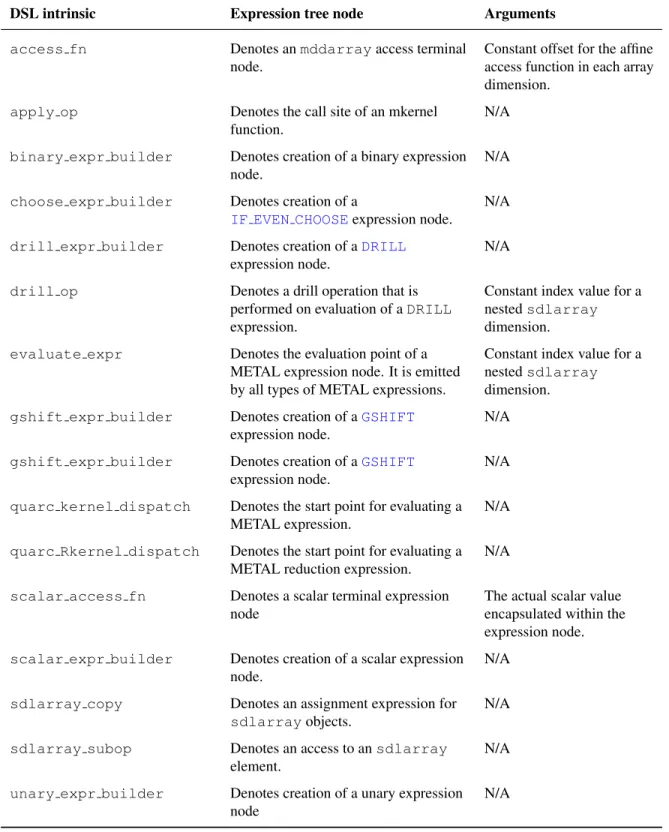
5.1 METAL DSL intrinsic functions . . . 54
6.1 QOPT analysis and code generation passes . . . 63
7.1 Evaluating all data-layout choices for 2D-Jacobi . . . 106
7.2 Calculated reuse distances and shuffle instructions for the{1024×512}sized 2D-Jacobi . . . 106
7.3 Evaluating the five best and five worst data-layout choices for 3D-Jacobi kernel . . . 107
7.4 Calculated reuse distances and shuffle instructions for the{128×64×64}sized 3D-Jacobi . . . 108
7.5 Evaluating the five best and five worst data-layout choices for WD kernel . . . 109
10.1 ICC vectorization v/s QOPT vectorization on Intel Skylake (AVX512) . . . 131
10.2 ICC vectorization v/s QOPT vectorization on Intel KNL (AVX512) . . . 131
LIST OF FIGURES
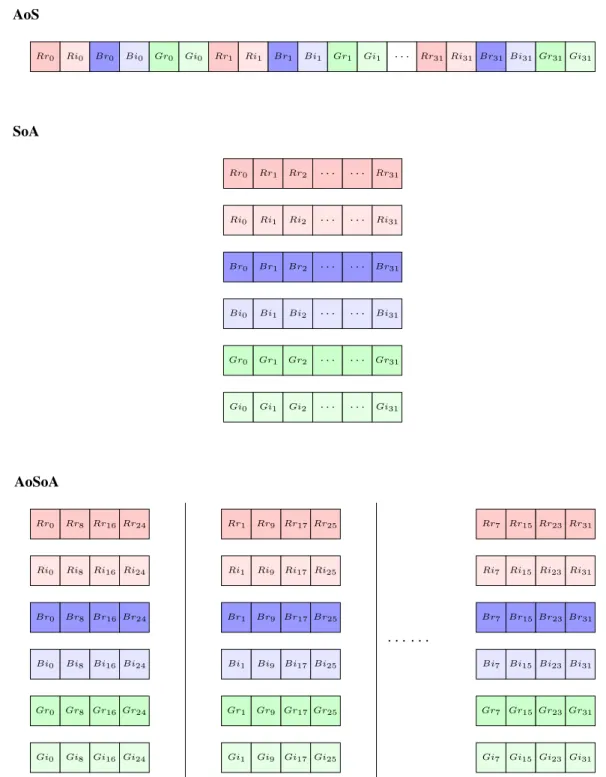
2.1 Array-of-Structs (AOS) versus Structs-of-Arrays (SOA) versus
Array-of-Structs-of-Arrays (AOSOA) . . . 15
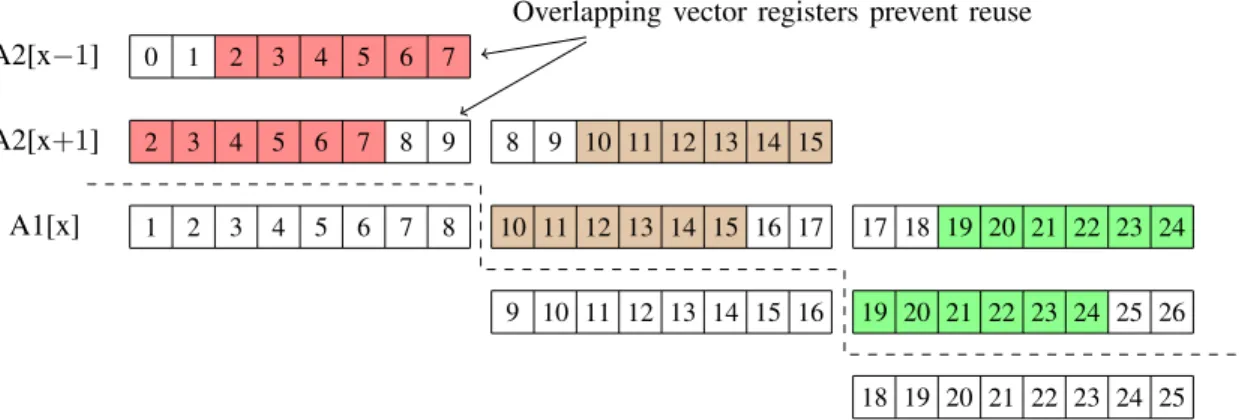
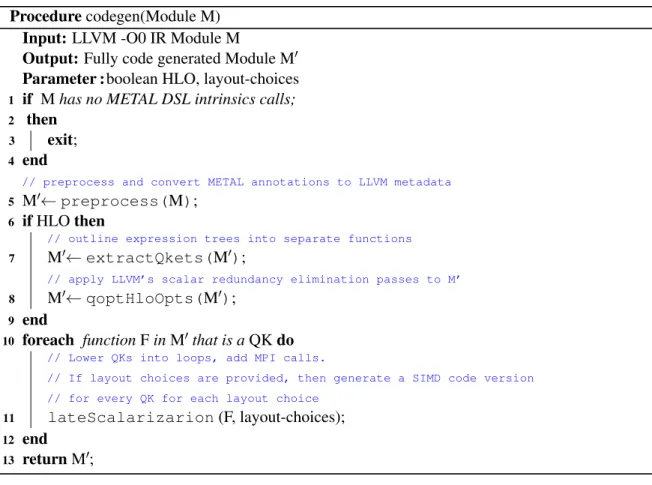
2.3 Improving SIMD vectorization after a data-layout transformation . . . 19
3.1 QUARC system architecture diagram . . . 22
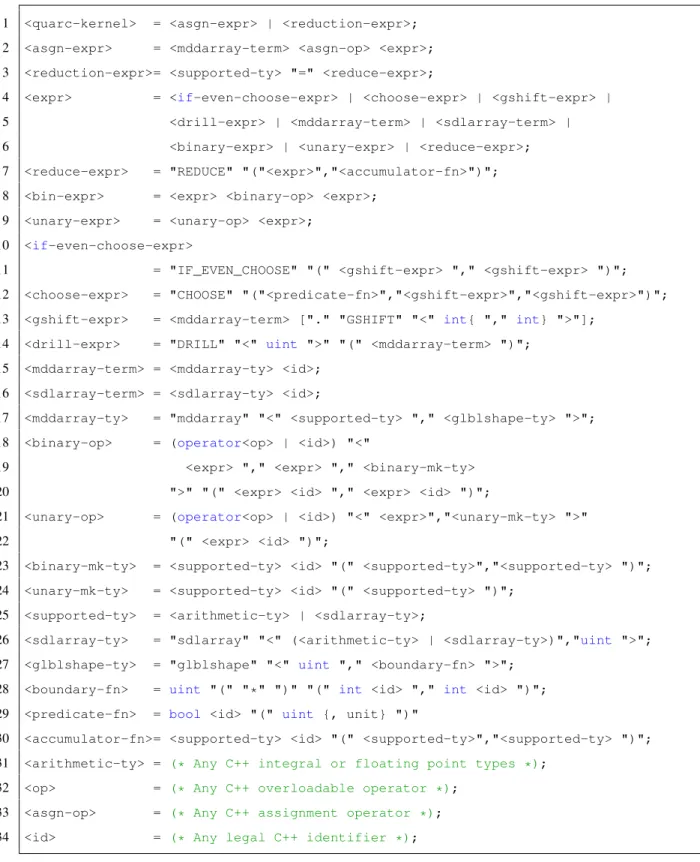
5.1 METAL’s EBNF grammar . . . 38
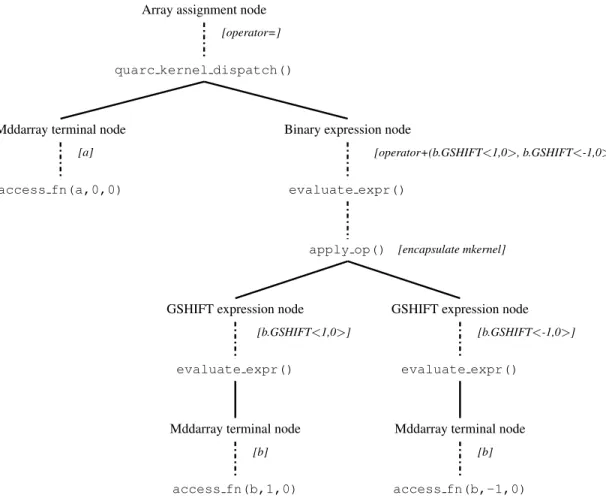
5.2 An example METAL binary expression tree . . . 52
5.3 Example of an ATL specification. . . 56
5.4 An example of an ATL specified block data-distribution. . . 57
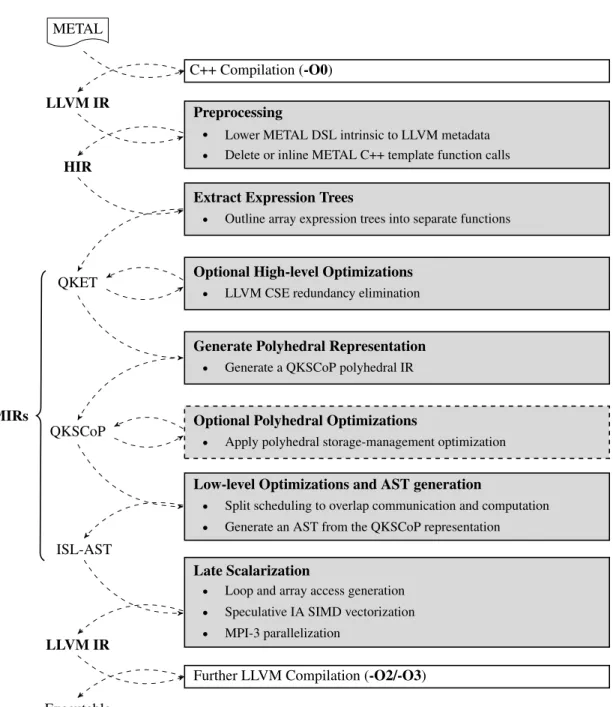
6.1 QOPT’s compilation pipeline . . . 60
6.2 Codegen shows at a high-level QOPT’s code generation process . . . 65
6.3 QOPT’s pre-processing pass . . . 69
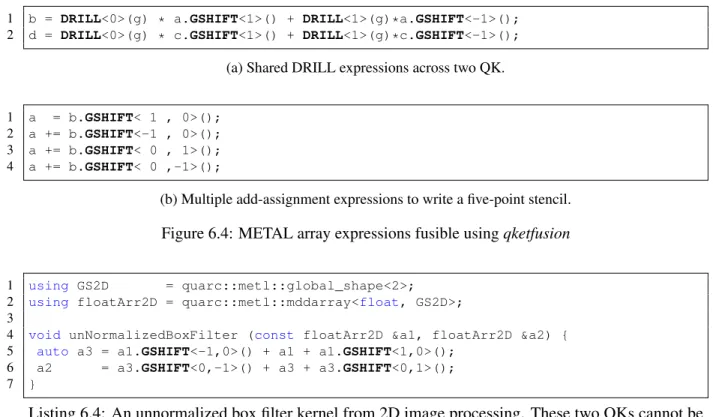
6.4 Examples of fusible METAL array expressions . . . 73
6.5 An example showing invalid scalarization of a METAL array assignment expression. . . 78
6.6 QOPT’s QKSCoP detection pass . . . 81
6.7 Steps involved in generating boundary region index sets from a vector of shift offsets. . . 82
6.8 Halo identification for multi-dimensional shifts . . . 83
6.9 Halo identification for array expressions with shifts . . . 85
6.10 Boundary domains and statements for a five-point stencil . . . 86
6.11 Basic block CFG for a typical QK . . . 88
6.12 QOPT’s QK expression tree code generation pass . . . 91
6.13 Handling boundaries within a SIMD vector tile . . . 94
8.1 Steps to select a set of data-layout candidates for a stencil kernel. . . 112
9.1 An illustrative four-dimensional even-odd preconditioned LQCD lattice. . . 117
9.2 High-level structure of the Wilson Dslash operator . . . 120
9.3 High-level structure of the KS Dslash operator . . . 122
9.4 Mkernel functions needed for the KS Dslash operator . . . 127
10.1 Single node Haswell comparison of QDP++ and QUICQ. . . 133
10.2 Single node KNL comparison of QDP++, QUICQ and QPhiX. . . 134
10.3 Single node comparison of MILC, QUICQ and QPhiX. . . 137
10.4 Evaluation of MILC and QUICQ’s conjugate gradient solvers and the complete su3 rmdsimulation on a single 48-core Skylake server. . . 138
LIST OF ABBREVIATIONS
ACT Abstraction Characterization Template
AOS Array-of-Structs
AOSOA Array-of-Structs-of-Arrays
ATL Array Transformation Language
C++ ET C++ Expression Template
DSL Domain-Specific Language
EDSL Embedded Domain-Specific Language
FLOP Floating-point Operations per Second
GPGPU General-purpose Graphical Processing Unit
HPC High-Performance Computing
IR Intermediate Representation
ISA Instruction Set Architecture
ISL Integer Set Library
JIT Just-in-Time
LHS Left-Hand Side
LQCD Lattice Quantum Chromodynamics
METAL Minimal Expression Template Array Language
MPI Message Passing Interface
MSP Multi-Staged Programming
QCD Quantum Chromodynamics
QOPT QUARC’s Optimizer
QUARC QCD’s Array-based Rapid-prototyping Compiler
QUARC-RT QUARC’s Runtime
QUICQ QUICQ Internally Calls QUARC
RHS Right-Hand Side
SIMD Single Instruction Multiple Data
SOA Structs-of-Arrays
CHAPTER 1: INTRODUCTION
This dissertation targets a long-standing challenge in High-Performance Computing (HPC), i.e. simultaneous achievement of programmer productivity and hardware computational efficiency. Our ap-proach is to develop a compiler for an Embedded Domain-Specific Language (EDSL) using a production compiler infrastructure (The LLVM Foundation, 2018). A unique innovation of this compiler is a frame-work for data-layout transformations to generate code competitive with the very best hand-optimizations. The breakdown of Dennard scaling (Dennardet al., 1974) in the early 2000’s capped air-cooled uniprocessor clock speeds at around 3GHz and marked the onset of chip multiprocessing. Consequently, shifts occurred in HPC hardware architectures and in parallel-programming models. A single node of a current-generation HPC cluster has complementary features, such as deeply nested cache hierarchies, multiple cores, simultaneous multithreading, short-vector Single Instruction Multiple Data (SIMD) units, and accelerators. The software stack consists of frameworks supporting various programming models, such as message-passing, shared-memory threads, and accelerator-based data parallelism. Such diversity offers more choices to application developers, but it greatly complicates extraction of high levels of portable performance from modern HPC systems. Application programming on today’s HPC systems requires programmers to mesh these disparate hardware and software components to boost performance. In addition, significant architecture-aware programming skills and domain-specific knowledge are both necessary. The deepening programming crisis calls for newer approaches in programming language design and in compiler technology. Development of such newer approaches is an increasingly important goal for the HPC research community (Department of Defense, 2001), especially given the current rush towards exascale computing.
General-legacy applications. The issue of code-tuning and rewriting also applies to non-General-legacy applications. Converting a prototype of an application to a production-grade HPC version generally involves an order of magnitude of growth in the lines of code. Thus, the net result is a high entry barrier to HPC programming that limits true accessibility of HPC platforms to a small niche of experts.
Performance portabilityis a set of closely related problems linked to the overall problem of code rewrite and re-implementation. For the very best performance, performance-tuning of an HPC application kernel by hand often requires architecture-specific optimizations. The specificity of such optimizations necessitate repeating the exercise on different architectures or generations of an architecture family. A notable example is hand-vectorization of code for different generations of x86 processors. Each generation of x86 has a different Instruction Set Architecture (ISA) extension to support SIMD vectorization that requires a rewrite of hand-vectorized codes before the code can make effective use of a newer ISA vector extension. Another aspect of performance portability is that hand optimizations are not directly portable across applications, or even across kernels within an application stack. Solving the issue of performance portability requires addressing all these related issues. A solution to the issue of performance portability is still missing in existing programming languages and frameworks. Often, the only recourse to high performance on different architectures is to write and maintain different versions of the application. The resulting code complexity means that many HPC applications bear little resemblance to the original abstract algorithms and are difficult, if not impossible, to understand for those domain experts who are not expert programmers.
existing high-level language to optimize, tune, and generate domain-specific code for a DSL embedded within that high-level language. C++ template metaprogramming is perhaps one of the most successfully adopted techniques for building EDSLs. Apart from C++ templates, other recent approaches have used Multi-Staged Programming (MSP) (Taha and Sheard, 1997) to build EDSLs on top of languages such as Scala (Oderskyet al., 2008) and Lua (LabLua, 2015). Chapter 2 explains these methods in detail.
EDSL designs, especially those based on purely generative methods, are not perfect. A significant limitation is the lack of important types of optimizations that require deeper compiler analysis than is possible inside the EDSL-layer. Analyses range from data-flow-based redundancy elimination optimization to much more intricate data-dependence-based loop optimizations. Code generated by some EDSL can also introduce obfuscations that impede low-level compiler optimizations. These obfuscations, such as address and loop linearization, can make it very hard, if not impossible, for any compiler to infer the programmer’s intent, inhibiting subsequent compiler-driven analysis and optimization.
Overcoming the limitations of EDSLs requires a new design approach. Such a design should extend the underlying host-language’s compiler be aware of EDSL domain-specific abstractions and constructs. With such a design the possibility exists of optimizing EDSL expressions using a wider range of standard compiler optimizations. A close coupling between the EDSL and the host-language compiler simplifies designing newer domain-specific optimization and code-generation techniques by reusing existing compiler infrastructure. Chapters 5 and 6 present such a new EDSL-design approach.
a new technique for EDSL code-generation that uses C++ template metaprogramming to encode a domain-specific Intermediate Representation (IR) inside a general-purpose compiler IR. The new metaprogramming technique simplifies the engineering of new domain-specific optimizations and code transformations on top of existing general-purpose compiler technology. We also introduce a data-placement abstraction technique that completely decouples architecture-specific data-distributions and data-layouts from application-level algorithms. Using these two innovations, we introduce a new SIMD auto-vectorization based on a data-layout transformation technique. For selected kernels form a large scale HPC application, the new auto-vectorization offered a factor of two performance improvement, while taking less than one-tenth the lines of code. Other innovations explained in Section 1.3 include automated code-generation from the same abstract high-level program for both multi-core and multi-node cluster, and a design for high-level optimization of EDSL constructs.
1.1 A Historical Perspective
Kennedyet al. (Kennedyet al., 2004) quantified computational productivity as a function of the amortized cost of preparing the program, the cost of running it, and the net present value of the results. The computational resources needed by some problems are minimal and the time to solution is not large. For such problems, it is ideal to minimize the programming costs by using an expressive scripting tool such as Python, Matlab, or R. At the other end of the spectrum, large computational campaigns may use many millions of CPU hours and the opportunity cost of waiting for an answer may be very large. In extreme cases,e.g., disaster forecasting or even responses to interactive queries, late answers may be useless. Such cases require uncompromised computational efficiency. There are even cases in which there is a need to program a new algorithm quickly for a large time-critical computation. Most large HPC applications lie somewhere between these extremes.
chips, multi-core/multi-threaded chips, and deeper, more complex coherent memory hierarchies, have exacerbated the problem.
Myers and Kennedy et al. addressed the same problem from different perspectives. Closing the semantic or productivity gap entails increasing the expressive power of the programming environment while simultaneously increasing the computational efficiency of programs.
Striking the right balance between expressiveness and computational efficiency has been a challenge since the first generation of computers. To incorporate expressiveness, programming systems have added layers of abstractions. In recent decades, innovations such as object-oriented and functional programming have greatly improved the tools available for abstraction. Unfortunately, multiple layers of abstraction and the resulting deep call chains, sometimes involving dynamic bindings, may decrease computational efficiency as measured in terms of the peak achievable architectural FLOPs rate. Generic and generative programming techniques,e.g., C++ template metaprogramming (Eisenecker, 1997; Bischofet al., 2004) and Template Haskell (Sheard and Peyton Jones, 2002) macros, mitigate aspects of this problem. MSP (Taha and Sheard, 1997), or staging, also has shown promise. From a code-generation perspective, Just-in-Time (JIT) compilation has been by far the most popular option. Many expressive high-level languages that support type introspection use JIT to enhance computational efficiency. Full-blown parallel programming languages such as the ones developed as part of United States Department of Defense’s Defense Advanced Research Projects Agency’s (DARPA) High Productivity Computing System (HPCS) project (Dongarraet al., 2008) are another alternative. These languages focus primarily on abstracting architecture-specific parallelization, making it easier to write parallel programs.
1.2 Thesis
applicability of the programming system. Close coupling of abstractions within the main programming interface is another issue, which leads to source code that has data-placement logic intertwined with application logic. Such entanglement impairs readability and overall portability of the code.
To mitigate these issues, our thesis is as follows.
A system of high-level data-placement abstraction based on a well-defined algebra can describe multiple layers of data-placement in relation to each other. Combining the data-placement mechanism with domain-specific code optimization and generation within a compiler can improve programmer productivity without loss in computational efficiency, reducing the semantic gap.
1.3 Contributions
In support of the thesis statement presented in Section 1.2 our dissertation makes the following main contributions.
• We implemented a C++-14 and LLVM-based EDSL compilation framework called QCD’s Array-based Rapid-prototyping Compiler (QUARC) that serves as a proof-by-example of our thesis.
– To demonstrate QUARC’s capability, we implemented a prototype EDSL for the HPC domain of Lattice Quantum Chromodynamics (LQCD). The performance of selected kernels implemented in this EDSL, QUICQ Internally Calls QUARC (QUICQ), was up to two times better than that of an existing production application called MILC (MILC collaboration, 1992). The kernels implemented in QUICQ also took less than one-tenth the lines of code when compared to MILC. QUICQ’s performance was up to 10 times better than that of an existing production DSL in LQCD, QDP++ (Edwards and Jo´o, 2005). QUICQ also was competitive with the best hand-optimized kernels for the evaluated set of examples.
• We implemented an array index-space transformation algebra to define data-placement abstrac-tions. Using the algebra, it is possible to define abstractions both for layouts and for data-distributions.
– The same high-level code executes in parallel on a single multi-core server or on a multi-node cluster by changing runtime data-placement specifications.
• We introduce an external policy-driven speculative SIMD auto-vectorizer.
– Speculative SIMD vectorization frees application programmers from having to make data-layout choices in their application code. External agents, such as an autotuner, or a low-level expert, can make the layout selection at runtime.
– We introduce a data-layout selection policy for higher-order stencil kernels. A stencil kernel is an iterative computation used in various scientific computations such as partial differential operators and image-processing. The term “stencil” refers to updating an array element according to a fixed computational pattern involving neighboring array elements in the same or in a separate array.
• We introduce a new technique for building C++-based EDSLs.
– The new technique, Abstraction Characterization Templates (sACTs), uses metaprogramming
to generate a domain-specific IR from standard C++ templates.
– We demonstrate the efficacy of delayed or latescalarizationof array expressions. In QUARC, scalarization does not happen inside C++ templates, and is done as late as possible in the code-generation process. This facilitates improved compiler analysis and optimization.
– We introduce a design for using scalar data-flow optimizations to optimize EDSL constructs.
1.4 Dissertation Overview
This rest of the dissertation provides the motivation, design considerations, implementation details, and evaluation of the QUARC framework as follows:
Chapter 4presents a formalization of the array index-space transformation algebra. The chapter discusses these operators in general, without focusing on any aspect of their use in QUARC. Readers with experience using APL or other array programming language already should be familiar with most of the concepts. They can refer to Section 4.1.2 for the specific differences between our operators and the more general APL counterparts.
Chapter 5 presents QUARC’s programming interface (METAL), describing the C++-14-based data-parallel array operators and the overall API to construct EDSLs. Section 5.1 includes a detailed guide to METAL’s syntax, and is aimed at programmers. General audiences may skip this chapter. Section 5.2 describes the ACT’s design pattern and its use for preserving high-level semantics inside METAL. Section 5.3 describes QUARC’s data-placement abstractions (ATL).
Chapter 6describes in detail our LLVM-based domain-specific compiler’s design and implementa-tion. It also describes a small runtime library interface for automating Message Passing Interface (MPI) communication-generation. The chapter explains each stage of the code-generation and optimization pipeline, including the late scalarization approach, in detail.
Chapter 7presents an empirical performance analysis of the impact of different data-layout choices on the SIMD vectorization performance of stencil computations. The study was conducted for multiple generations of Intel x86-based architectures. We discuss the data-layout characteristics that drive SIMD vectorization performance and the trade-offs required to ensure high performance.
Chapter 8presents a data-layout selection policy based on the empirical study in Chapter 7. QUARC uses the policy in its speculative SIMD vectorization technique.
Chapter 9presents the steps involved in developing an EDSL for LQCD. Section 9.1 introduces the domain of LQCD, and then Section 9.2 shows the main excerpts of our EDSL implementation. The goal of this chapter is to evaluate the overall productivity gained in terms of lines of code by using this EDSL, when compared to an existing production application developed in C.
Chapter 10 evaluates the performance of our LQCD DSL by comparing it both to an existing C++-based production DSL and to a legacy application written in C. Wherever available, both sets of evaluation include the very best hand-optimized implementations as the standard of peak performance.
Chapter 11surveys further related work in various areas of relevance to QUARC.
CHAPTER 2: BACKGROUND AND MOTIVATION
Designing a DSL for an HPC domain involves several important design considerations. This chapter reviews the choices, emphasizing code-generation methods and data-placement abstractions for domain-specific abstractions.
2.1 EDSL Code-Generation
Contemporary HPC DSLs fall into two broad categories: standalone DSLs, and EDSLs that are embedded inside a high-level host language. Examples of standalone DSLs are the numerical analysis DSLs Matlab (MATLAB, 2010), Julia (Bezansonet al., 2017), the machine-learning DSL Glow (Rotemet al., 2018). Prominent EDSLs are Halide (Ragan-Kelleyet al., 2013) an image-processing DSL, SPIRAL (P¨uschel et al., 2005) a DSL for signal processing, and QDP++ (Edwards and Jo´o, 2005), a DSL for LQCD. Our present discussion defines EDSLs as those languages whose syntax does not differ from the host languages,i.e., every EDSL program is a completely legal host language program. Such characterization of an EDSL excludes language extensions such as CUDA C (NVIDIA Corporation, 2010), OpenMP (OpenMP Architecture Review Board, 2015), OpenCL (Stoneet al., 2010) and OpenACC (OpenACC.org, 2013). All these language extensions introduce new keywords, data types, and annotations. All require custom parsers and compilers.
quicker design and development turnaround times, and thus present a more viable option. This chapter focuses exclusively on EDSL development methodologies.
There are several methodologies to construct EDSLs. Each methodology uses a different approach to detect EDSL code sections embedded inside a host language program and to generate domain-specific code for those EDSL sections. Metaprogramming within the host language, through custom source-to-source translation, and utilizing staging are some of the most successful EDSL methodologies. The following paragraphs review these methodologies.
Metaprogrammingis a programming technique in which programs treat themselves or other pro-grams as data. Using metaprogramming, a program generates code during compilation of itself, and merges the generated code with the rest of its source code. Lisp and its dialects were the earliest exponents of metaprogramming. Lisp (LISt Processor) treats source programs as linked lists of data structures. Using Lisp’s macro system, programmers canintrospecttheir programs as a list of data structures. Related macro systems have evolved in other programming languages as well,e.g., Template Haskell (Sheard and Peyton Jones, 2002), Scala (Oderskyet al., 2008), and Clojure (Rich Hickey, 2007). Generative programming(GP) is another term closely associated with metaprogramming. Czarnecki and Eisenecker (Czarnecki and Eisenecker, 2000) described GP as an attempt to automate creation of soft-ware components by developing programs that synthesize other programs. Template Metaprogramming (TMP) falls into this category. Templates are program constructs that are written without binding them to specific data types. The data types are specified later as a specialization of the template. TMP was pioneered by ML, a language derived from Lisp. Since templates are written with generic types rather than with concrete types, TMP is often also calledgeneric programming. The most popular use of TMP is found in C++. C++ TMP is widely used in C++’s standard library. C++ TMP-based methods such as C++ Expression Templates (sC++ ETs) (Veldhuizen, 1995; Vandevoorde and Josuttis, 2002) are also widely used to create EDSLs. C++ ETs use TMP to buildexpression objectsthat abstract complicated loop structures. Template expansion and specialization are used to synthesize loops for different data types and architectures without direct programmer involvement. C++ ETs has been used to develop HPC DSLs (Edwards and Jo´o, 2005; Parsons and Quinlan, 1994; Reynders and Cummings, 1998), where C++ ETs automate MPI, OpenMP, or CUDA code-generation.
that require data dependence-based analysis are hard, if not impossible, to incorporate using C++ TMP. C++ TMP also cannot apply high-level optimizations, such as expression fusion and other redundancy elimination, across multiple template statements. C++ TMP code-generation is limited to a single template recursion chain. For these reasons, C++ TMP may be used to synthesize parallel loops, but the performance often falls short of the level obtained by the very best hand-tuned libraries. Additionally, obfuscations introduced by C++ TMP can also impede subsequent compiler analysis and optimization. Multistage programming (MSP)(Taha and Sheard, 1997), or staging, is a special case of
metapro-gramming that involves staging of portions of code for evaluation and compilation at a later phase. Phased, or partial, evaluation is beneficial for scenarios in which information about a program only becomes available at a later phase. A good example is type information in dynamically typed languages. MSP can have both compile-time and runtime stages.
MSP is the basis for recent HPC DSL frameworks like Delite (Sujeethet al., 2014) and Terra (DeVito et al., 2013). Delite is an EDSL on top of Scala (Oderskyet al., 2008), a hybrid object-oriented functional language that runs on the Java Virtual Machine (JVM). Delite uses a modified Scala compiler and MSP to generate a domain-specific IR embedded into Scala’s byte code. Delite’s compiler optimizes this domain-specific IR, before generating architecture-specific parallel code. Terra is a low-level language specifically designed for MSP in Lua (LabLua, 2015), a dynamically typed functional programming language. Terra’s design envisions two-level staging. At first, a program is implemented in Lua for rapid prototyping, and then performance-critical sections are staged as Terra code. The Terra compiler uses dynamic staging to enable runtime feedback-driven optimizations and auto-tuning. Chapter 11 expands our discussion of Delite and Terra.
the domain-specific IR back into the regular host language IR or directly to low-level code. It is not trivial to ensure guaranteed type-safety during these code-generation steps, especially when MSP is used inside a dynamically typed language. Addressing the type-safety issue was one of the major emphases of the Terra framework. Terra required static type information to be added to every staged library function call within the dynamically typed Lua language. Beyond maintaining type-safety, extending the domain-specific IR of an MSP compiler requires significant engineering work. Often, that engineering work involves rewriting a lot of the same boilerplate. The recent Forge framework (Sujeethet al., 2013) targets this issue within the Delite framework.
Split-languagescan also fall under the purview of metaprogramming, but we choose to categorize them separately to highlight the use of two separate programming interfaces in split-languages. The two programming interfaces of a split-language separate domain-specific algorithms from architecture-specific code-generation decisions. The domain-architecture-specific programming interface is embedded into a host language, and a separate specification language drives architecture-specific code-generation. Notable examples of EDSLs using a split-language design are Halide (Ragan-Kelley et al., 2013), SPIRAL (P¨uschel et al., 2005), and Sequoia (Fatahalian et al., 2006). All three languages are programmed in C++/C, but use standalone specification languages for code-generation decisions. The standalone code-generation specification interface is a main feature of these EDSLs. Using the separate interface, a set of domain experts can rapidly prototype the algorithmic portions of an application. After that another set of experts can tune the application by building an architecture-specific code-generation specification.
Despite their elegance, split-languages have potential pitfalls. Often, the code-generation specifica-tion is too intricate for the average domain expert, and a separate set of experts to write the code-generaspecifica-tion specifications are not available. Even when experts to write code-generation specifications are available, the best specification may require exhaustive searching of a large optimization space. Thus, the challenge lies in splitting the two programming layers without over-complicating the code-generation specification layer. The authors of Halide acknowledge the problem in their recent follow-up paper (Ragan-Kelley et al., 2017). While the core Halide language is highly expressive and easy to learn for domain experts, the programming schedules remains hard for most programmers.
translation is a technique in which the DSL code is translated into a low-level language like C/C++ or FORTRAN. The translated code then is compiled using a standard compiler.
2.2 Data Placement Abstractions
Data placement refers to the organization of a program’s data across a memory domain. For modern HPC architectures, this can occur at multiple levels. Data placement across multiple nodes of a cluster is called data-distribution or data partitioning. The organization of the members of a data structure inside a shared-memory domain is called memory data-layout. The various levels of data-placement have to perform well in conjunction with each other. Together, they control data-movement-related costs and significantly impact a program’s overall performance.
The importance of data placement is closely tied to thelocality of reference. Denning and Schwartz (Denning and Schwartz, 1972) first observed that programs repeatedly access same or related storage locations, and called the locality of reference. A significant number of optimizations, both in software and hardware, are designed to exploit locality of reference. Such features include deeply nested multiple levels of caches, branch predictors, and prefetchers. Operating systems tailor their virtual memory sub-system and paging policies to depend on locality of reference. Important compiler optimizations such as loop tiling, loop fusion, and software prefetching work with the hardware layers to exploit locality of reference.
Several programming languages have explicit data-placement options using abstractions both for data-distribution and for data-layout. We next survey examples of both types of abstraction.
Data-Distribution Abstractions
(El-1998), all began as extensions to existing sequential languages. The initial implementation did not offer much support for controlling data-distributions. Later enhancements added abstractions that provided support for data-distributions, such asblockingof arrays. Closely related to the PGAS languages are those developed as part of DARPA’s High-Productivity Computing System (HPCS) project (Dongarraet al., 2008). The three HPCS languages, X10 (Charleset al., 2005), Fortress (Allenet al., 2008), and Chapel (Chamberlainet al., 2007), offered different levels of support for data-distributions. Fortress allows libraries to define custom data-distributions for arrays. X10 supports distributed arrays that can be blocked across multiple processes. Chapel offers the most flexibility for array-data distributions. It supports a set of data-distribution choices, but also allows defining application-specific custom data-distributions.
A common limitation of most of these languages is the close coupling of data-placement abstractions with the core language semantics. The close coupling means that data-placement abstractions are inherently intertwined with application-level algorithms. Experimenting is hard with different distribution options without first altering the source code. The code entanglement also limits portability, and restricts evolving an old code to a newer architecture.
A more modern framework, Legion (Baueret al., 2012), simplifies the problem of separating data placements from the rest of the application logic. Legion’s programming model is built around the notion oflogical regions. A logical region is a logical data partition, and the smallest unit for data-distribution in Legion’s programming model. Every logical region defines its access privileges, aliasing, and coherence properties. The properties of a logical region decide the level of concurrent accesses possible on the logical region. Legion programs are composed oftasks, each of which accesses logical regions. By performing a task-dependence analysis, Legion’s runtime system schedules parallel execution of tasks. Tasks can execute on different nodes of a cluster, a node-attached accelerator, or multiple cores of a node. Programmers retain control of how the data is partitioned and of the mapping of the data partitions to processors. The mapping interface is decoupled from the rest of the application programming interface. Therefore, data-placement logic is separated from the main application logic, and provides flexibility in extending an existing application to a new architecture.
Data-Layout Abstractions
appli-AoS
SoA
AoSoA
Rr0 Ri0 Br0 Bi0 Gr0 Gi0 Rr1 Ri1 Br1 Bi1 Gr1 Gi1 . . . Rr31 Ri31 Br31 Bi31 Gr31 Gi31
Rr0 Rr1 Rr2 . . . Rr31
Ri0 Ri1 Ri2 . . . Ri31
Br0 Br1 Br2 . . . Br31
Bi0 Bi1 Bi2 . . . Bi31
Gr0 Gr1 Gr2 . . . Gr31
Gi0 Gi1 Gi2 . . . Gi31
Rr0 Rr8 Rr16 Rr24
Ri0 Ri8 Ri16 Ri24
Br0 Br8 Br16 Br24
Bi0 Bi8 Bi16 Bi24
Gr0 Gr8 Gr16 Gr24
Gi0 Gi8 Gi16 Gi24
Rr1 Rr9 Rr17 Rr25
Ri1 Ri9 Ri17 Ri25
Br1 Br9 Br17 Br25
Bi1 Bi9 Bi17 Bi25
Gr1 Gr9 Gr17 Gr25
Gi1 Gi9 Gi17 Gi25
. . . .
Rr7 Rr15 Rr23 Rr31
Ri7 Ri15 Ri23 Ri31
Br7 Br15 Br23 Br31
Bi7 Bi15 Bi23 Bi31
Gr7 Gr15 Gr23 Gr31
Gi7 Gi15 Gi23 Gi31
cation’s performance, and for this reason there has been significant amount of research to optimize data-layouts. Andersonet al. (Andersonet al., 1995) used data-layout transformation to address false sharing in cache-coherent shared-memory multiprocessors. Luet al. (Luet al., 2009) used an approach like Andersonet al., but for improving the locality on a prototype non-uniform cache-access architecture. Baruaet al. (Baruaet al., 1999) and Soet al. (Soet al., 2004) proposed data-layout transformations to improve memory-level parallelism on FPGAs. Both methods transform the data-layout of an array to interleave elements across multiple on-chip memory banks. Sung (Sunget al., 2010) targeted structured grid applications on many-core and GPGPU platforms. Henretty (Henretty et al., 2011) looked at data-layout transformations to improve short-vector SIMD vectorization.
Programming systems for modern architectures are increasingly exploring data-layout options to improve application performance. Figure 2.1 illustrates three data-layout options, AOS, SOA, and Array-of-Structs-of-Arrays (AOSOA), for a one-dimensional array. Each choice has its advantage, the SOA data-layout is generally better for SIMD vectorization, the AOS data-layout has better spatial locality, especially if neighboring array elements are accessed together, the AOSOA data-layout strikes a balance between AOS and SOA. The performance of a data-layout depends on various factors, including array size, data access patterns, and hardware architectural properties. Several recent performance studies (Rosales et al., 2016; Giles et al., 2013) have argued for the inclusion of these type of data-layout optionsviaeither library-based abstractions or language extensions. Still, these layout choices have limitations, such as they do not allow arbitrary splitting and transposition of array dimensions. For higher-dimensional arrays, the lack of the feature to arbitrarily split and transpose array dimensions limits the number of data-layout choices. Such layout choices are required for some kernels and some architectures. Section 2.3 presents such a scenario.
2014) supports custom data-layouts other than Array-of-Structs (AOS) and Structs-of-Arrays (SOA) for multi-dimensional arrays.
Conclusion
Our work looks at a general system of data-placement abstractions that is usable for defining both data-layouts and data-distributions. Chapter 4 presents the array index-space transformation algebra that is the basis of our data-placement abstractions. The implementation of the abstractions is in Section 5.3, and code-generation based on the abstractions is described in detail in Chapter 6.
2.3 Motivating Example
This section presents a motivating example that highlights the need for data-layout transformations to improve the SIMD vectorization performance of stencil computation on an Intel Haswell server. Although this example uses a single server, the observations apply to other recent x86-based server architectures. Stencil computations are one of the most important computational patterns in scientific computation and HPC (Asanovicet al., 2009). Stencils are iterative computations that update each array element according to a fixed computational pattern involving its neighboring array elements. Listing 2.1 presents a nine-point scalar stencil computation over a four-dimensional regular grid. The loop-nest shown in the example is perfectly nested and completely parallel, and is an ideal candidate for fine-grained inner-loop parallelization or vectorization.
Auto-vectorization
1 constexpr std::size_t T = 32, Z = 32, Y = 32, X = 32;
2
3 void stencil_9pt (float * restrict A1, const float * restrict A2) {
4 for(auto t = 1ul; t < T-1; ++t)
5 for(auto z = 1ul; z < Z-1; ++z)
6 for(auto y = 1ul; y < Y-1; ++y)
7 for(auto x = 1ul; x < X-1; ++x) {
8 A1[t*Z*Y*X + z*Y*X + y*X + x]
9 = A2[(t-1)*Z*Y*X + z*Y*X + y*X + x]
10 + A2[(t+1)*Z*Y*X + z*Y*X + y*X + x]
11 + A2[t*Z*Y*X + (z-1)*Y*X + y*X + x]
12 + A2[t*Z*Y*X + (z+1)*Y*X + y*X + x]
13 + A2[t*Z*Y*X + z*Y*X + (y-1)*X + x]
14 + A2[t*Z*Y*X + z*Y*X + (y+1)*X + x]
15 + A2[t*Z*Y*X + z*Y*X + y*X + x - 1]
16 + A2[t*Z*Y*X + z*Y*X + y*X + x + 1];
17 }
18 //... Elided boundary region computations
19 }
Listing (2.1) A nine-point scalar stencil
1 # shape of arrays A1,A2 is {T-Z-Y-X}. X is the fastest changing dimensions.
2 vmovups 4228+A2(...), %ymm0 # (t-1) from 0*Z*Y*X + 1*Y*X + 1*Y + 1*X
3 vmovups 131204+A2(...), %ymm1 # (z-1) from 1*Z*Y*X + 0*Y*X + 1*Y + 1*X
4 vmovups 135172+A2(...), %ymm4 # (y-1) from 1*Z*Y*X + 1*Y*X + 0*Y + 1*X
5 vmovups 135296+A2(...), %ymm5 # (x-1) from 1*Z*Y*X + 1*Y*X + 1*Y + 0*X
6 vaddps 266372+A2(...), %ymm0, %ymm2 # (t+1) from 2*Z*Y*X + 1*Y*X + 1*Y + 1*X
7 vaddps 139396+A2(...), %ymm1, %ymm3 # (z+1) from 1*Z*Y*X + 2*Y*X + 1*Y + 1*X
8 vaddps 135428+A2(...), %ymm4, %ymm6 # (y+1) from 1*Z*Y*X + 1*Y*X + 2*Y + 1*X
9 vaddps 135304+A2(...), %ymm5, %ymm7 # (x+1) from 1*Z*Y*X + 1*Y*X + 1*Y + 2*X
10 vaddps %ymm7, %ymm6, %ymm9
11 vaddps %ymm3, %ymm2, %ymm8
12 vaddps %ymm14, %ymm13, %ymm2
13 vaddps %ymm9, %ymm8, %ymm10
14 vmovups %ymm10, 135300+A1(...) # (x) from 1*Z*Y*X + 1*Y*X + 1*Y + 1*X
Listing (2.2) AVX2 assembly generated by ICC 17.04
Hand-vectorization after data-layout transformation
A2[x−1]
A2[x+1]
A1[x]
Overlapping vector registers prevent reuse Default lexicographic indexing
0 1 2 3 4 5 6 7 8 9 10 11 12 13 14 15 16 . . . 28 29 30 31
0 1 2 3 4 5 6 7
2 3 4 5 6 7 8 9
1 2 3 4 5 6 7 8
8 9 10 11 12 13 14 15
10 11 12 13 14 15 16 17
9 10 11 12 13 14 15 16
17 18 19 20 21 22 23 24
19 20 21 22 23 24 25 26
18 19 20 21 22 23 24 25
(a) Default vectorization with row-major layout
A2[x−1]
A2[x+1]
A1[x]
(x−1) vector reused after two iterations, but needs a permute
(x+1) vector reused after two iterations Custom data-layout after reshaping and transposing the X-dimension
0 4 8 12 16 20 24 28
1 5 9 13 17 21 25 29
2 6 10 14 18 22 26 30
3 7 11 15 19 23 27 31
0 4 8 12 16 20 24 28
2 6 10 14 18 22 26 30
1 5 9 13 17 21 25 29
1 5 9 13 17 21 25 29
3 7 11 15 19 23 27 31
2 6 10 14 18 22 26 30
2 6 10 14 18 22 26 30
4 8 12 16 20 24 28 0
3 7 11 15 19 23 27 31
(b) Custom vectorization after a data-layout transformation
Discussion
Figure 2.3a illustrates why custom vectorization after a data-layout transformation is an improvement over auto-vectorization over the default data-layout. In the default case, the two SIMD registers for the
A2[x+1]andA2[x-1]shares multiple elements. The overlap of the data in SIMD registers limits reuse of the registers. Figure 2.3b shows the data reorganization done by the data-layout transformation. The layout transformation is akin to agather-scatterreorganization of the array elements. The effect of this transformation creates a two-dimensional tiled vector data-layout. The tiled data-layout ensures that each register in a tile has multiple reuses. The internal rows are directly reused after one iteration, and the only SIMD permutations needed are at the boundaries of the vector tile. The data-layout transformation is the primary reason why our custom hand-vectorization outperforms the existing compiler auto-vectorization for this stencil computation. Applying this type of data-layout transformation by hand is not feasible, it requires low-level programming skills and is error-prone. The low-level code offers minimal portability as each architecture has a different vector instruction set extension.
Chapter Review
CHAPTER 3: THE QUARC FRAMEWORK
QCD’s Array-based Rapid-prototyping Compiler (QUARC) is a framework for creating EDSLs using C++14 for lattice and grid-based domains (Debet al., 2016, 2017). QUARC consists of a high-level programming interface embedded in C++14, a domain-specific compiler that uses LLVM (The LLVM Foundation, 2018), and a runtime library for MPI parallelism. Figure 3.1 presents QUARC’s high-level system architecture. QUARC’s front-end has a split-language programming interface with two pro-gramming layers: Minimal Expression Template Array Language (METAL) and Array Transformation Language (ATL). METAL is the interface to build EDSLs using QUARC, and is a notational, array-based, implicitly data-parallel C++14 header-only library. METAL programs are free of explicit parallel constructs and make it easy for domain-experts to write readable code. ATL is a small specification language based on YAML (Oren Ben-Kiki, Clark Evans, Brian Ingerson, 2009). ATL specifications define the data-distribution and data-layout of abstract METAL arrays.
QUARC uses a domain-specific compiler, QUARC’s Optimizer (QOPT), to compile METAL programs. QOPT is a plug-in to the LLVM compiler framework that defines a set of domain-specific analysis and code-generation passes. QOPT passes execute before the standard LLVM compiler passes and lower METAL abstractions into standard LLVM IR. This step involves domain-specific optimizations, MPI library call generation, SIMD vectorization, array access linearization, and loop generation. After compiling the high-level METAL code, QOPT invokes the standard LLVM optimization and code-generation passes to optimize the code further and to lower it to a binary executable.
QUICQ
METAL
QUARC-RT
C++14 stdlib
MPI-3
ISL clang++
Policy Engine
Layout Dictionary
opt
llc *.exe
DSLs
QUARC
QOPT
External libraries
preprocess
high-level opt.
low-level opt.
codegen
Link dependency Include dependency Process flow
LLVM component
3.1 EDSL Design Approach
QUARC’s EDSL design approach combines the best ideas in several established EDSL techniques, such as metaprogramming and split-languages. Chapter 2 surveyed these EDSL code-generation techniques. Although based on established ideas, QUARC’s EDSL design approach has important enhancements that we list in this section.
QUARC uses C++ TMP to implement its METAL front-end. However, the use of C++ TMP differs from conventional C++ TMP-based EDSL designs. Conventional C++ TMP-based EDSLs generate low-level code using TMP. METAL takes an alternative approach, and uses C++ TMP to generate a domain-specific IR. The domain-specific IR consists of a set of side-effect-free domain-specific function calls. Using this approach, METAL communicates much of the high-level domain-specific semantics to QOPT. QOPT then uses the information for high-level optimizations on domain-specific constructs, and generates data-parallel code.
QUARC’s approach bears similarities to MSP. Like most MSP-based methods, QUARC involves multiple levels of staging and code-generation. Our design offers a novel way of staging a domain-specific IR using side-effect-free domain-specific function calls inside an industry-standard compiler IR. These domain-specific function calls are equivalent to staging annotations in MSP. QUARC’s domain-specific IR is legal LLVM IR, and as such, is analyzable via standard LLVM compiler passes. Analyzing a domain-specific IR using standard compiler passes makes it easier to implement domain-specific optimization and code-generation passes, and lowers the overall engineering cost of QOPT.
QUARC’s use of the split-language design is limited when compared to those of other EDSLs frameworks that take a similar design approach. Other frameworks such as Halide and SPIRAL offload a significant chunk of the code generation logic into the specification layer of the split-language interface. The ATL interface is much smaller in comparison, and exposes as little as possible of the code-generation process to end users. Instead, QUARC leverages standard compiler analysis to make domain-specific code-generation decisions.
vectorized versions of each METAL array expression based on different data-layout choices. The layout choices are provided as compiler flags to QOPT. The decision to use ahead-of-time code-generation instead of JIT compilation was based primarily on the ease of implementation. Integrating a JIT compiler into QUARC-RT would have entailed additional software engineering work, with minimal benefit for current use cases. It is a case for future consideration.
3.2 Parallel Programming Model
QUARC has an implicit data-parallel programming model exposedviaMETAL’s array program-ming interface. METAL is free of explicit parallelization constructs; therefore, programmers do not have to reason about actual data-parallel execution of their application-level code. Instead, the ATL-specified data placement of an application’s array-data types decides the parallel execution. Due to this programming model, programmers can adapt the execution of their application by only changing the ATL specification. Depending on the type of ATL specification, the same application can execute in serial, in parallel on multiple cores, or in parallel across distributed memory nodes.
The implementation of QUARC relies on MPI. Thus, QUARC shares MPI’s memory model. All participating processors have their own private address spaces, and explicit communication is needed to move data among processors. QUARC-RT internally uses various optimizations to ensure that the communication overheads remain low. Chapter 6 explains these optimizations in detail.
3.3 The Core Components of QUARC
3.3.1 Minimal Expression Template Array Language (METAL)
METAL’s semantics are similar to other languages supporting array objects, such as FORTRAN 90 and High-performance FORTRAN (HPF). METAL behaves as though it fully evaluates the Right-Hand Side (RHS) of an array-assignment expression without side effect, and only then modifies the Left-Hand Side (LHS) sub-expression of an array-assignment. Chapter 5 presents the METAL language, its design, and its implementation details.
3.3.2 Array Transformation Language (ATL)
ATL is a small specification language based on YAML that specifies data placement of high-level METAL arrays. An ATL specification serves three main purposes: it specifies the data-distribution of an array, it specifies the data-layout of the array, and it specifies the mapping of the array blocks, or partitions to an MPI Cartesian communicator. Section 5.3 presents the implementation details of ATL. Chapter 4 presents the underlying algebra that ATL uses to define data-distributions and data-layouts.
3.3.3 QUARC Optimizer (QOPT)
QOPT is an LLVM-based domain-specific compiler for METAL, and is a plug-in of LLVM’s Opt module. QOPT handles all low-level code-generation and parallelization decision for every METAL array expression. In the current implementation of QUARC, this includes speculative SIMD vectorization on x86 64 platforms, shared-memory parallelism using MPI-3, distributed memory parallelism using MPI-2, and other low-level optimizations. Chapter 6 presents the details of these optimizations, along with a detailed elucidation of QOPT’s design and implementation.
3.3.4 QUARC Runtime (QUARC-RT)
CHAPTER 4: AN ALGEBRA FOR ARRAY TRANSFORMATIONS
QUARC’s data-placement abstractions are based on a more general array-transformation algebra. This chapter presents the formal semantics, legality constraints, and composability rules of this algebra. The algebra defines array index-space transformations using two operators,reshape(ρ) andtranspose (φ). Aρtransformation reshapes array dimensions by partitioning existing dimensions, and creates a partitioned index-space. Theφtransformation permutes array dimensions. Reshaping and permuting dimensions create new array index-spaces. Theρφalgebra does not specify how an array index-space is mapped to a memory address space. Instead, it specifies how to generate a map between an initial index-space and a transformed index-space. Language implementations on top of this algebra must generate the needed data transformations based on the index-space maps.
QUARC’sρandφoperators resemble similarly named operators defined by APL (Iverson, 1962) and by other array programming languages. However, QUARC’s definition and usage of these operators differ from those of other array languages. Section 4.1.2 notes the differences.
Notation.We use the following notation to describe formally QUARC’s array-transformation algebra. Lower-case Greek letters identify operators. All operators are written in C/C++ function-call syntax. As in C++, the term “vector” is used for a one-dimensional sequence container. Some of our array notations follow the style of Mullin’s Mathematics of Arrays (Mullin, 1988). We use angle brackets, hi, to represent vectors. Parentheses( )denote arrays. For arrays with more than two dimensions, the parentheses are nested. The uppercase letterArepresents a typical QUARC array container wherever it is used in a definition. We use the notationAnwherever the dimensionality of an array is mentioned,n being the number of dimensions of the array. The lowercase lettervrepresents an arbitrary vector. Array and vector indices are zero-based and are read from left to right. The usual C/C++ subscript operator[]
4.1 Basic Operators
Definition 4.1. Dimensionality(δ(A))
The unaryδoperator returns the rank or dimensionality of an array.
δ(An)=∆n. (4.1)
Definition 4.2. Shape(σ(A))
The unaryσoperator takes either an array or a vector as its argument. For an array, it returns as a vector the number of components in each dimension of the array. For a vector argument,σreturns the total number of elements in the vector.
σ(A)=∆ s=∆he0, . . . , e(δA)−1i. (4.2)
The components of vector,s, are positive integers. Each component gives the extent of an array dimension. As QUARC does not support zero-ranked arrays, each component ofsmust be a positive integer greater than one,i.e.,∀i, s[i]>1.
Note.APL users would recognizeσas the same operator as APL’s monadicρshape operator. We chose to use a different symbol to avoid confusion with the dyadicρreshape operator.
Example 4.1.
For the following two-dimensional array
A=∆
a b c d
e f g h
i j k l
,
σ(A)=∆h3,4i.
Example 4.2.
Definition 4.3. Product(π(v))
The binaryπoperator returns the cumulative product of the components of a vector. It requires two input arguments: a vector and a start-index position. The start-index position argument defaults to 0, and can be omitted.
π(v, j)=∆ σ(v)−1
Y
i=j
v[i]. (4.3)
Example 4.3.
Given a vector (v)ha, b, c, di,
π(v)=∆π(v,0)=∆a·b·c·d
π(v,1)=∆b·c·d.
Definition 4.4. Stride(st)
A stride is the number of array elements that must be traversed to reach the next array element along an array dimensional axis. The vectorstdenotes the stride in every dimension for an array.
st[i]=∆
π(s, i+ 1) if0≤i < δ(A)−2
1 otherwise
, where0≤i < δ(A). (4.4)
Example 4.4.
Let A be a four-dimensional array with a row-major lexicographic data-layout, andσ(A4) =∆ ha, b, c, di.
st=∆ hb·c·d, c·d, d,1i
Definition 4.5. Block Dimension
Definition 4.6. Dimensional Attribute(da)
A vector of Boolean values, each of which specifies the type of an array dimension. The value is ‘1’ for a block dimension and ‘0’ otherwise.
Definition 4.7. Reshape(ρ)
The binaryρoperator splits every array dimension based on a corresponding reshape factor. The operator takes an integral vector argument (p). The components ofpspecify the reshape factors for all array dimensions. A legalpvector is defined as follows:
δ(A) =σ(p). (P1)
1≤p[i]<s[i], ∀i|0≤i < σ(s). (P2)
s[i] modp[i] = 0, ∀i|0≤i < σ(s). (P3)
p[i] = 1, ∀i|0≤i < σ(s)andda[i] = 1. (P4)
• P1 states that a reshape factor is needed for each array dimension. Thus, multiple dimensions may be reshaped together.
• P2 states that the reshape factor should be between one and the extent of a dimension. As reshaping involves integral division, the factor needs to be greater than 0. A reshape factor also cannot be equal to the extent of the dimension. If permitted, such a reshape operation would only create a superfluous unit-length dimension.
• P3 states that each reshape factor should split a dimension evenly. This constraint is primarily there to simplify indexing operations. Future extensions to QUARC may relax this constraint by handling uneven divisions using array padding.
ρupdatesstos0, anddatoda0 forAas follows:
(s0)2ij=0 =∆
p[j
2] ifjmod 2 = 0 s[j2]
p[2j] otherwise
, where0≤i < σ(s). (4.5)
(da0)2ij=0 =∆
1 ifjmod 2 = 0
0 otherwise
, where0≤i < σ(s). (4.6)
Equations 4.5 and 4.6 add entries into the new shape and dimensional attribute vectors. Both equations add entries in the new vectors, including a unit-reshape factor even though a unit-reshape factor performs no reshape. Therefore, as a final step,ρremoves all components corresponding to unit-length block dimensions froms0,da0, andst0 to create three new vectors,s00,da00, andst00.
s00=∆s0−k, (4.7)
da00=∆da0−k, (4.8)
where∀k|0≤k < σ(s0)ands0[k] = 1andda0[k] = 1.The notationv0−kindicates the removal of thekthentry from a vectorv.
Example 4.5.
This example uses a two-dimensional array,A, with initialsequalingh64,64i. To demonstrate the effect of reshaping, every array element is shown as a two-tuple consisting of the element’s initial two-dimensional index.
A=∆
0,0 0,1 . . . 0,63 ..
. ... ... ... 63,0 63,1 . . . 63,63
ρ(A,h2,2i)=∆
0,0 0,1 . . . 0,31
0,32 0,33 . . . 0,63
. . . . . . . .
31,0 0,1 . . . 31,31
31,32 31,33 . . . 31,63
32,0 32,1 . . . 32,31
32,32 32,33 . . . 32,63
. . . . . . . .
63,0 63,1 . . . 63,31
63,32 63,33 . . . 63,63
After the reshape transformation, the new shape-vector forAish2,32,2,32i. The notation should be read as a2×32array of2×32blocks. The index positions inside a block are contiguous. A reshape transformation does not change the lexicographic ordering of the original indices.
Definition 4.8. Transpose(φ)
The binary φ operator permutes the dimensions of an array using a permutation vector (p). φ permutes the existings, andda, attributes ofA. A legal permutation vector,p, is defined as follows:
δ(A) =σ(p). (P5)
p[i]6=p[j], ∀i, j|0≤i, j < σ(s)and i=j. (P6)
0≤p[i]< δ(A), ∀i|0≤i < σ(s). (P7)
P5 states that the size of the permutation vector should be equal to rank of the array. P6 states that the permutation vector should not have repeated values. P7 states that a permutation vector should contain only values corresponding to the position of an array dimension.
φupdates the existingstos0, anddatoda0, forAas follows:
s00[i]=∆s0[p[i]], (4.9)
da00[i]=∆da0[p[i]], (4.10)
where0≤i < σ(s0).
Example 4.6.
φ(A,h0,2,1,3i)=∆
0,0 . . . 0,31
1,0 . . . 1,31 ..
. ... ... 31,0 . . . 31,31
0,32 . . . 0,63
1,32 . . . 1,63 ..
. ... ... 31,32 . . . 31,63
32,0 . . . 32,31
33,0 . . . 33,31 ..
. ... ... 63,0 . . . 63,31
32,32 . . . 32,63
33,32 . . . 33,63 ..
. ... ... 63,32 . . . 63,63
Theφtransformation permuted the second and the third dimensions of the reshaped array. The array was transformed from a2×32array of2×32blocks to a2×2array of32×32blocks. Note that theφ transformation reorders the original indices. This transposition is useful when partitioning an array across multiple processors.
φ(A,h1,3,0,2i)=∆
( 0,0 0,32 ) ( 32,0 32,32 ) ..
. ... ... ...
( 0,31 31,63 ) ( 32,32 32,63 )
.. . ... ... ...
( 31,0 31,32 ) ( 33,0 33,32 ) ..
. ... ... ...
( 31,31 31,63 ) ( 63,32 63,63 )
This secondφtransformation is a different permutation of the array dimensions. To clarify, the overall permutation can be viewed as the following series of permutations.
φ(A,h1,0,2,3i)→φ(A,h1,0,3,2i)→φ(A,h1,3,0,2i)
dimensions. Here, the innermost dimensions may be composed together to generate a four-wide SIMD vector dimension.
4.1.1 Composing array-transformations
Theρandφoperators both update thesanddavector ofA. The transformations may be composed together if their input arguments do not violate any legality constraints.
A φ transformation is invertible. A ρ transformation, however is not invertible. To invert a ρ operation, our algebra would have to be extendedviaa concatenation or a ravel operator. Such operators are present in APL and in other array algebras, such as Mullin’s Mathematics of Arrays and More’s Array Theory (More, 1973). QUARC’s present use cases did not require a ravel operator, and it was omitted from this algebra. As such, any sequence of array-transformations that involve a reshape transformation is not invertible.
4.1.2 Comparison of QUARC’s array-transformations to APL
QUARC’sρandφoperators are eponyms of APL’s (Iverson, 1962)ρandφoperators. The general semantics of the two sets of operators is similar. However, QUARC’s operators differ from APL’s in some important ways.
APL’s dyadicρoperator requires as its input a new shape-vector for an array. It applies the new shape to an existing index-space. Thus, it may increase or decrease an array’s rank. APL’s reshape operator accepts a shape-vector argument even when the product of that vector’s components does not equal the total number of array elements. APL handles such cases either by ignoring all extra elements where the product is lesser, or by wrapping around when the product is greater. In comparison, QUARC’s ρoperator is an index-space partitioning operator. It partitions the existing index-space to create a new shape that can only increase an array’s rank.
4.2 Index-space Mapping
This last section describes the generation of mapping functions between a lexicographic index-space and an index-index-space created using aρφtransformation. These functions are the basis of writing data-redistribution or data-layout transformation routines.
First, we introduce another auxiliary operator (ι) to help describe data-mapping functions.
Definition 4.9. Index(ι)
The binaryιoperator returns an index offset (I) from a datum. This operator is used to calculate a memory address within an array. It takes two vector arguments, an index vector (i) and a stride vector (st).ιis defined as follows:
I = (i,∆ st) =∆ j=δ(st)
X
0
i[j]×st[j], where δ(st) =δ(i). (4.11)
Letibe an index vector for an arrayA, andi0be an index vector for the arrayA0 that is produced by aρtransformation onA. Then,i0is derived as follows.
(i00)2kj=0 =∆
i[2j]
s[2j] ifjmod 2 = 0 imods[j
2] otherwise
, where0≤k < σ(s). (4.12)
i0 =∆i00−k. (4.13)
With this definition for the index vector for the transformed array, the mapping function fromAto A0is derived as follows.
A0[ι(i0,st0)] =A[ι(i,st)], (4.14)
Example 4.7.
Given anA2 of shape32×32that isρφtransformed as follows:
ρ(A,h2,2i)→φ(A,h1,3,0,2i).
This transformation results in the layout shown in Example 4.6. Then, a possible implementation of the mapping from the default lexicographic data-layout to the new data-layout is shown by the following C++ loop nest.
for(auto y = 0ul; y < Y; ++y)
for(auto x = 0ul; x < X; ++x)
A_transformed[y%(Y/2)][x%(X/2)][y/(Y/2)][x/(X/2)] = A[y][x];
Copying data back from the transformed layout to the original row-major lexicographic data-layout can be done simply by reversing the assignment.
for(auto y = 0ul; y < Y; ++y)
for(auto x = 0ul; x < X; ++x)
A[y][x] = A_transformed[y%(Y/2)][x%(X/2)][y/(Y/2)][x/(X/2)];
Chapter Review