Volume 49 (2012)
Proceedings of the
First International Workshop on
Bidirectional Transformations
(BX 2012)
Observations relating to the equivalences induced on model sets by
bidirectional transformations
Perdita Stevens
16 pages
Guest Editors: Frank Hermann, Janis Voigtl¨ander
Observations relating to the equivalences induced on model sets by
bidirectional transformations
Perdita Stevens
Laboratory for Foundations of Computer Science, School of Informatics, University of Edinburgh
Abstract: A bidirectional transformation on a pair of sets of models induces two principal equivalence relations on each set of models. Since a model can be uniquely identified by specifying its equivalence class in each of these relations, they function as a coordinate system for the model sets, with respect to the transformation. We prove some results relating to this observation. Using them we give the implication relationships between various properties of bidirectional transformations. In partic-ular, we characterise the bidirectional transformations that can be decomposed into a pair of lenses working “tail to tail”.
Keywords:bidirectional transformation
1
Introduction
The study of bidirectional transformations between model sets is, so far, hampered by lack of sufficiently deep understanding of the structures involved. This paper aims to be one step in the right direction.
A recurring informal theme in work on bidirectional transformations is the idea of looking at different models “through glasses” which make them indistinguishable; for example, if we look at two correct implementations of the same abstract model through glasses which only care about what is relevant to the abstract model, they should not be distinguished. This idea is formalised using equivalence relations on the sets of models which are related by the transformation.
This paper gives a collection of results concerning them, and goes on to exploit these to deduce (non-)implications between various “niceness” conditions on bidirectional transformations. We also give examples: an informal, MDD-realistic one, and some tiny, formal ones to illustrate points and serve as counter-examples to over-optimistic conjectures.
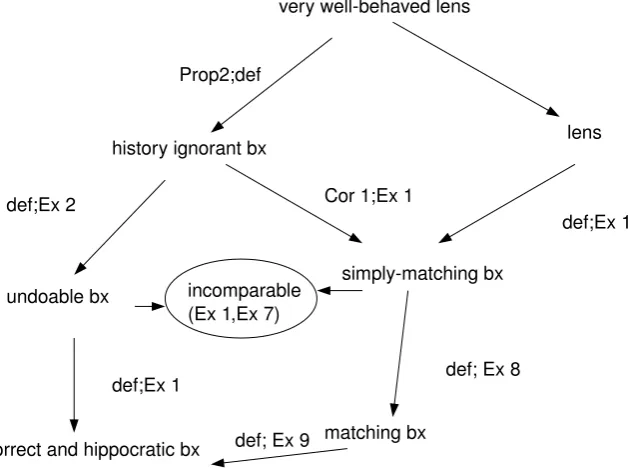
The paper is structured as follows. In Section2we introduce notation and terminology, and give a our first couple of examples. Section3introduces the main focus of the paper, defining a pair of equivalence relations on each model set related by a bidirectional transformation, giving examples and basic properties. Section4exploits them to prove relationships between the various “niceness” conditions on bidirectional transformations, summarised in Figure1. Especially, we show that a condition calledsimply matching, defined in terms of our equivalences, is achieved
2
Background
Here we recapitulate definitions found for example in [Ste10].
For purposes of this paper a bidirectional transformationR:M↔N between non-empty sets M andN is given by specifying aconsistency relation, also by slight abuse of notation called R⊆M×N, together a pair of functions
− →
R :M×N→N
←−
R :M×N→M
whose task is to enforce consistency.
We use the term “model” for the structures related by a bidirectional transformation because our motivation is from model-driven development, but this does not in fact entail any intention to restrict what the structures can be: throughout this paper,MandN can be any sets, finite or
infinite, including uncountable.
We will be concerned only with bidirectional transformations that only change a model when consistency requires it and, in that case, do enforce consistency: that is, those that are correct and hippocratic.
Definition 1 R:M↔Nis correct if
∀m∈M∀n∈N R(m,−→R(m,n))
∀m∈M∀n∈N R(←−R(m,n),n)
Definition 2 R:M↔Nis hippocratic if for allm∈Mandn∈N, we have
R(m,n) ⇒ −→R(m,n) =n
R(m,n) ⇒ ←−R(m,n) =m
From now on, all bidirectional transformations will be assumed to be correct and hippo-cratic. Please note also that many statements we shall make have exactly dual versions with dual proofs, replacing−→R with←−R etc. Generally we state both versions, but prove only one. Technically we need not include the consistency relation as part of the definition of a correct and hippocratic transformation, because we have immediately from the definitions
Lemma 1 R(m,n)⇔−→R(m,n) =n⇔←R−(m,n) =m.
However, the consistency relation is for software engineering purposes the primary part of the transformation definition, so it is convenient to include it.
Example1 Let the elements of model setMbe UML models. Let each element of model set
Nbe a test suite, given as a set of test classes. Suppose the development team wishes to count a UML modelmas being consistent with a test suiteniff the following two conditions hold:
• for every class in modelm, say with nameFoo1, there is at least one test class inn, with the naming convention that each such test class is calledTestFooX for some natural numberX;
• for every stringNamesuch that there is at least one test class innwith a name of the form
TestNameX for an integerX (there could be several different values ofX for the same
Name), there is a class calledNameinm.2
We writeT(m,n)if this holds. Notice that each model typically contains a lot of information not included in the other. There is a choice of ways to restore consistency, but one possibility is:
• −→T(m,n)deletes any test classes fromnwhose names are of the formTestNameXbut for which there is no classNameinm. For any class (say calledName) inmnot having any corresponding test class inn, it adds one “skeleton” test classTestName0.
• ←T−(m,n)deletes frommany class for whichncontains no test class (along with any other model elements that must be deleted, such as associations to deleted classes). For any test class innwhose name is of the formTestNameX but for which there is no className
inm, it adds a new classNametom(in a suitable “default” state, e.g., not related to any other class, and having no attributes or operations).
Appropriately implemented, this bidirectional transformation could (and should) be correct and hippocratic.
A well-known problem is that these definitions alone are too weak to enforce “sensible” be-haviour. Unfortunately the most natural extra conditions to impose have the disadvantage that they seem to be too strong in practice. One well-known possibility, here using terminology coined in [Dis08], is:
Definition 3 R:M↔Nishistory ignorantif for allm,m0∈Mandn,n0∈N, we have
− →
R(m,−→R(m0,n)) =−→R(m,n)
←−
R(←R−(m,n0),n) =←−R(m,n)
The terminology for special properties of bidirectional transformations is mildly problematic, partly because different perspectives make different names seem natural. In earlier versions of this paper, what we now call history ignorance was termed strong undoability. This was natural to
1For simplicity, in the example we assume that UML class names are strings containing only characters from
[A-Za-z], and in particular that there is only one package!
us because the notion calledundoabilityin [Ste10] demanded the same conditions as above, but
only form∈Mandn∈NsatisfyingR(m,n). That notion makes the bidirectional transformation undoable in the following sense: suppose that(m,n)is a consistent pair of models, and suppose the developer ofmmodifies it tom0, propagates the modification by applying−→R, and then wishes
to undo the modification, returning to m. To say that the transformation is undoable is to say
that now, applying−→R will return the situation to exactly what it was in the beginning, the pair
(m,n); mistakes can be undone – provided that the initial pair of models was consistent. History ignorance is a stronger form of undoability, in that it demands the same conditions for more model pairs. Indeed, the condition does capture a notion of undoability that is stronger, in the following sense. Suppose our indecisive developer starts from any pair of models(m,n), not necessarily consistent, and behaves as before. The final pair of models, (m,n0) say, may of course not be identical to the initial pair (m,n), since −→R always ensures consistency and the
original state may not have been consistent. Still, the developer’s mistaken modification tomhas
no effect in the final situation, in the sense thatn0is the very same model that would have been
the result of−→R(m,n); the mistake has been undone, even though the initial state of the pair of models might not have been consistent.
An alternative perspective, though, is that a history ignorant bidirectional transformation al-lows the developer to be safely ignorant of the history of when modifications to their model have been propagated to the other side: for example, if a developer starts withm0 and modifies it to m, it does not matter whether−→R was ever applied tom0; provided that it is applied tomat the
end, the effect on the other side’s model will be the same regardless. We use the term history ignorance here for consistency with [Dis08,XSHT11].
Whatever our terminology, the special situation that we have when a bidirectional transforma-tion is history ignorant would clearly be hugely advantageous to the usability of a bidirectransforma-tional- bidirectional-transformation enabled tool, because the tool could reasonably propagate changes as and when it was convenient to do so without needing the developer’s permission. It is unfortunate that realistic bidirectional transformations do not have this property. As we shall see in Section4, the essential reason why they do not is that the information that is relevant to consistency is usually interdependent with the rest of the information in a model, whereas history ignorance requires the consistency-relevant information to be independent of the rest.
History ignorance is also algebraically a more natural condition than undoability, as we shall see. That it is indeed stronger than undoability is illustrated by the following (minimal) example, this one given formally.
Example2 LetM={a,b,c} × {false,true} and letN={a,b,c}. For allx,y∈ {a,b,c},φ ∈ {false,true}, let:R((x,φ),y)hold iffx=y;−→R((x,φ),y) =x;
←−
R((x,φ),y) = (y,¬φ) if (as sets){x,y}={a,c}
= (y,φ) otherwise.
Example 3 The example begun in Example 1 is not even undoable. Suppose we start with a UML model m containing class Foo and a test suite n which has a test class TestFoo1
containing some actual test code, and also consistent in every other way so thatT(m,n). We modifymin a way which involves deletingFoo, givingm0, and apply−→T. This results in test class
TestFoo1being deleted, and the code which it contained being lost. If we now editm0back to its original statem, and again apply−→T, the resulting test suite will include a skeleton test class forFoo, calledTestFoo0, but the lost test code is not restored. That is,−→T(m,→−T(m0,n))6=n.
3
Coordinate grid induced by a bidirectional transformation
Suppose we are given a bidirectional transformationRwhich is correct and hippocratic (but not
necessarily undoable).
Recall the equivalences from [Ste08] (but presented here with slightly different symbols for better readability), defined in terms ofR.
Definition 4 The equivalence relations∼M F and∼
M
B on M, and∼ N F and∼
N
B onN, are defined as follows:
• m∼M F m
0⇔ ∀n∈N.−→R(m,n) =−→R(m0,n)
• m∼M
B m0⇔ ∀n∈N. ←−
R(m,n) =←−R(m0,n)
and dually,
• n∼N F n
0⇔ ∀m∈M.−→R(m,n) =−→R(m,n0)
• n∼N
B n0⇔ ∀m∈M. ←−
R(m,n) =←−R(m,n0)
Notice that it is immediate that these relations are indeed equivalence relations. Intuitively,m∼M
F m0 says “mandm0 do not differ in any way that is visible on theN side”. The reader familiar with lenses will recognise that this generalises∼g. On the other hand,m∼MB
m0 says that “the only differences between m and m0 are those visible on theN side, so that
they become indistinguishable after any synchronisation with an element of N”. The reader
familiar with [BFP+08] will recognise that this generalises∼max, thecoarsestequivalence with
respect to which a lens is quasi-oblivious. In an even more specialised setting, that of constant complement view updates, it generalises the equivalence defined in Theorem 7.2 of [BS81]. We can import the latter into the symmetric setting and demonstrate the relationship as follows.
Definition 5 The relation≡onMis defined as follows:
m≡m0⇔ ∃n∈N.←−R(m,n) =m0
In general, this is not an equivalence relation, even though for consistency with [BS81] we have used the≡symbol for it. For history ignorant bidirectional transformationsR, however, we
Proposition 1 Let R be a history ignorant bidirectional transformation. Then m∼M B m0 iff
m≡m0.
We postpone the proof until Section4, by which point we will have introduced some conse-quences of our definitions which make it easier.
We will generally suppress the superscripts and just write∼F,∼B.
Example4 Returning to the informal example of Examples1,3, we see that:
• m∼M
F m0 iff the set of names of classes inmis the same as the set of names of classes in
m0;
• m∼M
B m0 iff mand m0 are identical apart from (perhaps) containing different classes in the default state, that is, if one can be edited into the other just by adding and/or deleting default state classes.
• n∼N
F n0 iffn andn0 are identical apart from (perhaps) differing in the set ofNames for which they include a “skeleton” test class calledTestName0. (In particular, if n con-tained a skeletonTestName0,n0 could be equivalent even if it did not contain any test classTestName0. However, ifn’sTestName0had been filled in with some test code, then in order to be equivalent,n0would have to have aTestName0with identical code.)
• n∼N
B n0 iff the set of class names derived by taking class nameNamefor every test class innwhose name is of the formTestNameXfor some integerX(ignoring any test classes with names not of that form) is the same as the set of names derived from n0 using the same procedure.
Veryinformally, the fact that ∼M B and ∼
N
F are relatively fine – e.g. one feels that it would be unlikely for a randomly chosenmandm0 to happen to be such thatm∼M
B m
0 – arises from the
fact that both models can hold plenty of information not present in the other; it is not likely thatmandm0 will have only differences which are visible on theN side, because most potential differences between them are invisible there.
If we represent a bidirectional transformationR by giving a table for−→R and a table for←R−,
each with a row for each element ofMand a column for each element ofN, the equivalences can
be read off:m∼F m0if the rows formandm0in the−→R table are identical,n∼Fn0if the columns
fornandn0in the−→R table are identical, and similarly for the∼Bequivalences using the ←−
R table.
Example5 Let us represent Example2in this way. −
→
R a b c
(a,true) a a a
(b,true) b b b
(c,true) c c c
(a,false) a a a
(b,false) b b b
(c,false) c c c
←−
R a b c
We read off that(x,φ)∼F(x0,φ0)iffx=x0, whilem∼Bm0only whenm=m0. Looking atN,
n∼F n0always, whilen∼Bn0only whenn=n0.
Remark1 Clearly, thatn∼F n0always is equivalent to saying that − →
R ignores its second argu-ment, that is, that the transformation is a lens in the sense of [FGM+07].
We shall use this as the definition.
Definition 6 A bidirectional transformationRis a lens if it is correct and hippocratic and
fur-thermore−→R ignores its second argument, which we therefore omit for notational convenience.
The relationship between lenses and bidirectional transformations is easy to see and was dis-cussed in Section 4.4 of [Ste10], although in the context of undoability rather than history igno-rance. We will not introduce lens notation and laws, but simply state for the benefit of readers familiar with lenses:
Proposition 2 Let R be a (for once, not necessarily correct and hippocratic) bidirectional transformation in which−→R ignores its second argument. Then
1. R is a well-behaved lens in the sense of [FGM+07] iff it is correct and hippocratic.
2. R is a very well-behaved lens in the sense of [FGM+07] iff it is correct, hippocratic and history ignorant.
The following easy result was proved in [Ste08] and illustrated above.
Proposition 3 If both m1∼F m2and m1∼Bm2then m1=m2.
This results shows that a model is uniquely determined by specifying its∼F and its∼B equiv-alence class. Given a modelm, we can think of its∼F equivalence class as itsx-coordinate and
of its∼B equivalence class as itsy-coordinate. Specifying coordinates in this sense determines at most one model, but some pairs of coordinates specify no model; that is, if a given∼F equiv-alence class and a given∼Bequivalence class intersect, they do so in a set of just one model, but it is in general possible that they do not intersect. We think of the elements of a model space laid out in acoordinate gridin this way; some squares on the grid are empty, but no square contains
more than one model.
LetMF be a transversal3of∼F andMB be a transversal of∼B.
We may identifyMwith a subset ofMF×MB: that is, henceforth we notate any elementm∈M as(mF,mB) wheremF is the unique element of MF satisfyingmF ∼F mandmB is the unique element ofMB satisfyingmB∼Bm. The closure ofM,M, is the whole ofMF×MB. Similarly forN, we letNF be a transversal of∼F andNBbe a transversal of∼B.
Remark2 We are identifying a model by specifying its equivalence class in each of two equiv-alence relations. We have a notational choice to make here: do we represent a modelmby giving
3Recall that a transversalT for an equivalence relation on a setAis a setT ⊆Acomprising exactly one element of
representatives of each equivalence class, (mF,mB) or do we use some notation for the equiv-alence classes themselves, ([m]∼F,[m]∼B)? Each choice has strengths and weaknesses. Since
there is, in our setting, generally no canonical choice of representative of an equivalence class, the latter choice appeals; but it has the disadvantage that we must either define new symbols for a version of Rlifted to equivalence classes, and juggle both versions in our work, or risk the confusion that might result from our abusing notation by not doing so. Instead we choose the former option, despite the disadvantage that it involves an arbitrary choice of transversal. What we gain is that when we write, for example,mF, it does not matter whether we think ofmF as partial information concerning a modelm= (mF,mB)or as a model in its own right: it is both.
It is important to understand, however, that it is not generally possible to ensure that the elements ofMF are all∼Bequivalent; see Lemma3.
This way of representing models is useful because it separates relevant from irrelevant infor-mation for purposes of applying the components of the bidirectional transforinfor-mation.
Lemma 2 1. Whenever m∼Fm0and n∼Bn0we have R(m,n)⇔R(m0,n0); that is, whether
R((mF,mB),(nF,nB))is determined from mF and nBalone: it is R(mF,nB).
2. Whenever m ∼F m0 and n∼F n0 we have −→R(m,n) = −→R(m0,n0); that is, the value of
− →
R((mF,mB),(nF,nB))is determined by mF and nF alone: it is − →
R(mF,nF).
3. Whenever m∼B m0 and n ∼B n0 we have ←R−(m,n) = ←R−(m0,n0); that is, the value of
←−
R((mF,mB),(nF,nB))is determined by mBand nBalone: it is ←−
R(mB,nB).
Proof. IfR(m,n)andm0 ∼F mthen sincen= − →
R(m,n) =−→R(m0,n)we must have R(m0,n) by Remark1. Similarly,←−R(m,n) =miff R(m,n) in which case ifn0∼B nthen alsoR(m,n0). In other words, whetherR((mF,mB),(nF,nB))is determined by the entriesmF andnBalone. Since
mF itself is an element ofM, andnBitself is an element ofN, we haveR(m.n) =R(mF,nB). Similarly, if −→R((mF,mB),(nF,nB)) = (n0F,n0B) then by definition
− →
R((mF,m00B),(nF,n00B)) = (n0F,n0B)for any otherm00B,n00B; in other words the result of −→R((mF,mB),(nF,nB))is determined by the entriesmF,nF alone. Dually,
←−
R((mF,mB),(nF,nB))is determined bymB,nBalone.
Remark3 In terms of the symmetric lens formalism of [HPW11],MB×NF forms a minimal complement.
Example6 In model setM of Example2, let us pickMF ={(a,true),(b,true),(c,true)}(the second element of each pair being an arbitrary choice) and MB =M. With respect to these choices, the coordinate grid forMis:
(a,true) (a,true)
(b,true) (b,true)
(c,true) (c,true)
(a,false) (a,false)
(b,false) (b,false)
ForNF we may take any of{a},{b},{c}; forNB we must take{a,b,c}. The coordinate grid forNis a single column, because the transformation is a lens withNits abstract side.
In terms of the coordinate grid, whethermis consistent withnis determined by the column of mand the row ofn. It is natural to ask whether one column can be consistent with more than one
row. The answer is yes, but only provided that the rows do not overlap, in the following sense:
Lemma 3 Suppose R(mF,nB)and R(mF,zB)where nB,zB∈NBand nB6=zB. Then there cannot
exist any nF∈NF such that both(nF,nB)∈N and(nF,zB)∈N.
Dually, suppose R(mF,nB)and R(wF,nB)and mF6=wF. Then there cannot exist any mB∈MB
such that both(mF,mB)∈M and(wF,mB)∈M.
Proof. Suppose that such annF did exist. Then − →
R(mF,(nF,nB)) = (nF,nB)by hippocraticness and similarly−→R(mF,(nF,zB)) = (nF,zB). But(nF,nB)∼F (nF,zB)so(nF,nB) = (nF,zB)which is a contradiction.
4
Applications of equivalences
In this section we exploit the results of the previous section to investigate the relationships be-tween different special properties of bidirectional transformations.
We know that given m1,m2∈M there can be at most one m∈M such thatm∼F m1 and
m∼Bm2. An important special case is when there is exactly one: every square in our “coordinate
grid” is occupied.
Definition 7 Misfullwith respect to bidirectional transformationRif for anym1,m2∈Mthere
existsm∈Msuch thatm∼F m1andm∼Bm2.
Intuitively, when we specify a modelm∈Mby specifying its∼F and∼Bequivalence classes, what we are doing is picking out the information inmwhich is relevant to the question of whether mis consistent with some model inN. As we have seen, this consistency is completely
deter-mined bym’s∼M
F equivalence class (and dually, for a modeln∈Nits consistency is determined by its∼N
B class). In the simplest practical cases, this consistency-relevant information may actu-ally be identifiable in the model, as being, for example, the set of model elements of particular types contained in the model; however, our set-up also works generally.
What it means forMto be full is that the consistency-relevant information is in in a certain
sense independent of the rest of the information needed to specify a model fully; there is no redundancy in the representation. IfMis full, and ifm= (mF,mB)is changed by modifying one of the pieces of information (saymF is changed tom0F), it will not be necessary for the other piece of information to be modified as a side-effect, because fullness tells us that(m0F,mB)will definitely exist as a model inM. This simplifies the situation in an important way. Contrast the
more usual situation we see in Examples1,3; the information inm∈Mon which consistency
state (no attributes or other associated information), andm2to be a model containing a classBar
which is not in default state (say it has an attribute, or a state machine, or whatever). It is clear that there can be no modelmsuch thatm∼F m1andm∼Bm2. In order form∼Fm1to hold, the set of names of classes inmmust be the singleton{“Foo”}; in order form∼Bm2to hold, the
non-default-state classBarmust be inm.
More generally, we may informally consider that the more sparsely the coordinate grid is populated, the more dependency there is between the consistency-relevant information and the rest.
Definition 8 Let R:M↔N be a bidirectional transformation inducing equivalences and a
coordinate system as usual. We say thatRismatchingif there is a bijection f :MF →NB such thatR(mF,f(mF))for allmF ∈MF. We say thatRissimply matchingif, in addition,R(mF,nB) holdsonlywhennB= f(mF).
Lemma 4 If N is full, then given mF ∈MF there exists a unique nB∈NBsatisfying R(mF,nB).
Dually if M is full, then given nB∈NB there exists a unique mF ∈MF satisfying R(mF,nB).
Therefore if both M and N are full, then R is simply matching.
Proof. Follows directly from Lemma3.
Proposition 4 The following are equivalent:
1. R:M↔N is history ignorant.
2. M and N are full with respect to R.
3. For each m∈M and n∈N we have−→R(m,n)∼Fn and ←−
R(m,n)∼Bm: that is, − →
R stabilises the coordinate grid columns of N and←−R stabilises the coordinate grid rows of M.
Proof. 1⇔3 is immediate from the definitions. Next we show(1,3)⇒2. Letm1,m2∈M. We
must constructm∈Msuch thatm∼Fm1andm∼Bm2. Writem1= (m1F,m1B),m2= (m2F,m2B). Pick any(nF,nB)∈N. Then, using 3., for somewF ∈MF,zB∈NBwe have
− →
R((m1F,m1B),n) = (nF,zB) ←−
R((m2F,m2B),(nF,zB)) = (wF,m2B)
and by correctness R(m1F,zB)andR(wF,zB). Using 1. and Lemma4, m1F =wF so we have constructed(m1F,m2B) =m∈Mas required. Dually forN.
Finally we show 2⇒3. Consider−→R(m,(nF,nB) = (n0F,n0B); we must show thatnF=n0F. Since
Ris correct, R(m,(nF0 ,n0B))which is equivalent toR(m,n0B). Since N is full,(nF,n0B)∈N, and sinceR(m,n0B), by hippocraticness−→R(m,(nF,n0B)) = (nF,n0B). But since(nF,nB)∼F (nF,n0B), (n0F,n0B) =−→R(m,(nF,nB)) =
− →
R(m,(nF,n0B)) = (nF,n0B)sonF =n0F as required.
Corollary 1 If R is history ignorant, then R is simply matching.
Example7 We slightly modify Example2so that undoability is retained but simple matching is lost.
LetM=N={a,b,c} × {false,true}. For allx,y∈ {a,b,c},ψ,φ∈ {false,true}, let:
R((x,φ),(y,ψ))iffx=y; −
→
R((x,φ),(y,ψ)) = (x,ψ); ←−
R((x,φ),(y,F)) = (y,¬φ) if (as sets){x,y}={a,c}
= (y,φ) otherwise
←−
R((x,φ),(y,T)) = (y,φ)
This transformation is still correct, hippocratic and undoable, but not history ignorant. To see that it is not simply matching, observe that{(a,F),(a,T)}is a∼M
F-equivalence class which is consistent with two∼N
B-classes, viz. {(a,F)}and{(a,T)}. Our “twist” has ensured that these two classes remain separate, because←R−((c,T),(a,F)) = (a,F)= (6 a,T) =←−R((c,T),(a,T)).
Now it is easy to prove Proposition1relating Bancilhon and Spyratos’ equivalence to our∼M B.
Proof. Suppose first thatm≡m0, that is,∃n∈N.←R−(m,n) =m0. We need to show thatm∼Bm0. SinceRis history ignorant, by Proposition4,m0=←R−(m,n)∼Bmas required.
Conversely, suppose m∼B m0; we must show that ∃n∈N. ←−
R(m,n) =m0. By Corollary 1
there is a unique nB ∈NB such that R(m0,nB). Then by correctness of R and by Lemma 2, ←−
R(m,nB)∼Fm0. By Proposition4, ←−
R(m,nB)∼Bm∼Bm0. Finally by Proposition3, this implies that←−R(m,nB) =m0as required. (Notice that anyn∼NB nB would have done as well.)
Once we have a simply matching bidirectional transformationRit is natural to relabel the
ele-ments of MF and NB so that both are identified with a matching transversal P, so that
R((p,mB),(nF,p0))iffp=p0. This is reminiscent of constant complement bidirectional transfor-mations, but it is important to be aware (a) thatM⊆P×MBbut equality does not hold in general; (b) that while−→R((p,mB),(nF,p0)) = (n0F,p), we do not necessarily haven
0
F =nF. In fact, by Lemma2n0F depends on p andnF. We will write
− →
R((p,mB),(nF,p0)) = (fp(nF),p). Dually, ←−
R((p0,mB),(nF,p)) = (p,bp(mB)).
The property of being simply matching is an interesting one, being strictly weaker than being history ignorant, satisfied by realistic examples such as Example1, and yet not universally true. It turns out that there is an alternative characterisation of this class of bidirectional transformations: it comprises those that can be constructed by placing two lenses “tail to tail” in a certain way.
Definition 9 LetR:M↔Nbe a simply matching bidirectional transformation with matching
transversalP. Then we define lensesRM :M↔P andRN :N↔Pas follows, exploiting the representation of elements ofMas elements ofP×MB:
• RM(m,p)iff −→
RM(m) =piffm= (p,mB)for somemB∈MB.
• ←R−M((p0,mB),p) = (p,bp(mB)).
• Dually,RN(n,p)iff −→
• ←R−N((nF,p0),p) = (fp(nF),p).
The following lemma is obvious:
Lemma 5 RMand RN are indeed correct and hippocratic.
The following construction of a bidirectional transformation from a pair of lenses has been recorded before, see for example Theorem 6 of [Dis08]; here we shall show that it produces exactly the simply matching bidirectional transformations.
Definition 10 LetRM:M↔PandRN:N↔Pbe any lenses sharing a common view. Then the bidirectional transformationR=hRM,RNi:M↔N constructed fromRM andRN is defined thus:
• R(m,n)iff−R→M(m) = −→
RN(n)
• −→R(m,n) =←R−N(n, −→
RM(m))
• ←−R(m,n) =←R−M(m, −→
RN(n))
Proposition 5 Given lenses RM:M↔P and RN:N↔P,
1. hRM,RNiis indeed correct and hippocratic.
2. hRM,RNiis simply matching with common transversal in bijection with P.
Proof. LetR=hRM,RNi.
1. Correctness: letn0=−→R(m,n) =←R−N(n, −→
RM(m)). We have to show thatR(m,n0), that is, that −→
RM(m) = −→
RN(n0). Now −→
RN(n0) = −→
RN( ←−
RN(n, −→
RM(m))) = −→
RM(m)as required. Hippocratic-ness: supposeR(m,n), that is,−R→M(m) =
−→
RN(n), and consider − →
R(m,n) =←R−N(n, −→
RM(m)) = ←−
RN(n, −→
RN(n)) =nby hippocraticness ofRN.
2. We show that the∼M
F equivalence classes are the sets( −→
RM)−1({p})forp∈P. Supposem1 andm2are in(−R→M)−1({p}). Then for anyn∈N,
− →
R(m1,n) =←R−N(n, −→
RM(m1)) = ←−
RN(n,p) = ←−
RN(n, −→
RM(m2)) = − →
R(m2,n), som1∼Fm2as required. Conversely, suppose thatm1∼Fm2 and pick n1 such that −R→N(n1) =
−→
RM(m1) = p1. Then since − →
R(m1,n1) =→−R(m2,n1) by hypothesis, we haven1=←R−N(n1,
−→
RM(m1)) = ←−
RN(n1, −→
RM(m2))so by correctness ofRNwe must haveRN(n1,
−→
RM(m2)), that is, −→
RN(n1) = −→
RM(m2) =p1as required. It follows from the definition ofRthatRis simply matching.
We may summarise Lemma5and Proposition5in the following (informally-stated) theorem:
Example2is simply matching; take f((a,true)) =aetc. Example1is also simply matching,
for each possible subset of the set of all legal class names determines and is determined by a transversal element (of bothMF andNB) andT(mF,nB)holds iff the sets thus determined bymF andnB are identical. Notice that since we have already observed that neither of these examples is history ignorant, and that Example1is not even undoable, this shows that simply matching is a strictly weaker condition.
The following tiny example, which is matching but not simply matching, illustrates some of the difficulty inherent in “less nice” bidirectional transformations.
Example8 LetM=N={0,1}and letR(m,n)hold iffmn=0. −→R and←−R are determined by correctness and hippocraticness:
R 0 1
0 T T
1 T F
− →
R 0 1
0 0 1
1 0 0
←−
R 0 1
0 0 0
1 1 0
06∼F 1 because − →
R(0,1) =16=−→R(1,1); 06∼B 1because ←−
R(0,1) =06=←−R(1,1); thus each element ofM forms an equivalence class under each equivalence, and dually forN. Therefore there is only one choice of transversal, and we identify the elements with the equivalence classes. Considered as a subset ofMF×MB,Mis the diagonal subset{(0,0),(1,1)}where(0,0) rep-resents 0 and(1,1)represents 1. That is, the coordinate grids forMandNare both, identically:
1 1
0 0 0 1
We have here the simplest possible example in which there are two distinct elements ofMF (0 and 1) compatible with one element of NB (0), and only one of those MF elements (0) is also compatible with a second, distinct element of NB (1). In other words, both columns of
M’s coordinate grid are compatible with the 0 row ofN’s, and the 0 column ofM’s grid is also compatible with the 1 row ofN’s. Note that neither the rows, nor the columns, of the coordinate grids overlap in the sense of Lemma3.
ClearlyRis not undoable. For example,R(0,1), but−→R(0,−→R(1,1)) =−→R(0,0) =06=1.
Example9 Finally, lest the reader suspect that all bidirectional transformations be matching, we record an example which is not.
LetM={0,1}andN={a,b,c}. LetR,−→R and←R−be as follows:
R a b c
0 T T F
1 F T T
− →
R a b c
0 a b a
1 c b c
←−
R a b c
0 0 0 1
1 0 1 1
We read off that the only non-trivial equivalence is thata∼N
F c. Takingaas the representative of their∼N
F equivalence class, the coordinate grids are
1 1 0 0 0 1 c c b b a a a b
Figure 1: Implications between properties of correct hippocratic bidirectional transformations. Labels p;q on arrows indicate that p is for the implication and q for absence of the reverse implication, “def” meaning direct from the definition.
very wellbehaved lens
lens history ignorant bx
simplymatching bx
matching bx undoable bx
def; Ex 8
correct and hippocratic bx def; Ex 9 def;Ex 1
def;Ex 2 Cor 1;Ex 1
incomparable (Ex 1,Ex 7)
def;Ex 1 Prop2;def
To summarise, Figure1gives the implication relationships between different special cases of bidirectional transformations.
5
Related work
Defining equivalence relations on model sets that are induced by bidirectional transformations goes back at least to [BS81] in the special case of constant complement view updates in databases and to [BFP+08] in the less special case of lenses. We have demonstrated the relation of our work
to those papers.
transfor-mation from a pair of lenses.
Neither of those papers, however, made use of equivalences on model sets comparable to those considered in the earlier database and lens work. These were first generalised to the symmetric case as part of the work in [Ste08], but only a few results relating to them (identified here) were given in that paper.
Later work has included [XSHT11], focusing on the additional problems posed by concurrent updates, and a body of work exemplified by [DXC+11] on delta-based bidirectional
transforma-tions. The latter defines several other properties of bidirectional transformations; there is more work to be done to fully elucidate the connections.
6
Conclusion
We have laid out some results relating to the principal equivalence relations induced on model sets by a correct and hippocratic bidirectional transformation between them. By means of these results we have established implications and non-implications between many different conditions that can be placed on bidirectional transformations to ensure that they are “nice”.
A topic of conversation among people interested in bidirectional transformations has long been the extent to which the symmetric case, in which we relate models neither of which is a strict abstraction of the other, raises essentially new problems from the asymmetric case studied earlier in the database field. In practice, it is often possible to conceptualise a symmetric bidirectional transformation as a pair of lenses placed “tail to tail”, that is, having a common view: the view captures the information which is common to both models, and the lenses manage the synchro-nisation. Actually writing the transformation this way would have the obvious drawback that it would involve a great deal of duplication between the two lenses. In this paper, we have char-acterised the bidirectional transformations that could, in principle, be written in this way; they are the simply matching ones. Although we have shown that not all bidirectional transforma-tions are simply matching, we have the impression that a large class of practical examples (such as our Example1 etc.) are in fact simply matching. A bidirectional transformation language that gave good, usable facilities for expressing and working with simply matching transforma-tions might be practically useful even if it did not permit the expression of non-simply-matching transformations.
We have also begun, but not reported here, an investigation into subspaces and subspace pairs of model sets, which capture the fact that teams of developers can agree to stay within certain subspaces of the model spaces, in which case it is desirable that applying a transformation will not move them outside their agreed zone. In future work we will build on this to investigate the implications of adding an information orderings to a model set, and relate this work to the study of monoids of edits acting on model spaces.
Bibliography
[BFP+08] A. Bohannon, J. N. Foster, B. C. Pierce, A. Pilkiewicz, A. Schmitt. Boomerang: Re-sourceful Lenses for String Data. InACM SIGPLAN–SIGACT Symposium on Prin-ciples of Programming Languages (POPL), San Francisco, California. Jan. 2008.
[BS81] F. Bancilhon, N. Spyratos. Update Semantics of Relational Views. ACM Trans. Database Syst.6(4):557–575, 1981.
[Dis08] Z. Diskin. Algebraic Models for Bidirectional Model Synchronization. In Model Driven Engineering Languages and Systems, 11th International Conference, MOD-ELS 2008, Toulouse, France, September 28 - October 3, 2008. Proceedings. Lecture
Notes in Computer Science 5301, pp. 21–36. Springer, 2008.
[DXC+11] Z. Diskin, Y. Xiong, K. Czarnecki, H. Ehrig, F. Hermann, F. Orejas. From State- to Delta-Based Bidirectional Model Transformations: The Symmetric Case. InModel Driven Engineering Languages and Systems, 14th International Conference, MOD-ELS 2011, Wellington, New Zealand, October 16-21, 2011. Proceedings. Lecture
Notes in Computer Science 6981, pp. 304–318. Springer, 2011.
[FGM+07] J. N. Foster, M. B. Greenwald, J. T. Moore, B. C. Pierce, A. Schmitt. Combina-tors for bidirectional tree transformations: A linguistic approach to the view-update problem. ACM Transactions on Programming Languages and Systems 29(3):17,
May 2007.
[HPW11] M. Hofmann, B. C. Pierce, D. Wagner. Symmetric Lenses. In ACM SIGPLAN– SIGACT Symposium on Principles of Programming Languages (POPL), Austin, Texas. Jan. 2011.
[Ste08] P. Stevens. Towards an algebraic theory of bidirectional transformations. In Proceed-ings of the International Conference on Graph Transformations, ICGT’08. Lecture
Notes in Computer Science 5214, pp. 1–17. Springer, September 2008.
[Ste10] P. Stevens. Bidirectional Model Transformations in QVT: Semantic Issues and Open Questions.Journal of Software and Systems Modeling (SoSyM)9(1):7–20, 2010.