ISSN-L: 2501 - 1235 Available on-line at: www.oapub.org/edu
doi: 10.5281/zenodo.1765260 Volume 5 │ Issue 2 │ 2018
PARENTS’ ACADEMIC AND PROFESSIONAL BACKGROUND
AND THEIR RELATIONSHIP WITH THE CHOICE OF
MARTIAL ARTS FOR THEIR CHILDREN
Zaragkas Charilaos K.1i,
Thanos Teodoros2,
Liaskou Evridiki3
1Assistant Professor, E.C.E.D.U. University of Ioannina, Greece 2Associate Professor, E.C.E.D.U. University of Ioannina,
Greece 3Kindergartener, E.C.E.D.U. University of Ioannina,
Greece
Abstract:
Child engagement with martial arts contributes to the development of their personality. These are sports activities that are not done within the school but during their leisure time. This children’s choice is linked to the social and cultural environment of the family and constitutes part of the family practices of social reproduction according to P. Bourdieu This paper examines the pre-school and school children’s involvement in martial arts in relation to their social origin. The sample of the survey consists of 268 parents whose children are involved in the martial arts in their leisure time. The questionnaire was used as a means of collecting data. According to the results of the survey, boys are more involved in martial arts than girls are a fact which highlights the contribution of martial arts to the reproduction of gender discrimination. There was a statistically significant relationship between the choice of the martial arts and the profession, the educational level and the income of the parents. It seems that both the profession and the level of parenting education and their annual family income influence the choice of the martial arts sport for their children. In conclusion, the martial arts, although they had started from the lower social strata nowadays a social development is observed. More and more educated parents, who belong to the middle and upper social classes, get their children be involved in martial arts, in their free time, since they have realized the importance of the martial arts and how these help in creating and developing a complete personality.
Keywords: martial arts, social reproduction, leisure time
1. Introduction
Differentiation in the choice of sports in relation to the social origin of a
sportsman/sportswoman is timeless. According to Cordato (1960)ii in ancient Greece,
the majority of horse racing athletes came from the noble class. Only wealthy citizens had the means to bred horses, build chariots, and had the time needed to train in stadiums. The aristocrats with their sporting victories impressed the inferior social
classes and were given glory and honoriii.
The concept of social order is closely linked to the concept of social stratification. Hewitt and Mitchell (1979) point out that social stratification has the concept of a hierarchical classification that differentiates the social strata people belong to. Among the social strata there are recognized and established differences that place one higher or lower than the other onε in society.
According to Kavvadia (1983), the different ways of leisure and leisure utilization, as well as ways of nutrition, clothing and housing separate the social classes from each other. Social classes have a collective consciousness, have their own cultural works that characterize each of them at all levels of life, apart from the ideas and values that concern socio-economic demands such as clothing, nutrition habits and housing, and the relative budgeting of the family, entertainment and leisure utilization. The ways of entertainment, exercise and leisure use characterize each social class at all levels of life.
Krasanakis (1984, pp. 35-36) points out that leisure time is a social event which, in order to be true, must have four basic traits · two of them are negative and are defined by the obligations towards society while the other two are positive and determined by the needs of the personality. These four characters are: the liberating, the
charismatic, the hedonistic and the personal onesiv.
Bishop and Hoggett, (1995) point out that the problems of unemployment and poverty affect sporting participation as there is less income available for participation, purchase of equipment, equipment, sports and footwear, etc. Dishman (1989, p.143)
ii Reference to Koukouris, K. (2009). The Social Dimension of Sport, Thessaloniki, p. 58.
iiiTerm used to interpret a form of inequality that derives from economic factors, as opposed to other forms of social
stratification where inequalities have a legal or religious status. Weber defines social classes on the basis of the opportunities that a person has in the market. Weber distinguishes four classes: a) the class of the capital owners , b) the class of the intellect and the directors (the position of this social group is determined on the basis of technical training and possession of educational credentials, c) the traditional petty bourgeoisie, and d) the working class. Weber emphasizes the forms of social stratification based on social prestige (education, nationality, religion,
profession, etc.). Petmetzidou, M. (1990). Social classes, In Pedagogical Psychological Encyclopedia Dictionary,
Athens, Edition: Greek Letters, p.: 2669.
ivLiberation is an indispensable element in the definition of leisure time. There is not free time with coercion. It is
mentions poor economic populations who did not respond to and did not participate in government structures and programs on public health policy through sport for all:
"Manual workers, low socio-economic groups and the low-educated population groups,
the elderly and those at high risk for heart disease are relatively inactive during leisure time and are reluctant to take part in supervised sports programs”.
Sport is seen as a passport for a better life. The ways of entertainment, exercise and leisure utilization characterize each social class at all levels of life. Professionals in higher professional classes are more likely to participate in individual rather than in team sports. The dominance of the working class in the sports of boxing, wrestling and judo is due to the fact that the lower classes emphasize the value of cruelty (Koukouris, 2009). Those with a rich cultural background are more likely to engage in sport in general but not in working class sports (Wilson, 2002). The rich cultural background is acquired through the individual’s education and upbringing. The concept has been thoroughly described by Bourdieu (1978). Both cultural and athletic consumption is based on the cultural background of the individual (Wilson, 2002). On the other hand, people in the middle class appear to have the greatest need for outdoor sports. Giubanaki, Sardelis, Doganis and Thomoglou (1999) reported that people with a high level of education showed a preference for high-risk sports. The authors (1999, p. 65)
report that "the way in which high-risk sports are currently promoted gives the impression that
this is an excellent one that is addressed to few and eminent ones".
Koukouris (2009) reports that in a US study, adults have chosen their sport with the following differentiation: 1) senior social layer: hockey, golf, tennis and American football, 2) medium social layer: basketball, bowling, hunting etc. and 3) lower social strata: boxing and wrestling.
Grass (1971) found out that the majority of footballers and cyclists in Austria came from the working class and more specifically from skilled craftsmen and professionals in industry and commerce. Surprisingly, he found the same for skiers, although at the beginning of the sport in Austria most of the athletes were students.
Crawford (1977) studied the New Zealand athletes who participated in the Olympic Games and found out that track and field athletes, boxing and cycling athletes come from manual workers while canoeing, horse riding and weightlifting athletes come from non-manual working parents. Equality prevailed in the sports of hockey, rowing and shooting where athletes and athletes come from all social classes.
Yiannakis (1975) points out that the prevalence of the working class in the sports of boxing, wrestling and judo is due to the fact that lower classes emphasize the value of cruelty, a value associated with aggression, bravery and social rise. References to the workforce of the boxers are many in both sports literature and literature in general. The social reputation of boxing was particularly notorious. The spectators attended the races
rather infuriating and disgusting sport”. Characteristic of the boxers' working class descent is the introduction of Francis Lacassin in the short stories of Jack London (p.12):
“For a young, poor worker, there was no other way of recognizing his personality but his body ... because, thanks to paid labor, he would have received the tiredness of ten or twelve hours of work in advance Building his body and beautifying through exercising the only property he possessed, London, like every young worker, was offsetting the inferiority created by his economic alienation”.
Good athletic performance seems to be a means of compensating for the low social status of some people (Luschen, 1963). It is well known to everyone that the lower classes of society are engaged in the sports of wrestling, boxing, and soccer. Sport provides opportunities for social advancement and later for engaging in other careers (eg coach, administrative agent, sports reporter, advertiser, etc.). Hard training is seen as a way for social rise among people of low class. Miller and Russell (1971) consider sport as a passport for a better life. Bourdieu has dealt with the class content of sports, according to Zaimaki (2015).
Sports embody social contradictions and constitute a battleground for the dominant social groups. The importance of sports practices changes from social class to another social class and their particular functions are linked to the interests of economic and cultural capital in a society. Bourdieu focuses on the social significance of sports as a means of producing identities, cultural discrimination and social differences. In this sense, it links the roots of sports to the systems of different tastes and preferences of the
habits «habitués» of social classes and groups. Sports as practices aimed at exercising the
body are, amongst other things, a reality and a morality in a daily practical situation. Class exercises in sports practices are associated not only with the economic and cultural potential of some individuals and groups to meet the economic and cultural demands of a sport such as horseback riding, but also with the variants of recruiting the symbolic or economic benefits they expect from their sport practices. The class «habitués» defines the meaning attributed to the activity of sports, the benefits deriving from it and the social value accumulated by participation and distinction in certain sports. Particular sports such as "golf" give us the opportunity to study the social networks formed around sports organizations. For example, golf is of particular importance to members of upper social classes, since it belongs to the noble sport class, a non-mass sport that actively empowers the body and stimulates mind and thought. So, on the one hand, some sports such as riding, golf, cricket attract the high social strata, on the other hand weight lifting symbolizes values attributed to low social strata such as strength and hardness.
ancient Egyptians and Greeks. In modern times, fighting martial arts are performed both for the exercise and for sports. Martial arts are not simply a physical exercise, but also a complete body exercise and its health effects are therefore multidimensional, such as stress reduction, improved flexibility and balance, posture control and leg endurance (Bin Bu, Han Hai jun , Liu Yong, Zhang Chao hui, Yang Xiao yuan, Maria Fiata-rone Singh, 2010). Martial arts teaching gives priority to self-confidence, spiritual development, physical ability (including aesthetic form and coordination of movement) discipline, self-defense, and sometimes competition (Bin Bu, Han Hai jun, Liu Yong, Zhang Chao hui, Yang Xiao yuan, Maria Fiata-sing Singh, 2010; Adele Diamond, 2015). The martial arts advantages are not only limited to the biological sphere, but are also judged to be extremely high in spiritual and pedagogical values, and teaching practices because they help you overcome weaknesses, fears and abilities for aggression (Władysław Jagiełło, Marcin Dornowski, 2011).
A remarkable research, which was based on an «anti-bullying» program based on
martial arts in primary schools, reveals its positive results. According to Stuart, et al. (2008), this study evaluated the "Gentle Warrior: Evil Fighter" program, a didactic intervention based on traditional martial arts to reduce aggression and school violence in children, and was applied to three elementary schools. The successful impact on aggression by peers through participation in the program against aggression was made possible by the development of empathy achieved through practice in traditional martial arts. The impact of the intervention on the experimental group was the perception and promotion of empathy, respect, accountability, self-control and peaceful strategies for the resolution of conflicts.
On the basis of the above and taking into account the serious lack of research in the Greek field on the involvement of children in the martial arts, the present work is innovative in the following areas, which are also the aim of the research, namely:
a) To identify the reasons why parents choose for their children to take up the
specific physical-sporting activities, such as martial arts in their free time, and
b) b) To study the impact of parents’ social background (occupation, academic level
of parents and family income) and their choice for their children’s involvement with martial arts.
Necessary assumptions of work are that we accept:
a) As honest as the parents' answers to the questions we have been asking them,
b) The inability of limitation to martial arts (karate, judo, boxing, pankration,
wrestling, Korean, Chinese, Japanese, etc.)
c) There is insufficient measurement of participation,
d) There are various methods for measuring the social class,
e) That the sample of the survey is relatively small,
f) That the age range of the parents is large, and
g) That the classification of professions in social classes is a complex process
This research has no external validity and its results apply only to the sample individuals. The parents of the sample, however, are part (of a subset of) the wider population of parents whose children deal with the martial arts. So this work can show the general trends of the reasons for parents choosing for their children to take up the martial arts during their free time, and also the relationship of profession, financial prosperity of the family and the academic level of both parents. A fact that makes this research original for Greek data.
2. Sample
The survey was conducted in gyms and various types of martial arts schools which after being recorded were then selected by random choice in various cities in Greece and a sample of 268 parents (155 men aged 31-64 years, 113 women aged 28-50).
Table I: frequencies and corresponding percentages of the sample (N = 268, 100%) relative to its region of origin
Town f %
Agrinio 36 13
Athens 81 30,2
Arta 21 7,8
Thessaloniki 53 20
Ioannina 77 29
Total 268 100
2.1 Experimental data collection process
A questionnaire was constructed and used, and semi-structured interviews were conducted with open questions.
2.2 Statistical analysis
A frequency table of corresponding percentages was used to statistically process the data. A-Cronbach’s control for parents’ questionnaire (0.92) shows that it is of a good reliability. Exploratory factorial analysis showed three factors with roots greater than or equal to 1.00 for parental views in the corresponding questions. The first (gymnastic - kinetic) factor refers to the reasons for being involved (such as: gymnastics, learning self-defense technique, physical condition etc.) and is responsible for 42% of the fluctuation, while the second factor (psychological) – refers to psychological- behavioral reasons (such as: boosting self-confidence, not being afraid, facing challenges) and is responsible for 36% of the fluctuation and the third factor is clearly stated for personal reasons (such as: parents did and their siblings also , recommendation from a psychologist and specialists) and is responsible ca 22% of the variance. For the influence of the academic level, the parents' profession and the annual economic income on the
choice of their children’s engagement in martial arts training, an «x2» analysis was
2.3 Results of the survey A. Academic level of parents
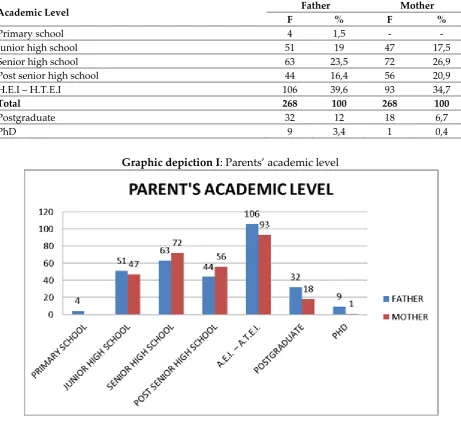
In table "II" and in graphical depiction "I" for the academic level of parents, we observe that 12% for males and 6,7% for mothers in the sample have postgraduate studies while 3,4% for males and 0 , 4% for the mothers in the sample are holders of a PhD degree. The highest incidence of the academic level is that of the possession of a Bachelor's degree of H.E.I (Higher Education Institute) or H.T.E.I (Higher Technological educational Institute) both for the mother (34.7%) and for the father (39.6%). The next academic level that appears for the father (23.5%) and more for the mother (26.9%) is the high school diploma. The next category of appearance for father (19%) and for mother (20,9%) are post-graduate studies (IEK). For the father (16.4%) post-graduate studies are the next category, while for the mother (17.5%) is the high school diploma. A small percentage of the fathers (1.5%) of the sample are graduates of primary school.
Table II: Frequencies and percentages for the academic level
Academic Level Father Mother
F % F %
Primary school 4 1,5 - -
Junior high school 51 19 47 17,5
Senior high school 63 23,5 72 26,9
Post senior high school 44 16,4 56 20,9
H.E.I – H.T.E.I 106 39,6 93 34,7
Total 268 100 268 100
Postgraduate 32 12 18 6,7
PhD 9 3,4 1 0,4
Graphic depiction I: Parents’ academic level
B. Parental profession
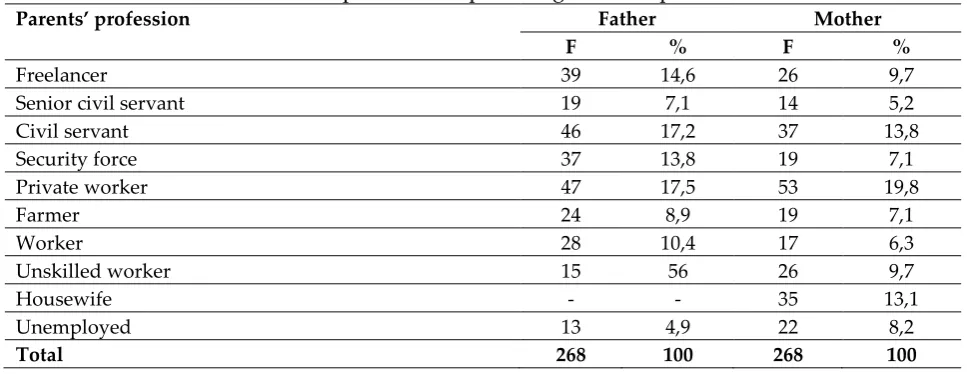
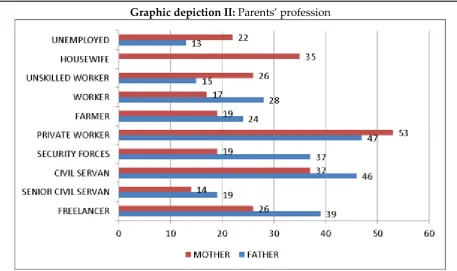
Observing the "III" table and the graphical depiction "II", the largest occurrence of frequencies in the parents' profession seems to be in the category of a private employee (17.5% father, 19.8% mother) for both parents. This category includes various professions such as sellers in various businesses - supermarkets, footwear, clothes, cafes, guides, telephone company employees.
The next highest incidence is the category of civil servants (17.2% father, 13.8% mother) such as teachers, bank employees, hospitals and public services and organizations (D.E.I, OTE, ELTA etc.).
Then for men (14.6%) there is the category of self-employed, while for women (13.1%) the household. Freelance professionals include businesses such as grocery stores, cafes, footwear shops, clothes shops, mobile phones, a civil engineering office, a law firm, a medical center. The self-employed (father N = 28, 71.8% of the total number of self-employed and 10.4% of the total sample) hold a H.E.I degree and H.T.E.I. with postgraduate and doctoral degrees, while the rest have finished the high school and post-college structures of I.E.Τ. (Ιnstitution of Educational Training) (father N = 11, 38.2% of all self-employed and 4.1% of the total sample).
After that, the category of security forces (army, land, air force, police, fire, port and air force) follows for men (13.8%), while for women there was the category of self-employed %) and the unskilled worker (9.7%). The self-self-employed (mother: N = 26 & 9,7% present 73% (N = 19)) who possess diploma of H.E.I and H.T.E.I while the rest of them have finished high school (the father N = 7 & 27% of the total number of self-employed and 2.6% of the total sample).
Table III: Frequencies and percentages for the profession
Parents’ profession Father Mother
F % F %
Freelancer 39 14,6 26 9,7
Senior civil servant 19 7,1 14 5,2
Civil servant 46 17,2 37 13,8
Security force 37 13,8 19 7,1
Private worker 47 17,5 53 19,8
Farmer 24 8,9 19 7,1
Worker 28 10,4 17 6,3
Unskilled worker 15 56 26 9,7
Housewife - - 35 13,1
Unemployed 13 4,9 22 8,2
Graphic depiction II: Parents’ profession
Table IV: Father’s academic level and profession
Parents Profession Father’s Academic Level
P ri ma ry Ju n ior High S ch oo l S en ior High S ch oo l P ost S ch oo l S tr u ct u re s of I .E .T H.E.. I an d H.T .E .I T ota l P ost gr ad u at e PhD
Freelancer - - - 11 28 39 13 5
Senior civil servant - - - - 19 19 8 4
Civil servant - - 6 8 32 46 5 -
Security forces - - 15 - 22 37 - -
Private worker - 20 15 12 - 47 6 -
Farmer 1 9 8 6 - 24 - -
Worker 9 15 4 - 28 - -
Unskilled worker 3 8 4 - - 15 - -
Housewife - - - - - -
Unemployed - 5 - 3 5 13 - -
Table V: Mother’s academic level and profession
Mother’s Academic Level Mother’s Profession P ri ma ry Ju n ior High S ch oo l S en ior High S ch oo l P ost Gr ad u at e S tr u ct u re s Of I .E .T . H.E.I A n d H.T .E .I T ota l P ost gr ad u at e P HD
Freelance Worker - - - 7 19 26 8 -
Higher Civil Servant - - - - 14 14 10 1
Civil Servant - - - 9 28 37 - -
Security Forces - - 2 - 17 19 - -
Private Employer - 13 9 23 8 53 - -
Farmer - 8 3 8 - 19 - -
Worker - 17 - - - 17 - -
Unskilled Worker - 9 16 1 - 26 - -
Housewife - - 28 3 4 35 - -
Unemployed - - 14 5 3 22 - -
Total - 47 72 56 93 268 18 1
Graphic depiction III: Annual income of the family
C. Reasons for engaging in martial arts
Graphic depiction IV: Frequencies of the reasons that made the parents (Ν= 268 100%) send their children to martial arts practice
D. Influence of the parents’ academic level on the choice of martial arts
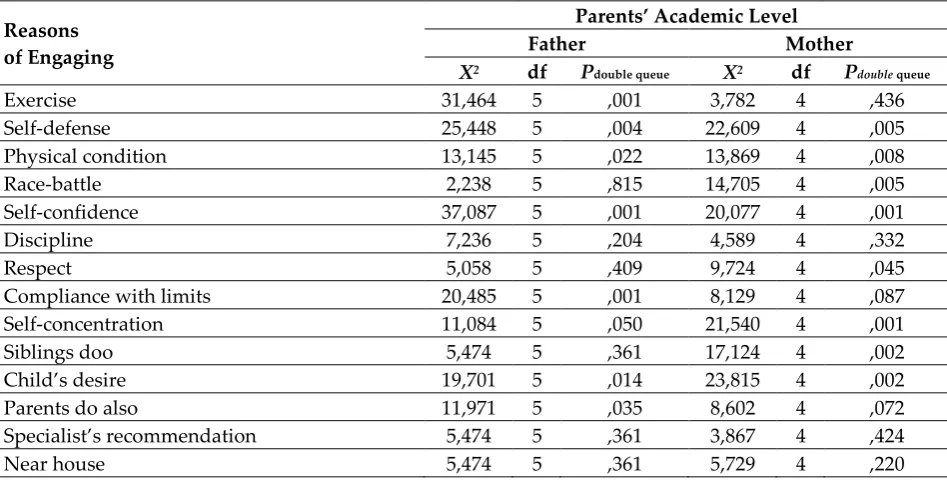
The non-parametric analyzes "x2" are presented in the tables "VI", "VII" and "VIII" for the influence of factors of the academic background, the father and mother's occupation, the annual family allowance in the choice of martial arts.
Table VI: Non-parametric statistical analysis «X2» for the academic level of father and mother
and for the reasons for occupation which according to the preliminary research analysis was categorized into three factors: gymnastic - kinetic, psychological - behavioral and personnel
Reasons of Engaging
Parents’ Academic Level
Father Mother
Χ2 df Pdouble queue Χ2 df Pdouble queue
Exercise 31,464 5 ,001 3,782 4 ,436
Self-defense 25,448 5 ,004 22,609 4 ,005
Physical condition 13,145 5 ,022 13,869 4 ,008
Race-battle 2,238 5 ,815 14,705 4 ,005
Self-confidence 37,087 5 ,001 20,077 4 ,001
Discipline 7,236 5 ,204 4,589 4 ,332
Respect 5,058 5 ,409 9,724 4 ,045
Compliance with limits 20,485 5 ,001 8,129 4 ,087
Self-concentration 11,084 5 ,050 21,540 4 ,001
Siblings doo 5,474 5 ,361 17,124 4 ,002
Child’s desire 19,701 5 ,014 23,815 4 ,002
Parents do also 11,971 5 ,035 8,602 4 ,072
Specialist’s recommendation 5,474 5 ,361 3,867 4 ,424
Near house 5,474 5 ,361 5,729 4 ,220
column (double queue ≤.05) of double-queue significance and a confidence interval of 95%, for the father and the mother it seems that the academic level:
affects fathers, but do not affect mothers to choose martial arts as a choice for
good gymnastics,
affects fathers and mothers to choose martial arts as learning self-defense,
affects fathers and mothers to choose martial arts as an improvement in physical
fitness,
doesn’t affect fathers while affects mothers to select martial arts as a good deal
with racing,
affect fathers and mothers to choose martial arts as a means of improving their
children's self-confidence,
does not affect fathers and mothers in choosing the martial arts as a means of
improving the promotion of their children's discipline,
doesn’t affect fathers, but affects mothers in choosing martial arts as a means of
improving their children’s respect,
affect fathers, but have marginal effects on mothers to choose martial arts as a
means of improving their children's limits,
affect fathers and mothers to choose martial arts as a means of improving the
concentration of their children,
doesn’t affect fathers and affects mothers to choose martial arts because the
children's other siblings also do,
affect fathers and mothers to choose martial arts because it is the desire of their
children,
affect fathers and mothers to choose martial arts because one of the children's
parents do the same,
doesn’t affect fathers or mothers for the choice of martial arts because an expert
recommended so,
Doesn’t affect fathers or mothers to choose martial arts because the gym is near
their home.
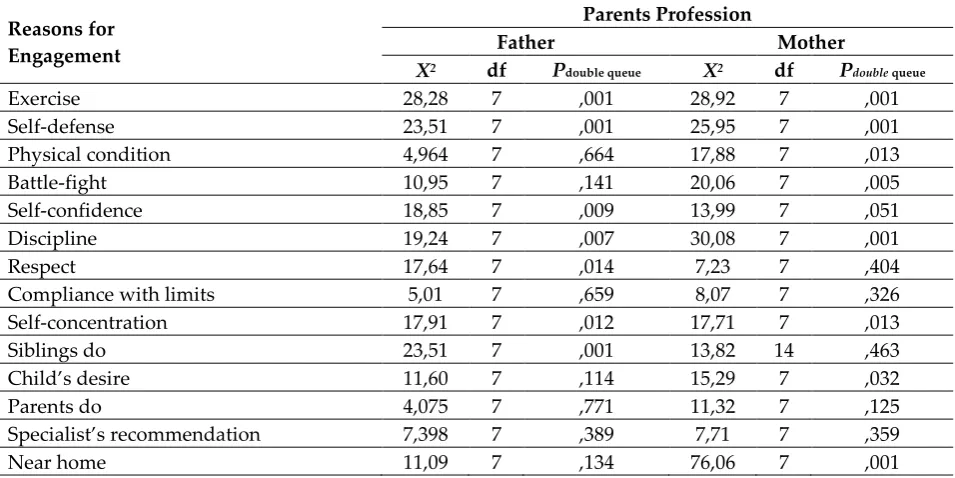
The table «VII» presents the non-parametric statistical analysis "χ2" for the influence of both father and mother's profession on the reasons that determined the choice of martial arts for their children’s engagement. In particular, from the observation of the column (double queue ≤.05) of the degree of significance with a double queue and a confidence interval of 95%, for the father and the mother it seems that the profession:
Has a positive effect on fathers for the choice of martial arts as a very good
desire, the fact that parents or other siblings do, that there is some recommendation from a specialist or is the gym close to home.
Positively affects mothers in the choice of martial arts as a very good means of
exercising, learning self-defense, improving the fitness and playing of children. It also acts positively as a means of improving self-confidence, discipline, concentration and the fact that it is the children's own desire and that the martial arts gym is close to home. The profession does not affect mothers in selecting the martial arts as a very good means of developing respect and observance of boundaries. Still on reasons like parents or other siblings or the fact that there is some recommendation by a martial artist.
Table VII: Non-parametric statistical analysis "X2" for the father’s and mother’s profession and for the reasons for engagement, which according to the preliminary exploratory factor
analysis they were categorized into three factors: gymnastic - kinetic, psychological - behavioral and personnel
Reasons for Engagement
Parents Profession
Father Mother
Χ2 df Pdouble queue Χ2 df Pdouble queue
Exercise 28,28 7 ,001 28,92 7 ,001
Self-defense 23,51 7 ,001 25,95 7 ,001
Physical condition 4,964 7 ,664 17,88 7 ,013
Battle-fight 10,95 7 ,141 20,06 7 ,005
Self-confidence 18,85 7 ,009 13,99 7 ,051
Discipline 19,24 7 ,007 30,08 7 ,001
Respect 17,64 7 ,014 7,23 7 ,404
Compliance with limits 5,01 7 ,659 8,07 7 ,326
Self-concentration 17,91 7 ,012 17,71 7 ,013
Siblings do 23,51 7 ,001 13,82 14 ,463
Child’s desire 11,60 7 ,114 15,29 7 ,032
Parents do 4,075 7 ,771 11,32 7 ,125
Specialist’s recommendation 7,398 7 ,389 7,71 7 ,359
Near home 11,09 7 ,134 76,06 7 ,001
Table VIII shows the non-parametric statistical analysis «χ2» for the effect of the annual
Table VIII: Non-parametric statistical analysis "X2" for the annual family income and the reasons for the involvement, which according to the preliminary exploratory
factor analysis they were categorized into three factors: gymnastic - kinetic, psychological - behavioral and personnel
Reasons for Engagement Annual family income
Χ2 df Pdouble queue
Exercise 19,837 9 ,019
Self-defense 18,949 9 ,026
Physical condition 45,056 9 ,001
Battle-fight 56,189 9 ,001
Self-confidence 47,607 9 ,001
Discipline 38,552 9 ,001
Respect 31,524 9 ,001
Compliance with limits 16,237 9 ,062
Self-concentration 26,776 9 ,002
Siblings do 15,631 9 ,075
Child’s desire 33,848 9 ,000
Parents do 17,530 9 ,041
Specialists’ recommendation 13,499 9 ,141
Near home 69,976 9 ,001
3. Discussion – Conclusions
The purpose of this work was to investigate the reasons parents choose to take their children to martial arts during their free time and to study the impact of social origin (academic level and parenting profession, annual family income) on the reasons their choice. This study attempts to highlight the fact that martial arts deal with children whose families belong to the profession, their annual income and their education in low, medium or high social strata.
violence, devotion, obedience and compliance to collective discipline) that contradict with the values of the bourgeoisie.
The results of this research appear to confirm partially and not entirely Bourdieu's theory, since the crowding of the majority of the sample in the frequencies of annual family income is depicted in the low and middle economic strata. The tables of the educational level, however, are testified by a majority of the parents of the sample who appear to have finished the H.E.I or H.T.E.I. and have an academic level. In conclusion, the conclusion drawn from this research over and above the assumptions made in the introduction is that most children of the low and middle social (petty bourgeois) strata are involved in martial arts, and barely the children of the bourgeoisie. In a survey based on the father’s profession at American College (Koukouris, 2009), a classification with six categories of sports emerged: the highest category (golf), low upper category (tennis), high middle class (athletics) high-low (boxing) and low-lower (wrestling). The martial arts in this age and days, although kinetically fit to the wrestling and boxing sports which according to (Koukouris, 2009) belong to the low social strata, nevertheless they seem to fit and be preferred by the low and middle social classes. In conclusion, the martial arts, although started from the lower social strata nowadays, show a social development. More and more educated parents, who belong to the middle and upper social classes, engage their children in their free time, to martial arts, after they had become aware of the importance of the martial arts and how these help them create and develop a complete personality. Each parent for different reasons sends his child to learn martial arts, but all agree with each other about the great contribution of the martial arts. Our research literature is fully confirmed and the major contribution of the martial arts to the education of children and youth is conceived. It is also important to do more research with larger samples in the different types of martial arts.
References
Bin Bu, Han Haijun, Liu Yong, Zhang Chaohui,Yang Xiaoyuan, Maria Fiatarone Singh
(2010). Effects of martial arts on health status: A systematic review, Journal of
Evidence-Based Medicine – Wiley Online Library, November, 3(4), pp.205-219.
http://onlinelibrary.wiley.com/doi/10.1111/j.1756-5391.2010.01107.x/full, (Was
accessed: 18 Joune 2018).
Bishop, J. and P. Hoggett 1995. “Mutual Aid in Leisure.” In Sociology of Leisure: A Reader, edited by C.
Bourdieau, P. (1978). Sport and Social class. Social Science Information, 17, 819-840.
Burke, D.Τ., Al-Adawi, S., Lee, & Y.T., Audette, J. (2007). Martial arts as sport and therapy, Journal of Sports Medicine and Physical Fitness, 47(1): 96 – 102.
Crawford, S. (1977). Occupational Prestige Rankings and the New Zealand Olympic
Athlete, International Review of Sport Sociology, 12, 1, pp. 5-15.
Critcher, P. Branham and A. Tomlinson, 197–208. London: Chapman and Hall, esp. p.206.
Diamond, Α. (2015). Research that Helps Move Us Closer to a World where Each Child
Thrives, Journal of Research in Human Development, 12(3-4) pp. 288–294.
https://www.ncbi.nlm.nih.gov/pmc/articles/PMC4666319/, (Was accessed: 18
Joune 2018).
Dishman, R. (1989). Determinants of Physical Activity and Exercise for Persons 65 years of
Age or Older, Paper presented during the sixtieth Annual Meeting of the
American Academy of Physical Education. Paper No 22.
Grass, H. (1971). Participation in high level sports of young people working in industry
and trade. International Review of Sport Sociology, pp.114-121.
Hewitt και Mitchell (1979). Social stratification. In Mitchell (ed), A new dictionary of Sociology. Routledge and Kegan Paul, London and Henley.
Ian Henry, Vafeas, N., Gasias, G., Zaimakis, G., Kotaridis, N., Koulouris, Chr., Mavrofidis, Th., Papageorgiou, D., Samatas M., Tzanakis, M., Fournarakis, E .,
Hadjiestasthiou, D., Tzahresta, B., Humerian, M. (2015). Society and Sports in
Greece - Sociological and Historical Approaches. Edited by: G., Zaimakis & E., Fournaraki, Athens, Publisher: Alexandria.
Jagiełło, W.ł., & Dornowski, Μ. (2011) Martial arts in the opinions of students at the
Faculty of Physical Education, Archives of Budo, 7(2),
http://archbudo.com/view/abstract/id/10613, (Was accessed: 18 Joune 2018).
London, J. (1988). Histories of Boxing. Agra Editions, Athens.
Luschen, G. (1971). Social Stratification and Social Mobility among young German
sportsmen. In E. Dunning (ed) The Sociology of Sport, Frank Cass, London, U.K.
Luschen, G. (1984). Status crystallization, social class integration and sport. International
Review of Sport Sociology, pp.283-293.
Miller, D.M. and Russell, K. (1971). Sport: A contemporary view. University of Arizona,
Lea and Febiger, Tuscon, USA.
Wilson, T. (2002). The paradox of social class and sports involvement. The roles of
cultural and economic capital. International Review for the Sociology of Sport, 37, 1,
5-16.
Yannakis, A. (1975). A theory of Social Stratification. Sport Sociology Bulletin 4(10).
Spring Edition.
Youvanaki, A., Sardelis, A., Doganis, G. & Thomoglou G. (1999). Athletic Psychology, 10,
53-68.
Kavadias, C. (1983). General Sociology (2nd Edition) Sokkoula Publications, Athens -
Komotini.
Kordatos G. (1960). Prehistory and history of ancient sport. Bairon Publications. Athens.
Koukouris, K. (2009). The Social Dimension of Sport, Thessaloniki.
Petmezidou-Tsoulouvi (1987). Social classes and mechanisms of social reproduction. Exandas Publications, Athens.
Petmetzidou, M. (1990). Social classes, In Pedagogical Psychological Encyclopedia Dictionary,
Athens, Edition: Greek Letters, p.: 2669.
Creative Commons licensing terms