Volume 63 (2014)
Proceedings of the
Eighth International Workshop on
Software Clones
(IWSC 2014)
How Accurate Is Coarse-grained Clone Detection?:
Comparision with Fine-grained Detectors
Keisuke Hotta, Jiachen Yang, Yoshiki Higo, and Shinji Kusumoto
18 pages
Guest Editors: Nils G ¨ode, Yoshiki Higo, Rainer Koschke
Managing Editors: Tiziana Margaria, Julia Padberg, Gabriele Taentzer
How Accurate Is Coarse-grained Clone Detection?:
Comparision with Fine-grained Detectors
Keisuke Hotta1, Jiachen Yang2, Yoshiki Higo3, and Shinji Kusumoto4
1[email protected],2[email protected]
3[email protected],4[email protected]
Graduate School of Information Science and Technology Osaka University, Japan
Abstract: Research on clone detection has been quite successful over the past two
decades, which produced a number of state-of-the-art clone detectors. However, it has been still challenging to detect clones, even with such successful detectors, across multiple projects or on thousands of revisions of code in limited time. A simple and coarse-grained detector will be an alternative of detectors using fine-grained analysis. It will drastically reduce time required for detection although it may miss some of clones that fine-grained detectors can detect. Hence, it should be adequate for a tentative analysis of clones if it has an acceptable accuracy. However, it is not clear how accurate such a coarse-grained approach is. This paper evaluates the accuracy of a coarse-grained clone detector compared with some fine-grained clone detectors. Our experiment provides an empirical evidence about acceptable accuracy of such a coarse-grained approach. Thus, we conclude that coarse-grained detection is adequate to make a summary of clone analysis and to be a starter of detailed analysis including manual inspections and bug detection.
Keywords:Clone detection, Software evolution, Mining software repositories
1
Introdution
Code clone, also called duplicated code, is known as a typical bad smell for software develop-ment and maintenance [FBB+99]. They recieve a considerable amount of attention from devel-opers [YM13], which may be because code cloning is quite easy to do and almost unavoidable [KBLN04].
Such a background encourages researchers to develop a variety of techniques to cope with clone-related problems [Kos08,ZR12, Kos06]. Clone detection is one of the hottest topics in this research area since it plays a fundamental role for managing clones. Research on clone detection has been quite successful because of great effort that many researchers have spent. As a result, a variety of clone detectors have been developed and used [RBS13,RC07,Bak95,
BYLB98,KKI02,MLM96,DRD99,HJHC10,RC08,JMSG07].
Inter-project clone detection opens our eyes to find reusable code, and to detect plagiarism and license violations [Kos13]. Historical analysis of clones has provided a number of useful findings [KSNM05, GK11,Kri08, HSHK10,LW08, HG12,JDHW09] because historical data has rich information that the current states of projects do not have [HMK12,KMM+10].
However, these research areas suffer the following issues.
Time required for detection: although state-of-the-art detectors have been successful to
detect clones in single projects, clone detection across multiple projects or on multiple revisions requires a huge amount of time.
A huge number of clones: state-of-the-art detectors tend to report a number of clones even
from a single state of code in a single software system. If we apply them to inter-project detection or historical analysis, the number of detected clones will become much larger. This may make it difficult to analyze the results in a limited time period.
It should be an alternative of using state-of-the-art detectors to use simple and coarse-grained clone detectors [HHK13]. Herein, “coarse-grained clone detection” means “clone detection on coarser units of code”. In this paper we suppose that finer unit of code means sequence of tokens, statements, or lines, and coarser units of code include blocks, methods, functions, classes, and files. In our defenition, fine-grianed detectors can find clones composed of a part of syntactic block, but coarse-grained detectors cannot find them. The main objective of this paper is to reveal the performance and the accuracy of such a coarse-grained detection. We have implemented a simple block-based detector and use it in our investigation.
The most advantageous point of the coarse-grained approach should be in its performance. That is, it will drastically reduce time required for clone detection because it requires a fewer number of comparisons of code units. Hence, it should be suitable for analyzing inter-project cloning or clone evolution. Therefore, we investigate the performance of the coarse-grained detection as our first research question.
RQ1: Is the coarse-grained detector much faster than fine-grained ones?
In addition to that, coarse-grained detectors will report a fewer number of clones than fine-grained ones. Therefore, they may make it possible to analyze the results in limited time. Hence, we are interested in the number of detected clones in the second research question.
RQ2: Does the coarse-grained detector report a fewer number of clones?
Note that this research question considers only the number of detected clones. In other words, this research question is not interested in the correctness of detected clones. Hence, it is unclear how many correct clones are detected and missed by the coarse-grained detector. The remaining research questions focus on the accuracy of the coarse-grained detector.
RQ3: Does the coarse-grained detector have high precision?
RQ4: Does the coarse-grained detector have high recall?
Our experiment confirmed high scalability of the coarse-grained detection on multiple projects and multiple revisions compared with fine-grained ones. It also showed that the coarse-grained detector reported fewer numbers of clones than fine-grained detectors. In addition, the coarse-grained detector achieved high precision compared to other detectors. On the other hand, it had lower recall than other detectors, but it was not so low.
Based on these findings, we conclude that using such a coarse-grained clone detector as a starter of clone analysis should be an effective way to analyze across multipe projects or multiple revisions. For instance, suppose that we are about to analyze clones among thousands of projects, which requires a vast amount of time to be analyzed with fine-grained detectors. In this case, we can apply a coarse-grained detector to get an overview of clones in the dataset even though there exists a tight limit of time. With the coarse-grained detector, you may find that there are a number of clones in a particular pair of projects. However, we have to note that the coarse-grained detector has a little lower recall compared to fine-coarse-grained ones. Hence, it is not sufficient using only coarse-grained detectors because it should miss some clones. Therefore, we suggest a two-staged analysis using both of fine-grained and coarse-grained detectors. That is, at the first stage we use a coarse-grained detector to get a summary of clones and narrow down the analysis target with the results. After the first stage, we use a fine-grained detector to conduct more detailed analysis with the narrowed target. Such a two-staged analysis should be effective for a huge dataset with limited time.
The remainder of this paper is organized as follows. At first, we discuss related work in Section2. Section3 describes the coarse-grained detector used in this study. Section4 gives how to conduct the experiment, and Section5shows the experimental results. Section6discusses threats to validity of this research, and the final section, Section7, concludes this paper.
2
Related Work
2.1 Clone Detection across Multiple Projects
Koschke developed a technique to detect inter-system clones with a suffix-tree-based approach [Kos13]. His technique is interested in clones between a subject system and a set of other sys-tems. He achieved high scalability with some heuristics, including to generate suffix trees for either the subject system or the set of other systems, and to use a filter based on hashing.
Ossher et al. proposed a technique to detect file-level clones [OSL11]. Through an empirical study on a dataset that includes over 13,000 projects [LBJP], they revealed that approximately 10% of files were clones. Furthermore, they found that file-level cloning tends to occur in cases of reusing whole of existing projects as a template of a new project.
A similar work was conducted by Sasaki et al. [SYHI10]. They developed a tool named
Ishihara et al. proposed a technique to detect method-level clones for locating library candi-dates [IHH+12]. They conducted an empirical study on the dataset used in Ossher et al.’s study, and their technique found approximately 2,900,000 cloned methods within four hours.
Keivanloo et al. conducted a set of empirical studies toward building real-time clone search system [KRC11]. They adopted multi level hashing to detect clones in their study. Although they were interested in clone search, they also reported the performance of their light weight clone detection approach on a code base that includes 1,500,000 Java classes. The empirical study revealed that their approach could detect approximately 11 billion clone pairs in 21 minutes.
Keivanloo et al. proposed a framework to improve scalability of existing detectors for large datasets including multiple projects [KRRC12]. Their technique is compirising of shuffling, repetition, and random subset generation of the subject dataset. Their approach is completely independent of detectors, and so it can be applied for any detectors without any modifications on them. The research was followed by a further experiment by Svajlenko et al. on six existing clone detectors [SKR13], and the experiment revealed the effectiveness of the framework.
2.2 Analysis of Clone Evolution
The pioneers of studies on clone evolution are Kim and her colleagues [KSNM05]. They formu-lated clone genealogies and conducted an empirical study on clone genealogies. The empirical study revealed that most of clones were short-lived.
G¨ode and Koschke investigated how many times clones were changed during their evolution [GK11]. They showed that most of clones were changed at most once, and changes on them did not cause severe problems in most cases.
There exists some other studies to analyze evolution of clones, which includes analyzing evo-lution of Type-1 clones [G¨09], analyzing evolution of near-miss clones [Baz12, SRS11], and analyzing stability or changeability of clones [Kri08,HSHK10,LW08,HG12]. The results did not agree with each other, and so the research community still has a room for discussion about harmfulness of clones. It can be said that, however, there are both harmful clones and harmless ones. Hence, managing clones is no longer considered a “hunt-and-kill” game [WG12] and
we thus have to carefully select the clones to be managed to avoid unnecessary effort managing clones with no risk potential[GK11].
2.3 Comparison between Clone Detectors
One of the benchmarks on clone detectors is the one conducted by Bellon and his colleagues [BKA+07]. It is quite difficult to make a correct set of clones due to the vagueness of definition of clones. Hence, they made their correct set through a manual inspection. They collected clones with six detectors on eight open source projects, and looked them through to judge whether they should be really regarded as clones. The vast amount of collected clones made it impossible to investigate all of them, and so they randomly selected clones to be judged.
Roy et al. provided another benchmark from a different standpoint [RCK09]. That is, they compared clone detectors with four distinct senarios on copy/paste/modify operations. Their benchmark showed which tools are adequate for each senario.
[RC09]. The key idea of their study is using mutation. Their technique generates and injects mutants of code fragments, and evaluates detectors with them.
A similar work to our study was conducted by Ducasse et al. [DNR06]. They implemented a clone detector using simple string matching, which can be applied to a number of different lan-guages including COBOL, Java, or C++. They confirmed that the inexpensive detector achieved high recall and acceptable precision. A major difference between their work and this study is in the granularity of clone detection. Their work used a simple string matching to reduce time required for detection, which is a fine-grained detection technique. On the other hand, this study is interested in coarse-grained technique. The simple string matching reduces the cost of each comparison between two elements, but coarse-grained detection, by contrast, reduces not only the cost of each comparison but also the number of comparisons of elements. Hence, coarse-grained technique will be faster than simple fine-coarse-grained ones, but it may miss some clones that finer techniques can detect. The objective of this research is to empirically reveal that.
3
Coarse-grained Clone Detection
This section describes the coarse-grained detector used in this study. It detects block-level clones from the given source files. It explains how to detect clones in a set of source files, followed by the description of incremental detection.
3.1 Clone Detection on a Set of Source Files
Input and Output
The detector takes a set of source files as its input, and reports a list of clone pairs among them. Currently, it targets only Java because of the limitations of the implementation.
Procedure
The detection procedure consists of the following four steps.
• STEP1: Parse given source files to detect blocks.
• STEP2: Normalize every detected block.
• STEP3: Calculate a hash value from each block.
• STEP4: Group the blocks based on their hash values.
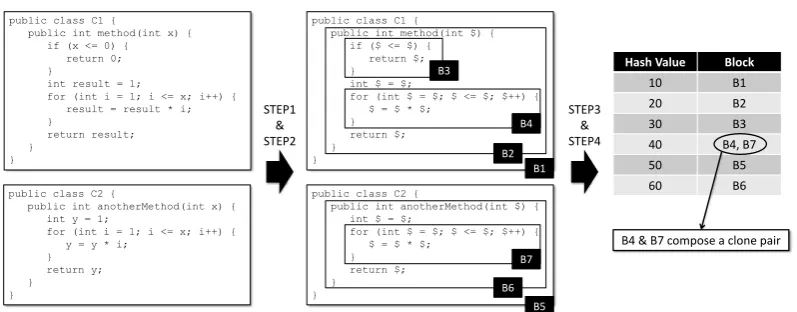
Figure1shows an overview of the procedure. The followings describe each step in detail.
STEP1: Detect Blocks
public class C1 {
public int method(int x) { if (x <= 0) { return 0; }
int result = 1;
for (int i = 1; i <= x; i++) { result = result * i; }
return result; }
}
public class C2 {
public int anotherMethod(int x) { int y = 1;
for (int i = 1; i <= x; i++) { y = y * i;
} return y; } } STEP1 & STEP2
public class C1 {
public int method(int $) { if ($ <= $) { return $; }
int $ = $;
for (int $ = $; $ <= $; $++) { $ = $ * $;
} return $; }
}
public class C2 {
public int anotherMethod(int $) { int $ = $;
for (int $ = $; $ <= $; $++) { $ = $ * $; } return $; } } B1 B5 B2 B3 B4 B6 B7
Hash Value Block
10 B1
20 B2
30 B3
40 B4, B7
50 B5
60 B6
STEP3 & STEP4
B4 & B7 compose a clone pair
Figure 1: Overview of the Detection Procedure
STEP2: Nomalize Blocks
The next step is normalization for every block detected in the previous step. At first, it reformats every block with a regularized form. This procedure allows the detector to ignore differences of white-spaces or tabs. In addition to that, it replaces each variable name and each literal with a special token, which allows the detector to find Type-2 clones. Hence, the detector can find both of Type-1 and Type-2 clones, but cannot find Type-3 clones.
STEP3: Calculate Hash Values
The third step calculates hash values from texts of respective blocks. Our implementation uses
hashCode()ofjava.lang.Stringas the hash function. Any other hash functions, how-ever, can be used instead if they can generate a numerical value from a given string.
STEP4: Group Blocks
The final step is grouping blocks based on their hash values. Two blocks have the same hash value if their text representations after normalized are equal to each other. Hence, a block pair is regarded as a clone pair if the two blocks have the same hash value. The detector groups all the detected blocks and reports all the clone pairs.
3.2 Incremental Detection
In addition to the function of clone detection for a single state of code, the detector has a function for detecting clones incrementally. The detector takes a Subversion repository as its input for performing incremental clone detection, and reports clone pairs in every revision.
The detector is motivated by the idea of the implementation from the literature [HHK13]. That is, it analyzes only files that were modified in a target commit. In other words, it reuses the results of analysis on the past commits of the target commit.
Suppose that the detector is about to analyze a commit cr, which is a commit between the
files (f1. . .fn). In this case, the detector has already finished analyzing all the commits beforecr.
Hence, all the analysis results for files f1. . .fnexcept for fkcan be used for analyzingcrbecause
these files did not changed incr. Therefore, the detector newly performs STEP1, STEP2, and
STEP3 only for fk, and it performs STEP4 on all the blocks in files f1. . .fn.
4
Experimental Setup
4.1 Terms
This study uses the benchmark of Bellon and his colleagues [BKA+07], which is a well-used benchmark in the research community.
Hereafter, this paper uses the following terms.
Reference: a reference is a clone pair that was judged as correct by Bellon and his colleagues.
Candidate: a candidate is a clone pair that was reported by a clone detector.
This study uses a metric namedOK-valueto judge whether a candidate matches a reference. This metric was defined and used in the original study of Bellon et al..
Before definingOK-value, we give the definition ofcontained(CF1,CF2)for a given code fragmentsCF1 andCF2 as follows.
contained(CF1,CF2) =|lines(CF1)∩lines(CF2)|
|lines(CF1)| (1)
where,lines(CF)indicates the set of all the lines of code in the code fragmentCF. Now we can defineOK-valuefor a given pair of clone pairsCP1 andCP2.
OK(CP1,CP2) =min(max(contained(CP1.CF1,CP2.CF1), (2)
contained(CP2.CF1,CP1.CF1)),
max(contained(CP1.CF2,CP2.CF2),
contained(CP2.CF2,CP1.CF1)))
where,CP.CF1 andCP.CF2 are the two code fragments of which the clone pairCPconsists. It is regarded that a detector could detect a referenceCR if it reported a candidateCC that satisfies the following condition.
OK(CR,CC)>=threshold (3)
This study uses 0.7 as thethreshold, which is the same value used in the original work. Furthermore, this paper uses the following metrics to evaluate the accuracy of detected clones for a given target software systemPand a given detectorT.
Precision(P,T) = |DetectedRefs(P,T)|
|Cands(P,T)| (4)
Recall(P,T) = |DetectedRefs(P,T)|
|Refs(P)| (5)
• DetectedRefs(P,T)refers to a set of references inPthat were detected withT.
• Cands(P,T)refers to a set of candidates thatT reported fromP.
• Refs(P)refers to the set of all the references inP, which is independent of detectors.
We have to note that there exists another metric used in the original benchmark of Bellon and his colleagues, which is namedGoodvalue. Goodvalue is a stronger criterion thanOKvalue.
OKvalue becomes high in the case that a clone reference(candidate) subsumes a clone candi-date(reference) sufficiently. On the other hand,Goodvalue becomes high in the case that a clone reference(candidate) sufficiently match a clone candidate(reference). In other words,Goodvalue becomes not high in the case thatOKvalue becomes high if a large clone reference(candidate) subsumes a small clone candidate(reference).
The reason why we have chosen the looser metric is that we suppose that the main use of the coarse-grained detection is to roughly analyze code clones on a huge data set. Hence, we think thatGoodmetric is too strict for the purpose.
4.2 Target Software Systems
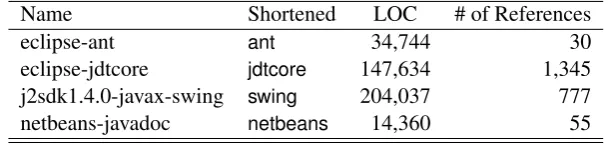
The expriment for RQ2, RQ3, and RQ4 targets software systems used in Bellon et al.’s work because there does not exist Bellon et al.’s correct sets of clones on any other software systems. In addition, it omits C projects from the target due to the limitation of our implementation. Therefore, there are four target systems for the expriment, which are shown in Table1.
The experiment for RQ1 needs another set of targets. This is because the main usage of such a coarse-grained detector should be reducing time required for detection. Hence, it should be reasonable to use a corpus of many projects and historical repositories to answer RQ1.
The experiment uses a dataset called UCI dataset[OSL11,LBJP]. The dataset has approx-imately 13,000 Java projects, which should be enough large for fine-grained detectors not to complete their tasks. More statistics are shown in Table21.
1We ignored branches, tags, test cases, and not parsable files, which results different values from ones in [OSL11,
IHH+12]
Table 1: Target Software Systems (for RQ2, RQ3, and RQ4)
Name Shortened LOC # of References
eclipse-ant ant 34,744 30
eclipse-jdtcore jdtcore 147,634 1,345
j2sdk1.4.0-javax-swing swing 204,037 777
netbeans-javadoc netbeans 14,360 55
Table 2: Overview ofUCI Dataset
# of .java files 2,092,739
# of projects 13,193
The experiment also uses the historical code repository ofDNSJava. We selected this reposi-tory because it has been used in some empirical studies on clone evolution and it has a reasonable length of histories. Table3tells some statistics of the repository.
4.3 Detectors Used for the Comparison
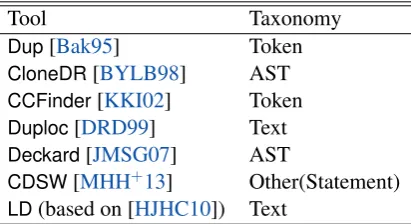
Our experiment uses seven detectors shown in Table4 as comparison targets. We chose four of them, Dup, CloneDR, CCFinder, and Duploc, because they were used in the original work of Bellon et al. and they can handle Java. We omitted CLANfrom the list of attendees in this experiment becanse it detects clones based on function metrics, which is categorized a coarse-grained detector in our definition. We add other two detectors, DeckardandCDSW, that were developed recently because the four detectors used in the original work were developed over a decade ago.
The other one, which is refered as LD (Lightweight Detector), was developed by ourselves based on the paper of Hummel et al. [HJHC10]. It aims to detect clones in a short time period with lightweight analysis. The technique creates and uses indexes on N-grams of source lines, which gives it high scalability. Although it uses a lightweight analysis, it is more fine-grained than the coarse-grained detector. Hence, we think that coarse-grained analysis will be faster than it, but it is still unclear. This is a motivation that we use the detector in the experiment.
In addition to that, it has a function of incremental clone detection. Incremental clone detec-tion is one of the way to cope with the issue of time required for clone detecdetec-tion on multiple revisions of code [GK09]. Hence, this detector has high scalability for detecting clones on mul-tiple revisions. This is the other reason that we use this detector as our target.
Table 3: Overview of the Repository ofDNSJava
the revision number of the latest revision 1,670
# of commits where at least one .java file was modified 1,432
# of files in the latest revision 7,362
total LOC of .java files in the latest revision 1,237,336
Table 4: Detectors Used as Comparison Targets
Tool Taxonomy
Dup[Bak95] Token
CloneDR[BYLB98] AST
CCFinder[KKI02] Token
Duploc[DRD99] Text
Deckard[JMSG07] AST
CDSW[MHH+13] Other(Statement)
5
Results
This section provides the results of our experiment. It answers the four research questions, and gives a summary of the results.
Note that we reused the results of Bellon et al.’s experiment of Dup, CloneDR, CCFinder,
CLAN, andDuploc, and so we did not run the five detectors on our own platform.
5.1 RQ1: Is the coarse-grained detector much faster than fine-grained ones?
The answer isYes.
We applied the coarse-grained detector andLDtoUCI datasetand the repository ofDNSJava
to compare the performance of the coarse-grained approach with fine-grained one. Note that both of the two detectors can perform incremental clone detection and parallelized execution.
Each detector ran on an HP workstation Z820 with two Intel 64bit 2.4GHz CPUs and 128GB RAM. The workstation has an SSD that contains the whole of UCI datasetand a copy of the repository ofDNSJava. Each detector used 32 threads to perform parallelized execution.
Table 5 shows the result of the comparison. Coarse-grained in the table refers the coarse-grained detector described above, which detects clones in the block-level. Note thatLDcould not finish its task onUCI dataset within 24 hours, so we aborted it. As the table shows, the coarse-grained detector was faster than fine-grained one. We also appliedCCFinderon the latest revision of the repository ofDNSJavajust for reference. The target has approximately 7,000 files with 1.2 million LOC as shown in Table3. As a result,CCFindertook 42 minutes for the target. Therefore, it should not be realistic to apply it on the whole ofUCI datasetor all the revisions of
DNSJavadue to the massive amount of time required for the detection.
To summarize the comparison of performance of the two detectors, althoughLDcompleted its task in hours, the results show the high scalability of the coarse-grained technique.
5.2 RQ2: Does the coarse-grained detector report a fewer number of clones?
The answer isYes.
Table6shows the number of detected clone pairs with each detector on each target. Note that
Duploccould not finish its task onswing, and so the corresponding column is filled with N/A. As shown in the table, the coarse-grained detector reported fewer numbers of clones in most cases, except for the comparison withCloneDRandCDSW. Although the coarse-grained detector did not report the fewest number of clones, we can say that it found fewer numbers of clones.
Table 5: Time Elapsed for Detection
LD Coarse-grained
UCI dataset(multiple projects) N/A 152 [m]
0.0% 5.0% 10.0% 15.0% 20.0% 25.0% 30.0%
ant netbeans swing netbeans
Dup CloneDR CCFinder Duploc Deckard CDSW LD Coarse-grained
Figure 2: The Results of Comparision (Precision)
0.0% 20.0% 40.0% 60.0% 80.0% 100.0%
ant jdtcore swing netbeans
Dup CloneDR CCFinder Duploc Deckard CDSW LD Coarse-grained
Figure 3: The Results of Comparison (Recall)
5.3 RQ3: Does the coarse-grained detector have high precision?
The answer isYes.
Figure 2shows the results of comparison of precision. Each bar in the graph indicates the value ofprecisionwith a detector on a target project. The bars are sorted in the descending order of the value ofprecisionfor each of the target projects. The black bar indicates the coarse-grained detector.
The graph tells us that the coarse-grained detector achieved the highestprecisionin the case ofjdt-core. In the other cases, it have the second highestprecision.
Therefore, we conclude that the coarse-grained detector achieved high precision compared with others.
Table 6: The Number of Detected Clone Pairs
Tool ant jdtcore swing netbeans
Dup 245 11,589 7,220 344
CloneDR 42 3,593 3,766 33
CCFinder 950 26,049 21,421 5,552
Duploc 162 710 N/A 223
Deckard 319 22,353 25,415 414
CDSW 222 5,247 1,703 1,344
LD 662 44,294 19,253 1,360
0 0.05 0.1 0.15 0.2 0.25
ant jdtcore swing netbeans
Dup CloneDR CCFinder Duploc Deckard CDSW LD Coarse-grained
Figure 4: The Results of Comparision (F-Measure)
5.4 RQ4: Does the coarse-grained detector have high recall?
The answer isNo.
Figure3shows the values of recall. This graph has the same fashion of the graph shown in Figure2except for the difference of represented values.
We can see that the coarse-grained detector could not achieve the highest recall in all the targets. Hence, we conclude that the coarse-grained detector cannot achieve high recall.
However, please note that the coarse-grained detector did not have the lowestrecallin all the cases. Therefore, it could detect a ceartain amount of, not so few, clones.
5.5 Summary of the Results
Our experimental result confirmed the high scalability of a coarse-grained technique on inter-project and multi-revision clone detection. Furthremore, it showed that the coarse-grained detec-tion technique achieved high precision with fewer numbers of clones detected, but it could not achieve high recall.
In general, the values ofprecisionandrecallare in trade-off. The clone detector that have high recall tend to have low precision and vice verse. To evaluate the total accuracy, we compared the values ofF-Measure, which is the harmonic average ofprecisionandrecall. A highF-Measure
means that the values ofprecisionandrecallare highly balanced. The formal definition of F-Measureis shown below.
F−Measure(P,T) =2∗Precision(P,T)∗Recall(P,T)
Precision(P,T) +Recall(P,T) (6)
Figure4shows the values ofF-Measurein the similar fashion of Figures2and3. This graph shows that the coarse-grained detector achieved the highestF-Measureon two out of four target projects. This result indicates that it has highly balancedprecisionandrecall, and it is no longer a poor detector.
coarse-grained one because it can retrieve clones that the coarse-grained one misses. We will need to narrow down our investigation target due to limitations of resources to use a fine-grained detector. In this case, a coarse-grained technique will help us narrow down the investigation target.
6
Threats to Validity
Configurations of Detectors
This study used a particular configuration for each detector, but the configurations have not small effect on the results of detection. There exists an automated way to find a adequate configuration for a given situation with the search based approach [WHJK13]. If we search a better configura-tion for each detector with such a technique, the results might be different from this study.
Different Core Paradigms of Detectors
This study compared the accuracy of a coarse-grained clone detector with other detectors. How-ever, the detectors adopt different core paradigms and heuristics. Hence, such differences except for granularity might affect the results of comparison. It is impossible, however, to compare the detectors with the same paradigm because the detection granularity plays an important role on the paradigm of clone detection.
Hash Collision
We are threaten by the possibility of hash collision as long as we use hash values for compar-ing two elements of code. For the ease of implementation, we adopted a simple hash function provided by Java standard libraries. However, Keivanloo et al. revealed that the 32-bit hash function is enough strong with an experiment on a huge data set [KRC11]. We used the same hash function that was used in the experiment conducted by Keivanloo et al., and so we believe that the hash function is enough strong in this experiment.
Target Software Systems
The limitation of our implementation enfourced us to target only Java projects. Hence, it is nec-essary to conduct more experiments on other programming languages to generalize our findings.
References of Clones
As long as we used the benchmark of Bellon et al., we suffered from threats to validity of their study. That is, the references were built on only a part of collected clones. Hence, it is possible that a clone pair that did not match to any references is actually a correct clone.
In addition, we have to mention that the references were built from the results of 6 detectors used in Bellon et al.’s benchmark. The results of any other detectors used in this study, including the ones developed by ourselves for this study, were not considered for building the references. For fairer comparision, it is necessary to rebuild the clone references with considering all the results of all the clone detectors attending the competition.
A fairer way of compaison will be sampling each detector’s output and making judgements whether they are true clones. However, we are afraid that we make judgements that are better for coarse-grained detectors. Hence, we decide to use Bellon et al.’s benchmark.
Types of Clones
The two detectors that we have implemented for this study do not consider the types of clones. However, the references judged by Bellon et al. have been labeled with their types. Hence, some other findings may be produced if we take into account types of clones.
In addtision, most of clone detectors are not very good at detecting Type-3 clones. Therefore, it has been still unclear whether the coarse-grained approach is useful in the case that Type-3 clones are taken into account.
However, it is difficult for the simple and coarse-grained approach to detect Type-3 clones. NiCad, which is one of the well-used clone detectors in the research community, can detect Type-3 clones at the block level. The granurality of detection of NiCad is the block level as well as the coarse-grained detector that is used in this study. However, NiCad compares token sequences created from each block with the algorithm to detect longest common subseqneuces. In other words, it requires a fine-grained analysis to detect Type-3 clones.
From this aspect, as well as the issue of low recall, it is not sufficient to use only coarse-grained clone detectors for detail analysis. The issue of Type-3 clones can be resolved by using Type-3 clone detector in the second stage of clone analysis.
7
Conclusion
This paper evaluated the accuracy of coarse-grained clone detection compared to other fine-grained clone detectors. We implemented a simple coarse-fine-grained clone detector, and we com-pared precision and recall of the detection results of it with Bellon et al.’s benchmark.
Our experimental results showed that the coarse-grained detector achieved high precision com-pared to other seven detectors, with the number of detected clones reduced. They also showed that it could not achieve high recall. However, although such a coarse-grained detector missed some of correct clones, our experimental results indicate that it is not a poor detector.
In addition, we confirmed that the coarse-grained approach drastically reduced the time re-quired to complete its clone detection. We adapted it to a corpus of over 13,000 Java projects, and we confirmed that it completed the detection task on the dataset in 152 minutes. Further-more, we used it on multiple revisions, and confirmed that it completed the task in 17 minutes for over a thousand revisions.
than fine-grained detectors, which enables its users to analyze the results easily. However, it will miss some of clones, and so it is necessary to use other fine-grained detectors to perform more detailed analysis after the lightweight analysis. In such a case, the lightweight analysis helps us to narrow down the analysis target to achieve effective analysis of clones.
Acknowledgements: This study has been supported by Grants-in-Aid for Scientific Research
(S) (25220003), Grant-in-Aid for Exploratory Research (24650011), Grant-in-Aid for JSPS Fel-lows (25-1382) from JSPS, and Grand-in-Aid for Young Scientists (A) (24680002) from MEXT.
Bibliography
[Bak95] B. Baker. On Finding Duplication and Near-Duplication in Large Software
Sys-tems. InWCRE’95. Pp. 86–95. 1995.
[Baz12] S. Bazrafshan. Evolution of Near-Miss Clones. InSCAM’12. Pp. 74–83. 2012.
[BKA+07] S. Bellon, R. Koschke, G. Antniol, J. Krinke, E. Merlo. Comparison and Evaluation of Clone Detection Tools.IEEE Trans. on Software Engineering31(10):804–818, Oct. 2007.
[BYLB98] I. Baxter, A. Yahin, M. A. L. Moura, L. Bier. Clone Detection Using Abstract Syn-tax Trees. InICSM’98. Pp. 368–377. 1998.
[DNR06] S. Ducasse, O. Nierstrasz, M. Rieger. On the Effectiveness of Clone Detection by String Matching. Journal of Software Maintenance and Evolution: Research and Practice18(1):37–58, 2006.
[DRD99] S. Ducasse, M. Rieger, S. Demeyer. A Language Independent Approach for
Detect-ing Duplicated Code. InICSM’99. Pp. 109–118. 1999.
[FBB+99] M. Fowler, K. Beck, J. Brant, W. Opdyke, D. Roberts.Refactoring: Improving the Design of Existing Code. Addison-Wesley Professional, 1999.
[G¨09] N. G¨ode. Evolution of Type-1 Clones. InSCAM’09. Pp. 77–86. 2009.
[GK09] N. G¨ode, R. Koschke. Incremental Clone Detection. In CSMR’09. Pp. 219–228.
2009.
[GK11] N. G¨ode, R. Koschke. Frequency and Risks of Changes to Clones. In ICSE’11.
Pp. 311–320. 2011.
[HG12] J. Harder, N. G¨ode. Cloned code: stable code.Journal of Software : Evolution and Process, Mar. 2012. doi: 10.1002/smr.1551.
[HHK13] Y. Higo, K. Hotta, S. Kusumoto. Enhancement of CRD-based Clone Tracking. In
[HJHC10] B. Hummel, E. Juergens, L. Heinemann, M. Conradt. Index-Based Code Clone Detection: Incremental, Distributed, Scalable. InICSM’10. Pp. 1–9. 2010.
[HMK12] H. Hata, O. Mizuno, T. Kikuno. Bug Prediction Based on Fine-Grained Module
Histories. InICSE’12. Pp. 210–220. 2012.
[HSHK10] K. Hotta, Y. Sano, Y. Higo, S. Kusumoto. Is Duplicate Code More Frequently Modi-fied than Non-duplicate Code in Software Evolution?: An Empirical Study on Open Source Software. InIWPSE/EVOL’10. Pp. 73–82. 2010.
[IHH+12] T. Ishihara, K. Hotta, Y. Higo, H. Igaki, S. Kusumoto. Inter-Project Functional Clone Detection toward Building Libraries - An Empirical Study on 13,000 Projects. InWCRE’12. Pp. 387–391. 2012.
[JDHW09] E. Juergens, F. Deissenboeck, B. Hummel, S. Wagner. Do Code Clones Matter? In
ICSE’09. Pp. 485–495. 2009.
[JMSG07] L. Jiang, G. Misherghi, Z. Su, S. Glondu. DECKARD : Scalable and Accurate
Tree-based Detection of Code Clones. InICSE’07. 2007.
[KBLN04] M. Kim, L. Bergman, T. Lau, D. Notokin. An Ethnographic Study of Copy and Paste Programming Practices in OOPL. InISESE’04. Pp. 83–92. 2004.
[KKI02] T. Kamiya, S. Kusumoto, K. Inoue. CCFinder: A Multi-Linguistic Token-based
Code Clone Detection System for Large Scale Source Code.IEEE Trans. on Soft-ware Engineering28(7):654–670, July 2002.
[KMM+10] Y. Kamei, S. Matsumoto, A. Monden, K. Matsumoto, B. Adams, A. E.
Has-san. Revisiting Common Bug Prediction Findings Using Effort-aware Models. In
ICSM’10. Pp. 1–10. 2010.
[Kos06] R. Koschke. Survey of Research on Software Clones. InDuplication, Redundancy,
and Similarity in Software, Dagstuhl Seminar. 2006.
[Kos08] R. Koschke. Frontiers on Software Clone Management. InICSM’08. Pp. 119–128.
2008.
[Kos13] R. Koschke. Large-Scale Inter-System Clone Detection Using Suffix Trees
and Hashing. Journal of Software: Evolution and Process, 2013. doi:
10.1002/smr.1592.
[KRC11] I. Keivanloo, J. Rilling, P. Charland. Internet-scale Real-time Code Clone Search via Milti-level Indexing. InWCRE’11. Pp. 23–27. 2011.
[Kri08] J. Krinke. Is Cloned Code More Stable than Non-cloned Code? In SCAM’08.
Pp. 57–66. 2008.
[KSNM05] M. Kim, V. Sazawal, D. Notkin, G. C. Murphy. An Empirical Study of Code Clone Genealogies. InESEC/FSE’05. Pp. 187–196. 2005.
[LBJP] C. Lopes, S. Bajracharya, J.Ossher, P.Baldi. UCI Source Code Data Sets. http://
www.ics.uci.edu/∼lopes/datasets/.
[LW08] A. Lozano, M. Wermelinger. Assessing the Effect of Clones on Changeability. In
ICSM’08. Pp. 227–236. 2008.
[MHH+13] H. Murakami, K. Hotta, Y. Higo, H. Igaki, S. Kusumoto. Gapped Code Clone
De-tection with Lightweight Source Code Analysis. In Proceedings of the 21st Inter-national Conference on Program Comprehension(ICPC 2013). Pp. 93–102. May 2013.
[MLM96] J. Mayrand, C. Leblanc, E. Merlo. Experiment on the Automatic Detection of Func-tion Clones in a Software System Using Metrics. InICSM’96. Pp. 244–253. 1996.
[OSL11] J. Ossher, H. Sajnani, C. Lopes. File Cloning in Open Source Java Projects: The
Good, The Bad, and The Ugly. InICSM’11. Pp. 283–292. 2011.
[RBS13] D. Rattan, R. Bhatia, M. Singh. Software clone detection: A systematic review.
Information and Software Technology55(7):1165–1199, July 2013.
[RC07] C. K. Roy, J. R. Cordy. A Survey on Software Clone Detection Research.School of
Computing Technical Report 2007-541, Queen’s University115, 2007.
[RC08] C. K. Roy, J. R. Cordy. NICAD: Accurate Detection of Near-Miss Intentional Clons
Using Flexible Pretty-Printing and Code Normalization. InICPC’08. Pp. 172–181. 2008.
[RC09] C. K. Roy, J. R. Cordy. A Mutation/Injection-based Automatic Framework for
Eval-uating Clone Detection Tools. InMutation’09. Pp. 157–166. 2009.
[RCK09] C. K. Roy, J. R. Cordy, R. Koschke. Comparison and Evaluation of Code Clone
Detection Techniques and Tools: A Qualitative Approach. Science of Computer
Programming74(7):470–495, May 2009.
[SKR13] J. Svajlenko, I. Keivanloo, C. K. Roy. Scaling Classical Clone Detection Tools for Ultra-Large Datasets: An Exploratory Study. InIWSC’13. Pp. 16–22. 2013.
[SRS11] R. K. Saha, C. K. Roy, K. A. Schneider. An Automatic Framework for Extracting
and Classifying Near-Miss Clone Genealogies. InICSM’11. Pp. 293–302. 2011.
[SYHI10] Y. Sasaki, T. Yamamoto, Y. Hayase, K. Inoue. Finding File Clones in FreeBSD
Ports Collection. InMSR’10. Pp. 102–105. 2010.
[WG12] W. Wang, M. W. Godfrey. We Have All of the Clones, Now What? Toward
[WHJK13] T. Wang, M. Harman, Y. Jia, J. Krinke. Searching for Better Configurations: A Rigorous Approach to Clone Evaluation. InESEC/FSE’13. Pp. 455–465. 2013.
[YM13] A. Yamashita, L. Moonen. Do Developers Care about Code Smells? An
Ex-ploratory Survey. InWCRE’13. Pp. 242–251. 2013.
[ZR12] M. F. Zibran, C. K. Roy. The Road of Software Clone Management: A Survey.